Construction Dewatering
Dr. P. NANJUNDASWAMY
Professor of Civil Engineering
S J College of Engineering
Mysuru – 570 006
Contact : 94492 64365
pnswamy@yahoo.com
Dr. P. Nanjundaswamy SJCE Mysore July 15, 2015 2
Outline
Consequences-Improper Dewatering
Dewatering – What & Why
Methods of Ground water Control
Design Considerations
Dr. P. Nanjundaswamy SJCE Mysore July 15, 2015 3
What is Water Table?
 Most people know that the "water table"
has something to do with ground water
 The word table provides an image of a flat
surface, like a tabletop, and it is commonly
assumed that when a well is drilled it
strikes water once it reaches below the
water table
© American Ground Water Trust
Dr. P. Nanjundaswamy SJCE Mysore July 15, 2015 4
What is Water Table?
© American Ground Water Trust
 Ground water is sub-surface water, but not all
sub-surface water is ground water.
 The upper surface of ground water is the water
table. Below this surface, all the pore spaces
and cracks in sediments and rocks are
completely filled (saturated) with water. These
saturated layers, known as the saturated zone
(or the phreatic zone), are where ground water
occurs. Strictly speaking only water found in the
saturated zone is ground water.
Dr. P. Nanjundaswamy SJCE Mysore July 15, 2015 5
WATER TABLE LOCATION
Dr. P. Nanjundaswamy SJCE Mysore July 15, 2015 6
HVORSLEV’S METHOD
DETERMINATION OF GROUND WATER LEVEL
BY
HVORSLEV’S METHOD
• Borehole observation is the simplest technique.
• Boreholes drilled during a subsurface
investigation can be kept open for 24 hours.
• The level of water is normally determined by
lowering a tape with a float or by an electrical
switching device, which is, actuated on contact
with water.
Dr. P. Nanjundaswamy SJCE Mysore July 15, 2015 7
HVORSLEV’S METHOD cont…
• In a cohesive soil stratum, the stabilization of water
table may take time.
• In such situations, the location may be ascertained
by adopting the extrapolation method.
• In this case, a plot of water level versus time is made
and the groundwater level is estimated by
extrapolating the curve until it becomes parallel to
the time axis. If several levels are noted at equal time
intervals the following computational method is used.
Dr. P. Nanjundaswamy SJCE Mysore July 15, 2015 8
HVORSLEV’S METHOD cont…
Rising water level method-by Hvorslev
• This method is also referred to as the time lag method or
computational method.
• It consists of bailing the water out of the casing and then
observing the rate of rise of water level in the casing at
intervals of time until the rise in water level becomes
negligible.
• The rate is observed by measuring the elapsed time and the
depth of the water surface below the top of the casing.
Dr. P. Nanjundaswamy SJCE Mysore July 15, 2015 9
HVORSLEV’S METHOD cont…
• The intervals at which the readings are required will vary
somewhat with the permeability of the soil.
• In no case should the elapsed time for the readings be
less than 5 minutes.
• In freely draining materials such as sands, gravels etc.,
the interval of time between successive readings may
not exceed 1 to 2 hours.
• But in soils of low permeability such as fine sand, silts
and clays, the intervals may rise from 12 to 24 hours,
and it may take a few days to determine the stabilized
water level.
Dr. P. Nanjundaswamy SJCE Mysore July 15, 2015 10
HVORSLEV’S METHOD cont…
Dr. P. Nanjundaswamy SJCE Mysore July 15, 2015 11
HVORSLEV’S METHOD cont…
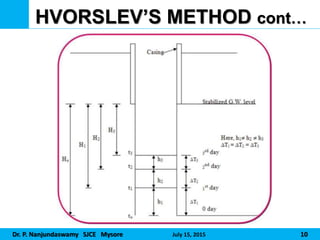
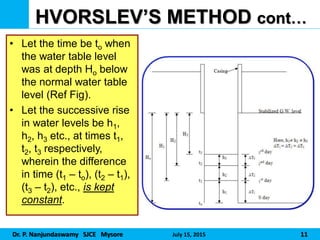
• Let the time be to when
the water table level
was at depth Ho below
the normal water table
level (Ref Fig).
• Let the successive rise
in water levels be h1,
h2, h3 etc., at times t1,
t2, t3 respectively,
wherein the difference
in time (t1 – to), (t2 – t1),
(t3 – t2), etc., is kept
constant.
Dr. P. Nanjundaswamy SJCE Mysore July 15, 2015 12
HVORSLEV’S METHOD cont…
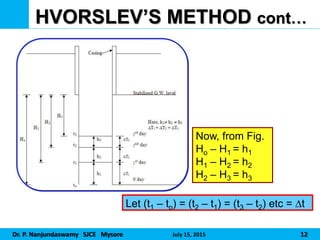
Let (t1 – to) = (t2 – t1) = (t3 – t2) etc = t
Now, from Fig.
Ho – H1 = h1
H1 – H2 = h2
H2 – H3 = h3
Dr. P. Nanjundaswamy SJCE Mysore July 15, 2015 13
HVORSLEV’S METHOD cont…
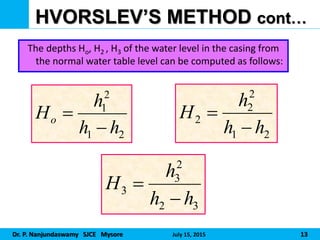
2
1
2
1
h
h
h
Ho


2
1
2
2
2
h
h
h
H


3
2
2
3
3
h
h
h
H


The depths Ho, H2 , H3 of the water level in the casing from
the normal water table level can be computed as follows:
Dr. P. Nanjundaswamy SJCE Mysore July 15, 2015 14
HVORSLEV’S METHOD cont…
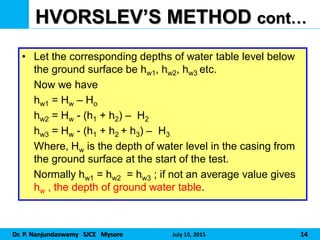
• Let the corresponding depths of water table level below
the ground surface be hw1, hw2, hw3 etc.
Now we have
hw1 = Hw – Ho
hw2 = Hw - (h1 + h2) – H2
hw3 = Hw - (h1 + h2 + h3) – H3
Where, Hw is the depth of water level in the casing from
the ground surface at the start of the test.
Normally hw1 = hw2 = hw3 ; if not an average value gives
hw , the depth of ground water table.
Dr. P. Nanjundaswamy SJCE Mysore July 15, 2015 15
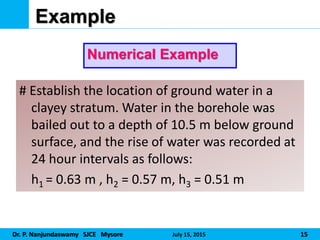
Example
Numerical Example
# Establish the location of ground water in a
clayey stratum. Water in the borehole was
bailed out to a depth of 10.5 m below ground
surface, and the rise of water was recorded at
24 hour intervals as follows:
h1 = 0.63 m , h2 = 0.57 m, h3 = 0.51 m
Dr. P. Nanjundaswamy SJCE Mysore July 15, 2015 16
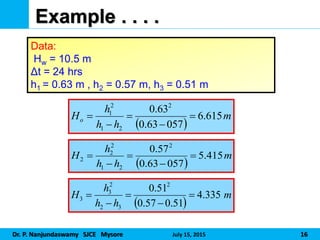
Example . . . .
 
m
h
h
h
Ho 615
.
6
057
63
.
0
63
.
0 2
2
1
2
1





 
m
h
h
h
H 415
.
5
057
63
.
0
57
.
0 2
2
1
2
2
2 




 
m
h
h
h
H 335
.
4
51
.
0
57
.
0
51
.
0 2
3
2
2
3
3 




Data:
Hw = 10.5 m
Δt = 24 hrs
h1 = 0.63 m , h2 = 0.57 m, h3 = 0.51 m
Dr. P. Nanjundaswamy SJCE Mysore July 15, 2015 17
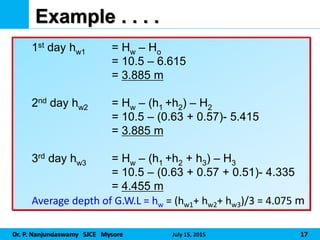
Example . . . .
1st day hw1 = Hw – Ho
= 10.5 – 6.615
= 3.885 m
2nd day hw2 = Hw – (h1 +h2) – H2
= 10.5 – (0.63 + 0.57)- 5.415
= 3.885 m
3rd day hw3 = Hw – (h1 +h2 + h3) – H3
= 10.5 – (0.63 + 0.57 + 0.51)- 4.335
= 4.455 m
Average depth of G.W.L = hw = (hw1+ hw2+ hw3)/3 = 4.075 m
Dr. P. Nanjundaswamy SJCE Mysore July 15, 2015 18
CONTROL OF GROUND WATER
Dr. P. Nanjundaswamy SJCE Mysore July 15, 2015 19
Purpose
• The purpose is to control the surface and subsurface
hydrologic environment in such a way as to permit the
structure to be constructed “in the dry.”
• Dewatering means “the separation of water from the
soil,” or perhaps “taking the water out of the particular
construction problem completely.”
• This leads to concepts like pre-drainage of soil, control
of ground water, and even the improvement of physical
properties of soil.
Dr. P. Nanjundaswamy SJCE Mysore July 15, 2015 20
Purpose
During construction stage
 Provide a dry excavation and permit construction to proceed
efficiently
 Reduce lateral loads on sheeting and bracing in excavations
 Stabilize “quick” bottom conditions and prevent heaving and
piping
 Improve supporting characteristics of foundation materials
 Increase stability of excavation slopes and side-hill fills
 Cut off capillary rise and prevent piping and frost heaving in
pavements
 Reduce air pressure in tunneling operations
Dr. P. Nanjundaswamy SJCE Mysore July 15, 2015 21
Purpose
Post construction stage
 Reduce or eliminate uplift pressures on bottom slabs and
permit economics from the reduction of slab thicknesses fro
basements, buried structures, canal linings, spillways, dry
docks, etc.,
 Provide for dry basements
 Reduce lateral pressures on retaining structures
 Control embankment seepage in all dams
 Control seepage and pore pressures beneath pavements,
side-hill fills, and cut slopes.
Dr. P. Nanjundaswamy SJCE Mysore July 15, 2015 22
Dr. P. Nanjundaswamy SJCE Mysore July 15, 2015 23
Methods
 Exclusion Techniques
 Dewatering Techniques
Dr. P. Nanjundaswamy SJCE Mysore July 15, 2015 24
Methods . . . .
 Exclusion Techniques
Methods in which a very low-permeability discrete wall
or barrier is physically inserted or constructed in the
ground (sheet-piling and diaphragm walls)
Methods which reduce the permeability of the in situ
ground (grouting methods and artificial ground-freezing)
Methods which use a fluid pressure in confined
chambers such as tunnels to counterbalance
groundwater pressures (compressed air and earth
pressure balance tunnel-boring machines)
Dr. P. Nanjundaswamy SJCE Mysore July 15, 2015 25
Methods . . . .
 Dewatering Techniques
There are several methods commonly
used to drain or dewater a construction
site:
Gravity flow
 Pumping and Vacuum
 Electro-Osmosis.
Dr. P. Nanjundaswamy SJCE Mysore July 15, 2015 26
Methods
Exclusion Techniques
Dr. P. Nanjundaswamy SJCE Mysore July 15, 2015 27
Exclusion Techniques
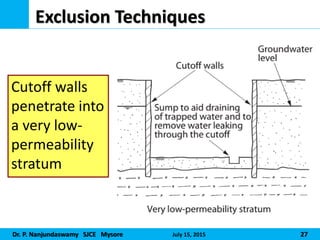
Cutoff walls
penetrate into
a very low-
permeability
stratum
Dr. P. Nanjundaswamy SJCE Mysore July 15, 2015 28
Exclusion Techniques . . . .
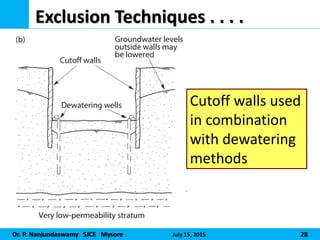
Cutoff walls used
in combination
with dewatering
methods
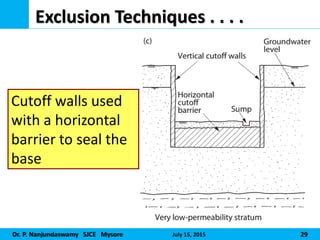
Dr. P. Nanjundaswamy SJCE Mysore July 15, 2015 29
Exclusion Techniques . . . .
Cutoff walls used
with a horizontal
barrier to seal the
base
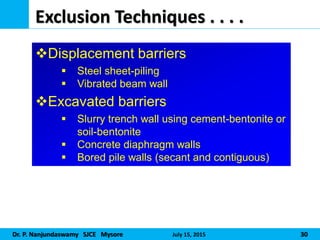
Dr. P. Nanjundaswamy SJCE Mysore July 15, 2015 30
Exclusion Techniques . . . .
Displacement barriers
 Steel sheet-piling
 Vibrated beam wall
Excavated barriers
 Slurry trench wall using cement-bentonite or
soil-bentonite
 Concrete diaphragm walls
 Bored pile walls (secant and contiguous)
Dr. P. Nanjundaswamy SJCE Mysore July 15, 2015 31
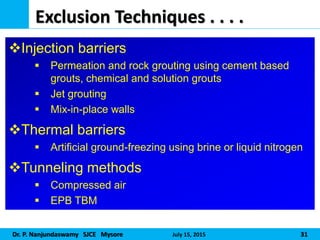
Exclusion Techniques . . . .
Injection barriers
 Permeation and rock grouting using cement based
grouts, chemical and solution grouts
 Jet grouting
 Mix-in-place walls
Thermal barriers
 Artificial ground-freezing using brine or liquid nitrogen
Tunneling methods
 Compressed air
 EPB TBM
Dr. P. Nanjundaswamy SJCE Mysore July 15, 2015 32
Methods
Dewatering Techniques
Dr. P. Nanjundaswamy SJCE Mysore July 15, 2015 33
Dewatering
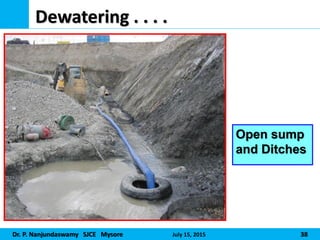
 This is the less costly method.
 The site is drained through channels placed at
intervals, that permit the water to flow away from the
high points.
 This method has been used for thousands of years.
 It has the disadvantage of requiring a long time to
properly drain the land.
Gravity Flow Method
Through Channels and ditches
Dr. P. Nanjundaswamy SJCE Mysore July 15, 2015 34
Dewatering . . . .
 This method is more expensive than gravity, but is
faster in results.
 It requires pumps that suck the water out of the
soil and remove it to a distant place or river or
lake.
Pumping and Vacuum Method
Through Open sumps and Ditches, Well points system and Vacuum
Dr. P. Nanjundaswamy SJCE Mysore July 15, 2015 35
Dewatering . . . .
 This method is most expensive
 It is only effective method of
dewatering in deep clay soils.
Electro-Osmosis
Through use of Cathodes and Anodes with passage of Electrical current
Dr. P. Nanjundaswamy SJCE Mysore July 15, 2015 36
Dewatering . . . .
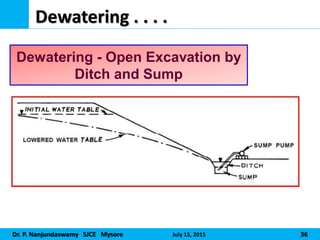
Dewatering - Open Excavation by
Ditch and Sump
Dr. P. Nanjundaswamy SJCE Mysore July 15, 2015 37
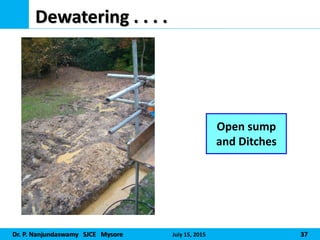
Dewatering . . . .
Open sump
and Ditches
Dr. P. Nanjundaswamy SJCE Mysore July 15, 2015 38
Dewatering . . . .
Open sump
and Ditches
Dr. P. Nanjundaswamy SJCE Mysore July 15, 2015 39
Dewatering . . . .
CASE STUDY-1
No. 65, PUTANNA ROAD, GANDHIBAZAAR, BANGALORE
Dr. P. Nanjundaswamy SJCE Mysore July 15, 2015 40
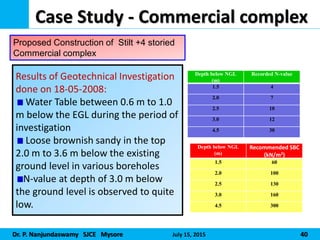
Case Study - Commercial complex
Results of Geotechnical Investigation
done on 18-05-2008:
Water Table between 0.6 m to 1.0
m below the EGL during the period of
investigation
Loose brownish sandy in the top
2.0 m to 3.6 m below the existing
ground level in various boreholes
N-value at depth of 3.0 m below
the ground level is observed to quite
low.
Proposed Construction of Stilt +4 storied
Commercial complex
Depth below NGL
(m)
Recorded N-value
1.5 4
2.0 7
2.5 10
3.0 12
4.5 30
Depth below NGL
(m)
Recommended SBC
(kN/m2)
1.5 60
2.0 100
2.5 130
3.0 160
4.5 300
Dr. P. Nanjundaswamy SJCE Mysore July 15, 2015 41
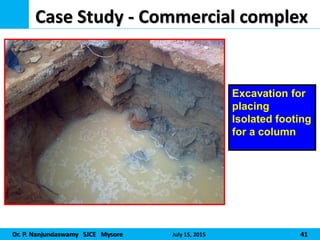
Case Study - Commercial complex
Excavation for
placing
Isolated footing
for a column
Dr. P. Nanjundaswamy SJCE Mysore July 15, 2015 42
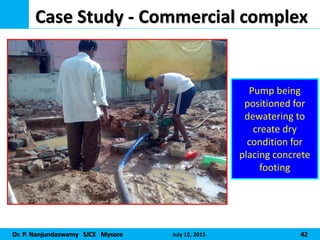
Case Study - Commercial complex
Pump being
positioned for
dewatering to
create dry
condition for
placing concrete
footing
Dr. P. Nanjundaswamy SJCE Mysore July 15, 2015 43
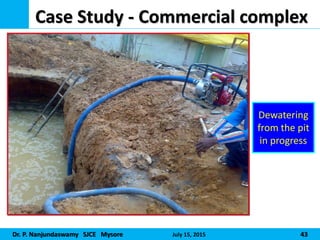
Case Study - Commercial complex
Dewatering
from the pit
in progress
Dr. P. Nanjundaswamy SJCE Mysore July 15, 2015 44
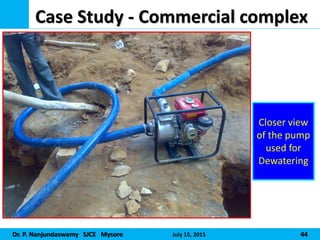
Case Study - Commercial complex
Closer view
of the pump
used for
Dewatering
Dr. P. Nanjundaswamy SJCE Mysore July 15, 2015 45
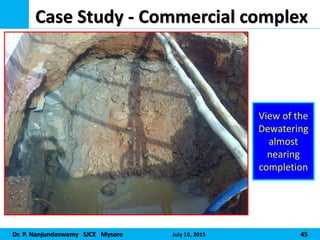
Case Study - Commercial complex
View of the
Dewatering
almost
nearing
completion
Dr. P. Nanjundaswamy SJCE Mysore July 15, 2015 46
Case Study - Commercial complex
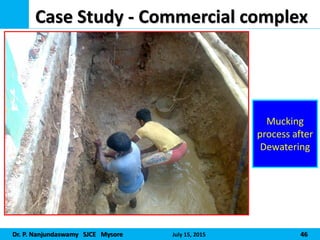
Mucking
process after
Dewatering
Dr. P. Nanjundaswamy SJCE Mysore July 15, 2015 47
Case Study - Commercial complex
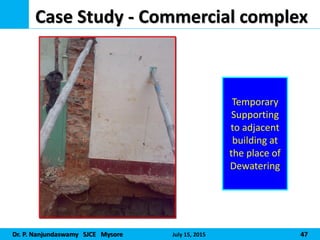
Temporary
Supporting
to adjacent
building at
the place of
Dewatering
Dr. P. Nanjundaswamy SJCE Mysore July 15, 2015 48
Case Study - Commercial complex
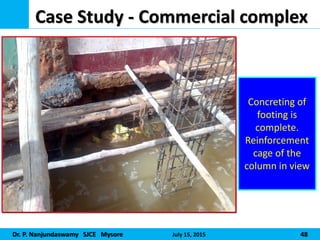
Concreting of
footing is
complete.
Reinforcement
cage of the
column in view
Dr. P. Nanjundaswamy SJCE Mysore July 15, 2015 49
Case Study - Commercial complex
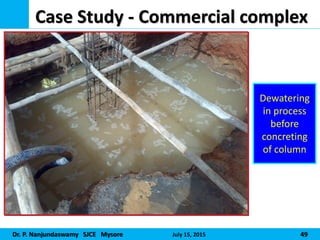
Dewatering
in process
before
concreting
of column
Dr. P. Nanjundaswamy SJCE Mysore July 15, 2015 50
Case Study - Commercial complex
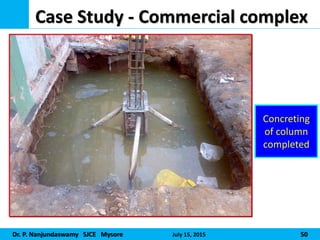
Concreting
of column
completed
Dr. P. Nanjundaswamy SJCE Mysore July 15, 2015 51
Case Study - Commercial complex
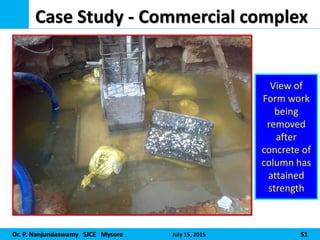
View of
Form work
being
removed
after
concrete of
column has
attained
strength
Dr. P. Nanjundaswamy SJCE Mysore July 15, 2015 52
Case Study - Commercial complex
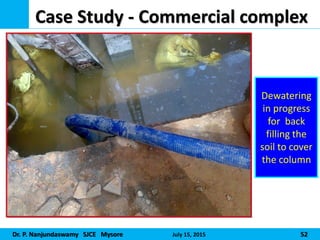
Dewatering
in progress
for back
filling the
soil to cover
the column
Dr. P. Nanjundaswamy SJCE Mysore July 15, 2015 53
Case Study - Commercial complex
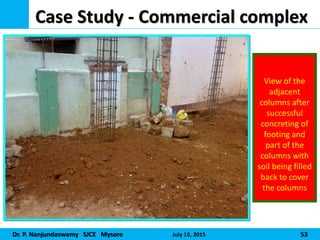
View of the
adjacent
columns after
successful
concreting of
footing and
part of the
columns with
soil being filled
back to cover
the columns
Dr. P. Nanjundaswamy SJCE Mysore July 15, 2015 54
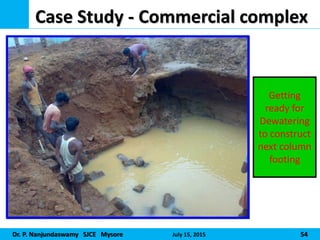
Case Study - Commercial complex
Getting
ready for
Dewatering
to construct
next column
footing
Dr. P. Nanjundaswamy SJCE Mysore July 15, 2015 55
CASE STUDY-2
LIC OF INDIA, JEEVAN BHEEMA NAGAR,
BANGALORE
Dr. P. Nanjundaswamy SJCE Mysore July 15, 2015 56
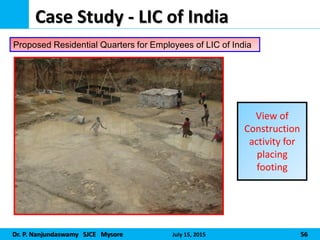
Case Study - LIC of India
View of
Construction
activity for
placing
footing
Proposed Residential Quarters for Employees of LIC of India
Dr. P. Nanjundaswamy SJCE Mysore July 15, 2015 57
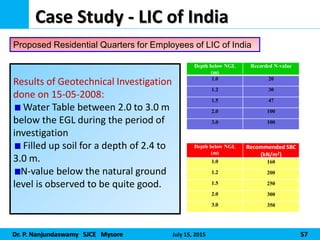
Case Study - LIC of India
Results of Geotechnical Investigation
done on 15-05-2008:
Water Table between 2.0 to 3.0 m
below the EGL during the period of
investigation
Filled up soil for a depth of 2.4 to
3.0 m.
N-value below the natural ground
level is observed to be quite good.
Proposed Residential Quarters for Employees of LIC of India
Depth below NGL
(m)
Recorded N-value
1.0 20
1.2 30
1.5 47
2.0 100
3.0 100
Depth below NGL
(m)
Recommended SBC
(kN/m2)
1.0 160
1.2 200
1.5 250
2.0 300
3.0 350
Dr. P. Nanjundaswamy SJCE Mysore July 15, 2015 58
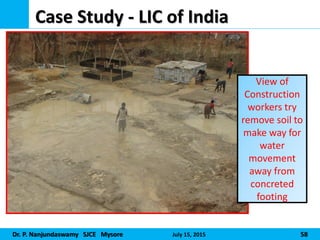
Case Study - LIC of India
View of
Construction
workers try
remove soil to
make way for
water
movement
away from
concreted
footing
Dr. P. Nanjundaswamy SJCE Mysore July 15, 2015 59
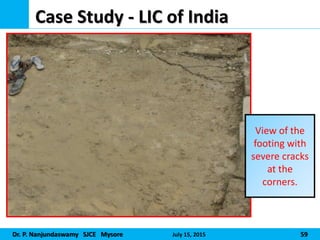
Case Study - LIC of India
View of the
footing with
severe cracks
at the
corners.
Dr. P. Nanjundaswamy SJCE Mysore July 15, 2015 60
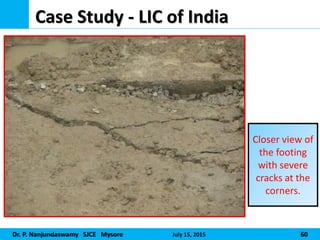
Case Study - LIC of India
Closer view of
the footing
with severe
cracks at the
corners.
Dr. P. Nanjundaswamy SJCE Mysore July 15, 2015 61
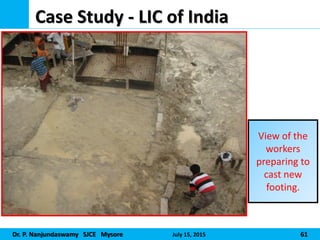
Case Study - LIC of India
View of the
workers
preparing to
cast new
footing.
Dr. P. Nanjundaswamy SJCE Mysore July 15, 2015 62
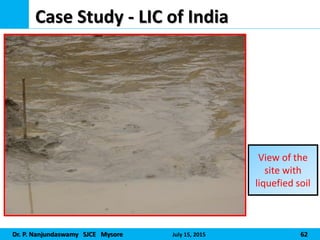
Case Study - LIC of India
View of the
site with
liquefied soil
Dr. P. Nanjundaswamy SJCE Mysore July 15, 2015 63
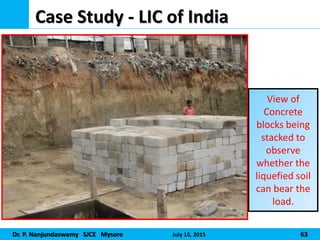
Case Study - LIC of India
View of
Concrete
blocks being
stacked to
observe
whether the
liquefied soil
can bear the
load.
Dr. P. Nanjundaswamy SJCE Mysore July 15, 2015 64
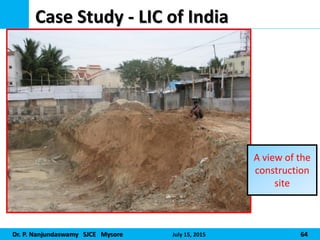
Case Study - LIC of India
A view of the
construction
site
Dr. P. Nanjundaswamy SJCE Mysore July 15, 2015 65
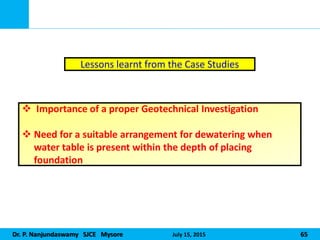
Lessons learnt from the Case Studies
 Importance of a proper Geotechnical Investigation
 Need for a suitable arrangement for dewatering when
water table is present within the depth of placing
foundation
Dr. P. Nanjundaswamy SJCE Mysore July 15, 2015 66
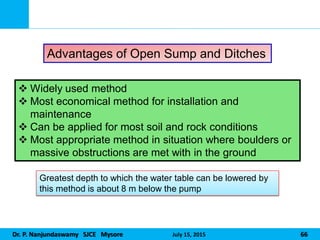
Advantages of Open Sump and Ditches
 Widely used method
 Most economical method for installation and
maintenance
 Can be applied for most soil and rock conditions
 Most appropriate method in situation where boulders or
massive obstructions are met with in the ground
Greatest depth to which the water table can be lowered by
this method is about 8 m below the pump
Dr. P. Nanjundaswamy SJCE Mysore July 15, 2015 67
Disadvantages of Open Sump and Ditches
 Ground water flows towards the excavation with high
head or a steep slope and hence there is a risk of
collapse of sides.
 In open or timbered excavations there is risk of
instability of the base due to upward seepage towards
pumping sump.
Dr. P. Nanjundaswamy SJCE Mysore July 15, 2015 68
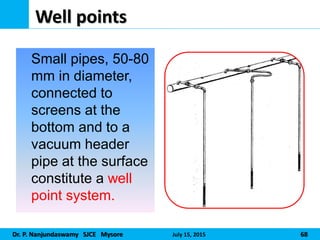
Well points
Small pipes, 50-80
mm in diameter,
connected to
screens at the
bottom and to a
vacuum header
pipe at the surface
constitute a well
point system.
Dr. P. Nanjundaswamy SJCE Mysore July 15, 2015 69
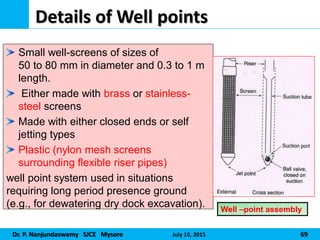
Details of Well points
Small well-screens of sizes of
50 to 80 mm in diameter and 0.3 to 1 m
length.
Either made with brass or stainless-
steel screens
Made with either closed ends or self
jetting types
Plastic (nylon mesh screens
surrounding flexible riser pipes)
well point system used in situations
requiring long period presence ground
(e.g., for dewatering dry dock excavation). Well –point assembly
Dr. P. Nanjundaswamy SJCE Mysore July 15, 2015 70
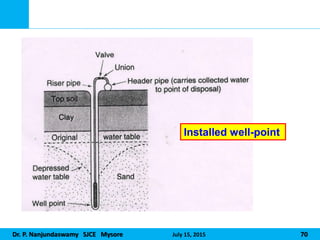
Installed well-point
Dr. P. Nanjundaswamy SJCE Mysore July 15, 2015 71
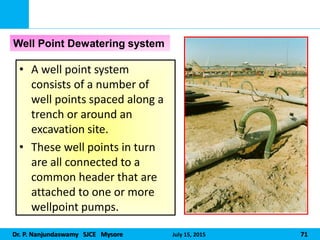
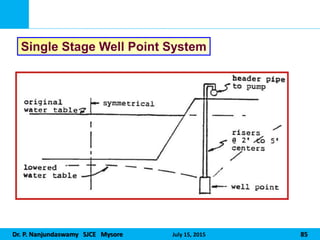
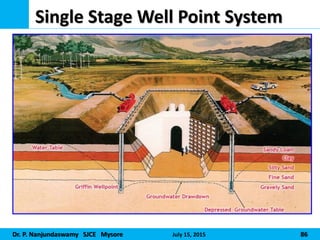
• A well point system
consists of a number of
well points spaced along a
trench or around an
excavation site.
• These well points in turn
are all connected to a
common header that are
attached to one or more
wellpoint pumps.
Well Point Dewatering system
Dr. P. Nanjundaswamy SJCE Mysore July 15, 2015 72
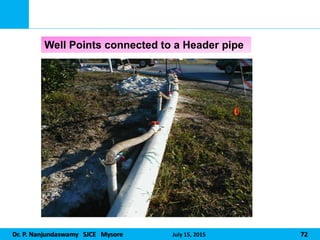
Well Points connected to a Header pipe
Dr. P. Nanjundaswamy SJCE Mysore July 15, 2015 73
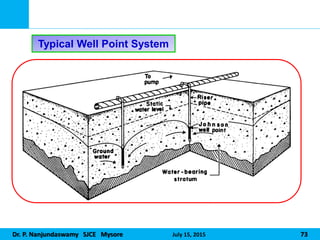
Typical Well Point System
Dr. P. Nanjundaswamy SJCE Mysore July 15, 2015 74
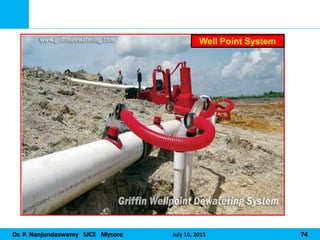
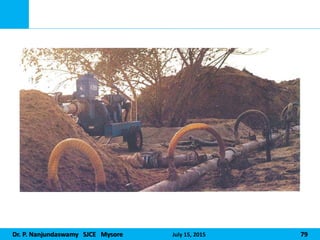
Well Point System
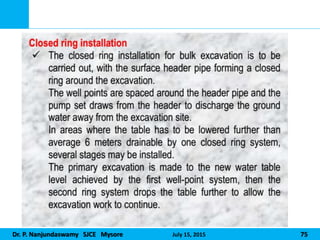
Dr. P. Nanjundaswamy SJCE Mysore July 15, 2015 75
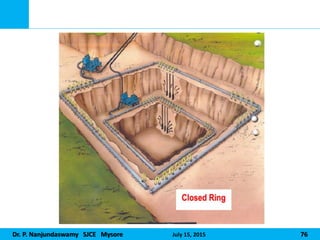
Dr. P. Nanjundaswamy SJCE Mysore July 15, 2015 76
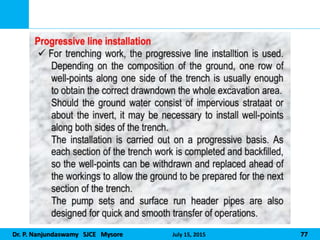
Dr. P. Nanjundaswamy SJCE Mysore July 15, 2015 77
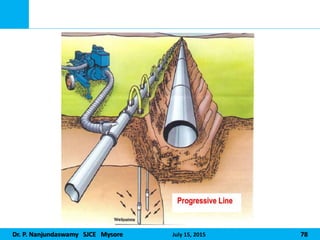
Dr. P. Nanjundaswamy SJCE Mysore July 15, 2015 78
Dr. P. Nanjundaswamy SJCE Mysore July 15, 2015 79
Dr. P. Nanjundaswamy SJCE Mysore July 15, 2015 80
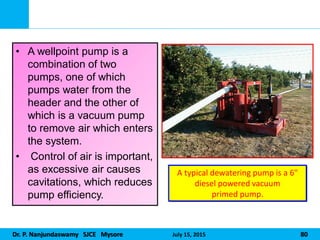
• A wellpoint pump is a
combination of two
pumps, one of which
pumps water from the
header and the other of
which is a vacuum pump
to remove air which enters
the system.
• Control of air is important,
as excessive air causes
cavitations, which reduces
pump efficiency.
A typical dewatering pump is a 6"
diesel powered vacuum
primed pump.
Dr. P. Nanjundaswamy SJCE Mysore July 15, 2015 81
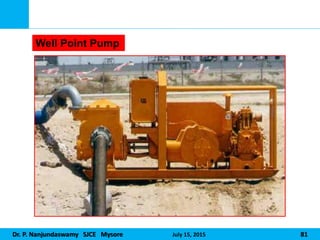
Well Point Pump
Dr. P. Nanjundaswamy SJCE Mysore July 15, 2015 82
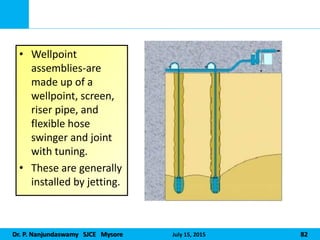
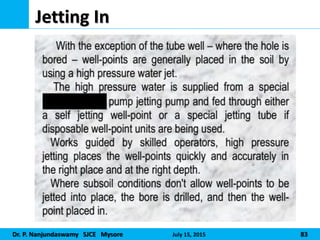
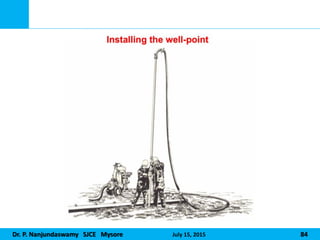
• Wellpoint
assemblies-are
made up of a
wellpoint, screen,
riser pipe, and
flexible hose
swinger and joint
with tuning.
• These are generally
installed by jetting.
Dr. P. Nanjundaswamy SJCE Mysore July 15, 2015 83
Jetting In
Dr. P. Nanjundaswamy SJCE Mysore July 15, 2015 84
Dr. P. Nanjundaswamy SJCE Mysore July 15, 2015 85
Single Stage Well Point System
Dr. P. Nanjundaswamy SJCE Mysore July 15, 2015 86
Single Stage Well Point System
Dr. P. Nanjundaswamy SJCE Mysore July 15, 2015 87
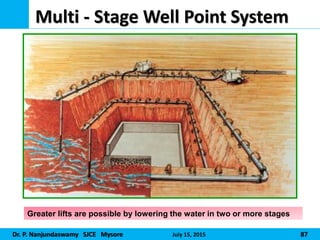
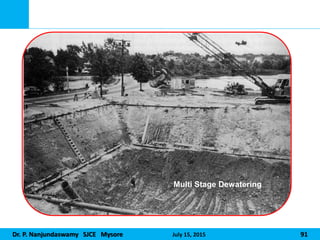
Multi - Stage Well Point System
Greater lifts are possible by lowering the water in two or more stages
Dr. P. Nanjundaswamy SJCE Mysore July 15, 2015 88
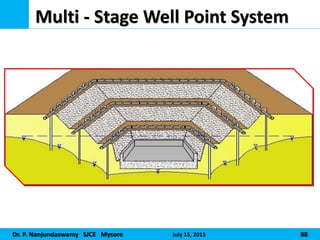
Multi - Stage Well Point System
Dr. P. Nanjundaswamy SJCE Mysore July 15, 2015 89
• Well point systems are frequently the most logical
and economical choice for dewatering construction
sites where the required lowering of ground water
level is approximately 6 m (20 feet)or less. However,
greater lifts are possible by lowering the water in two
or more stages.
• The 20-foot lift restriction results from the fact that
the water is lifted by difference between ambient air
pressure and the lowered pressure created by the
pump.
Dr. P. Nanjundaswamy SJCE Mysore July 15, 2015 90
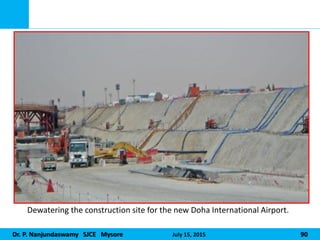
Dewatering the construction site for the new Doha International Airport.
Dr. P. Nanjundaswamy SJCE Mysore July 15, 2015 91
Multi Stage Dewatering
Dr. P. Nanjundaswamy SJCE Mysore July 15, 2015 92
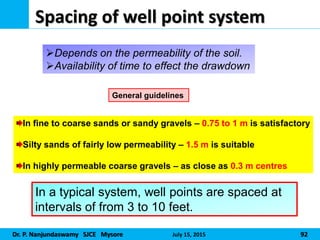
Spacing of well point system
General guidelines
Depends on the permeability of the soil.
Availability of time to effect the drawdown
In fine to coarse sands or sandy gravels – 0.75 to 1 m is satisfactory
Silty sands of fairly low permeability – 1.5 m is suitable
In highly permeable coarse gravels – as close as 0.3 m centres
In a typical system, well points are spaced at
intervals of from 3 to 10 feet.
Dr. P. Nanjundaswamy SJCE Mysore July 15, 2015 93
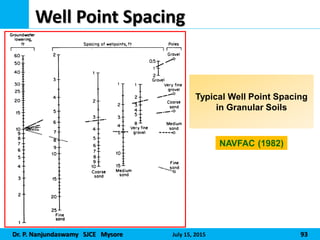
Well Point Spacing
Typical Well Point Spacing
in Granular Soils
NAVFAC (1982)
Dr. P. Nanjundaswamy SJCE Mysore July 15, 2015 94
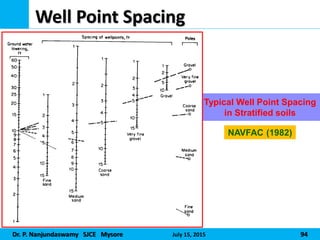
Well Point Spacing
Typical Well Point Spacing
in Stratified soils
NAVFAC (1982)
Dr. P. Nanjundaswamy SJCE Mysore July 15, 2015 95
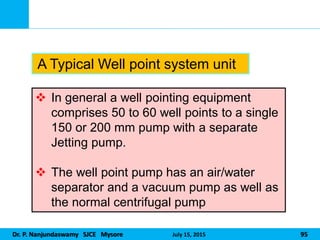
 In general a well pointing equipment
comprises 50 to 60 well points to a single
150 or 200 mm pump with a separate
Jetting pump.
 The well point pump has an air/water
separator and a vacuum pump as well as
the normal centrifugal pump
A Typical Well point system unit
Dr. P. Nanjundaswamy SJCE Mysore July 15, 2015 96
Suitability of well point system
Practical and effective under most soil and
hydrological conditions.
Suitable in shallow aquifers where the water
level needs to be lowered no more than 15 or
20 feet.
Site is accessible
Most effective in sands and sandy gravels of
moderate permeability
Dr. P. Nanjundaswamy SJCE Mysore July 15, 2015 97
Situations where other systems of dewatering of
are preferred to Well point system
where water levels must be lowered greater
distance than can be practically handled by the
well point systems
 where greater quantities of water must be moved
than is practical with well points
where the close spacing of well points and the
existence of the above-ground header might
physically interfere with construction operations.
Dr. P. Nanjundaswamy SJCE Mysore July 15, 2015 98
Capacity of well point system
 Depending on their
diameter and other
physical
characteristics, each
well point can draw
from 0.1 to 25 gallons
and more per minute
 total systems can
have capacities
exceeding 20 000
gallons per minute.
General Typical
The capacity of a
single well point with
a 50 mm riser is
about 10 litres/min
Gallon is a measure of capacity equal
to eight pints and equivalent to 4.55
litres (British); equivalent to 3.79 litres
(U.S); used for liquids.
Dr. P. Nanjundaswamy SJCE Mysore July 15, 2015 99
The physical layout
Adjacent areas
Soil conditions
Permeability of the soil
The amount of water to be pumped
Depth to imperviousness
Stratification
Design considerations of well-point system
When designing a well point system, it is necessary
to give first consideration to the physical conditions
of the site to be dewatered
Dr. P. Nanjundaswamy SJCE Mysore July 15, 2015 100
Advantages of well point system
Installation is very rapid
Requires reasonably simple and less costly
equipment
Water is filtered and carries little or no soil particles.
There is less danger of subsidence of the
surrounding ground than with open-sump pumping
Dr. P. Nanjundaswamy SJCE Mysore July 15, 2015 101
Limitations of well point system
A lowering of about 6 m (20 ft) below pump level
is generally possible beyond which excessive air
shall be drawn into the system through the joints in
the pipes, valves, etc., resulting in the loss of
pumping efficiency
If the ground is consisting mainly of large gravel,
stiff clay or soil containing cobbles or boulders it is
not possible to install well points.
Dr. P. Nanjundaswamy SJCE Mysore July 15, 2015 102
DEEP-WELL DEWATERING
Dr. P. Nanjundaswamy SJCE Mysore July 15, 2015 103
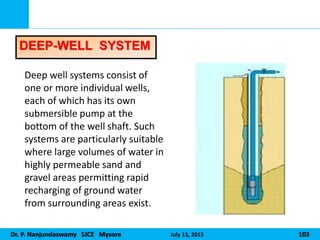
Deep well systems consist of
one or more individual wells,
each of which has its own
submersible pump at the
bottom of the well shaft. Such
systems are particularly suitable
where large volumes of water in
highly permeable sand and
gravel areas permitting rapid
recharging of ground water
from surrounding areas exist.
DEEP-WELL SYSTEM
Dr. P. Nanjundaswamy SJCE Mysore July 15, 2015 104
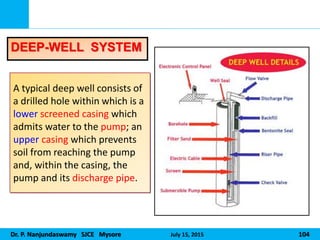
A typical deep well consists of
a drilled hole within which is a
lower screened casing which
admits water to the pump; an
upper casing which prevents
soil from reaching the pump
and, within the casing, the
pump and its discharge pipe.
DEEP-WELL SYSTEM
Dr. P. Nanjundaswamy SJCE Mysore July 15, 2015 105
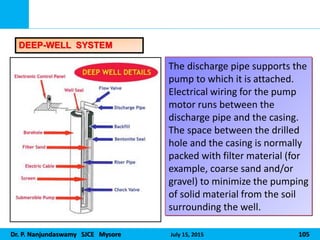
The discharge pipe supports the
pump to which it is attached.
Electrical wiring for the pump
motor runs between the
discharge pipe and the casing.
The space between the drilled
hole and the casing is normally
packed with filter material (for
example, coarse sand and/or
gravel) to minimize the pumping
of solid material from the soil
surrounding the well.
DEEP-WELL SYSTEM
Dr. P. Nanjundaswamy SJCE Mysore July 15, 2015 106
Normally, individual wells are spaced at an
approximate distance of 50 feet apart.
However, depending upon soil conditions and the
dewatering plan the spacing may need to be just a
few feet apart.
Spacing of Deep well point system
Dr. P. Nanjundaswamy SJCE Mysore July 15, 2015 107
Individual well capacities are from 21 to 3 000 gallons per
minute and with total systems the capacities can be as high as
60 000 gallons per minute.
Deep well pumps can lift water 100 feet or more in a single
stage and the variation of the typical deep well system is a
pressure within an aquifer.
Deep well points require no pump as the water is forced to
the surface by its own pressure. To boost the water flow a
vacuum pump is frequently used.
Dewatering Capacity of Deep-well System
Dr. P. Nanjundaswamy SJCE Mysore July 15, 2015 108
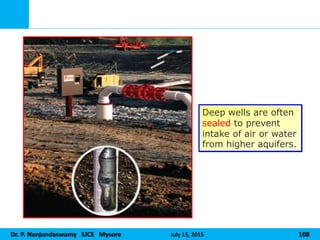
Deep wells are often
sealed to prevent
intake of air or water
from higher aquifers.
Dr. P. Nanjundaswamy SJCE Mysore July 15, 2015 109
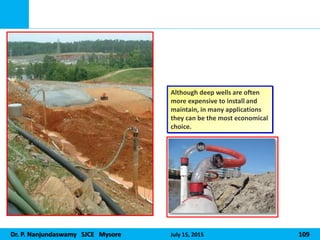
Although deep wells are often
more expensive to install and
maintain, in many applications
they can be the most economical
choice.
Dr. P. Nanjundaswamy SJCE Mysore July 15, 2015 110
Design considerations of Deep well-point system
The soil investigation report
The grain size analysis and permeability tests
The hydrology of the area
 The topography
 The space limitations of the site and surrounding
structure.
 The projected method of excavation and shoring
if any
 The construction schedule
Dr. P. Nanjundaswamy SJCE Mysore July 15, 2015 111
VACUUM DEWATERING
OR
EJECTOR/EDUCTOR
DEWATERING SYSTEMS
Dr. P. Nanjundaswamy SJCE Mysore July 15, 2015 112
Ejector/Eductor dewatering systems are
employed to control pore pressures
To lower groundwater levels to provide
stable working conditions in excavations.
They are particularly suited to operating
in fine soil conditions.
SITUATIONS NEEDING EJECTOR/EDUCTOR
DEWATERING SYSTEMS
Dr. P. Nanjundaswamy SJCE Mysore July 15, 2015 113
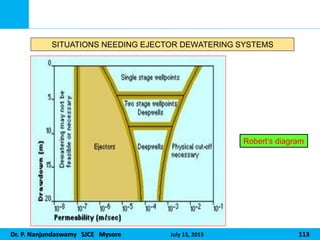
SITUATIONS NEEDING EJECTOR DEWATERING SYSTEMS
Robert’s diagram
Dr. P. Nanjundaswamy SJCE Mysore July 15, 2015 114
Eductor systems are able to extract
groundwater and generate a high vacuum at
the base of wells up to 50 m deep and of as
little as 50 mm diameter.
Vacuum drainage can provide dramatic
improvement in the stability of silty fine sands
and laminated silts and clays by the control of
excess pore pressures.
 Eductor wells have been successfully installed
in raking boreholes to dewater beneath
inaccessible areas such as railway lines and
canals.
Dr. P. Nanjundaswamy SJCE Mysore July 15, 2015 115
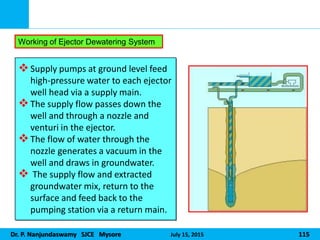
Supply pumps at ground level feed
high-pressure water to each ejector
well head via a supply main.
The supply flow passes down the
well and through a nozzle and
venturi in the ejector.
The flow of water through the
nozzle generates a vacuum in the
well and draws in groundwater.
 The supply flow and extracted
groundwater mix, return to the
surface and feed back to the
pumping station via a return main.
Working of Ejector Dewatering System
Dr. P. Nanjundaswamy SJCE Mysore July 15, 2015 116
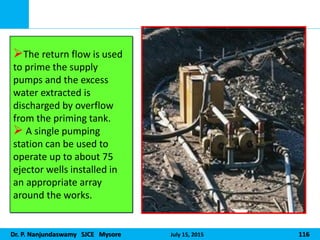
The return flow is used
to prime the supply
pumps and the excess
water extracted is
discharged by overflow
from the priming tank.
 A single pumping
station can be used to
operate up to about 75
ejector wells installed in
an appropriate array
around the works.
Dr. P. Nanjundaswamy SJCE Mysore July 15, 2015 117
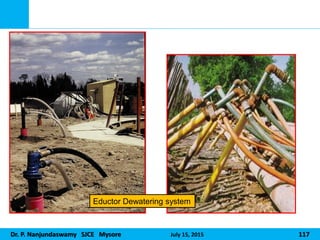
Eductor Dewatering system
Dr. P. Nanjundaswamy SJCE Mysore July 15, 2015 118
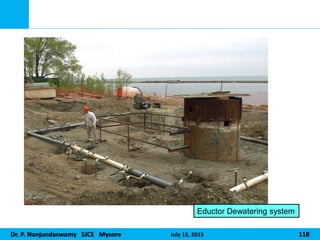
Eductor Dewatering system
Dr. P. Nanjundaswamy SJCE Mysore July 15, 2015 119
Eductor dewatering system
They are flexible in level and layout
Stable in operation
Able to run dry without damage
Not limited by depth. Also effective to greater
depths
Best in low-yielding wells
Energy intensive
Venturi in base of well creates vacuum
Dr. P. Nanjundaswamy SJCE Mysore July 15, 2015 120
Only effective method of
dewatering in deep clay soils.
Electro-Osmosis
Through use of Cathodes and Anodes with passage of Electrical current
Dr. P. Nanjundaswamy SJCE Mysore July 15, 2015 121
Electro-osmosis is the movement of water
(and whatever is contained in the water)
through a porous media by applying a
direct current (DC) field.
Definition
Dr. P. Nanjundaswamy SJCE Mysore July 15, 2015 122
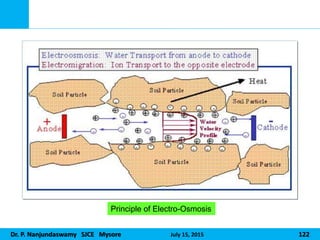
Principle of Electro-Osmosis
Dr. P. Nanjundaswamy SJCE Mysore July 15, 2015 123
When electrodes are placed across a clay mass and
a direct current is applied, water in the clay pore
space is transported to the cathodically charged
electrode by electro-osmosis.
Electro-osmotic transport of water through a clay is
a result of diffuse double layer cations in the clay
pores being attracted to a negatively charged
electrode or cathode.
As these cations move toward the cathode, they
bring with them water molecules that clump around
the cations as a consequence of their dipolar nature.
Mechanism of Electro-osmosis
Dr. P. Nanjundaswamy SJCE Mysore July 15, 2015 124
In addition, the frictional drag of these molecules as
they move through the clay pores help transport
additional water to the cathode.
The macroscopic effect is a reduction of water
content at the anode and an increase in water content
of the clay at the cathode.
 In particular, free water appears at the interface
between the clay and the cathode surface.
This excess of free water at the cathode has
lubricating effects.
Mechanism of Electro-osmosis Cont’d
Dr. P. Nanjundaswamy SJCE Mysore July 15, 2015 125
 First, electro-osmosis provides uniform pore water movement in
most types of soil. Since the boundary layer movement towards the
cathode provides the motive force for the bulk pore water, the size
of the pore is not important.
 Unlike hydraulic conductivity, electro-osmotic flow rate is NOT
sensitive to pore size. Electro-osmotic flow rate is primarily a
function of applied voltage. The electro-osmotic permeability for
any soil at 20oC is around 1 x 10⁻⁵ cm/s at 1 volt/cm.
 The entire soil mass between the electrodes is basically treated
equally.
Effectiveness of Electro-osmosis
Electro-osmosis provides two benefits when properly applied
This is why electro-osmosis is so effective in clayey and heterogeneous soils.
Dr. P. Nanjundaswamy SJCE Mysore July 15, 2015 126
Some Applications and Precautions in
Construction Dewatering and its control

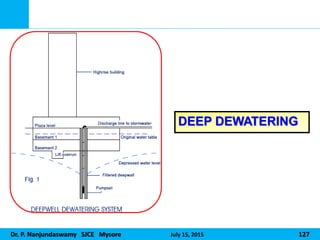
Dr. P. Nanjundaswamy SJCE Mysore July 15, 2015 127
DEEP DEWATERING
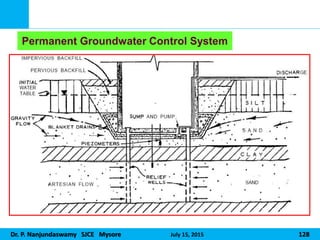
Dr. P. Nanjundaswamy SJCE Mysore July 15, 2015 128
Permanent Groundwater Control System
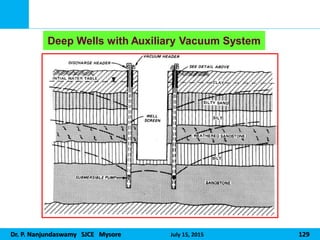
Dr. P. Nanjundaswamy SJCE Mysore July 15, 2015 129
Deep Wells with Auxiliary Vacuum System
Dr. P. Nanjundaswamy SJCE Mysore July 15, 2015 130
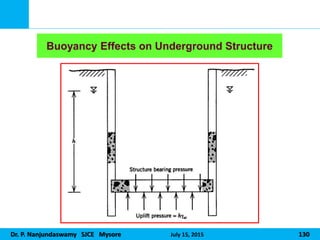
Buoyancy Effects on Underground Structure
Dr. P. Nanjundaswamy SJCE Mysore July 15, 2015 131
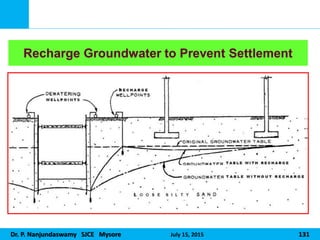
Recharge Groundwater to Prevent Settlement
Dr. P. Nanjundaswamy SJCE Mysore July 15, 2015 132
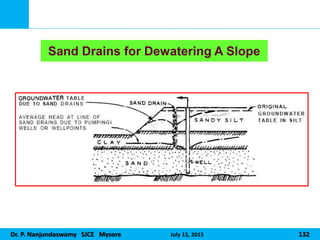
Sand Drains for Dewatering A Slope
Dr. P. Nanjundaswamy SJCE Mysore July 15, 2015 133
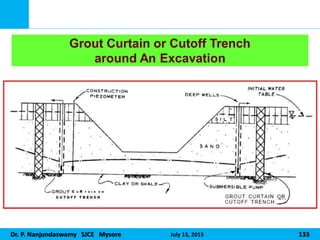
Grout Curtain or Cutoff Trench
around An Excavation
Dr. P. Nanjundaswamy SJCE Mysore July 15, 2015 134
Video
Dr. P. Nanjundaswamy SJCE Mysore July 15, 2015 135
Thank you

Construction-Dewatering Techniques and Methods

  • 1.
    Construction Dewatering Dr. P.NANJUNDASWAMY Professor of Civil Engineering S J College of Engineering Mysuru – 570 006 Contact : 94492 64365 pnswamy@yahoo.com
  • 2.
    Dr. P. NanjundaswamySJCE Mysore July 15, 2015 2 Outline Consequences-Improper Dewatering Dewatering – What & Why Methods of Ground water Control Design Considerations
  • 3.
    Dr. P. NanjundaswamySJCE Mysore July 15, 2015 3 What is Water Table?  Most people know that the "water table" has something to do with ground water  The word table provides an image of a flat surface, like a tabletop, and it is commonly assumed that when a well is drilled it strikes water once it reaches below the water table © American Ground Water Trust
  • 4.
    Dr. P. NanjundaswamySJCE Mysore July 15, 2015 4 What is Water Table? © American Ground Water Trust  Ground water is sub-surface water, but not all sub-surface water is ground water.  The upper surface of ground water is the water table. Below this surface, all the pore spaces and cracks in sediments and rocks are completely filled (saturated) with water. These saturated layers, known as the saturated zone (or the phreatic zone), are where ground water occurs. Strictly speaking only water found in the saturated zone is ground water.
  • 5.
    Dr. P. NanjundaswamySJCE Mysore July 15, 2015 5 WATER TABLE LOCATION
  • 6.
    Dr. P. NanjundaswamySJCE Mysore July 15, 2015 6 HVORSLEV’S METHOD DETERMINATION OF GROUND WATER LEVEL BY HVORSLEV’S METHOD • Borehole observation is the simplest technique. • Boreholes drilled during a subsurface investigation can be kept open for 24 hours. • The level of water is normally determined by lowering a tape with a float or by an electrical switching device, which is, actuated on contact with water.
  • 7.
    Dr. P. NanjundaswamySJCE Mysore July 15, 2015 7 HVORSLEV’S METHOD cont… • In a cohesive soil stratum, the stabilization of water table may take time. • In such situations, the location may be ascertained by adopting the extrapolation method. • In this case, a plot of water level versus time is made and the groundwater level is estimated by extrapolating the curve until it becomes parallel to the time axis. If several levels are noted at equal time intervals the following computational method is used.
  • 8.
    Dr. P. NanjundaswamySJCE Mysore July 15, 2015 8 HVORSLEV’S METHOD cont… Rising water level method-by Hvorslev • This method is also referred to as the time lag method or computational method. • It consists of bailing the water out of the casing and then observing the rate of rise of water level in the casing at intervals of time until the rise in water level becomes negligible. • The rate is observed by measuring the elapsed time and the depth of the water surface below the top of the casing.
  • 9.
    Dr. P. NanjundaswamySJCE Mysore July 15, 2015 9 HVORSLEV’S METHOD cont… • The intervals at which the readings are required will vary somewhat with the permeability of the soil. • In no case should the elapsed time for the readings be less than 5 minutes. • In freely draining materials such as sands, gravels etc., the interval of time between successive readings may not exceed 1 to 2 hours. • But in soils of low permeability such as fine sand, silts and clays, the intervals may rise from 12 to 24 hours, and it may take a few days to determine the stabilized water level.
  • 10.
    Dr. P. NanjundaswamySJCE Mysore July 15, 2015 10 HVORSLEV’S METHOD cont…
  • 11.
    Dr. P. NanjundaswamySJCE Mysore July 15, 2015 11 HVORSLEV’S METHOD cont… • Let the time be to when the water table level was at depth Ho below the normal water table level (Ref Fig). • Let the successive rise in water levels be h1, h2, h3 etc., at times t1, t2, t3 respectively, wherein the difference in time (t1 – to), (t2 – t1), (t3 – t2), etc., is kept constant.
  • 12.
    Dr. P. NanjundaswamySJCE Mysore July 15, 2015 12 HVORSLEV’S METHOD cont… Let (t1 – to) = (t2 – t1) = (t3 – t2) etc = t Now, from Fig. Ho – H1 = h1 H1 – H2 = h2 H2 – H3 = h3
  • 13.
    Dr. P. NanjundaswamySJCE Mysore July 15, 2015 13 HVORSLEV’S METHOD cont… 2 1 2 1 h h h Ho   2 1 2 2 2 h h h H   3 2 2 3 3 h h h H   The depths Ho, H2 , H3 of the water level in the casing from the normal water table level can be computed as follows:
  • 14.
    Dr. P. NanjundaswamySJCE Mysore July 15, 2015 14 HVORSLEV’S METHOD cont… • Let the corresponding depths of water table level below the ground surface be hw1, hw2, hw3 etc. Now we have hw1 = Hw – Ho hw2 = Hw - (h1 + h2) – H2 hw3 = Hw - (h1 + h2 + h3) – H3 Where, Hw is the depth of water level in the casing from the ground surface at the start of the test. Normally hw1 = hw2 = hw3 ; if not an average value gives hw , the depth of ground water table.
  • 15.
    Dr. P. NanjundaswamySJCE Mysore July 15, 2015 15 Example Numerical Example # Establish the location of ground water in a clayey stratum. Water in the borehole was bailed out to a depth of 10.5 m below ground surface, and the rise of water was recorded at 24 hour intervals as follows: h1 = 0.63 m , h2 = 0.57 m, h3 = 0.51 m
  • 16.
    Dr. P. NanjundaswamySJCE Mysore July 15, 2015 16 Example . . . .   m h h h Ho 615 . 6 057 63 . 0 63 . 0 2 2 1 2 1        m h h h H 415 . 5 057 63 . 0 57 . 0 2 2 1 2 2 2        m h h h H 335 . 4 51 . 0 57 . 0 51 . 0 2 3 2 2 3 3      Data: Hw = 10.5 m Δt = 24 hrs h1 = 0.63 m , h2 = 0.57 m, h3 = 0.51 m
  • 17.
    Dr. P. NanjundaswamySJCE Mysore July 15, 2015 17 Example . . . . 1st day hw1 = Hw – Ho = 10.5 – 6.615 = 3.885 m 2nd day hw2 = Hw – (h1 +h2) – H2 = 10.5 – (0.63 + 0.57)- 5.415 = 3.885 m 3rd day hw3 = Hw – (h1 +h2 + h3) – H3 = 10.5 – (0.63 + 0.57 + 0.51)- 4.335 = 4.455 m Average depth of G.W.L = hw = (hw1+ hw2+ hw3)/3 = 4.075 m
  • 18.
    Dr. P. NanjundaswamySJCE Mysore July 15, 2015 18 CONTROL OF GROUND WATER
  • 19.
    Dr. P. NanjundaswamySJCE Mysore July 15, 2015 19 Purpose • The purpose is to control the surface and subsurface hydrologic environment in such a way as to permit the structure to be constructed “in the dry.” • Dewatering means “the separation of water from the soil,” or perhaps “taking the water out of the particular construction problem completely.” • This leads to concepts like pre-drainage of soil, control of ground water, and even the improvement of physical properties of soil.
  • 20.
    Dr. P. NanjundaswamySJCE Mysore July 15, 2015 20 Purpose During construction stage  Provide a dry excavation and permit construction to proceed efficiently  Reduce lateral loads on sheeting and bracing in excavations  Stabilize “quick” bottom conditions and prevent heaving and piping  Improve supporting characteristics of foundation materials  Increase stability of excavation slopes and side-hill fills  Cut off capillary rise and prevent piping and frost heaving in pavements  Reduce air pressure in tunneling operations
  • 21.
    Dr. P. NanjundaswamySJCE Mysore July 15, 2015 21 Purpose Post construction stage  Reduce or eliminate uplift pressures on bottom slabs and permit economics from the reduction of slab thicknesses fro basements, buried structures, canal linings, spillways, dry docks, etc.,  Provide for dry basements  Reduce lateral pressures on retaining structures  Control embankment seepage in all dams  Control seepage and pore pressures beneath pavements, side-hill fills, and cut slopes.
  • 22.
    Dr. P. NanjundaswamySJCE Mysore July 15, 2015 22
  • 23.
    Dr. P. NanjundaswamySJCE Mysore July 15, 2015 23 Methods  Exclusion Techniques  Dewatering Techniques
  • 24.
    Dr. P. NanjundaswamySJCE Mysore July 15, 2015 24 Methods . . . .  Exclusion Techniques Methods in which a very low-permeability discrete wall or barrier is physically inserted or constructed in the ground (sheet-piling and diaphragm walls) Methods which reduce the permeability of the in situ ground (grouting methods and artificial ground-freezing) Methods which use a fluid pressure in confined chambers such as tunnels to counterbalance groundwater pressures (compressed air and earth pressure balance tunnel-boring machines)
  • 25.
    Dr. P. NanjundaswamySJCE Mysore July 15, 2015 25 Methods . . . .  Dewatering Techniques There are several methods commonly used to drain or dewater a construction site: Gravity flow  Pumping and Vacuum  Electro-Osmosis.
  • 26.
    Dr. P. NanjundaswamySJCE Mysore July 15, 2015 26 Methods Exclusion Techniques
  • 27.
    Dr. P. NanjundaswamySJCE Mysore July 15, 2015 27 Exclusion Techniques Cutoff walls penetrate into a very low- permeability stratum
  • 28.
    Dr. P. NanjundaswamySJCE Mysore July 15, 2015 28 Exclusion Techniques . . . . Cutoff walls used in combination with dewatering methods
  • 29.
    Dr. P. NanjundaswamySJCE Mysore July 15, 2015 29 Exclusion Techniques . . . . Cutoff walls used with a horizontal barrier to seal the base
  • 30.
    Dr. P. NanjundaswamySJCE Mysore July 15, 2015 30 Exclusion Techniques . . . . Displacement barriers  Steel sheet-piling  Vibrated beam wall Excavated barriers  Slurry trench wall using cement-bentonite or soil-bentonite  Concrete diaphragm walls  Bored pile walls (secant and contiguous)
  • 31.
    Dr. P. NanjundaswamySJCE Mysore July 15, 2015 31 Exclusion Techniques . . . . Injection barriers  Permeation and rock grouting using cement based grouts, chemical and solution grouts  Jet grouting  Mix-in-place walls Thermal barriers  Artificial ground-freezing using brine or liquid nitrogen Tunneling methods  Compressed air  EPB TBM
  • 32.
    Dr. P. NanjundaswamySJCE Mysore July 15, 2015 32 Methods Dewatering Techniques
  • 33.
    Dr. P. NanjundaswamySJCE Mysore July 15, 2015 33 Dewatering  This is the less costly method.  The site is drained through channels placed at intervals, that permit the water to flow away from the high points.  This method has been used for thousands of years.  It has the disadvantage of requiring a long time to properly drain the land. Gravity Flow Method Through Channels and ditches
  • 34.
    Dr. P. NanjundaswamySJCE Mysore July 15, 2015 34 Dewatering . . . .  This method is more expensive than gravity, but is faster in results.  It requires pumps that suck the water out of the soil and remove it to a distant place or river or lake. Pumping and Vacuum Method Through Open sumps and Ditches, Well points system and Vacuum
  • 35.
    Dr. P. NanjundaswamySJCE Mysore July 15, 2015 35 Dewatering . . . .  This method is most expensive  It is only effective method of dewatering in deep clay soils. Electro-Osmosis Through use of Cathodes and Anodes with passage of Electrical current
  • 36.
    Dr. P. NanjundaswamySJCE Mysore July 15, 2015 36 Dewatering . . . . Dewatering - Open Excavation by Ditch and Sump
  • 37.
    Dr. P. NanjundaswamySJCE Mysore July 15, 2015 37 Dewatering . . . . Open sump and Ditches
  • 38.
    Dr. P. NanjundaswamySJCE Mysore July 15, 2015 38 Dewatering . . . . Open sump and Ditches
  • 39.
    Dr. P. NanjundaswamySJCE Mysore July 15, 2015 39 Dewatering . . . . CASE STUDY-1 No. 65, PUTANNA ROAD, GANDHIBAZAAR, BANGALORE
  • 40.
    Dr. P. NanjundaswamySJCE Mysore July 15, 2015 40 Case Study - Commercial complex Results of Geotechnical Investigation done on 18-05-2008: Water Table between 0.6 m to 1.0 m below the EGL during the period of investigation Loose brownish sandy in the top 2.0 m to 3.6 m below the existing ground level in various boreholes N-value at depth of 3.0 m below the ground level is observed to quite low. Proposed Construction of Stilt +4 storied Commercial complex Depth below NGL (m) Recorded N-value 1.5 4 2.0 7 2.5 10 3.0 12 4.5 30 Depth below NGL (m) Recommended SBC (kN/m2) 1.5 60 2.0 100 2.5 130 3.0 160 4.5 300
  • 41.
    Dr. P. NanjundaswamySJCE Mysore July 15, 2015 41 Case Study - Commercial complex Excavation for placing Isolated footing for a column
  • 42.
    Dr. P. NanjundaswamySJCE Mysore July 15, 2015 42 Case Study - Commercial complex Pump being positioned for dewatering to create dry condition for placing concrete footing
  • 43.
    Dr. P. NanjundaswamySJCE Mysore July 15, 2015 43 Case Study - Commercial complex Dewatering from the pit in progress
  • 44.
    Dr. P. NanjundaswamySJCE Mysore July 15, 2015 44 Case Study - Commercial complex Closer view of the pump used for Dewatering
  • 45.
    Dr. P. NanjundaswamySJCE Mysore July 15, 2015 45 Case Study - Commercial complex View of the Dewatering almost nearing completion
  • 46.
    Dr. P. NanjundaswamySJCE Mysore July 15, 2015 46 Case Study - Commercial complex Mucking process after Dewatering
  • 47.
    Dr. P. NanjundaswamySJCE Mysore July 15, 2015 47 Case Study - Commercial complex Temporary Supporting to adjacent building at the place of Dewatering
  • 48.
    Dr. P. NanjundaswamySJCE Mysore July 15, 2015 48 Case Study - Commercial complex Concreting of footing is complete. Reinforcement cage of the column in view
  • 49.
    Dr. P. NanjundaswamySJCE Mysore July 15, 2015 49 Case Study - Commercial complex Dewatering in process before concreting of column
  • 50.
    Dr. P. NanjundaswamySJCE Mysore July 15, 2015 50 Case Study - Commercial complex Concreting of column completed
  • 51.
    Dr. P. NanjundaswamySJCE Mysore July 15, 2015 51 Case Study - Commercial complex View of Form work being removed after concrete of column has attained strength
  • 52.
    Dr. P. NanjundaswamySJCE Mysore July 15, 2015 52 Case Study - Commercial complex Dewatering in progress for back filling the soil to cover the column
  • 53.
    Dr. P. NanjundaswamySJCE Mysore July 15, 2015 53 Case Study - Commercial complex View of the adjacent columns after successful concreting of footing and part of the columns with soil being filled back to cover the columns
  • 54.
    Dr. P. NanjundaswamySJCE Mysore July 15, 2015 54 Case Study - Commercial complex Getting ready for Dewatering to construct next column footing
  • 55.
    Dr. P. NanjundaswamySJCE Mysore July 15, 2015 55 CASE STUDY-2 LIC OF INDIA, JEEVAN BHEEMA NAGAR, BANGALORE
  • 56.
    Dr. P. NanjundaswamySJCE Mysore July 15, 2015 56 Case Study - LIC of India View of Construction activity for placing footing Proposed Residential Quarters for Employees of LIC of India
  • 57.
    Dr. P. NanjundaswamySJCE Mysore July 15, 2015 57 Case Study - LIC of India Results of Geotechnical Investigation done on 15-05-2008: Water Table between 2.0 to 3.0 m below the EGL during the period of investigation Filled up soil for a depth of 2.4 to 3.0 m. N-value below the natural ground level is observed to be quite good. Proposed Residential Quarters for Employees of LIC of India Depth below NGL (m) Recorded N-value 1.0 20 1.2 30 1.5 47 2.0 100 3.0 100 Depth below NGL (m) Recommended SBC (kN/m2) 1.0 160 1.2 200 1.5 250 2.0 300 3.0 350
  • 58.
    Dr. P. NanjundaswamySJCE Mysore July 15, 2015 58 Case Study - LIC of India View of Construction workers try remove soil to make way for water movement away from concreted footing
  • 59.
    Dr. P. NanjundaswamySJCE Mysore July 15, 2015 59 Case Study - LIC of India View of the footing with severe cracks at the corners.
  • 60.
    Dr. P. NanjundaswamySJCE Mysore July 15, 2015 60 Case Study - LIC of India Closer view of the footing with severe cracks at the corners.
  • 61.
    Dr. P. NanjundaswamySJCE Mysore July 15, 2015 61 Case Study - LIC of India View of the workers preparing to cast new footing.
  • 62.
    Dr. P. NanjundaswamySJCE Mysore July 15, 2015 62 Case Study - LIC of India View of the site with liquefied soil
  • 63.
    Dr. P. NanjundaswamySJCE Mysore July 15, 2015 63 Case Study - LIC of India View of Concrete blocks being stacked to observe whether the liquefied soil can bear the load.
  • 64.
    Dr. P. NanjundaswamySJCE Mysore July 15, 2015 64 Case Study - LIC of India A view of the construction site
  • 65.
    Dr. P. NanjundaswamySJCE Mysore July 15, 2015 65 Lessons learnt from the Case Studies  Importance of a proper Geotechnical Investigation  Need for a suitable arrangement for dewatering when water table is present within the depth of placing foundation
  • 66.
    Dr. P. NanjundaswamySJCE Mysore July 15, 2015 66 Advantages of Open Sump and Ditches  Widely used method  Most economical method for installation and maintenance  Can be applied for most soil and rock conditions  Most appropriate method in situation where boulders or massive obstructions are met with in the ground Greatest depth to which the water table can be lowered by this method is about 8 m below the pump
  • 67.
    Dr. P. NanjundaswamySJCE Mysore July 15, 2015 67 Disadvantages of Open Sump and Ditches  Ground water flows towards the excavation with high head or a steep slope and hence there is a risk of collapse of sides.  In open or timbered excavations there is risk of instability of the base due to upward seepage towards pumping sump.
  • 68.
    Dr. P. NanjundaswamySJCE Mysore July 15, 2015 68 Well points Small pipes, 50-80 mm in diameter, connected to screens at the bottom and to a vacuum header pipe at the surface constitute a well point system.
  • 69.
    Dr. P. NanjundaswamySJCE Mysore July 15, 2015 69 Details of Well points Small well-screens of sizes of 50 to 80 mm in diameter and 0.3 to 1 m length. Either made with brass or stainless- steel screens Made with either closed ends or self jetting types Plastic (nylon mesh screens surrounding flexible riser pipes) well point system used in situations requiring long period presence ground (e.g., for dewatering dry dock excavation). Well –point assembly
  • 70.
    Dr. P. NanjundaswamySJCE Mysore July 15, 2015 70 Installed well-point
  • 71.
    Dr. P. NanjundaswamySJCE Mysore July 15, 2015 71 • A well point system consists of a number of well points spaced along a trench or around an excavation site. • These well points in turn are all connected to a common header that are attached to one or more wellpoint pumps. Well Point Dewatering system
  • 72.
    Dr. P. NanjundaswamySJCE Mysore July 15, 2015 72 Well Points connected to a Header pipe
  • 73.
    Dr. P. NanjundaswamySJCE Mysore July 15, 2015 73 Typical Well Point System
  • 74.
    Dr. P. NanjundaswamySJCE Mysore July 15, 2015 74 Well Point System
  • 75.
    Dr. P. NanjundaswamySJCE Mysore July 15, 2015 75
  • 76.
    Dr. P. NanjundaswamySJCE Mysore July 15, 2015 76
  • 77.
    Dr. P. NanjundaswamySJCE Mysore July 15, 2015 77
  • 78.
    Dr. P. NanjundaswamySJCE Mysore July 15, 2015 78
  • 79.
    Dr. P. NanjundaswamySJCE Mysore July 15, 2015 79
  • 80.
    Dr. P. NanjundaswamySJCE Mysore July 15, 2015 80 • A wellpoint pump is a combination of two pumps, one of which pumps water from the header and the other of which is a vacuum pump to remove air which enters the system. • Control of air is important, as excessive air causes cavitations, which reduces pump efficiency. A typical dewatering pump is a 6" diesel powered vacuum primed pump.
  • 81.
    Dr. P. NanjundaswamySJCE Mysore July 15, 2015 81 Well Point Pump
  • 82.
    Dr. P. NanjundaswamySJCE Mysore July 15, 2015 82 • Wellpoint assemblies-are made up of a wellpoint, screen, riser pipe, and flexible hose swinger and joint with tuning. • These are generally installed by jetting.
  • 83.
    Dr. P. NanjundaswamySJCE Mysore July 15, 2015 83 Jetting In
  • 84.
    Dr. P. NanjundaswamySJCE Mysore July 15, 2015 84
  • 85.
    Dr. P. NanjundaswamySJCE Mysore July 15, 2015 85 Single Stage Well Point System
  • 86.
    Dr. P. NanjundaswamySJCE Mysore July 15, 2015 86 Single Stage Well Point System
  • 87.
    Dr. P. NanjundaswamySJCE Mysore July 15, 2015 87 Multi - Stage Well Point System Greater lifts are possible by lowering the water in two or more stages
  • 88.
    Dr. P. NanjundaswamySJCE Mysore July 15, 2015 88 Multi - Stage Well Point System
  • 89.
    Dr. P. NanjundaswamySJCE Mysore July 15, 2015 89 • Well point systems are frequently the most logical and economical choice for dewatering construction sites where the required lowering of ground water level is approximately 6 m (20 feet)or less. However, greater lifts are possible by lowering the water in two or more stages. • The 20-foot lift restriction results from the fact that the water is lifted by difference between ambient air pressure and the lowered pressure created by the pump.
  • 90.
    Dr. P. NanjundaswamySJCE Mysore July 15, 2015 90 Dewatering the construction site for the new Doha International Airport.
  • 91.
    Dr. P. NanjundaswamySJCE Mysore July 15, 2015 91 Multi Stage Dewatering
  • 92.
    Dr. P. NanjundaswamySJCE Mysore July 15, 2015 92 Spacing of well point system General guidelines Depends on the permeability of the soil. Availability of time to effect the drawdown In fine to coarse sands or sandy gravels – 0.75 to 1 m is satisfactory Silty sands of fairly low permeability – 1.5 m is suitable In highly permeable coarse gravels – as close as 0.3 m centres In a typical system, well points are spaced at intervals of from 3 to 10 feet.
  • 93.
    Dr. P. NanjundaswamySJCE Mysore July 15, 2015 93 Well Point Spacing Typical Well Point Spacing in Granular Soils NAVFAC (1982)
  • 94.
    Dr. P. NanjundaswamySJCE Mysore July 15, 2015 94 Well Point Spacing Typical Well Point Spacing in Stratified soils NAVFAC (1982)
  • 95.
    Dr. P. NanjundaswamySJCE Mysore July 15, 2015 95  In general a well pointing equipment comprises 50 to 60 well points to a single 150 or 200 mm pump with a separate Jetting pump.  The well point pump has an air/water separator and a vacuum pump as well as the normal centrifugal pump A Typical Well point system unit
  • 96.
    Dr. P. NanjundaswamySJCE Mysore July 15, 2015 96 Suitability of well point system Practical and effective under most soil and hydrological conditions. Suitable in shallow aquifers where the water level needs to be lowered no more than 15 or 20 feet. Site is accessible Most effective in sands and sandy gravels of moderate permeability
  • 97.
    Dr. P. NanjundaswamySJCE Mysore July 15, 2015 97 Situations where other systems of dewatering of are preferred to Well point system where water levels must be lowered greater distance than can be practically handled by the well point systems  where greater quantities of water must be moved than is practical with well points where the close spacing of well points and the existence of the above-ground header might physically interfere with construction operations.
  • 98.
    Dr. P. NanjundaswamySJCE Mysore July 15, 2015 98 Capacity of well point system  Depending on their diameter and other physical characteristics, each well point can draw from 0.1 to 25 gallons and more per minute  total systems can have capacities exceeding 20 000 gallons per minute. General Typical The capacity of a single well point with a 50 mm riser is about 10 litres/min Gallon is a measure of capacity equal to eight pints and equivalent to 4.55 litres (British); equivalent to 3.79 litres (U.S); used for liquids.
  • 99.
    Dr. P. NanjundaswamySJCE Mysore July 15, 2015 99 The physical layout Adjacent areas Soil conditions Permeability of the soil The amount of water to be pumped Depth to imperviousness Stratification Design considerations of well-point system When designing a well point system, it is necessary to give first consideration to the physical conditions of the site to be dewatered
  • 100.
    Dr. P. NanjundaswamySJCE Mysore July 15, 2015 100 Advantages of well point system Installation is very rapid Requires reasonably simple and less costly equipment Water is filtered and carries little or no soil particles. There is less danger of subsidence of the surrounding ground than with open-sump pumping
  • 101.
    Dr. P. NanjundaswamySJCE Mysore July 15, 2015 101 Limitations of well point system A lowering of about 6 m (20 ft) below pump level is generally possible beyond which excessive air shall be drawn into the system through the joints in the pipes, valves, etc., resulting in the loss of pumping efficiency If the ground is consisting mainly of large gravel, stiff clay or soil containing cobbles or boulders it is not possible to install well points.
  • 102.
    Dr. P. NanjundaswamySJCE Mysore July 15, 2015 102 DEEP-WELL DEWATERING
  • 103.
    Dr. P. NanjundaswamySJCE Mysore July 15, 2015 103 Deep well systems consist of one or more individual wells, each of which has its own submersible pump at the bottom of the well shaft. Such systems are particularly suitable where large volumes of water in highly permeable sand and gravel areas permitting rapid recharging of ground water from surrounding areas exist. DEEP-WELL SYSTEM
  • 104.
    Dr. P. NanjundaswamySJCE Mysore July 15, 2015 104 A typical deep well consists of a drilled hole within which is a lower screened casing which admits water to the pump; an upper casing which prevents soil from reaching the pump and, within the casing, the pump and its discharge pipe. DEEP-WELL SYSTEM
  • 105.
    Dr. P. NanjundaswamySJCE Mysore July 15, 2015 105 The discharge pipe supports the pump to which it is attached. Electrical wiring for the pump motor runs between the discharge pipe and the casing. The space between the drilled hole and the casing is normally packed with filter material (for example, coarse sand and/or gravel) to minimize the pumping of solid material from the soil surrounding the well. DEEP-WELL SYSTEM
  • 106.
    Dr. P. NanjundaswamySJCE Mysore July 15, 2015 106 Normally, individual wells are spaced at an approximate distance of 50 feet apart. However, depending upon soil conditions and the dewatering plan the spacing may need to be just a few feet apart. Spacing of Deep well point system
  • 107.
    Dr. P. NanjundaswamySJCE Mysore July 15, 2015 107 Individual well capacities are from 21 to 3 000 gallons per minute and with total systems the capacities can be as high as 60 000 gallons per minute. Deep well pumps can lift water 100 feet or more in a single stage and the variation of the typical deep well system is a pressure within an aquifer. Deep well points require no pump as the water is forced to the surface by its own pressure. To boost the water flow a vacuum pump is frequently used. Dewatering Capacity of Deep-well System
  • 108.
    Dr. P. NanjundaswamySJCE Mysore July 15, 2015 108 Deep wells are often sealed to prevent intake of air or water from higher aquifers.
  • 109.
    Dr. P. NanjundaswamySJCE Mysore July 15, 2015 109 Although deep wells are often more expensive to install and maintain, in many applications they can be the most economical choice.
  • 110.
    Dr. P. NanjundaswamySJCE Mysore July 15, 2015 110 Design considerations of Deep well-point system The soil investigation report The grain size analysis and permeability tests The hydrology of the area  The topography  The space limitations of the site and surrounding structure.  The projected method of excavation and shoring if any  The construction schedule
  • 111.
    Dr. P. NanjundaswamySJCE Mysore July 15, 2015 111 VACUUM DEWATERING OR EJECTOR/EDUCTOR DEWATERING SYSTEMS
  • 112.
    Dr. P. NanjundaswamySJCE Mysore July 15, 2015 112 Ejector/Eductor dewatering systems are employed to control pore pressures To lower groundwater levels to provide stable working conditions in excavations. They are particularly suited to operating in fine soil conditions. SITUATIONS NEEDING EJECTOR/EDUCTOR DEWATERING SYSTEMS
  • 113.
    Dr. P. NanjundaswamySJCE Mysore July 15, 2015 113 SITUATIONS NEEDING EJECTOR DEWATERING SYSTEMS Robert’s diagram
  • 114.
    Dr. P. NanjundaswamySJCE Mysore July 15, 2015 114 Eductor systems are able to extract groundwater and generate a high vacuum at the base of wells up to 50 m deep and of as little as 50 mm diameter. Vacuum drainage can provide dramatic improvement in the stability of silty fine sands and laminated silts and clays by the control of excess pore pressures.  Eductor wells have been successfully installed in raking boreholes to dewater beneath inaccessible areas such as railway lines and canals.
  • 115.
    Dr. P. NanjundaswamySJCE Mysore July 15, 2015 115 Supply pumps at ground level feed high-pressure water to each ejector well head via a supply main. The supply flow passes down the well and through a nozzle and venturi in the ejector. The flow of water through the nozzle generates a vacuum in the well and draws in groundwater.  The supply flow and extracted groundwater mix, return to the surface and feed back to the pumping station via a return main. Working of Ejector Dewatering System
  • 116.
    Dr. P. NanjundaswamySJCE Mysore July 15, 2015 116 The return flow is used to prime the supply pumps and the excess water extracted is discharged by overflow from the priming tank.  A single pumping station can be used to operate up to about 75 ejector wells installed in an appropriate array around the works.
  • 117.
    Dr. P. NanjundaswamySJCE Mysore July 15, 2015 117 Eductor Dewatering system
  • 118.
    Dr. P. NanjundaswamySJCE Mysore July 15, 2015 118 Eductor Dewatering system
  • 119.
    Dr. P. NanjundaswamySJCE Mysore July 15, 2015 119 Eductor dewatering system They are flexible in level and layout Stable in operation Able to run dry without damage Not limited by depth. Also effective to greater depths Best in low-yielding wells Energy intensive Venturi in base of well creates vacuum
  • 120.
    Dr. P. NanjundaswamySJCE Mysore July 15, 2015 120 Only effective method of dewatering in deep clay soils. Electro-Osmosis Through use of Cathodes and Anodes with passage of Electrical current
  • 121.
    Dr. P. NanjundaswamySJCE Mysore July 15, 2015 121 Electro-osmosis is the movement of water (and whatever is contained in the water) through a porous media by applying a direct current (DC) field. Definition
  • 122.
    Dr. P. NanjundaswamySJCE Mysore July 15, 2015 122 Principle of Electro-Osmosis
  • 123.
    Dr. P. NanjundaswamySJCE Mysore July 15, 2015 123 When electrodes are placed across a clay mass and a direct current is applied, water in the clay pore space is transported to the cathodically charged electrode by electro-osmosis. Electro-osmotic transport of water through a clay is a result of diffuse double layer cations in the clay pores being attracted to a negatively charged electrode or cathode. As these cations move toward the cathode, they bring with them water molecules that clump around the cations as a consequence of their dipolar nature. Mechanism of Electro-osmosis
  • 124.
    Dr. P. NanjundaswamySJCE Mysore July 15, 2015 124 In addition, the frictional drag of these molecules as they move through the clay pores help transport additional water to the cathode. The macroscopic effect is a reduction of water content at the anode and an increase in water content of the clay at the cathode.  In particular, free water appears at the interface between the clay and the cathode surface. This excess of free water at the cathode has lubricating effects. Mechanism of Electro-osmosis Cont’d
  • 125.
    Dr. P. NanjundaswamySJCE Mysore July 15, 2015 125  First, electro-osmosis provides uniform pore water movement in most types of soil. Since the boundary layer movement towards the cathode provides the motive force for the bulk pore water, the size of the pore is not important.  Unlike hydraulic conductivity, electro-osmotic flow rate is NOT sensitive to pore size. Electro-osmotic flow rate is primarily a function of applied voltage. The electro-osmotic permeability for any soil at 20oC is around 1 x 10⁻⁵ cm/s at 1 volt/cm.  The entire soil mass between the electrodes is basically treated equally. Effectiveness of Electro-osmosis Electro-osmosis provides two benefits when properly applied This is why electro-osmosis is so effective in clayey and heterogeneous soils.
  • 126.
    Dr. P. NanjundaswamySJCE Mysore July 15, 2015 126 Some Applications and Precautions in Construction Dewatering and its control
  • 127.
    Dr. P. NanjundaswamySJCE Mysore July 15, 2015 127 DEEP DEWATERING
  • 128.
    Dr. P. NanjundaswamySJCE Mysore July 15, 2015 128 Permanent Groundwater Control System
  • 129.
    Dr. P. NanjundaswamySJCE Mysore July 15, 2015 129 Deep Wells with Auxiliary Vacuum System
  • 130.
    Dr. P. NanjundaswamySJCE Mysore July 15, 2015 130 Buoyancy Effects on Underground Structure
  • 131.
    Dr. P. NanjundaswamySJCE Mysore July 15, 2015 131 Recharge Groundwater to Prevent Settlement
  • 132.
    Dr. P. NanjundaswamySJCE Mysore July 15, 2015 132 Sand Drains for Dewatering A Slope
  • 133.
    Dr. P. NanjundaswamySJCE Mysore July 15, 2015 133 Grout Curtain or Cutoff Trench around An Excavation
  • 134.
    Dr. P. NanjundaswamySJCE Mysore July 15, 2015 134 Video
  • 135.
    Dr. P. NanjundaswamySJCE Mysore July 15, 2015 135 Thank you