Introduction:
Open data concept is
facing a lot of challenges as
it is in an early stage.
Open data needs solutions
to involve more people to
exploit it.
Aim:
This study aims at
providing a co-creation
model as a potential
solution for open data from
multiple perspectives
(County councils,
academics, developers,
volunteers and
organizations).
Materials and methods:
Multiple methods have
been used including 43
semi-structured interviews
with 48 participants,
participant-observation and
analysing open data portals
for research triangulation.
The interviews were
conducted locally and
internationally.
Results:
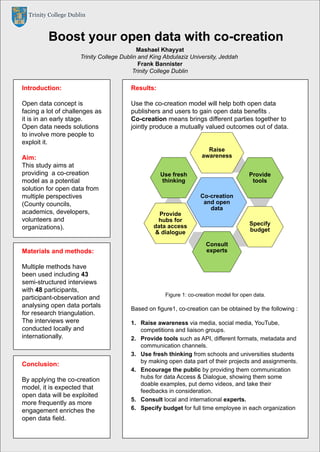
Use the co-creation model will help both open data
publishers and users to gain open data benefits .
Co-creation means brings different parties together to
jointly produce a mutually valued outcomes out of data.
Figure 1: co-creation model for open data.
Based on figure1, co-creation can be obtained by the following :
1. Raise awareness via media, social media, YouTube,
competitions and liaison groups.
2. Provide tools such as API, different formats, metadata and
communication channels.
3. Use fresh thinking from schools and universities students
by making open data part of their projects and assignments.
4. Encourage the public by providing them communication
hubs for data Access & Dialogue, showing them some
doable examples, put demo videos, and take their
feedbacks in consideration.
5. Consult local and international experts.
6. Specify budget for full time employee in each organization
Conclusion:
By applying the co-creation
model, it is expected that
open data will be exploited
more frequently as more
engagement enriches the
open data field.
Mashael Khayyat
Trinity College Dublin and King Abdulaziz University, Jeddah
Frank Bannister
Trinity College Dublin
Boost your open data with co-creation
Co-creation
and open
data
Raise
awareness
Provide
tools
Specify
budget
Consult
experts
Provide
hubs for
data access
& dialogue
Use fresh
thinking

Boost you Open Data with Co-Creation

  • 1.
    Introduction: Open data conceptis facing a lot of challenges as it is in an early stage. Open data needs solutions to involve more people to exploit it. Aim: This study aims at providing a co-creation model as a potential solution for open data from multiple perspectives (County councils, academics, developers, volunteers and organizations). Materials and methods: Multiple methods have been used including 43 semi-structured interviews with 48 participants, participant-observation and analysing open data portals for research triangulation. The interviews were conducted locally and internationally. Results: Use the co-creation model will help both open data publishers and users to gain open data benefits . Co-creation means brings different parties together to jointly produce a mutually valued outcomes out of data. Figure 1: co-creation model for open data. Based on figure1, co-creation can be obtained by the following : 1. Raise awareness via media, social media, YouTube, competitions and liaison groups. 2. Provide tools such as API, different formats, metadata and communication channels. 3. Use fresh thinking from schools and universities students by making open data part of their projects and assignments. 4. Encourage the public by providing them communication hubs for data Access & Dialogue, showing them some doable examples, put demo videos, and take their feedbacks in consideration. 5. Consult local and international experts. 6. Specify budget for full time employee in each organization Conclusion: By applying the co-creation model, it is expected that open data will be exploited more frequently as more engagement enriches the open data field. Mashael Khayyat Trinity College Dublin and King Abdulaziz University, Jeddah Frank Bannister Trinity College Dublin Boost your open data with co-creation Co-creation and open data Raise awareness Provide tools Specify budget Consult experts Provide hubs for data access & dialogue Use fresh thinking