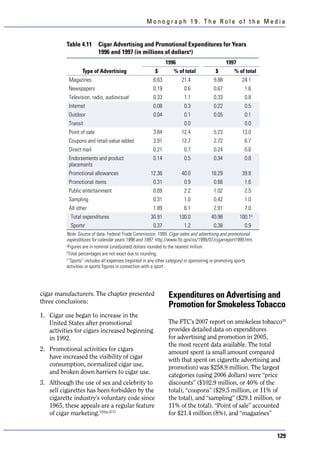
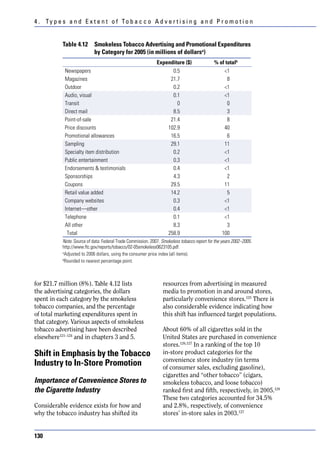
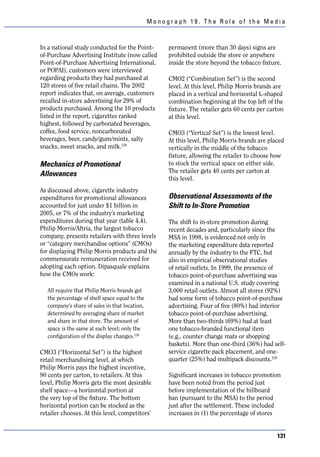
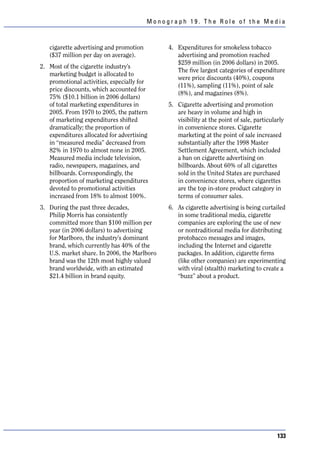
4
               Types and Extent of Tobacco
                 Advertising and Promotion
This chapter examines the types and extent of tobacco advertising and promotion in the
United States and their evolution over time. Areas discussed include

     n	   A taxonomy of past and present channels used in advertising and promoting
          tobacco products
     n	   A review of emerging promotional channels, such as packaging, viral marketing,
          and the Internet
     n	   Expenditures for advertising and promotion, and trends over time, for cigarettes,
          cigars, and smokeless tobacco, using data from the Federal Trade Commission,
          the advertising trade press, and other sources as available

Despite restrictions on cigarette advertising from federal legislation adopted in 1969 and
from the 1998 Master Settlement Agreement, cigarette marketing expenditures have
increased substantially, peaking at $16.7 billion (in 2006 dollars) in 2003 and then dropping
in 2005 (the latest year for which figures are available) to $13.5 billion (in 2006 dollars).
Over time, expenditures have shifted dramatically from traditional print advertising to
promotional activities, primarily price discounting. These trends have had a major impact
on the milieu of media messages that affect tobacco-related attitudes and behaviors.


                                                                                              99
4 . Ty p e s a n d E x t e n t o f To b a c c o A d v e r t i s i n g a n d P r o m o t i o n


                                                      in response to factors such as restrictions on
Introduction                                          tobacco advertising, the mix of promotional
                                                      channels has evolved further into areas
For at least 50 years, cigarettes have                such as promotional allowances and viral
been one of the most heavily marketed                 marketing techniques.
consumer products in the United States.
This chapter reviews the types and extent             Information on the extent of tobacco
of tobacco advertising and promotion                  advertising and promotion is important
as well as how the scope and nature of                for several reasons. First, the pervasiveness
tobacco marketing have changed over time.             of tobacco advertising and promotion
The first part of the chapter addresses the           determines the level of consumers’
types of tobacco advertising and promotion            exposure to marketing messages and
used, including emerging marketing                    images. The “dose” of exposure, in turn,
practices. The second part of the chapter             is likely to correlate with the impact of
reviews the extent of tobacco advertising             media communications. (Impact might be
and promotion and long-term trends in                 measured using outcomes such as brand
marketing expenditures. This chapter, like            recognition, attitudes toward smoking, and
the monograph as a whole, focuses on the              smoking behavior.) However, susceptibility
United States, but developments in other              to smoking and receptivity to advertising
countries are occasionally mentioned for              and promotion vary among individuals and
illustrative purposes.                                population subgroups (chapters 5 and 7),
                                                      and it is important to measure relative
In 2005, the U.S. tobacco industry spent              exposure levels among them.
$13.5 billion (in 2006 dollars) on tobacco
advertising and promotion. Since 1981,                Second, widely dispersed tobacco advertising
as cigarette consumption and sales in the             and promotion are likely to affect social
United States have declined, tobacco industry         norms concerning tobacco use. In outlining
expenditures on advertising and promotion             direct and indirect mechanisms by which
have grown 10 times greater.1 The tobacco             advertising might increase tobacco
industry has mastered and dominated nearly            consumption, the 1989 Surgeon General’s
all forms of communications media during              report points out this indirect effect:
the past 100 years. In the early 1900s,               “the ubiquity and familiarity of tobacco
these included promotional items such as              advertising and promotion may contribute
trading cards (often included with a pack of          to an environment in which tobacco use is
cigarettes). In the 1920s and 1930s, these            perceived by users to be socially acceptable,
forms of communications included print                or at least less socially objectionable and
media such as magazine and newspaper                  less hazardous than it is in fact.”4(p.502)
advertising. In the 1940s and early 1950s,
the tobacco industry was one of the prime             Third, heavy spending for cigarette
sponsors of radio. In the 1950s and 1960s,            advertising in a particular media outlet
the tobacco industry was predominant in               tends to suppress coverage of smoking-and-
television advertising.2,3 In the 1970s and           health issues in that medium5 (chapter 9).
1980s, tobacco manufacturers dominated                Similarly, heavy spending for cigarette
sports and event sponsorships, billboards,            promotion, sponsorships, philanthropy,
and magazine advertising. In the 1980s and            and public relations targeting certain
1990s, point-of-sale advertising, direct mail         sporting activities, cultural institutions,
advertising, sponsorships, and promotions             or community organizations (e.g., groups
on the Internet became major marketing                representing women or minorities)
tools for cigarette manufacturers. Today,             “may create political support for, or mute


100
Monograph 19. The Role of the Media


opposition to, the industry’s marketing and      would unquestionably serve the public
policy objectives.”4(p.502) These two effects    interest.” However, she ruled that “under
provide additional indirect mechanisms by        the narrow standard for §1964(a) remedies
which tobacco advertising and promotion          articulated in [Court of Appeals] Judge
may increase tobacco consumption.4(p.502)        [David] Sentelle’s Opinion [United States v.
                                                 Philip Morris USA Inc., et al., 396 F.3d 1190
Fourth, “saturation” advertising facilitates     (D.C. Cir. 2004)], the Court cannot enter
the penetration of marketing messages            such a remedy because it is not specifically
into communities where more populations          aimed at preventing and restraining future
are found that are vulnerable to take up         RICO violations.”7)
and maintain tobacco use, especially when
communication channels are selectively
chosen to reach those populations.               Sources of Data
Fifth, policymakers wishing to enact a
comprehensive ban on tobacco advertising         Information on the types and extent of
and promotion need to be aware of the            tobacco advertising and promotion comes
many types of tobacco advertising and            from many sources, including the Federal
promotion, so as to avoid ambiguities in         Trade Commission (FTC), advertising trade
legislation that would allow manufacturers       publications such as Advertising Age and
to shift marketing expenditures from             Adweek, research published in scholarly
“banned” media to “allowed” media                journals and reports, and the lay press.
(see below and chapters 3 and 8).                The FTC is a major source of data on
                                                 tobacco advertising and promotional
Finally, it is important to know the dose        expenditures. The Federal Cigarette
and duration of a population’s exposure          Labeling and Advertising Act of 1965 and
to tobacco advertising and promotion             the Public Health Cigarette Smoking Act
to estimate the amount of “corrective            of 1969 required the FTC to transmit an
communication” that may be needed to             annual report to Congress concerning
negate or overcome the effects of many years     current practices and methods of cigarette
of protobacco marketing. Again, varying          advertising and promotion.4 These reports
susceptibility to smoking and receptivity to     have been transmitted to Congress since
advertising and promotion need to be taken       1967.1,8 The Comprehensive Smokeless
into account in determining the optimal          Tobacco Health Education Act of 1986
amount of corrective communication. In the       required the FTC to report to Congress
civil (i.e., noncriminal) lawsuit waged by the   every other year on current advertising
U.S. Department of Justice (DOJ) against         and marketing practices for smokeless
tobacco manufacturers, alleging violations       tobacco products;4 ten such reports have
of the Racketeer Influenced Corrupt              been transmitted to Congress, with the first
Organizations (RICO) Act, the DOJ proposed       report issued in 1987 (but dated 1986) and
extensive remedies including corrective          the most recent issued in 2007.9,10 The FTC
communication concerning the adverse             has obtained information on advertising and
health effects of smoking and exposure to        promotion from the largest cigarette and
secondhand smoke, the addictiveness of           smokeless tobacco manufacturers through
smoking and nicotine, “low-tar” cigarettes,      a compulsory data collection process.
and the impact of tobacco marketing on
youth.6 (Federal Judge Gladys Kessler,           Beginning with fiscal year 2000, the Federal
in a decision issued on August 17, 2006,         Reports Elimination and Sunset Act of
concluded that “adoption of such a public        1995 (Public Law 104-66) terminated most
education and countermarketing campaign          periodic reporting requirements established


                                                                                           101
4 . Ty p e s a n d E x t e n t o f To b a c c o A d v e r t i s i n g a n d P r o m o t i o n


before 1993, including those requiring the            the cigarette report for 2004/20051), are
FTC to transmit to Congress reports on                presented below, alphabetically. As explained
cigarette and smokeless tobacco advertising           within the definitions, this classification
and promotion. A Senate Committee has                 system has been structured to avoid double
reviewed the legislative history and detail           counting of expenditures in more than
surrounding that action.11 In April 2001, the         one category. For example, expenditures
FTC announced that it was soliciting public           for a magazine advertisement promoting
comments “to help it determine whether                a cigarette-sponsored event appear in the
to continue to issue reports on the sales,            “sponsorships” category but are excluded
advertising and promotion of cigarettes               from the “magazines” category.
and smokeless tobacco products, as well as
the formats for any such reports.”12(p.18640)         Audiovisual. Audiovisual or video
At least 98 public comments were submitted            advertising on any medium of electronic
to the agency, almost all of which supported          communications not subject to the Federal
continued publication.12 As noted above,              Communications Commission’s jurisdiction,
the FTC has continued to issue reports on             including screens at motion picture theaters,
cigarette and smokeless tobacco marketing             video cassettes, and monitors in stores, but
since the sunset of statutory requirements.           excluding expenditures in connection with
                                                      Internet advertising.
The FTC has produced one report on cigar
advertising and promotion13 that presented            Company Web site. All expenditures
data on advertising and promotional                   associated with advertising on any company
expenditures for 1996 and 1997 (summarized            Internet Web site.
later in this chapter). The agency collected
these data “in response to information                Coupons. All costs associated with coupons
showing a resurgence of cigar use in                  for the reduction of the retail price of
the United States,” by issuing special                tobacco products, whether redeemed at
orders to the five leading domestic cigar             the point of sale or by mail, including
manufacturers at that time (Consolidated              all costs associated with advertising or
Cigar Corporation; General Cigar Co., Inc.;           promotion, design, printing, distribution,
Havatampa Inc.; John Middleton Inc.; and              and redemption. However, when coupons
Swisher International, Inc.).                         are distributed for free tobacco products
                                                      and no purchase or payment is required to
Types of Tobacco                                      obtain the coupons or tobacco products,
                                                      these activities are considered as sampling
Advertising and                                       rather than couponing. This category has
                                                      been separate from the “retail-value-added”
Promotion                                             category in the FTC’s cigarette reports
                                                      since 1997.
FTC Definitions
                                                      Direct mail. Advertising sent via direct mail
To facilitate data collection, monitoring,            to the consumer, excluding expenditures
and reporting, the FTC has developed                  in connection with sampling, specialty
categories and definitions of advertising and         item distribution, public entertainment,
promotion expenditures, with particular               endorsements, sponsorships, coupons, retail
reference to the tobacco industry. These              value added, and Internet advertising.
categories, drawn from FTC reports on
cigarette, cigar, and smokeless tobacco               Endorsements and testimonials. This
advertising and promotion (especially                 category includes, but is not limited to,


102
Monograph 19. The Role of the Media


all expenditures made to procure tobacco        Price discounts. Price discounts paid to
use; the mention of a tobacco product           tobacco retailers or wholesalers to reduce
or company name; the appearance of a            the price of tobacco products to consumers,
tobacco product, name, or package; or other     including off-invoice discounts, buy downs,
representation associated with a tobacco        voluntary price reductions, and trade
product or company, in any situation            programs, but excluding retail-value-added
(e.g., motion pictures, stage shows, or         expenditures for promotions involving
public appearances by, or photographs of,       free tobacco products and expenditures
a celebrity or public figure) in which such     involving coupons.
use, mention, or appearance may come to
the public’s attention.                         Promotional allowances—retail. Payments
                                                to tobacco retailers to facilitate the sale
Internet—other. Internet advertising            or placement of any tobacco product,
other than on the company’s own Web             including payments for stocking, shelving,
site, including on the World Wide Web, on       displaying, and merchandising brands,
commercial online services, and through         volume rebates, and incentive payments,
electronic mail messages.                       but excluding expenditures in connection
                                                with newspapers, magazines, outdoor,
Magazines. Magazine advertising, but            audiovisual, transit, direct mail, point of
excluding expenditures in connection with       sale, and price discounts.
sampling, specialty item distribution, public
entertainment, endorsements, sponsorships,      Promotional allowances—wholesale.
coupons, and retail value added.                Payments to tobacco wholesalers to
                                                facilitate the sale or placement of any
Newspapers. Newspaper advertising, but          tobacco product, including payments
excluding expenditures in connection            for volume rebates, incentive payments,
with sampling, specialty item distribution,     value-added services, promotional
public entertainment, endorsements,             execution and satisfaction-of-reporting
sponsorships, coupons, and retail value         requirements, but excluding expenditures
added.                                          in connection with newspapers, magazines,
                                                outdoor, audiovisual, transit, direct mail,
Outdoor. Billboards; signs and placards         point of sale, price discounts, and retail
in arenas, stadiums, and shopping malls,        promotional allowances.
whether they are open air or enclosed;
and any other advertisements placed             Public entertainment—adult only.
outdoors, regardless of their size, including   Public entertainment events bearing
those on cigarette retailer property; but       or otherwise displaying the name or
excluding expenditures in connection with       logo or an image of any portion of the
sampling, specialty item distribution, public   package of any of a company’s tobacco
entertainment, endorsements, sponsorships,      products or otherwise referring or
coupons, and retail value added.                relating to tobacco products, which take
                                                place in an adult-only facility, including
Point-of-sale (point-of-purchase)               all expenditures made by the company
advertising. Advertising posted in retail       in promoting and/or sponsoring such
outlets, but excluding expenditures in          events. The definition for this category for
connection with outdoor advertising,            cigars specifically mentions the inclusion
sampling, specialty item distribution, public   of “dinners, wine or spirit tastings, and
entertainment, endorsements, sponsorships,      weekends or other vacations featuring
coupons, and retail value added.                cigar smoking.”13


                                                                                           103
4 . Ty p e s a n d E x t e n t o f To b a c c o A d v e r t i s i n g a n d P r o m o t i o n


Public entertainment—general audience.                distributed) that bear the name or logo
The same as “public entertainment—adult               or depict an image of any portion of the
only,” except that the public entertainment           package of a tobacco product, including
events do not take place in an adult-only             the costs of the items distributed but
facility.                                             subtracting any payments received for the
                                                      item. The costs associated with distributing
Retail value added—bonus tobacco                      nontobacco items in connection with
products. Retail-value-added expenditures             sampling or retail-value-added programs
for promotions involving free tobacco                 are reported in those categories, not as
products (e.g., buy two packs, get one free),         specialty item distribution. Examples of
whether or not the free tobacco products              specialty items distributed as part of tobacco
are physically bundled together with the              promotions are sunglasses, key chains,
purchased tobacco products, including                 calendars, sporting goods, T-shirts, caps,
all expenditures and costs associated with            and other clothing.
the value added to the purchase of tobacco
products (e.g., excise taxes paid for free            Specialty item distribution—nonbranded.
cigarettes and increased costs under the              The same as “specialty item distribution—
Master Settlement Agreement [MSA]).                   branded,” except that the specialty items
                                                      do not bear the name or logo or depict an
Retail value added—non-tobacco-product                image of any portion of the package of a
bonus. Retail-value-added expenditures                tobacco product.
for promotions involving free nontobacco
items (e.g., buy two packs, get a cigarette           Sponsorships. For cigarettes, this category
lighter), including all expenditures and              is defined as sponsorships of sports
costs associated with the value added to the          teams or individual athletes but excludes
purchase of tobacco products.                         endorsements.1 For smokeless tobacco,
                                                      this category is called “sports and sporting
Sampling distribution. Sampling of                    events,” is duplicative of expenditures for
tobacco products, including the costs of              other categories, and is defined as follows:
the products, all associated excise taxes and         “All costs associated with sponsoring,
increased costs under the MSA, and the cost           advertising or promotion of sports or
of organizing, promoting, and conducting              sporting events, including football, weight
sampling. Sampling includes the distribution          lifting, sailing, rodeo, automobile, race
of tobacco products for consumer testing              car, funny car, motorcycle, bicycle, truck,
or evaluation when consumers are able to              monster truck, tractor-pull, fishing, and
use the tobacco products outside of a facility        hunting events, competitions, tournaments,
operated by the company, but does not                 and races.”10(p.32) In the FTC’s report on
include the cost of actual clinical testing           cigar advertising and promotion,13 this
or market research associated with such               category is called “sports” and also was
tobacco product distributions. Sampling               duplicative of expenses reported in other
also includes the distribution of coupons for         categories.
free tobacco products, when no purchase or
payment is required to obtain the coupons             Telephone. Telephone advertising, including
or tobacco products.                                  costs associated with the placement of
                                                      telemarketing calls or the operation of
Specialty item distribution—branded.                  incoming telephone lines that allow
All costs of distributing items other                 customers to participate in any promotion
than cigarettes (whether the items are                or hear pre-recorded product messages;
sold, redeemed by coupon, or otherwise                but excluding costs associated with having


104
Monograph 19. The Role of the Media


customer service representatives available       advertisements that were virtually identical
for responding to consumer complaints or         to earlier ads for Camel cigarettes.16 Other
questions.                                       examples include “Marlboro Classics”
                                                 clothing, sold in at least 29 countries;
Television and radio. This category              Marlboro and Camel lighters, Pall Mall
was used for the FTC’s report on cigar           matches, Peter Stuyvesant Travel, and Camel
advertising and promotion,13 and was             footwear in France, following the tobacco
defined as advertising on any medium of          advertising restrictions imposed by the
electronic communications subject to the         Loi Veil legislation in 1976; Camel boots
jurisdiction of the Federal Communications       in Finland, after direct tobacco advertising
Commission such as broadcast television,         was banned in 1976; “Camel adventures”
cable television, and radio. For that            (travel tours) in Sweden, after tobacco
report, this category was combined with          advertising was restricted in 1979; Liggett
the “audiovisual” category. Broadcast            & Myers (L&M) matches, Camel scooters,
advertising has been prohibited by law           Gauloises travel excursions, and Bastos
for manufactured cigarettes (since 1971),        cassettes in Belgium, after the enactment of
smokeless tobacco (since 1986), and “little      advertising limits under the Royal Decree
cigars” (since 1973) but is still permitted      of 20 December 1982; the Benson & Hedges
for other cigars, pipe tobacco, and roll-your-   Bistro in Kuala Lumpur, Malaysia, where
own cigarette tobacco4 (chapter 8).              direct tobacco advertising is banned; Camel
                                                 Trophy “adventure boots” in Turkey, after its
Transit. Advertising on or within private        1997 ban on tobacco advertising; and plain
or public vehicles and all advertisements        (nontobacco) pan masala as an advertising
placed at, on, or within any bus stop, taxi      surrogate for tobacco-containing pan masala
stand, transportation waiting area, train        in India, where advertising of tobacco
station, airport, or any other transportation    products has been banned since 2004.14,17–21
facility; but excluding expenditures in
connection with sampling, specialty              A Web site description of a Marlboro Classics
item distribution, public entertainment,         clothing store in Hong Kong reads,
endorsements, sponsorships, coupons,
and retail value added.                            Although Marlboro Classics clothing
                                                   chain is part of the Marlboro cigarettes
All other. Advertising and promotional             company, one thing is for sure: their
expenditures not covered by another category.      clothes are a lot healthier, and better
                                                   looking. There are great chinos, shirts,
Indirect Advertising                               T-shirts and accessories, including shoes.
                                                   You will walk out looking like you just did
Indirect advertising, a form of trademark          a photo shoot in the Wild West for, well,
diversification, is often used by                  a cigarette advert. But nevertheless, the
manufacturers where partial advertising            quality is high, the prices fair, and the style
bans are in force. This term, also called          is definitely cool.22
brand sharing or brand stretching, refers
to the application of cigarette brand            Two R.J. Reynolds (RJR) France documents,
names, logos, or other distinctive elements      “Communication Strategy and Strategic
of cigarette brands (and their ads) to           Plan 1992–1996” and “Worldwide Brands,
nontobacco products.14,15 For example,           Inc. Strategic Plan 1993–1997” describe
after enactment of a cigarette advertising       how to circumvent legal restrictions by
ban in Norway in 1975, Camel boots               promoting nontobacco products and
were introduced in that country, with            services bearing the Camel and Winston


                                                                                                 105
4 . Ty p e s a n d E x t e n t o f To b a c c o A d v e r t i s i n g a n d P r o m o t i o n


brand names.23,24 These documents were                Internal tobacco corporate documents
made public in a court judgment (Tribunal             make it clear that the industry understands
de Grande Instance de Paris 19 October                and appreciates the value of packaging
1998).15 According to RJR France’s 1992–              in influencing smokers and potential
1996 strategic plan,23(p.4)                           smokers. A 1963 Liggett & Myers report
                                                      states, “The primary job of the package
   Compared to most competitors,                      is to create a desire to purchase and try.
   RJR France seems better prepared to                To do this, it must look new and different
   successfully confront the new legal                enough to attract the attention of the
   restrictions thanks to a larger number             consumer.”28(Bates no. TI3072-9042)
   of available logo licensing activities,
   (Camel Trophy watches, Camel boots,                Philip Morris’s comment regarding its
   Camel collection/shops, Winston wear)              efforts to target women provides one
   allowing a satisfactory communication              example of how packaging is used to
   continuity behind [the] Camel and                  influence specific target markets or niches:
   Winston [brands].
                                                         Some women admit they buy Virginia
Tobacco control research has also borne out              Slims, Benson & Hedges, etc. when
the connection between brand stretching                  they go out at night, to complement
and promotion of the sponsoring tobacco                  a desire to look more feminine and
products. Initial research shows that                    stylish.…29(Bates no. 2060037888) Women are
advertising for the nontobacco product or                a primary target for our innovative
service is consistently seen as advertising              packaging task.29(Bates no. 2060037905)
for the sponsoring tobacco brand,25,26 while
15-year-olds’ awareness of brand stretching           In appealing to the youth segment,
is independently associated with being a              Lorillard developed unique packaging for
smoker.27 Thus, indirect advertising serves           Zack (a new brand in the 1970s). “Zack’s
as a powerful tool for maintaining a product          strength in appealing to young adults is
brand identity, particularly in the absence of        its unusual name, denim pack and graphic
traditional promotional channels.                     entity.”30(Bates no. 91260420) Similar strategies
                                                      have been followed by Gauloises in France
Advertising on the Package                            and Brown & Williamson (B&W) in the
                                                      United States. Special package design
As the “face” of the product being sold,              for Légères, a brand made by Gauloises,
packaging is always an important part                 portrays a seductive young female in a
of the firm’s advertising and promotion               dungeons and dragons setting.31 Referring
considerations. For cigarettes, packaging is          to an innovative Kool package that
even more important because the package               opens as a book and has rounded corners
is not opened once and discarded, as with             and vivid colors, B&W vice president
many purchases, but is opened each time               Ludo Cremers commented, “The response
a cigarette is removed. The visibility of the         from consumers is ‘this is a pack to be
package under these circumstances makes               seen with’.”32(p.C11)
packaging an important advertising vehicle.
An additional advantage of advertising                Many other examples of new cigarette
on tobacco packaging is that it does not              packaging shapes or materials33 and vivid
fall within any of the FTC’s categories               or creative imagery on cigarette packs34–36
of advertising and promotion; hence,                  have been reported. A collector of cigarette
expenditures for this marketing vehicle               packs—who claims to have collected more
are not reported to the FTC.                          than 33,500 cigarette packs from more than


106
Monograph 19. The Role of the Media


                          Cigarette Packaging as Seen by the Tobacco Industry

  The impact of cigarette packaging was explored in detail in one study of industry documents.
  This study concluded that pack imagery has significant effects on an individual’s perception
  of the cigarette product and encourages trial smoking, and in highly competitive or restricted
  environments, the pack acts as an advertisement that creates or reinforces brand imagery.a
  When the pack shows signs of weakness, redesign is quick to follow:
      Marlboro is significantly under-represented in the 27.5% menthol category. The existing Marlboro
      Menthol has a 0.2 market share, or less than 1% of the category.… Three new products have been
      developed.… The full flavor pack has been redesigned to achieve a fresher more contemporary look
      while preserving the basic identity of the original.b
  British American Tobacco focused on packaging even when it considered selling individual
  cigarettes to people in less-developed countries: “The brand image must be enhanced by the
  new packaging … if you just say, this is a cheap cigarette … they’re not going to go for it.” c
  In addition, cigarette packages have been designed to appeal to particular target groups, such as
  young adults or women.
  a
   Wakefield, M., C. Morley, J. K. Horan, and K. M. Cummings. 2002. The cigarette pack as image: New evidence
  from tobacco industry documents. Tobacco Control 11 Suppl. 1: i73–I80.
  b
   Fuller, S. Marlboro menthol. 30 Sep 1987. Philip Morris. Bates No. 2048517809/7813. http://legacy.library
  .ucsf.edu/tid/jqm92e00.
  c
   Muggli, M. E., and R. D. Hurt. 2003. Listening between the lines: What BAT really thinks of its consumers in
  the developing world. Tobacco Control 12 (1): 104.


140 countries, dating from the 1890s to                     package design look can provide for a
the present—has more than 1,700 images                      greater in-store presence,”39(Bates no. 94600013)
and illustrations of cigarette packs on                     and Wakefield and colleagues explained
the collection’s Web site.37 It includes,                   that “the arrangement of packs at the
for example, dozens of different images of                  point of purchase themselves become an
Camel iconography (including Joe Camel)                     advertisement for the brand family.”40(p.i76)
on cigarette packs sold in Argentina, Austria,
France, Germany, Italy, Mexico, Norway,                     Similarly, a British American Tobacco
Switzerland, and the United States.37                       report states,

Packaging accessories provide yet another                      Given the consequences of a total ban on
channel for advertising imagery. In                            advertising, a pack should be designed to
Hong Kong, Philip Morris introduced a                          give the product visual impact as well as
plastic outer cover for Marlboro cigarette                     brand imagery.… The pack itself can be
packs, featuring a series of images of the                     designed so that it achieves more visual
Marlboro cowboy. Besides presenting                            impact in the point of sale environment
powerful visuals of the “Marlboro Man,” the                    than its competitors.41(Bates no. 102699354)
cover also seems designed to obscure the
health warning on the underlying pack.38                    Colors on packaging, like the colors in
                                                            traditional advertising (chapter 3), can
Cigarette package design can be an                          contribute to brand image. For example,
important feature of in-store advertising.                  tobacco companies have used lighter
An American Tobacco Company                                 colors on packages to convey a sense of a
memorandum stated that “an integrated                       lighter and perhaps healthier cigarette.


                                                                                                                  107
4 . Ty p e s a n d E x t e n t o f To b a c c o A d v e r t i s i n g a n d P r o m o t i o n


In a 1979 report, RJR pointed to lighter                  Beyond the issue of perceiving products as
colors for the Camel’s filter brand as                    light or mild, tobacco packaging has been
playing a key role in creating the image of               shown in general to both reinforce brand
“reduced strength”:                                       imagery and reduce the impact of health
                                                          warnings.44–47 Conversely, when fewer
   Refinements in the [Camel Filter brand]                brand image cues appear on the packaging,
   Package consist mainly of increasing the               adolescents are able to recall nonimage
   amount of white space on the pack and                  health information more accurately.47
   lightening the brown color tones, … to give            Plain packaging limits the ease with which
   the revised package the appearance of                  consumers associate particular images with
   reduced strength.42(Bates no. 500566631)               cigarette brands and significantly influences
                                                          smoking behavior.44 Thus, packaging not
A Canadian ministerial advisory committee                 only plays a role in product branding
on tobacco control concluded,                             but can also be used effectively in policy
                                                          interventions designed to counter the
   The colours and designs of cigarette                   desirability of smoking.
   packages continue to reinforce the notion
   that some brands are less harmful. The hue             Viral (or Stealth) Marketing
   and density of the colours applied within
   a brand family follow a natural spectrum               One strategy that tobacco marketers have
   of intensity, with the lightest colours                used increasingly is called viral or buzz
   matched to the ‘lightest’ brand.43(p.10)               marketing or, more pejoratively, as stealth
                                                          or guerilla marketing. It is described as the
The committee recommended a ban on                        situation in which “the advertiser creates an
the use of “deceptive descriptors such as                 environment in which the idea can replicate
‘light’ and ‘mild’ on cigarette packaging                 and spread. It’s the virus that does the work,
and marketing … [and] the use of other                    not the marketer.”48(p.26) Examples might
words, colours or devices that result in                  include paying teens to talk to their friends
an erroneous perception of a difference                   about a product or to infiltrate a chat room,
in health risks and/or tar/nicotine                       commissioning footpath graffiti, or creating
deliveries.”43(p.11) (emphasis added)                     Web sites or sponsoring events that support a


                   Integrating Packaging and Marketing: The “Kool Mixx” Campaign

   One example of combining custom packaging with merchandising for an integrated product
   marketing effort was Brown & Williamson’s 2004 hip-hop music-themed “Kool Mixx” campaign
   for Kool cigarettes. The campaign included (1) a series of limited-edition cigarette packs featuring
   artists’ renditions of the elements of hip-hop culture—“MC-ing” (rapping), “disc jockeying”
   (DJ-ing), break dancing, and creating graffiti art; (2) a “Mixx Stick” radio, free with the purchase
   of a limited-edition two-pack set; (3) free magazine subscriptions for various hip-hop themed
   magazines; (4) an interactive Kool Mixx compact disc featuring video clips of Kool Mixx events
   and interviews and performances from rappers, DJs, graffiti artists, and dancers; (5) “Mixx”-
   branded desktop wallpaper to be downloaded to the user’s computer; (6) three “test your hip-hop
   skills” interactive games; (7) a selection of audio tracks; and (8) DJ software enabling the user to
   create original music mixes.a
   a
    Hafez, N., and P. M. Ling. 2006. Finding the Kool Mixx: How Brown & Williamson used music marketing to
   sell cigarettes. Tobacco Control 15 (5): 359–66.


108
Monograph 19. The Role of the Media


product but without overt brand imagery.49,50        to have your consumer do your marketing
The labels for this marketing activity reflect       for you,’ explains Sharon Smith, director of
how it works: the marketers orchestrate              Lucky Strike. ‘It is credible, less expensive,
a “tsunami of chatter”49—or buzz—that                and enormously believable.’
helps an idea or product spread like a virus.
Commercial sponsorship is surreptitious so         The Internet has played a crucial role in
that consumers believe they are discovering        viral marketing. Camel was the sponsor of
something on their own—hence, the                  a German Web site for a new rock band,
descriptors “stealth” and “guerrilla.”50           featuring English headings such as “party
                                                   previews,” “love parade,” and “Berlin
Although the terms viral marketing and             fashion,” and a picture of the members of a
stealth marketing are relatively new,              mixed-sex band fondling each other nude.53
they are not different from two other              A nontobacco example is the Web-based
concepts familiar to social scientists.            company Tremor. With 280,000 teens (1% of
A parallel, earlier concept familiar to            total teenage population), the firm, which
communication researchers is the multistep         is formally linked to major (nontobacco)
flow in persuasion efforts. This process           marketers, seeks to involve teenagers in
refers to the fact that those around us can        the marketing process. One example of the
and do influence us, but this influence            process is the naming of the movie Eurotrip.
comes as a consequence of the media                More than 60,000 Tremor members
messages to which we are all exposed.51            submitted title suggestions after reviewing
A bandwagon effect represents a similar            a brief movie synopsis. Dreamworks, the
concept that R.J. Reynolds recognized              movie’s producer, narrowed down the list,
decades ago. Widespread exposure to a              picked its favorites, and then chose the
brand’s advertising creates an initial focus       official title. The winning title had been
on the brand. A bandwagon, or virus, then          submitted by 20 Tremor members.54
allows the brand’s share of the market
to grow. Once 30% of underage smokers              Although not formally linked to tobacco
adopt a brand, its lasting success in the          firms, Internet “virtual teen smoking clubs”
marketplace is said to be ensured.52               make positive smoking images for youths the
                                                   norm.55 Ribisl55 reviews a number of sites,
An article on stealth marketing in Business        including (1) http://www.smokingcelebs
Week49 describes the use of the technique to       .com/teenceleb.html, one of a dozen or
reinvigorate a well-known cigarette brand:         more Web sites dedicated to smoking by
                                                   celebrities; (2) online clubs, such as the
   Brown & Williamson Tobacco Corp. and            Yahoo! Club “Smoking_Girls_in_Movies”
   its ad agency, Bates, decided to add buzz       or the newsgroup alt.smokers.glamour;
   to Lucky Strike’s equation. The result was      (3) Teen Smokers Home Page, described as
   the Lucky Strike Force, attractive couples      a “place for teen smokers to hang out”; and
   working trendy neighborhoods such as            (4) Badteengirlssmokingden, a Yahoo! site
   Miami’s South Beach, New York’s Soho,           that has almost 1,500 members. In addition,
   and Santa Monica, Calif., proffering hot        teen smokers participate in online polls and
   coffee and cell-phone calls to shivering        message boards.
   smokers in winter or iced coffee and
   lounge chairs in spring and summer. ‘Send       British American Tobacco (BAT) has
   up a smoke signal, and we’ll be there,’ local   developed an independent Web site that
   teaser ads urged. The Strike Force has          features BAT retailers who appear to offer
   helped the onetime icon edge back toward        independent advice on nightlife to young
   broad availability. ‘As a marketer, you hope    people. The youth are directed to bars, clubs,


                                                                                                  109
4 . Ty p e s a n d E x t e n t o f To b a c c o A d v e r t i s i n g a n d P r o m o t i o n


or restaurants where BAT cigarettes are                 trendy bars and clubs in Sydney, Australia.
being sampled or promoted.56                            Selected for their good looks, style, and
                                                        charm, the roachers often appear at special
Another approach to viral, or stealth,                  dance events where tents filled with bean
marketing is embodied by trend influence                bags, a bar, and a DJ help them create
marketing, which involves an alliance                   “fantastic themed sales points.”60
among the tobacco industry, the alternative
press, and bars and nightclubs.57 The                   Viral marketing techniques are spread
alternative press includes free periodicals             across several of the FTC’s categories of
distributed in trendy nightclubs and found              advertising and promotion, but some of
at stores and coffee houses frequented by               these techniques may not be captured
the club crowd. These periodicals, which                by those categories. In addition, a clear
lend “hip credibility” to the advertised                definition of viral marketing for purposes
brands, have become a major outlet for                  of estimating the extent of its use has
modern tobacco marketing. A sampling                    not been developed, so no information is
of two prominent alternative weeklies                   available on expenditures and trends for
(one in San Francisco and the other in                  viral marketing of tobacco products.
Philadelphia) found a dramatic increase
in tobacco advertising from 1994 to 1999:               Internet Marketing
the number of ads increased from 8 to
337 in the San Francisco weekly, and                    Aside from its use in viral marketing, as
from 8 to 351 in the Philadelphia weekly.58             described above, the Internet has been used
In addition, smoking “hipsters” are recruited           to actually sell tobacco products. In a 2002
clandestinely (from the bar and nightclub               study, Ribisl55 found 195 Internet cigarette
scene) to surreptitiously sell tobacco                  vendors in the United States. A majority of
products to unsuspecting young adults in                vendors (105) were in New York State, and
bars and elsewhere.57                                   most of these were in the western part of
                                                        the state on Indian reservations. A total of
BAT’s “Project Whisper,” a good example of a            88 Web sites sold other tobacco products:
viral strategy, was intended to capitalize on           42%, cigars; 39%, smokeless tobacco; 18%,
social interactions within bars to influence            clove cigarettes; and 8%, bidis.
bar patrons:
                                                        The 2001 National Household Survey on
   The rationale of Project Whisper is                  Drug Abuse found that 3.3% of 12- to
   straightforward—influence an opinion                 17-year-olds reported having purchased
   leader with your product communication               cigarettes over the Internet at least once
   and you are at the same time achieving               during the past month.20 Data from
   dissemination of that communication                  additional studies indicate that buying
   throughout his sociometric network.                  cigarettes on the Internet is easier than in
   An additional aspect of this type of                 retail outlets, suggesting the potential for
   communication is that it typically takes             future growth. As one example, a youth
   place where a high degree of opinion                 tobacco purchase survey found that four
   transfer and modelling behaviour is                  11- to 15-year-olds were successful in
   observed. This is seen in the British public         76 (92%) of 83 attempts to purchase
   house or night club, and has equivalent              cigarettes via the Internet.55
   phenomena in all societies.59(Bates no. 542003684)
                                                        States have taken a variety of steps to
Young marketers (or “roachers”) are hired               attempt to control tobacco sales over the
by tobacco companies to sell cigarettes in              Internet to ensure that state tobacco taxes


110
Monograph 19. The Role of the Media


are applied and that illegal sales to minors        using e-mail.1 The major smokeless tobacco
do not occur.61 However, the extent to which        companies, using one combined category
these actions may have reduced Internet-            for Internet advertising, reported no
based tobacco sales and marketing is unclear.       expenditures for that category before 2000
                                                    but reported spending $155,405 in 2000 and
In March 2000, an attorney with Philip Morris       $413,000 in 2005, a 266% increase.10
Corporate Services commented on the use of
the company’s Australian Web site:                  In a repeated cross-sectional survey of
                                                    New Jersey adults, the proportion of Internet
   As you are no doubt aware, our ability           users reporting exposure to online tobacco-
   to communicate about the Company                 product advertising increased from 6.9% in
   and its positions through traditional            2001 to 15.6% in 2002 to 17.8% in 2005.
   media is severely restricted. As a               The 2005 survey showed significantly higher
   result, the website takes an [sic] added         recall of online tobacco-product advertising
   significance.”62(Bates no. 2072557317A)          among those aged 18–24 years than among
                                                    older groups.63 The 2004 National Youth
Nevertheless, the attorney added that “the          Tobacco Survey found that 34.1% of middle
site will be purely an information site and         school students and 39.2% of high school
will not have any elements of marketing,            students reported seeing advertisements for
branding or e-commerce.”62(Bates no. 2072557317A)   tobacco products on the Internet.64

As noted above, the FTC now requires                In a 2003 fact sheet on Internet tobacco
tobacco manufacturers to report to the              marketing (http://www.tobaccofreekids
agency their expenditures on advertising            .org/research/factsheets/pdf/0081.pdf), the
and promotion, according to several                 Campaign for Tobacco-Free Kids reported
categories, two of which pertain to the             that RJR had created a Web site to sell
Internet: (1) expenditures associated with          Eclipse cigarettes, a product purported
advertising on any of the tobacco company’s         to lower the risks of smoking.65 When
Internet Web sites (“Company Web site”);            the Web site (now located at http://www
and (2) expenditures for Internet advertising       .tobaccopleasure.com/ECL/home.aspx) was
other than on the company’s own Web                 reviewed in February 2007, it discussed
site, including on the World Wide Web, on           “The Eclipse Concept,” including assertions
commercial online services, and through             that the product “responds to concerns
electronic mail messages (“Internet—                about certain illnesses caused by smoking,
other”). From 1996 to 2001, there was               including cancer” and “reduces secondhand
only one (combined) category for Internet           smoke by 80%.” The site explained how
expenditures, and for these years, the major        to use the product and promoted “special
cigarette companies reported the following          introductory offers”: (1) two free coupons for
expenditures for Internet advertising:              $4 off three packs or a carton, and (2) “Give
$432,000 (1996); $215,000 (1997); $125,000          3 adult friends our Eclipse Get-Acquainted
(1998); $651,000 (1999); $949,000 (2000);           Form and get a $4.00 off coupon for each
and $841,000 (2001). The companies                  friend that signs up.” Persons requesting
reported a 285% increase in spending for            coupons had to go through a registration
advertising on company Web sites from               process; a question on how the registrant
2002 ($940,000) to 2005 ($2,675,000).               heard about the Web site included the
For those four years, however, they reported        following response choices: direct mail, from
no expenditures for “Internet—other”                a friend, magazine, newspaper, alternative
advertising, such as banner ads on third-           weekly/local city publication, phone,
party Web sites or direct mail advertising          cigarette pack, cigarette carton, bar coasters/


                                                                                               111
4 . Ty p e s a n d E x t e n t o f To b a c c o A d v e r t i s i n g a n d P r o m o t i o n


napkins, matchbooks, retail display, pocket           less than $15 million was spent on video
card, other. The site offered a store locator,        games as an advertising vehicle.70
a “Smokers’ Bulletin Board,” and a list of
135 “key publications and presentations               In 2003–2004, Nielsen data recorded a
relevant to the scientific evaluation of              significant drop in television viewership
Eclipse.” The Web site informed visitors              among young males, seemingly in favor of
that it was no longer selling Eclipse online,         video games. This has triggered a major
but that the product was available for                initiative on the part of the advertising
purchase via a toll-free telephone number.            industry to explore the use of video games
                                                      for marketing purposes. In fact, video
As reviewed in chapter 8, the European                games are becoming a significant part of the
Union’s directive on tobacco advertising              advertiser’s media planning strategy. Major
bans tobacco promotion on the Internet, and           marketers, including McDonald’s, PUMA,
the World Health Organization’s (WHO’s)               P&G, AT&T Wireless, Nokia, Coca Cola’s
Framework Convention on Tobacco Control               Sprite, and Nestlé’s Butterfinger, have
(FCTC) mentions Internet advertising in               embedded their brands into some of the
the context of Article 13, which directs              most popular video games.69 Massive, a firm
each party to the treaty to ban all tobacco           in partnership with Viacom, is developing
advertising, promotion, and sponsorship               a system for inserting ads into video games
“in accordance with its constitution or               and tracking their impact.71 The firm
constitutional principles.”66(p.11)                   conducted a survey of gamers 12–36 years
                                                      of age. Of these, 70% thought ads in video
Kenyon and Liberman have explored the                 games would greatly enhance the quality
challenges of regulating tobacco advertising          and realism of the gaming experience and
on the Internet.67 A presentation at the              indicated they would feel more positive
13th World Conference on Tobacco OR                   about a brand or product advertised in
Health in July 2006, for example, reported a          a video game.72 A 2004 survey of nearly
27% increase in the number of protobacco              1,000 males aged 18–34 years, conducted
Web sites on the Russian-speaking Internet            by Activision and Nielsen Entertainment,
since 2004, most of which violated                    found that 52% of “heavy gamers” like
advertising norms such as age restrictions.68         games to contain real products and 35% of
                                                      male gamers agree that advertising in video
Video Games                                           games helps them decide which products
                                                      to buy (http://news.gamewinners.com/
Video games are a $9.4 billion business               index.php/news/92/).
in the United States, with sales higher
than that of the movie box office. There              Just as the tobacco industry has begun to
are 100 million video gaming consoles in              use the Internet as a strategic advertising
households, 60 million handheld games,                vehicle in reaching target audiences,
and growing numbers of game-enabled cell              tobacco control advocates have concern
phones. The average gamer is 29 years of              that video games will be used in the same
age. Younger audiences, in particular, regard         way. The Entertainment Software Rating
video games as a more important form of               Board is an independent rating system
entertainment than television.69 According            established by the computer and video
to Nielsen Media Research data, males aged            game industry in 1994. Its “Principles and
18–34 years now spend as much time with               Guidelines,” established by its Advertising
video games as with television; yet, while            Review Council (ARC), states as a basic
advertisers spent more than $8 billion in             principle, “Companies must not specifically
2003 to try to reach that market segment,             target advertising for entertainment


112
Monograph 19. The Role of the Media


software products rated ‘Teen,’ ‘Mature,’
or ‘Adults Only’ to consumers for whom
the product is not rated as appropriate.”
Among the core guidelines that the ARC
indicates it will focus on with concern is the
following: “glamorizing, encouraging and/or
depicting the consumption of alcohol.”
However, there is no statement with regard
to tobacco products.73 Even if tobacco
advertisers formally avoid the teen category,    Xbox game “Halo 2” character Sergeant Major Avery
any placement in the mature (M) category         Johnson with cigar
might influence them as well, given the
breadth of appeal of these games to youth.          and jump off it onto one of the rails.
                                                    There will be a small room with no doors.
Some game content incorporates or features          Jump onto that and bash the trash can.
tobacco products. A review of 396 video             When you look on the floor, you will see
games indicated that 6 of these involved            Johnson’s cigar.77
tobacco and/or alcohol.74 In one video game,
The Chronicles of Riddick: Escape from           A posting on an online forum for Halo
Butcher Bay (rated M), cigarettes are used       explains that Sergeant Johnson “obviously
as a reward, with each pack revealing some       wasn’t aloud [sic] to smoke on ‘Cairo Station’
aspect of a new, related Riddick movie.          so he hid his cigar behind a trash can.”78
In this video game, cigarettes are made          That posting includes two screenshot images
to seem “cool” and the cigarette warning         and a downloadable game-playing videoclip
labels are mocked.75                             showing the discarded cigar.

In Halo 2 (rated M), the most popular            Another Web site devoted to “Halo 2 cheats”
video game for the Xbox game console             includes a posting (entitled “Smoke a cigar”)
for almost two years after its debut in          about another appearance of the cigar in
November 2004,76 a character named               this game:
Sergeant Major Avery Johnson smokes a
cigar and discarded cigars are featured.            On the first level if you go to the boxes
On a Web site devoted to “Xbox Hints and            near the sheild [sic] re-charger and hit
Tips,” a hint entitled “Johnson’s Cigar In          them all together u will c a cigar in the
Cairo Station” is described as follows:             middle then take out your battle rifle and
                                                    shoot it your screen should turn white and
   In the first level, as soon as you get off       then if you die you will see a cigar on the
   the lift do not go on the train. Instead,        floor next to your body. This only works on
   look to your right to find a trash can.          legendary and should give u extra power in
   Go over to it, crouch, and look in between       your melee.79
   the can and the wall. There should be a
   Johnson Cigar burning away. Additionally,     It is unclear whether the images and usages
   go to the armory. As you are coming up        of cigars were built into Halo 2 as the result
   the stairs, you will hear the man shooting    of paid advertising (i.e., product placement).
   his shotgun and talking. Kill the Elites      The MSA [Section III, subsection (e)] bans
   and go through the door. Jump over the        “payment or other consideration” to promote
   turret and look to the right. Jump on the     tobacco products “in any motion picture,
   lights sticking out of the wall, then jump    television show, theatrical production or
   over the rail. Get on one of the beams        other live performance, live or recorded


                                                                                                  113
4 . Ty p e s a n d E x t e n t o f To b a c c o A d v e r t i s i n g a n d P r o m o t i o n


                                                      smoking.82–85 Product placement is a form
                                                      of promotion, is captured by the FTC’s
                                                      categories of advertising and promotion,
                                                      and is the focus of this section. Chapter 10,
                                                      on the other hand, focuses on both
                                                      paid and unpaid depictions of tobacco
                                                      in entertainment media, in the context
                                                      of examining the role of these media in
                                                      promoting or discouraging tobacco use.

                                                      A chronology of events developed by
                                                      Mekemson and Glantz86 in reviewing the paid
Cigar accessories advertised to “Halo 2” players
                                                      placement of tobacco products in movies is
                                                      presented in table 4.1. The discussion below,
performance of music, commercial film or              reviewing the evidence available (largely
video, or video game” (emphasis added).80(p.18)       through internal corporate documents), is
Cigar manufacturers, however, are not parties         also drawn from Mekemson and Glantz.86
to the MSA between the major cigarette firms
and 46 state attorneys general.                       R.J. Reynolds. Executives of the public
                                                      relations firm charged with developing
When viewing a Web site description                   product placements for R.J. Reynolds
of the cigar “cheat code” in Halo 2,81 a              recognized the importance of tying
banner advertisement for cigar accessories            celebrities to smoking on (and off) the
was visible at the top of the Web page.               screen: “Our primary objective will
This illustrates the complex (and often               remain … to have smoking featured in a
unpredictable) interplay between video                prominent way, especially when it is tied to
games, the Internet, and digital advertising.         celebrities.”87(Bates no. 503579240) The firm detailed
More research is needed to track the                  one placement in a James Bond movie:
appearance and use of tobacco products in
video games, to determine whether these                  For a financial consideration of [U.S.]
depictions are the result of paid promotion              $10,000 … Sean Connery, and other
or “artistic” design, and to evaluate their              principal players, will smoke Winston
impact on video game players’ attitudes                  and Camel cigarettes. A Salem Spirit
and behaviors related to tobacco use                     billboard will be used in an action scene.
(see chapter 10).                                        No other cigarette company will be
                                                         represented.88(Bates no. 503579592)
Paid Placement of Tobacco
Products in Movies                                    Other placements by Rogers & Cowan for
                                                      R.J. Reynolds include those in The Jazz
The portrayal of tobacco use and the                  Singer, Backroads, Cannonball Run, Pennies
appearance of tobacco products, brand                 from Heaven, and Blowout.86
names, and brand imagery in movies
and other entertainment media can                     Philip Morris. Philip Morris products were
occur in exchange for promotional fees                placed in more than 191 movies between
(product placement) or because of artistic            1978 and 1988; 48 were rated PG, 10 were
(noncommercial) decision making by                    PG-13, 91 were R, and 1 was G (The Muppet
producers. Strong evidence links the                  Movie). Among the movies listed during
placement of cigarette products in                    that period were Grease, Rocky II, Airplane,
films and on television with adolescent               Little Shop of Horrors, Crocodile Dundee,


114
Monograph 19. The Role of the Media


Table 4.1      Chronology of Tobacco Industry Activities Related to Smoking in Motion Pictures,
               1972–2001
 1972       Productions Inc.,a a movie and television company, informs R.J. Reynolds (RJR) that product placement in movies is
            “better than any commercial that has been run on Television or any magazine, because the audience is totally unaware
            of the sponsor involvement.”
 1978       Philip Morris begins working with Charles Pomerance to place tobacco products in movies.
 1979       Brown & Williamson (B&W) contracts with the product placement firm of Associated Film Promotions for placing B&W
            products in movies.
 1979       Philip Morris pays to have Marlboros featured in the movie Superman II.
 1980       RJR contracts with Rogers & Cowan to develop a relationship with the television and movie industry that includes
            product placement, providing free products to key entertainment industry workers, and promoting star use of RJR
            products through national media.
 1982       American Tobacco contracts with Unique Product Placement (UPP) to place American Tobacco products in films.
 1982       Rogers & Cowan reports to RJR that it has arranged to have Sean Connery and others smoke Winston and Camel
            cigarettes in Never Say Never Again for $10,000.
 1983       In the spring, B&W launches a campaign placing cigarette ads in 3,000 movie theatres. During July, a Kool ad is run during
            the G-rated Disney film Snow White in Boston; antismoking activists create extensive controversy.
 1983       In the fall, B&W implements a critical audit of relationship with Associated Film Promotions, questioning the
            effectiveness and control of the product placement program.
 1984       B&W cancels product placement and in-theatre ad programs.
 1984       Twentieth Century Fox Licensing and Merchandising Corporation seeks tobacco company product placement agreements
            that would feature products and guarantee exclusivity in films for $20,000 to $25,000 per film.
 1988       Philip Morris pays $35,000 for the use of Larks in the James Bond movie License to Kill and for rights to run a media
            promotion effort to coincide with the movie’s opening in Japan.
 1989       A Philip Morrisb marketing study notes that most “strong, positive images for cigarettes and smoking are created and
            perpetuated by cinema and television.”
 1989–90    Congressman Thomas Luken’s Subcommittee on Transportation, Tourism, and Hazardous Materials conducts public
            hearings on product placement.
 1990       The Federal Trade Commission (FTC) conducts an inquiry into product placement activities of various tobacco firms.
 1990       RJR International contracts with Rogers & Cowan International for the placement of RJR products in films produced
            outside the United States.
 1990       Cigarette companies modify the voluntary Cigarette Advertising and Promotion Code to prohibit paid product placement.
 1991       After declining through the 1960s, 1970s, and 1980s, the frequency of smoking in the movies begins a rapid increase.
 1992       The UPP contract with American Tobacco is modified to limit UPP’s engagements with filmmakers to reactive efforts
            rather than proactive ones.
 1996–97    The FTC notes that expenditures by the cigar industry for “celebrity endorsements, and appearances, and payment for
            product placement in movies and television more than doubled between 1996 and 1997.”c
 1998       The Cigar Manufacturers’ Association adopts a voluntary policy discouraging (but not outlawing) paid and donated cigar
            placements in movies and on television.
 1998       The Master Settlement Agreement prohibits participating cigarette manufacturers from product placement activities.
 2000       The average amount of smoking in movies exceeds levels observed in the 1960s.
 2001       Studies of films during the 1990s find continuing brand use depiction in movies with about 80% of the exposures being
            Philip Morris products, primarily Marlboro; identifiable brand use by high-profile stars is higher than before the tobacco
            industry’s voluntary restrictions on product placement in movies.

Note. From Mekemson, C., and S. A. Glantz. 2002. How the tobacco industry built its relationship with Hollywood. Tobacco Control
11 Suppl. 1: 81–91.
a
  Richards, R. P. We are about to go into production with the motion picture, “Run Sheep Run,” a suspense, thriller, set in
Los Angeles. 25 Aug 1972. R.J. Reynolds. Bates No. 500201423/1424. http://legacy.library.ucsf.edu/tid/ylm89d00.
b
  Kelly Weedon Shute Advertising. Philip Morris cigarette marketing—A new perspective. Nov 1989. Bates No. 2501057693/7719.
http://legacy.library.ucsf.edu/tid/lti49e00.
c
  Federal Trade Commission. 1999. Cigar sales and advertising and promotional expenditures for calendar years 1996 and 1997.
http://www.ftc.gov/os/1999/07/cigarreport1999.htm.


                                                                                                                                     115
4 . Ty p e s a n d E x t e n t o f To b a c c o A d v e r t i s i n g a n d P r o m o t i o n


Die Hard, Who Framed Roger Rabbit, and                and television, more than doubled.”12 It was
Field of Dreams.86                                    only in 1998 that the Cigar Association of
                                                      America formally precluded paid placement
A contract between Leo Burnett, the                   in movies and on television.
agency for Marlboro/Philip Morris, and
the producers (Danjaq S.A; Switzerland)               Paid Placement in Movies Made in
documents an exclusive placement of                   India and Nigeria
Lark cigarettes in a James Bond movie,
License to Kill, in return for $350,000.              Information on paid placement of tobacco
Another contract documents placement of               products in movies by U.S. tobacco firms has
Marlboro in Superman II for £20,000.86,89             surfaced through congressional hearings and
                                                      investigations and the disclosure of previously
Brown & Williamson. B&W contracted                    secret tobacco industry documents. In the
with the product placement firm AFP,                  absence of similar investigations and industry
which arranged to pay $500,000 to                     document disclosure in other countries,
Sylvester Stallone for using B&W tobacco              it is difficult to determine whether tobacco
products “in no less than five feature                depictions in movies made outside the
films.”90(Bates no. 685083119) A 1983 audit of        United States are the result of promotional
AFP revealed that B&W paid $965,500 to                payments from tobacco companies. However,
Kovoloff, of which $575,000 was for movies            circumstantial evidence suggests that paid
that had not yet been released.91 B&W                 placement of tobacco products is occurring in
was prepared to pay $100,000–$200,000                 India, which has the world’s largest motion-
“on special movie placement where a                   picture industry (including Bollywood, the
star actually smokes our brand … and                  popular Hindi-language film industry), and in
where our presence in the movie is more               Nigeria, whose film industry (Nollywood) has
apparent.”92(Bates no. 680118052)                     become the world’s third largest.93

Liggett and American Tobacco. Hearings                The Burning Brain Society in Chandigarh,
held in 1989 by the Subcommittee on                   India, with support from WHO and the
Transportation and Hazardous Materials,               Indian Ministry of Health and Family
Committee on Energy and Commerce,                     Welfare, studied the appearance of tobacco
U.S. House of Representatives—under the               scenes in a random sample of 110 Hindi
leadership of Subcommittee Chairman                   movies released in 2004 and 2005.94 They
Thomas A. Luken—revealed that Liggett                 found that 98 (89%) of the movies contained
paid $30,000 to place Eve cigarettes in               tobacco scenes, 74 (67%) showed the main
Supergirl and that American Tobacco paid              protagonist using tobacco, and 30 (27%)
$5,000 to have Lucky Strike appear in                 trivialized or mocked the dangers of tobacco
Beverly Hills Cop.83                                  use. A key observation is that 45 (41%) of
                                                      the movies displayed a specific brand of
Cigars. General Cigar Company, Inc.                   tobacco (usually a shot of the cigarette pack)
contracted with the product placement                 or include a verbal mention of the brand
firm Keppler Entertainment Inc. for                   name. More than 90% of brand appearances
$27,000 to place its products on the                  were for cigarettes made by Philip Morris
television shows Friends, Baywatch,                   (Marlboro) or ITC (Wills and Gold Flake).
Mad About You, Spin City, Suddenly Susan,
and Third Rock from the Sun.86 As late as             By contrast, a WHO study found 62 brand
1996 and 1997, “Expenditures on celebrity             exposures in 395 high-revenue Bollywood
endorsements and appearances, and                     movies released during 1990–2002 (16%,
payment for product placements in movies              assuming that each exposure occurred in


116
Monograph 19. The Role of the Media


a different film).95 Goswami and Kashyap        show 5–10 movies per week, reaching
suggest that the increase in brand exposures    60%–70% of the cable and satellite audience
in movies released in 2004–2005 occurred        each week. Pirated copies of films are viewed
because of tobacco industry efforts to          in India by an estimated 230,000 people
circumvent the Cigarettes and Other             each day. Mainstream Indian films target
Tobacco Products Act, 2003, which banned        an estimated 250 million youth in India,
all forms of direct and indirect tobacco        and the films appeal to millions of diaspora
advertising as of 2004.94                       Indians in South Asia, the Middle East, and
                                                parts of the United Kingdom, United States,
Although movie producers may choose             Europe, and Africa.94–96
to portray tobacco use in films for artistic
or other noncommercial purposes, such           Nollywood, Nigeria’s “thriving” straight-
portrayals would typically not use overt        to-video film industry, produces more than
brand identifications (e.g., close-up shots     400 movies each year. Most are filmed for less
of cigarette packs or cartons). Thus, the       than $15,000 within two weeks’ time; they
substantial increase in brand exposures in      are then copied onto videocassettes and sold
Indian movies, coinciding with legislative      in open-air markets for about $3.97 The
restrictions on tobacco advertising,            organization Environmental Rights Action/
suggests that paid placement is occurring.      Friends of the Earth Nigeria (ERA/FoEN)
Further suggestive evidence comes from          screened a random sample of 10 new
disclosures by several Indian movie actors,     Nollywood movies.98 A program manager for
producers, and directors that they have         ERA/FoEN reported that “smoking scenes,
received requests from tobacco companies        mostly unnecessary and of no value to
for tobacco brand endorsements or product       the plot, were prevalent,”98 and that brand
placements.94 One movie producer-director       placements occurred in 6 of the 10 movies.
in India said that his company had rejected     As noted above in the case of Bollywood
approaches from tobacco companies,              movies, the visibility of brand placements
explaining that “we are in a comfortable        in several of the movies suggests that paid
position and we can be responsible”;            product placement has occurred. Another
he added, however, that “there are many         spokesperson for ERA/FoEN reported that
needy producers who will do anything for        all but one of the 10 movies had smoking
money. Corruption is part of our culture        scenes, and the one movie lacking a smoking
and money overrules everything.”95(p.20)        scene had an image of an actor smoking
                                                on the sleeve of the video compact disc.98
Tobacco depictions in Bollywood movies,         The frequent depiction in Nollywood movies
whether resulting from paid placement or        of smoking and tobacco brand names, and
“artistic” design, are particularly worrisome   the likelihood of paid brand placements, are
to public health advocates because of           as worrisome to public health advocates as
the popularity of Bollywood movies.             are similar occurrences in Bollywood movies.
India produces about 1,000 films a year         Nollywood movies are popular across the
(accounting for more than one-quarter           African continent and are brought to Europe
of the global film production by volume),       and North America by expatriates, where they
in more than eight languages, seen by           are distributed to the African diaspora.93,97
more than 188 million persons each year.
An estimated 15 million people watch a          Restrictions on Cigarette Placements
Bollywood (Hindi-language) film each day.       in Movies
Cable and satellite television features more
than 10 movie channels showing movies           In 1990, the Cigarette Advertising and
around the clock. Four of these channels        Promotion Code introduced a voluntary


                                                                                          117
4 . Ty p e s a n d E x t e n t o f To b a c c o A d v e r t i s i n g a n d P r o m o t i o n


ban on paid product placement in the                  including (1) movie industry self-regulation,
United States; however, it did not include            using a self-regulatory body similar to the
a prohibition on providing free products,             Advertising Standards Council of India, to
signs, or other props. As noted above, the            vet films before sending them to a censor
MSA provided legal backing for the ban                board for certification, and (2) certification
on paid product placement of any type,                of films showing smoking scenes as “A”—
including paid placement in motion pictures           only for adult viewing.100–102
and commercial films or videos.80 The major
U.S. cigarette firms have denied paying               Chapter 10 reviews strategies and efforts to
for product placement in movies since the             reduce tobacco exposures in entertainment
Federal Trade Commission began to request             media (e.g., movie rating systems and
information on such payments in 1989.83               self-regulation) and to modify viewers’
                                                      response to exposures through, for example,
The FCTC (chapter 8) calls on each                    antitobacco advertising in theaters and
country that has ratified the treaty to               “media literacy” interventions (educational
enact a comprehensive ban of all tobacco              approaches to help viewers better understand
advertising, promotion, and sponsorship               media influence).
“in accordance with its constitution or
constitutional principles” (Article 13).66(p.11)
The treaty’s definitions of “tobacco                  Extent of Tobacco
advertising and promotion” and “tobacco
sponsorship” (Article 1) includes paid
                                                      Advertising and
placement: “‘tobacco advertising and                  Promotion
promotion’ means any form of commercial
communication, recommendation or                      As mentioned earlier, the FTC has issued
action with the aim, effect or likely effect          reports on expenditures for tobacco
of promoting a tobacco product or tobacco             advertising and promotion, providing
use either directly or indirectly,”66(p.4) and        annual data on expenditures for 1970–2005
“‘tobacco sponsorship’ means any form                 for cigarettes, for 1996–1997 for cigars,
of contribution to any event, activity or             and for 1985–2005 for smokeless tobacco.
individual with the aim, effect or likely             The FTC reports are the most readily
effect of promoting a tobacco product or              available sources of quantitative data on
tobacco use either directly or indirectly.”           the extent of tobacco advertising and
By April 2008, 154 countries had become               promotion. Information on the extent of
parties to the FCTC, including India                  tobacco advertising and promotion is useful
(in 2004) and Nigeria (in 2005) but                   for (1) assessing the level of consumers’
excluding the United States.                          exposure to marketing messages and
                                                      images, particularly among vulnerable
On May 31 (World No Tobacco Day), 2005,               populations; (2) understanding how
the health minister of India announced new            marketing affects social norms concerning
rules banning all scenes showing smoking,             tobacco use; (3) predicting whether
cigarette packs, or tobacco advertisements            cigarette advertising will suppress coverage
in movies and television programs, to                 of smoking-and-health issues in various
become effective as law in August of that             media; (4) informing policymakers on
year.96,99 After intense opposition arose             how to avoid or close loopholes in tobacco
from the Information and Broadcasting                 advertising bans; and (5) determining the
Ministry and the film industry, the Indian            amount of corrective communications
government set aside the ban and began                needed to negate or overcome the effects of
to explore alternative control strategies,            many years of protobacco marketing.


118
Monograph 19. The Role of the Media


Expenditures on Advertising and                                   person aged 18 years and older, or $47 per
                                                                  capita for the entire population (using 2000
Promotion for Cigarettes                                          census data). The total annual expenditures
                                                                  from 1970 to 2005 (in 5-year increments
From 1940 to 2005, the tobacco industry
                                                                  until 1995, and then annually) are presented
spent about $250 billion on cigarette
                                                                  in table 4.2.
advertising and promotion—averaging more
than $10 million per day. (Unless otherwise                       As indicated in table 4.2, total expenditures
stated, all figures for cigarette marketing                       climbed from $1.9 billion in 1970 to
expenditures presented in this section are                        $7.1 billion in 1997. Since the MSA, the
adjusted to 2006 values, using the consumer                       rate of increase has climbed dramatically,
price index for all items.) In 2005, the last                     with the total almost doubling from 1997
year for which figures are available, the                         (just prior to the settlement coming into
industry spent just over $13.5 billion1—                          effect) to $13.5 billion in 2005.1 Figure 4.1
or $37 million per day ($36 million in                            shows the increase in cigarette advertising
unadjusted dollars). The unadjusted                               and promotional expenditures from 1970 to
expenditure in 2005 is equivalent to $63 per                      2005 using both adjusted and unadjusted
                                                                  dollar figures. Expenditures peaked in 2003
                                                                  at $16.6 billion and dropped during the
Table 4.2      Cigarette Advertising and                          subsequent two years to $13.5 billion.
               Promotional Expenditures in
               the United States, 1970–2005                       The nature of the expenditures, following
               (in millions of dollars)                           the definitions provided earlier, are detailed
                                                                  in table 4.3. The “price discounts” category
                         Total Expenditures                       now accounts for the overwhelming
  Year        Unadjusted ($)              Adjusted ($)a           percentage of advertising and promotional
 1970                361.0                    1,875.7             expenditures (77.3% in 2004 and 74.6%
 1975                491.3                    1,841.0             in 2005). (For the sake of convenience,
 1980              1,242.3                    3,039.4             the term marketing expenditures is often
                                                                  used below to refer to advertising and
 1985              2,476.4                    4,639.8
                                                                  promotional expenditures.) Because this
 1990              3,992.0                    6,157.5
                                                                  category was not previously broken out
 1995              4,895.2                    6,475.5             separately, it is difficult to determine its rate
 1996              5,107.7                    6,562.9             of growth relative to previous years. Once
 1997              5,660.0                    7,109.4             the “price discounts” category is extracted,
 1998b             6,733.2                    8,327.7             the two categories that earlier accounted
 1999              8,237.6                    9,968.2             for the bulk of marketing expenditures are
                                                                  now considerably diminished:
 2000              9,592.6                  11,230.4
 2001             11,216.2                  12,775.1              1. In 2005, just under $1 billion, or
 2002             12,466.4                  13,970.1                 just under 7% of total marketing
 2003             15,146.0                  16,594.8                 expenditures, was spent on “promotional
 2004             14,150.0                  15,101.3                 allowances.”
 2005             13,111.0                  13,533.9              2. Because the FTC cigarette reports had
Note. Federal Trade Commission. 2007. Federal Trade commission       listed “coupons” together with the
cigarette report for 2004 and 2005. http://www.ftc.gov/reports/      “retail-value-added” category until
tobacco/2007cigarette2004-2005.pdf.
a
 Adjusted to 2006 dollars, using the consumer price index
                                                                     1997, the two categories are combined
(all items).                                                         in table 4.4 for comparative purposes.
b
 Year the Master Settlement Agreement was signed.                    Expenditures for this category were,


                                                                                                                119
4 . Ty p e s a n d E x t e n t o f To b a c c o A d v e r t i s i n g a n d P r o m o t i o n


 Figure 4.1 Cigarette Advertising and Promotional Expenditures in the United States,
            1970–2005
                                              $18

                                              $16

                                              $14
      Expenditures (in billions of dollars)


                                              $12

                                              $10

                                              $8

                                              $6          Adjusted expenditures

                                              $4
                                                                                   Unadjusted expenditures
                                              $2

                                              $0
                                                1970       1980             1985    1990             1995    2000         2005
                                                   1975                             Year
 Note. Source of data: Federal Trade Commission. 2007. Federal Trade Commission cigarette report for 2004 and 2005.
 http://www.ftc.gov/reports/tobacco/2007cigarette2004-2005.pdf. Adjusted expenditures are adjusted to 2006 dollars using the
 consumer price index (all items).


      in 2004, $1.5 billion, or 10% of total                                         increase cigarette sales and will undercut
      marketing expenditures, and in 2005,                                           the impact of cigarette tax increases on
      $1.7 billion, or 12% of total marketing                                        cigarette consumption.104
      expenditures.1
                                                                                     As can be seen in table 4.5, from 1970 to
The predominance of price discounts among                                            2005 the pattern of marketing expenditures
the cigarette industry’s marketing activities                                        shifted dramatically: from 82% allocated
is an effective marketing tool, given smokers’                                       for advertising in “measured media”
sensitivity to cigarette prices, especially those                                    (i.e., syndicated marketing research
who are young or in otherwise vulnerable                                             services estimate the audiences for
population groups. The price elasticity                                              magazines, television, radio, newspapers,
of demand for cigarettes is –0.3 to –0.5,                                            and billboards) in 1970 to almost 0% in
meaning that a 10% increase in price will                                            2005. Correspondingly, the percentage
reduce overall cigarette consumption by                                              of marketing expenditures devoted to
3%–5%.103 Moreover, studies indicate that                                            promotional activities increased during this
adolescents and young adults are two to three                                        period, from 18% to almost 100%.
times more sensitive to cigarette price than
are adults.103 In addition, there is evidence                                        The cigarette industry’s shift away from
indicating greater cigarette price sensitivities                                     advertising in measured media is also
among low-income persons, less-educated                                              reflected in data on the advertising-
persons, and minority populations.103 Thus,                                          to-sales (A-S) ratio for cigarettes in
price-discount promotions—by making                                                  comparison to other products and services.
cigarettes more affordable—will tend to                                              The A-S ratio—the ratio of advertising


120
Monograph 19. The Role of the Media


Table 4.3        Cigarette Advertising and Promotional Expenditures in the United States, 2005
                 (in millions of dollars)
                                                                        Expenditures                        Percentage
                                                                                                              of total
 Advertising medium/promotional activitya               Unadjusted ($)             Adjusted ($)b           expendituresc
 Newspapers                                                       1.6                       1.7                     —
 Magazines                                                       44.8                     46.2                      —
 Outdoor                                                          9.8                     10.1                      —
 Transit                                                          0.0                       0.0                     —
 Point of sale                                                  182.2                    188.1                     1.4
 Price discounts                                              9,776.1                  10,091.5                   74.6
 Promotional allowances—retail                                  435.8                    449.9                     3.3
 Promotional allowances—wholesalers                             410.3                    423.5                     3.1
 Promotional allowances—other                                     1.5                       1.5                     —
 Sampling distribution                                           17.2                     17.8                      —
 Specialty item distribution—branded                              5.3                       5.5                     —
 Specialty item distribution—nonbranded                         225.3                    232.6                     1.7
 Public entertainment—adult only                                214.1                    221.0                     1.6
 Public entertainment—general audience                           0.15                       0.2                     —
 Sponsorships                                                    30.6                     31.6                      —
 Direct mail                                                     51.8                     53.5                      —
 Endorsements and testimonials                                    0.0                       0.0                     —
 Coupons                                                        870.1                    898.2                     6.6
 Retail value added—bonus cigarettes                            725.0                    748.4                     5.5
 Retail value added—noncigarette bonus                            7.5                       7.7                     —
 Company Web site                                                 2.7                       2.8                     —
 Internet—other                                                   0.0                       0.0                     —
 Telephone                                                       0.06                       0.1                     —
 Otherd                                                          99.0                    102.2                     1.0
  Total                                                     13,111.0                   13,533.9                  100.0
Note. Federal Trade Commission. 2007. Federal Trade Commission cigarette report for 2004 and 2005. http://www.ftc.gov/reports/
tobacco/2007cigarette2004-2005.pdf.
a
  See “FTC Definitions” earlier in this chapter for explanation of terms.
b
  Adjusted to 2006 dollars, using the consumer price index (all items).
c
  Figures are rounded to nearest percentage point; “—” indicates values of less than 1%.
d
  Expenditures for audiovisual are included in the “other” category to avoid disclosure of individual company data.


expenditures to net sales—is a measure of                          typically ranges from 0.8% to 3.0%. The
the intensity of advertising for a particular                      A-S ratio for cigarettes was substantially
company or industry. The trade magazine                            higher than the median value in past
Advertising Age publishes annual data on                           decades, with correspondingly high rankings
the A-S ratio for the 200 industries with                          among the top-200 advertisers. However,
the largest dollar volume of advertising in                        for four of the past five years (2002–06),
measured media. As shown in table 4.6,                             the A-S ratio for cigarettes was less than the
the median A-S ratio for these industries                          median value, and cigarettes ranked in the


                                                                                                                            121
4 . Ty p e s a n d E x t e n t o f To b a c c o A d v e r t i s i n g a n d P r o m o t i o n


Table 4.4      Cigarette Advertising and Promotional Expenditures in the United States, 1995–2005
               (in billions of dollarsa)
                                             Expenditures                 Expenditures on
              Total advertising             on promotional                coupons & retail                 Expenditures on
              and promotional                allowancesb                   value addedb                    price discountsc
              expenditures ($)               ($)           (%)              ($)           (%)               ($)        (%)
 1995                 6.414                 2.444           38            1.766            28                 —         —
 1996                 6.501                 2.737           42            1.666            26                 —         —
 1997                 7.042                 3.034           43            1.894            27                 —         —
 1998                 8.249                 3.527           43            2.670            32                 —         —
 1999                 9.873                 4.247           43            3.704            38                 —         —
 2000               11.124                  4.539           41            4.823            43                 —         —
 2001               12.647                  5.020           40            6.048            48                 —         —
 2002               14.000                  1.997           14            1.806            13               8.627       63
 2003               16.594                  2.098           13            1.477             9            11.842         71
 2004               15.101                  1.060            7            1.497            10            11.665         77
 2005               13.534                  0.907            7            1.654            12            10.095         75
Note. Federal Trade Commission. 2007. Federal Trade Commission cigarette report for 2004 and 2005. http://www.ftc.gov/reports/
tobacco/2007cigarette2004-2005.pdf.
a
  Adjusted to 2006 dollars, using the consumer price index (all items). Figures are rounded to nearest million.
b
  Percentages represent the share of total expenditures devoted to the category listed.
c
  Price discounts were itemized separately beginning in 2002.


              Table 4.5       Cigarette Advertising and Promotional Expenditures in the
                              United States, 1970–2005, with Relative Emphasis on Advertising
                              Versus Promotion (in millions of dollarsa)
                                Advertising                       Promotional
                              expenditures in                    expenditures
                              measured mediab                    and “others”c
                               ($)          (%)               ($)            (%)                Total ($)
               1970           1,526          82                  332          18                   1,858
               1975           1,228          67                  596          33                   1,824
               1980           1,915          64              1,096            36                   3,011
               1985           1,730          38              2,867            62                   4,597
               1990           1,276          21              4,823            79                   6,099
               1995            740           12              5,674            88                   6,414
               2000            413            4             10,711            96                 11,124
               2003            171            1             16,424            99                 16,594
               2004            126            1             14,976            99                 15,101
               2005             58            0             13,475           100                 13,534
              Note. Federal Trade Commission. 2007. Federal Trade Commission cigarette report for 2004 and 2005.
              http://www.ftc.gov/reports/tobacco/2007cigarette2004-2005.pdf.
              a
                Adjusted to 2006 dollars, using the consumer price index (all items).
              b
                Advertising expenditures include newspapers, magazines, outdoor, and transit.
              c
                Promotional expenditures include point of sale, promotional allowances, sampling distribution,
              specialty item distribution, public entertainment, direct mail, endorsements/testimonials, Internet,
              coupons, retail value added, and all others.


122
Monograph 19. The Role of the Media


           Table 4.6      Advertising-to-Sales Ratios (expressed as percentages) for
                          Selected Product Categories, 1975–2006
                        A-S ratios for the top-200 advertisersa                A-S ratios for cigarettes
                        Mean (%)        Median (%)         Range (%)         A-S Ratio (%)          Rank
            1975             1.8               0.8           0.1–20.1               8.0               11
            1980             2.0               1.3             0–10.7               6.3               11
            1985             2.5               1.8             0–16.7               4.2               42
            1990             3.4               2.4           0.3–18.8               3.9               61
            1995             3.2               2.4           0.2–18.1               4.1               47
            1997            3.53               2.7           0.3–17.4               5.9               33
            1998            3.80               2.7           0.1–14.9               8.2               27
            1999            3.84               3.0           0.3–27.1               3.9               70
            2000            4.17               3.0           0.1–22.1               2.9               98
            2001            4.14              2.95           0.1–46.3               8.4               25
            2002            3.78               2.4           0.1–61.2               1.8              116
            2003            3.50               2.5           0.1–38.4               1.8              116
            2004            3.10               2.2           0.0–15.8               4.0               53
            2005            3.22               2.2           0.0–30.4               1.6              115
            2006            3.27               2.2           0.1–18.4               2.2              100
           Note. Sources of data: Advertising Age (1975–1995). Data for 1975: October 19, 1981, p. 42. Data for
           1980: August 17, 1981, p. 38. Data for 1985: September 15, 1986, p. 60. Data for 1990: September 16,
           1991, p. 32. Data for 1995: August 14, 1995, p. 26. Data for 1997–2006: http://adage.com/datacenter/
           article.php?article_id=106575. A-S ratio = advertising-to-sales ratio (advertising expenditures as a
           percentage of net sales).
           a
            The 200 industries with the largest dollar volume of advertising in measured media.


lower one-half of the top 200 industries for                    As seen in table 4.7, in 1955 L&M/Liggett
advertisement spending (table 4.6).                             was ranked as the 17th-largest advertiser
                                                                in the United States, spending $70 million
In a ranking of total domestic advertising                      in measured media. In 1980, Philip Morris
spending in measured media by industry,                         was ranked as the third largest, spending
“cigarettes & tobacco” ranked 29th                              $782 million. Also in 1980, RJR was ranked
in both 2004 and 2005.105 The largest                           as the 5th-largest advertiser in the country,
industries in advertising spending in each                      spending $720 million. In 1965, each of
of those years were automotive, retail,                         the six major tobacco firms was among the
and telecom/Internet/Internet service                           25 leading national advertisers (table 4.7).
provider, respectively. Again, this relatively
low ranking for cigarettes is likely related                    In 2005, Altria Group (the corporate
to the cigarette industry’s movement of                         name adopted by Philip Morris in 2003)
its marketing dollars into promotional                          was the 20th leading advertiser in the
activities during the past few decades.                         United States, spending $1.49 billion on
                                                                advertising that year ($1.53 billion in 2006
Until 1980, when advertising in measured                        dollars).105 Other cigarette companies
media dominated the tobacco industry’s                          were not among the 100 leading national
marketing portfolio, each of the major                          advertisers in 2005, probably because of the
companies was ranked among the largest                          shift of the cigarette industry’s marketing
advertisers across all industries.106–113                       efforts from advertising in measured media


                                                                                                                  123
Table 4.7       Cigarette Company Advertising Expenditures, 1945–1980 (in millions of dollarsa)


124
                   L&M/Liggett              Lorillard/Loews               Am. Tobacco                    B&W/BAT                       RJR                   Philip Morris            No. 1
                                                                                                                                                                                     Ranked
               Rank         AE ($)         Rank        AE ($)          Rank        AE ($)         Rank         AE ($)         Rank        AE ($)          Rank        AE ($)        Company            AE ($)
       1945      17         57.120           —              —           —                           28         40.971           26         33.932          21         49.400            P&G            317.471
       1950      13         69.772           22         46.734            8        80.966           90              —           11         74.285          20         46.639            P&G            226.052
       1955      17         70.396           18         68.258            9       130.279           62         24.469           10       114.748           36         38.734             GM            334.441
       1960      26        126.782           18       170.007           12        198.706           17        170.706            9       232.481           15        175.883             GM            832.469
       1965      20        226.975           21       222.127           11        371.479           24        210.439            8       446.881           19        241.290            P&G          1,136.902
       1970      28        187.138           —              —           13        304.337           21        242.650            7       436.383           12        346.585            P&G            978.994
       1975      24        190.582           —              —           23        212.276           30        173.252            6       420.400             9       341.976            P&G          1,045.259
       1980      95        199.120           —              —           40        218.993           31        194.400            5       719.605             3       781.701            P&G          1,335.167
      Note. Expenditures are for advertising in measured media for all tobacco and nontobacco products sold by each company. Sources of data: Advertising Age (1946–1981). Data for 1945: April 22, 1946, p. 2.
      Data for 1950: February 28, 1951, p. 59. Data for 1955: March 26, 1956, pp. 120–21. Data for 1960: August 28, 1961, p. 43. Data for 1965: August 29, 1966, p. 45. Data for 1970: August 30, 1971, p. 24. Data
      for 1975: August 23, 1976, p. 30. Data for 1980: September 10, 1981, p. 12. “—“ signifies that the company’s advertising expenditures ranked below the top 100 for that time period. L&M = Liggett & Myers;
      Am. = American; B&W = Brown & Williamson; BAT = British American Tobacco; RJR = R.J. Reynolds; AE = adjusted expenditures; P&G = Proctor & Gamble; GM = General Motors.
      a
       All figures adjusted to 2006 dollars, using the consumer price index (all items).
                                                                                                                                                                                                                      4 . Ty p e s a n d E x t e n t o f To b a c c o A d v e r t i s i n g a n d P r o m o t i o n
Table 4.8     Cigarette Company Advertising Expenditures for Selected Brands in Selected Years between 1972 and 2000 (in millions of dollarsa)
                               Philip Morris                                 Lorillard Loews                          R.J. Reynolds                        BAT/B&W
                                         Virginia Benson &
              Marlboro       Merit        Slims    Hedges           Newport        Kent        TRUE           Camel      Winston       Salem      Kool   Capri   Carlton   Raleigh
                ($)           ($)           ($)      ($)              ($)           ($)         ($)            ($)         ($)          ($)        ($)    ($)      ($)       ($)
       2000       110           33          47           —             —            —            —              —            —            —        —      —        —         —
       1999       115           39          37           24            —            —            —               54           66          —        —      —        —         —
       1998       166           32          34           22            —            —            —               96           71          —        —      —        —         —
       1997       144           33          35           22            —            —            —               78           44          —        —      —        —         —
       1996       143           35          40           22            —            —            —               62            5          —        57     25       24        —
       1995       172           39          35           35            —            —            —               36           20          —        70     25       23        —
       1994       131           42          34           55            —            —            —               44           17          —        45     22       21        —
       1993       106           14          24            6             48           12          —               60           25            5      29     21       —          8
       1992       123           45          27           14             52            8          —               33           21          14        8     20       —          7
       1991       150           —           41           —              65           21          —               50           67          14       29     27       —         14
       1990       132           —           68           —              81           15          —               48           29          39        9     23       —          2
       1989       164           88          72           61             79           10          13              44           39          48       32     48       —         —
       1988       203           94          54           98             75           15          12              41           52          60       33     53       —         —
       1978       133          136          —            92            —             39          49             110         128          134      114     —        73        36
       1977       138          141          —            92            —             96          35              21         146          112       95     —        74        31
       1976       111          157          —            49            —             80          43              23         108           86       81     —        75        21
       1975        82           —           —            54            —             62          27              37         117           89       75     —        37        20
       1974       104           —           —            75            —             61          33              46         133           88       69     —        15        42
       1973        94           —           —            73            —             70          31              30           99          91       72     —        10        34
       1972       102           —           —            74            —             59          30              32         105           84       96     —          0       34
      Note. Source of data: Advertising Age (1979–2001). “—“ indicates not available. BAT = British American Tobacco; B&W = Brown & Williamson.
      a
       All figures adjusted to 2006 dollars, using the consumer price index (all items).
                                                                                                                                                                                     Monograph 19. The Role of the Media


125
4 . Ty p e s a n d E x t e n t o f To b a c c o A d v e r t i s i n g a n d P r o m o t i o n


to promotional activities, as well as the             expenditures for cigarette advertising
increasing market share—and advertising               in newspapers, magazines, and outdoor
“share of voice”—of Altria/Philip Morris.             media from 1988 to 2005;1 during that
                                                      time, cigarette advertising expenditures
Table 4.8 documents how much money                    fell (in 2006 dollars) from $180.3 million
was committed for selected brands in                  to $1.6 million for newspapers, from
selected years, from 1972 to 2000. Since              $605.1 million to $46.2 million for
1976, Philip Morris has consistently                  magazines, and from $544.1 million to
committed more than $100 million per year             $10.1 million for outdoor media. The drop
to advertising for Marlboro, the industry’s           in cigarette advertising in outdoor media
dominant brand. In 2005, the Marlboro brand           in the years following 1998 was due in
had 40% of the market and Philip Morris               large part to the MSA’s ban on billboard
brands overall had 50% of the market.114              cigarette advertising.

Table 4.9 demonstrates another metric in
measuring the success of the advertising              Table 4.9     Global Brand Equity for Leading
and promotional efforts for Marlboro. In                            Brands, 2006 (in billions of dollars)
2006, the Marlboro brand was estimated to              1          Coca-Cola                      $67.00
be worth $21.35 billion in brand equity—               2          Microsoft                      $56.93
the 12th most valuable brand worldwide.115
                                                       3          IBM                            $56.20
Marlboro has also achieved stature in annual           4          GE                             $48.91
and semiannual rankings by Advertising Age             5          Intel                          $32.32
of the “top 200 brands” (according to total            6          Nokia                          $30.13
measured U.S. advertising spending).                   7          Toyota                         $27.94
For example, Marlboro was ranked as                    8          Disney                         $27.85
71 in 1997, 67 in 1998, 126 in 1999, and               9          McDonald’s                     $27.50
142 in 2000,116 surpassing in 2000 “brands”
                                                       10         Mercedes-Benz                  $21.80
that are entire companies, such as FedEx
delivery services, Toys “R” Us stores, and             11         Citi                           $21.46
Victoria’s Secret women’s apparel. The                 12         Marlboro                       $21.35
Camel cigarette brand was ranked as 163 in             13         HP                             $20.46
1997 and 138 in 1998.116                               14         American Express               $19.64
                                                       15         BMW                            $19.62
Table 4.10 shows the percentage of total               16         Gillette                       $19.58
advertising expenditures in three media
                                                       17         Louis-Vuitton                  $17.61
(outdoor, magazines, and newspapers) that
were devoted to cigarette advertising, for             18         Cisco                          $17.53
1984, 1985, and 1988. Consistent with the              19         Honda                          $17.05
shift in cigarette marketing expenditures              20         Samsung                        $16.17
from advertising in measured media to                  21         Merrill Lynch                  $13.00
promotional activities (table 4.5), the                22         Pepsi                          $12.69
percentage of total advertising expenditures           23         Nescafe                        $12.51
devoted to cigarette advertising declined in
                                                       24         Google                         $13.38
each of these media, from 21.1% to 16.9%
for outdoor media, from 8.4% to 5.7%                   25         Dell                           $12.26
for magazines, and from 1.0% to 0.4%                  Note. Source of data: Business Week. 2006, http://bwnt
                                                      .businessweek.com/brand/2006. IBM = International Business
for newspapers.117,118 These trends have              Machines; GE = General Electric; HP = Hewlett-Packard;
continued, as reflected in the declining              BMW = Bavarian Motor Works.


126
Monograph 19. The Role of the Media


           Table 4.10       Percentage of Total Advertising Expenditures in Selected
                            Media Devoted to Cigarette Advertising, United States,
                            1984–1988
                                            1984 (%)                 1985 (%)                  1988 (%)
            Outdoor media                     21.1                      22.3                      16.9
            Magazines                           8.4                      7.1                       5.7
            Newspapers                          1.0                      0.8                       0.4
           Note. Sources of data: Davis, R. M. 1987. Current trends in cigarette advertising and marketing. New
           England Journal of Medicine 316 (12): 725–32. Centers for Disease Control and Prevention. 1990.
           Cigarette advertising—United States, 1988. Morbidity and Mortality Weekly Report 39 (16): 261–65.


According to the Media Records                                   disparity are that the low-tar segment
classification system used in the 1980s,117,118                  of the market is more competitive than
national advertising expenditures for                            higher-tar segments, or the companies
products and services were classified into                       were trying to drive smokers toward low-tar
major categories (e.g., alcoholic beverages,                     brands, perhaps in the hope that health-
automotive products, foods, tobacco, and                         conscious smokers would be less likely to
transportation) and subcategories (e.g., beer,                   quit if they switched to a brand perceived
passenger cars, nonalcoholic beverages,                          as less hazardous.117 For most of the 1990s,
cigarettes, and airlines). By using the                          perhaps because of a “ceiling effect” (both
subcategories in this classification system,                     percentages could realistically go only so
it was found that cigarettes were the most                       high), the two sets of percentages were
heavily advertised product or service in                         more closely aligned. The 2000 FTC report
outdoor media and the second most heavily                        (presenting data for 1998) was the last
advertised product or service in magazines                       report that provided the percentage of
(after passenger cars) in both 1985 and                          the industry’s sales and marketing dollars
1988. For newspaper advertising, cigarettes                      allocated to light cigarettes. Chapter 5
were ranked third (after passenger cars and                      reviews the content of advertisements for
airlines) in 1985 and sixth in 1988.117,118                      low-tar cigarettes and other brands aimed
                                                                 at “concerned smokers.”
The nature of the cigarettes both advertised
and purchased changed over the decades,                          Expenditures on Advertising and
with “light” cigarettes (defined as less                         Promotion for Cigars
than 15 milligrams of “tar”) coming to
dominate both categories. Figure 4.2                             As mentioned above, the FTC has
illustrates (1) the trend with regard to                         produced one report on cigar advertising
the percentage of the tobacco industry’s                         and promotion,13 which presents data on
advertising and promotion dollars that                           advertising and promotional expenditures
were allocated annually to light cigarettes                      for 1996 and 1997. Total expenditures for
from 1967 to 1998, the years for which                           cigar advertising and promotion in the
the FTC reported these data in their                             United States increased by 32% from 1996
annual reports on cigarettes;119 and (2) the                     ($30.9 million) to 1997 ($41.0 million),
annual percentage of total cigarette sales                       coinciding with substantial increases in
represented by light cigarettes. Until the                       cigar sales volume and revenues. The largest
1990s, the percentage of dollars allocated                       expenditure categories in 1997 were
to advertising and promotion for light                           promotional allowances (39.8% of total
cigarettes exceeded their share of the                           marketing expenditures), magazines (24.1%),
market. Two possible explanations for this                       and point of sale (13.0%) (table 4.11).


                                                                                                                  127
4 . Ty p e s a n d E x t e n t o f To b a c c o A d v e r t i s i n g a n d P r o m o t i o n


 Figure 4.2 Share of Market for Light Cigarettes and Percentage of Marketing Expenditures
            Devoted to Light Cigarettes, 1967–1998

                   90

                   80

                   70

                   60       Percentage of marketing expenditures

                   50
      Percentage


                   40

                   30
                                                                   Domestic market share
                   20

                   10

                    0
                     1967        1970               1975             1980               1985          1990          1995    1998
                                                                                Year

 Note. Source of data: Federal Trade Commission. 2000. Report to Congress for 1998 pursuant to the Federal Cigarette Labeling
 and Advertising Act. http://www.ftc.gov/reports/cigarettes/cig98rpt.pdf. Light cigarettes are defined as < 15 mg of tar.
 Percentage of marketing expenditures is the proportion of total cigarette advertising and promotional expenditures devoted to
 light cigarettes.


As noted above, broadcast advertising has                                              cigar retailers in several parts of the
been prohibited by law for manufactured                                                country have run cigar advertisements
cigarettes (since 1971), smokeless tobacco                                             recently on local television and radio
(since 1986), and “little cigars” (since 1973)                                         stations.13
but is still permitted for other cigars, pipe
tobacco, and roll-your-own cigarette                                             Because of the FTC’s belief that cigars and
tobacco. The FTC report on advertising for                                       other tobacco products should be regulated
cigars showed that cigar manufacturers                                           in a consistent manner, it recommended
spent $327,000 in 1996 and $325,000 in                                           “that Congress enact legislation prohibiting
1997 on television, radio, and audiovisual                                       the advertisement of cigars on television,
advertising. The report also noted                                               radio, or any other electronic media
                                                                                 regulated by the Federal Communications
   Some portion of the $339,000 reported                                         Commission.”13
   as expenditures for endorsements and
   product placements was money spent to                                         The National Cancer Institute’s Smoking
   place cigars on television shows. Moreover,                                   and Tobacco Control Monograph 9 includes
   the extent of cigar advertising on television                                 a chapter on the marketing and promotion
   and radio is greater than simply the major                                    of cigars.120 It reviews the content of cigar
   manufacturers’ expenditures reported                                          advertisements and provides data on
   herein. For instance, it has come to the                                      advertising expenditures in measured media
   Commission’s attention that individual                                        for cigar brands sold by seven different


128
Monograph 19. The Role of the Media


          Table 4.11       Cigar Advertising and Promotional Expenditures for Years
                           1996 and 1997 (in millions of dollarsa)
                                                              1996                            1997
                  Type of Advertising                   $         % of total            $         % of total
           Magazines                                   6.63           21.4             9.88           24.1
           Newspapers                                  0.19            0.6             0.67            1.6
           Television, radio, audiovisual              0.33            1.1             0.33            0.8
           Internet                                    0.08            0.3             0.22            0.5
           Outdoor                                     0.04            0.1             0.05            0.1
           Transit                                                     0.0                             0.0
           Point of sale                               3.84           12.4             5.23           13.0
           Coupons and retail value added              3.91           12.7             2.72            6.7
           Direct mail                                 0.21            0.7             0.24            0.6
           Endorsements and product                    0.14            0.5             0.34            0.8
           placements
           Promotional allowances                     12.36           40.0           16.29            39.8
           Promotional items                           0.31            0.9             0.66            1.6
           Public entertainment                        0.69            2.2             1.02            2.5
           Sampling                                    0.31            1.0             0.42            1.0
           All other                                   1.89            6.1             2.91            7.0
            Total expenditures                        30.91          100.0           40.98           100.1b
            Sports   c
                                                       0.37            1.2             0.38            0.9
          Note. Source of data: Federal Trade Commission. 1999. Cigar sales and advertising and promotional
          expenditures for calendar years 1996 and 1997. http://www.ftc.gov/os/1999/07/cigarreport1999.htm.
          a
            Figures are in nominal (unadjusted) dollars rounded to the nearest million.
          b
            Total percentages are not exact due to rounding.
          c
           ”Sports” includes all expenses (reported in any other category) in sponsoring or promoting sports
          activities or sports figures in connection with a sport.


cigar manufacturers. The chapter presented                     Expenditures on Advertising and
three conclusions:
                                                               Promotion for Smokeless Tobacco
1. Cigar use began to increase in the
   United States after promotional                             The FTC’s 2007 report on smokeless tobacco10
   activities for cigars increased beginning                   provides detailed data on expenditures
   in 1992.                                                    for advertising and promotion in 2005,
                                                               the most recent data available. The total
2. Promotional activities for cigars                           amount spent (a small amount compared
   have increased the visibility of cigar                      with that spent on cigarette advertising and
   consumption, normalized cigar use,                          promotion) was $258.9 million. The largest
   and broken down barriers to cigar use.                      categories (using 2006 dollars) were “price
3. Although the use of sex and celebrity to                    discounts” ($102.9 million, or 40% of the
   sell cigarettes has been forbidden by the                   total), “coupons” ($29.5 million, or 11% of
   cigarette industry’s voluntary code since                   the total), and “sampling” ($29.1 million, or
   1965, these appeals are a regular feature                   11% of the total). “Point of sale” accounted
   of cigar marketing.120(p.217)                               for $21.4 million (8%), and “magazines”


                                                                                                               129
4 . Ty p e s a n d E x t e n t o f To b a c c o A d v e r t i s i n g a n d P r o m o t i o n


            Table 4.12       Smokeless Tobacco Advertising and Promotional Expenditures
                             by Category for 2005 (in millions of dollarsa)
                                                               Expenditure ($)                % of totalb
             Newspapers                                              0.5                          <1
             Magazines                                              21.7                            8
             Outdoor                                                 0.2                          <1
             Audio, visual                                           0.1                          <1
             Transit                                                   0                            0
             Direct mail                                             8.5                            3
             Point-of-sale                                          21.4                            8
             Price discounts                                       102.9                          40
             Promotional allowances                                 16.5                            6
             Sampling                                               29.1                          11
             Specialty item distribution                             0.2                          <1
             Public entertainment                                    0.3                          <1
             Endorsements & testimonials                             0.4                          <1
             Sponsorships                                            4.3                            2
             Coupons                                                29.5                          11
             Retail value added                                     14.2                            5
             Company websites                                        0.3                          <1
             Internet—other                                          0.4                          <1
             Telephone                                               0.1                          <1
             All other                                               8.3                            3
              Total                                                258.9                         100
            Note. Source of data: Federal Trade Commission. 2007. Smokeless tobacco report for the years 2002–2005.
            http://www.ftc.gov/reports/tobacco/02-05smokeless0623105.pdf.
            a
             Adjusted to 2006 dollars, using the consumer price index (all items).
            b
             Rounded to nearest percentage point.


for $21.7 million (8%). Table 4.12 lists                          resources from advertising in measured
the advertising categories, the dollars                           media to promotion in and around stores,
spent in each category by the smokeless                           particularly convenience stores.125 There is
tobacco companies, and the percentage                             also considerable evidence indicating how
of total marketing expenditures spent in                          this shift has influenced target populations.
that category. Various aspects of smokeless
tobacco advertising have been described                           About 60% of all cigarettes sold in the
elsewhere121–124 and in chapters 3 and 5.                         United States are purchased in convenience
                                                                  stores.126,127 In a ranking of the top 10
Shift in Emphasis by the Tobacco                                  in-store product categories for the
                                                                  convenience store industry (in terms
Industry to In-Store Promotion                                    of consumer sales, excluding gasoline),
                                                                  cigarettes and “other tobacco” (cigars,
Importance of Convenience Stores to                               smokeless tobacco, and loose tobacco)
the Cigarette Industry                                            ranked first and fifth, respectively, in 2005.128
                                                                  These two categories accounted for 34.5%
Considerable evidence exists for how and                          and 2.8%, respectively, of convenience
why the tobacco industry has shifted its                          stores’ in-store sales in 2003.127


130
Monograph 19. The Role of the Media


In a national study conducted for the Point-         permanent (more than 30 days) signs are
of-Purchase Advertising Institute (now called        prohibited outside the store or anywhere
Point-of-Purchase Advertising International,         inside the store beyond the tobacco fixture.
or POPAI), customers were interviewed
regarding products they had purchased at             CMO2 (“Combination Set”) is the second
120 stores of five retail chains. The 2002           level. At this level, Philip Morris brands are
report indicates that, on average, customers         placed in a vertical and horizontal L-shaped
recalled in-store advertising for 29% of             combination beginning at the top left of the
products purchased. Among the 10 products            fixture. The retailer gets 60 cents per carton
listed in the report, cigarettes ranked              at this level.
highest, followed by carbonated beverages,
coffee, food service, noncarbonated                  CMO3 (“Vertical Set”) is the lowest level.
beverages, beer, candy/gum/mints, salty              At this level, Philip Morris brands are placed
snacks, sweet snacks, and milk.129                   vertically in the middle of the tobacco
                                                     fixture, allowing the retailer to choose how
Mechanics of Promotional                             to stock the vertical space on either side.
                                                     The retailer gets 40 cents per carton at
Allowances
                                                     this level.
As discussed above, cigarette industry
expenditures for promotional allowances              Observational Assessments of the
accounted for just under $1 billion in               Shift to In-Store Promotion
2005, or 7% of the industry’s marketing
expenditures during that year (table 4.4).           The shift to in-store promotion during
Philip Morris/Altria, the largest tobacco            recent decades and, particularly since the
company, presents retailers with three levels        MSA in 1998, is evidenced not only in
or “category merchandise options” (CMOs)             the marketing expenditure data reported
for displaying Philip Morris products and the        annually by the industry to the FTC, but
commensurate remuneration received for               also in empirical observational studies
adopting each option. Dipasquale explains            of retail outlets. In 1999, the presence of
how the CMOs work:                                   tobacco point-of-purchase advertising was
                                                     examined in a national U.S. study covering
   All require that Philip Morris brands get         3,000 retail outlets. Almost all stores (92%)
   the percentage of shelf space equal to the        had some form of tobacco point-of-purchase
   company’s share of sales in that location,        advertising. Four of five (80%) had interior
   determined by averaging share of market           tobacco point-of-purchase advertising.
   and share in that store. The amount of            More than two-thirds (69%) had at least
   space is the same at each level; only the         one tobacco-branded functional item
   configuration of the display changes.126          (e.g., counter change mats or shopping
                                                     baskets). More than one-third (36%) had self-
CMO3 (“Horizontal Set”) is the highest               service cigarette pack placement, and one-
retail merchandising level, at which                 quarter (25%) had multipack discounts.130
Philip Morris pays the highest incentive,
90 cents per carton, to retailers. At this           Significant increases in tobacco promotion
level, Philip Morris gets the most desirable         have been noted from the period just
shelf space—a horizontal portion at                  before implementation of the billboard
the very top of the fixture. The bottom              ban (pursuant to the MSA) to the period
horizontal portion can be stocked as the             just after the settlement. These included
retailer chooses. At this level, competitors’        increases in (1) the percentage of stores


                                                                                                131
4 . Ty p e s a n d E x t e n t o f To b a c c o A d v e r t i s i n g a n d P r o m o t i o n


carrying interior store advertising for               marketing expenditures has changed
tobacco products and the extent of that               dramatically in recent decades, shifting from
advertising; (2) the percentage of stores             traditional print advertising to promotional
carrying exterior advertising for tobacco             activities. Cigarette marketing at the point
products and the extent of that advertising;          of sale increased substantially after the
(3) the percentage of stores carrying a range         1998 MSA prohibited cigarette advertising
of promotions, including gift with purchase,          on billboards.
cents-off promotions, and multipack
discounts; and (4) the percentage of stores           In response to the changing regulatory
carrying tobacco-related functional objects           climate, tobacco firms are exploring new
and the extent to which these objects were            ways to promote their products, such
in the store.131                                      as viral marketing and a presence on
                                                      the Internet. In the meantime, tobacco
In 2001, a cross section of 586 California            marketing expenditures overwhelmingly
retailers was found to have more than                 involve discounting and promotional
17 tobacco point-of-purchase ads, on                  allowances for in-store marketing, together
average, in or around the store. More than            with other channels such as coupons and
four-fifths of these (85%) were located               specialty item distribution. Leading cigarette
within four feet of the counter; 11% had              brands, especially Marlboro, still maintain
large exterior signs—in violation of the              substantial brand equity, even within today’s
MSA; 48% had ads at or below child level              regulatory environment, and continue to
(three feet); and 23% had cigarette product           rank as leading brands among consumer
displays next to candy.132                            products in the United States.

Concerns about the heavy volume and high              Data on trends in tobacco advertising
visibility of tobacco promotions at the point         and promotion highlight the economic
of sale are heightened given the frequency            importance of effective marketing efforts
of youth shopping at convenience stores.              for tobacco industry interests. These
When asked where they have shopped                    trends, combined with shifts in marketing
during the past 30 days, 44% of adolescents           expenditures across categories of advertising
aged 12–17 years mentioned convenience                and promotion, underscore the need to
stores (behind shopping malls and centers             critically examine the evolution of tobacco
[58%] and discount stores [45%]), and                 advertising and promotional efforts. Such
52% of teenagers aged 16–17 years cited               an examination, in turn, must continue
convenience stores (second only to shopping           to inform ongoing tobacco control efforts
malls and centers [63%]).133 In a study of            aimed at reducing the morbidity and
more than 3,000 students in grades 9–12               mortality associated with smoking and
who smoked, Wakefield and colleagues                  other forms of tobacco use.
found that their cigarette brand preferences
correlated with the brands most heavily
advertised in the convenience stores within           Conclusions
a one-mile radius of their schools.134
                                                      1. Cigarettes are one of the most heavily
                                                         marketed products in the United States.
Summary                                                  Between 1940 and 2005, U.S. cigarette
                                                         manufacturers spent about $250 billion
Tobacco products remain among the most                   (in 2006 dollars) on cigarette advertising
heavily promoted consumer products in the                and promotion. In 2005, the industry
United States. The allocation of cigarette               spent $13.5 billion (in 2006 dollars) on


132
Monograph 19. The Role of the Media


   cigarette advertising and promotion        4. Expenditures for smokeless tobacco
   ($37 million per day on average).             advertising and promotion reached
                                                 $259 million (in 2006 dollars) in 2005.
2. Most of the cigarette industry’s
                                                 The five largest categories of expenditure
   marketing budget is allocated to
                                                 were price discounts (40%), coupons
   promotional activities, especially for
                                                 (11%), sampling (11%), point of sale
   price discounts, which accounted for
                                                 (8%), and magazines (8%).
   75% ($10.1 billion in 2006 dollars)
   of total marketing expenditures in         5. Cigarette advertising and promotion
   2005. From 1970 to 2005, the pattern          are heavy in volume and high in
   of marketing expenditures shifted             visibility at the point of sale, particularly
   dramatically; the proportion of               in convenience stores. Cigarette
   expenditures allocated for advertising        marketing at the point of sale increased
   in “measured media” decreased from            substantially after the 1998 Master
   82% in 1970 to almost none in 2005.           Settlement Agreement, which included
   Measured media include television,            a ban on cigarette advertising on
   radio, newspapers, magazines, and             billboards. About 60% of all cigarettes
   billboards. Correspondingly, the              sold in the United States are purchased
   proportion of marketing expenditures          in convenience stores, where cigarettes
   devoted to promotional activities             are the top in-store product category in
   increased from 18% to almost 100%.            terms of consumer sales.
3. During the past three decades,             6. As cigarette advertising is being curtailed
   Philip Morris has consistently                in some traditional media, cigarette
   committed more than $100 million per          companies are exploring the use of new
   year (in 2006 dollars) to advertising         or nontraditional media for distributing
   for Marlboro, the industry’s dominant         protobacco messages and images,
   brand, which currently has 40% of the         including the Internet and cigarette
   U.S. market share. In 2006, the Marlboro      packages. In addition, cigarette firms
   brand was the 12th most highly valued         (like other companies) are experimenting
   brand worldwide, with an estimated            with viral (stealth) marketing to create a
   $21.4 billion in brand equity.                “buzz” about a product.


                                                                                           133
4 . Ty p e s a n d E x t e n t o f To b a c c o A d v e r t i s i n g a n d P r o m o t i o n


                                                           of 1999. Report of the Committee on
References                                                 Governmental Affairs, United States Senate,
                                                           to accompany S. 1877 to amend the Federal
1.  Federal Trade Commission. 2007. Federal                Report Elimination and Sunset Act of 1995.
    Trade Commission cigarette report for                  106th Congress, 1st Session. http://www
    2004 and 2005. http://www.ftc.gov/reports/             .senate.gov/~govt-aff/s1877_main.htm.
    tobacco/2007cigarette2004-2005.pdf.               12. Federal Register. 2001. Federal Trade
2. Pollay, R. W. 1994. Exposure of US youth to            Commission. Cigarette and smokeless
    cigarette television advertising in the 1960s.        tobacco reports; Request for public
    Tobacco Control 3 (2): 130–33.                        comment. Federal Register 66 (69): 18640.
3. Pollay, R. W. 1994. Promises, promises:            13. Federal Trade Commission. 1999. Cigar
    Self-regulation of US cigarette broadcast             sales and advertising and promotional
    advertising in the 1960s. Tobacco Control             expenditures for calendar years 1996
    3 (2): 134–44.                                        and 1997. http://www.ftc.gov/os/1999/07/
4. U.S. Department of Health and Human                    cigarreport1999.htm.
    Services. 1989. Reducing the health               14. Davis, R. M. 2000. The effects of tobacco
    consequences of smoking: 25 years of                  advertising, promotion, and sponsorship.
    progress. A report of the Surgeon General             Expert report submitted to the Canadian
    (DHHS publication no. [CDC] 89-8411).                 Department of Justice. http://legacy.library
    Rockville, MD: U.S. Department of Health              .ucsf.edu/tid/qmp11b00.
    and Human Services, Public Health Service,
                                                      15. U.K. Department of Health. 2002.
    Centers for Disease Control, National Center
                                                          Consultation on the draft: Tobacco
    for Chronic Disease Prevention and Health
                                                          advertising and promotion (sponsorship)
    Promotion, Office on Smoking and Health.
                                                          transitional regulations; tobacco advertising
    http://profiles.nlm.nih.gov/NN/B/B/X/S/.
                                                          and promotion (point of sale) regulations;
5. Warner, K. E. 1985. Cigarette advertising              tobacco advertising and promotion
    and media coverage of smoking and health.             (brandsharing) regulations. http://oldash.
    New England Journal of Medicine 312 (6):              org.uk/html/advspo/pdfs/consultation.pdf.
    384–88.
                                                      16. Kjønstad, A. 1985. An attempt to circumvent
6. United States v. Philip Morris USA, Civil              the ban on cigarette advertising in Norway.
    Action No. 99-CV-02496GK (D.C.C.)                     New York State Journal of Medicine 85:
    (United States’ final proposed finding of fact,       403–4.
    incorporating errata of August 16, 2005).
    http://www.usdoj.gov/civil/cases/tobacco2/        17. Simpson, D. 1994. Paris and beyond.
    US%20Executive%20Summary%                             Tobacco Control 3 (4): 302–7.
    20Redacted%2020050815.pdf.                        18. Joossens, L. 2001. How to circumvent
7. United States v. Philip Morris USA, Civil              tobacco advertising restrictions: The
    Action No. 99-CV-02496GK (D.D.C.)                     irrelevance of the distinction between
    (amended final opinion 2006).                         direct and indirect advertising. http://www
8. Federal Trade Commission. 1967. Federal                .globalink.org/tobacco/docs/eu-docs/
    Trade Commission report to Congress                   0102joossens.shtml.
    pursuant to the Federal Cigarette Labeling        19. Slade, J., and R. K. White. 1996. Marlboro
    and Advertising Act. http://legacy.library            classics: Sheep’s clothing. Tobacco Control
    .ucsf.edu/tid/qjf92f00.                               5 (4): 340–41.
9. Federal Trade Commission. 1986. Federal            20. U.S. Department of Health and Human
    Trade Commission report to Congress                   Services. 2002. How youths get cigarettes.
    pursuant to the Comprehensive Smokeless               The NHSDA Report. Rockville, MD:
    Tobacco Health Education Act of 1986. http://         U.S. Department of Health and Human
    legacy.library.ucsf.edu/tid/ofk98c00.                 Services, Public Health Service, Substance
10. Federal Trade Commission. 2007.                       Abuse and Mental Health Services, Office
    Smokeless tobacco report for the years                of Applied Studies. http://www.oas.samhsa
    2002–2005. Washington, DC: Federal Trade              .gov/2k2/YouthCigs/YouthCigs.cfm.
    Commission. http://www.ftc.gov/reports/           21. Sushma, C., and C. Sharang. 2005. Pan
    tobacco/02-05smokeless0623105.pdf.                    masala advertisements are surrogate for
11. U.S. Congress. Senate. 1999. Federal Reports          tobacco products. Indian Journal of Cancer
    Elimination and Sunset Act amendments                 42 (2): 94–8.


134
Monograph 19. The Role of the Media


22. OAG. 2007. Marlboro classics. http://www         39. Bogie, J. C. Approval recommendation:
    .igougo.com/attractions-reviews-b49160-              Lucky Strike package design exploratory.
    Hong_Kong-Marlboro_Classics.html.                    7 Jan 1991. American Tobacco Company.
23. R.J. Reynolds France. 1992. Communication            Bates No. 970530514-970530521. http://
    strategy and strategic plan 1992–1996.               legacy.library.ucsf.edu/tid/vty85f00.
    http://tobaccodocuments.org/misc_trial/          40. Wakefield, M., C. Morley, J. K. Horan, and
    RJRFRANCEPLAN1992-96.html.                           K. M. Cummings. 2002. The cigarette
24. Worldwide Brands, Inc. 1993. Worldwide               pack as image: New evidence from tobacco
    Brands Inc., strategic plan, 1993–1997.              industry documents. Tobacco Control
    http://tobaccodocuments.org/misc_trial/              11 Suppl. 1: i73–i80.
    WBIPLAN1993-97.html.                             41. Miller, L., T. Hirji, and R. P. Ferris. Principles
25. Aitken, P. P., D. S. Leathar, and                    of measurement of visual standout in
    F. J. O’Hagan. 1985. Children’s perceptions          pack design report number RD 2039.
    of advertisements for cigarettes. Social             23 May 1986. British American Tobacco.
    Science and Medicine 21 (7): 785–97.                 Bates No. 102699346/9502. http://bat.library
26. University of Strathclyde. 2001. Tobacco             .ucsf.edu/tid/bks46a99.
    brand stretching: A report prepared for the      42. Etzel, E., E. N. Monahan, and I. Ece.
    Department of Health. Glasgow: Univ. of              Camel filter revised packaging test:
    Strathclyde, Centre for Tobacco Control              Consumer research proposal. 2 Mar 1979.
    Research.                                            R. J. Reynolds. Bates No. 500566627–6632.
27. MacFadyen, L., G. Hastings, and                      http://legacy.library.ucsf.edu/tid/qxb79d00.
    A. M. MacKintosh. 2001. Cross-sectional          43. Gauvin, G. 2001. Putting an end to
    study of young people’s awareness of and             deception: A report to the Canadian
    involvement with tobacco marketing.                  Minister of Health. Ottawa, ON: Ministerial
    British Medical Journal 322 (7285): 513–17.          Advisory Council on Tobacco Control.
28. Arthur D. Little. Development of cigarette           http://www.cctc.ca/cctc/EN/fundamentals/
    packaging. 14 Oct 1963. Liggett and Myers.           cessation/basics/Putting_an_End_to
    Bates No. T130729022–9058. http://legacy             _Deception.pdf/view.
    .library.ucsf.edu/tid/yiq76d00.
                                                     44. Goldberg, M. E., J. Liefeld, K. Kindra,
29. Marketing Perceptions. 1992. Untitled                J. Madill-Marshall, J. Lefebvre,
    research report. Philip Morris. http://legacy        N. Martohardjono, and J. Vredenburg.
    .library.ucsf.edu/tid/afe72e00.                      1995. When packages can’t speak: Possible
30. Lancaster, W. Zack tracking/attitude                 impacts of plain and generic packaging of
    research request. 19 Aug 1974. Lorillard.            tobacco products. Expert panel report to
    Bates No. 91260420. http://legacy.library            Health Canada. Ottawa, ON: Health Canada,
    .ucsf.edu/tid/jvr90e00.                              Office of Tobacco Control.
31. Simpson, D. 1999. France: Packaging is kids      45. Rootman, I., and B. R. Flay. 1995. A study
    stuff. Tobacco Control 8 (4): 362.                   on youth smoking: Plain packaging, health
32. Ives, N. 2002. Kool cigarettes in new flavors        warnings, event marketing and price
    draw criticism. New York Times, March 9.             reductions. Key findings. Toronto: Univ.
33. Swanson, M. G. 2006. Australia: Health               of Toronto.
    warnings canned. Tobacco Control 15 (3):         46. Carr-Greg, M. R. C., and A. J. Gray. 1993.
    151.                                                 Generic packaging: A possible solution to
34. Slade, J. 1997. The pack as advertisement.           the marketing of tobacco to young people.
    Tobacco Control 6 (3): 169–70.                       World Smoking and Health 18 (2): 11–13.
35. Wakefield, M., and T. Letcher. 2002. My pack     47. Beede, P., and R. Lawson. 1992. The effect
    is cuter than your pack. Tobacco Control             of plain packages on the perception of
    11 (2): 154–66.                                      cigarette health warnings. Public Health
36. Simpson, D. 2002. Hong Kong: Marlboro tries          106 (4): 315–22.
    it on (the pack). Tobacco Control 11 (3): 171.   48. Godin, S. 2001. Unleashing the ideavirus.
37. Martin, S. 2008. Svein Martin’s home page.           New York: Hyperion.
    http://home.online.no/~smpeders/ind-a.htm.       49. Khermouch, G., and J. Green. 2001.
38. Simpson, D. 2006. Hong Kong, China:                  Buzz marketing: Suddenly this stealth
    Marlboro pack sleeves. Tobacco Control               strategy is hot—but it’s still fraught with
    15 (1): 6.                                           risk. Business Week, July 30. http://www


                                                                                                       135
4 . Ty p e s a n d E x t e n t o f To b a c c o A d v e r t i s i n g a n d P r o m o t i o n


      .businessweek.com/magazine/content/                   to tobacco in media among middle and
      01_31/b3743001.htm.                                   high school students—United States, 2004.
50.   Carter, S. M. 2003. Going below the line:             Morbidity and Mortality Weekly Report
      Creating transportable brands for Australia’s         54 (12): 297–301.
      dark market. Tobacco Control 12 Suppl. 3:       65.   Slade, J., G. N. Connolly, and D. Lymperis.
      iii87–iii94.                                          2002. Eclipse: Does it live up to its health
51.   Assael, H. 1995. Consumer behavior and                claims? Tobacco Control 11 Suppl. 2:
      marketing action. 5th ed. Cincinnati:                 ii64–ii70.
      SouthWestern College Publishing.                66.   World Health Organization. 2005. WHO
52.   Burrows, D. S. Strategic research report.             Framework Convention on Tobacco Control
      Younger adult smokers: Strategies and                 (WHO FCTC). http://www.who.int/tobacco/
      opportunities. 29 Feb 1984. R.J. Reynolds.            framework/WHO_FCTC_english.pdf.
      Bates No. 50677795/8042. http://legacy          67.   Kenyon, A. T., and J. Liberman. 2006.
      .library.ucsf.edu/tid/tei44d00.                       Controlling cross-border tobacco:
53.   Kaufman, L. 1997. Tobacco: Stealth                    Advertising, promotion and sponsorship—
      marketing. Newsweek, March 3.                         Implementing the FCTC. Univ. of Melbourne
54.   Tremor News. 2004. Dreamworks studios                 Legal Studies Research Paper No. 161.
      delivers sneak preview. http://www.tremor             http://papers.ssrn.com/sol3/papers
      .com/news/story_public.aspx?news_id=18.               .cfm?abstract_id=927551.
55.   Ribisl, K.M. 2003. The potential of the         68.   Koryagin, D. A., and O. Lezhneva. 2006.
      Internet as a medium to encourage and                 Tobacco advertising in the Russian
      discourage youth tobacco use. Tobacco                 Internet—Case study. Paper presented at
      Control 12 Suppl. 1: i48–i59.                         the 13th World Conference on Tobacco
                                                            OR Health, Washington, DC. http://2006
56.   Simpson, D. 2001. BAT’s Internet marketing
                                                            .confex.com/uicc/wctoh/techprogram/
      plan. Tobacco Control 10 (2): 92.
                                                            P6894.HTM.
57.   Goold, S. 2003. USA: The battle for the bars.
      Tobacco Control 12 (1): 6–7.                    69.   Stanley, T. L. 2004. Joystick nation.
                                                            Advertising Age 75 (12): 1–2.
58.   Sepe, E., and S. A. Glantz. 2002. Bar and
      club tobacco promotions in the alternative      70.   Kharif, O., and S. Baker. 2004. Advertisers
      press: Targeting young adults. American               take aim at gamers. Business Week, June 22.
      Journal of Public Health 92 (1): 75–78.               http://www.businessweek.com/technology/
                                                            content/jun2004/tc20040622_2673_tc150
59.   British American Tobacco Company                      .htm.
      Limited. Product communication in the
      context of varying degrees of advertising       71.   Delaney, K. J. 2004. Another player aims
      restriction. Oct 1999. Bates No. 542003674–           to shoot ads to videogamers. Wall Street
      542003685. http://library.ucsf.edu/tobacco/           Journal, May 12.
      batco/html/14000/14026/index.html.              72.   Massive Incorporated. 2004. Research.
60.   Benns, M. 2004. Good-looking guerillas                http://web.archive.org/web/20040724053553/
      push smokes. Sydney Morning Herald,                   http://www.massiveincorporated.com/
      February 29.                                          research.htm.
61.   Banthin, C. 2006. Public health policy for      73.   Advertising Review Council, ed. 2008.
      Internet cigarette retailers. St. Paul, MN:           Principles and guidelines for responsible
      Tobacco Control Legal Consortium.                     advertising practices. New York: Advertising
      www.wmitchell.edu/tobaccolaw/resources/               Review Council, Entertainment Software
      Banthin012506.pdf.                                    Rating Board. https://www.esrb.org/ratings/
62.   Windholz, E. L. Australian Website—                   principles_guidlines.jsp.
      Status report. 30 Mar 2000. Philip Morris.      74.   Haninger, K., and K. M. Thompson. 2004.
      Bates No. 2072557317A/7318. http://legacy             Content and ratings of teen-rated video
      .library.ucsf.edu/tid/gjz95c00.                       games. JAMA: The Journal of the American
63.   Hrywna, M., C. D. Delnevo, and J. M. Lewis.           Medical Association 291 (7): 856–65.
      2007. Adult recall of tobacco advertising       75.   Emery, G. 2004. Programs: “Riddick”
      on the Internet. Nicotine and Tobacco                 revels in butchery, profanity. Reuters News
      Research 9 (11): 1103–07.                             Service, June 30.
64.   Centers for Disease Control and Prevention.     76.   Wikipedia. 2007. Halo 2. http://en.wikipedia
      2005. Tobacco use, access, and exposure               .org/wiki/Halo_2.


136
Monograph 19. The Role of the Media


77. Game Daily. 2007. Game Daily: The definitive     92. Brown & Williamson. Product movie
    voice of games. http://www.gamedaily.com/             placement. Bates No. 680118048/8052.
    games/halo-2/xbox/game-cheats/list/300/0.             http://legacy.library.ucsf.edu/tid/ccv04f00.
78. High Impact Halo. 2006. Sarge’s cigar.           93. Vasagar, J. 2006. Welcome to Nollywood.
    http://www.highimpacthalo.org/forum/                  The Guardian, March 23. http://film
    showthread.php?t=12699.                               .guardian.co.uk/features/featurepages/
79. Gamez.com Network. Game Cheat Codes                   0,,1737425,00.html.
    Database. http://cheats.gamez.com/cheats/        94. Burning Brain Society, H. Goswami, and
    xbox/halo_2/175.html.                                 R. Kashyap. 2006. Tobacco in movies and
80. National Association of Attorneys General.            impact on youth: A study on tobacco in
    1998. Master Settlement Agreement and                 Indian movies released in 2004, 2005
    amendments. Washington, DC: National                  [and] influence of movies on youngsters.
    Association of Attorneys General. http://             Chandigarh, India: Burning Brain
    www.naag.org/backpages/naag/tobacco/msa.              Society. http://www.burningbrain.org/pdf/
                                                          tobaccoinmovies.pdf.
81. AZGameCheats.com. 2007. Halo 2. http://
    www.azgamecheats.com/content/xbox/729.           95. World Health Organization. 2003. Bollywood:
                                                          Victim or ally? A WHO study on the portrayal
82. Hart, P. 1996. Product placement comes of             of tobacco in Indian cinema. http://www
    age in Canada. Marketing 101 (44): 20.                .who.int/tobacco/wntd/2003/en/bollywood-
83. Chapman, S., and R. M. Davis. 1997.                   exesum.pdf.
    Smoking in movies: Is it a problem?              96. Ramaswamy, A. 2005. Bollywood fumes
    Tobacco Control 6 (4): 269–71.                        at onscreen smoking ban. http://www
84. Dalton, M. A., J. D. Sargent, M. L. Beach,            .int.iol.co.za/index.php?set_id=1&click
    L. Titus-Ernstoff, J. J. Gibson, M. B. Ahrens,        _id=126&art_id=qw1117968301935R131.
    J. J. Tickle, and T. F. Heatherton. 2003.        97. Tucker, N. 2005. Nollywood, in a starring
    Effect of viewing smoking in movies on                role. Washington Post, February 5.
    adolescent smoking initiation: A cohort
    study. Lancet 362 (9380): 281–85.                98. Haruna, G. 2007. Promotion of smoking…
                                                          Nollywood’s bad example. This Day,
85. Cummings, K. M., C. P. Morley, J. K. Horan,           February 26. http://blogsofbainbridge
    C. Steger, and N. R. Leavell. 2002. Marketing         .typepad.com/africa/2007/02/promotion
    to America’s youth: Evidence from corporate           _of_sm.html.
    documents. Tobacco Control 11 Suppl. 1:
    I5–I17.                                          99. Agence France Presse. 2005. India bans
                                                          smoking scenes in movies and on TV in
86. Mekemson, C., and S. A. Glantz. 2002. How             anti-tobacco campaign. Agence France
    the tobacco industry built its relationship           Presse: http://www.smoke-free.ca/movies/
    with Hollywood. Tobacco Control 11                    bollywood_hollywood.htm.
    Suppl. 1: i81–i91.
                                                     100. Times of India. 2005. Govt goes back
87. Cowan, W. Activity report. 9 Nov 1982.                on tobacco ban. Times of India, July 6.
    R. J. Reynolds. Bates No. 503579586–9591.             http://timesofindia.indiatimes.com/
    http://legacy.library.ucsf.edu/tid/dow85d00.          articleshow/1161658.cms.
88. Devaney, F. Activity report. 10 Aug 1982.        101. Indlaw Communications Pvt. Limited.
    R.J. Reynolds. Bates No. 503579539/9541.              2006. Ban on smoking scenes to be deferred
    http://legacy.library.ucsf.edu/tid/dyx62d00.          till July 31. http://www.indlawnews.com/
89. Magnus, P. 1985. Superman and the Marlboro            110e4714c2c561939960bfed8f7939c8.
    woman. The lungs of Lois Lane. New York          102. Chauhan, C. 2006. Govt moves to stub out
    State Journal of Medicine 85 (7): 342–43.             smoking scenes on TV. Hindustan Times,
90. Stallone, S. Letter to B. Kovoloff of B & W           November 6. http://htnext.in/news/181
    Tobacco. 28 Apr 1983. Brown & Williamson.             _1837621,0011.htm.
    Bates No. 6850883119. http://legacy.library      103. U.S. Department of Health and Human
    .ucsf.edu/tid/cuf33f00.                               Services. 2000. Reducing tobacco use:
91. Scott, D. R. [Internal correspondence:                A report of the Surgeon General. Atlanta:
    Movie placement.] Memorandum.                         U.S. Department of Health and Human
    26 Oct 1983. Brown & Williamson. Bates                Services, Centers for Disease Control and
    No. 680517197. http://legacy.library.ucsf             Prevention, National Center for Chronic
    .edu/tid/xcj04f00.                                    Disease Prevention and Health Promotion,


                                                                                                  137
4 . Ty p e s a n d E x t e n t o f To b a c c o A d v e r t i s i n g a n d P r o m o t i o n


       Office on Smoking and Health. http://www             119. Federal Trade Commission. 2000. Report
       .cdc.gov/tobacco/data_statistics/sgr/sgr                  to Congress for 1998 pursuant to the
       _2000/index.htm.                                          Federal Cigarette Labeling and Advertising
104.   Pierce, J. P., T. P. Gilmer, L. Lee, E. A. Gilpin,        Act. Washington, DC: Federal Trade
       J. de Beyer, and K. Messer. 2005. Tobacco                 Commission. http://www.ftc.gov/reports/
       industry price-subsidizing promotions may                 cigarettes/cig98rpt.pdf.
       overcome the downward pressure of higher             120. Slade, J. 1998. Marketing and promotion of
       prices on initiation of regular smoking.                  cigars. In Cigars: Health effects and trends
       Health Economics 14 (10): 1061–71.                        (Smoking and tobacco control monograph
105.   Advertising Age. 2006. 100 leading national               no. 9, NIH publication no. 98-4302),
       advertisers: Profiles of the top 100 U.S.                 195–219. Bethesda, MD: National Cancer
       marketers in this 51st annual ranking.                    Institute. http://cancercontrol.cancer.gov/
       Advertising Age, June 26:6–8. http://adage                tcrb/monographs/9/index.html.
       .com/images/random/lna2006.pdf.                      121. Massachusetts Department of Public Health.
106.   Advertising Age. 1946. Advertisers spending               2002. Smokeless tobacco advertising
       $3,000,000 or more in 1945. Advertising                   expenditures before and after the Smokeless
       Age, April 22:1.                                          Tobacco Master Settlement Agreement.
                                                                 Boston: Massachusetts Department of
107.   Advertising Age. 1951. 100 leading magazine               Public Health. http://tobaccofreekids.org/
       and broadcast advertisers. Advertising Age,               pressoffice/release503/smokeless.pdf.
       February 26:59.
                                                            122. Connolly, G.N. 1995. The marketing
108.   Advertising Age. 1956. 100 top magazine                   of nicotine addiction by one oral snuff
       and broadcast advertisers in 1955.                        manufacturer. Tobacco Control 4 (1): 73–79.
       Advertising Age, March 26:120–21.
                                                            123. Ernster, V. L. 1989. Advertising and
109.   Advertising Age. 1961. 100 leading                        promotion of smokeless tobacco products.
       national advertisers: Grouped by products.                In Smokeless tobacco use in the United
       Advertising Age, August 28:43.                            States (Monograph no. 8, NIH publication
110.   Advertising Age. 1966. How their media                    no. 89-3055), 87–94. Bethesda, MD: National
       expenditures compared in 1965. Advertising                Cancer Institute.
       Age, August 29:45.                                   124. Braverman, M. T., C. N. D’Onofrio, and
111.   Advertising Age. 1971. 100 leaders’ media                 J. M. Moskowitz. 1989. Marketing smokeless
       expenditures compared in 1970. Advertising                tobacco in California communities:
       Age, August 30:24.                                        Implications for health education. NCI
                                                                 Monographs 8: 79–85.
112.   Advertising Age. 1976. 100 leaders’ media
       expenditures compared in 1975. Advertising           125. Goldberg, M. E., R. M. Davis, and
       Age, August 23:30.                                        A. M. O’Keefe. 2006. The role of tobacco
                                                                 advertising and promotion: Themes
113.   Advertising Age. 1981. 100 leaders’ media
                                                                 employed in litigation by tobacco industry
       expenditures compared in 1980. Advertising
                                                                 witnesses. Tobacco Control 15 Suppl. 4:
       Age, September 10:12.
                                                                 iv54–iv67.
114.   Altria Group. 2006. Altria Group: 2005               126. Dipasquale, C. 2002. Store wars: With
       annual report. http://www.altria.com/                     advertising options dwindling, tobacco
       download/pdf/investors_AltriaGroupInc                     marketers take the battle to convenience
       _2005_AnnualRpt.pdf.                                      stores. Advertising Age, January 14:4–8.
115.   Business Week. 2003. The 100 top brands.             127. National Association of Convenience Stores.
       Business Week, August 4.                                  2004. Convenience stores rebound in 2003.
116.   Advertising Age. 2006. MegaBrands index.                  “Real” sales increase, strong pretax profits
       http://adage.com/datacenter/article?article               reverse three-year slide. NASC SOI annual
       _id=106349.                                               report. Alexandria, VA: National Association
117.   Davis, R. M. 1987. Current trends in cigarette            of Convenience Stores.
       advertising and marketing. New England               128. NACS Online. 2006. The convenience store
       Journal of Medicine 316 (12): 725–32.                     industry. http://www.nacsonline.com/NACS/
118.   Centers for Disease Control and Prevention.               Resource/PRToolkit/FactSheets/prtk_fact
       1990. Cigarette advertising—United States,                _ecoimpact.
       1988. Morbidity and Mortality Weekly                 129. Blatt, D. 2002. P-O-P Measures Up:
       Report 39 (16): 261–65.                                   Convenience Channel Study. Introduction


138
Monograph 19. The Role of the Media


     and Consumer Insights. Slide presentation.      132. Feighery, E., K. Ribisl, N. Shleicher, and
     Washington, DC: Point-Of-Purchase                    S. Halvorson. 2001. Cigarette advertising
     Advertising International.                           and promotional strategies in retail outlets:
130. Centers for Disease Control and Prevention.          Results of a statewide survey in California.
     2002. Point-of-purchase tobacco                      Tobacco Control 10 (1): 184–88.
     environments and variation by store             133. Magazine Publishers of America. 2003.
     type—United States, 1999. Morbidity and              Where teens shop. New York: Magazine
     Mortality Weekly Report 51 (9): 184–87.              Publishers of America. www.magazine.org/
131. Wakefield, M. A., Y. M. Terry-McElrath,              content/files/teenprofile04.pdf.
     F. J. Chaloupka, D. C. Barker, S. J. Slater,    134. Wakefield, M. A., E. E. Ruel, F. J. Chaloupka,
     P. I. Clark, and G. A. Giovino. 2002. Tobacco        S. J. Slater, and N. J. Kaufman. 2002.
     industry marketing at point of purchase              Association of point-of-purchase tobacco
     after the 1998 MSA billboard advertising             advertising and promotions with choice of
     ban. American Journal of Public Health               usual brand among teenage smokers. Journal
     92 (6): 937–40.                                      of Health Communication 7 (2): 113–21.


                                                                                                    139

marlboro

  • 1.
    4 Types and Extent of Tobacco Advertising and Promotion This chapter examines the types and extent of tobacco advertising and promotion in the United States and their evolution over time. Areas discussed include n A taxonomy of past and present channels used in advertising and promoting tobacco products n A review of emerging promotional channels, such as packaging, viral marketing, and the Internet n Expenditures for advertising and promotion, and trends over time, for cigarettes, cigars, and smokeless tobacco, using data from the Federal Trade Commission, the advertising trade press, and other sources as available Despite restrictions on cigarette advertising from federal legislation adopted in 1969 and from the 1998 Master Settlement Agreement, cigarette marketing expenditures have increased substantially, peaking at $16.7 billion (in 2006 dollars) in 2003 and then dropping in 2005 (the latest year for which figures are available) to $13.5 billion (in 2006 dollars). Over time, expenditures have shifted dramatically from traditional print advertising to promotional activities, primarily price discounting. These trends have had a major impact on the milieu of media messages that affect tobacco-related attitudes and behaviors. 99
  • 2.
    4 . Typ e s a n d E x t e n t o f To b a c c o A d v e r t i s i n g a n d P r o m o t i o n in response to factors such as restrictions on Introduction tobacco advertising, the mix of promotional channels has evolved further into areas For at least 50 years, cigarettes have such as promotional allowances and viral been one of the most heavily marketed marketing techniques. consumer products in the United States. This chapter reviews the types and extent Information on the extent of tobacco of tobacco advertising and promotion advertising and promotion is important as well as how the scope and nature of for several reasons. First, the pervasiveness tobacco marketing have changed over time. of tobacco advertising and promotion The first part of the chapter addresses the determines the level of consumers’ types of tobacco advertising and promotion exposure to marketing messages and used, including emerging marketing images. The “dose” of exposure, in turn, practices. The second part of the chapter is likely to correlate with the impact of reviews the extent of tobacco advertising media communications. (Impact might be and promotion and long-term trends in measured using outcomes such as brand marketing expenditures. This chapter, like recognition, attitudes toward smoking, and the monograph as a whole, focuses on the smoking behavior.) However, susceptibility United States, but developments in other to smoking and receptivity to advertising countries are occasionally mentioned for and promotion vary among individuals and illustrative purposes. population subgroups (chapters 5 and 7), and it is important to measure relative In 2005, the U.S. tobacco industry spent exposure levels among them. $13.5 billion (in 2006 dollars) on tobacco advertising and promotion. Since 1981, Second, widely dispersed tobacco advertising as cigarette consumption and sales in the and promotion are likely to affect social United States have declined, tobacco industry norms concerning tobacco use. In outlining expenditures on advertising and promotion direct and indirect mechanisms by which have grown 10 times greater.1 The tobacco advertising might increase tobacco industry has mastered and dominated nearly consumption, the 1989 Surgeon General’s all forms of communications media during report points out this indirect effect: the past 100 years. In the early 1900s, “the ubiquity and familiarity of tobacco these included promotional items such as advertising and promotion may contribute trading cards (often included with a pack of to an environment in which tobacco use is cigarettes). In the 1920s and 1930s, these perceived by users to be socially acceptable, forms of communications included print or at least less socially objectionable and media such as magazine and newspaper less hazardous than it is in fact.”4(p.502) advertising. In the 1940s and early 1950s, the tobacco industry was one of the prime Third, heavy spending for cigarette sponsors of radio. In the 1950s and 1960s, advertising in a particular media outlet the tobacco industry was predominant in tends to suppress coverage of smoking-and- television advertising.2,3 In the 1970s and health issues in that medium5 (chapter 9). 1980s, tobacco manufacturers dominated Similarly, heavy spending for cigarette sports and event sponsorships, billboards, promotion, sponsorships, philanthropy, and magazine advertising. In the 1980s and and public relations targeting certain 1990s, point-of-sale advertising, direct mail sporting activities, cultural institutions, advertising, sponsorships, and promotions or community organizations (e.g., groups on the Internet became major marketing representing women or minorities) tools for cigarette manufacturers. Today, “may create political support for, or mute 100
  • 3.
    Monograph 19. TheRole of the Media opposition to, the industry’s marketing and would unquestionably serve the public policy objectives.”4(p.502) These two effects interest.” However, she ruled that “under provide additional indirect mechanisms by the narrow standard for §1964(a) remedies which tobacco advertising and promotion articulated in [Court of Appeals] Judge may increase tobacco consumption.4(p.502) [David] Sentelle’s Opinion [United States v. Philip Morris USA Inc., et al., 396 F.3d 1190 Fourth, “saturation” advertising facilitates (D.C. Cir. 2004)], the Court cannot enter the penetration of marketing messages such a remedy because it is not specifically into communities where more populations aimed at preventing and restraining future are found that are vulnerable to take up RICO violations.”7) and maintain tobacco use, especially when communication channels are selectively chosen to reach those populations. Sources of Data Fifth, policymakers wishing to enact a comprehensive ban on tobacco advertising Information on the types and extent of and promotion need to be aware of the tobacco advertising and promotion comes many types of tobacco advertising and from many sources, including the Federal promotion, so as to avoid ambiguities in Trade Commission (FTC), advertising trade legislation that would allow manufacturers publications such as Advertising Age and to shift marketing expenditures from Adweek, research published in scholarly “banned” media to “allowed” media journals and reports, and the lay press. (see below and chapters 3 and 8). The FTC is a major source of data on tobacco advertising and promotional Finally, it is important to know the dose expenditures. The Federal Cigarette and duration of a population’s exposure Labeling and Advertising Act of 1965 and to tobacco advertising and promotion the Public Health Cigarette Smoking Act to estimate the amount of “corrective of 1969 required the FTC to transmit an communication” that may be needed to annual report to Congress concerning negate or overcome the effects of many years current practices and methods of cigarette of protobacco marketing. Again, varying advertising and promotion.4 These reports susceptibility to smoking and receptivity to have been transmitted to Congress since advertising and promotion need to be taken 1967.1,8 The Comprehensive Smokeless into account in determining the optimal Tobacco Health Education Act of 1986 amount of corrective communication. In the required the FTC to report to Congress civil (i.e., noncriminal) lawsuit waged by the every other year on current advertising U.S. Department of Justice (DOJ) against and marketing practices for smokeless tobacco manufacturers, alleging violations tobacco products;4 ten such reports have of the Racketeer Influenced Corrupt been transmitted to Congress, with the first Organizations (RICO) Act, the DOJ proposed report issued in 1987 (but dated 1986) and extensive remedies including corrective the most recent issued in 2007.9,10 The FTC communication concerning the adverse has obtained information on advertising and health effects of smoking and exposure to promotion from the largest cigarette and secondhand smoke, the addictiveness of smokeless tobacco manufacturers through smoking and nicotine, “low-tar” cigarettes, a compulsory data collection process. and the impact of tobacco marketing on youth.6 (Federal Judge Gladys Kessler, Beginning with fiscal year 2000, the Federal in a decision issued on August 17, 2006, Reports Elimination and Sunset Act of concluded that “adoption of such a public 1995 (Public Law 104-66) terminated most education and countermarketing campaign periodic reporting requirements established 101
  • 4.
    4 . Typ e s a n d E x t e n t o f To b a c c o A d v e r t i s i n g a n d P r o m o t i o n before 1993, including those requiring the the cigarette report for 2004/20051), are FTC to transmit to Congress reports on presented below, alphabetically. As explained cigarette and smokeless tobacco advertising within the definitions, this classification and promotion. A Senate Committee has system has been structured to avoid double reviewed the legislative history and detail counting of expenditures in more than surrounding that action.11 In April 2001, the one category. For example, expenditures FTC announced that it was soliciting public for a magazine advertisement promoting comments “to help it determine whether a cigarette-sponsored event appear in the to continue to issue reports on the sales, “sponsorships” category but are excluded advertising and promotion of cigarettes from the “magazines” category. and smokeless tobacco products, as well as the formats for any such reports.”12(p.18640) Audiovisual. Audiovisual or video At least 98 public comments were submitted advertising on any medium of electronic to the agency, almost all of which supported communications not subject to the Federal continued publication.12 As noted above, Communications Commission’s jurisdiction, the FTC has continued to issue reports on including screens at motion picture theaters, cigarette and smokeless tobacco marketing video cassettes, and monitors in stores, but since the sunset of statutory requirements. excluding expenditures in connection with Internet advertising. The FTC has produced one report on cigar advertising and promotion13 that presented Company Web site. All expenditures data on advertising and promotional associated with advertising on any company expenditures for 1996 and 1997 (summarized Internet Web site. later in this chapter). The agency collected these data “in response to information Coupons. All costs associated with coupons showing a resurgence of cigar use in for the reduction of the retail price of the United States,” by issuing special tobacco products, whether redeemed at orders to the five leading domestic cigar the point of sale or by mail, including manufacturers at that time (Consolidated all costs associated with advertising or Cigar Corporation; General Cigar Co., Inc.; promotion, design, printing, distribution, Havatampa Inc.; John Middleton Inc.; and and redemption. However, when coupons Swisher International, Inc.). are distributed for free tobacco products and no purchase or payment is required to Types of Tobacco obtain the coupons or tobacco products, these activities are considered as sampling Advertising and rather than couponing. This category has been separate from the “retail-value-added” Promotion category in the FTC’s cigarette reports since 1997. FTC Definitions Direct mail. Advertising sent via direct mail To facilitate data collection, monitoring, to the consumer, excluding expenditures and reporting, the FTC has developed in connection with sampling, specialty categories and definitions of advertising and item distribution, public entertainment, promotion expenditures, with particular endorsements, sponsorships, coupons, retail reference to the tobacco industry. These value added, and Internet advertising. categories, drawn from FTC reports on cigarette, cigar, and smokeless tobacco Endorsements and testimonials. This advertising and promotion (especially category includes, but is not limited to, 102
  • 5.
    Monograph 19. TheRole of the Media all expenditures made to procure tobacco Price discounts. Price discounts paid to use; the mention of a tobacco product tobacco retailers or wholesalers to reduce or company name; the appearance of a the price of tobacco products to consumers, tobacco product, name, or package; or other including off-invoice discounts, buy downs, representation associated with a tobacco voluntary price reductions, and trade product or company, in any situation programs, but excluding retail-value-added (e.g., motion pictures, stage shows, or expenditures for promotions involving public appearances by, or photographs of, free tobacco products and expenditures a celebrity or public figure) in which such involving coupons. use, mention, or appearance may come to the public’s attention. Promotional allowances—retail. Payments to tobacco retailers to facilitate the sale Internet—other. Internet advertising or placement of any tobacco product, other than on the company’s own Web including payments for stocking, shelving, site, including on the World Wide Web, on displaying, and merchandising brands, commercial online services, and through volume rebates, and incentive payments, electronic mail messages. but excluding expenditures in connection with newspapers, magazines, outdoor, Magazines. Magazine advertising, but audiovisual, transit, direct mail, point of excluding expenditures in connection with sale, and price discounts. sampling, specialty item distribution, public entertainment, endorsements, sponsorships, Promotional allowances—wholesale. coupons, and retail value added. Payments to tobacco wholesalers to facilitate the sale or placement of any Newspapers. Newspaper advertising, but tobacco product, including payments excluding expenditures in connection for volume rebates, incentive payments, with sampling, specialty item distribution, value-added services, promotional public entertainment, endorsements, execution and satisfaction-of-reporting sponsorships, coupons, and retail value requirements, but excluding expenditures added. in connection with newspapers, magazines, outdoor, audiovisual, transit, direct mail, Outdoor. Billboards; signs and placards point of sale, price discounts, and retail in arenas, stadiums, and shopping malls, promotional allowances. whether they are open air or enclosed; and any other advertisements placed Public entertainment—adult only. outdoors, regardless of their size, including Public entertainment events bearing those on cigarette retailer property; but or otherwise displaying the name or excluding expenditures in connection with logo or an image of any portion of the sampling, specialty item distribution, public package of any of a company’s tobacco entertainment, endorsements, sponsorships, products or otherwise referring or coupons, and retail value added. relating to tobacco products, which take place in an adult-only facility, including Point-of-sale (point-of-purchase) all expenditures made by the company advertising. Advertising posted in retail in promoting and/or sponsoring such outlets, but excluding expenditures in events. The definition for this category for connection with outdoor advertising, cigars specifically mentions the inclusion sampling, specialty item distribution, public of “dinners, wine or spirit tastings, and entertainment, endorsements, sponsorships, weekends or other vacations featuring coupons, and retail value added. cigar smoking.”13 103
  • 6.
    4 . Typ e s a n d E x t e n t o f To b a c c o A d v e r t i s i n g a n d P r o m o t i o n Public entertainment—general audience. distributed) that bear the name or logo The same as “public entertainment—adult or depict an image of any portion of the only,” except that the public entertainment package of a tobacco product, including events do not take place in an adult-only the costs of the items distributed but facility. subtracting any payments received for the item. The costs associated with distributing Retail value added—bonus tobacco nontobacco items in connection with products. Retail-value-added expenditures sampling or retail-value-added programs for promotions involving free tobacco are reported in those categories, not as products (e.g., buy two packs, get one free), specialty item distribution. Examples of whether or not the free tobacco products specialty items distributed as part of tobacco are physically bundled together with the promotions are sunglasses, key chains, purchased tobacco products, including calendars, sporting goods, T-shirts, caps, all expenditures and costs associated with and other clothing. the value added to the purchase of tobacco products (e.g., excise taxes paid for free Specialty item distribution—nonbranded. cigarettes and increased costs under the The same as “specialty item distribution— Master Settlement Agreement [MSA]). branded,” except that the specialty items do not bear the name or logo or depict an Retail value added—non-tobacco-product image of any portion of the package of a bonus. Retail-value-added expenditures tobacco product. for promotions involving free nontobacco items (e.g., buy two packs, get a cigarette Sponsorships. For cigarettes, this category lighter), including all expenditures and is defined as sponsorships of sports costs associated with the value added to the teams or individual athletes but excludes purchase of tobacco products. endorsements.1 For smokeless tobacco, this category is called “sports and sporting Sampling distribution. Sampling of events,” is duplicative of expenditures for tobacco products, including the costs of other categories, and is defined as follows: the products, all associated excise taxes and “All costs associated with sponsoring, increased costs under the MSA, and the cost advertising or promotion of sports or of organizing, promoting, and conducting sporting events, including football, weight sampling. Sampling includes the distribution lifting, sailing, rodeo, automobile, race of tobacco products for consumer testing car, funny car, motorcycle, bicycle, truck, or evaluation when consumers are able to monster truck, tractor-pull, fishing, and use the tobacco products outside of a facility hunting events, competitions, tournaments, operated by the company, but does not and races.”10(p.32) In the FTC’s report on include the cost of actual clinical testing cigar advertising and promotion,13 this or market research associated with such category is called “sports” and also was tobacco product distributions. Sampling duplicative of expenses reported in other also includes the distribution of coupons for categories. free tobacco products, when no purchase or payment is required to obtain the coupons Telephone. Telephone advertising, including or tobacco products. costs associated with the placement of telemarketing calls or the operation of Specialty item distribution—branded. incoming telephone lines that allow All costs of distributing items other customers to participate in any promotion than cigarettes (whether the items are or hear pre-recorded product messages; sold, redeemed by coupon, or otherwise but excluding costs associated with having 104
  • 7.
    Monograph 19. TheRole of the Media customer service representatives available advertisements that were virtually identical for responding to consumer complaints or to earlier ads for Camel cigarettes.16 Other questions. examples include “Marlboro Classics” clothing, sold in at least 29 countries; Television and radio. This category Marlboro and Camel lighters, Pall Mall was used for the FTC’s report on cigar matches, Peter Stuyvesant Travel, and Camel advertising and promotion,13 and was footwear in France, following the tobacco defined as advertising on any medium of advertising restrictions imposed by the electronic communications subject to the Loi Veil legislation in 1976; Camel boots jurisdiction of the Federal Communications in Finland, after direct tobacco advertising Commission such as broadcast television, was banned in 1976; “Camel adventures” cable television, and radio. For that (travel tours) in Sweden, after tobacco report, this category was combined with advertising was restricted in 1979; Liggett the “audiovisual” category. Broadcast & Myers (L&M) matches, Camel scooters, advertising has been prohibited by law Gauloises travel excursions, and Bastos for manufactured cigarettes (since 1971), cassettes in Belgium, after the enactment of smokeless tobacco (since 1986), and “little advertising limits under the Royal Decree cigars” (since 1973) but is still permitted of 20 December 1982; the Benson & Hedges for other cigars, pipe tobacco, and roll-your- Bistro in Kuala Lumpur, Malaysia, where own cigarette tobacco4 (chapter 8). direct tobacco advertising is banned; Camel Trophy “adventure boots” in Turkey, after its Transit. Advertising on or within private 1997 ban on tobacco advertising; and plain or public vehicles and all advertisements (nontobacco) pan masala as an advertising placed at, on, or within any bus stop, taxi surrogate for tobacco-containing pan masala stand, transportation waiting area, train in India, where advertising of tobacco station, airport, or any other transportation products has been banned since 2004.14,17–21 facility; but excluding expenditures in connection with sampling, specialty A Web site description of a Marlboro Classics item distribution, public entertainment, clothing store in Hong Kong reads, endorsements, sponsorships, coupons, and retail value added. Although Marlboro Classics clothing chain is part of the Marlboro cigarettes All other. Advertising and promotional company, one thing is for sure: their expenditures not covered by another category. clothes are a lot healthier, and better looking. There are great chinos, shirts, Indirect Advertising T-shirts and accessories, including shoes. You will walk out looking like you just did Indirect advertising, a form of trademark a photo shoot in the Wild West for, well, diversification, is often used by a cigarette advert. But nevertheless, the manufacturers where partial advertising quality is high, the prices fair, and the style bans are in force. This term, also called is definitely cool.22 brand sharing or brand stretching, refers to the application of cigarette brand Two R.J. Reynolds (RJR) France documents, names, logos, or other distinctive elements “Communication Strategy and Strategic of cigarette brands (and their ads) to Plan 1992–1996” and “Worldwide Brands, nontobacco products.14,15 For example, Inc. Strategic Plan 1993–1997” describe after enactment of a cigarette advertising how to circumvent legal restrictions by ban in Norway in 1975, Camel boots promoting nontobacco products and were introduced in that country, with services bearing the Camel and Winston 105
  • 8.
    4 . Typ e s a n d E x t e n t o f To b a c c o A d v e r t i s i n g a n d P r o m o t i o n brand names.23,24 These documents were Internal tobacco corporate documents made public in a court judgment (Tribunal make it clear that the industry understands de Grande Instance de Paris 19 October and appreciates the value of packaging 1998).15 According to RJR France’s 1992– in influencing smokers and potential 1996 strategic plan,23(p.4) smokers. A 1963 Liggett & Myers report states, “The primary job of the package Compared to most competitors, is to create a desire to purchase and try. RJR France seems better prepared to To do this, it must look new and different successfully confront the new legal enough to attract the attention of the restrictions thanks to a larger number consumer.”28(Bates no. TI3072-9042) of available logo licensing activities, (Camel Trophy watches, Camel boots, Philip Morris’s comment regarding its Camel collection/shops, Winston wear) efforts to target women provides one allowing a satisfactory communication example of how packaging is used to continuity behind [the] Camel and influence specific target markets or niches: Winston [brands]. Some women admit they buy Virginia Tobacco control research has also borne out Slims, Benson & Hedges, etc. when the connection between brand stretching they go out at night, to complement and promotion of the sponsoring tobacco a desire to look more feminine and products. Initial research shows that stylish.…29(Bates no. 2060037888) Women are advertising for the nontobacco product or a primary target for our innovative service is consistently seen as advertising packaging task.29(Bates no. 2060037905) for the sponsoring tobacco brand,25,26 while 15-year-olds’ awareness of brand stretching In appealing to the youth segment, is independently associated with being a Lorillard developed unique packaging for smoker.27 Thus, indirect advertising serves Zack (a new brand in the 1970s). “Zack’s as a powerful tool for maintaining a product strength in appealing to young adults is brand identity, particularly in the absence of its unusual name, denim pack and graphic traditional promotional channels. entity.”30(Bates no. 91260420) Similar strategies have been followed by Gauloises in France Advertising on the Package and Brown & Williamson (B&W) in the United States. Special package design As the “face” of the product being sold, for Légères, a brand made by Gauloises, packaging is always an important part portrays a seductive young female in a of the firm’s advertising and promotion dungeons and dragons setting.31 Referring considerations. For cigarettes, packaging is to an innovative Kool package that even more important because the package opens as a book and has rounded corners is not opened once and discarded, as with and vivid colors, B&W vice president many purchases, but is opened each time Ludo Cremers commented, “The response a cigarette is removed. The visibility of the from consumers is ‘this is a pack to be package under these circumstances makes seen with’.”32(p.C11) packaging an important advertising vehicle. An additional advantage of advertising Many other examples of new cigarette on tobacco packaging is that it does not packaging shapes or materials33 and vivid fall within any of the FTC’s categories or creative imagery on cigarette packs34–36 of advertising and promotion; hence, have been reported. A collector of cigarette expenditures for this marketing vehicle packs—who claims to have collected more are not reported to the FTC. than 33,500 cigarette packs from more than 106
  • 9.
    Monograph 19. TheRole of the Media Cigarette Packaging as Seen by the Tobacco Industry The impact of cigarette packaging was explored in detail in one study of industry documents. This study concluded that pack imagery has significant effects on an individual’s perception of the cigarette product and encourages trial smoking, and in highly competitive or restricted environments, the pack acts as an advertisement that creates or reinforces brand imagery.a When the pack shows signs of weakness, redesign is quick to follow: Marlboro is significantly under-represented in the 27.5% menthol category. The existing Marlboro Menthol has a 0.2 market share, or less than 1% of the category.… Three new products have been developed.… The full flavor pack has been redesigned to achieve a fresher more contemporary look while preserving the basic identity of the original.b British American Tobacco focused on packaging even when it considered selling individual cigarettes to people in less-developed countries: “The brand image must be enhanced by the new packaging … if you just say, this is a cheap cigarette … they’re not going to go for it.” c In addition, cigarette packages have been designed to appeal to particular target groups, such as young adults or women. a Wakefield, M., C. Morley, J. K. Horan, and K. M. Cummings. 2002. The cigarette pack as image: New evidence from tobacco industry documents. Tobacco Control 11 Suppl. 1: i73–I80. b Fuller, S. Marlboro menthol. 30 Sep 1987. Philip Morris. Bates No. 2048517809/7813. http://legacy.library .ucsf.edu/tid/jqm92e00. c Muggli, M. E., and R. D. Hurt. 2003. Listening between the lines: What BAT really thinks of its consumers in the developing world. Tobacco Control 12 (1): 104. 140 countries, dating from the 1890s to package design look can provide for a the present—has more than 1,700 images greater in-store presence,”39(Bates no. 94600013) and illustrations of cigarette packs on and Wakefield and colleagues explained the collection’s Web site.37 It includes, that “the arrangement of packs at the for example, dozens of different images of point of purchase themselves become an Camel iconography (including Joe Camel) advertisement for the brand family.”40(p.i76) on cigarette packs sold in Argentina, Austria, France, Germany, Italy, Mexico, Norway, Similarly, a British American Tobacco Switzerland, and the United States.37 report states, Packaging accessories provide yet another Given the consequences of a total ban on channel for advertising imagery. In advertising, a pack should be designed to Hong Kong, Philip Morris introduced a give the product visual impact as well as plastic outer cover for Marlboro cigarette brand imagery.… The pack itself can be packs, featuring a series of images of the designed so that it achieves more visual Marlboro cowboy. Besides presenting impact in the point of sale environment powerful visuals of the “Marlboro Man,” the than its competitors.41(Bates no. 102699354) cover also seems designed to obscure the health warning on the underlying pack.38 Colors on packaging, like the colors in traditional advertising (chapter 3), can Cigarette package design can be an contribute to brand image. For example, important feature of in-store advertising. tobacco companies have used lighter An American Tobacco Company colors on packages to convey a sense of a memorandum stated that “an integrated lighter and perhaps healthier cigarette. 107
  • 10.
    4 . Typ e s a n d E x t e n t o f To b a c c o A d v e r t i s i n g a n d P r o m o t i o n In a 1979 report, RJR pointed to lighter Beyond the issue of perceiving products as colors for the Camel’s filter brand as light or mild, tobacco packaging has been playing a key role in creating the image of shown in general to both reinforce brand “reduced strength”: imagery and reduce the impact of health warnings.44–47 Conversely, when fewer Refinements in the [Camel Filter brand] brand image cues appear on the packaging, Package consist mainly of increasing the adolescents are able to recall nonimage amount of white space on the pack and health information more accurately.47 lightening the brown color tones, … to give Plain packaging limits the ease with which the revised package the appearance of consumers associate particular images with reduced strength.42(Bates no. 500566631) cigarette brands and significantly influences smoking behavior.44 Thus, packaging not A Canadian ministerial advisory committee only plays a role in product branding on tobacco control concluded, but can also be used effectively in policy interventions designed to counter the The colours and designs of cigarette desirability of smoking. packages continue to reinforce the notion that some brands are less harmful. The hue Viral (or Stealth) Marketing and density of the colours applied within a brand family follow a natural spectrum One strategy that tobacco marketers have of intensity, with the lightest colours used increasingly is called viral or buzz matched to the ‘lightest’ brand.43(p.10) marketing or, more pejoratively, as stealth or guerilla marketing. It is described as the The committee recommended a ban on situation in which “the advertiser creates an the use of “deceptive descriptors such as environment in which the idea can replicate ‘light’ and ‘mild’ on cigarette packaging and spread. It’s the virus that does the work, and marketing … [and] the use of other not the marketer.”48(p.26) Examples might words, colours or devices that result in include paying teens to talk to their friends an erroneous perception of a difference about a product or to infiltrate a chat room, in health risks and/or tar/nicotine commissioning footpath graffiti, or creating deliveries.”43(p.11) (emphasis added) Web sites or sponsoring events that support a Integrating Packaging and Marketing: The “Kool Mixx” Campaign One example of combining custom packaging with merchandising for an integrated product marketing effort was Brown & Williamson’s 2004 hip-hop music-themed “Kool Mixx” campaign for Kool cigarettes. The campaign included (1) a series of limited-edition cigarette packs featuring artists’ renditions of the elements of hip-hop culture—“MC-ing” (rapping), “disc jockeying” (DJ-ing), break dancing, and creating graffiti art; (2) a “Mixx Stick” radio, free with the purchase of a limited-edition two-pack set; (3) free magazine subscriptions for various hip-hop themed magazines; (4) an interactive Kool Mixx compact disc featuring video clips of Kool Mixx events and interviews and performances from rappers, DJs, graffiti artists, and dancers; (5) “Mixx”- branded desktop wallpaper to be downloaded to the user’s computer; (6) three “test your hip-hop skills” interactive games; (7) a selection of audio tracks; and (8) DJ software enabling the user to create original music mixes.a a Hafez, N., and P. M. Ling. 2006. Finding the Kool Mixx: How Brown & Williamson used music marketing to sell cigarettes. Tobacco Control 15 (5): 359–66. 108
  • 11.
    Monograph 19. TheRole of the Media product but without overt brand imagery.49,50 to have your consumer do your marketing The labels for this marketing activity reflect for you,’ explains Sharon Smith, director of how it works: the marketers orchestrate Lucky Strike. ‘It is credible, less expensive, a “tsunami of chatter”49—or buzz—that and enormously believable.’ helps an idea or product spread like a virus. Commercial sponsorship is surreptitious so The Internet has played a crucial role in that consumers believe they are discovering viral marketing. Camel was the sponsor of something on their own—hence, the a German Web site for a new rock band, descriptors “stealth” and “guerrilla.”50 featuring English headings such as “party previews,” “love parade,” and “Berlin Although the terms viral marketing and fashion,” and a picture of the members of a stealth marketing are relatively new, mixed-sex band fondling each other nude.53 they are not different from two other A nontobacco example is the Web-based concepts familiar to social scientists. company Tremor. With 280,000 teens (1% of A parallel, earlier concept familiar to total teenage population), the firm, which communication researchers is the multistep is formally linked to major (nontobacco) flow in persuasion efforts. This process marketers, seeks to involve teenagers in refers to the fact that those around us can the marketing process. One example of the and do influence us, but this influence process is the naming of the movie Eurotrip. comes as a consequence of the media More than 60,000 Tremor members messages to which we are all exposed.51 submitted title suggestions after reviewing A bandwagon effect represents a similar a brief movie synopsis. Dreamworks, the concept that R.J. Reynolds recognized movie’s producer, narrowed down the list, decades ago. Widespread exposure to a picked its favorites, and then chose the brand’s advertising creates an initial focus official title. The winning title had been on the brand. A bandwagon, or virus, then submitted by 20 Tremor members.54 allows the brand’s share of the market to grow. Once 30% of underage smokers Although not formally linked to tobacco adopt a brand, its lasting success in the firms, Internet “virtual teen smoking clubs” marketplace is said to be ensured.52 make positive smoking images for youths the norm.55 Ribisl55 reviews a number of sites, An article on stealth marketing in Business including (1) http://www.smokingcelebs Week49 describes the use of the technique to .com/teenceleb.html, one of a dozen or reinvigorate a well-known cigarette brand: more Web sites dedicated to smoking by celebrities; (2) online clubs, such as the Brown & Williamson Tobacco Corp. and Yahoo! Club “Smoking_Girls_in_Movies” its ad agency, Bates, decided to add buzz or the newsgroup alt.smokers.glamour; to Lucky Strike’s equation. The result was (3) Teen Smokers Home Page, described as the Lucky Strike Force, attractive couples a “place for teen smokers to hang out”; and working trendy neighborhoods such as (4) Badteengirlssmokingden, a Yahoo! site Miami’s South Beach, New York’s Soho, that has almost 1,500 members. In addition, and Santa Monica, Calif., proffering hot teen smokers participate in online polls and coffee and cell-phone calls to shivering message boards. smokers in winter or iced coffee and lounge chairs in spring and summer. ‘Send British American Tobacco (BAT) has up a smoke signal, and we’ll be there,’ local developed an independent Web site that teaser ads urged. The Strike Force has features BAT retailers who appear to offer helped the onetime icon edge back toward independent advice on nightlife to young broad availability. ‘As a marketer, you hope people. The youth are directed to bars, clubs, 109
  • 12.
    4 . Typ e s a n d E x t e n t o f To b a c c o A d v e r t i s i n g a n d P r o m o t i o n or restaurants where BAT cigarettes are trendy bars and clubs in Sydney, Australia. being sampled or promoted.56 Selected for their good looks, style, and charm, the roachers often appear at special Another approach to viral, or stealth, dance events where tents filled with bean marketing is embodied by trend influence bags, a bar, and a DJ help them create marketing, which involves an alliance “fantastic themed sales points.”60 among the tobacco industry, the alternative press, and bars and nightclubs.57 The Viral marketing techniques are spread alternative press includes free periodicals across several of the FTC’s categories of distributed in trendy nightclubs and found advertising and promotion, but some of at stores and coffee houses frequented by these techniques may not be captured the club crowd. These periodicals, which by those categories. In addition, a clear lend “hip credibility” to the advertised definition of viral marketing for purposes brands, have become a major outlet for of estimating the extent of its use has modern tobacco marketing. A sampling not been developed, so no information is of two prominent alternative weeklies available on expenditures and trends for (one in San Francisco and the other in viral marketing of tobacco products. Philadelphia) found a dramatic increase in tobacco advertising from 1994 to 1999: Internet Marketing the number of ads increased from 8 to 337 in the San Francisco weekly, and Aside from its use in viral marketing, as from 8 to 351 in the Philadelphia weekly.58 described above, the Internet has been used In addition, smoking “hipsters” are recruited to actually sell tobacco products. In a 2002 clandestinely (from the bar and nightclub study, Ribisl55 found 195 Internet cigarette scene) to surreptitiously sell tobacco vendors in the United States. A majority of products to unsuspecting young adults in vendors (105) were in New York State, and bars and elsewhere.57 most of these were in the western part of the state on Indian reservations. A total of BAT’s “Project Whisper,” a good example of a 88 Web sites sold other tobacco products: viral strategy, was intended to capitalize on 42%, cigars; 39%, smokeless tobacco; 18%, social interactions within bars to influence clove cigarettes; and 8%, bidis. bar patrons: The 2001 National Household Survey on The rationale of Project Whisper is Drug Abuse found that 3.3% of 12- to straightforward—influence an opinion 17-year-olds reported having purchased leader with your product communication cigarettes over the Internet at least once and you are at the same time achieving during the past month.20 Data from dissemination of that communication additional studies indicate that buying throughout his sociometric network. cigarettes on the Internet is easier than in An additional aspect of this type of retail outlets, suggesting the potential for communication is that it typically takes future growth. As one example, a youth place where a high degree of opinion tobacco purchase survey found that four transfer and modelling behaviour is 11- to 15-year-olds were successful in observed. This is seen in the British public 76 (92%) of 83 attempts to purchase house or night club, and has equivalent cigarettes via the Internet.55 phenomena in all societies.59(Bates no. 542003684) States have taken a variety of steps to Young marketers (or “roachers”) are hired attempt to control tobacco sales over the by tobacco companies to sell cigarettes in Internet to ensure that state tobacco taxes 110
  • 13.
    Monograph 19. TheRole of the Media are applied and that illegal sales to minors using e-mail.1 The major smokeless tobacco do not occur.61 However, the extent to which companies, using one combined category these actions may have reduced Internet- for Internet advertising, reported no based tobacco sales and marketing is unclear. expenditures for that category before 2000 but reported spending $155,405 in 2000 and In March 2000, an attorney with Philip Morris $413,000 in 2005, a 266% increase.10 Corporate Services commented on the use of the company’s Australian Web site: In a repeated cross-sectional survey of New Jersey adults, the proportion of Internet As you are no doubt aware, our ability users reporting exposure to online tobacco- to communicate about the Company product advertising increased from 6.9% in and its positions through traditional 2001 to 15.6% in 2002 to 17.8% in 2005. media is severely restricted. As a The 2005 survey showed significantly higher result, the website takes an [sic] added recall of online tobacco-product advertising significance.”62(Bates no. 2072557317A) among those aged 18–24 years than among older groups.63 The 2004 National Youth Nevertheless, the attorney added that “the Tobacco Survey found that 34.1% of middle site will be purely an information site and school students and 39.2% of high school will not have any elements of marketing, students reported seeing advertisements for branding or e-commerce.”62(Bates no. 2072557317A) tobacco products on the Internet.64 As noted above, the FTC now requires In a 2003 fact sheet on Internet tobacco tobacco manufacturers to report to the marketing (http://www.tobaccofreekids agency their expenditures on advertising .org/research/factsheets/pdf/0081.pdf), the and promotion, according to several Campaign for Tobacco-Free Kids reported categories, two of which pertain to the that RJR had created a Web site to sell Internet: (1) expenditures associated with Eclipse cigarettes, a product purported advertising on any of the tobacco company’s to lower the risks of smoking.65 When Internet Web sites (“Company Web site”); the Web site (now located at http://www and (2) expenditures for Internet advertising .tobaccopleasure.com/ECL/home.aspx) was other than on the company’s own Web reviewed in February 2007, it discussed site, including on the World Wide Web, on “The Eclipse Concept,” including assertions commercial online services, and through that the product “responds to concerns electronic mail messages (“Internet— about certain illnesses caused by smoking, other”). From 1996 to 2001, there was including cancer” and “reduces secondhand only one (combined) category for Internet smoke by 80%.” The site explained how expenditures, and for these years, the major to use the product and promoted “special cigarette companies reported the following introductory offers”: (1) two free coupons for expenditures for Internet advertising: $4 off three packs or a carton, and (2) “Give $432,000 (1996); $215,000 (1997); $125,000 3 adult friends our Eclipse Get-Acquainted (1998); $651,000 (1999); $949,000 (2000); Form and get a $4.00 off coupon for each and $841,000 (2001). The companies friend that signs up.” Persons requesting reported a 285% increase in spending for coupons had to go through a registration advertising on company Web sites from process; a question on how the registrant 2002 ($940,000) to 2005 ($2,675,000). heard about the Web site included the For those four years, however, they reported following response choices: direct mail, from no expenditures for “Internet—other” a friend, magazine, newspaper, alternative advertising, such as banner ads on third- weekly/local city publication, phone, party Web sites or direct mail advertising cigarette pack, cigarette carton, bar coasters/ 111
  • 14.
    4 . Typ e s a n d E x t e n t o f To b a c c o A d v e r t i s i n g a n d P r o m o t i o n napkins, matchbooks, retail display, pocket less than $15 million was spent on video card, other. The site offered a store locator, games as an advertising vehicle.70 a “Smokers’ Bulletin Board,” and a list of 135 “key publications and presentations In 2003–2004, Nielsen data recorded a relevant to the scientific evaluation of significant drop in television viewership Eclipse.” The Web site informed visitors among young males, seemingly in favor of that it was no longer selling Eclipse online, video games. This has triggered a major but that the product was available for initiative on the part of the advertising purchase via a toll-free telephone number. industry to explore the use of video games for marketing purposes. In fact, video As reviewed in chapter 8, the European games are becoming a significant part of the Union’s directive on tobacco advertising advertiser’s media planning strategy. Major bans tobacco promotion on the Internet, and marketers, including McDonald’s, PUMA, the World Health Organization’s (WHO’s) P&G, AT&T Wireless, Nokia, Coca Cola’s Framework Convention on Tobacco Control Sprite, and Nestlé’s Butterfinger, have (FCTC) mentions Internet advertising in embedded their brands into some of the the context of Article 13, which directs most popular video games.69 Massive, a firm each party to the treaty to ban all tobacco in partnership with Viacom, is developing advertising, promotion, and sponsorship a system for inserting ads into video games “in accordance with its constitution or and tracking their impact.71 The firm constitutional principles.”66(p.11) conducted a survey of gamers 12–36 years of age. Of these, 70% thought ads in video Kenyon and Liberman have explored the games would greatly enhance the quality challenges of regulating tobacco advertising and realism of the gaming experience and on the Internet.67 A presentation at the indicated they would feel more positive 13th World Conference on Tobacco OR about a brand or product advertised in Health in July 2006, for example, reported a a video game.72 A 2004 survey of nearly 27% increase in the number of protobacco 1,000 males aged 18–34 years, conducted Web sites on the Russian-speaking Internet by Activision and Nielsen Entertainment, since 2004, most of which violated found that 52% of “heavy gamers” like advertising norms such as age restrictions.68 games to contain real products and 35% of male gamers agree that advertising in video Video Games games helps them decide which products to buy (http://news.gamewinners.com/ Video games are a $9.4 billion business index.php/news/92/). in the United States, with sales higher than that of the movie box office. There Just as the tobacco industry has begun to are 100 million video gaming consoles in use the Internet as a strategic advertising households, 60 million handheld games, vehicle in reaching target audiences, and growing numbers of game-enabled cell tobacco control advocates have concern phones. The average gamer is 29 years of that video games will be used in the same age. Younger audiences, in particular, regard way. The Entertainment Software Rating video games as a more important form of Board is an independent rating system entertainment than television.69 According established by the computer and video to Nielsen Media Research data, males aged game industry in 1994. Its “Principles and 18–34 years now spend as much time with Guidelines,” established by its Advertising video games as with television; yet, while Review Council (ARC), states as a basic advertisers spent more than $8 billion in principle, “Companies must not specifically 2003 to try to reach that market segment, target advertising for entertainment 112
  • 15.
    Monograph 19. TheRole of the Media software products rated ‘Teen,’ ‘Mature,’ or ‘Adults Only’ to consumers for whom the product is not rated as appropriate.” Among the core guidelines that the ARC indicates it will focus on with concern is the following: “glamorizing, encouraging and/or depicting the consumption of alcohol.” However, there is no statement with regard to tobacco products.73 Even if tobacco advertisers formally avoid the teen category, Xbox game “Halo 2” character Sergeant Major Avery any placement in the mature (M) category Johnson with cigar might influence them as well, given the breadth of appeal of these games to youth. and jump off it onto one of the rails. There will be a small room with no doors. Some game content incorporates or features Jump onto that and bash the trash can. tobacco products. A review of 396 video When you look on the floor, you will see games indicated that 6 of these involved Johnson’s cigar.77 tobacco and/or alcohol.74 In one video game, The Chronicles of Riddick: Escape from A posting on an online forum for Halo Butcher Bay (rated M), cigarettes are used explains that Sergeant Johnson “obviously as a reward, with each pack revealing some wasn’t aloud [sic] to smoke on ‘Cairo Station’ aspect of a new, related Riddick movie. so he hid his cigar behind a trash can.”78 In this video game, cigarettes are made That posting includes two screenshot images to seem “cool” and the cigarette warning and a downloadable game-playing videoclip labels are mocked.75 showing the discarded cigar. In Halo 2 (rated M), the most popular Another Web site devoted to “Halo 2 cheats” video game for the Xbox game console includes a posting (entitled “Smoke a cigar”) for almost two years after its debut in about another appearance of the cigar in November 2004,76 a character named this game: Sergeant Major Avery Johnson smokes a cigar and discarded cigars are featured. On the first level if you go to the boxes On a Web site devoted to “Xbox Hints and near the sheild [sic] re-charger and hit Tips,” a hint entitled “Johnson’s Cigar In them all together u will c a cigar in the Cairo Station” is described as follows: middle then take out your battle rifle and shoot it your screen should turn white and In the first level, as soon as you get off then if you die you will see a cigar on the the lift do not go on the train. Instead, floor next to your body. This only works on look to your right to find a trash can. legendary and should give u extra power in Go over to it, crouch, and look in between your melee.79 the can and the wall. There should be a Johnson Cigar burning away. Additionally, It is unclear whether the images and usages go to the armory. As you are coming up of cigars were built into Halo 2 as the result the stairs, you will hear the man shooting of paid advertising (i.e., product placement). his shotgun and talking. Kill the Elites The MSA [Section III, subsection (e)] bans and go through the door. Jump over the “payment or other consideration” to promote turret and look to the right. Jump on the tobacco products “in any motion picture, lights sticking out of the wall, then jump television show, theatrical production or over the rail. Get on one of the beams other live performance, live or recorded 113
  • 16.
    4 . Typ e s a n d E x t e n t o f To b a c c o A d v e r t i s i n g a n d P r o m o t i o n smoking.82–85 Product placement is a form of promotion, is captured by the FTC’s categories of advertising and promotion, and is the focus of this section. Chapter 10, on the other hand, focuses on both paid and unpaid depictions of tobacco in entertainment media, in the context of examining the role of these media in promoting or discouraging tobacco use. A chronology of events developed by Mekemson and Glantz86 in reviewing the paid Cigar accessories advertised to “Halo 2” players placement of tobacco products in movies is presented in table 4.1. The discussion below, performance of music, commercial film or reviewing the evidence available (largely video, or video game” (emphasis added).80(p.18) through internal corporate documents), is Cigar manufacturers, however, are not parties also drawn from Mekemson and Glantz.86 to the MSA between the major cigarette firms and 46 state attorneys general. R.J. Reynolds. Executives of the public relations firm charged with developing When viewing a Web site description product placements for R.J. Reynolds of the cigar “cheat code” in Halo 2,81 a recognized the importance of tying banner advertisement for cigar accessories celebrities to smoking on (and off) the was visible at the top of the Web page. screen: “Our primary objective will This illustrates the complex (and often remain … to have smoking featured in a unpredictable) interplay between video prominent way, especially when it is tied to games, the Internet, and digital advertising. celebrities.”87(Bates no. 503579240) The firm detailed More research is needed to track the one placement in a James Bond movie: appearance and use of tobacco products in video games, to determine whether these For a financial consideration of [U.S.] depictions are the result of paid promotion $10,000 … Sean Connery, and other or “artistic” design, and to evaluate their principal players, will smoke Winston impact on video game players’ attitudes and Camel cigarettes. A Salem Spirit and behaviors related to tobacco use billboard will be used in an action scene. (see chapter 10). No other cigarette company will be represented.88(Bates no. 503579592) Paid Placement of Tobacco Products in Movies Other placements by Rogers & Cowan for R.J. Reynolds include those in The Jazz The portrayal of tobacco use and the Singer, Backroads, Cannonball Run, Pennies appearance of tobacco products, brand from Heaven, and Blowout.86 names, and brand imagery in movies and other entertainment media can Philip Morris. Philip Morris products were occur in exchange for promotional fees placed in more than 191 movies between (product placement) or because of artistic 1978 and 1988; 48 were rated PG, 10 were (noncommercial) decision making by PG-13, 91 were R, and 1 was G (The Muppet producers. Strong evidence links the Movie). Among the movies listed during placement of cigarette products in that period were Grease, Rocky II, Airplane, films and on television with adolescent Little Shop of Horrors, Crocodile Dundee, 114
  • 17.
    Monograph 19. TheRole of the Media Table 4.1 Chronology of Tobacco Industry Activities Related to Smoking in Motion Pictures, 1972–2001 1972 Productions Inc.,a a movie and television company, informs R.J. Reynolds (RJR) that product placement in movies is “better than any commercial that has been run on Television or any magazine, because the audience is totally unaware of the sponsor involvement.” 1978 Philip Morris begins working with Charles Pomerance to place tobacco products in movies. 1979 Brown & Williamson (B&W) contracts with the product placement firm of Associated Film Promotions for placing B&W products in movies. 1979 Philip Morris pays to have Marlboros featured in the movie Superman II. 1980 RJR contracts with Rogers & Cowan to develop a relationship with the television and movie industry that includes product placement, providing free products to key entertainment industry workers, and promoting star use of RJR products through national media. 1982 American Tobacco contracts with Unique Product Placement (UPP) to place American Tobacco products in films. 1982 Rogers & Cowan reports to RJR that it has arranged to have Sean Connery and others smoke Winston and Camel cigarettes in Never Say Never Again for $10,000. 1983 In the spring, B&W launches a campaign placing cigarette ads in 3,000 movie theatres. During July, a Kool ad is run during the G-rated Disney film Snow White in Boston; antismoking activists create extensive controversy. 1983 In the fall, B&W implements a critical audit of relationship with Associated Film Promotions, questioning the effectiveness and control of the product placement program. 1984 B&W cancels product placement and in-theatre ad programs. 1984 Twentieth Century Fox Licensing and Merchandising Corporation seeks tobacco company product placement agreements that would feature products and guarantee exclusivity in films for $20,000 to $25,000 per film. 1988 Philip Morris pays $35,000 for the use of Larks in the James Bond movie License to Kill and for rights to run a media promotion effort to coincide with the movie’s opening in Japan. 1989 A Philip Morrisb marketing study notes that most “strong, positive images for cigarettes and smoking are created and perpetuated by cinema and television.” 1989–90 Congressman Thomas Luken’s Subcommittee on Transportation, Tourism, and Hazardous Materials conducts public hearings on product placement. 1990 The Federal Trade Commission (FTC) conducts an inquiry into product placement activities of various tobacco firms. 1990 RJR International contracts with Rogers & Cowan International for the placement of RJR products in films produced outside the United States. 1990 Cigarette companies modify the voluntary Cigarette Advertising and Promotion Code to prohibit paid product placement. 1991 After declining through the 1960s, 1970s, and 1980s, the frequency of smoking in the movies begins a rapid increase. 1992 The UPP contract with American Tobacco is modified to limit UPP’s engagements with filmmakers to reactive efforts rather than proactive ones. 1996–97 The FTC notes that expenditures by the cigar industry for “celebrity endorsements, and appearances, and payment for product placement in movies and television more than doubled between 1996 and 1997.”c 1998 The Cigar Manufacturers’ Association adopts a voluntary policy discouraging (but not outlawing) paid and donated cigar placements in movies and on television. 1998 The Master Settlement Agreement prohibits participating cigarette manufacturers from product placement activities. 2000 The average amount of smoking in movies exceeds levels observed in the 1960s. 2001 Studies of films during the 1990s find continuing brand use depiction in movies with about 80% of the exposures being Philip Morris products, primarily Marlboro; identifiable brand use by high-profile stars is higher than before the tobacco industry’s voluntary restrictions on product placement in movies. Note. From Mekemson, C., and S. A. Glantz. 2002. How the tobacco industry built its relationship with Hollywood. Tobacco Control 11 Suppl. 1: 81–91. a Richards, R. P. We are about to go into production with the motion picture, “Run Sheep Run,” a suspense, thriller, set in Los Angeles. 25 Aug 1972. R.J. Reynolds. Bates No. 500201423/1424. http://legacy.library.ucsf.edu/tid/ylm89d00. b Kelly Weedon Shute Advertising. Philip Morris cigarette marketing—A new perspective. Nov 1989. Bates No. 2501057693/7719. http://legacy.library.ucsf.edu/tid/lti49e00. c Federal Trade Commission. 1999. Cigar sales and advertising and promotional expenditures for calendar years 1996 and 1997. http://www.ftc.gov/os/1999/07/cigarreport1999.htm. 115
  • 18.
    4 . Typ e s a n d E x t e n t o f To b a c c o A d v e r t i s i n g a n d P r o m o t i o n Die Hard, Who Framed Roger Rabbit, and and television, more than doubled.”12 It was Field of Dreams.86 only in 1998 that the Cigar Association of America formally precluded paid placement A contract between Leo Burnett, the in movies and on television. agency for Marlboro/Philip Morris, and the producers (Danjaq S.A; Switzerland) Paid Placement in Movies Made in documents an exclusive placement of India and Nigeria Lark cigarettes in a James Bond movie, License to Kill, in return for $350,000. Information on paid placement of tobacco Another contract documents placement of products in movies by U.S. tobacco firms has Marlboro in Superman II for £20,000.86,89 surfaced through congressional hearings and investigations and the disclosure of previously Brown & Williamson. B&W contracted secret tobacco industry documents. In the with the product placement firm AFP, absence of similar investigations and industry which arranged to pay $500,000 to document disclosure in other countries, Sylvester Stallone for using B&W tobacco it is difficult to determine whether tobacco products “in no less than five feature depictions in movies made outside the films.”90(Bates no. 685083119) A 1983 audit of United States are the result of promotional AFP revealed that B&W paid $965,500 to payments from tobacco companies. However, Kovoloff, of which $575,000 was for movies circumstantial evidence suggests that paid that had not yet been released.91 B&W placement of tobacco products is occurring in was prepared to pay $100,000–$200,000 India, which has the world’s largest motion- “on special movie placement where a picture industry (including Bollywood, the star actually smokes our brand … and popular Hindi-language film industry), and in where our presence in the movie is more Nigeria, whose film industry (Nollywood) has apparent.”92(Bates no. 680118052) become the world’s third largest.93 Liggett and American Tobacco. Hearings The Burning Brain Society in Chandigarh, held in 1989 by the Subcommittee on India, with support from WHO and the Transportation and Hazardous Materials, Indian Ministry of Health and Family Committee on Energy and Commerce, Welfare, studied the appearance of tobacco U.S. House of Representatives—under the scenes in a random sample of 110 Hindi leadership of Subcommittee Chairman movies released in 2004 and 2005.94 They Thomas A. Luken—revealed that Liggett found that 98 (89%) of the movies contained paid $30,000 to place Eve cigarettes in tobacco scenes, 74 (67%) showed the main Supergirl and that American Tobacco paid protagonist using tobacco, and 30 (27%) $5,000 to have Lucky Strike appear in trivialized or mocked the dangers of tobacco Beverly Hills Cop.83 use. A key observation is that 45 (41%) of the movies displayed a specific brand of Cigars. General Cigar Company, Inc. tobacco (usually a shot of the cigarette pack) contracted with the product placement or include a verbal mention of the brand firm Keppler Entertainment Inc. for name. More than 90% of brand appearances $27,000 to place its products on the were for cigarettes made by Philip Morris television shows Friends, Baywatch, (Marlboro) or ITC (Wills and Gold Flake). Mad About You, Spin City, Suddenly Susan, and Third Rock from the Sun.86 As late as By contrast, a WHO study found 62 brand 1996 and 1997, “Expenditures on celebrity exposures in 395 high-revenue Bollywood endorsements and appearances, and movies released during 1990–2002 (16%, payment for product placements in movies assuming that each exposure occurred in 116
  • 19.
    Monograph 19. TheRole of the Media a different film).95 Goswami and Kashyap show 5–10 movies per week, reaching suggest that the increase in brand exposures 60%–70% of the cable and satellite audience in movies released in 2004–2005 occurred each week. Pirated copies of films are viewed because of tobacco industry efforts to in India by an estimated 230,000 people circumvent the Cigarettes and Other each day. Mainstream Indian films target Tobacco Products Act, 2003, which banned an estimated 250 million youth in India, all forms of direct and indirect tobacco and the films appeal to millions of diaspora advertising as of 2004.94 Indians in South Asia, the Middle East, and parts of the United Kingdom, United States, Although movie producers may choose Europe, and Africa.94–96 to portray tobacco use in films for artistic or other noncommercial purposes, such Nollywood, Nigeria’s “thriving” straight- portrayals would typically not use overt to-video film industry, produces more than brand identifications (e.g., close-up shots 400 movies each year. Most are filmed for less of cigarette packs or cartons). Thus, the than $15,000 within two weeks’ time; they substantial increase in brand exposures in are then copied onto videocassettes and sold Indian movies, coinciding with legislative in open-air markets for about $3.97 The restrictions on tobacco advertising, organization Environmental Rights Action/ suggests that paid placement is occurring. Friends of the Earth Nigeria (ERA/FoEN) Further suggestive evidence comes from screened a random sample of 10 new disclosures by several Indian movie actors, Nollywood movies.98 A program manager for producers, and directors that they have ERA/FoEN reported that “smoking scenes, received requests from tobacco companies mostly unnecessary and of no value to for tobacco brand endorsements or product the plot, were prevalent,”98 and that brand placements.94 One movie producer-director placements occurred in 6 of the 10 movies. in India said that his company had rejected As noted above in the case of Bollywood approaches from tobacco companies, movies, the visibility of brand placements explaining that “we are in a comfortable in several of the movies suggests that paid position and we can be responsible”; product placement has occurred. Another he added, however, that “there are many spokesperson for ERA/FoEN reported that needy producers who will do anything for all but one of the 10 movies had smoking money. Corruption is part of our culture scenes, and the one movie lacking a smoking and money overrules everything.”95(p.20) scene had an image of an actor smoking on the sleeve of the video compact disc.98 Tobacco depictions in Bollywood movies, The frequent depiction in Nollywood movies whether resulting from paid placement or of smoking and tobacco brand names, and “artistic” design, are particularly worrisome the likelihood of paid brand placements, are to public health advocates because of as worrisome to public health advocates as the popularity of Bollywood movies. are similar occurrences in Bollywood movies. India produces about 1,000 films a year Nollywood movies are popular across the (accounting for more than one-quarter African continent and are brought to Europe of the global film production by volume), and North America by expatriates, where they in more than eight languages, seen by are distributed to the African diaspora.93,97 more than 188 million persons each year. An estimated 15 million people watch a Restrictions on Cigarette Placements Bollywood (Hindi-language) film each day. in Movies Cable and satellite television features more than 10 movie channels showing movies In 1990, the Cigarette Advertising and around the clock. Four of these channels Promotion Code introduced a voluntary 117
  • 20.
    4 . Typ e s a n d E x t e n t o f To b a c c o A d v e r t i s i n g a n d P r o m o t i o n ban on paid product placement in the including (1) movie industry self-regulation, United States; however, it did not include using a self-regulatory body similar to the a prohibition on providing free products, Advertising Standards Council of India, to signs, or other props. As noted above, the vet films before sending them to a censor MSA provided legal backing for the ban board for certification, and (2) certification on paid product placement of any type, of films showing smoking scenes as “A”— including paid placement in motion pictures only for adult viewing.100–102 and commercial films or videos.80 The major U.S. cigarette firms have denied paying Chapter 10 reviews strategies and efforts to for product placement in movies since the reduce tobacco exposures in entertainment Federal Trade Commission began to request media (e.g., movie rating systems and information on such payments in 1989.83 self-regulation) and to modify viewers’ response to exposures through, for example, The FCTC (chapter 8) calls on each antitobacco advertising in theaters and country that has ratified the treaty to “media literacy” interventions (educational enact a comprehensive ban of all tobacco approaches to help viewers better understand advertising, promotion, and sponsorship media influence). “in accordance with its constitution or constitutional principles” (Article 13).66(p.11) The treaty’s definitions of “tobacco Extent of Tobacco advertising and promotion” and “tobacco sponsorship” (Article 1) includes paid Advertising and placement: “‘tobacco advertising and Promotion promotion’ means any form of commercial communication, recommendation or As mentioned earlier, the FTC has issued action with the aim, effect or likely effect reports on expenditures for tobacco of promoting a tobacco product or tobacco advertising and promotion, providing use either directly or indirectly,”66(p.4) and annual data on expenditures for 1970–2005 “‘tobacco sponsorship’ means any form for cigarettes, for 1996–1997 for cigars, of contribution to any event, activity or and for 1985–2005 for smokeless tobacco. individual with the aim, effect or likely The FTC reports are the most readily effect of promoting a tobacco product or available sources of quantitative data on tobacco use either directly or indirectly.” the extent of tobacco advertising and By April 2008, 154 countries had become promotion. Information on the extent of parties to the FCTC, including India tobacco advertising and promotion is useful (in 2004) and Nigeria (in 2005) but for (1) assessing the level of consumers’ excluding the United States. exposure to marketing messages and images, particularly among vulnerable On May 31 (World No Tobacco Day), 2005, populations; (2) understanding how the health minister of India announced new marketing affects social norms concerning rules banning all scenes showing smoking, tobacco use; (3) predicting whether cigarette packs, or tobacco advertisements cigarette advertising will suppress coverage in movies and television programs, to of smoking-and-health issues in various become effective as law in August of that media; (4) informing policymakers on year.96,99 After intense opposition arose how to avoid or close loopholes in tobacco from the Information and Broadcasting advertising bans; and (5) determining the Ministry and the film industry, the Indian amount of corrective communications government set aside the ban and began needed to negate or overcome the effects of to explore alternative control strategies, many years of protobacco marketing. 118
  • 21.
    Monograph 19. TheRole of the Media Expenditures on Advertising and person aged 18 years and older, or $47 per capita for the entire population (using 2000 Promotion for Cigarettes census data). The total annual expenditures from 1970 to 2005 (in 5-year increments From 1940 to 2005, the tobacco industry until 1995, and then annually) are presented spent about $250 billion on cigarette in table 4.2. advertising and promotion—averaging more than $10 million per day. (Unless otherwise As indicated in table 4.2, total expenditures stated, all figures for cigarette marketing climbed from $1.9 billion in 1970 to expenditures presented in this section are $7.1 billion in 1997. Since the MSA, the adjusted to 2006 values, using the consumer rate of increase has climbed dramatically, price index for all items.) In 2005, the last with the total almost doubling from 1997 year for which figures are available, the (just prior to the settlement coming into industry spent just over $13.5 billion1— effect) to $13.5 billion in 2005.1 Figure 4.1 or $37 million per day ($36 million in shows the increase in cigarette advertising unadjusted dollars). The unadjusted and promotional expenditures from 1970 to expenditure in 2005 is equivalent to $63 per 2005 using both adjusted and unadjusted dollar figures. Expenditures peaked in 2003 at $16.6 billion and dropped during the Table 4.2 Cigarette Advertising and subsequent two years to $13.5 billion. Promotional Expenditures in the United States, 1970–2005 The nature of the expenditures, following (in millions of dollars) the definitions provided earlier, are detailed in table 4.3. The “price discounts” category Total Expenditures now accounts for the overwhelming Year Unadjusted ($) Adjusted ($)a percentage of advertising and promotional 1970 361.0 1,875.7 expenditures (77.3% in 2004 and 74.6% 1975 491.3 1,841.0 in 2005). (For the sake of convenience, 1980 1,242.3 3,039.4 the term marketing expenditures is often used below to refer to advertising and 1985 2,476.4 4,639.8 promotional expenditures.) Because this 1990 3,992.0 6,157.5 category was not previously broken out 1995 4,895.2 6,475.5 separately, it is difficult to determine its rate 1996 5,107.7 6,562.9 of growth relative to previous years. Once 1997 5,660.0 7,109.4 the “price discounts” category is extracted, 1998b 6,733.2 8,327.7 the two categories that earlier accounted 1999 8,237.6 9,968.2 for the bulk of marketing expenditures are now considerably diminished: 2000 9,592.6 11,230.4 2001 11,216.2 12,775.1 1. In 2005, just under $1 billion, or 2002 12,466.4 13,970.1 just under 7% of total marketing 2003 15,146.0 16,594.8 expenditures, was spent on “promotional 2004 14,150.0 15,101.3 allowances.” 2005 13,111.0 13,533.9 2. Because the FTC cigarette reports had Note. Federal Trade Commission. 2007. Federal Trade commission listed “coupons” together with the cigarette report for 2004 and 2005. http://www.ftc.gov/reports/ “retail-value-added” category until tobacco/2007cigarette2004-2005.pdf. a Adjusted to 2006 dollars, using the consumer price index 1997, the two categories are combined (all items). in table 4.4 for comparative purposes. b Year the Master Settlement Agreement was signed. Expenditures for this category were, 119
  • 22.
    4 . Typ e s a n d E x t e n t o f To b a c c o A d v e r t i s i n g a n d P r o m o t i o n Figure 4.1 Cigarette Advertising and Promotional Expenditures in the United States, 1970–2005 $18 $16 $14 Expenditures (in billions of dollars) $12 $10 $8 $6 Adjusted expenditures $4 Unadjusted expenditures $2 $0 1970 1980 1985 1990 1995 2000 2005 1975 Year Note. Source of data: Federal Trade Commission. 2007. Federal Trade Commission cigarette report for 2004 and 2005. http://www.ftc.gov/reports/tobacco/2007cigarette2004-2005.pdf. Adjusted expenditures are adjusted to 2006 dollars using the consumer price index (all items). in 2004, $1.5 billion, or 10% of total increase cigarette sales and will undercut marketing expenditures, and in 2005, the impact of cigarette tax increases on $1.7 billion, or 12% of total marketing cigarette consumption.104 expenditures.1 As can be seen in table 4.5, from 1970 to The predominance of price discounts among 2005 the pattern of marketing expenditures the cigarette industry’s marketing activities shifted dramatically: from 82% allocated is an effective marketing tool, given smokers’ for advertising in “measured media” sensitivity to cigarette prices, especially those (i.e., syndicated marketing research who are young or in otherwise vulnerable services estimate the audiences for population groups. The price elasticity magazines, television, radio, newspapers, of demand for cigarettes is –0.3 to –0.5, and billboards) in 1970 to almost 0% in meaning that a 10% increase in price will 2005. Correspondingly, the percentage reduce overall cigarette consumption by of marketing expenditures devoted to 3%–5%.103 Moreover, studies indicate that promotional activities increased during this adolescents and young adults are two to three period, from 18% to almost 100%. times more sensitive to cigarette price than are adults.103 In addition, there is evidence The cigarette industry’s shift away from indicating greater cigarette price sensitivities advertising in measured media is also among low-income persons, less-educated reflected in data on the advertising- persons, and minority populations.103 Thus, to-sales (A-S) ratio for cigarettes in price-discount promotions—by making comparison to other products and services. cigarettes more affordable—will tend to The A-S ratio—the ratio of advertising 120
  • 23.
    Monograph 19. TheRole of the Media Table 4.3 Cigarette Advertising and Promotional Expenditures in the United States, 2005 (in millions of dollars) Expenditures Percentage of total Advertising medium/promotional activitya Unadjusted ($) Adjusted ($)b expendituresc Newspapers 1.6 1.7 — Magazines 44.8 46.2 — Outdoor 9.8 10.1 — Transit 0.0 0.0 — Point of sale 182.2 188.1 1.4 Price discounts 9,776.1 10,091.5 74.6 Promotional allowances—retail 435.8 449.9 3.3 Promotional allowances—wholesalers 410.3 423.5 3.1 Promotional allowances—other 1.5 1.5 — Sampling distribution 17.2 17.8 — Specialty item distribution—branded 5.3 5.5 — Specialty item distribution—nonbranded 225.3 232.6 1.7 Public entertainment—adult only 214.1 221.0 1.6 Public entertainment—general audience 0.15 0.2 — Sponsorships 30.6 31.6 — Direct mail 51.8 53.5 — Endorsements and testimonials 0.0 0.0 — Coupons 870.1 898.2 6.6 Retail value added—bonus cigarettes 725.0 748.4 5.5 Retail value added—noncigarette bonus 7.5 7.7 — Company Web site 2.7 2.8 — Internet—other 0.0 0.0 — Telephone 0.06 0.1 — Otherd 99.0 102.2 1.0 Total 13,111.0 13,533.9 100.0 Note. Federal Trade Commission. 2007. Federal Trade Commission cigarette report for 2004 and 2005. http://www.ftc.gov/reports/ tobacco/2007cigarette2004-2005.pdf. a See “FTC Definitions” earlier in this chapter for explanation of terms. b Adjusted to 2006 dollars, using the consumer price index (all items). c Figures are rounded to nearest percentage point; “—” indicates values of less than 1%. d Expenditures for audiovisual are included in the “other” category to avoid disclosure of individual company data. expenditures to net sales—is a measure of typically ranges from 0.8% to 3.0%. The the intensity of advertising for a particular A-S ratio for cigarettes was substantially company or industry. The trade magazine higher than the median value in past Advertising Age publishes annual data on decades, with correspondingly high rankings the A-S ratio for the 200 industries with among the top-200 advertisers. However, the largest dollar volume of advertising in for four of the past five years (2002–06), measured media. As shown in table 4.6, the A-S ratio for cigarettes was less than the the median A-S ratio for these industries median value, and cigarettes ranked in the 121
  • 24.
    4 . Typ e s a n d E x t e n t o f To b a c c o A d v e r t i s i n g a n d P r o m o t i o n Table 4.4 Cigarette Advertising and Promotional Expenditures in the United States, 1995–2005 (in billions of dollarsa) Expenditures Expenditures on Total advertising on promotional coupons & retail Expenditures on and promotional allowancesb value addedb price discountsc expenditures ($) ($) (%) ($) (%) ($) (%) 1995 6.414 2.444 38 1.766 28 — — 1996 6.501 2.737 42 1.666 26 — — 1997 7.042 3.034 43 1.894 27 — — 1998 8.249 3.527 43 2.670 32 — — 1999 9.873 4.247 43 3.704 38 — — 2000 11.124 4.539 41 4.823 43 — — 2001 12.647 5.020 40 6.048 48 — — 2002 14.000 1.997 14 1.806 13 8.627 63 2003 16.594 2.098 13 1.477 9 11.842 71 2004 15.101 1.060 7 1.497 10 11.665 77 2005 13.534 0.907 7 1.654 12 10.095 75 Note. Federal Trade Commission. 2007. Federal Trade Commission cigarette report for 2004 and 2005. http://www.ftc.gov/reports/ tobacco/2007cigarette2004-2005.pdf. a Adjusted to 2006 dollars, using the consumer price index (all items). Figures are rounded to nearest million. b Percentages represent the share of total expenditures devoted to the category listed. c Price discounts were itemized separately beginning in 2002. Table 4.5 Cigarette Advertising and Promotional Expenditures in the United States, 1970–2005, with Relative Emphasis on Advertising Versus Promotion (in millions of dollarsa) Advertising Promotional expenditures in expenditures measured mediab and “others”c ($) (%) ($) (%) Total ($) 1970 1,526 82 332 18 1,858 1975 1,228 67 596 33 1,824 1980 1,915 64 1,096 36 3,011 1985 1,730 38 2,867 62 4,597 1990 1,276 21 4,823 79 6,099 1995 740 12 5,674 88 6,414 2000 413 4 10,711 96 11,124 2003 171 1 16,424 99 16,594 2004 126 1 14,976 99 15,101 2005 58 0 13,475 100 13,534 Note. Federal Trade Commission. 2007. Federal Trade Commission cigarette report for 2004 and 2005. http://www.ftc.gov/reports/tobacco/2007cigarette2004-2005.pdf. a Adjusted to 2006 dollars, using the consumer price index (all items). b Advertising expenditures include newspapers, magazines, outdoor, and transit. c Promotional expenditures include point of sale, promotional allowances, sampling distribution, specialty item distribution, public entertainment, direct mail, endorsements/testimonials, Internet, coupons, retail value added, and all others. 122
  • 25.
    Monograph 19. TheRole of the Media Table 4.6 Advertising-to-Sales Ratios (expressed as percentages) for Selected Product Categories, 1975–2006 A-S ratios for the top-200 advertisersa A-S ratios for cigarettes Mean (%) Median (%) Range (%) A-S Ratio (%) Rank 1975 1.8 0.8 0.1–20.1 8.0 11 1980 2.0 1.3 0–10.7 6.3 11 1985 2.5 1.8 0–16.7 4.2 42 1990 3.4 2.4 0.3–18.8 3.9 61 1995 3.2 2.4 0.2–18.1 4.1 47 1997 3.53 2.7 0.3–17.4 5.9 33 1998 3.80 2.7 0.1–14.9 8.2 27 1999 3.84 3.0 0.3–27.1 3.9 70 2000 4.17 3.0 0.1–22.1 2.9 98 2001 4.14 2.95 0.1–46.3 8.4 25 2002 3.78 2.4 0.1–61.2 1.8 116 2003 3.50 2.5 0.1–38.4 1.8 116 2004 3.10 2.2 0.0–15.8 4.0 53 2005 3.22 2.2 0.0–30.4 1.6 115 2006 3.27 2.2 0.1–18.4 2.2 100 Note. Sources of data: Advertising Age (1975–1995). Data for 1975: October 19, 1981, p. 42. Data for 1980: August 17, 1981, p. 38. Data for 1985: September 15, 1986, p. 60. Data for 1990: September 16, 1991, p. 32. Data for 1995: August 14, 1995, p. 26. Data for 1997–2006: http://adage.com/datacenter/ article.php?article_id=106575. A-S ratio = advertising-to-sales ratio (advertising expenditures as a percentage of net sales). a The 200 industries with the largest dollar volume of advertising in measured media. lower one-half of the top 200 industries for As seen in table 4.7, in 1955 L&M/Liggett advertisement spending (table 4.6). was ranked as the 17th-largest advertiser in the United States, spending $70 million In a ranking of total domestic advertising in measured media. In 1980, Philip Morris spending in measured media by industry, was ranked as the third largest, spending “cigarettes & tobacco” ranked 29th $782 million. Also in 1980, RJR was ranked in both 2004 and 2005.105 The largest as the 5th-largest advertiser in the country, industries in advertising spending in each spending $720 million. In 1965, each of of those years were automotive, retail, the six major tobacco firms was among the and telecom/Internet/Internet service 25 leading national advertisers (table 4.7). provider, respectively. Again, this relatively low ranking for cigarettes is likely related In 2005, Altria Group (the corporate to the cigarette industry’s movement of name adopted by Philip Morris in 2003) its marketing dollars into promotional was the 20th leading advertiser in the activities during the past few decades. United States, spending $1.49 billion on advertising that year ($1.53 billion in 2006 Until 1980, when advertising in measured dollars).105 Other cigarette companies media dominated the tobacco industry’s were not among the 100 leading national marketing portfolio, each of the major advertisers in 2005, probably because of the companies was ranked among the largest shift of the cigarette industry’s marketing advertisers across all industries.106–113 efforts from advertising in measured media 123
  • 26.
    Table 4.7 Cigarette Company Advertising Expenditures, 1945–1980 (in millions of dollarsa) 124 L&M/Liggett Lorillard/Loews Am. Tobacco B&W/BAT RJR Philip Morris No. 1 Ranked Rank AE ($) Rank AE ($) Rank AE ($) Rank AE ($) Rank AE ($) Rank AE ($) Company AE ($) 1945 17 57.120 — — — 28 40.971 26 33.932 21 49.400 P&G 317.471 1950 13 69.772 22 46.734 8 80.966 90 — 11 74.285 20 46.639 P&G 226.052 1955 17 70.396 18 68.258 9 130.279 62 24.469 10 114.748 36 38.734 GM 334.441 1960 26 126.782 18 170.007 12 198.706 17 170.706 9 232.481 15 175.883 GM 832.469 1965 20 226.975 21 222.127 11 371.479 24 210.439 8 446.881 19 241.290 P&G 1,136.902 1970 28 187.138 — — 13 304.337 21 242.650 7 436.383 12 346.585 P&G 978.994 1975 24 190.582 — — 23 212.276 30 173.252 6 420.400 9 341.976 P&G 1,045.259 1980 95 199.120 — — 40 218.993 31 194.400 5 719.605 3 781.701 P&G 1,335.167 Note. Expenditures are for advertising in measured media for all tobacco and nontobacco products sold by each company. Sources of data: Advertising Age (1946–1981). Data for 1945: April 22, 1946, p. 2. Data for 1950: February 28, 1951, p. 59. Data for 1955: March 26, 1956, pp. 120–21. Data for 1960: August 28, 1961, p. 43. Data for 1965: August 29, 1966, p. 45. Data for 1970: August 30, 1971, p. 24. Data for 1975: August 23, 1976, p. 30. Data for 1980: September 10, 1981, p. 12. “—“ signifies that the company’s advertising expenditures ranked below the top 100 for that time period. L&M = Liggett & Myers; Am. = American; B&W = Brown & Williamson; BAT = British American Tobacco; RJR = R.J. Reynolds; AE = adjusted expenditures; P&G = Proctor & Gamble; GM = General Motors. a All figures adjusted to 2006 dollars, using the consumer price index (all items). 4 . Ty p e s a n d E x t e n t o f To b a c c o A d v e r t i s i n g a n d P r o m o t i o n
  • 27.
    Table 4.8 Cigarette Company Advertising Expenditures for Selected Brands in Selected Years between 1972 and 2000 (in millions of dollarsa) Philip Morris Lorillard Loews R.J. Reynolds BAT/B&W Virginia Benson & Marlboro Merit Slims Hedges Newport Kent TRUE Camel Winston Salem Kool Capri Carlton Raleigh ($) ($) ($) ($) ($) ($) ($) ($) ($) ($) ($) ($) ($) ($) 2000 110 33 47 — — — — — — — — — — — 1999 115 39 37 24 — — — 54 66 — — — — — 1998 166 32 34 22 — — — 96 71 — — — — — 1997 144 33 35 22 — — — 78 44 — — — — — 1996 143 35 40 22 — — — 62 5 — 57 25 24 — 1995 172 39 35 35 — — — 36 20 — 70 25 23 — 1994 131 42 34 55 — — — 44 17 — 45 22 21 — 1993 106 14 24 6 48 12 — 60 25 5 29 21 — 8 1992 123 45 27 14 52 8 — 33 21 14 8 20 — 7 1991 150 — 41 — 65 21 — 50 67 14 29 27 — 14 1990 132 — 68 — 81 15 — 48 29 39 9 23 — 2 1989 164 88 72 61 79 10 13 44 39 48 32 48 — — 1988 203 94 54 98 75 15 12 41 52 60 33 53 — — 1978 133 136 — 92 — 39 49 110 128 134 114 — 73 36 1977 138 141 — 92 — 96 35 21 146 112 95 — 74 31 1976 111 157 — 49 — 80 43 23 108 86 81 — 75 21 1975 82 — — 54 — 62 27 37 117 89 75 — 37 20 1974 104 — — 75 — 61 33 46 133 88 69 — 15 42 1973 94 — — 73 — 70 31 30 99 91 72 — 10 34 1972 102 — — 74 — 59 30 32 105 84 96 — 0 34 Note. Source of data: Advertising Age (1979–2001). “—“ indicates not available. BAT = British American Tobacco; B&W = Brown & Williamson. a All figures adjusted to 2006 dollars, using the consumer price index (all items). Monograph 19. The Role of the Media 125
  • 28.
    4 . Typ e s a n d E x t e n t o f To b a c c o A d v e r t i s i n g a n d P r o m o t i o n to promotional activities, as well as the expenditures for cigarette advertising increasing market share—and advertising in newspapers, magazines, and outdoor “share of voice”—of Altria/Philip Morris. media from 1988 to 2005;1 during that time, cigarette advertising expenditures Table 4.8 documents how much money fell (in 2006 dollars) from $180.3 million was committed for selected brands in to $1.6 million for newspapers, from selected years, from 1972 to 2000. Since $605.1 million to $46.2 million for 1976, Philip Morris has consistently magazines, and from $544.1 million to committed more than $100 million per year $10.1 million for outdoor media. The drop to advertising for Marlboro, the industry’s in cigarette advertising in outdoor media dominant brand. In 2005, the Marlboro brand in the years following 1998 was due in had 40% of the market and Philip Morris large part to the MSA’s ban on billboard brands overall had 50% of the market.114 cigarette advertising. Table 4.9 demonstrates another metric in measuring the success of the advertising Table 4.9 Global Brand Equity for Leading and promotional efforts for Marlboro. In Brands, 2006 (in billions of dollars) 2006, the Marlboro brand was estimated to 1 Coca-Cola $67.00 be worth $21.35 billion in brand equity— 2 Microsoft $56.93 the 12th most valuable brand worldwide.115 3 IBM $56.20 Marlboro has also achieved stature in annual 4 GE $48.91 and semiannual rankings by Advertising Age 5 Intel $32.32 of the “top 200 brands” (according to total 6 Nokia $30.13 measured U.S. advertising spending). 7 Toyota $27.94 For example, Marlboro was ranked as 8 Disney $27.85 71 in 1997, 67 in 1998, 126 in 1999, and 9 McDonald’s $27.50 142 in 2000,116 surpassing in 2000 “brands” 10 Mercedes-Benz $21.80 that are entire companies, such as FedEx delivery services, Toys “R” Us stores, and 11 Citi $21.46 Victoria’s Secret women’s apparel. The 12 Marlboro $21.35 Camel cigarette brand was ranked as 163 in 13 HP $20.46 1997 and 138 in 1998.116 14 American Express $19.64 15 BMW $19.62 Table 4.10 shows the percentage of total 16 Gillette $19.58 advertising expenditures in three media 17 Louis-Vuitton $17.61 (outdoor, magazines, and newspapers) that were devoted to cigarette advertising, for 18 Cisco $17.53 1984, 1985, and 1988. Consistent with the 19 Honda $17.05 shift in cigarette marketing expenditures 20 Samsung $16.17 from advertising in measured media to 21 Merrill Lynch $13.00 promotional activities (table 4.5), the 22 Pepsi $12.69 percentage of total advertising expenditures 23 Nescafe $12.51 devoted to cigarette advertising declined in 24 Google $13.38 each of these media, from 21.1% to 16.9% for outdoor media, from 8.4% to 5.7% 25 Dell $12.26 for magazines, and from 1.0% to 0.4% Note. Source of data: Business Week. 2006, http://bwnt .businessweek.com/brand/2006. IBM = International Business for newspapers.117,118 These trends have Machines; GE = General Electric; HP = Hewlett-Packard; continued, as reflected in the declining BMW = Bavarian Motor Works. 126
  • 29.
    Monograph 19. TheRole of the Media Table 4.10 Percentage of Total Advertising Expenditures in Selected Media Devoted to Cigarette Advertising, United States, 1984–1988 1984 (%) 1985 (%) 1988 (%) Outdoor media 21.1 22.3 16.9 Magazines 8.4 7.1 5.7 Newspapers 1.0 0.8 0.4 Note. Sources of data: Davis, R. M. 1987. Current trends in cigarette advertising and marketing. New England Journal of Medicine 316 (12): 725–32. Centers for Disease Control and Prevention. 1990. Cigarette advertising—United States, 1988. Morbidity and Mortality Weekly Report 39 (16): 261–65. According to the Media Records disparity are that the low-tar segment classification system used in the 1980s,117,118 of the market is more competitive than national advertising expenditures for higher-tar segments, or the companies products and services were classified into were trying to drive smokers toward low-tar major categories (e.g., alcoholic beverages, brands, perhaps in the hope that health- automotive products, foods, tobacco, and conscious smokers would be less likely to transportation) and subcategories (e.g., beer, quit if they switched to a brand perceived passenger cars, nonalcoholic beverages, as less hazardous.117 For most of the 1990s, cigarettes, and airlines). By using the perhaps because of a “ceiling effect” (both subcategories in this classification system, percentages could realistically go only so it was found that cigarettes were the most high), the two sets of percentages were heavily advertised product or service in more closely aligned. The 2000 FTC report outdoor media and the second most heavily (presenting data for 1998) was the last advertised product or service in magazines report that provided the percentage of (after passenger cars) in both 1985 and the industry’s sales and marketing dollars 1988. For newspaper advertising, cigarettes allocated to light cigarettes. Chapter 5 were ranked third (after passenger cars and reviews the content of advertisements for airlines) in 1985 and sixth in 1988.117,118 low-tar cigarettes and other brands aimed at “concerned smokers.” The nature of the cigarettes both advertised and purchased changed over the decades, Expenditures on Advertising and with “light” cigarettes (defined as less Promotion for Cigars than 15 milligrams of “tar”) coming to dominate both categories. Figure 4.2 As mentioned above, the FTC has illustrates (1) the trend with regard to produced one report on cigar advertising the percentage of the tobacco industry’s and promotion,13 which presents data on advertising and promotion dollars that advertising and promotional expenditures were allocated annually to light cigarettes for 1996 and 1997. Total expenditures for from 1967 to 1998, the years for which cigar advertising and promotion in the the FTC reported these data in their United States increased by 32% from 1996 annual reports on cigarettes;119 and (2) the ($30.9 million) to 1997 ($41.0 million), annual percentage of total cigarette sales coinciding with substantial increases in represented by light cigarettes. Until the cigar sales volume and revenues. The largest 1990s, the percentage of dollars allocated expenditure categories in 1997 were to advertising and promotion for light promotional allowances (39.8% of total cigarettes exceeded their share of the marketing expenditures), magazines (24.1%), market. Two possible explanations for this and point of sale (13.0%) (table 4.11). 127
  • 30.
    4 . Typ e s a n d E x t e n t o f To b a c c o A d v e r t i s i n g a n d P r o m o t i o n Figure 4.2 Share of Market for Light Cigarettes and Percentage of Marketing Expenditures Devoted to Light Cigarettes, 1967–1998 90 80 70 60 Percentage of marketing expenditures 50 Percentage 40 30 Domestic market share 20 10 0 1967 1970 1975 1980 1985 1990 1995 1998 Year Note. Source of data: Federal Trade Commission. 2000. Report to Congress for 1998 pursuant to the Federal Cigarette Labeling and Advertising Act. http://www.ftc.gov/reports/cigarettes/cig98rpt.pdf. Light cigarettes are defined as < 15 mg of tar. Percentage of marketing expenditures is the proportion of total cigarette advertising and promotional expenditures devoted to light cigarettes. As noted above, broadcast advertising has cigar retailers in several parts of the been prohibited by law for manufactured country have run cigar advertisements cigarettes (since 1971), smokeless tobacco recently on local television and radio (since 1986), and “little cigars” (since 1973) stations.13 but is still permitted for other cigars, pipe tobacco, and roll-your-own cigarette Because of the FTC’s belief that cigars and tobacco. The FTC report on advertising for other tobacco products should be regulated cigars showed that cigar manufacturers in a consistent manner, it recommended spent $327,000 in 1996 and $325,000 in “that Congress enact legislation prohibiting 1997 on television, radio, and audiovisual the advertisement of cigars on television, advertising. The report also noted radio, or any other electronic media regulated by the Federal Communications Some portion of the $339,000 reported Commission.”13 as expenditures for endorsements and product placements was money spent to The National Cancer Institute’s Smoking place cigars on television shows. Moreover, and Tobacco Control Monograph 9 includes the extent of cigar advertising on television a chapter on the marketing and promotion and radio is greater than simply the major of cigars.120 It reviews the content of cigar manufacturers’ expenditures reported advertisements and provides data on herein. For instance, it has come to the advertising expenditures in measured media Commission’s attention that individual for cigar brands sold by seven different 128
  • 31.
    Monograph 19. TheRole of the Media Table 4.11 Cigar Advertising and Promotional Expenditures for Years 1996 and 1997 (in millions of dollarsa) 1996 1997 Type of Advertising $ % of total $ % of total Magazines 6.63 21.4 9.88 24.1 Newspapers 0.19 0.6 0.67 1.6 Television, radio, audiovisual 0.33 1.1 0.33 0.8 Internet 0.08 0.3 0.22 0.5 Outdoor 0.04 0.1 0.05 0.1 Transit 0.0 0.0 Point of sale 3.84 12.4 5.23 13.0 Coupons and retail value added 3.91 12.7 2.72 6.7 Direct mail 0.21 0.7 0.24 0.6 Endorsements and product 0.14 0.5 0.34 0.8 placements Promotional allowances 12.36 40.0 16.29 39.8 Promotional items 0.31 0.9 0.66 1.6 Public entertainment 0.69 2.2 1.02 2.5 Sampling 0.31 1.0 0.42 1.0 All other 1.89 6.1 2.91 7.0 Total expenditures 30.91 100.0 40.98 100.1b Sports c 0.37 1.2 0.38 0.9 Note. Source of data: Federal Trade Commission. 1999. Cigar sales and advertising and promotional expenditures for calendar years 1996 and 1997. http://www.ftc.gov/os/1999/07/cigarreport1999.htm. a Figures are in nominal (unadjusted) dollars rounded to the nearest million. b Total percentages are not exact due to rounding. c ”Sports” includes all expenses (reported in any other category) in sponsoring or promoting sports activities or sports figures in connection with a sport. cigar manufacturers. The chapter presented Expenditures on Advertising and three conclusions: Promotion for Smokeless Tobacco 1. Cigar use began to increase in the United States after promotional The FTC’s 2007 report on smokeless tobacco10 activities for cigars increased beginning provides detailed data on expenditures in 1992. for advertising and promotion in 2005, the most recent data available. The total 2. Promotional activities for cigars amount spent (a small amount compared have increased the visibility of cigar with that spent on cigarette advertising and consumption, normalized cigar use, promotion) was $258.9 million. The largest and broken down barriers to cigar use. categories (using 2006 dollars) were “price 3. Although the use of sex and celebrity to discounts” ($102.9 million, or 40% of the sell cigarettes has been forbidden by the total), “coupons” ($29.5 million, or 11% of cigarette industry’s voluntary code since the total), and “sampling” ($29.1 million, or 1965, these appeals are a regular feature 11% of the total). “Point of sale” accounted of cigar marketing.120(p.217) for $21.4 million (8%), and “magazines” 129
  • 32.
    4 . Typ e s a n d E x t e n t o f To b a c c o A d v e r t i s i n g a n d P r o m o t i o n Table 4.12 Smokeless Tobacco Advertising and Promotional Expenditures by Category for 2005 (in millions of dollarsa) Expenditure ($) % of totalb Newspapers 0.5 <1 Magazines 21.7 8 Outdoor 0.2 <1 Audio, visual 0.1 <1 Transit 0 0 Direct mail 8.5 3 Point-of-sale 21.4 8 Price discounts 102.9 40 Promotional allowances 16.5 6 Sampling 29.1 11 Specialty item distribution 0.2 <1 Public entertainment 0.3 <1 Endorsements & testimonials 0.4 <1 Sponsorships 4.3 2 Coupons 29.5 11 Retail value added 14.2 5 Company websites 0.3 <1 Internet—other 0.4 <1 Telephone 0.1 <1 All other 8.3 3 Total 258.9 100 Note. Source of data: Federal Trade Commission. 2007. Smokeless tobacco report for the years 2002–2005. http://www.ftc.gov/reports/tobacco/02-05smokeless0623105.pdf. a Adjusted to 2006 dollars, using the consumer price index (all items). b Rounded to nearest percentage point. for $21.7 million (8%). Table 4.12 lists resources from advertising in measured the advertising categories, the dollars media to promotion in and around stores, spent in each category by the smokeless particularly convenience stores.125 There is tobacco companies, and the percentage also considerable evidence indicating how of total marketing expenditures spent in this shift has influenced target populations. that category. Various aspects of smokeless tobacco advertising have been described About 60% of all cigarettes sold in the elsewhere121–124 and in chapters 3 and 5. United States are purchased in convenience stores.126,127 In a ranking of the top 10 Shift in Emphasis by the Tobacco in-store product categories for the convenience store industry (in terms Industry to In-Store Promotion of consumer sales, excluding gasoline), cigarettes and “other tobacco” (cigars, Importance of Convenience Stores to smokeless tobacco, and loose tobacco) the Cigarette Industry ranked first and fifth, respectively, in 2005.128 These two categories accounted for 34.5% Considerable evidence exists for how and and 2.8%, respectively, of convenience why the tobacco industry has shifted its stores’ in-store sales in 2003.127 130
  • 33.
    Monograph 19. TheRole of the Media In a national study conducted for the Point- permanent (more than 30 days) signs are of-Purchase Advertising Institute (now called prohibited outside the store or anywhere Point-of-Purchase Advertising International, inside the store beyond the tobacco fixture. or POPAI), customers were interviewed regarding products they had purchased at CMO2 (“Combination Set”) is the second 120 stores of five retail chains. The 2002 level. At this level, Philip Morris brands are report indicates that, on average, customers placed in a vertical and horizontal L-shaped recalled in-store advertising for 29% of combination beginning at the top left of the products purchased. Among the 10 products fixture. The retailer gets 60 cents per carton listed in the report, cigarettes ranked at this level. highest, followed by carbonated beverages, coffee, food service, noncarbonated CMO3 (“Vertical Set”) is the lowest level. beverages, beer, candy/gum/mints, salty At this level, Philip Morris brands are placed snacks, sweet snacks, and milk.129 vertically in the middle of the tobacco fixture, allowing the retailer to choose how Mechanics of Promotional to stock the vertical space on either side. The retailer gets 40 cents per carton at Allowances this level. As discussed above, cigarette industry expenditures for promotional allowances Observational Assessments of the accounted for just under $1 billion in Shift to In-Store Promotion 2005, or 7% of the industry’s marketing expenditures during that year (table 4.4). The shift to in-store promotion during Philip Morris/Altria, the largest tobacco recent decades and, particularly since the company, presents retailers with three levels MSA in 1998, is evidenced not only in or “category merchandise options” (CMOs) the marketing expenditure data reported for displaying Philip Morris products and the annually by the industry to the FTC, but commensurate remuneration received for also in empirical observational studies adopting each option. Dipasquale explains of retail outlets. In 1999, the presence of how the CMOs work: tobacco point-of-purchase advertising was examined in a national U.S. study covering All require that Philip Morris brands get 3,000 retail outlets. Almost all stores (92%) the percentage of shelf space equal to the had some form of tobacco point-of-purchase company’s share of sales in that location, advertising. Four of five (80%) had interior determined by averaging share of market tobacco point-of-purchase advertising. and share in that store. The amount of More than two-thirds (69%) had at least space is the same at each level; only the one tobacco-branded functional item configuration of the display changes.126 (e.g., counter change mats or shopping baskets). More than one-third (36%) had self- CMO3 (“Horizontal Set”) is the highest service cigarette pack placement, and one- retail merchandising level, at which quarter (25%) had multipack discounts.130 Philip Morris pays the highest incentive, 90 cents per carton, to retailers. At this Significant increases in tobacco promotion level, Philip Morris gets the most desirable have been noted from the period just shelf space—a horizontal portion at before implementation of the billboard the very top of the fixture. The bottom ban (pursuant to the MSA) to the period horizontal portion can be stocked as the just after the settlement. These included retailer chooses. At this level, competitors’ increases in (1) the percentage of stores 131
  • 34.
    4 . Typ e s a n d E x t e n t o f To b a c c o A d v e r t i s i n g a n d P r o m o t i o n carrying interior store advertising for marketing expenditures has changed tobacco products and the extent of that dramatically in recent decades, shifting from advertising; (2) the percentage of stores traditional print advertising to promotional carrying exterior advertising for tobacco activities. Cigarette marketing at the point products and the extent of that advertising; of sale increased substantially after the (3) the percentage of stores carrying a range 1998 MSA prohibited cigarette advertising of promotions, including gift with purchase, on billboards. cents-off promotions, and multipack discounts; and (4) the percentage of stores In response to the changing regulatory carrying tobacco-related functional objects climate, tobacco firms are exploring new and the extent to which these objects were ways to promote their products, such in the store.131 as viral marketing and a presence on the Internet. In the meantime, tobacco In 2001, a cross section of 586 California marketing expenditures overwhelmingly retailers was found to have more than involve discounting and promotional 17 tobacco point-of-purchase ads, on allowances for in-store marketing, together average, in or around the store. More than with other channels such as coupons and four-fifths of these (85%) were located specialty item distribution. Leading cigarette within four feet of the counter; 11% had brands, especially Marlboro, still maintain large exterior signs—in violation of the substantial brand equity, even within today’s MSA; 48% had ads at or below child level regulatory environment, and continue to (three feet); and 23% had cigarette product rank as leading brands among consumer displays next to candy.132 products in the United States. Concerns about the heavy volume and high Data on trends in tobacco advertising visibility of tobacco promotions at the point and promotion highlight the economic of sale are heightened given the frequency importance of effective marketing efforts of youth shopping at convenience stores. for tobacco industry interests. These When asked where they have shopped trends, combined with shifts in marketing during the past 30 days, 44% of adolescents expenditures across categories of advertising aged 12–17 years mentioned convenience and promotion, underscore the need to stores (behind shopping malls and centers critically examine the evolution of tobacco [58%] and discount stores [45%]), and advertising and promotional efforts. Such 52% of teenagers aged 16–17 years cited an examination, in turn, must continue convenience stores (second only to shopping to inform ongoing tobacco control efforts malls and centers [63%]).133 In a study of aimed at reducing the morbidity and more than 3,000 students in grades 9–12 mortality associated with smoking and who smoked, Wakefield and colleagues other forms of tobacco use. found that their cigarette brand preferences correlated with the brands most heavily advertised in the convenience stores within Conclusions a one-mile radius of their schools.134 1. Cigarettes are one of the most heavily marketed products in the United States. Summary Between 1940 and 2005, U.S. cigarette manufacturers spent about $250 billion Tobacco products remain among the most (in 2006 dollars) on cigarette advertising heavily promoted consumer products in the and promotion. In 2005, the industry United States. The allocation of cigarette spent $13.5 billion (in 2006 dollars) on 132
  • 35.
    Monograph 19. TheRole of the Media cigarette advertising and promotion 4. Expenditures for smokeless tobacco ($37 million per day on average). advertising and promotion reached $259 million (in 2006 dollars) in 2005. 2. Most of the cigarette industry’s The five largest categories of expenditure marketing budget is allocated to were price discounts (40%), coupons promotional activities, especially for (11%), sampling (11%), point of sale price discounts, which accounted for (8%), and magazines (8%). 75% ($10.1 billion in 2006 dollars) of total marketing expenditures in 5. Cigarette advertising and promotion 2005. From 1970 to 2005, the pattern are heavy in volume and high in of marketing expenditures shifted visibility at the point of sale, particularly dramatically; the proportion of in convenience stores. Cigarette expenditures allocated for advertising marketing at the point of sale increased in “measured media” decreased from substantially after the 1998 Master 82% in 1970 to almost none in 2005. Settlement Agreement, which included Measured media include television, a ban on cigarette advertising on radio, newspapers, magazines, and billboards. About 60% of all cigarettes billboards. Correspondingly, the sold in the United States are purchased proportion of marketing expenditures in convenience stores, where cigarettes devoted to promotional activities are the top in-store product category in increased from 18% to almost 100%. terms of consumer sales. 3. During the past three decades, 6. As cigarette advertising is being curtailed Philip Morris has consistently in some traditional media, cigarette committed more than $100 million per companies are exploring the use of new year (in 2006 dollars) to advertising or nontraditional media for distributing for Marlboro, the industry’s dominant protobacco messages and images, brand, which currently has 40% of the including the Internet and cigarette U.S. market share. In 2006, the Marlboro packages. In addition, cigarette firms brand was the 12th most highly valued (like other companies) are experimenting brand worldwide, with an estimated with viral (stealth) marketing to create a $21.4 billion in brand equity. “buzz” about a product. 133
  • 36.
    4 . Typ e s a n d E x t e n t o f To b a c c o A d v e r t i s i n g a n d P r o m o t i o n of 1999. Report of the Committee on References Governmental Affairs, United States Senate, to accompany S. 1877 to amend the Federal 1. Federal Trade Commission. 2007. Federal Report Elimination and Sunset Act of 1995. Trade Commission cigarette report for 106th Congress, 1st Session. http://www 2004 and 2005. http://www.ftc.gov/reports/ .senate.gov/~govt-aff/s1877_main.htm. tobacco/2007cigarette2004-2005.pdf. 12. Federal Register. 2001. Federal Trade 2. Pollay, R. W. 1994. Exposure of US youth to Commission. Cigarette and smokeless cigarette television advertising in the 1960s. tobacco reports; Request for public Tobacco Control 3 (2): 130–33. comment. Federal Register 66 (69): 18640. 3. Pollay, R. W. 1994. Promises, promises: 13. Federal Trade Commission. 1999. Cigar Self-regulation of US cigarette broadcast sales and advertising and promotional advertising in the 1960s. Tobacco Control expenditures for calendar years 1996 3 (2): 134–44. and 1997. http://www.ftc.gov/os/1999/07/ 4. U.S. Department of Health and Human cigarreport1999.htm. Services. 1989. Reducing the health 14. Davis, R. M. 2000. The effects of tobacco consequences of smoking: 25 years of advertising, promotion, and sponsorship. progress. A report of the Surgeon General Expert report submitted to the Canadian (DHHS publication no. [CDC] 89-8411). Department of Justice. http://legacy.library Rockville, MD: U.S. Department of Health .ucsf.edu/tid/qmp11b00. and Human Services, Public Health Service, 15. U.K. Department of Health. 2002. Centers for Disease Control, National Center Consultation on the draft: Tobacco for Chronic Disease Prevention and Health advertising and promotion (sponsorship) Promotion, Office on Smoking and Health. transitional regulations; tobacco advertising http://profiles.nlm.nih.gov/NN/B/B/X/S/. and promotion (point of sale) regulations; 5. Warner, K. E. 1985. Cigarette advertising tobacco advertising and promotion and media coverage of smoking and health. (brandsharing) regulations. http://oldash. New England Journal of Medicine 312 (6): org.uk/html/advspo/pdfs/consultation.pdf. 384–88. 16. Kjønstad, A. 1985. An attempt to circumvent 6. United States v. Philip Morris USA, Civil the ban on cigarette advertising in Norway. Action No. 99-CV-02496GK (D.C.C.) New York State Journal of Medicine 85: (United States’ final proposed finding of fact, 403–4. incorporating errata of August 16, 2005). http://www.usdoj.gov/civil/cases/tobacco2/ 17. Simpson, D. 1994. Paris and beyond. US%20Executive%20Summary% Tobacco Control 3 (4): 302–7. 20Redacted%2020050815.pdf. 18. Joossens, L. 2001. How to circumvent 7. United States v. Philip Morris USA, Civil tobacco advertising restrictions: The Action No. 99-CV-02496GK (D.D.C.) irrelevance of the distinction between (amended final opinion 2006). direct and indirect advertising. http://www 8. Federal Trade Commission. 1967. Federal .globalink.org/tobacco/docs/eu-docs/ Trade Commission report to Congress 0102joossens.shtml. pursuant to the Federal Cigarette Labeling 19. Slade, J., and R. K. White. 1996. Marlboro and Advertising Act. http://legacy.library classics: Sheep’s clothing. Tobacco Control .ucsf.edu/tid/qjf92f00. 5 (4): 340–41. 9. Federal Trade Commission. 1986. Federal 20. U.S. Department of Health and Human Trade Commission report to Congress Services. 2002. How youths get cigarettes. pursuant to the Comprehensive Smokeless The NHSDA Report. Rockville, MD: Tobacco Health Education Act of 1986. http:// U.S. Department of Health and Human legacy.library.ucsf.edu/tid/ofk98c00. Services, Public Health Service, Substance 10. Federal Trade Commission. 2007. Abuse and Mental Health Services, Office Smokeless tobacco report for the years of Applied Studies. http://www.oas.samhsa 2002–2005. Washington, DC: Federal Trade .gov/2k2/YouthCigs/YouthCigs.cfm. Commission. http://www.ftc.gov/reports/ 21. Sushma, C., and C. Sharang. 2005. Pan tobacco/02-05smokeless0623105.pdf. masala advertisements are surrogate for 11. U.S. Congress. Senate. 1999. Federal Reports tobacco products. Indian Journal of Cancer Elimination and Sunset Act amendments 42 (2): 94–8. 134
  • 37.
    Monograph 19. TheRole of the Media 22. OAG. 2007. Marlboro classics. http://www 39. Bogie, J. C. Approval recommendation: .igougo.com/attractions-reviews-b49160- Lucky Strike package design exploratory. Hong_Kong-Marlboro_Classics.html. 7 Jan 1991. American Tobacco Company. 23. R.J. Reynolds France. 1992. Communication Bates No. 970530514-970530521. http:// strategy and strategic plan 1992–1996. legacy.library.ucsf.edu/tid/vty85f00. http://tobaccodocuments.org/misc_trial/ 40. Wakefield, M., C. Morley, J. K. Horan, and RJRFRANCEPLAN1992-96.html. K. M. Cummings. 2002. The cigarette 24. Worldwide Brands, Inc. 1993. Worldwide pack as image: New evidence from tobacco Brands Inc., strategic plan, 1993–1997. industry documents. Tobacco Control http://tobaccodocuments.org/misc_trial/ 11 Suppl. 1: i73–i80. WBIPLAN1993-97.html. 41. Miller, L., T. Hirji, and R. P. Ferris. Principles 25. Aitken, P. P., D. S. Leathar, and of measurement of visual standout in F. J. O’Hagan. 1985. Children’s perceptions pack design report number RD 2039. of advertisements for cigarettes. Social 23 May 1986. British American Tobacco. Science and Medicine 21 (7): 785–97. Bates No. 102699346/9502. http://bat.library 26. University of Strathclyde. 2001. Tobacco .ucsf.edu/tid/bks46a99. brand stretching: A report prepared for the 42. Etzel, E., E. N. Monahan, and I. Ece. Department of Health. Glasgow: Univ. of Camel filter revised packaging test: Strathclyde, Centre for Tobacco Control Consumer research proposal. 2 Mar 1979. Research. R. J. Reynolds. Bates No. 500566627–6632. 27. MacFadyen, L., G. Hastings, and http://legacy.library.ucsf.edu/tid/qxb79d00. A. M. MacKintosh. 2001. Cross-sectional 43. Gauvin, G. 2001. Putting an end to study of young people’s awareness of and deception: A report to the Canadian involvement with tobacco marketing. Minister of Health. Ottawa, ON: Ministerial British Medical Journal 322 (7285): 513–17. Advisory Council on Tobacco Control. 28. Arthur D. Little. Development of cigarette http://www.cctc.ca/cctc/EN/fundamentals/ packaging. 14 Oct 1963. Liggett and Myers. cessation/basics/Putting_an_End_to Bates No. T130729022–9058. http://legacy _Deception.pdf/view. .library.ucsf.edu/tid/yiq76d00. 44. Goldberg, M. E., J. Liefeld, K. Kindra, 29. Marketing Perceptions. 1992. Untitled J. Madill-Marshall, J. Lefebvre, research report. Philip Morris. http://legacy N. Martohardjono, and J. Vredenburg. .library.ucsf.edu/tid/afe72e00. 1995. When packages can’t speak: Possible 30. Lancaster, W. Zack tracking/attitude impacts of plain and generic packaging of research request. 19 Aug 1974. Lorillard. tobacco products. Expert panel report to Bates No. 91260420. http://legacy.library Health Canada. Ottawa, ON: Health Canada, .ucsf.edu/tid/jvr90e00. Office of Tobacco Control. 31. Simpson, D. 1999. France: Packaging is kids 45. Rootman, I., and B. R. Flay. 1995. A study stuff. Tobacco Control 8 (4): 362. on youth smoking: Plain packaging, health 32. Ives, N. 2002. Kool cigarettes in new flavors warnings, event marketing and price draw criticism. New York Times, March 9. reductions. Key findings. Toronto: Univ. 33. Swanson, M. G. 2006. Australia: Health of Toronto. warnings canned. Tobacco Control 15 (3): 46. Carr-Greg, M. R. C., and A. J. Gray. 1993. 151. Generic packaging: A possible solution to 34. Slade, J. 1997. The pack as advertisement. the marketing of tobacco to young people. Tobacco Control 6 (3): 169–70. World Smoking and Health 18 (2): 11–13. 35. Wakefield, M., and T. Letcher. 2002. My pack 47. Beede, P., and R. Lawson. 1992. The effect is cuter than your pack. Tobacco Control of plain packages on the perception of 11 (2): 154–66. cigarette health warnings. Public Health 36. Simpson, D. 2002. Hong Kong: Marlboro tries 106 (4): 315–22. it on (the pack). Tobacco Control 11 (3): 171. 48. Godin, S. 2001. Unleashing the ideavirus. 37. Martin, S. 2008. Svein Martin’s home page. New York: Hyperion. http://home.online.no/~smpeders/ind-a.htm. 49. Khermouch, G., and J. Green. 2001. 38. Simpson, D. 2006. Hong Kong, China: Buzz marketing: Suddenly this stealth Marlboro pack sleeves. Tobacco Control strategy is hot—but it’s still fraught with 15 (1): 6. risk. Business Week, July 30. http://www 135
  • 38.
    4 . Typ e s a n d E x t e n t o f To b a c c o A d v e r t i s i n g a n d P r o m o t i o n .businessweek.com/magazine/content/ to tobacco in media among middle and 01_31/b3743001.htm. high school students—United States, 2004. 50. Carter, S. M. 2003. Going below the line: Morbidity and Mortality Weekly Report Creating transportable brands for Australia’s 54 (12): 297–301. dark market. Tobacco Control 12 Suppl. 3: 65. Slade, J., G. N. Connolly, and D. Lymperis. iii87–iii94. 2002. Eclipse: Does it live up to its health 51. Assael, H. 1995. Consumer behavior and claims? Tobacco Control 11 Suppl. 2: marketing action. 5th ed. Cincinnati: ii64–ii70. SouthWestern College Publishing. 66. World Health Organization. 2005. WHO 52. Burrows, D. S. Strategic research report. Framework Convention on Tobacco Control Younger adult smokers: Strategies and (WHO FCTC). http://www.who.int/tobacco/ opportunities. 29 Feb 1984. R.J. Reynolds. framework/WHO_FCTC_english.pdf. Bates No. 50677795/8042. http://legacy 67. Kenyon, A. T., and J. Liberman. 2006. .library.ucsf.edu/tid/tei44d00. Controlling cross-border tobacco: 53. Kaufman, L. 1997. Tobacco: Stealth Advertising, promotion and sponsorship— marketing. Newsweek, March 3. Implementing the FCTC. Univ. of Melbourne 54. Tremor News. 2004. Dreamworks studios Legal Studies Research Paper No. 161. delivers sneak preview. http://www.tremor http://papers.ssrn.com/sol3/papers .com/news/story_public.aspx?news_id=18. .cfm?abstract_id=927551. 55. Ribisl, K.M. 2003. The potential of the 68. Koryagin, D. A., and O. Lezhneva. 2006. Internet as a medium to encourage and Tobacco advertising in the Russian discourage youth tobacco use. Tobacco Internet—Case study. Paper presented at Control 12 Suppl. 1: i48–i59. the 13th World Conference on Tobacco OR Health, Washington, DC. http://2006 56. Simpson, D. 2001. BAT’s Internet marketing .confex.com/uicc/wctoh/techprogram/ plan. Tobacco Control 10 (2): 92. P6894.HTM. 57. Goold, S. 2003. USA: The battle for the bars. Tobacco Control 12 (1): 6–7. 69. Stanley, T. L. 2004. Joystick nation. Advertising Age 75 (12): 1–2. 58. Sepe, E., and S. A. Glantz. 2002. Bar and club tobacco promotions in the alternative 70. Kharif, O., and S. Baker. 2004. Advertisers press: Targeting young adults. American take aim at gamers. Business Week, June 22. Journal of Public Health 92 (1): 75–78. http://www.businessweek.com/technology/ content/jun2004/tc20040622_2673_tc150 59. British American Tobacco Company .htm. Limited. Product communication in the context of varying degrees of advertising 71. Delaney, K. J. 2004. Another player aims restriction. Oct 1999. Bates No. 542003674– to shoot ads to videogamers. Wall Street 542003685. http://library.ucsf.edu/tobacco/ Journal, May 12. batco/html/14000/14026/index.html. 72. Massive Incorporated. 2004. Research. 60. Benns, M. 2004. Good-looking guerillas http://web.archive.org/web/20040724053553/ push smokes. Sydney Morning Herald, http://www.massiveincorporated.com/ February 29. research.htm. 61. Banthin, C. 2006. Public health policy for 73. Advertising Review Council, ed. 2008. Internet cigarette retailers. St. Paul, MN: Principles and guidelines for responsible Tobacco Control Legal Consortium. advertising practices. New York: Advertising www.wmitchell.edu/tobaccolaw/resources/ Review Council, Entertainment Software Banthin012506.pdf. Rating Board. https://www.esrb.org/ratings/ 62. Windholz, E. L. Australian Website— principles_guidlines.jsp. Status report. 30 Mar 2000. Philip Morris. 74. Haninger, K., and K. M. Thompson. 2004. Bates No. 2072557317A/7318. http://legacy Content and ratings of teen-rated video .library.ucsf.edu/tid/gjz95c00. games. JAMA: The Journal of the American 63. Hrywna, M., C. D. Delnevo, and J. M. Lewis. Medical Association 291 (7): 856–65. 2007. Adult recall of tobacco advertising 75. Emery, G. 2004. Programs: “Riddick” on the Internet. Nicotine and Tobacco revels in butchery, profanity. Reuters News Research 9 (11): 1103–07. Service, June 30. 64. Centers for Disease Control and Prevention. 76. Wikipedia. 2007. Halo 2. http://en.wikipedia 2005. Tobacco use, access, and exposure .org/wiki/Halo_2. 136
  • 39.
    Monograph 19. TheRole of the Media 77. Game Daily. 2007. Game Daily: The definitive 92. Brown & Williamson. Product movie voice of games. http://www.gamedaily.com/ placement. Bates No. 680118048/8052. games/halo-2/xbox/game-cheats/list/300/0. http://legacy.library.ucsf.edu/tid/ccv04f00. 78. High Impact Halo. 2006. Sarge’s cigar. 93. Vasagar, J. 2006. Welcome to Nollywood. http://www.highimpacthalo.org/forum/ The Guardian, March 23. http://film showthread.php?t=12699. .guardian.co.uk/features/featurepages/ 79. Gamez.com Network. Game Cheat Codes 0,,1737425,00.html. Database. http://cheats.gamez.com/cheats/ 94. Burning Brain Society, H. Goswami, and xbox/halo_2/175.html. R. Kashyap. 2006. Tobacco in movies and 80. National Association of Attorneys General. impact on youth: A study on tobacco in 1998. Master Settlement Agreement and Indian movies released in 2004, 2005 amendments. Washington, DC: National [and] influence of movies on youngsters. Association of Attorneys General. http:// Chandigarh, India: Burning Brain www.naag.org/backpages/naag/tobacco/msa. Society. http://www.burningbrain.org/pdf/ tobaccoinmovies.pdf. 81. AZGameCheats.com. 2007. Halo 2. http:// www.azgamecheats.com/content/xbox/729. 95. World Health Organization. 2003. Bollywood: Victim or ally? A WHO study on the portrayal 82. Hart, P. 1996. Product placement comes of of tobacco in Indian cinema. http://www age in Canada. Marketing 101 (44): 20. .who.int/tobacco/wntd/2003/en/bollywood- 83. Chapman, S., and R. M. Davis. 1997. exesum.pdf. Smoking in movies: Is it a problem? 96. Ramaswamy, A. 2005. Bollywood fumes Tobacco Control 6 (4): 269–71. at onscreen smoking ban. http://www 84. Dalton, M. A., J. D. Sargent, M. L. Beach, .int.iol.co.za/index.php?set_id=1&click L. Titus-Ernstoff, J. J. Gibson, M. B. Ahrens, _id=126&art_id=qw1117968301935R131. J. J. Tickle, and T. F. Heatherton. 2003. 97. Tucker, N. 2005. Nollywood, in a starring Effect of viewing smoking in movies on role. Washington Post, February 5. adolescent smoking initiation: A cohort study. Lancet 362 (9380): 281–85. 98. Haruna, G. 2007. Promotion of smoking… Nollywood’s bad example. This Day, 85. Cummings, K. M., C. P. Morley, J. K. Horan, February 26. http://blogsofbainbridge C. Steger, and N. R. Leavell. 2002. Marketing .typepad.com/africa/2007/02/promotion to America’s youth: Evidence from corporate _of_sm.html. documents. Tobacco Control 11 Suppl. 1: I5–I17. 99. Agence France Presse. 2005. India bans smoking scenes in movies and on TV in 86. Mekemson, C., and S. A. Glantz. 2002. How anti-tobacco campaign. Agence France the tobacco industry built its relationship Presse: http://www.smoke-free.ca/movies/ with Hollywood. Tobacco Control 11 bollywood_hollywood.htm. Suppl. 1: i81–i91. 100. Times of India. 2005. Govt goes back 87. Cowan, W. Activity report. 9 Nov 1982. on tobacco ban. Times of India, July 6. R. J. Reynolds. Bates No. 503579586–9591. http://timesofindia.indiatimes.com/ http://legacy.library.ucsf.edu/tid/dow85d00. articleshow/1161658.cms. 88. Devaney, F. Activity report. 10 Aug 1982. 101. Indlaw Communications Pvt. Limited. R.J. Reynolds. Bates No. 503579539/9541. 2006. Ban on smoking scenes to be deferred http://legacy.library.ucsf.edu/tid/dyx62d00. till July 31. http://www.indlawnews.com/ 89. Magnus, P. 1985. Superman and the Marlboro 110e4714c2c561939960bfed8f7939c8. woman. The lungs of Lois Lane. New York 102. Chauhan, C. 2006. Govt moves to stub out State Journal of Medicine 85 (7): 342–43. smoking scenes on TV. Hindustan Times, 90. Stallone, S. Letter to B. Kovoloff of B & W November 6. http://htnext.in/news/181 Tobacco. 28 Apr 1983. Brown & Williamson. _1837621,0011.htm. Bates No. 6850883119. http://legacy.library 103. U.S. Department of Health and Human .ucsf.edu/tid/cuf33f00. Services. 2000. Reducing tobacco use: 91. Scott, D. R. [Internal correspondence: A report of the Surgeon General. Atlanta: Movie placement.] Memorandum. U.S. Department of Health and Human 26 Oct 1983. Brown & Williamson. Bates Services, Centers for Disease Control and No. 680517197. http://legacy.library.ucsf Prevention, National Center for Chronic .edu/tid/xcj04f00. Disease Prevention and Health Promotion, 137
  • 40.
    4 . Typ e s a n d E x t e n t o f To b a c c o A d v e r t i s i n g a n d P r o m o t i o n Office on Smoking and Health. http://www 119. Federal Trade Commission. 2000. Report .cdc.gov/tobacco/data_statistics/sgr/sgr to Congress for 1998 pursuant to the _2000/index.htm. Federal Cigarette Labeling and Advertising 104. Pierce, J. P., T. P. Gilmer, L. Lee, E. A. Gilpin, Act. Washington, DC: Federal Trade J. de Beyer, and K. Messer. 2005. Tobacco Commission. http://www.ftc.gov/reports/ industry price-subsidizing promotions may cigarettes/cig98rpt.pdf. overcome the downward pressure of higher 120. Slade, J. 1998. Marketing and promotion of prices on initiation of regular smoking. cigars. In Cigars: Health effects and trends Health Economics 14 (10): 1061–71. (Smoking and tobacco control monograph 105. Advertising Age. 2006. 100 leading national no. 9, NIH publication no. 98-4302), advertisers: Profiles of the top 100 U.S. 195–219. Bethesda, MD: National Cancer marketers in this 51st annual ranking. Institute. http://cancercontrol.cancer.gov/ Advertising Age, June 26:6–8. http://adage tcrb/monographs/9/index.html. .com/images/random/lna2006.pdf. 121. Massachusetts Department of Public Health. 106. Advertising Age. 1946. Advertisers spending 2002. Smokeless tobacco advertising $3,000,000 or more in 1945. Advertising expenditures before and after the Smokeless Age, April 22:1. Tobacco Master Settlement Agreement. Boston: Massachusetts Department of 107. Advertising Age. 1951. 100 leading magazine Public Health. http://tobaccofreekids.org/ and broadcast advertisers. Advertising Age, pressoffice/release503/smokeless.pdf. February 26:59. 122. Connolly, G.N. 1995. The marketing 108. Advertising Age. 1956. 100 top magazine of nicotine addiction by one oral snuff and broadcast advertisers in 1955. manufacturer. Tobacco Control 4 (1): 73–79. Advertising Age, March 26:120–21. 123. Ernster, V. L. 1989. Advertising and 109. Advertising Age. 1961. 100 leading promotion of smokeless tobacco products. national advertisers: Grouped by products. In Smokeless tobacco use in the United Advertising Age, August 28:43. States (Monograph no. 8, NIH publication 110. Advertising Age. 1966. How their media no. 89-3055), 87–94. Bethesda, MD: National expenditures compared in 1965. Advertising Cancer Institute. Age, August 29:45. 124. Braverman, M. T., C. N. D’Onofrio, and 111. Advertising Age. 1971. 100 leaders’ media J. M. Moskowitz. 1989. Marketing smokeless expenditures compared in 1970. Advertising tobacco in California communities: Age, August 30:24. Implications for health education. NCI Monographs 8: 79–85. 112. Advertising Age. 1976. 100 leaders’ media expenditures compared in 1975. Advertising 125. Goldberg, M. E., R. M. Davis, and Age, August 23:30. A. M. O’Keefe. 2006. The role of tobacco advertising and promotion: Themes 113. Advertising Age. 1981. 100 leaders’ media employed in litigation by tobacco industry expenditures compared in 1980. Advertising witnesses. Tobacco Control 15 Suppl. 4: Age, September 10:12. iv54–iv67. 114. Altria Group. 2006. Altria Group: 2005 126. Dipasquale, C. 2002. Store wars: With annual report. http://www.altria.com/ advertising options dwindling, tobacco download/pdf/investors_AltriaGroupInc marketers take the battle to convenience _2005_AnnualRpt.pdf. stores. Advertising Age, January 14:4–8. 115. Business Week. 2003. The 100 top brands. 127. National Association of Convenience Stores. Business Week, August 4. 2004. Convenience stores rebound in 2003. 116. Advertising Age. 2006. MegaBrands index. “Real” sales increase, strong pretax profits http://adage.com/datacenter/article?article reverse three-year slide. NASC SOI annual _id=106349. report. Alexandria, VA: National Association 117. Davis, R. M. 1987. Current trends in cigarette of Convenience Stores. advertising and marketing. New England 128. NACS Online. 2006. The convenience store Journal of Medicine 316 (12): 725–32. industry. http://www.nacsonline.com/NACS/ 118. Centers for Disease Control and Prevention. Resource/PRToolkit/FactSheets/prtk_fact 1990. Cigarette advertising—United States, _ecoimpact. 1988. Morbidity and Mortality Weekly 129. Blatt, D. 2002. P-O-P Measures Up: Report 39 (16): 261–65. Convenience Channel Study. Introduction 138
  • 41.
    Monograph 19. TheRole of the Media and Consumer Insights. Slide presentation. 132. Feighery, E., K. Ribisl, N. Shleicher, and Washington, DC: Point-Of-Purchase S. Halvorson. 2001. Cigarette advertising Advertising International. and promotional strategies in retail outlets: 130. Centers for Disease Control and Prevention. Results of a statewide survey in California. 2002. Point-of-purchase tobacco Tobacco Control 10 (1): 184–88. environments and variation by store 133. Magazine Publishers of America. 2003. type—United States, 1999. Morbidity and Where teens shop. New York: Magazine Mortality Weekly Report 51 (9): 184–87. Publishers of America. www.magazine.org/ 131. Wakefield, M. A., Y. M. Terry-McElrath, content/files/teenprofile04.pdf. F. J. Chaloupka, D. C. Barker, S. J. Slater, 134. Wakefield, M. A., E. E. Ruel, F. J. Chaloupka, P. I. Clark, and G. A. Giovino. 2002. Tobacco S. J. Slater, and N. J. Kaufman. 2002. industry marketing at point of purchase Association of point-of-purchase tobacco after the 1998 MSA billboard advertising advertising and promotions with choice of ban. American Journal of Public Health usual brand among teenage smokers. Journal 92 (6): 937–40. of Health Communication 7 (2): 113–21. 139