Markets & Market Failure

Guide to the Exam
 Tips, Techniques, & Structure
Exam Basics
The Exam Paper is 1hr 15 minutes
It is divided into two parts
Section 1 is the Objective Testing Questions (Multiple Choice)
Section 2 is the Data Response


Section 1– Objective Testing
This part of the exam paper consists of 25 questions with an option of A,B,C or D. They
will test you on all your economic knowledge from the current unit from Supply & De-
mand to Markets Failures and government intervention.


Questions will quite often try and use smaller words which will alter the meaning of a
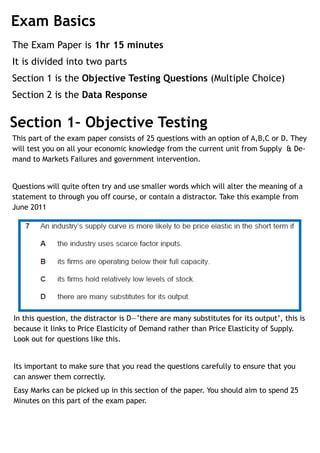
statement to through you off course, or contain a distractor. Take this example from
June 2011


In this question, the distractor is D—’there are many substitutes for its output’, this is
because it links to Price Elasticity of Demand rather than Price Elasticity of Supply.
Look out for questions like this.


Its important to make sure that you read the questions carefully to ensure that you
can answer them correctly.
Easy Marks can be picked up in this section of the paper. You should aim to spend 25
Minutes on this part of the exam paper.
Section 2– Data Response
In the exam you will have a choice of two sets of questions called Contexts. One will
be on Markets and the other on Market Failure. Both sets require similar structure but
will require different skills in each. Each context comes with 3 extracts which you
should study. One extract will always be a graph which shows two things on the same
graph. The others tend to be articles or information.


Question 1: Define [5 Marks]
This is the same for both contexts and will normally ask you to define a term men-
tioned in one of the extracts you have read. This question requires a simple one line
definition from you which is easy marks as it is work 5 marks.

E.g. January 2012: Define the term Composite Demand.
Composite Demand is where a good is demanded for two or more different purposes,
for example aluminium may be demanded for both the production of drinks cans and
aeroplanes
That was answer was awarded 5 marks


Question 2: Compare [8 Marks]
This requires the graph or chart extract. You should identify two significant points of
comparison which would be when a price peaked or was at a low. You must include
specific numerical values to gain top marks. Each comparison is worth 4 Marks.
To help the examiner place each comparison in a new paragraph.


Question 3: Mini Essay [12 Marks]
This question in the paper will require that you use a diagram and a specific extract to
explain why something happens. In the Markets Context a simple Demand and Supply
Diagram are appropriate. In the Market Failure context and Externalities Graph is re-
quired.
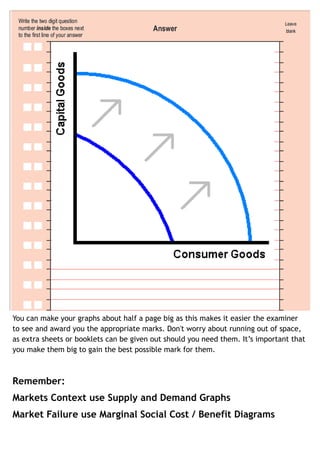
You should make your graphs big not small (see over page). Make sure that you do the
following:
   Label the Axis
   Use a Ruler
   Label the Curves
   Use lines to indicate areas of importance e.g. Price Level or Quantity Demanded
You can make your graphs about half a page big as this makes it easier the examiner
to see and award you the appropriate marks. Don't worry about running out of space,
as extra sheets or booklets can be given out should you need them. It’s important that
you make them big to gain the best possible mark for them.


Remember:
Markets Context use Supply and Demand Graphs
Market Failure use Marginal Social Cost / Benefit Diagrams
Question 4: Essay [25 Marks]
 In this question you will be presented with an evaluate style question. You should aim
 to make use of the extracts as these are likely to contain vital information to help you
 complete the exam question.
 You can pick up easy marks here by defining the term in which you are going to evalu-
 ate as this would ground your economic knowledge and use of specialist vocabulary.
 When evaluating you should go through the options that would be available in relation
 to your question and analyse each one.
 You can look at ISWOT to make your evaluation better and allow it cover the maximum
 amount of areas available for evaluation.
 Using a graph here would also add marks, and make you look like a more serious eco-
 nomic student


 Evaluating ISWOT
                     Evaluation can gain a candidate a good amount of marks and if
                     done right you can be right on the money!
                     Impact: it is important that with all economic decisions that you
                     mention as to how far they go what would be affected or who
                     would be affected by the policy
                     Short Run/ Long Run: All decisions or options are going to have
ISWOT


                     short run and long term effects and it is up to you to decide what
                     they might be. For example a buffer stock scheme may in the
                     long run affect price levels but in the short run its effectiveness
                     may be limited
                     Weaknesses/Strengths: Policies or decisions are likely to be
                     stronger or weaker than others, so comment on these.
                     Opportunity Cost / Other Things Remain Equal: A decision is
                     likely to have an opportunity cost attached to it so comment on
                     it, what could the money required be used for if not the decision.
                     Most policies or decisions assume that everything else remains
                     equal and it is likely that it wont, so therefore comment on the
                     changing circumstances
                     Time Lag: All policies will have a delay in coming into effect such
                     as the building of motorways will take time for the positive exter-
                     nalities to be felt as well as the negatives such as pollution


                     Follow this to ensure a sound evaluation in your exam

Markets & Market Failure Exam Question Guide

  • 1.
    Markets & MarketFailure Guide to the Exam Tips, Techniques, & Structure
  • 2.
    Exam Basics The ExamPaper is 1hr 15 minutes It is divided into two parts Section 1 is the Objective Testing Questions (Multiple Choice) Section 2 is the Data Response Section 1– Objective Testing This part of the exam paper consists of 25 questions with an option of A,B,C or D. They will test you on all your economic knowledge from the current unit from Supply & De- mand to Markets Failures and government intervention. Questions will quite often try and use smaller words which will alter the meaning of a statement to through you off course, or contain a distractor. Take this example from June 2011 In this question, the distractor is D—’there are many substitutes for its output’, this is because it links to Price Elasticity of Demand rather than Price Elasticity of Supply. Look out for questions like this. Its important to make sure that you read the questions carefully to ensure that you can answer them correctly. Easy Marks can be picked up in this section of the paper. You should aim to spend 25 Minutes on this part of the exam paper.
  • 3.
    Section 2– DataResponse In the exam you will have a choice of two sets of questions called Contexts. One will be on Markets and the other on Market Failure. Both sets require similar structure but will require different skills in each. Each context comes with 3 extracts which you should study. One extract will always be a graph which shows two things on the same graph. The others tend to be articles or information. Question 1: Define [5 Marks] This is the same for both contexts and will normally ask you to define a term men- tioned in one of the extracts you have read. This question requires a simple one line definition from you which is easy marks as it is work 5 marks. E.g. January 2012: Define the term Composite Demand. Composite Demand is where a good is demanded for two or more different purposes, for example aluminium may be demanded for both the production of drinks cans and aeroplanes That was answer was awarded 5 marks Question 2: Compare [8 Marks] This requires the graph or chart extract. You should identify two significant points of comparison which would be when a price peaked or was at a low. You must include specific numerical values to gain top marks. Each comparison is worth 4 Marks. To help the examiner place each comparison in a new paragraph. Question 3: Mini Essay [12 Marks] This question in the paper will require that you use a diagram and a specific extract to explain why something happens. In the Markets Context a simple Demand and Supply Diagram are appropriate. In the Market Failure context and Externalities Graph is re- quired. You should make your graphs big not small (see over page). Make sure that you do the following:  Label the Axis  Use a Ruler  Label the Curves  Use lines to indicate areas of importance e.g. Price Level or Quantity Demanded
  • 4.
    You can makeyour graphs about half a page big as this makes it easier the examiner to see and award you the appropriate marks. Don't worry about running out of space, as extra sheets or booklets can be given out should you need them. It’s important that you make them big to gain the best possible mark for them. Remember: Markets Context use Supply and Demand Graphs Market Failure use Marginal Social Cost / Benefit Diagrams
  • 5.
    Question 4: Essay[25 Marks] In this question you will be presented with an evaluate style question. You should aim to make use of the extracts as these are likely to contain vital information to help you complete the exam question. You can pick up easy marks here by defining the term in which you are going to evalu- ate as this would ground your economic knowledge and use of specialist vocabulary. When evaluating you should go through the options that would be available in relation to your question and analyse each one. You can look at ISWOT to make your evaluation better and allow it cover the maximum amount of areas available for evaluation. Using a graph here would also add marks, and make you look like a more serious eco- nomic student Evaluating ISWOT Evaluation can gain a candidate a good amount of marks and if done right you can be right on the money! Impact: it is important that with all economic decisions that you mention as to how far they go what would be affected or who would be affected by the policy Short Run/ Long Run: All decisions or options are going to have ISWOT short run and long term effects and it is up to you to decide what they might be. For example a buffer stock scheme may in the long run affect price levels but in the short run its effectiveness may be limited Weaknesses/Strengths: Policies or decisions are likely to be stronger or weaker than others, so comment on these. Opportunity Cost / Other Things Remain Equal: A decision is likely to have an opportunity cost attached to it so comment on it, what could the money required be used for if not the decision. Most policies or decisions assume that everything else remains equal and it is likely that it wont, so therefore comment on the changing circumstances Time Lag: All policies will have a delay in coming into effect such as the building of motorways will take time for the positive exter- nalities to be felt as well as the negatives such as pollution Follow this to ensure a sound evaluation in your exam