If you no longer require this review copy,
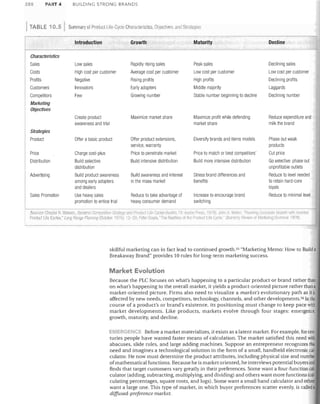
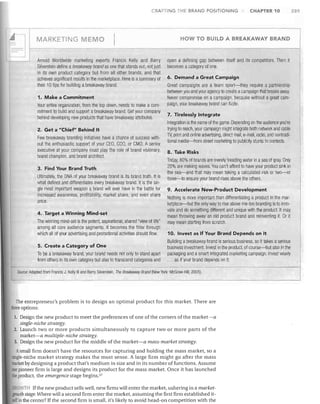
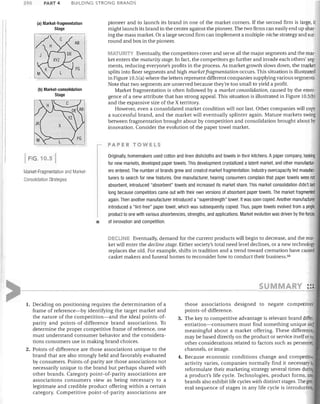
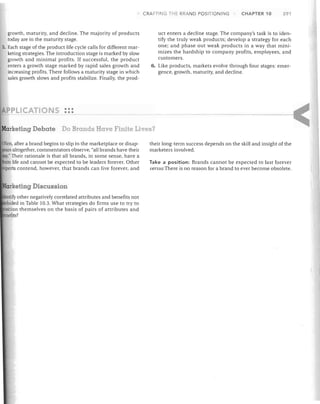
please return it to Pearson Education
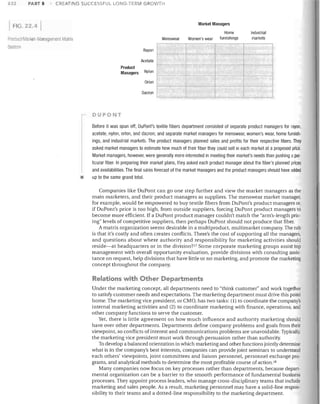
and we will donate $1 to Jumpstart
for children who need our help.
---l---r_ __ _J,-__

T
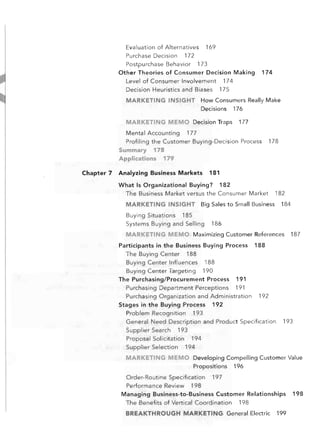
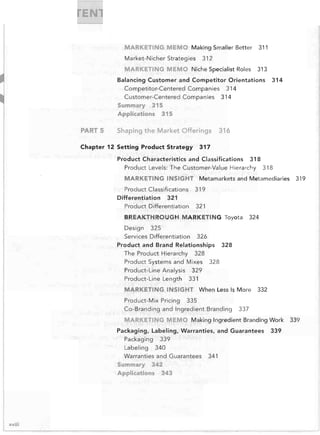
Preface xxix

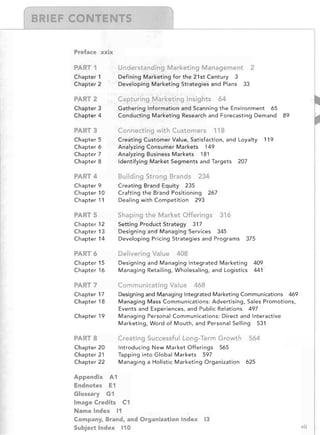
PART 1

Understanding Marketing Management
 2

Chapter 1
Chapter 2

Defining Marketing for the 21 st Century 3

Developing Marketing Strategies and Plans 33


AR

2

Capturing Marketing Insights

Chapter 3
Chapter 4

ART
Chapter
Chapter
Chapter
Chapter

Connecting with Customers
5
6
7
8

64


Gathering Information and Scanning the Environment 65

Conducting Marketing Research and Forecasting Demand 89


118


Creating Customer Value, Satisfaction, and Loyalty
Analyzing Consumer Markets 149

Analyzing Business Markets 181

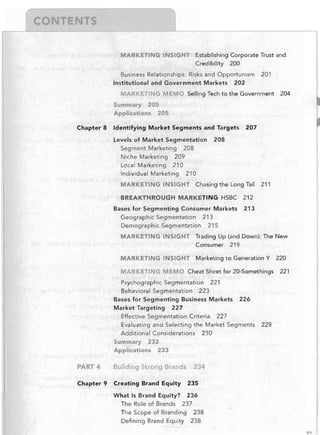
Identifying Market Segments and Targets 207


119


PART 4

Building Strong Brands

Chapter 9
Chapter 10
Chapter 11

Creating Brand Equity 235

Crafting the Brand Positioning 267

Dealing with Competition 293


PART 5

Shaping the Market Offerings

Chapter 12
Chapter 13
Chapter 14

Setting Product Strategy 317

Designing and Managing Services 345

Developing Pricing Strategies and Programs

PART 6

Delivering Value

Chapter 15
Chapter 16

Designing and Managing Integrated Marketing
Managing Retailing, Wholesaling, and Logistics

PA T7

Communicating Value

Chapter 17
Chapter 18

Designing and Managing Integrated Marketing Communications 469

Managing Mass Communications: Advertising, Sales Promotions,

Events and Experiences, and Public Relations 497

Managing Personal Communications: Direct and Interactive

Marketing, Word of Mouth, and Personal Selling 531


Chapter 19

234


316


375


408

409

441'


468


PARTS

Creating Successful Long-Term Growth

Chapter 20
Chapter 21
Chapter 22

Introducing New Market Offerings 565

Tapping into Global Markets 597

Managing a Holistic Marketing Organization

Appendix A1

Endnotes E1

Glossary G1

Image Credits C1

Name Index 11

Company, Brand, and Organization Index
Subject Index 110


564


625


13

vii
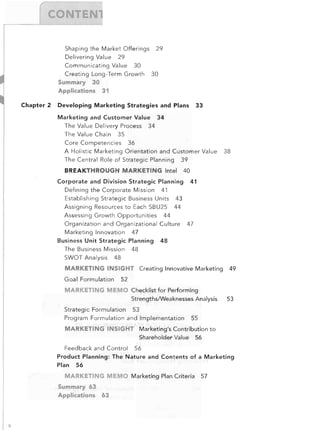
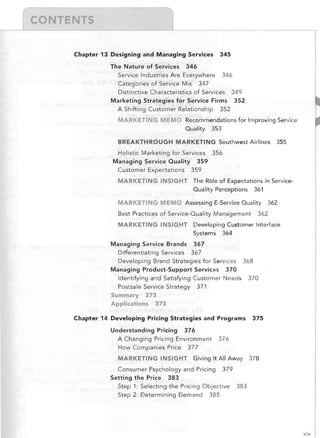
Preface xxix

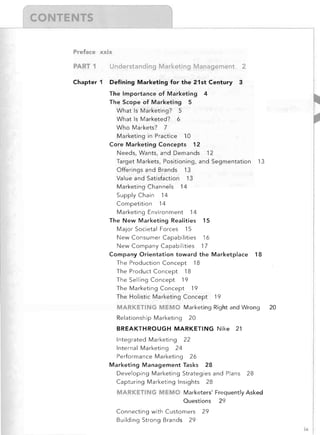
PART 1

Understanding Marketing Management

Chapter 1

Defining Marketing for the 21st Century
The Importance of Marketing
The Scope of Marketing 5


2

3


4


What Is Marketing? 5

What Is Marketed? 6

Who Markets? 7

Marketing in Practice 10

Core Marketing Concepts 12

Needs, Wants, and Demands 12

Target Markets, Positioning, and Segmentation
Offerings and Brands 13


13


Value and Satisfaction 13

Marketing Channels 14

Supply Chain 14

Competition 14

Marketing Environment 14

The New Marketing Realities 15

Major Societal Forces 15

New Consumer Capabilities

16


New Company Capabilities 17

Company Orientation toward the Marketplace

18


The Production Concept 18

The Product Concept 18

The Selling Concept 19

The Marketing Concept 19

The Holistic Marketing Concept

19


MARKETING MEMO	 Marketing Right and Wrong
Relationship Marketing

20


20


BREAKTHROUGH MARKETING Nike
Integrated Marketing 22

Internal Marketing 24

Performance Marketing 26

Marketing Management Tasks

21


28


Developing Marketing Strategies and Plans
Capturing Marketing Insights 28


28


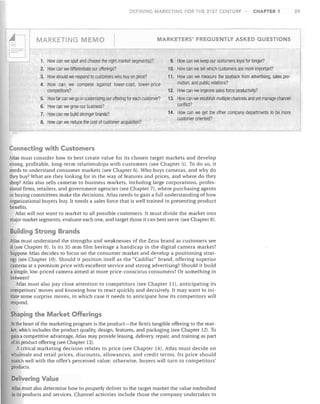
MARKETING MEMO	 Marketers' Frequently Asked

Questions

29


Connecting with Customers 29

Building Strong Brands 29

ix
E


Shaping the Market Offerings
Delivering Value

29


29


Communicating Value

30


Creating Long-Term Growth

30


Summary 30

Applications 31

Chapter 2

33


Developing	 Marketing Strategies and Plans
Marketing and Customer Value 34

The Value Delivery Process 34

The Value Chain 35

Core Competencies

36


A Holistic Marketing Orientation and Customer Value
The Central Role of Strategic Planning

BREAKTHROUGH MARKETING Intel

40


Corporate and Division Strategic Planning
Defining the Corporate Mission

38


39


41


41


Establishing Strategic Business Units

43


Assigning Resources to Each SBU25

44


Assessing Growth Opportunities

44


Organization and Organizational Culture
Marketing Innovation

Business Unit Strategic Planning
The Business Mission	 48

SWOT Analysis

47


47


48


48


MARKETING INSIGHT	 Creating Innovative Marketing
Goal Formulation

MARKETI

49


52


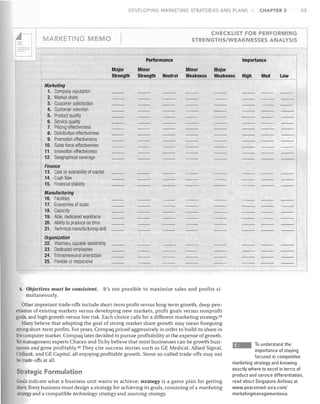
MEMO	 Checklist for Performing

StrengthslWeaknesses Analysis

53


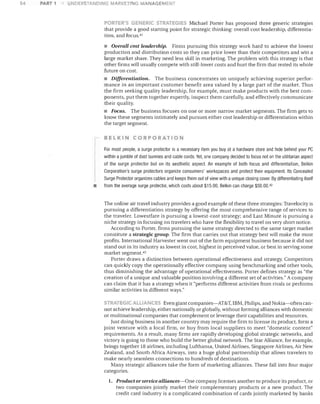
Strategic Formulation	 53

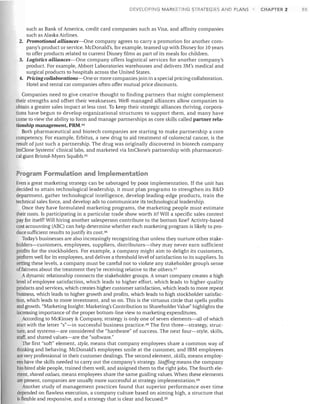
Program Formulation and	 tmplementation

55


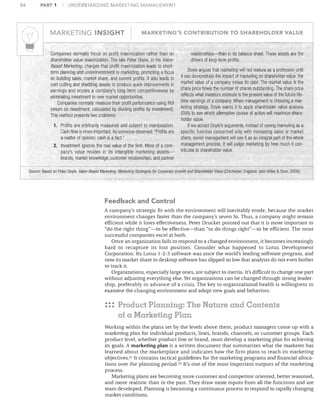
MARKETING INSIGHT	 Marketing's Contribution to

Shareholder Value
Feedback and Control

56


56


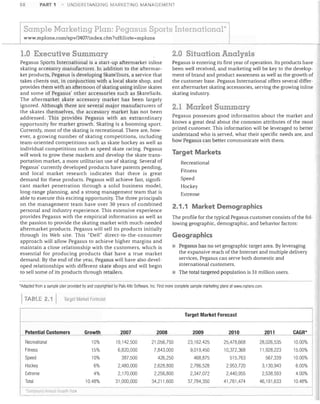
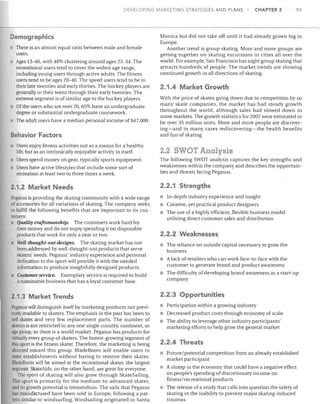
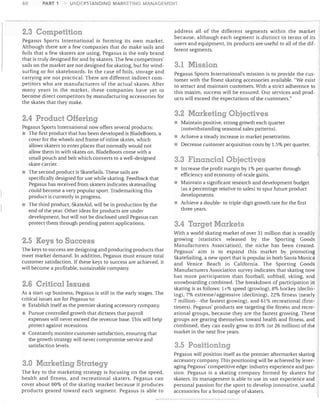
Product Planning: The Nature and Contents of a Marketing

Plan 56


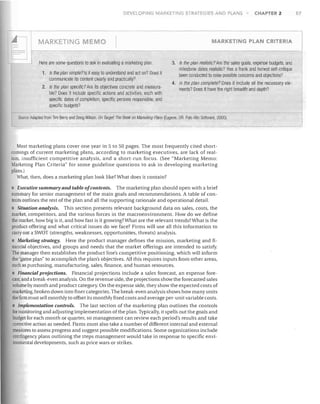
MARKETING MEMO Marketing Plan Criteria
Summary 63

Applications

;.

63


57
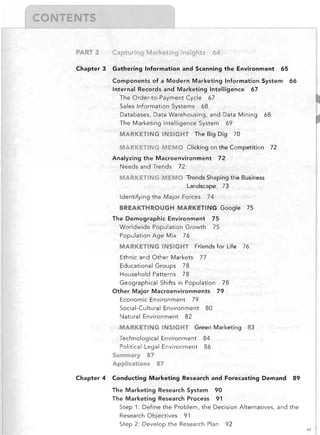
PART 2

Capturing Marketing Insights

64


Chapter 3

Gathering Information and Scanning the Environment

65


Components of a Modern Marketing Information System
Internal Records and Marketing Intelligence 67

The Order-to-Payment Cycle 67

Sales Information Systems 68

Databases, Data Warehousing, and Data Mining 68

The Markehng Intelligence System 69

MARKETING INSIGHT The Big Dig

66


70


MARKETING MEMO Clicking on the Competition

72


72


Analyzing the Macroenvironment
Needs and Trends 72


MARKET NG MEMO Trends Shaping the Business

Landscape 73


74


Identifying the Major Forces

BREAKTHROUGH MARKETING Google
The Demographic Environment
Worldwide Population Growth
Population Age Mix 76

MARKETING INSIGHT

75


75

75


Friends for Life

76


Ethnic and Other Markets 77

Educational Groups 78

Household Patterns 78

Geographical Shifts in Population 78

Other Major Macroenvironments 79

Economic Environment 79

Social-Cultural Environment 80

Natural Environment 82

MARKETING INSIGHT

Green Marketing

Technological Environment
Political-Legal Environment
Summary 87

Applications 87

Chapter 4

83


84


86


Conducting Marketing Research and Forecasting Demand

89


The Marketing Research System 90

The Marketing Research Process 9~

Step 1: Define the Problem, the Decision Alternatives, and the

Research Objectives 91

Step 2: Develop the Research Plan 92

xi
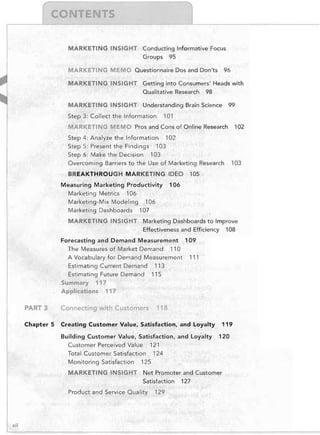
MARKETING INSIGHT	 Conducting Informative Focus

Groups 95

MARKETING MEMO Questionnaire Dos and Don'ts

96


MARKETING INSIGHT	 Getting into Consumers' Heads with

Qualitative Research 98

MARKETING INSIGHT	 Understanding Brain Science
Step 3: Collect the Information

99


101


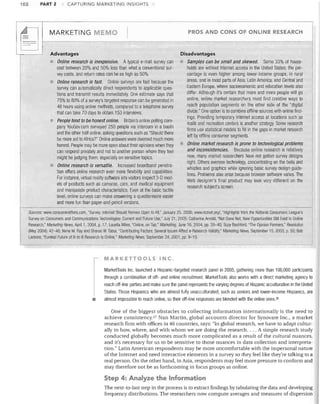
MARKETING MEMO Pros and Cons of Online Research
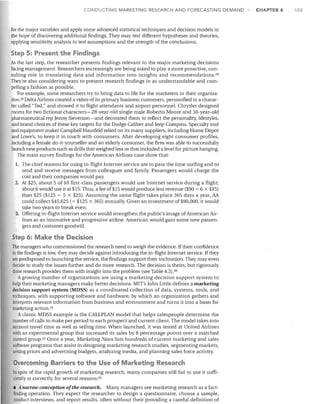
Step 4: Analyze the Information 102

Step 5: Present the Findings 103

Step 6: Make the Decision 103

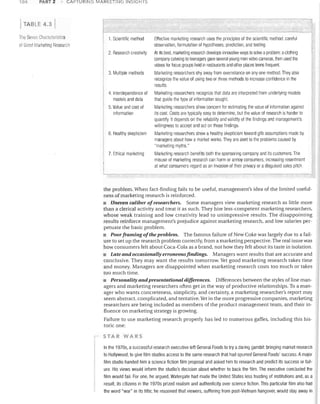
Overcoming Barriers to the Use of Marketing Research
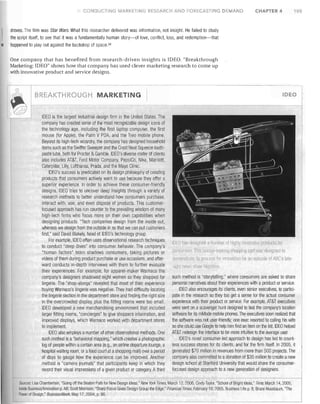
BREAKTHROUGH MARKETING IDEO
Measuring Marketing Productivity
Marketing Metrics 106

Marketing-Mix Modeling 106

Marketing Dashboards 107

MARKETING INSIGHT

102


103


105


106


Marketing Dashboards to Improve

Effectiveness and Efficiency 108


Forecasting and Demand Measurement 109

The Measures of Market Demand 110

A Vocabulary for Demand Measurement 111

Estimating Current Demand 113

Estimating Future Demand 115

Summary 117

Applications 117


PART 3

Connecting with Customers

Chapter 5

Creating Customer Value, Satisfaction, and Loyalty

118


Building Customer Value, Satisfaction, and loyalty
Customer Perceived Value 121

Total Customer Satisfaction 124

Monitoring Satisfaction 125

MARKETING INSIGHT

120


Net Promoter and Customer

Satisfaction 127


Product and Service Quality

xli

119


129
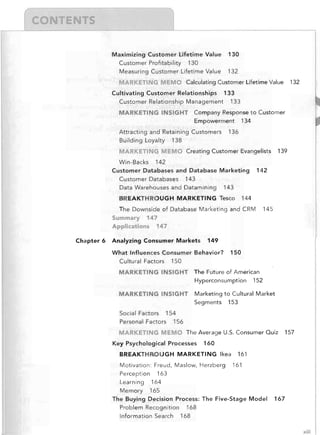
Maximizing Customer Lifetime Value

130

130

Customer Profitability

132

Measuring Customer Lifetime Value

ARKETI G MEMO Calculating Customer Lifetime Value
Cultivating Customer Relationships

132

133

133

Customer Relationship Management

MARKETING INSIGHT Company Response to Customer
Empowerment 134
136

Attracting and Retaining Customers
Building Loyalty

138

MA KETI G MEMO Creating Customer Evangelists
142

Win-Backs

Customer Databases and Database Marketing

142

143

Customer Databases

Data Warehouses and Datamining

143

BREAKTHROUGH MARKETING Tesco

144

The Downside of Database Marketing and CRM

Summary

139

145

147
147

Applications
Chapter 6

Analyzing Consumer Markets

149

What Influences Consumer Behavior?
Cultura! Factors

150

150

MARKETING INSIGHT The Future of American
Hyperconsumption 152
MARKETING INSIGHT

Marketing to Cultural Market
Segments

153

154
Personal Factors 156

Social Factors

MARKETING MEMO The Average U.s. Consumer Quiz
Key Psychological Processes

160

BREAKTHROUGH MARKETING Ikea
Motivation: Freud, Maslow, Herzberg
Perception

157

161
161

163

Learning

164

Memory

165

The Buying Decision Process: The Five-Stage Model
Problem Reco9nition
Information Search

167

168
168
xlii
Evaluation of Alternatives

169


Purchase Decision 172

Postpurchase Behavior 173

Other Theories of Consumer Decision Making

174


Level of Consumer Involvement 174

Decision Heuristics and Biases 175

MARKETING INSIGHT	 How Consumers Really Make

Decisions 176

MARKETING MEMO	 Decision Traps
Mental Accounting

177


177


Profiling the Customer Buying-Decision Process
Summary 178

Applications 179

Chapter 7

Analyzing	 Business Markets

178


181


What Is Organizational Buying? 182

The Business Market versus the Consumer Market

182


MARKETING INSIGHT	 Big Sales to Small Business
Buying Situations 185

Systems Buying and Selling

184


186


MARKETING MEMO	 Maximizing Customer References
Participants in the Business Buying Process
The Buying Center 188

Buying Center Influences 188

Buying Center Targeting 190

The Purchasing/Procurement Process

188


191


Purchasing Department Perceptions 191

Purchasing Organization and Administration
Stages in the Buying 'Process 192

Problem Recognition

187


192


193


General Need Description and Product Specification
Supplier Search 193


193


Proposal Solicitation 194

Supplier Selection 194

MARKETING MEMO	 Developing Compelling Customer Value

Propositions

196


Order-Routine Specification 197

Performance Review 198

Managing Business-to-Business Customer Relationships
The Benefits of Vertical Coordination

198


BREAKTHROUGH MARKETING General Electric

199


198
MARKETING INSIGHT

Establishing Corporate Trust and

Credibility 200


Business Relationships: Risks and Opportunism
Institutional and Government Markets 202


201


A KETt G MEMO Selling Tech to the Government

204


Summary 205

Applications 205

Chapter 8

Identifying Market Segments and Targets
Levels of Market Segmentation
Segment Marketing 208

lIiche Marketing 209

Local Marketing 210

Individual Marketing 210


207


208


MARKETING INSIGHT Chasing the Long Tall
BREAKTHROUGH MARKETING HSBC

212


Bases for Segmenting Consumer Markets
Geographic Segmentation 213

Demographic Segmentation 215


211


213


MARKETING INSIGHT Trading Up (and Down): The New

Consumer 219

MARKETING INSIGHT Marketing to Generation Y 220

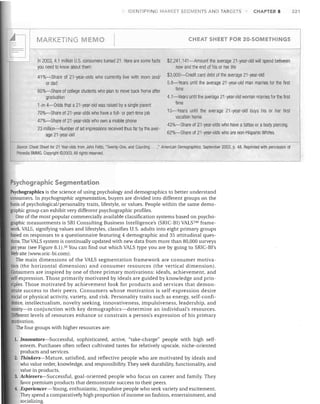
MARKETING M MO Cheat Sheet for 20-Somethin'gs
Psychographic Segmentation 221

Behavioral Segmentation 223

Bases for Segmenting Business Markets 226

Market Targeting 227

Effective Segmentation Criteria 227

Evaluating and Selecting the Market Segments
Additional Considerations 230

Summary 232

Applications 233


PART 4

Building Strong Brands

Chapter 9

Creating Brand Equity

221


228


234

235


What Is Brand Equity? 236

The Role of Brands 237

The Scope of Branding 238

Defining Brand Equity 238

xv
r

"


T

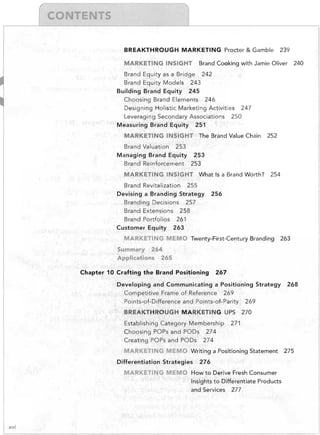
BREAKTHROUGH MARKETING Procter & Gamble
MARKETING INSIGHT

239


Brand Cooking with Jamie Oliver

240


Brand Equity as a Bridge 242

Brand Equity Models 243

Building Brand Equity 245

Choosing Brand Elements 246

Designing Holistic Marketing Activities 247

Leveraging Secondary Associations 250

Measuring Brand Equity 251

MARKETING INSIGHT The Brand Value Chain

252


Brand Valuation 253

Managing Brand Equity 253

Brand Reinforcement 253

MARKETING INSIGHT What Is a Brand Worth?

Brand Revitalization 255

Devising a Branding Strategy
Branding Decisions 2'57

Brand Extensions 258

Brand Portfolios 261

Customer Equity 263


254


256


MARKETING MEMO Twenty-First-Century Branding

263


Summary 264

Applications 265

Chapter 10 Crafting the Brand Positioning

267


Developing and Communicating a Positioning Strategy
Competitive Frame of Reference 269

Points-of-Difference and Points-of-Parity 269

BREAKTHROUGH MARKETING UPS

Establishing Category Membership
Choosing POPs and PODs 274

Creating POPs and PODs 274


270


271


MARKET1NG MEMO	 Writing a Positioning Statement

Differentiation Strategies

276


MARKETING MEMO	 How to Derive Fresh Consumer

Insights to Differentiate Products

and Services 277


xvi

268


275
"

I


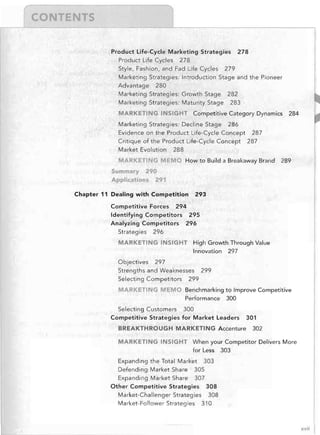
Product Life-Cycle Marketing Strategies
Product Life Cycles 278

Style, Fashion, and Fad Life Cycles

278


279


Marketing Strategies: Introduction Stage and the Pioneer

Advantage 280

Marketing Strategies: Growth Stage 282

Marketing Strategies: Maturity Stage

283


MARKETING INSIGHT	 Competitive Category Dynamics
Marketing Strategies: Decline Stage 286

Evidence on the Product Life-Cycle Concept
Critique of the Product Life-Cycle Concept
Market Evolution 288


284


287

287


MARKETI G MEMO	 How to Build a Breakaway Brand

289


Summary

290

Applications 291


Chapter 11 Dealing with	 Competition
Competitive Forces

293


294


Identifying Competitors 295

Analyzing Competitors	 296

Strategies

296


MARKETING INSIGHT	 High Growth Through Value

Innovation
Objectives

297


297


Strengths and Weaknesses 299

Selecting Competitors 299


MARKETING MEM	

Benchmarking to Improve Competitive

Performance 300


Selecting Customers	 300

Competitive Strategies for Market Leaders

BREAKTHROUGH MARKETING Accenture

301

302


MARKETING INSIGHT	 When your Competitor Delivers More

for Less

303


Expanding the Total Market 303

Defending Market Share 305

Expanding Market Share 307

Other Competitive Strategies 308

Market-Challenger Strategies 308

Market-Follower Strategies 310


xvii
MARKETING MEMO Making Smailer Better
Market-Nicher Strategies

311


312


MARKETING MEMO Niche Specialist Roles

313


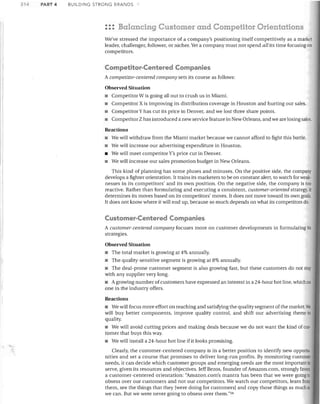
Balancing Customer and Competitor Orientations

314


Competitor-Centered Companies 314

Customer-Centered Companies 314

Summary

315


Applications

PARTS	

315


Shaping the Market Offerings

Chapter 12	 Setting Product Strategy

316


317


Product Characteristics and Classifications

318


Product Levels: The Customer-Value Hierarchy

MARKETING INSIGHT
Product Classifications
Differentiation 321

Product Differentiation

Metamarkets and Metamediaries

321

324


326


Product and	 Brand Relationships
The Product Hierarchy 328

Product Systems and Mixes
Product-Line Analysis 329

Product-Line Length 331


328


328


MARKETING INSIGHT When Less Is More
Product-Mix Pricing

332


335


Co-Branding and Ingredient Branding

337


MARKETING MEMO Making Ingredient Branding Work
Packaging, Labeling, Warranties, and Guarantees
Packaging 339

Labeling 340

Warranties and Guarantees
Summary

342


Applications

xviii

343


319


319


BREAKTHROUGH MARKETING Toyota
Design 325

Services Differentiation

318


341


339


339
Chapter 13 Designing	 and Managing Services
The Nature of Services 346

Service Industries Are Everywhere

345


346


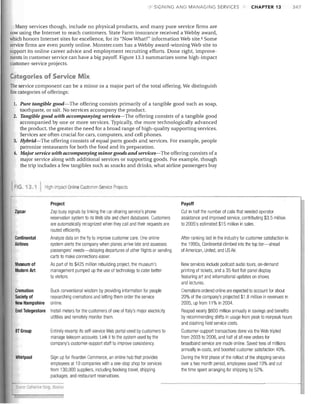
Categories of Service Mix 347

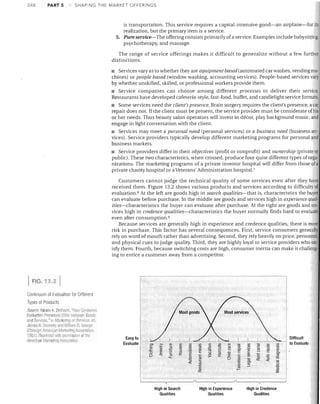
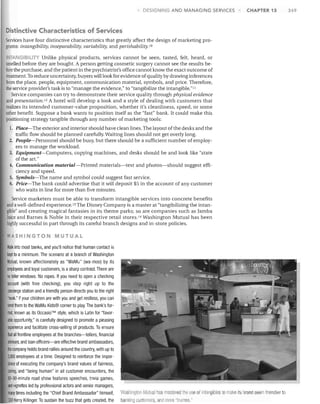
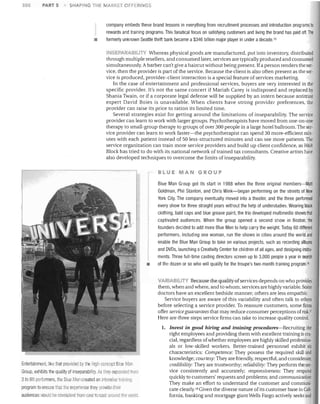
Distinctive Characteristics of Services 349

Marketing Strategies for Service Firms 352

A Shifting Customer Relationship

352


MARKETING MEMO	 Recommendations for Improving Service

Quality

353


BREAKTHROUGH MARKETING Southwest Airlines
Holistic Marketing for Services

355


356


Managing Service Quality 359

Customer Expectations 359

MARKETING INSIGHT	 The Role of Expectations in Service­

Quality Perceptions 361

MARKETING MEMO	 Assessing E-Service Quality

362


362


Best Practices of Service-Quality Management

MARKETING INSIGHT	 Developing Customer Interface

Systems 364

Managing Service Brands 367

Differentiating Services 367

Developing Brand Strategies for Services 368

Managing Product-Support Servkes 370

Identifying and Satisfying Customer Needs
Postsale Service Strategy 371


370


Summary 373

Applications 373

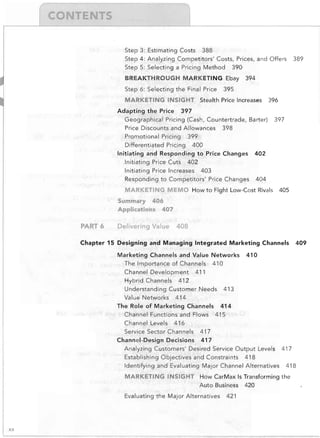
Chapter 14 Developing	 Pricing Strategies and Programs
Understanding Pricing

375


376


A Changing Pricing Environment
How Companies Price 377

MARKETING INSIGHT

376


Giving It All Away

Consumer Psychology and Pricing
Setting the Price 383


378


379


Step 1: Selecting the Pricing Objective
Step 2: Determining Demand 385


383


xix
r

Step 3: Estimating Costs 388

Step 4: Analyzing Competitors' Costs, Prices, and Offers
Step 5: Selecting a Pricing Method

390


BREAKTHROUGH MARKETING Ebay
Step 6: Selecting the Final Price

394


395


MARKETING INSIGHT	 Stealth Price Increases
Adapting the Price

389


396


397


Geographical Pricing (Cash, Countertrade, Barter)
Price Discounts and Allowances 398

Promotional Pricing 399

Differentiated Pricing 400

Initiating and Responding to Price Changes

397


402


Initiating Price Cuts 402

Initiating Price Increases 403

Responding to Competitors' Price Changes

404


MARKETING ME:MO How to Fight Low-Cost Rivals

405


Summary 406

Applications 407


PART 6

Delivering Value

408


Chapter 15 Designing and Managing Integrated Marketing Channels
Marketing Channels and Value Networks
The Importance of Channels 410

Channel Development 411

Hybrid Channels 412

Understanding Customer Needs

409


410


413


Value Networks 414

The Role of Marketing Channels 414

Channel Functions and Flows 415

Channel Levels 416

Service Sector Channels
Channel-Design Decisions

417

417


Analyzing Customers' Desired Service Output

Leve~s

Establishing Objectives and Constraints 418

Identifying and Evaluating Major Channel Alternatives

417

418


MARKETING INSIGHT	 How CarMax Is Transforming the

Auto Business 420

Evaluating the Major Alternatives

xx

421
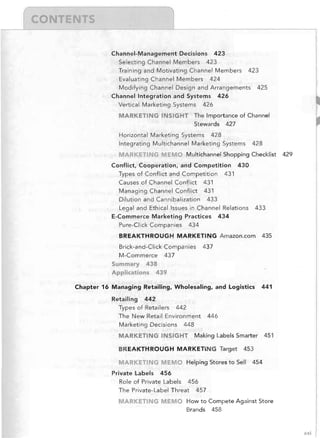
Channel-Management Decisions 423
Selecting Channel Members 423
Training and Motivating Channel Members

423

Evaluating Channel Members 424
Modifying Channel Design and Arrangements
Channel Integration and Systems 426
Vertical Marketing Systems

425

426

MARKETING INSIGHT The Importance of Channel
Stewards

427

Horizontal Marketing Systems 428
Integrating Multichannel Marketing Systems

TI

MEM

428

Multichannel Shopping Checklist

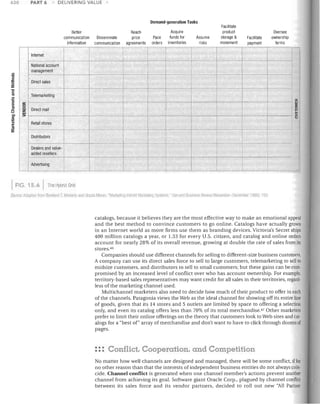
Conflict, Cooperation, and Competition
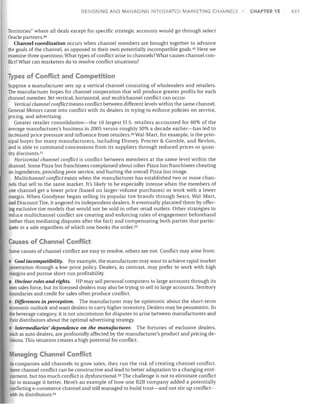
Types of Conflict and Competition
Causes of Channel Conflict 431
Managing Channel Conflict 431

430

431

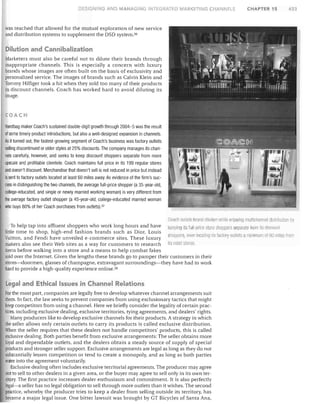
Dilution and Cannibalization 433
Legal and Ethical Issues in Channel Relations
E-Commerce Marketing Practices 434
Pure-Click Companies

433

434

BREAKTHROUGH: MARKETING Amazon.com
Brick-and-Click Companies
M-Commerce 437

Summary

435

437

438

Applications

439

Chapter 16 Managing Retailing, Wholesaling, and Logistics
Retailing

429

441

442

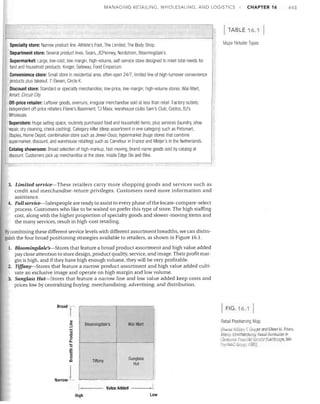
Types of Retailers 442
The New Retail Environment
Marketing Decisions

446

448

MARKETING INSIGHT Making Labels Smarter 451
BREAKTHROUGH MARKETING Target
M

RKETING ME

Private Labels

453

0 Helping Stores to Sell

454

456

Role of Private Labels 456
The Private-Label Threat 457

MARKETING MEMO How to Compete Against Store
Brands

458

xxi
•

Wholesaling

458

Trends in Wholesaling
Market Logistics

459

461

Integrated Logistics Systems
Market-Logistics Objectives
Market-Logistics Decisions
Organizational Lessons

Summary

462
462
464

466

467
467

Applications

PART 7

Communicating Value

468

Chapter 17 Designing and Managing Integrated Marketing
Communications 469
The Role of Marketing Communications

470

The Changing Marketing Communication Environment
Marketing Communications, Brand Equity, and Sales
the Communications Process Models

474

Developing Effective Communications

470
471

476

Identify the Target Audience

476

Determi,ne the Communications Objectives
Design the Communications

477

477

MARKETING INSIGHT Celebrity Endorsements as
a Strategy

480

481
Establish the Total Marketing Communications Budget 484
Deciding on the Marketing Communications Mix 486
Characteristics of the Marketing Communications Mix 486
Select the Communications Channels

BREAKTHROUGH MARKETING Ocean Spray

486

Factors in Setting the Marketing Communications Mix

491
Managing the Integrated Marketing Communications
Process 491
Coordinating Media 492
Implementing IMC 493
Measuring Communication Results

MARKETING MEMO How Integrated Is Your IMC
Program?

Summary

494
Applications 495

494

489
_[

1.-'---_ _
Chapter 18 Managing Mass Communications: Advertising, Sales
Promotions, Events and Experiences, and Public
Relations 497

498

Developing and Managing an Advertising Program
Setting the Objectives 499
Deciding on the Advertising Budget 499
Developing the Advertising Campaign 500
MARKETI

G M MO Print Ad Evaluation Criteria

Deciding on Media and Measuring Effectiveness
Deciding on Reach, Frequency, and Impact
Choosing among Major Media Types 506

504
505

505

Alternative Advertising Options 508
Selecting Specific Media Vehicles 510
MARKETING INSIGHT

Playing Games with Brands

Deciding on Media Timing and Allocation
Evaluating Advertising Effectiveness 513
Sales Promotion 514
Objectives 514
Advertising versus Promotion
Major Decisions 516
Events and Experiences 520
Events Objectives 521
Major Sponsorship Decisions
Creating Experiences
Public Relations 523

512

515

521

523

MARKETING INSIGHT

Experiential Marketing

MARKETING INSIGHT

Managing a Brand Crisis

Marketing Public Relations

524
525

525

BREAKTHROUGH MARKETING Virgin Group
Major Decisions in Marketing PR
Summary

511

526

527

529

Applications

529

Chapter 19 Managing Personal Communications: D,i,rect and Interactive
Marketing, Word of Mouth, and Personal Selling
Direct Marketing 532
The Benefits of Direct Marketing
Direct Mail

531

532

534

Catalog Marketing

536

ywiii
Telemarketing

537

Other Media for Direct-Response Marketing

538

Public and Ethical Issues in Direct Marketing

538

Interactive Marketing

538

Advantages and Disadvantages of Interactive Marketing

BREAKTHROUGH MARKETING Yahoo!
Placing Ads and Promotions Online

MARKfTI
Word of Mouth

538

539

540

MEMO Segmenting Tech Users 542
545

Buzz and Viral Marketing
Opinion Leaders

546

548

MARKETING MEMO How to Start a Buzz Fire 548
Blogs

550

Measuring the Effects of Word of Mouth
Designing the Sales Force

Sales-Force Objectives and Strategy
Sales-Force Structure
Sales-Force Size

551

551
552

553

554

MARKETING INSIGHT Major Account Management
Sales-Force Compensation
Managing the Sales Force

555
556

Recruiting and Selecting Representatives

556

Training and Supervising Sales Representatives
Sales Rep Productivity

557

Motivating Sales Representatives

558

Evaluating Sales Representatives

559

Principles of Personal Selling
The Six Steps

561

561

Relationship Marketing

562

Summary 563
Applicatij)ns 563

PARTS

Creating Successful Long-Term Growth

Chapter 20 Introducing New Market Offerings
New-Product Options
Make or Buy

565

566

566

Types of New Products

566

Challenges in New-Product Development
The Innovation Imperative
New-Product Success
New-Product Failure
xxiv

564

569
570

567

567

557

555
--,

I/~-----------~'"	
Organizational Arrangements 571
Budgeting for New-Product Development 572
Organizing New-Product Development 573
Managing the Development Process: Ideas 574
Idea Generation 574
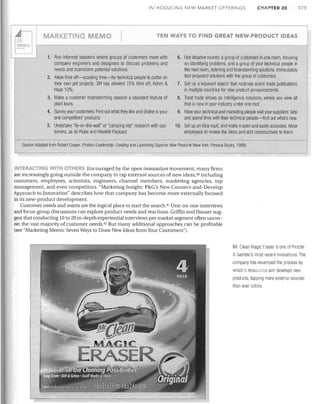
MARKET! G MEMO Ten Ways to Find Great New-Product
Ideas 575
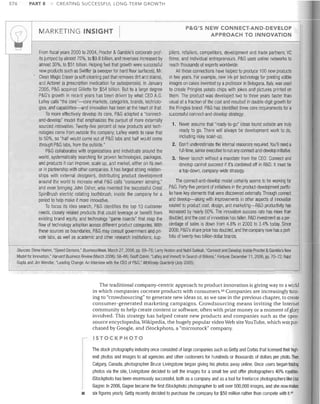
MARKETING INSIGHT

MARKETING

P&G'S New Connect-and-Develop
Approach to Innovation 576

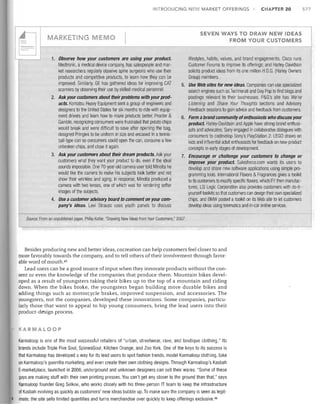
EMO Seven Ways to Draw New Ideas from
Your Customers 577

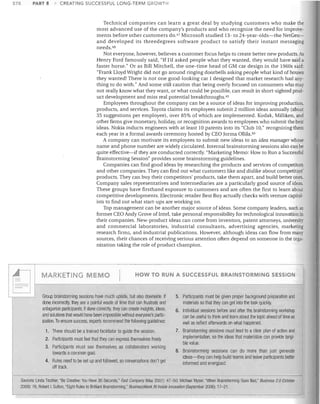
MARKETI G MEMO How to Run a Successful Brainstorming
Session 578
Idea Screening 579
Managing the Development Process: Concept to Strategy
Concept Development and Testing 581
Marketing Strategy Development 584
Business Analysis 584
Managing the Development Process: Development to
Commercialization 586
Product Development 586
Market Testing 587
Commercialization 590
BREAKTHROUGH MARKETING Apple Ipod
The Consumer-Adoption Process 592
Stages in the Adoption Process 592
Factors Influencing the Adoption Process
Summary 595
Applications 595
Chapter 21 Tapping into Global Markets

591

593

597

Competing on a Global Basis

581

598

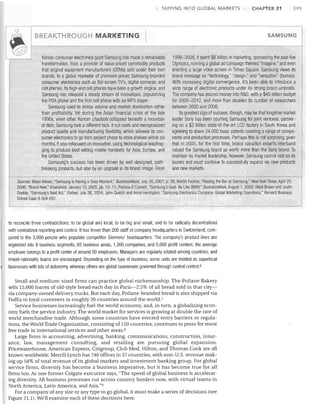
BREAKTHROUGH MARKETING Samsung
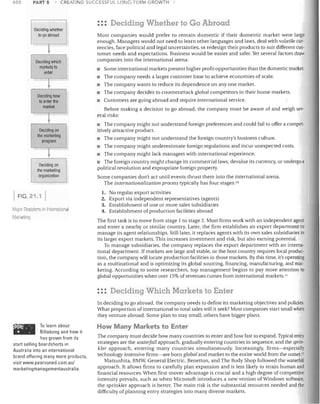
Deciding Whether to Go Abroad 600
Deciding Which Markets to Enter 600
How Many Markets to Enter 600
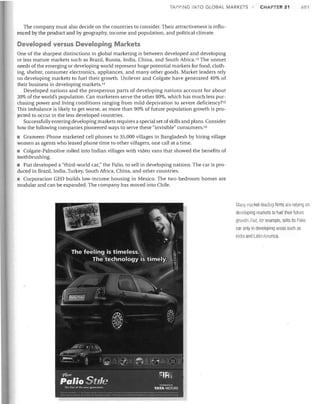
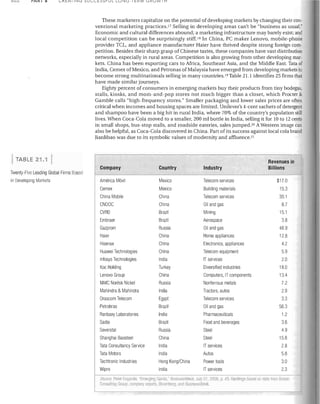
Developed versus Developing Markets

599

601

MARKETING INSIGHT Spotlight on Key Developing
Markets 604
Evaluating Potential Markets

605
xxv
'

Deciding How to Enter the Market 606
Indirect and Direct Export 606
Using a Global Web Strategy 607
Licensing 607
Joint Ventures 608
Direct Investment 609
Deciding on the Marketing Program 609
Product 611
MARKETING MEMO The Ten Commandments of Global
Branding 612
Communications
Price 615

613

MARKETING INSIGHT Unauthorized Sales-Dealing with
the Gray Market and Counterfeit
Products 617
Distribution Channels 618
Country-of-Origin Effects 619
Building Country Images 619
Consumer Perceptions of Country of Origin

620

MARKETING INSIGHT The Ups and Downs of Brand
America 621
Deciding on the Marketing Organization
Export Department 622
International Division 622
Global Organization 622
$u.mmary 623
Applications 623

621

Chapter 22 Managing a Holistic Marketing Organization
for the Long Run 625
Trends in Marketing Practices 626
Internal Marketing 627
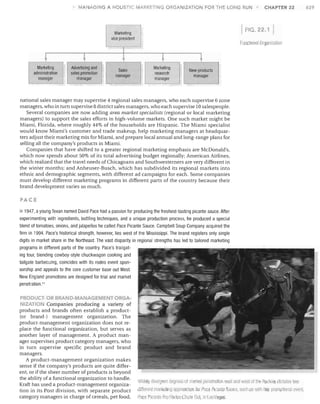
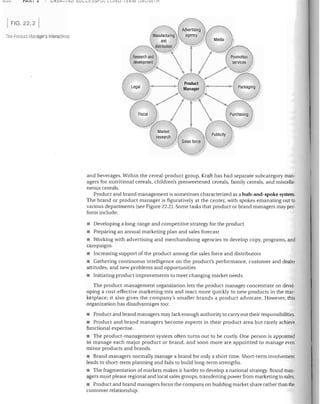
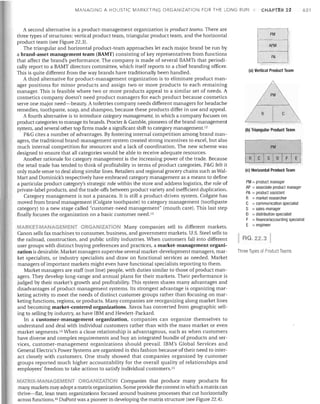
Organizing the Marketing Department

627

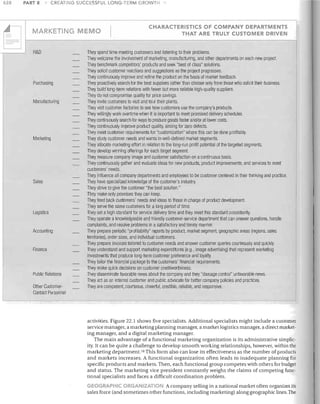
MARKET!NG MEMO Characteristics of Company Departments
That Are Truly Customer Driven 628
Relations with Other Departments 632
Building a Creative Marketing Organization
MARKETING INSIGHT The Marketing CEO

633
633

MARKETING MEMO Fueling Strategic Innovation
Socially Responsible Marketing
xxvi

634

634
BREAKTHROUGH MARKETING Starbucks
Corporate Social Responsibility 638
Socially Responsible Business Models
Cause-Related Marketing 640

637

640

MARKETING INSIGHT New Views on Corporate Social
Responsibility 641
Social Marketing

644

MARK TING MEMO Making a Difference

645

Marketing Implementation 648
Evaluation and Control 649
Annual-Plan Control 649
Profitability Control 652
Efficiency Control 656
Strategic Control 656
The Future of Marketing

657

MARKETING MEMO Major Marketing Weaknesses

660

Summary 661
Applications 662
Appendix A1
Endnotes E1
Glossary G1
Image Credits C1
Name Index 11
Company, Brand, and Organization Index
Subject Index 110

13

xxvii
Each title in the Pearson One series is part of a collaborative global editorial development
process that harnesses the talent and expertise of Pearson authors, editors, and production
people from all over the world. And we combine content from many cultures, giving stu­
dents greater insight into what they have in common with the world, and at the same time,
we offer material that is locally relevant.

: :: Our History
Pearson imprints have a rich heritage of academic, business, and professional books. For
more than 100 years, we have provided educational tools to more than 100 million people
across the globe. Our diverse network of brands encompasses a comprehensive range of
solutions in testing, ,assessment, and enterprise software; the very best in online consumer
and professional learning; and textbooks written by the most notable authors for higher
education around the world. We help teachers teach and students learn across the globe.

: :: The First in the Pearson One Series
Readers of the U.S. edition will benefit from these local perspectives and expertise through
our international case studies, authored by our partners worldwide. These cases will be
identified by a marginal note in each chapter linked to relevant content and available
through links on our Companion Website.

PEARSON

rr-­
UItC
,r~---------~---------~

r	

1
::: What Is Marketing Management All About?
Marketing Management is the leading marketing text because its content and organization
consistently reflect changes in marketing theory and practice, The very first edition of
Marketing Management, published in 1967, introduced the concept that companies must be
customer-and-market driven, But there was little mention of what have now become funda­
mental topics such as segmentation, targeting, and positioning, Concepts such as brand
equity, customer value analysis, database marketing, e-commerce, value networks, hybrid
channels, supply chain management, and integrated marketing communications were not
even part of the marketing vocabulary then, Marketing Management continues to reflect the
changes in the marketing discipline over the past forty years,
Firms now sell goods and services through a variety of direct and indirect channels. Mass
advertising is not nearly as effective as it was, so marketers are exploring new forms of com­
munication, such as experiential, entertainment, and viral marketing. Customers are telling
companies what types of product or services they want and when, where, and how they want
to buy them, They are increasingly reporting to other consumers what they think of specific
companies and products-using e-mail, blogs, podcasts, and other digital media to do so,
Company messages are becoming a smaller fraction of the total "conversation" about prod­
ucts and services,
In response, companies have shifted gears from managing product portfolios to manag­
ing customer portfolios, compiling databases on individual customers so they can under­
stand them better and construct individualized offerings and messages, They are doing less
product and service standardization and more niching and customization, They are replac­
ing monologues with customer dialogues, They are improving their methods of measuring
customer profitability and customer lifetime value. They are intent on measuring the return
on their marketing investment and its impact on shareholder value, They are also concerned
with the ethical and social implications of their marketing decisions,
As companies change, so does their marketing organization. Marketing is no longer a
company department charged with a limited number of tasks-it is a company-wide under­
taking, It drives the company's vision, mission, and strategic planning, Marketing indudes
decisions like who the company wants as its customers; which of their needs to satisfy; what
products and services to offer; what prices to set; what communications to send and receive;
what channels of distribution to use; and what partnerships to develop, Marketing succeeds
only when all departments work together to achieve goals: when engineering designs the
right products, finance furnishes the required funds, purchasing buys high-quality materials,
production makes high-quality products on time, and accounting measures the profitability
of different customers, products, and areas,
To address all these different shifts, good marketers are practicing holistic marketing.
Holistic marketing is the development, design, and implementation of marketing programs,
processes, and activities that recognize the breadth and interdependencies oftoday's market­
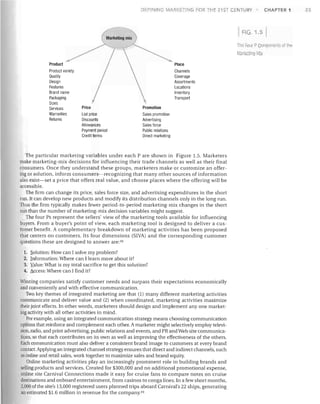
ing environment. Four key dimensions of holistic marketing are:
1.	 Internal marketing-ensuring everyone in the organization embraces appropriate mar­

keting principles, especially senior management,
2.	 Integrated marketing-ensuring that multiple means of creating, delivering, and com­
municating value are employed and combined in the best way,
3.	 Relationship marketing-having rich, multifaceted relationships with customers, chan­
nel members, and other marketing partners,
4.	 Performance marketing-understanding returns to the business from marketing activi­
ties and programs, as well as addressing broader concerns and their legal, ethical, social,
and environmental effects,
These four dimensions are woven throughout the book and at times spelled out explicitly,
The text specifically addresses the following tasks that constitute modern marketing manage­
ment in the 21st century:
/'	

PREr-~~t:::

I

1.	 Developing marketing strategies and plans
2.	 Capturing marketing insights and performance

3.	
4.	
5.	
6.	

Connecting with customers
Building strong brands
Shaping the market offerings
Delivering and communicating value

7.	 Creating successful long-term growth

•••
••• What Makes Marketing Management

the Marketing Leader?
Marketing is of interest to everyone, whether they are marketing goods, services, properties,
persons, places, events, information, ideas, or organizations. As it has maintained its
respected position among students, educators, and businesspeople, Marketing Management
has kept up-to-date and contemporary. Students (and instructors) feel that the book is talk­
ing directly to them in terms of both content and delivery.
Marketing Management owes its marketplace success to its ability to maximize three di­
mensions that characterize the best marketing texts-depth, breadth, and relevance-as
measured by the following criteria:
•	 Depth. Does the book have solid academic grounding? Does it contain important theo­
retical concepts, models, and frameworks? Does it provide conceptual guidance to solve
practical problems?
•	 Breadth. Does the book cover all the right topics? Does it provide the proper amount of
emphasis on those topics?
•	 Relevance. Does the book engage the reader? Is it interesting to read? Does it have lots of
compelling examples?
The thirteenth edition builds on the fundamental strengths of past editions that collec­
tively distinguish it from all other marketing management texts:
•	 Managerial Orientation. The book focuses on the major decisions that marketing man­
agers and top management face in their efforts to harmonize the organization's objectives,
capabilities, and resources with marketplace needs and opportunities.
•	 Analytical Approach. Marketing Management presents conceptual tools and frame­
works for analyzing recurring problems in marketing management. Cases and examples
illustrate effective marketing principles, strategies, and practices.
•	 Multidisciplinary Perspective. The book draws on the rich findings of various scientific
disciplines-economics, behavioral science, management theory, and mathematics-for
fundamental concepts and tools directly applicable to marketing challenges.
•	 Universal Applications. The book applies strategic thinking to the complete spectrum
of marketing: products, services, persons, places, information, ideas and causes; con­
sumer and business markets; profit and nonprofit organizations; domestic and foreign
companies; small and large firms; manufacturing and intermediary businesses; and low­
and high-tech industries.
•	 Comprehensive and Balanced Coverage. Marketing Management covers all the topics
an informed marketing manager needs to understand to execute strategic, tactical, and
administrative marketing.
Other features include new concepts, examples, gUidelines, and developments as detailed
below.

xxx
: :: Revision Strategy for the Thirteenth Edition
As marketing techl'iques and organization have changed, so has this text. The thirteenth
edition is designed not only to preserve the strengths of previous editions, but also to intro­
duce new material and organization to further enhance learning. We retained the key theme
of holistic marketing, and the recognition that "everything matters" with marketing and that
a broad, integrated perspective is often necessary. This theme is not developed so deeply,
however, that it would restrict or inhibit an instructor's flexibility and teaching approach. To
provide flexibility in the classroom, we also retained the new modular structure and eight
parts corresponding to the eight key marketing management tasks. The thirteenth edition
was changed to include the following:
•	 All chapters have brief commentary and new introductory vignettes that set the stage for
the chapter material to follow. By covering topical brands or companies, the vignettes
serve as great discussion starters.
•	 Breakthrough Marketing boxes replace the Marketing Spotlight boxes from the twelfth
edition. Each chapter has one box appearing in an appropriate spot to highlight innova­
tive, insightful marketing accomplishments by leading organizations.
•	 Approximately four Marketing Insight and Marketing Memo boxes are included in each
chapter; at least half, on average, are new. Marketing Insight boxes delve into important
marketing topics, often highlighting current research findings. Marketing Memo boxes of­
fer practical advice and direction in dealing with various decisions at all stages ofthe mar­
keting management process.
•	 About ten in-text boxes are included in each chapter, with roughly two-thirds new. These
in-text boxes provide vivid illustrations of chapter concepts using actual companies and
situations. The boxes cover a variety of products, services, and markets, and many have ac­
companying illustrations in the form of ads or product shots.
•	 Chapters are updated throughout, especiaJly in terms of academic references.
•	 At the end of each chapter, the Marketing Applications section has two practical exercises
to challenge students: Marketing Debate suggests opposing points of view on an impor­
tant marketing topic from the chapter and asks students to take a side. Marketing Discus­
sion identifies provocative marketing issues and allows for a personal point of view.

::: Chapter-by-Chapter Changes
Once again. this edition has been both streamlined and expanded to bring essentials and
classic examples into sharper focus, while covering new concepts and ideas in depth.
Following is an overview of some of the new or expanded matelial in each chapter:

Chapter 1
•	 Role of Chief Marketing Officer (CMO)
•	 1Vhat makes a great marketer
•	 Internal marketing and effective marketing departments

Chapter 2
•	 Market sensing and becoming more market-driven
•	 Assigning resources to SBUs
•	 Corporate culture and innovative marketing

xxxi
l
Chapter 3
•
•
•
•

Database marketing
Important new marketplace trends
Generations and cohorts
Green marketing

Chapter 4
• Ethnographic research
• Brain science
• Marketing dashboards
• Marketing-mix modeling

Chapter 5
• Measuring customer satisfaction
• Methods to calculate customer lifetime value
• The new customer empowerment

Chapter 6
• New consumer trends
• Consumer decision-making

Chapter 7
• Customer references
• Lead generation
• Customer value proposition

Chapter 8
• Niche marketing and the "long tail"
• Consumers trading up and down
• Brand funnel

Chapter 9
Brand equity models
• Internal branding
• Brand valuation
• Customer equity

Chapter 10
• Creating new markets and categories
• Building a breakaway brand

Chapter 11
• Value innovation ("blue ocean thinking")
• Selecting customers
• Competing with value-based rivals
J(J()(lj
Chapter 12
•	 Product returns
•	 Product and product line simplification

Chapter 13
Customer empowerment
•	 Coproduction
•	 Customer interface systems
•	 Service strategies for product companies

Chapter 14
•	 The changing pricing environment
"Freemium" pricing strategies
Price optimization
•	 Strategies to fight low-cost rivals

Chapter 15
•	 Channel stewardship
•	 E-marketing
•	 M-marketing

Chapter 16
•	 The new retail environment
•	 "Fast forward" retailers
•	 RFIDs

•	 Private-label competition

Chapter 17
The changing marketing communication environment

Interactive marketing

Word-of-mouth marketing


Chapter 18
•	 New developments in place advertising
•	 Advergames and Second Life
•	 New developments in marketing events and experiences

Chapter 19
•	 Consumer-generated ads
•	 Types of interactive marketing
•	 Word of mouth, buzz and viral marketing, blogs, and podcasts

Chapter 20
•	 Innovation imperative
•	 "Connect and develop" innovation approaches
xxxiii
E


E

•	 Generating ideas from customers
Designing brainstorming sessions

Chapter 21
•	 Emerging markets ("BlUeS")
•	 Regionalization
•	 Gray markets and counterfeit products

Chapter 22
•	 New developments in social responsibility
•	 Cause marketing guidelines
•	 Marketing metrics
•	 Marketing creativity and discipline

::: The Teaching and Learning Package
Marketing Management is an entire package of materials available to students and instruc­

tors. This edition includes a number of ancillaries designed to make the marketing manage­
ment course an exciting, dynamic. mtewctive experience.

CourseSmart
CourseSmart is an exciting new chuice tor students looking to save money. As an alternative to
purchasing the print textbook, studellts can purchase an electronic version of the same content
and save up to 50 percent off the suggested list price of the print text. With a CourseSmart
eTextbook, students can search the text, nlake notes online, print out reading assignments tbat
incorporate lecture notes, and bookmark important passages for later review. For more infor­
mation, or to purchase access to the CourseSmart eTextbook, visit www.coursesmart.colll.

VangoNotes
Study on the go with VangoNotes--chapter reviews from your text in downloadable MP3 for­
mat. Now wherever you are--whatever you're doing--you can study by listening to the fol­
lowing for each chapter of your textbook:
•	 Big Ideas: Your "need to know" for each chapter

•	 Key Terms: Audio "flashcards" to help you review key concepts and terms
•	 Rapid Review: A quick drill session--use it right before your test

VangoNotes are flexible; download all the material directly to your player, or only the chap­
ters you need. And they're efficient. Use them in your car, at the gym, walking to class, or
wherever. So get yours today. And get studying.

Marketing Management Cases
Prentice Hall Custom Business Resources can provide instructors and students with all the
cases and articles needed to enhance and maximize learning in a marketing course.
Instructors can create Custom Course Packs or Custom CaseBooks. Resources include top­
tier cases from Darden, Harvard, Ivey, NACRA. and Thunderbird, plus full access to a data­
base of articles. For details on how to order these value-priced packages, colltact your
local representative or visit the Prentice Hall Custom Business Resources Web site at
W/llw.prenhaJl.com/custornbusilIess.

xxxiv
(	

J


------!....-.---~---,

Instructor's Resource Manual
The Instructor's Resource Manual· includes chapter/summary overviews, key teaching
objectives, answers to end-of-chapter materials, Harvard Business School case suggestions,
exercises, projects, and detailed lecture outlines. Also included is the feature, "Professors on
the Go!" which was created with the busy professor in mind. It brings key material upfront,
where an instructor who is short on time can find key points and assignments that can be
incorporated into the lecture, without having to page through all the material provided for
each chapter.

Instructor's Resource Center (lRC)
IRC-CD-ROM: New interface and searchable database makes sorting through and locat­

ing specific resources easier than ever before. Includes all the same supplements hosted
at our IRC Online; however, the TestGen is only available online. The CD-ROM also con­
tains many images from the textbook, which you may incorporate into your lectures.
•	 IRC-ONLINE: The Prentice Hall catalog at wNw.prenhall.com/kotler is where instructors

can access our complete array of teaching materials. Simply go to the Instructor's Resource
page for this text and click on the Instructor link to download the Instructor's Manual,
Video Guide, Test Item File, TestGen, PowerPoint slides (Basic only), and more. Please note
that the PowerPoint Media Rich set is provided only on the IRC on CD-ROM due to its
larger file size and embedded video clips.
NOTE: Prentice Hall manuaUy checks evelJlpassword request and verifies each individual's instructor
status before issuing a password.

Test Item File

1~IAACS[31


The Test Item File contains more than 3,000 multiple-choice, true-false, short-answer, and
essay questions, with page reference and difficulty level provided for each question. Please
note that an entire section is dedicated to application questions. These real-life situations
take students beyond basic chapter concepts and vocabulary and ask them to apply market­
ing skills.
The Test Item File supports Association to Advance Collegiate Schools of Business (AACSB)
International Accreditation. Each chapter of the Test Item File was prepared with the AACSB
curricula standards in mind. Where appropriate, the answer line of each question' indicates
a category within which the question falls. This AACSB reference helps instructors identify
those test questions that support that organization's learning goals.
'Please note that not all the questions will offer an AACSB reference.

TestGen
Prentice Hall's TestGen test-generating software is available for this edition as well. This sup­
plement is available from the IRe Online only (www.prenhall.com/kotler). Please note that
the TestGen is NOT included on the Instructor's Resource Center on CD.
•	 PC/Mac compatible and preloaded with all the Test Item file questions.
•	 Manually or randomly view test bank questions and drag-and-drop to create a test.
•	 Add or modify test bank questions using the built-in Question Editor.
•	 Print up to 25 variations of a single test and deliver the test on a local area network using
the built-in QuizMaster feature.
•	 Free customer support is available at media.support@pearsoned.com or call 1-800-6­
PROFESSOR between 8:00 AM and 5:00 PM CST.

xxxv
PowerPoints
When it comes to PowerPoints, Prentice Hall knows one size does not fit all. That's why
Marketing Management, thirteenth edition, offers instructors more than one option.
PowerPoint BASIC: This simple presentation includes only basic outlines and key points
from each chapter. No animation or forms of rich media are integrated, which makes the
total file size manageable and easier to share online or via e- mail. BASIC was also designed
for instructors who prefer to customize PowerPoints or want to avoid having to strip out
animation, embedded files, or other media-rich features.
•	 PowerPoint MEDIA RICH: This media-rich alternative-the best option if you want a
complete presentation solution-includes basic outlines and key points from each chap­
ter, plus advertisements and art from the text, discussion questions, Web links, and em­
bedded video snippets from the accompanying video library. Instructors can further
customize this presentation using the image library featured on the IRC on CD-ROM.

Aside from these two PowerPoint options, a select number of slides, based on the MEDIA
RICH version, are also available as overhead transparencies.

Marketing Management Video Gallery 2009
Make your classroom "newsworthy." PH has updated the Marketing Management video
library for the thirteenth edition. Using today's popular newsmagazine format, students are
taken on location and behind closed doors. Each news story profiles a well-known or up­
and-coming company leading the way in its industry. A full library of video segments accom­
pany this edition, covering key topics using leading companies such as American Express,
the NFL, Eaton, and Wild Planet. Issue-focused footage includes interviews with top execu­
tives, objective reporting by real news anchors, industry research analysts, and marketing
and advertising campaign experts. A full video guide, including synopses, discussion ques­
tions, and teaching suggestions, is available on the IRC (online and on CD-ROM) to accom­
pany the video library.

Companion Web Site
Available at www.prenhall.com/kotler.This site offers students valuable resources at no cost.
Two quizzes are offered per chapter. The Concept Check Quiz is to be administered prior to
reviewing the chapter, in order to assess students' initial understanding. The Concept
Challenge Quiz is to be administered after reviewing the chapter.

The Marketing Plan Handbook 3rc1 edition with Marketing Plan Pro
l

l

Marketing Plan Pro is a highly rated commercial software program that guides students
through the entire marketing plan process. The software is totally interactive and features
ten sample marketing plans, step-by-step guides, and customizable charts. Customize your
marketing plan to fit your marketing needs by following easy-to-use plan wizards. Follow the
clearly outlined steps from strategy to implementation. Click to print, and your text, spread­
sheet, and charts come together to create a powerful marketing plan. The new The Marketing
Plan Handbook, by Marian Burk Wood, supplements the in-text marketing plan material
with an in-depth guide to what student marketers really need to know. A structured learning
process leads to a complete and actionable marketing plan. Also included are timely, real­
world examples that illustrate key points, sample marketing plans, and Internet resources.
The Handbook and Marketing Plan Pro software are available as value-pack items at a dis­
counted price. Contact your ,local Prentice Hall representative for more information.

xxxvi
..-----------~---------~-"

..

he thirteenth edition bears the imprint of many people.

From Phil Kotler: My colleagues and associates at the Kellogg School of Management at

Northwestern University continue to have an important impact on my thinking: Nidhi

Agrawal, Eric 1. Anderson, James c. Anderson, Robert C. Blattberg, Miguel C. Brend!, Bobby J.

Calder, Gregory S. Carpenter, Alex Chernev, Anne T. Coughlan, David Gal, Kent Grayson, Karsten

Hansen, Dipak C. Jain, Lakshman Krishnamurti, Angela Lee, Vincent Nijs, Yi Qian, Mohanbir S.

Sawhney, Louis W. Stern, Brian Sternthal, Alice M. Tybout, and Andris A. Zoltners. I also want to

thank the S. C. Johnson Family for the generous support of my chair at the Kellogg School. Com­

pleting the Northwestern team is my former Dean, Donald P. Jacobs, and my current Dean,

Dipak Jain, both of whom have provided generous support for my research and writing.

Several former faculty members of the marketing department had a great influence on my
thinking when I first joined the Kellogg marketing faculty, specifically Richard M. Clewett,
Ralph Westfall, Harper W. Boyd, and Sidney J. Levy. I also want to acknowledge Gary
Armstrong for our work on Principles ofMarketing.
I am indebted to the following coauthors of international editions of Marketing Manage­
mentand Principles ofMarketing who have taught me a great deal as we worked together to
adapt marketing management thinking to the problems of different nations:

T

•	
•	
•	
•	

Swee- Hoon Ang and Siew-Meng Leong: National University of Singapore
Chin-Tiong Tan: Singapore Management University
FriedheIm W. Bliemel: Universitat Kaiserslautern (Germany)
Linden Brown; Stewart Adam: Deakin University; Suzan Burton: Macquarie Graduate
School of Management; and Sara Denize: University ofWestern Sydney (Australia)

•	 Bernard Dubois: Groupe HEC School of Management (France); and Delphine Manceau:
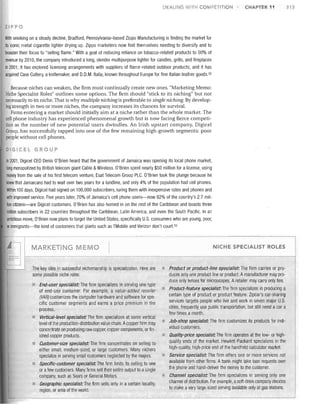
ESCP-EAP European School of Management
•	 John Saunders (Loughborough University) and Veronica Wong (Warwick University,
United Kingdom)
•	 Jacob Hornick: Tel Aviv University (Israel)
•	 Walter Giorgio Scott: Universita Cattolica del Sacro Cuore (Italy)
•	 Peggy Cunningham: Queen's University (Canada)
I also want to acknowledge how much I have learned from working with coauthors on
more specialized marketing subjects: Alan Andreasen, Christer Asplund, Paul N. Bloom, John
Bowen, Roberta C. Clarke, Karen Fox, David Gertner, Michael Hamlin, Thomas Hayes,
Donald Haider, Hooi Den Hua, Dipak Jain, Somkid Jatusripitak, Hermawan Kartajaya, Neil
Kotler, Nancy Lee, Sandra Liu, Suvit Maesincee, James Maken, Waldemar Pfoertsch, Gustave
Rath, Irving Rein, Eduardo Roberto, Joanne Scheff, Norman Shawchuck, Joel Shalowitz, Ben
Shields, Francois Simon, Robert Stevens, Martin Stoller, Fernando Trias de Bes, Bruce Wrenn,
and David Young.
My overriding debt continues to be to my lovely wife, Nancy, who provided me with the
time, support, and inspiration needed to prepare this edition. It is truly our book.
From Kevin Lane Keller: I continually benefit from the wisdom of my colleagues at Tuck­
Scott Neslin, Punam Keller, Kusum Ailawadi, Praveen Kopalle, Koen Pauwels, Petia Petrova,
Jackie Luan, Fred Webster, Gert Assmus, and John Farley-as well as the leadership of Dean
Paul Danos. I also gratefully acknowledge the invaluable research and teaching contributions
from my faculty colleagues and collaborators through the years. lowe a considerable debt of
gratitude to Duke University's Jim Bettman and Rick Staelin for helping to get my academic
career started and serving as positive role models. I am also appreciative of all that I have
learned from working with industry executives who have generously shared their insights and
experiences. Finally, I give special thanks to Punam, my wife, and Carolyn and Allison, my
daughters, who make it all happen and make it all worthwhile.

)(Xxvii
,~

]L---_ _


We are indebted to the following colleagues at other universities who reviewed this new
edition:
•	 Bomero Aguirre, TAMIU
•	 Parimal Bhagat, Indiana University of Pennsylvania
•	 Michael Bruce, Anderson University
•	 Yun Chu, Frostburg State University
•	 Bugh Daubek, Purdue University
•	 Kathleen Dominick, Rider University
•	 Tad Duffy, Golden Gate University
•	 Mohan Dutra, Purdue University
•	 Barbara Dyer, University of North Carolina at Greensboro
•	 Jackie Eastman, Valdosta State University
•	 Steve Edison. University of Arkansas-Little Rock
•	 Barb Finer, Suffolk University
•	 Renee Foster, Delta State University

Chic Fojtik, Pepperdine University

•	 Robert Galka, De Paul University
•	 Rashi Glazer, University of California, Berkeley
•	 Lewis Hershey, Fayetteville State University
•	
•	
•	
•	

Thomas Hewett, Kaplan University
Mary Higby, University of Detroit-Mercy
Michelle Kunz, Morehead State University
Even Lanseng, Norwegian School of Management

•	 Michael Lodato, California Lutheran University
•	 Henry Loehr, Pfeiffer University-Charlotte
•	 Susan Mann, Bluefield State College
•	 Charles Martin, Wichita State University
•	
•	
•	
•	

John McKeever, University of Houston
Robert Mika, Monmouth University
Mark Mitchell, Coastal Carolina University
Nnamdi Osakwe, Bryant & Stratton College

•	 Young-Hoon Park, Cornell University
•	
•	
•	
•	
•	

Koen Pauwels, Dartmouth College
Keith Penney, Webster University
Patricia Perry, University of Alabama
Mike Powell, North Georgia College and State University
William Rice, California State University-Fresno

•	 Bill Robinson, Purdue University
•	 Jan Napoleon Saykiewicz, Duquesne University
•	 Larry Schramm, Oakland University
•	 Jim Skertich, Upper Iowa University
•	 Allen Smith, Florida Atlantic University
•	 Joe Spencer, Anderson University
•	 Nancy Stephens, Arizona State University
I{xxviii
---=-0_··----~

_ _)

__


• Thomas Tellefsen, The College of Staten Island-CUNY
•
•
•
•

Daniel Turner, University ofWashington
Edward Volchok, Stevens Institute of Management
OJ. Wasmer, St. Mary-of-the-Woods College
Zac Williams, Mississippi State University

We would also like to thank colleagues who have reviewed previous editions of Marketing
Management:
Alan Au, University of Hong Kong
Hiram Barksdale, University of Georgia
Boris Becker, Oregon State University
Sandy Becker, Rutgers University
Sunil Bhatia, Case Western Reserve University
Frederic BruneI, Boston University
John Burnett, University of Denver
Lisa Cain, University of California at Berkeley and Mills College
Surjit Chhabra, DePaul University
Dennis Clayson, University of Northern Iowa
Bob Cline, University of Iowa
Brent Cunningham, Ph.D., Jacksonville State University
John Deighton, University of Chicago
Alton Erdem, University of Houston at Clear Lake
Elizabeth Evans, Concordia University
Ralph Gaedeke, California State University, Sacramento
Betsy Gelb, University of Houston at Clear Lake
Dennis Gensch, University ofWisconsin, Milwaukee
David Georgoff, Florida Atlantic University
Bill Gray, Keller Graduate School of Management
Barbara Gross, California State University at Northridge
Arun Jain, State University of New York, Buffalo
Eric Langer, Johns Hopkins University
Ron Lennon, Barry University
Bart Macchiette, Plymouth University
H. Lee Matthews, Ohio State University

Paul McDevitt, University of Winois at Springfield

Mary Ann McGrath, Loyola University, Chicago

Kenneth P. Mead, Central Connecticut State University

Henry Metzner, University of Missouri, Rolla

Francis Mulhern, Northwestern University

Pat Murphy, University of Notre Dame

Jim Murrow, Drury College

Zhou Nan, University of Hong Kong

Nicholas Nugent, Boston College

Donald Outland, University of Texas, Austin

Albert Page, University ofTJIinois, Chicago

Lisa Klein Pearo, Cornell University

Hank Pruden, Golden Gate University

'llUell(
K

LE


Christopher Puto, Arizona State University
Abe Qstin, Lakeland University
Lopo Rego, University of Iowa
Richard Rexeisen, University of St. Thomas
Scott D. Roberts, Northern Arizona University
Robert Roe, University ofWyoming
Alex Sharland, Hofstra University
Dean Siewers, Rochester Institute of Technology
Anusorn Singhapakdi, Old Dominion University
Mark Spriggs, University of St. Thomas
Michael Swenso, Brigham Young University, Marriott School
Sean Valentine, University of Wyoming
Ann Veeck, West Michigan University
R. Venkatesh, University of Pittsburgh

Greg Wood, Canisius College

Kevin Zeng Zhou, University of Hong Kong

A warm welcome and many thanks to the following people who contributed to the global
case studies developed for the thirteenth edition:
Mairead Brady, Trinity College
John R. Brooks, Jr., Houston Baptist University
Sylvain Charlebois, University of Regina
Geoffrey da Silva, Temasek Business School
Malcolm Goodman, Durham University
Torben Hansen, Copenhagen Business School
Abraham Koshy, Sanjeev Tripathi, and Abhishek, Indian Institute of Management
Ahmedabad
Peter Ling, Edith Cowan University
Marianne Marando, Seneca College
Lu Taihong, Sun Yat-Sen University
The talented staff at Prentice Hall deserves praise for their role in shaping the thirteenth edi­
tion. We want to thank our Editor Melissa Sabella, for her contribution to this revision. We
also want to thank our project manager, Melissa Pellerano, for making sure everything was
moving along and falling into place in such a personable way, both vvith regard to the book
and supplements. We benefited greatly from the superb editorial help of Elisa Adams, who
lent her considerable talents as a development editor to this edition. We thank Nancy
Brandwein, who again researched and updated the examples. We also want to acknowledge
the fine production work of Judy Leale, the creative design work of Steve Frim, and the edi­
torial assistance of Christine letto. We thank Denise Vaughn for her work on the media pack­
age. We also thank our Marketing Manager, Anne Fahlgren.

Philip Kotler

s. C. Johnson Distinguished Professor ofInternational Marketing
Kellogg School of Management
Northwestern University
Evanston, Illinois

Kevin Lane Keller

xl

E. B. Osborn Professor of Marketing
Tuck School of Business
Dartmouth College
Hanover, New Hampshire
.lN3ltJ397'NVltJ 9N 1.1..3>1 tlV[.tJ 9N 10 NV.lStl30 N n
CHAPTER 1

•••
•••

DEFINING MARKETING
FOR THE 21ST CENTURY

Marketing is everywhere. Formally or informally, people and organi­
zations engage in a vast number of activities that we could call mar­
keting. Good marketing has become an increasingly vital ingredient
for business success. And marketing profoundly affects our day-to­
day lives. It is embedded in everything we do-from the clothes we
wear, to the Web sites we click on, to the ads we see:

[flJ

woteenage gir.ls.. walk into their local Starbucks, which happens to
be in Shanghai. One goes to the crowded counter and waits to

hand the barista cards for two free peppermint lattes. The other

sits at a table and opens her Lenovo ThinkPad R60 notebook computer.

Within a few seconds she connects to the Internet, courtesy of Starbucks'
deal with China Mobile to provide its customers with wireless access to
HotSpots on the China Mobile Network. Once on the Net, the girl uses
Baidu.com-the Chinese search engine market leader-to search for infor­
mation about the latest online game release from China's Shanda Interactive.
In

addition to links to various reviews, news sites, and fan pages, Baidu's

search results feature a link to a chat room where hundreds of other gamers
are discussing the game. The girl enters the chat room to ask whether peo­
ple who have played the game recommend it. The response is overwhelm­
ingly positive, so she clicks on a sponsored link from the results page, which > > >

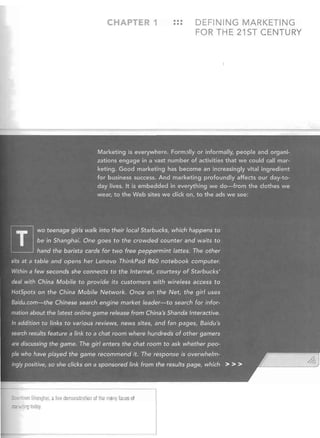
Downtown Silanghai, a Iii e (1811 onslration of the many r res of


ma keling today.
generatesasliver'of.paid7search revenue/or Baidu and takes her to Shanda's offi­
,cial site! ~/.l~re sh.e'sets'yp,.an. EJ.cc(junt.
Nqwh~r friencJ'has ff?tLJrneljwithl(;ltfesi[1,hand. She's eager to show off her
parents~ Nev,/,Year;'s giftto Iier~ifhot pink Motorola RAZR cell,phane created bya
.tearnof;young~bicago-based
designers after;months of market ,research and con"

sumertests: ihe~twogirls'are admiring the slender phone when it receives a text
~d anno_uncin.g the,a.vaU~bJlitYo.rShanda'sJates.i,garne·for rrlobi/~ doV(n/oad. The

girls:turn to, the, laptop so; they can gauge theon/ilie buzzf6r,the mobile version
of the game.
Good marketin5;)is no accident, but a result of careful planning and execution.
It is both, an art and',a science-there's a constant tension between its· f()rmu­
lated sideCind its c;~eative,~side; It's easi~r to leCll"n the formulated side, which
will occupy most ofcour'attention in this book, but Newill also describe how
real creativity and. passion operate in.many companies. In this c;hapter" we lay
the foundation for· our- stud'yby. reviewin'g, a number of important marketing'
~oncepts, tools, frameworks, :and issues;
•

po.

""'I!!I

: :: The Importance of Marketing
Financial success often depends on marketing ability. Finance, operations, accounting, and
other business functions 'Will not really matter if there isn't sufficient demand for products
and services so the company can make a profit. There must be a top line for there to be a
bottom line. Many companies have now created a Chief Marketing Officer, or CMO, position
to put marketing on a more equal footing with other C-Ievel executives, such as the Chief
Executive Officer (CEO) and Chief Financial Officer (CFO). Press releases from organizations
of all kinds-from consumer goods makers to health care insurers and from nonprofit
organizations to industrial product manufacturers-trumpet their latest marketing achieve­
ments on their Web sites. In the business press, countless articles are devoted to marketing
strategies and tactics.
In stating their business priorities, CEOs acknowledge the importance of marketing. One
survey of the top 10 challenges CEOs face around the world in 2006 revealed that among the
top 5 were both "sustained and steady top line growth" and "customer loyalty/retention,"
challenges whose achievement depends heavily on marketing. l CEOs also recognize the
importance of marketing to building brands and a loyal customer base, intangible assets
that make up a large percentage of the value of a firm.
Marketing is tricky, however, and it has been the Achilles' heel of many formerly prosper­
ous companies. Sears, Levi's, General Motors, Kodak, Sony, and Xerox all have confronted
newly empowered customers and new competitors and have had to rethink their business
models.
Even market leaders such as Intel, Microsoft, and Wal-Mart recognize that they cannot
afford to relax as their leadership is challenged. Jack Welch, GE's former CEO, repeatedly
warned his company: "Change or die."
DEFI ING MARKETING FOR THE 21ST CENTURY

XEROX

•

Xerox has had to become more than just a copier company. Now the blue-chip icon with the name that
became a verb sports the broadest array of imaging products in the world and dominates the market for high­
end printing systems. And it's making a huge product-line transition as it moves away from the old-line "light
lens" technology to digital systems. Xerox is preparing for a world that is no longer black and white, and in
which most pages are printed in color (which, not incidentally, generates five times the revenue of black and
white). In addition to revamping its machines, Xerox is beefing up sales by providing annuity-like products and
services that are ordered again and again: document management, ink, and toners. Having been slow at one
time to respond to the emergence of Canon and the small copier market, Xerox is doing everything it can to
stay ahead of the game. 2
Making the right decisions about change isn't always easy. Marketing managers must
decide what features to design into a new product, what prices to offer customers, where to
sell products, and how much to spend on advertising, sales, or the Internet. They must also
decide on details such as the exact wording or color for new packaging. The companies at
greatest risk are those that fail to carefully monitor their customers and competitors and to
continuously improve their value offerings. They take a short-term, sales-driven view of
their business and ultimately they fail to satisfy their stockholders, employees, suppliers,
and channel partners. Skillful marketing is a never-ending pursuit.

::: The Scope of Marketing
To prepare to be a marketer, you need to understand what marketing is, how it works, what
is marketed, and who does the marketing.

What 15 Marketing?
Marketing is about identifying and meeting human and social needs. One of the shortest
good definitions of marketing is "meeting needs profitably." When eBay recognized that peo­
ple were unable to locate some of the items they desired most, it created an online auction
clearinghouse. When IKEA noticed that people wanted good furniture at a substantially
lower price, it created knockdown furniture. These two firms demonstrated marketing savvy
and turned a private or social need into a profitable business opportunity.
The American Marketing Association offers the following formal definition: Marketing is
an organizational function and a set ofprocesses for creating, communicating, and delivering
value to customers and for managing customer relationships in ways that benefit the organi­
zation and its stakeholders. 3 Coping with these exchange processes calls for a considerable
amount of work and skill. Marketing management takes place when at least one party to a
potential exchange thinks about the means of achieving desired responses from other par­
ties. Thus we see marketing management as the art and science of choosing target markets
and getting, keeping, and growing customers through creating, delivering, and communicat­
ing superior customer value.
We can distinguish between a social and a managerial definition of marketing. A social
definition shows the role marketing plays in society; for example, one marketer has said that
marketing's role is to "deliver a higher standard of living." Here is a social definition that
serves our purpose: Marketing is a societal process by which individuals and groups obtain
what they need and want through creating, offering, and freely exchanging products and ser­
vices ofvalue with others.
Managers sometimes think of marketing as "the art of selling products," but many people
are surprised when they hear that selling is not the most important part of marketing! Selling
is only the tip of the marketing iceberg. Peter Drucker, a leading management theorist, puts
it this way:
There will always, one can assume, be need for some selling. But the aim of market­
ing is to make selling superfluous. The aim of marketing is to know and understand
the customer so well that the product or service fits him and sells itself. Ideally,
marketing should result in a customer who is ready to buy. All that should be
needed then is to make the product or service available. 4

CHAPTER 1

5
6

PART 1

UNDERSTANDING MARKE.TING MANAGEMENT

t

!

~~

,

I

L.
.

When Sony designed its Play Station 3 game
system, when Apple launched its iPod Nano
digital music player. and when Toyota intro­
duced its Prius hybrid automobile, these manu­
facturers were swamped with orders because
they had designed the "right" product. based on
doing careful marketing homework.

,

What Is Marketed?

~

)

Marketing people market 10 types of enti­
ties: goods, services. events. experiences.
persons. places. properties, organizations.
information. and ideas. Let's take a quick
look at these categories.
GOODS Physical goods constitute the bulk of

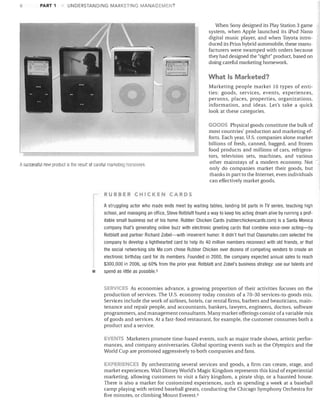
A successful new product is tile result of careful marketing Ilomework

most countries' production and marketing ef­
forts. Each year, U.S. companies alone market
billions of fresh. canned. bagged, and frozen
food products and millions of cars, refrigera­
tors. television sets, machines, and various
other mainstays of a modern economy. Not
only do companies market their goods, but
thanks in part to the Internet, even individuals
can effectively market goods.

RUBBER CHICKEN CARDS

A struggling actor who made ends meet by waiting tables, landing bit parts in TV series, teaching high

•

school, and managing an office, Steve Rotblatt found a way to keep his acting dream alive by running a prof­
itable small business out of his home. Rubber Chicken Cards (rubberchickencards.com) is a Santa Monica
company that's generating online buzz with electronic greeting cards that combine voice-over acting-by
Rotblatt and partner Richard Zobel-with irreverent humor. It didn't hurt that Classmates.com selected the
company to develop a lighthearted card to help its 40 million members reconnect with old friends, or that
the social networking site Me.com chose Rubber Chicken over dozens of competing vendors to create an
electronic birthday card for its members. Founded in 2000. the company expected annual sales to reach
$300,000 in 2006, up 60% from the prior year. Rotblatt and Zobel's business strategy: use our talents and
spend as little as possible. 5
SERVICES As economies advance, a growing proportion of their activities focuses on the
production of services. The U.S. economy today consists of a 70-30 services-to-goods mix.

Services include the work of airlines, hotels, car rental firms, barbers and beauticians. main­
tenance and repair people, and accountants, bankers, lawyers, engineers. doctors, software
programmers, and management consultants. Many market offerings consist ofa variable mix
of goods and services. At a fast-food restaurant, for example, the customer consumes both a
product and a service.
EVENTS Marketers promote time-based events, such as major trade shows, artistic perfor­

mances, and company anniversaries. Global sporting events such as the Olympics and the
World Cup are promoted aggressively to both companies and fans.
EXPERIENCES By orchestrating several services and goods, a firm can create, stage. and

market experiences. Walt Disney World's Magic Kingdom represents this kind of experiential
marketing. allowjng customers to visit a fairy kingdom, a pirate ship, or a haunted house.
There is also a market for customized experiences. such as spending a week at a baseball
camp playing wjth retired baseball greats, conducting the Chicago Symphony Orchestra for
five minutes, or climbing Mount Everest. 6
DEFINING MJl.RKETIN

1

FOR THE 2'!ST CENTURY

PERSONS Celebrity marketing is a major business. Artists, musicians, CEOs, physicians,
high-profile lavvyers and financiers, and other professionals all get help from celebrity mar­
keters. 7 Some people have done a masterful job of marketing themselves-think of David
Beckham, Oprah Winfrey, and the Rolling Stones. Management consultant Tom Peters, him­
self a master at self-branding, has advised each person to become a "brand."
PLACES Cities, states, regions, and whole nations compete actively to attract tourists, facto­
ries, company headquarters, and new residents. G Place marketers include economic develop­
ment specialists, real estate agents, commercial banks, local business associations, and
advertising and public relations agencies. The Las Vegas Convention & Tourism Authority
spent about $80 million on a provocative ad campaign, "What Happens Here, Stays Here." Re­
turning to its roots as an "adult playground," Las Vegas hoped the campaign would lead to an
increase from 37.4 million visitors in 2004 to 43 million visitors by 2009.~J
PROPERTIES Properties are intangible rights of ownership of either real property (real es­
tate) or financial property (stocks and bonds). Properties are bought and sold, and these ex­
changes require marketing. Real estate agents work for property owners or sellers, or they buy
and sell residential or commercial real estate. Investment companies and banks market se­
curities to both institutional and individual investors.
ORGANIZATIONS Organizations actively work to build a strong, favorable, and unique im­
age in the minds of their target publics. In the United Kingdom, Tesco's "Every Little Helps"
marketing program reflects the food marketer's attention to detail in everything it does, within
as well as outside the store in the community and the environment. The campaign has vaulted
Tesco to the top of the UK supermarket chain industry. Universities, museums, performing
arts organizations, and nonprofits all use marketing to boost their public images and to com­
pete for audiences and funds. Corporate identity campaigns are the result of intensive market
research programs. This is certainly the case with Philips "Sense and Simplicity" campaign.
ROYAL PHILIPS
Philips researchers asked 1,650 consumers and 180 customers in dozens of in-depth and quantitative interviews
and focus groups what was most important to them in using technology. Respondents from the UK, United States,
France, Germany, the Netherlands, Hong Kong, China, and Brazil agreed on one thing: they wanted the benefits of
technology without the hassles. With its "Sense and Simplicity" advertising campaign and focus, Philips believes,

•

"our brand now reflects our belief that simplicity can be a goal of technology. It just makes sense." The campaign
consists of print, online, and television advertising directed by five experts from the worlds of health care, lifestyle,
and technology whose role is to provide "additional outside perspectives on the journey to simplicity. "10

INFORMATION Information is essentially what books, schools, and universities produce, mar­
ket, and distribute at a price to parents, students, and communities. Magazines such as Road and
Track, PC World, and Vogue supply information about the car, computer, and fashion worlds, re­
spectively. The production, packaging, and distribution of information are some of our society's
major industries. I I Even companies that sell physical products attempt to add value through the
use of information. For example, the CEO of Siemens Medical Systems, Tom McCausland, says,
"Iour product] is not necessarily an X-ray or an MRI, but information. Our business is really
health care information technology, and our end product is really an electronic patient record:
information on lab tests, pathology, and drugs as weB as voice dictation."12
IDEAS Every market offering includes a basic idea. Charles Revson of RevIon once Observed:
"In the factory, we make cosmetics; in the store we sell hope." Products and services are plat­
forms for delivering some idea or benefit. Social marketers are busy promoting such ideas as
"Friends Don't Let Friends Drive Drunk" and "A Mind Is a Terrible Thing to Waste."

Who Markets?
MARKETERS AND PROSPECTS A marketer is someone who seeks a response-attention,
a purchase, a vote, a donation-from another party, called the prospect. If two parties are
seeking to sell something to each other, we call them both marketers.

CHAPTER 1
a

PART 1

arl~eling can

UNDERSTAriDING MARKETING MANAGEMENT

!lelp to promote powen ul

ideas

I:tII
~,

UNCF h~lps thousands of d~!,ming students. But we
h~"Il to turn away thousands more. So ~~aS>l give
10 the Unlilld N~IOCOllege Fund. Your donation will
make adIHer~f)l. ~lSrt un:;[crg (fcall 1·300-332·9623.

~ UNITE. D NEGRO

Co - p-

J

un
LLEGE liND
'"'' """"" • ""b"· "tn, 'ow.... ,

Marketers are indeed skilled at stimulating demand for their company's products, but
that's too limited a view of the tasks they perform. Just as production and logistics profes­
sionals are responsible for supply management, marketers are responsible for demand man­
agement. Marketing managers seek to influence the level, timing, and composition of
demand to meet the organization's objectives. Eight demand states are possible:
1.	 Negative demand-Consumers dislike the product and may even pay a price to avoid it.
2.	 Nonexistent demand-Consumers may be unaware of or uninterested in the product.
3.	 Latent demand-Consumers may share a strong need that cannot be satisfied by an
existing product.
4.	 Declining demand-Consumers begin to buy the product less frequently or not at all.
5.	 Irregular demand-Consumer purchases vary on a seasonal, monthly, weekly, daily, or
even hourly basis.
6.	 Full demand-Consumers are adequately buying all products put into the marketplace.
7.	 Overfull demand-More consumers would like to buy the product than can be satisfied.
8.	 Unwholesome demand-Consumers may be attracted to products that have undesir­
able social consequences.

In each case, marketers must identify the underlying causers) of the demand state and
then determine a plan of action to shift the demand to a more desired state.

MARKETS Traditionally, a "market" was a physical place where buyers and sellers gathered
to buy and sell goods. Economists describe a market as a collection of buyers and sellers who
transact over a particular product or product class (such as the housing market or the grain
market). Modern economies abound in such markets.
DEFINING MARKETING FOR THE 21ST CENTURY

Resources

-

-

Money

•

Taxes, goods

Taxes
Consumer
markets
Services

Services,
money

I

Taxes,
goods

Money
Goods and services

S!IlIl'IIJlr. nf Rows in a Morlern
bcl131lJ6 Economy

money

~ G"""m,m
•
markets

Manufacturer
markets

FIG. 1.1

Money

S'"i"~

Taxes,
goods
Services,
money

Resources

I~'

Resource
markets

Money

t

CHAPTER 1

Intermediary

markets

Goods and services


Five basic markets and their connecting flows are shown in Figure 1.1. Manufacturers go
to resource markets (raw material markets, labor markets, money markets), buy resources
and turn them into goods and services, and then sell finished products to intermediaries,
who sell them to consumers. Consumers sell their labor and receive money with which they
pay for goods and services. The government collects tax revenues to buy goods from
resource, manufacturer, and intermediary markets and uses these goods and services to
proVide public services. Each nation's economy, and the global economy, consists of com­
plex interacting sets of markets linked through exchange processes.
Marketers often use the term market to cover various groupings of customers. They view
sellers as constituting the industry and buyers as constituting the market. They talk about
need markets (the diet-seeking market), product markets (the shoe market), demographic
markets (the youth market), and geographic markets (the French market); or they extend the
concept to cover other markets, such as voter markets, labor markets, and donor markets.
Figure 1.2 shows the relationship betvreen the industry and the market. Sellers and buy­
ers are connected by four flows. The sellers send goods and services and communications
such as ads and direct mail to the market; in return they receive money and information
such as customer attitudes and sales data. The inner loop shows an exchange of money for
goods and services; the outer loop shows an exchange of information.

EY CUSTOMER ARKETS Consider the following key customer markets: consumer, busi­
ness, global, and nonprofit.
Con sum e r Mar k e t s Companies selling mass consumer goods and services such
as soft drinks, cosmetics, air travel, and athletic shoes and equipment spend a great deal
of time trying to establish a superior brand image. Much of a brand's strength depends on
developing a superior product and packaging, ensuring its availability, and backing it with
engaging communications and reliable service.
Bus i n e ssM r k e t s Companies selling business goods and services often face
well-trained and well-informed professional buyers who are skilled at evaluating competitive
offerings. Business buyers buy goods in order to make or resell a product to others at a profit.
Business marketers must demonstrate how their products will help these buyers achieve
Communication

Goods/services

J------,
Market
(a collection of buyers)

Industry
(a collection of sellers)
Money

Information

FIG. 1.2

9
10

PART 1

UNDERSTANDING MARI<:ETiNG MANAGEMENT

higher revenue or lower costs. Advertising can playa role, but the sales force, price, and the
company's reputation for reliability and quality may playa stronger one.
G lob a I Mar k e t s Companies selling goods and services in the global marketplace
face additional decisions and challenges. They must decide which countries to enter; how to
enter each (as an exporter, licenser, joint venture partner, contract manufacturer, or solo
manufacturer); how to adapt their product and service features to each country; how to price
their products in different countries; and how to adapt their communications to fit different
cultures. They make these decisions in the face of different requirements for buying, negoti­
ating, owning, and disposing of property; different culture, language, and legal and political
systems; and currencies that might fluctuate in value. Yet, the payoff for doing all this addi­
tionallegwork can be huge.
ALASKA DEPARTMENT OF COMMERCE. WAL-MART
In 2005 alone, China accounted for $337 million of Alaska's exports-from seafood and fish meal to minerals,
fertilizers, and wood-and surpassed Canada to become Alaska's third-largest export partner. Noting the huge
market potential of China, especially with the 2008 Olympics in Beijing and the 2010 World Expo slated for
Shanghai, Wal-Mart purchased about $140,000 of Alaska seafood for its China stores. In order to compete with
white fish and farmed salmon from Norway, five Wal-Mart stores hired Alaska officials to host cooking demon­

•

strations of wild Alaska sockeye salmon and black cod during a 14-day span. Although they were labor inten­
sive, the demonstrations gave an immediate taste test to China's young, sophisticated urban residents, who can
pay the high prices these fish command. 13

Non pro fit and G 0 v ern men t a I Mar k e t s Companies selling their
goods to nonprofit organizations such as churches, universities, charitable organizations,
and government agencies need to price carefully, because these buyers have limited purchas­
ing power. Lower selling prices affect the features and quality the seller can build into the of­
fering. Much government purchasing calls for bids, and buyers often favor the lowest bid in
the absence of extenuating factors.
ARKETPLACES, M",RKETSPACES, A ~D METAIVIARKETS The marketplace is physical,
such as a store you shop in; marketspaceis digital, as when you shop on the Internet. J4
Northwestern University's Mohan Sawhney has proposed the concept of a metamarket to
describe a cluster of complementary products and services that are closely related in the
minds of consumers, but spread across a diverse set of industries. The automobile metamar­
ket consists of automobile manufacturers, new car and used car dealers, financing compa­
nies, insurance companies, mechanics, spare parts dealers, service shops, auto magazines,
classified auto ads in newspapers, and auto sites on the Internet.
In purchasing a car, a buyer will get involved in many parts of this metamarket, and this
creates an opportunity for metamediaries to assist buyers in moving seamlessly through
these groups, although they are disconnected in physical space. One example is Edmund's
(www.edmunds.com). a Web site where a car buyer can find the stated features and prices of
different automobiles and easily click to other sites to search for the lowest-price dealer for
financing, for car accessories, and for used cars at bargain prices. Metamediaries also serve
other metamarkets, such as the home ownership market, the parenting and baby care mar­
ket, and the wedding market. 15

Marketing in Practice
How is marketing done? Increasingly, marketing is not done only by the marketing depart­
ment. Marketing needs to affect every aspect of the customer experience, meaning that mar­
keters must properly manage all possible touch points-store layouts, package designs,
product functions, employee training, and shipping and logistics methods. Marketing must
also be heavily involved in key general management activities, such as product innovation
and new-business development.
To create a strong marketing organization, marketers must think like executives in
other departments, and executives in other departments must think more like mar­
keters. IG CMO and later CEO ofWaIMart.com, Carter Cast, noted that what surprised him
DEFINING MARKETING FOR THE 21ST CENTURY

CHAPTER 1

11

Eclmunrj's Is ametamediary Web site Ilml
helps pro, pectil e car ouvers navigate the

The All-New 2008 Cadillac CTS
Now tM19able v.iilh a 304 hp Direct Inj~ction 16. the most powerful
V6 E'J1glOe ever to beat the- Cadillac Wreath and Crest.

New Vehicle

Spotlight

automubile metamarkel onlini:i,

Spon.(I,.db'l'~

r;;;;;nj Edmunds.com provides True Market Value;t!I pricing, unbiased car reviews, ratings, and
~

THE EDl'iUNDS CREEN CAR ADVISOR >ell....

N....,. ••d Comm.,nlaly on En·~',o"lm.nl"l


expert advice to help you ger a talr desL Bqad OLf S!;9t9:1! StQ!W

NEWCARSEJ

1-

£..d..W Brvlo;n. InfoanJ1l!w

r;-

I~

liW!!

--I!lI<l<-' - ­
-

COMortlbig

_

IolU<l!!:l

~

~

~

Aut6n:kltiV* r,..nch.1lad 1.dwlolcgi.s.

~~;R~!.~~n~~o~)

AII-Whaal-Drlva Shootout

1

J~p

Ctlerokeo SRTe

VI.

Audl R8.

Find Used Car.. for Salo:

(:.2lI.2.2

:j

tiG!!~

Q.lml

I OPRbO!'U'1!lMCtli

~EUNE

Thlll;J.loslaulo·onlhuslulnl7W$

• 20QI TQkyo &1lO Show
• Fyi To", 2QC8loxu'IS.f
• BSooqir.gflomT9ho'llvoC9YS?'XifcomStlOwf!oor

REVIEWS, AWARDS' AD

Whip Now.w.ek of Oclober23
LATeST ROAD TfSTS

FtATnr i99I bgallll~E
enl pr~/r
BMW 1J5;

m

-F

~I~I~I~

FH

out '1'It1::1 YlIIl'ii:Jlll
.... "1

C3me 0Il( Ol'. top:

.. 1

COMPMIISON SPOHIGIH
SR:~ CrQouover

C,adil1",c

c


8

CAR COMPARISONS

l


~

• Auto lOCle; AS low AS 6 Q9%
i

•

APR

GQl pt'ob!Rm-Cfc<li! Of Qo=crQdlJ r.... prcl':o

• CAleulIO yOII! AAYfIDW'
!I

,

• GAl your FREE Crg" RoQO!'1

Il'Iluronco Conlo(

most when he became CMO was "that I would interact so much with functions outside of
marketing. I didn't realize it is a holistic assignment. Then I realized I really had to under­
stand things like product supply, cost break-evens, and accounting."17
Companies generally establish a marketing department to be responsible for creating
and delivering customer value, but as the late David Packard of Hewlett-Packard observed,
"Marketing is far too important to leave to the marketing department." Companies now
know that every employee has an impact on the customer and must see the customer as the
source of the company's prosperity. So they're beginning to emphasize interdepartmental
teamwork to manage key processes. They're also placing more emphasis on the smooth
management of core business processes, such as new-product realization, customer acqui­
sition and retention, and order fulfillment.
In practice, marketing follows a logical process. The marketing planning process consists
of analyzing marketing opportunities, selecting target markets, designing marketing strate­
gies, developing marketing programs, and managing the marketing effort. In highly compet­
itive marketplaces, however. marketing planning is more fluid and is continually refreshed.
Companies must always be moving forward with marketing programs, innovating products
and services, staying in touch with customer needs, and seeking new advantages rather than
relying on past strengths.
The changing new marketing environment is putting considerable demands on market­
ing executives. Marketers must have diverse quantitative and qualitative skills, an entrepre­
neurial attitude, and a keen understanding of how marketing can create value within their
organization. 18 They must work in harmony with the sales function.
There are five key functions for a CMO in leading marketing within the organization:
1. Strengthening the brands

2.
3.
4.
5.

Measuring marketing effectiveness
Driving new product development based on customer needs
Gathering meaningful customer insights
Utilizing new marketing technology

Harvard's John Quelch and Gail McGovern note that there is tremendous variability in the
responsibilities and job descriptions for CMOs.19 They offer eight ways to improve CMO suc­
cess (see Figure 1.3).
12

PART 1

UNDERSTANDING MARKETlrlG MANAGEMEN

FIG. 1,3
Improvlll[1 CMO Success
S,III/l:i"I~'lll MC;;C1,'el I "rod Jorrr A OliellJI
'Tim Tall ;j11' I [lis~ d !Ill_ CMO ..

:;;i,llt!gv,ffil.','·I//I~.','

liy 1"1.; I r ,$~I(ln

V,'nial 20ll-l. RelJIIPkd

1. Make the mission and responsibilities clear. Be certain that the case for having a CMO is strong and
.the mission is well understood by leaders in the organization, particularly the CEO, the board, and line
management Without a clear need (real or perceived), the role will be rejected by the organization,
2. Fit the role to the marketing culture and structure. Avoid having a CMO in a marketing-led company

that has many individual brands rather than a single corporate umbrella-unless the person appointed to the

position is a well-connected insider,

3. Choose a CMO who is compatible with the CEO. Beware of the CEO who wants to hire aCMO but doesn't

want to relinquish any marketing control. Find a CEO who recognizes his or her responsibility to be the cheerleader

for marketing and the brand, but realizes the need to be guided and coached by a marketing specialist.


4. Remember that showpeople don't succeed. The CMO should work hard to ensure the CEO is

successful at being the principal cheerleader for the brand


5. Match the personality with the CMO type. Be certain that the chief marketer has the right skills and

personality for whichever of the three CMO models he or she might fill (VP of Marketing Services, Classic CMO,

or "Super" CMO) There is little tolerance for on-the-job training,

6. Make line managers marketing heroes. By stretching their marketing budgets, CMOs can improve a

division's marketing productivity and help business unit leaders increase their top-line revenues,

7. Infiltrate the line organization. Have the CMO support the placement of marketing professionals from

the corporate marketing department into divisional marketing roles, Provide input from the CMO into the

annual reviews of line marketers.


8. Require right-brain and left-brain skills. The most successful CMO will have strong creative and technical

marketing expertise, be politically savvy, and have the interpersonal skills to be a great leader and manager,


: :: Core Marketing Concepts
To understand the marketing function, we need to understand the following core set of
concepts.

Needs, Wants, and Demands
Needs are the basic human requirements. People need air, food, water, clothing, and shelter
to survive. People also have strong needs for recreation, education, and entertainment.
These needs become wants when they are directed to specific objects that might satisfy the
need. A consumer in the United States needs food but may want a hamburger, french fries,
and a soft drink. A person in Mauritius needs food but may want a mango, rice, lentils, and
beans. Wants are shaped by our society.
Demands are wants for specific products backed by an ability to pay. Many people want a
Mercedes; only a few are Willing and able to buy one. Companies must measure not only
how many people want their product, but also how many would actually be willing and able
to buy it.
These distinctions shed light on the frequent criticism that "marketers create needs" or
"marketers get people to buy things they don't want." Marketers do not create needs: Needs
preexist marketers. Marketers, along with other societal factors, influence wants. Marketers
might promote the idea that a Mercedes would satisfy a person's need for social status. They
do not, however, create the need for social status.
Understanding customer needs and wants is not always simple. Some customers have
needs of which they are not fully conscious, or they cannot articulate these needs, or they
use words that require some interpretation. What does it mean when the customer asks
for a "powerful" lawnmower, a "fast" lathe, an "attractive" bathing suit, or a "restful" hotel?
The marketer must probe furtheL We can distinguish among five types of needs:
1. Stated needs (The customer wants an inexpensive caL)
2. Real needs (The customer wants a car whose operating cost, not its initial price, is low.)
3. Unstated needs (The customer expects good service from the dealeL)
DEFINING

MARKETING FOR THE 21 ST CENTURY

CHAPTER 1

4.	 Delight needs (The customer would like the dealer to include an onboard navigation

system.)

5.	 Secret needs (The customer wants friends to see him as a savvy consumer.)
Responding only to the stated need may shortchange the customer. Many consumers do

not know what they want in a product. Consumers did not know much about cellular phones

when they were first introduced, and Nokia and Ericsson fought to shape consumer percep­

tions of them. Simply giving customers what they want isn't enough any more-to gain an

edge companies must help customers learn what they want.


Target Markets, Positioning, and Segmentation
A marketer can rarely satisfy everyone in a market. Not everyone likes the same cereal, hotel


room, restaurant, automobile, college, or movie. Therefore, marketers start by dividing the

market into segments. They identify and profile distinct groups of buyers who might prefer

or require varying product and service mixes by examining demographic, psychographic,

and behavioral differences among buyers.

WAL-MART

•

Wal-Mart uses segmentation to reach customers in different geographic markets, with its new Store of the

Community concept. Now over two dozen Wal-Mart stores have been designed to reflect the communities in

which they are located. For instance, there's a Wal-Mart with a Western flair in Ft. Collins, Colorado, and a

two-level art-deco-inspired unit to draw in wealthy African Americans in Baldwin Hills, California. In an effort

to cater to the country's fourth-largest Amish community, the Middlefield, Ohio, Wal-Mart offers hitching posts

outside for horse and buggies, block ice for refrigerators, and a huge assortment of denim fabric for making

work pants.
After identifying market segments, the marketer then decides which present the greatest

opportunity-which are its target markets. For each, the firm develops a market offering that

it positions in the minds of the target buyers as delivering some central benefit(s). For exam­

ple, Volvo develops its cars for buyers to whom safety is a major concern. Volvo, therefore,

positions its car as the safest a customer can

buy. Companies do best when they choose

their target market(s) carefully and prepare

tailored marketing programs.


Offerings and Brands
Companies address needs by putting forth a

value proposition, a set of benefits that they

offer to customers to satisfy their needs. The

intangible value proposition is made physi­ 

cal by an offering, which can be a combina­ 

tion of products, services, information, and

experiences.

A brand is an offering from a known

source. A brand name such as McDonald's

carries many associations in people's minds

that make up the brand image: hamburgers,

fun, children, fast food, convenience, and

golden arches. All companies strive to build a

strong, favorable, and unique brand image.


Value and Satisfaction
The offering wiU be successful if it delivers value
and satisfaction to the target buyer. The buyer
chooses between different offerings based on

1he art -deeo slylinO of II lis new Wal-Mart store is Oleanlto appeal 10 the wealthy sllolJPers in it
CaliforniiJ neiglllJorllOO(1.

13
14

PART 1

UNDERSTANDING MARKETING MANAGEMENT

which she perceives to deliver the most value. Value reflects the sum of the perceived tangible
and intangible benefits and costs to customers. It's primarily a combination of quality, service,
and price ("qsp"), called the "customer value triad." Value increases with quality and service and
decreases with price, although other factors can also play an important role in our perceptions
of value.
Value is a central marketing concept. We can think of marketing as the identification, cre­
ation, communication, delivery, and monitoring of customer value. Satisfaction reflects a
person's judgments of a product's perceived performance (or outcome) in relationship to
expectations. If the performance falls short of expectations, the customer is dissatisfied and
disappointed. If it matches expectations, the customer is satisfied. If it exceeds them, the
customer is delighted.

Marketing Channels
To reach a target market, the marketer uses three kinds of marketing channels.
Communication channels deliver and receive messages from target buyers and include
newspapers, magazines, radio, television, mail, telephone, billboards, posters, fliers, CDs,
audiotapes, and the Internet. Beyond these, just as we convey messages by our facial
expressions and clothing, firms communicate through the look of their retail stores, the
appearance of their Web sites, and many other media. Marketers are increasingly adding
dialogue channels such as e-mail, blogs, and toll-free numbers to familiar monologue
channels such as ads.
The marketer uses distribution channels to display, sell, or deliver the physical product
or service(s) to the buyer or user. They include distributors, wholesalers, retailers, and
agents.
The marketer also uses service channels to carry out transactions with potential buyers.
Service channels include warehouses, transportation companies, banks, and insurance
companies that facilitate transactions. Marketers clearly face a design challenge in choosing
the best mix of communication, distribution, and service channels for their offerings.

Supply Chain
The supply chain is a longer channel stretching from raw materials to components to final
products that are carried to final buyers. The supply chain for women's purses starts with
hides and moves through tanning, cutting, manufacturing, and the marketing channels to
bring products to customers. Each company captures only a certain percentage of the total
value generated by the supply chain's value delivery system. When a company acquires com­
petitors or expands upstream or downstream, its aim is to capture a higher percentage of
supply chain value.

Competition
Competition includes all the actual and potential rival offerings and substitutes a buyer
might consider. Suppose an automobile company is planning to buy steel for its cars. There
are several possible levels of competitors. The manufacturer can buy steel from U.S. Steel in
the United States, it can buy from a foreign firm in Japan or Korea, it can buy from a minimill
such as Nucor at a cost savings, or it can buy aluminum from Alcoa for certain parts to
reduce the car's weight or engineered plastics from Saudi Basic Industries Corporation
(SABIC), purchasers of GE Plastics, for bumpers instead of steel. Clearly, U.S. Steel would be
thinking too narrowly about its competition if it thought only of other integrated steel com­
panies. In fact, in the long run U.S. Steel is more likely to be hurt by substitute products than
by other steel companies.

Marketing Environment
The marketing environment consists of the task environment and the broad environment.
The task environment includes the actors engaged in producing, distributing, and promot­
ing the offering. These are the company, suppliers, distributors, dealers, and the target
customers. In the supplier group are material suppliers and service suppliers, such as
marketing research agencies, advertising agencies, banking and insurance companies,
transportation companies, and telecommunications companies. Distributors and dealers
DEFlr~lrjG

MARKETI

G I-OR HiE 21ST CENTURY

include agents, brokers, manufacturer representatives, and others who facilitate finding
and selling to customers.
The broad environment consists of six components: demographic environment, eco­
nomic environment, physical environment. technological environment, political-legal
environment, and social-cultural environment. Marketers must pay close attention to the
trends and developments in these environments and make timely adjustments to their
marketing strategies.

::: The New Marketing Realities
We can say with some confidence that "the marketplace isn't what it used to be." Marketers
must attend and respond to a number of significant developments.

Major Societal Forces
Today the marketplace is radically different as a result of major, and sometimes inter­
linking, societal forces that have created new behaviors, new opportunities, and new
challenges:

• Network information technology. The digital revolution has created an Information
Age. The Industrial Age was characterized by mass production and mass consumption, stores
stuffed with inventory, ads everywhere, and rampant discounting. The Information Age
promises to lead to more accurate levels of production, more targeted communications, and
more relevant pricing.
• Globalization. Technological advances in transportation, shipping, and communica­
tion have made it easier for companies to market in other countries, and easier for con­
sumers to buy products and services from marketers in other countries.
Deregulation. Many countries have deregulated industries to create greater compe­
tition and growth opportunities. In the United States, laws restricting financial services,
telecommunications, and electric utilities have all been loosened in the spirit of greater
competition.
Privatization. Many countries have converted public companies to private ownership
and management to increase their efficiency, such as British Airways and British Telecom in
the United Kingdom.
Heightened competition. Brand manufacturers are facing intense competition from
domestic and foreign brands, resulting in rising promotion costs and shrinking profit mar­
gins. They are being further buffeted by powerful retailers that command limited shelf space
and are putting out their own store brands in competition with national brands. Many strong
brands are extending into related product categories, creating mega brands with much pres­
ence and reputation.
Industry convergence. Industry boundaries are blurring at an incredible rate as compa­
nies are recognizing that new opportunities lie at the intersection of two or more industries.
The computing and consumer electronics industries are converging as the giants of the
computer world such as Dell, Gateway, and Hewlett-Packard release a stream of entertain­
ment devices-from MP3 players to plasma TVs and camcorders. The shift to digital tech­
nology is fueling this massive convergence. 20
Consumer resistance. A 2004 Yankelovich study found record levels of marketing
resistance from consumers. 21 A majority of those surveyed reported negative opinions
about marketing and advertising, stating that they avoid products that they feel overmar­
ket. The increased popularity of digital video recorders such as TiVo make it easier for
consumers to skip or "zap" TV commercials, in part reflecting their desire for marketing
avoidance.
Retail transformation. Small retailers are succumbing to the growing power of giant
retailers and "category killers." Store-based retailers face competition from catalog houses;
direct-mail firms; newspaper, magazine, and TV direct-to-customer ads; home shopping TV;
and e-commerce on the Internet. In response, entrepreneurial retailers are building enter­
tainment into their stores with coffee bars, lectures, demonstrations, and performances,
marketing an "experience" rather than a product assortment.

CHAPTER 1

15
16

PART 1

UNDERSTANDING MARKETING MANAGEMENT

MAC COSMETICS INC-

•

Adivision of cosmetics giant Estee Lauder, MAC Cosmetics is considered a significant reason for Lauder's
13% net makeup sales increase. Yet, MAC's 1,000 stores worldwide don't simply sell Small Eye Shadow,
Studio Fix, Lustreglass, and Pro Longwear Lipcoulour. Instead, they rely on highly paid "artists" to bond with
each customer during a free makeup consultation and application lesson. Although this tack is hardly new in
the world of retail makeup, what's unique is that MAC's artists are not out there to bump up their commis­
sions and load customers down with more products. Rather, they're trained to collaborate with customers so
they'll leave the store with $50 or more of MAC products and the feeling, "I can definitely do this at home."
The goal, says Matthew Waitesmith, MAC's head of "artist training and development," is for each customer to
feel she's had an authentically artistic experience "that hopefully means they'll return to the place that makes
them feel like an artist."22

• Disintermediation. The amazing success of early online dot-corns, such as AOL,
Amazon.com, Yahoo!, eBay, WTRADE, and dozens of others that created disintermediation in
the delivery of products and services by intervening between the traditional flow of goods
through distribution channels, struck terror into the hearts of many established manufacturers
and retailers. In response, many traditional companies engaged in reintermediationand became
"brick-and-click" retailers, adding online services to their existing offerings. Many brick-and­
click competitors became stronger contenders than pure-click firms, because they had a larger
pool of resources to work with and well-established brand names.
The societal forces that spawned this Information Age have resulted in many new con­
sumer and company capabilities.

New Consumer Capabilities
Customers today perceive fewer real product differences and show less brand loyalty, and
they are becoming more price and quality sensitive in their search for value. Consider ,;vhat
consumers have today that they didn't have yesterday:

• A substantial increase in buying power. Buyers are only a click away from comparing
competitor prices and product attributes on the Internet. They can even name their price for
a hotel room, airline ticket, or mortgage. Business buyers can run a relJerse auction in which
sellers compete to capture their business. They can readily join with others to aggregate their
purchases and achieve deeper volume discounts.
• A greater variety of available goods and services. Amazon.com quickly became the
world's largest bookstore but has since branched into retail sales of music and movies,
clothing and accessories, consumer electronics, health and beauty aids, and home and
garden products. Buyers can order goods online from anywhere in the world, bypassing
limited local offerings and realizing great savings by ordering in countries with lower
prices.
• A great amount of information about practically anything. People can read almost
any newspaper in any language from anywhere in the world. They can access online ency­
clopedias, dictionaries, medical information, movie ratings, consumer reports, and count­
less other information sources.
• Greater ease in interacting and placing and receiving orders. Today's buyers can place
orders from home, office, or mobile phone 24 hours a day, 7 days a week, and quickly receive
goods at their home or office.
• An ability to compare notes on products and services. Social networking sites bring
together buyers with a common interest. At CarSpace.com auto enthusiasts talk about
chrome rims, the latest BMW model, and where to find a great mechanic in their local area.
Marketers are eying the success of the site, given that 35% of young, first-time car buyers
consider the Internet their most important shopping tool.2 3
• An amplified voice to influence peer and public opinion. The Internet fuels personal
connections and user-generated content through social media such as MySpace and
single-use social networks such as Flickr (photos), Del.cio.us (links), Digg (news stories),
DEFINING MARKET!NG FOR THE 21 ST CENTURY

Wikipedia (encyclopedia articles), and YouTube (video).24 In late 2004, Kryptonite, a firm
that makes high-priced bike locks, found itself in an awkward position when several blogs
showed how the firm's U-shaped locks could be easily picked using only the plastic casing
of a Bic pen. 25
KFC, CONVERSE, WM. WRIGLEY JR.
Although Chinese citizens are still prohibited from criticizing the government online, they have thousands of
online forums for airing grievances about poor customer service, misleading ad campaigns, shoddy prod­
ucts, safety standards, and more. Chinese consumers are vocal and active, and when enough of them voice
a complaint, companies listen. When a Chinese TV spot for Yum! Brand Inc.'s KFC Corp. depicted a hard­
working student who didn't pass his exams and two carefree children who enjoyed KFC fried chicken and
did, KFC received so many complaints for suggesting hard work doesn't pay that it changed the ad to show

•

all three children doing well. Smart companies are enlisting their opinionated Internet consumers to give
input before a product is launched. Converse and Wm. Wrigley Jr. conducted a joint promotion encouraging
Chinese consumers to come up with their own cool designs for Converse sneakers that featured Wrigley's
Juicy Fruit logo. 26

New Company Capabilities
New forces also have combined to generate a new set of capabilities for today's companies:
• Marketers can use the Internet as a powerful information and sales channel, augment­
ing their geographical reach to inform customers and promote their businesses and prod­
ucts worldwide. By establishing one or more Web sites, they can list their products and
services, history, its business philosophy, job opportunities, and other information of inter­
est to visitors.
Researchers can collect fuller and richer information about markets, customers, prospects,
and competitors. They can also conduct fresh marketing research using the Internet to arrange
for focus groups, send out questionnaires, and gather primary data in several other ways.
Managers can facilitate and speed internal communication among their employees by
using the Internet as a private intranet. Employees can query one another, seek advice, and
download or upload needed information from and to the company's main computer.
• Companies can also facilitate and speed external communication among customers by
creating online and off-line "buzz" through brand advocates and user communities. In 2003,
the Rock Bottom Brew pub chain reported a 76% jump in revenues after hiring BzzAgent and
l,OOO-plus of its "agents" to launch a 13-week word-of-mouth campaignP BzzAgent has
assembled a nationwide volunteer army of 260,000 consumers who join promotional pro­
grams for products and services they deem worth talking about. 20
Target marketing and two-way communication are easier thanks to the proliferation of
special-interest magazines, TV channels, and Internet newsgroups. Extranets linking suppli­
ers and distributors let firms send and receive information, place orders, and make pay­
ments more efficiently. The company can also interact with each customer individually to
personalize messages, services, and the relationship. Discount brokerage Charles Schwab
spent 25% of its marketing communication budget online in 2005 to support its "Talk to
Chuck" campaign, up from 8% in 2003. 29
• Marketers can send ads, coupons, samples, and information to customers who have
requested them or have given the company permission to send them. They can now
assemble information about individual customers' purchases, preferences, demograph­
ics, and profitability. British supermarket giant Tesco is outpacing its rival store,
Sainsbury, by using its Clubcard data to personalize offers according to individual cus­
tomer attributes. 3o
• Companies can reach consumers on the move with mobile marketing. Using GPS tech­
nology, for instance, consumers can download company logos so they can spot brands
such as Dunkin' Donuts or Baskin Robbins when they're on the road. 3 ! Firms can also
advertise on video iPods and reach consumers on their cell phones through mobile market­
ing. 32 General Motors Corp. launched its Pontiac G6 with a promotion asking consumers to

CHAPTER 1

17
18

PART 1

UNDERSTANDING MARKETING MANAGEMENT

take photos ofthe sports sedan on their camera phones and send
them to GM in return for a free classic punk rock ring tone and a
chance to win $1 million in cash. About 18,500 photos were sent,
mostly from the G6 target market of young males under the age
of 25. 33
• Firms can produce individually differentiated goods, whether
they're ordered in person, on the phone, or online, thanks to ad­
vances in factory customization, computers, the Internet, and data­
base marketing software. For a price, customers can buy M&M
candies with their names on them, Wheaties boxes or Jones soda
cans with their pictures on the front, and Heinz ketchup bottles
with customized messages.3 4 BMW's technology now allows buyers
to design their own models from among 350 variations, with 500 op­
tions, 90 exterior colors, and 170 trims. The company claims that
80% of the cars bought by individuals in Europe and up to 30%
bought in the United States are built to order.

More and more companies can produce individually differentiated gooc1s,
even consume I products like these

• Managers can improve purchasing, recruiting, training, and in­
ternal and external communications. Aerospace and defense con­
tractor Boeing has joined large, high-profile companies Walt
Disney, General Motors, and McDonald's in embracing corporate
blogging to communicate with the public, customers, and em­
ployees. External blogs allow dialogues with a marketing vice pres­
ident and a glimpse into the flight testing of the new 777 model;
internal blogs allow conversations on hot topics and anonymous
feedback. 35

• Corporate buyers can achieve substantial savings by using the
Internet to compare sellers' prices and to purchase materials at
auction or by posting their own terms. Companies can improve logistics and operations to
reap substantial cost savings, at the same time improving accuracy and service quality.
• Firms can also recruit new employees online, and many are also preparing Internet train­
ing products for download to employees, dealers, and agents.

: :: Company Orientation toward the Marketplace
Given these new marketing realities, what philosophy should guide a company's marketing
efforts? Increasingly, marketers operate consistent with a holistic marketing concept. Let's
review the evolution of earlier marketing ideas.

The Production Concept
The production concept is one of the oldest concepts in business. It holds that con­
sumers will prefer products that are widely available and inexpensive. Managers of
production-oriented businesses concentrate on achieving high production efficiency,
low costs, and mass distribution. This orientation makes sense in developing countries
such as China, where the largest PC manufacturer, Lenovo, and domestic appliances
giant Haier take advantage of the country's huge and inexpensive labor pool to dominate
the market. Marketers also use the production concept when a company wants to
expand the market. 3G

The Product Concept
The product concept proposes that consumers favor products that offer the most quality,
performance, or innovative features. Managers in these organizations focus on making
superior products and improving them over time. However, these managers are sometimes
caught up in a love affair with their products. They might commit the "better-mousetrap"
fallacy, believing that a better mousetrap will lead people to beat a path to their door. A new
or improved product will not necessarily be successful unless it's priced, distributed, adver­
tised, and sold properly.
DEFINING MARKETING rOR THE 21 ST CE TURY

CHAPTER 1

19

The Selling Concept
The selling concept holds that consumers and businesses, if left alone, won't buy enough
of the organization's products. The organization must, therefore, undertake an aggressive
selling and promotion effort. The selling concept is expressed in the thinking of Sergio
Zyman, Coca-Cola's former vice president of marketing, who said: "The purpose of mar­
keting is to sell more stuff to more people more often for more money in order to make
more profit."37
The selling concept is practiced most aggressively with unsought goods, goods that buy­
ers normally do not think of buying, such as insurance, encyclopedias, and cemetery plots.
Most firms also practice the selling concept when they have overcapacity. Their aim is to
sell what they make, rather than make what the market wants. However, marketing based
on hard selling carries high risks. It assumes that customers who are coaxed into buying a
product will like it, and that if they don't, they not only won't return or bad-mouth it or
complain to consumer organizations, but they might even buy it again.

The Marketing Concept
The marketing concept emerged in the mid-1950s. 30 Instead of a product-centered,
"make-and-sell" philosophy, business shifted to a customer-centered, "sense-and­
respond" philosophy. The job is not to find the right customers for your products, but to

find the right products for your customers. Dell Computer doesn't prepare a perfect com­
puter for its target market. Rather, it provides product platforms on which each person
customizes the features he desires in the computer.
The marketing concept holds that the key to achieving organizational goals is being more
effective than competitors in creating, delivering, and communicating superior customer
value to your chosen target markets.
Theodore Levitt of Harvard drew a perceptive contrast between
the selling and marketing concepts:

To learn how Tata applied
the marketing conceptto
deepen its understanding
of customers in India, visit

www.pearsoned.co.in/
marketingmanagementindia.

o

Selling focuses on the needs of the seller; marketing on the

needs of the buyer. Selling is preoccupied with the seller's

need to convert his product into cash; marketing with the

idea of satisfying the needs of the customer by means of the

product and the whole cluster of things associated with cre­

ating, delivering, and finally consuming it. 39

Several scholars have found that companies that embrace the

marketing concept achieve superior performance. 4o This was first

demonstrated by companies practicing a reactive market orienta­

tion-understanding and meeting customers' expressed needs.

Some critics say this means companies develop only very basic

innovations. Narver and his colleagues argue that more advanced,

high-level innovation is possible if the focus is on customers' latent

needs. Narver calls this a proactive marketing orientation. 4 !

Companies such as 3M, Hewlett Packard, and Motorola have made

a practice of researching latent needs through a "probe-and-learn"

process. Companies that practice both a reactive and a proactive

marketing orientation are implementing a total market orientation

and are likely to be the most successful.


The Holistic Marketing Concept
Without question, the trends and forces defining the 21st century

are leading business firms to a new set of beliefs and practices.

Today's best marketers recognize the need to have a more com­ 

plete, cohesive approach that goes beyond traditional applications

of the marketing concept. "Marketing Memo: Marketing Righ t and

Wrong" suggests where companies go wrong-and how they can

get it right-in their marketing.

The holistic marketing concept is based on the develop­ 

ment, design, and implementation of marketing programs,

Nike is Wil ely acknowledger! as One or Ihe mOS1 skilled marketers
tiround.
PART 1

~I

UNDERSTANDING MARKETING MANAGEMENT

MARKETING MEMO	


20

MARKETING RIGHT AND WRONG

I
~

_

The Ten Deadly Sins of Marketing	
f---

The Ten Commandments of Marketing
..

-	

- -

1. The company is not sufficiently market focused and	

1. The company segments the market, chooses the best

customer driven.

segments, and develops a strong position in each chosen
segment.

2. The company does not fully understand its target	
customers.	

2. The company maps its customers' needs, perceptions,
preferences, and behavior and motivates it stakeholders to
obsess about serving and satisfying the customers.

3.	 The company needs to better define and monitor its

3. The company knows its major competitors and their strengths


competitors.

and vveaknesses.


4.	 The company has not properly managed its relationships

4. The company builds pal1ners out of its stakeholders and


with its stakeholders.

generously rewards them.


5.	 The company is not good at finding new opportunities.

5. The company develops systems for identifying opportunities,


6.	 The company's marketing plans and planning process

6. The company manages a marketing planning system that leads


ranking them, and choosing the best ones.

are deficient

to insightful long-term and short-term plans.


7.	 The company's product and service policies need

7. The company exercises strong control over its product and


tiglltenlng.

service mix.


8.	 The company's brand-building and communications skills

8. Tile company builds strong brands by using the most cost-


are weak.

effective communication and promotion tools.


9.	 The company is not well organized to carryon effective

9. The company builds marketing leadership and a team spirit


and efficient marketing.

among its various departments.


10.	 The company has not macle maximum use of

10. Tile company constantly adds technology that gives it a


technology.
I

competitive advantage in the marketplace.


Adapled Source: Philip Kotler, Ten Deadly Markeling Sins (Hoboken, NJ: John Wiley & Sons, 2004).

-

processes, and activities that recognizes their breadth and interdependencies. Holistic
marketing recognizes that "everything matters" in marketing-and that a broad, inte­
grated perspective is often necessary.
Holistic marketing is thus an approach that attempts to recognize and reconcile the
scope and complexities of marketing activities. Figure 1.4 provides a schematic overview
of four broad components characterizing holistic marketing: relationship marketing, inte­
grated marketing, internal marketing, and performance marketing. We'll examine these
major themes throughout this book. Successful companies will be those that can keep
their marketing changing with the changes in their marketplace-and marketspace.
"Breakthrough Marketing: Nike" describes how that company has successfully changed­
and thrived-through the years.

Relationship Marketing
Increasingly, a key goal of marketing is to develop deep, enduring relationships with people
and organizations that could directly or indirectly affect the success of the firm's marketing
activities. Relationship marketing aims to build mutually satisfying long-term relationships
with key constituents in order to earn and retain their business. 42
Four key constituents for relationship marketing are customers, employees, marketing
partners (channels, suppliers, distributors, dealers, agencies), and members of the financial
community (shareholders, investors, analysts). Marketers must respect the need to create
prosperity among all these constituents and develop policies and strategies to balance the
DEfiNiNG MARI<ETING FOR THE 21ST CENTURY

Marketing
department

Senior
management

Products &
services

Other
departments

CHAPTER 1

21

FIG. 1.4
HolisIC M"lrl<elillQ Dimensions

Internal
marketing

~/

Holistic

Sales revenue
Brand &
customer equity

Integrated
marketing


n

Performance
marketing

Relationship
marketing

Ethics
Community
Environment Legal

BREAKTHROUGH MARKETING

Nike hit the ground running in 1962. Originally known as Blue Ribbon
Sports, the company focused on providing high-quality running shoes
designed especially for athletes by athletes. Founder Philip Knight
believed that high-tech shoes for runners could be manufactured at
competitive prices if imported from abroad. The company's commit­
ment to designing innovative footwear for serious athletes helped it
build a cult following among U.S. consumers.
Nike believed in a "pyramid of influence" where product and
brand choices were influenced by the preferences and behavior of a
small percentage of top athletes. Therefore, from the start, Nike's
marketing campaigns featured winning athletes as spokespeople.
Nike's first spokesperson, runner Steve Prefontaine, had an irreverent
attitude that matched the company's spirit.
In 1985, Nike signed up then-rookie guard Michael Jordan as a
spokesperson. Jordan was still an up-and-comer, but he personified
superior performance. Nike's bet paid off: The Air Jordan line of bas­
ketball shoes flew off the shelves, with revenues of over $1 00 million
In the first year alone.
In 1988, Nike aired the first ads in its $20 million "Just Do It" ad
campaign. The campaign, which ultimately featured 12 TV spots in
all, subtly challenged a generation of athletic enthusiasts to chase
their goals; it was a natural manifestation of Nike's attitude of self­
empowerment through sports.
As Nike began expanding overseas to Europe, however, it found
that its U.S. -style ads were seen there as too aggressive. Nike real­
ized it had to "authenticate" its brand in Europe the way it had in the
United States. That meant building credibility and relevance in

Channel

NIKE

European sports, especially soccer (known outside the United States
as football) Nike became actively involved as a sponsor of youth
leagues, local clubs, and national teams.
Autllenticity also required that consumers see athletes using
the product, especially athletes who win. The big break came in
1994, when the Brazilian team (the only national team for which
Nike had any real sponsorships) won the World Cup. That victory in
the world's most popular sport helped Nike succeed in otller inter­
national markets such as China, where Nike came to command
10% of the shoe market. By 2003 overseas revenues surpassed
U.S. revenues for the first time, and by 2006 international divisions
generated nearly $7.3 billion in revenue, compared to $5.7 billion
from the United States.
In addition to expanding overseas, Nike moved into new athletic
footvvear, apparel, and equipment product categories. These included
the Nike Golf brand of footwear, apparel, and equipment, which were
all endorsed by megastar Tiger Woods. In 2005, Nike introduced an
urban-themed collection of retro footvlJear and apparel bearing the
name of the original company, Blue Ribbon Sports. Blue Ribbon Sports
designs-which included jeans, belts, sweaters, and woven shirts­
were sold at high-end retailers such as Barney's and Fred Segal.
Today, Nike (Iominates the athletic footwear market. Swooshes
abound on everytlling from wristwatches to golf clubs to swimming
caps. As a result of its expansion across geographic markets and
product categories, Nike is the top athletic apparel and footwear
manufacturer in the world, with corporate fiscal 2007 revenues of
nearly $16 billion.

Sources: Justin Ewers and Tim Smart, "A Designer Swooshes In," US. News & World Report, January 26, 2004, p. 12; "Corporate Media Executive of the Year," Delaney
Report, January 12, 2004, p. 1; "10 Top Nontraditional Campaigns," Advertising Age, December 22, 2003, p. 24; Chris Zook and James Allen, "GrO~~h Outside the Core,"
Harvard Business Review 8 (December 2003): 66.
22

PART 1

UNDERSTANDING MARKETING MANAGEMENT

returns to all key stakeholders. To develop strong relationships with these constituents
requires an understanding of their capabilities and resources, as well as their needs, goals,
and desires.
The ultimate outcome of relationship marketing is a unique company asset called a
marketing network. A marketing network consists of the company and its supporting
stakeholders-customers, employees, suppliers, distributors, retailers, ad agencies, uni­
versity scientists, and others-with whom it has built mutually profitable business rela­
tionships. The operating principle is simple: build an effective network of relationships
with key stakeholders, and profits will follow. 43 Following this reasoning, more companies
are choosing to own brands rather than physical assets. They are also increasingly subcon­
tracting activities to outsourcing firms that can do them better and more cheaply, while
retaining core activities.
A growing number of today's companies are also shaping separate offers, services, and
messages to individual customers, based on information about past transactions, demo­
graphics, psychographics, and media and distribution preferences. By focusing on their
most profitable customers, products, and channels, these firms hope to achieve profitable
growth, capturing a larger share of each customer's expenditures by building high customer
loyalty. They estimate individual customer lifetime value and design their market offerings
and prices to make a profit over the customer's lifetime.
These activities fall under what Columbia Business School professor Larry Selden and his
wife and business consulting partner, Yoko Sugiura Selden, call "customer centricity." They
offer the Royal Bank of Canada as an example:

ROYAL BANK OF CANADA

•


In thinking of its business in terms of customer segments rather than product segments, Royal Bank of Canada
(RBC) has tagged each of its roughly 11 million clients and put them into meaningful segments. Now it can focus
on measuring and managing the customer profitability of these segments. In the process, RBC discovered a size­
able subsegment of customers hidden within its broader categories of "wealth preservers" and "wealth accu­
mulators." Dubbed "snowbirds," these individuals spent a number of months each winter in Florida, where they
were experiencing difficulties establishing credit as well as missing their Canadian communities, particularly the
familiarity of the French-Canadian accent and fluency in French. In order to meet their unique needs, RBC cre­
ated a Canadian banking experience in Florida 44

Another goal of relationship marketing is to place much more emphasis on customer
retention. Attracting a new customer may cost five times as much as doing a good enough
job to retain an existing one. A bank aims to increase its share of the customer's wallet; the
supermarket aims to capture a larger share of the customer's "stomach." Companies build
customer share by offering a larger variety of goods to existing customers. They train their
employees in cross-selling and up-selling.
Marketing must skillfully conduct not only customer relationship management (CRM),
but partner relationship management (PRM) as well. Companies are deepening their part­
nering arrangements with key suppliers and distributors, thinking of these intermediaries
not as customers but as partners in delivering value to final customers so everybody bene­
fits. For example, tired of having its big rigs return empty as often as 15% of the time after
making a delivery, General Mills entered a program with Fort James and a dozen other com­
panies to combine one-way shipping routes into a cross-country loop served by a tag team
of contracted trucks. As a result, General Mills reduced its empty-truck time to 6%, saving 7%
on shipping costs in the process. 45

Integrated Marketing
The marketer's task is to devise marketing activities and assemble fully integrated mar­
keting programs to create, communicate, and deliver value for consumers. Marketing
activities come in all forms. 46 McCarthy classified these activities as marketing-mix tools
of four broad kinds, which he called the four Ps of marketing: product, price, place, and
promotion. 47
DEFINI

G MARKETING FOR THE 21ST C NTURY

~Mk ' mix
ar etmg .

CHAPTER 1

FIG. 1.5


The Four P Components of the
Ma <eUng Mix
Product

Place

Product variety
Quality
Design
Features
Brand name
Packaging
Sizes
Services
Warranties
Returns

Channels
Coverage
Assortments
Locations
Inventory
Transport
Price

Promotion

List price
Discounts
Allowances
Payment period
Credit terms

Sales promotion
Advertising
Sales force
Public relations
Direct marketing

The particular marketing variables under each P are shown in Figure 1.5. Marketers
make marketing-mix decisions for influencing their trade channels as well as their final
consumers. Once they understand these groups, marketers make or customize an offer­
ing or solution, inform consumers-recognizing that many other sources of information
also exist-set a price that offers real value, and choose places where the offering will be
accessible.
The firm can change its price, sales force size, and advertising expenditures in the short
run. It can develop new products and modify its distribution channels only in the long run.
Thus the firm typically makes fewer period-to-period marketing-mix changes in the short
run than the number of marketing-mix decision variables might suggest.
The four Ps represent the sellers' view of the marketing tools available for influencing
buyers. From a buyer's point of view, each marketing tool is designed to deliver a cus­
tomer benefit. A complementary breakdown of marketing activities has been proposed
that centers on customers. Its four dimensions (SIVA) and the corresponding customer
questions these are designed to answer are: 48
1. Solution: How can I solve my problem?
2. Information: Where can I learn more about it?
3. Yalue: What is my total sacrifice to get this solution?
4. Access: Where can I find it?

Winning companies satisfy customer needs and surpass their expectations economically
and conveniently and with effective communication.
Two key themes of integrated marketing are that (1) many different marketing activities
communicate and deliver value and (2) when coordinated, marketing activities maximize
their joint effects. In other words, marketers should design and implement anyone market­
ing activity with all other activities in mind.
For example, using an integrated communication strategy means choosing communication
options that reinforce and complement each other. A marketer might selectively employ televi­
sion, radio, and print advertising, public relations and events, and PR and Web site communica­
tions, so that each contributes on its own as well as improving the effectiveness of the others.
Each communication must also deliver a consistent brand image to customers at every brand
contact. Applying an integrated channel strategy ensures that direct and indirect channels, such
as online and retail sales, work together to maximize sales and brand equity.
Online marketing activities play an increasingly prominent role in building brands and
selling products and services. Created for $300,000 and no additional promotional expense,
online site Carnival Connections made it easy for cruise fans to compare notes on cruise
destinations and onboard entertainment, from casinos to conga lines. In a few short months,
2,000 of the site's 13,000 registered users planned trips aboard Carnival's 22 ships, generating
an estimated $1.6 million in revenue for the company.49

23
csnlllJdl Connr,r.tions

olllifiti Iilill kelinu

<1dl'lltI80 indudB fUI inleractlve site wllere

UuiBe fans can compare nores. 1118 me
11[15 qent'l alet! Clbuut $jG million In

Ilooklllgs

I ~carntval

Site Mop I Ab"ut U$ I Mv Pr"mo I Add .."" a""k I FAQ I Logl"

CONNECTIONS.

w:;::LiV i "A' i li:.I 'ra.': ,'a?it.fW'+UJL1jJ'i,Jj";jiij·jift1i? t!'W

I

Make the: Carnival Connection
Time for a FUN Cruise together" You bet! Plan your group cruises with Cam ivai
Connections: birthday parties, ·....eddings, family reunions, and more!

EI1311:

P3$SVt'orc: - - - - - Rernerlber
FergM. Pas.swbf'C?

Me~

t:t::I

Not,] Member Vet?

ChOOO'" • ClUJ

Begin by selecting one or more of the cruise details below OR create a.n Invitation.

A;WOtS:&."'.l~ AnySIt ..o

M;;k

Co

:~.

N1~·Du·.lho"

111£:'l~lCruise tOQetl~er with
Carnival for your next
family event.

kC:lrn ""arc abou
Car'lll",al ConnCcbons

"Tt

~~O'Stat~'

hoosc

Ya~

r

r:

Am.'~

lisp

Get the inside scoop on::I.Q.t1!
Choice Qilling, actiVIties and
more .... ith the latest reviews

from Connections members.
COllnect to CruIse Reviews

Internal Marketing
Holistic marketing incorporates internal marketing, ensuring that everyone in the organiza­
tion embraces appropriate marketing principles, especially senior management. Internal
marketing is the task of hiring, training, and motivating able employees who want to serve
customers well. Smart marketers recognize that marketing activities within the company can
be as important or even more important than marketing activities directed outside the com­
pany. It makes no sense to promise excellent service before the company's staff is ready to
provide it.
Internal marketing must take place on two levels. At one level, the various marketing
functions-sales force, advertising, customer service, product management, marketing
research-must work together. Too often, the sales force thinks product managers set
prices or sale quotas "too high"; or the advertising director and a brand manager cannot
agree on an advertising campaign. All these marketing functions must be coordinated
from the customer's point of view. The following example highlights the coordination
problem:
The marketing vice president of a major European airline wants to increase the air­
line's traffic share. His strategy is to build up customer satisfaction by providing
better food, cleaner cabins, better-trained cabin crews, and lower fares, yet he has
no authority in these matters. The catering department chooses food that keeps
food costs down; the maintenance department uses cleaning services that keep
cleaning costs down; the human resources department hires people without regard
to whether they are naturally friendly; the finance department sets the fares.
Because these departments generally take a cost or production point of view, the
vice president of marketing is stymied in his efforts to create an integrated market­
ing mix.
At the second level, other departments must embrace marketing; they must also
"think customer." Marketing is not a department so much as a company orientation. 5o
See Table 1.1.
Internal marketing thus requires vertical alignment with senior management and hor­
izontal alignment with other departments, so everyone understands, appreciates, and
supports the marketing effort. As former Yahoo! CMO Cammie Dunaway states, "You
TABLE 1.1
H&D
•	 They spend time meeting customers and listening to their problems.
•	 They welcome the involvement of marketing, manufacturing, and other departments to each new project.
•	 They benchmark competitors' products and seek "best of class" solutions
•	 They solicit customer reactions and suggestions as the project progresses.
•	 They continuously improve and refine the product on the basis of market feedback.
Purchasing
•	 They proactively search for the best suppliers.
•	 They build long-term relationships with fewer but more reliable, high-quality suppliers.
•	 They don't compromise quality for price savings.
Manufacturing
•	 They invite customers to visit and tour their plants.
•	 They visit customer plants.
•	 They willingly work overtime to meet promised delivery schedules.
•	 They continuously search for ways to produce goods faster and/or at lower cost.
•	 They continuously improve product quality, aiming for zero defects.
•	 They meet customer requirements for "customization" where possible.
Marketing
•	 They study customer needs and wants in well-defined market segments.
•	 They allocate marketing effort in relation to the long-run profit potential of the targeted segments.
•	 They develop winning offers for each target segment.
•	 They measure company image and customer satisfaction on a continuous basis.
•	 They continuously gather and evaluate ideas for new products, product improvements, and services.
•	 They urge all company departments and employees to be customer centered.
Sales
•	 They have specialized knowledge of the customer's industry
•	 They strive to give the customer "the best solution."
•	 They make only promises that they can keep.
•	 They feed back customers' needs and ideas to those in charge of product development.
They serve the same customers for a long period of time.
Logistics
•	 They set a high standard for service delivery time and meet this standard consistently.
•	 They operate a knowledgeable and friendly customer service department that can answer questions,
handle complaints, and resolve problems in a satisfactory and timely manner.
Accounting
•	 They prepare periodic "profitability" reports by product, market segment, geographic areas (regions, sales
territories), order sizes, channels, and individual customers.
•	 They prepare invoices tailored to customer needs and answer customer queries courteously and quickly.
Finance
•	 They understand and support marketing expenditures (eg., image advertising) that produce long-term
customer preference and loyalty.
•	 They tailor the financial package to the customer's financial requirements.
•	 They make quick decisions on customer creditworthiness.
Public Relations
•	 They send out favorable news about the company and "damage control" unfavorable news.

They act as an internal customer and public advocate for better company policies and practices.

S:Jutr;a. Pr ill[,I<:JI'f. I(III~I ('II MarAvlio!TlNew YOI. Fr,;e PJ'!;ss 19!ofLl) n <- ~~. R~fir !I',I] 1.1111 llo~.l(,ll ( I'lt' FiCl'
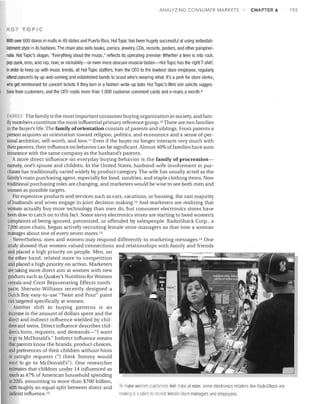
Prf:8'; d DN'L ur 0 StfTlUC /!. S,~llI.;"er I (:1111 PuI)II'llIr~1 (1;' Co Wiiatl! /j 1:J~' IIV Pillip MI vi All 'lljJL~; ieselvon


A'lS8SsinQ Wilich

_Olllparl~

Are Cuslome Mil1lii!rj

D,par lmenl
26

PART 1

UNDERS-rANDING MARKETING MANAGi=MENT

FIG. 1.6

Types of Marketing Organimtions
(percenl of sample population i
parentheses)
Based llll Boo.:A!I/;'1I H;JIIIIII01I/jl';~II.
of Natinl1rrlAI!vt>rIISI1I,', M,'}(kf!!llIil emlill~-'. ii'
conjunclioll wi!h C1rarJ(/wee!( hOIF Constatltlne
'1111 ~IDHIT1illl. 'Arrl1l-d vlillllill£lIllell~e.
Hli1ll,j1~L'A, May 2ft, 2006, pp. ,7 ?O
S{l/II('e'

Growth Champions (14.7%) emphasize growth-support functions, leading such general-management

activities as product innovation and new-business development.
Marketing Masters (38.4%) oversee company-wide marketing efforts and the customer-focused side of new
product and service launches, although are typically not involved with strategic decisions.
Senior Counselors (16.9%) specialize in marketing strategy, advising the CEO and individual businesses, and
may drive major communication programs, although not typically new product development.
Best Practices Advisors (8.9%) work with individual business units to improve their marketing effectiveness
and, but are less likely to be linked with above-average growth than both the Growth Champions and the
Marketing Masters.
Brand Builders (12.2%) support brands by providing marketing services like communications strategy,
creative output, and campaign execution, but exhibit little strategic leadership.
Service Providers (14.7%) coordinate marketing communications, but often work in firms with lower revenue
growth and profitability

want to be connecting at the very senior levels of the organization, and you also want to
be connecting in with the engineers and scientists who are doing a lot of the work on the
front lines." Dunaway also emphasizes the importance of integrated marketing, compar­
ing her job to that of an orchestra conductor: "You have to figure out how to pull all those
instruments together in a way that's delivering great marketing accountability and engag­
ing marketing programs."S1
A study conducted by Booz Allen Hamilton and the Association of National
Advertisers, in conjunction with Brandweek magazine, asked 2,000 executives to describe
the marketing structure within their organizations and to detail the tasks they consider
integral to their missions. The researchers identified six types of marketing organizations
(see Figure 1.6 for a breakdown and descriptions). In the most successful type, Growth
Champions, marketing heavily influenced all aspects of the organization. Growth
Champions were 20% more likely to deliver revenue growth and profitability than the
other types of marketing organizations.

Performance Marketing
Holistic marketing incorporates peljormance marketing and understanding the returns to
the business from marketing activities and programs, as well as addressing broader con­
cerns and their legal, ethical, social, and environmental effects. Top management is going
beyond sales revenue to examine the marketing scorecard and interpret what is happening
to market share, customer loss rate, customer satisfaction, product quality, and other
measures.
FINANCIAL ACCOUNTABILITY Marketers are thus being increasingly asked to justify their
investments to senior management in financial and profitability terms, as well as in terms of
building the brand and growing the customer base. 52 As a consequence, they're employing a
broader variety of financial measures to assess the direct and indirect value their marketing
efforts create. They're also recognizing that much of their firms' market value comes from in­
tangible assets, particularly their brands, customer base, employees, distributor and supplier
relations, and intellectual capital.
SOCIAL RESPONSIBILITY MARKF;ING The effects of marketing clearly extend beyond the
company and the customer to society as a whole. Marketers must carefully consider their role
in broader terms, and the ethical, environmental, legal, and social context of their activities. 53
Increasingly, consumers demand such behavior, as Starbucks Chairman Howard Schultz has
observed: 54
DEFINING MARKETING FOR THE 21ST CENTURY

CHAPTER 1

We see a fundamental change in the way consumers buy their products and
services.... Consumers now commonly engage in a cultural audit of providers.
People want to know your value and ethics demonstrated by how you treat employ­
ees, the community in which you operate. The implication for marketers is to strike
the balance between profitability and social consciousness and sensitivity.... It is
not a program or a quarterly promotion, but rather a way of life. You have to inte­
grate this level of social responsibility into your operation.
This realization caJis for a new term that enlarges the marketing concept. We propose
calling it the "societal marketing concept." The societal marketing concept holds that the
organization's task is to determine the needs, wants, and interests of target markets and
to deliver the desired satisfactions more effectively and efficiently than competitors in a
way that preserves or enhances the consumer's and society's long-term well-being.
Sustainability has become a major corporate concern in the face of challenging environ­
mental forces. Firms such as Hewlett-Packard have introduced recyclable computers
and printers and reduced greenhouse emissions; McDonald's strives for a "socially
responsible supply system" encompassing everything from healthy fisheries to
redesigned packaging. 55
The societal marketing concept calls upon marketers to build social and ethical con­
siderations into their marketing practices. They must balance and juggle the often con­
flicting criteria of company profits, consumer want satisfaction, and public interest.
Table 1.2 displays some different types of corporate social initiatives, illustrated by
McDonald's.56
As goods become more commoditized, and as consumers grow more socially conscious,
some companies-including the Body Shop, Timberland, and Patagonia-are adding social
responsibility as a way to differentiate themselves from competitors, build consumer prefer­
ence, and achieve notable sales and profit gains. They believe customers will increasingly
look for signs of good corporate citizenship.

ITAB LE 1.2 I

Corporate Social Initiatives

Type

Description

Example

Corporate social marketing

Supporting behavior change campaigns

McDonald's promotion of a statewide childhood
immunization campaign in Oklahoma

Cause marketing

Promoting social issues through efforts such as
sponsorships, licensing agreements, and advertising

McDonald's sponsorship of Forest (a gonlla) at Sydney's
Zoo-a 1O-year sponsorship commitment, aimed at
preserving this endangered species

Cause-related marketing

Donating a percentage of revenues to a specific
cause based on the revenue occurring during the
announced period of support

McDonald's earmarking of $1 for Ronald McDonald
Children's Charities from the sale of every Big Mac and
pizza sold on McHappy Day

Corporate philanthropy

Making gifts of money, goods, or time to help
nonprofit organizations, groups, or individuals

McDonald's contributions to Ronald McDonald House
Charities

Corporate community involvement

Providing in-kind or volunteer services in the
community

McDonald's catering meals for firefighters in the
December 1997 bushfires in Australia

Socially responsible business
practices

Adapting and conducting business practices that
protect the environment and human and animal
rights

McDonald's requirement that suppliers increase the
amount of living space for laying hens on factory farms

d.,'

$(JUice Philip Koller and N:1I1CV Lee, (,'orromte
Res.onnsib1il/f. [J, lilll) Ihf' Most GOOI! (or t(lU( C<ilflfJ3I1Y [Wi Yuw Cause (Hoboken, NJ: Wiley, 2004). Copyriglll © 2005 Ily
Philip Koller and Nancy Lei' lJ~p.d bv pr./I i~sl()n ,If lo!m Wl10y & Sen:i, Inr
'

27
28

PART 1

UNDERSTANDING MARKETING MANAGEMENT

BEN & JERRY'S

•

When they founded Ben & Jerry's, Ben Cohen and Jerry Greenfield embraced the performance marketing con­
cept by dividing the traditional financial bottom line into a "double" bottom line, which would include a measure­
ment of the environmental impact of their products and processes. That "double bottom line" later expanded into
a "triple bottom line," to represent in objective terms the social impacts, both negative and positive, of the firm's
entire range of business activities. Cohen and Greenfield informed their senior managers that they were going to
be held accountable to maintain two bottom lines: "To improve the quality of life in the communities in which we
operate, and to make a reasonable profit." Ben &Jerry's also recognized that just as companies require outside
auditors to measure financial performance, they also require outside auditors to measure their performance
along the environmental and social dimensions. As one of those outside auditors later recalled: "Measurement
is a key tool to convince boards of directors and core executives that the socially responsible company is a
sound business strategy. As companies make more data from their efforts available, the story becomes more
compelling.... To advocate transparency in business and for all of us to ascribe to that-that's the ultimate
acid test. "57

::: Marketing Management Tasks
With the holistic marketing philosophy as a backdrop, we can identify a specific set of tasks
that make up successful marketing management and marketing leadership. We'll use the fol­
lowing situation to illustrate these tasks in the context of the plan of the book. (The
"Marketing Memo: Marketers' Frequently Asked Questions" is a good checklist for the ques­
tions marketing managers ask, all of which we examine in this book.)
Zeus Inc. (name disguised) operates in several industries, including chemicals,
cameras, and film. The company is organized into SBUs. Corporate management is
considering what to do with its Atlas camera division, which produces a range of
35 mm and digital cameras. Although Zeus has a sizable share and is producing rev­
enue, the 35 mm market itself is rapidly declining and its market share is slipping.
In the faster-growing digital camera segment, Zeus faces strong competition and
has been slow to gain sales. Zeus's corporate management wants Atlas's marketing
group to produce a strong turnaround plan for the division.

Developing Marketing Strategies and Plans
The first task facing Atlas is to identify its potential long-run opportunities, given its mar­
ket experience and core competencies (see Chapter 2). Atlas can design its cameras with
better features. It can make a line of video cameras, or it can use its core competency in
optics to design a line of binoculars and telescopes. Whichever direction it chooses, it
must develop concrete marketing plans that specify the marketing strategy and tactics
going forward.

Capturing Marketing Insights
Atlas needs a reliable marketing information system to closely monitor its marketing envi­
ronment. Its microenvironment consists of all the players who affect its ability to produce
and sell cameras-suppliers, marketing intermediaries, customers, and competitors. Its
macroenvironment includes demographic, economic, physical, technological, political­
legal, and social-cultural forces that affect sales and profits (see Chapter 3).
Atlas also needs a dependable marketing research system. To transform marketing strat­
egy into marketing programs, marketing managers must measure market potential, forecast
demand, and make basic decisions about marketing expenditures, marketing activities, and
marketing allocation. 58 To make these allocations, marketing managers may use sales­
response functions that show how the amount of money spent in each application will affect
sales and profits (see Chapter 4).
DEFINING MARKETlbJG FOR THE 21ST CENTURY

I

CHAPTER 1

29

~	 II1 - - - - - - - - - - - - - - - - 1 

=:J
MARKETING MEMO
1.	
2.	
3.	
4.	

MARKETERS' FREQUENTLY ASKED QUESTIONS

How can we spot and choose the right market segment(s)?
How can we differentiate our offerings?
How should we respond to customers who buy on price?
How can '.'Ie compete against lower-cost, lower-price
competitors?
5.	 How far can we go in customizing our offering for each customer?
6.	 How can we grow our business?
7.	 How can we build stronger brands?
8.	 How can we reduce the cost of customer acquisition?

9. How can we keep our customers loyal for longer?
10. How can we tell which customers are more important?
11. How can we measure the payback from advertising, sales pro­
motion, and public relations?
12. How can we improve sales force productivity?
13. How can we establish multiple channels and yet manage channel
conflict?
14. How can we get tile other company departments to be more
customer oriented?

Connecting with Customers
Atlas must consider how to best create val ue for its chosen target markets and develop
strong, profitable, long-term relationships with customers (see Chapter 5). To do so, it
needs to understand consumer markets (see Chapter 6). Who buys cameras, and why do
they buy? What are they looking for in the way of features and prices, and where do they
shop? Atlas also sells cameras to business markets, including large corporations, profes­
sional firms, retailers, and government agencies (see Chapter 7), where purchasing agents
or buying committees make the decisions. Atlas needs to gain a full understanding of how
organizational buyers buy. It needs a sales force that is well trained in presenting product
benefits.
Atlas will not want to market to all possible customers. It must divide the market into
major market segments, evaluate each one, and target those it can best serve (see Chapter 8).

Building Strong Brands
Atlas must understand the strengths and weaknesses of the Zeus brand as customers see
it (see Chapter 9). Is its 35 mm film heritage a handicap in the digital camera market?
Suppose Atlas decides to focus on the consumer market and develop a positioning strat­
egy (see Chapter 10). Should it position itself as the "Cadillac" brand, offering superior
cameras at a premium price with excellent service and strong advertising? Should it build
a simple, low-priced camera aimed at more price-conscious consumers? Or something in
between?
Atlas must also pay close attention to competitors (see Chapter 11), anticipating its
competitors' moves and knowing how to react quickly and decisively. It may want to ini­
tiate some surprise moves, in which case it needs to anticipate how its competitors will
respond.

Shaping the Market Offerings
At the heart of the marketing program is the product-the firm's tangible offering to the mar­
ket, which includes the product quality, design, features, and packaging (see Chapter 12). To
gain a competitive advantage, Atlas may provide leasing, delivery, repair, and training as part
ofits product offering (see Chapter 13).
Acritical marketing decision relates to price (see Chapter 14). Atlas must decide on
wholesale and retail prices, discounts, allowances, and credit terms. Its price should
match well with the offer's perceived value; otherwise, buyers will turn to competitors'
products.

Delivering Value
Atlas must also determine how to properly deliver to the target market the value embodied

in its products and services. Channel activities include those the company undertakes to
30

PART 1

UNDERSTANDING MARKETING MANAGEMENT

make the product accessible and available to target customers (see Chapter 15). Atlas must
identify, recruit, and link various marketing facilitators to supply its products and services
efficiently to the target market. It must understand the various types of retailers, whole­
salers, and physical-distribution firms and how they make their decisions (see Chapter 16).

Communicating Value
Atlas must also adequately communicate to the target market the value embodied by its
products and services. It will need an integrated marketing communication program that
maximizes the individual and collective contribution of all communication activities (see
Chapter 17). Atlas needs to set up mass communication programs consisting of advertising,
sales promotion, events, and public relations (see Chapter 18). It also needs to plan more
personal communications, in the form of direct and interactive marketing, as well as hire,
train, and motivate salespeople (see Chapter 19).

Creating Long-Term Growth
Based on its product positioning, Atlas must initiate new-product development, testing, and
launching as part of its long-term view (see Chapter 20). The strategy should take into
account changing global opportunities and challenges (see Chapter 21).
Finally, Atlas must build a marketing organization that's capable of implementing the
marketing plan (see Chapter 22). Because surprises and disappointments can occur as mar­
keting plans unfold, Atlas will need feedback and control to understand the efficiency and
effectiveness of its marketing activities and how it can improve them. 59

MARY
1.	 From a managerial point of view, marketing is an organiza­

tional function and a set of processes for creating, commu­
nicating, and delivering value to customers and for man­
aging customer relationships in ways that benefit the
organization and its stakeholders. Marketing management
is the art and science of choosing target markets and get­
ting, keeping, and growing customers through creating,
delivering, and communicating superior customer value.
2. Marketers are skilled at managing demand: they seek to
influence the level, timing, and composition of demand.
Marketers are involved in marketing many types of enti­
ties: goods, services, events, experiences, persons, places,
properties, organizations, information, and ideas. They
also operate in four different marketplaces: consumer,
business, global, and nonprofit.
3. Marketing is not done only by the marketing department.
Marketing needs to affect every aspect of the customer
experience. To create a strong marketing organization,
marketers must think like executives in other departments,
and executives in other departments must think more like
marketers.
4. Today's marketplace is fundamentally different as a result
of major societal forces that have resulted in many new
consumer and company capabilities. These forces have

•••

•••

created new opportunities and challenges, and market­
ing management has changed significantly in recent
years as companies seek new ways to achieve marketing
excellence.
5. There are five competing concepts under which organiza­
tions can choose to conduct their business: the production
concept, the product concept, the selling concept, the
marketing concept, and the holistic marketing concept.
The first three are of limited use today.
6. The holistic marketing concept is based on the develop­
ment, design, and implementation of marketing programs,
processes, and activities that recognize their breadth and
interdependencies. Holistic marketing recognizes that
"everything matters" with marketing and that a broad!
integrated perspective is often necessary. Four compo-'
nents of holistic marketing are relationship marketing,
integrated marketing, internal marketing, and socially
responsible marketing.
7. The set of tasks necessary for successful marketing man­
agement includes developing marketing strategies and
plans, capturing marketing insights, connecting with cus­
tomers, building strong brands, shaping the market offer­
ings, delivering and communicating value, and creating
long-term growth.
DEFI ING MARKETING FOR THE 21 ST CENTURY

CHAPTER 1

31

•••
APPLICATIONS •••

Marketing Debate Does Marketing Create or Satisfy Needs?
Marketing has often been defined in terms of satisfying customers' needs and wants. Critics, however, maintain that marketing goes beyond that and creates needs and wants that did
not exist before. According to these critics, marketers encourage consumers to spend more money than they should on
goods and services they really do not need.

Marketing Discussion
Consider the broad shifts in marketing. Are there any themes
that emerge in these shifts? Can they be related to the major
societal forces? Which force has contributed to which shift?

Take a position: Marketing shapes consumer needs and
wants versus Marketing merely reflects the needs and wants of
consumers.
------------

CHA TER 2

~iAmens AGs

011 J

a lefl(linu p.nergy Conljli'll y foc:u elf

growth smJfegl'

..

•••

DEVELOPING MARKETING
STRATEGIES AND PLANS
34

PART 1

UNDERSTAI--JDING MARKETING MArJAGEIV1ENT

::: Marketing and Customer Value
Marketing is about satisfying consumers' needs and wants. The task of any business is to
deliver customer value at a profit. In a hypercompetitive economy with increasingly rational
buyers faced with abundant choices, a company can win only by fine-tuning the value deliv­
ery process and choosing, providing, and communicating superior value.

The Value Delivery Process
The traditional view of marketing is that the firm makes something and then sells it. In this
view, marketing takes place in the second half of the process. Companies that subscribe to
this view have the best chance of succeeding in economies marked by goods shortages
where consumers are not fussy abbut quality, features, or style-for example, basic staple
goods in developing markets.
This traditional view of the business process, however, will not work in economies where
people face abundant choices. There, the "mass market" is actually splintering into numer­
ous micro markets, each with its own wants, perceptions, preferences, and buying criteria.
The smart competitor must design and deliver offerings for well-defined target markets.
This realization inspired a new view of business processes that places marketing at the
beginning of planning. Instead of emphasizing making and selling, companies now see
themselves as part of a value delivery process.
The value creation and delivery sequence can be divided into three phases. The first
phase, choosing the value, represents the "homework" marketing must do before any
product exists. The marketing staff must segment the market, select the appropriate mar­
ket target. and develop the offering's value positioning. The formula "segmentation, tar­
geting, positioning (STP)" is the essence of strategic marketing. Once the business unit
has chosen the value, the second phase is providing the value. Marketing must determine
specific product features, prices. and distribution. The task in the third phase is
communicating the value by utilizing the sales force, sales promotion. advertising, and
other communication tools to announce and promote the product. Each of these value
phases has cost implications. It is also the case that the value delivery process begins
before there is a product and continues while it is being developed and after it becomes
available.
NIKE

•

Critics of Nike often complain that its shoes cost almost nothing to make, yet cost the consumer so mUCh. True,
the raw materials and manufacturing costs of a sneaker are relatively cheap, but marketing the product to the
consumer is expensive. Materials, labor, shipping, equipment, import duties, and suppliers' costs generally total
less than $25 a pair. Compensating the sales team, distributors, administration, and endorsers, as well as pay­
ing for advertising and R&D, adds $15 or so to Nike's total. Nike sells its product to retailers to make a profit of
$7. The retailer therefore pays roughly $47 to put a pair of Nikes on the shelf. Factoring in the retailer's overhead
(typically $30 covering human resources, lease, and equipment), along with a $1 0 profit, the shoe costs the con­
sumer over $80.
o

VELOPING MARKETING STRATEGIES AND PLANS

London Business School's Nirmalya Kumar has put forth a "3 Vs" approach to marketing:
value segment or customers (and their needs); (2) define the value proposition;
and (3) define the value network that will deliver the promised service. 2 Dartmouth's
Frederick Webster views marketing in terms of: (1) value-defining processes such as market
research and company self-analysis; (2) value-developing processes including new-product
development, sourcing strategy, and vendor selection; and (3) value-delivering processes
such as advertising and managing distribution. 3
(1) define the

The Value Chain
Michael Porter of Harvard has proposed the value chain as a tool for identifying ways to cre­
ate more customer value (see Figure 2.1).4 According to this model, every firm is a synthesis
of activities performed to design, produce, market, deliver, and support its product. The
value chain identifies nine strategically relevant activities-five primary and four support
activities-that create value and cost in a specific business.
The primary activities are inbound logistics or bringing materials into the business;
operations or converting them into final products; outbound logistics or shipping out
final products; marketing them, which includes sales; and servicing them. The support
activities-procurement, technology development, human resource management, and
firm infrastructure-are handled in specialized departments. The firm's infrastructure
covers the costs of general management, planning, finance, accounting, legal, and gov­
ernment affairs.
The firm's task is to examine its costs and performance in each value-creating activity
and to look for ways to improve it. Managers should estimate their competitors' costs and
performances as benchmarks against which to compare their own costs and perfor­
mance. And they should go further and study the "best of class" practices of the world's best
companies. 5

CISCO SYSTEMS INC.

•

Although Cisco Systems continues to grow, it is not grOWing at the breakneck speed of the 1990s, so its
supply base needs have changed. The company has reduced its number of suppliers and aligned itself more
closely with the remaining suppliers for each of its product-based teams-from Application Specific
Integrated Circuits (ASIC) to microprocessors and broadband chips. Steve Darendinger, vice president of
supply chain management for Cisco, says, "With ASIC we have gone from more than 20 suppliers to 3 sup­
pliers," and "the three have a greater level of ASIC leverage ... " Involving suppliers in new-product devel­
opment lets Cisco tap into its partners' expertise in improving time to volume, cutting costs, and improving
supplier quality.6

The firm's success depends not only on how well each department performs its work, but
also on how well the company coordinates departmental activities to conduct core business
processes. 7 These core business processes include:

The market-sensing process. All the activities in gathering market intelligence, dissemi­
nating it within the organization, and acting on the information
• The new-offering realization process. All the activities in researching, developing, and
launching new high-quality offerings quickly and within budget

• The customer acquisition process.

All the activities in defining target markets and

prospecting for new customers

• The customer relationship management process. All the activities in building deeper
understanding, relationships, and offerings to individual customers

The fulfillment management process. All the activities in receiving and approving or­
ders, shipping the goods on time, and collecting payment
Strong companies are reengineering their work flows and building cross-functional
teams to be responsible for each process. 8 At Xerox, a Customer Operations Group links

CHAPTER 2

35
36

PART 1

UNDERSTANDING MARKETING MANAGEMENT

Rite Aid is hoping ils use of CfTJss-tunctionalteams will illiprovn its lJusine&i processes enough to	
make it number Oil6 among retail druu chains.

sales, shipping, installation, service, and billing
so these activities flow smoothly into one
another. Winning companies are those that
excel at managing core business processes
through cross-functional teams. AT&T, Polaroid,
and Motorola have reorganized their employees
into cross-functional teams; cross-functional
teams are also found in nonprofit and govern­
ment organizations as well. Drugstore chain
Rite Aid is using cross-functional teams to try to
push its store from third to first place in the
drugstore hierarchy. The company has created
teams to focus on sales and margin growth,
operational excellence, market optimization,
continued supply chain improvements, and
continued cost control. 9
To be successful, a firm also needs to look
for competitive advantages beyond its own
operations, into the value chains of suppli­
ers, distributors, and customers. Many com­
panies today have partnered with specific
suppliers and distributors to create a supe­
rior value delivery network, also called a
supply chain.

Core Competencies
Traditionally, companies owned and controlled most of the resources that entered their
businesses-labor power, materials, machines, information, and energy-but this situation
is changing. Many companies today outsource less-critical resources if they can obtain bet­
ter quality or lower cost. India has developed a reputation as a country that can provide
ample outsourcing support.
The key, then, is to own and nurture the resources and competencies that make up the
essence of the business. Nike, for example, does not manufacture its own shoes, because cer­
tain Asian manufacturers are more competent in this task; instead Nike nurtures its superi­
ority in shoe design and merchandising, its two core competencies. A core competency has
three characteristics: (1) It is a source of competitive advantage in that it makes a significant
contribution to perceived customer benefits. (2) It has applications in a wide variety of mar­
kets. (3) It is difficult for competitors to imitate. lO
Competitive advantage also accrues to companies that possess distinctive capabilities.
IThereas "core competencies" refers to areas of special technical and production expertise,
distinctive capabilities describes excellence in broader business processes. Consider Netflix,
the pioneer online DVD rental service, based in Silicon Valley.!l
,..

•

NETFLIX
Back in 1997, while most people were still fumbling with programming their VCRs, Netflix founder Reed Hastings
became convinced that DVDs were the home video medium of the future. He raised $120 million, attracted hun­
dreds of thousands of customers for his online movie DVD rental business, and took the company public in 2002,
gaining another $90 million. Netflix has distinctive capabilities that promise to keep the company on top even as
competitors such as Blockbuster and Wal-Mart try to muscle in on its turf. These distinctive capabilities are no
late fees, (mostly) overnight delivery, and a deep catalog of over 65,000 movie titles, linked to systematic pro­
prietary search software that allows customers to easily search for obscure films and discover new ones. Netflix
is now making all of Hollywood-not just movie rental businesses-react. With its online communities of peo­
ple who provide reviews and feedback, Netflix can identify potential fans for films. For instance, the company is
credited with single-handedly bUilding audiences for such quirky independent films as Capturing the Friedmans,
a documentary about sexual abuse in a Long Island family.
DEVE.LOPING MARKE.TING STRATEGIES AND PLANS

CHAPTER 2

37

Netflix became a success in the DVD
rental business by exploiting its
distinctive capabilities-state-oHhe-art
software that supports its product
recommendations, merchandising, and
inventory control
R.pl inter! hy permissior of NetlliJ-:, Inc.
, pYflghll2' L007 Nell.ix. 111[; AL llgilt"

leseivoti.
How Netfllx Works:

0°'"
6S.~

o:~-=

0

, I

LATE

FEE'
_!V1~r-l:I..-o,

r"'... ~_~,'

Wharton's George Day sees market-driven organizations as excelling in three distinc­
tive capabilities: market sensing, customer linking, and channel bonding. 12 In terms of
market sensing, he believes that tremendous opportunities and threats often begin as
"weak signals" from the "periphery" of a business. 13 He offers a systematic process for
developing peripheral vision, and practical tools and strategies for building "vigilant
organizations" attuned to changes in the environment, by asking questions in three cate­
gories (see Table 2.1).
Competitive advantage ultimately derives from how well the company has fitted its core
competencies and distinctive capabilities into tightly interlocking "activity systems."
Competitors find it hard to imitate companies such as Southwest Airlines, Dell, and IKEA
because they are unable to copy their activity systems.

TABLE 2.1
Learning from the
• •	 What have beenpast past blind spots?
our
• What instructive analogies do other industries offer?

!I

Who in the industry is skilled at picking up weak signals and acting on them?


Evaluating the present
•	 What important signals are we rationalizing away?
•	 Wllat are our mavericks, outliers, complainers, and defectors telling us?

What are our peripheral customers and competitors really thinking?


•

EnVisioning the future
What future surprises could really hurt or help us?
• What emerging technologies could change the game?
• Is there an unthinkable scenario that might disrupt our business?

~Mro'
~')1Ir

George S O~y alld P(l~ J H SchcemaKer, I' riplloml Vision: Dctecung ttle Weali Sigmls That WI/I Make or Break
COrllPEIfIY (Boston' HaJvanJ BU$iness Sello I f"re<;s. ;?fJnf))

I

Becoming a Vigilant Organization
38

PART 1

UNDERSTANDING MARKETING MANAGEMENT

Business realignment may be necessary to maximize core competencies. It has three
steps: (1) (re)defining the business concept or "big idea"; (2) (re)shaping the business
scope; and (3) (re)positioning the company's brand identity. Consider what Kodak is doing
to realign its business:
KODAK

•

With the advent of the digital era and consumers' new capacity to store, share, and print photos using their PCs,
Kodak faces more competition than ever, both in-store and online. In 2004, after being bumped from the Dow
Jones Industrial Average, where it had held a spot for more than 70 years, the company started the painful
process of transformation. It started off by expanding its line of digital cameras, printers, and other equipment,
and it also set out to increase market share in the lucrative medical imaging business. Making shifts is not with­
out challenges,however. The company announced in the summer of 2006 that it would outsource the making of
its digital cameras. Kodak eliminated almost 30,000 jobs between 2004 and 2007 and it spent money acquiring
a string of companies for its graphics communications unit. Not only must Kodak convince consumers to buy its
digital cameras and home printers, but it also must become known as the most convenient and affordable way
to process digital images. So far, the company faces steep competition from Sony, Canon, and Hewlett-Packard. 14

A Holistic Marketing Orientation and Customer Value
A holistic marketing orientation can also help capture customer value. One view of holistic
marketing sees it as "integrating the value exploration, value creation, and value delivery
activities with the purpose of building long-term, mutually satisfying relationships and
coprosperity among key stakeholders."15 According to this view, holistic marketers succeed
by managing a superior value chain that delivers a high level of product quality, service, and
speed. Holistic marketers achieve profitable growth by expanding customer share, building
customer loyalty, and capturing customer lifetime value. Figure 2.1, a holistic marketing
framework, shows how the interaction between relevant actors and value-based activities
helps to create, maintain, and renew customer value.
The holistic marketing framework is designed to address three key management questions:
1.	 Value exploration-How can a company identify new value opportunities?
2.	 Value creation-How can a company efficiently create more promising new value

offerings?
3.	 Value delivery-----How can a company use its capabilities and infrastructure to deliver the

new value offerings more efficiently?
Let's look at how marketers can answer them.

I FIG. 2.1 I

Collaborative
Network

A Holistic Marketing Framework
$oilieR P. Koller. DC. J~iJl, anti
S. Maesincea "Formulaliflg a Malkel

Renewal Strategy." in M"rkoting Moves
(f'alt 1) Fig. H (Ba~[on: IlarvallJ Business
School Press, 2002), p. 29. Callyriolll © 200?
hv President ami Fellows of HarvArd Collene.
All righls raSAI ved

Value
Exploration

Cognitive
space

Competency
space

Resource
space

t
Value
Creation

)'

Customer
benefits	


Customer
relationship
management

•

•

Business
domain

Business
partners

..

•

Internal
resource
management

Business
partner
management

t
Value


DeIiVe:._~
DEVELOrlNG MARKETING STRATEGIES AND PLANS

VALUE EXPLORATION Finding new value opportunities is a matter of understanding the

relationships among three spaces: (1) the customer's cognitive space; (2) the company's com­
petence space; and (3) the collaborator's resource space. The customer's cognitive space re­
flects existing and latent needs and includes dimensions such as the need for participation,
stability, freedom, and change. 16 We can describe the company's competency space in terms
of breadth-broad versus focused scope of business; and depth-physical versus knowledge­
based capabilities. The collaborator's resource space includes horizontal partnerships, with
partners chosen for their ability to exploit related market opportunities, and vertical partner­
ships, with partners who can serve the firm's value creation.
VALUE CREATION Value-creation skills for marketers include identifying new customer
benefits from the customer's view; utilizing core competencies from its business domain; and
selecting and managing business partners from its collaborative networks. To create new cus­
tomer benefits, marketers must understand what the customer thinks about, wants, does,
and worries about and observe whom customers admire and interact with, and who influ­
ences them.
ALUE DEUVERV Delivering value often means making substantial investments in infra­
structure and capabilities. The company must become proficient at customer relationship
management, internal resource management, and business partnership management.
Customer relationship management allows the company to discover who its customers are,
how they behave, and what they need or want. It also enables the company to respond ap­
propriately, coherently, and quickly to different customer opportunities. To respond effec­
tively, the company requires internal resource management to integrate major business
processes, such as order processing, general ledger, payroll, and production, within a single
family of software modules. Finally, business partnership management allows the company
to handle complex relationships with its trading partners to source, process, and deliver
products.

The Central Role of Strategic Planning
Successful marketing thus requires companies to have capabilities such as understand­
ing customer value, creating customer value, delivering customer value, capturing cus­
tomer value, and sustaining customer value. Only a select group of companies stand out
as master marketers: Procter & Gamble, Southwest Airlines, Nike, Disney, Nordstrom,
Barnes & Noble, Starbucks, Wal-Mart, Target, Enterprise Rent-A-Car, Progressive
Insurance, McDonald's, Ritz-Carlton, and several Asian (Sony, Toyota, Samsung, Canon)
and European (IKEA, Club Med, Bang & Olufsen, Electrolux, Nokia, Lego, Tesco, and
Virgin) companies. "Breakthrough Marketing: Intel" describes how that company created
customer value and built a brand in a category for which most people thought branding
impossible.
These companies focus on the customer and are organized to respond effectively to
changing customer needs. They all have well-staffed marketing departments, and all their
other departments accept the concept that the customer is king.
To ensure that they select and execute the right activities, marketers must give priority to
strategic planning in three key areas: managing a company's businesses as an investment
portfolio, assessing each business's strength by considering the market's growth rate and the
company's position and fit in that market, and establishing a strategy. For each business, the
company must develop a game plan for achieving its long-run objectives.
Most large companies consist of four organizational levels: the corporate level, the
division level, the business unit level, and the product level. Corporate headquarters is
responsible for designing a corporate strategic plan to guide the whole enterprise; it
makes decisions on the amount of resources to allocate to each division, as well as on
which businesses to start or eliminate. Each division establishes a plan covering the allo­
cation of funds to each business unit within the division. Each business unit develops a
strategic plan to carry that business unit into a profitable future. Finally, each product
level (product line, brand) within a business unit develops a marketing plan for achieving
its objectives in its product market.
The marketing plan is the central instrument for directing and coordinating the market­
ing effort. The marketing plan operates at two levels: strategic and tactical. The strategic
marketing plan lays out the target markets and the value proposition the firm will offer,

CHAPTER 2
40

PART 1

UNDERSTANDING MARKETING MANAGEMENT

INTEL

BREAKTHROUGH MARKETING

Intel makes the microprocessors that are found in 80% of the world's
personal computers. In the early days, Intel microprocessors were
known simply by their engineering numllers, such as "80386" or
"80486." Intel positioned its chips as the most advanced. The trouble
was, as Intel soon learned, numbers can't be trademarked.
Competitors came out with their own "486" chips, and Intel had no
way to distinguish itself from the competition. Worse, Intel's products
were hidden from consumers, buried deep inside PCs. Witll a hidden,
untrademarked product, Intel had a hard time convincing consumers
to pay more for its high-performance products.
Intel's response was a marketing campaign that created history.
Tile company chose atrademarkable nam&--Pentium-and launched
the "Intel Inside" marketing campaign to build awareness of the brancl
and get its name outside the PC and into the minds of conslilners.
Intel used an innovative cooperative scheme to extend the reacll
of the campaign: It would help computer makers who used Intel
processors to advertise their PCs if the makers also included the Intel
logo in their ads. Intel also gave computer manufacturers a co-op
reimbursement on Intel processors if they agreed to place an "Intel
Inside" sticker on the outside of their PCs and laptops
Intel continues its integrated ingredient campaigns to this day.
For example, when launching its Centrino mobile microprocessor
platform, Intel began with 1V ads III at aired in the United States and
11 other countries. These ads include tile animated logo and now
familiar five-note brand signature melody. Print, online, and outdoor

advertising followed shortly thereafter. Intel created eight-page
inserts for major newspapers 1I1at urged the wired world to not only
"unwire," but also "Untangle. Unburden. Uncompromise. Unstress."
Intel even held a "One Unwired Day" event that took place in
major cities such as New York, Chicago, San Francisco, and Seattle.
In addition to allowing free trial Wi-Fi access, the company held fes­
tivals in each city that included live music, product demonstrations,
and prize giveaways.
The "Unwired" campaign was another Intel success in marketing.
The $300 million total media effort for the Centrino mobile platform,
which also included cooperative advertising with manufacturers,
helped generate $2 billion in revenue for Intel during the first nine
months of the campaign.
Going forward, Intel launched a new brand identity in 2006, sup­
ported by a $2 billion global marketing campaign. The company intro­
duced a new logo with a different font and updated visual look and
also cI'eated a new slogan: "Leap Ahead." In addition to the new logo
and slogan, Intel developed a new microprocessor platform called
Viiv (rhymes with "five") aimed at home entertainment enthusiasts.
These moves were designed to create the impression of Intel as a
"vvarm and fuzzy consumer company," with products that went
beyond the PC. Intel remained one of the most valuable brands in the
world, its $32 billion brand valuation earning it fifth place in the 2006
InterbrandlBusinessWeek ranking of the Best Global Brands.

Sources: Don Clark, "Intel to Overhaul Marketing in BirJ to Go heyond PCs," Wall Street Joumal, December 30, 2005; Cliff Edwards, "Intel Everywhere?" BusinessWeek, March 8,
2004, pp. 56-62; Scott Van Camp, "ReadMe. 1st," BtalJdweek, February 23, 2004, p. 17; and David Kirkpatrick, "At Intel, Speed Isn't Everything," FOItulJe, Februal)l9, 2004, p. 34;
"How to Become a Superbrand," Marketing, Janual)l8, 2004, p. 15; Roger Slavens, "Pam Pallace, liP-Director, Corporate Marketing Group, Intel Corp," 8 to B, December 8,2003,
p. 19; Kennetll Hein. "Study: New Brand Names Not Making Tileir Mark," Brandweek, December 8, 2003, p. 12; Heather Clancy, "Intel Thinking Outside the Box," Computer Reseller
News, November 24, 2003, p. 14; Cynthia L. Webb, "A Chip Off tile Old Recovery?" Wasllingtonposl.com, October 15, 2003; "Intel Launches Second Phase of Centrino Ads,"
TectJlJology Advertising & Branding Report, Octoher 6, 2003.

based on an analysis of the best market opportunities. The tactical marketing plan specifies
the marketing tactics, including product features, promotion, merchandising, pricing, sales
channels, and service.
Today, teams develop the marketing plan with inputs and sign-offs from every important
function. Management then implements these plans at the appropriate levels of the organi­
zation, monitors results, and takes necessary corrective action. The complete planning,
implementation, and control cycle is shown in Figure 2.2. We next consider planning at each
of these four levels of the organization.

FIG,2.2
18

Strategic rlannin[l. Impl8mentation,

unrl Conlr!)1

Pr[)ces~es

Planning

Implementing

Controlling

Corporate planning

Organizing

Measuring results

Division planning

Implementing
Diagnosing results

Business planning

~

Product planning

Taking corrective
action
DEVELOPING MARKETING STRATEGIES A D PLANS

CHAPTER 2

41

Arls III<e this were p<lrl 01 Illiel:; strateg
for lJuilding Q branu ill

il

product area

where no hranrl name hat! ever xsted
l1efnre--llliCloprocessors.

INTEl' CENTRINO' DUO PROCESSOR TECHNOLOGY.

be_

Irs what 4flves your not_ _s performance•..weless coMeclMty, and IIlIIZing
billt!flJrt, Ifs

w lifference

@

a QOQd CD"""IJ!I"Oln<! ~
_ . Centrlno'
(iREAT COMPUTING STAATS WITH INTEL INSIDE. 0.0

::: Corporate and Division Strategic Planning
Some corporations give their business units a lot of freedom to set their o""n sales and profit
goals and strategies. Others set goals for their business units but let them develop their own
strategies. Still others set the goals and participate in developing individual business unit
strategies. 17
All corporate headquarters undertake four planning activities:
1. Defining the corporate mission
2. Establishing strategic business units
3. Assigning resources to each SBD
4. Assessing growth opportunities

We'll look at each process.

Defining the Corporate Mission
An organization exists to accomplish something: to make cars, lend money, provide a night's

lodging, and so on. Over time the mission may change, to take advantage of new opportuni­
ties or respond to new market conditions. Amazon.com changed its mission from being the
world's largest online bookstore to aspiring to become the world's largest online store; and
eBay changed its mission from running online auctions for collectors to running online auc­
tions of all kinds of goods.
To define its mission, a company should address Peter Drucker's classic questions: W What
is our business? Who is the customer? What is of value to the customer? What will our busi­
ness be? What should our business be? These simple-sounding questions are among the
42

PART 1

UNDERSTANDING MARKETING MA!'JAGEMENT

most difficult a company will ever have to answer. Successful companies continuously raise
them and answer them thoughtfully and thoroughly.19
Organizations develop mission statements to share with managers, employees, and (in
many cases) customers. A clear, thoughtful mission statement provides employees with a
shared sense of purpose, direction, and opportunity.
Mission statements are at their best when they reflect a vision, an almost "impossible
dream" that provides a direction for the company for the next 10 to 20 years. Sony's former
president, Akio Morita, wanted everyone to have access to "personal portable sound," so his
company created the Walkman and portable CD player. Fred Smith wanted to deliver mail
anywhere in the United States before 10:30 AM the next day, so he created FedEx. Table 2.2
lists three sample mission statements.
Good mission statements have five major characteristics. First, they focus on a limited
number of goals. The statement "We want to produce the highest-quality products, offer the
most service, achieve the widest distribution, and sell at the lowest prices" claims too much.
Second, mission statements stress the company's major policies and values. They narrow the
range of individual discretion so that employees act consistently on important issues. Third,
they define the major competitive spheres within which the company will operate.

• Industry. Some companies will operate in only one industry; some only in a set of related
industries; some only in industrial goods, consumer goods, or services; and some in any in­
dustry. For example, DuPont prefers to operate in the industrial market, whereas Dow is will­
ing to operate in the industrial and consumer markets.
• Products and applications. Firms define the range of products and applications they
will supply. St. Jude Medical aims to "serve physicians worldwide with high-quality products
for cardiovascular care."
• Competence. The firm identifies the range of technological and other core competen­
cies it will master and leverage. Japan's NEC has built its core competencies in computing,
communications, and components to support production of laptop computers, television
receivers, and handheld telephones.
• Market segment. The type of market or customers a company will serve is the market
segment. Aston Martin makes only high-performance sports cars. Gerber serves primarily
the baby market.
• VerticaL The vertical sphere is the number of channel levels, from raw material to final prod­
uct and distribution, in which a company will participate. At one extreme are companies with a
large vertical scope; at one time Ford owned its own rubber plantations, sheep farms, glass man­
ufacturing plants, and steel foundries. At the other extreme are "hollow corporations" or "pure
marketing companies" consisting of a person with a phone, fax, computer, and desk who con­
tracts out every service, including design, manufacture, marketing, and physical distribution. 20
• Geographical. The range of regions, countries, or country groups in which a company
will operate defines its geographical sphere. Some companies operate in a specific city or
TABLE 2.2
Sample Mission Statement

Rubbermaid Commercial Products Inc.
"Our Vision is to be the Global Market Share Leader in each of the markets we serve. We will earn this
leadership position by providing to our distributor and end-user customers innovative, high-quality, cost­
effective, and environmentally responsible products. We will add value to these products by providing legendary
customer service through our Uncompromising Commitment to Customer Satisfaction."
Motorola
"The purpose of Motorola is to honorably serve the needs of the community by providing products and services
of superior quality at a fair price to our customers; to do this so as to earn an adequate profit which is required
for the total enterprise to grow; and by so doing provide the opportunity for our employees and shareholders to
achieve their reasonable personal objectives."
eBay
"We help people trade practically anrthing on earth. We will continue to enhance the online trading
experiences of all-collectors, dealers, small businesses, unique item seekers, bargain hunters, opportunity
sellers, and browsers"
DEVELOPING MARKETING STRATEGIES AND PLAr--J5

CHAPTER 2

state. Others are multinationals such as Unilever and Caterpillar, which operate in almost
every country in the world.
The fourth characteristic of mission statements is that they take a long-term view. They
should be enduring; management should change the mission only when it ceases to be rel­
evant. Finally, a good mission statement is as short, memorable, and meaningful as possible.
Marketing consultant Guy Kawasaki even advocates developing short three- to four-word
corporate mantras rather than mission statements, like "peace of mind" for Federal
Express. 21 Compare the rather vague missions statements on the left with Google's mission
statement and philosophy on the right:
To build total brand value by innovating to deliver
customer value and customer leadership faster,
better, and more completely than our competition.
We build brands and make the world a little happier
by bringing our best to you


Google Mission:

To organize the worlel's information and make it
universally accessible and useful.

Google Philosophy:


Never settle for the best.
1.	 Focus on the user and all else will follow.
2.	 It's best to do one thing really, really well.
3.	 Fast is better than slow.
4.	 Democracy on the Web works.
5.	 You don't need to be at your desk to need an
answer.
6.	 You can make money without doing evil.
7.	 There is always more information out there.
8.	 The need for information crosses all borders.
9.	 You can be serious without a suit.
10. Great just isn't good enough.22

Establishing Strategic Business Units
Companies often define their businesses in terms of products: They are in the "auto busi­
ness" or the "clothing business." But Harvard's famed marketing professor Ted Levitt argued
that market definitions of a business are superior to product definitions. In other words,
companies must see their business as a customer-satisfying process, not a goods-producing
process. Products are transient; basic needs and customer groups endure forever.
Transportation is a need: the horse and carriage, the automobile, the railroad, the airline,
and the truck are products that meet that need.
Viewing businesses in terms of customer needs can suggest additional growth opportu­
nities. IBM redefined itself from a hardware and software manufacturer to a "builder of net­
works." Table 2.3 gives several examples of companies that have moved from a product to a
market definition of their business. It highlights the difference between a target market def­
inition and a strategic market definition.
TABLE 2.3

Product OriOll1eti v,rsus Marke -Oliont (I Defillitions of a BusillP,o,s

Company	

Product Definition

Market Definition

Missouri-Pacific Railroad	
Xerox	
Standard all	
Columbia Pictures	
Encyclopaedia Britannica	
Carrier	

We run a railroad.
We make copying equipment.
We sell gasoline.
We make movies.
We sell encyclopedias.
We make air conditioners and furnaces.

We are a people-and-goods mover.
We help improve office productivity.
We supply energy.
We market entertainment.
We distribute information.
We provide climate control in the home.

43
A target market definition tends to focus on selling a product or service to a current
market. Pepsi could define its target market as everyone who drinks a cola beverage, and
competitors would therefore be other cola companies. A strategic market definition, how­
ever, focuses also on the potential market. If Pepsi considered everyone who might drink
something to quench their thirst, their competition would also include non cola soft
drinks, bottled water, fruit juices, tea, and coffee. To better compete, Pepsi might decide to
sell additional beverages whose growth rate appears to be promising.
A business can define itself in terms of three dimensions: customer groups, customer
needs, and technology.23 Consider a small company that defines its business as designing
incandescent lighting systems for television studios. Its customer group is television studios;
the customer need is lighting; and the technology is incandescent lighting. The company
might want to expand. It could make lighting for other customer groups, such as homes, fac­
tories, and offices; or it could supply other services needed by television studios, such as
heating, ventilation, or air conditioning. It could design other lighting technologies for tele­
vision studios, such as infrared or ultraviolet lighting.
Large companies normally manage quite different businesses, each requiring its own
strategy. General Electric has classified its businesses into 49 strategic business units, SBlls.
An SBU has three characteristics:
1.	 It is a single business, or a collection of related businesses, that can be planned sepa­

rately from the rest of the company.
2.	 It has its own set of competitors.
3.	 It has a manager responsible for strategic planning and profit performance, who con­
trols most of the factors affecting profit.
The purpose of identifying the company's strategic business units is to develop separate strate­
gies and assign appropriate funding. Senior management knows that its portfolio of businesses
usually includes a number of "yesterday's has-beens" as well as "tomorrow's breadwinners."24

Assigning Resources to Each SBU 25
Once it has defined SBUs, management must decide how to allocate corporate resources to
each. The 1970s saw several portfolio-planning models introduced to provide an analytical
means for making investment decisions. The GE/McKinsey Matrix classifies each SBU
according to the extent of its competitive advantage and the attractiveness of its industry.
Management would want to grow, "harvest" or draw cash from, or hold on to the business.
Another model, the BCG's Growth-Share Matrix, uses relative market share and annual rate
of market growth as criteria to make investment decisions.
Portfolio-planning models like these have fallen out of favor as oversimplified and sub­
jective. More recent methods firms use to make internal investment decisions are based on
shareholder value analysis, and whether the market value of a company is greater with an
SBU or without it (whether it is sold or spun off). These value calculations assess the poten­
tial of a business based on potential growth opportunities from global expansion, reposi­
tioning or retargeting, and strategic outsourcing.

Assessing Growth Opportunities
Assessing growth opportunities includes planning new businesses, downsizing, and termi­
nating older businesses. If there is a gap between future desired sales and projected sales,
corporate management will need to develop or acquire new businesses to fill it.
Figure 2.3 illustrates this strategic-planning gap for a major manufacturer of blank com­
pact disks called Musicale (name disguised). The lowest curve projects the expected sales
over the next five years from the current business portfolio. The highest curve describes
desired sales over the same period. Evidently, the company wants to grow much faster than
its current businesses will permit. How can it fill the strategic-planning gap?
The first option is to identify opportunities to achieve further growth within current busi­
nesses (intensive opportunities). The second is to identify opportunities to build or acquire
businesses that are related to current businesses (integrative opportunities). The third
option is to identify opportunities to add attractive businesses unrelated to current busi­
nesses (diversification opportunities).
INTENSIVE G .OWTH Corporate management's first course of action should be a review of op­

portunities for improving existing businesses. One useful framework for detecting new intensive
growth opportunities is called a "product-market expansion grid" (Figure 2.4).26
DEVELOPING MARKETING STRATEGIES AND PLANS

(

Desired
sales

~

Dive::itic~ __

<::

1110 Sirategic-Planning Gap

/ /

~

~~
~

Strategic-planning
Gap

//

45

FIG.2.3

~

~egrativegrowth
~ / ~ Intensive growt~

Cil

CHAPTER 2

~
~' portfolio
:~~~~~

I?	

U)	

o	

2

3

4

/

)

5

Time (years)

The company first considers whether it could gain more market share with its current prod­
ucts in their current markets, using a market-penetration strategy. Next it considers whether it
can find or develop new markets for its current products, in a market-development strategy.
Then it considers whether it can develop new products of potential interest to its current mar­
kets with a product-development strategy. Later the firm will also review opportunities to
develop new products for new markets in a diversification strategy.
STARBUCKS

•

When Howard Schultz, Starbucks' CEO until 2000, came to the company in 1982, he recognized an unfilled niche for
cafes serving gourmet coftee directly to customers, This became Starbucks' market-penetration strategy and helped
the company attain a loyal customer base in Seattle. The market-development strategy marked the next phase in
Starbucks' growth: It applied the same successful formula that had worked wonders in Seattle, first to other cities in
the Pacific Northwest, then throughout North America, and finally, across the globe. Once the company had estab­
lished itself as a presence in thousands of cities internationally, Starbucks sought to increase the number of pur­
chases by existing customers with a product-development strategy that led to new in-store merchandise, including
compilation CDs, a Starbucks Duetto Visa card that allows customers to receive points toward Starbucks purchases
whenever they use it, and high-speed wireless Internet access at thousands of Starbucks "HotSpots" through a deal
with T-Mobile. Finally, Starbucks pursued diversification into grocery store aisles with Frappuccino® bottled drinks,
Starbucks brand ice cream, and the purchase of tea retailer Tazo® Tea. 27
So how might Musicale use these three major intensive growth strategies to increase its
sales? It could try to encourage its current customers to buy more by demonstrating the ben­
efits of using compact disks for data storage in addition to music storage. Musicale could
also try to attract competitors' customers if it noticed major weaknesses in competitors'
products or marketing programs. Finally, Musicale could try to convince nonusers of com­
pact qisks to start using them.
How can Musicale use a market-development strategy? First, it might try to identify poten­
tial user groups in the current sales areas. If Musicale has been selling compact disks only to
consumer markets, it might go after office and factory markets. Second, it might seek addi­
tional distribution channels in its present locations. If it has been selling its disks only through
stereo equipment dealers, it might add mass-merchandising or online channels. Third, the
Current
Products

New
Products

Current
Markets

1. Market-penetration
strategy

3. Product-development
strategy
.... __ ._­

New
Markets

2. Market-development
strategy

(Diversification
strategy)

FIG . . 4

Tllree Intensive Towth Strategies:
Ansoft's Pmdllcl-Markel Exransion Grid
';ll/If' .. 1~11,1Il1 II III '''[111 Itl'l 11'1 p,!rr lI;'si'H,
H'1fI','I!O '//lO'<:W.>s fir:~IIW
.:ill;'femcs
l']f 11 VW'llllcllio. I, )~ !II!.!! f'I: fJI ,
Sri,; llllP.l- 1 ,t(lll~1 l'l5t, '" 1'l'IIIJIJ ,~ ~h"
"'III'e p!I.,";IIl:;'11 [lid Fl h)i:~ II Hdrv:lIl
C"!!r.pe.rJ! III Ills II": ::'!I·f1.

rmw
46

PART 1

UNDERSTANDING MARKETING MANAGE.MENT

company might consider selling in new locations in its home countIy or abroad. If Musicale
sold only in the United States, it could consider entering the European market.
Management should also consider new-product possibilities. Musicale could develop
new features, such as additional data storage capabilities or greater durability. It could offer
the CD at two or more quality levels, or it could research an alternative technology such as
flash drives.
By examining these intensive growth strategies, managers may discover several ways to
grow. Still, that growth may not be enough. In that case, management must also look for
integrative growth opportunities.
TEGRAT' VE u~OWTH A business can increase sales and profits through backward, for­
ward, or horizontal integration within its industry. For example, drug giant Merck has gone
beyond just developing and selling ethical pharmaceuticals requiring a doctor's prescription.
It purchased Medco, a mail-order pharmaceutical distributor, formed a joint venture with
DuPont to establish more basic research, and began another joint venture with Johnson &
Johnson to bring some of its ethical products into the over-the-counter market.
Media companies have long reaped the benefits of integrative growth. Here's how one
business writer explains the potential that NBC could reap from its merger with Vivendi
Universal Entertainment to become NBC Universal. Although it's a far-fetched example, it
gets across the possibilities inherent in this growth strategy:28

[When] the hit movie Seabiscuit (produced by Universal Pictures) comes to televi­
sion, it would air on Bravo (owned by NBC) or USA Network (owned by Universal),
followed by the inevitable bid to make the movie into a TV series (by Universal
Television Group), with the pilot being picked up by NBC, which passes on the
show, but it's then revived in the "Brilliant But Canceled" series on cable channel
Trio (owned by Universal) where its cult status leads to a Spanish version shown on
Telemundo (owned by NBC) and the creation of a popular amusement-park attrac­
tion at Universal Studios.
How might Musicale achieve integrative growth? The company might acquire one or
more of its suppliers, such as plastic material producers, to gain more control or generate
more profit through backward integration. It might acquire some wholesalers or retailers,
especially if they are highly profitable, in forward integration. Finally, Musicale might
acquire one or more competitors, provided that the government does not bar this horizon­
tal integration. However, these new sources may still not deliver the desired sales volume. In
that case, the company must consider diversification.
DIVERSIFICATION GROWTH Diversification growth makes sense when good opportunities
exist outside the present businesses-the industry is highly attractive and the company has
the right mix of business strengths to be successful. For example, from its origins as an ani­
mated film producer, Walt Disney Company has moved into licensing characters for mer­
chandised goods, entering the broadcast industry with its own Disney Channel as well as ABC
and ESPN acquisitions, and developing theme parks and vacation and resort properties.
CISCO SYSTEMS INC.

•

Known for years as a mass producer of routers and switches, Cisco is attempting to diversify beyond these nuts
and bolts products into the business of changing how consumers communicate and view television. With its
recent $6.9 billion acquisition of Scientific-Atlanta Inc., widely recognized for its expertise in video delivery, Cisco
hopes to enter consumers' living rooms with items such as home-networking equipment and wirelessly net­
worked DVD players and services such as video on demand. The diversification move is already paying off:
Scientific-Atlanta produced 7% of Cisco's $8 billion in revenue in the fourth quarter of 2006. 29
Several types of diversification are possible for Musicale. First, the company could choose
a concentric strategy and seek new products that have technological or marketing synergies
with existing product lines, though the new products themselves may appeal to a different
group of customers. It might start a laser disk manufacturing operation, because it knows
how to manufacture compact discs. Second, the company might use a horizontal strategy to
search for new products that could appeal to current customers, even though the new prod­
DEVELOPING MARKETING STRATEGIES AND PLANS

ucts are technologically unrelated to its current product line. Musicale might produce com­
pact disc cases, for example, though they require a different manufacturing process. Finally,
the company might seek new businesses that have no relationship to its current technology,
products, or markets, adopting a conglomerate strategy to consider such new businesses as
making application software or personal organizers.

DOWNSIZING ANO OlVESTING OWER BUSINESSES Weak businesses require a dispro­
portionate amount of managerial attention. Companies must carefully prune, harvest, or di­
vest tired old businesses in order to release needed resources to other uses and reduce costs.
To focus on its travel and credit card operations, American Express in 2005 spun offAmerican
Express Financial Advisors, which provided insurance, mutual funds, investment advice, and
brokerage and asset management services (it was renamed Ameriprise Financial).

HEALTHSOUTH CORP.
In 2006, HealthSouth Corp., one of the nation's largest providers of rehabilitative health care, announced it was
planning to get rid of its large network of outpatient services. The company, still reeling from a $2.7 billion fraud
scandal in 2003, planned to increase its stockholder value by focusing on the areas that account for 58% of the
company's net operating revenue and 86% of its operating earnings: post-acute-care inpatient services. "We
intend to focus HealthSouth's resources on establishing a 'pure play,' post-acute company that builds on our
Gore competencies," said Jay Grinney, CEO and president. "At the same time, we believe our outpatient, surgery,
and diagnostic divisions will be well positioned to succeed under new owners who will place strategic priority
on strengthening each individual business. "30

Organization and Organizational Culture
Strategic planning happens within the context of the organization. A company's organization
consists of its structures, policies, and corporate culture, all of which can become dysfunctional
in a rapidly changing business environment. Whereas managers can change structures and
policies (with difficulty), the company's culture is very hard to change. Yet adapting the culture
is often the key to successfully implementing a new strategy.
What exactly is a corporate culture? Most businesspeople would be hard-pressed to
describe this elusive concept, which some define as "the shared experiences, stories, beliefs,
and norms that characterize an organization." Yet, walk into any company and the first thing
that strikes you is the corporate culture-the way people dress, talk to one another, and
greet customers.
Acustomer-centric culture can affect all aspects of an organization. As one expert says,
"To me, being consumer-centric is more a principle-the driving value of a company­
than a process. It's in a company's DNA, top to bottom. It means you recognize the diver­
sity across the face of consumers, and that you are open to observations and opinions
other than your own; this allows you to be an advocate for the consumer-whether you are
a leacjing innovator or packing boxes in the warehouse.... The question is, Do you see
consumers as the driving life force of your company for as long as it exists, or do you see
them as simply a hungry group of people that needs to be satisfied so your business will
grow in the short term?"31
Sometimes corporate culture develops organically and is transmitted directly from the
CEO's personality and habits to the company employees. Mike Lazaridis, president and co­
CEO of Blackberry producer Research in Motion, is a scientist in his own right, winning an
Academy Award for technical achievement in film. He hosts a weekly, innovation-centered
"Vision Series" at company headquarters to focus on new research and company goals. As he
states, "I think we have a culture of innovation here, and [engineers] have absolute access to
me. I live a life that tries to promote innovation."32

arketing Innovation
Innovation in marketing is critical. The traditional view is that senior management hammers
out the strategy and hands it down. Gary Hamel offers the contrasting view that imaginative
ideas on strategy exist in many places within a company.33 Senior management should identify

CHAPTER 2

47
48

UNDERSTANDING MARKETING MANAGEMENT

PART 1

and encourage fresh ideas from three groups
that tend to be underrepresented in strategy
maJdng: employees 'with youthful perspectives;
employees who are far removed from company
headquarters; and employees who are new to
the industry, Each group is capable of challeng­
ing company orthodoxy and stimulating new
ideas, Jump Associates, an innovative strategy
firm, offers five key strategies for managing
change in an organization: 34
1.	 Avoid the innovation title-Pick a name

RoseAtcl, In Motion, the cOlllflany thai developed 1118 Blaclllerry wireloss {levir,n fosters Q culture ot
Innovation thot CEO Miko LJmmHs care1ully cUliivates and vCllu8S hitjhly

for the innovation team that won't alien­
ate coworkers,
2.	 Use the buddy system-Find a like- minded
collaborator within the organization,
3. Set the metrics in advance-Establish dif­
ferent sets of funding, testing, and perfor­
mance criteria for incremental, experimen­
tal, and potentially disruptive innovations,
4.	 Aim for quick hits first-Start with easily
implemented ideas that will work to
demonstrate that things can get done,
before quickly switching to bigger initiatives,
5.	 Get data to back up your gut-Use testing
to get feedback and improve an idea,

"Marketing Insight: Creating Innovative Marketing" describes how some leading compa­
nies approach innovation,
Firms develop strategy by identifying and selecting among different views of the
future, The Royal Dutch/Shell Group has pioneered scenario analysis, which consists of
developing plausible representations of a firm's possible future that make different
assumptions about forces driving the market and that include different uncertainties,
Managers need to think through each scenario with the question: "What will we do if it
happens?" They need to adopt one scenario as the most probable and watch for signposts
that might confirm or disconfirm it. 35

::: Business Unit Strategic Planning
The business unit strategic-planning process consists of the steps shown in Figure 2.5. We
examine each step in the sections that follow.

The Business Mission
Each business unit needs to define its specific mission within the broader company mission.
Thus, a television-studio-lighting-equipment company might define its mission as, "To tar­

.:.

Business
mission

I

•

External
environment
(opportunity &
__
__
threat analysis)
.
Goal
SWOT analYSIS
I-­ formulation I-+­
Internal
environment
(strengths/!­
weaknesses analysis)

t
FIG. 2.5

I

The Business Uilli Sirniegilc-Plalllllllq flloccss

__

I

Strateg.v
formulation

L-­
I
i

Program
formulallon

I - Implementation f-­

Feedback
and
control
DEVELOPING MARKETING STRATEGIES AND PLANS

I '~') ~
1

MARKETING INSIGHT

CHAPTER 2

CREATING INNOVATIVE MARKETING

I

When IBM surveyed top CEOs and government leaders about their
agenda priorities, their answers about innovation were revealing.
Business-model innovation and coming up with unique ways of doing
things scored high. IBM's own drive for business-model innovation
led to much collaboration, bolh within IBM itself and externally with
companies, governments, and educational institutions, CEO Samuel
Palmisano noted how the breakthrough Cell processor, based on the
company's Power architecture, would not have happened without
collaboration with Sony and Nintendo, as well as competitors Toshiba
and Microsoft,
Procter & Gamble similarly has made it a goal for 50% of the new
company's products to come from outside P&G's labs-from inven­
tors, scientists, and suppliers whose new-product ideas can be devel­
oped in-house
Business guru Jim Collins' research emphasizes the importance
of systematic, broad-based innovation: "Always looking for the one
big breakthrough, the one big idea, is contrary to what we founcl: To
build a truly great company, it's decision upon decision, action upon
action, day upon day, month upon month .. , . It's cumulative momen­
tum and no one decision defines a great company." He cites the suc­
cess of Walt Disney with theme parks and Wal-Mart with retailing as
examples of companies who ivere successful after having executed
against a big idea brilliantly over such a long period of time,
Northwestern's Mohanbir Sawhney and his colleagues outline
12 dimensions of business innovation that make up the "innovation
radar" (see Table 2.4) and suggest that business innovation is about
increasing customer value, not just creating new things; business
innovation comes in many flavors and can take place on any dimen­
sion of a business system; and business innovation is systematic and
requires careful consideration of all aspects of a business.
Business writer C.K. Prahalad believes much innovation in indus­
tries from financial and telecom services to health care and automo­
biles can come from developments in emerging markets such as
India. Forced to do more with less, Indian companies and foreign
competitors are finding new ways to maximize minimal resources
and offer quality products and services at low prices. Consider
Bangalore's Narayana Hrudayalaya hospital, which charges a flat fee
of $1,500 for heart bypass surgery that would cost 50 times that

Low labor costs allow India's Narayana Hrudayalaya hO&pital to
innovate throuUh irs priCing

stral~gies,

much in the United States. The low cost is a result of the hospital's
low labor and operating expenses and an assembly-line view of care
that has specialists focus just on their own area. The approacll
works-the hospital's mortality rates are half those of U.S. hospitals.
Narayana also operates on hundreds of infants for free and profitably
insures 2.5 million poor Indians against serious illness for 11 cents a
month,
Finally, to find breakthrough ideas, some companies find ways to
immerse a range of employees in solVing marketing problems.
Samsung's Value Innovation Program (VIP) isolates product develop­
ment teams of engineers, designers, and planners with a timetable
and end date in the company's center just south of Seoul, Korea,
while 50 specialists help guide their activities. To help make tough
trade-offs, team members draw "value curves" that rank attributes
such as a product's sound or picture quality on a scale from 1 to 5.
To develop a new car, BMW similarly mobilizes specialists in engi­
neering, design, production, marketing, purchasing, and finance at its
Research and Innovation Center or Project House.

Sources: Steve Hamm, "Innovation: The View From the Top," BusinessWeek, April 3, 2006, pp. 52-53: Jena McGregor, "The World's Most Innovative Companies,"
BusinessWeek, April 24, 2006, pp, 63-74; Rich Karlgard, "Digital Rules," Forbes, March 13, 2006, p, 31; Jennifer Rooney and Jim Collins, "Being Great Is Not Just a Matter
of Big Ideas," Point, June 2006, p, 20; Moon Ihlwan, "Camp Samsung," BlisinessWeek, July 3,2006, pp, 46-47; Mohanbir Sawhney, Robert C. Wolcott, and Inigo Arroniz,
"The 12 Different Ways for Companies to Innovate," MIT Sloan Management Review, Spring 2006, pp, 75-85; Pete Engardio, "Business Prophet: How C,K. Prahalad Is
Changing the Way CEO's Think," BlisinessWeek, January 23, 2006, pp. 68-73.

get major television studios and become their vendor of choice for lighting technologies that
represent the most advanced and reliable studio lighting arrangements." Notice that this
mission does not attempt to win business from smaller television studios, win business by
being lowest in price, or venture into nonlighting products.

SWOT Analysis
The overall evaluation of a company's strengths, weaknesses, opportunities, and threats
is called SWOT analysis. It's a way of monitoring the external and internal marketing
environment.

49
50

PART 1

TABLE 2.4

I

UNDERSTANDING MARKETING MANAGEMENT

Tile '12 Dimensiolls of Business Innovation
-------

-

Dimension	

Definition

Examples

Offerings (WHAT)	

Develop innovative new products or services.

•	 Gillette Mach3Turbo razor

Platform	

Use common components or building blocks to create
derivative offerings.

•	 General Motors OnStar telematics platform

Solutions	

Create integrated and customized offerings that solve end­
to-end customer problems.

•	 UPS logistics services Supply Chain Solutions

Customers (WHO)	

Discover unmet customer needs or identify underserved
customer segments.

•	 Enterprise Rent-A-Car focus on replacement car renters

Customer Experience	

Redesign customer interactions across all touch points and
all moments of contact.

•	 Washington Mutual Occasio retail banking concept

Value Capture	

Redefine how company gets paid or create innovative new
revenue streams.

•	 Google paid search
•	 Blockbuster revenue sharing with movie distributors

Processes (HOW)	

Redesign core operating processes to improve efficiency
and effectiveness.

•	 Toyota Production System for operations

Change form, function, or activity scope of the firm.

•	 Cisco partner-centric networked virtual organization

•	 Apple iPod music player and iTunes music service

-

Organization	

•	 Disney animated movies
•	 DuPont Building Innovations for construction
•	 Green Mountain Energy focus on "green power"
•	 Cabela's "store as entertainment experience" concept

•	 General Electric Design for Six Sigma (DFSS)
•	 Procter & Gamble front-back hybrid organization for

customer focus


Supply Chain	

Think differently about sourcing and fulfillment.

•	 Moen ProjectNet for collaborative design with suppliers
•	 General Motors Celta use of integrated supply and online
sales

Presence (WHERE)	

Create new distribution channels or innovative points of
presence, including the places where offerings can be
bought or used by customers.

•	 Starbucks music CD sales in coffee stores

Networking	

Create network-centric intelligent and integrated offerings.

•	 Otis Remote Elevator Monitoring service

Brand	

Leverage a brand into new domains.

--

•	 Diebold RemoteTeller System for banking

•	 Department of Defense Network-Centric Warfare
•	 Virgin Group "branded venture capital"
•	 Yahoo l as a lifestyle brand
Dourct) MII!IRl1blr SiIWlll1r.y, Rot,er! C WOIt:nIl, .111(1 IlIlyoArrnl1lz. "T118 12 Dilfl1rem Wny:; for COf1lllAnil~;410 Il1l1ovalp," MITSIV<1/1 MalJ8gellwl11 ileview, Sprin(j 2006, 11. i8

EXTERNAL ENVIRONMENT (OPPORTUNITY AND THREAT) ANALYSIS A business unit
must monitor key macroenvironmentforces and significant microenvironmentfactors that af­
fect its ability to earn profits. The business unit should set up a marketing intelligence system
to track trends and important developments and any related opportunities and threats.
Good marketing is the art of finding, developing, and profiting from these opportunities. o6
A marketing opportunity is an area of buyer need and interest that a company has a high
probability of profitably satisfying. There are three main sources of market opportunities. 37
The first is to supply something that is in short supply. This requires little marketing talent, as
the need is fairly obvious. The second is to supply an existing product or service in a new or
superior way. There are several ways to uncover possible product or service improvements: the
problem detection method asks consumers for their suggestions, the ideal method has them
imagine an ideal version of the product or service, and the consumption chain method asks
consumers to chart their steps in acquiring, USing, and disposing of a product. This last
method often leads to a totally new product or service.
Opportunities can take many forms, and marketers need to be good at spotting them.
Consider the following:
• A company may benefit from converging industry trends and introduce hybrid products
or services that are new to the market. For example: At least five major cell phone manufac­
turers released phones with digital photo capabilities.
DEVELOPING tvlARKETINCi STRATEGIES AND PLANS

CHAPTER 2

A company may make a buying process more convenient or efficient. Consumers can
now use the Internet to find more books than ever and search for the lowest price with a
few clicks.
• A company can meet the need for more information and advice. Guru.com facilitates
finding professional experts in a wide range of fields.
• A company can customize a product or service that was formerly offered only in a stan­

dard form. Timberland allows customers to choose colors for different sections of their
boots, add initials or numbers to their boots, and choose different stitching and embroidery.
• A company can introduce a new capability. Consumers can now create and edit digital
"iMovies" with the new iMac and upload them to an Apple Web server or Web site such as
YouTube to share with friends around the world.
• A company may be able to deliver a product or a service faster. FedEx discovered a way to
deliver mail and packages much more quickly than the U.S. Post Office.
• A company may be able to offer a product at a much lower price. Pharmaceutical firms

have created generic versions of brand-name drugs.
To evaluate opportunities, companies can use market opportunity analysis (MOA) to
determine their attractiveness and probability of success by asking questions like:
1.	

Can we articulate the benefits convincingly to a defined target market(s)?

2.	 Can we locate the target market(s) and reach them with cost-effective media and trade


channels?

3.	 Does our company possess or have access to the critical capabilities and resources we


need to deliver the customer benefits?

4.	 Can we deliver the benefits better than any actual or potential competitors?
5.	 Will the financial rate of return meet or exceed our required threshold for investment?

In the opportunity matrix in Figure 2.6(a), the best marketing opportunities facing the
TV-lighting-equipment company are listed in the upper-left cell (#1). The opportunities in
the lower-right cell (#4) are too minor to consider. The opportunities in the upper-right cell
(#2) and lower-left cell (#3) are worth monitoring in the event that any improve in attractive­
ness and success probability.
An environmental threat is a challenge posed by an unfavorable trend or development
that would lead, in the absence of defensive marketing action, to lower sales or profit.
Figure 2.6(b) illustrates the threat matrix facing the TV-lighting-equipment company. The
(a) Opportunity Matrix

FIG. 2.6

Success Probability
High

~	 High

Low

1

2

c:	
>	

'"

1.	 Company develops more poweriul
lighting system
2.	 Company develops device to
measure energy efficiency
of any lighting system
3. Company develops device to
measure illumination level
4.	 Company develops software program
to teach lighting fundamentals to
1V studio personnel

-­

~

E

~	 Low

3

4

(b) Threat Matrix
Probability of Occurrence
High

~

High

Low

2

'"
c:
en

::l	

.~

'"

en	

LOW~. ~
__

1. Competitor develops superior
lighting system

2. Major prolonged economic

depression

3. Higher costs
4. Legislation to reduce number
of 1V studio licenses

OppOl1Ul1ity anrl Threill Mati ice

51
52

PART 1

UNDERSTANDING MARKETING MANAGEMCNT

threats in the upper-left cell are major, because they can seriously hurt the company and
they have a high probability of occurrence. To deal with them, the company needs contin­
gency plans. The threats in the lower-right cell are very minor and can be ignored. The firm
will want to carefully monitor threats in the upper-right and lower-left cells in the event
they grow more serious.
INTERI""L E.'IIVIRONMENl (STR.EIlGTHS AND WEAKNESSES) ANA...YSI5 It's one thing

to find attractive opportunities, and another to be able to take advantage of them. Each busi­
ness needs to evaluate its internal strengths and weaknesses.

LOAN BRIGHT

•

At the Web site of Loan Bright, an online mortgage company, potential homebuyers can get a personalized list of
lenders and available terms. At first Loan Bright made its money by selling the homebuyer data to high-end
mortgage lenders, including Wells Fargo, Bank of America, and Chase Manhattan Mortgages. These firms turned
the data into leads for their sales teams. But worrisome internal issues arose. For one thing, Loan Bright had to
please everyone of its big clients, yet each was becoming tougher to satisfy, eating up time and resources. The
company's top managers gathered to analyze the market and Loan Bright's strengths and weaknesses. They
decided that instead of serving a few choice clients, they would shift down-market to serve many more individ­
ual loan officers, who responded to the company's Google ads and only wanted to buy a few leads. The switch
required revamping the way Loan Bright salespeople brought in new business, including using a one-page con­
tract instead of the old 12-page contract and creating a separate customer service departmenl.3 8
Businesses can evaluate their own strengths and weaknesses by using a form like the one
shown in "Marketing Memo: Checklist for Performing Strengths/Weaknesses Analysis."
Clearly, the business doesn't have to correct all its weaknesses, nor should it gloat about
all its strengths. The big question is whether the firm should limit itself to those opportuni­
ties for which it possesses the required strengths, or consider those that might reqUire it to
find or develop new strengths. For example, managers at Texas Instruments (Tl) were split
between those who wanted TI to stick to industrial electronics, where it has clear strength,
and those who wanted the company to continue introducing consumer products, where it
lacks some reqUired marketing strengths.
Sometimes a business does poorly not because its people lack the required strengths, but
because they don't work together as a team. In one major electronics company, engineers
look down on the salespeople as "engineers who couldn't make it," and salespeople look
down on the service people as "salespeople who couldn't make it." It's critical to assess inter­
departmental working relationships as part of the internal environmental audit.

Goal Formulation
Once the company has performed a SWOT analysis, it can proceed to develop specific goals
for the planning period. This stage of the process is called goal formulation. Goals are objec­
tives that are specific with respect to magnitude and time.
Most business units pursue a mix of objectives, including profitability, sales growth, mar­
ket share improvement, risk containment, innovation, and reputation. The business unit
sets these objectives and then manages by objectives (MBa). For an MBa system to work,
the unit's objectives must meet four criteria:
1.	 They must be arranged hierarchically, from the nwst to the least important.

For ex­
ample, the business unit's key objective for the period may be to increase the rate of re­
turn on investment. Managers can increase profit by increasing revenue and reducing
expenses. They can grow revenue, in turn, by increasing market share and prices.
2.	 Objectives should be quantitative whenever possible. The objective "to increase the
return on investment (ROIl" is better stated as the goal "to increase ROI to 15% within
two years."
3.	 Goals should be realistic. Goals should arise from an analysis of the business unit's
opportunities and strengths, not from wishful thinking.
DEVELOPING MARKETING S1RATEGIES AND PLANS

lll-_M_A_R_K_E_T_IN_G_M_E_M_O

_

;!j
------

Minor
Strength

Neutral

53

CHECKLIST FOR PERFORMING
STRENGTHS/WEAKNESSES ANALYSIS

Performance
Major
Strength

CHAPTER 2

Importance
Minor
Weakness

Major
Weakness

High

Med

Low

Marketing

1. Company reputation
2. Market share
3. Customer satisfaction
4. Customer retention
5. Product quality
6. Service quality
7. Pricing effectiveness
8. Distribution effectiveness
9. Promotion effectiveness
10. Sales force effectiveness
11. Innovation effectiveness
12. Geographical coverage
Finance
13. Cost or availability of capital
14. Cash flow

15. Financial stability
Manufacturing

16. Facilities
17. Economies of scale
18. Capacity
19. Able. dedicated workforce
20. Ability to produce on time
21. Technical manufacturing skill
Organization

22. Visionary, capable leadership
23. Dedicated employees
24. Entrepreneurial orientation
25. Flexible or responsive

4. Objectives must be consistent.
multaneously.

It's not possible to maximize sales and profits si-

Other important trade-offs include short-term profit versus long-term growth, deep penetration of existing markets versus developing new markets, profit goals versus nonprofit
goals, and high growth versus low risk. Each choice calls for a different marketing strategy.39
Many believe that adopting the goal of strong market share growth may mean foregoing
strong short-term profits. For years, Compaq priced aggressively in order to build its share in
the computer market. Compaq later decided to pursue profitability at the expense of growth.
Yet management experts Charan and Tichy believe that most businesses can be growth businesses and grow profitably.40 They cite success stories such as GE Medical, Allied Signal,
Citibank, and GE Capital, all enjoying profitable growth. Some so-called trade-offs may not
be trade-offs at all.

Strategic Formulation
Goals indicate what a business unit wants to achieve; strategy is a game plan for getting
there. Every business must design a strategy for achieving its goals. consisting of a marketing
strategy and a compatible technology strategy and sourcing strategy.

To understand the
importance of staying
focused in competitive
marketing strategy and knowing
exactly where to excel in terms of
product and service differentiation,
read about Singapore Airlines at
www.pearsoned-asia.com/
marketingmanagementasia.
54

PART 1

UNDERSTANDING MARKETING MAN.A,GEMENT

DORTER'~ GENERIC. S"'"RATEG IES Michael Porter has proposed three generic strategies
that provide a good starting point for strategic thinking: overall cost leadership, differentiation, and focus. 4 !

• Overall cost leadership.

Firms pursuing this strategy work hard to achieve the lowest
production and distribution costs so they can price lower than their competitors and win a
large market share. They need less skill in marketing. The problem with this strategy is that
other firms will usually compete with still-lower costs and hurt the firm that rested its whole
future on cost.

• Differentiation.

The business concentrates on uniquely achieving superior performance in an important customer benefit area valued by a large part of the market. Thus
the firm seeking quality leadership, for example, must make products with the best components, put them together expertly, inspect them carefully, and effectively communicate
their quality.

• Focus. The business focuses on one or more narrow market segments. The firm gets to
know these segments intimately and pursues either cost leadership or differentiation within
the target segment.
BELKIN CORPORATION

•

For most people, a surge protector is a necessary item you buy at a hardware store and hide behind your PC
within a jumble of dust bunnies and cable cords, Yet, one company decided to focus not on the utilitarian aspect
of the surge protector but on its aesthetic aspect. An example of both focus and differentiation, Belkin
Corporation's surge protectors organize consumers' workspaces and protect their equipment. Its Concealed
Surge Protector organizes cables and keeps them out of view with a unique closing cover. By differentiating itself
from the average surge protector, Which costs about $15,00, Belkin can charge $50.00,42

The online air travel industry provides a good example of these three strategies: Travelocity is
pursuing a differentiation strategy by offering the most comprehensive range of services to
the traveler. Lowestfare is pursuing a lowest-cost strategy; and Last Minute is pursuing a
niche strategy in focusing on travelers who have the flexibility to travel on very short notice.
According to Porter, firms pursuing the same strategy directed to the same target market
constitute a strategic group. The firm that carries out that strategy best will make the most
profits. International Harvester went out of the farm equipment business because it did not
stand out in its industry as lowest in cost, highest in perceived value, or best in serving some
market segment. 43
Porter draws a distinction between operational effectiveness and strategy. Competitors
can quickly copy the operationally effective company using benchmarking and other tools,
thus diminishing the advantage of operational effectiveness. Porter defines strategy as "the
creation of a unique and valuable position involving a different set of activities." A company
can claim that it has a strategy when it "performs different activities from rivals or performs
similar activities in different ways."
STRATEGIC ALLIANc.eS Even giant companies-AT&T, IBM, Philips, and Nokia-often can-

not achieve leadership, either nationally or globally, without forming alliances with domestic
or multinational companies that complement or leverage their capabilities and resources.
Just doing business in another country may require the firm to license its product, form a
joint venture with a local firm, or buy from local suppliers to meet "domestic content"
requirements. As a result, many firms are rapidly developing global strategic networks, and
victory is going to those who build the better global network. The Star Alliance, for example,
brings together 18 airlines, including Lufthansa, United Airlines, Singapore Airlines, Air New
Zealand, and South Africa Airways, into a huge global partnership that allows travelers to
make nearly seamless connections to hundreds of destinations.
Many strategic alliances take the form of marketing alliances. These fall into four major
categories.
1. Product or service alliances-One company licenses another to produce its product, or

two companies jointly market their complementary products or a new product. The
credit card industry is a complicated combination of cards jointly marketed by banks
DEVI::LOPING MARKETING STRATEGIES AND PLANS

such as Bank of America, credit card companies such as Visa, and affinity companies
such as Alaska Airlines.
2. Promotional alliances-One company agrees to carry a promotion for another company's product or service. McDonald's, for example, teamed up with Disney for 10 years
to offer products related to current Disney films as part of its meals for children.
3. Logistics alliances-One company offers logistical services for another company's
product. For example, Abbott Laboratories warehouses and delivers 3M's medical and
surgical products to hospitals across the United States.
4. Pricing collaborations-One or more companies join in a special pricing collaboration.
Hotel and rental car companies often offer mutual price discounts.
Companies need to give creative thought to finding partners that might complement
their strengths and offset their weaknesses. Well-managed alliances allow companies to
obtain a greater sales impact at less cost. To keep their strategic alliances thriving, corporations have begun to develop organizational structures to support them, and many have
come to view the ability to form and manage partnerships as core skills called partner relationship management, PRM.44
Both pharmaceutical and biotech companies are starting to make partnership a core
competency. For example, Erbitux, a new drug to aid treatment of colorectal cancer, is the
result of just such a partnership. The drug was originally discovered in biotech company
ImClone Systems' clinical labs, and marketed via ImClone's partnership with pharmaceutical giant Bristol-Myers Squibb. 45

Program Formulation and Implementation
Even a great marketing strategy can be sabotaged by poor implementation. If the unit has
decided to attain technological leadership, it must plan programs to strengthen its R&D
department, gather technological intelligence, develop leading-edge products, train the
technical sales force, and develop ads to communicate its technological leadership.
Once they have formulated marketing programs, the marketing people must estimate
their costs. Is participating in a particular trade show worth it? Will a specific sales contest
pay for itself? Will hiring another salesperson contribute to the bottom line? Activity-based
cost accounting (ABC) can help determine whether each marketing program is likely to produce sufficient results to justify its COSt. 46
Today's businesses are also increasingly recognizing that unless they nurture other stakeholders-customers, employees, suppliers, distributors-they may never earn sufficient
profits for the stockholders. For example, a company might aim to delight its customers,
perform welJ for its employees, and deliver a threshold level of satisfaction to its suppliers. In
setting these levels, a company must be careful not to violate any stakeholder group's sense
offairness about the treatment they're receiving relative to the others. 47
Adynamic relationship connects the stakeholder groups. A smart company creates a high
level of employee satisfaction, which leads to higher effort, which leads to higher-quality
products and services, which creates higher customer satisfaction, which leads to more repeat
business, which leads to higher growth and profits, which leads to high stockholder satisfaction, which leads to more investment, and so on. This is the virtuous circle that spells profits
and grmvth. "Marketing Insight: Marketing's Contribution to Shareholder Value" highlights the
increasing importance of the proper bottom-line view to marketing expenditures.
According to McIGnsey & Company, strategy is only one of seven elements-all of which
start with the letter "s"-in successful business practice. 48 The first three-strategy, structure, and systems-are considered the "hardware" of success. The next four-style, skills,
staff, and shared values-are the "software."
The first "soft" element, style, means that company employees share a common way of
thinking and behaving. McDonald's employees smile at the customer, and IBM employees
are very professional in their customer dealings. The second element, skills, means employees have the skills needed to carry out the company's strategy. Staffing means the company
has hired able people, trained them well, and assigned them to the right jobs. The fourth element, shared values, means employees share the same guiding values. When these elements
are present, companies are usually more successful at strategy implementation. 49
Another study of management practices found that superior performance over time
depended on flawless execution, a company culture based on aiming high, a structure that
is flexible and responsive, and a strategy that is clear and focused. 50

CHAPTER 2

S5
56

PART 1

,

,J.~/
"~

_

~

UNDERSTANDING MARKETING MANAGEMENT

----_._MARKETING INSIGHT I MARKETING'S
-._ _._ _._ _ _------_ _--_._---_ _._-----.-----.
...

.....

..

......

..•

..

CONTRIBUTION TO SHAREHOLDER VALUE

__

Companies normally focus on profit maximization rather than on
shareholder value maximization. The late Peter Doyle, in his Value·
Based Marketing, charges that profit maximization leads to short·
term planning and underinvestment in marketing, promoting a focus
on building sales, market share, and current profits. It also leads to
cost cutting and shedding assets to produce quick improvements in
earnings and erodes a company's long· term competitiveness by
eliminating investment in new market opportunities.
Companies normally measure their profit performance using ROI
(return on investment, calculated by dividing profits by investment).
This method presents two problems:

1. Profits are arbitrarily measured and subject to manipulation.
Cash flow is more important. As someone observed: "Profits are
a matter of opinion; cash is a fact."
2. Investment ignores the real va'lue of the firm. More of a com·
pany's value resides in its intangible marketing assetsbrands, market knowledge, customer relationships, and partner

._.

__._--_

...

_--_._---.. _-----------------------_._----_..

__

.-.-.-._--

relationships-than in its balance sheet. TI1ese assets are the
drivers of long·term profits.
Doyle argues that marketing will not mature as a profession until
it can demonstrate the impact of marketing on shareholder value, the
market value of a company minus its debt. The market value is the
share price times the number of shares outstanding. The share price
reflects what investors estimate is the present value of the future life·
time earnings of a company. When management is choosing a mar·
keting strategy, .Doyle wants it to apply shareholder value analysis
(SVA) to see which alternative course of action will maximize share·
holder value.
If we accept Doyle's arguments, instead of seeing marketing as a
specific function concerned only with increasing sales or market
share, senior management will see it as an integral part of the whole
management process. It will judge marketing by how mucl1 it con·
tributes to sharel10lder value.

Source: Based on Peter Doyle, Value·Based Marketing: Marketing Strategies for Corporate Grovdh and Shareholder Value (Chichester, England: John ~Viley & Sons, 2000).

Feedback and Control
A company's strategic fit with the environment will inevitably erode, because the market
environment changes faster than the company's seven Ss. Thus, a company might remain
efficient while it loses effectiveness. Peter Drucker pointed out that it is more important to
"do the right thing"-to be effective-than "to do things right"-to be efficient. The most
successful companies excel at both.
Once an organization fails to respond to a changed environment, it becomes increasingly
hard to recapture its lost position. Consider what happened to Lotus Development
Corporation. Its Lotus 1-2-3 software was once the world's leading software program, and
now its market share in desktop software has slipped so low that analysts do not even bother
to track it.
Organizations, especially large ones, are subject to inertia. It's difficult to change one part
without adjusting everything else. Yet organizations can be changed through strong leadership, preferably in advance of a crisis. The key to organizational health is willingness to
examine the changing environment and adopt new goals and behaviors.

•••
• •• Product Planning: The Nature and Contents
of a Marketing Plan
Working within the plans set by the levels above them, product managers come up with a
marketing plan for individual products, lines, brands, channels, or customer groups. Each
product level, whether product line or brand, must develop a marketing plan for achieving
its goals. A marketing plan is a written document that summarizes what the marketer has
learned about the marketplace and indicates how the firm plans to reach its marketing
objectives. 51 It contains tactical guidelines for the marketing programs and financial allocations over the planning period. 52 It's one of the most important outputs of the marketing
process.
Marketing plans are becoming more customer and competitor oriented, better reasoned,
and more realistic than in the past. They draw more inputs from all the functions and are
team developed. Planning is becoming a continuous process to respond to rapidly changing
market conditions.
DEVELOPING MARKETING STRATEGIES AND PLANS

MARKETING

EMO

Here are some questions to ask in evaluating a marketing plan.
1. Is the plan simple? Is it easy to understand and act on? Does it

communicate its content clearly and practically?
2. Is the plan specific? Are its objectives concrete and measura-

ble? Does it include specific actions and activities, each wiHl
specific dates of completion, specific persons responsible, and
specific budgets?

CHAPTER 2

MARKETING PLAN CRITERIA

3. Is the plan realistic? Are the sales goals, expense budgets, and

milestone dates realistic? Has a frank and honest self-critique
been conducted to raise possible concerns and objections?
4. Is the plan complete? Does it include all the necessary elements? Does it have the right breadth and depth?

SoU/ceo Adapted from Tim Berry ami Doug Wilson, On Target.· Tile Book all Marketing Plans (Eugene, OR: Palo Alto Software, 2000).

Most marketing plans cover one year in 5 to 50 pages. The most frequently cited shortcomings of current marketing plans, according to marketing executives, are lack of realism, insufficient competitive analysis, and a short-run focus. (See "Marketing Memo:
Marketing Plan Criteria" for some guideline questions to ask in developing marketing
plans.)
Vhat, then, does a marketing plan look like? What does it contain?

Executive summary and table ofcontents. The marketing plan should open with a brief
summ31Y for senior management of the main goals and recommendations. A table of contents outlines the rest of the plan and all the supporting rationale and operational detail.
Situation analysis. This section presents relevant background data on sales, costs, the
market, competitors, and the various forces in the macroenvironment. How do we define
the market, how big is it, and how fast is it growing? What are the relevant trends?What is the
product offering and what critical issues do we face? Firms will use all this information to
cany out a SWOT (strengths, weaknesses, opportunities, threats) analysis.
• Marketing strategy. Here the product manager defines the mission, marketing and financial objectives, and groups and needs that the market offerings are intended to satisfy.
The manager then establishes the product line's competitive positioning, which will inform
the "game plan" to accomplish the plan's objectives. All this requires inputs from other areas,
such as purchasing, manufacturing, sales, finance, and human resources.
Financial projections. Financial projections include a sales forecast, an expense forecast, and a break-even analysis. On the revenue side, the projections show the forecasted sales
volume by month and product category. On the expense side, they show the expected costs of
marketing, broken down into finer categories. The break-even analysis shows how many units
the firm must sell monthly to offset its monthly fixed costs and average per-unit variable costs.
Implementation controls. The last section of the marketing plan outlines the controls
for monitoring and adjusting implementation of the plan. Typically, it spells out the goals and
budget for each month or qU31ter, so management can review each period's results and take
corrective action as needed. Firms must also take a number of different internal and external
measures to assess progress and suggest possible modifications. Some organizations include
contingency plans outlining the steps management would take in response to specific environmental developments, such as price wars or strikes.

57
58

UNDERSTANDING MARKETING MANAGEMENT

PART 1

Sample Marketing Plan: Pegasus Sports International *
www.mplans.com/spv/3407/index.cfm?affiliate=mplans

1.0 Executive Summary

2.0 Situation Analysis

Pegasus Sports International is a start-up aftermarket inline
skating accessory manufacturer. In addition to the aftermarket products, Pegasus is developing SkateTours, a service that
takes clients out, in conjunction with a local skate shop, and
provides them with an afternoon of skating using inline skates
and some of Pegasus' other accessories such as SkateSails.
The aftermarket skate accessory market has been largely
ignored. Although there are several major manufacturers of
the skates themselves, the accessory market has not been
addressed. This provides Pegasus with an extraordinary
opportunity for market growth. Skating is a booming sport.
Currently, most of the skating is recreational. There are, however, a growing number of skating competitions, including
team-oriented competitions such as skate hockey as well as
individual competitions such as speed skate racing. Pegasus
will work to .grow these markets and develop the skate transportation market, a more utilitarian use of skating. Several of
Pegasus' currently developed products have patents pending,
and local market research indicates that there is great
demand for these products. Pegasus will achieve fast, significant market penetration through a solid business model,
long-range planning, and a strong management team that is
able to execute this exciting opportunity. The three principals
on the management team have over 30 years of combined
personal and industry experience. This extensive experience
provides Pegasus with the empirical information as well as
the passion to provide the skating market with much-needed
aftermarket products. Pegasus will sell its products initially
through its Web site. This "Dell" direct-to-the-consumer
approach will allow Pegasus to achieve higher margins and
maintain a close relationship with the customers, which is
essential for producing products that have a true market
demand. By the end of the year, Pegasus will have also developed relationships with different skate shops and will begin
to sell some of its products through retailers.

Pegasus is entering its first year of operation. Its products have
been well received, and marketing will be key to the development of brand and product awareness as well as the growth of
the customer base. Pegasus International offers several different aftermarket skating accessories, serving the growing inline
skating industry.

2.1 Market Summary
Pegasus possesses good information about the market and
knows a great deal about the common attributes of the most
prized customer. This information will be leveraged to better
understand who is served, what their specific needs are, and
how Pegasus can better communicate with them.

Target Markets
Recreational
Fitness
Speed
Hockey
Extreme

2.1.1 Market Demographics
The profile for the typical Pegasus customer consists of the following geographic, demographic, and behavior factors:

Geographies
Pegasus has no set geographic target area. By leveraging
the expansive reach of the Internet and multiple delivery
services, Pegasus can serve both domestic and
international customers.
• The total targeted population is 31 million users.

*Adapted from a sample plan provided by and copyrighted by Palo Alto Software, Inc. Find more complete sample marketing plans at www.mplans.com.

TABLE 2.1

argel Markel Forecast

Target Market Forecast

Recreational
Fitness
Speed
Hockey
Extreme
Total
-

'(;Uiil!'UUIIiI

-_.-

'11'111,11 C'owlll
---

R~l,i

2007

2008

2009

2010

2011

CAGR*

10%
15%
10%

Potential Customers

19,142,500
6,820,000
387,500

21,056,750
7,843,000
426,250

23,162,425
9,019,450
468,875

25,478,668
10,372,368
515,763

1000%
15.00%

6%
4%
10.48%

2,480,000
2,170,000
31,000,000

2,628,800
2,256,800
34,211,600

2,786,528
2,347,072
37,784,350

2,953,720
2,440,955
41,761,474

28,026,535
11,928,223
567,339
3,130,943
2,538,593
46,191,633

4.00%
10.48%

Growth

10.00%
6.00%
DEVELOPING MARKETING STRATEGIES AfID PLANS

Demographics
There is an almost equal ratio between male and female
users.
Ages 13-46, with 48% clustering around ages 23-34. The
recreational users tend to cover the widest age range,
including young users through active adults. The fitness
users tend to be ages 20-40. The speed users tend to be in
their late twenties and early thirties. The hockey players are
generally in their teens through their early twenties. The
extreme segment is of similar age to the hockey players.
Of the users who are over 20,65% have an undergraduate
degree or substantial undergraduate coursework.
The adult users have a median personal income of $47,000.

Behavior Factors
Osers enjoy fitness activities not as a means for a healthy
life, but as an intrinsically enjoyable activity in itself.
Users spend money on gear, typically sports equipment.
Users have active lifestyles that include some sort of
recreation at least two to three times a week.

CHAPTER 2

59

Monica but did not take off until it had already grown big in
Europe.
Another trend is group skating. More and more groups are
getting together on skating excursions in cities all over the
world. For example, San Francisco has night group skating that
attracts hundreds of people. The market trends are showing
continued growth in all directions of skating.

2.1.4 Market Growth
With the price of skates going down due to competition by so
many skate companies, the market has had steady growth
throughout the world, although sales had slowed down in
some markets. The growth statistics for 2007 were estimated to
be over 35 million units. More and more people are discovering-and in many cases rediscovering-the health benefits
and fun of skating.

2.2 SWOT Analysis
The follOWing SWOT analysis captures the key strengths and
weaknesses within the company and describes the opportunities and threats facing Pegasus.

2.1.2 Market Needs

2.2.1 Strengths

Pegasus is providing the skating community with a wide range
of accessories for all variations of skating. The company seeks
to fulfill the following benefits that are important to its customers:
Quality craftsmanship. The customers work hard for
their money and do not enjoy spending it on disposable
products that work for only a year or two.
Well-thought-outdesigns. The skating market has not
been addressed by well-thought-out products that serve
skaters' needs. Pegasus' industry experience and personal
dedication to the sport will provide it with the needed
informahon to produce insightfully designed products.
Customer service. Exemplary service is required to build
a sustainable business that has a loyal customer base.

• In-depth industry experience and insight
Creative, yet practical product designers
The use of a highly efficient, flexible business model
utilizing direct customer sales and distribution

• A lack of retailers who can work face-to-face with the
customer to generate brand and product awareness
The difficulty of developing brand awareness as a start-up
company

2.1.3 Market Trends

2.2.3 Opportunities

Pegasus will distinguish itself by marketing products not previously available to skaters. The emphasis in the past has been to
sell skates and very few replacement parts. The number of
skaters is not restricted to anyone single country, continent, or
age group, so there is a world market. Pegasus has products for
virtually every group of skaters. The fastest-growing segment of
this sport is the fitness skater. Therefore, the marketing is being
directed toward this group. BladeBoots will enable users to
enter establishments without having to remove their skates.
B1adeBoots will be aimed at the recreational skater, the largest
segment. SkateAids, on the other hand, are great for everyone.
The sport of skating will also grow through SkateSailing.
This sport is primarily for the medium-to-advanced skater,
and its growth potential is tremendous. The sails that Pegasus
has manufactured have been sold in Europe, following a pattern similar to windsurfing. Windsailing originated in Santa

• Participation within a growing industry
• Decreased product costs through economy of scale
• The ability to leverage other industry participants'
marketing efforts to help grow the general market

2.2.2 Weaknesses
The reliance on outside capital necessary to grow the
business

2.2.4 Threats
Future/potential competition from an already established
market participant
• A slump in the economy that could have a negative effect
on people's spending of discretionary income on
fitness/recreational products
The release of a study that calls into question the safety of
skating or the inability to prevent major skating-induced
traumas
60

PART 1

UNDERSTANDING MARKETING MANAGEMENT

2.3 Competition
Pegasus Sports International is forming its own market.
Although there are a few companies that do make sails and
foils that a few skaters are using, Pegasus is the only brand
that is truly designed for and by skaters. The few competitors'
sails on the market are not designed for skating, but for windsurfing or for skateboards. In the case of foils, storage and
carrying are not practical. There are different indirect competitors who are manufacturers of the actual skates. After
many years in the market, these companies have yet to
become direct competitors by manufacturing accessories for
the skates that they make.

2.4 Product Offering
Pegasus Sports International now offers several products:
The first product that has been developed is BladeBoots, a
cover for the wheels and frame of inline skates, which
allows skaters to enter places that normally would not
allow them in with skates on. BladeBoots come with a
small pouch and belt which converts to a well-designed
skate carrier.
The second product is SkateSaiis. These sails are
specifically designed for use while skating. Feedback that
Pegasus has received from skaters indicates skatesailing
could become a very popular sport. Trademarking this
product is currently in progress.
The third product, SkateAid, will be in production by the
end of the year. Other ideas for products are under
development, but will not be disclosed until Pegasus can
protect them through pending patent applications.

2.5 Keys to Success
The keys to success are designing and producing products that
meet market demand. In addition, Pegasus must ensure total
customer satisfaction. If these keys to success are achieved, it
will become a profitable, sustainable company.

2.6 Critical Issues
As a start-up business, Pegasus is still in the early stages. The
critical issues are for Pegasus to:
• Establish itself as the premier skating accessory company.
• Pursue controlled growth that dictates that payroll
expenses will never exceed the revenue base. This will help
protect against recessions.
Constantly monitor customer satisfaction, ensuring that
the growth strategy will never compromise service and
satisfaction levels.

3.0 Marketing Strategy
The key to the marketing strategy is focusing on the speed,
health and fitness, and recreational skaters. Pegasus can
cover about 80% of the skating market because it produces
products geared toward each segment. Pegasus is able to

address all of the different segments within the market
because, although each segment is distinct in terms of its
users and equipment, its products are useful to all of the different segments.

3.1 Mission
Pegasus Sports International's mission is to provide the customer with the finest skating accessories available. "We exist
to attract and maintain customers. With a strict adherence to
this maxim, success will be ensured. Our services and products will exceed the expectations of the customers."

3.2 Marketing Objectives
Maintain positive, strong growth each quarter
(notwithstanding seasonal sales patterns).
Achieve a steady increase in market penetration.
• Decrease customer acquisition costs by 1.5% per quarter.

3.3 Financial Objectives
• Increase the profit margin by 1% per quarter through
efficiency and economy-of-scale gains.
Maintain a significant research and development budget
(as a percentage relative to sales) to spur future product
developments.
Achieve a double- to triple-digit growth rate for the first
three years.

3.4 Target Markets
With a world skating market of over 31 million that is steadily
growing (statistics released by the Sporting Goods
Manufacturers Association), the niche has been created.
Pegasus' aim is to expand this market by promoting
SkateSailing, a new sport that is popular in both Santa Monica
and Venice Beach in California. The Sporting Goods
Manufacturers Association survey indicates that skating now
has more participation than football, softball, skiing, and
snowboarding combined. The breakdown of participation in
skating is as follows: 1+% speed (growing), 8% hockey (declining), 7% extreme/ aggressive (declining), 22% fitness (nearly
7 million~the fastest growing), and 61 % recreational (firsttimers). Pegasus' products are targeting the fitness and recreational groups, because they are the fastest growing. These
groups are gearing themselves toward health and fitness, and
combined, they can easily grow to 85% (or 26 million) of the
market in the next five years.

3.5 Positioning
Pegasus will position itself as the premier aftermarket skating
accessory company. This positioning will be achieved by leveraging Pegasus' competitive edge: industry experience and passion. Pegasus is a skating company formed by skaters for
skaters. Its management is able to use its vast experience and
personal passion for the sport to develop innovative, useful
accessories for a broad range of skaters.
CHAPTER 2

DEVELOPING MARKETING STRATEGIES AND PLANS

61

36 Strategies

4.1 Break-Even Analysis

The single objective is to position Pegasus as the premier skating accessory manufacturer, serving the domestic market as
well as the international market. The marketing strategy will
seek to first create customer awareness concerning the offered
products and services and then develop the customer base.
The message that Pegasus will seek to communicate is that it
offers the best-designed, most useful skating accessories. This
message will be communicated through a variety of methods.
The first will be the Pegasus Web site, which will provide a rich
source of product information and offer consumers the opportunity to purchase. A lot oftime and money will be invested in
the site to provide the customer with the perception of total
professionalism and utility for Pegasus' products and services.
The second marketing method will be advertisements
placed in numerous industry magazines. The skating industry
is supported by several different glossy magazines designed to
promote the industry as a whole. In addition, a number of
smaller periodicals serve the smaller market segments within
the skating industry. The last method of communication is the
use of printed sales literature. The two previously mentioned
marketing methods will create demand for the sales literature,
which will be sent out to customers. The cost of the sales literature will be fairly minimal, because it will use the alreadycompiled information from the Web site.

The break-even analysis indicates that $7,760 will be required
in monthly sales revenue to reach the break-even point.

3.7 Marketing Mix
Pegasus' marketing mix is comprised of the following
approaches to pricing, distribution, advertising and promotion, and customer service.
Pricing. This will be based on a per-product retail price.

Distribution. Initially, Pegasus will use a direct-toconsumer distribution model. Over time, it will use
retailers as well.
• Advertising and promotion. Several different methods
will be used for the advertising effort.
Customer service. Pegasus will strive to achieve
benchmarked levels of customer care.

3.8 Marketing Research
Pegasus is blessed with the good fortune of being located in
the center of the skating world: Venice, California. It will be
able to leverage this opportune location by working with
many of the different skaters that live in the area. Pegasus was
able to test all of its products not only with its principals, who
are accomplished skaters, but also with the many other dedicated and "newbie" users located in Venice. The extensive
product testing by a wide variety of users provided Pegasus
with valuable product feedback and has led to several design
improvements.

4.0 inancials
This section will offer the financial overview of Pegasus related
to marketing activities. Pegasus will address break-even analysis, sales forecasts, expense forecast, and indicate how these
aotivities link to the marketing strategy.

$6,000

L,.....-

$4,000
$2,000
$0
{$2,000j
{$4,000j
{$6,000j
{$8,000j
$0

--- ----$2,512

$5,025

~

$7,537

~

$10,050

$12,562

Monthly Break-even Point

Rl'llfirftcd IJ, pI I Tlis~i<)11 ul Pall) Alto Snf1w8le.

TABLE 4.1

Break-Even Analysis

Break-even Analysis;
Monthly Units Break-even

62

Monthly Sales Break-even

$ 7,760

Assumptions:
Average Per-Unit Revenue

$125.62

Average Per-Unit Variable Cost

$ 22.61

Estimated Monthly Fixed Cost

$ 6,363

4.2 Sales Forecast
Pegasus feels that the sales forecast figures are conservative. It
will steadily increase sales as the advertising budget allows.
Although the target market forecast (Table 2.1) listed all of the
potential customers divided into separate groups, the sales forecast groups customers into two categories: recreational and competitive. Reducing the number of categories allows the reader to
quickly discern information, making the chart more functional.

Monthly Sales Forecast
TABLE 4.2

Sales Forecast

Sales Forecast
Sales

2007

2008

2009

Recreational
Competitive

$455,740
$ 72,918

$598,877

Total Sales

$528,658

$ 95,820
$694,697

$687,765
$110,042

2007

2008

Direct Cost of Sales

$797,807

2009

Recreational

$ 82,033

$107,798

$123,798

Competitive

$ 13,125

$ 17,248

$ 19,808

Subtotal Cost of Sales

$ 95,158

$125,046

$143,606

--
PART 1

62

UNDERSTANDING MARKETING MANAGEMENT

4.3 Expense Forecast
The expense forecast will be used as a tool to keep the
department on target and provide indicators when correc-

tions/modifications are needed for the proper implementation of the marketing plan.

Milestones
TABLE 5.1

Milestones
Plan

Milestones

Start Date

End Date

Budget

Manager

Department

Marketing plan completion

1/1107

2/1/07

$

Web site completion

1/1/07

3/15/07

$20,400

Advertising campaign #1

1/1/07

6/30/07

$ 3,500

Stan

Marketing

Advertising campaign #2

3/1/07

12/30/07

$ 4,550

Stan

Marketing

Developmentof the retail channel

1/1/07

11/30/07

$

Stan

Marketing

Totals

0

0

Stan

Marketing

outside firm

Marketing

$28,450

Monthly Expense Budget
TABLE 4.3

Marketing Expense Buciget

2007

Marketing Expense Budget

2008

-

2009

$ 8,000

$ 10,000

Web site

$ 25,000

Advertisements

$ 8,050

$ 15,000

$ 20,000

Printed Material

$ 1,725

$ 2,000

$ 3,000

Total Sales and
Marketing Expenses

$ 34,775

$ 25,000

$ 33,000

Percent of Sales
Contribution Margin

6,58%

360%

4,14%

$398,725

$544,652

$621,202

75.42%

78.40%

77.86%

Contribution Margin/Sales

5.0 Controls

5.2 Marketing Organization

The purpose of Pegasus' marketing plan is to serve as a guide
for the organization. The following areas will be monitored to
gauge performance:
I:! Revenue: monthly and annual
Expenses: monthly and annual
• Customer satisfaction
New-product development

Stan Blade will be responsible for the marketing activities.

5.1 Implementation
The following milestones identify the key marketing programs.
It is important to accomplish each one on time and on budget.

5.3 Contingency Planning
Difficulties and Risks
Problems generating visibility, a function of being an
Internet-based start-up organization
An entry into the market by an already-established market
competitor

II

Worst-Case Risks

Determining that the business cannot support itself on an
ongoing basis
Having to liquidate equipment or intellectual capital to
cover liabilities
DEVELOPING MARKETING STRATEGIES AND PLANS

SUMM

CHAPTER 2

63

•••
Y •••

1. The value delivery process involves choosing (or identify-

ing), providing (or delivering), and communicating superior value. The value chain is a tool for identifying key
activities that create value and costs in a specific business.
2. Strong companies develop superior capabilities in managing core business processes such as new-product realization, inventory management, and customer acquisition and
retention. Managing these core processes effectively means
creating a marketing network in which the company works
closely with all parties in the production and distribution
chain, from suppliers of raw materials to retail distributors.
Companies no longer compete-marketing networks do.
3. According to one view, holistic marketing maximizes value
exploration by understanding the relationships between
the customer's cognitive space, the company's competence space, and the collaborator's resource space; maximizes value creation by identifying new customer benefits
from the customer's cognitive space, utilizing core competencies from its business domain, and selecting and managing business partners from its collaborative networks;
and maximizes value delivery by becoming proficient at
customer relationship management, internal resource
management, and business partnership management.
4. Market-oriented strategic planning is the managerial
process of developing and maintaining a viable fit between

APPLICATIO

the organization's objectives, skills, and resources and its
changing market opportunities. The aim of strategic planning is to shape the company's businesses and products so
that they yield target profits and growth. Strategic planning takes place at four levels: corporate, division, business unit, and product.
5. The corporate strategy establishes the framework within
which the divisions and business units prepare their
strategic plans. Setting a corporate strategy entails four
activities: defining the corporate mission, establishing
strategic business units (SBUs), assigning resources to
each SBU based on its market attractiveness and business
strength, and planning new businesses and downsizing
older businesses.
6. Strategic planning for individual businesses entails the
following activities: defining the business mission, analyzing external opportunities and threats, analyzing internal strengths and weaknesses, formulating goals, formulating strategy, formulating supporting programs,
implementing the programs, and gathering feedback and
exercising control.
7. Each product level within a business unit must develop a
marketing plan for achieving its goals. The marketing plan
is one of the most important outputs of the marketing
process.

S •••
•••

Marketing Debate

What Good Is a Mission Statement?

Virtually all firms have mission statements to help guide and
inspire employees as well as signal what is important to the
firm to those outside the firm. Mission statements are often
the product of much deliberation and discussion. At the same
time, some critics claim that mission statements sometimes
lack "teeth" and specificity. Moreover, critics also maintain

Marketing Discussion
Consider Porter's value chain and the holistic marketing orientation model. What implications do they have for marketing
planning? How would you structure a marketing plan to incorporate some of their concepts?

that, in many cases, mission statements do not vary much
from firm to firm and make the same empty promises.
Take a position: Mission statements are critical to a successful marketing organization versus Mission statements rarely
provide useful marketing value.
SlH91SNI

9N113)1~VItJ

9NIC./nl-df:J
CH PTER 3

VIla Mart 11M made (J number of cnanUI~s in reccllt ears in how it
GOmluets Its Llusiness

...
...

GATHERING INFORMATION
AND SCANNING THE
ENVIRONMENT
66

PART 2

CAPTURING MARKETING INSIGHTS

the company estimated savings of $2.4 million a year in shipping costs, 3,800 trees,
and one million barrels of piI. By wrapping four' kinds of produce in a polymer
derived from corn instead of oil, the company

believ~s

it could save as much as

800,000 gallons of gas. Major environmental groups have been pleased, but Wal­
Mart still facescritici$m from union leaders and /il:J~ral activists abou.t its wage
rates, employee health care, gender discrimination, and.treatmentof local compe­
tition. The company has responded by citing progress in. each area. 1

Wal-Mart isn't alone in making adjustments to the way it does business. Virtually

every industry is facing up to changes in the natural environment. In this chap­ 

ter, we consider how firms can develop processes to track trends. We alsoiden­ 

tify a number of important macroenvironment trends. Chapter 4 will review

how marketers can conduct more customized research that addresses specific

marketing problems or issues.

~-

... Components of a Modern Marketing
•••

'

Information System
Although every manager in an organization needs to observe the outside environment, the
major responsibility for identifying significant marketplace changes falls to the company's
marketers. They have two advantages: they have disciplined methods for collecting informa­
tion, and they spend more time than anyone else interacting with customers and observing
competition and other outside firms and groups.
Some firms have developed marketing information systems that provide management
with rich detail about buyer wants, preferences, and behavior.

DUPONT

•

DuPont commissioned marketing studies to uncover personal pillow behavior for its Dacron Polyester unit, which
supplies filling to pillow makers and sells its own Comforel brand. One challenge is that people don't give up
their old pillows: 37% of one sample described their relationship with their pillow as being like that of "an old
married couple," and an additional 13% said their pillow was like a "childhood friend." Respondents fell into dis­
tinct groups in terms of pillow behavior: stackers (23%), plumpers (20%), rollers or folders (16%), cuddlers
(16%), and smashers, who pound their pillows into a more comfy shape (10%). Women were more likely to
plump, men to fold. The prevalence of stackers led the company to sell more pillows packaged as pairs, as well
as to market different levels of softness or firmness. 2

Marketers also have extensive information about how consumption patterns vary across
countries. On a per capita basis within Western Europe, for example, the Swiss consume the
GATHERING INFORMATlOf! AND SCANNII G THE ENVIRO

1­

1. What decisions do you regularly make?
2. What information do you need to make these decisions?
3. What information do you regularly get?
4. What special studies do you periodically request?
5. What information would you want that you are not getting now?
6. What information would you want daily? Weekly? Monthly? Yearly?
7. What magazines and trade reports would you like to see on a regular basis?
8. What topics would you like to be kept informed of?
9 What data analysis programs would you want?
10.	 What are the four most helpful improvements that could be made in the present marketing information

system?

I

most chocolate, the Greeks eat the most cheese, the Irish drink the most tea, and the
Austrians smoke the most cigarettes.
Nevertheless, many business firms are not sophisticated about gathering information. Many
do not have a marketing research department. Others have a department that limits its work to
routine forecasting, sales analysis, and occasional surveys. Some managers complain about not
knowing how to get hold of critical information; getting too much information that they cannot
use and too little that they really need; and getting important information too late. Companies
with superior information enjoy a competitive advantage. They can choose their markets better,
develop better offerings, and execute better marketing planning.
Every firm must organize and distribute a continuous flow of information to its market­
ing managers. A marketing information system, MIS, consists of people, equipment, and
procedures to gather, sort, analyze, evaluate, and distribute needed, timely, and accurate
information to marketing decision makers. A marketing information system relies on inter­
nal company records, marketing intelligence activities, and marketing research. We'll dis­
cuss the first two topics here, and the third one in the next chapter.
The company's marketing information system should be a cross between what managers
think they need, what they really need, and what is economically feasible. An internal MIS
committee can interview a cross section of marketing managers to discover their informa­
tion needs. Table 3.1 displays some useful questions.

::: Intemal Records and Marketing Intelligence
Marketing managers rely on internal reports of orders, sales, prices, costs, inventory levels,
receivables, payables, and so on. By analyzing this information, they can spot important
opportunities and problems.

Tne Order-to-Payment Cycle
The heart ofthe internal records system is the order-to-payment cycle. Sales representatives,
dealers, and customers send orders to the firm. The sales department prepares invoices,
transmits copies to various departments, and back-orders out-of-stock items. Shipped items
generate shipping and billing documents that go to various departments.
Today's companies need to perform these steps quickly and accurately, because customers
favor firms that can promise timely delivery. An increasing number of companies are using the
Internet and extranets to improve the speed, accuracy, and efficiency of the order-to-payment
cycle. Cisco Connection OnJine allows the computer-networking leader to connect with all its
suppliers, manufacturers, customers, and resellers online. By reducing payment cycles for
suppliers, eliminating paper-based purchasing, and reducing inventory levels, Cisco saved
more than $24 million in material costs and $51 million in labor costs annually in the first
years of the program's operations. 3

MENT

CHAPTER 3

TABLE 3.1
Information Needs Pro~Jes

'7
68

PART 2

CAPTURING MARKETIIlG INSIGHTS

Sales Information Systems
Marketing managers need timely and accurate reports on current sales. Wal-Mart operates
a sales and inventory data warehouse that captures data on every item, for every cus­
tomer, for every store, every day and refreshes it every hour. For example, the IT staff at
headquarters tapped into the data warehouse the morning after Thanksgiving and noticed
that East Coast sales of a computer-monitor holiday special were far below expectations.
Marketing staff contacted stores and learned the computers and monitors weren't being
displayed together, so potential buyers couldn't see what they were getting for the posted
price. Calls went out to Wal-Mart stores across the country to rearrange the displays. By
9:30 that morning, the pace of sales could be seen picking up in the company's database. 4
Wal-Mart also transmits nightly orders to its many suppliers for new shipments of replace­
ment stock, even entrusting some companies such as Procter & Gamble with the manage­
ment of its inventory.5
And companies that make good use of "cookies," records of Web site usage stored on per­
sonal browsers, are smart users of targeted marketing. Although the perception is that most
people delete cookies out of concern for their privacy, the numbers tell a different story. A
recent survey showed that only 8% of people very frequently delete cookies, down from 18%
in 2004, and 24% of respondents said they never delete cookies. Not only do customers not
delete cookies, but they also expect customized marketing appeals and deals once they
accept cookies.
UNICA CORPORATION

•

Amarketing software provider in Lincoln, Massachusetts, Unica feels that its customers appreciate the informed
messaging that the company is able to provide based on the cookies it receives. "They don't just come to the
Unica site and register," says Andrew Halley, senior director of marketing at Unica. Instead, customers have a
specific need and are searching for a strong vendor. Halley says the cookies allow Unica to better target its com­
munications, like follOWing up on a phone call or meeting at an appropriate event, such as a "Webinar," a Webbased seminar. 6
Technological gadgets are revolutionizing sales information systems and allowing rep­
resentatives to have up-to-the-second information. In visiting any of the 10,000 golf
shops around the country, sales reps for TaylorMade used to spend up to two hours
counting golf clubs in stock before filling new orders by hand. Since the company
adopted handheld devices "vith bar-code readers and Internet connections, the reps sim­
ply point their handhelds at the bar codes and automatically tally inventory. By using the
two hours they save to focus on boosting sales to retail customers, sales reps improved
productivity by 20%.7
Companies must carefully interpret the sales data so as not to draw the wrong conclu­
sions. Michael Dell gave this illustration: "If you have three yellow Mustangs sitting on a
dealer's lot and a customer wants a red one, the salesman may be really good at figuring out
how to sell the yellow Mustang. So the yellow Mustang gets sold, and a signal gets sent back
to the factory that, hey, people want yellow Mustangs."

Databases, Data Warehousing, and Data Mining
Today companies organize their information into databases-customer databases, product
databases, salesperson databases-and then combine data from the different databases. For
example, the customer database will contain every customer's name, address, past transac­
tions, and sometimes even demographics and psychographies (activities, interests, and
opinions). Instead of sending a mass "carpet bombing" mailing of a new offer to every cus­
tomer in its database, a company will rank its customers according to purchase recency, fre­
quency, and monetary value (RFM) and send the offer to only the highest-scoring customers.
Besides saving on mailing expenses, this manipulation of data can often achieve a double­
digit response rate.
Companies warehouse these data and make them easily accessible to decision makers.
Furthermore, by hiring analysts skilled in sophisticated statistical methods, they can
GATHERING INFORMATIO

AND SC NNING THE ENVIRONMENT

CHAPTER 3

69

"mine" the data and garner fresh insights into
neglected customer segments, recent cus­
tomer trends, and other useful information.
Managers can cross-tabulate customer infor­
mation with product and salesperson infor­
mation to yield still-deeper insights. Using its
own in-house technology, for example, Wells
Fargo has developed the ability to track and
analyze every bank transaction made by its 10
million retail customers-whether at ATMs,
bank branches, or online. When transaction
data are combined with personal information
provided by customers, Wells Fargo can come
up with targeted offerings to coincide with a
customer's life-changing event. As a result,
compared with the industry average of 2.2
products per customer, Wells Fargo sells 4. 8
Many other firms are also taking advantage of
these new rich databases (see "Marketing
Insight: The Big Dig").

The Marketing Intelligence

System

I[ clistOmms want red Mustangs but bUy yellov because red isn't available, nl8fketers mighl (lraw

an im:OIrecl message from lM sales (Iala alJout whal mlor people really want.
Ihe internal records system supplies results
data, but the marketing intelligence system
supplies happenings data. A marketing intelligence system is a set of procedures and
sources managers use to obtain everyday information about developments in the mar­
keting environment. Marketing managers collect marketing intelligence by reading
books, newspapers, and trade publications; talking to customers, suppliers, and distribu­
tors; monitoring "social media" on the Internet via online discussion groups, e-mailing
lists and blogs; and meeting with other company managers.
A company can take several steps to improve the quality of its marketing intelligence.

Train and motivate the sales force to spot and report new developments. The com­ 

pany must "sell" its sales force on their importance as intelligence gatherers. Grace Perfor­ 

mance Chemicals, a division of W. R. Grace, supplies materials and chemicals to the

construction and packaging industries. Grace sales reps were instructed to observe the in­ 

novative ways customers used its products in order to suggest possible new products. For

example, some customers were using Grace waterproofing materials to soundproof their

cars and patch boots and tents. Seven new-product ideas emerged, worth millions in

sales. 9

Motivate distributors, retailers, and other intermediaries to pass along important

intelligence. Many companies hire specialists to gather marketing intelligence. lo

Service providers and retailers often send mystery shoppers to their stores to assess

cleanliness of facilities, product quality, and the way employees treat customers. Mystery

shoppers for McDonald's discovered that only 46% of its restaurants nationwide met

internal speed-of-service standards, forcing the company to rethink processes and train­ 

ing. 11 Health care facilities that use mystery shoppers say the reports have led to a num­ 

ber of changes in the patient experience, including improved estimates of wait times, bet­ 

ter explanations of medical procedures, and even less-stressful programming on the

television in the waiting room. 12

• Network externally. The firm can purchase competitors' products; attend open houses

and trade shows; read competitors' published reports; attend stockholders' meetings; talk to

employees, dealers, distributors, suppliers, and freight agents; collect competitors' ads; and

look up news stories about competitors. Software developer Cognos created an internal Web

site called Street Fighter, where any of the firm's 3,000 workers can submit scoops about

competitors and win prizes. 13
70

PART 2

MARKETING INSIGHT


~

CAPTURING MARKETING INSIGHTS

As companies gather more and more information, their ability to col­
lect and analyze data to generate insights is more critical. Here is
what several leading companies are doing.
Best Buy has assembled a 15-plus terabyte database with seven
years of data on 75 million households. The company captures infor­
mation about every transaction and interaction-from phone calls
and mouse clicks to delivery and rebate-check addresses-and then
deploys sophisticated match-and-merge algorithms to classify over
three-quarters of its customers, or more than 100 million individuals.
Best Buy places its core customers into profiled categories, such as
"Buzz" (the young technology buff), "Jill" (the suburban soccer mom),
"Barry" (the wealthy professional guy), and "Ray" (the family man).
The firm also applies a customer lifetime value model that measures
transaction-level profitability and factors in a host of customer behav­
iors that either increase or decrease the value of the relationship.
Knowing so much about consumers allows Best Buy to employ pre­
cision marketing and customer-triggered incentive programs with
more favorable response rates.
Some companies have applied their database knowledge to drive
media purchases. To assess the effectiveness of various advertising
media, a leading industry group, Interactive Advertising Bureau, con-

THE BIG DIG

ducted a series of tests over an 18-month period for 30 blue-chip
companies. Analyzing customer behavior, the study concluded that
Ford Motor Co. could have sold an additional $625 million worth of
trucks if it had increased its online budget from 2.5% to 6%. After
seeing the results, Ford announced in August 2005 that it would shift
up to 30% of its $1 billion ad budget into media targeted to individ­
ual customers, half of it through online advertising.
Capturing online customer behavior can yield a wealth of insights.
A new customer signing up with Microsoft to get a free Hotmail e­
mail account is required to give the company his name, age, gender,
and zip code. Microsoft can then combine those facts with infonna­
tion such as observed online behavior and characteristics of the area
in Wllich the customer lives, to help advertisers better understand
whether, when, and how to contact that customer. Although Microsoft
must be careful to preserve consumer privacy-the company claims
it won't purchase an individual's income history-it can still provide
advertising clients with bellavioral targeting information. For example,
it can help a Dinners To Go franchisee to zero in on working moms
aged 30-40 in a given neighborhood with ads designed to reach
them before 10 AM when they're most likely to be planning their
evening meal

Sources: "Jeff Zabin, "The Importance of Being Analytical," Brandweek, July 24, 2006, p. 21. Stephen Baker, "Math Will Rock Your World," BusinessWeek, January 23, 2006,
pp. 54-62. Michelle Kessler and Byron Acohido, "Data Miners Dig a Little Deeper," USA Today, July 11 , 2006.

Of course, before the Internet, sometimes you just had to go out in the field, litera
and watch the competition. This is what oil and gas entrepreneur T. Boone Pickens c
Describing how he learned about a rival's drilling activity, Pickens recalls, "We would h,
someone who would watch [the rival'sl drilling floor from a half mile away with fi
glasses. Our competitor didn't like it but there wasn't anything they could do about it. C
spotters would watch the joints and drill pipe. They would count them; each [drill] jo
was 30 feet long. By adding up all the joints, you would be able to tally the depth of'
well." Pickens knew that the deeper the well, the more costly it would be for his rival to
the oil or gas up to the surface, and this information provided him with an immedi
competitive advantage. 14
Companies can still gain useful information in the field. On a fact-finding trip to Asia
a U.S. textile company, Fuld & Co., a Cambridge consulting firm that specializes in comp
itive intelligence, snapped a photo of a goat munching grass on a field. This wasn't just (
goat, but proof that the rival company's much-heralded new Indonesian plant wasn't wh
it was rumored to be. Armed Jvith that information, the textile company could change
defensive strategy. 15
Competitive intelligence gathering must be legal and ethical, though. ProcteJ
Gamble reportedly paid a multimillion-dollar settlement to Unilever when some exten
operatives hired as part of a P&G corporate intelligence program to learn about Unilev(
hair care products were found to have engaged in such unethical behavior as "dumps
diving."IG

• Set up a customer advisory panel. Members might include representative customerE
the company's largest customers or its most outspoken or sophisticated customers. Me
business schools have advisory panels made up of alumni and recruiters who provide va
able feedback on the curriculum.

• Take advantage ofgovernment data resources. The 2000 U.S. Census provides an
depth look at the population swings, demographic groups, regional migrations, and chaI
GATHERING INFORMATION AND SCANNING THE ENVIRONMENT

CHAPTER 3

ing family structure of 281,421,906 people. Census marketer Clm'itas
cross-references census figures with consumer surveys and its own
grassroots research for clients such as Procter & Gamble, Dow Jones,
and Ford Motor Co, Partnering with "list houses" that provide cus­
tomer phone and address information, Claritas can help firms select
and purchase mailing lists with specific clusters.J7
Purchase information from outside suppliers. Well-known data
suppliers include the A.C. Nielsen Company and Information
Resources Inc. (see Table 3.2). These research firms gather consumer­
panel data at a much lower cost than the company could manage on
its own. Biz360 has specialized databases to provide reports from
7,000 sources on the extent and nature of print, broadcast, and online
media coverage, including blogs and message boards, a company is
receiving. 18

Use online cllstomer feedback systems to collect competitive
illtelligence. Online customer review boards, discussion forums,
chat rooms, and blogs can distribute one customer's evaluation of
a product or a supplier to a large number of other potential buyers
and, of course, to marketers seeking information about the compe­
tition. Chat rooms allow users to share experiences and impres­
sions, but their unstructured nature makes it difficult for marketers
to find relevant messages. Thus some companies have adopted
structured systems, such as customer discussion boards or cus­
tomer reviews. See "Marketing Memo: Clicking on the Competi­
tion" for a summary of the major categories of structured online
feedback systems. 19

GLAXOSMITHKLlNE PLC

Best BIJY uses dilt, to prohle Its c IslOmers illto Ili(ll1ly c1lfferentratcd
GlaxoSmithKline PLC, Kraft, and Hewlett-Packard are learning how to use the Internet r;ategoriAs witll flrc/lp,type Ilames SlJch as "Buzz," "Barry," ami ",Jill."
to harness customer input. They aren't going it alone but teaming up with
Communispace Corp., a start-up that hosts private online communities. For instance, Glaxo sponsors an online
community devoted to weight loss and says it is learning far more than it could have gleaned from focus groups
on topics that range from advice on packaging its first weight-loss pill to where to place in-store marketing.
Most importantly, members give Glaxo insights into their own battles with weight loss and dieting. 2o

TABLE 3.2
•	 Nielsen Company: Data on products and brands sold through retail outlets (Retail Index SerVices),

supermarket scanner data (Scantrack), data on television audiences (Media Research Services), magazine

circulation data (Neodata Services Inc.), and others.

•	 MRCA Information Services: Data on weekly family purchases of consumer products (National Consumer

Panel) and data on home food consumption (National Menu Census),

•	 Information Resources Inc.: Supermarket scanner data (InfoScan) and data on the impact of supermarket

promotions (PromotioScan),

•	 SAMI/Burke: Reports on warehouse withdrawals to food stores in selected market areas (SAMI reports) and

supermarket scanner data (SamScan).

Simmons Market Research Bureau (MRB Group): Annual reports covering television markets, sporting
goods, and proprietary drugs, with demographic data by sex, income, age, and brand preferences (selective
markets and media reaching them).
•	 Other commercial research houses selling data to subscribers include the Audit Bureau of Circulation;

Arbitron Audits and Surveys; Dun & Bradstreet's; National Family Opinion; Standard Rate & Data Service;

and Starch.


Sp.coilliflry Commer~iill Data SOlllr:es

71
PART 2

72

~

CAPTURING MARKE.TIIIG INSIGHTS

MARKETING MEMO
There are four mainlfvays marketers can finel relevant online informa­
tion about competitors' product strengths and weaknesses, as well
as summary comments and overall performance ratings of a product,
service, or supplier.


Independent customer goods and service review forums.
Independent forums include Web sites such as Epinions,com,
Rateital,com, Consumerreview.com, and Bizrate.com. Bizrate.
com is a consumer feedback network that collects millions of
consumer reviews of stores and products each year from two
sources: its 1.3 million members, who have volunteered to pro­
vide ratings and feedback to assist other shoppers, and survey
results on service quality from stores that have agreed to allow
BizRate.com to collect feedback directly from their customers as
they make purchases.
Distributor or sales agent feedback sites. Feedback sites
offer both positive and negative product or service reviews, but the
stores or distributors have built the sites tllemselves, Amazon.com,
for instance, offers an interactive feedback opportunity through
which buyers, readers, editors, and otllers may review all products
listed in the site, especially books. Elance.com is an online profes­
sional services provider that allows contractors to describe their
experience and level of satisfaction with subcontractors.

CLICKING ON THE COMPETITION

Combo sites offering customer reviews and expet1 opinions.
Combination sites are concentrated in financial services and
high-tech products that require professional knowledge,
Zdnel.com, an online advisor on technology products, offers cus­
tomer comments and evaluations based on ease of use, features,
and stability, along with expert reviews. The advantage of this
type of review site is that a product supplier can compare opin­
ions from the experis with those from consumers.
Customer complaint sites. Customer complaint forums are
designed mainly for dissatisfied customers, For instance,
Planetfeedback.com allows customers to voice unfavorable expe­
riences with specific companies. Another site, Complaints, com, is
devoted to customers who want to vent their frustrations with par­
ticular firms or their offerings.
Public blogs. Tens of millions of blogs exist online and their
numbers continue to grow. Finns such as BuzzMetrics, Umbria,
and other consultancies analyze blogs and social networks to
provide firms with insights into consumer sentiment: Drug firms
want to know what questions are on patients' minds when they
hear about problems with a medication; car companies are
looking for better ways to spot defects and work out what to do
about them,

/­

Source: "The Blogs in tile Corporate Maclline," Tim Economist, February 11 , 2006, pp. 55-56; also adapted from Robin T. Peterson and Zhilin Yang, "Web Product Revie'!s
Help Strategy," Marketing News, April 7, 2004, p. 18,

Some companies circulate marketing intelligence. The staff scans the Internet and major
publications, abstracts relevant news, and disseminates a news bulletin to marketing man­
agers. The competitive intelligence function works best when intelligence operations collab­
orate closely <Vith key users in the decision-making process. In contrast, organizations where
intelligence is seen as a distinct, separate function that only produces reports and doesn't
get involved are less effective. 2 !

: :: Analyzing the Macroenvironment
Successful companies recognize and respond profitably to unmet needs and trends.

Needs and Trends
Enterprising individuals and companies manage to create new solutions to unmet needs.
FedEx was created to meet the need for next-day mail delivery. Dockers was created to meet
the needs of baby boomers who could no longer really wear-or fit into!-their jeans and
wanted a physically and psychologically comfortable pair of pants.
We distinguish among fads, trends, and megatrends. A fad is ((unpredictable, short-lived,
and without social, economic, and political significance." A company can cash in on a fad
such as Beanie Babies, Furbies, and Tickle Me Elmo dolls, but getting it right is more a mat­
ter of luck and good timing than anything else. 22
A trend is a direction or sequence of events that has some momentum and durability.
Trends are more predictable and durable than fads. A trend reveals the shape of the future
and provides many opportunities. For example, the percentage of people who value physi­
cal fitness and well-being has risen steadily over the years, especially in the under-3D group,
young women, upscale consumers, and people living in the West.
GATHERING INFORMATION AND SCANNING THE ENVIROIJMENT

CHAPTER 3

73

r----.--------------------------~--------------------.

MARKETING

EMO	

TRENDS SHAPING THE BUSINESS LANDSCAPE


Management consulting firm McKinsey believes that macroeco­
nomic factors, environmental and social issues, and business and
industry developments will profoundly shape the business landscape
in the coming years, Here are some of the main trends they have
highlighted,
Macroeconomic trends
1.	 Centers of economic activity will shift profoundly, not just
globally, but also regionally. Today, Asia (excluding Japan)
accounts for 13% of world GOP, and Western Europe accounts
for more than 30%. Within the next 20 years the two will nearly
converge. Some industries and functions-manufacturing and
IT services, for example-will shift even more dramatically.
2.	 Public-sector activities will balloon, making productivity
gains essential. The unprecedented aging of populations across
the developed world will call for new levels of efficiency and cre­
ativity from the public sector, Many emerging-market governments
will also have to decide what level of social services to provide to
citizens who increasingly dema~d state-provided pmtections such
as healll care and retirement security. Private-sector approaches
will likely become pervasive in the provision of social services.

well-trained talent. The 33 million university-educated young pro­
fessionals in developing countries is more than double the num­
ber in developed ones, For many companies and governments,
global labor and talent strategies will become as important as
global sourcing and manufacturing strategies,
6.	 The role and behavior of big business will come under
increasingly sharp scrutiny. The tenets of current global
business ideology-for example, shareholder value, free
trade, intellectual-property rights, and profit repatriation-are
not understood, let alone accepted, in many parts of the
world. Business leaders need to argue and demonstrate more
forcefully the intellectual, social, and economic case for busi­
ness in society and the massive contributions business makes
to social welfare.

7. Demand for natural resources will grow, as will the strain
on the environment. Natural resources are being used at
unprecedented rates. Oil demand is projected to grow by 50% in
the next two decades, and without large new discoveries or radi­
cal innovations, supply is unlikely to keep up. Water shortages will
be the key constraint to growth in many countries. And one of our
scarcest natural resources-the atmosphere-will require dra­
matic shifts in human
3.	 The consumer landscape will change and expand signifi­ behavior to escape further depletion.
cantly. Almost a billion new consumers will enter the global
Business and industry trends
marketplace in the next decade as economic growth in emerg­
ing markets puslles llem beyond the threshold level of $5,000
8. New global industry structures are emerging. In many
in annual hOLisehold income-a point when people generally
industries, a barbell-like structure is appearing, with a few giants
begin to spend on discretionary goods. Shifts within consumer
on top, a narrow middle, and then a flourish of smaller, fast­
segments in developed economies will also be profound. For
moving players on the bottom. Similarly, corporate borders are
example, by 2015 the Hispanic population in the United States
becoming blurrier as interlinked "ecosystems" of suppliers, pro­
will have spending power equivalent to that of 60% of all
ducers, and customers emerge.
Chinese consumers.
9.	 Management will go from art to science. Long gone is the
Social and environmental trends
4.	 Technological connectivity will transform the way people live and
interact. More transformational than technology itself is the shift
in behavior that it enables, Communities and relationships are
being formed in new ways (12% of U.S. newlyvlJeds in 2005 met
online). More than two billion people now use cell phones and
nine trillion e-mails are sent a year. A billion Google searches
occur every day, more Ulan half in languages other than English.
5.	 TlJe battlefield for talent will shift. The movement to knovvledge­
intensive industries highlights the importance and scarcity of

day of the "gut instinct" management style. Today's business
leaders are adopting algorithmic decision-making techniques and
using highly sophisticated software to run their organizations.
Scientific management is becoming the ante that gives compa­
nies the right to play the game.

10. Ubiquitous access to information is changing the econom­
ics of knowledge. Open-source approaches to knowledge
development are arising as communities, not individuals,
become responsible for innovations. Knowledge production
itself is growing: worldwide patent applications, for example,
rose from 1990 to 2004 at a rate of 20% annually,

:	 Source: Ian Davis and Elizabeth Stephenson, "Ten Trends to Watch in 2006," McKinsey Quarterly (January 2006). Used with permission from McKinsey & Company.
L

Megatrends have been described as "large social, economic, political, and technological

changes [that] are slow to form, and once in place, they influence us for some time­ 

between seven and ten years, or longer."23 See "Marketing Memo: Trends Shaping the

Business Landscape" for a look into some of the broad forces that are likely to come into play

during the next decade or so.

Anew market opportunity doesn't guarantee success, even if the product is technically

feasible. For example, some companies sell portable "electronic books" or "e-books"; but

I
74

PART 2

CAPTURING MARKETING INSIGHTS

there may not be a sufficient number of people interested in reading a book on a computer
screen or willing to pay the required price. This is why market research is necessary to deter­
mine an opportunity's profit potential.
To help marketers spot cultural shifts that might bring new opportunities or threats, sev­
eral firms offer social-cultural forecasts. The Yankelovich Monitor interviews 2,500 people
nationally each year and has tracked 35 social trends since 1971, such as "anti-bigness,"
"mysticism," "living for today," "away from possessions," and "sensuousness."

Identifying the Major Forces
Companies and their suppliers, marketing intermediaries, customers, competitors, and
publics all operate in a macroenvironment of forces and trends, increasingly global, that
shape opportunities and pose threats. These forces represent "noncontrollables," which the
company must monitor and to which it must respond.
The beginning of the new century brought a series of new challenges: the steep decline of
the stock market, which affected savings, investment, and retirement funds; increasing
unemployment; corporate scandals; and of course, the rise of terrorism. These dramatic
events were accompanied by the continuation of existing trends that have already pro­
foundly influenced the global landscape. In 2005, more transistors were produced (and at a
lower cost) than grains of rice; the U.S. blog-reading audience is already 20% of the size of
the newspaper-reading population; and insatiable world oil consumption is expected to rise
50% by 2030. 24
Within the rapidly changing global picture, the firm must monitor six major forces: demo­
graphic, economic, social-cultural, natural, technological, and political-legal. We'll describe
these forces separately, but marketers must pay attention to their interactions, because
these will lead to new opportunities and threats. For example, explosive population growth
(demographic) leads to more resource depletion and pollution (natural), which leads con­
sumers to call for more laws (political-legal), which stimulate new technological solutions
and products (technological), which, if they are affordable (economic), may actually change
attitudes and behavior (social-cultural). "Breakthrough Marketing: Google" describes how
that company has successfully capitalized on the new marketing environment.

The simplicity of Google's home page
has recievecl hiOh marks from consumers
for usability.

1,-

Web ~s ~ News ~New' more»
Advanced Search

Google Search

I'm Feeling Lucky

Advertising Programs - Business Solutions - About Google
Make Google Your Homepage!

Preferences
Language Tools
GATHERING INFORMATION AND SCANIJING THE ENVIRONMENT

I (S?;u

BREAKTHROUGH MARKETING

75

GOOGLE

~ It-------------,­

Founded in 1998 by two Stanford University PhD students, search
engine Google's name is a play on the word googol-the number
represented by a 1 followed by 100 zeroes-a reference to the mas­
sive quantity of data available online, which the company helps users
make sense of. Google's stated corporate mission is "To organize the
world's information and make it universally accessible and useful"
The company has become the market leader for search engines
through its business focus and constant innovation. As Google grew
into a primary destination for Web users searching for information
online, it attracted a host of online advertisers. These advertisers
drove Google's revenue by buying what are called "search ads," little
text-based boxes shown alongside search results that advertisers
pay for only when users click on them. Google's search ad program,
called AdWords, sells space on its search pages to ads linked with
specific keywords. Google auctions off the keyword ads, with the
prime key words and prime page locations going to the highest bid­
der. The advertisers pay only if Internet users click on their ads.
In addition to offering prime online "real estate" for advertisers,
Google adds value to advertisers by providing them with a variety of
means to better target their ads to users ancl better understand the
effectiveness of their marketing. Google Analytics, which Google pro­
vides free to advertisers, provides advertisers with a custom report,
or dashboard, detailing how Internet users found the site, what ads
they saw and/or clicked on, how they behaved while at the site, and

CHAPTER 3

how much traffic was generated. Google client Discount Tire was
able to identify where visitors to the site encountered problems that
led them to abandon a purchase midstream. After modifying its site
and updating its keyword search campaign, Discount Tire measured
a 14% increase in sales within a week.
With its ability to deploy data that enable up-to-the-minute improve­
ments of a Web marketing program, Google supported a style of mar­
keting where the advertising resources and budget could be constantly
monitored and optimized. Google called this approach "marketing asset
management," implying that advertising should be managed like assets
in a portfolio, with management marshaling certain resources at one
time or place online and others at a different time or place, depending
on the market conditions. Rather than follow a marketing plan that had
been developed months in advance, companies could use the real-time
data collected on their campaigns to optimize the campaign's effective­
ness by making it more responsive to the market.
Google has augmented its search capabilities with additional
services and features for Internet users, including Google Maps,
Google Local, Google Finance, Gmail (a Google e-mail service), and
Google Video (which was bolstered by the $1 .65 billion acquisition of
video hosting site YouTube in 2006). These new efforts all offered
opportunities for Google to grow by selling the additional targeted
advertising space that was created.

Sources: www.google.com; Catherine P. Taylor, "Google Flex," Adweek, March 20, 2006, cover story; Richard Karpinski, "Keywords, Analytics Help Define User Lifetime Value,"
Aa'vertisingAge, April 24, 2006, p. S2; Danny Gorog, "Survival Guide," Herald Sun, March 29, 2006; julie SChlosser, "Google," Fonune, October 31, 2005, pp. 168-69; Jefferson
Graham, "Qlogle's Profit Sails Past Expectations," USA Today, October 21,2005.

::: The Demographic Environment
There's little excuse for being surprised by demographic developments. The Singer Company
should have known for years that its sewing machine business would be hurt by smaller
families and more working wives, yet it was slow in responding.
The main demographic force that marketers monitor is population, because people make
up markets. Marketers are keenly interested in the size and growth rate of population in
cities, regions, and nations; age distribution and ethnic mix; educational levels; household
patterns; and regional characteristics and movements.

Worrdwide Population Growth
The world population is showing explosive growth: it totaled 6.1 billion in 2000 and will
exceed 7.9 billion by the year 2025. 25 Here is an interesting picture:
If the world were a village of 1,000 people, it would consist of 520 females and
480 males, 330 children, 60 people over age 65, 10 college graduates, and 335 illiter­
ate adults. The village would contain 52 North Americans, 55 Russians, 84 Latin
Americans, 95 Eastern and Western Europeans, 124 Africans, and 584 Asians.
Communication would be difficult because 165 people would speak Mandarin,
86 English, 83 Hindi/Urdu, 64 Spanish, 58 Russian, and 37 Arabic, and the rest would
speak one of over 200 other languages. There would be 329 Christians, 178 Muslims,
132 Hindus, 62 Buddhists, 3 Jews, 167 nonreligious, 45 atheists, and 84 others. 26

The population explosion has been a source of major concern. Moreover, population
growth is highest in countries and communities that can least afford it. The less-developed
regions of the world currently account for 76% of the world population and are growing
76

PART 2

CAPTURING MARKETING INSIGHTS

at 2% per year, whereas the population in more developed countries is growing at only
0.6% per year. In developing countries, the death rate has been falling as a result of modern
medicine, but the birthrate has remained fairly stable. Feeding, clothing, and educating chil­
dren, although it can also raise the standard of living, is nearly impossible in these countries.
Explosive population growth has major implications for business. A growing population
does not mean growing markets, unless these markets have sufficient purchasing power.
Nonetheless, companies that carefully analyze their markets can find major opportunities.

Population Age Mix
National populations vary in their age mix. At one extreme is Mexico, a country with a very
young population and rapid population growth. At the other extreme is Japan, a country with
one of the world's oldest populations. Milk, diapers, school supplies, and toys will be more
important products in Mexico than in Japan. In general, there is a global trend toward an
aging population. By 2005, the population of people aged 60 or over surpassed the propor­
tion of under-fives, and it is unlikely that there will ever again be more toddlers than seniors,27
Marketers generally divide the population into six age groups: preschool children, school­
age children, teens, young adults age 20 to 40, middle-aged adults age 40 to 65, and older
adults age 65 and up. Some marketers like to focus on cohorts. Cohorts are groups of indi­
viduals who are born during the same time period and travel through life together. The
"defining moments" they experience as they become adults can stay with them for a lifetime
and influence their values, preferences, and buying behaViors. "Marketing Insight: Friends
for Life" summarizes one breakdown of cohorts in the U.S. market.

/~

1

~/)
L.J

MARKETING INSIGHT

I

FRIENDS FOR LIFE

I

l

I
Schewe and Meredith have developed a generational cohort segmen­
tation scheme based on the concept that the key defining moments
that occur when aperson comes of age (roughly ages 17-24) imprints
core values that remain largely intact throughout life, They divide the
U,S. adult population into seven distinct cohorts, each with its own
unique value structure, demographic makeup, and markers,
Depression Cohan: Born from 1912 to 1921, ages 87 to 96 in 2008,
This rapidly dwindling group's coming-of-age years were marked
by economic strife and elevated unemployment rates, Financial
security-what they most lacked when corning of age-rules their
thinking. They are no longer in the workforce, but they have had a
clear impact on many of today's management practices.
World War /I Cohan: Born from 1922 to 1927, aged 81 to 86 in
2008. Sacrifice for the common good was widely accepted
among members of t,he World War II cohort. This cohort was
focused on defeating a common enemy during their coming-of­
age years, and its members are team oriented and patriotic.
Postwar Cohan: Born from 1928 to 1945, ages 63 to 80 in 2008.
These individuals experienced a time of remarkable economic
growth and social tranqUility, along with McCarthyism and the
Korean conflict. They participated in the rise of the middle class,
sought a sense of security and stability, and expected prosper­
ous times to continue indefinitely.
Leading-Edge Baby Boomer Cohort: Born from 1946 to 1954,
ages 54 to 62 in 2008, The loss of Jolln F, Kennedy had the

largest influence on this cohort's values They became adults
during the Vietnam War and watched as the first man walked
on the moon, Leading-edge boomers championed causes
(Greenpeace, civil rights, women's rights) yet were simulta­
neously hedonistic and self-indulgent (pot, free love, sensuality).
Trailing-Edge Baby Boomer Cohan: Born from 1955 to 1965, ages
43 to 53 in 2008. This group witnessed the fall of Vietnam,
Watergate, and Nixon's resignation, The oil embargo, the raging
inflation rate, and the more than 30% decline in the S&P Index
led these individuals to be less optimistic about their financial
future than the leading-edge boomers,
Generation X Cohan: Born from 1966 to 1976, ages 32 to 42 in
2008. Many members of this cohort were latch-key children or
have parents who divorced. They have delayed marriage and
cllildren, and they don't take those commitments lightly. More
than other groups, this cohort accepts cultural diversity and puts
personal life ahead of work life. Members show a spirit of entre­
preneurship unmatclled by any other cohort.
N Generation Cohan: Born from 1977, ages 31 and under in 2008.
The advent of the Internet is a defining event for them, and they
wili be the engine of growth over the next two decades. Although
still a work in progress, their core value structure is different
from that of Gen X. They are more idealistic and social-cause
oriented, without the cynical, what's-in-it-for-me, free-agent
mindset of many Xers,

Sources: Charles D. Schewe and Geoffrey Mereditll, "Segmenting Global Markets by Generational Cohort: Determining Motivations by Age," Journal of Consumer Behavior 4
(October 2004) 51-63; Geoffrey E, Meredith and Charles D, Scllewe, Managing by Defining Moments: America's 7 Generallonal Cohorts, Their Workplace Values, and Why
Managers Should Care (Wiley, New York: Hungry Minds, 2002); Geoffrey E, Meredith, Charles D, Scllewe, and Janice Karlovich, Defining Markels Defining Moments (VViley
New York: Hungry Minds, 2001),

,!
~
GATHERING INFORMATION AND SCAIINING THE ENVI ONMEIIT

Ethnic and Other Markets
Countries also vary in ethnic and racial makeup. At one extreme is Japan, where almost
everyone is Japanese; at the other is the United States, where people come from virtually
all nations.
According to the 2000 census, the U.S. population of 276.2 million was 72% White. African
Americans constituted 13%, and Hispanics 11 %. The Hispanic population had been growing
fast, with the largest subgroups of Mexican (5.4%), Puerto Rican (1.1%), and Cuban (0.4%)
descent. By 2020, Hispanics are expected to make up 18.9% ofthe population. Asian Americans
constituted 3.8% of the U.S. population, with the Chinese as the largest group, followed by the
Filipinos, Japanese, Asian Indians, and Koreans, in that order. Hispanic and Asian American
consumers were originally concentrated in the far western and southern parts of the country,
but increasing dispersal is taking place. Moreover, nearly 25 million people living in the United
States-more than 9% of the population-were born in another country.
Afrequently noted megatrend, the increase in the percentage of Hispanics in the total
population. represents a major shift in the nation's center of gravity. Hispanics made up half
of all new workers in the past decade and will bump up to 25% of workers in two genera­
tions. Despite their lagging family incomes, their buying power is soaring. Disposable
income in recent years has soared at double the pace of the rest of the population, to $760
billion. From the food U.S. consumers eat, to the clothing they wear, the music they listen to,
and the cars they buy, Hispanics are having a huge impact.
Companies are scrambling to refine their products and their marketing to reach this
fastest-growing and most influential consumer group:23 Hispanic media giant Univision
touts research that 70% of Spanish-language viewers are more likely to buy a product when
advertised in Spanish. Targeting Hispanics also affects the actual message that is commu­
nicated. Fisher-Price, recognizing that many Hispanic mothers did not grow up with their
brand, shifted their ad campaigns away from appeals to their heritage. Instead, ads target­
ing the Hispanic market have emphasized the joy of mother and child playing together
with the toYS.29

MTVTr3s

•

Replacing the all-Spanish-Ianguage MTV en Espanol, MTVTr3s (pronounced MTVtres) is concentrating on young
Latnos between the ages of 12 and 34 and expects to reach 15 million households through cable, satellite, and
broadcast channels. Changes in the program-which segues back and forth between Spanish and English, often
in the same show-are based on market research showing that although U.S.-born Hispanics might speak only
English, they preserve a pride and sense of uniqueness based on their Hispanic heritage. On MTVTr3s the VJs
speckle their English with Spanish words and expressions and use playlists that put Daddy Yankee next to Justin
Timberlake, for instance. Instead of Pimp My Ride, the popular car-customizing series, MTVTr3s viewers watch
Pimpeando, where the talk is all about low riders and paint jobs with images of Aztecs and the Virgin of
Guadalupe. For MTVTr3s and other companies trying to reach this market, it seems that attitude is more impor­
tant than language and encompasses an individualistic approach to life, less rebellion against parents, and a
less-rigid sense of privacy.30
Several food, clothing, and furniture companies have directed their products and promo­
tions to one or more ethnic groups.3! Yet marketers must be careful not to overgeneralize.
Within each ethnic group are consumers who are quite different from each other. "There is
really no such thing as an Asian market," says Greg Macabenta, whose ethnic advertising
agency specializes in the Filipino market. Macabenta emphasizes that the five major Asian
American groups have their own very specific market characteristics, speak different lan­
guages, consume different cuisines, practice different religions, and represent very distinct
national cultures. 32
This is no less true for the African American market, which marketers often treat as a
monolithic group. Yet, subsections are divided less by culture than by economic aspirations
and attainment. For instance, a 2005 Yankelovich MONITOR Multicultural Marketing study
showed that marketers can separate the African American market into six socio-behavioral
segments: Emulators. Seekers, Reachers, Attainers, Elites, and Conservers. The largest and
perhaps most influential of these subsegments are the Reachers (24%) and the Attainers

CHAPTER 3

77
78

PART 2

CAPTURING MARKETING INSIGHTS

(27%). each with very different needs. Reachers tend to be older, around 40, and are slowly
working toward the American dream. Often single parents who are also caring for elderly
relatives, they have median income of $28,000 and seek the greatest value for the money.
Attainers have a more defined sense of self and solid plans for the future. Their median
income is $55,000, and they want ideas and information to improve their quality of life. 33
Diversity goes beyond ethnic and racial markets. More than 50 million U.S. consumers
have disabilities, and they constitute a market for home delivery companies, such as Peapod,
and for various medical services.

Educational Groups
The population in any society falls into five educational groups: illiterates, high school
dropouts, high school diplomas, college degrees, and professional degrees. Over two-thirds
of the world's 785 million illiterate adults are found in only eight countries (India, China,
Bangladesh, Pakistan, Nigeria, Ethiopia, Indonesia, and Egypt); of all the illiterate adults in
the world, two-thirds are women. 34 The United States has one of the world's highest percent­
ages of college-educated citizens, around 36%. The large number of educated people in the
United States spells a high demand for quality books, magazines, and travel, and a high sup­
ply of skills.

Household Patterns
The "traditional household" consists of a husband, wife, and children (and sometimes
grandparents). Yet, by 2010, only one in five U.S. households will consist of married couples
with children under the age of 18. Other projected household compositions are single live­
alol1es (27%), single-parent families (8%), childless married couples and empty nesters
(32%), living with nonrelatives only (5%). and other family structures (8%).35
More people are divorcing or separating, choosing not to marry, marrying later, or marry­
ing without the intention to have children. Each group has a distinctive set of needs and
buying habits. For example, people in the SSWD group (single, separated, widowed,
divorced) need smaller apartments; inexpensive and smaller appliances, furniture, and fur­
nishings; and smaller-size food packages. Products such as the George Foreman grill that
target people who live alone and value convenience can be successfuP6
Marketers must increasingly consider the special needs of nontraditional households,
now growing more rapidly than traditional households. Academics and marketing experts
estimate that the gay and lesbian population ranges between 4% and 8% of the total U.S.
population, with an even higher percentage in urban areasY Compared to the average U.S.
consumer, respondents who classify themselves as gay are over 10 times more likely to be in
professional jobs, almost 2 times as likely to own a vacation home, 8 times more likely to
own a notebook computer, and 2 times as likely to own individual stocks. 38 Companies such
as Absolut, American Express, IKEA, Procter & Gamble, and Subaru have recognized the
potential of this market and the nontraditional household market as a whole.
Yet, in focusing the gay market or the recently targeted "metrosexual,"-straight urban
men with gay shopping styles-marketers may miss out on other male markets just under
their nose. For instance, millions of boomer dads shop a lot more than their fathers or grand­
fathers did. They married later and are much more involved in raising their kids. For
instance, many of today's dads actually push strollers, and they don't want to be seen behind
some fussy-looking contraption of yesteryear. So the maker of the high-concept Bugaboo
stroller designed a stroller with a sleek design and tires resembling those of a dirt bike.
Dyson, the high-end vacuum company, is reaching out to involved dads with ads geared to
appeal to their inner geek, focusing on the machine's revolutionary technology. Before
Dyson entered the U.S. market, men weren't even on the radar for vacuum cleaner sales.
Now they make up 40% of Dyson's customers. 39

Geographical Shifts in Population
This is a period of great migratory movements between and within countries. Although the
United States experienced a rural rebound in the 1990s when nonmetropolitan counties
attracted large numbers of urban refugees, the twenty-first century saw urban markets grow
more rapidly again, due to a higher birth rate, a lower death rate, and rapid growth from for­
eign immigration. 40
GATHERING INFORMATION AND SCANijING THE ENVIRONMENT

CHAPTER 3

79

Marketers also look at where consumers are gathering. Almost one in two people over the
age of five (120 million) moved at least one time between 1995 and 2000, according to a
Census 2000 brief. State-by-state analysis clearly shows that the shift has been toward the
Sunbelt states, away from the Midwest and Northeast. 41 From Virginia to Florida and western
Sunbelt states such as Texas, Nevada, or Arizona, these "hot" states are luring more roamers.
The movement to the Sunbelt states has lessened the demand for warm clothing and
home heating equipment and increased the demand for air conditioning. Those who live in
large cities such as New York, Chicago, and San Francisco account for most of the sales of
expensive furs, perfumes, luggage, and works of art. These cities also support the opera, bal­
let, and other forms of culture.
People living in the suburbS lead more casual lives, do more outdoor living, and have
greater neighbor interaction, higher incomes, and younger families. Suburbanites buy vans,
home workshop equipment, outdoor furniture, lawn and gardening tools, and outdoor
cooking equipment. There are also regional differences: People in Seattle buy more tooth­
brushes per capita than people in any other U.S. city; people in Salt Lake City eat more candy
bars; people from New Orleans use more ketchup; and people in Miami drink more prune
juice. And nearly 40 million U.S. workers are working from their homes with the help of elec­
tronic conveniences such as computers, cell phones, fax machines, and personal organizers.

::: Other Major Macroenvironments
Other macroenvironment forces profoundly affect the fortunes of marketers. Here we review
developments in the economic, social-cultural, natural, technological, and political-legal
environments.

Economic Environment
The available purchasing power in an economy depends on current
income, prices, savings, debt, and credit availability. Marketers must
pay careful attention to trends affecting purchasing power, because
they can have a strong impact on business, especially for companies
whose products are geared to high-income and price-sensitive con­
sumers.
INCOME DISTRIBUTIO There are four types of industrial structures:
subsistence economies like Papua New Guinea, with few opportunities
for marketers; raw-materiaL-exporting economies like Democratic

Republic of Congo (copper) and Saudi Arabia (oil), with good markets
for equipment, tools, supplies, and luxury goods for the rich;
industriaLizing economies like India, Egypt, and the Philippines, where
a new rich class and a growing middle class demand new types of
goods; and industriaL economies like countries in Western Europe,
which are rich markets for all sorts of goods.
Marketers often distinguish countries using five different income­
distribution patterns: (1) very low incomes; (2) mostly low incomes;
(3) very low, very high incomes; (4) low, medium, high incomes; and
(5) mostly medium incomes. Consider the market for Lamborghinis,

an automobile costing more than $150,000. The market would be very

small in countries with type (1) or (2) income patterns. One of the

largest single markets for Lamborghinis turns out to be Portugal

(income pattern 3)-one of the poorer countries in Western Europe,

but one with enough wealthy families to afford expensive cars.

Over the past three decades in the United States, the rich have

grown richer, the middle class has shrunk, and the poor have

remained poor. From 1973 to 1999, earnings for U.S. households in

the top 5% of the income distribution grew 65%, compared with

growth of 11 % for the middle one-fifth of households during the same

period. This is leading to a two-tier U.S. market, with affluent people

able to buy expensive goods and working-class people having to
spend more carefully, shopping at discount stores and factory outlet

malls, and selecting less-expensive store brands.

Levi's 113S responded to changes in income distribution in the United
States by additionally segmenting its offerings willi the upscale
Capital Eand the mass-market Signature lines.
so

PART 2

CAPTURING MARKETING INSIGHTS

Conventional retailers who offer medium-priced goods are the most vulnerable to these
changes. Companies that respond to the trend by tailoring their products and pitches to
these two very different Americas stand to gain. 42 Recognizing that it could be trapped in
"no-man's land," given its channel strategy that emphasized retailers like Sears selling pri­
marily to the middle class, Levi-Strauss introduced premium lines such as Levi's Capital E to
upscale retailers Bloomingdales, Barney's New York, and others whiJe also introducing the
less-expensive Levis Strauss Signature line to mass-market retailers such as Wal-Mart.
SAVINGS, DEBT, AND CREDIT Consumer expenditures are affected by savings, debt, and

credit availability. U.S. consumers have a high debt-to-income ratio, which sJows down fur­
ther expenditures on housing and large-ticket items. Credit is readily available in the United
States but at fairly high interest rates, especially to lower-income borrowers. An economic is­
sue of increasing importance to many unemployed U.S. consumers is the migration of man­
ufacturers and service jobs off shore. From India, Infosys provides outsourcing services for
Cisco, Nordstrom, Microsoft, and others. The 15,000 employees that the fast-growing $1.6
bilJion company hires every year receive training in Infosys' $120 million facility outside Ban­
galore. There they learn technical skills as well as "softer" skills concerning team building, in­
terpersonal communication, and the importance of being an ambassador for the brands
they serve. 43
To learn about
challenges in
conducting market
research in China, visit
www.pearsoned-asia.com/
marketingmanagementchina.

Social-Cultural Environment
Society shapes the beliefs, values, and norms that largely define consumer tastes and prefer­
ences. People absorb, almost unconsciously, a world view that defines their relationships to
themselves, to others, to organizations, to society, to nature, and to the universe.

• Views ofthemselves. In the United States during the 1960s and 1970s, "pleasure seekers"
sought fun, change. and escape. Others sought "self-realization." People bought dream cars
and dream vacations and spent more time in health activities (jogging, tennis), in introspec­
tion, and in arts and crafts (see Table 3.3 for a summary of top consumer leisure-time activi­
ties and how they have changed over the past decade). Today, some people are adopting more
conservative behaviors and ambitions.

TABLE 3.3

1995

2004

%

%

28
25
12
8
10
2

35
21
20
10
8

TOp Leisure Time Activities

(Spontaneous, Unaided Responses)

Reading

"What ilre yOLII two or lhree most

TV watching

lavOl ite l~islJre-time activities?"

Spending time with family/kids

Base: All Mulls

Going to movies
Fishing
Computer activities

7

Gardening

9

6

Renting movies

6

Listening to music

5
8
2
5

Entertaining

7

Walking
Exercise (aerobics, weights)

Hunting

6

5
5
5
5

9

Shopping

6

4

Playing team sports

6

3

'1lb[1tld flDfi) g;l(JU'1.

11;1 rlS IlltO'.ii !IV' 11l,~ !1I1~J!ltS 'as~ "uI.1.

1'f(IIIlIJlIPrJ w,li'loul th'1 eXrJrEJS8 'mitten

l'lCIIlII:;liIOIl [I

R{>pr'XlIr:;IIIJII

IIsn,;; IllIcractlVt;
GATHERI

G INFORMATIO

o

SCANNING THE ENVIRO

MENT

CHAPTER 3

81

• Views ofothers. People are concerned about the homeless, crime
and victims, and other social problems. At the same time, they seek out
their "own kind" for serious and long-lasting relationships and avoid
strangers. These trends portend a growing market for social-support
products and services that promote direct relationships between
human beings, such as health clubs, cruises, and religious activity. They
also suggest a growing market for "social surrogates" such as television,
home video games, and chat rooms on the Internet.
• Views oforganizations. After a wave of company downsizings
and corporate accounting scandals, there has been an overall decline
in organizational loyalty.44 Many people today see work not as a
source of satisfaction, but as a required chore to earn money to enjoy
their nonwork hours. Companies need to find new ways to win back
consumer and employee confidence. They need to make sure they
are good corporate citizens and that their consumer messages are
honest. 45
• Views ofsociety. Some people defend society (preservers), some
run it (makers), some take what they can from it (takers), some want
to change it (changers), some are looking for something deeper (seek­
ers). and still others want to leave it (escapers).46 Consumption pat­
terns often reflect social attitude. Makers tend to be high achievers
who eat, dress, and live well. Changers usually live more frugally, drive
smaller cars, and wear simpler clothes. Escapers and seekers are a
major market for movies, music, surfing, and camping.
• Views of nature. People have awakened to nature's fragility and
the finiteness of its resources. Business has responded to increased
interest in being in harmony <!ith and experiencing nature by produc­
ing wider varieties of camping, hildng, boating, and fishing gear such
as boots, tents, backpacks, and accessories.
• Views of the universe. Most U.S. citizens are monotheistic, al­

though religious conviction and practice have been waning through A9 owil 9 appreciation oi natur IS amontJ the elements 01 th" so fJI·

the years. Certain evangelical movements are reaching out to bring
 , Iitural environmenl, to wl1ir.11 marketers have respond d willl ouldoOi
people back into organized religion. Some of the religious impulse has
18;.11. [lnd wildeiliess trips.
been redirected into an interest in Eastern religions, mysticism, the oc­

cult, and the human potential movement.

Other cultural characteristics of interest to marketers are the persistence of core cultural

values and the existence of subcultures. Let's look at both.

HIGH PERSISTENCE OF CORE CULTURAL VALUFS Most people in the United States still

believe in work, in getting married, in giving to charity, and in being honest. Core beliefs and
values are passed on from parents to children and reinforced by major social institutions­
schools, churches, businesses, and governments. Secondary beliefs and values are more
open to change. Believing in the institution of marriage is a core belief; believing that peo­
ple ought to get married early is a secondary belief.
Marketers have some chance of changing secondary values, but little chance of chang­
ing core values. For instance, the nonprofit organization Mothers Against Drunk Drivers
(MADD) does not try to stop the sale of alcohol, but it does promote lower legal blood­
alcohol levels for driving and more-limited operating hours for businesses permitted to
sell alcohol. Although core values are fairly persistent, cultural swings do take place. In the
1960s, hippies, the Beatles, Elvis Presley, and other cultural phenomena had a major
impact on young people's hairstyles, clothing, sexual norms, and life goals. Today's young
people are influenced by new heroes and new activities: U2's Bono, the NBA's LeBron
James, and skateboarder Tony Hawk.
ISTENCE 0
BCULTU es Each society contains subcultures, groups with shared values,

beliefs, preferences, and behaviors emerging from their special life experiences or circumstances.

There are sometimes unexpected rewards in targeting subcultures. Marketers have always

loved teenagers because they are society's trendsetters in fashion, music, entertainment, ideas,

and attitudes. Marketers also know that if they attract someone as a teen, there's a good chance
82

PART 2

CAPTURING MARKETING INSIGHTS

they will keep the person as a customer later in life. Frito-Lay, which draws 15% of its sales from
teens, said it saw a rise in chip snacking by grown-ups. "We think it's because we brought them in
as teenagers," said Frito-Lay's marketing director. 47

Natural Environment
The deterioration of the natural environment is a major global problem. There is great con­
cern about "greenhouse gases" in the atmosphere due to the burning of fossil fuels; about
the depletion of the ozone layer due to certain chemicals and global warming; and about
growing shortages of water. In Western Europe, "green" parties have vigorously pressed for
public action to reduce industrial pollution. In the United States, experts have documented
ecological deterioration, and watchdog groups such as the Sierra Club and Friends of the
Earth carry these concerns into political and social action.
New regulations hit certain industries very hard. Steel companies and public utilities
have had to invest billions of dollars in pollution-control equipment and more environmen­
tally friendly fuels. The soap industry increased its products' biodegradability. Great oppor­
tunities await companies and marketers who can create solutions that reconcile prosperity
with environmental protection. Consider how the auto industry has adjusted to environ­
mental concerns. 4B
TOYOTA PRIUS

•

Some auto experts scoffed when Toyota launched its Prius sedans with hybrid gas-and-electric engines in 2001
and predicted sales of 300,000 cars within five years. But by 2004, the Prius was such a huge hit that it had a
six-month waiting list. Toyota's winning formula consists of a powerful electric motor and the ability to quickly
switch power sources-resulting in 55 miles per gallon for city and highway driving-with the roominess and
power of a family sedan and an eco-friendly design and look, for a little over $20,000. The lesson? Products that
consumers see as good for the environment and that are functionally successful can offer enticing options.
Toyota is now rolling out hybrids throughout its auto lineup, and U.S. automakers have followed suit.
Consumers often appear conflicted about product decisions that affect the natural
environment. One research study showed that although 80% of U.S. consumers said envi­
ronmental safety influenced their decision to buy a product, only a little over half asserted
that they bought recycled or environmentally safe products. 49 Young people especially
were more likely to feel that nothing they did personally made a difference in solving
environmental problems. Increasing the number of green products they buy requires
consumers to break their loyalty habits, overcome skepticism about the motives behind
the introduction of the products and their quality level, and change their attitudes about
the role such products play in environmental protection. (See "Marketing Insight: Green
Marketing.")
Corporate environmentalism is the recognition of the importance of environmental
issues facing the firm and the integration of those issues into the firm's strategic plans. 50
Marketers practicing corporate environmentalism need to be aware of the threats and
opportunities associated with four major trends in the natural environment: the shortage of
raw materials, especially water; the increased cost of energy; increased pollution levels; and
the changing role of governments.
• The earth's raw materials consist of the infinite, the finite renewable, and the finite
nonrenewable. Finite nonrenewable resources-oil, coal, platinum, zinc, silver-pose a
particularly serious problem as the point of depletion approaches. Firms making prod­
ucts that require these increasingly scarce minerals face substantial cost increases. Firms
engaged in research and development have an excellent opportunity to develop substi­
tute materials.
• One finite nonrenewable resource, oil, has created serious problems for the world econ­
omy. As oil prices soar to record levels, companies are searching for practical means to har­
ness solar, nuclear, wind, and other alternative forms of energy.
• Some industrial activity will inevitably damage the natural environment. A large mar­
ket has been created for pollution-control solutions, such as scrubbers, recycling centers,
GATHERING INFORMATION AI'lD SCANNING THE ENVIRONMENT

~I

MARKETING INSIGHT	
..

83

GREEN MARKETING

I

Gallup polls reveal that the percentage of U.S. consumers who report
that they worry about the environment a great deal or a fair amount
increased from 62% to 77% between 2004 and 2006. Membership in
the Sierra Club increased by roughly a third between 2003 and 2006
Environmental concerns are manifested in many behaviors. A
Roper survey in 2002 reported that 58% of U.S. consumers try to
save electricity at home, 46% recycle newspapers, 45% return botties or cans, and 23% buy products made from, or packaged in, recy­
cled materials. But people vary in their environmental sensitivity. The
Roper survey breaks consumers into five groups based on their
degree of environmental sensitivity (see Figure 3.1).
A new Bank of America tower in Manhattan designed by Cook &
Fox takes sustainability to new heights. Every drop of rain that falls on
its roof will be captured for use; scraps from the cafeteria will be fer­
mented in the building to produce methane as a supplementary fuel for
a generator designed to produce more than half the building's electric­
ity; and the waste heat from the generator will both warm the offices
and power a refrigeration plant to cool them. Little things can add up.
When Anheuser-Busch developed an aluminum can that was 33%
lighter than previous cans, the reduced use of aluminum combined
with an overall recycling plan saved the company $200 million a year.
From a branding perspective, however, "green marketing" pro­
grams have not been entirely successful. Two main problems are that

CHAPTER 3

(1) consumers may believe the product is of inferior quality as a result
of being green and (2) they may feel the product is not really that
green to begin with. Successful green products convincingly over­
come both these concerns to persuade consumers they are acting in
tlleir own and society's long-run interest at the same time, such as
with organic foods that are seen as healthier, tastier, and safer, and
energy-efficient appliances that cost less to run. Ottman and her
colleagues refer to the tendency to overly focus on a product's green­
ness as "green marketing myopia." Figure 3.2 displays their recom­
mendations for avoiding myopia by following three key principles:
consumer value positioning, calibration of consumer knowledge, and
the credibility of product claims
Many top companies such as McDonald's, Nike, GE, and DuPont
are embracing sustainability and green marketing. UPS and FedEx
have introduced alternative-fuel and hybrid electric diesel vehicles
to their fleets. Citicorp, Barclays, and other major banks have
agreed to meet environmental- and social-impact standards when
financing public work projects, such as dams and power plants,
especially in developing markets. HP's "e-inclusion" programs are
designed to increase access to technology and accelerate eco­
nomic development in underserved communities all around the
world.

-_.. _._, ...
..
Sources: Jerry Adler, "Going Green," Newsweek, July 17, 2006, pp. 43-52: Jacquelyn A. Ottman, Edwin R. Stafford, and Cathy L. Hartman, "Avoiding Green Marketing
Myopia," Environment (June 2006): 22-36; Jill Mereditll Ginsberg and Paul N. Bloom, "Choosing the Right Green Marketing Strategy," MIT Sloan Management Review (Fall
2004): 79-84; Marc Gunther, "Tree Huggers, Soy Lovers, and Profits," Fortune, June 23, 2003, pp. 98-104; Roper ASW, "Green Gauge Report 2002," (New York: Roper ASW,
2002); Jacquelyn Ottman, Green Marketing: Opportunity for Innovation, 2nd ed. (Chicago: NTC/Conlemporary Publishing Company, 1998).
_
~
_

and landfill systems. Its existence leads to a search for alternative ways to produce and
package goods.
• Governments vary in their concern for and efforts to promote a clean environment. Many
poor nations are doing little about pollution, largely because they lack the funds or the polit­
ieal will. It is in the richer nations' interest to help the poorer nations control their pollution,
but even the richer nations today lack the necessary funds.

•	 True Blue Greens (30%): True Blues are the environmental leaders and activists. They are characterized
by astrong knowledge of environmental issues. They are more likely than the average consumer to engage
in environmentally conscious behavior, such as recycling.
Greenback Greens (10%): Greenbacks do not have the time or inclination to behave entirely green.
However, they are more likely to purchase green.
•	 Sprouts (26%): Sprouts are environmental fence sitters. They feel some environmental issues are worth
supporting, but not others. They will purchase an environmentally conscious product, but only if it meets
their needs.
•	 Grousers (15%): Grousers believe that their individual behavior cannot improve environmental conditions.
They are generally uninvolved and disinterested in environmental issues.
•	 Apathetics (18%): Apathetics are not concerned enough about the environment to do anythirig about it.
They also believe that environmental indifference is mainstream.

, FIG.3.1

I

Consumer EnVironmental Sv9n enls
Swrr:p.l.ili< Rop r Grc~n Gauge',]'. 2.007, dl
r!Ollfli

COl1Sllllil·j. New Yorl,, NY.
84

PART 2

CAPTURiNG MAi,KETiNG INSIGHTS

FIG. J.2
Three Keys to Avoiding Greerl Marketing
Myol)la
S{II'rteJAcqIJp.IYI1I:::ltjman i::Jj'Nil1 n.
Br:d Call1y L Harlmall. 'AVOidil!!J
timon Milrkclulfj M'U[';J. LI1V/fonmenl(,Ii.lIIB
20nG) ;'2-3fi.
~I~ff(lrrl,

Consumer Value Positioning

•	 Design environmental products to perform as well as (or better than) alternatives.
•	 Promote and deliver the consumer-desired value of environmental products and target relevant consumer
market segments (such as market health benefits among health-conscious consumers).
•	 Broaden mainstream appeal by bundling (or adding) consumer-desired value into environmental products
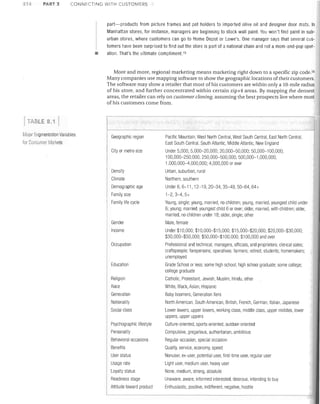
(such as fixed pricing for subscribers of renewable energy).
Calibration of Consumer KnOWledge

•	 Educate consumers with marketing messages that connect environmental product attributes with desired
consumer value (for example, "pesticide-free produce is healthier"; "energy-efficiency saves money"; or
"solar power is convenient").
•	 Frame environmental product attributes as "solutions" for consumer needs (for example, "rechargeable

batteries offer longer performance").

•	 Create engaging and educational Internet sites about environmental products' desired consumer value (for
example, Tide Coldwater's interactive Web site allows visitors to calculate their likely annual money savings
based on their laundry habits, utility source [gas or electricity], and zip code location).
Credibility of Product Claims

•	 Employ environmental product and consumer benefit claims that are specific, meaningful, unpretentious,
and qualified (that is, compared with comparable alternatives or likely usage scenarios).
•	 Procure product endorsements or eco-certifications from trustvvorthy third parties, and educate consumers
about the meaning behind those endorsements and eco-certifications
•	 Encourage consumer evangelism via consumers' social and Internet communication networks with
compelling, interesting, and/or entertaining information about environmental products (for example, Tide's
"Coldwater Challenge" Web site included a map of the United States so visitors could track and watch their
personal influence spread when their friends requested a free sample).

Technological Environment
One of the most dramatic forces shaping people's lives is technology. Through the years,
technology has released such wonders as penicillin, open-heart surgery, and the birth con­
trol pill, and such horrors as the hydrogen bomb, nerve gas, and the submachine gun. It has
also released such mixed blessings as cell phones and video games.
Every new technology is a force for "creative destruction." Transistors hurt the vac­
uum-tube industry, xerography hurt the carbon-paper business, autos hurt the railroads,
and television hurt the newspapers. Instead of moving into the new technologies, many
old industries fought or ignored them, and their businesses declined. Yet it is the essence
of market capitalism to be dynamic and tolerate the creative destructiveness of technol­
ogy as the price of progress.
The number of major new technologies we discovered affects the economy's growth rate.
Unfortunately, technological discoveries do not arise evenly through time-the railroad
industry created a lot of investment, and then investment petered out until the auto indus­
try emerged. In the time between major innovations, an economy can stagnate. In the mean­
time, minor innovations fill the gap: freeze-dried coffee, combination shampoo and condi­
tioner, antiperspirants and deodorants, and the like. They require less risk, but they can also
divert research effort away from major breakthroughs.
New technology also creates major long-run consequences that are not always foresee­
able. The contraceptive pill, for example, helped lead to smaller families, more working
wives, and larger discretionary incomes-resulting in higher expenditures on vacation
travel, durable goods, and luxury items. Cell phones, video games, and Internet are not
only reducing attention to traditional media, they are reducing face- to-face social interac­
tion as people listen to music, watch a movie on their cellphone, and so on. Technologies
also compete with each other. Consider the variety of means to view video material, as
shown in Table 3.4.
GATHERING INFORMATION AND SCANNING THE ENVIRONMENT

TABLE

% U.S. Households Owning Device in 2006

I

VCR

I

Home DVD player

j

Cellular phone'
Color TV with screen
27 inches or bigger

I

Desktop computer

2.

1. 4
1. 9

~
~

Ql

1. 7

I

Video game console

1. 8

1. 6

J
J

Color TV with screen
smaller than 27 inches

Vicleo Venues

1. 8

cg
z

c:

DVD recorder

I

1. 3

3

Portable DVD player

I
I

1. 3

So

1. 4

"
it
~

Notebook or laptop
computer

~

1. 8

I

Portable game device
Portable MP3 player
such as IPod'

1. 6

High-definition TV

1. 3

Digital video recorder
such as liVo

~
I

LCD flat-panel TV
Rear-projection TV
Plasma flat-panel TV
Any other type of TV

1. 2

c

~

"

~

o
c:

~

o

c:

1. 3
1. 5

Ef
0

0%

C"

1. 3
1. 6

20

40

60

80

100

Marketers should monitor the following four trends in technology: the accelerating pace
of change, the unlimited opportunities for innovation, varying R&D budgets, and the
increased regulation of technological change.
C:CElERA ING ACE OF CHA GE Many oftoday's common products were not available
40 years ago. Electronic researchers are building smarter chips to make our cars, homes, and
offices connected and more responsive to changing conditions. More ideas than ever are in
the works, and the time between the appearance of new ideas and their successful imple­
mentation is all but disappearing. So is the time between introduction and peak production.
Apple quickly ramped up in a little over five years to sell 23.5 million iPod's in 2006.
JNLIMITEO OPPORTUNITIES FOR INNOVATION Some of the most exciting work today is

taking place in biotechnology, computers, microelectronics, telecommunications, robotics,
and deSigner materials. The Human Genome project promises to usher in the Biological Cen­
tury as biotech workers create new medical cures, new foods, and new materials. Researchers
are working on AIDS vaccines, totally safe contraceptives, and nonfattening foods. They are
designing robots for firefighting, underwater exploration, and home nursing.
VARYING R&D BUDGETS A growing portion of U.S. R&D expenditures is going into the de­

velopment side of R&D as opposed to the research side, raising concerns about whether the
United States can maintain its lead in basic science. Many companies are content to put their

CHAPTER 3

3.41

85
86

PART 2

CAPTURING MARKETING INSIGHTS

money into copying competitors' products and making minor fea­
ture and style improvements. Even basic research companies such as
DuPont, Bell Laboratories, and Pfizer are proceeding cautiously, and
more consortiums than single companies are directing their research
efforts toward major breakthroughs.
INC.REASEO

REGULATION

OF

TECHNOLOGICAL

CHANGE

Government has expanded its agencies' powers to investigate and ban
potentially unsafe products. In the United States, the Federal Food and
Drug Administration must approve all drugs before they can be sold.
Safety and health regulations have also increased in the areas of food,
automobiles, clothing, electrical appliances, and construction.

Political-Legal Environment
The political and legal environment consists of laws, government agen­
cies, and pressure groups that influence and limit various organizations
and individuals. Sometimes these laws also create new opportunities
for business. For example, mandato!)' recycling laws have given the
recycling industry a major boost and spurred the creation of dozens of
new companies making new products from recycled materials. Two
major trends in the political-legal environment are the increase in busi­
ness legislation and the growth of special- interest groups.
INC.Rl:t,SE 11'1 BUSINESS EGISLATION Business legislation has four

main purposes: to protect companies from unfair competition, to pro­
tect consumers from unfair business practices, to protect the interests
of society from unbridled business behavior, and to charge businesses
with the social costs created by their products or production processes.
Although each new law may have a legitimate rationale, it may also
have the unintended effect of sapping initiative and retarding eco­
nomic growth.
Taklll(j sLisLainallillly to Ilew 11eigll!S, HlP Bank of America tower ill New
Legislation affecting business has increased steadily over the years.
The European Commission has been active in establishing a new
York City will recycle rain from lIle /001. wasle Imln lI1e cafeteria, am!	
framework of laws covering competitive behavior, product standards,
excess heat from lhe generatol to provrdtJ the ollildino with altol native
product liability, and commercial transactions for the 25 member
sources of fuel ancl power.
nations of the European Union. The United States has many laws on its
books coveling such issues as competition, product safety and liability,
fair trade and credit practices, and packaging and labeling. 51
Several countries have gone further than the United States in passing strong consumer pro­
tection legislation. Norway bans several forms of sales promotion-trading stamps, contests,
premiums-as inappropriate or "unfair" instruments for promoting products. Thailand
requires food processors selling national brands to market low-price brands also, so that low­
income consumers can find economy brands. In India, food companies need special approval
to launch brands that duplicate what already exists on the market, such as another cola drink
or brand of rice.
Companies generally establish legal review procedures and promulgate ethical standards
to guide their marketing managers, and as more business takes place in cyberspace, mar­
keters must establish new parameters for doing electronic business ethically.
GROwn"l OF SPECIA ..-INTERF,5T GROUPS Political action committees (PACs) lobby gov­
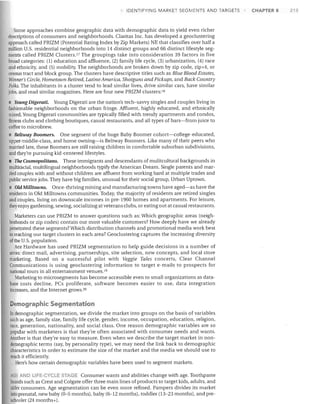
ernment officials and pressure business executives to pay more attention to consumers'
rights, women's rights, senior citizens' rights, minority rights, and gay rights.
Many companies have established public affairs departments to deal with these groups
and issues. An important force affecting business is the consumerist movement-an
organized movement of citizens and government to strengthen the rights and powers of
buyers in relationship to sellers. Consumerists have advocated and won the right to know
the true interest cost of a loan, the true cost per standard unit of competing brands (unit
pricing), the basic ingredients in a product, the nutritional quality of food, the freshness of
products, and the true benefits of a product.
With consumers increasingly willing to swap personal information for customized products
from firms-as long as they can be trusted-privacy issues will continue to be a public policy
GATHERING INFORMATION AND SCANNING THE ENVIRONMENT

CHAPTER 3

87

hot button. 52 Consumers worry that they will be robbed or cheated; that private information
will be used against them; that someone will steal their identity; that they will be bombarded
by solicitations; and that children will be targeted. 53 Wise companies establish consumer affairs
departments to help formulate policies and resolve and respond to consumer complaints.
Clearly, new laws and growing numbers of pressure groups have put more restraints on
marketers. Marketers must clear their plans with the company's legal, public relations, public affairs, and consumer affairs departments. Insurance companies directly or indirectly
affect the design of smoke detectors; scientific groups affect the design of spray products. In
essence, many private marketing transactions have moved into the public domain.

•••
Y •••
To carry out their analysis, planning, implementation, and
control responsibilities, marketing managers need a marketing information system (MIS). The role of the MIS is to
assess the managers' information needs, develop the
needed information, and distribute that information in a
timely manner.
2. An MIS has three components: (a) an internal records system, which includes information on the order-to-payment
cycle and sales information systems; (b) a marketing intelligence system, a set of procedures and sources used by
managers to obtain everyday information about pertinent
developments in the marketing environment; and (c) a
marketing research system that allows for the systematic
design, collection, analysis, and reporting of data and findings relevant to a specific marketing situation.
3. Marketers find many opportunities by identifying trends
(directions or sequences of events that have some momentum and durability) and megatrends (major social, economic, political, and technological changes that have
long-lasting influence).
4. Within the rapidly changing global picture, marketers
must monitor six major environmental forces: demographic, economic, social-cultural, natural, technological,
and political-legal.
5. In the demographic environment, marketers must be
aware of worldwide population growth; changing mixes of

1.

age, ethnic composition, and educational levels; the rise of
nontraditional families; and large geographic shifts in
population.
6. In the economic arena, marketers need to focus on
income distribution and levels of savings, debt, and credit
availability.
7. In the social-cultural arena, marketers must understand
people's views of themselves, others, organizations, society, nature, and the universe. They must market products
that correspond to society's core and secondary values
and address the needs of different subcultures within a
society.
8. In the natural environment, marketers need to be aware of
the public's increased concern about the health of the
environment. Many marketers are now embracing sustainability and green marketing programs that provide better
environmental solutions as a result.
9. In the technological arena, marketers should take account
of the accelerating pace of technological change, opportunities for innovation, varying R&D budgets, and the
increased governmental regulation brought about by technological change.
10. In the political-legal environment, marketers must work
within the many laws regulating business practices and
with various special-interest groups.

PPLICATIONS :::
Marketing Debate Is Consumer Behavior More a Function of a Person's Age
or Generation?
One of the widely debated issues in developing marketing programs that target certain age groups is how much consumers
change over time. Some marketers maintain that age differences are critical and that the needs and wants of a 25-yearold in 2002 are not that different from those of a 25-year-old in
1972. Others dispute that contention and argue that cohort

Marketing Discussion
What brands and products do you feel successfully "speak to
you" and effectively target your age group? Why? Which ones
do not? What could they do better?

and generation effects are critical, and that marketing programs must therefore suit the times.
Take a position: Age differences are fundamentally more
important than cohort effects versus Cohort effects can dominate age differences.
CHAP ER 4

•••
•••	

CONDUCTING MARKETING
RESEARCH AND
FORECASTING DEMAND

Good marketers want insights to help them interpret past perfor­
mance as well as plan future activities. They need timely, accurate;
and actionable information about consumers, competition, and
their brands. They also needto make the best possible tactical deci­
sions in the short run and strategic decisions in the long run.
Discovering aconsumer'insight and understanding its marketing
implications can often lead to a successful product launch or spur
the growth of a brand.

A.
~

s part of a $300 million budget for the development of its first

razor designedsolely:for women, Gillette conducted extensive
consumer research and f?erformed numerous market tests. The

razor, called Venus, was a marked departure from previous women's razor

designs, which. had. essentially beetleolored or· repackaged versions .of men's
razors. After' research .re·vealed that women change their grip on a razor
abollt30 times dljring eachshavingse!ision, Gilleitedesigned.the Venus with

a wide, sculpted rubberized handle offering superior grip and control, and
oval-shaped blade in a storage case that could stick to shower walls. Research
also indicated that women were reluctant to leave the shower in order to
replace a .dull. blade, so· the case held spare blade cartridges. The research
paid off for Gillette, as the Venus brand accounted for more than $2 billion in > > >

i lIIketing research led 10 miilW of the successful features of Gilletllj's
V~rlls,

Ille filst razm designed fOI womell.

AQ
90

PART 2

CAPTURING MARKETING INSIGHTS

: :: The Marketing Research System
Marketing managers often commission formal marketing studies of specific problems and
opportunities. They may request a market survey, a product-preference test, a sales forecast
by region, or an advertising evaluation. It's the job of the marketing researcher to produce
insight into the customer's attitudes and buying behavior. Marketing insights provide diag­
nostic information about how and why we observe certain effects in the marketplace, and
what that means to marketers. 2 We define marketing research as the systematic design,
collection, analysis, and reporting of data and findings relevant to a specific marketing sit­
uation facing the company. Spending on marketing research topped $24 billion globally in
2006, according to ESOMAR, the World Association of Opinion and Market Research
Professionals. 3
Most large companies have their own marketing research departments, which often play
crucial roles within the organization. Procter & Gamble's Consumer & Market Knowledge
(CMK) market research function has dedicated CMK groups working for P&G businesses
around the world to improve both their brand strategies and program execution, as well as a
relatively smaller, centralized corporate CMK group that focuses on a variety of big-picture
concerns that transcend any specific line of business. Yet, marketing research is not limited
to large companies with big budgets and marketing research departments. Often at much
smaller companies, everyone carries out marketing research-including the customers.
Companies normally budget marketing research at 1% to 2% of company sales. A large
percentage of that is spent on the services of outside firms. Marketing research firms fall into
three categories:

Syndicated-service research finns-These firms gather consumer and trade informa­
tion, which they sell for a fee. Examples: Nielsen Media Research, SAMI/Burke.
2.	 Custom marketing research firms- These firms are hired to carry out specific projects.
They design the study and report the findings.
3.	 Specialty-line marketing research firms-These firms provide specialized research
services. The best example is the field-service firm, which sells field interviewing ser­
vices to other firms.
1.	

Small companies can hire the services of a marketing research firm or conduct research
in creative and affordable ways, such as:
1.	

Engaging students or professors to design and cany out projects-Companies such as
American Express, GE, Hilton Hotels, IBM, Mars, and Whirlpool engage in "crowdcast­
ing" and are sponsors of competitions such as the Innovation Challenge, where top MBA
students compete in teams. The payoff to the students is experience and visibility; the
payoff to the companies is fresh sets of eyes to solve problems at a fraction of the costs
that consultants would charge. 4
91

CHAPTER 4

CONDUCTING MARKETING RESEARCH AND FORECASTING DEMAND

2.	 Using the Internet-A company can collect considerable information at very little
cost by examining competitors' Web sites, monitoring chat rooms, and accessing pub­
lished data.
3.	 Checking out rivals-Many small companies routinely visit their competitors. Tom
Coohill, a chef who owns two Atlanta restaurants, gives managers a food allowance to
dine out and bring back ideas. s
Most companies use a combination of marketing research resources to study their indus­
tries, competitors, audiences, and channel strategies.

::: The Marketing Research Process
Effective marketing research follows the six steps shown in Figure 4.1. We illustrate them
with the following situation: 6
American Airlines (AA) was one of the first companies to install phone handsets on
its planes. Now it's reviewing many new ideas, especially to cater to its first-class
passengers on very long flights, mainly businesspeople whose high-priced tickets
pay most ofthe freight. Among these ideas are: (1) an Internet connection with lim­
ited access to Web pages and e-mail messaging; (2) 24 channels of satellite cable TV;
and (3) a 50-CD audio system that lets each passenger create a customized in-flight
play list. The marketing research manager was assigned to investigate how first­
class passengers would rate these services, specifically the Internet connection, and
how much extra they would be willing to pay for it. One source estimates revenues
of $70 billion' from in-flight Internet access over 10 years, if enough first-class pas­
sengers paid $25. AA could thus recover its costs in a reasonable time. Making the
connection available would cost the airline $90,000 per plane.7

Step 1: Define the Problem, the Decision Alternatives,
and the Research Objectives
Marketing managers must be careful not to define the problem too broadly or too narrowly
for the marketing researcher. A marketing manager who says, "Find out everything you can
about first-class air travelers' needs," will collect a lot of unnecessary information. One who
says, "Find out whether enough passengers aboard a B747 flying direct between Chicago
and Tokyo would be willing to pay $25 for an Internet connection for American Airlines to
break even in one year on the cost of offering this service:' is taking too narrow a view of the
problem.
The marketing researcher might even ask, ""Thy does the Internet connection have to be
priced at $25 as opposed to $10, $50, or some other price? Why does American have to break
even on the cost of the service, especially if it attracts new customers?" Another relevant
question is: How important is it to be first in the market, and how long can the company sus­
tain its lead?
The marketing manager and marketing researcher agreed to define the problem as fol­
lows: "Will offering an in-flight Internet service create enough incremental preference and
profit for American Airlines to justify its cost against other possible investments in service
enhancements American might make?" To help in designing the research, management
should first spell out the decisions it might face and then work backward. Suppose manage­
ment outlines these decisions: (1) Should American offer an Internet co.nnection? (2) If so,
should we offer the service to first-class only, or include business class, and possibly econ­
omy class? (3) What price(s) should we charge? (4) On what types of planes and lengths of
trips should we offer the service?
Now management and marketing researchers are ready to set specific research objec­
tives: (1) What types of first-class passengers would respond most to using an in-flight
Internet service? (2) How many first-class passengers are likely to use the Internet service at
different price levels? (3) How many extra first-class passengers might choose American
because of this new service? (4) How much long-term goodwill will this service add to
American Airlines' image? (5) How important is Internet service to first-class passengers rel­
ative to other services, such as a power plug or enhanced entertainment?

Define the problem

and research objectives


Develop the

research plan


Collect the

information


~
Analyze the
information
..

~

Present the
findings

~
Make the
decision

FIG.41
The Marketing Research Process

I
92

PART 2

CAPTURING MARKETING INSIGHTS

Not all research projects can be this specific. Some research is exploratory-its goal is to
shed light on the real nature of the problem and to suggest possible solutions or new ideas.
Some research is descriptive-it seeks to quantify demand, such as how many first-class pas­
sengers would purchase in-flight Internet service at $25. Some research is causal-its pur­
pose is to test a cause-and-effect relationship.

Step 2: Develop the Research Plan
The second stage of marketing research is where we develop the most efficient plan for
gathering the needed information and what that will cost. Suppose the company made a
prior estimate that launching in-flight Internet service would yield a long-term profit of
$50,000. If the manager believes that doing the marketing research will lead to an
improved pricing and promotional plan and a long-term profit of $90,000, he should be
willing to spend up to $40,000 on this research. If the research will cost more than $40,000,
it's not worth doing. 8
To design a research plan, we need to make decisions about the data sources, research
approaches, research instruments, sampling plan, and contact methods.
ATA SOURCES The researcher can gather secondary data, primary data, or both.
Secondary data are data that were collected for another purpose and already exist some­
where. Primary data are data freshly gathered for a specific purpose or for a specific research
project.
Researchers usually start their investigation by examining some of the rich variety of I ow­
cost and readily available secondary data, to see whether they can partly or wholly solve the
problem without collecting costly primary data. For instance, auto advertisers looking to get
a better return on their online car ads might purchase a copy 00.D. Power and Associates'
"Online Media Study-Wave 1," a survey that gives insights into who buys specific brands
and where on the Web advertisers can find them. Among the helpful findings they would
discover in the report are:

• The 6% of adults per year who buy a new car are six times more likely to frequent financial
sites such as MSN Money and Yahoo! Finance than the average Web user.
• People who bought mid-sized pick-up trucks spent more time on sports Web sites.
• Women who purchase minivans and large
SUVs also used Disney's online and game sites. 9
When the needed data don't exist or are
dated, inaccurate, incomplete, or unreliable,
the researcher will need to collect primary data.
Most marketing research projects do include
some primary-data collection.
RESEARCH APP OACHE Marketers collect
primary data in five main ways: through obser­
vation, focus groups, surveys, behavioral data,
and experiments.

o b s e r vat ion a IRe sea r c h

A picture Is worth 1.000 words to skilled marketing researcher ii, WilD C::ln olRan a numbel of
Insights [rom a photo of a Swedisll kilrl1en like tllis,

Re­
searchers can gather fresh data by observing the
relevant actors and settings, unobtrusively ob­
serving as they shop or as they consume prod­
ucts. 10 Sometimes they equip consumers with
pagers and instruct them to write down what
they're doing whenever prompted, or they hold
informal interview sessions at a cafe or bar. Pho­
tographs can also provide a wealth of detailed
information.
CONDUCTING MARKETING RESEARCH AND FORECASTING DEMAND

CHAPTER 4

Et h n 0 9 rap hie Res ear chis a particular observational
research approach that uses concepts and tools from anthropology
and other social science disciplines to provide deep understanding of
how people live and work. I I The goal is to immerse the researcher into
consumers' lives to uncover unarticulated desires that might not sur­
face in any other form of research. 12 Firms such as IBM, Intel, and
Steelcase have embraced ethnographic research to design break­
through products.
Bank of America's ethnographic research following baby-boomer
women at home and while they shopped yielded two insights-they
rounded up financial transactions because it was more convenient,
and those with children found it difficult to save. Subsequent research
led to the launch of "Keep the Change," a debit card program whereby
purchases are rounded up to the nearest dollar amount and the added
difference is automatically transferred from a checking account to a
sa~ngs account. Since the launch, 2.5 million customers have signed
up for the program, opening 700,000 new checking accounts and
1million new savings accounts in the process. 13
Many other companies have benefited from ethnographic
research. 14
After observing the popularity of Chinese-character text messaging
in Shanghai, Motorola developed the A732 cell phone, with which
users could write messages directly on the keypad using a finger.
I After finding that many of their guests turned their bedrooms
into work spaces, TownePlace Suites replaced a dining table with a
flexible modular wall unit that could serve as either an office or a
place to eat.
I After interviewing contractors and home renovators, OXO developed
aset of professional-grade tools for consumers that included a hammer
with a fiberglass core to cut vibration and a rubber bumper on top to
avoid leaving marks when removing nails.
After studying how people listen to music. read magazines, and
watch Tv, Sirius developed a portable satellite-radio player that is eas­
ily loaded with up to 50 hours of digital music for later playback.

ll1e clevelopment of Sirius' portable satellite racHos, such a the
Sillello 10. beneflltetl from etliflographic research.

Ethnographic research isn't limited just to consumer companies in developed markets. GE's
ethnographic research into the plastic-fiber industry showed the firm that it wasn't in a com­
modity business driven by price as much as it was in an artisanal industry with customers who
wanted collaborations at the earljest stages of development. GE completely reoriented the way
it interacted with the companies in the plastic-fiber industry as a result. Ethnographic research
can be particularly useful in developing markets, especially far-flung rural areas, where compa­
nies do not know consumers as well. 15
The American Airlines researchers might meander around first -class lounges to hear how
travelers talk about the different carriers and their features. They can fly on competitors'
planes to observe in-flight service.

Foe u s G r 0 U pRe 5 ear c h A focus group is a gathering of 6 to 10 people care­
fully se'l'ected by researchers based on certain demographic, psychographic. or other con­
siderations and brought together to discuss various topics of interest at length.
Participants are normally paid a small sum for attending. A professional research moder­
atorprovides questions and probes based on the marketing managers' discussion guide or
agenda.
Moderators try to discern consumers' real motivations and why they say and do certain
things. They typically record the sessions, and marketing managers often remain behind
two-way mirrors in the next room. Focus-group research is a useful exploratory step, but
~ earchers must avoid generalizing from focus-group participants to the whole market,
because the sample size is too small and the sample is not drawn randomly.

93
94

PART 2

CAPTURING MARKETING INSIGHTS

In fact, an increasing number of marketers
are relying on other means of collecting infor­
mation that they believe are less artificial.
"Focus groups confirm what you already
know," says Eva Steensig, a sociologist at DDB
Denmark. DDB, part of the Omnicom Group,
introduced a new service called SignBank,
which uses the Internet and the advertising
agency's global office network to collect thou­
sands of snippets of information about cul­
tural change, identify trends within the data,
and advise clients about what it means to
them. Consumers are not experts on their own
consumption patterns, says Steensig, and this
makes them easily led by focus group modera­
tors. DDB and some other advertisers feel it is
better to "read the signs" of consumption than
ask consumers to self-consciously comment
Afocus group in session, with marketing people observing through a twa-way mirror
on their own patterns. For instance, DDB's
sign spotters in several markets noticed that
dinner-party guests were bringing their hosts
flowers instead of chocolate, in a nod to current concerns over obesity and health. Anthon
Berg, a Danish chocolate company and DDB client, plans to use that information to more
closely associate its chocolate with different social occasions. 16
"Marketing Insight: Conducting Informative Focus Groups" has some practical tips to
improve the quality of focus groups. In the American Airlines research, the moderator might
start with a broad question, such as, "How do you feel about first-class air trave!?" Questions
then move to how people view the different airlines, different existing services, different pro­
posed services, and specifically, Internet service.
Sur V e y Res ear c h Companies undertake surveys to learn about people's knowl­
edge, beliefs, preferences, and satisfaction and to measure these magnitudes in the general
population. A company such as American Airlines might prepare its own survey instrument
to gather the information it needs, or it might add questions to an omnibus survey that car­
ries the questions of several companies, at a much lower cost. It can also put the questions to
an ongoing consumer panel run by itself or another company. It may do a mall intercept
study by having researchers approach people in a shopping mall and ask them questions.
As we'll discuss in more detail later in this chapter, many marketers are taking their sur­
veys online where they can easily develop, administer, and collect e-mail and Web-based
questionnaires. "Companies are doing this ona much more frequent basis now, and they're
using surveys as more of a performance-management tool; they 'tie the results to managers'
compensation," says Charles Cornwell, a senior vice president at TNS Custom Research of
North America. Cornwell reports that business at his division, which creates and conducts
surveys. has increased 20% to 30% over the past two years. However they conduct their
surveys-online, by phone, or in person-companies must feel the information they're get­
ting from the mounds of data makes it all worthwhile. Here are two that do:

• Comcast Corp. This cable 1V giant surveys between 10,000 and 15,000 customers each
month by phone. Customer feedback has resulted in a more accommodating installation
schedule that allows customers who sign up for cable 1V or broadband Internet service to get
a visit from a technician on Saturday afternoon or at 7 PM on weeknights. No more staying
home all day waiting for "the cable guy."
• Wells Fargo. The San Francisco-based bank collects more than 50,000 customer surveys
each month through its bank branches. It has used customers' comments to begin more
stringent new wait-time standards designed to improve customer satisfaction.
Of course by putting out so many surveys each month, companies may run the risk of creat­
ing "survey burnout" and seeing response rates plummet. Keeping a survey short and sim­
ple and contacting customers no more than once a month are two keys to drawing people
into the data collection effort. Offering incentives is another way companies get cons.umers
to respond. Both Gap Inc. and Jack in the Box Inc. offer coupons for discount merchandise
or the chance to win a cash prize. l ?
CONDUCTING MARKETING RESEARCH AND FORECASTING DEMAND

r

-r1

MARKETING INSIGHT

I

Focus groups allow marketers to observe how and why consumers
accept or reject concepts, ideas, or any specific notion. The key to
using focus groups successfUlly is to listen and observe. Marketers
should eliminate their own biases as much as possible. Although
many useful insights can emerge from thoughtfully run focus groups,
questions can arise about their validity, especially in today's market­
ing environment.
Some researchers believe that consumers have been so bom­
barded with ads, they unconsciously (or perhaps cynically) parrot
back what they've already heard instead of what they really think.
There's always a concern that participants are just trying to maintain
their self-image and public persona or have a need to identify with
the other members of the group. Participants also may not be willing
to admit in public-or may not even recognize-their behavior pat­
terns and motivations. And the "loudmouth" or "know-it-all" problem
often crops up when one highly opinionated person drowns out the
rest of the group. It may be expensive to recruit qualified subjects
who meet the sampling criteria ($3,000 to $5,000 per group), but
getting the right participants is crucial.
Even when marketers use multiple focus groups. it may be diffi­
cult to generalize the results to a broader population. For example,
within the United States, focus-group findings often vary from region
to region. One firm specializing in focus-group research claimed that
the best city to conduct groups was Minneapolis, because it could
get a sample of fairly well-educated people who were honest and

CHAPTER 4

CONDUCTING INFORMATIVE FOCUS GROUPS

forthcoming with their opinions. Many marketers interpret focus
groups in New York and other northeastern cities carefully, because
the people in these areas tend to be highly critical and generally don't
report that they like much.
Participants must feel as relaxed as possible and strongly moti­
vated to be truthful. Physical surroundings can be crucial to achiev­
ing the right atmosphere. At one agency an executive noted, "We
wondered why people always seemed grumpy and negative-people
were resistant to any idea we showed them." Finally in one session a
fight broke out between participants. The problem was the room
itself: cramped, stifling, forbidding. "It was a cross between a hospi­
tal room and a police interrogation room." To fix the problem, the
agency gave the room a makeover. Other firms are adapting the look
of the room to fit the theme of the topic-such as designing the
room to look like a playroom when speaking to children.
Many firms are substituting observalional research for focus
groups, but ethnographic observation can be expensive and tricky:
Researchers must be highly skilled and participants on the level.
Then there are mounds of data to analyze. The beauty of focus
groups, as one marketing executive noted, is that "it's still the most
cost-effective, quickest. dirtiest way to get information in rapid time
on an idea." In analyzing the pros and cons, Wharton's Americus
Reed might have said it best: "A focus group is like a chain saw. If
you know what you're doing, it's very useful and effective. If you
don't, you could lose a limb."

r-sources: Naomi R. Henderson, "Beyond Top of Mind," Marketing Research, September 1. 2005; Rebecca Harris, "Do Focus Groups Have aFuture?" Marketing, June 6, 2005,
p. 17; Malcolm Gladwell, Blink: The Power 01 Thinking Without Thinking (New York: Little Brown, 2005); Linda Tischler, "Every Move You Make," Fast Company (April 2004):
73-75; Alison Stein Wellner, "The New SCience at Focus Groups," American Demographics (March 2003): 29-33; Dennis Rook. "Out-at-Focus Groups," Marketing Research
15, no. 2 (Summer 2003): 11; Dennis W. Rook, "Loss of Vision: Focus Groups Fail to Connect Theory, Current Practice," Marketing News, September 15, 2003, p. 40; Sarah
Jeffrey Kasner, "Fistfights and Feng Shui," Boston Globe, July 21, 2001.
I

I

Be h a v i 0 r a I D a t a Customers leave traces of their purchasing behavior in store
scanning data, catalog purchases, and customer databases. Marketers can learn much by an­
alyzing these data. Actual purchases reflect consumers' preferences and often are more reli­
able than statements they offer to market researchers. For example, grocery shopping data
show that high-income people don't necessarily buy the more expensive brands, contrary to
what they might state in interviews; and many low-income people buy some expensive
brands. Clearly, American Airlines can learn many useful things about its passengers by ana­
lyzing ticket purchase records and online behavior.
Ex per i men t a IRe sea r c h The most scientifically valid research is experi­
mental research, designed to capture cause-and-effect relationships by eliminating compet­
ing explanations of the observed findings. If the experiment is well designed and executed,
research and marketing managers can have confidence in the conclusions.
Experiments call for selecting matched groups of subjects, subjecting them to different
treatments, controlling extraneous variables, and checking whether observed response dif­
ferences are statistically significant. If we can eliminate or control extraneous factors, we can
relate the observed effects to the variations in the treatments or stimuli. American Airlines
might introduce in-flight Internet service on one of its regular flights from Chicago to Tokyo
and charge $25 one week and $15 the next week. If the plane carried approximately the same
number of first-class passengers each week and the particular weeks made no difference,
the airline could relate any significant difference in the number of passengers using the ser­
vice to the different prices charged.

95
PART 2

'J6-

CAPTURING MARKETING INSIGHTS

RESEARCH iNSTRUMENTS Marketing researchers have a choice of three main research in­
struments in collecting primary data: questionnaires, qualitative measures, and technologi­
cal devices.
Que 5 t ion n air e s A questionnaire consists of a set of questions presented to re­

spondents. Because of its flexibility, it is by far the most common instrument used to collect
primary data. Researchers need to carefully develop, test, and debug questionnaires before
administering them on a large scale. The form, wording, and sequence of the question can
all influence the response. Closed-end questions specify all the possible answers and provide
answers that are easier to interpret and tabulate. Open-end questions allow respondents to
answer in their own words and often reveal more about how people think. They are especially
useful in exploratory research, where the researcher is looking for insight into how people
think rather than measuring how many people think a certain way. Table 4.1 provides exam­
ples of both types of questions; also see "Marketing Memo: Questionnaire Dos and Don'ts."
Qua lit a t i v e

Mea sur e s Some marketers prefer more qualitative methods for
gauging consumer opinion, because consumer actions don't always match their answers to
survey questions. Qualitative research techniques are relatively unstructured measurement
approaches that permit a range of possible responses. Their variety is limited only by the cre­
ativity of the marketing researcher.

MOBILTEC
Mobiltec, a San Mateo, California-based company that offers content management software for wireless service
providers, has an ingenious way of conducting global research on what teens want on their cell phones in terms
of media, ringtones, games, music, and TV. The Mobiltec Lab consists of 11 teens aged 13-17 from around the
world. Each month these teens find, access, use, and pay for different types of mobile content and then rate their
experiences at every stage of the process. In their first assignment, for instance, Mobiltec asked Lab members
to use their phones to download four mobile games: two specific ones (Jamdat Bowling, PacMan, or Tetris) and
two games of their choice. The teens then rated their experience in downloading the game as well as things

•

~

such as price. Because the teens expected the same ease, speed, graphics, sound, and marketing they get on
the Internet, they were frustrated, for example, if a game took more than 10 seconds to load. They all felt the
price, from $2 in India to $7 in Europe and the United States, was too high for length and quality.18

MARKETING MEMO

I

QUESTIONNAIRE DOS AND DON'TS

1. Ensure that questions are without bias, Don't lead the respon­
dent into an answer.

8. Avoid hypothetical questions, It's difficult to answer questions
about imaginary situations. Answers aren't necessarily reliable,

2. Make the questio,ns as simple as possible. Questions that include
multiple ideas or two questions in one will confuse respondents.

9. Do not use words that could be misheard. This is especially
important when administering the interview over the telephone.
"What is your opinion of sects?" could yield interesbing but not
necessarily relevant answers,

3. Make the questions specific. Sometimes it's advisable to add
memory cues. For example, be specific with time periods,
4. Avoid jargon or shorthand. Avoid trade jargon, acronyms, and ini­
tials not in everyday use,
5. Steer clear of sophisticated or uncommon words. Only use worejs
in common speech.
6. Avoid ambiguous words. Words such as "usually" or "frequently"
have no specific meaning.
7. Avoid questions with a negative in t~em, It is better to say, "Do
you ever. , ,?" than "Do you never ... ?"
_­
Source: Adapted from Paul Hague and Peter Jackson, Market Research' A Guide 10 Planning,

10. Desensitize questions by using response bands, To ask people
their age or ask companies about employee turnover rates, offer
a range of response bands instead of precise numbers.
11. Ensure tllat fixed responses do not overlap. Categories used in
fixed-response questions should be distinct and not overlap.
12. Allow for "other" in fixed-response questions. Precoded
answers should always allow for a response other than tllose
listed.

......

MelhodologJ~ and Evalualion (London: Kogan Page, 1999), See also, Hans

Baumgartner and Jan-Benedict E, M, Steenkamp, "Response Styles in Marketing Research: ACross-National Investigation," Journal of Marketing Research (May 2001): 143-56.


I

I
!
C NDUCTING MARKETING RESEARCH AND FORECA TING DEMAND

TAB LE 4. 1

CHAPTER 4

97

Types (if Questions

Name

Description

Example

A. Closed-End Questions
Dichotomous

Aquestion with tVI'O possible answers

In arranging this trip, did you personally phone American?
Yes
No

Multiple choice

Aquestion with three or more answers

With whom are you traveling on this flight?
0 Children only
o Spouse
0 Business associates/friends/relatives
o Spouse and children
0 An organized tour group

o No one

Likert scale

Semantic differential

Astatement with which the respondent
shows the amount of agreement!
disagreement
Ascale connecting nllJo bipolar words. The
respondent selects the point that
represents his or her opinion.

Small airlines generally give better service than large ones.
Strongly
Disagree
Neither agree
Agree
disagree
nor disagree
1
2_
3_
4_

Strongly
agree

5_

American Airlines
Large -------------------------------------------------------------- Small
Experienced ----- ------ ---- ----- --------- ------- ------ -- ---- ---- --- Inexperienced
Modern ------ -- --- -------------- -- -- ----- -- ----- -- -- -- -- -- -- -- -- -- Old-fash ioned

----------------------- in-flight service to me is
Importance scale
Ascale that rates the importance of some
Airline
attribute

Intention-to-buy
scale

Ascale that rates some attribute from
"poor" to "excellent"
Ascale that describes the respondent's
intention to buy

Very
important

1
Rating scale

Extremely
important

2_

American in-flight service is
Excellent
Very Good
1
2

Somewhat
important
3_

Not very
important
4_

5_

Good
3_

Fair
4_

5_

Not at all
important

Poor

If an in-flight telephone were available on a long flight, I would
Definitely
Probably
Not sure
Probably
buy
bUy
not buy

Definitely
not buy

1

5_

2

3_

4_

B. Open-End Questions
Completely
unstructured

A question that respondents can answer in an
almost unlimited number of ways

What is your opinion of American Airlines?

Word association

Words are presented, one at a time, and
respondents mention the first word that
comes to mind.

What is the first word that comes to your mind when you hear the
following?
Airline
_
American
_

An incomplete sentence is presented and
respondents complete the sentence.

When I choose an airline, the most important consideration in
my decision is
_

Story completion

An incomplete story is presented, and
respondents are asked to complete it.

"I flew American a few days ago. I noticed that the exterior and
interior of the plane had very bright colors. This aroused in me
the following thoughts and feelings.. ." Now complete the story.

Picture

A picture of two characters is presented, with
one making astatement. Respondents are
asked to identify with the other and fill in
the empty balloon.

Thematic
Apperception
Test (TAT)

Apicture is presented and respondents are asked
to make up a story about what they think is
happening or may happen in the picture.

,--­
Sentence
completion

Trav~e:.:1=====-=======================:=--------J
98

PART 2

CAPTURING MARKETING INSIGHTS

Because of the freedom afforded both researchers in their probes and consumers in
their responses, qualitative research can often be a useful first step in exploring con­
sumers' brand and product perceptions, but it has its drawbacks. Marketers must temper
the in-depth insights that emerge with the fact that the samples are often very small and
may not necessarily generalize to broader populations. And different researchers examin­
ing the same qualitative results may draw very different conclusions. "Marketing Insight:

MARKETI NG INSIGHT

GETTING INTO CONSUMERS' HEADS WITH
QUALITATIVE RESEARCH

Here are some popular qualitative research approaches to getting
inside consumers' minds and finding out what they think or feel about
brands and products:
1.	 Word associations. Ask subjects what words come to mind
when they hear the brand's name. "What does the Timex name
mean to you? Tell me what comes to mind when you think of
Timex watches." The primary purpose of free-association tasks is
to identify the range of possible brand associations in consumers'
minds. But they may also provide some rough indication of the rel­
ative strength, favorability, and uniqueness of brand associations,
2.	 Projective techniques. Give people an incomplete stimulus and
ask them to complete it, or give them an ambiguous stimulus and
ask them to make sense of it. One such approach is "bubble
exercises" in which empty bubbles, like those found in cartoons,
appear in scenes of people buying or using certain products or
services. SUbjects fill in the bubble, indicating what they believe
is happening or being said. Another technique is comparison
tasks in which people compare brands to people, countries, ani­
mals, activities, fabrics, occupations, cars, magazines, vegeta·
bles, nationalities, or even other brands,
3.	 Visualization. Visualization requires people to create a collage
from magaZine photos or drawings to depict their perceptions.
The ZMET technique asks participants in advance to select a
minimum of 12 images from their own sources (magazines, cat­
alogs, family photo albums) to represent their thoughts and feel­
ings about the research topic. In a one-on-one interview the
study administrator uses advanced interview techniques to
explore the images with the participant and reveal hidden mean­
ings. Finally, the participants use a computer program to create
a collage with these images that communicates their subcon­
scious thoughts and feelings about the topic. In one ZMET study
about pantyhose, some of the respondents' pictures showed
fence posts encased in plastic wrap or steel bands strangling
trees, suggesting that pantyhose are tight and inconvenient.
Another picture showed tall flowers in a vase, suggesting that
the product made a woman feel thin, tall; and sexy
4.	 Brand personification. Ask subjects what kind of person they
think of when the brand is mentioned: "If the brand were to come
alive as a person, what would it be like, what would it do, where
would it live, what would it wear, who would it talk to if it went to

Drawings or other pictures that express consumers' feelings aGoui
products are part of ZMET studies, Tilis drmving SilO'NS wi13t one
antismoking campaign researcll participant felt.

a party (and what would it talk about)?" For example, the John
Deere brand might make someone think of a rugged Midwestern
male who is hardworking and trustworthy. The brand personality
delivers a picture of the more human qualities of the brand,
5.	 Laddering. Aseries of increasingly more specific "Why" questions
can reveal consumer motivation and consumers' deeper, more
abstract goals. Ask why someone wants to bUy a Nokia cellular
phone "They look well built" (attribute). "Why is it important that
the phone be well built?" "it suggests that the Nokia is reliable" (a
functional benefit). "Why is reliability important?" "Because my
colleagues or family can be sure to reach me" (an emotional ben­
efit). "Why must you be available to them at all times?" "I can help
tl1em if they're in trouble" (brand essence), The brand makes this
person feel like a Good Samaritan, ready to help others.

Sources: Catherine Marshall and Gretcllen B, Rossman, Designing Qualitative Research, 4th ed, (Thousand Oaks, CA: Sage Publications, 2006): Bruce L, Berg, Qualitative
Research Methods for the Social Sciences, 6th ed. (Boston: Allyn & Bacon, 2006); NOiman K. Denzin and Yvonna S. Lincoln, eds., Tile Sage Handbook of Qualitative Researcll,
3rd ed, (Thousand Oaks, CA: Sage Publications, 2005); Linda Tisciller, "Every Move You Make," Fast Company (April 2004): 73-75; Gerald Zaltman, How Customers Think:
Essential Insights into the Mind of the Market (Boston: Harvard Business SCllool Press, 2003),
CONDUCTiNG MARKETING RES ARCH AND FORECASTING DEMAND

CHAPTER 4

Getting into Consumers' Heads with Qualitative Research" describes some popular
approaches.
Tee h n 0 I 0 9 i c a IDe vic e 5 Technological devices are occasionally useful in
marketing research. Galvanometers can measure the interest or emotions aroused by ex­
posure to a specific ad or picture. The tachistoscope flashes an ad to a subject with an ex­
posure interval that may range from less than one hundredth of a second to several
seconds. After each exposure, the respondent describes everything he recalls. Eye cameras
study respondents' eye movements to see where their eyes land first, how long they linger
on a given item, and so on.
Technology has now advanced to such a degree that marketers can use devices such as
skin sensors, brain wave scanners, and full body scanners to get consumer responses. 19
TACODA, an advertising technology company, is studying the eye movements and brain
activity of Web surfers to see which ads grab their attention. 20 "Marketing Insight:
Understanding Brain Science" provides a glimpse into some new marketing research fron­
tiers studying the brain.
Technology has replaced the diaries that participants in media surveys used to keep.
Audiometers attached to television sets in participating homes now record when the set is
on and to which channel it is tuned. Electronic devices can record the number of radio pro­
grams a person is exposed to during the day, or, using Global Positioning System (GPS) tech­
nology, how many billboards a person may walk by or drive by during a day. Technology is
also used to capture consumer reactions to programming content.

MARKETING INSIGHT
As an alternative to traditional consumer research, some researchers
have begun to develop sophisticated techniques from neuroscience
that monitor brain activity to better gauge consumer responses to
marketing stimuli.
For example, a group of researchers at UCLA used functional
magnetic resonance imaging (fMRI) to measure how consumers'
brains responded to 2006 Super Bowl advertisements. The research
demonstrated how consumers' stated preferences often contradict
their inner thoughts and emotions. The fMRI showed that the "I'm
going to Disney World" ad featuring members of both teams rehears­
ing the famous line elicited the highest levels of positive brain activ­
ity, followed by a Sierra Mist commercial starring an airport security
screener and a traveler. Yet in a consumer poll conducted independ­
ently, a Bud Light ad rated highest, despite not generating significant
positive reaction in the fMRI tests.
Although it can be more effective in uncovering inner emotions
than conventional techniques, neurological research is costly, running
as much as $100,000 per project. One major finding to emerge from
neurological consumer research is that many purchase decisions are
characterized less by the logical weighing of variables than was pre­
viously assumed and more "as a largely unconscious habitual
process, as distinct from the rational, conscious, information­
processing model of economists and traditional marketing text­
books." Even basic decisions, such as the purchase of gasoline, are
influenced by brain activity at the subrationallevel.

UNDERSTANDING BRAIN SCIENCE

Neurological research can be used to measure the type of
emotional response that consumers exhibit when presented with
marketing stimuli. A group of researchers in England used an elec­
troencephalograph (EEG) to monitor cognitive functions related to
memory recall and attentiveness for 12 different regions of the
brain as subjects were exposed to advertising. Brain wave activity
in different regions indicated different emotional responses. For
example, heightened activity in the left prefrontal'cortex is charac­
teristic of an "approach" response to an ad and indicates an
attraction to the stimulus. In contrast, a spike in brain activity in
the right prefrontal cortex is indicative of a strong revulsion to the
stimulus, In yet another part of the brain, the degree of memory
formation activity correlates with purchase intent. Other research
has shown that people activate different regions of the brain in
assessing the personality traits of people versus brands.
The term neuromarkeling has been used to describe brain
research on the effect of marketing stimuli, By adding neurological
techniques to their research arsenal, marketers are trying to move
toward a more complete picture of what goes on inside con­
sumers' heads, Given the compleXity of the human brain, however,
many researchers caution that neurological research should not
form the sole basis for marketing decisions. These research activ­
ities have not been universally applauded though, Critics think that
such a development will only lead to more marketing manipulation
by companies,

Sources: Carolyn Yoon, Angela H. Gutchess, Fred Feinberg, and Thad A. Polk, "A Functional Magnetic Resonance Imaging Study of Neural Dissociations be~Neen Brand and
Person Judgments," Journal of Consumer Research 33 (June 2006): 31-40; Daryl TraVis, "Tap Buyers' Emotions for Marketing Success," Marketing News, February 1,2006,
pp, 21-22; Deborah L, Vence, "Pick Someone's Brain," Marketing News, May 1,2006, pp, 11-13; Louise Wilt, "Inside Intent," American Demographics (March 2004): 34-39;
Samuel M. McClure, Jian Li, Damon Tomlin, Kim S. Cypert, Latane M. Montague, and P. Read Montague, "Neural Correlates of Behavioral Preference for Culturally Familiar
Drinks," Neuron 44, October 14, 2004, pp, 379-87; Melanie Wells, "In Search of the Buy Bulton," Forbes, September 1,2003,

99
100

PARi 2

CAPTURING MARKETING INSIGHTS

ASI ENTERTAINMENT

r

Television networks use marketing research to test their TV pilot ideas. ASI, the largest testing company, counts
all the major broadcast and cable TV networks among its clients. In a small screening room outfitted with two­
way mirrors and video cameras, 48 voluntary subjects take their seats and watch pilots on twin TV sets at the
front of the room. At each seat the subjects use a handset to register their reaction, turning the dial from a neu­
tral position to a minus, double minus, plus, or double plus. If they think a show is really poor, they can hit a red
button to indicate they'd turn it off at home. Networks such as CBS and Fox pay as much as $20,000 per two­
hour session to find their shows' weak points. Testing isn't perfect, however. Three shows that would have hit

•

the cutting room floor if marketers had listened to test results are All in the Family, Seinfeld, and Lost. 21

SAMPLING PLAN After deciding on the research approach and instruments, the marketing
researcher must design a sampling plan. This calls for three decisions:
1.	 Sampling unit: Who should we survey?In the American Airlines survey, should the

sampling unit consist only of first-class business travelers, first-class vacation travelers,
or both? Should it include travelers under age 18? Both husbands and wives? Once they
have determined the sampling unit, marketers must develop a sampling frame so that
everyone in the target population has an equal or known chance of being sampled.
2.	 Sample size: How many people should we survey? Large samples give more reliable
results, but it's not necessary to sample the entire target population to achieve reliable
results. Samples of less than 1% of a population can often provide good reliability, with
a credible sampling procedure.
3.	 Sampling procedure: How should we choose the respondents? Probability sampling al­
lows confidence limits to be calculated for sampling error and makes the sample more
representative. Thus, after choosing the sample the conclusion could be that "the inter­
val five to seven trips per year has 95 chances in 100 of containing the true number of
trips taken annually by first-class passengers flying between Chicago and Tokyo." Three
types of probability sampling are described in Table 4.2 part A. When the cost or time to
use probability sampling is too high, marketing researchers will take nonprobability
samples. Table 4.2 part B describes three types.
CONTACT METHODS Now the marketing researcher must decide how to contact the sub­
jects: by mail, by telephone, in person, or online.

M a i I Q Ll est ion n air e The mail questionnaire is the best way to reach people
who would not give personal interviews or whose responses might be biased or distorted by
the interviewers. Mail questionnaires require simple and clearly worded questions. Unfortu­
nately, the response rate is usually low or slow.

TABLE 4.2
Probability emu Nonprobability Samples

A. Probability Sample
Simple random sample	

Every member of the population has an equal chance of selection.

Stratified random sample	

The population is divided into mutually exclusive groups (such as age groups),
and random samples are drawn from each group.

Cluster (area) sample	

The population is divided into mutually exclusive groups (such as city blocks),
and the researcher draws a sample of the groups to interview.

B. Nonprobability Sample

Convenience sample	

The researcher selects the most accessible population members.

Judgment sample	

The researcher selects population members who are good prospects for accu­
rate information.

Ouota sample	

The researcher finds and interviews a prescribed number of people in each of
several categories.
CONDUCTI G MARKETING RESEARCH AND FORECASTING DEMAND

CHAPTER 4

101

Tel e p h 0 n e I h t e r vie w Telephone interviewing is the best method for gathering
information quickly; the interviewer is also able to clarify questions if respondents do not un­
derstand them. The response rate is typically higher than for mailed questionnaires, but in­
terviews must be brief and not too personal. Telephone interviewing in the United States is
getting more difficult because of consumers' growing antipathy toward telemarketers. In late
2003, Congress passed legislation allowing the Federal Trade Commission to restrict tele­
marketing calls through its "Do Not Call" registry, and consumers have since registered over
125 million phone numbers. Marketing research firms are exempt from the ruling, but many
think it spells the beginning of the end for telephone surveys as a marketing research
method in the United States. In other parts of the world, such restrictive legislation does not
exist. One in nine Africans now owns a phone, so cell phones in Africa are used to convene
focus groups in rural areas and to interact with text messages. 22
Per son a I In t e r vie w Personal interviewing is the most versatile method. The in­
terviewer can ask more questions and record additional observations about the respondent,
such as dress and body language. At the same time, however, personal interviewing is the
most expenSive method, is subject to interviewer bias, and requires more administrative
planning and supervision. Personal interviewing takes two forms. In arranged interviews,
marketers contact respondents for an appointment and often offer a small payment or incen­
tive. In intercept interviews, researchers stop people at a shopping mall or busy street corner
and request an interview on the spot. Intercept interviews must be quick, and they run the
risk of including nonprobability samples.

On lin e I n t e r vie w There are so many ways to use the Internet to do research. A
company can embed a questionnaire on its Web site in different ways and offer an incentive
to answer it, or it can place a banner on a frequently visited site such as Yahoo!, inviting peo­
ple to answer some questions and possibly win a prize. Marketers can also sponsor a chat
room or bulletin board and introduce questions from time to time or host a real-time con­
sumerpanel or virtual focus group. The company can learn about individuals who visit its site
by tracking how they clickstream through the Web site and move to other sites. It can post dif­
ferent prices, use different headlines, and offer different product features on different Web
sites or at different times to learn the relative effectiveness of its offerings. Online product
testing, in which companies float trial balloons for new products, is also growing and provid­
ing information much faster than traditional new-product marketing research techniques.
Online research was estimated to make up 33% of all survey-based research in 2006, and
Internet-based questionnaires also accounted for nearly one-third of U.S. spending on mar­
ket research surveys in the same year. 23 Yet, as popular as online research methods are, smart
companies are choosing to use them to augment rather than replace more traditional meth­
ods. At Kraft Foods, online research is a supplement to traditional research, said Seth
Diamond, director of consumer insights and strategy. "Online is not a solution in and of
itself to all of our business challenges," he said, "but it does expand our toolkit." For exam­
ple, insights from Kraft-sponsored online communities helped the company develop its
popular line of 100-calorie snacks. 24
"Marketing Memo: Pros and Cons of Online Research" outlines some of the advantages
and disadvantages of online research thus far. Online researchers have also begun to use
instant messaging (IM) in various ways-to conduct a chat with a respondent, to probe
more deeply with a member of an online focus group, or to direct respondents to a Web
site. 25 1M is also a useful way to get teenagers to open up on topics.

Step 3: Collect the Information
The data collection phase of marketing research is generally the most expensive and the most
prone to error. Four major problems arise in surveys. Some respondents will not be at home
and must be contacted again or replaced. Other respondents will refuse to cooperate. Still oth­
ers will give biased or dishonest answers. Finally, some interviewers will be biased or dishonest.
Data collection methods are rapidly improving thanks to computers and telecommuni­
cations. Some telephone research firms interview from a central location, using professional
interviewers to read a set of questions from a monitor and type the respondent's answers
into a computer. This procedure eliminates editing and coding, reduces errors, saves time,
and produces all the required statistics. Other research firms have set up interactive termi­
nals in shopping centers, where respondents sit at a terminal, read questions from the mon­
Itor, and type in their answers. Here's what one firm did to develop its panel.

To learn how Nokia
applied market research
to develop a mobile
handset especially suited for India,
visit www.pearsoned.co.in/
marketingmanagementindia.

o
PART 2

1(1;e

~

CAPTURING MARKETING INSIGHTS

MARKETING

EMO

Advantages

PROS AND CONS OF ONLINE RESEARCH

Disadvantages

Online research is inexpensive. A typical e-mail survey can
cost between 20% and 50% less than what a conventional sur­
vey costs, and return rates can be as high as 50%.


Online research is fast. Online surveys are fast because the
survey can automatically direct respondents to applicable ques­
tions and transmit results immediately. One estimate says that
75% to 80% of a survey's targeted response can be generated in
48 hours using online methods, compared to a telephone survey
that can take 70 days to obtain 150 interviews.
People tend to be honest online. Britain's online polling com­
pany YouGov.com surveyed 250 people via intercom in a booth
and the other half online, asking questions such as "Should there
be more aid to Africa?" Online answers were deemed much more
honest. People may be more open about their opinions when they
can respond privately and not to another person whom they feel
might be judging them, especially on sensitive topics.
Online research is versatile. Increased broadband penetra­
tion offers online researcll even more flexibility and capabilities.
For instance, virtual reality software lets visitors inspect 3-D mod­
els of products such as cameras, cars, and medical equipment
and manipulate product characteristics. Even at the basic tactile

level, online surveys can make answering a questionnaire easier

and more fun than paper-and-pencil versions.


Samples can be small and skewed. Some 33% of house­
holds are without Internet access in the United States; the per­
centage is even higher among lower-income groups, in rural
areas, and in most parts of Asia, Latin America, ahd Central and
Eastern Europe, where socioeconomic and education levels also
differ. Although it's certain that more and more people will go
online, online market researchers must find creative ways to
reach population segments on the other side of the "digital
divide." One option is to combine offline sources with online find­
ings. Providing temporary Internet access at locations such as
malls and recreation centers is another strategy. Some research
firms use statistical models to/ill in the gaps in market research
left by offline consumer segments.
Online market research is prone to technological problems
and inconSistencies. Because online research is relatively
new, many market researchers have not gotten survey designs
right. Others overuse technology, concentrating on the bells and
whistles and graphics while ignoring basic survey design guide­
lines. Problems also arise because browser software varies. The
Web designer's final product may look very different on the
researc'h subject's screen.

I

Sources: www.consumeraffairs.com, "Survey: Internet Should Remain Open to All," January 25, 2006; www.nclnet.org/, "Highlights from the National Consumers League's
Survey on Consumers and Communications Technologies: Current and Future Use," July 21, 2005; Catherine Arnold, "Not Done Net; New Opportunities Still Exist ill Online
Research," Marketing News, April 1, 2004, p. 17; Louella Miles, "Online, on Tap," Marketing, June 16, 2004, pp. 39-40; Suzy Bashford, "The Opinion Formers," Revolution
(May 2004): 42-46; Nima M. Ray and Sharon W Tabor, "Contributing Factors; Several Issues Affect e-Research Validity," Marketing News, September 15, 2003, p. 50; Bob
Lamons, "Eureka! Future of B-to-B Research Is Online," Marketing News, September 24, 2001, pp. 9-10.

MARKETTOOLS INC,
MarketTools Inc. launched a Hispanic-targeted research panel in 2005, gathering more than 100,000 participants
through a combination of off- and online recruitment. MarketTools also works with a direct marketing agency to

•

reach off-line parties and make sure the panel represents the varying degrees of Hispanic acculturation in the United
States. Those Hispanics who are almost fully unacculturated, such as seniors and lower-income Hispanics, are
almost impossible to reach online, so their off-line responses are blended with the online ones. 26
One of the biggest obstacles to collecting information internationally is the need to
achieve consistency.27 Nan Martin, global accounts director for Synovate Inc., a market
research firm with offices in 46 countries, says: "In global research, we have to adapt cultur­
ally to how, where, and with whom we are doing the research .... A simple research study
conducted globally becomes much more complicated as a result of the cultural nuances,
and it's necessary for us to be sensitive to those nuances in data collection and interpreta­
tion." Latin American respondents may be more uncomfortable with the impersonal nature
of the Internet and need interactive elements in a survey so they feel like they're talking to a
real person. On the other hand, in Asia, respondents may feel more pressure to conform and
may therefore not be as forthcoming in focus groups as online.

Step 4: Analyze the Information
The next-to-last step in the process is to extract findings by tabulating the data and developing
frequency distributions. The researchers now compute averages and measures of dispersion
CONDUCTING MARKETING RESEARCH AND FORECASTING DEMAND

for the major variables and apply some advanced statistical techniques and decision models in
the hope of discovering additional fmdings. They may test different hypotheses and theories,
applying sensitivity analysis to test assumptions and the strength of the conclusions.

Step 5: Present the Findings
As the last step, the researcher presents findings relevant to the major marketing decisions
facing management. Researchers increasingly are being asked to playa more proactive, con­
suIting role in translating data and information into insights and recommendations. 211
They're also considering ways to present research findings in as understandable and com­
pelling a fashion as possible.
For example, some researchers try to bring data to life for the marketers in their organiza­
tion. 29 Delta Airlines created a video of its primary business customers, personified in a charac­
ter called "Ted," and showed it to flight attendants and airport personnel. Chrysler designed
rooms for two fictional characters-28-year-old single male Roberto Moore and 30-year-old
pharmaceutical rep Jermy Sieverson-and decorated them to reflect the personality, lifestyles,
and brand choices of these key targets for the Dodge Caliber and Jeep Compass. Specialty tool
and equipment maker Campbell Hausfeld relied on its many suppliers, including Home Depot
and Lowe's, to keep it in touch with consumers. Aiter developing eight consumer profiles,
including a female do-it-yourselfer and an elderly consumer, the firm was able to successfully
launch new products such as drills that weighed less or that included a level for picture hanging.
The main survey findings for the American Airlines case show that:
The chief reasons for using in-flight Internet service are to pass the time surfing and to
send and receive messages from colleagues and family. Passengers would charge the
cost and their companies would pay.
2.	 At $25, about 5 of 10 first-class passengers would use Internet service during a flight;
about 6 would use it at $15. Thus, a fee of$15 would produce less revenue ($90 = 6 x $15)
than $25 ($125 = 5 x $25). Assuming the same flight takes place 365 days a year, AA
could collect $45,625 (= $125 x 365) annually. Given an investment of $90,000, it would
take two years to break even.
3.	 Offering in-flight Internet service would strengthen the public's image of American Air­
lines as an innovative and progressive airline. American would gain some new passen­
gers and customer good"vill.
1.	

Step 6: Make the Decision
The managers who commissioned the research need to weigh the evidence. If their confidence
in the findings is low, they may decide against introducing the in-flight Internet service. If they
are predisposed to launching the service, the findings support their inclination. They may even
decide to study the issues further and do more research. The decision is theirs, but rigorously
done research provides them with insight into the problem (see Table 4.3) .30
Agrowing number of organizations are using a marketing decision support system to
help their marketing managers make better decisions. MIT's John Little defines a marketing
decision support system (MDSS) as a coordinated collection of data, systems, tools, and
techniques, with supporting software and hardware, by which an organization gathers and
interprets relevant information from business and environment and turns it into a basis for
marketing action. 31
Aclassic MDSS example is the CALLPLAN model that helps salespeople determine the
number of calls to make per period to each prospect and current client. The model takes into
account travel time as well as selling time. When launched, it was tested at United Airlines
~th an experimental group that increased its sales by 8 percentage points over a matched
control group.32 Once a year, Marketing News lists hundreds of current marketing and sales
software programs that assist in designing marketing research studies, segmenting markets,
setting prices and advertising budgets, analyzing media, and planning sales force activity.

Overcoming Barriers to the Use of Marketing Research
In spite of the rapid growth of marketing research, many companies still fail to use it suffi­
ciently or correctly, for several reasons: 33
• A narrow conception ofthe research. Many managers see marketing research as a fact­
finding operation. They expect the researcher to design a questionnaire, choose a sample,
conduct interviews, and report results, often without their providing a careful definition of

CHAPTER 4

103
04

PART 2

CAP lURING rVIARI<E1ING INSIGHTS

TABLE 4.3
The SAven CllilJacteristics

1. Scientific method

Effective marketing research uses the principles of the scientific method: careful

observation, formulation of hypotheses, prediction, and testing.


2. Research creativity

At its best, marketing research develops innovative ways to solve aproblem: aclothing

company catering to teenagers gave several young men video cameras, then used the

videos for focus groups held in restaurants and other places teens frequent.


3. Multiple methods

Marketing researchers shy away from overreliance on anyone method. They also

recognize the value of using two or three methods to increase confidence in the

results.


4. Interdependence of
models and data

Marketing researchers recognize that data are interpreted from underlying models

that gUide the type of information sought.


5. Value and cost of
information	

Marketing researchers show concern for estimating the value of information against
its cost. Costs are typically easy to determine, but the value of research is harder to
quantify. It depends on the reliability and validity of the findings and management's
willingness to accept and act on those findings.

6. Healthy skepticism

Marketing researchers show a healthy skepticism toward glib assumptions made by
managers about how a market works. They are alert to the problems caused by
"marketing myths."

7. Ethical marketing

Marketing research benefits both the sponsoring company and its customers. The
misuse of marketing research can harm or annoy consumers, increasing resentment
at what consumers regard as an invasion of their privacy or a disguised sales pitch.

01 Good Marketing Researcll

the problem. When fact-finding fails to be useful, management's idea of the limited useful­
ness of marketing research is reinforced.
• Uneven caliber of researchers. Some managers view marketing research as little more
than a clerical activity and treat it as such. They hire less-competent marketing researchers,
whose weak training and low creativity lead to unimpressive results. The disappointing
results reinforce management's prejudice against marketing research, and low salaries per­
petuate the basic problem.

• Poor framing of the problem. The famous failure of New Coke was largely due to a fail­
ure to set up the research problem correctly, from a marketing perspective. The real issue was
how consumers felt about Coca-Cola as a brand, not how they felt about its taste in isolation.
• Late and occasionally erroneous findings. Managers want results that are accurate and
conclusive. They may want the results tomorrow. Yet good marketing research takes time
and money. Managers are disappointed when marketing research costs too much or takes
too much time.

• Personality and presentational differences.

Differences between the styles of line man­
agers and marketing researchers often get in the way of productive relationships. To a man­
ager who wants concreteness, simplicity, and certainty, a marketing researcher's report may
seem abstract, complicated, and tentative. Yet in the more progressive companies, marketing
researchers are being included as members of the product management team, and their in­
fluence on marketing strategy is growing.

Failure to use marketing research properly has led to numerous gaffes, including this his­
toric one:
STAR WARS

In the 1970s, a successful research executive left General Foods to try a daring gambit: bringing market research
to Hollywood, to give film studios access to the same research that had spurred General Foods' success. Amajor
film studio handed him a science fiction film proposal and asked him to research and predict its success or fail­
ure. His views would inform the studio's decision about whether to back the film. The executive concluded the
film would fail. For one, he argued, Watergate had made the United States less trusting of institutions and, as a
result, its citizens in the 1970s prized realism and authenticity over science fiction. This particular film also had
the word "war" in its title; he reasoned that viewers, suffering from post-Vietnam hangover, would stay away in
CONDUCTING MARI<:EW,JG RESEARCH AND FORECASTING DEMAND

CHAPTER 4

105

droves. The film was Star Wars. What this researcher delivered was information, not insight. He failed to study
the script itself, to see that it was a fundamentally human story-of love, conflict, loss, and redemption-that
happened to play out against the backdrop of space. 34

One company that has benefited from research-driven insights is IDEO. "Breakthrough
Marketing: IDEO" shows how that company has used clever marketing research to come up
""rith innovative product and service designs.

BREAKTHROUGH MARKETING

IDEO is the largest inclustrial-design firm in the United States. The
company has created some of the most recognizable design icons of
the technology age, including the first laptop computer, the first
mouse (for Apple), the Palm V PDA, and the Treo mobile phone.
Beyond its high-tech wizardry, the company has designed household
items such as the Swiffer Sweeper and the Crest Neat Squeeze tooth­
paste tube, both for Procter & Gamble. IDEO's diverse roster of clients
also includes AT&T, Ford Motor Company, PepsiCo, Nike, Marriott,
Caterpillar, Lilly, Lufthansa, Prada, and the Mayo Clinic.
IDEO's success is predicated on its design philosophy of creating
products that consumers actively want to use because they offer a
superior experience. in order to ac·hieve these consumer-friendly
designs, IDEO tries to uncover deep insights through a variety of
research methods to better understand how consumers purchase,
interact with, use, and even dispose of products. This customer­
focused approach has run counter to the prevailing wisdom of many
high-tech firms who focus more on their own capabilities when
designing products. "Tech companies design from the inside out,
whereas we design from the outside in so that we can put customers
first," said David Blakely, head of IDEO's technology group
For example, IDEO often uses observational research techniques
to conduct "deep dives" into consumer behavior. The company's
"human factors" team shadows consumers, taking pictures or
videos of them during product purchase or use occasions, and after­
ward conducts in-depth interviews with them to further evaluate
their experiences. For example, for apparel-maker Warnaco the
company's designers shadowed eight women as they shopped for
lingerie The "shop-alongs" revealed that most of their experience
buying Warnaco's lingerie was negative. They had diffiCUlty locating
the lingerie section in the department store and finding the right size
in the overcrowded display, plus the fitting rooms were too small.
IDEO developed a new merchandising environment that included
larger fitting rooms, "concierges" to give shoppers information, and
improved displays, whicll Warnaco worked with department stores
to implement.
IDEO also employs a number of other observational methods. One
such method is a"behavioral mapping," vvhich creates aphotographic
log of people within a certain area (e.g., an airline departure lounge, a
hospital waiting room, or a food court at a shopping mall) over a period
of days to gauge how the experience can be improved. Another
method is "camera journals" that participants keep in which they
record their visual impressions of a given product or category. A third

DEO

IOEO 11a~ desi[1116rl a f1Ull1l1er of hillllV innuvative prodllr!);; for
rOllstlfllP.rs Tht., Unique-looking SllOppillg carl was designed to

demonstrate it prol.t::SS lor innovation for an episodf;l uF ABC's Jale­

nIght news ~h()w Nlghlllne
such method is "storytelling," where consumers are asked to share
personal narratives about their experiences with a product or service.
IDEO also encourages its clients, even senior executives, to partici­
pate in the research so they too get a sense for the actual consumer
experience with their product or service. For example, AT&T executives
were sent on a scavenger hunt designed to test the company's location
software for its IllMode mobile phones. The executives soon realized that
the software was not user-friendly; ol1e exec resorted to calling his wife
so she could use Google to help him find an item on the list IDEO helped
AT&T redesign the interface to be more intuitive to the average user.
IDEO's novel consumer-led approach to design has led to count­
less success stories for its clients, and for the firm itself. In 2005, it
generated $70 million in revenues from 1110re than 500 projects. The
company also committed to a donation of $35 million to create a new
design school at Stanford University that would share the consumer­
focused design approach to a new generation of designers.

Sources: Lisa Chamberlain, "Going off the Beaten Path for New Design Ideas," New York Times, March 12,2006; Cindy Taylor, "School of Bright Ideas," Time, March 14,2005,
Inside Business/Innovation p. A8; Scott Morrison, "Sharp Focus Gives Design Group the Edge," Financial Times, February 18, 2005, Business Life p. 8; Bruce Nussbaum, "The
Power of Design," Business Week, May 17, 2004, p. 86.
106

PART 2

CAPTURING MARKETING INSIGHTS

::: Measuring Marketing Productivity
An important task of marketing research is to assess the efficiency and effectiveness of
marketing activities. 35 Marketers increasingly are being held accountable for their invest­
ments and must be able to justify marketing expenditures to senior management. 36 One
survey of top U.S. marketers revealed that around half were not satisfied with their ability
to measure the return on their marketing investments. 37 Another revealed that 63% of sen­
ior management were dissatisfied with their marketing performance measurement system
and wanted marketing to supply prior and posterior estimates of the impact of marketing
programs. 30
Marketing research can help address this increased need for accountability. Two com­
plementary approaches to measuring marketing productivity are: (1) marketing metrics
to assess marketing effects and (2) marketing-mix modeling to estimate causal relation­
ships and measure how marketing activity affects outcomes. Marketing dashboards are a
structured way to disseminate the insights gleaned from these two approaches within the
organization.

Marketing Metrics
Marketers employ a wide variety of measures to assess marketing effects. 39 Marketing
metcies is the set of measures that helps them quantify, compare, and interpret their
marketing performance. Marketing metrics can be used by brand managers to justify
and design marketing prograrrls and by senior management to decide on financial
allocations. 4o
London Business School's Tim Ambler suggests that if firms think they are already
measuring marketing performance adequately, they should ask themselves five
questions: 41
1.	 Do you routinely research consumer behavior (retention, acquisition, usage) and why

consumers behave that way (awareness, satisfaction, perceived quality)?
2.	 Do you routinely report the results of this research to the board in a format integrated
with financial marketing metrics?
3.	 In those reports, do you compare the results with the levels previously forecasted in the
business plans?
4.	 Do you also compare them with the levels achieved by your key competitor using the
same indicators?
5.	 Do you adjust short-term performance according to the change in your marketing­
based asset(s)?
Ambler believes firms must give priority to measuring and reporting marketing perfor­
mance through marketing metrics. He believes evaluation can be split into two parts: (1)
short-term results and (2) changes in brand equity. Short-term results often reflect profit­
and-loss concerns as shown by sales turnover, shareholder value, or some combination of
the two. Brand-equity measures could include customer awareness, attitudes, and behav­
iors; market share; relative price premium; number of complaints; distribution and avail­
ability; total number of customers; perceived quality, and loyalty and retention. 42
DoubleClick Inc., which places roughly two trillion ads a month for clients, offers 50 differ­
ent types of metrics to monitor campaigns. 43
Companies can also monitor an extensive set of metrics internal to the company,
such as innovation. For example, 3M tracks the proportion of sales resulting from its
recent innovations. Ambler also recommends developing employee measures and met­
rics, arguing that "end users are the ultimate customers, but your own staff are your first;
you need to measure the health of the internal market." Table 4.4 summarizes a list of
popular internal and external marketing metrics from Ambler's survey in the United
Kingdom. 44

Marketing-Mix Modeling
Marketing accountability also means that marketers must more precisely estimate the
effects of different marketing investments. Marketing-mix models analyze data from a vari­
ety of sources, such as retailer scanner data, company shipment data, pricing, media, and
CONDUCTING MARKETING RESEARCH AND FORECASTING DEMAND

I. External

II. Internal

Awareness
Market share (volume or value)
Relative price (market share value/volume)
Number of complaints (level of dissatisfaction)
Consumer satisfaction
Distribution/availability
Total number of customers
Perceived quality/esteem
Loyalty/retention
Relative perceived quality

Awareness of goals
Commitment to goals
Active innovation support
Resource adequacy
Staffing/skill levels
Desire to learn
Willingness to change
Freedom to fail
Autonomy
Relative employee satisfaction

promotion spending data, to understand more precisely the effects of specific marketing
activities. 45 To deepen understanding, marketers can conduct multivariate analyses, such as
regression analysis, to sort through how each marketing element influences marketing out­
comes such as brand sales or market share. 4G
Especially popular with packaged-goods marketers such as Procter & Gamble, Clorox,
and Colgate, the findings from marketing-mix modeling help allocate or reallocate expendi­
tures. Analyses explore which part of ad budgets are wasted, what optimal spending levels
are, and what minimum investment levels should be. 47
Although marketing-mix modeling helps to isolate effects, it is less effective at assessing
how different marketing elements work in combination. Wharton's Dave Reibstein also notes
three other shortcomings: 48
• Marketing-mix modeling focuses on incremental growth instead of baseline sales or long­
term effects.
Despite their importance, the integration ofmetrics such as customer satisfaction, aware­
ness, and brand equity into marketing-mix modeling is limited.
• Marketing-mix modeling generally fails to incorporate metrics related to competitors, the
trade, or the sales force (the average business spends far more on the sales force and trade
promotion than on advertising or consumer promotion).

Marketing Dashboards
Firms are also employing organizational processes and systems to make sure they maximize
the value of all these different metrics. Management can assemble a summary set of relevant
internal and external measures in a marketing dashboard for synthesis and interpretation.
Marketing dashboards are like the instrument panel in a car or plane, visually displaying
real-time indicators to ensure proper functioning. They are only as good as the information
on which they're based, but sophisticated visualization tools are helping bring data alive to
improve understanding and analysis. 49
Some companies are also appointing marketing controllers to review budget items and
expenses. Increasingly, these controllers are using business intelligence software to create
digital versions of marketing dashboards that aggregate data from disparate internal and
external sources.
As input to the marketing dashboard, companies should include two key market-based
scorecards that reflect performance and provide possible early warning signals.
• A customer-performance scorecard records how well the company is doing year after
year on such customer-based measures as those shown in Table 4.5. Management should set
norms for each measure and take action when results get out of bounds.

TABLE

CHAPTER 4

4.41

Sflnlple M Iketing lVIellics

107
108

PART 2

CAPTURING MARKETING iNSIGHTS

--;

TABLE 4.5
Sample Customer-Pertormance
Scorecard Measures

•	 Percentage of new customers to average number of customers
•	 Percentage of lost customers to average number of customers
•	 Percentage of win-back customers to average number of customers
•	 Percentage of customers falling into very dissatisfied, dissatisfied, neutral, satisfied, and very satisfied

categories

•	 Percentage of customers who say they would repurchase the product
•	 Percentage of customers who say they would recommend the product to others
•	 Percentage of target market customers who have brand awareness or recall
•	 Percentage of customers who say that the company's product is the most preferred in its category
•	 Percentage of customers who correctly identify the brand's intended positioning and differentiation
•

Average perception of company's product quality relative to chief competitor


i2i

Average perception of company's service quality relative to chief competitor


• A stakeholder-performance scorecard tracks the satisfaction of various constituen­
cies who have a critical interest in and impact on the company's performance: employ­
ees, suppliers, banks, distributors, retailers, and stockholders. Again, management
should take action when one or more groups register increased or above-norm levels of
dissa tisfaction. 50
Some executives worry that they'll miss the big picture if they focus too much on a set of
numbers on a dashboard. Some critics are concerned about privacy and the pressure the
technique places on employees. But most experts feel the rewards offset the risks. 51
"Marketing Insight: Marketing Dashboards to Improve Effectiveness and Efficiency" pro­
vides practical advice about the development of these marketing tools.

·~I
~


(~)

MARKETING INSIGHT

,

Marketing consultant Pat LaPointe sees marketing dashboards as
providing all the up-to-the-minute information necessary to run the
business operations for a company-such as sales versus forecast,
distribution channel effectiveness, brand equity evolution, and
human capital development. According to LaPointe, an effective
dashboard will focus thinking, improve internal communications,
and reveal where marketing investments are paying off and where
they aren't.
LaPointe observes four common measurement "pathways" mar­
keters are pursuing today (see Figure 42),
•	 The customer metrics pathway looks at how prospects become
customers, from awareness to preference to trial to repeat pur­
chase, Many companies track progression through a "hierarchy
of effects" model to follow the evolution of broad market potential
to specific revenue opportunities,
•	 The unit metrics pathway reflects what marketers know alJout
sales of product/service units-how much is sold by product line
and/or by geography; tile marketing cost per unit sold as an effi­
ciency yardstick; and where and how margin is optimized in terms
of characteristics of the product line or distribution channel.
•	 The cash-flow metrics pathway focuses on how well marketing
expenditures are achieving short-term returns, Program and

MARKETING DASHBOARDS TO IMPROVE
EFFECTIVENESS AND EFFICIENCY

campaign ROI models measure the immediate impact or net
present value of profits expected from a given investment.

I

•	 The brand metrics pathway tracks the development of the longerterm impact of marketing through brand equity measures that
assess both the perceptual health of the brand from customer
and prospective customer perspectives as well as the overall
financial health of the brand,

I

LaPointe feels a marketing dashboard can present insights from
all the patl1ways in a graphically related view that helps manage­
ment see subtle links between them. Awell-constructed dashlJoard
can have a series of "tabs" that allow the user to toggle easily
between different "families" of metrics organized by customer,
product, experience, brand, channels, efficiency, organizational
development, or macroenvironmental factors. Each tab presents
the three or four most insightful metrics, with data filtered by busi­
ness unit, geography, or customer segment IJased upon the users'
needs, (See Figure 4.3 for example.)
Ideally, the number of metrics presented in the marketing dash­
board would be reduced to a handful of key drivers over time.
Important, the process of developing and refining the marketing
dasl1board will undoubtedly raise and resolve many key questions
about the business,

I

i

I
I

i

j
CHAPTER 4

CONDU TING MARI<ETING RESEARCH AND FORECASTiNG DEMAND

109

I FIG. 4.2

Technically Sound But Ad-hoc Efforts
Across Multiple Measurement Silos

Marketino Measurement athway

I

f

t

t

f

Customer
Metrics

Unit
Metrics

Cash-Flow
Metrics

I

I

I	

I

Hierarchy of
Effects

ProducVCategory
Sales

Program and
Campaign ROI

Brand Imagery

& Attributes


II

Brand

Metrics


I

I

I

I


Satisfaction/
Experience

Marketing
Cost per Unit

Media Mix
Models

Equity

Drivers

I

I

I

I	

Attitude/Behavior
Segment Migration

Margin
Optimization

Initiative Portfolio
Optimization

Financial
Valuation

1ODs of Reports
But Very Little
Knowledge

Integration or

Learning Synthesis

L
•

Jj.

j.	

L
j.

J+
I

II

~

......

~

_

-

-.-..

FIG . .3

...... ~........ D


_
.
_.

Example of a Mark ling Dashboard

~~'	

-­	

'::~---r-~:,......-:2.	
eo,·
~
~

•

,....	
1110"·

c

... ---------------..-,­
m "I
n

"nd_~

~

~

~

N

~

n

N

"

~J

.....

:: : Forecasting and Demand Measurement
One major reason for undertaking marketing research is to identify market opportunities.
Once the research is complete, the company must measure and forecast the size, growth,
and profit potential of each market opportunity. Sales forecasts are used by finance to raise
the needed cash for investment and operations; by the manufacturing department to estab­
lish capacity and output levels; by purchasing to acquire the right amount of supplies; and
by human resources to hire the needed number of workers. Marketing is responsible for
preparing the sales forecasts. If its forecast is far off the mark, the company will face excess
or inadequate inventory.
Sales forecasts are based on estimates of demand. Managers need to define what they
mean by market demand. Dupont's Performance Materials group doesn't see DuPont Tyvek
as haVing a 70% share of the $100 million market for air barrier membranes. Rather, they
evaluate the brand much more broadly in terms of the entire $7 billion U.S. home construc­
tion market. 52

AtiaiJI"d

111111

·alricy. L IrOlflt~, 1',Jln,ormn IN

file Dasilbol1!(J u{jiJi /-IO!:I j, 1;"/ M,)r~.
ii!'~f1111. r;n·'si7111• .1l1dAr:,::jll/ll.,/lilll; from
vC111 M,JlK(.'Il/llj IIWc:,IrTW, I.." ,"J?( l'i. 1',11111 (
iJJl'OIL lJ.
110

PART 2

CAPTURING MARKETING INSIGHTS

The Measures of Market Demand
Companies can prepare as many as 90 different
types of demand estimates for six different
product levels, five space levels, and three time
periods (see Figure 4.4). Each demand measure
serves a specific purpose. A company might
forecast short-run demand for a particular
product for the purpose of ordering raw mate­
rials, planning production, and borrowing cash.
It might forecast regional demand for its major
product line to decide whether to set up
regional distribution.
The size of a market hinges on the number
of buyers who might exist for a particular mar­
ket offer. But there are many productive ways to
break down the market:
• The potential market is the set of con­
sumers who profess a sufficient level of interest
in a market offer. However, consumer interest is
not enough to define a market for marketers un­
less they also have sufficient income and access
to the product.
Forecasting dCIl1Llnd of pmclucts, incilluing building rnal~rials slich as Tyvek. is pari of the JUll of
• The available market is the set of con­
lIlarketing.
sumers who have interest, income, and access
to a particular offer. For some market offers, the company or government may restrict sales
to certain groups. For example, a particular state might ban motorcycle sales to anyone
under 21 years of age. Eligible adults constitute the qualified available market-the set of
consumers who have interest, income, access, and qualifications for the particular market
offer.
• The target market is the part of the qualified available market the company decides to
pursue. The company might decide to concentrate its marketing and distribution effort on
the East Coast.
• The penetrated market is the set of consumers who are buying the company's product.
These definitions are a useful tool for market planning. If the company isn't satisfied with
its current sales, it can take a number of actions. It can try to attract a larger percentage of
buyers from its target market. It can lower the qualifications for potential buyers. It can
expand its available market by opening distribution elsewhere or lowering its price, or it can
reposition itself in the minds of its customers.

w

FIG. 4.4

/

u.s

Regia /
Territory /
Customer /

Ninety Types of Demalld Meascllernent
(6 x 5 x 3)

I
I
!
I


i,

All sales

--t--­
Industry sales

-­
Product

level

Company sales
Product line sales

­

Product form sales

..
,

-_. ­

Product item sales
Short run

Medium run

Long run


I

i

!

Time level
CONDUCTING MARKETING RESEARCH AND F RECASTING DEMAND

A Vocabulary for Demand Measurement
The major concepts in demand measurement are market demand and company demand.
Within each, we distinguish among a demand function, a sales forecast, and a potential.
MARKET DEMAND The marketer's first step in evaluating marketing opportunities is to es­
timate total market demand. Market demand for a product is the total volume that would be
bought by a defined customer group in a defined geographical area in a defined time period
in a defined marketing environment under a defined marketing program.
Market demand is not a fixed number, but rather a function of the stated conditions. For
this reason, we can call it the market demand function. The dependence of total market
demand on underlying conditions is illustrated in Figure 4.5(a). The horizontal axis shows
different possible levels of industry marketing expenditure in a given time period. The vertical
axis shows the resulting demand level. The curve represents the estimated market demand
associated with varying levels of industry marketing expenditure.
Some base sales-called the market minimum and labeled QI in the figure-would take
place without any demand-stimulating expenditures. Higher levels of industry marketing
expenditures would yield higher levels of demand, first at an increasing rate, then at a
decreasing rate. Take fruit juices. Given all the indirect competition they face from other
types of beverages, increased marketing expenditures would be expected to help fruit juice
products stand out and increase demand and sales. Marketing expenditures beyond a cer­
tain level would not stimulate much further demand, thus suggesting an upper limit to mar­
ket demand, called the market potential and labeled Q2 in the figure.
The distance between the market minimum and the market potential shows the overall
marketing sensitivity of demand. We can think of two extreme types of market, the expansi­
ble and the nonexpansible. An expansible market, such as the market for racquetball play­
ing, is very much affected in size by the level of industry marketing expenditures. In terms of
Figure 4.5(a), the distance between QI and Q2 is relatively large. A nonexpansible market­
for example, the market for weekly trash or garbage removal-is not much affected by the
level of marketing expenditures; the distance between Q, and Q2 is relatively small.
Organizations selling in a nonexpansible market must accept the market's size-the level of
primary demand for the product class-and direct their efforts toward winning a larger
market share for their product, that is, a higher level of selective demand for their product.
It pays to compare the current and potential levels of market demand. The result is called
the market-penetration index. A low market-penetration index indicates substantial growth
potential for all the firms. A high market-penetration index suggests it will be expensive to
attract the few remaining prospects. Generally, price competition increases and margins fall
when the market-penetration index is already high.
A company should also compare its current and potential market shares. The result is
called the company's share-penetration index. A low share-penetration index indicates the
company can greatly expand its share. The factors holding it back could be many: low brand
awareness, low availability, benefit deficiencies, and high price. A firm should calculate the
share-penetration increases that would occur if it removed each factor, to see which invest­
ments produce the greatest improvement.53

(a) Marketing Demand as a Function of Industry
Marketing Expenditure (assumes a particular
marketing environment)

'C
0

.!2

.t:

t

Market

Q)

Cl.

0­
.~

.!:! potential, O
2

~
Q)

~
0.)

"

a. Market
(/)

Q.

en

forecast, OF

Q)

5

.=
'C
C

"0

(b) Marketing Demand as a Function of Industry
Marketing Expenditure (two different
environments assumed)

'E
"

0.)

~

'"

Q)

Market /
'Q; minimum, 01

Q

~

'"

.:
"0
C

' Planned
// expenditure

,

Industry Marketing Expenditure

:E

FIG. 4.5

Market
Prosperity
potential.,
(prosperity)~ 1------::::;;:=....----­

Market Demand Funcliolls

'"

E
0.)

..,

0

Market
potential
(recession)

Recession

~

'"
::E

Industry Marketing Expenditure

CHAPTER 4

111
112

PART 2

CAPTURING MARKETING INSIGHTS

Remember that the market demand function is not a picture of market demand over
time. Rather, the curve shows alternative current forecasts of market demand associated
with possible levels of industry marketing effort.
MARKET FORECAST Only one level of industry marketing expenditure will actually occur.
The market demand corresponding to this level is called the market forecast.
MARKET POTENTIAL The market forecast shows expected market demand, not maximum

market demand. For the latter, we need to visualize the level of market demand resulting from
a "very high" level of industry marketing expenditure, where further increases in marketing
effort would have little effect in stimulating further demand. Market potential is the limit ap­
proached by market demand as industry marketing expenditures approach infinity for a
given marketing environment.
The phrase "for a given market environment" is crucial. Consider the market potential for
automobiles. It's higher during prosperity than during a recession. The dependence of mar­
ket potential on the environment is illustrated in Figure 4.5(b). Market analysts distinguish
between the position of the market demand function and movement along it. Companies
cannot do anything about the position of the market demand function, which is determined
by the marketing environment. However, they influence their particular location on the
function when they decide how much to spend on marketing.
Companies interested in market potential have a special interest in the product-penetration
percentage, which is the percentage of ownership or use of a product or service in a pop­
ulation. Companies assume that the lower the product-penetration percentage, the higher
the market potential, although this assumes that everyone will eventually be in the market
for every product.
COMPANY DEMAND Company demand is the company's estimated share of market de­

mand at alternative levels of company marketing effort in a given time period. It depends on
how the company's products, services, prices, and communications are perceived relative to
the competitors'. If other things are equal, the company's market share will depend on the rel­
ative scale and effectiveness of its market expenditures. Marketing model builders have de­
veloped sales response functions to measure how a company's sales are affected by its
marketing expenditure level, marketing mix, and marketing effectiveness. 54
COMPANY SALES FOPt:CAST Once marketers have estimated company demand, their

next task is to choose a level of marketing effort. The company sales forecast is the ex­
pected level of company sales based on a chosen marketing plan and an assumed market­
ing environment.
We represent the company sales forecast graphically with sales on the vertical axis and
marketing effort on the horizontal axis, as in Figure 4.5. We often hear that the company
should develop its marketing plan on the basis of its sales forecast. This forecast-to-plan
sequence is valid if "forecast" means an estimate of national economic activity, or if com­
pany demand is nonexpansible. The sequence is not valid, however, where market demand
is expansible or where "forecast" means an estimate of company sales. The company sales
forecast does not establish a basis for deciding what to spend on marketing. On the contrary,
the sales forecast is the result of an assumed marketing expenditure plan.
Two other concepts are important here. A sales quota is the sales goal set for a product
line, company division, or sales representative. It is primarily a managerial device for defin­
ing and stimulating sales effort. Generally, sales quotas are set slightly higher than estimated
sales to stretch the sales force's effort.
Asales budget is a conservative estimate ofthe expected volume of sales, primarily for mak­
ing current purchasing, production, and cash flow decisions. It's based on the sales forecast
and the need to avoid excessive risk and is generally set slightly lower than the sales forecast.
COMPANY SALES POTEI'III' ,L Company sales potential is the sales limit approached by

company demand as company marketing effort increases relative to that of competitors. The
absolute limit of company demand is, of course, the market potential. The two would be
equal if the company got 100% of the market. In most cases, company sales potential is less
than the market potential, even when company marketing expenditures increase consider­
ably. Each competitor has a hard core of loyal buyers who are not very responsive to other
companies' efforts to woo them.
CONDUCTING MAI<KETING RESEARCH A

D F RECASTING DEMAND

CHAPTER 4

Estimating Current Demand
We are now ready to examine practical methods for estimating current market demand.
Marketing executives want to estimate total market potential, area market potential, and
total industry sales and market shares.
TOTAL ARKET POTENTI L Total market potential is the maximum amount of sales that
might be available to all the firms in an industry during a given period, under a given level of
industry marketing effort and environmental conditions. A common way to estimate total
market potential is to multiply the potential number of buyers by the average quantity each
purchases, times the price.
If 100 million people buy books each year, and the average book buyer buys three books
a year, and the average price of a book is $20, then the total market potential for books is $6
billion (l00 million x 3 x $20). The most difficult component to estimate is the number of
buyers for the specific product or market. We can always start with the total population in
the nation, say, 261 million people. Next we eliminate groups that obviously would not buy
the product. Assume that illiterate people and children under 12 don't buy books and con­
stitute 20% of the population. This means 80% of the population, or 209 million people, are
in the potentials pool. We might do further research and find that people of low income and
low education don't read books, and they constitute over 30% of the potentials pool.
Eliminating them, we arrive at a prospect pool of approximately 146.3 million book buyers.
We use this number of prospective buyers to calculate total market potential.
Avariation on this method is the chain-ratio method, which multiplies a base number by
several adjusting percentages. Suppose a brewery is interested in estimating the market
potential for a new light beer especially designed to accompany food. It can make an esti­
mate with the following calculation:
Demand
for tile
new
light
beer

Average percentage
of personal
Population x discretionary income x
per capita spent
on food

Average percentage
of amount spent
on food that is spent
on beverages

Average percentage
of amount spent
x on beverages that is x
spent on alcoholic
beverages

Expected percentage
Average percentage of
amounf spent on
of amount spent on
x
alcoholic beverages
beer that will be
that is spent on beer
spent on light beer.

A ET QTE Tl L Because companies must allocate their marketing budget op­
timally among their best territories, they need to estimate the market potential of different
cities, states. and nations. Two major methods of assessing area market potential are the
market-buildup method, used primarily by business marketers, and the multiple-factor in­
dex method, used primarily by consumer marketers.

AREA

Mar k e t - B u i I d u P Met hod The market-buildup method calls for identifying
all the potential buyers in each market and estimating their potential purchases. This method
produces accurate results if we have a list of all potential buyers and a good estimate of what
each will buy. Unfortunately, this information is not always easy to gather.
Consider a machine-tool company that wants to estimate the area market potential for
its wood lathe in the Boston area. Its first step is to identify all potential buyers of wood
lathes in the area, primarily manufacturing establishments that shape or ream wood as part
of their operations. The company could compile a list from a directory of all manufacturing
establishments in the Boston area. Then it could estimate the number of lathes each indus­
try might purchase, based on the number of lathes per thousand employees or per $1 mil­
lion of sales in that industry.
An efficient method of estimating area market potentials makes use of the North
American Industry Classification System (NAICS), developed by the U.S. Bureau of the
Census in conjunction with the Canadian and Mexican governments. 55 The NAlCS classifies
all manufacturing into 20 major industry sectors and further breaks each sector into a six­
digit, hierarchical structure as follows.
51

Industry sector (information)


513


Industry subsector (broadcasting and telecommunications)

5133
51332
513321

Industry group (telecommunications)
Industry (wireless telecommunications carriers, except satellite)
National industry (US paging)
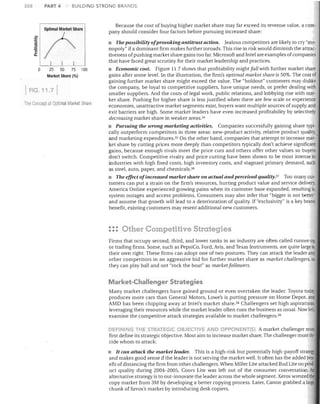
113
114

PART 2

CAPTURING MARKETING INSIGIHS

For each six-digit NAICS number, a company can purchase CD- ROMs of business direc­
tories that provide complete company profiles of millions of establishments, subclassified
by location, number of employees, annual sales, and net worth.
To use the NArCS, the lathe manufacturer must first determine the six-digit NArCS codes
that represent products whose manufacturers are likely to require lathe machines. To get a
full picture of all six-digit NAICS industries that might use lathes, the company can (1) deter­

mine past customers' NArCS codes; (2) go through the NArCS manual and check off all the
six-digit industries that might have an interest in lathes; (3) mail questionnaires to a wide
range of companies inquiring about their interest in wood lathes.
The company's next task is to determine an appropriate base for estimating the number
of lathes that each industry will use. Suppose customer industry sales are the most appropri­
ate base. Once the company estimates the rate of lathe ownership relative to the customer
industry's sales, it can compute the market potential.

M u I tip I e - F act 0 r I n d e x Met hod Like business marketers, consumer
companies also need to estimate area market potentials, but the customers of consumer
companies are too numerous to list. The method most commonly used in consumer markets
is a straightforward index method. A drug manufacturer, for example, might assume that the
market potential for drugs is directly related to population size. If the state of Virginia has
2.28% of the U.S. population, the company might assume that Virginia would be a market for
2.28% of total drugs sold.
A single factor, however, is rarely a complete indicator of sales opportunity. Regional drug
sales are also influenced by per capita income and the number of physicians per 10,000
people. Thus it makes sense to develop a multiple-factor index, with each factor assigned a
specific weight. The numbers are the weights attached to each variable. For example, sup­
pose Virginia has 2.00% of the U.S. disposable personal income, 1.96% of U.S. retail sales,
and 2.28% of U.S. population, and the respective weights are 0.5, 0.3, and 0.2. The buying­
power index for Virginia is then 2.04 [0.5(2.00) + 0.3(1.96) + 0.2(2.28)J. Thus 2.04% of the
nation's drug sales (not 2.28%) might be expected to take place in Virginia.
The weights in the buying-power index are somewhat arbitrary, and companies can
assign others if appropriate. A manufacturer might also want to adjust the market potential
for additional factors, such as competitors' presence in that market, local promotional costs,
seasonal factors, and local market idiosyncrasies.
Many companies compute other area indexes as a guide to allocating marketing
resources. Suppose the drug company is reviewing the six cities listed in Table 4.6. The
first two columns show its percentage of U.S. brand and category sales in these six cities.
Column 3 shows the brand development index (BDI), which is the index of brand sales to
category sales. Seattle, for example, has a BOI of 114 because the brand is relatively more
developed than the category in Seattle. Portland has a BOI of 65, which means that the
brand in Portland is relatively underdeveloped. Normally, the lower the BOI, the higher
the market opportunity, in that there is room to grow the brand. However, other marketers
would argue the opposite-that marketing funds should go into the brand's strongest mar­
kets, where it might be important to reinforce loyalty or more easily capture additional
brand share. 5G

TABLE 4.6 I

I

(a)
Percent of
U.S. Brand

(b)
Percent of
U.S. Category

BOI

I Territory

Sales

Sales

(a-;-b)x100

Seattle

3,09

2,71

114

Portland

6.74

10.41

65

Boston

3.49

3.85

91

Toledo

97

,81

120

Calculating the Brann Development Index
(BOI)

_.-----­

Chicago

1,13

81

140

Baltimore

3.12

300

104
CONDUCTING

ARI<ETING RESEARCH AND FORECASTING DEMAND

After the company decides on the city-by-city allocation of its budget, it can refine each
city allocation down to census tracts or zip+4 code centers. Census tracts are small, locally
defined statistical areas in metropolitan areas and some other counties. They generally have
stable boundaries and a population of about 4,000. Zip+4 code centers (which were designed
by the U.S. Post Office) are a little larger than neighborhoods. Data on population size,
median family income, and other characteristics are available for these geographical units,
and marketers have found them extremely useful for identifying high-potential retail areas
within large cities or for buying mailing lists to use in direct-mail campaigns (see Chapter 8).
INDUS TRY SALES'

0.., RKE - 5H
5 Besides estimating total potential and area po­
tential, a company needs to know the actual industry sales taking place in its market. This
means identifying competitors and estimating their sales.
The industry trade association will often collect and publish total industry sales, although
it usually does not list individual company sales separately. With this information, however,
each company can evaluate its own performance against the whole industry. If a company's
sales are increasing by 5% a year, and industry sales are increasing by 10%, the company is
losing its relative standing in the industry.
Another way to estimate sales is to buy reports from a marketing research firm that
audits total sales and brand sales. Nielsen Media Research audits retail sales in various
product categories in supermarkets and drugstores and sells this information to interested
companies. These audits let a company compare its performance to the total industry or
to any particular competitor to see whether it is gaining or losing share either overall or on
a brand-by-brand basis.
Because distributors typically will not supply information about how much of competi­
tors' products they are selling, business-goods marketers operate with less knowledge of
their market share results.

Estimating Future Demand
The few products or services that lend themselves to easy forecasting generally enjoy an
absolute level or a fairly constant trend and competition that is either nonexistent (public
utilities) or stable (pure oligopolies). In most markets, in contrast, good forecasting is a key.
factor in success.
Companies commonly prepare a macroeconomic forecast first, followed by an industry
forecast, followed by a company sales forecast. The macroeconomic forecast calls for pro­
jecting inflation, unemployment, interest rates, consumer spending, business investment,
government expenditures, net exports, and other variables. The end result is a forecast of
gross national product, which the firm uses, along with other environmental indicators, to
forecast industry sales. The company derives its sales forecast by assuming that it will win a
certain market share.
How do firms develop their forecasts? They may create their own or buy forecasts from
outside sources such as marketing research firms, which interview customers, distributors,
and other knowledgeable parties. Specialized forecasting firms produce long-range fore­
casts of particular macro environmental components, such as population, natural resources,
and technology. Some examples are Global Insight (a merger of Data Resources and Wharton
Econometric Forecasting Associates), Forrester Research, and the Gartner Group. Futurist
research firms produce speculative scenarios; three examples are the Institute for the Future,
Hudson Institute, and the Futures Group.
All forecasts are built on one ofthree information bases: what people say, what people do,
or what people have done. Using what people say requires surveying the opinions of buyers
or Ihose close to them, such as salespeople or outside experts, with surveys of buyer's inten­
tions, composites of sales force opinions, and expert opinion. BUilding a forecast on what
people do means putting the product into a test market to measure buyer response. To use
the final basis-what people have done-firms analyze records of past bUying behavior or
use time-series analysis or statistical demand analysis.
URVEY OF BUYERS I TENTI
5 Forecasting is the art of anticipating what buyers are
Jikelyto do under a given set of conditions. For major consumer durables such as appliances,
several research organizations conduct periodic surveys of consumer buying intentions and

CHAPTER 4

115
116

PART 2

CAPTURING MARKETING INSIGHTS

ask questions like this: Do you intend to buy an automobile within the next six months? and
put the answers on a purchase probability scale:
0.00

0.20

0.40

0.60

0.80

1.00

No

Slight
possibility

Fair
possibility

Good

High
possibility

Certain

chance

possibility

Surveys also inquire into consumers' present and future personal finances and their expec­
tations about the economy. They combine various bits of information into a consumer con­
fidence measure (Conference Board) or a consumer sentiment measure (Survey Research
Center of the University of Michigan).
For business buying, research firms can carry out buyer-intention surveys regarding
plant, equipment, and materials. Their estimates tend to fall within a 10% error band around
the actual outcomes. Buyer-intention surveys are particularly useful in estimating demand
for industrial products, consumer durables, product purchases where advanced planning is
required, and new products. The value of a buyer-intention survey increases to the extent
that buyers are few, the cost of reaching them is low, and they have clear intentions that they
willingly disclose and implement.
COMPOS TE OF SALES FORCE OPINIONS When buyer interviewing is impractical, the

company may ask its sales representatives to estimate their future sales.
Few companies use sales force estimates without making some adjustments. Sales repre­
sentatives might be pessimistic or optimistic, they might not know how their company's
marketing plans will influence future sales in their territory, and they might deliberately
underestimate demand so the company will set a low sales quota. To encourage better esti­
mating, the company could offer incentives or assistance, such as information about mar­
keting plans or past forecasts compared to actual sales.
Sales force forecasts bring a number of benefits. Sales reps might have better insight into
developing trends than any other group, and forecasting might give them greater confidence
in their sales quotas and more incentive to achieve them. Also, a "grassroots" forecasting pro­
cedure provides detailed estimates broken down by product, territory, customer, and sales rep.
XPFPT OPJ"UOI'll Companies can also obtain forecasts from experts, including dealers,
distributors, suppliers, marketing consultants, and trade associations. Dealer estimates are
subject to the same strengths and weaknesses as sales force estimates. Many companies buy
economic and industry forecasts from well-known economic-forecasting firms that have
more data available and more forecasting expertise.
Occasionally, companies will invite a group of experts to prepare a forecast. The experts
exchange views and produce an estimate as a group (group-discussion method] or individually,
in which case another analyst might combine them into a single estimate (pooling ofindivid­
ual estimates). Further rounds of estimating and refining follow (this is the Delphi method),57

PAST·SAL.ES ANALYSIS Firms can develop sales forecasts on the basis of past sales. Time­

series analysis breaks past time series into four components (trend. cycle, seasonal, and er­
ratic) and projects them into the future. Exponential smoothing projects the next period's
sales by combining an average of past sales and the most recent sales, giving more weight to
the latter. Statistical demand analysis measures the impact of a set of causal factors (such as
income, marketing expenditures, and price) on the sales level. Finally, econometric analysis
builds sets of equations that describe a system and statistically derives the different parame­
ters that make up the equations statistically.
MARKET·TEST METHOD When buyers don't plan their purchases carefully, or experts are
unavailable or unreliable, a direct-market test can help forecast new-product sales or estab­
lished product sales in a new distribution channel or territory. (We discuss market testing in
detail in Chapter 20.)
CONDUCTING MARI<ETI

G RES ARCH AND FORECASTING DEMAND

CHAPTER 4

117

C

;;:...-U-::......::.....:....::...M.:....::...A=-.::...::....;R--=-Y--:.....:::~:
1.	 Companies can conduct their own marketing research or

hire other companies to do it for them. Good marketing
research is characterized by the scientific method, creativity,
multiple research methods, accurate model building, cost­
benefit analysis, healthy skepticism, and an ethical focus.
2.	 The marketing research process consists of defining the
problem, decision alternatives, and research objectives,
developing the research plan, collecting the information,
analyzing the information, presenting the findings to man­
agement, and making the decision.
3.	 In conducting research, firms must decide whether to col­
lect their own data or use data that already exist. They must
also decide which research approach (observational, focus
group, survey, behavioral data, or experimental) and which
research instruments (questionnaire, qualitative mea­
sures, or technological devices) to use. In addition, they
must decide on a sampling plan and contact methods (by
mail, by phone, in person, or online).

4.	 Two complementary approaches to measuring marketing
productivity are: (1) marketing metrics to assess marketing
effects and (2) marketing-mix modeling to estimate causal
relationships and measure how marketing activity affects
outcomes. Marketing dashboards are a structured way to
disseminate the insights gleaned from these two
approaches within the organization.
5. There are two types of demand: market demand and com­
pany demand. To estimate current demand, companies
attempt to determine total market potential, area market
potential, industry sales, and market share. To estimate
future demand, companies survey buyers' intentions,
solicit their sales force's input, gather expert opinions, ana­
lyze past sales, or engage in market testing. Mathematical
models, advanced statistical techniques, and computer­
ized data collection procedures are essential to all types of
demand and sales forecasting.

_P_L_I_C_A_TI_O_N_S_:_:: - - - - - - - - - - - - - - - - - - - - - - - - 1 (
Marketing Debate

What Is the Best Type of Marketing Research?

Many market researchers have their favorite research
approaches or techniques, although different researchers
often have different preferences. Some researchers maintain
that the only way to really learn about consumers or brands is
through in-depth, qualitative research. Others contend that
the only legitimate and defensible form of marketing research
involves quantitative measures.

Take a position: The best marketing research is quantitative
in nature versus The best marketing research is qualitative in
nature.

Markefng Discussion
When was the last time you participated in a survey? How
helpful do you think was the information you provided? How

could the research have been done differently to make it more
effective?
SCl3lt101sn::> HllM 9Nll::>3NNOJ
CHAPTE

•••
...

CREATING CUSTOMER
VALUE, SATISFACTION,
AND LOYALTY

Today, companies face their toughest competition ever. Moving from
a product-and-sales philosophy to a holistic marketing philosophy,
however, gives thema better chance of outperforming competition.
And the cornerstone of a well-conceived marketing orientation is
strong customer relationships. Marketers must connect with cus­
tomers-informing,engaging, and maybe even el.,ergizing them in
the process. John Chambers, CEO of Cisco Systems, put it well when
he said to "Make your customer the center ·of your culture."
Customer-centered companies are adept at building customer rela­
tionships, not just products; they are skilled;n market engineering,
not just product engineering;

lTI

he Ritz-Carl.ton hotel chain, owned bY. M. wiott InternaHona/, i,

known throughout the world for: its singular focus on providing

guests with luxurious amenities and exceptional service. This

customer-centered approach is expressed by thee company's motto: "We are
ladies and gentlemen

s~rving ladies

and gentlemen. "

Guest~

at any of the 62

Ritz-Carlton hotels in 21 co~ntries notice the brand's famed personal touch
immediately upon checking in,. when they are greeted by name; To ensure
guests' total experience at the hotel is of the utmost quality, Ritz-Carlton cre­

ates a daily "ServiceQuality Index" (SQI) at each of its locations/so employ­
ees can continually monitor key guest service processes and swiftly address.
potential problem areas. At the brand's corporate headquarters in Maryland,

RItz-Carltan's

fOCliS

on IL<> guests helped i

win the prestigious Baldrige award twice a fJ
paced It among r Ie Ton 20 in the Brand

Kys Customer L yally Index.

> ».

l
119
120

PART 3

CONNECTING WITH CUSTOMERS

SOls for. each hotelaredisplayed-in a central command room,. allowing instant analy­
sis of how well,a' single location is perf()rming. Other customer'service initiatives

include the CLASS (Customer L0)la/ty Anticipation Satisfaction System) database,
whic;h contains preferenc;es .and requirements of repeat Ritz,Cariton guests, and a
rooni maintainence system known as CARE (Clean and.. Repair Everything), which
'ensures all guestrooms are free of defects every.90 days. These initiatives helped
Ritz-Carlton win its second Malcolm Baldrige National Quality Award in 1999,
becoming the only service company to win twice:

It~ dedication

to its customers also

enables. Ritz-Car/tonto forge lasting relationships w.ith them, as evidenced by the
hotel's Top 20 ranking

on the Brand /(eys2006 Customer Loyalty Index.!

As Ritz-Carlton's experience shows, successful marketers are the ones that fully
satisfy their customers profitably. In this chapter, we spell out in detail the ways
companies can go about winning customers and beating competitors. The answer
lies largely in doing a better job of meeting or exceeding customer expectations.

::: Building Customer Value. Satisfaction, and Loyalty
Creating loyal customers is at the heart of every business. 2 As marketing experts Don Peppers
and Martha Rogers say::;
The only value your company will ever create is the value that comes from customers-the
ones you have now and the ones you ,,,,,ill have in the future. Businesses succeed by getting,
keeping, and growing customers. Customers are the only reason you build factories, hire
employees, schedule meetings, lay fiber-optic lines, or engage in any business activity.
VVithout customers, you don't have a business.

Managers who believe the customer is the company's only true "profit center" consider
the traditional organization chart in Figure 5.1-a pyramid with the president at the top,
management in the middle, and frontline people and customers at the bottom-obsolete. 1
Successful marketing companies invert the chart (Figure 5.1b). At the top are customers;
next in importance are frontline people who meet, serve, and satisfy customers; under them
are the middle managers, whose job is to support the frontline people so they can serve cus­
tomers well; and at the base is top management, whose job is to hire and support good mid­
dle managers. We have added customers along the sides of Figure 5.1(b) to indicate that man­
agers at every level must be personally involved in knowing, meeting, and serving customers.
Some companies have been founded with the customer-on-top business model, and cus­
tomer advocacy has been their strategy-and competitive advantage-all along. With the rise
of digital technologies such as the Internet, today's increasingly informed consumers expect
companies to do more than connect with them, more than satisfy them, and even more than
delight them. They expect companies to listen to them. 5 When CompUSA permitted customer
reviews on its site-which can then show up in online searches-it found that 20,000 more cus­
tomers than before visited the site in a month, with a 50% greater propensity to buy.6 Vhen
Ebates, an online shopping portal that offers members cash back for shopping on the Web,
switched to online survey software to better monitor customer responses, the site redesign and
other changes that resulted from customer feedback brought increases in virtually all aspects
of business performance, including sales.?
CREATING CUSTOMER VALUE, SATISFACTION, AI D LOYALTY

(a) Traditional Organization Chart

(b) Modern Customer-oriented Organization Chart

;(~

/

I


I-

/

I

I

~ll_/

Frontline people


/

/


Middle management 

/

/


CUSTOMERS


Frontline people

II


.....


CUSTOMERS

/

<:-
<1''

/,

0 

Middle management / /


OrOJnlzaboll

'" /

~/

.p

~
ma~o:ge_ /

<1'  ' 

<;) /

l_"/
/,"'/

I

«'


Customer· 01 iented COIIlPWIY

//~/

 ~ 


Traditional Olqanimtioll vel sus Model11

I/'v/


ment

1/

121

FIG. 51

/

~

/manage-

ment 


,
/


CHAPTER 5

/ .:::> /

e" /

 /L/

Customer Perceived Value
Consumers are more educated and informed than ever, and they have the tools to verify
companies' claims and seek out superior alternatives. s

HEWLETT-PACKARD CO., DELL INCHewlett-Packard is beginning to outpace Dell in terms of customer perceived value. Dell rode to success by
offering low-priced computers, logistical efficiency, and after-sales service. Dell's maniacal focus on low costs

Customerperceived
Value

has been a key ingredient to that business model success. When the company shifted its customer-service
call centers to India and the Philippines to cut costs, understaffed call centers led to frequent 30-minute waits

'­

for customers. Almost half the calls required at least one transfer. To discourage customer calls, Dell even
removed its toll-free service number from its Web site. With customer satisfaction slipping and competitors

I

matching its product quality and prices and offering improved service, Dell's market share and stock price

Total
customer
benefit

both declined sharply. Dell ended up hiring more North American call center employees. "The team was man­
aging cost instead of managing service and quality," Michael Dell confesses. In contrast, Hewlett-Packard is
aggressively pursuing a solutions approach based on strengthening its channel partner relationships. Don
Ritchie, CEO of Sequel Data Systems, an exclusive HP partner, says he sees no threat from Dell as he contin­

I
Total
customer
cost

t

t

into an account that has been serviced by Dell. "9

How then do customers ultimately make choices? They tend to be value maximizers,
within the bounds of search costs and limited knowledge, mobility, and income. Customers
estimate which offer will deliver the most perceived value and act on it (Figure 5.2). tThether
the offer lives up to expectation affects customer satisfaction and the probability that the
customer will purchase the product again.
Customer-perceived value (CPV) is the difference between the prospective customer's
evaluation of all the benefits and all the costs of an offering and the perceived alternatives.
Total customer benefit is the perceived monetary value of the bundle of economic, func­
tional, and psychological benefits customers expect from a given market offering because of
the products, services, personnel, and image involved. Total customer cost is the perceived
bundle of costs customers expect to incur in evaluating, obtaining, using, and disposing of
the given market offering, including monetary, time, energy, and psychological costs.
Customer-perceived value is thus based on the difference between what the customer gets
and what he or she gives for different possible choices. The customer gets benefits and assumes
costs. The marketer can increase the value of the customer offering by some combination of
raising economic, functional, or emotional benefits and/ or reducing one or more of the various

Product
benefit

Monetary
cost

I

ues to deliver enterprise solutions in concert with HP and says, "One of the easiest sales Sequel has is to go

I

Services
benefit

Time cost

I

I

Personnel
benefit

Energy cost

__L­

I
Image
benefit

Psychological
cost

FIG. 5.2

o.temllt an1

01 Cuslomer­

Pen:civtJ1.1 Value
2

PART 3

CONNECTING WITH CUS iOMERS

types of costs. The customer choosing between two value offerings, VI and V2, will examine the
ratio Vl:V2 and favor VI if the ratio is larger than one, favor V2 if the ratio is smaller than one,
and be indifferent if the ratio equals one.
APPLYING VALUE CONCEP""S Suppose the buyer for a large construction company wants
to buy a tractor from Caterpillar or Komatsu. The competing salespeople carefully describe

their respective offers. The buyer wants to use the tractor in residential construction work.
He would like it to deliver certain levels of reliability, durability, performance, and resale
value. He evaluates the tractors and decides that Caterpillar has greater product benefits
based on his perceptions of those attributes. He also perceives differences in the accompa­
nying services-delivery, training, and maintenance-and decides that Caterpillar provides
better service as well as more knowledgeable and responsive personnel. Finally, he places
higher value on Caterpillar's corporate image and reputation. He adds up all the economic,
functional, and psychological benefits from these four sources-product, services, person­
nel, and image-and perceives Caterpillar as delivering greater customer benefits.
Does he buy the Caterpillar tractor? Not necessarily. He also examines his total cost of
transacting with Caterpillar versus Komatsu, which consists of more than money. As Adam
Smith observed over two centuries ago, "The real price of anything is the toil and trouble of
acquiring it." Total customer cost also includes the buyer's time, energy, and psychological
costs expended in product acquisition, usage, maintenance, ownership, and disposal. The
buyer evaluates these elements together with the monetary cost to form a total customer
cost. Then he considers whether Caterpillar's total customer cost is too high in relationship
to the total customer benefits Caterpillar delivers. If it is, the buyer might choose Komatsu.
The buyer .vill choose whichever source he thinks delivers the highest perceived value.
Now let's use this decision-making theory to help Caterpillar succeed in selling to this buyer.
Caterpillar can improve its offer in three ways. First, it can increase total customer benefit by
improving economic, functional, and psychological benefits of its product, services, person­
nel, and/ or image. Second, it can reduce the buyer's nonmonetary costs by reducing the time,
energy, and psychological costs. Third, it can reduce its product's monetary cost to the buyer.
Suppose Caterpillar concludes that the buyer sees its offer as worth $20,000. Further, sup­
pose Caterpillar's cost of producing the tractor is $14,000. This means Caterpillar's offer
potentially generates $6,000 over the company's cost, so Caterpillar needs to charge a price
between $14,000 and $20,000. If it charges less than $14,000, it won't cover its costs; if it
charges more than $20,000, it .viII price itself out of the market.
The price Caterpillar charges will determine how much value will be delivered to the
buyer and how much .viII flow to Caterpillar. For example, if Caterpillar charges $19,000, it is
creating $1,000 of customer perceived value and keeping $5,000 for itself. The lower
Caterpillar sets its price, the higher the customer perceived value and, therefore, the higher
the customer's incentive to purchase. To win the sale, Caterpillar must offer more customer
perceived value than Komatsu does. 1O
Very often, managers conduct a customer value analysis to reveal the company's strengths
and weaknesses relative to those of various competitors. The steps in this analysis are:

1.	 Identify the major attributes and benefits that customers value-Customers are asked
what attributes, benefits, and performance levels they look for in choosing a product
and vendors.
2.	 Assess the quantitative importance of the different attributes and benefits­
Customers are asked to rate the importance of the different attributes and benefits. Iftheir
ratings diverge too much, the marketer should cluster them into different segments.
3.	 Assess the company's and competitors' performances on the different customer values
against their rated importance-Customers describe where they see the company's
and competitors' performances on each attribute and benefit.
4.	 Examine how customers in a specific segment rate the company's peljormance
against a specific major competitor on an individual attribute or benefit basis-If the
company's offer exceeds the competitor's offer on all important attributes and benefits,
the company can charge a higher price (thereby earning higher profits), or it can charge
the same price and gain more market share.
5.	 Monitor customer values over time-The company must periodically redo its stud­
ies of customer values and competitors' standings as the economy, technology, and
features change.
CREATING CUSTOMER Vfl.LUE, SATISFACTION, AND LOYALTY

CHAPTER 5

CHOICES AND IMPLICATIONS Some marketers might argue that the process we have de­
scribed is too rational. Suppose the customer chooses the Komatsu tractor. How can we ex­
plain this choice? Here are three possibilities.
1.	 The buyer might be under orders to buy at the lowest price--The Caterpillar salesper­ 


son's task is to convince the buyer's manager that buying on price alone will result in

lower long-term profits and customer value.

2.	 The buyer will retire before the company realizes that the Komatsu tractor is more

expensive to operate--The buyer will look good in the short run; he is maximizing per­

sonal benefit. The Caterpillar salesperson's task is to convince other people in the cus­ 

tomer company that Caterpillar delivers greater customer value.

3.	 The buyer enjoys a long-term friendship with the Komatsu salesperson-In this case,

Caterpillar's salesperson needs to show the buyer that the Komatsu tractor will draw

complaints from the tractor operators when they discover its high fuel cost and need for

frequent repairs.

The point of these examples is clear: Buyers operate under various constraints and occa­
sionally make choices that give more weight to their personal benefit than to the company's
benefit.
Customer-perceived value is a useful framework that applies to many situations and
yields rich insights. Here are its implications:
First, the seller must assess the total customer benefit and total customer cost associated
with each competitor's offer in order to know how his or her offer rates in the buyer's mind.
Second, the seller who is at a customer-perceived-value disadvantage has two alterna­
tives: to increase total customer benefit or to decrease
total customer cost. The former calls for strengthen­
ing or augmenting the economical, functional, and
psychological benefits of the offering's product, ser­
vices, personnel, and image. The latter calls for reduc­
ing the buyer's costs by reducing the price or cost of
ownership and maintenance, simplifying the order­
THE GREATEST
ing and delivery process, or absorbing some buyer

LUXURY OF ALL.

risk by offering a warranty. I I

THE LUXURY CAR THAT
TREATS LIFE LIKE

OEUVERING ilGH CUSTOM R VALUE Consumers

have varying degrees of loyalty to specific brands,

stores, and companies. Oliver defines loyalty as "A

deeply held commitment to rebuy or repatronize a

preferred product or service in the future despite situ­

ational influences and marketing efforts having the

potential to cause switching behavior."12Table 5.1 dis­

plays brands with the greatest degree of customer loy­

alty according to one 2006 survey.l3

The value proposition consists of the whole cluster
of benefits the company promises to deliver; it is more
than the core positioning of the offering. For example,
Volvo's core positioning has been "safety," but the
buyer is promised more than just a safe car; other ben­
efits include a long-lasting car, good service, and a long
warranty period. The value proposition is a statement
about the experience customers will gain from the
company's market offering and from their relationship
Volvo. for life
with the supplier. The brand must represent a promise
about the total experience customers can expect.
If you
rrta the greatOSI!uJ;uty, you'll want a luxury car thai
protecting life its first priority. Tho

.U'M'W' ~ sao ~ exaclly lhal wilh new Pre·Emptive Technologies thai can actually detect dangerous

Whether the promise is kept depends on the com­
sitwllonJ, bolonP they happen. These wond-firsts Or'SUre that for people both insido and outside the car, Ihe

~ of lite ~rnty gDCs on. And wilh the power 01 an available 3n-hp VB and elegant Scandinavian

pany's ability to manage its value delivery system. 14
detign. t.he driver experiences a perfectly struck balance of perfOlmance and luxury.

WHO WOULD YOU GIVE A VOLVO TO? The all-new Volvo S80, starting at $38,705:

The value delivery system includes aJJ the experiences
visit us at volvocars.us
-.Cot...............

..
the customer will have on the way to obtaining and	
using the offering. At the heart of a good value delivery ' - - - - - - - - - - - - - - - - - - - - - - - - ­
system is a set of core business processes that help to
deliver distinctive consumer value. ls
Safety is ,1 18adill(j, bulnol the only, benefit promiseel in Volvo's value proposition.

THE ALL-NEW VOLVO sao.
~lI!Ir

"MSA:f'dooH"",(~~~T.o_	 ~.....,........
....

r;.200?~C..otNonll"-a.UC.Thoh.~~"''''''o,wW.·

make~

~~

~t;Oo.l.s....,.:....-..t-:'cd"""""""""b~~

... ~''''''''olw.t.<l.u.'*I'''_:O_l'C'''_boolI.
•

123
124

PART 3

CONNECTING WITH CUSTOMERS

TABLE 5.1
TOp 20 Brands in Customer Loyally

1. Avis

11. Verizon long distance

2. Google

12. KeySpan Energy

3. L.L. Bean catalog

13. Miller Genuine Draft

4. Samsung mobile phones

14. Amazon

5. Yahoo!

15. Target

6. Canon office copiers

16. Motorola mobile phones

7. Land's End catalog

17. BlackBerry

8. Coors

18. Diet Pepsi

9. Hyatt hotels

19. Netscape

1O. Marriott hotels

20. Ritz-Carlton Hotels

SOll/ce: 2006 81;'1111 K~Vs Customel Loyalty Leaums list, as summGrlzeo In leflPdtl Helll, 'Brand Loy~lt" <.;tKNIS TIl£:'I1'~; I~I
Plac" Llh~ f1,,,,w. ' Brail(,ll~'I~~' OcloilBI 23 ?006, p I

Here's a company that is a master at delivering customer value,16

SUPERQUINN

•

Superquinn is Ireland's largest supermarket chain and its founder, Feargal Quinn, is Ireland's master marketer,
A greeter is posted at the store entrance to welcome and help customers and even offer coffee, and to pro­
vide carryout service to customers' cars and umbrellas in case of rain, Department managers post them­
selves in the aisles to interact with customers and answer questions. There is a high-quality salad bar, fresh
bread baked every four hours, and indications of when produce arrived, including the farmers' pictures.
Superquinn also operates a child care center. It offers a loyalty program that gives points for the amount pur­
chased and for discovering anything wrong with the store, such as dented cans or bad tomatoes, A dozen
other firms (a bank, gas station, and others) that give points for purchases at their establishments recognize
the loyalty card, Because everything is done to exceed normal customer expectations, Superquinn stores
enjoy an almost cult/ike following, In August 2006, Superquinn was sold to a consortium, Select Retail
Holdings for $590 million.

Total Customer Satisfaction
Whether the buyer is satisfied after purchase depends on the offer's performance in relation­
ship to the buyer's expectations, and whether the buyer interprets any deviations between
the two,17 In general, satisfaction is a person's feelings of pleasure or disappointment that
result from comparing a product's perceived performance (or outcome) to their expecta­
tions,1O If the performance falls short of expectations, the customer is dissatisfied. If the per­
formance matches the expectations, the customer is satisfied. If the performance exceeds
expectations, the customer is highly satisfied or delighted. 19 Customer assessments of prod­
uct performance depend on many factors, especially the type of loyalty relationship the cus­
tomer has with the brand. 20 Consumers often form more favorable perceptions of a product
with a brand they already feel positive about.
Although the customer-centered firm seeks to create high customer satisfaction, that is
not its ultimate goal. If the company increases customer satisfaction by lowering its price or
increasing its services, the result may be lower profits. The company might be able to
increase its profitability by means other than increased satisfaction (for example, by improv­
ing manufacturing processes or investing more in R&D), Also, the company has many stake­
holders, including employees, dealers, suppliers, and stockholders, Spending more to
C EATING CUSTOMER VALUE, SATISFACTION, AND LOYALTY

CHAPTER 5

increase customer satisfaction might divert
funds from increasing the satisfaction of other
"partners." Ultimately, the company must operate on the philosophy that it is trying to deliver a
high level of customer satisfaction subject to
delivering acceptable levels of satisfaction to the
other stakeholders, given its total resources. 21
How do buyers form their expectations?
Expectations result from past buying experience;
friends' and associates' advice; and marketers'
and competitors' information and promises. If
marketers raise expectations too high, the buyer
is likely to be disappointed. However, if the company sets expectations too low, it won't attract
enough buyers (although it will satisfy those who
do buy).22 Some of today's most successful companies are raising expectations and delivering
performances to match. Korean auto maker Kia
found success in the United States by launching
low-cost, high-quality cars with enough reliability so that it could offer 10-year warranties.
A customer's decision to be loyal or to defect Joie de Vivre's lJoutique hotels oHer parso! al touches that exceed customer expectations.
is the sum of many small encounters with the
company. Many companies now strive to create a "branded customer experience." Here's
how San Francisco's Joie de Vivre chain does this. 23

JotE DE VIVRE

•

Joie de Vivre Hospitality Inc. operates a chain of boutique hotels, restaurants, and resorts in the San
Francisco area. Each property's unique decor, quirky amenities, and thematic style are often loosely based
on popular magazines. For example, the Hotel del Sol-a converted motel bearing a yellow exterior and
surrounded by palm trees wrapped with festive lights-is described as "kind of Martha Stewart Living
meets Islands magazine."24 Two Silicon Valley hotels offer guests high-speed Internet connections in their
rooms and by the pool.25 The boutique concept enables the hotels to offer personal touches, such as vitamins in place of chocolates on pillows. Joie de Vivre now owns the largest number of independent hotel
properties in the Bay Area.

Monitoring Satisfaction
Many companies are systematicaJly measuring how well they treat their customers, identifying the factors shaping satisfaction, and making changes in their operations and marketing
as a result. 26 For example, Wachovia Securities employs mystery shoppers to assess how well
employees are satisfying customers, linking part of employees' compensation to their ratings. The emphasis on customer service seems to be working-a research study by Brand
Keys during the first quarter of 2006 found that Wachovia did a better job of meeting the
expectations of its loyal customers than any other bank. 27
A company would be wise to measure customer satisfaction regularly, because one key
to customer retention is customer satisfaction. 28 A highly satisfied customer generally stays
loyal longer, buys more as the company introduces new products and upgrades existing
products, talks favorably to others about the company and its products, pays less attention
to competing brands and is less sensitive to price, offers product or service ideas to the
company, and costs less to serve than new customers because transactions can become
routine. 29 Greater customer satisfaction has also been linked to higher returns and lower
risk in the stock market. 3D
The link between customer satisfaction and customer loyalty, however, is not proportional. Suppose customer satisfaction is rated on a scale from one to five. At a very low level

125
126

PART 3

CONNECTING WITH CUSTOMERS

of customer satisfaction (level one), customers are likely to abandon the company and even
bad-mouth it. At levels two to four, customers are fairly satisfied but still find it easy to
switch when a better offer comes along. At level five, the customer is very likely to repurchase and even spread good word of mouth about the company. High satisfaction or delight
creates an emotional bond with the brand or company, not just a rational preference. Xerox's
senior management found out that its "completely satisfied" customers were six times more
likely to repurchase Xerox products over the following 18 months than its "very satisfied"
customers. 3J
When customers rate their satisfaction with an element of the company's performancesay, delivery-the company needs to recognize that customers vary in how they define good
performance. Good delivery could mean early delivery, on-time delivery, order completeness, and so on. The company must also realize that two customers can report being "highly
satisfied" for different reasons. One may be easily satisfied most of the time and the other
might be hard to please but was pleased on this occasion.3 2
MEASUREMENT TECHNIQUES A number of methods exist to measure customer satisfaction. Periodic surveys can track customer satisfaction directly and also ask additional
questions to measure repurchase intention and the respondent's likelihood or willingness to recommend the company and brand to others. Paramount attributes the success
of its five theme parks to the thousands of Web-based guest surveys it sends to customers who have agreed to be contacted. During a recent year, the company conducted
more than 55 of these surveys and netted 100,000 individual responses that described
guest satisfaction on topics including rides, dining, shopping, games, and shows. 33
"Marketing Insight: Net Promoter and Customer Satisfaction" describes why some companies believe just one well-designed question is all that is necessary to assess customer
satisfaction. 34
Besides conducting periodic surveys, companies can monitor their customer loss rate
and contact customers who have stopped buying or who have switched to another supplier to find out why. Finally, companies can hire mystery shoppers to pose as potential
buyers and report on strong and weak points experienced in buying the company's and
competitors' products. Managers themselves can enter company and competitor sales situations where they are unknown and experience firsthand the treatment they receive, or
they can phone their own company with questions and complaints to see how employees
handle the calls.
In addition to tracking customer value expectations and satisfaction for their own
firms, companies need to monitor their competitors' performance in these areas. One
company was pleased to find that 80% of its customers said they were satisfied. Then the
CEO found out that its leading competitor had a 90% customer satisfaction score. He was
further dismayed when he learned that this competitor was aiming for a 95% satisfaction
score.
lr-.rLlJENCE Of- CUSTOMEh SATISFA~T10N For customer-centered companies, customer satisfaction is both a goal and a marketing tool. Companies need to be especially
concerned today with their customer satisfaction level because the Internet provides a
tool for consumers to quickly spread bad word of mouth-as well as good word of
mouth-to the rest of the world. Some customers even set up their own Web sites to air
their grievances and dissatisfaction, targeting high-profile brands such as United Airlines, Wal-Mart, and Mercedes-Benz. 36 Describing events and actions as being wronged
by the company, these Web sites often attempt to galvanize consumer discontent and
protest.
Companies that do achieve high customer satisfaction ratings make sure their target market knows it. Once they achieved number-one status on J.D. Power's customer satisfaction
ratings, Countrywide home mortgage lenders, Continental airlines, and Kyocera copiers all
advertised that fact.
The University of Michigan's Claes Fornell has developed the American Customer
Satisfaction Index (ACS!) to measure the perceived satisfaction consumers feel with different
firms, industries, economic sectors, and national economies. 37 Examples of firms that led
their respective industries with high ACSI scores in 2005 are Heinz (91), Toyota (87), Apple
(83), and Google (82).
CREATiNG CUSTOMER VALUE, SATISFACTION, AND LOYALTY

MARKETING INSIGHT

CHAPTER 5

NET PROMOTER AND CUSTOMER SATISFACTION

Measuring customer satisfaction is a top priority for many companies, but a difference of opinion exists as to how they should
go about doing that. Bain's Frederick Reichheld suggests that
perhaps only one customer question really matters: "How likely
is it that you would recommend this product or service to a friend
or colleague?" According to Reichheld, a customer's Willingness
to recommend to a friend results from how well the customer is
treated by frontline employees, which in turn is determined by all
the functional areas that contribute to a customer's experience. 35
Reichheld was inspired in part by the experiences of Enterprise
Rent-A-Car. When the company cut its customer satisfaction survey
from 18 to 2 questions in 1998-one about the quality of their rental
experience and the other about the likelihood they would rent from
the company again-it found that customers who gave the higllest
ratings to their rental experience were three times as likely to rent
again than those who gave the company the second highest rating.
The firm also found that the diagnostic information its managers collected from dissatisfied customers helped the company fine-tune its
operations.
In a typical Net Promoter survey that follows Reicheld's thinking,
customers are asked to rate their likelihood to recommend on a
0-10-point scale. Marketers then subtract detractors (those who
gave a0 to 6) from promoters (those who gave a9 or 10) to arrive at
the Net Promoter Score (NPS). Customers who rate the brand with a
7 or 8 are deemed passively satisfied and are not included in the final
score. Atypical set of NPS scores falls in the 10% to 30% range, but
world-class companies can score over 50%. Some firms with top
NPS scores include USAA (82%), Harley-Davidson (81 %), Costco
(79%), Amazon (73%), and eBay (71 %).
Reichheld is gaining a number of believers. GE, American
Express, and Microsoft, among others, have all adopted the NPS
metric. GE has tied 20% of its manager's bonuses to its NPS
scores. When the European unit of GE Healthcare scored low,
follow-up research revealed that response times to customers
were a major problem. After it overhauled its call center and put
more specialists in the field, GE Healthcare's Net Promoter
scores jumped 10 to 15 points. BearingPoint found that clients
who gave it high Net Promoter scores showed the highest revenue growth.
Reichheld says he developed NPS in response to what he saw
as overly complicated-and thus ineffective-customer surveys.
So it's not surprising that client firms praise its simplicity and its
strong relationship to financial performance. Companies such as

At Enterprise,
You Always Know
Where You Stand.

~'''''o
l

,

There's a place where the number one
priority is you. That's why no malleI' whal
the season, no matter whet rhe reason, you
can always count on Enterprise.

Pick Enterprise_ We'll pick you up~
1 800 rent-a-car

Enterprise Rellt -a Car was able to learn a great deal alJout
customer loyally by cutting the number of customer satisfaction
questions dowil to just two.

GE stress the importance of the explanations customers provide to
explain or justify their ratings. When Intuit applied Net Promoter to
its TurboTax software, feedback revealed dissatisfaction with
TurboTax's rebate procedure, After dropping the proof-of-purchase
requirement as a result, Intuit saw sales jump 6%.

Sources: Fred Reichheld, Ultimate Question: For Driving Good Profits and True Growll) (Cambridge, MA: Harvard Business School Press, 2006); Matthew Creamer, "Do You
Know Your Score?" Advertising Age, July 3, 2006, pp. 1-24; Jena McGregor, "Would YOLI Recommend Us?" BusinessWeek, January 30, 2006, pp. 94-95; Kathryn Kranhold,
"Client-Satisfaction Tool Takes Root," Wall Street Journat, July 10, 2006; Todd Wasserman, "Net Promoter Approaches ROI Question with Question," Brandweek, April 17,
2006, p. 13; Fred Reichheld, "The One Number You Need to Grow," Harvard Business Review, December 2003.

127
128

PART 3

CONNECTING WITH CUSTOMERS

JD. Powor's customer satisfaction
mlings make nowertul arJveliisillg copy
for customer-cenlererJ firms.

r-...

hl '-I II'., l'.. lH.l

".

I
"

~~

-HIGI tEST IN CUSTOM!!!'? SATrSFACno~ WITH INTERIOR P.INT5~ FROM J.D. PO','ER AND ASSOCIATES.

WE'RE TICKLED
2002·50

~
.......,:....-.-..,""'-

- - . .... ,.,~......

"-"

.-. _-,...:_.. _1:- ........
....-._".-.....
_

111

~

I

.

.

..

_

_

_ . - ••_

~

1Il

.

~

_ _ 'UI

-.

r

v-.......,..

_

........ ----, _--.'

-loti

2002~'

lIr-.~

•

'-tWIll

PULTE HOMES INC
One of the nation's largest and most diversified new homebuilders, Pulte Homes has won more awards in
J.D. Power's annual survey of customers than any other new homebuilder. The 55-year-old company doesn't
rely on J.D. Power to get a bead on its customers' satisfaction level, however. Pulte Homes constantly measures how well it's doing with customers by tracking them over a long period of time. The builder first surveys buyers to get a feel of what the experience was like just after they bought their home. Then, several
years later, Pulte goes back to those same buyers to make sure they're still happy. When Pulte was dissatisfied with the marks it was getting from customers for overall satisfaction in 2001, it created a customer relations department of 1,200 people and a program to ensure that it paid closer attention to customers' desires
throughout the entire sales and building process. Erik Pekarski, national vice president of customer relations
at Pulte, says that the jump in repeat and referral business following this initiative is "proof that the stronger
relationship increases our bottom line." Pekarski also stresses that Pulte's focus is on preventing customer

•

problems and complaints and that's why the firm uses the term "customer relations" instead of "customer
service. "30

CUSTOMER c.. MPl 4 ".r~ Some companies think they're getting a sense of customer satisfaction by tallying complaints, but studies of customer dissatisfaction show that customers
are dissatisfied with their purchases about 25% of the time but that only about 5% complain.
CREATING C.USTOMER VALUE, SATISFACTION, AND LOYALTY

The other 95% either feel complaining is not worth the effort, or they do not know how or to
whom to complain, and they just stop buying. 39
Of the customers who register a complaint, between 54% and 70% will do business with
the organization again if their complaint is resolved. The figure goes up to a staggering 95%
if the customer feels the complaint was resolved quickly. Customers who have complained
to an organization and had their complaints satisfactorily resolved tell an average of 5 people about the good treatment they received. 40 The average dissatisfied customer, however,
gripes to 11 people. If each of them tells still other people, the number of people exposed to
bad word of mouth may grow exponentially.
The fact is, no matter how perfectly designed and implemented a marketing program is,
mistakes will happen. The best thing a company can do is to make it easy for the customer
to complain. Suggestion forms, toll-free numbers, Web sites, and e-mail addresses allow for
quick, two-way communication. The 3M Company claims that over two-thirds of its product
improvement ideas come from listening to customer complaints.
Given the potential downside of having an unhappy customer, it's critical that marketers
deal with the negative experience properly.4l Beyond that, the following procedures can help
to recover customer goodwill: 42
1. Set up a 7-day, 24-hour toll-free "hotline" (by phone, fax, or e-mail) to receive and act on

customer complaints.
2. Contact the complaining customer as quickly as possible. The slower the company is to
respond, the more dissatisfaction may grow and lead to negative word of mouth.
3. Accept responsibility for the customer's disappointment; don't blame the customer.
4. Use customer-service people who are empathic.
5. Resolve the complaint swiftly and to the customer's satisfaction. Some complaining customers are not looking for compensation so much as a sign that the company cares.

Product and Service Quality
Satisfaction will also depend on product and service quality. What exactly is quality? Various
experts have defined it as "fitness for use," "conformance to requirements," "freedom from
variation," and so on. We will use the American Society for Quality Control's definition:
Quality is the totality of features and characteristics of a product or service that bear on its
ability to satisfy stated or implied needs. 43 This is clearly a customer-centered definition. We
can say that the seller has delivered quality whenever its product or service meets or exceeds
the customers' expectations. A company that satisfies most of its customers' needs most of
the time is called a quality company, but we need to distinguish between conformance qualityand pmjormance quality (or grade). A Lexus provides higher performance quality than a
Hyundai: The Lexus rides smoother, goes faster, and lasts longer. Yet we can say that both a
Lexus and a Hyundai deliver the same conformance quality if all the units deliver their
respective promised quality.
According to GE's former chairman, John F. Welch Jr., "Quality is our best assurance of customer allegiance, our strongest defense against foreign competition, and the only path to sustained growth and earnings."44 The drive to produce goods that are superior in world markets
has led some countries-and groups of countries-to recognize or award prizes to companies
that exemplify the best quality practices, such as the Deming Prize in Japan, the Malcolm
Baldrige National Quality Award in the United States, and the European Quality Award.
OF Q f
Product and service quality, customer satisfaction, and company
profitability are intimately connected. Higher levels of quality result in higher levels of customer satisfaction, which support higher prices and (often) lower costs. Studies have shown
a high correlation between relative product quality and company profitability.45 Companies
that have lowered costs to cut corners have paid the price when the quality of the customer
experience suffers: 46

I i1PAC

When Home Depot decided to expand into the contractor supply business, while also cutting costs and streamlining operations in 1,816 U.S. stores, it replaced many full-time workers with part-time employees who soon made up about 40% of store staff. The chain's ACS
index of customer satisfaction dropped to the bottom among major U.S. retailers, 11 points
behind customer-friendly competitor Lowe's, and Home Depot's share price slid 24% during
the biggest home improvement boom in history.

CHAPTER 5

29
130

PART 3

CONNECTING WITH CUSTOMERS

• Although Northwest Airlines stopped offering free magazines, pillows, movies, and even
mini bags of pretzels on domestic flights, the carrier also raised prices and reduced its flight
schedule. As one frequent flier noted, "Northwest acts low cost without being low cost." Not
surprisingly, Northwest came in last of all top U.S. airlines in both the ACS index and J.D.
Power & Associates customer satisfaction poll.
Quality is clearly the key to value creation and customer satisfaction.
TOTAL QUAliTY Total quality is everyone's job, just as marketing is everyone's job. Mar-

keters play several roles in helping their companies define and deliver high-quality goods and
services to target customers. First, they bear the major responsibility for correctly identifying
the customers' needs and requirements. Second, they must communicate customer expectations properly to product designers. Third, they must make sure that customers' orders are
filled correctly and on time. Fourth, they must check that customers have received proper instructions, training, and technical assistance in the use of the product. Fifth, they must stay
in touch with customers after the sale to ensure that they are satisfied and remain satisfied.
Sixth, they must gather customer ideas for product and service improvements and convey
them to the appropriate departments. When marketers do all this, they are making substantial contributions to total quality management and customer satisfaction, as well as to customer and company profitability.

::: Maximizing Customer Lifetime Value
Ultimately, marketing is the art of attracting and keeping profitable customers. Yet every
company loses money on some of its customers. The well-known 20-80 rule says that the
top 20% of the customers often generates 80% or more of the company's profits. In some
cases the profit distribution may be more extreme-the most profitable 20% of customers
(on a per capita basis) may contribute as much as 150% to 300% of profitability. The least
profitable 10% to 20% of customers, on the other hand, can actually reduce profits between
50% to 200% per account, with the middle 60% to 70% breaking evenY Figure 5.3 displays
one customer profit distribution. The implication is that a company could improve its profits by "firing" its worst customers.
It's not always the company's largest customers who yield the most profit. The largest
customers can demand considerable service and receive the deepest discounts. The smallest customers pay full price and receive minimal service, but the costs of transacting .vith
them can reduce their profitability. The midsize customers who receive good service and pay
nearly full price are often the most profitable.

Customer Profitability
What makes a customer profitable? A profitable customer is a person, household, or company that over time yields a revenue stream that exceeds by an acceptable amount the
FIG. 5.3

I

Tile 150-20 Rule: "Tile 20% mos1
profitable customers generate as muc!

I

$10,000

I

8,000 -

20% least profitable lose -100% of Ihe
Larry Seloer ami Yoko S. seILle;l.
"?mf:tnhlr- ClsIOillf,r. nt~ Ke' to Gll':1t
Rr<Jilru..-' Poinl (JUly-/lIIQllst 2110fij. Y.
!>OUlCC.

I

6,000

as 150% of Ille profils of a company: the
profits"

I~
~-

#.
';2 I I
+
0

CfJ
Cl

4,000 -

CfJ

2,000 -

z
<:(

::::>
0

0
-2,000

~-

WD~

:r:
f-~

I

LJIT

I

I

I I'#.
0
0

L-----l

-4,000 -I
-6,000

2

3

4

5

6

7

8

9

I 'I

10
CREATING CUSTOMER VALUE, SATISFACTION, AND LOYALTY

CHAPTER 5

131

company's cost stream for attracting, selling, and servicing that customer. Note that the
emphasis is on the lifetime stream of revenue and cost, not on the profit from a particular
transaction. 48 Marketers can assess customer profitability individually, by market segment, or by channel.
Although many companies measure customer satisfaction, most companies fail to
measure individual customer profitability.49 Banks claim this is a difficult task, because
each customer uses different banking services and the transactions are logged in different
departments. However, the number of unprofitable customers in their customer base has
appalled banks that have succeeded in linking customer transactions. Some banks report
losing money on over 45% of their retail customers.
ROFITABILITY
ALYSIS A useful type of profitability analysis is shown in
Figure 5.4. 50
Customers are arrayed along the columns and products along the rows. Each cell contains a symbol representing the profitability of selling that product to that customer.
Customer 1 is very profitable; he buys two profit-making products (PI and P2). Customer 2
yields a picture of mixed profitability; he buys one profitable product (PI) and one unprofitable product (P3). Customer 3 is a losing customer because he buys one profitable product
(PI) and two unprofitable products (P3 and P4).
"Vhat can the company do about customers 2 and 3? (1) It can raise the price of its less
profitable products or eliminate them, or (2) it can try to sell customers 2 and 3 its profitmaking products. Unprofitable customers who defect should not concern the company. In
fact, the company should encourage these customers to switch to competitors.
Customer profitability analysis (CPA) is best conducted with the tools of an accounting
technique called activity-based costing (ABC). The company estimates all revenue coming
from the customer, less all costs. The costs should include not only the cost of making and
distributing the products and services, but also of taking phone calls from the customer,
traveling to visit the customer, paying for entertainment and gifts-all the company's
resources that go into serving that customer.
When a company does this for each customer, it can classify customers into different
profit tiers: platinum customers (most profitable), gold customers (profitable), iron customers
(low profitability but desirable for volume), and lead customers (unprofitable and undesirable). The company can then move iron customers into the gold tier and gold customers
into the platinum tier, while dropping the lead customers or making them profitable by raising
their prices or lowering the cost of serving them. More generally, marketers must segment
customers into those worth pursuing and those potentially less-lucrative customers that
should receive less attention, if any at all.
CUSTOMER

(USTOMER PORTFOLIOS Marketers are recognizing the need to manage customer portfo-

lios, made up of different groups of customers51 defined in terms oftheir loyalty, profitability,
and other factors. One perspective is that a firm's portfolio consists of a com bination of "acquaintances," "friends," and "partners" that are constantly changing. 52 The three types of customers will differ in their product needs, their buying, selling, and servicing activities, and
their acquisition costs and competitive advantages.

..

Customers

FIG. 5.4

C,

Pz

C3

+

P,

Cz

+

+

Profitable
product

+

Products

-

P3
I
P
4

L-.

High-profit
customer

Highly profitable
,
, product

Mixed-bag
customer

Losing
customer

Unprofitable
product
Highly unprofitable
product

!'

I
,
I

Customer-Product PlOfital)ility Analysis
132

PART 3

CONNECTING WITH CUSTOMERS

Another perspective compares the individuals who make up the firm's customer portfolio to the stocks that make up an investment portfolio. 53 In marketing, as in investments, it's
important to calculate the beta, or risk-reward value, for each portfolio item and then diversify accordingly. From this perspective, firms should assemble portfolios of negatively correlated individuals so that the financial contributions of one offset the deficits of another to
maximize the portfolio's risk-adjusted lifetime value.

Measuring Customer Lifetime Value
The case for maximizing long-term customer profitability is captured in the concept of customer lifetime value. 54 Customer lifetime value (CLV) describes the net present value of the
stream of future profits expected over the customer's lifetime purchases. The company must
subtract from its expected revenues the expected costs of attracting, selling, and servicing
the account of that customer, applying the appropriate discount rate (say, between 10% and
20%, depending on cost of capital and risk attitudes). Lifetime value calculations for a product or service can add up to tens of thousands of dollars or even into six figures. 55
Many methods exist to measure customer lifetime value. 56 "Marketing Memo: Calculating
Customer Lifetime Value" illustrates one.
CLV calculations provide a formal quantitative framework for planning customer investment and help marketers adopt a long-term perspective. One challenge in applying CLV
concepts, however, is to arrive at reliable cost and revenue estimates. Marketers who use
CLV concepts must also take into account the short-term, brand-building marketing activities that help increase customer loyalty.

--

,.---

r

CALCULATING CUSTOMER LIFETIME VALUE

EMO

MARKETING

Researchers and practitioners have used many different approaches
for modeling and estimating customer lifetime value (CLV). Columbia's
Don Lehmann and Harvard's Sunil Gupta recommend the following
formula to estimate tile CLV for a not-yet-acquired customer:
CL V =

i

(PI - c/ )r,
1=0 (1+iY

AC

where, PI = price paid by a consumer at time t,
ci = direct cost of servicing the customer at time t,

i = discount rate or cost of capital for the firm,

rl = probability of customer repeat buying or being "alive" at time t,

example, the firm acquires 100 customers with an acquisition cost per
customer of $40. Therefore, in year 0, it spends $4,000. Some of these
customers defect each year. The present value of the profits from this
cohort of customers over 10 years is $13,286.52. Tile net CLV (after
deducting acquisition costs) is $9,286.52 or $92.87 per customer.
Using an infinite time horizon avoids using an arbitrary time horizon for calculating CLV. In the case of an infinite time horizon,
researcllers have shown that if margins (price minus cost) and retention rates stay constant over time, then the future CLV of an eXisting
customer simplifies to the following:
., mr l
r
CLV=

2:--, = m - (1+i)1
(1+i-r)
1=1

AC = acquisition cost,

T= time horizon for estimating CLV
A key decision is what time horizon to use for estimating CLV.
Typically, three to five years is reasonable. With this information and
estimates of other variables, we can calculate CLV using spreadsheet
analysis.
Gupta and Lehmann illustrate their approach by calculating the
CLV of 100 customers over a 1O-year period (see Table 5.2). In this

In other words, CLV simply becomes margin (m) times a margin multiple [r/(1 +i - nJ.
Table 5.3 shows the margin multiple for various combinations of
rand i. This table shows a simple way to estimate CLV of a customer.
For example, when retention rate is 80% and discount rate is 12%,
the margin multiple is about two-and-a-half. Tilerefore, the future
CLV of an existing customer in this scenario is simply his or her
annual margin multiplied by 25.

Sources: Sunil Gupta and Donald R. Lehmann, "Models of Customer Value," in HandlJook of Marketing Decision Models, ed. Berend Wierenga (Berlin, Germany: Springer
Science and Business Media, 2007): Sunil Gupta and Donald R. Lehmann, "Customers as Assets," Journal of Interactive Marketing 17, no. 1 (VVinter 2006): 9-24: Sunil Gupta
and Donald R. Lehmann, Managing Customers as Investments (Upper Saddle River, NJ: Wharton School Publishing, 2005); Peter Fader, Bruce Hardie, and Ka Lee, "RFM and
CLV: Using Iso-Value Curves for Customer Base Analysis," Journal of Marketing Research 42, no. 4, (November 2005): 415-30; Sunil Gupta, Donald R. Lehmann, and Jennifer
Ames Stuart, "Valuing Customers," Journal of Marketing Researc/141, no. 1 (February 2004): 7-18; Werner J. Reinartz and V. Kumar, "On the Profitability of Long-Life
Customers in a Noncontractual Setting: An Empiricallnvesligation and Implications for Marketing," Journal of Marketing 64 (October 2000): 17-35.

I
CHAPTER 5

CRE TING CUSTOMER VALUE, SATISFACTION, AND LOYALTY

TABLE 5 2

AIlypothetical Example to Illustrate UJi

Year 0

I

Number of Customers

Year 1

Year 3

Year 4

Year 5

Year 6

Year 7

Year 8

Year 9

Year 10

90

80

72

60

48

34

23

12

6

2

100

110

120

125

130

135

140

142

143

145

70

72

75

76

78

79

80

81

82

83

30

38

45

49

52

56

60

61

61

62

2700

3040

3240

2940

2496

1904

1380

732

366

124

2454.55 2512.40 243426 2008.06 1549.82 1074.76 70816

341.48

155.22

47.81

100

Revenue per Customer
Variable Cost per
Customer
Margin per Customer
Acquisition Cost per
Customer

Year 2

Calcul~lions

40

Total Cost or Profit

-4000

Present Value

-4000

Discount Rate

I TABLE 5.3

Retention
Rate

10%

12%

14%

16%

60%

1.20

1.5

1.11

107

70%

1.75

1.67

159

1.52

80%

2.67

2.50

2.35

2.22

90%

4.50

4.09

3.75

3.46

::: Cultivating Customer Relationships
Maximizing customer value means cultivating long-term customer relationships.
Companies are now moving away from wasteful mass marketing to precision marketing
designed to build strong customer relationships.57 Today's economy is supported by information businesses. Information has the advantages of being easy to differentiate, customize,
personalize, and dispatch over networks at incredible speed.
But information cuts both ways. For instance, customers now have a quick and easy
means of doing comparison shopping through sites such as BizRate.com, Shopping.com,
and PricegrabbeLcom. The Internet also facilitates communication between customers.
Web sites such as Epinions.com and Amazon.com enable customers to share information
about their experiences with various products and services.
Customer empowerment has become a way of life for many companies that have had to
adjust to a shift in the power with their customer relationships. "Marketing Insight:
Company Response to Customer Empowerment" describes some of the changes companies
have made in their marketing practices as a result.

Customer Relationship Management
Customer relationship management (CRM) is the process of carefully managing detailed
information about individual customers and all customer "touch points" to maximize customer loyalty.58 A customer touch pointis any occasion on which a customer encounters the
brand and product-from actual experience to personal or mass communications to casual
observation. For a hotel, the touch points include reservations, check-in and checkout,
frequent-stay programs, room service, business services, exercise facilities, laundry service,
restaurants, and bars. For instance, the Four Seasons relies on personal touches, such as a
staff that always addresses guests by name, high-powered employees who understand the

Margin Multipie

-r1+i-r

133
~
L...J

PART 3

CONNECTING WITH CUSTOMERS

MARKETING INSIGHT


134

I

COMPANY RESPONSE TO CUSTOMER EMPOWERMENT

Ollen seen as the flag bearer for marketing best practices, P&G's
chairman A, G, Lafley created shockwaves for marketers with his
Association of National Advertiser's speech in October 2006. "The
power is with the consumer," proclaimed Lalley, and "marketers and
retailers are scrambling to keep up with her. Consumers are beginning in a very real sense to own our brands and participate in their
creation. We need to learn to let go." In support of his contention,
Lafley pointed out how a teenager had created an animated spot for
Pringles snacks that was posted on YouTube; how Pantene, the hair
care products company, had created a campaign that encouraged
women to cut their hair and donate the clippings to make wigs for
cancer patients; and how sales of Cover Girl Outlast lipstick increased
25% aller the firm put mirrored ads in women's restrooms asking, "Is
your lipstick still on?" and ran targeted five-second TV ads with the
same theme.
Other marketers have begun to advocate a "bottom-up" grassroots approach to marketing, rather than the more traditional "topdown" approach where the marketers feel they are calling the shots.
Burger King has launched edgy campaigns on consumer-friendly
new media such as YouTube, MySpace, video games, and iPods.
Allowing the customer to take charge just makes sense for a brand
whose slogan is "Have It Your Way" and whose main rival,
McDonald's, already owns the more staid family market.

To provide a little more control, Yahoo! engages in "participation
marketing" by tapping consumers who already like a particular brand,
rather than just casting awide net. For example, to create a new music
video, Yahoo! Music asked fans of the singer Shakira to contribute
video clips of themselves performing her song "Hips Don't Lie," which
then provided the visual content. Reflecting the company philosophy,
Yahoo! CMO Cammie Dunaway noted, "Content is no longer something
you push out; content is an invitation to engage with your brand."
Even the 2007 Super Bowl, the most expensive media event on
the planet, had two homemade consumer commercials. To capitalize
on the buzz of user-generated content, both Frito-Lay and Chevrolet
created ad contests, with the winners receiving prizes and gelling
their ads aired during the game telecast. Perhaps the most compelling example of the new brand world comes from master marketer
Nike. As part of its Joga Bonito (Portuguese for "play beautiful") World
Cup Sponsorship, Nike spent $100 million on a multilayered campaign. The centerpiece, however, was Joga.com, a social networking
Web site available in 140 countries. One million members blogged,
downloaded videos, created fan communities for their favorite players or teams, and expressed their passions on bul!etin-board-type
debates, Nike CEO Mark Parker sums up the new marketing equation
well, "A strong relationship is created when someone joins a Nike
community or invites Nike into their community."

Sources: Stuart Elliott, "Letting Consumers Control Marketing: Priceless," New York Times, October 9, 2006; Louise Story, "Super Bowl Glory for Amateurs with Video
Cameras," New York Times, September 27, 2006; Todd Wasserman and Jim Edwards, "Marketers' New World Order," Brandweek, October 9,2006, pp 4-6; Heather Green
and Robert D. Hof, "Your Attention Please," BusinessWeek, JUly 24, 2006, pp. 48-53; Brian Sternberg, "The Marketing Maze," Wall Slreel Joumal, July 10, 2006.

Web sites such as Yahoo l music that
empower visitors, allow them to post
comments or pictures, or encourage the
formation of active communities can
benefit companies allel customers illike,
CREATING CUSTOMER VAl UE, SATISFACTION, AND lOYALTY

CHAPTER 5

135

needs of sophisticated business travelers, and at least one best-in-region facility, such as a
premier restaurant or spa. 59
Sometimes touch points are where you least expect, such as in customer billing.
Microsoft's Global CRM product manager, Karen Smith, related what happened when a
telecommunications company converted to unified billing-one bill for all lines-to cut
company costs. One of the customers requested a slightly modified version of unified billing
to suit his expense submission purposes, but the service rep replied, "No, Sir, we can't do
that. We use unified billing." The frustrated customer then switched his two business lines to
another telecommunications company but lost his volume discount with the original
provider, which still had his personal accounts. Even more frustrated, the customer then
moved all his business to the new telecommunications company. Says Smith, "We may think
that something will be great to do for our customers, but before we take action we need to
really step into their shoes. Companies often focus on CRM functionality and integration,
but they forget about some of the most basic touch points."6o
Customer relationship management enables companies to provide excellent real-time
customer service through the effective use of individual account information. Based on
what they know about each valued customer, companies can customize market offerings,
services, programs, messages, and media. CRM is important because a major driver of company profitability is the aggregate value of the company's customer base. m A pioneer in the
application of CRM techniques is Harrah's Entertainment.

HARRAH'S

In 1997, Harrah's Entertainment Inc., in Las Vegas, launched a pioneering loyalty program that pulled all customer data into a centralized warehouse and prOVided sophisticated analysis to better understand the value of
the investments the casino makes in its customers. Harrah's has fine-tuned its Total Rewards system to
achieve near-real-time analysis: As customers interact with slot machines, check into casinos, or buy meals,
they receive reward offers based on the predictive analyses. The company has now identified hundreds of customer segments among its more than 26 million slot players. By targeting offers to highly specific customer
segments, the company has been able to almost double its share of customers' gaming budgets, from 26% in
1997 to 50% in 2005. Harrah's has over 6 million active members in its Total Rewards loyalty program who
have used their card. 62
MARKETI G Some of the groundwork for customer relationship management was laid by Don Peppers and Martha Rogers. 63 Peppers and Rogers outline a four-step
framework for one-to-one marketing that can be adapted to CRM marketing as follows:

ONE·TO-ON

1. Identify your prospects and customers-Don't go after everyone. Build, maintain, and

mine a rich customer database with information derived from all the channels and customer touch points.
2. Differentiate customers in terms of (1) their needs and (2) their value to your company-Spend proportionately more effort on the most valuable customers (MVCs).
Apply activity-based costing and calculate customer lifetime value. Estimate net present value of all future profits coming from purchases, margin levels, and referrals, less
customer-specific servicing costs.
3. Interact with individual customers to improve your knowledge about their individual needs and to build stronger relationships-Formulate customized offerings that
you can communicate in a personalized way.
4. Customize products, services, and messages to each customer-Facilitate customercompany interaction through the company contact center and Web site.
The practice of one-to-one marketing, however, is not for every company: The required
investment in information collection, hardware, and software may exceed the payout. It
works best for companies that normally collect a great deal of individual customer information, carry a lot of products that can be cross-sold, carry products that need periodic replacement or upgrading, and sell products of high value.

~

To read how Tesco
built, maintains, and
mines a rich customer
database in the United Kingdom,
visit www.pearsoned.co.uk/
marketingmanagementeurope.

.Iii::"

~

~
!l

PART 3

CONNECTING WITH CUSTOMERS

NC REASING VAlJE Of THE CUSTOMER BASE A key driver of shareholder value is the aggregate value of the customer base. Winning companies improve the value of their customer
base by excelling at strategies such as the following:

• Reducing the rate ofcustomer defection. Selecting and training employees to be knowledgeable and friendly increases the likelihood that the inevitable shopping questions from
customers will be answered satisfactorily. Whole Foods, the world's largest retailer of natural
and organic foods, woos customers with a commitment to marketing the best foods and a
team concept for employees.

• Increasing the longevity oJthe customer relationship. The more involved a customer is
with the company, the more likely he is to stick around. Some companies treat their customers as partners-especially in business-to-business markets-soliciting their help in the
design of new products or improving their customer service. Instant Web Companies
OWCO), a Chanhassen, Minnesota, direct-mail printer, launched a monthly Customer
Spotlight program where guest companies provide an overview of their business and directmail programs and comment on rwco practices, products, and services. rwco's staff not
only gains exposure to customers but also develops a broader perspective on customers'
business and marketing objectives and how to add value and identify options that help meet
its customers' goals. G4

• Enhancing the growth potential of each customer through "share-oJ-wallet," crossselling, and up-selling. G5 Increase sales from existing customers with new offerings and
opportunities. Harley-Davidson sells more than motorcycles and accessories (such as gloves,
leather jackets, helmets, and sunglasses). Its dealerships sell more than 3,000 items of clothing-some shops even have fitting rooms. Licensed goods sold by others range from predictable items (shot glasses, cue balls, and Zippo cigarette lighters) to the more surprising
(cologne, dolls, and cell phones).

• Making low-profit customers more profitable or terminating them. To avoid the direct
need for termination, marketers can encourage unprofitable customers to buy more or in
larger quantities, forgo certain features or services, or pay higher amounts or fees. Banks,
phone companies, and travel agencies are all now charging for once-free services to ensure
minimum customer revenue levels.

• Focusing disproportionate effort on high-value customers. The most valuable customers can be treated in a special way. Thoughtful gestures such as birthday greetings, small
gifts, or invitations to special sports or arts events can send a strong positive signal to the
customer.

Attracting and Retaining Customers
Companies seeking to expand their profits and sales must spend considerable time and
resources searching for new customers. To generate leads, they develop ads and place them
in media that Vlrill reach new prospects; send direct mail and make phone calls to possible
new prospects; send their salespeople to participate in trade shows where they might find
new leads; purchases names from list brokers; and so on.

CITIZENS BANK

•

In Boston's fiercely competitive banking market, Citizens Bank distinguishes itself by substituting the dog
biscuit for the ubiquitous lollipop, which banks have long used to attract and retain customers with young
children. Citizens gives out dog biscuits to canine-loving customers with their pooches in tow, distributing
14,000 in 2005. Because dog lovers keep coming back and bringing their dog-loving friends, Citizens'
South End Boston branch went a step further and installed the Dog Spot, a dedicated area in the lobby
where dogs can hang out while their owners take care of their banking needs. This 1O-foot-wide space has
turf, a doghouse, water bowls, plants, and biscuits. Since the Dog Spot opened, the bank has seen a spike
in new customers, and its branch manager noted that sometimes dogs force owners in even if there's no
banking to be done. 66
CR ATING CUSTOMER VALUE, SATISFACTION, AND LOYALTY

Activity

Cost per New Customer

Cost per Solicitation

Personal selling
Direct mail

$550
$130

$110.00
$ 1.70

Telemarketing

$105

$

CHAPTER 5

'137

TABLE 5.4
Cuslomer Acquisition Cost
by Marketin~1 Acli it

3.75

Web site, e-mail

$ 35
$ 007
1. Costs are based upon typical industry averages. Response rates are implied.
2. Actual costs vary from business to business depending on the complexity of the sales process.

Far li,SClISSldlI, :;I)C'

tol,'· !!)n~.

'l;lIstancl ACqliisi!IO'l

COSl-l Kev Mark~Ii'llj t;l~fric. Nol/iOIl.l! Pel/ll!>o11Tl IVI'I. IJIr.(· 20031

----------

Table 5.4 displays one analysis of some typical acquisition costs. Different types of acquisition methods can yield different types of customers with varying CLVs. One study showed
that customers acquired through the offer of a 35% discount had about one-half the longterm value of customers acquired without any discount. 57

~'
Potentials
..--'

REDUCING DEFECTIO

Disqualified
Prospects

It is not enough, however, to attract new customers; the company

must keep them and increase their business. 5o Too many companies suffer from high
customer churn or defection. Adding customers here is like adding water to a leaking bucket.
Cellular carriers and cableTV operators, for example, are plagued with "spinners," customers
who switch carriers at least three times a year looking for the best deal. Many lose 25% of their
subscribers each year, at an estimated cost of $2 billion to $4 billion.
To reduce the defection rate, the company must:

~~e

;ustomers

1. Define and measure its retention rate. For a magazine, subscription renewal rate is a

good measure of retention. For a college, it could be the first- to second-year retention
rate, or the class graduation rate.
2. Distinguish the causes of customer attrition and identify those that can be managed
better. Not much can be done about customers who leave the region or go out of business, but much can be done about those who leave because of poor service, shoddy
products, or high prices. 59
3. Compare the lost profit equal to the customer's lifetime value from a lost customer to
the costs to reduce the defection rate. As long as the cost to discourage defection is
lower than the lost profit, the company should spend the money to try to retain the
customer.
~FTENTION DYNAMICS Figure 5.5 shows the main steps in the process of attracting and
retaining customers. The starting point is everyone who might conceivably buy the product
or service. These potentials are people or organizations who might conceivably have an interest in buying the company's product or service, but may not have the means or intention to
buy. The next task is to identify which potentials are really good prospects-people with the
motivation, ability, and opportunity to make a purchase-by interviewing them, checking on
their financial standing, and so on. Marketing efforts can then concentrate on converting the
prospects into first-time customers, and then into repeat customers, and then into clientspeople to whom the company gives very special and knowledgeable treatment. The next
challenge is to turn clients into members by starting a membership program that offers benefits to customers who join, and then turning members into advocates, customers who enthusiastically recommend the company and its products and services to others. The ultimate
challenge is to turn advocates into partners.
Unfortunately, much marketing theory and practice centers on the art of attracting new
customers, rather than on retaining and cultivating existing ones. The emphasis traditionally has been on making sales rather than on building relationships; on preselling and selling rather than on caring for the customer afterward. More companies now recognize the
importance of satisfying and retaining customers.

FIG .

•5

The CUSlomer Do elopmenl Process
Soan:f ;,cc J GIlt1In. CuSlon fJI LOjJIW Huv.'
/Q [M/If 1M:' /(I KI'(,,J II II,ewYl,rk: L~,ill(jIOIl
Book;;, 199Gl, II !Iii 1l,1~;() y:;~ Mllrr"v RapheJ
ant1 Noll Rapll€ . Vi; IIJp 10ynl,I' La(/Vor TfI(f1trl~'1
';"'", 'Imm COSIO'IiEr ill/a, /ill Time A,MI(~II,'" I rI
v,)/II FI/5/1it'';<i'

J,:w Y(IIk.Ii"IPBrB 1;,llIe;o,;" 1 '!;;J.
138

PART 3

CONNECTING WITH CUSTOMERS

Satisfied customers constitute the company's customer relationship capital. If the
company were to be sold, the acquiring company would pay not only for the plant and
equipment and the brand name, but also for the delivered customer base, the number and
value of the customers who would do business with the new firm. Here are some interesting facts that bear on customer retention: 7o
• Acquiring new customers can cost five times more than satisfying and retaining current
customers. It requires a great deal of effort to induce satisfied customers to switch away from
their current suppliers.
• The average company loses 10% of its customers each year.
• A 5% reduction in the customer defection rate can increase profits by 25% to 85%,
depending on the industry.
• The customer profit rate tends to increase over the life ofthe retained customer due to increased purchases, referrals, and price premiums and reduced operating costs to service.

Building Loyalty
Creating a strong, tight connection to customers is the dream of any marketer and often the
key to long-term marketing success. Companies that want to form strong customer bonds
need to attend to a number of different considerations (see Figure 5.6). One set of
researchers see retention-building activities as adding financial benefits, social benefits, or
structural ties.?l The following sections explain four important types of marketing activities
that companies are using to improve loyalty and retention.
INTERAcnNG WI-H CUSTOMERS Listening to customers is crucial to customer relation-

ship management. Some companies have created an ongoing mechanism that keeps senior
managers permanently plugged in to frontline customer feedback.
• MBNA, the credit card giant, asks every executive to listen in on telephone conversations
in the customer-service area or customer recovery units.
• Deere & Company, which makes John Deere tractors and has a superb record of customer
loyalty-nearly 98% annual retention in some product areas-has used retired employees to
interview defectors and customersJ2
Chicken of the Sea has 80,000 members in its Mermaid Club, a core-customer group
treated to coupons and special offers. In return, club members provide valuable feedback on
what the company is doing and is thinking of doing. When the company considered introducing canned whitefish, members emphatically rejected the product concept and the company
chose not to introduce itJ 3
But listening is only part of the story. It is also important to be a customer advocate and,
as much as possible, take the customers' side on issues, understanding their point of view,?4
USAA Insurance's legendary quality of service has led to the highest customer satisfaction in

FIG. 5.6
Forming Strong Ciistoiliel Bomls

• Create superior products, services, and experiences for the target market.
• Get cross-departmental participation in planning and managing the customer satisfaction and retention
process.
• Integrate the "Voice of the Customer" to capture their stated and unstated needs or requirements in all
business decisions.
• Organize and make accessible a database of information on individual customer needs, preferences,
contacts, purchase frequency, and satisfaction.
• Make it easy for customers to reach appropriate company personnel and express their needs,
perceptions, and complaints.
• Assess the potential of frequency programs and club marketing programs.
Run award programs recognizing outstanding employees.
CREATING CUSTOMER VALUE, SATISFACTION, AND LOYALTY

CHAPTER 5

139

the industry. USAA subscribers will often tell stories about how the company looks out for
them, even counseling them not to take out more insurance than they need. With such levels of trust, USAA enjoys high levels of customer loyalty and significant cross-selling opportunities.?5 "Marketing Memo: Creating Customer Evangelists" describes six keys to creating
customers who feel so strongly about companies and brands that they go way beyond just
purchasing and consuming their products and services.
OYALTY PR GR MS Two customers loyalty programs that companies
can offer are frequency programs and club marketing programs. Frequency programs (FPs)
are designed to provide rewards to customers who buy frequently and in substantial
amounts.?6 They can help build long-term loyalty with high CLV customers, creating crossselling opportunities in the process. Originally pioneered by the airlines, hotels, and credit
card companies, FPs now exist in many other types of businesses. For example, today most
supermarket chains offer price club cards, which provide member customers with discounts
on particular items.?7

DEVELOPl G

,_~
...

I_M_A_R_K_ET_I_N_G
.

EMO

Authors Ben McConnell and Jackie Huba assert that customer evangelists not only bUy a company's products or services but believe in them
so much that they are compelled to spread the word and voluntarily
recruit their friends and colleagues on the company's behalf. McConnell
and Huba studied brands such as Macintosh, Krispy Kreme, the Dallas
Mavericks, Linux, Pallotta TeamWorks, SolutionPeople, and others created and sustained by customer evangelists. On their own "Church of
the Customer" blog site (wwvv.churchofthecustomer.com), they offer six
tips for marketing evangelism:
Customer Plus-Delta. Understand what evangelists love by
continuously gathering their input. Build-a-Bear Workshop uses a
"Cub Advisory Board" as a feedback and decision-input body. The
board is made up of twenty 8-to-12-year-olds who review newproduct ideas and give a "paws up or down," Many products in
the stores are customer ideas.
Napsterize Your Knowledge. Release your own knowledge,
data or intellectual property into a fast-moving distribution network. Sharing knowledge freely makes it more accessible, reducing your biggest threat: obscurity. It's liable to fall into the hands
of people who will tell others about it. People talking about your
knowledge increases its perceived and actual value.
Build the Buzz. Keep customer evangelists talking by providing them tools, programs, and features to demonstrate their
passion, Sneaker company Converse asked amateur filmmakers to submit 30-second short films that demonstrated their
inspiration from the iconic brand. The best of the 1,800 submissions were showcased in the Converse Gallery Web site
(conversegallery.com). Converse used the best of the best films
as TV commercials. One key outcome of the gallery: Sales of
shoes via the Web site doubled in the month after the gallery's
launch.

CREATING CUSTOMER EVANGELISTS

Create Community. Provide like-minded customers the
chance to meet. Paetec provides telecommunications services to
hotels, universities, and other companies. It has grown into a
$500 million company in six years, and its growth is due entirely
to evangelism, Paetec's primary marketing strategy: Host informal dinners around the country for customers. Current customers
and key prospects are invited to dine on Paetec's tab and meet
one another. No boring PowerPoint presentations here, just customers talking about their telecommunications challenges and
their unfiltered experiences of being a Paetec customer.
Prospects are sold on the company by other customers,
Make Bite-Size Chunks. Bite-size chunks of products and
services reduce risk, improve sales cycles, and offer ~pfront value.
Even if acustomer doesn't purchase, he or she may spread favorable word of mouth. This is largely the marketing strategy of beverage maker Izze. The company's slightly carbonated juice drinks
appear at high-profile charity events. In what surely must be confounding to some brand marketers, Izze insists that event organizers do not clisplay Izze logos or banners anyWhere at the event.
The outcome is serendipity: Attendees feel as if they have "discovered" a new drink without a marketer hawking it to them. The discovery process inspires them to tell others. The result: Starbucks,
Whole Foods, ancl Target have all sought out Izze to stock the beverages in their stores, without requiring the typical slotting fees.
Create a Cause. Companies that strive for a higher purposesuch as supporting "freedom," as Harley-Davidson and Southwest
do-often find that customers, vendors, suppliers, and employees
naturally root for their success. Customer evangelists crave emotional connection and validation; a well-defined cause generates
emotional commitment. When your brand, product, or service
aspires to cllange the world, altruism and capitalism converge.

Sources: Ben McConnell and Jackie Huba, "Learning to Leverage the Lunatic Fringe," Point (July-August 2006): 14-15; Michael Krauss, "Work to Convert Customers into
Evangelists," Marketing News, December 15, 2006, p. 6; Ben McConnell ane! Jackie HUba, Creating Customer Evangelists: How Loyal Customers Become a Loyal Sales Force
(New York: Kaplan Business, 2003).
140

PART 3

CONNECTING WITH CUSTOMERS

HERSHEY CO.
In the Spring of 2006, Hershey's started an unusual loyalty program in conjunction with online auction giant
eBay. Consumers who collect WrapperCash points-codes printed on one billion single-serve Hershey products-could bank those points at the Hershey's Web site and then use them to outbid other players for bigticket items in an online auction powered by eBay. That means customers may have had to eat a lot of candy
to post a winning bid, but they could also win a sports car for a pretty low number of wrappers. The program
successfully integrated consumers' off-line and online experiences with the brand. For instance, the bigticket items, such as the chance to be a master chocolatier for a day, spurred consumers to visit
•

Hersheys.com to register and bank their codes. 78
Typically, the first company to introduce an FP in an industry gains the most benefit, especially if competitors are slow to respond. After competitors respond, FPs can become a
financial burden to all the offering companies, but some companies are more efficient and
creative in managing FPs.
Many companies have created club membership programs. Club membership programs can be open to everyone who purchases a product or service, or it can be limited to
an affinity group or to those willing to pay a small fee. Although open clubs are good for
building a database or snagging customers from competitors, limited membership clubs
are more powerful long-term loyalty builders. Fees and membership conditions prevent
those with only a fleeting interest in a company's products from joining. These clubs
attract and keep those customers who are responsible for the largest portion of business.
Some highly successful clubs include the following:

APP L E

Apple encourages owners of its computers to form local Apple-user groups. By
2001, there were over 600, ranging in size from fewer than 25 members to over
1,000 members. The user groups provide Apple owners with opportunities to
learn more about their computers, share ideas, and get product discounts. They
sponsor special activities and events and perform community service, A visit to
Apple's Web site will help a customer find a nearby user group,79

•

HARLEY-DAVIDSON

I
•

The world-famous motorcycle company sponsors the Harley Dwners Group
(H.D.G.), which now numbers one million members in over 1,200 chapters. The
first-time buyer of a Harley-Davidson motorcycle gets a free one-year H.D.G.
membership. H.D.G. benefits include amagazine called Hog Tales, atouring handbook, emergency road service, a specially designed insurance program, theft
reward service, discount hotel rates, and aFly & Ride program enabling members
to rent Harleys while on vacation. The company also maintains an extensive Web
site devoted to H.D.G., which includes information on club chapters, events, and a
special members-only section. 8o

PERSONALIZING MARKETING Company personnel can create
strong bonds with customers by individualizing and personalizing
relationships. In essence, thoughtful companies turn their customers into clients. One distinction that has been drawn:

Local user woups Ilave proliferated among Apple owners, thanks to
links on the Apple Web site 111al help visitOi g locate tl18m The glllllpS
11SIp executives suell as Steve Jobs keep in close tourJI with tile
company's customers and their needs.

Customers may be nameless to the institution; clients
cannot be nameless. Customers are served as part of the
mass or as part of larger segments; clients are served on
an individual basis. Customers are served by anyone who
happens to be available; clients are served by the professional assigned to them. 8l
CREATING CUSTOMER VALUE, SATISFACTION, AIlD LOYALTY

TAB LE 5 5

Breaking 0 wn

CHAPTER 5

141

stomer Relationship ManagemOl11: Whal Cu tomer Relallonship Managemfml Really COrllf1/ ises

I

CRM Imperative
j

I

Acquiring the right
customer

Crafting the right value
proposition

Instituting the best processes

Motivating employees

Learning to retain customers

You Get It When ...

!

•

You've identified your
most valuable
customers.

•

You've calculated your
share of their wallet
for your goods and
services

•

You've studied what
products or services your
customers need today and
will need tomorrow.

You
You've learned why
researched
• You've deliver your the best • yourknow what tools to • customers defect and how
way to
products
employees need
or services to customers,
inclUding the alliances you
need to strike, the
technologies you need to
invest in, and the service
capabilities you need to
develop or acquire.

• You've surveyed whatyour
products or services
competitors offer today and
will offer tomorrow.

•

You've spotted what
products or services you
should be offering.

foster customer
relationships.
You've identified the HR
systems you need to
institute in order to
boost employee loyalty.

to win them back.

•

You've analyzed what your
competitors are doing to
win your high-value
customers.

• Your senior management
monitors customer
defection metrics.

CRM Technology Can Help . ..

• Analyze customer
ravenue and cost
I

data to identify
current and future
high-value
customers.
• Target your directmarketi ng efforts
better.

transactions faster.
• Capture relevant product • Process better information to • Align incentives and
and service behavior data.
metrics.
Provide
• the front line.
Create new
• channels. distribution
• Deploy knowledge
management systems.
Manage logistics and the
• supply chain more
Develop new pricing
models.

•

I1ii

efficiently.

Build communities.

$oli/ce. cllmtll< Klyl!y fIHfP.ri·~ f Rell,ll/lel,j

Track customer
defection and retention
levels.

muJ

•

Catalyze collaborative
commerce.

rilll SLllJ'1'. 'Avol/ 1111, ;:(JIII 1,'11:·; >1 cnM." n,1I lIiI811S/II;''' R~vil';. (Felt Iltl·) £l/,I..'): 1Ub

An increasingly essential ingredient for the best relationship marketing today is the
right technology. Table 5.5 highlights five imperatives of CRM and shows where technology fits in. GE Plastics could not target its e-mail effectively to different customers if it
lVere not for advances in database software. Dell Computer could not customize computer
ordering for its global corporate customers without advances in Web technology.
Companies are using e-mail, Web sites, call centers, databases, and database software to
foster continuous contact between company and customer. Here is how one company
used technology to build customer value:

AMERITRADE
The discount brokerage service Ameritrade provides detailed information to its customers, which helps to create
strong bonds. It offers customized e-mail alerts to the device of the customer's choice, detailing stock movements and analysts' recommendations. The company's Web site permits online trading and provides access to
avariety of research tools. Ameritrade developed an investing tutorial called Oarvvin, which it offered free 6n COROM to its customers. Customers responded to this new focus on their needs: Ameritrade grew from fewer than
100,000 accounts in 1997 to over 3 million in 2004. A research stUdy in 2005 showed Ameritrade customers
were among the most active online traders in the industry.82

Track customer service
satisfaction levels.
142

PART 3

CONNECTING WITH CUSTOMERS

E-commerce companies looking to attract and retain customers are discovering that personalization goes beyond creating customized information. 83 For example, the Lands' End
Live Web site offers visitors the opportunity to talk with a customer service representative.
Nordstrom takes a similar approach with its Web site to ensure that online buyers are as satisfied with the company's customer service as the in-store visitors. Even the BBC, British
archetype of an old media company, is reaping the benefits of customizing its offerings, a
practice that is taking it well beyond its commercial rivals in UK broadcasting:
BRITISH BROADCASTING CORP.
MyBBC player, now in trials, lets British users download current radio and TV programs up to seven days after

•

broadcast. Not only can viewers download content, they can also build on it and share it. One project, for
instance, lets Britons download footage from BBC news and science shows, remix them, and eventually share
them online. Even more radical is http://backstage.bbc.co.uk, which provides data, resources, and support for
Internet developers and designers-inside and outside the BBC-to share in order to build prototypes of new
concepts using BBC material. One consumer-created prototype called Sport Map allows people to find the
nearest soccer team on the map and get its latest news-a service bound to be popular in a country full of
avid soccer fans. 84

At the same time, online companies need to make sure their attempts to create relationships
with customers don't backfire, as when customers are bombarded by computer-generated
recommendations that consistently miss the mark. Buy a lot of baby gifts on Amazon.com,
and your personalized recommendations suddenly don't look so personal! E-tailers need to
recognize the limitations of online personalization at the same time that they try harder to
find technology and processes that really work. 85
Companies are also recognizing the importance of the personal component to CRM and
what happens once customers make actual contact. As Stanford's business guru Jeffrey
Pfeffer puts it, "the best companies build cultures in which frontline people are empowered
to do what's needed to tal<e care of the customer." He cites examples of firms such as SAS,
the Scandinavian airline, which engineered a turnaround based in part on the insight that a
customer's impressions of a company are formed through myriad small interactionschecking in, boarding the plane, eating a meal. 8G
CREATING INSTITUTlONA.. TIE" The company may supply customers with special equip-

ment or computer links that help customers manage orders, payroll, and inventory. Customers are less inclined to switch to another supplier when this would involve high capital
costs, high search costs, or the loss of loyal-customer discounts. A good example is McKesson
Corporation, a leading pharmaceutical wholesaler, which invested millions of dollars in ED!
capabilities to help independent pharmacies manage inventory, order-entry processes, and
shelf space. Another example is Milliken & Company, which provides proprietary software
programs, marketing research, sales training, and sales leads to loyal customers.

Win-Backs
Regardless of the nature of the category or how hard companies may try, some customers
inevitably become inactive or drop out. The challenge is to reactivate dissatisfied customers
through win-back strategies. 87 It's often easier to reattract ex-customers (because the company knows their names and histories) than to find new ones. The key is to analyze the
causes of customer defection through exit interviews and lost-customer surveys and win
back only those who have strong profit potential. 88

: :: Customer Databases and Database Marketing
Marketers must know their customers.89 And in order to know the customer, the company must
collect information and store it in a database from which to conduct database marketing. A
customer database is an organized collection of comprehensive information about individual
customers or prospects that is current, accessible, and actionable for such marketing purposes
CREATING CUSTOMER VALUE, SATISFACTION, AND LOYALTY

as lead generation, lead qualification, sale of a product or service, or maintenance of customer
relationships. Database marketing is the process of building, maintaining, and using customer
databases and other databases (products, suppliers, resellers) to contact, transact, and build
customer relationships.

Customer Databases
Many companies confuse a customer mailing list with a customer database. A customer
mailing list is simply a set of names, addresses, and telephone numbers. A customer database contains much more information, accumulated through customer transactions, registration information, telephone queries, cookies, and every customer contact.
Ideally, a customer database also contains the consumer's past purchases, demographics
(age, income, family members, birthdays), psychographics (activities, interests, and opinions), mediagraphics (preferred media), and other useful information. The catalog company
Fingerhut possesses some 1,400 pieces of information about each of the 30 million households in its massive customer database.
Ideally, a business database would contain business customers' past purchases; past volumes, prices, and profits; buyer team member names (and ages, birthdays, hobbies, and
favorite foods); status of current contracts; an estimate of the supplier's share of the customer's business; competitive suppliers; assessment of competitive strengths and weaknesses in selling and servicing the account; and relevant buying practices, patterns, and
policies.
For example, a Latin American unit ofthe Swiss pharmaceutical firm Novartis keeps data
on 100,000 of Argentina's farmers, knows their crop protection chemical purchases, groups
them by value, and treats each group differently. "Breakthrough Marketing: Tesco" describes
how the U.K. supermarket giant has found ways to use its database to attract and engage
customers.

Data Warehouses and Datamining
Savvy companies are capturing information every time a customer comes into contact with
any of their departments. Touch points include a customer purchase, a customer-requested
service call, an online query, or a mail-in rebate card. Banks and credit card companies,
telephone companies, catalog marketers, and many other companies have a great deal of
information about their customers, including not only addresses and phone numbers, but
also transactions and enhanced data on age, family size, income, and other demographic
information.
These data are collected by the company's contact center and organized into a data warehouse where marketers can capture, query, and analyze it to draw inferences about an individual customer's needs and responses. Telemarketers can respond to customer inquiries
based on a total picture of the customer relationship.
Through datamining, marketing statisticians can extract useful information about indi~duals, trends, and segments from the mass of data. Datamining uses sophisticated statistical and mathematical techniques such as cluster analysis, automatic interaction detection,
predictive modeling, and neural networking. 90
Some observers believe that a proprietary database can provide a company with a significant competitive advantage. MCI Communications Corporation, the long-distance carrier,
sifts through 1 trillion bytes of customer phoning data to create new discount calling plans
for different types of customers. Lands' End can tell which of its 2 million customers should
receive special mailings of specific clothing items that would fit their wardrobe needs. (See
Figure 5.7 for additional examples.)
In general, companies can use their databases in five ways:
1. To identify prospects-Many companies generate sales leads by advertising their prod-

uct or service. The ads generally contain a response feature, such as a business reply card
or toll-free phone number, and the company builds its database from customer responses. It sorts through the database to identify the best prospects, then contacts them
by mail, phone, or personal call to try to convert them into customers.
2. To decide which customers should receive a particular offer-Companies are interested in selling, up-selling, and cross-selling their products and services. Companies

CHAPTER 5

143
PART 3

144

i_

CONNECTING WITH CUSTOMERS

BREAKTHROUGH MARKETING

r@
If you asked a customer of U. K. supermarket
chain Tesco what the shopping experience there
was like in the early 1980s, "customer friendly"
would probably not be the answer. Though it
began upgrading its stores and product selection
in 1983, Tesco continued to suffer from a reputation as a "pile it high and sell it cheap" massmarket retailer, lagging behind the more upscale
market leader Sainsbury's. To gain share against
Sainsbury's, Tesco needed to reverse the public
perception of its stores. It decided to improve the
shopping experience and highlight improvements
with an image campaign to "lift us out of the mold
in our particular sector," as its 1989 agency brief
put it.
Between 1990 and 1992, Tesco launched 114
separate initiatives to improve the quality of its Bnllsh retailer Tesco's strong cuslomerfocus Ilas spurrerllis qrowth in the UK and allowed it
stores, inclUding adding baby-changing rooms, to successfully enler oliler COUll tries such as China.
stocking specialty items such as French free-range
chickens, and introducing a value-priced line of
products. It developed acampaign titled "Every Little Helps" to commuClubcards had been issued, of which 5 million were used regularly.
The customer focus enhanced by the Clubcard helped propel Tesco
nicate these improvements with 20 ads, each focusing on a different
aspect of its approach-"doing right by the customer." As a result,
to even greater success than in the early 1990s. The company's
between 1990 and 1995, Tesco attracted 1.3 million new customers,
market share in the United Kingdom rose to 15% by 1999, and that
who pushed revenues and market share steadily upward until Tesco
year other British companies voted Tesco Britain's most admired
surpassed sainsbury's as the market leader in 1995.
company for the second year in a row.
Tesco then introduced an initiative that would make it aworld-class
In the following years, Tesco continued to apply its winning forexample of how to build lasting relationships with customers: the Tesco
mula of using customer data to dominate the BritiSh retail landClubcard frequent-shopper program. Essentially a loyalty card that
scape, moving beyond supermarkets to "big-box" retailing of genoffered discounts and special offers tailored to individual shoppers, the
eral merchandise, or nonfood products. Not only was Tesco providing
Clubcard was also a powerful data-gathering tool enabling Tesco to
additional convenience to consumers who preferred shopping under
understand the shopping patterns and preferences of its customers
one roof, it was also improving its profitability. The average margin
better than any competitor could. Using Clubcard data, Tesco created
of nonfood products was 9%, as opposed to 5% for food. By 2003,
a unique "DNA profile" for each customer based on shopping habits. To
nearly 20% of Tesco's revenues came from nonfood items, and the
build this profile, it classified each product purchased by acustomer on
company was selling more CDs than Virgin Megastores, and its
a set of up to 40 dimensions, including price, size, brand, ecofriendliapparel line, Cherokee, was the fastest-growing brand in the United
ness, convenience, and healthiness. Based on their DNA profile, Tesco
Kingdom.
shoppers received one of 4 million different variations of the quarterly
Tesco also undertook extensive customer researcll with teleClubcard statement, which contained targeted special offers and other
phone and written surveys and customer panels to extend its lead
promotions. The company also installed kiosks in its stores where
in the grocery market. By 2005, the company had a 35% share of
Clubcard shoppers could get customized coupons.
supermarket spending in the united Kingdom, almost twice that of
The Clubcard data also helped Tesco run its business more effiits nearest competitor, and a 14% share of total retail sales. Tesco
ciently Tracking Clubcard purchases helped uncover price elasticiused the same customer-centered strategy to expand overseas. In
ties and set promotional schedules saving over $500 million. Tesco
2005, it had 648 stores outside the United Kingdom and ,vas the
used customer data to determine the range of products and the
supermarket leader in Poland, Hungary, Thailand, Ireland, and
Slovakia. In 2006, it was Britain's largest company and the sixthnature of merchandising for each store, and even the location of
new stores. Within 15 months of introduction, more than 8 million
largest retailer in the world.
Sources; Richard Fletcher, "Leahy Shrugs Off Talk of a'Brain Drain' ," Sunday Times (London), January 29, 2006; Elizabeth Rigby, "Prosperous Tesco Takes Retailing to aNeVI
Level," Financiat Times, September 21, 2005, p. 23; Laura COI1n, "A Grocery War That's Not about Food," BusinessWeek, October 20, 2003, p. 30: "The Prime Minister
Launches the 1Olh Tesco Computers for Schools Scheme," M2 Presswire, January 26, 2001; Ashleye Sharpe and Joanna Bamford, "Tesco Stores Ltd." (paper presented al
Advertising Effectiveness Awards, 2000); Hamish Pringle and Marjorie Thompson, Brand Spirit (New York: John Wiley, 1999).
CREATING CUSTOMER VALUE, SATISFACTION, AND LOYALTY

Owest Twice a year Owest sifts through its customer list looking for customers that have the potential to be
more profitable. The company's database contains as many as 200 observations about each customer's
calling patterns. By looking at demographic profiles, plus the mix of local versus long-distance calls or
whether aconsumer has voice mail, Owest can estimate potential spending. Next, the company determines
how much of the customer's likely telecom budget is already coming its way. Armed with that knowledge,
Owest sets a cutoff point for how much to spend on marketing to this customer.
Royal Caribbean Royal Caribbean uses its database to offer spur-of-the-moment cruise packages to fill all
the berths on its ships. It focuses on retired people and single people because they are more able to make
quick commitments. Fewer empty berths mean maximized profits for the cruise line.
Fingerhut The skillful use of database marketing and relationship building has made catalog house
Fingerhut one of the nation's largest direct-mail marketers. Not only is its database full of demographic
details such as age, marital status, and number of children, but it also tracks customers' hobbies, interests,
and birthdays. Fingerhut tailors mail offers based on what each customer is likely to buy. Fingerhut stays in
continuous touch with customers through regular and special promotions, such as annual sweepstakes, free
gifts, and deferred billing. Now the company has applied its database marketing to its Web sites.
Mars Mars is a market leader not only in candy, but also in pet food. In Germany, Mars has compiled the
names of virtually every cat-owning family by contacting veterinarians and by advertising a free booklet
titled "How to Take Care of Your Cat." Those who request the booklet fill out a questionnaire, so Mars knows
the cat's name, age, and birthday. Mars now sends a birthday card to each cat each year, along with a newcat-food sample or money-saving coupons for Mars brands.
American Express It is no wonder that, at its secret location in Phoenix, security guards watch over
American Express's 500 billion bytes of data on how its customers have used the company's 35 million
green, gold, and platinum charge cards. Amex uses the database to include precisely targeted offers in its
monthly mailing of millions of customer bills,

set up criteria describing the ideal target customer for a particular offer. Then they
search their customer databases for those who most closely resemble the ideal type. By
noting response rates, a company can improve its targeting precision over time.
Following a sale, it can set up an automatic sequence of activities: One week later, send
a thank-you note; five weeks later, send a new offer; ten weeks later (if customer has
not responded), phone the customer and offer a special discount.
3. To deepen customer loyalty-Companies can build interest and enthusiasm by remembering customer preferences and by sending appropriate gifts, discount coupons, and
interesting reading material.
4. To reactivate customer purchases-Companies can install automatic mailing programs (automatic marketing) that send out birthday or anniversary cards, Christmas
shopping reminders, or off-season promotions. The database can help the company
make attractive or timely offers.
5. To avoid serious customer mistalces-A major bank confessed to a number of mistakes
it had made by not using its customer database well. In one case, the bank charged a
customer a penalty for late payment on his mortgage, failing to note he headed a company that was a major depositor in this bank. He quit the bank. In a second case, two different staff members of the bank phoned the same mortgage customer offering a home
equity loan at different prices. Neither knew that the other had made the call. In a third
case, the bank gave a premium customer only standard service in another country.

The Downside of Database Marketing and CRM
Having covered the good news about database marketing, we also need to cover the bad
news. Four problems can prevent a firm from effectively using CRM. The first is that building
and maintaining a customer database requires a large investment in computer hardware,
database software, analytical programs, communication links, and skilled personnel. It's difficult to collect the right data, especially to capture all the occasions of company interaction
with individual customers. Building a customer database would not be worthwhile in the following cases: (1) when the product is a once-in-a-lifetime purchase (a grand piano); (2) when
CHAPTER 5

FIG . .7
[xamples of OataiJ(lsfJ Marketing

145
46

PART 3

CONNECTING WITH CUSTOMERS

customers show little loyalty to a brand (there is lots of customer churn); (3) when the unit sale
is very small (a candy bar); and (4) when the cost of gathering information is too high.
The second problem is the difficulty of getting everyone in the company to be customer
oriented and to use the available information. Employees find it far easier to carry on traditional transaction marketing than to practice customer relationship marketing. Effective database marketing requires managing and training employees as well as dealers and suppliers.
The third problem is that not all customers want a relationship with the company, and
they may resent knowing that the company has collected that much personal information
about them. Marketers must be concerned about customer attitudes toward privacy and
security. American Express, long regarded as a leader on privacy issues, does not sell information about specific customer transactions. However, the company found itself the target
of consumer outrage when it announced a partnership with KnowledgeBase Marketing Inc.
that would have made data about 175 million U.S. customers available to any merchant that
accepted American Express cards. American Express killed the partnership. AOL, also targeted by privacy advocates, junked a plan to sell subscribers' telephone numbers. Online
companies would be smart to explain their privacy policies and to give consumers the right
not to have their information stored in a database. European countries do not look favorably
upon database marketing and are more protective of consumers' private information. The
European Union passed a law handicapping the growth of database marketing in its
15 member countries.
A fourth problem is that the assumptions behind CRM may not always hold true. 91 For
example, it may not cost less to serve more loyal customers. High-volume customers often
know their value to a company and can leverage it to extract premium service and/or price
discounts. Loyal customers may expect and demand more from the firm and resent any
attempt to charge full or higher prices. They may also be jealous of attention lavished on
other customers. When eBay beg,lD to chase big corporate customers such as IBM, Disney,
and Sears, some small mom-and-pop businesses that helped to build the brand felt abandoned. 92 Loyal customers may not necessarily be the best ambassadors for the brand. One
study found that customers who scored high on behavioral loyalty and bought a lot of a
company' products were less active word-of-mouth marketers than customers who scored
high on attitudinal loyalty and expressed greater commitment to the firm.
Thus, the benefits of database marketing do not come without heavy costs, not only in
collecting the original customer data, but also in maintaining them and mining them. When
it works, a data warehouse yields more than it costs, but the data must be in good condition,
and the discovered relationships must be valid.
Database marketing is most frequently used by business marketers and service
providers (hotels, banks, airlines; and insurance, credit card, and telephone companies)
that normally and easily collect a lot of customer data. Other types of companies in the
best position to invest in CRM are those that do a lot of cross-selling and up-selling
(such as GE and Amazon.com) or whose customers have highly differentiated needs and
are of highly differentiated value to the company. Packaged-goods retailers and consumer packaged-goods companies use database marketing less frequently, though some
(such as Kraft, Quaker Oats, Ralston Purina, and Nabisco) have built databases for certain brands. Businesses with low CLV, high churn, and no direct contact between the
seller and ultimate buyer may not benefit as much from CRM. Some businesses cited as
CRM successes include Enterprise Rent-A-Car, Pioneer Hi-Bred Seeds, Fidelity
Investments, Lexus, Intuit, and Capital One. 93
Deloitte Consulting found that 70% of firms found little or no improvement through CRM
implementation. The reasons are many: The CRM system was poorly designed, it became
too expensive, users didn't make much use of it or report much benefit, and collaborators
ignored the system. One set of business commentators suggested the following as the four
main perils of CRM:94
1. Implementing CRM before creating a customer strategy
2. Rolling out CRM before changing the organization to match
3. Assuming more CRM technology is better
4. Stalking, not wooing, customers

Wharton's George Day concludes that one of the reasons many CRM failures occur is that
companies concentrate on customer contact processes without making corresponding
changes in internal structures and systems. 95 His recommendation? Change the configura-
CREATING CUSTOMER V/I,LUE, SATISFACTION, AND LOYALTY

CHAPTER 5

147

lion before installing CRM: "Our survey results confirm that a superior customer-relating
capability has everything to do with how a business builds and manages its organization and
not much to do with the CRM tools and technologies it employs." All this points to the need
for each company to determine how much (and where) to invest in building and using database marketing to conduct its customer relationships.

u

MARY

•••

•••

Customers are value maximizers. They form an expectation of value and act on it. Buyers will buy from the firm
that they perceive to offer the highest customer-delivered
value, defined as the difference between total customer
benefits and total customer cost.
2. A buyer's satisfaction is a function of the product's perceived performance and the buyer's expectations.
Recognizing that high satisfaction leads to high customer
loyalty, many companies today are aiming for TCS-total
customer satisfaction. For such companies, customer satisfaction is both a goal and a marketing tool.
3. Losing profitable customers can dramatically affect a
firm's profits. The cost of attracting a new customer is estimated to be five times the cost of keeping a current customer happy. The key to retaining customers is relationship marketing.

1.

4. Quality is the totality of features and characteristics of a
product or service that bear on its ability to satisfy stated
or implied needs. Marketers playa key role in achieving
high levels of total quality so that firms remain solvent and
profitable.
5. Marketing managers must calculate customer lifetime values of their customer base to understand their profit implications. They must also determine ways to increase the
value of the customer base.
6. Companies are also becoming skilled in customer relationship management (CRM), which focuses on developing programs to attract and retain the right customers and
meeting the individual needs of those valued customers.
7. Customer relationship management often requires building a customer database and doing datamining to detect
trends, segments, and individual needs.

PPLICATIO 5 •••
•••
Marketing Debate

Online versus Off-line Privacy

As more and more firms practice relationship marketing and
develop customer databases, privacy issues are emerging as
an important topic. Consumers and public interest groups
are scrutinizing-and sometimes criticizing-the privacy
policies of firms and raising concerns about potential theft of
online credit card information or other potentially sensitive
or confidential financial information. Others maintain that
the online privacy fears are unfounded and that security

issues are every bit as much a concern in the off-line world.
They argue that the opportunity to steal information exists
virtually everywhere and that it's up to the consumer to protect their interests.
Take a position: (1) Privacy is a bigger issue in the online world
than the off-line world versus Privacy is no different online than
off-line.

Marketing Discussion
Consider the lifetime value of customers (CLV). Choose a business and show how you would go about developing a quantitative formulation that captures the concept. How would that'

business change if it totally embraced the customer equity
concept and maximized CLV?
..

I

I

I


_-------- - - - - - - ­
CHA T R 6

CI pnones am 81110no the newest

marketing frontiers for wireless
i/lil:lrllslng messages.

...
•••

ANALYZING CONSUMER
MARKETS
PAIH :3

ISO	

CONNECTING WITH CUSTOMERS

on text messages in 2005. Major advertisers have begun embracing mobile mar­

keting. For example, Procter & Gamble developed a mobile effort for its Crest
Whitening Plus Scope Extreme Toothpaste, in which consumers were prompted
by a series of guerrilla ads on bar napkins and club bathroom signs to text the let­

ters "/0" to a specific number in order to take a quiz that tested their
"Irresistability 10." From this small start, mobile advertising is expected to grow
significantly, providing revenues of $11 billion by 2011 according tolnforma
Telecoms & Media."

Successful marketing requires that companies fully connect with their customers.
Adopting a holistic marketing orientation means understanding customers­
gaining a 360-degree view of both their daily lives and the changes that occur
during their lifetimes so that the right products are marketed to the right cus­
tomers in the right way. This chapter explores individual consumer buying
dynamics; the next chapter explores the buying dynamics of business buyers.

-*-I
I

To learn how Quebec's
rich and diverse culture

has led various

multinational companies to adapt their
campaigns, visit WVINV.pearsoned.ca/
marketingmanagementcanada.
~

: :: What Influences Consumer Behavior?


Consumer behavior is the study of how individuals, groups, and organizations select,
buy, use, and dispose of goods, services, ideas, or experiences to satisfy their needs and
wants. 2 Marketers must fully understand both the theory and reality of consumer behav­
ior. Table 6.1 profiles U.S. consumers in 2005, and "Marketing Insight: The Future of
American Hyperconsumption" looks ahead to how broad demographic trends might
bring changes in the level of consumer demand.
A consumer's buying behavior is influenced by cultural, social. and personal factors.
Cultural factors exert the broadest and deepest influence.

Cultural Factors
Culture, subculture, and social class are particularly important influences on consumer buy­
ing behavior. Culture is the fundamental determinant of a person's wants and behavior.
Through family and other key institutions, a child groJving up in the United States is exposed
to the following values: achievement and success, activity, efficiency and practicality,
progress, material comfort, individualism, freedom, external comfort, humanitarianism,
and youthfulness. 3 A child growing up in another country might have a different view of self,
relationship to others, and rituals. Marketers must closely attend to cultural values in every
country to understand how to best market their existing products and find opportunities for
new products.
Each culture consists of smaller subcultures that provide more specific identification and
socialization for their members. Subcultures include nationalities, religions, racial groups,
and geographic regions. When subcultures grow large and affluent enough, companies often
design specialized marketing programs to serve them.
ANALYZING CONSUMER MARKETS

CHAPTER 6

TABLE 6 1
America, COllsumer Almanac
Expenditures
Average U.S. outlays for goods and services in 2005:
•	 Housing: 32.1%

•

Reading: 0.3%

•	 Transportation: 18%

•

Apparel: 4.2%

•	 Food at home: 7.7%
Food away from home: 5.6%

•

Education: 2.1 %

•

Life insurance, pensions, Social Security

contributions: 11.1 %


•

Cash contributions: 3.2%

Alcohol: 1.1 %
Tobacco: 0.7%
•	 Health care: 5.9%

•	 Personal care: 1.3%

•	 Entertainment 5.1 %

•	 Miscellaneous: 1.6%

Ownership
•	 Average number of vehicles per household: 1.9
•	 Percentage of households that own homes: 68%
•	 Percentage of households that own their homes "free and clear": 26%
Time (per day)
•	 Sleeping & personal care: 9.34 hours

•

Caring for household members: 0.56 hours

•	 Leisure &sports: 518 hours

•

Education: 0.50 hours

•	 Work: 3.65 hours: 7.9 hours (during workweek)

•

Volunteering, civic groups, & religion: 0.32 hours

•	 Household activities: 180 hours

•

Caring for non-household members: 0.27 hours

•	 Eating & drinking: 1.24 hours

•

Phone calls, mail, e-mail: 0.18 hours

•	 Shopping: 0.81 hours

•

Miscellaneous: 0.15 hours

Media
The average consumer was estimated to spend 9 hours and 35 minutes a day using media in 2006 (including
media multitasking).
•	 TV: 256 minutes

•

Books: 17 minutes

•	 Radio: 160 minutes

•

Prerecorded OVO &VCR 14 minutes

•	 Internet: 31 minutes

•

Video games: 14 minutes

•	 Newspapers: 29 minutes

•

Wireless content: 3 minutes

•	 Recorded rnusic: 29 rninutes

•

Movie theater: 2 minutes


Magazines: 20 rninutes


DAVID'S BRIDAL
M Latinos make up a greater proportion of the population in the United States and their purchasing power
grows, the Quinceaiiera is attracting marketers' attention. A social and religious celebration of a girl's transi­
tion to womanhood on her 15th birthday, the Quinceaiiera resembles a groomless wedding and features a
processional entrance and a waltz. Not surprisingly, then, big retail chains such as David's Bridal, with 250
stores, now market to the Quinceaiiera customer. For instance, David's Bridal started a Spanish-language ver­
sion of its Web site, and its 2007 line featured more dresses in pink and blue to cater to the Quinceaiiera cel­
ebrant. The company's senior vice president says, "We hope we're going to be there for her for events later
in life. It's a relationship business. "4

151
152

PART 3

(~

CONNECilNG WITH CUSTOMERS

MARKETING INSIGHT

I

THE FUTURE OF AMERICAN HYPERCONSUMPTION

As a group, U.S. consumers outspend every other nation's consumers.
In 2005, total U.S. household consumption in the average week
exceeded Finland's gross domestic product for an entire year. Yet ongoing shifts in the makeup of the U.S. consumer base bring questions as
to whether this hyperconsumption will continue to grow. Here are three
trends that may lessen demand and three that may increase it.
Lessening Demand	

2004, fully employed college graduates earned twice as much
as fully employed high-school graduates, on average. As fewer
men go to college, their total spending power will drop.
Compounding the problem is the fact that women with bache­
lor's degrees currently earn 32% less on average than men
with the same qualifications.
Increasing Demand

1.	 Higher Growth in Low-Income Households-Low-income
households are projected to grow througll 2010 for two main
reasons. One, the grovlfth rate of single mothers is projected to
increase, while tile growtll rate of married mothers with children living at home will decrease. Single mothers have a
median annual income of less than $27,000, apprOXimately
one-third of tile median annual income for married couples
with children. Second, the Hispanic population is projected to
grow 14% through 2010, while the non-Hispanic White population will grow 1% in the same time. The average Hispanic
annual household income is $45,900, compared with $65,300
for White non-Hispanics.
2.	 Widening Wealth Disparity-Between 2000 and 2004, the
number of U.S. citizens living in poverty rose 17% to 37 million.
By contrast, the number of very affluent people-with individual
incomes above $90,000-rose 16% in real terms to 11.9 million. It is expected that this gap between rich and poor will continue to widen. Furthermore, as the United States shifts from a
manufacturing- to a knowledge-based economy, wages for
unskilled labor may fall, leading to an increase in the number of
its citizens living in poverty.
3.	 Male College Enrollment Dropping-Among those aged
18-24, U.S. men slightly outnumber women, yet in this group
there are 23% more women enrolled in college than men. In

1. Female Economic Power GroWing-Women are rapidly nar­
rowing the wage gap. Women between 25 and 64 who worked
full time saw their inflation-adjusted income rise an average of
4% betvveen 2000 and 2005, compared with a 3% decline for
men. As a greater percentage of women earn advanced degrees
than their male counterparts, women will also attain a greater
proportion of higll-paying jobs for which these qualifications are
essential. Though they represented only 47% of the workforce in
2005, women held nearly 52% of all professional or managerial
positions and 64% of sales and other white-collar jobs.
2.	 Rise of the Mass Affluent-The superrich are growing, and
spending. The number of households with total spending of more
than $100,000 a year is growing at an annual rate of 7%, compared to total household growth of 1%. As the knowledge-based
economy continues to grow, the mass affluent segment-which
contains many wllite-collar workers and entrepreneurs-vvill
continue to reap the benefits.
3.	 Baby Boomer PopUlation Aging-Baby Boomers, the approximately 76 million U.s. consumers bern between 1946 and 1964,
represent 26% of tile U.S. population and control roughly one-third
of the country's wealth. The average annual income for households
headed by people between the ages of 50 and 59 was $75,000 in
2005. Rather than retire as they get older, many of them will continue to work and, consequently, continue to spend.

:
I
I
I

I

I
I
,
I

--4

Source: Adapted from Peter Francese, "U.S. Consumer-Like No Other on the Planet," Advertising Age, January 2, 2006. p. 3.
-	

I

Multicultural marketing grew out of careful marketing research, which revealed that dif­
ferent ethnic and demographic niches did not always respond favorably to mass-market
advertising.
Companies have capitalized on well-thought-out multicultural marketing strategies
in recent years (see "Marketing Insight: Marketing to Cultural Market Segments"). As
countries become more culturally diverse, however, many marketing campaigns target­
ing a specific cultural target can spill over and positively influence other cultural
groupsS
Virtually all human societies exhibit social stratification, most often in the form of social
classes, relatively homogeneous and enduring divisions in a society, hierarchically ordered
and with members who share similar values, interests, and behavior. One classic depiction
of social classes in the United States defined seven ascending levels, as follows: (1) lower
lowers, (2) upper lowers, (3) working class, (4) middle class, (5) upper middles, (6) lower
uppers, and (7) upper uppers. G
Social classes have several characteristics. First, those within each class tend to be
more alike in dress, speech patterns, and recreational preferences than persons from
ANALYZING CONSUMER MAl lETS

MARKETING INSIGHT

Hispanic Americans

African Americans

!

153

MARKETING TO CULTURAL MARKET SEGMENTS


Hispanic Americans have become the largest minority in the country
with annual purchasing power expected to reach $1 trillion in 2010,
The Hispanic American segment can be difficult for marketers,
Roughly two dozen nationalities can be classified as "Hispanic
American," including Cuban, Mexican, Puerto Rican, Dominican, and
other Central and South American groups with a mix of cultures,
physical types, racial backgrounds, and aspirations,
Nickelodeon has been hugely successful in creating a "Pan­
Latina" character, the bilingual Dora the Explorer Dora's creators
enlisted the help of a team of consultants with Latin American back­
grounds, As a result, kids might see Dora up in the Andes or with a
cocky, a frog that's an important part of Puerto Rican folklore, The
research paid off; the show, which airs on both Nick Jr, and sister
network Noggin, is the most watched preschool show on commercial
television, not only by Hispanic Americans but also by all preschool­
ers. Dora also soon became a licensing powerhouse, generating over
$30 million in 2005 from sales of more than 250 licensed items.
Despite their differences, Hispanic Americans often share strong
family values, a need for respect, brand loyalty, and a keen interest in
product quality. Marketers are reaching out to Hispanic Americans
with targeted promotions, ads, or Web sites, but need to be careful to
capture the nuances of cultural and market trends. Although Hispanic
Americans share a common language, significant differences exist
across regional and national dialects. For example, the word used in
Argentina for insect is the same word that people from tile Caribbean
use to describe the male reproductive organ, which could have seri­
ous consequences for the maker of an insect repellent.
U,S,-born Hispanic Americans also have different needs and tastes
than their foreign-born counterparts and, though bilingual, often prefer
to communicate in English. To cater to this U.S,-born audience, which
in 2006 comprised 60% of all Hispanic Americans, Toyota ran an ad for
its hybrid cars during the 2006 Super Bowl that featured a Hispanic
father and son in a bilingual conversation that compared the cars' use
of gas and electricity to their family's use of Spanish and English.
Some marketers are partnering closely with Hispanic-based
media; Miller BreWing's three-year, $100 million deal with Spanish­
language media giant Univision includes TV, radio, and online ads;
numerous sponsorships; and significant brand integration.

l

CHAPTER 6

The purchasing power of the country's 36 million African Americans
p
g
p p
e_x_lo_d_ed_du_f1_'n__th_e__ro_s_e_ro_u_s_1_9_90_s_a_n_d_re_a_ch_e_d$800 billion in

2006, or 8.4% of total U.S, buying power, Based on survey findings,
African Americans are the most fashion conscious of all racial and
ethnic groups and are strongly motivated by quality and selection.
They're also more likely to be influenced by their children when
selecting a product for purchase, and less likely to buy brands that
are not familiar to them. African Americans watch television and lis­
ten to tile radio more than other groups, and they buy more DVDs
than any except Hispanics.
Many companies have been successful at tailoring products to
meet the needs of African Americans. In 1987, Hallmark Cards
launched its African American-targeted Mahogany line with only 16
greeting cards; today it offers 800 cards and a line of stationary. Sara
Lee Corporation's L'eggs discontinued its separate line of pantyhose
for black women; now shades and styles popular among black
women make up half the company's general-focus sub-brands.
Similarly, in 2004 L'Oreal launched its TrueMatch line of cosmetic
foundation, designed to match any skin tone. L'Oreal's move reflected
its understanding of the diversity of pigmentation not just across eth­
nic groups, but also within them.
Asian Americans

According to the U,S, Census Bureau, "Asian" refers to people having
origins in any of the original peoples of the Far East, Southeast Asia,
or the Indian subcontinent. Six countries represent 79% of the Asian
US. population: Cilina (21 %), the Philippines (18%), India (11 %),
Vietnam (10%), Korea (10%), ancl Japan (9%). As a group, Asian
Americans represented $427 billion in purchasing power in 2006, or
4.5% of the total. Yet the Asian American market received only a
small fraction-less than 2%-of the total multicultural marketing
expenditure in the United States in 2004, with Hispanic Americans
and African Americans garnering 68% and 30%, respective.ly, For this
reason, many experts on Asian American marketing called it the
"invisible market."
Asian Americans tend to be more brand conscious than other
minority groups, yet are the least loyal to particular brands. They
also tend to care more about what otllers think (for instance,
whether their neighbors will approve of them). The most computer­
literate group, Asian Americans are more likely to use the Internet on
a daily basis. The diverse national identities that make up the Asian
American ethnicity limit the effectiveness of pan-Asian marketing
appeals. Bank of America prospered by targeting Asians in San
Francisco with separate TV campaigns aimed at Chinese, Korean,
and Vietnamese consumers.

Sources: Lisa Sanders, "How to Target Blacks? First You Gatta Spend," Adv8l1ising Age, July 3, 2006, p, 19; "Tile 'Invisible' Market," Brandweek, January 30, 2006; Samar
Farah, "Latino Marketing Goes Mainstream," Boston Globe, July 9, 2006; Dianne Solis, "Latino Buying Power Still Surging," Dal/as Morning News, September 1,2006; Joseph
Tarnowski, "Assimilate or Perish," Progressive Grocer, February 1, 2006; Pepper Miller and Herb Kemp, What:l' Black about It? Insights to Increase Your S/7are of a CI78nging
African American Market (Ithaca, NY: Paramount Market Publishing, 2005); Paula Lyon Andrus, "Mass Appeal: 'Dora' Translates Well," Marketing News, October 13, 2003,
p, 8; Mindy Charski, "Old Navy to Tailor Message to Hispanics," Adweek, August 4, 2003, p, 9,
154

PART 3

CONNECTING WITH CUSTOIv1ERS

two different social classes. Second, persons are perceived as occupying inferior or
superior positions according to social class. Third, a cluster of variables-for example,
occupation, income, wealth, education, and value orientation-indicates social class,
rather than any single variable. Fourth, individuals can move up or down the social­
class ladder during their lifetimes. How easily and how far depends on how rigid the
social stratification is.
Social classes show distinct product and brand preferences in many areas, including
clothing, home furnishings, leisure activities, and automobiles. They also differ in media
preferences, with upper-class consumers often preferring magazines and books and lower­
class consumers often preferring television. Even within a category such as TV; upper-class
consumers tend to prefer news and drama, and lower-class consumers tend to prefer soap
operas and sports programs. There are also language differences-advertising copy and dia­
logue must ring true to the targeted social class.

Social Factors
In addition to cultural factors, social factors such as reference groups, family, and social
roles and statuses affect our buying behavior.
REFERENCE GROUPS A person's reference groups are all the groups that have a direct
(face-to-face) or indirect influence on their attitudes or behavior. Groups having a direct
influence are called membership groups. Some of these are primary groups with whom
the person interacts fairly continuously and informally, such as family, friends, neigh­
bors, and coworkers. People also belong to secondary groups, such as religious, profes­
sional, and trade-union groups, which tend to be more formal and require less
continuous interaction.
Referenc.e groups influence members in at least three ways. They expose an individual
to new behaviors and lifestyles, they influence attitudes and self-concept, and they create
pressures for conformity that may affect product and brand choices. People are also influ­
enced by groups to which they do not belong. Aspirational groups are those a person
hopes to join; dissociative groups are those whose values or behavior an individual
rejects.
Where reference group influence is strong, marketers must determine how to reach and
influence the group's opinion leaders. An opinion leader is the person who offers informal
advice or information about a specific product or product category, such as which of several
brands is best or how a particular product may be used.? Opinion leaders are often highly
confident, socially active, and involved with the category. Marketers try to reach opinion
leaders by identifying their demographic and psychographic characteristics, identifying the
media they read, and directing messages at them.

r

•


CHRYSLER

To reach opinion leaders involved with their African American communities, Chrysler is taking its cars to church.
As part of its "Inspired Drives" tour, in which the company sets up tracks around the country for customers to
test its latest models, Chrysler is locating test drives at influential megachurches. New Birth Missionary Baptist
Church in Lithonia, Georgia, is one. Situated on 250 acres, it has 25,000 members and a charismatic senior pas­
tor, Bishop Eddie L. Long. Bishop Long hosts a weekly program on the Trinity Broadcasting Network and is an
occasional advisor to government policy makers. By locating test drives at megachurches-and partnering with
them at fundraising events, such as a Patti Labelle concert to raise funds for cancer research-Chrysler has
found a powerful way to reach customers. 8

In the United States, the hottest trends in teenage music, language, and fashion often
start in the inner cities. Clothing companies such as Hot Topic, which hope to appeal to the
fickle and fashion-conscious youth market, have made a concerted effort to monitor urban
opinion leaders' style and behavior.
ANALYZING CONSUMER MARKETS

CHAPTER 6

HOT TOPIC
Wrth over 600 stores in malls in 49 states and Puerto Rico, Hot Topic has been hugely successful at using antiestab­

lishment style in its fashions. The chain also sells books, comics, jewelry, CDs, records, posters, and other parapher­
nalia. Hot Topic's slogan, "Everything about the music," reflects its operating premise: Whether a teen is into rock,
pop-punk, emo, acid rap, rave, or rockabilly-or even more obscure musical tastes-Hot Topic has the right T-shirt.
In order to keep up with music trends, all Hot Topic staffers, from the CEO to the lowliest store employee, regularly
attend concerts by up-and-coming and established bands to scout who's wearing what. It's a perk for store clerks,
who get reimbursed for concert tickets if they turn in a fashion write-up later. Hot Topic's Web site solicits sugges­
tions from customers, and the CEO reads more than 1,000 customer comment cards and e-mails a month. 9

FAMILY The family is the most important consumer buying organization in society, and fam­
ily members constitute the most influential primary reference group.IO There are two families
in the buyer's life. The family of orientation consists of parents and siblings. From parents a
person acquires an orientation toward religion, politics, and economics and a sense of per­
sonal ambition, self-worth, and love. I I Even if the buyer no longer interacts very much with
their parents, their influence on behavior can be significant. Almost 40% offamilies have auto
insurance with the same company as the husband's parents.
A more direct influence on everyday buying behavior is the family of procreation­
namely, one's spouse and children. In the United States, husband-wife involvement in pur­
chases has traditionally varied widely by product category. The wife has usually acted as the
family's main purchasing agent, especially for food, sundries, and staple clothing items. Now
traditional purchasing roles are changing, and marketers would be wise to see both men and
women as possible targets.
For expensive products and services such as cars, vacations, or housing, the vast majority
of husbands and wives engage in joint decision making. lz And marketers are realizing that
women actually buy more technology than men do, but consumer electronics stores have
been slow to catch on to this fact. Some savvy electronics stores are starting to heed women's
complaints of being ignored, patronized, or offended by salespeople. RadioShack Corp., a
7,000-store chain, began actively recruiting female store managers so that now a woman
manages about one of every seven stores. 13
Nevertheless, men and women may respond differently to marketing messages. 14 One
study showed that women valued connections and relationships with family and friends
and placed a high priority on people. Men, on
the other hand, related more to competition
and placed a high priority on action. Marketers
are taking more direct aim at women with new
products such as Quaker's Nutrition for Women
cereals and Crest Rejuvenating Effects tooth­
paste. Sherwin- Williams recently designed a
Dutch Boy easy-to-use "Twist and Pour" paint
can targeted specifically at women.
Another shift in buying patterns is an
increase in the amount of dollars spent and the
direct and indirect influence wielded by chil­
dren and teens. Direct influence describes chil­
dren's hints, requests, and demands-"I want
to go to McDonald's." Indirect influence means
that parents know the brands, product choices,
and preferences of their children without hints
or outright requests ("1 think Tommy would
lVant to go to McDonald's"). One researcher
estimates that children under 14 influenced as
much as 47% of American household spending
in 2005, amounting to more than $700 billion,
with roughly an equal split between direct and
 To make women cListomers feel more at ease, some electronics retailers like RadioShack are
indirect influence. 15
mAking il a point I) recruit female stor managers and employees


155
156

PART 3

CONNECTING WITH CUSTOMERS

Research has shown that teenagers are playing a more active role than before in help­
ing parents choose a car, audio/video equipment, or a vacation SpOt. 16 In fact, a J.D. Power
study revealed that 62% of parents say their child "actively participated in the car-buying
decision." That's why auto makers are upping their marketing programs for children as
young as five.
GENERAL MOTORS

•

In August 2006, GM's Hummer division teamed up with McDonald's to put tiny toy Hummers in McDonald's
Happy Meals-the first time a carmaker directly offered toy versions of its vehicles in the meals. At the same
time, GM rolled out its Hummerkids.com Web site with games and printable coloring pages of H3 models.
Hummer's licensed goods geared to kids are also increasing in volume-from a Hummer kids' bike to a chil­
dren's tent. 17

Recognizing the power of kids, marketers are pouring money into programs targeting them.
Advertising directed at children is estimated at over $15 billion annually-about 2.5 times
more than in 1992. 18
Television can be powerful in reaching children, and marketers are using television to tar­
get children at younger ages than ever before. By the time children are around 2 years old,
they can often recognize characters, logos, and specific brands. They can distinguish
between advertising and programming by about ages 6 or 7. A year or so later, they can
understand the concept of persuasive intent on the part of advertisers. By 9 or 10, they can
understand the discrepancies between message and product.!9 Marketers are tapping into
that audience with product tie-ins, placed at a child's eye level, on just about everything­
from Scooby Doo vitamins to Elmo juice and cookies. 20
Millions of kids under the age of 17 are also online. Marketers have jumped online with
them, offering freebies in exchange for personal information. Many have come under fire for
this practice and for not clearly differentiating ads from games or entertainment.
Establishing ethical and legal boundaries in marketing to children online and off-line con­
tinues to be a hot topic as consumer advocates decry the commercialism they believe such
marketing engenders, as discussed in Chapter 8.
ROLES AND STATUS A person participates in many groups-family, clubs, organizations.
Groups often are an important source of information and help to define norms for behavior.
We can define a person's position in each group to which he belongs in terms of role and sta­
tus. Arole consists of the activities a person is expected to perform. Each role carries a status.
A senior vice president of marketing has more status than a sales manager, and a sales man­
ager has more status than an office clerk. People choose products that reflect and communi­
cate their role and actual or desired status in society. Marketers must be aware of the
status-symbol potential of products and brands.

Personal Factors
A buyer's decisions are also influenced by personal characteristics. These include the buyer's
age and stage in the life cycle; occupation and economic circumstances; personality and
self-concept; and lifestyle and values. Because many of these characteristics have a very
direct impact on consumer behavior, it is important for marketers to follow them closely. See
how well you do with "Marketing Memo: The Average U.S. Consumer Quiz."
AGE AND STAGE IN THE LIFE CYCLE Our taste in food, clothes, furniture, and recreation
is often related to our age. Consumption is also shaped by the family life cycle anel the
number, age, and gender of people in the household at any point in time. U.S. households
are increasingly fragmented-the traditional family of four with a husband, wife, and two
kids makes up a much smaller percentage of total households than it once did. In addi­
tion, psychological life-cycle stages may matter. Adults experience certain "passages" or
"transformations" as they go through life. 21 Yet, the behavior people exhibit as they go
through these passages, such as becoming a parent, is not necessarily fixed but changes
with the times.
CHAPTER 6

ANALYZING CONSUMER MARKETS

-,-------------------

157

------­

THE AVERAGE U.S. CONSUMER QUIZ

MARKETING MEMO

,---------------..,."...----------------­
Listed below is a series of statements used in attitude surveys of U,S,
consumers, For each statement, estimate what percent of married
U,S, men and women agreed with it in 2005 and write your answer,

a number between 0% and 100%, in the columns to the right. Then
check your results against the correct answers in the footnote:
Percent of consumers
agreeing

Statements

% Men

% Women
----

---

----

1. A store's brand is usually a better buy than a nationally advertised brand,
2. I went fishing at least once in the past 12 montlls,
3. I am a homebody,

----

4. Information from advertising helps me make better buying decisions.
5. I like to pay cash for everything I buy.

---

---

6. Awoman's place is in the home

---

---

7. I am interested in spices and seasonings.

---

----

8. The father should be the boss in the house,
9. You have to use disinfectants to get things really clean,
10. I believe beings from other planets have visited Earth,

---­

-------

------------------------------

Note: Only married U,S. men and women participated and were selected as representative of a broad cross section of U,S, consumers based on a

quota sample, balanced on age, income, geograpllical area, and population density,


'17c-g lS :(866l Jaqlua~ao) g lljJJe8S8/J J8WnSUOJ 10 /ewnor ,,'JawnsuoJ

ue~!JalUf aWI)O suo!u!dO pue SISaJalul aWl oUlplpaJd :MOU)j aM 00 oWM" 'W~OH T ualidalS aas 'zlnb alH )0 S!SIiIBUB pUB uOlle~lIddB OUllSaJalUi ue JO~WOH

A)Jev~ jO Iisa)Jno~ ,"llipnlS alfjS ajll 800 CJOOc aWl uo pasBq aJB sJaqwnu asaWl'%6£=M '0/0 l17=VJ '0 l :%CJ9=M '%179=VJ '6 :O/08Z=N '%6v=t'j '8 :%gL=N

'%89=~~ 'L :O/OOZ=M '%9c=VoJ9 :%LCJ=M '%Lg=~~ 'g :%9CJ=M '%SCJ=11oJ 'v :%89=M '%S9=~~ 'S :%vc=N '%6S=VJ 'c :%Lg=M '%CJCJ=t'j 'L :SJ3MSUIf.


Marketers should also consider critical life events or transitions-marriage, childbirth, ill­
ness, relocation, divorce, career change, widowhood-as giving rise to new needs. These
should alert service providers-banks, lawyers, and marriage, employment, and bereave­
ment counselors-to ways they can help.22

OCCUPATION AND ECONOMIC CIRCUMSTANCES Occupation also influences consump­
tion patterns. A blue-collar worker will buy work clothes, work shoes, and lunchboxes. A com­
pany president will buy dress suits, air travel, and country club memberships. Marketers try
to identify the occupational groups that have above-average interest in their products and
services and even tailor products for certain occupational groups: Computer software com­
panies, for example, design different products for brand managers, engineers, lawyers, and
physicians.
Product choice is greatly affected by economic circumstances: spendable income (level,
stability, and time pattern), savings and assets (including the percentage that is liquid),
debts, borrowing power, and attitudes toward spending and saving. Luxury-goods makers
such as Gucci, Prada, and Burberry can be vulnerable to an economic downturn. If eco­
nomic indicators point to a recession, marketers can take steps to redesign, reposition, and
reprice their products or introduce or increase the emphasis on discount brands so they can
continue to offer value to target customers.
PERSON L1TY AND SElF·CONCE
Each person has personality characteristics that influ­

ence his or her buying behavior. By personality, we mean a set of distinguishing human psy­

chological traits that lead to relatively consistent and enduring responses to environmental
158

PART 3

CONNECTING WITH CUSTOMERS

stimuli (including buying behavior). We often desclibe it in terms of such traits as self­
confidence, dominance, autonomy, deference, sociability, defensiveness, and adaptability.23
Personality can be a useful variable in analyzing consumer brand choices. The idea is that
brands also have personalities, and consumers are likely to choose brands whose personalities
match their own. We define brand personality as the specific mix of human traits that we can
attribute to a particular brand.
Stanford's Jennifer Aaker researched brand personalities and identified the following
traits: 24
1. Sincerity (down-to-earth, honest, wholesome, and cheerful)

2. Excitement (daring, spirited, imaginative, and up-to-date)

3. Competence (reliable, intelligent, and successful)
4. Sophistication (upper-class and charming)
5. Ruggedness (outdoorsy and tough)
She analyzed some well-known brands and found that a number of them tended to be
strong on one particular trait: Levi's with "ruggedness"; MTV with "excitement"; CNN with
"competence"; and Campbell's with "sincerity." The implication is that these brands will
attract persons who are high on the same personality traits. A brand personality may have
several attributes: Levi's suggests a personality that is also youthful, rebellious, authentic,
and American.
A cross-cultural study exploring the generalizability of Aaker's scale outside the United
States found that three of the five factors applied in Japan and Spain, but a "peacefulness"
dimension replaced "ruggedness" both in Japan and Spain, and a "passion" dimension
emerged in Spain instead of "competency."20 Research on brand personality in Korea
revealed two culture-specific factors-passive likeableness and ascendancy-reflecting the
importance of Confucian values in Korea's social and economic sYstems. 2G
Consumers often choose and use brands that have a brand personality consistent with
their own actual self-concept (how we view ourselves), although the match may instead be
based on the consumer's ideal self-concept (how we would like to view ourselves) or even on
others' self-concept (how we think others see US).27 These effects may also be more pro­
nounced for publicly consumed products than for privately consumed goods. 28 On the other
hand, consumers who are high "self-monitors"-that is, sensitive to how others see them­
are more likely to choose brands whose personalities fit the consumption situation. 29 Finally,
often consumers have multiple aspects of self (serious professional, caring family member,

Levi's iconic brand image and persoilalily
11as endured for years. Here is Andy
Warhol's take on tile brand.
ANALYZING CONSUMER MARKETS

CHAPTER 6

active fun-lover) that may be evoked differently in different situations or around different
types of people.

LIFESTYLE NO VALUES People from the same subculture, social class, and occupation
may lead quite different lifestyles.

DIA'S liGEN NEXT"

I

Within the 54% of India's population that is under 30, approximately 16 million, or 3%, are high-earning targets of
youth lifestyle brands connoting high status and an affluent lifestyle. Members of India's so-called Gen Next spend
most of their money on personal clothing and accessories, food, entertainment, and consumer durables as well as
on exotic holidays in India and abroad. Luxury cars and shiny motorbikes are the most sought-after status symbols
among these newly prosperous young people, most of whom work in India's burgeoning IT sector. Harley-Davidson
has set its sights on the Indian market, and LeviStrauss India (Pvt.) Ltd., a subsidiary of the U.S.-based clothing
giant, regards India as one of the fastest-growing markets for Levi's in the world. 3o

Alifestyle is a person's pattern of living in the world as expressed in activities, interests, and
opinions. It portrays the "whole person" interacting with his environment. Marketers search
for relationships between their products and lifestyle groups. For example, a computer man­
ufacturer might find that most computer buyers are achievement oriented and then aim the
brand more clearly at the achiever lifestyle. Here's an example of one of the latest lifestyle
trends businesses are targeting:

LOHAS
Consumers who worry about the environment, want products to be produced in a sustainable way, and spend
money to advance their personal health, development, and potential have been named "LOHAS," an acronym
standing for lifestyles of health and sustainability. The market for LOHAS products encompasses organic foods,
energy-efficient appliances and solar panels, as well as alternative medicine, yoga tapes, and ecotourism. Taken
together, these accounted for a $230 billion market in 2000. One estimate placed 30% of the adults in the United
States, or 50 million people, in the LOHAS or "Cultural Creatives" category. Table 6.2 breaks the LOHAS market
into five segments with estimated size, and product and service interests. 31

I
Sustainable Economy

Ecological Lifestyles

Green building and industrial goods

Ecological home and office products

Renewable energy

Organic / recycled fiber products

Resource-efficient products

Environmentally friendly appliances

Socially responsible investing

Ecotourism and travel

Alternative transportation

US Market-$81. 19 billion

Environmental management

Alternative Health Care

US Market-$76. 47 billion

Health and wellness solutions

Healthy Lifestyles

Acupuncture, homeopathy, naturopathy, etc.

Natural, organics; nutritional products

Holistic disease prevention

Food and beverage

Complementary medicine

Dietary supplements

US Market-$30. 7 billion

Personal care

Personal Development

US Market-$30 billion

Mind, body, and spirit products such as CDs, books,
tapes, seminars
Yoga, fitness, weight loss

i

L.

Spiritual products and services
u,_'S_M_a_rk_et_$_1_0_.6_3_bl_·III_'on_

I ,!iI~ Rep III lei I II', l'errni:;.si!1' I olLOHfiS.
_ _ _ _ _ _ _ _ _ _ _ _ _ _ _ _ _ _ _ _ _ _ _ _- - J

TABLE

6.21

LOHAS Market Segments

159
160

CONNECTiNG WITH CUSTOMERS

PART 3

Lifestyles are shaped partly by whether consumers are money constrained or time con­
strained. Companies aiming to serve money-constrained consumers will create lower­
cost products and services. By appealing to thrifty consumers, Wal-Mart has become the
largest company in the world. Its "everyday low prices" have wrung tens of billions of dol·
lars out of the retail supply chain, passing the larger
part of savings along to shoppers in the form of rock­
bottom bargain prices.32 "Breakthrough Marketing:
IKEA" outlines IKEA's global success formula of
appealing to price-conscious shoppers in the furni­
ture market.
Consumers who experience time famine are prone
to multitasking, doing two or more things at the same
time. They will also pay others to perform tasks
because time is more important than money.
Companies aiming to serve them will create conven­
ient products and services for this group.
In some categories, notably food processing, compa­
nies targeting time-constrained consumers need to be
aware that these very same people want to believe
they're not operating within time constraints. Marketers
call those who seek both convenience and some
involvement in the cooking process the "convenience
involvement segment."33

I

HAMBURGER HELPER
Launched in 1971 in response to tough economic times, the inex­
pensive pasta-and-powdered mix Hamburger Helper was
designed to quickly and inexpensively stretch a pound of meat
into a family meal. With an estimated 44% of evening meals pre­
pared in under 30 minutes and strong competition from fast-food
drive-through windows, restaurant deliveries, and precooked gro­
cery store dishes, Hamburger Helper'S days of prosperity might

~

..

r~

The "convelliance involvemelll segI1H:iIlI" of Ille fO(lrlm311,€t is rp,rfJptIVP. to time·	
Silvers such as Hamburger Helper t11U! still allow them 10 fool goorl about Invosling	
SOlllll lillie nr tlf!oft In OleaI preparatioll.

•

seem numbered. Market researchers found, however, that some
consumers don't want the fastest microwaveable solution possi­
ble-they also want to feel good about how they prepare a meal.
In fact, on average, they prefer to use at least one pot or pan and
15 minutes of time. To remain attractive to this segment, mar­
keters of Hamburger Helper are always introducing new flavors
to tap into the latest consumer taste trends.34

Consumer decisions are also influenced by core values, the belief systems that underlie
attitudes and behaviors. Core values go much deeper than behavior or attitude and deter­
mine, at a basic level, people's choices and desires over the long term. Marketers who target
consumers on the basis of their values believe that with appeals to people's inner selves, it is
possible to influence their outer selves-their purchase behavior.

: :: Key Psychological Processes
The starting point for understanding consumer behavior is the stimulus-response model
shown in Figure 6.1. Marketing and environmental stimuli enter the consumer's con­
sciousness, and a set of psychological processes combine with certain consumer charac­
teristics to result in decision processes and purchase decisions. The marketer's task is to
understand what happens in the consumer's consciousness between the arrival of the out·
side marketing stimuli and the ultimate purchase decisions. Four key psychological
Ar'JALYZING CO

UMER MARKETS

--

CHAPTER 6

161

----------------,

BREAKTHROUGH MARKETING

IKEA

IKEA was founded in 1943 by a 17-year-old

Swede named Ingvar Kamprad. The company,

which initially sold pens, Cilristmas cards, and

seeds from a shed on Kamprad's family farm,

eventually grew into a retail titan in home fur­

nishings and a global cultural phenomenon,

what BusinessWeek called a "one-stop sanctu­

ary for coolness" and "the quintessential cult

brand"

IKEA inspires remarkable levels of devotion

from its customers, who visit in numbers that

average 1.1 million per day. When a new loca­

tion debuted in London in 2005, 6,000 people

arrived before the cloors opened. A contest in

Atlanta crowned five winners "Ambassador of

Kul" (Swedish for "fun") who, in order to collect

their prizes, had to live in the IKEA store for

three full days before it opened, which they

gladly did.

IKEA aohieved this level of success by offer­
ing a unique value proposition to consumers: Swedish tumiture rAtailer IKEA IJxcels at appealing to price-con claus shoppers around the
leading-edge Scandinavian design at bargain wOlld With slVlisll Iteln~ carefully selected for each country's market.
prices. The company's fashionable bargains
include Klippan sofas for $249, Billy bookcases
for $120, and Lack side tables for $13. In Scandinavian markets,
250,000 plastic placemats with Year of tile Rooster themes, which
IKEA has even sold 2,500 prefabricated homes for around $45,000,
qUickly sold out after the holiday. When employees realized U.S.
depending on local housing prices. The company is able to offer such
shoppers were buying vases as drinking glasses because they con­
low prices in part because most items come boxed and require com­
sidered IKEA's regular glasses too small, the company developed
plete assembly at home, meaning they are easier to transport, take
larger glasses for the U.S. market.
up less shelf space, and seldom require delivery, which reduces
IKEA managers visited Europeans and U.S. consumers in their
costs.
homes and learned that Europeans generally hang their clotlles,
IKEA's mission of providing value is predicated on founder
whereas U.S. shoppers prefer to store them folded. Wardrobes for the
Kamprad's statement that "People have very thin wallets. We
US. market were designed with deeper drawers. Visits to Hispanic
should take care of their interests." IKEA adheres to this philoso­
households in California led IKEA to add seating and dining space in
phy by reducing prices across its products by 2% to 3% annually.
its California stores, brighten the color palettes, and hang more pic­
Its focus on value also benefits the bottom line: IKEA enjoys 10% mar­
ture frames on the walls.
gins, higher than competitors such as Target (7.7%) and Pier 1
IKEA evolved into a retail empire with 264 stores and revenues of
Imports (5%).
$22.2 billion in 2006 and still had excellent growth opportunities.
Many of its products are sold uniformly throughout the world, but
IKEA planned to double the number of U.S. outlets by 2010, and in
IKEA also caters to local tastes. In China, for example, it stocked
2006, it rolled out 6 new stores worldwide.
Sources: Kerry Capell, "IKEA: How the Swedish Retailer Became a Global Cult Brand," BusinessWeek, November 14, 2005, p. 96; "Need a Home to Go with That Sofa?"
BusinessWeek, November 14, 2005, P 106; www.ikea.com.

processes-motivation, perception, learning, and memory-fundamentally influence
consumer responses. 35

Motivation: Freud, Maslow, Herzberg
We all have many needs at any given time. Some needs are biogenic; they arise from physi­
ological states of tension such as hunger, thirst, or discomfort. Other needs are psychogenic;
hey arise from psychological states of tension such as the need for recognition, esteem, or
162

PART 3

CONNECTING WITH CUSTOMERS

Consumer
Psychology
Marketing
Stimuli
Products & services
Price
Distribution
Communications

FIG. 6.1

~

Other
Stimuli
Econ lmic
Tech 1010gical
Politi :al
Cultu ral

J~

Motivation
Perception
Learning
Memory

.­

~

I-+­
Consumer
Characteristics
Cultural
Social
Personal

t-­

..

Buying
Decision Process
Problem recognition
Information search
Evaluation of
alternatives
Purchase decision
Post-purchase
behavior

Purchase
Decision

f-+­

Product choice
Brand choice
Dealer choice
Purchase amount
Purchase timing
Payment method

I

Model of Consumer Behavior
belonging. A need becomes a motive when it is aroused to a sufficient level of intensity to
drive us to act. Motivation has both direction-we select one goal over another-and
intensity-the vigor with which we pursue the goal.
Three of the best-known theories of human motivation-those of Sigmund Freud,
Abraham Maslow, and Frederick Herzberg-carry quite different implications for consumer
analysis and marketing strategy.
FREUD'S THEORY Sigmund Freud assumed that the psychological forces shaping people's

behavior are largely unconscious, and that a person cannot fully understand his or her own
motivations. When a person examines specific brands, she will react not only to their stated
capabilities, but also to other, less conscious cues such as shape, size, weight, material, color,
and brand name. A technique called ladderinglets us trace a person's motivations from the
stated instrumental ones to the more terminal ones. Then the marketer can decide at what
level to develop the message and appeaJ.36
Motivation researchers often collect "in-depth interviews" with a few dozen consumers
to uncover deeper motives triggered by a product. They use various projective techniques
such as word association, sentence completion, picture interpretation, and role playing,
many pioneered by Ernest Dichter, a Viennese psychologist who settled in the United
States,37
Today motivational researchers continue the tradition of Freudian interpretation. Jan
Callebaut identifies different motives a product can satisfy. For example, whisky can meet
the need for social relaxation, status, or fun. Different whisky brands need to be motivation­
ally positioned in one of these three appeals. 3 !! Another motivation researcher, Clotaire
Rapaille, works on breaking the "code" behind a lot of product behavior. 39
CHRYSLER

r
•


When Chrysler decided to offer a new sedan, it had already done a great deal of traditional market research that
suggested U.S. consumers wanted excellent gas mileage, safety, and prices. However, it was only through qual­
itative research that Chrysler discovered what cultural anthropologist Clotaire Rapaille calls "the code"-the
unconscious meaning people give to a particular market offering. First interviewers took on the role of "a visitor
from another planet," asking participants to help them understand the product in question. Then, participants
told stories about the product, and finally, after a relaxation exercise they wrote about their first experiences with
the prodUCt. In this way, Chrysler learned that "cookie-cutter" sedans were "off-code," and it used information
from the sessions to create the PT Cruiser. With its highly distinctive retro design, this sedan was one of the most
successful U.S. car launches in recent history40
MASLOW'S THEOPY Abraham Maslow sought to explain why people are driven by partic­

ular needs at particular times. 41 His answer is that human needs are arranged in a hierarchy
ANALYZING CONSUMER MARKETS

M
,/

/
5elf-  
/ actualization 
'
Needs
(self-development
and realization)

/

Social Needs
(sense of belonging, love)

/

/

/ 2

Safety Needs
(security, protection)
Physiological Needs
(food, water, shelter)

from most to least pressing-physiological needs, safety needs, social needs, esteem needs,
and self-actualization needs (see Figure 6.2), People will try to satisfy their most important
needs first. When a person succeeds in satisfying an important need, he will then try to sat­
isfythe next-most-important need. For example, a starving man (need 1) will not take an in­
terest in the latest happenings in the art world (need 5), nor in how he is viewed by others
(need 3 or 4), nor even in whether he is breathing clean air (need 2); but when he has enough
food and water, the next-most-important need will become salient.
HERZBERG'S THEORY Frederick Herzberg developed a two-factor theory that distin­
guishes dissatisfiers (factors that cause dissatisfaction) from satisfiers (factors that cause
satisfaction).42 The absence of dissatisfiers is not enough to motivate a purchase; satisfiers
must be present. For example, a computer that does not come with a warranty would be a
dissatisfier. Yet the presence of a product warranty would not act as a satisfier or motiva­
tor of a purchase, because it is not a source of intrinsic satisfaction. Ease of use would be
asatisfier.
Herzberg's theory has two implications. First, sellers should do their best to avoid dissat­
isfiers (for example, a poor training manual or a poor service policy). Although these things
will not sell a product, they might easily unsell it. Second, the seller should identify the
major satisfiers or motivators of purchase in the market and then supply them.

Perception
Amotivated person is ready to act. How she acts is influenced by her view of the situation. In
marketing, perceptions are more important than the reality, because it's perceptions that
affect consumers' actual behavior. Perception is the process by which we select, organize,
and interpret information inputs to create a meaningful picture of the world. 43 The key point
is that it depends not only on the physical stimuli, but also on the stimuli's relationship to
the surrounding field and on conditions within each of us. One person might perceive a fast­
lalking salesperson as aggressive and insincere; another, as intelligent and helpful. Each will
respond differently to the salesperson.
In. marketing, perceptions are more important than the reality, as it is perceptions that
~ll affect consumers' actual behavior. People can emerge with different perceptions of the
same object because of three perceptual processes: selective attention, selective distortion,
and selective retention.
SELECTIVE ATIENTIO Attention is the allocation of processing capacity to some stimulus.
Voluntary attention is something purposeful; involuntary attention is grabbed by someone or

CHAPTER 6

163

FIG.6.21
Maslow's HlBrarr.hy of Needs
~'UllrCB. 1. 'I 1.,1J!"lIl/. MOiivii/io/l <llltl
1'e.'~IIII"lify, 21d ~II IIIIP,;1 ::lad, Ii; RiM,

'rer-.!:cc H;dl, 1,,,1). Aerrrnk IIW
111 IBI:I,:e! lalill c.

N.I,

(IlmiSSIOn
164

PART 3

CONNECTING WITH CUSTOMERS

something. It's estimated that the average person may be exposed to over 1,500 ads or brand
communications a day. Because we cannot possibly attend to all these, we screen most stim­
uli out-a process called selective attention. Selective attention means that marketers must
work hard to attract consumers' notice. The real challenge is to explain which stimuli people
will notice. Here are some findings:

1.	 People are nwre likely to notice stimuli that relate to a current need-A person who is mo­
tivated to buy a computer will notice computer ads; he will be less likely to notice DVD ads.
2.	 People are more likely to notice stimuli they anticipate-You are more likely to notice
computers than radios in a computer store because you don't expect the store to carry
radios.
3.	 People are more likely to notice stimuli whose deviations are large in relationship to
the normal size ofthe stimuli-You are more likely to notice an ad offering $100 off the
list price of a computer than one offering $5 off.
Though we screen out much, we are influenced by unexpected stimuli, such as sudden offers
in the mail, over the phone, or from a salesperson. Marketers may attempt to promote their
offers intrusively in order to bypass selective attention filters.
SELEC.lIVE ')ISTOfl: 01--' Even noticed stimuli don't always come across in the way the
senders intended. Selective distortion is the tendency to interpret information in a way that
fits our preconceptions. Consumers will often distort information to be consistent with prior
brand and product beliefs and expectations. 44
For a stark demonstration of the power of consumer brand beliefs, consider that in
"blind" taste tests, one group of consumers samples a product without knowing which brand
it is, while another group knows. Invariably, the groups have different opinions, despite con­
suming exactly the same product.
When consumers report different opinions of branded and unbranded versions of iden­
tical products, it must be the case that their brand and product beliefs, created by whatever
means (past experiences, marketing activity for the brand, or the like), have somehow
changed their product perceptions. We can find examples with virtually every type of prod­
UCt. 45 When Coors changed its label from "Banquet Beer" to "Original Draft," consumers
claimed the taste had changed even though the formulation had not.
Selective distortion can work to the advantage of marketers with strong brands when
consumers distort neutral or ambiguous brand information to make it more positive. In
other words, beer may seem to taste better, a car may seem to drive more smoothly, the wait
in a bank line may seem shorter, depending on the particular brands involved.
SELECTIVE RETENTION Most of us don't remember much ofthe information to which we're

exposed, but we do retain information that supports our attitudes and beliefs. Because of
selective retention, we're likely to remember good points about a product we like and forget
good points about competing products. Selective retention again works to the advantage of
strong brands. It also explains why marketers need to use repetition-to make sure their mes­
sage is not overlooked.
UBLJMlf'1 AL PERCEPTION The selective perception mechanisms require consumers' ac­
tive engagement and thought. A topic that has fascinated armchair marketers for ages is
subliminal perception. They argue that marketers embed covert, subliminal messages in ads
or packaging. Consumers are not consciously aware of them, yet they affect behavior. Al­
though it's clear that mental processes include many subtle subconscious effects,46 no evi­
dence supports the notion that marketers can systematically control consumers at that level,
especially in terms of changing moderately important or strongly held beliefs. 47

Learning
When we act, we learn. Learning induces changes in our behavior arising from experience.
Most human behavior is learned, although much learning is incidental. Learning theorists
believe that learning is produced through the interplay of drives, stimuli, cues, responses,
and reinforcement. Two popular approaches to learning are classical conditioning and oper­
ant (instrumental) conditioning.
A drive is a strong internal stimulus impelling action. Cues are minor stimuli that deter­
mine when, where, and how a person responds. Suppose you buy an HP computer. If your
ANALYZING CONSUMER MARKETS

experience is rewarding, your response to computers and HP will be positively reinforced.
Later on, when you want to buy a printer, you may assume that because HP makes good
computers, HP also makes good printers. In other words, you generalize your response to
similar stimuli. A countertendency to generalization is discrimination. Discrimination
means we have learned to recognize differences in sets of similar stimuli and can adjust our
responses accordingly.
Learning theory teaches marketers that they can build demand for a product byassociat­
ing it with strong drives, using motivating cues, and providing positive reinforcement. A new
company can enter the market by appealing to the same drives that competitors use and by
providing similar cues, because buyers are more likely to transfer loyalty to similar brands
(generalization); or the company might design its brand to appeal to a different set of drives
and offer strong cue inducements to switch (discrimination).
Some researchers prefer more active, cognitive approaches when learning depends
upon the inferences or interpretations consumers make about outcomes (was an unfa­
vorable consumer experience due to a bad product or did the consumer fail to follow
instructions properly?). The hedonic bias says people have a general tendency to attrib­
ute success to themselves and failure to external causes. Consumers are thus more likely
to blame a product than themselves, putting pressure on marketers to carefully explicate
product functions in well-designed packaging and labels, instructive ads and Web sites,
and so on.

Memory
All the information and experiences we encounter as we go through life can end up in our
long-term memory. Cognitive psychologists distinguish between short-term memory
(STM)-a temporary and limited repository of information-and long-term memory
(LTM)-a more permanent, essentially unlimited repository.
Most widely accepted views of long-term memory structure assume we form some kind
of associative model. 48 For example, the associative network memory model views LTM as
a set of nodes and links. Nodes are stored information connected by links that vary in
strength. Any type of information can be stored in the memory network, including verbal,
visual. abstract. and contextual. A spreading activation process from node to node deter­
mines how much we retrieve and what information we can actually recall in any given situ­
ation. When a node becomes activated because we're encoding external information (when
we read or hear a word or phrase) or retrieving internal information from LTM (when we
think about some concept), other nodes are also activated if they're strongly enough associ­
ated with that node.
In this model, we can think of consumer brand knowledge as a node in memory with a
variety of linked associations. The strength and organization of these associations will be
important determinants of the information we can recall about the brand. Brand associa­
tions consist of all brand -related thoughts, feelings, perceptions, images, experiences,
beliefs, attitudes, and so on that become linked to the brand node.

AHLSEN
Germany's largest cookie company takes an unusual tack to embed cues in consumers' minds so the next time
they're in the cookie aisle, they'll reach for Bahlsen cookies. Bahlsen is concentrating on a mostly neglected
aspect of the cookie-eating experience: sound. Steffen Heise, Bahlsen's director of R&D, says, "Imagine, you
would see a cookie on a plate and it looks to you very crunchy, it appears crunchy and when you eat it, you
would find something very soft and unpleasant. .. Bahlsen has hired a team of testers who use special micro­
phones in their ears to record the crunching. Then Bahlsen adjusts the dough recipes to get just the right crunCh.
For cookies aimed at young people, Bahlsen aims for a loud, crisp, exciting sound. Elderly people, they have
found, are not interested in noisy or stressful situations and prefer a softer crunch. While all this may sound a lit­
tie far-fetched, sound design in other industries has been part of the brand experience for a long time. Engineers
Iiddle with everything from the buzz of an electric razor to the way a car door sounds when it slams-all to cre­
tie apleasing subconscious association for the consumer. 49

CHAPTER 6
PART 3

CONNECTING WITH CUSTOMERS

FIG.6.3

Around a long time
Top-ol-the-line insurance

Hypothetical State Farm Mental Map
INSURANCE.

!

1

STATE FARM

Conservative

Good "p"rn"o


~

Sale

~

.
Responsive

~~~ "'"","'001

4 _----


166

- - - -........~~ Reputable


Dependable ...

~

Good h:::::d:?;
insurance

I

Red color Agents that are part

Fast settlement

Personal service

"G ood Neighbors"

01 my neighborhood

We can think of marketing as a way of making sure consumers have the right types of
product and service experiences to create the right brand knowledge structures and main­
tain them in memory. Companies such as Procter & Gamble like to create mental maps of
consumers that depict their knowledge of a particular brand in terms of the key associations
that are likely to be triggered in a marketing setting, and their relative strength, favorability,
and uniqueness to consumers. Figure 6.3 displays a very simple mental map highlighting
brand beliefs for a hypothetical consumer for State Farm insurance.
MEMORy PROCESSES Memory is a very constructive process, because we don't remember

information and events completely and accurately. Often we remember bits and pieces and
fill in the rest based upon whatever else we know.
Memory encoding describes how and where information gets into memory. The strength
of the resulting association depends on how much we process the information at encoding
(how much we think about it, for instance) and in what way.50
In general, the more attention we pay to the meaning of information during encoding,
the stronger the resulting associations in memory will be. 51 When a consumer actively thinks
about and "elaborates" on the significance of product or service information, stronger asso­
ciations are created in memory. It's also easier for consumers to create an association to new
information when extensive, relevant knowledge structures already exist in memory. One
reason personal experiences create such strong brand associations is that information about
the product is likely to be related to existing knowledge.
The ease with which we can integrate new information into established knowledge struc­
tures also clearly depends on its simplicity, vividness, and concreteness. Repeated exposures
to information, too, provide greater opportunity for processing and thus the potential for
stronger associations. Recent advertising research in a field setting. however. suggests that
high levels of repetition for an uninvolving, unpersuasive ad are unlikely to have as much
sales impact as lower levels of repetition for an involving, persuasive ad. 52
MEMORY RETRIEAL Memory retrieval is the way information gets out of memory. Ac­

cording to the associative network memory model, a strong brand association is both more
accessible and more easily recalled by "spreading activation." Our successful recall of brand
information doesn't depend only on the initial strength of that information in memory. Three
factors are particularly important.
First, the presence of other product information in memory can produce interference
effects and cause us to either overlook or confuse new data. One marketing challenge in a
category crowded with many competitors-for example, airlines, financial services, and
insurance companies-is that consumers may mix up brands.
ANALYZING CONSUMER MARKETS

CHAPTER 6

Second, the time between exposure to information and encoding matters-the longer
the time delay, the weaker the association. The time elapsed since the last exposure oppor­
tunity, however, has been shown generally to produce only gradual decay. Cognitive psy­
chologists believe memory is extremely durable, so that once information becomes stored in
memory, its strength of association decays very slowly.53
Third, information may be available in memory but not be accessible (able to be recalled)
without the proper retrieval cues or reminders. The particular associations for a brand that
come to mind depend on the context in which we consider it. The more cues linked to a
piece of information, however, the greater the likelihood that we can recall it. The effective­
ness of retrieval cues is one reason marketing inside a supermarket or any retail store is so
critical-the actual product packaging, the use of in-store minibillboard displays, and so on.
The information they contain and the reminders they provide of advertising or other infor­
mation already conveyed outside the store will be prime determinants of consumer decision
making.
MemOlY can often be reconstructive, however, and consumers may remember an experi­
ence with a brand differently after the fact due to intervening factors or other events. 54

::: The Buying Decision Process: The Five-Stage Model
These basic psychological processes play an important role in understanding how con­
sumers actually make their buying decisions. 55 Table 6.3 provides a list of some key con­
sumer behavior questions in terms of "who, what, when, where, how, and why."
Smart companies try to fully understand the customers' buying-decision process-all
their experiences in learning, choosing, using, and even disposing of a product. 56 Bissel
developed its Steam n' Clean vacuum cleaner based on the product trial experiences of a
local PTA group near corporate headquarters in Grand Rapids, Michigan. The result was
a name change, color-coded attachments, and an infomercial highlighting its special
features.57
Marketing scholars have developed a "stage model" of the buying-decision process
(see Figure 6.4). The consumer passes through five stages: problem recognition, informa­
tion search, evaluation of alternatives, purchase decision, and postpurchase behavior.
Clearly, the buying process starts long before the actual purchase and has consequences
long afterward. 58

ITABLE 6.3
Who buys our product or service?
Who makes the decision to bUy the product?
Who influences the decision to buy the product?

How is the purchase decision made? Who assumes what role?
What does the customer buy? What needs must be satisfied?
Why do customers bUy a particular brand?
Where do they go or look to bUy the product or service?
When do they buy? Any seasonality factors?

How is our product perceived by customers?
What are customers' attitudes toward our product?
What social factors might influence the purchase decision?
Do customers' lifestyles influence their decisions?
OW do

r

personal or demographic factors influence the purchase decision?

Y!(J(CP. Based ull !ql IrOIi. L.'!(lrgt' BRiel; mill MlclmrJ Belcll Ar/lrel(J';ltrg dlJd :VI/I/f/u/il,'alloll fI.1./lWlff:Il1t.lII. 1,:1 ::[J
n~~l1P'W,)()iJ L' '1'111 )IHl'Jl

UrHierstanning Consumer Behavior

167
168

PART 3

CONNECTING WiTH CUSTOMERS

Problem
recognition

~
'",,,m,'oo­
search

~
Evaluation
of alternatives

~
Purchase
decision

~
Postpurchase
behavior

FIG. 6.4
Five-Stage Mouet of the COI1Slirner

Buying Pmr.ess

Consumers don't always pass through all five stages in buying a product. They may skip
or reverse some. When you buy your regular brand of toothpaste, you go directly from the
need for toothpaste to the purchase decision, skipping information search and evaluation.
The model in Figure 6.4 provides a good frame of reference, however, because it captures
the full range of considerations that arise when a consumer faces a highly involving new
purchase. 59

Problem Recognition
The buying process starts when the buyer recognizes a problem or need triggered by
internal or external stimuli. With an internal stimulus, one of the person's normal needs­
hunger, thirst, sex-rises to a threshold level and becomes a drive; or a need can be
aroused by an external stimulus. A person may admire a neighbor's new car or see a tele­
vision ad for a Hawaiian vacation, which triggers thoughts about the possibility of mak­
ing a purchase.
Marketers need to identify the circumstances that trigger a particular need by gathering
information from a number of consumers. They can then develop marketing strategies that
trigger consumer interest. Particularly for discretionary purchases such as luxury goods,
vacation packages, and entertainment options, marketers may need to increase consumer
motivation so a potential purchase gets serious consideration.

Information Search
Surprisingly, consumers often search for limited amounts of information. Surveys have
shown that for durables, half of all consumers look at only one store, and only 30% look at
more than one brand of appliances. We can distinguish between two levels of involvement
with search. The milder search state is called heightened attention. At this level a person sim­
ply becomes more receptive to information about a product. At the next level, the person
may enter an active information search: looking for reading material, phoning friends, going
online, and visiting stores to learn about the product.

FORMATION SOURCl:c: Major information sources to which consumers will turn fall into
four groups:

•	 Personal. Family, friends, neighbors, acquaintances
•	 Commercial. Advertising, Web sites, salespersons, dealers, packaging, displays
Public. Mass media, consumer-rating organizations
•	 Experiential. Handling, examining, using the product
The relative amount and influence of these sources vary with the product category and
the buyer's characteristics. Generally speaking, the consumer receives the most information
about a product from commercial-that is, marketer-domina ted-sources. However, the
most effective information often comes from personal sources or public sources that are
independent authorities.
Each information source performs a different function in influencing the buying deci­
sion. Commercial sources normally perform an information function, whereas personal
sources perform a legitimizing or evaluation function. For example, physicians often learn
of new drugs from commercial sources but turn to other doctors for evaluations.
ARCH DY ~AM!C5 Through gathering information, the consumer learns about compet­
ing brands and their features. The first box in Figure 6.5 shows the total setofbrands available
to the consumer. The individual consumer will come to know only a subset of these brands,
the awareness set. Some brands, the consideration set, ",vill meet initial buying criteria. As the
consumer gathers more information, only a few, the choice set, will remain strong contenders.
The consumer makes a final choice from this set. GO
Marketers need to identify the hierarchy of attributes that guide consumer decision mak­
ing in order to understand different competitive forces and how these various sets get
formed. This process of identifying the hierarchy is called market partitioning. Years ago,
most car buyers first decided on the manufacturer and then on one of its car divisions
(brand-dominant hierarchy). A buyer might favor General Motors cars and, within this set,
ANAI_YZING CONSUMER MARKETS

Consideration Set -

I

Apple
Dell
Hewlett-Packard
Toshiba
Compaq

NEC

I
1

I

Apple
Dell
Hewlett-Packard
Toshiba
Compaq

Apple
Dell
Toshiba

Deci~1

Choice Set
Apple
Dell

I

?

I

l

Pontiac. Today, many buyers decide first on the nation from which they want to buy a car
(nation-dominant hierarchy). Buyers may first decide they want to buy a Japanese car, then
Toyota, and then the Corolla model of Toyota.
The hierarchy of attributes also can reveal customer segments. Buyers who first decide on
price are price dominant; those who first decide on the type of car (sports, passenger, station
wagon) are type dominant; those who first decide on the car brand are brand dominant.
Type/price/brand-dominant consumers make up a segment; quality/service/type buyers
make up another. Each segment may have distinct demographics, psychographics, and
mediagraphics and different awareness, consideration, and choice sets. 61
Figure 6.5 makes it clear that a company must strategize to get its brand into the
prospect's awareness, consideration, and choice sets. If a food store ov.rner arranges yogurt
first by brand (such as Dannon and Yoplait) and then by flavor within each brand, con­
sumers will tend to select their flavors from the same brand. However, if all the strawberry
yogurts are together, then all the vanilla and so forth, consumers will probably choose which
flavors they want first, and then choose the brand name they want for that particular flavor.
Australian supermarkets arrange meats by the way they might be cooked, and stores use
more descriptive labels, such as "a IO-minute herbed beef roast." The result is that
Australians buy a greater variety of meats than U.S. shoppers, who choose from meats laid
out by animal type-beef, chicken, pork, and so on 62
The company must also identify the other brands in the consumer's choice set so that it
can plan the appropriate competitive appeals. In addition, the company should identify the
consumer's information sources and evaluate their relative importance. Asking consumers
how they first heard about the brand, what information came later, and the relative impor­
tance of the different sources will help the company prepare effective communications for
the target market.

Evaluation of Alternatives
How does the consumer process competitive brand information and make a final value
judgment? No single process is used by all consumers, or by one consumer in all buying
situations. There are several processes, and the most current models see the consumer
forming judgments largely on a conscious and rational basis.
Some basic concepts will help us understand consumer evaluation processes: First, the
consumer is trying to satisfy a need. Second, the consumer is looking for certain benefits
from the product solution. Third, the consumer sees each product as a bundle of attributes
with varying abilities for delivering the benefits sought to satisfy this need. The attributes of
interest to buyers vary by product-for example:
I. Hotels-Location, cleanliness, atmosphere, price
2. Mouthwash--{:,olor, effectiveness, germ-killing capacity, taste/flavor, price

3. Tires-Safety, tread life, ride quality, price
Consumers will pay the most attention to attributes that deliver the sought-after benefits.
We can often segment the market for a product according to attributes important to differ­
ent consumer groups.

CHAPTER 6

169

FIG. 6.5
SIIWoSSlV(!

Sets Invol ed in COllsumer

Dcdsiol laking
170

PART 3

CONNECTING WITH CUSTOMERS

The Got Milk campaign success!ully
reminds consumers of existing attitudes
instead of trying to change them.

BELIEFS AND ATIITUOES Through experience and learning, people acquire beliefs and
attitudes. These in turn influence buying behavior. A belief is a descriptive thought that a
person holds about something. Just as important are attitudes, a person's enduring favor­
able or unfavorable evaluations, emotional feelings, and action tendencies toward some
object or idea. G3 People have attitudes toward almost everything: religion, politics, clothes,
music, food.
Attitudes put us into a frame of mind: liking or disliking an object, moving toward or away
from it. They lead us to behave in a fairly consistent way toward similar objects. Because atti­
tudes economize on energy and thought, they can be very difficult to change. A company is
well advised to fit its product into existing attitudes rather than to try to change attitudes.
Here's an example of an organization that used ad campaigns to remind consumers of their
attitudes, with handsome results:

CALIFORNIA MILK PROCESSOR BOARD
After a 20-year decline in milk consumption among Californians, in 1993 milk processors from across the state
formed the California Milk Processor Board (CMPB) with one goal in mind: to get people to drink more milk. The
ad agency commissioned by the CMPB developed a novel approach to pitching milk's benefits. Research had
shown that most consumers already believed milk was good for them. So the campaign would remind con­
sumers of the inconvenience and annoyance of running out of milk, which became known as "milk depriva­
tion." The "Got Milk?" tagline reminded consumers to make sure they had milk in their refrigerators. A year
after the launch, sales volume increased 1.07%. In 1995, the "Got Milk?" campaign was licensed to the
ANALYZING CONSUMER MARKETS

CHAPTER 6

National Dairy Board. In 1998, the National Fluid Milk Processor Education Program, which had been using the
"milk mustache" campaign since 1994 to boost sales, bought the rights to the "Got Milk?" tagline. The "Got
Milk?" campaign continues to pay strong dividends by halting the decline in sales of milk in California more
than 13 years after its launch 64

XPECTA CV-VA UE 00
The consumer arrives at attitudes toward various brands
through an attribute evaluation procedure. 65 She develops a set of beliefs about where
each brand stands on each attribute. The expectancy-value model of attitude formation
posits that consumers evaluate products and services by combining their brand beliefs­
the positives and negatives-according to importance.
Suppose Linda has narrowed her choice set to four laptop computers (A, B, C, D). Assume
she's interested in four attributes: memory capacity, graphics capability, size and weight,
and price. Table 6.4 shows her beliefs about how each brand rates on the four attributes. If
one computer dominated the others on all the criteria, we could predict that Linda would
choose it. But, as is often the case, her choice set consists of brands that vary in their appeal.
If Linda wants the best memory capacity, she should buy C; if she wants the best graphics
capability, she should buy A; and so on.
If we knew the weights Linda attaches to the four attributes, we could more reliably pre­
dict her computer choice. Suppose she assigned 40% of the importance to the computer's
memory capacity, 30% to graphics capability, 20% to size and weight, and 10% to price. To
find Linda's perceived value for each computer, according to the expectancy-value model,
we multiply her weights by her beliefs about each computer's attributes. This computation
leads to the following perceived values:

Computer A = 0.4(8) + 0.3(9) + 0.2(6) + 0.1 (9) = 8.0
Computer B = 0.4(7) + 0.3(7) + 0.2(7) + 0.1(7) = 7.0
Computer C =0.4(10) + 0.3(4) + 0.2(3) + 0.1 (2) =6.0
Computer D =0.4(5) + 0.3(3) + 0.2(8) + 0.1 (5) =5.0
An expectancy-model formulation predicts that Linda will favor computer A, which (at 8.0)

has the highest perceived value. 66
Suppose most computer buyers form their preferences the same way. Knowing this, the
marketer of computer B, for example, could apply the following strategies to stimulate
greater interest in brand B:
• Redesign the computer.

This technique is called real repositioning.

• Alter beliefs about the brand. Attempting to alter beliefs about the brand is called
psychological repositioning.
• Alter beliefs about competitors' brands. This strategy, called competitive depositioning,
makes sense when buyers mistakenly believe a competitor's brand has more quality than it
actually has.

r--..,.....-------------------------------,
Laptop Computer

Attribute

AConSllmfn's Brand Beliefs alJout

Memory
Capacity

Graphics
Capability

Size and
Weight

Price

9

6

9

7

7

7

C

8
7
10

4

2

D

5

3

3
8

A
B

I~te [acl. ;JHriiJule, rille Iii" 0 lu 10, 'N,wr~ IU
II1lilxed 'II' 18'terSe miJntlel, will, a HJ '(-pl"", 1111111)

I Ii rricll

111° 100"...·,1

5

cV~11 '"~I lilill ·IIIIII'III!!. ~111(;t;, l"Il",~vtlr. IS
If r", Lll1f,dllse a COflsurllor prclcrs., OW II!JCt' to J

r .fllt<SeI1L IIle Ili1lllt:sl

TABLE 6.4

Laplo Computers

171
172

PART 3

CONNECTING WITH CUSTOMERS

• Alter the importance weights. The marketer could try to persuade buyers to attach
more importance to the attributes in which the brand excels.
• Call attention to neglected attributes. The marketer could draw buyers' attention to
neglected attributes, such as styling or processing speed.
• Shift the buyer's ideals. The marketer could try to persuade buyers to change their ideal
levels for one or more attributes. G7

Purchase Decision
In the evaluation stage, the consumer forms preferences among the brands in the choice set.
The consumer may also form an intention to buy the most preferred brand. In executing a
purchase intention, the consumer may make up to five subdecisions: brand (brand A), dealer
(dealer 2), quantity (one computer), timing (weekend), and payment method (credit card).
ONCOMPENSATOPY MODELS Or CONSUMER CHOICE The expectancy-value model
is a compensatory model, in that perceived good things for a product can help to overcome
perceived bad things. But consumers often take "mental shortcuts" using simplifying
choice heuristics. Heuristics are rules of thumb or mental shortcuts in the decision
process.
With noncompensatory models of consumer choice, positive and negative attribute
considerations don't necessarily net out. Evaluating attributes in isolation makes decision
making easier for a consumer, but it also increases the likelihood that she would have made
a different choice if she had deliberated in greater detail. We highlight three such choice
heuristics here.
1.	 With the conjunctive heuristic, the consumer sets a minimum acceptable cutoff level

for each attribute and chooses the first alternative that meets the minimum standard for
all attributes. For example, if Linda decided all attributes had to rate at least a 5, she
would choose computer B.
2.	 With the lexicographic heuristic, the consumer chooses the best brand on the basis of
its perceived most important attribute. With this decision rule, Linda would choose
computer C.
3.	 With the elimination-by-aspects heuristic, the consumer compares brands on an at­
tribute selected probabilistically-where the probability of choosing an attribute is pos­
itively related to its importance-and eliminates brands that do not meet minimum
acceptable cutoffs.
Purchase
decision

t

I
Attitudes of
others

1
Unanticipated
situational factors

I

l

t

r

t

Purchase
intention

t
Evaluation of
alternatives

FIG. 6.6
Steps belween Evaluation of AlternEilives
ancl a Purchase Decision

Our brand or product knowledge, the number and similarity of brand choices and time
pressure involved, and the social context (such as the need for justification to a peer or boss)
all may affect whether and how we use choice heuristics. Gtl
Consumers don't necessarily use only one type of choice rule. Sometimes, they adopt a
phased decision strategy that combines two or more. For example, they might use a non­
compensatory decision rule such as the conjunctive heuristic to reduce the number of brand
choices to a more manageable number, and then evaluate the remaining brands. One rea­
son for the runaway success of the Intel Inside campaign in the 1990s was that it made the
brand the first cutoff for many consumers-they would only buy a personal computer that
had an Intel microprocessor. Personal computer makers such as IBM, Dell, and Gateway had
no choice but to support Intel's marketing efforts.
INTERVENING FACTORS Even if consumers form brand evaluations, two general factors
can intervene between the purchase intention and the purchase decision (Figure 6.6).69 The
first is the attitudes of others. The extent to which another person's attitude reduces our
preference for an alternative depends on two things: (1) the intensity of the other person's
negative attitude toward our preferred alternative and (2) our motivation to comply vvith
the other person's wishes'?o The more intense the other person's negativism and the closer
the other person is to us, the more we will adjust our purchase intention. The converse is
also true.
Related to the attitudes of others is the role played by infomediaries who publish their
evaluations. Examples include Consumer Reports, which provides unbiased expert reviews
of all types of products and services; J.D. Power, which provides consumer-based ratings of
cars, financial services, and travel products and services; professional movie, book, and
music reviewers; customer reviews of books and music on Amazon.com; and the increasing
ANALYZING CONSUMER MARKETS

number of chat rooms, bulletin boards, blogs, and so on where people discuss products,
services, and companies. Consumers are undoubtedly influenced by these evaluations, as
evidenced by the success of a small-budget movie such as Napoleon Dynamite, which cost
only $400,000 to make but grossed over $44 million at the box office in 2004 thanks to a slew
of favorable reviews by moviegoers on many Web sites.
The second factor is unanticipated situational/actors that may erupt to change the pur­
chase intention. Linda might lose her job, some other purchase might become more urgent,
or a store salesperson may turn her off. Preferences and even purchase intentions are not
completely reliable predictors of purchase behavior.
Aconsumer's decision to modify, postpone, or avoid a purchase decision is heavily influ­
enced by perceived risk. 71 Consumers may perceive many types of risk in buying and con­
suming a product:
1.	 Functional risk-The product does not perform up to expectations.
2.	 Physical risk-The product poses a threat to the physical weJl-being or health of the
user or others.
3.	 Financial risk-The product is not worth the price paid.
4.	 Social risk: The product results in embarrassment from others.
5.	 Psychological risk-The product affects the mental well-being of the user.
6.	 Time risk-The failure of the product results in an opportunity cost of finding another
satisfactory product.

The amount of perceived risk varies with the amount of money at stake, the amount of
attribute uncertainty, and the amount of consumer self-confidence. Consumers develop
routines for reducing the uncertainty and negative consequences of risk, such as decision
avoidance, information gathering from friends, and preferences for national brand names
and warranties. Marketers must understand the factors that provoke a feeling of risk in con­
sumers and provide information and support to reduce perceived risk.

Postpurchase Behavior
After the purchase, the consumer might experience dissonance that stems from noticing
certain disquieting features or hearing favorable things about other brands and ,vill be alert
to information that supports his or her decision. Marketing communications should supply
beliefs and evaluations that reinforce the consumer's choice and help him feel good about
the brand.
The marketer's job therefore doesn't end with the purchase. Marketers must monitor
postpurchase satisfaction, postpurchase actions, and postpurchase product uses.
5 PURCHAS SATI ACTI
Satisfaction is a function ofthe closeness between expec­
tations and the product's perceived performance. 72 If performance falls short of expecta­
tions, the consumer is disappointed; if it meets expectations, the consumer is satisfied; if it
exceeds expectations, the consumer is delighted. These feelings make a difference in whether
the customer buys the product again and talks favorably or unfavorably about it to others.
The larger the gap between expectations and performance, the greater the dissatisfac­
lion. Here the consumer's coping style comes into play. Some consumers magnify the gap
when the product isn't perfect and are highly dissatisfied; others minimize it and are less
dissatisfied. 73

POSTPURCH SE A TIO S If the consumer is satisfied, she is more likely to purchase the

product again. The satisfied customer will also tend to say good things about the brand to
others. On the other hand, dissatisfied consumers may abandon or return the product. They
may seek information that confirms its high value. They may take public action by complain­
ing to the company, going to a lawyer, or complaining to other groups (such as business, pri­
vate, or government agencies). Private actions include deciding to stop buying the product
(exit option) or warning friends (voice option). 74
Chapter 5 described CRM programs designed to build long-term brand loyalty.
Postpurchase communications to buyers have been shown to result in fewer product returns
and order cancellations. Computer companies, for example, can send a letter to new owners
congratulating them on having selected a fine computer. They can place ads showing satis­
fied brand owners. They can solicit customer suggestions for improvements and list the
location of available services. They can write intelligible instruction booldets. They can send

CHAPTER 6

173
PART 3

174

CONNECTING WITH CUSTOMERS

FIG.67
Rent it

How Customers Use 01 Dispose
of PlOclucls
':;ill!'Y

I: 01,,,II'OIS1, Wll:Il

To be
used

Lend it

,Jacpl! .JdC[J!ly, Clr,,1 K Ikillil.(!,

ill d Tllor~'d5

To be
(re)sold

!JJI,I

D;"positioO' Journal 01 Marne/lila [JIII'
hlnl, 2:'. RP.pril1!111 wltl1 ;i"II11I:~;il)ll r,r II,,:
~.m·.ri(;dP Mal~<J11IIU As:;od:i1lnl'

Use it to serve
original purpose

Keep it

Convert it to serve
a new purpose

Store it

To
intermediary

owners a magazine containing articles describing new computer applications. In addition,
they can provide good channels for speedy redress of customer grievances.
POSTPURCHA~e: JS II NO DISrO~Al Marketers should also monitor how buyers use and
dispose of the product (Figure 6.7). A key driver of sales frequency is product consumption
rate-the more quickly buyers consume a product, the sooner they may be back in the mar­
ket to repurchase it.
One opportunity to increase frequency of product use occurs when consumers' percep­
tions of their usage differ from reality. Consumers may fail to replace products with relatively
short life spans soon enough because they overestimate its product life,75 One strategy to
speed up replacement is to tie the act of replacing the product to a certain holiday, event, or
time of year.
For example, Oral B has run toothbrush promotions tied in with the springtime switch
to daylight savings time. Another strategy is to provide consumers with better information
about either: (1) when they first used the product or need to replace it or (2) its current
level of performance. Batteries have built-in gauges that show how much power they have
left; toothbrushes have color indicators to indicate when the bristles are worn; and so on.
Perhaps the simplest way to increase usage is to learn when actual usage is less than rec­
ommended and persuade customers of the merits of more regular usage, overcoming
potential hurdles.
If consumers throw the product away, the marketer needs to know how they dispose of
it, especially if-like batteries, beverage containers, electronic equipment, and disposable
diapers-it can damage the environment.

: :: Other Theories of Consumer Decision Making
The consumer decision process may not always develop in a carefully planned fashion. Here
are some other theories and approaches to explaining it.

Level of Consumer Involvement
The expectancy-value model assumes a high level of involvement on the part of the con­
sumer. We can define consumer involvement in terms of the level of engagement and active
processing the consumer undertakes in responding to a marketing stimulus.
lAb0RATION LIKE' .IHOOO MODF.l Richard Petty and John Cacioppo's elaboration like­
lihood model, an influential model of attitude formation and change, describes how con­
sumers make evaluations in both low- and high-involvement circumstances,?GThere are two
means of persuasion in their model: the central route, where attitude formation or change
stimulates much thought and is based on a diligent, rational consideration of the most im­
portant product information; and the peripheral route, where attitude formation or change
provokes much less thought and results from the association of a brand with either positive
A

ALYZING CONSUMER MARI<ETS

or negative peripheral cues. Peripheral cues for consumers include a celebrity endorsement,
a credible source, or any object that generates positive feelings.
Consumers follow the central route only if they possess sufficient motivation, ability, and
opportunity. In other words, consumers must want to evaluate a brand in detail, have the
necessary brand and product or service knowledge in memory, and have sufficient time and
the proper setting. If any of those factors is lacking, consumers tend to follow the peripheral
route and consider less central, more extrinsic factors in their decisions.
LOW·INVOLVEMENT MARKETING STRATEGIES Many products are bought under condi­
tions oflow involvement and the absence of significant brand differences. Consider salt. Con­
sumers have little involvement in this product category. If they keep reaching for the same
brand, it's out of habit, not strong brand loyalty. Evidence suggests consumers have low in­
volvement with most low-cost, frequently purchased products.
Marketers use four techniques to try to convert a low-involvement product into one of
higher involvement. First, they can link the product to some involving issue, as when Crest
linked its toothpaste to avoiding cavities. Second, they can link the product to some involv­
ing personal situation-for example, fruit juice makers began to include vitamins such as
calcium to fortify their drinks. Third, they might design advertising to trigger strong emo­
tions related to personal values or ego defense, as when cereal makers began to advertise to
adults the heart-healthy nature of cereals and the importance of living a long time to enjoy
family life. Fourth, they might add an important feature-for example, when GE light bulbs
introduced "Soft White" versions. These strategies at best raise consumer involvement from
a low to a moderate level; they do not necessarily propel the consumer into highly involved
buying behavior.
If, regardless of what the marketer can do, consumers will have low involvement with
a purchase decision, they are likely to follow the peripheral route. Marketers must pay spe­
cial attention to giving consumers one or more positive cues to justify their brand choice.
Por instance, frequent ad repetition, visible sponsorships, and vigorous PR are all ways
to enhance brand familiarity. Other peripheral cues that can tip the balance in favor of
the brand include a beloved celebrity endorser, attractive packaging, and an appealing
promotion. 77
VARIETY·SEEKING BUYING BEHAVIOR Some buying situations are characterized by low
involvement but significant brand differences. Here consumers often do a lot of brand
s~tching. Think about cookies. The consumer has some beliefs about cookies, chooses a
brand IN"ithout much evaluation, and evaluates the product during consumption. Next time,
the consumer may reach for another brand out of a wish for a different taste. Brand switch­
log occurs for the sake of variety, rather than dissatisfaction.
The market leader and the minor brands in this product category have different marketing
,trategies. The market leader will try to encourage habitual buying behavior by dominating the
helf space with a variety of related but different product versions, avoiding out-of-stock con­
ditions, and sponsoring frequent reminder advertising. Challenger firms will encourage vari­
ety seeking by offering lower prices, deals, coupons, free samples, and advertising that tries to
break the consumer's purchase and consumption cycle and presents reasons for trying some­
lhingnew.

Decision Heuristics and Biases
We've seen that consumers don't always process information or make decisions in a deliber­
ale, rational manner. "Marketing Insight: How Consumers Really Make Decisions" high­
lights some recent advances from the thriving academic study of how consumers make
decisions.
Behavioral decision theorists have identified many different heuristics and biases in
everyday consumer decision making. They come into play when consumers forecast the
likelihood of future outcomes or events.78
l.	 The availability heuristic-Consumers base their predictions on the quickness and

ease with which a particular example of an outcome comes to mind. If an example
comes to mind too easily, consumers might overestimate the likelihood of its happen­
ing. For example, a recent product failure may lead a consumer to inflate the likeli­
hood of a future product failure and make him more inclined to purchase a product
warranty.

CHAPTER 6

175
176

PART 3

CONr"IECTING WITH CUSTOMERS

-

1-, __-.

I (/ "'-~)

l'~

MARKETING INSIGHT	

I

I

One of the most active academic research areas in marketing is
behavioral decision tlleory (BOT). Researchers have uncovered many
fascinating influences and outcomes in consumer decision making,
often challenging predictions from economic theory and assumptions
about rationality.79

HOW CONSUMERS REALLY MAKE DECiSIONS

•

Consumer's predictions of their future tastes are not accuratethey do not really know how they will feel after consuming the
same flavor of yogurt or ice cream several times.

•

Consumers often overestimate the duration of their overall emo­
tional reactions to future events (moves, financial windfalls, out­
comes of sporting events).

•

•	 Consumers are more likely to choose an alternative that appears
to be a compromise in the particular choice set under considera­
tion.

Consumers often overestimate their future consumption, espe­
cially if tllere is limited availability (which may explain why Black
Jack and other gums have higher sales when availability is lim­
ited to several months per year than when they are offered year
round).

•	 The choices that consumers make influence their assessment of
their own tastes.

•	 In anticipating future consumption opportunities, consumers often
assume they will want or need more variety than they actually do.

•	 Shifting attention to one of two considered alternatives tends to
enhance the perceived attractiveness and choice probability of
that alternative.

•	 Consumers are less likely to choose alternatives with product
features or promotional premiums that have little or no value,
even when these features and premiums are optional (like the
opportunity to purchase a Collector's Plate) and do not reduce the
actual value of the product in any way.

•	 Consumers are more likely to choose an alternative (a home
bread bakery) after a relatively inferior option (a sliglltly better but
significantly more expensive bakery) is added to the choice set.

•	 The manner in which consumers compare products that vary in
terms of price and perceived quality (features, brand name) and
the way those products are displayed in the store (by brand or by
model type) affect their willingness to pay more for additional fea­
tures or a better-known brand.
•	 Consumers who think about the possibility that their purchase
decisions will turn out to be wrong are more likely to choose
better-known brands.
•	 Consumers for whom possible feelings of regret are made more
relevant are more likely to choose a product that is currently on
sale rather than wait for a better sale or buy a higher-priced item.
•	 Consumers' choices are influenced by subtle (and theoreticall'
inconsequential) changes in the way alternatives are described.
•	 Consumers who make purchases for later consumption appear to

make systematic errors in predicting their future preferences.


•	 Consumers are less likely to choose products selected by other
consumers for reasons that they find irrelevant, even though
these other reasons would not suggest anything positive or neg­
ative about the products' values.

I

I

•	 Consumers' interpretations and evaluations of past experiences
are greatly influenced by the ending and trend of events. A posi­
tive event at the end of a service experience can color later reflec­
tions and evaluations of the experience as a whole.
What all these and other studies reinfol'ce is that consumer
behavior is very constructive and that the context of decisions really
matter. Understanding how these effects show up in the marketplace
can be crucial for marketers.

Sources: For an overview of some issues involved, see James R, Bettman, Mary Frances Luce, and John W. Payne, "Constructive Consumer Choice Processes," Journal of
Consumer Researcll 25 (December 1998): 187-217; and Itamar Simonson, "Getting Closer to Your Customers by Understanding How They Make Choices," California
Management Review 35 (Summer 1993); 68-84. For examples of classic studies in this area, see some of the following: Dan Ariely and Ziv Carmon, "Gestalt Characteristics
of Experiences: The Defining Features of Summarized Events," Journat of BetJaviOiat Decision Makino 13, no, 2 (April 2000): 191-201; Ravi Dhar and Klaus Wertenbrocll,
"Consumer Choice between Hedonic and Utilitarian Goods." Journat of Marketing Researcll 37 (February 2000): 60-71; Itamar Simonson and Amos Tversky, "CtlOice in
Context: Tradeoff Contrast and Extremeness Aversion," Journal of Marketing Research 29 (August 1992): 281-95; Itamar Simonson, "The Effects of Purchase Quantity and
Timing on Variety-Seeking Behavior," Journal of Marketing Researcll 27 (May 1990): 150-62.

I
1

I

I

I

2.	 The representativeness heuristic-Consumers base their predictions on how repre­
sentative or similar the outcome is to other examples. One reason that package appear­
ances may be so similar for different brands in the same product category is that they
want to be seen as representative of the category as a whole.
3.	 The anchoring and adjustment heuristic-Consumers arrive at an initial judgment
and then adjust it based on additional information. For services marketers, it is critical
to make a strong first impression to establish a favorable anchor, so that subsequent ex­
periences are interpreted in a more favorable light.
Note that marketing managers also may use heuristics and be subject to biases in their
decision making. "Marketing Memo: Decision Traps" reveals 10 common mistakes man­
agers make in their decisions.
ANA SZIfIG

MARKETING ME

ONSUMER M RKETS

1.	 Plunging In-Beginning to gather information and reach con­
clusions without taking a few minutes to think about the crux of
the issue you're facing or how you believe decisions like this
one should be made.
2.	 Allowing Frame Blindness-Setting out to solve the wrong
problem because you've created a mental framework for your
decision with little thought, causing you to overlook the best
options or to lose sight of important objectives.
3.	 Lacking Frame Control-Failing to consciously define the
problem in more ways than one, or being unduly influenced by
the frames of others.
4.	 Being Overconfident in Your JUdgment-Failing to collect
key factual information because you are too sure of your assump­
tions and opinions.
5.	 Using Shortsighted Shortcuts-Relying inappropriately on

"rules of thumb" such as implicitly trusting the most readily avail­

able information or anchoring too much on convenient facts.


177

DECISION TRAPS

0	

In Decision Traps, Jay Russo and Paul Schoemaker reveal the 10
most common mistakes managers make in their decisions.

CHAPTER 6

6. Shooting from the Hip-Believing you can keep straight all the
information you've discovered, "winging it" rather than following
a systematic procedure when making the final choice.
7.	 Allowing Group Failure-Assuming tllat with many smart peo­
ple involved, good clloices will follow automatically, and therefore
failing to manage the group decision-making process.
8.	 Fooling Yourself about Feedback-Failing to interpret the evi­
dence from past outcomes for what it really says, because you
are protecting your ego or hindsight effects trick you.
9. Not Keeping Track-Assuming that experience will make its
lessons available automatically, and therefore failing to keep sys­
tematic records to track the results of your decisions and analyze
them in ways that reveal their key lessons.
10. Failing to Audit Your Decision Process-Failing to create an
organized approach to understanding your own decision mak­
ing, so you remain constantly exposed to all the other nine deci­
sion traps.

Sources: J Edwarcl Russo and Paul J H. Schoemaker, Decision Traps: Ten Barriers to Brilliant Decision Making ancl How to Overcome Them (New York: Doubleday, 1990);
see also, J Edward Russo and Paul J H. Schoemaker, Winning Decisions: Getting It Rig/It the First lime (New York: Doubleclay, 2001).

Mental Accounting
Researchers have found that consumers use mental accounting when they handle their
money.80 Mental accounting refers to the way consumers code, categorize. and evaluate
financial outcomes of choices. Formally, it is "the tendency to categorize funds or items of
value even though there is no logical basis for the categorization, e.g., individuals often seg­
regate their savings into separate accounts to meet different goals even though funds from
any ofthe accounts can be applied to any of the goals."81
For example. assume you spend $50 to buy a ticket to see a concert.82 As you arrive at the
show, you realize you've lost your ticket. You may be unsure about purchasing another ticket
for $50. Assume, on the other hand, that you realize you lost $50 on the way to buy the ticket.
You might be much more likely to go ahead and buy the ticket anyway. Although you lost the
same amount in each case-$50-in the first case, you may have mentally allocated $50 for
going to a concert. Buying another ticket would exceed your mental concert budget. 1n the
second case, the money you lost did not belong to any account, so you had not yet exceeded
your mental concert budget.
According to Chicago's Richard Thaler, mental accounting is based on a set of key core
principles:
l.	 Consumers tend to segregate gains. When a seller has a product with more than one pos­


itive dimension, it's desirable to have the consumer evaluate each dimension separately.

Listing multiple benefits of a large industrial product, for example, can make the sum of

the parts seem greater than the whole.

2.	 Consumers tend to integrate losses. Marketers have a distinct advantage in selling

something if its cost can be added to another large purchase. House buyers are more

inclined to view additional expenditures favorably given the high price of buying a

house.

3.	 Consumers tend to integrate smaller losses with lel/gel" gains. The "cancellation" princi­ 

ple might explain why withholding taxes from monthly paychecks is less aversive than
178

PART 3

CONNECTING WITH CUSTOMERS

large, lump-sum tax payments-the smaller withholdings are more likely to be
absorbed by the larger pay amount.
4.	 Consumers tend to segregate small gains from large losses. The "silver lining" principle
might explain the popularity of rebates on big-ticket purchases such as cars.
The principles of mental accounting are derived in part from prospect theory. Prospect
theory maintains that consumers frame their decision alternatives in terms of gains and
losses according to a value function. Consumers are generally loss averse. They tend to over­
weight very low probabilities and underweight very high probabilities.

Profiling the Customer Buying-Decision Process
How can marketers learn about the stages in the buying process for their product? They can
think about how they themselves would act, in the introspective method. They can interview a
small number of recent purchasers, asking them to recall the events leading to their purchase,
in the retrospective method. They can use the prospective method to locate consumers who
plan to buy the product and ask them to think out loud about going through the buying
process, or they can ask consumers to describe the ideal way to buy the product, in the
prescriptive method. Each method yields a picture of the steps in the process.
Trying to understand the customer's behavior in connection with a product has been
called mapping the customer's consumption system,83 customer activity cycle,84 or customer
scenario. 8s Marketers can do this for such activity clusters as doing laundry, preparing for a
wedding, or buying a car. Buying a car, for example, includes a whole cluster of activities­
choosing the car, financing the purchase, buying insurance, buying accessories, and so on.

•••
SUMMARY •• •
1.	 Consumer behavior is influenced by three factors: cultural

(culture, subculture, and social class); social (reference
groups, family, and social roles and statuses); and personal
(age, stage in the life cycle, occupation, economic circum­
stances, lifestyle, personality, and self-concept). Research
into all these factors can provide marketers with clues to
reach and serve consumers more effectively.
2. Four	 main psychological processes affect consumer
behavior: motivation, perception, learning, and memory.
3.	 To understand how consumers actually make buying deci­
sions, marketers must identify who makes and has input
into the buying decision; people can be initiators, influ­

encers, deciders, buyers, or users. Different marketing

campaigns might be targeted to each type of person.


4. The typical buying process consists of the following
sequence of events: problem recognition, information
search, evaluation of alternatives, purchase decision, and
postpurchase behavior. The marketers' job is to under­
stand the behavior at each stage. The attitudes of others,
unanticipated situational factors, and perceived risk may
all affect the decision to buy, as will consumers' levels of
postpurchase product satisfaction, use and disposal, and
actions on the part of the company.
5.	 Consumers are constructive decision makers and subject
to many contextual influences. Consumers often exhibit
low involvement in their decisions, using many heuristics
as a result.
ANALYZING CONSUMER MARKETS

CHAPTER 6

179

•••
•••
Marketing Debate

Is Target Marketing Ever Bad?

As marketers increasingly develop marketing programs tailored
to certain target market segments, some critics have denounced
these efforts as exploitive. For example, the preponderance of
billboards advertising cigarettes, alcohol, and other vices in lowincome urban areas is seen as taking advantage of a vulnerable
market segment. Critics can be especially harsh in evaluating
marketing programs that target African Americans and other

Marketing Discussion

minority groups, claiming they often employ stereotypes and
inappropriate depictions. Others counter that targeting and
positioning is critical to marketing and that these marketing programs are an attempt to be relevant to a certain consumer group.
Take a position: Targeting minorities is exploitive versus
Targeting minorities is a sound business practice.

What Are Your Mental Accounts?

What mental accounts do you have in your mind about purchasing products or services? Do you have any rules you
employ in spending money? Are they different from what other

people do? Do you follow Thaler's four principles in reacting to
gains and losses?
,dl,dl'
CISCO.

Welcome to You, Inc.
One thing is constant in busin
It's change. New competitors
appear daily. And customers a
always demanding more. How
you keep up? Welcome to You.
a smart. new way of doing bUSI
with highly secure Cisco netw
designed for small to mediumbusinesses. Today, people like
are Web conferencing Shangh
mouse click. And tracking inve
in Ottawa from a cab in New Yo
world of constant change and
unprecedented opportunity. Fii
what businesses like yours arc
at cisco.com

welcome to
III
the human network. CI
HAPTE

Mctwork equipment manufactlJrer Cisco discovered 1I18l about athlrrl

'f tile firms in the small- to merlium si7ed segment of its mQJket
account for aboul 75% of 10lal netwol kin exnendllures. noilltillY tile

':Iay 10 a Iucra Ive gro til opportunillj.

7

•••
•••

ANALYZING BUSINESS
MARKETS
182

PART 3

CONNECTING WITH CUSTOMERS

RoacJmap" that matched common business issues faced by 5MB custo1l1er.types
with

lo,!g~term

technolog)/so/utions. One()f these s9/utions vvas

Link~ys

,One, a

hosted communications- service .offering' telephone; video, data, ,and Internet networking on one high-speed connection that debuted in 2005: Overall, Cisco raised
its R&D budget for the 5MB market to $2 billion and directed 40% of its total marketing expenditure towi'Jrd this market. The: pr()graf!1 generated 22% growth in
Cisco's business withSMBs;

Some of the world's most valuable brands belong to business marketers: ABS,
Caterpillar, DuPont, Fed Ex, GE, Hewlett-Packard, IBM, Intel, and Siemens to
name a few. Many principles of basic marketing also apply to business marketers. They need to embrace holistic marketing principles, such as building
strong relationships with their customers, just like any marketer. But they also
ace some unique considerations in selling to other businesses. In this chapter,
e will highlight some of the crucial similarities and differences formarlcetil1g in
business markets. 2

::: What Is Organizational Buying?
Webster and Wind define organizational buying as the decision-making process by which
formal organizations establish the need for purchased products and services and identify,
evaluate, and choose among alternative brands and suppliers. 3

The Business Market versus the Consumer Market
The business market consists of all the organizations that acquire goods and services used
in the production of other products or services that are sold, rented, or supplied to others.
The major industries making up the business market are agriculture, forestry, and fisheries;
mining; manufacturing; construction; transportation; communication; public utilities;
banking, finance, and insurance; distribution; and services.
More dollars and items change hands in sales to business buyers than to consumers.
Consider the process of producing and selling a simple pair of shoes. Hide dealers must sell
hides to tanners, who sell leather to shoe manufacturers, who sell shoes to wholesalers, who
sell shoes to retailers, who finally sell them to consumers. Each party in the supply chain
also buys many other goods and services to support their operations.
Business marketers face many of the same challenges as consumer marketers. In particular, understanding their customers and what they value is of paramount importance to
both. 4 Table 7.1 summarizes the business-to-business challenges identified in the 2005-2007
ISBM Trends Study.
Business marketers, however, have several characteristics that contrast sharply ,<lith those
of consumer markets:
Fewer, larger buyers. The business marketer normally deals with far fewer, much larger
buyers than the consumer marketer does, particularly in such industries as aircraft engines
and defense weapons. The fate of Goodyear Tire Company and other automotive part suppliers depends on getting contracts from just a handful of major automakers. It's also true, however, that as a slowing economy has put a stranglehold on large corporations' purchasing

•
ANALYZING BUSINESS MARKETS

CHAPTER 7

183

TABLE 7.1
The Top Business Marketing Challenges
1. Expand understanding of customer needs, market segments, and tile drivers of customer value.

for 2005-2007

2. Competing globally as China and India reshape markets.
3. Master analytical tools and improving quantitative skills.
4. Reinstate innovation as an engine of growth.
5. Create new organizational models and linkages.
6. Improve return on marketing investment (ROMI) decision making.
7. Demonstrate and document delivered customer value, and price accordingly.
S!ql/l:e' "",f~t!II}I:/tY VI'ltDr 20rlfi, InstlHltI; fClf tile SillIly Oil BI/,III~SS MtuktJls

departments, the small and midsize business market is offering new opportunities for suppliers. 5 See "Marketing Insight: Big Sales to Small Business," for more on this important B2B
market.

• Close supplier-customer relationship. Because of the smaller customer base and the
importance and power of the larger customers, suppliers are frequently expected to customize their offerings to individual business customer needs.

fE.XAS INSTRUMENTS INC.
Texas Instruments is a maker of analog- and digital-signal-processing (DSP)
chiPs that has learned it's worthwhile to pay attention to some of the smallest
business customers. After reinventing itself as a more innovative company, TI is
exploring sales leads for customers it used to ignore, such as tiny LifeSize
Communications, which as a two-person startup was too small for Tl's attention
ten years ago. Recently, TI brought several engineers and salespeople to LifeSize
and spent half a day talking to its four employees and asking them what they
wanted. The result is LifeSize Room, an $8,000 to $12,000 system that delivers
high definition video and CD quality sound over the Internet. LifeSize has sold
over 1,000 of the systems, with 75 TI components each, to customers such as a
casting agency that allows actors on one coast to audition for roles on the opposite coast via teleconference. 6

PPG INDUSTRIES
At Pittsburgh-based PPG industries, a specific program has buyers and suppliers of
maintenance, repair, and operating (MRO) goods and services working together
more closely than ever. It's called $AVE for Supplier Added Value Effort. Through this
program, PPG challenges its suppliers to deliver on annual value-added/costsavings proposals equaling at least 5% of their total annual sales to PPG. One
preferred supplier (one that PPG designates for providing a particular commodity)
submitted a suggestion to $AVE that reduced costs by $160,000 for a lighting
project by negotiating discounted prices for new fixtures and fluorescent bulbsJ
Business buyers often select suppliers who also buy from them. A
paper manufacturer might buy from a chemical company that buys
aconsiderable amount of its paper.
I

Professional purchasing. Business goods are often purchased

by trained purchasing agents, who must follow their organizations'

Goodyear Tire Company exemplifies many suppliers that depenrl on a
market of fewer', 11111 larger, business ollyels.
PART 3

184

-

CONNECTING WITH CUSTOMERS

..---..
i

"

( 7 )
',-

1

MARKET!NG INSIGHT

I

BIG SALES TO SMALL BUSINESS

/

Small businesses-defined as those with fewer than 500 employeeshire half of all private sector workers and have generated 60% to
80% of net new jobs annually over the past decade. According to the
Small Business Administration's Office of Advocacy, 670,000 small
businesses opened in the United States in 2005. Those new ventures
all need capital equipment, technology, supplies, and services. Look
beyond the United States to new ventures around the world and you
have a huge and growing B2B market. Here's how some companies
are reaching it:
•

•

With its new suite of run-your-business software, Microsoft is
counting on sales to 45 million small to midsize businesses
worldwide to add $10 billion to annual revenue by 2010. Yet even
Microsoft can't afford to send reps to all its customers. Instead,
the company is unleashing an army of 24,000 independent computer consulting companies and adding 300 sales managers to
support resellers and customers.
IBM counts small to midsize customers as 20% of its business
and has launched Express, a line of harclware, software services,
and financing, for this market. IBM sells through regional reps as
well as independent software vendors and resellers, and it supports its small-midsize push with millions of dollars in advel1ising
annually, including in publications SUCll as American Banker and
Inc. The company also directly targets gay business owners with
ads in The Advocate and Out and partners with nonprofits to
reach racial and ethnic minority segments.
American Express has been steadily adding new features to its
credit card for small business, which some small companies use
to cover hundreds of tllousands of dollars a month in cash needs
It Ilas also created a small business network called OPEN (www.
openamericanexpress.com) to bring together various services,
Web tools, and discount programs with otller giants such as
ExxonMobil, Dell, FedEx, and Staples. With OPEN, American
Express not only allows customers to save money on common
expenses, it also encourages them to do much of their recordkeeping on its Web site.

Midsize businesses present a huge opportunity, and huge challenges. The market is large and fragmented by industry, size, and
number of years in operation. Small business owners are notably
averse to long-range planning and have an 'Til buy it when I need it"

decision-making style. Here are some guidelines for selling to small
businesses:
Don't lump sma/l and midsize businesses together. There's
a big gap between $1 million in revenue and $50 million, or
between a start-up with 10 employees and a more mature business with 100. IBM customizes its small and midsize business
portal (www-ibm.com/businesscenter/us) with call-me or textchat buttons connected to products for different market segments.
•

Don't waste their time. That means no cold calls, entertaining
sales shows, or sales pitches over long lavish lunches.

•

Do keep it simple. Simplicity means one point of contact with a
supplier for all service problems, or one bill for all services and products. AT&T corporation, which serves 3.9 million businesses with
fewer than 100 employees, bundles data management, networking,
and other abilities into convenient single packages for this market.

•

Do use the Internet. Hewlett-Packard found that time-strapped
small-business decision makers prefer to buy, or at least research,
products and services online. So it designed a site targeted to
small and midsize businesses and pulls visitors through extensive
advel1ising, direct mail, e-mail campaigns, catalogs, and events.
Don't forget about direct contact. Even if a small business
owner's first point of contact is via the Internet, you still need to
offer phone or face time. In major metropolitan areas, Sprint connects with small businesses through its Sprint Experience
Centers, where Sprint reps or dealer reps can invite prospects to
interact with the technologies.
Do provide support after the sale. Small businesses
want partners, not pitchmen. When The DeWitt Company, a
100-employee landscaping products business, purchased a
large piece of machinery from Moeller, a German company, the
company's president paid DeWitt's CEO a personal visit and
stayed until the maC/line was up and running properly.

•

Do your homework. The realities of small or midsize business
management are different from those of a large corporation.
Microsoft created a small, fictional executive research finn,
Southridge, and baseball-style trading cards of its key decision
makers in order to help Microsoft employees tie sales strategies
to small business realities.

Sources: Based on Barnaby J. Feder, "When Goliath Comes Knocking on David's Door," New York Times, May 6, 2003; Jay Greene, "Small Biz: Microsoft's Next Big Thing?"
BusinessWeek, April 21, 2003, pp. 72-73; Jennifer Gilbert, "Small but Mighty," Saies & Marketing Management (January 2004): 30-35; Verne Kopytoff, "Businesses Click
on eBay," San Francisco Cflronicle, July 28, 2003; Matt Krantz, "Firms Jump on the eBay Wagon:' USA Today, May 3, 2004.

------

i

~

purchasing policies, constraints, and requirements. Many of the buying instruments-for example, requests for quotations, proposals, and purchase contracts-are not typically found in
consumer buying. Professional buyers spend their careers learning how to buy better. Many be·
long to the National Association of Purchasing Managers (NAPMj, which seeks to improve professional buyers' effectiveness and status. This means that business marketers must provide
greater technical data about their product and its advantages over competitors' products.

Multiple buying influences. More people typically influence business buying decisions.
Buying committees consisting of technical experts and even senior management are com-
ANAI_YZING BU INESS MARKET

man in the purchase of major goods. Business marketers need to send well-trained sales
representatives and sales teams to deal with the well-trained buyers.

• Multiple sales calls. A study by McGraw-Hili found that it takes four to four and a half
calls to close an average industrial sale. In the case of capital equipment sales for large projects, it may take many attempts to fund a project, and the sales cycle-between quoting a
job and delivering the product-is often measured in years. o
• Derived demand. The demand for business goods is ultimately derived from the
demand for consumer goods. For this reason, the business marketer must closely monitor
the buying patterns of ultimate consumers. For instance, the Big Three automakers in Detroit
have been driving the boom in demand for steel-bar products. Much of that demand in turn
is derived from the sustained growth in sales of minivans and other light trucks, which consume far more steel than cars. Business buyers must also pay close attention to current and
expected economic factors, such as the level of production, investment, consumer spending, and the interest rate. In a recession, they reduce their investment in plant, equipment,
and inventories. Business marketers can do little to stimulate total demand in this environment. They can only fight harder to increase or maintain their share of the demand.
Inelastic demand. The total demand for many business goods and services is inelasticthat is, not much affected by price changes. Shoe manufacturers are not going to buy much
more leather if the price of leather falls, nor will they buy much less leather if the price rises,
unless they can find satisfactory substitutes. Demand is especially inelastic in the short run
because producers cannot make quick changes in production methods. Demand is also
inelastic for business goods that represent a small percentage of the item's total cost, such as
shoelaces.
• Fluctuating demand. The demand for business goods and services tends to be more
volatile than the demand for consumer goods and services. A given percentage increase in
consumer demand can lead to a much larger percentage increase in the demand for plant
and equipment necessary to produce the additional output. Economists refer to this as the
acceleration effect. Sometimes a rise of only 10% in consumer demand can cause as much as
a 200% rise in business demand for products in the next period; a 10% fall in consumer
demand may cause a complete collapse in business demand.
• Geographically concentrated buyers. More than half of U.S. business buyers are concentrated in seven states: New York, California, Pennsylvania, Illinois, Ohio, New Jersey, and
Michigan. The geographical concentration of producers helps to reduce selling costs. At the
same time, business marketers need to monitor regional shifts of certain industries.
I Direct purchasing. Business buyers often buy directly from manufacturers rather than
through intermediaries, especially items that are technically complex or expensive such as
mainframes or aircraft.

Buying Situations
The business buyer faces many decisions in making a purchase. The number depends on
the buying situation: complexity of the problem being solved, newness of the buying
requirement, number of people involved, and time required. Three types of buying situations are the straight rebuy, modified rebuy, and new task. 9

5 RAIGH r E L In a straight rebuy, the purchasing department reorders supplies such as
office supplies and bulk chemicals on a routine basis and chooses from suppliers on an approved list. The suppliers make an effort to maintain product and service quality and often
propose automatic reordering systems to save time. "Out-suppliers" attempt to offer something new or to exploit dissatisfaction with a current supplier. Their goal is to get a small order and then enlarge their purchase share over time.
MODI lED REBUY The buyer wants to modify product specifications, prices, delivery requirements, or other terms. The modified rebuy usually involves additional participants
onboth sides. The in-suppliers become nervous and want to protect the account. The outsuppliers see an opportunity to propose a better offer to gain some business.

NEW TAS A purchaser buys a product or service for the first time (an office building, a new
security system). The greater the cost or risk, the larger the number of participants and the
greater their information gathering-and therefore the longer the time to a decision. 1O

CHAPTER 7

185
186

PART 3

CONNECTING WITH CUSTOMERS

The business buyer makes the fewest decisions in the straight rebuy situation and the
most in the new-task situation. Over time, newbuy situations become straight rebuys and routine purchase behavior.
New-task buying is the marketer's greatest
opportunity and challenge. The process passes
through several stages: awareness, interest,
evaluation, trial, and adoption. 11 Mass media
can be most important during the initial awareness stage; salespeople often have their greatest
impact at the interest stage; and technical
sources can be most important during the evaluation stage.
In the new-task situation, the buyer must
determine product specifications, price limits,
delivery terms and times, service terms, payment terms, order quantities, acceptable suppliers, and the selected supplier. Different participants influence each decision, and the order
in which these decisions are made varies.
Because of the complicated selling involved,
Orica Ltd. 's success grew from its realization that it could provide more than just exrlosives to Its
many companies use a missionary sales fOl'ce
mining customers Now it researches the efficiency of differellt kinds of explosions and manages
consisting of their most effective salespeople.
the entire blasl for its clients.
The brand promise and the manufacturer's
brand name recognition will be important in
establishing trust and the customer's willingness to consider change. 12 The marketer also tries
to reach as many key participants as possible and provide helpful information and assistance.
Once a customer is acquired, in-suppliers are continually seeking ways to add value to
their market offer to facilitate rebuys. Data storage leader EMC successfully acquired a series
of computer software leaders to reposition the company to manage-and not just storeinformation, often by giving customers customized information. 13

-

•

ORICA LTD.

Orica Ltd., formerly lei Australia, competes in the cutthroat commercial explosives business. Its customers are
quarries that use explosives to blast solid rock face into aggregate of a specified size. Orica is constantly trying
to minimize the cost of explosives. The firm realized it could create significant value by improving the efficiency
of the blast. To do this, it established over 20 parameters that influenced the success of the blast and began collecting data from customers on the input parameters as well as the outcomes of individual blasts. By collating
the data, Orica engineers came to understand the conditions that produced different outcomes. It then could
offer customers a contract for "broken rock" that would almost guarantee the desired outcome. The success of
Orica's approach-of managing the entire blast for the quarry rather than simply selling explosives-entrenched
the company as the world's leading supplier of commercial explosives. 14
Customers considering dropping six or seven figures on one transaction for big-ticket goods
and services want all the information they can get. One way to entice new buyers is to create
a customer reference program in which satisfied existing customers act in concert with the
company's sales and marketing department by agreeing to serve as references. Technology
companies such as HP, Lucent, and Unisys have all employed such programs. "Marketing
Memo: MaximiZing Customer References" provides some tips for developing activities and
programs with impact.

Systems Buying and Selling
Many business buyers prefer to buy a total solution to a problem from one seller. Called
systems buying, this practice originated with government purchases of major weapons and
communications systems. The government would solicit bids from prime contractors, who
ANALYZING BUSINESS MARKETS

MARKETING MEMO

I

Many firms depend on the opinions ancl experiences of others in
evaluating a new business proposal from a new company, Here is
some industry wisdom as to what works and doesn't work when
developing customer information and reference programs to respond
to these demands,
Five Common Mistakes in Developing Customer Reference Stories
1. Failing to state the customer's need and its implications
with specificity-Clearly state why customers had a need and
how the company's proclucts would resolve it. Such detailed information can better allow salespeople to assess whether aprospect
has similar needs and could obtain similar pay-offs.
2. Failing to quantify your customer's results-Although outside
companies may seem reluctant to share too much hard data, it
may just reflect the fact that they don't have the information
readily accessible, Assist trem in getting it.
3. Failing to describe business benefits of any kind (quantified or not}--Don't focus on your expertise in various technologies and industries without telling how it specifically
helped customers to enter or grow markets. Make an obvious

MAXIMIZING CUSTOMER REFERENCES

cause-and-effect link between the solution provided and the
claims for your product.
4. Failing to differentiate your offerings from competitionMake it clear why it was the case that not just any company's
products or services could have led to the same solution.
5. Failing to provide a concise, accessible summary of the
story-Make sure you package the customer reference story
in a way that a prospect can easily and quickly understand.
Here are seven ways to do so.
Seven Keys to Successfully Developing Customer Reference
Stories
1. State the customer's needs in compelling terms,
2. Emphasize the barriers in satisfying customer needs.
3. Describe your company's solution in terms of value,
4. List quantified results, especially those that affect ROI.
5. Differentiate your offering from those of competitors.
6. Provide a brief comprehensive summary.
7. Include numerous customer quotes.

Source: Based on awhite paper, Bill Lee, "Success Stories: The Top 5 Mistakes," www.lee-col1ll1lunications.colll/,

assembled the package or system. The contractor who was awarded the contract would be
responsible for bidding out and assembling the system's subcomponents from second-tier
contractors. The prime contractor would thus provide a turnkey solution, so-called because
the buyer simply had to turn one key to get the job done.
Sellers have increasingly recognized that buyers like to purchase in this way, and many have
adopted systems selling as a marketing tool. One variant of systems selling is systems contracting,
where a single suppher provides the buyer with his entire requirement of MRO (maintenance,
repair, operating) supplies. During the contract period, the supplier manages the customer's
inventory. For example, Shell Oil manages the oil inventory of many of its business customers
and knows when it requires replenishment. The customer benefits from reduced procurement
and management costs and from price protection over the term of the contract. The seller benefits from lower operating costs because of a steady demand and reduced paperwork.
Systems selling is a key industrial marketing strategy in bidding to build large-scale industrial projects, such as dams, steel factories, irrigation systems, sanitation systems, pipelines,
utilities, and even new towns. Project engineering firms must compete on price, quality, reliability, and other attributes to win contracts. With systems selling, customers present potential
suppliers with a list of project specifications and requirements. Suppliers, however, are not just
at the mercy of these customer demands. Ideally, they're involved with customers early in the
process to influence the actual development of the specifications. Or they can go beyond the
specifications to offer additional value in various ways, as the following example shows.

JAPAN AND INDONESIA

III

CHAPTER 7

The Indonesian government requested bids to build a cement factory near Jakarta. A U.S. firm made a proposal
that included choosing the site, designing the cement factory, hiring the construction crews, assembling the
materials and equipment, and turning over the finished factory to the Indonesian government. A Japanese firm,
in outlining its proposal, included all these services, plus hiring and training the workers to run the factory,
exporting the cement through its trading companies, and using the cement to build roads and new office buildings in Jakarta. Although the Japanese proposal involved more money, it won the contract. Clearly, the Japanese

187
PART 3

CONNECTING WITH CUSTOMERS

•

viewed the problem not just as one of building a cement factory (the narrow view of systems selling) but as one
of contributing to Indonesia's economic development. They took the broadest view of the customer's needs. This
is true systems selling.

::: Participants in the Business Buying Process
Who buys the trillions of dollars' worth of goods and services needed by business organizations? Purchasing agents are influential in straight-rebuy and modified-rebuy situations,
whereas other department personnel are more influential in new-buy situations.
Engineering personnel usually have a major influence in selecting product components,
and purchasing agents dominate in selecting suppliers. 15,16

The Buying Center
Webster and Wind call the decision-making unit of a buying organization the buying center.
It consists of "all those individuals and groups who participate in the purchasing decisionmaking process, who share some common goals and the risks arising from the decisions."!7
The buying center includes all members of the organization who play any of seven roles in
the purchase decision process.
1. Initiators-Users or others in the organization who request that something be purchased.
2. Users-Those who will use the product or service. In many cases, the users initiate the
buying proposal and help define the product requirements.
3. Influencers-People who influence the buying decision, often by helping define specifications and providing information for evaluating alternatives. Technical personnel
are particularly important influencers.
4. Deciders-People who decide on product requirements or on suppliers.
5. Approuers-People who authorize the proposed actions of deciders or buyers.
6. Buyers-People who have formal authority to select the supplier and arrange the purchase terms. Buyers may help shape product specifications, but they play their major
role in selecting vendors and negotiating. In more complex purchases, buyers might
include high-level managers.
7. Gatekeepers-People who have the power to prevent sellers or information from reaching members of the buying center. For example, purchasing agents, receptionists, and
telephone operators may prevent salespersons from contacting users or deciders.

Several people can occupy a given role such as user or influencer, and one person may
occupy multiple roles. lo A purchasing manager, for example, often occupies the roles of
buyer, influencer, and gatekeeper simultaneously: She can determine which sales reps can
call on other people in the organization; what budget and other constraints to place on the
purchase; and which firm will actually get the business, even though others (deciders) might
select two or more potential vendors that can meet the company's requirements.
The typical buying center has a minimum of five or six members and often has dozens.
Some may be outside the organization, such as government officials, consultants, technical
advisors, and other members of the marketing channel. One study found that 3.5 more people on average were involved in making a purchase decision in 2005 than in 2001. 19

Buying Center Influences
Buying centers usually include several participants with differing interests, authority, status,
and persuasiveness and sometimes very different decision criteria. For example, engineering personnel may want to maximize the performance of the product; production personnel
may want ease of use and reliability of supply; financial personnel focus on the economics
ofthe purchase; purchasing may be concerned with operating and replacement costs; union
officials may emphasize safety issues.
Business buyers also have personal motivations, perceptions, and preferences that are
influenced by their age, income, education, job position, personality, attitudes toward risk,
and culture. Buyers definitely exhibit different buying styles. There are "keep-it-simple" buyers, "own-expert" buyers, "want-the-best" buyers, and "want-everything-done" buyers.
Some younger, highly educated buyers are computer experts who conduct rigorous analyses
of competitive proposals before choosing a supplier. Other buyers are "toughies" from the
ANALYZING BUSIN 55 MARK TS

old school who pit the competing sellers against one another, and in some companies, the
purchasing powers-that-be are legendary.
GENERAL MOTORS

Every year Bo I. Andersson, General Motors VP of global purchasing, is charged with knocking a whopping $2 billion from GM's purchasing bill. Aformer Swedish army officer, Andersson is a hands-on individual who buys $85
billion worth of wheels, axles, seats, bolts, and other parts in a purchasing bill topped only by the U.S. military.
Yet, he isn't focused so much on squeezing suppliers as he is on squeezing inefficiencies out of the system, such
as getting GM's vehicles to share more parts. (GM currently makes 26 versions of seat frames, whereas Toyota
makes 2.) Still, Andersson does not suffer inefficiency from suppliers. If they don't meet his standards, he will
drop them even if it means forcing them into bankruptcy. In 2006, for instance, he decided to jettison 3,200 suppliers. Perhaps that's why GM ranks last in an annual supplier satisfaction survey!20
Webster cautions that ultimately, individuals, not organizations, make purchasing decisions. 21 Individuals are motivated by their own needs and perceptions in attempting to maximize the rewards (pay, advancement, recognition, and feelings of achievement) offered by
the organization. Personal needs motivate the behavior of individuals, but organizational
needs legitimate the buying-decision process and its outcomes. People are not buying "products." They are buying solutions to two problems: the organization's economic and strategic
problem and their own personal need for individual achievement and reward. In this sense,
industrial buying decisions are both "rational" and "emotional," as they serve both the organization's and the individual's needs. 22
For example, research conducted by one industrial component manufacturer found that
although top executives at small- and medium-size companies stated they were comfortable
in general with buying from other companies, they appeared to harbor subconscious insecurities about buying the manufacturer's product. Constant changes in technology had left them
concerned about the internal effects within the company. Recognizing this unease, the manufacturer retooled its selling approach to emphasize more emotional appeals and how its product line actually enabled the customer's employees to improve their performance, relieving
management of the complications and stress with component use. 23
Recognizing these extrinsic, interpersonal influences, more industrial firms have put
greater emphasis on strengthening their corporate brand. At one time, Emerson Electric,
global provider of power tools, compressors, electrical equipment, and engineering solutions, was a conglomerate of 60 autonomous-and sometimes anonymous-companies. A
new CMO aligned the previously independent brands under a new global brand architecture
and identity, allowing Emerson to achieve a broader presence so that it could sell locally
while leveraging its global brand name. Record sales and stock price highs soon followed. 24

SAS INSTITUTE INC.

With sales of more than $1.1 billion and a huge "fan club" of IT customers, SAS, the business intelligence software finn, seemed to be in an enviable position in 1999. Yet, its image was what one industry observer called
'a geek brand." In order to extend the company's reach beyond IT managers with Ph Os in math or statistical
analysis, the company needed to connect with C-Ievel executives in the largest companies-the kind of people
who either didn't have a clue what SAS's software was and what to do with it, or who didn't think business intelligence was a strategic issue. Working with its first outside ad agency ever, SAS emerged with a new logo, a new
slogan, "The Power to Know," and a series of TV spots and print ads in business publications such as Business
Week, Forbes, and The Wall Street Journal. One TV spot that exemplifies SAS's rebranding effort ran like this:
The problem is not harvesting the new crop of e-business information. It's making sense of it. With eintelligence from SAS, you can harness the information. And put the knowledge you need within reach.
SAS. The power to know

Subsequent research showed that SAS had made the transition to a mainstream business decision-making support brand, both user friendly and necessary.25

CHAPTER 7

189
PART 3

CONNECTING WITH CUSTOMERS

Recognizable brands are impoliant to
business buyers, as Emerson Electric
found when it created a new global brand
identity for its 60 autonomous compal1les

Buying Center Targeting
To target their efforts properly, business marketers need to figure out: Who are the major
decision participants? What decisions do they influence? What is their level of influence?
What evaluation criteria do they use? Consider the following example:
A company sells nonwoven disposable surgical gowns to hospitals. The hospital personnel who participate in this bUying decision include the vice president of purchasing, the operating-room administrator, and the surgeons. The vice president of
purchasing analyzes whether the hospital should buy disposable govvns or reusable
gowns. If the findings favor disposable gowns, then the operating-room administrator
compares various competitors' products and prices and makes a choice. This administrator considers absorbency, antiseptic quality, design. and cost and normally buys
the brand that meets the functional requirements at the lowest cost. Surgeons influence the decision retroactively by reporting their satisfaction with the particular brand.
The business marketer is not likely to know exactly what kind of group dynamics take place
during the decision process, although whatever information he can obtain about personalities and interpersonal factors is useful.
Small sellers concentrate on reaching the key buying influencers. Larger sellers go for
multilevel in-depth selling to reach as many participants as possible. Their salespeople virtually "live" with high-volume customers. Companies must rely more heavily on their communications programs to reach hidden buying influences and keep current customers informed. 26
SYMANTEC CORPORATION

Internet security provider Symantec Corporation has moved from being primarily a provider of consumer software (under the Norton name) to a provider of enterprise security solutions for financial services, health care,
and utilities industries, as well as key accounts for the U.S. Department of Defense. To reach these new markets,
ANALYZING BUSI[!ESS MARKETS

Symantec had to restructure its sales force to develop high-level relationships. So Symantec launched the
Executive Sponsorship Program in 2003. The 13 Symantec executives enrolled in the program are paired with
vice presidents or C-level executives within 19 key customer organizations in industries ranging from banking to
telecommunications and manufacturing. The goal of the program is to foster better understanding of Symantec's
customers and their business concerns. So far the program has enabled Symantec to be seen as a valued partner and has given its executives insights into how they can develop products that fit customers' needs. 27
Business marketers must periodically review their assumptions about buying center participants. For years, Kodak sold X-ray film to hospital lab technicians, but research indicated
that professional administrators were increasingly making purchasing decisions. As a result,
Kodak revised its marketing strategy and developed new advertising to reach out to these
decision makers.

::: The PUfchasingJProcurement Process
In principle, business buyers seek to obtain the highest benefit package (economic, technical, service, and social) in relation to a market offering's costs. To make comparisons, they
will try to translate all costs and benefits into monetary terms. A business buyer's incentive
to purchase will be a function of the difference between perceived benefits and perceived
costS. 28 The marketer's task is to construct a profitable offering that delivers superior customer value to the target buyers.
Supplier diversity is a benefit that may not have a price tag but that business buyers overlook at their risk. As the CEOs of many of the country's largest companies see it, a diverse
supplier base is a business imperative. Minority suppliers are the fastest -growing segment of
today's business landscape.

PFIZ.ER
One of the biggest names in pharmaceuticals, Pfizer views its supplier-diversity program as an essential tool in connecting with customers. Gwendolyn Turner, manager of supplier diversity, says the company spent about $700M with
2,400 minority and women suppliers. "Our business touches all kinds of customers, so it only makes sense that our
supplier base represents abroad range of people as welL" Pfizer has even developed a mentoring program that iden@es the women and minority suppliers who need help growing, whether it's designing a better Web site or bUilding
abetter business plan. Pfizer managers meet with the owners, often on-site, to figure out what they need. 29

Purchasing Department Perceptions
In the past, purchasing departments occupied a low position in the management hierarchy, in
spite of often managing more than half the company's costs. Recent competitive pressures
have led many companies to upgrade their purchasing departments and elevate administrators to vice presidential rank. These new, more strategically oriented purchasing departments
have a mission to seek the best value from fewer and better suppliers. Some multinationals
have even elevated them to "strategic supply deparments" with responsibility for global sourcing and partnering. At Caterpillar, for example, purchasing, inventory control, production
scheduling, and traffic have been combined into one department. Lockheed Martin and
McDonald's are two companies that have improved their business buying practices.
LO CK H E E 0

MART IN

Defense contractor Lockheed Martin, which spends $13.2 billion annually, created a Strategic Sourcing Solutions
Group to centralize the company's purchasing functions across divisions and consolidate redundancies. The group
llas52 employees with cross-functional experience, and its mission is "to be an integrated, leading-edge team that
provides industry-recognized supply chain intelligence and innovative sourcing strategies, while fully optimiZing
customer value." As an example of the group's strategic focus, Lockheed Martin found it was spending roughly 25%
1040% more than it should on machining. A machining council was assigned to look into driving down the number
of suppliers and consolidating among the preferred ones. It reduced the supply base by driving more business to
preferred suppliers, negotiating more often, and introducing reverse auctions where appropriate.30

CHAPTER 7

191
192

PART 3

CONNECTING WITH CUSTOMERS

MCDONALD'S

•

As director of global technology supplier management for McDonald's, Joseph Youssef's mandate is to segment
and measure suppliers and then manage them based on the measurements. And, mind you, Youssef oversees
only one aspect of McDonald's huge supplier base, its IT services and equipment. As McDonald's began to see
positive results from applying its supplier relationship management methods to one of its IT suppliers, it
extended the strategy to its other IT contracts such as its network systems, Verizon and Mel, and its restaurant
point-of-sale systems. McDonalds will now go on to apply supplier management strategies to its indirect materials suppliers. 31
The upgrading of purchasing means that business marketers must upgrade their sales
personnel to match the higher caliber of the business buyers.

Purchasing Organization and Administration
Most purchasing professionals describe their jobs as more strategic, technical, team oriented, and involving more responsibility than ever before. "Purchasing is doing more crossfunctional work than it did in the past," says David Duprey, a buyer for Anaren Microwave
Inc. Sixty-one percent of buyers surveyed said the buying group was more involved in newproduct design and development than it was five years ago; and more than half the buyers
participate in cross-functional teams, with suppliers well represented.3 2
Some companies have started to centralize purchasing. Headquarters identifies materials
purchased by several divisions and buys them centrally, gaining more purchasing clout. For
the business marketer, this development means dealing with fewer and higher-level buyers
and using a national account sales group to deal with large corporate buyers. At the same
time, companies are decentralizing some purchasing operations by empowering employees
to purchase small-ticket items, such as special binders, coffeemakers, or Christmas trees,
through corporate purchasing cards issued by credit card organizations.

::: Stages in the Buying Process
We're ready to describe the general stages in the business buying-decision process. Robinson
and his associates identified eight stages and called them buyphases. 33 The model in Table 7.2
is the buygrid framework.
In modified-rebuy or straight-rebuy situations, some stages are compressed or bypassed.
For example, the buyer normally has a favorite supplier or a ranked list of suppliers and can
skip the search and proposal solicitation stages. Here are some important considerations in
each of the eight stages.

TABLE 7.2

Buyclasses

Bllygrid Framework: Major Stages
(Buypllases) of tile Industl ial BUYin~1
Process in Relation to Major buying
Situations (Buyclasses)

New

BUYPHASES

1. Problem recognition
2. General need description
3. Product specification
4. Supplier search
5 Proposal solicitation
6. Supplier selection
7. Order-routine specification
8 Performance review

Modified

Straight

Task

Rebuy

Yes
Yes
Yes
Yes
Yes
Yes
Yes
Yes

Maybe
Maybe
Yes
Maybe
Maybe
Maybe
Maybe
Yes

Rebuy
No
No
Yes

No
No
No
No
Yes
ANAl YZING BUSINESS MARKETS

Problem Recognition
The buying process begins when someone in the company recognizes a problem or need
that can be met by acquiring a good or service. The recognition can be triggered by internal
or external stimuli. Internal stimuli might be that the company decides to develop a new
product and needs new equipment and materials, or a machine breaks down and requires
new parts. Or purchased material turns out to be unsatisfactory and the company searches
for another supplier, or lower prices or better quality. Externally, the buyer may get new
ideas at a trade show, see an ad, or receive a call from a sales representative who offers a better product or a lower price. Business marketers can stimulate problem recognition by direct
mail, telemarketing, and calling on prospects.

General Need Description and Product Specification
Next, the buyer determines the needed item's general characteristics and required quantity.
For standard items, this is simple. For complex items, the buyer will work with othersengineers, users-to define characteristics such as reliability, durability, or price.
Business marketers can help by describing how their products meet or even exceed the
buyer's needs.
The buying organization now develops the item's technical specifications. Often, the
company will assign a product-value-analysis engineering team to the project. Product value
analysis (PVA) is an approach to cost reduction that studies components to determine
whether they can be redesigned or standardized or made by cheaper methods of production. The PVA team will identify overdesigned components, for instance, that last longer
than the product itself. Tightly written specifications will allow the buyer to refuse components that are too expensive or that fail to meet specified standards, Suppliers can use productvalue analysis as a tool for positioning themselves to win an account.

Supplier Search
The buyer next tries to identify the most appropriate suppliers through trade directories,
contacts with other companies, trade advertisements, trade shows, and the InterneP4 The
move to Internet purchasing has far-reaching implications for suppliers and will change the
shape of purchasing for years to come. 35 Companies that purchase over the Internet are utilizing electronic marketplaces in several forms:
• Catalog sites. Companies can order thousands of items through electronic catalogs distributed bye-procurement software, such as Grainger's.
Vertical markets. Companies buying industrial products such as plastics, steel. or
chemicals or services such as logistics or media can go to specialized Web sites (called ehubs). For example, Plastics.com allows plastics buyers to search for the best prices among
thousands of plastics sellers.
• "Pure Play" auction sites. Online marketplaces such as eBay and Freemarkets.com
could not have been realized without the Internet. Freemarkets.com provides online auctions for buyers and sellers of industrial parts, raw materials, commodities, and services in
over 50 product categories and has facilitated over $40 billion worth of commerce since 1995.
Spot (or exchange) markets. On spot electronic markets, prices change by the minute.
ChemConnect.com is an exchange for buyers and sellers of bulk chemicals such as benzene,
and it's a B2B success in an arena littered with failed online exchanges. First to market, it is
now the biggest online exchange for chemical trading, with 1 million barrels traded daily.
Customers such as Vanguard Petroleum Corp. in Houston conduct about 15% of their spot
purchases and sales of natural gas liquids on ChemConnect's commodities trading site.
• Private exchanges. HeWlett-Packard, IBM, and Wal-Mart operate private exchanges to
link with specially invited groups of suppliers and partners over the Web.
• Barter markets. In barter markets, participants offer to trade goods or services.
• Buying alliances. Several companies buying the same goods join together to form purchasing consortia such as Transora and Covisint to gain deeper discounts on volume purchases.
Online business buying offers several advantages: It shaves transaction costs for both
buyers and suppliers, reduces time between order and delivery, consolidates purchasing

CHAPTER 7

193
194

PART 3

CONNECTING WITH CUSTOMERS

systems, and forges more direct relationships between partners and buyers. On the downside, it may help to erode supplier-buyer loyalty and create potential security problems.
E·PROCUREMENT Web sites are organized around two types of e-hubs: vertical hubs centered on industries (plastics, steel, chemicals, paper) and functional hubs (logistics, media
buying, advertising, energy management). In addition to using these Web sites, companies
can use e-procurement in other ways:

Set up direct extranet links to major suppliers. For example, a company can set up a direct e-procurement account at Dell or Office Depot, and its employees can make their purchases this way.
• Form buying alliances. A number of major retailers and manufacturers such as Ace
Hardware, Coca-Cola, Colgate Palmolive, Johnson & Johnson, Kraft, Kroger, Lowe's, Nestle,
Office Depot, PepsiCo, Procter & Gamble, Sara Lee, Staples, Wal-Mart, and Wegmans Food
Markets are part of a data-sharing alliance called ISYNC. Several auto companies (GM, Ford,
DaimlerChrysler) formed Covisint for the same reason. Covisint is the leading provider of
services that can integrate crucial business information and processes between partners,
customers, and suppliers. The company has now also targeted health care to provide similar
services.
Set up company buying sites. General Electric formed the Trading Process Network
(TPN), where it posts requests for proposals (RFPs), negotiates terms, and places orders.
Moving into e-procurement means more than acquiring software; it requires changing
purchasing strategy and structure. However, the benefits are many: Aggregating purchasing
across multiple departments yields larger, centrally negotiated volume discounts, a smaller
purchasing staff, and less buying of substandard goods from outside the approved list of
suppliers.
LEAD GENERATION The supplier's task is to ensure it is considered when customers areor could be-in the market and searching for a supplier. Identifying good leads and converting them to sales requires the whole marketing and sales organizations to work in a
coordinated, multichannel approach in the role oftrusted advisor to prospective customers.
Marketing must work together with sales to define what makes a "sales ready" prospect and
cooperate to send the right messages via sales calls, tradeshows, online activities, PR, events,
direct mail, and referrals. 3G
To proactively generate leads, suppliers need to know about their customers. They can
obtain background information from vendors such as Dun & Bradstreet and infoUSA or
information-sharing Web sites such as Jigsaw and LinkedIn. 37
Suppliers that lack the required production capacity or suffer from a poor reputation will
be rejected. Those 'who qualify may be visited by the buyer's agents, who will examine the
suppliers' manufacturing facilities and meet their personnel. After evaluating each company,
the buyer will end up with a short list of qualified suppliers. Many professional buyers have
forced suppliers to change their marketing to increase their likelihood of making the cut.

Proposal Solicitation
The buyer next invites qualified suppliers to submit proposals. If the item is complex or expensive, the buyer Vlrill requ ire a detailed written proposal from each qualified supplier. After evaluating the proposals, the buyer will invite a few suppliers to make formal presentations.
Business marketers must be skilled in researching, writing, and presenting proposals.
Written proposals should be marketing documents that describe value and benefits in customer terms. Oral presentations must inspire confidence and position the company's capabilities and resources so they stand out from the competition. Proposals and selling are
often team efforts. Pittsburgh-based Cutler-Hammer developed "pods" of salespeople
focused on a particular geographic region, industry, or market concentration. Salespeople
can leverage the knowledge and expertise of coworkers instead of working in isolation. 38

Supplier Selection
Before selecting a supplier, the buying center will specify desired supplier attributes and
indicate their relative importance. To rate and identify the most attractive suppliers, buying
centers often use a supplier-evaluation model such as the one shown in Table 7.3.
ANALYZING BUSINESS MARKETS

Importance
Weights
Price

ITABLE 7.3

Rating Scale

Attributes

An Example of Vendor Analysis
Poor (1)

Fair (2)

Good (3)

.30

Supplier reputation

.30

Service reliability

.10

Supplier flexibility

10

Excellent (4)
x

20

Product reliability

x
x
x
x

Total Score: .30(4) + .20(3) + .30(4) + .10(2) + .10(3) = 3.5

To develop compelling value propositions, business marketers need to better understand
how business buyers arrive at their valuations. 39 Researchers studying how business marketers assess customer value found eight different customer value assessment (eVA) methods. Companies tended to use the simpler methods, although the more sophisticated ones
promise to produce a more accurate picture of customer-perceived value. (See "Marketing
Memo: Developing Compelling Customer Value Propositions.")
The choice and importance of different attributes varies with the type of buying situation.
Delivery reliability, price, and supplier reputation are important for routine-order products.
For procedural-problem products, such as a copying machine, the three most important
attributes are technical service, supplier flexibility, and product reliability. For politicalproblem products that stir rivalries in the organization (such as the choice of a computer
system), the most important attributes are price, supplier reputation, product reliability, service reliability, and supplier flexibility.
VERCOMING PRICE PRESSURES The buying center may attempt to negotiate with preferred suppliers for better prices and terms before making the final selection. Despite moves
toward strategic sourcing, partnering, and participation in cross-functional teams, buyers
still spend a large chunk of their time haggling with suppliers on price. The number of priceoriented buyers can vary by country depending on customer preferences for different service
configurations and characteristics of the customer's organization.'l0
Marketers can counter requests for a lower price in a number of ways. They may be able to
show evidence that the "total cost of ownership," that is, the "life-cycle cost" of using their product, is lower than for competitors' products. They can cite tlle value of the services the buyer now
receives, especially if they are superior to those offered by competitors. Research shows that service support and personal interactions, as well as a supplier's know-how and ability to improve
customers' time to market, can be useful differentiators in achieving key-supplier status. 41
Improving productivity helps alleviate price pressures. Burlington Northern ties 30% of
employee bonuses to improvements in the number of railcars shipped per mile. 42 Some
firms are using technology to devise novel customer solutions. With Web technology and
tools, VistaPrint printers can offer professional printing to small businesses that previously
could not afford it. 43
Some companies handle price-oriented buyers by setting a lower price but establishing
restrictive conditions: (1) limited quantities, (2) no refunds, (3) no adjustments, and (4) no
services. 44

• Cardinal Health set up a bonus-dollars scheme and gave points according to how much
the customer purchased. The points could be turned in for extra goods or free consulting.

• GE is installing diagnostic sensors in its airline engines and railroad engines. It is now
compensated for hours of flight or railroad travel.
• lBMis now more of a service company aided by products than a product company aided
by services. It can sell computer power on demand (like video on demand) as an alternative
to selling computers.

Solution selling can also alleviate price pressure and comes in different forms. Here are
three examples. 45

CHAPTER 7

195
196

PART 3

CONNECTING WITH CUSTOMERS

DEVELOPING COMPELLING CUSTOMER
VALUE PROPOSITIONS

MARKETING MEMO
To command price premiums in competitive B2B markets, firms must
create compelling customer value propositions, The first step is to
research the customer, Here are a number of productive research
methods:
1. Internal engineering assessment-Have company engineers

use laboratory tests to estimate the product's performance
characteristics. Weakness: Ignores the fact that in different
applications, the product will have different economic value.
2. Field value-in-use assessment-Interview customers about

how costs of using a new product compare to those of using an
incumbent. The task is to assess how mucll each cost element is
worth to the buyer.
3. Focus-group value assessment-Ask customers in a focus

group what value they would put on potential market offerings.
4. Direct survey questions-Ask customers to place a direct dol-

lar value on one or more cllanges in the market offering
5. Conjoint analysis-Ask customers to rank tlleir preferences for

alternative market offerings or concepts. Use statistical analysis
to estimate the implicit value placed on each attribute.
6. Benchmarks-Show customers a "benchmark" offering ancl

then a new-market offering. Ask how much more they would pay
for the new offering or how much less they would pay if certain
features were removed from the benchmark offering,

Rock'.~e'l Automation's

COSt

marketers quantified its clistomers potential

savingshy applying indusli y,-standard measures of

perforrnanr.e to its products

7. Compositional approach-Ask customers to attach a mone-

tary value to each of three alternative levels of a given attribute,
Repeat for otller attributes, then add the values together for any
offer configuration,
8. Importance ratings-Ask customers to rate the importance

of different attributes and their suppliers' performance
on eacll.
Having done this research, you can specify the customer value proposition, follOWing a number of important principles. First, clearly substantiate value claims by concretely specifying the differences
between your offerings and those of competitors on the elimensions
that matter most to the customer. For example, Rock"vell Automation
determined the cost savings customers would realize from purchasing its pump solution instead of a competitor's by using industry-

standard metrics of functionality and performance: kilowatHours
spent, number 01 operating hours per year, and dollars per kilowatthour. Also, make the financial implications obvious.
Second, document the value delivered by creating written
accounts of costs savings or added value that existing customers
have actually captured by using your offerings, Chemical producer
Akzo Nobel conducted a two-week pilot on a production reactor at a
prospective customer's facility to document points-of-parity and
points-ol-difference 01 its high-purity metal organics product.
Finally, make sure tile customer value proposition is well implemented within the company, and train and reward employees lor
developing a compelling one. Quaker Chemical conducts training
programs lor its managers that incluele a competition to develop the
best proposals.

Source: James C, Anderson, James A. Narus, and Wouter van Rossum, "Customer Value Propositions in Business Markets," Harvard Business Review (March 2006): 2-10;
James C, Anderson and James A, Narus, "Business Marketing: Understanding What Customers Value," Harvard Business Review (November 1998): 53-65; James C, Anderson
and James A. Narus, "Capturing the Value of Supplementary Services," Harvard Business Review (January 1995): 75-83; James C, Anderson, Dipak C. Jain, and Pradeep K,
Chintagunta, "A Customer Value Assessment in Business Markets: A State-at-Practice Study," Journal of Business-to-Business Marketing 1, no. 1 (January 1993): 3-29.
I

ANALYZING BUSINESS MARK

S

CHAPTER 7

197

• Solutions to Enhance Customer Revenues.
Hendrix Voeders used its sales consultants to help
farmers deliver an incremental animal weight gain
of 5% to 10% over competitors.
• Solutions to Decrease Customer Risks. ICI
Explosives formulated a safer way to ship explosives for quarries.
• Solutions to Reduce Customer Costs. w.w.
Grainger employees work at large customer facilities to reduce materials-management costs.
More and more firms are seeking solutions
that increase benefits and reduce costs enough
to overcome any low price concerns. Consider
the following example.
LINCOLN ELECTRIC

Lincoln Electric has a decades-long tradition of working
with its customers to reduce costs through its Guaranteed
Cost Reduction Program. When a customer insists that a Uncoil I Flecllic is a successful inrlustrial prQ(lucls company trial worl<s witll its customers to build
Lincoln distributor lower prices to match competitors, the . trong relationsllips by Illwel illg 111 ,ir costs.
company and the particular distributor may guarantee that,
during the coming year, they will find cost reductions in the customer's plant that meet or exceed the price difference between Lincoln's products and the competition's. For example, The Holland Binkley Company, a major
manufacturer of components for tractor trailers including landing gear, suspension undercarriages, and custom
parts, had been purchasing Lincoln Electric welding wire for years. When Binkley began to shop around for a better price on wire, Lincoln Electric developed a package of reducing costs and working together that called for a
$10,000 savings but eventually led to a six-figure savings, a growth in business, and a strong, long-term partnership between customer and supplier. 46

Risk and gain sharing can offset requested price reductions from customers. For example, say Medline, a hospital supplier, signs an agreement with Highland Park Hospital promising $350,000 in savings over the first 18 months in exchange for a tenfold increase in the
hospitals' share of supplies. If Medline achieves less than this promised savings, it will make
up the difference. If Medline achieves substantially more than promised, it participates in
the extra savings. To make such arrangements work, the supplier must be willing to help the
customer to build a historical database, reach an agreement for measuring benefits and
costs, and devise a dispute resolution mechanism.

UMBE OF SU PES As part ofthe huyer selection process, buying centers must decide
how many suppliers to use. Companies are increasingly reducing the number of suppliers.
Ford, Motorola, and Honeywell have cut the number of suppliers by 20% to 80%. These companies want their chosen suppliers to be responsible for a larger component system, they
want them to achieve continuous quality and performance improvement, and at the same
time they want them to lower prices each year by a given percentage. These companies expect their suppliers to work closely with them during product development, and they value
their suggestions. There is even a trend toward single sourcing.
Companies that use multiple sources often cite the threat of a labor strike as the biggest
deterrent to single sourcing. Another reason companies may be reluctant to use a single
source is that they fear they'll become too comfortable in the relationship and lose their
competitive edge.

Order-Routine Specification
After selecting suppliers, the buyer negotiates the final order, listing the technical specifications, the quantity needed, the expected time of delivery, return policies, warranties, and so
1'1

PART 3

CONNECTING WITH CUSTOMERS

on. Many industrial buyers lease heavy equipment such as machinery and trucks. The lessee
gains a number of advantages: conserving capital, getting the latest products, receiving bet·
ter service, and gaining some tax advantages. The lessor often ends up with a larger net
income and the chance to sell to customers that could not afford outright purchase.
In the case of maintenance, repair, and operating items, buyers are moving toward blanket
contracts rather than periodic purchase orders. A blanket contract establishes a long-term
relationship in which the supplier promises to resupply the buyer as needed, at agreed-upon
prices, over a specified period of time. Because the seller holds the stock, blanket contracts are
sometimes called stockless purchase plans. The buyer's computer automatically sends an order
to the seller when stock is needed. This system locks suppliers in tighter with the buyer and
makes it difficult for out-suppliers to break in unless the buyer becomes dissatisfied with the
in-supplier's prices, quality, or service.
Companies that fear a shortage of key materials are willing to buy and hold large inventories. They will sign long-term contracts with suppliers to ensure a steady flow of materials.
DuPont, Ford, and several other major companies regard long-term supply planning as a
major responsibility of their purchasing managers. For example, General Motors wants to
buy from fewer suppliers, who must be willing to locate close to its plants and produce highquality components. Business marketers are also setting up extranets with important customers to facilitate and lower the cost of transactions. The customers enter orders directly on
the computer that aTe automatically transmitted to the supplier. Some companies go further
and shift the ordering responsibility to their suppliers in systems called vendor-managed
inventOly. These suppliers are privy to the customer's inventory levels and take responsibility
for replenishing it automatically through continuous replenishment programs.

Performance Review
The buyer periodically reviews the performance of the chosen supplier(s) using one of three
methods. The buyer may contact the end users and ask for their evaluations; the buyer may
rate the supplier on several criteria using a weighted-score method; or the buyer might
aggregate the cost of poor performance to come up with adjusted costs of purchase, including price. The performance review may lead the buyer to continue, modify, or end a supplier
relationship.
Many companies have set up incentive systems to reward purchasing managers for good
buying performance, in much the same way that sales personnel receive bonuses for good
selling performance. These systems lead purchasing managers to increase pressure on sellers for the best terms.

•••
•••

Managing Business-to-Business
Customer Relationships

To improve effectiveness and efficiency, business suppliers and customers are exploring different ways to manage their relationships.47 Closer relationships are driven in part by supply chain
management, early supplier involvement, and purchasing alliances. 48 Cultivating the right relationships with business is paramount for any holistic marketing program. A master at businessto-business marketing is GE, as chronicled in "Breakthrough Marketing: General Electric."

The Benefits of Vertical Coordination
Much research has advocated greater vertical coordination between buying partners and
sellers, so they can transcend merely transacting and instead engage in activities that create
more value for both parties. 49 Building trust is one prerequisite to healthy long-term relationships. "Marketing Insight: Establishing Corporate Trust and Credibility" identifies some
key dimensions to such trust. Knowledge that is specific and relevant to a relationship partner is also an important factor in the strength of interfirm ties between partners. 50
Consider the mutual benefits from the following arrangement.

I

MOTOMAN INC. AND STILLWATER TECHNOLOGIES
Motoman Inc., a leading supplier of industry robotic systems, and Stillwater Technologies, a contract tooling and
machinery company and a key supplier to Motoman, are tightly integrated. Not only do they occupy office and
manufacturing space in the same facility, but their telephone and computer systems are linked, and they shan:
ANALYZING BUSINESS MARKETS

BREAKTHROUG H MARKETING

I

GE is made up of six recently reorganized major divisions that operate in areas as diverse as home appliances, jet engines, security systems, wind turbines, and financial services, The company is so large
(2005 revenues of $150 billion) that if each of its six business units
were ranked separately, all would appear in the Fortune 500. If GE
were a country, it vifould be one of the 50 largest, ahead of Finland,
Israel, and Ireland.
Founded by Thomas Edison as the Edison Electric Light Company
in 1878, GE was an early pioneer in light bulbs and electrical appliances. It also served the electrical needs of various industries, such as
transportation, utilities, manufacturing, and broadcasting. It became the
acknowledged pioneer in business-to-business marketing in the 1950s
and 1960s when its tagline was "Live Better Electrically." As the company diversified its product lines, it created new campaigns, including
"Progress for People" and "We Bring Good Things to Life."
In 2003, GE faced a new challenge: how to promote its diversified brand globally with a unified message. Its major new campaign,
called "Imagination at Work," highlighted its renewed focus on innovation and new technology, The award-winning campaign promoted
units such as GE Aircraft Engines, GE Medical Systems, and GE
Plastics, focusing on the breadth of GE's product offerings. GE spends
some $150 million on corporate advertising-a large expenditure,
but one that creates efficiencies by focusing on the core GE brand.
The goal was to unify these divisions under the GE brand while giving them a voice. "When you're a company like ours, with 11 different businesses, brand is really important in pulling the identity of the
company together," said former Chief Marketing Officer Beth
Comstock, "Integration was important in communicating the brand
across the organization and to al~ of our constituents."
The new integrated campaign got results, "Research indicates GE
is now being associated with attributes such as being high tech,
leading edge, innovative, contemporary, and creative," said Judy Hu,

CHAPTER 7

199

GENERAL ELECTRIC

GE's general manager for global advertising and branding. Just as
encouraging, survey respondents still associate GE with some of its
traditional attributes, such as being trustworthy and reliable,
In 2005, the company extended the campaign with its next initiative, "Ecomagination," which highlighted the company's efforts to
develop environmentally friendly "green" technologies. It leveraged
the "Imagination" tagline again with a 2006 campaign called "Health
Care Re-Imagined" that featured innovative GE health care products
for detecting, preventing, and curing diseases.
While the campaign unites all GE business units, GE's success
rests on its ability to understand the business market and the business buying process, putting itself in the shoes of its business customers. Consider its approach to pricing its aircraft engines. GE is
aware that purchasing an aircraft engine is a multi-million-dollar
expenditure ($21 million for each large engine). And it doesn't end
with the purchase of the engine--eustomers (airlines) face substantial maintenance costs to meet FAA guidelines and ensure reliability
of the engines. So in 1999, GE pioneered a new pricing option. The
concept, called "Power by the Hour," gives customers an opportunity
to pay a fixed fee each time they run the engine. In return, GE performs all the maintenance and guarantees the engine's reliability.
When demand for air travel is uncertain, GE gives its customers a
lower cost of ownership,
This kind of B2B marketing savvy helped GE cement its top position in the Financial Times "World's Most Respected Companies" survey for six consecutive years. Its understanding of the business markets' its way of doing business, and its brand marketing have kept
GE's brand eqUity growing. Indeed, its brand equity was valued at
$49 billion in the 2006 Interbrand!BusinessWeek ranking of the top
100 Global Brands, placing it fourth among aH brands. "The GE brand
is what connects us all and makes us so much better than the parts,"
Chief Marketing Officer Comstock said.

Sources. Geoffrey Colvin, "What Makes GE Great?" For/une, March 6, 2006, pp, 90-104; Tll0mas A. Stewart, "Growth as a Process," Harvard Business Review (June 2006):
60-70; Kathryn Kranhold, "111e Immelt Era, Five Years Old, Transforms GE," Wall Street Journat, September 11, 2006; Daniel Fisher, "GE Turns Green," Forbes, August 15,
2005, pp. 80- 85; Jolln A. Byrne, "Jeff Immel," Fast Company (July 2005): 60-65,

acommon lobby, conference room, and employee cafeteria. Philip V. Morrison, chairman and CEO of Motoman,
says ii is like "a joint venture without the paperwork." Short delivery distances are just one benefit of the unusual
partnership. Also key is the fact that employees of both companies have ready access to one another and can
share ideas on improving quality and reducing costs. This close relationship has opened the door to new opportunities. Both companies had been doing work for Honda Motor Company, and Honda suggested that they work
together on systems projects, The integration makes the two bigger than they are individually.51
One historical study of four very different business-to-business relationships found that
several factors, by affecting partner interdependence and! or environmental uncertainty,
influenced the development of a relationship between business partners. 52 The relationship
between advertising agencies and clients illustrates these findings:
L In the relationship formation stage, one partner experienced substantial market
growth-Manufacturers capitalizing on mass-production techniques developed national brands, which increased the importance and amount of mass-media advertising.
r 1---
I


'

I

MARKETING INSIGHT

ESTABLISHING CORPORATE TRUST AND CREDIBILITY

Corporate credibility is the extent to which customers believe a finn
can design and deliver products and services that satisfy their needs
and wants. It reflects the supplier's reputation in the marketplace and
is the foundation for a strong relationship.
Corporate credibility depends in turn on three factors:
•

Corporate expertise the extent to which a company is seen as
able to make and sell products or conduct services.

•

Corporate trustworthiness the extent to which a company is
seen as motivated to be honest, dependable, and sensitive to
customer needs.

•

Corporate likability the extent to which a company is seen as
likable, attractive, prestigious, dynamic, and so on.

In other words, a credible firm is good at what it does; it keeps its
customers' best interests in mind and is enjoyable to work with.

Trust is the willingness of a finn to rely on a business partner. It
depends on a number of interpersonal and interorganizational factors, such as the finn's perceived competence, integrity, honesty, and
benevolence. Personal interactions with employees of the firm, opinions about the company as a whole, and perceptions of trust will
evolve with experience, Figure 7.1 provides a summary of some core
dimensions of trust.
Building trust can be especially tricky in online settings, and firms
often impose more stringent requirements on their online business
partners than on others. Business buyers worry that they won't get
products of the right quality delivered to the right place at the right
time. Sellers worry about getting paid on time-or at all-and how
much credit they should extend, Some firms, such as transportation
and supply chain management company Ryder System, use automated credit-checking applications and online trust services to determine the creditworthiness of trading partners.

Sources: Bob Violino, "Building B2B Trust," Computerl'lorld, June 17, 2002, p, 32; Richard E. Plank, David A. Reid, and Ellen Bolman Pullins, "Perceived Trust in Business-toBusiness Sales: ANew Measure," Journal of Pelsonal Selling and Sales Management 19, no. 3 (Summer 1999): 61-72; Kevin Lane Keller and David A. Aaker, "CorporateLevel Marketing: The Impact of Credibility on aCompany's Brand Extensions," Corporate Reputation Review 1(August 1998): 356-78; Robert M. Morgan and Shelby D. Hunt,
"The Commitment-Trust Theory of Relationship Marketing," Journal of Marketing 58, no, 3 (July 1994): 20-38; Christine Moorman, Rohit Deshpande, and Gerald Zaltman,
"Factors Affecting Trust in Market Research Relationships," Journal of Marketing 57 (January 1993): 81-101.

Low

High

Transparent

.:

.,

..

Distorted, Hidden information

.,

Best product and service to fulfill expectations

•

Incentives aligned so employees trust and
meet customer need

Full, Honest information

Product/Service Quality

Low product service quality fails to meet
promises

•

Incentives aligned for company, not customer
gains

Incentive

.

Partnering with Customers

.:

Leave customers to work out their own
problems

Help customers learn and help themselves

Cooperating Design

..

.,

·

Customers are sold company solutions

.,

Customers help design products individually
and through communities

Product Comparison and Advice

No or biased comparison and no advice

Compare to competitive products honestly and
comprehensive communities

Supply Chain

•

Customer trust conflict in channel

·

•

All supply chain partners aligned to build trust

.,

All functions work to build trust

Pervasive Advocacy

Marketing pushes services and products

FIG. 7. 1

Trust Dimensions

SOWCc bien Jmnr ,' 111111'11: lin, You I'o~"tl(",,;d
len ~·:cn(J()11 'ubllshel~ ;'0l1f,,1J oJU

(In

lh,; Tmsl

[lllll~II1;llIl~,I' !)oo'l ,1/1.11 R,'!,!!, ' 1~lilll:;JtI''J1 Rlu~'lllllil lil" Profl/

ill Iii" he nt (;liS/iFf!i!! I'mW)I, WII"'
ANALYZING BUSINESS MARKETS

CHAPTER 7

201

2. Information asymmetry between partners was such that a partnership would generate more profits than if the partner attempted to invade the other firm's areaAdvertising agencies had specialized knowledge that their clients would have had difficulty obtaining.
3. At least one partner had high barriers to entry that would prevent the other partner
from entering the busines~Advertisingagencies could not easily become national manufacturers, and for years, manufacturers were not eligible to receive media commissions.
4. Dependence asymmetry existed such that one partner was more able to control or
influence the other's conduct-Advertising agencies had control over media access.
5. One partner benefited from economies ofscale related to the relationship-Ad agencies gained by providing the same market information to multiple clients.
Research has found that buyer-supplier relationships differ according to four factors:
availability of alternatives; importance of supply; complexity of supply; and supply market
dynamism. Based on these four factors, they classified buyer-supplier relationships into
eight different categories: 53
1. Basic buying and selling-These are simple, routine exchanges with moderate levels of

cooperation and information exchange.
2. Bare bones-These relationships require more adaptation by the seller and less cooperation and information exchange.
3. Contractual transaction-These exchanges are defined by formal contract and generally have low levels of trust, cooperation, and interaction.
4. Customer supply-In this traditional custom supply situation, competition rather than
cooperation is the dominant form of governance.
5. Cooperative systems-The partners in cooperative systems are united in operational
ways, but neither demonstrates structural commitment through legal means or
adaptation.
6. Collaborativlr--In collaborative exchanges, much trust and commitment lead to true
partnership.
7. Mutually adaptivlr--Buyers and sellers make many relationship-specific adaptations,
but without necessarily achieving strong trust or cooperation.
8. Customer is king-In this close, cooperative relationship, the seller adapts to meet the
customer's needs without expecting much adaptation or change in exchange.
Over time, however, the roles and nature of a relationship may shift and be activated
depending on different circumstances. 54 Some needs can be satisfied with fairly basic supplier performance. Buyers then neither want nor require a close relationship with a supplier.
Likewise, some suppliers may not find it worth their while to invest in customers with limited growth potential.
One study found that the closest relationships between customers and suppliers arose
when the supply was important to the customer and there were procurement obstacles,
such as complex purchase requirements and few alternative suppliers. 55 Another study suggested that greater vertical coordination between buyer and seller through information
exchange and planning is usually necessary only when high environmental uncertainty
exists and specific investments (described below) are modest. 56

Business Relationships: Risks and Opportunism
Researchers have noted that establishing a customer-supplier relationship creates tension
between safeguarding and adaptation. Vertical coordination can facilitate stronger
customer-seHer ties but at the same time may increase the risk to the customer's and supplier's specific investments. Specific investments are those expenditures tailored to a particular company and value chain partner (investments in company-specific training, equipment, and operating procedures or systems).57 They help firms grow profits and achieve
tlleir positioning. 58 For example, Xerox has worked closely with its suppliers to develop customized processes and components that reduced its copier-manufacturing costs by 30% to
40%. In return, suppliers received sales and volume guarantees, an enhanced understanding of their customer needs, and a strong position with Xerox for future sales. 59
Specific investments, however, also entail considerable risk to both customer and supplier. Transaction theory from economics maintains that because these investments are partially sunk, they lock the firms that make them into a particular relationship. Sensitive cost

To understand how
Dome Coffee worked
its business
relationships to grow its operations
from Australia to an international
presence, visit www.pearsoned.com.
au/m arketing mana geme nta ustra Iia.
202

PART 3

CONNECTING WITH CUSTOMERS

and process information may need to be exchanged. A buyer may be vulnerable to holdup
because of switching costs; a supplier may be more vulnerable to holdup in future contracts
because of dedicated assets and/or expropriation of technology/knowledge. In terms of the
latter risk, consider the following example. GO
An automobile component manufacturer wins a contract to supply an under-hood
component to an original equipment manufacturer (OEM). A one-year, sole-source
contract safeguards the supplier's OEM-specific investments in a dedicated production line. However, the supplier may also be obliged to work (noncontractually)
as a partner with the OEM's internal engineering staff, using linked computing
facilities to exchange detailed engineering information and coordinate frequent
design and manufacturing changes over the term of the contract. These interactions could reduce costs and/or increase quality by improving the firm's responsiveness to marketplace changes. But they could also magnify the threat to the supplier's intellectual property.
When buyers cannot easily monitor supplier performance, the supplier might shirk or
cheat and not deliver the expected value. Opportunism is "some form of cheating or undersupply relative to an implicit or explicit contract."GI It may entail blatant self-interest and
deliberate misrepresentation that violates contractual agreements. In creating the 199.6 version of the Ford Taurus, Ford Corporation chose to outsource the whole process to one supplier, Lear Corporation. Lear committed to a contract that, for various reasons, it knew it was
unable to fulfill. According to Ford, Lear missed deadlines, failed to meet weight and price
objectives, and furnished parts that did not work. G2 A more passive form of opportunism
might be a refusal or unwillingness to adapt to changing circumstances.
Opportunism is a concern because firms must devote resources to control and monitoring that they could otherwise allocate to more productive purposes. Contracts may become
inadequate to govern supplier transactions when supplier opportunism becomes difficult to
detect, when firms make specific investments in assets that they cannot use elsewhere, and
when contingencies are harder to anticipate. Customers and suppliers are more likely to
form a joint venture (instead of signing a simple contract) when the supplier's degree of
asset specificity is high, monitoring the supplier's behavior is difficult, and the supplier has
a poor reputation. G3 When a supplier has a good reputation, it is more likely to avoid opportunism to protect this valuable intangible asset.
The presence of a significant future time horizon and/or strong solidarity norms typicaUy
causes customers and suppliers to strive for joint benefits. As a result, there is a shift in specific investments from expropriation (increased opportunism on the receiver's part) to
bonding (reduced opportunism).G4

: :: Institutional and Government Markets
Our discussion has concentrated largely on the buying behavior of profit-seeking compa·
nies. Much of what we have said also applies to the buying practices of institutional and
government organizations. However, we want to highlight certain special features of these
markets.
The institutional market consists of schools, hospitals, nursing homes, prisons, and
other institutions that must provide goods and services to people in their care. Many of
these organizations are characterized by low budgets and captive clienteles. For example,
hospitals must decide what quality of food to buy for patients. The buying objective here
is not profit, because the food is provided as part of the total service package; nor is cost
minimization the sole objective, because poor food will cause patients to complain and
hurt the hospital's reputation. The hospital purchasing agent must search for institutional-food vendors whose quality meets or exceeds a certain minimum standard and
whose prices are low. In fact, many food vendors set up a separate division to sell to insti·
tutional buyers because of these buyers' special needs and characteristics. Heinz pro·
duces, packages, and prices its ketchup differently to meet the requirements of hospitals,
colleges, and prisons. Aramark Corp., which provides food services for stadiums, arenas,
campuses, businesses, and schools, also has a competitive advantage for providing food
for the nation's prisons, a direct result of refining its purchasing practices and supply
chain management:
A ALYZING B SINES

MARKETS

CHAPTER 7

203

ARAMARK CORP.

Where Aramark once merely selected products from lists provided by potential suppliers, it now collaborates with suppliers
to develop products that it customizes to meet the needs of individual segments. In the corrections segment, quality has historically been sacrificed to meet food costs that operators outside
the market would find impossible to work with. "When you go
after business in the corrections field, you are making bids that
are measured in hundredths of a cent," says John Zillmer, president of Aramark's Food & Support Services, "So any edge we
can gain on the purchasing side is extremely valuable." Aramark
sourced a series of protein products with unique partners at
price points it never could have imagined before. These partners
were unique because they understood the chemistry of proteins
and knew how to lower the price while still creating a product
very acceptable to Aramark's customers, allowing Aramark to
drive down costs. Then Aramark replicated this process with
163 different items formulated exclusively for corrections.
Rather than reducing food costs by increments of a penny or so
ameal, the previous norm for this market, Aramark took five to
nine cents off-while maintaining or even improving quality.65

Aramark Corn., a food supplier to the corrections m,lIket, worked with its uwn suppliers in 111m to
offer its customers IIrilmalic saVings.

In most countries, government organizations are a major buyer of goods and services.
They typically require suppliers to submit bids and often award the contract to the lowest
bidder. In some cases, the government unit will make allowance for superior quality or a
reputation for completing contracts on time. Governments will also buy on a negotiated
contract basis, primarily in the case of complex projects involving major R&D costs and
risks, and in cases where there is little competition.
Amajor complaint of multinationals operating in Europe was that each country showed
favoritism toward its nationals despite superior offers from foreign firms. Although such
practices are fairly entrenched, the European Union is attempting to remove this bias.
Because their spending decisions are subject to public review, government organizations
require considerable paperwork from suppliers, who often complain about bureaucracy,
regulations, decision-making delays, and frequent shifts in procurement personnel. But the
fact remains that the U.S. government buys goods and services valued at $200 billion, making it the largest and therefore most potentially attractive customer in the world.
It is not just the dollar figure that is large, but the number of individual acquisitions.
According to the General Sources Administration Procurement Data Center, over 20 million
individual contract actions are processed every year. Although most items purchased cost
between $2,500 and $25,000, the government also makes purchases in the billions, many in
technology. But government decision makers often think technology vendors have not done
their homework. In addition, vendors do not pay enough attention to cost justification, which
isamajor activity for government procurement professionals. Companies hoping to be government contractors need to help government agencies see the bottom-line impact of products.
Just as companies provide government agencies with guidelines about how best to purchase and use their products, governments provide would-be suppliers with detailed guidelines describing how to sell to the government. Failure to follow the guidelines or to fill out
forms and contracts correctly can create a legal nightmare. G6
ADI TECHNOLOGY

The federal government has always been ADI Technology Corporation's most important client, accounting for
about 90% of its nearly $6 million in annual revenues. Yet managers at this professional services company often
shake their heads at all the work that goes into winning the coveted government contracts. Acomprehensive bid
proposal will run from 500 to 700 pages because of federal paperwork requirements. The company's president
estimates that the firm has spent as much as $20,000, mostly in worker hours, to prepare a single bid proposal.
204

PART 3

g-

CONNECTING WITH CUSTOMERS

MARKETING MEMO
Alarge chunk of this U.S. government business, isn't contracted
out at all. Through the General Services Administration (GSA) and
other government organizations, companies can sell directly to
agencies without formal bidding. Here are three tips for tapping into
that market.
1. Get in the Government IT Catalog-The GSA runs an

online catalog of goods and services for government agencies. About 28% of federal spending flows through the catalog's Schedule 70, which includes more than 2,000 tech
vendors. Getting a business listed can be important. Apply
electronically and remember to spell out pricing structure
carefully,
2. Work Your Way In-Small businesses-especially those
owned by women and minorities-are often needed by large

SELLING TeCH TO THE GOVl:RNMENT

businesses to satisfy small business set-asides. To maximize
that probability:
Make sure contractors can find you. Get listed on the
Small Business Administration's Subcontracting NetJvork
(wed.sba.gov/subnet) or use the U.S. Chamber of
Commerce Web site
Stay on top of key contracts. Several Web sites provide
updates for the latest deals that might provide opportunities
(www,fedbizopps,gov; www.dodbusopps,com; prod.nais,
nasa ,gov/pub/fedproc/home, hm I),
Work the angles. Meet with prospective bidders and explain
your qualifications,
3. Network Actively-Attend one of the large trade shows, such
as FOSE, GSA Expo, or E-Gov.

Source. Owen Thomas, "How to Sell Tech to the Feds," Business 2.0 (Marcil 2003): 111-12.

Fortunately for businesses of all sizes, the federal government has been trying to simpli~r
the contracting procedure and make bidding more attractive. Some reforms place more
emphasis on buying commercial off-the-shelf items instead of items built to the government's specs; online communication with vendors to eliminate the massive paperwork; and
a "debriefing" from the appropriate government agency for vendors who lose a bid.
enabling them to increase their chances of winning the next time around. G7 More purchasing is being done online via Web-based forms, digital signatures, and electronic procurement cards (P-cards).G8
Several federal agencies that act as purchasing agents for the rest of the government have
launched Web-based catalogs that allow authorized defense and civilian agencies to buy
everything from medical and office supplies to clothing online. "Marketing Memo: Selling
Tech to the Government" provides some tips for attacking that multibillion-dollar market.
The General Services Administration, for example, not only sells stocked merchandise
through its Web site but also creates direct links between buyers and contract suppliers.
In spite of these reforms, for a number of reasons many companies that sell to the government have not used a marketing orientation. Some, though, have pursued government
business by establishing separate government marketing departments. Companies such as
Gateway, Rockwell, Kodak, and Goodyear anticipate government needs and projects, participate in the product specification phase, gather competitive intelligence, prepare bids
carefully, and produce strong communications to describe and enhance their companies'
reputations.
ANALYZING BUSINESS MARKETS

CHAPTER 7

205

•••
Y • •• ------1. Organizational buying is the decision-making process by

which formal organizations establish the need for purchased products and services, then identify, evaluate, and
choose among alternative brands and suppliers. The business market consists of all the organizations that acquire
goods and services used in the production of other products or services that are sold, rented, or supplied to others.
2. Compared to consumer markets, business markets generally have fewer and larger buyers, a closer customersupplier relationship, and more geographically concentrated buyers. Demand in the business market is derived
from demand in the consumer market and fluctuates
with the business cycle. Nonetheless, the total demand
for many business goods and services is quite price
inelastic. Business marketers need to be aware of the role
of professional purchasers and their influencers, the need
for multiple sales calls, and the importance of direct purchasing, reciprocity, and leasing.
3. The buying center is the decision-making unit of a buying
organization. It consists of initiators, users, influencers,
deciders, approvers, buyers, and gatekeepers. To influence

these parties, marketers must be aware of environmental,
organizational, interpersonal, and individual factors.
4. The buying process consists of eight stages called
buyphases: (1) problem recognition, (2) general need
description, (3) product specification, (4) supplier search,
(5) proposal solicitation, (6) supplier selection, (7) orderroutine specification, and (8) performance review.
5. Business marketers must form strong bonds and relationships with their customers and provide them added value.
Some customers, however, may prefer more of a transactional relationship.
6. The institutional market consists of schools, hospitals,
nursing homes, prisons, and other institutions that provide goods and services to people in their care. Buyers for
government organizations tend to require a great deal of
paperwork from their vendors and to favor open bidding
and domestic companies. Suppliers must be prepared to
adapt their offers to the special needs and procedures
found in institutional and government markets.

•••
L'CATIO 5 •••
Marketing Debate How Different Is Business-to-Business Marketing?
Many business-to-business marketing executives lament the

challenges of business-to-business marketing, maintaining
that many traditional marketing concepts and principles do
not apply. For a number of reasons, they assert that selling
products and services to a company is fundamentally different
from selling to individuals. Others disagree, claiming that marketing theory is still valid and only involves some adaptation
in the marketing tactics.

Marketing Discussion
Consider some of the consumer behavior topics from Chapter
6, How might you apply them to business-to-business settings? For example, how might noncompensatory models of
choice work? Mental accounting?

Take a position: Business-to-business marketing requires a
special, unique set of marketing concepts and principles
versus Business-to-business marketing is really not that different and the basic marketing concepts and principles
apply.
CHA TER 8

Ameriprise, a spin-off from American Express, provides
linanGial planning and advice. It has set its sights on

naby boomers as a prime target, given the impending
retirement of many members of this group

•••
• ••

IDENTIFYING MARKET
SEGMENTS AND TARGETS
208

PART 3

CONNECTING WITH CUSTOMERS

'-cl~b, memberships,: I;ome 9,ym e'!uipmenf, . skin-tightening .c(eams,',nutrlti.onarsl.fp~'

plf!ments,: and' organic foods have all. soared.. Furthermore; contrary.to th'e coi1Ven~

ti9.nCJI' rn~tk~ting':, !A'.isc!<;>m· ~h~(th~, brcmq: pr~ferer~es of, c.on~(Jrne,r~..,<?~~rl5Q. ;.?re,
fixed::. One) study; found'ithat Si%,.of..bo6mers are.: wiliinfi t6,'cha0ge:brands; in'~lihe:
~;t,h"tl~~ t~tal p.9Pulation.",'Th~

ppgmer' n!arket:v~ilJ on.Jy:gro.w.:i1')1Jlpoi-t.ance·;j~t[Je
comiflg' years: ,:!?y '2020' the proportion ot-tiS; adults~C!ver,,65,:wilI:iJe:2()%>,cofTI~
pawsJ,IWitf:Uldst1.?% iTi,?Q.Q5,1


To compete, moreeffeFtively, fT)anycornpanies.are ~o~' ~mbracing:;target mar~
k~~ing.lnsteadof scattering their marketing efforts; they're'focusing on those
consumerstheyhave the greatest chance of satisfying.
, 'Effectiv~ target·.marketing .requir~s·~hat marl<eters:'
1. Identify, and' profile ,dist'inct:groups of buyersiwho!,differin, their needs and
preferences . (markef'segmentation).
2.

Se~e<:t .one' or.'more,.market

segments to enter (market targeting);

3. For'each,targetisegment,establish',and communicate the distinctive benefit(s):C?f ,the' c;ompany's marke{offering(marketp~s.itioning),


Thischapt€d;wilJ. focus orithe'fjrst two steps, Chapter 1 a discusses tliethird
step, brand ,ancl 'market positioning,
I

"ij.

1_!lC" •

• ,.,

.I

: :: Levels of Market Segmentation
The starting point for discussing segmentation is mass marketing. In mass marketing, the
seller engages in the mass production, mass distribution, and mass promotion of one prod·
uct for all buyers. Henry Ford epitomized this strategy when he offered the Model-T Ford in
one color, black, Coca-Cola also practiced mass marketing when it sold only one kind of
Coke in a 6.5-ounce bottle.
The argument for mass marketing is that it creates the largest potential market, which
leads to the lowest costs, which in turn can lead to lower prices or higher margins. However,
many critics point to the increasing splintering of the market, and the proliferation of advertising media and distribution channels, which are making it difficult and increasingly
expensive to reach a mass audience. Some claim that mass marketing is dying. Most companies are turning to micromarketing at one of four levels: segments, niches, local areas,
and individuals.

Segment Marketing
A market segment consists of a group of customers who share a similar set of needs and
wants. Rather than creating the segments, the marketer's task is to identify them and decide
which one(s) to target. Segment marketing offers key benefits over mass marketing. The
company can often better design, price, disclose, and deliver the product or service and also
can fine-tune the marketing program and activities to better reflect competitors' marketing.
However, even a segment is partly a fiction, in that not everyone wants exactly the same
thing. Business-to-business marketing experts Anderson and Narus have urged marketers to
present flexible market offerings to all members of a segment. 2 A flexible market offering
IDENTIFYING M RI<.ET SEGMENTS A D TARGETS

CHAPTER 8

209

consists of two parts: a naked solution containing the product and service elements that all
segment members value, and discretionary options that some segment members value. Each
option might carry an additional charge. For example, Siemens Electrical Apparatus Division
sells metal-clad boxes to small manufacturers at prices that include free delivery and a warranty, but it also offers installation, tests, and communication peripherals as extra-cost
options. Delta Airlines offers all economy passengers a seat and soft drinks and charges
extra for alcoholic beverages, snacks, and meals.
We can characterize market segments in different ways. One way is to identify preference
segments. Homogeneous preferences exist when all consumers have roughly the same preferences; the market shows no natural segments. At the other extreme, consumers in diffused
preferences vary greatly in their preferences. If several brands are in the market, they are
likely to position themselves throughout the space and show real differences to match differences in consumer preference. Finally, clustered preferences result when natural market
segments emerge from groups of consumers with shared preferences.

Niche Marketing
Aniche is a more narrowly defined customer group seeking a distinctive mix of benefits.
Marketers usually identify niches by dividing a segment into subsegments. For example,
whereas Hertz, Avis, Alamo, and others specialize in airport rental cars for business and
leisure travelers, Enterprise has attacked the low-budget, insurance-replacement market by
primarily renting to customers whose cars have been wrecked or stolen. By creating unique
associations to low cost and convenience in an overlooked niche market, Enterprise has
been highly profitable.
What does an attractive niche look like? The customers have a distinct set of needs; they
will pay a premium to the firm that best satisfies them; the niche is fairly small but has size,
profit, and growth potential and is unlikely to attract many other competitors; and the nicher
gains certain economies through specialization.
Larger companies, such as IBM, have lost pieces of their market to nichers: These confrontations have been labeled "guerrillas against gorillas."3 This is happening in the online social networking market, where MySpace and Facebook are becoming mature service providers.
MYSPACE, FACESOOK
Adrop in traffic numbers has made headlines for the nation's

biggest social networking sites, MySpace and Facebook. The
sites, with 130 million and 12 million users respectively, rely
on advertising revenue to survive and risk losing out by trying to be all things to all people. A host of upstart social
networking nichers hope to capitalize on the tendency of
individuals to want to congregate with others who share their
own particular passions, however arcane. For instance, there
is now 1Up.com, a content-heavy social site where online
gaming fanatics can trade tips, stories, opinions, and gossip.
Gathef.com is a social network for the so-called NPR crowd:
people in the prime of their career who, unlike stUdents, have
disposable income to burn. Then there's Oogster, an ultraniche site that has 3,500 active communities for dog owners
and is already attracting scads of advertisers. 4
Some large companies have even turned to
niche marketing. Hallmark personal expression
products can be found in more than 43,000
retail outlets nationwide, and they account for
one of every two greeting cards purchased in
the United States. Hallmark's success in part
has been due to its vigorously segmenting its
greeting card business, In addition to popular
subbranded card lines such as the humorous

Hallinark tar'gels se erill markel scqlliel ts inl'llldlll!j yOlHlg WOllierl, African Americans Hispanics,
aM Jews II' also promolRs t;IQcteflploullC[S lines including Warm Wishr.s (in8xpPil 'Ive greellngs
cards) and Shoebox Greetings (humorous cmds).
210

PART 3

CONNECTING WITH CUSTOMERS

Shoebox Greetings, Hallmark has introduced lines targeting specific market segments. Fresh
Ink targets 18- to 39-year-old women. Hallmark Warm Wishes offers hundreds of 99-cent
cards. Hallmark's three ethnic lines-Mahogany, Sinceramente Hallmark, and Tree of Lifetarget African American, Hispanic, and Jewish consumers respectively.
Niche marketers aim to understand their customers' needs so well that the customers
willingly pay a premium. Tom's of Maine was acquired by Colgate-Palmolive for $100 million
in part because its all-natural personal care products and charitable donation programs
appeal to consumers who have been turned off by big businesses. The brand commands a
30% premium as a result. 5
As marketing efficiency increases, niches that were seemingly too small may become
more profitable. 6 The low cost of setting up shop on the Internet has led to many small business start-ups aimed at niches. The recipe for Internet niching success: Choose a hard-tofind product that customers don't need to see and touch. "Marketing Insight: Chasing the
Long Tail" outlines how provocative are the implications of Internet niching.

INTERNET NICHING

•

The experience of Dan Myrick, director of The Blair Witch Project, illustrates what can happen when you move
away from targeting the mass market. In 1999, just two years out of film school, Myrick spent eight days in the
woods of Maryland shooting The Blair Witch Project. The crudely made film netted nearly $250 million on a
$35,000 production budget, largely from audiences drawn to the movie through Myrick's Web site. Myrick has
also used the Web to distribute The Strand, a series of "Webisodes" set in Venice Beach, California. He says, "The
great thing about the Internet is it opens up this realm of micromarkets and Idon't need an 8 or 9 or 10 Nielson
share to be a success. NBC will cancel a show if it didn't get $3 million."?

local Marketing.
Target marketing is leading to marketing programs tailored to the needs and wants of local customer groups in trading areas, neighborhoods, even individual stores. Retail firms such as
Starbucks, Costco, Trader Joe's, and REI have all found great success
emphasizing local marketing initiatives, but other types of firms are
also jumping into action. 8 Citibank provides different mixes of banking
services in its branches, depending on neighborhood demographics.
Curves, an exercise chain aimed at middle-aged women, places paper
bags in local businesses such as ice cream shops, pizza parlors, and
other places where guilt can strike. In 2004, Baskin-Robbins dropped
all TV advertising for its ice cream specialty stores for the first time in
17 years to focus on "three- mile marketing," with more emphasis on
local events and promotions, remodeled stores with vibrant new colors, and improved customer service from greater employee training.
Local marketing reflects a growing trend called grassroots
marketing. Marketing activities concentrate on getting as close and
personally relevant to individual customers as possible. Much of Nike's
initial success comes from engaging target consumers through grassroots marketing such as sponsorship of local school teams, expertconducted clinics, and provision of shoes, clothing, and equipment.
"Breakthrough Marketing: HSBC" profiles another success story.
Those who favor localized marketing see national advertising as
wasteful because it is too "arm's length" and fails to address local
needs. Those against local marketing argue that it drives up manufacturing and marketing costs by reducing economies of scale and
magnifying logistical problems. A brand's overall image might be
diluted if the product and message are different in differen t localities.

Individual Marketing
To emphasize its new rlrive lowarcl "tIlr6e-rnile mall'llIIllCJ" willi a Ileflvily
10Cili concentrRtion, Baskin-Robbins stopped advertisil1U all nt for l11e
firsllirne in 11 years

The ultimate level of segmentation leads to "segments of one," "customized marketing," or "one-to-one marketing."9 Today customers are
taking more individual initiative in determining what and how to buy.
They log onto the Internet; look up information and evaluations of
I ENTIFYING MARK T SEGMENTS AND TARGETS

MARKETI

G INSIGHT

CHAPTER 8

CHASING THE LONG TAIL

The advent of online commerce, made possible by technology and
epitomized by Amazon.com, iTunes, and Netflix, has led to a shift in
consumer buying patterns, according to Chris Anderson, editor-inchief of Wired magazine and author of The Long Tail.
In most markets, the distribution of product sales conforms to a
curve weighted heavily to one side-the "head"-where the bulk of
sales are generated by afew products. The curve falls rapidly toward
zero and hovers just above it far along the X-axis-the "long tail"where the vast majority of products generate very little sales. The
mass market traditionally focused on generating "hit" products that
occupy the head, disdaining the low-revenue market niches comprising the tail.
Anderson asserts that as a result of consumers' embrace of the
Internet as a shopping medium, the long tail harbors significantly
more value than before. In fact, Anderson argues, the Internet has
directly contributed to the shifting of demand "down the tail, from
hits to niches" in a number of product categories, including music,
books, clothing, and movies.
On his blog, Anderson boils down his argument as follows: "The
~!8W consumer rJU'II1[) patterns, aideci bV tile Internet. eve rliQillightiilg
Long Tail equation is simple: (1) The lower the cost of distribution,
the more you can economically ofIeI' without having to predict ti,e revenue potential of "the long tail" 01 the market. Wllere many
demand. (2) The more you can offer, the greater the chance that you seelllinfjly niche products can find broader success. My Chemicai
will be able to tap latent demand for minority tastes that was
unreachable through traditional retail. (3) Aggregate enough minor- Romance is an exam Jle of a hit band that emergen from ttlis "long tail."
ity taste, and you'll often find a big new market."
Anderson identifies two aspects of Internet shopping that contribute to this shift. First, greater choice is permitted by increased a midsize retailer purchased a more even distribution of products
inventory and variety. Given a choice between 10 hit products, con- than through the catalog.
sumers are forced to select one of the 10. If, however, the choice set
The same companies that compete in the business of creating
is expanded to 1,000, then the top 10 hits will be chosen less fre- hits are beginning to develop ways to evolve niche successes in the
quently. Second, the "search costs" of finding relevant new products long tail. For example, in 2006 the Universal Music Group released
are lowered due to the wealth of information sources available 3,000 out-ot-print European recordings in download~only digital foronline, the filtering of product recommendations based on user pref- mat on the Internet. The release generated 250,000 individual downerences that vendors can provide, and the word-ol-mouth network loads of the songs, and after this encouraging start Universal planned
of Internet users.
to eventually release more than 100,000 out-of-print recordings. In a
Anderson sees the long tail effect as particularly pronounced in press release, Universal even stated, "Overall, these results lend
media, a category that's historically hit-driven but that benefits enor- weight to author Chris Anderson's The Long Tail theory."
mously from these two aspects of online shopping. He points to the
Yet companies like Universal may soon tace additional competisuccess of niche media properties such as the book Touching the tion trom unconventional sources, Anderson predicts that as a result
Void, the band My Chemical Romance, and the documentary film of the proliferation of free user-generated content, the variety popuCapturing the Friedmans, which all benefited from the choice and larized by YouTube, the end of the long tail where this content resides
information-organization aspects of Internet shopping to achieve will be a "nonmonetary economy,"
greater success than was expected.
Others have countered that, especially in entertainment, the
The long tail thesis was also supported by researchers Erik "head" where the hits are concentrated is valuable to consumers, not
Brynjolfsson and Yu "Jeffrey" Hu at MIT and Michael D. Smitll at only to the content creators. An article in Tile Economist argued that
Carnegie Mellon, who conducted two studies to measure the tail "most hits are popular because they are of high quality," and a criin online versus off-line book selling and clothing retail. The book- tique in the New Yorker notes that the majority of products and serselling stUdy concluded that the increased product variety offered by vices making up the long tail originate trom a small concentration of
online bookstores increased consumer welfare by $731 million to "long-tail aggregators"-sites such as Amazon.com, eBay, iTunes,
$1.03 billion in 2000. In the case of online clothing retail, the study and Netflix. This observation challenges the premise that old busifound that consumers who used both online and catalog channels of ness paradigms have changed as much as Anderson suggests.
Sources: Chris Anderson, The Long Tail (New York: Hyperion, 2006); "Reading the Tail," interview with Chris Anderson, Wired, July 8, 2006, p, 30; "Wag the Dog: What the
Long Tail 'lo/ill Do," The Economist, July 8, 2006, p, 77; Erik Brynjolfsson, Yu "Jeffrey" Hu, and Michael D. Smith, "From Niches to Riches: Anatomy or aLong Tail," MIT Sloan
Management Review (Summer 2006): 67; John Cassidy, "Going Long," New Yorker, July 10,2006: www.longtail.com.

21'
212

PART 3

~

CONNECTlfiG WITH CUSTOMERS

BREAKTHROUGH MARKETING

HSBC wants to be known as the "world's local bank," Tllis tagline
reflects HSBC's positioning as a globe-spanning financial institution
with unique focus on serving local markets, Originally the Hong Kong
and Shanghai Banking Corporation Limited, HSBC was established in
1865 to finance the growing trade between China and the United
Kingdom, It's now the second-largest bank in the world, Despite serv­
ing over 100 million customers through 9,500 branches in 79 coun­
tries, the bank works hard to maintain a local presence and local
knowledge in each area, Its fundamental operating strategy is to
remain close to its customers, As HSBC chairman Sir John Bond
said, "Our position as the world's local bank enables us to approach
each country uniquely, blending local knowledge with a worldwide
operating platform,"
Ads for the "World's Local Bank" campaign depicted tile way two
different cultures interpret the same objects or events, One TV spot
showed a U,S, businessman hitting a hole-in-one during a round in
Japan with his Japanese counterparts, He is surprised to find that
ratller than paying for a round of drinks in the ciubhouse, as in the
United States, by Japanese custom he must buy expensive gifts for his
playing partners, The ad shows a SUbsequent round, with the Japanese
players sporting expensive-looking new clotlles and watches, The com­
mercial closes with the U,S. player aiming his tee shot into the trees,
only to have it ricochet directly into the 1101e. Ads for the campaign dif­
fered by region, where, according to the ad agency, "Each country has
developed its own variations on the initial idea,"
HSBC demonstrated its local knowledge with marketing efforts
dedicated to specific locations, For example, in 2005 it set out to
prove to jaded New Yorkers that the London-based financial behe­
moth was a bank with local knowledge. The company held a "New
York City's Most Knowledgeable Cabbie" contest, in which the win-

HSBC


ning cabbie got paid to drive an HSBC-branded BankCab full-time for
a year. HSBC customers could win, too, Any customer showing an
HSBC bankcard, checkbook, or bank statement was able to get a free
ride in the BankCab, HSBC also ran an integrated campaign high­
lighting the diversity of New Yorkers, which appeared on subways,
taxis, bus shelters, kiosks, coffee cups, and aTimes Square billboard,
as well as print, radio, and TV.
More than 8,000 miles away, HSBC undertook a two-part
"Support Hong Kong" campaign to revitalize the local economy hit
hard by the 2003 SARS outbreak, First, HSBC delayed interest pay­
ments for personal-loan customers who worked in industries most
affected by SARS (cinemas, hotels, restaurants, and travel agencies),
Second, the bank offered discounts and rebates for HSBC credit card
users when they shopped and dined out. More than 1,500 local mer­
chants participated in the promotion,
HSBC also targets consumer niches with unique products and
services. For example, it found a little-known product area growing at
125% a year: pet insurance. The bank now distributes nationwide pet
insurance to its depositors through its HSBC Insurance agency. In
Malaysia, HSBC offered a "smart card" and no-frills credit cards to
the underserved student segment and targeted high-value customers
with special "Premium Centers" bank branches,
The bank pulls its worldwide businesses together under a single
global brand with the "world's local bank" slogan, The aim is to link its
international size with close relationships in each of the countries in
which it operates, HSBC spends $600 million annually on global mar­
keting, which it consolidated in 2004 under the WPP group of agencies,
Going forward, it will be seeking to leverage its position as "The World's
Local Bank" to improve on its $11 .6 billion brand value, which placed it
28th on the 2006 Interbrand/BusinessWeek global brand rankings.


~

I

Sources: Carrick Mollenkamp, "HSBC Stumbles in Bid to Become Global Deal Maker," Wall Street Journal, October 5, 2006; Kate Nicholson, "HSBC Aims to Appear Global Yet
Approachable," Campaign, December 2, 2005, p, 15; Deborah Orr, "New Ledger," Forbes, March 1, 2004, pp, 72-73: "HSBC's Global Marketing Head Explains Reviev!
Decision," Adweel<, January 19, 2004; "Now Your Customers Can Afford to Take Fido to the Vet," Bank Marketing (December 2003): 47; Kenneth Hein, "HSBC Bank Rides
the Coattails of Chatty Cabbies," Brandweek, December 1, 2003, p, 30; Sir John Bond and Stephen Green, "HSBC Strategic OvervielY," presentation to investors, November
27, 2003; "Lafferty Retail Banking Awards 2003," Retai/Banker Inlemalionat, November 27, 2003, pp. 4-5; "Ideas that Work," Bank Marketing (November 2003): 10; "HSBC
Enters the Global Branding Big League," Bank Marketing Inlemalional(August 2003): 1-2; Normandy Madden, "HSBC Rolls out Post-SARS Effort," Advertising Age, June 16,
2003, p. 12; www.hsbc.com.

product or service offers; conduct dialogue with suppliers, users, and product critics; and in
many cases, design the product they want.
Wind and Rangaswamy see a movement toward "customerizing" the firm. lo Customerization
combines operationally driven mass customization with customized marketing in a way that
empowers consumers to design the product and service offering of their choice. The firm no
longer requires prior information about the customer, nor does the firm need to own manufac­
turing. The firm provides a platform and tools and "rents" out to customers the means to design
their own products. A company is customerized when it is able to respond to individual cus·
tomers by customizing its products, services, and messages on a one-to-one basis. 1I
Customization is certainly not for every companyl2 It may be very difficult to implement
for complex products such as automobiles. Customization can also raise the cost of goods by
more than the customer is willing to pay. Some customers don't know what they want until
they see actual products. They also cannot cancel the order after the company has started to
work on the product. The product may be hard to repair and have little sales value. In spite
of this, customization has worked well for some products.
IDEr-.JTlFY NG MARKET SEGMENTS AND TARGETS

CHAPTER 8

213

JACKRABBIT, SBR MULTISPORTS, SIGNATURE

"Custom bikes are on the rise, and we're nowhere near the saturation point," said Megan Tompkins, editor of
Bicycle Retailer and Industry News. As if to prove her point, three custom bike shops have opened in New York
City in the past two years: JackRabbit, SBR MultiSports, and Signature. The main market for custom-made
bikes is made up of wealthy, aging baby boomers with worn-out knees who have embraced cycling as a lowimpact, aerobic alternative to basketball, tennis, or running. When they corne to these tony shops seeking a
custom-made bike, they face a detailed interview process similar to an adoption proceeding. Yet, with custom
bikes selling for $9,000 or $10,000, consumers need to be sure the bikes fit their needs and desires. At
JackRabbit, $9,000 can buy you a brushed silver bike called a Guru and made of titanium, known for its high
performance, ultralight strength, and lifetime durability. However, it's not geeks who are shopping at the custom stores, but those who seek custom bikes as status accessories and who revel in the personalized service.ln the typical bike shop, "customer service" is an oxymoron. As one industry executive said, "It's one of
the few retail industries where a condition for employment seems to be utter contempt for the customer."
Contrast that with Signature, where customers are offered a glass of Courvoisier while discussing their
• cycling habits. 13

::: Bases for Segmenting Consumer Markets
We use two broad groups of variables to segment consumer markets. Some researchers try
to define segments by looking at descriptive characteristics: geographic, demographic, and
psychographic. Then they examine whether these customer segments exhibit different
needs or product responses. For example, they might examine the differing attitudes of "professionals," "blue collars," and other groups toward, say, "safety" as a car benefit.
Other researchers try to define segments by looking at behavioral considerations, such as
consumer responses to benefits, use occasions, or brands. The researcher then sees whether
different characteristics are associated with each consumer-response segment. For example,
do people who want "quality" rather than "low price" in an automobile purchase differ in
their geographic, demographic, and psychographic makeup?
Regardless of which type of segmentation scheme we use, the key is adjusting the marketing program to recognize customer differences. The major segmentation variablesgeographic, demographic, psychographic, and behavioral segmentation-are summarized in Table 8.1.

To learn how BMW
studies changing
consumer lifestyles to
match product development to
segmentation, visit www.pearsoned.
cO.uk/marketingmanagement
europe.

Geographic Segmentation
Geographic segmentation calls for dividing the
market into different geographical units such
as nations, states, regions, counties, cities, or
neighborhoods. The company can operate in
one or a few areas, or operate in all, but pay
attention to local variations. For example,
Hilton Hotels customizes rooms and lobbies
according to location. Northeastern hotels are
sleeker and more cosmopolitan. Southwestern
hotels are more rustic. Major retailers such as
Wal-Mart; Sears, Roebuck & Co.; and Kmart all
allow local managers to stock products that suit
the local community. 14
~ED BATH

& BEYOND

Home furnishing retailer Bed Bath & Beyond's ability
to cater to local tastes has fueled its phenomenal
growth. The firm's managers pick 70% of their own
merchandise, and this fierce local focus has helped
the chain evolve from bed linens to the "beyond"

local Seu 13Jth 8. BeyoncllllallJuers choose most of Iheir own rnerchandise, etllowing stmes
separated Ily only a few miles to Jltlllress the Itlfferent laste preferences of City anrl sUburhla wilh
unique product mixes lor ead L
214

PART 3

CONNECTING WITH

I

•

CUSTOMEf~S

part-products from picture frames and pot holders to imported olive oil and designer door mats. In
Manhattan stores, for instance, managers are beginning to stock wall paint. You won't find paint in sub­
urban stores, where customers can go to Home Depot or Lowe's. One manager says that several cus­
tomers have been surprised to find out the store is part of a national chain and not a mom-and-pop oper­
ation. That's the ultimate compliment. 15

More and more, regional marketing means marketing right down to a specific zip code. 16
Many companies use mapping software to show the geographic locations of their customers.
The software may show a retailer that most of his customers are within only a lO-mile radius
of his store, and further concentrated within certain zip+4 areas. By mapping the densest
areas, the retailer can rely on customer cloning, assuming the best prospects live where most
of his customers come from.

TABLE 8.1
MiljOI Segmentation Valiables

Geographic region

Pacific Mountain, West North Central, West South Central, East North Central,
East South Central, South Atlantic, Middle Atlantic, New England

City or metro size

Under 5,000; 5,000-20,000; 20,000-50,000; 50,000-100,000;
100,000-250,000; 250,000-500,000; 500,000-1,000,000;
1,000,000-4,000,000; 4,000,000 or over

Density

Urban, suburban, rural

Climate

Northern, southern

Demographic age

Under 6, 6-11, 12-19,20-34,35-49,50-64,64+

for Consumer Markets

Family size

1-2,3-4,5+

Family life cycle

Young, single; young, married, no children; young, married, youngest child under
6; young; married, youngest child 6 or over; older, married, with children; older,
married, no children under 18; older, single; other

Gender

Male, female

Income

Under $10,000; $10,000-$15,000; $15,000-$20,000; $20,000-$30,000;
$30,000-$50,000; $50,000-$100,000; $100,000 and over

Occupation

Professional and technical; managers, officials, and proprietors; clerical sales;
craftspeople; forepersons; operatives; farmers; retired; students; homemakers;
unemployed

Education

Grade School or less; some high school; high school graduate; some college;
college graduate

Religion

Catholic, Protestant, Jewish, Muslim, Hindu, other

Race

White, Black, Asian, Hispanic

Generation

Baby boomers, Generation Xers

Nationality

North American, South American, British, French, German, Italian, Japanese

Social class

Lower lowers, upper lowers, working class, middle class, upper middles, lower
uppers, upper uppers

Psychographic lifestyle

Culture-oriented, sports-oriented, outdoor-oriented

Personality

Compulsive, gregarious, authoritarian, ambitious

Behavioral occasions

Regular occasion, special occasion

Benefits

Quality, service, economy, speed

User status

Nonuser, ex-user, potential user, first -time user, regular user

Usage rate

Light user, medium user, heavy user

Loyalty status

None, medium, strong, absolute

Readiness stage

Unaware, aware, informed interested, desirous, intending to buy

Attitude toward product

Enthusiastic, positive, indifferent, negative, hostile
IDENTIFYING MARKET SEGMENTS AND TARGETS

Some approaches combine geographic data with demographic data to yield even richer
descriptions of consumers and neighborhoods. Claritas Inc. has developed a geoclustering
approach called PRIZM (Potential Rating Index by Zip Markets) NE that classifies over half a
million U.S. residential neighborhoods into 14 distinct groups and 66 distinct lifestyle seg­
ments called PRIZM Clusters. 17 The groupings take into consideration 39 factors in five
broad categories: (1) education and affluence, (2) family life cycle, (3) urbanization, (4) race
and ethnicity, and (5) mobility. The neighborhoods are broken down by zip code, zip+4, or
census tract and block group. The clusters have descriptive titles such as Blue Blood Estates,
Winner's Circle, Hometown Retired, Latino America, Shotguns and Pickups, and Back Country
Folks. The inhabitants in a cluster tend to lead similar lives, drive similar cars, have similar
jobs, and read similar magazines. Here are four new PRIZM clusters: 1O
• Young Digerati. Young Digerati are the nation's tech-savvy singles and couples living in
fashionable neighborhoods on the urban fringe. Affluent, highly educated, and ethnically
mixed, Young Digerati communities are typically filled with trendy apartments and condos,
fitness clubs and clothing boutiques, casual restaurants, and all types of bars-from juice to
coffee to microbrew.
• Beltway Boomers. One segment of the huge Baby Boomer cohort-college-educated,
upper-middle-class, and home owning-is Beltway Boomers. Like many of their peers who
married late, these Boomers are still raising children in comfortable suburban subdivisions,
and they're pursuing kid-centered lifestyles.
The Cosmopolitans. These immigrants and descendants ofmulitcultural backgrounds in
multiracial, multilingual neighborhoods typify the American Dream. Single parents and mar­
ried couples with and without children are affluent from working hard at multiple trades and
public service jobs. They have big families, unusual for their social group, Urban Uptown.

I

• Old Milltowns. Once-thriving mining and manufacturing towns have aged-as have the
residents in Old Milltowns communities. Today, the majority of residents are retired singles
and couples, living on downscale incomes in pre-1960 homes and apartments. For leisure,
they enjoy gardening, sewing, socializing at veterans clubs, or eating out at casual restaurants.
Marketers can use PRIZM to answer questions such as: Which geographic areas (neigh­
borhoods or zip codes) contain our most valuable customers? How deeply have we already
penetrated these segments? Which distribution channels and promotional media work best
jn reaching our target clusters in each area? Geoclustering captures the increasing diversity
of the U.S. population.
Ace Hardware has used PRIZM segmentation to help guide decisions in a number of
areas: direct mail, advertising, partnerships, site selection, new concepts, and local store
marketing. Based on a successful pilot with Veggie Tales concerts, Clear Channel
Communications is using geoclustering information to target e-mails to prospects for
national tours in all entertainment venues. 19
Marketing to microsegments has become accessible even to small organizations as data­
base costs decline, PCs proliferate, software becomes easier to use, data integration
increases, and the Internet grows. 20

emographic Segmentation
In demographic segmentation, we divide the market into groups on the basis of variables
such as age, family size, family life cycle, gender, income, occupation, education, religion,
race, generation, nationality, and social class. One reason demographic variables are so
popular with marketers is that they're often associated with consumer needs and wants.
Another is that they're easy to measure. Even when we describe the target market in non­
demographic terms (say, by personality type), we may need the link back to demographic
characteristics in order to estimate the size of the market and the media we should use to
reach it efficiently.
Here's how certain demographic variables have been used to segment markets.
AGE AND liFE-CYCLE STAGE Consumer wants and abilities change with age. Toothpaste
brands such as Crest and Colgate offer three main lines of products to target kids, adults, and

older consumers. Age segmentation can be even more refined. Pampers divides its market
into prenatal, new baby (0-5 months), baby (6-12 months), toddler (13-23 months), and pre­
schooler (24 months+).

CHAPTER 8

215
216

PART 3

CONNECTING WITH CUSTOMERS

Super ToillfctiDn!


n.",!rom HondO ~mli:r nUllsl ~rtotUr I1llln.)hlad~I;tJ.

nl"

I!leQl,I!f mtlfdi J,it..... ~ l.§.ftlc Vi£C

CaJoo.'

''''''G'n~l S~ill ::l'jJi$J1
Wl'tl larl,lrqg elllOllllr.'('~ ~ ('Il the Ilthtl S~ PIft1) £Wlr,l'lI!
JIC IQ..-i!? 5·door. 5·p..W~Il~""f III W,"I~'Q Sid)! 2'o1l-f(lW ~;,ot.t~ ~r' h!l'" dl~ 'Cfs:tujl WI ~h'~ J:(dC:U

(g)
.

IIl.lJDndG.~

Tu markellhe lew Fit mouel, Iloorla
lIseel wllilt ililad leilflle(1 hom Ihe launch
ollile Element-that baby boomers
Ilangrng 011 0 t11eir youthful irnagu wer
just as interested in thf' slylisil 'lew t.ars
as ttle oriQinallargp.[ ;llidience, 21 yew
olel dr ivers

Nevertheless, age and life cycle can be tricky variables. 21 In some cases, the target market for
products may be the psychologically young. For example, Honda tried to target 21-year-olds
Nith its boxy Element, which company officials described as a "dorm room on wheels." So
many baby boomers were attracted to the car's ads depicting sexy college kids partying near the
car at a beach, however, that the average age of buyers turned out to be 42! With baby boomers
seeking to stay young, Honda decided that the lines between age groups were getting blurred.
When it was ready to launch a new subcompact called the Fit, Honda deliberately targeted Gen
Y buyers as well as their empty-nest parents. 22
LIFE ,~bi: People in the same part of the life cycle may differ in their life stage. Life
stage defines a person's major concern, such as going through a divorce, going into a sec­
ond marriage, taking care of an older parent, deciding to cohabit with another person, de­
ciding to buy a new home, and so on. These life stages present opportunities for marketers
who can help people cope with their major concerns.
The wedding industry attracts marketers of a whole host of products and services.
Recognizing that 80% of Broadway musicals fail to make money, producers of the $11 mil­
lion show "The Wedding Singer" negotiated advertising partnerships with weddingWeb sites
such as The Knot and magazines such as Modern Bride, product placements with NBC's
"Today" show, and promotional packages with large New York city bridal retailer, Kleinfeld. 2l
But marketing opportunities don't end when couples say "I do."

NEWLYWEDS

•

Newlyweds in the United States spend a total of about $70 billion on their households in the first year after
marriage-and they buy more in the first six months than an established household does in live yearsl
Marketers know that marriage often means two sets of shopping habits and brand preferences must be
blended into one. Companies such as Procter & Gamble, Clorox, and Colgate-Palmolive include their products
in "Newlywed Kits" distributed when couples apply for their marriage license. JC Penney has identified
"Starting Outs" as one of its two major customer groups. Marketers pay a premium for name lists to assist their
direct marketing because, as one marketer noted, newlywed names "are like gold."24
IDENTIFYING MARKET SEGMENTS AND lARGETS

CHAPTER 8

217

GENDER Men and women have different atti­

tudes and behave differently, based partly on ge­
neHc makeup and partly on socialization. 25 For
example, women tend to be more communal
minded and men tend to be more self-expressive
and goal directed; women tend to take in more of
the data in their immediate environment; men
tend to focus on the part of the environment that
helps them achieve a goal. A research study exam­
ining how men and women shop found that men
often need to be invited to touch a product,
whereas women are likely to pick it up without
prompting. Men often like to read product infor­
mation; women may relate to a product on a more
personal level.
According to some studies, women in the
United States and the United Kingdom control or
influence over 80% of consumer goods and serv­
ices, make 75% of the decisions about buying
new homes, and purchase 60% of new cars out­
right. Gender differentiation has long been
applied in clothing, hairstyling, cosmetics, and A rnarlleting bonall1a to tile bridal industry anrll1larketer~ lilrgeting newlyweus, the hll Brorulway
magazines. Avon has built a $6 billion-plus busi­
show "TIle Wedding Sillger' tmtered adv~ltlsil1q panl1erships with wetJlling eb siles amI britlal
ness selling beauty products to women. Some
products have been positioned as more mascu- magazines.
line or feminine. Gillette's Venus is the most suc­
cessful female shaving line ever, with over 50% of the market, and has appropriate product
design, packaging, and advertising cues to reinforce a female image. 26
But it's not enough to tout a product as masculine or feminine. Hypersegmentation is now
occurring within both male and female personal care segments. To expand beyond the metro­
sexual market, Unilever's Axe brand includes "Snake Eel Shower Scrub with Desert Minerals +
Cactus Oil:' whose ingredients sound more rugged than "exfoliating liquid soap with plant
oils."Z? And Unilever earned kudos by targeting women who don't look like, or aspire to look
like, fashion models, with its award-winning "Dove Campaign for Real Beauty":
DOVE

Dove's Campaign for Real Beauty features women of all shapes, sizes, and colors posing proudly in their under­
wear. The company claims that the ad series, developed by Ogilvy & Mather, was not just a vehicle to sell more
soap but "aims to change the status quo and offer in its place a broader, healthier, more democratic view of
beauty." The springboard was a global study sponsored by Dove that researched women's attitudes toward
themselves and beauty. Only 2% of women in the study considered themselves beautiful, so not only women,
but everyone, took notice when the pictures of beaming fUll-figured or average-looking women began appear­
ing. Even the National Organization for Women (NOW), not known for approving of depictions of women in adver­
tising, has called the campaign "a step forward for the advertising industry. "28
Media have emerged to make gender targeting easier. Marketers can reach women more
easily on Lifetime, Oxygen, and WE television networks and through scores of women's mag­
azines; men are more likely to be found at ESPN, Comedy Central, Fuel, and Spike TV chan­
nels and through magazines such as Maxim and Men's Health. 2D
Some traditionally more male-oriented markets, such as the automobile industry, are
beginning to recognize gender segmentation and are changing the way they design and sell
cars. 3D Women shop differently for cars than men; they are more interested in environmen­
tal impact, care more about interior than exterior styling, and view safety in terms of fea­
tures that help survive an accident rather than handling to avoid an accident.3'
Armed with research suggesting that 80% of home improvement projects are now initiated
bywomen, Lowe's designed its stores with wider aisles-to make it easier for shopping carts
to get around-and to include more big-ticket appliances and high-margin home furnish­
Ings. Half its clientele is now female, forcing its more traditional competitor, Home Depot, to
218

PART 3

CONNECTING WITH CUSTOMERS

So-called Nevv Luxury products, including
premium hotels, personal care products,
and Kendall-Jackson wines, are riding a
number of demographic and cultural
trends that allow consumers to "trade
up" their purcllase decisions

I'v.tw.L.-VO':SON

-"W

Tcrrolr can be defined as that mystical
melding or light. water. 5011. air and human touch.
It IS i;t definition I often use. The simple fact Is. you
mUSI h!lve a world-elass grape In order to make
a world-class wine. And when It comes to grapes.

their source. the land Is what matters.
Precious rew places exist on this Earth that
will prOduce grapes of this caliber. we have been
fortunate to fInd several 01 those places In Cali­
fornia's COOl coastal mountalns. hillsides. ridges and
nenchlanCIs. It Is some of the best land In call/arnra.
And why you will see the Jackson Estates Grown
designation prOUdly Clisplayed on our labels.

My family and I have made It our life's work.
to seek out these special places. have the knowl·
edge and respect to work In concert with Mother
Nature. then commit to the hard work. expense
and patience to stev/aro the wine Into the bOttle It
Is a commitment many In our Industry are either
unwilling or unable to make. But we are convinced
you can and will taste the difference because,
ultImately. the Wine's distinct pensonllllty will reflect
trs source. the specIal terrolr.
I understand that many Of you enjoy the taste
our wines but you aren't sure Why. My goal Is to
nelp with A Tasle of the Truth.

0'

~~cf--..:.!;;O:~~'~II"_

introduce "Ladies' Night at the Depot" to appeal to women. 32 Another hot retail trend is ath­
letic stores and boutiques such as Lucy, Paiva, and NikeWomen that target women. 33
INCOME Income segmentation is a long-standing practice in such categories as automo­
biles, clothing, cosmetics, financial services, and travel. However, income does not always
predict the best customers for a given product. Blue-collar workers were among the first pur­
chasers of color television sets; it was cheaper for them to buy these sets than to go to movies
and restaurants.
Many marketers are deliberately going after lower-income groups, in some cases dis­
covering fewer competitive pressures or greater consumer loyalty.34 Casual Male created
a big-and-tall brand aimed at the lower-income market. Procter & Gamble launched two
discount-priced brand extensions-Bounty Basic and Charmin Basic. Prepaid debit
cards and wireless service accounts are the fastest-growing segments in those respective
markets.
Yet, at the same time, other marketers are finding success with premium-priced products.
JVhen Whirlpool launched a pricey Duet washer line, sales doubled forecasts in a weak econ­
omy, due primarily to middle-class shoppers who traded up,
Increasingly, companies are finding that their markets are "hourglass shaped" as middle­
market U.S. consumers migrate toward both discount and premium products. 35 Companies
that miss out on this new market risk being "trapped in the middle" and seeing their market
share steadily decline. General Motors was caught in the middle, between highly engineered
German imports in the luxury market and high-value Japanese and Korean models in the
economy class, and has seen its market share continually slide. 36 "Marketing Insight: Trading
Up (and Dmvn): The New Consumer" describes the factors creating this trend and what it
means to marketers.
D,,~"TIFYING

r;)
(

MARKETING INSIGHT I

MARKET SEGMENTS AND TARGETS

CHAPTER 8

219

TRADING UP (AND DOWN): THE NEW CONSUMER

I

A new pattern in consumer behavior has emerged in recent years,
according to Michael Silverstein and Neil Fiske, the authors of Trading
Up. In unprecedented numbers, middle-market consumers are periodi­
cally trading up to what Silverstein and Fiske call "New Luxury" products
and services "that possess higher levels of quality, taste, and aspiration
than other goods in the category but are not so expensive as to be out
of reach." For example, these consumer might trade up to an imported
French wine, use a premium skin cream, or stay in a luxury hotel for a
few nights on vacation, depending on the emotional benefits gained in
the trade. In 2003, 96% of U.S. consumers said they were willing to pay
a premium for at least one type of product. Silverstein and Rske calcu­
late that this percentage translates to almost 122 million U.S. con­
sumers WllO are Willing and able to trade up.
The authors identify a number of broad demographic and cultural
explanations for the trend. In general, people have more money to
spend than in years past. Average U.S. household income has risen
in the past 30 years, with growth highest for the top 20% of house­
holds, those earning over $82,000 per year. More women are enter­
ing the workforce and are commanding higher salaries than before.
They feel entitled to spend the money they earn; women accounted
for 75% of discretionary spending. And, as baby boomers find them­
selves with empty nests, as adults continue to marry later and divorce
more often, the typical U.S. consumer has fewer mouths to feed. In
2003, only 24% of households had a married couple with children
liVing at home. Finally, US. consumers today are better educated and
more comfortable analyzing and satisfying their emotional needs,
which New Luxury goods often target. As a result, the authors assert,
the typical U.S. consumer has been transformed into "a sophisticated
and discerning consumer with high aspirations and substantial bUY­
ing power and clout."
Thanks to the trading-up trend, New Luxury goods sell at higher
volumes than traditional luxury goods, although priced higher than
conventional mid-market items. The authors identify three main types
of New Luxury products:
•	 Accessible superpremium products, such as Victoria's Secret
underwear and Kettle gourmet potato chips, carry a significant
premium over middle-market brands, yet consumers can readily

trade up to them because they are relatively low-ticket items in
affordable categories.
•	 Old Luxury brand extensions extend historically high-priced
brands down-market while retaining their cachet, such as the
Mercedes-Benz C-class and the American Express Blue card.
•	 Masstige goods, such as Kiehl's skin care and Kendall-Jackson
wines, are priced between average middle-market brands and
s perpremium Old Luxury brands. They are "always based on
emotions, and consumers have a much stronger emotional
engagement with them than with other goods."
The authors note that in order to trade up on the brands that
offered these emotional benefits, consumers often "trade down" by
shopping at discounters such as Wal-Mart and Costco for staple
items or goods that confer no emotional benefit but still deliver qual­
ity and functionality. In a subsequent book titled Treasure Hunt,
Michael Silverstein notes that 82% of U.S. consumers trade down in
five or more categories (what he calls "treasure hunting"), whereas
62% focus on trading up in the two categories that provide the most
emotional benefits. This makes the new consumer "part martyr and
part hedonist," willingly sacrificing on a number of purchases in order
to experience enhanced benefits from a handful of others.
Silverstein reasons that with the trading-up segment of the mar­
ket expected to rise from $605 billion in 2005 to $1 trillion in 2010,
and trading-down segment predicted to grow from $1.1 trillion to
$1.5 trillion in the same period, the finns that succeed will offer one
of two kinds of value: New Luxury or Treasure Hunting. The remain­
ing finns, which occupy the middle market, Will continue to see their
market share shrink as they get "trapped in the middle." Traditional
grocers and department stores are already suffering, having experi­
enced market share declines of 30% and 50%, respectively.
Silverstein argues that most middle-market companies do not offer
the economic, functional, and emotional value that modern con­
sumers are searching for. Brands that offer opportunities to trade up,
such as Coach, Victoria's Secret, Grey Goose, and Bath & Body
Works, or to trade down, such as Best Value Inn, Kohls, Dollar
General, and IKEA, are optimally positioned to deliver the value that
modern consumers seek.

Sources: Michael J. Silverstein, Treasure Hunt: Inside the Mind of the New Consumer (New York: Portfolio, 2006); Jeff Cioletti, "Movin' on Up," BeverageWorid (June 2006):
20; Michael J. Silverstein and Neil Fiske, Trading Up: The New American Luxury (New York: Portfolio, 2003).

-----------------"'--------------------------'

Each generation is profoundly influenced by the times in which it grows up­
the music, movies, politics, and defining events of that period. Demographers call these gen­
erational groups cohorts_ Members share the same major cultural, political, and economic
experiences and have similar outlooks and values. Marketers often advertise to a cohort by
using the icons and images prominent in its experiences. "Marketing Insight: Marketing to
Gen Y" provides insight into that keyage cohort. "Marketing Memo: Cheat Sheet for 20-Some­
things" looks at a key part of Gen Y.
Although we can make distinctions between them, different generational cohorts also influ­
ence each other. For instance, because so many members of Generation Y-"Echo Boomers"­
are living with their boomer parents, parents are being influenced by what demographers are
calling a "boom-boom effect." The same products that appeal to 21-year-olds are appealing to

GENERAlO
220

PART 3

I

MARKETING INSIGHT	


~

CONNECTING WITH CUSTOMERS

They're dubbed "Echo Boomers" or "Generation Y." They grew up amid
economic abundance, followed by years of economic recession. Their
world was defined by a long period of national calm disrupted by events
such as Columbine and 9/11 .They've been "wired" almost from birth­ 

playing computer games, navigating the World Wide Web, downloading
music, connecting with friends via instant messaging and mobile
phones. They have a sense of entitlement and abundance from growing
up during the economic boom and being pampered by their boomer
parents. They are selective, confident, and impatient. They want what
they want when they want it-and they often get it by using plastic. The
average 21-year-old carries almost $3,000 in credit card debt.
The influences that shaped Gen Yare increelibly important to mar­
keters because this cohort will shape consumer and business markets
for years to come. Born between 1977 and 1994, Generation Y is
three times the size of Generation Xwith roughly 78 million members.
Their annual spending power is estimated at $187 billion. If you fac­
tor in career growth and household and family formation, anel multiply
by another 53 years of life expectancy, you're in the $10 trillion range
in consumer spending over the life span of today's 21-year-olds.
It's not surprising, then, that market researchers and advertisers
are racing to get a bead on Gen V's buying behavior. Because its

members are often turned off by overt branding practices and a"hard
sell," marketers have tried many different approaches to reach and
persuade them.
1.	 Online buzz-Rock band Foo Fighters created a digital street

MARKETING TO GENERATION Y

the latest news, exclusive audio/video sneak previews, tons of

chances to win great Foo Fighters prizes, and become part of

the Foo Fighters Family."

2. Student ambassadors-Red Bull enlists college students as

Red Bull Student Brand Managers to distribute samples, research
drinking trends, design on-campus marketing initiatives, and
write stories for student newspapers.
3.	 Unconventional sports-Dodge automobiles sponsors the

World Dodgeball Association, which is taking the sport "to a new
level by emphasizing teamwork, strategy, and skill."
4. Cool events-The U.S. Open of Surfing attracted sponsors such

as Honda, Philips Electronics, and, of course, O'Neill Clothing,
originators of the first wet suit. Spring break in Florida has been
the launch site of such products as Old Spice Cool Contact
Refreshment Towels and Calvin Klein's CK swimwear line.
5. Computer games-Product placement is not restricted to

movies or TV: Mountain Dew, Oakley, and Harley-Davidsoll all
made deals to put logos on Tony Hawk's Pro Skater 3 from
Activisioll.

6.	 Videos-Burton snowboards ensures that its boards and riders

are clearly visible in any videos that are shot.
7.	 Street teams-As part of an antismoking crusade, The

American Legacy hires teens as the "Truth Squad" to hand out
T-shirts, bandanas, and dog tags at teen-targeted events.

team that sends targeted e-mail blasts to members who "get
Sources: Anonymous, "Gen Y and tile Future of Mall Retailing," American Demograpllics (December 2002-January 2003): J1-J4; Michael J. Weiss, "To Be about to Be,"
American Demographics (September 2003): 28-36; John Leo, "The Good-News Generation," U.S. News & World Report, November 3, 2003, p .60; Kelly Pate, "Not 'X,' but
'V' Marks the Spot: Young Generation a Marketing Target," Denver Post, August 17, 2003; Bruce Horovitz, "Gen Y: ATough Crowd to Sell," USA Today, April 22, 2002; Bruce
Horovitz, "Marketers Revel with Spring Breakers," USA TodaJ~ March 12,2002; Martha Irvine, "Labels Don't Fit Us, Gen YInsists," Denver Post, April 19, 2001; J. M. Lawrence,
"Trends: X-ed Out: Gen YTakes Over," Boston Herald, February 2, 1999.

youth-obsessed baby boomers. The multiseason success of MTV's reality show The Osbournes,
starring heavy- metal rocker Ozzy Osbourne and his family, was fueled as much by boomer par­
ents as by their MTV-loving kids. This is what writer and corporate consultant Christopher
Noxon has called the "rejuvenile" mindset. Here are !'No examples of the rejuvenilization phe­
nomenon:
• Adult gadgets, such as cell phones, automobiles, and even housewares have been trans­
formed from purely utilitarian to toylike. Vacuums come in candy-apple red and baby blue,
and Target sells a Michael Graves version of a toaster shaped like a fluffy cartoon cloud. Cars
such as lemon yellow Mini Coopers look like they're designed for the toddler set.
• Half the adults who visit Disney World every day do so without kids, and Noxon found
that Disney enthusiasts return to the Magic Kingdom to recapture the safety and serenity
of childhood. 37
SOCIAL CLASS Social class has a strong influence on preferences in cars, clothing, home

furnishings, leisure activities, reading habits, and retailers, and many companies design
products and services for specific social classes. The tastes of social classes change with
the years, however. The 1990s were about greed and ostentation for the upper classes. Af­
fluent tastes now run more conservatively, although luxury-goods makers such as Coach,
Tiffany, Burberry, TAG Heuer, and Louis Vuitton still successfully sell to those seeking the
good life. 38
IDENTIFYING MARKET SEGMENTS AND TARGETS

MARKETING

EMO	

In 2003, 4.1 million U.S. consumers turned 21. Here are some facts
you need to know about them:
41 %-Share of 21-year-olds who currently live with mom and/
or dad
60%-Share of college students who plan to move back home after
graduation
1-in-4-0dds that a 21-year-old was raised by a single parent
70%-Share of 21-year-olds who have a full- or part-time job
47%-Share of 21-year-olds who own a mobile phone
23 million-Number of ad impressions received thus far by the aver­
age 21-year-old

CHAPTER 8

CHEAT SHEET FOR 20·S0METHINGS

$2,241, 141-Amount the average 21-year-old will spend betvveen
now and the end of his or her life
$3,000-Credit card debt of the average 21-year-old
5,S-Years until the average 21-year-old man marries for the first
time
4.1-Years until the average 21-year-old woman marries for the first
time
10-Years until the average 21-year-old buys his or her first
vacation home
43%-Share of 21-year-olds who have a tattoo or a body piercing
62%-Share of 21-year-olds who are non-Hispanic Whites

Source: Cheat Sheet for 21 Year-aids from John Fetlo, "Twenty-One, and Counting, , ,," American Demographics, September 2003, p. 48 Reprinted wilh permission of
Primedia BMMG. Copyright ©2003, All rights reserved.

Psychographic Segmentation
Psychographies is the science of using psychology and demographics to better understand
consumers. In psychographic segmentation, buyers are divided into different groups on the
basis of psychological/personality traits, lifestyle, or values. People within the same demo­
graphic group can exhibit very different psychographic profiles.
One of the most popular commercially available classification systems based on psycho­
graphic measurements is SRI Consulting Business Intelligence's (SRIC-BI) VALSTM frame­
work. VALS, signifying values and lifestyles, classifies U.S. adults into eight primary groups
based on responses to a questionnaire featuring 4 demographic and 35 attitudinal ques­
tions. The VALS system is continually updated vvith new data from more than 80,000 surveys
pet· year (see Figure 8.1).39 You can find out which VALS type you are by going to SRIC-BI's
Web site (www.sric-bi.com).
The main dimensions of the VALS segmentation framework are consumer motiva­
tion (the horizontal dimension) and consumer resources (the vertical dimension).
Consumers are inspired by one of three primary motivations: ideals, achievement, and
self-expression. Those primarily motivated by ideals are guided by knowledge and prin­
ciples. Those motivated by achievement look for products and services that demon­
strate success to their peers. Consumers whose motivation is self-expression desire
social or physical activity, variety, and risk. Personality traits such as energy, self-confi­
dence' intellectualism, novelty seeking, innovative ness, impulsiveness, leadership, and
vanity-in conjunction with key demographics-determine an individual's resources.
Different levels of resources enhance or constrain a person's expression of his primary
motivation.
The four groups with higher resources are:
I.	 Innovators-Successful, sophisticated, active, "take-charge" people with high self­


esteem. Purchases often reflect cultivated tastes for relatively upscale, niche-oriented

products and services.

2.	 Thinkers-Mature, satisfied, and reflective people who are motivated by ideals and

who value order, knowledge, and responsibility. They seek durability, functionality, and

value in products.

3.	 Achievers-Successful, goal-oriented people who focus on career and family. They

favor premium products that demonstrate success to their peers.

4.	 Experiencer-Young, enthusiastic, impulsive people who seek variety and excitement.

They spend a comparatively high proportion of income on fashion, entertainment, and

socializing.


221
222

PART 3

CONNECTII'JG WITH CUSTOMERS

FIG.8.1
The VALS Segmentation System:
An Eiglll-Par1 Typology
SOi/rep VlIlsrM ',J, SRI COI1SIIIIII I /J BIISIO'~%
J';;~II will1 pern' .,;sinn

11l1~III~wr'i:e

VALS™ Network

Innovators
High Resources
High Innovation

Primary
Motivation

Low Resources
Low Innovation

~'
The four groups with lower resources are:
1.	 Believers-Conservative, conventional, and traditional people with concrete beliefs.

They prefer familiar, U.S. products and are loyal to established brands.

2.	 Strivers-Trendy and fun-loving people who are resource constrained. They favor styl­
ish products that emulate the purchases of those with greater material wealth.
3.	 Makers-Practical, down-to-earth, self­
sufficient people who like to work with
their hands. They seek U.S.-made products
with a practical or functional purpose.
4.	 Survivors-Elderly, passive people who are
concerned about change. They are loyal to
their favorite brands.

Sharpsr Imags is lUI example of 3 lel<iilm wllo Llseu VALS segll1ents to !Jlli(!I'lhtJil lar08t markel
and $ile selecliol1s

Marketers can apply their understanding of
VALS segments to marketing planning. For
example, Transport Canada, the agency that
operates major Canadian airports, found that
Actualizers, who desire to express independ­
ence and taste, made up a disproportionate
percentage of air travelers. Given that segment's
profile, stores such as Sharper Image and
Nature Company were expected to do weil in
the firm's airports.
Psychographic segmentation schemes are
often customized by culture. The Japanese ver­
sion ofVALS, Japan VALSTM, divides society into
10 consumer segments on the basis of two key
concepts: life orientation (traditional ways,
occupations, innovation, and self-expression)
and attitudes to social change (sustaining, prag­
matic, adapting, and innovating).
IDENTIFYING MARKET SEGMENTS AND TARGETS

Behavioral Segmentation
In behavioral segmentation, marketers divide buyers into groups on the basis of their knowl­
edge of, attitude toward, use of, or response to a product.
DECISION ROLES It's easy to identify the buyer for many products. In the United States, men

normally choose their shaving equipment and women choose their pantyhose; but even here
marketers must be careful in making their targeting decisions, because buying roles change~
When ICI. the giant British chemical company, discovered that women made 60% of decisions
on the brand of household paint, it decided to advertise its DuLux brand to women.
People play five roles in a buying decision: Initiator, Influencer, Decider, Buyel; and User.
For example, assume a wife initiates a purchase by requesting a new treadmill for her birth­
day. The husband may then seek information from many sources, including his best friend
who has a treadmill and is a key influencer in what models to consider. After presenting the
alternative choices to his wife, he then purchases her preferred model which, as it turns out,
ends up being used by the entire family. Different people are playing different roles, but all
are crucial in the decision process and ultimate consumer satisfaction.
BEHAVIORAL VARIABLES Many marketers believe behavioral variables-occasions,
benefits, user status, usage rate, buyer-readiness stage, loyalty status, and attitude-are
the best starting points for constructing market segments.

o c cas ion 5

Occasions can be defined in terms ofthe time of day, week, month, yeal, or in
terms of other well-defined temporal aspects of a consumer's life. We can distinguish buyers ac­
cording to the occasions when they develop a need, purchase a product, or use a product. For
example, air travel is triggered by occasions related to business, vacation, or family. Occasion
segmentation can help expand product usage. During the 1960s and 1970s, Ocean Spray Cran­
berries Inc. was essentially a single-purpose, single-usage product: Consumption of cranberries
was almost entirely confined to cranberry sauce served as a side dish with Thanksgiving and
Christmas dinners. After a pesticide scare one Thanksgiving drastically cut sales and almost put
growers out of business, the Ocean Spray cooperative embarked on a program to diversify and
create a year-round market by producing cranberry-based juice drinks and other products. 4o
Marketers also can extend activities associated with certain holidays to other times ofthe
year. Although Christmas, Mother's Day, and Valentine's Day are the major gift-giving holi­
days, these and other events account for just over half of givers' budgets. That leaves the rest
available throughout the year for occasions such as birthdays, weddings, anniversaries,
housewarming, and new babies. 41
Ben e fit 5 Not everyone who buys a product wants the same benefits from it. Constella­

tion Wines U. S. identified six different benefit segments in the premium wine market ($5.50
a bottle and Up).42
Enthusiast (12% of the market). Skewing female, their average income is about $76,000
ayear. About 3% are "luxury enthusiasts" who skew more male with a higher income.
• Image Seekers (20%). The only segment that skews male, with an average age of 35.
They use wine basically as a badge to say who they are, and they're willing to pay more to
make sure they're getting the right bottle.
I Savvy Shoppers (15%). They love to shop and believe they don't have to spend a lot to
get a good bottle of wine. Happy to use the bargain bin.
I Traditionalist (16%). With very traditional values, they like to buy brands they've heard
of and from wineries that have been around a long time. Their average age is 50 and they are
68% female.
I Satisfied Sippers (14%). Not knowing much about wine, they tend to buy the same
brands. About half of what they drink is white zinfandel.
• Ovenvhelmed (23%). A potentially attractive target market, they find purchasing wine
confusing.

Use r 5 tat U 5 Every product has its nonusers, ex-users, potential users, first-time
users, and regular users. Blood banks cannot rely only on regular donors to supply blood; they
must also recruit new first-time donors and contact ex-donors, each with a different market­
ing strategy. The key to attracting potential users, or even possibly nonusers, is understanding

CHAPTER 8

223
224

PART 3

CONNECTING WITH CUSTOMERS

the reasons they are not using. Do they have deeply held attitudes, beliefs, or behaviors or just
lack knowledge of the product or brand benefits and usage?
Included in the potential-user group are consumers who will become users in connec­
tion with some life stage or life event. Mothers-to-be are potential users who will turn into
heavy users. Producers of infant products and services learn their names and shower them
with products and ads to capture a share of their future purchases. Market share leaders
tend to focus on attracting potential users because they have the most to gain. Smaller firms
focus on trying to attract current users away from the market leader.

Usa 9 eRa t e Markets can be segmented into light, medium, and heavy product users.
Heavy users are often a small percentage of the market but account for a high percentage of
total consumption. For example, heavy beer drinkers account for 87% of the beer con­
sumed-almost seven times as much as light drinkers. Marketers would rather attract one
heavy user than several light users. A potential problem, however, is that heavy users are of­
ten either extremely loyal to one brand or never loyal to any brand and always looking for the
lowest price. They also may have less room to expand their purchase and consumption.
Buyer - Rea d i h e 5 sSt a 9 e Some people are unaware ofthe product, some are
aware, some are informed, some are interested, some desire the product, and some intend
to buy. To help characterize how many people are at different stages and how well they
have converted people from one stage to another, some marketers employ a marketing
funnel. Figure 8.2 displays a funnel for two hypothetical brands, A and B. Brand B performs
poorly compared to Brand A at converting one-time triers to more recent triers (only 46%
convert for Brand A as compared to 61 % for Brand B).
The relative numbers of consumers at different stages make a big difference in designing
the marketing program. Suppose a health agency wants to encourage women to have an
annual Pap test to detect cervical cancer. At the beginning, most women may be unaware of
the Pap test. The marketing effort should go into awareness-building advertising using a
simple message. Later, the advertising should dramatize the benefits of the Pap test and the
risks of not taking it. A special offer of a free health examination might motivate women to
actually sign up for the test.
Loyal t Y S tat u s Marketers usually envision four groups based on brand loyalty status:
1. Hard-core loyals-Consumers who buy only one brand all the time
2. Split loyals-Consumers who are loyal to two or three brands
3. Shifting loyals-Consumers who shift loyalty from one brand to another
4. Switchers-Consumers who show no loyalty to any brand 43

A company can learn a great deal by analyzing the degrees of brand loyalty: Hard-core
loyals can help identify the products' strengths; split loyals can show the firm which
brands are most competitive with its own; and by looking at customers who are shifting
away from its brand. the company can learn about its marketing weaknesses and

I

FIG.8

~ 46%~l--J

21

Brand Funnel

BrandA

II

96' 165%) I

Aware

Brand B

Ever Tried

97

Ever Tried

I

167%)

.~ n

12ZW

Recent Trial

Occasional
User

Regular User

Most Often
Used

Recent Trial

Occasional
User

Regular User

Most Often
Used

74

Aware

62%)

15
iDENTIFYING MARKET SEGMENTS AND TARGETS

attempt to correct them. One caution: What appear to be brand-loyal purchase patterns
may reflect habit, indifference, a low price, a high switching cost, or the unavailability of
other brands.

At tit u d e Five attitudes about products are: enthusiastic, positive, indifferent, neg­
ative, and hostile. Door-to-door workers in a political campaign use voter attitude to de­
termine how much time to spend with that voter. They thank enthusiastic voters and
remind them to vote; they reinforce those who are positively disposed; they try to win the
votes of indifferent voters; they spend no time trying to change the attitudes of negative
and hostile voters.
Combining different behavioral bases can help to provide a more comprehensive and
cohesive view of a market and its segments. Figure 8.3 depicts one possible way to break
dO"iT1 a target market by various behavioral segmentation bases.
HI: tON ERSION
0 EL The Conversion Model measures the strength of con­
sumers' psychological commitment to brands and their openness to change. 44 To deter­
mine how easily a consumer can be converted to another choice, the model assesses
commitment based on factors such as consumer attitudes toward, and satisfaction with,
current brand choices in a category and the importance of the decision to select a brand
in the category. 45
The model segments users of a brand into four groups based on strength of commitment,
from low to high, as follows:
1.	 Convertible (most likely to defect)
2.	 Shallow (uncommitted to the brand and could switch-some are actively considering
alternatives)

Aware

Loyal to	
other brand	

FIG. 8 3

BfJI13Viorai Segmeillation Bleakd

WII

Switcher

Loyal to
brand

CHAPTER 8

225
226

PART 3

CONNECTING WITH CUSTOMERS

3.	 Average (also committed to the brand they are using, but not as strongly-they are
unlikely to switch brands in the short term)
4.	 Entrenched (strongly committed to the brand they are currently using-they are highly
unlikely to switch brands in the foreseeable future)
The model also classifies nonusers of a brand into four other groups based on their "bal­
ance of disposition" and openness to trying the brand, from low to high, as follows:
1.	 Strongly unavailable (unlikely to switch to the brand-their preference lies strongly

with their current brands)
2.	 Weakly unavailable (not available to the brand because their preference lies with their
current brand, although not strongly)
3.	 Ambivalent (as attracted to the brand as they are to their current brands)
4.	 Available (most likely to be acquired in the short run)
In an application of the Conversion Model, Lloyds TSB bank discovered that the prof­
itability of its "least committed" clients had fallen by 14% in a 12-month period, whereas for
the "most committed" it had increased by 9%. Those who were "committed" were 20% more
likely to increase the number of products they held during the 12-month period. As a result,
the bank took action to attract and retain high-value committed customers, which resulted
in increased profitability.
Finally, a related method of behavioral segmentation has recently been proposed
that looks more at the expectations a consumer brings to a particular kind of transac­
tion and locates those expectations on a "Gravity of Decision Spectrum." On the shal­
low end of the spectrum, consumers seek products and services they think will save
them time, effort, and money, such as toiletries and snacks. Segmentation for these
items would tend to measure consumers' price sensitivity, habits, and impulsiveness.
At the other end of the spectrum, the deep end, are those decisions in which consumers'
emotional investment is greatest and their core values most engaged, such as deciding
on a health care facility for an aging relative or buying a new horne. Here the marketer
would seek to determine the core values and beliefs related to the buying decision. As
the model suggests, focusing on consumer's relationships and involvement with prod­
ucts and product categories can often be revealing as to where and how the firm should
market to consumers. 4G

::: Bases for Segmenting Business Markets
We can segment business markets with some of the same variables we use in consumer mar­
kets, such as geography, benefits sought, and usage rate, but business marketers also use
other variables. Table 8.2 shows one set of variables to segment the business market. The
demographic variables are the most important, followed by the operating variables-down
to the personal characteristics of the buyer.
The table lists major questions that business marketers should ask in determining which
segments and customers to serve. A rubber-tire company for instance can sell tires to man­
ufacturers of automobiles, trucks, farm tractors, forklift trucks, or aircraft. Within a chosen
target industry, a company can further segment by company size. The company might set
up separate operations for selling to large and small customers.
Within a given target industry and customer size, a company can segment further by pur­
chase criteria. For example, government laboratories need low prices and service contracts
for scientific equipment; university laboratories need equipment that requires little service;
and industrial laboratories need equipment that is highly reliable and accurate.
Business marketers generally identify segments through a sequential process. Consider
an aluminum company: The company first undertook macrosegmentation. It looked at
which end-use market to serve: automobile, residential, or beverage containers. It chose the
residential market, and it needed to determine the most attractive product application:
semifinished material, building components, or aluminum mobile homes. Deciding to focus
on building components, it considered the best customer size and chose large customers,
The second stage consisted of microsegmentation. The company distinguished among cus·
tomers buying on price, service, or quality. Because the aluminum company had a high·
service profile, it decided to concentrate on the service-motivated segment of the market.
IDENTIFYING MARKET SEGMENTS AND TARGET5

I

CHAPTER 8

TABLE 8.2
Major Seomentation Variables

Demographic

for BU~lness Markets

1.	 Industry: Which industries should we serve?
2.	 Company size: What size companies should we serve?
3.	 Location- What geographical areas should we serve?
Operating Variables

4.	 Technology.' What customer technologies should we focus on?
5.	 User or nonuser status: Should we serve heavy users, medium users, light users, or nonusers?
6.	 Customer capabilities: Should we serve customers needing many of few services?
Purchasing Approaches
7.	 Purchasing-function organization: Should we serve companies with highly centralized or decentralized

purchasing organization?

8	 Power structure: Should we serve companies that are engineering dominated, financially dominated, and

so on?

9.	 Nature of existing relationship: Should we serve companies with which we have strong relationship or

simply go after the most desirable companies?

10.	 General purchasing policies.' Should we serve companies that prefer leasing? Service contract? Systems

purchases? Sealed bidding?

11.	 Purchasing criteria: Should we serve companies that are seeking quality? Service? Price?
Situational Factors
12.	 Urgency: Should we serve companies that need quick and sudden delivery or service?
13.	 Specific application: Should we focus on certain application of our product rather than all applications?
14.	 Size or order: Should we focus on large or small orders?
Personal Characteristics
15.	 Buyer-seller similarity: Should we serve companies whose people and values are similar to ours?
16.	 Attitude toward risk: Should we serve risk-taking or risk-avoiding customers?
17.	 Loyalty: Should we serve companies that show high loyalty to their suppliers?
~/(rt'

, .I~p'nlJ Irrllli II OIllW, V. B'IIOII ,1.11 I R"IIWII P. SlldjllO .'itiU,WlllmfJ I/~:
,:IlUloI 1 Bonks ,'J/: )


IlICf(/.~llId/l"iil/l/

(Lex

11111 ,n

MA


::: Market Targeting
There are many statistical techniques for developing market segments.'j7 Once the firm has
identified its market-segment opportunities, it must decide how many and which ones to
target. Marketers are increasingly combining several variables in an effort to identify smaller,
better-defined target groups. Thus, a bank may not only identify a group of wealthy retired
adults, but within that group distinguish several segments depending on current income,
assets, savings, and risk preferences. This has led some market researchers to advocate a
needs-based market segmentation approach. Roger Best proposed the seven-step approach
shown in Table 8.3.

Effective Segmentation Criteria
Not all segmentation schemes are useful. For example, table salt buyers could be divided
into blond and brunette customers, but hair color is undoubtedly irrelevant to the purchase

of salt. Furthermore, if all salt buyers buy the same amount of salt each month, believe all
salt is the same, and would pay only one price for salt, this market would be minimally seg­
mentable from a marketing point of view.

227
228

PART 3

CONNECTING WITH CUSTOMERS

TABLE 8.3
Steps In tile Segmentation Process

Description
1.	 Needs-Based Segmentation

Group customers into segments based on similar needs and benefits

sought by customer in solving a particular consumption problem.


2.	 Segment Identification

For each needs-based segment, determine which demographics, lifestyles,
and usage behaviors make the segment distinct and identifiable
(actionable) .

3.	 Segment Attractiveness

Using predetermined segment attractiveness criteria (such as market
growth, competitive intensity, and market access), determine the overall
attractiveness of each segment.

4. Segment Profitability	

Determine segment profitability.

5.	 Segment Positioning

For each segment, create a "value proposition" and product-price
positioning strategy based on that segment's unique customer needs and
characteristics.

6.	 Segment "Acid Test"

Create "segment storyboard" to test the attractiveness of each segment's
positioning strategy.

7.	 Marketing-Mix Strategy

Expand segment positioning strategy to include all aspects of the marketing
mix: product, price, promotion, and place.

SrllJrce.A.llJpleil hnm ROlH'.J l'les MilfKI'IR1Sf.r! Mimagemell/4111 err IlJppPI

;~;ludIB

RiVl'! NJ: f'r,:nlice 11',11. 20051

To be useful, market segments must rate favorably on five key criteria:

• Measurable. The size, purchasing power, and characteristics of the segments can be
measured.
• Substantial. The segments are large and profitable enough to serve. A segment should
be the largest possible homogeneous group worth going after with a tailored marketing pro·
gram. It would not pay, for example, for an automobile manufacturer to develop cars for
people who are less than four feet tall.
• Accessible. The segments can be effectively reached and served.
• Differentiable. The segments are conceptually distinguishable and respond differently
to different marketing-mix elements and programs. If married and unmarried women
respond similarly to a sale on perfume, they do not constitute separate segments.
• Actionable. Effective programs can be formulated for attracting and serving the segments.

Evaluating and Selecting the Market Segments
In evaluating different market segments, the firm must look at two factors: the segment's
overall attractiveness and the company's objectives and resources. How well does a potential
segment score on the five criteria? Does a potential segment have characteristics that make
it generally attractive, such as size, growth, profitability, scale economies, and low risk? Does
investing in the segment make sense given the firm's objectives, competencies, and
resources? Some attractive segments may not mesh with the company's long-run objectives,
or the company may lack one or more necessary competencies to offer superior value.
After evaluating different segments, the company can consider five patterns of target
market selection, shown in Figure 8.4. We describe each of them next.
SINGLe-SEGMENT CONCENTRA ON Volkswagen concentrates on the small-car market­
its foray into the large-car market with the Phaeton was a failure in the United States-and
Porsche on the sports car market. Through concentrated marketing, the firm gains a strong
knowledge of the segment's needs and achieves a strong market presence. Furthermore, the
firm enjoys operating economies through specializing its production, distribution, and pro·
motion. If it captures segment leadership, the firm can earn a high return on its investment.
However, there are risks. A particular market segment can turn sour or a competitor may
invade the segment: When digital camera technology took off, Polaroid's earnings fell
IDENTIFYING MARKET SEGMENTS AND T RGETS

sharply. For these reasons, many companies prefer to operate in more than one segment. If
selecting more than one segment to serve, a company should pay close attention to segment
interrelationships on the cost, performance, and technology side. A company carrying fixed
costs (sales force, store outlets) can add products to absorb and share some costs. The sales
force will sell additional products, and a fast-food outlet will offer additional menu items.
Economies of scope can be just as important as economies of scale.
Companies can try to operate in supersegments rather than in isolated segments. A
supersegment is a set of segments sharing some exploitable similarity. For example, many
symphony orchestras target people who have broad cultural interests, rather than only those
who regularly attend concerts.
LECTIVE SPErlALIZATION A firm selects a number of segments, each objectively attrac­
tive and appropriate. There may be little or no synergy among the segments, but each prom­
ises to be a moneymaker. This multisegment strategy has the advantage of diversifying the
firm's risk. When Procter & Gamble launched Crest Whitestrips, initial target segments in­
cluded newly engaged women and brides-to-be as well as gay males.

PRODUCT SPECiALIZATION The firm makes a certain product that it sells to several differ­
ent market segments. A microscope manufacturer, for instance, sells to university, govern­
ment, and commercial laboratories. The firm makes different microscopes for the different
customer groups and builds a strong reputation in the specific product area. The downside
risk is that the product may be supplanted by an entirely new technology.
MARKET PECIALIZATION The firm concentrates on serving many needs of a particular
customer group. For instance, a firm can sell an assortment of products only to university lab­
oratories. The firm gains a strong reputation in serving this customer group and becomes a
channel for additional products the customer group can use. The downside risk is that the
customer group may suffer budget cuts or shrink in size.
FU MARKE""'" COVERAGE The firm attempts to serve all customer groups with all the
products they might need. Only very large firms such as Microsoft (software market), General
MotoFS (vehicle market), and Coca-Cola (nonalcoholic beverage market) can undertake a full
market coverage strategy. Large firms can cover a whole market in two broad ways: through
undifferentiated marketing or differentiated marketing.
In undifferentiated marketing, the firm ignores segment differences and goes after the
whole market with one offer. It designs a product and a marketing program that will endow
the product with a superior image and appeal to the broadest number of buyers, and it relies
on mass distribution and advertising. Undifferentiated marketing is "the marketing counter­
part to standardization and mass production in manufacturing."48 The narrow product line
keeps down the costs of research and development, production, inventory, transportation,
marketing research, advertising, and product management. The undifferentiated advertis­
ing program also reduces advertising costs. The company can turn its lower costs into lower
prices to win the price-sensitive segment of the market.
In differentiated marketing, the firm operates in several market segments and designs dif­
ferent products for each. Cosmetics firm Estee Lauder markets brands that appeal to women
(and men) of different tastes: The flagship brand, the original Estee Lauder, appeals to older
consumers; Clinique caters to middle-aged women; MAC. to youthful hipsters; Aveda to
aromatherapy enthusiasts; and Origins to ecoconscious consumers who want cosmetics
made from natural ingredients. 49
STARWOOD HOTELS & RESORTS

In its rebranding attempt to go "beyond beds," Starwood Hotels & Resorts has differentiated its hotels along

emotional, experiential lines. In order to quickly provide distinctive definitions for each Starwood brand, the

company took an innovative co-branding approach, creating alliances for each brand that helped telegraph

that brand's particular identity. At upscale Westin Hotels the key definition became "renewal." Not only are

guests welcomed with herbal drinks, candles, and soft music, but each room features Westin's own "Heavenly

Beds," sold exclusively in the retail market through Nordstrom's, thus enhancing the brand's upscale image.


CHAPTER 8

229

Single-segment
Concentration
M,

M2

M3

P,

selective Specialization
M1

M2

M3

P,

Product Specialization
M,

M2

M3

Market Specialization
M,
M2 M3
J-~-=-"'-":-

P,

Full Market Coverage
M)
M2 M3

P'l±§

P2

P3

P = Product

M = Market

FIG. 8.4
Five Patterns of Target M rket Selection
Sol/ree: AllaptelllrrJlJI [1.;[1 %F /lhell Dt!/IIlI/l{)
1M Busmess. Tne StilTIlr/g Pin! 01 SlraJegi
P!;111/lil)(!IUppe' SaiJtllp. f1iVAI .J PIt.I1!it)
Hilll, 1HADI, c1,;lP~ r 8 PI! 1':12-96
230

PART 3

CONNECTING WITH CUSTOMERS

Multisegment strategies work well for
products like Crest Whitestrips that
appeal equally to several attractive but
separate markets

. .Crest Whitestrips Premium
is clinically proven to remove up to
11 years of stain build-up in JUst
7 days - satisfaction guaranteed:'

...".",

lCI(I).lN,fJ

•

-­

:~",.~-

Somewhat less upscale, Sheraton's core value centers on "connections," an image aided by the hotel's
alliance with Yahoo l , which cofounded the Yahoo! Link@Sheraton lobby kiosks and cyber cafes. Four Points by
Sheraton is a more value-oriented Sheraton chain that uses "comfort" as its watchword and links with the
American Pie Council, Nestle Waters, and Seattle's Best Coffee to reinforce that positioning (free coffee and
bottled water are offered in each room). The Four Points ads feature apple pies and talk about providing
guests with "the comforts of home."5o

Differentiated marketing typically creates more total sales than undifferentiated market­
ing. However, it also increases the costs of doing business. Because differentiated market­
ing leads to both higher sales and higher costs, nothing general can be said about the prof­
itability of this strategy. Companies should be cautious about oversegmenting their
markets. If this happens, they may want to turn to countersegmentation to broaden the cus­
tomer base. For example, Johnson & Johnson broadened its target market for its baby sham­
poo to include adults. Smith Kline Beecham launched its Aquafresh toothpaste to attract
three benefit segments simultaneously: those seeking fresh breath, whiter teeth, and cavit)'
protection.

Additional Considerations
Two other considerations in evaluating and selecting segments are segment-by-segmenl
invasion plans and ethical choice of market targets.
IDENTIFYING MARKET SEGMENTS AND TARGETS

Customer Groups
Airlines

FIG. 8.5

Railroads

Truckers

I
1---­

Product
Varieties

I

I
I

I

,

Large
computers

I"

Segment·by-Segmenllnvasion Pliln
,,~

"

__

Midsize
computers


. .­

/.

Personal

computers


I

____ ~_~~.L

I
1Company A

-1/~

DIIJ] Company B

CHAPTER 8

~~

Company C

SEGME T-BY-SEGMENT INV SION PLANS A company would be wise to enter one seg­
ment at a time. Competitors must not know to what segment(s) the firm will move into next.
Segment-by-segment invasion plans are illustrated in Figure 8.5. Three firms, A, B, and C,
have specialized in adapting computer systems to the needs of airlines, railroads, and truck­
ing companies. Company A meets all the computer needs of airlines. Company B sells large
computer systems to all three transportation sectors. Company C sells personal computers to
trucking companies.
'There should company C move next? Arrows added to the chart show the planned
sequence of segment invasions. Company C will next offer midsize computers to trucking
companies. Then, to allay company B's concern about losing some large computer busi­
ness with trucking companies, C's next move will be to sell personal computers to railroads.
Later, C will offer midsize computers to railroads. Finally, it may launch a full-scale attack
on company B's large computer position in trucking companies. Of course, C's hidden
planned moves are provisional in that much depends on competitors' segment moves and
responses.
Unfortunately, too many companies fail to develop a long-term invasion plan. PepsiCo is
an exception. It first attacked Coca-Cola in the grocery market, then in the vending-machine
market, then in the fast-food market, and so on. Japanese firms also plot their invasion
sequence. They first gain a foothold in a market, then enter new segments with new prod­
ucts. Toyota began by introducing small cars (Tercel, Corolla), then expanded into midsize
cars (Camry, Avalon), and finally into luxury cars (Lexus).
A company's invasion plans can be thwarted when it confronts blocked markets. The
invader must then figure out a way to break in, which usually calls for a megamarketing
approach. Megamarketing is the strategic coordination of economic, psychological,
political, and public relations skills, to gain the cooperation of a number of parties in
order to enter or operate in a given market. Pepsi used megamarketing to enter the Indian
market.

PEPSICO
After Coca-Cola left India, Pepsi worked with an Indian business group to gain government approval for its entry,
over the objections of domestic soft drink companies and antimultinationallegislators. Pepsi offered to help India
export some agricultural products in a volume that would more than cover the cost of importing soft-drink con­
centrate. Pepsi also promised to help rural areas in their economic development. It further offered to transfer
food-processing, packaging, and water-treatment technology to India. Pepsi's bundle of benefits won the sup­
port of various Indian interest groups.

231
232

PART 3

COtJNECTING WITH CUSTOMERS

C~OICE OF MARKET TARGETS Marketers must target segments carefully to avoid
consumer backlash. Some consumers may resist being labeled. Singles may reject single-serve
food packaging because they don't want to be reminded they are eating alone. Elderly con­
sumers who don't feel their age may not appreciate products that identify them as "old."
Market targeting also can generate public controversy.51 The public is concerned when
marketers take unfair advantage of vulnerable groups (such as children) or disadvantaged
groups (such as inner-city poor people) or promote potentially harmful products. The cereal
industry has been heavily criticized for marketing efforts directed toward children. Critics
wony that high-powered appeals presented through the mouths of lovable animated char­
acters will overwhelm children's defenses and lead them to want sugared cereals or poorly
balanced breakfasts. Toy marketers have been similarly criticized. McDonald's and other
chains have drawn criticism for pitching high-fat, salt-laden fare to low-income, inner-city
residents.
Not all attempts to target children, minorities, or other special segments draw criticism.
Colgate-Palmolive's Colgate Junior toothpaste has special features designed to get children
to brush longer and more often. Other companies are responding to the special needs of
minority segments. Black-owned ICE theaters noticed that although moviegoing by Blacks
has surged, there were few inner-city theaters. Starting in Chicago, ICE partnered with the
Black communities in which it operates theaters, using local radio stations to promote films
and featuring favorite food items at concession stands. 52 Thus the issue is not who is tar­
geted, but rather, how and for what. Socially responsible marketing calls for targeting that
serves not only the company's interests, but also the interests of those targeted.
This is the case being made by many companies marketing to the nation's preschoolers.
With nearly four million youngsters attending some kind of organized child care, the poten­
tial market-including kids and parents-is too great to pass up. So in addition to stocking the
usual standards such as art easels, gerbil cages, and blocks, the nation's preschools are likely
to have Care Bear worksheets, Pizza Hut reading programs, and Nickelodeon magazines.
Teachers and parents are divided in their feelings about the ethics of this increasing pre­
school marketing push. Some side with groups such as Stop Commercial Exploitation of
Children, who feel that preschoolers are incredibly susceptible to advertising and that
schools' endorsements of products make children believe the product is good for them-no
matter what it is. Yet, many preschools and day care centers operating on tight budgets wel­
come the free resources. 53

ETHICAL

su

MARY •••
•• •

1.	 Target marketing includes three activities: market segmen­

5. Business marketers use all these variables along with oper­

tation, market targeting, and market positioning.
2.	 We can target markets at four levels: segments, niches,
local areas, and individuals. Market segments are large,
identifiable groups within a market. A niche is a more nar­
rowly defined group. Globalization and the Internet have
made niche marketing more feasible to many. Marketers
appeal to local markets through grassroots marketing for
trading areas, neighborhoods, and even individual stores.
3. More companies now practice individual and mass cus­
tomization. The future is likely to see more self-marketing,
a form of marketing in which individual consumers take
the initiative in designing products and brands.
4. There are two bases for segmenting consumer markets:
consumer characteristics and consumer responses. The
major segmentation variables for consumer markets are
geographic, demographic, psychographic, and behavioral.
Marketers use them singly or in combination.

ating variables, purchasing approaches, and situational
factors.
6. To be useful, market segments must be measurable, sub­
stantial, accessible, differentiable, and actionable.
7. A firm must evaluate the various segments and decide how
many and which ones to target: a single segment, several
segments, a specific product, a specific market, or the full
market. If it serves the full market, it must choose between
differentiated and undifferentiated marketing. Firms musl
also monitor segment relationships and seek economies of
scope and the potential for marketing to supersegments.
8.	 Marketers must develop segment-by-segment invasion
plans and choose target markets in a socially responsible
manner at all times.
IDENTIFYING MARKET SEGMENTS AND TARGETS

P LlCATI

CHAPTER 8

233

5 •••
•••

Marketing Deba1e

Is Mass Marketing Dead?

With marketers increasingly adopting more and more refined
market segmentation schemes-fueled by the Internet and
other customization efforts-some critics claim that mass
marketing is dead. Others counter that there will always be
room for large brands that employ marketing programs target­
ing the mass market.

Take a position: Mass marketing is dead versus Mass market­
ing is still a viable way to build a profitable brand.

Marketing Discussion
Descriptive versus Behavioral Market Segmentation
Schemes
Think of various product categories. How would you classify
yourself in terms of the various segmentation schemes? How

would marketing be more or less effective for you depending on
the segment involved? How would you contrast demographic
versus behavioral segment schemes? Which ones do you think
would be most effective for marketers trying to sell to you?
SON'v'tlS 9NOtllS 9NIOlinS

.lHfd
CHA TE

CREATING BRAND EQUITY


At the heart of a successful brand is a great product or service,
backed by careful planning, a great deal of longcterm commitmerit,
and creatively designed and executed marketing. A strong brand
commands intense consumer loyalty.

E
l§J

SPN (the Entertainment and Sports Programming Networ/<) was
launchedin 1978 in Bristol, Connecticut, with a single satellite,
broadcasting.regional sports and obscure international sporting

contests sLlch as the "World's Strongest Man." Through its singular focus on
providing sports programming and news,it grew into the biggest name in
sports. Its slogan, "Worldwide Leader in Sports," embodies its position as

the sports authority, but one with a youthful, slightlyirreverentpersonality. In
the early 19905, the company crafted a well-thought-out plan: where.ver
sports fans watched, read, and discussed spqrts, ESPNwas going to be

there. The network pursued this strategy by expanding its brand into a num­
ber of new categories relevantJo sports fans. By 2006, the ESPN brand had
been extended to encompass a total of 10 cable channels, a Web site,

a mag­

azine, a restaurant chain, more than 600 local radio'affiliates, original movies
and television series, book publishing, a. sports merchandise catalog and

online store, music and video games, and a mobile service.

~alile i score

ESPN cable channel now reaches 09% of cabie cuslomers


III tile United Stales, tl ItJ ESPN branclllas Qlowlllaprdly and Inclucle"

10 cable channels, a Web site, a magazine, a restaurant cllain, mor . Ulan

£CO local radio affiliates. as well as oUler media 3nrl pulllisl1il1g venilires,


>>>
236

PART 4

BUILDING STRONG BRANDS

: :: What Is Brand Equity?
Perhaps the most distinctive skill of professional marketers is their ability to create, main­
tain, enhance, and protect brands. Starbucks, Sony, and Nike brands command a price pre·
mium and elicit deep customer loyalty. Newer brands such as Google, Red Bull, and JetBluG
capture the imagination of consumers and the financial community alike.
The American Marketing Association defines a brand as "a name, term, sign, symbol, or
design, or a combination of them, intended to identify the goods or services of one seller or
group of sellers and to differentiate them from those of competitors." A brand is thus a prod·
uct or service whose dimensions differentiate it in some way from other products or services
designed to satisfy the same need. These differences may be functional, rational, or tangible­
related to product performance of the brand. They may also be more symbolic, emotional, 01
intangible-related to what the brand represents.
Branding has been around for centuries as a means to distinguish the goods of one pro­
ducer from those of another. 3 The earliest signs of branding in Europe were the medieval
guilds' requirement that craftspeople put trademarks on their products to protect them­
selves and their customers against inferior quality. In the fine arts, branding began with
artists signing their works. Brands today playa number of important roles that improve con·
sumers' lives and enhance the financial value of firms.
CREATING BRAND EQUITY

CHAPTER 9

237

The Role of Brands
Brands identify the source or maker of a product and allow consumers-either individuals
or organizations-to assign responsibility for its performance to a particular manufacturer
or distributor. Consumers may evaluate the identical product differently depending on how
it is branded. They learn about brands through past experiences with the product and its
marketing program, finding out which brands satisfy their needs and which do not. As con­
sumers' lives become more complicated, rushed, and time starved, the ability of a brand to
simplify decision making and reduce risk is invaluable. 4
Brands also perform valuable functions for firms. s First, they simplify product handling
or tracing. Brands help to organize inventory and accounting records. A brand also offers the
firm legal protection for unique features or aspects of the product. 6 The brand name can be
protected through registered trademarks; manufacturing processes can be protected
through patents; and packaging can be protected through copyrights and proprietary
designs. These intellectual property rights ensure that the firm can safely invest in the brand
and reap the benefits of a valuable asset.
Brands signal a certain level of quality so that satisfied buyers can easily choose the
product again.? Brand loyalty provides predictability and security of demand for the
firm, and it creates barriers to entry that make it difficult for other firms to enter the
market. Loyalty also can translate into customer willingness to pay a higher price-often
20% to 25% more than competing brands. 8 Although competitors may duplicate manu­
facturing processes and product designs, they cannot easily match lasting impressions
left in the minds of individuals and organizations by years of product experience and
marketing activity. In this sense, branding can be a powerful means to secure a compet­
itive advantage. 9
Sometimes marketers don't see the real importance of brand loyalty until they change a
crucial element of the brand, as Federated Department Stores realized when it bought the
fabled Chicago retailer Marshall Field's.

MARSHALL FIELD'S & MACY'S

To consolidate its retail properties, Federated Department Stores had rechristened a number of regional depart­
ment stores with the Macy's brand. Whereas in some markets, this wouldn't have caused much of a stir, in
Chicago it caused an uproar among customers loyal to the Marshall Field's store, which opened in 1852. The
store has long been synonymous with Chicago itself,
attracting some 9 million visitors a year, and is considered
one of Chicago's most popular tourist spots. Its rebranding
as Macy's, a name widely associated with New York, was
greeted with largely negative reactions including an online
petition to retain the Marshall Field's name, which garnered
nearly 60,000 signatures. Federated, which owns Macy's,
quickly realized it had to preserve some elements of the
original brand. Federated eventually retained the Marshal
Field's name on the flagship State Street store's brass name
plate and on some merchandise, including the beloved
Frango chocolate mints, sold at Marshall Field's. Although
the slogan "As Chicago as It Gets" was replaced by Macy's
'Way to Shop," Macy's promised it would continue local tra­
ditions in Chicago during and after the transition, such as
the Great Tree at Christmas and Glamorama, its signature
fashion. show. 1o

To firms, brands represent enormously valu­
able pieces of legal property that can influence
consumer behavior, be bought and sold, and

Customer sensitivily 10 hanges in a beloved b anfJ surprised Fedemled Stores wilen it rebraOlle(1
the fnmous Mar hall Field's store in Cllicngo WiNl the Macy's name.
238

PART 4

BUILDING STRONG BRANDS

provide the security of sustained future revenues to their owner. Companies have paid large
earning multiples for brands in mergers or acquisitions, often justifying the price premium
on the basis of the extra profits to be extracted and sustained from the brands, as well as the
tremendous difficulty and expense of creating similar brands from scratch. Wall Street
believes strong brands result in better earnings and profit performance for firms, which, in
turn, create greater value for shareholders. I I One of the master marketers at creating brands
is Procter & Gamble, as described in "Breakthrough Marketing: Procter & Gamble."

The Scope of Branding
How do you "brand" a product? Although firms provide the impetus to brand creation
through marketing programs and other activities, ultimately a brand resides in the minds of
consumers. It is a perceptual entity rooted in reality but reflecting the perceptions and idio­
syncrasies of consumers.
Branding is endowing products and services with the power of a brand. It's all about cre­
ating differences between products. Marketers need to teach consumers "who" the product
is-by giving it a name and other brand elements to identify it-as well as what the product
does and why consumers should care. Branding creates mental structures that help con­
sumers organize their knowledge about products and services in a way that clarifies their
decision making and, in the process, provides value to the firm.
For branding strategies to be successful and brand value to be created, consumers mus!
be convinced there are meaningful differences among brands in the product or service cat­
egory. Brand differences are often related to attributes or benefits of the product itself.
Gillette, Merck, 3M, and others have been leaders in their product categories for decades,
due, in part, to continual innovation. Other brands create competitive advantages through
nonproduct-related means. Gucci, Chanel, Louis Vuitton, and others have become leaders
in their product categories by understanding consumer motivations and desires and creat­
ing relevant and appealing images around their products.
Marketers can apply branding virtually anywhere a consumer has a
choice. It's possible to brand a physical good (Pantene shampoo, Ford
Mustang automobiles, or Lipitor cholestoral medication), a service
(Singapore Airlines, Bank of America, or BlueCross BlueShield medical
insurance), a store (Nordstrom department store, Foot Locker specialty
store, or Safeway supermarket), a person (Tony Hawk, Jay-Z, or Andre
Agassi), a place (the city of Sydney, state of Texas, or country of Spain),
an organization (UNICEF, American Automobile Association, or U2), or
an idea (abortion rights, free trade, or freedom of speech) .12

COLONIAL WILLIAMSBURG

Colonial Williamsburg, created on a Revolutionary War site in Virginia was the nation's first
successful geographic brand, established by John D. Rockefeller 70 years ago. The first
license to use the "Williamsburg" brand was awarded to Wedgewood for a line of fine
china based on a pottery shard excavated at the site. Licensees continued in this vein, pro­
ducing high-end bone china, brass, and rugs, until five years ago, when Williamsburg
adopted an aggressive, focused program to expand the brand beyond "Colonial" to con­
temporary home decor with a "revolutionary," cheeky twist. Now it includes historically
accurate paint (Sherwin Williams), comforter covers (Pine Cone Hill), and a little verse dish
(Mottahedeh) that says "A little rebellion now and then is a good thing,"-a sentiment that
sounds hip and modern but was actually penned by Thomas Jefferson.
"Marketing Insight: Brand Cooking with Jamie Oliver" looks at how the
popular English chef has become a brand in his own right.
CollJl'Ial Wilh<1l1lsburg was 111~ llalillrJ'S first Sllcres$ful

Defining Brand Equity

l./eofJl3pliic I)ranrl 3mlnow licenses ils Iwne In Ilome ,Jecor

Brand equity is the added value endowed on products and services. It
may be reflected in the way consumers think, feel, and act Nith respeci

wltl1 a modern twis•.
BREAKTHROUGH MARKETING

PROCTER & GAMBLE

Procter & Gamble (P&G) is one of the most skillful marketers of con­
sumer packaged goods. The company's scope and accomplishments
are staggering. It employs 138,000 people in more than 180 coun­
tries; is a global leader in the majority of the 22 different product cat­
egories in which it competes; has 23 billion-dollar global brands;
spends more than $5 million a day on R&D; and has total worldwide
sales of more than $76 billion ayear, Its sustained market leadership
rests on a number of different capabilities and philosophies:
•	 Customer knowledge: P&G studies its customers-both end
consumers and trade partners-through continuous marketing
research and intelligence gathering. It spends more than $100
million annually on more than 10,000 formal consumer
research projects every year and generates more than 3 mil­
lion consumer contacts via its e-mail and phone center. It also
puts more emphasis on getting its marketers and researchers
out into the field, where they can interact with consumers and
retailers in their natural environment.
•	 Long-term outlook: P&G takes the time to analyze each oppor­
tunity carefully and prepare the best product, then commits
itself to making this product a success, It struggled with
Pringles potato chips for almost a decade before achieving mar­
ket success.
•	 Product innovation: P&G is an active product innovator, devoting
$1.8 billion (3.5% of sales) to research and development, an
impressively high amount for a packaged-goods company, It
employs more science PhDs than Harvard, Berkeley, and MIT com­
bined and applies for roughly 3,000 patents each year, Part of its
innovation process is developing brands that offer new
consumer benefits. Recent examples include Febreze, an odor­
eliminating fabric spray; Swiffer, a new cleaning system that more
effectively removes dust, dirt, and hair from floors and other hard
surfaces; and Mr. Clean Magic Eraser, a innovative cleaning sponge
that contains a specialty chemical compound developed by BASF.
•	 Quality strategy: P&G designs products of above-average qual­
ity and continuously improves them. When P&G says "new and
improved," it means it. Recent examples include Pantene Ice
Shine shampoo, conditioner, and styling gel, and Pampers
BabyDry with Caterpillar Flex, a diaper designed to prevent leaks
when babies' stomachs shrink at night.
•	 Brand extension strategy: P&G produces its brands in severai
sizes and forms. This strategy gains more shelf space and pre­
vents competitors from moving in to satisfy unmet market needs.
P&G also uses its strong brand names to launch new products
with instant recognition and much less advertising outlay. The Mr.
Clean brand has been extended from household cleaner to bath­
room cleaner, and even to a carwash system. Old Spice was suc­
cessfully extended from men's fragrances to deodorant.
•	 Multibrand strategy: P&G markets several brands in the
same product category, such as Luvs and Pampers diapers and
Oral-B and Crest toothbrushes. Each brand meets a different
consumer want and competes against specific competitors'
brands, At the same time, P&G has begun carefully not to sell
too many brands and has reducecl its vast array of products,

Procter [~ Gamble successfully markets nearly 300 brancls in
16D countries iJy

focusirl~J 011

innovation anrlunmatchecl

brancl-management and extension strategies,
sizes, flavors, and varieties in recent years to assemble a
stronger brand portfolio.
•	 Communication pioneer: With its acquisition of Gillette, P&G
became the nation's largest advertiser, spending over $5 billion a
year on advertising. A pioneer in using the power of television to
create strong consumer awareness and preference, P&G is now
taking a leading role in bUilding its brands on the Web. It's also
infusing stronger emotional appeals into its communications to
create deeper consumer connections.
•	 Aggressive sales force: P&G's sales force has been named one of
the top 25 sales forces by Sales & Marketing Management maga­
zine, A key to its success is the close ties its sales force forms with
retailers, notably Wal-Mart. The 150-person team that serves the
retail giant works closely with Wal-Mart to improve ·both the prod­
ucts that go to tile stores and the process by which they get there.
•	 Manufacturing efficiency and cost cutting: P&G's reputation
as a great marketing company is matched by its excellence as a
manufacturing company. P&G spends large sums developing and
improving production operations to keep its costs among the low­
est in the industry, allowing it to reduce the premium prices at
which some of its goods sell.
•	 Brand-management system: P&G originated the brand­
management system, in which one executive is responsible for
each brand. The system Ilas been copied by many competitors
but not often with P&G's success. Recently, P&G modified its
general management structure so that each brand category is
now run by a category manager with volume and profit responsi­
bility. Although this new organization does not replace the brand­
management system, it helps to sharpen strategic focus on key
consumer needs and competition in tile category.
It's easy to see that P&G's success is based not on doing one thing
well, but on successfully orchestrating the myriad factors that con­
tribute to market leadership.

Sources: Robert Berner, "Detergent Can Be So Much More," Business Week, May 1, 2006, pp. 66-68; "A Post-Modern Proctoid," The Economist, April 15, 2006, p, 68; P&G
Fact 5/7eel (December 2006); John Galvin, "The World on a String," Poinl (February 2005): 13-24; Jack Neff, "P&G Kisses Up to the Boss: Consumers," Advertising Age,
May 2,2005, p. 18; www.pg.com.
240

PART 4

7

BUILDING STRONG BRANDS

MARKETING INSIGHT

BRAND COOKING WITH JAMIE OLIVER

Jamie Oliver got his start as a chef at London's River Cafe. In 1997,
when he was prominently featured in a TV documentary about the
restaurant, his engaging personality led five different TV production
companies to contact him the next day. His resulting television show
on cooking, "The Naked Chef," became a worldwide hit, and a
celebrity chef was born. Oliver has since leveraged his cooking fame
and reputation to launch a number of successful new products:
•	 Seven books published internationally in 26 languages with over
14 million sold worldwide
•	 Eleven different television series with over 123 episodes shown
in over 60 countries
•	 Eleven DVDs distributed in 25 countries
•	 Two UK-based newspaper columns syndicated in 5 countries
•	 Jamie Oliver Professional Series of pots and pans, bakeware,
and kitchen accessories, licensed by Tefal (American spelling is
T-Fal) and sold in department stores in 15 countries
•	 Porcelain tableware and serveware licensed by Royal Worcester
•	 New products such as the Flavour Shaker, traditional Italian pasta
sauces, antipasti, olive oils, and vinegars
•	 AWeb site, jamieoliver.com, that logs 250,000 unique visitors per
month
An endorser for U.K. supermarket giant Sainsbury since 2000,
Jamie Oliver is also credited with helping the chain's "Recipe for
Success" campaign deliver a staggering £1.12 billion of incremental
revenue. The company believes the campaign has been 65% more
effective than any of its other campaigns.
Besides these commercial ventures, Oliver has a philanthropic
side. For instance, he created the Fifteen Foundation whose mission
is to "inspire young people." An important activity was the introduc-

Jamie Oliver tlas skillfully managed his career as a IX<'lnc.
tion of the Fifteen restaurant in London in 2002 that trains 15 disad­
vantaged young people to work in the hospitality industry. Additional
restaurants in Amsterdam, Melbourne, and Cornivall have followed.
Oliver next turned his sights on a high-profile campaign "to ban the
junk in schools and get kids eating fresh, tasty, nutritious food
instead." Dialogue, pUblicity, and new SCllool food standards have
resulted.
Jamie Oliver clearly has a strong brand and benefits from all its
advantages. And like any strong brand, his has a well-defined brand
image and appealing brand promise. Figure 9.1 displays a BrandPrint
assembled to help his marketing brand trust to better understand and
explain their brand. Oliver's success in brand building is reflected in
the profitable financial performance of the company he created to
manage his businesses, Sweet as Candy Limited.

Source: Tessa Graham, Sweet as Candy Limited.

to the brand, as well as in the prices, market share, and profitability the brand commands
for the firm.
Marketers and researchers use various perspectives to study brand equity. 13 Customer­
based approaches view it from the perspective of the consumer-either an individual or an
organization. 14 The premise of customer-based brand equity models is that the power of a
brand lies in what customers have seen, read, heard, learned, thought, and felt about the
brand over time. ls
Customer-based brand equity is the differential effect that brand knowledge has on
consumer response to the marketing of that brand. 16 A brand has positive customer-based
brand equity when consumers react more favorably to a product and the way it is marketed
when the brand is identified, than when it is not identified. A brand has negative customer­
based brand equity if consumers react less favorably to marketing activity for the brand
under the same circumstances. There are three key ingredients of customer-based brand
equity.
First, brand equity arises from differences in consumer response. If no differences occur,
then the brand name product is essentially a commodity or generic version of the product.J7
Competition will probably be based on price.
C CATIN . GRAN

~hO Jami~ is ...	
I Passionate
Inspiring	
Challenging
Entertaining	
Genuine	
Good Fun	

EQUITY

FIG.9.1
Rational Benefits
Selected by Jamie
Honest
Everyday

241

I

The Jamie Oliver BrancJ Print

No nasties
Simple to use

CHAPTER 9

What he
promises...
Get more than you

expect. ..

His Mission ...
Better food for
everyone!

What is

important to
him...
Creativity

Accessibility
Quality
Common Sense
Detail
Big Love!

Emotional Benefits

His Vision ...

Inspires more people to
cook
Makes kids want good

food

Changes the way we eat

and think about food

Makes me realize why I

should pay more
Gets people round the
table

Get stuck in!


Second, differences in response are a result of consumer's knowledge about the brand.
Brand knowledge consists of all the thoughts, feelings, images, experiences, beliefs, and so
on that become associated with the brand. In particular, brands must create strong, favor­
able, and unique brand associations with customers, as have Volvo (safety), Hallmark
(caring), and Harley-Davidson (adventure).
Third, the differential response by consumers that makes up brand equity is reflected in
perceptions, preferences, and behavior related to all aspects of the marketing of a brand.
Stronger brands lead to greater revenue. 13 Table 9.1 summarizes some of these key benefits
of brand equity.
The challenge for marketers in building a strong brand is therefore ensuring that cus­
tomers have the right type of experiences with products, services, and their marketing
programs to create the desired brand knowledge.

TABLE 9.1

Improved perceptions of product performance

Greater loyalty

Less vulnerability to competitive marketing actions

Less vulnerability to marketing crises

Larger margins

More inelastic consumer response to price increases

More elastic consumer response to price decreases

Greater trade cooperation and support

Increased marketing communications effectiveness

Possible licensing opportunities

I Additional brand extension opportunities

L.,--	

Mal ketma Advantages of Strong Grands

_
242

PART 4

BUILDING STRONG BRANDS

APPLE COMPUTER

•

Apple Computer is a master at building a strong brand that resonates with customers across generations and
national boundaries. It achieves incredible brand loyalty largely by delivering on its mission as defined by CEO Steven
Jobs: "To create great things that change people's lives." The company has created an army of Apple evangelists, not
just because it produces great advertising but also because it focuses on the consumer in everything it does. Apple's
innovative products combine superior design functionality and style, and many cite the wildly successful iPod music
player as a prime example. Apple has also created 150 retail stores worldwide to fuel excitement for the brand. The
rationale behind the move to retail is that the more people can see and touch Apple products-and see what Apple
can do for them-the more likely Apple is to increase its market share. 19

Consumer knowledge is what drives the differences that manifest themselves in brand
equity. In an abstract sense, we can think of brand equity as providing marketers with a vital
strategic "bridge" from their past to their future. 20

Brand Equity as a Bridge
From the perspective of brand equity, marketers should think of all the marketing dollars
spent on products and services each year as investments in consumer brand knowledge. The
quality of the investment in brand building i~ the critical factor, not necessarily the quantity,
beyond some minimal threshold amount. It's actually possible to overspend on brand build­
ing, if money is not spent wisely. Michelob, Miller Lite, and 7Up saw sales decline in the
1990s despite sizable marketing support, arguably because af poorly targeted and delivered
marketing campaigns.
At the same time, the brand knowledge created by marketing investments dictates appro­
priate future directions for the brand. Consumers will decide, based on what they think and
feel about the brand, where (and how) they believe the brand should go and grant permis­
sion (or not) to any marketing action or program. New products such as Crystal Pepsi, Levi's
Tailored Classic suits, Fruit of the Loom laundry detergent, and Cracker Jack cereal failed
because consumers found them inappropriate extensions for the brand.
A brand promise is the marketer's vision of what the brand must be and do for con­
sumers. At the end of the day, the true value and future prospects of a brand rest vvith con­
sumers, their knowledge about the brand, and their likely response to marketing activity as
a result of this knowledge. Understanding consumer brand knowledge-all the different
things that become linked to the brand in the minds of consumers-is thus of paramount
importance because it is the foundation of brand equity.
Oxford University's Douglas Holt believes for companies to build iconic, leadership
brands, they must assemble cultural knowledge, strategize according to cultural branding
principles, and hire and train cultural experts. 21 Even Procter & Gamble, a company that has
long orchestrated how shoppers perceive its products, has started on what its chief execu­
tive, A. G. Lafley, calls "a learning journey" with the consumer. "Consumers are beginning in
a very real sense to own our brands and participate in their creation," he said. "We need to
learn to begin to let go." One company that has let go is Burger King.

BURGER KING

•

"If you have a global brand promise, 'Have It Your Way'," says Russ Klein, Burger King's president for global
marketing, strategy, and innovation; "it's about putting the customer in charge," even if they say "bad
things" about the brand. In competing against McDonald's, with its family-friendly image, "it's more impor­
tant for us to be provocative than pleasant," adds Klein, especially when appealing to a market of mainly
teenage boys. Burger King's brash ad campaigns-featuring its creepy bobble-head king and talking
chicken-appear on social networking sites such as YouTube.com and MySpace, so that the company can,
take advantage of what Klein calls "social connectivity" as consumers react to the ads. Burger King encour­
ages customers to build online communities around their favorite company icons and products. The mascot
King even has his own site on MySpace. "If YOU'd like to be the King's friend, he's totally down with that,'
his page introduction says.22
CHAPTER 9

CRF.ATiNG l:lRAND EOUITY

Brand Equity Models
Although marketers agree about basic branding principles, a number of models of brand
equity offer some different perspectives. Here we highlight four of the more-established ones.
RAND ASSET VALUA OR Advertising agency Young and Rubicam (Y&R) developed a
model of brand equity called brand asset valuator (BAV). Based on research with almost
500,000 consumers in 44 countries, BAV provides comparative measures of the brand eq­
uity of thousands of brands across hundreds of different categories. There are five key
components-or pillars-of brand equity, according to BAV:

Differentiation measures the degree to which a brand is seen as different from others.
.. Energy measures the brand's sense of momentum .
•	 Relevance measures the breadth of a brand's appeal.
•	 Esteem measures how well the brand is regarded and respected.
Knowledge measures how familiar and intimate consumers are with the brand.
Differentiation, Energy, and Relevance combine to determine Energized Brand Strength.
These three pillars point to the brand's future value. Esteem and Knowledge together create
Brand Stature, which is more of a "report card" on past performance.
The relationships among these dimensions-a brand's "pillar pattern"-reveal much
about a brand's current and future status. Energized Brand Strength and Brand Stature com­
bined form the Power Grid, depicting the stages in the cycle of brand development-each
with characteristic pillar patterns-in successive quadrants (see Figure 9.2). Strong new
brands show higher levels of Differentiation and Energy than Relevance, whereas both
Esteem and Knowledge are lower still. Leadership brands show high levels on all pillars.
Finally, declining brands show high Knowledge-evidence of past performance-a lower
level of Esteem, and even lower Relevance, Energy, and Differentiation.
BRA DZ Marketing research consultants Millward Brown and WPP have developed the
BRANDZ model of brand strength, at the heart of which is the BrandDynamics pyramid. Ac­
cording to this model, brand building follows a sequential series of steps, each contingent
lipan successfully accomplishing the preceding one (see Figure 9.3).
"Bonded" consumers, those at the top of the pyramid, build stronger relationships with
the brand and spend more on it than those at lower levels. More consumers, however, will be
found at the lower levels. The challenge for marketers is to develop activities and programs
that help consumers move up the pyramid.

Up-and-Comlng/NIGlie
JetBlue
Ikea
TiVo
Redbull	

leaders
Google
USA
Pringles
Nike

>:

'"	

=~
C>w
" ­

'" '"	
~~	

,,

.., >

" '"
~ ~_
~

.§

.g, ]j
~ ~
w ~

e

Brand Stature
(Esteem / Knowledge)

FIG. 9.2

/IV Power rit;

~

,

;

;

,

;

,,

, .-

~

.­ .­

Declining
Leaders
Kodak
AM
Tide
Payless Shoe SourGe

,
,,

-'

1---------+--------­
New/Undeveloped
BlackBerry
Sephora
SAP
British Airways

ErodedlCommodltized
Centrum
Entertainment Weekly
Wells Fargo
Budget Rent-A-Car

Brand Stature
(Esteem & Knowledge)

2
244

PART 4

FIG. 9.3

BUILDING STRONG BRANDS

1

Strong relationship/
High share of category expenditure

Bonding

Nothing else beats it

BrRrlllDynRmics 1M Pyrnmic!
fl(illlfJDvnnnuu, ,,; f'yr1Ilfld.
hy peflIlISS;()11 of MllIWJlllBrOWIl
r"!'r(:~:

R~PIIf1111J

Does it offer something
better than the others?

Advantage

Can it deliver?

I

I

Performance

I

_1-.._

Does it offer
me something?

Relevance

--------Do I know
about it?

Presence
.-~

.•..

_-

Weak relationship/
Low share of category expenditure

ER "",nOEL Former liC-Berkeley marketing professor David Aaker views brand equity as
the brand awareness, brand loyalty, and brand associations that combine to add to or subtract
from the value provided by a product or service. 23 According to Aaker, brand management starts
with developing a brand identity-the unique set of brand associations that represent what the
brand stands for and promises to customers, an aspirational brand image. 24 Brand identity is
typically 8 to 12 elements that represent concepts such as product scope, product attributes,
quality/value, uses, users, country of origin, organizational attributes, brand personality, and
symbols. The most important of these, which will drive brand-building programs, are the core
identity elements. The others, extended identity elements, add texture and guidance. In addition,
a brand essence can communicate the brand identity in a compact and inspiring way.
For example, according to Aaker, Ajax, a large industrial service company, has a brand
essence of "Commitment to Excellence-Anytime, Anywhere, Whatever It-Takes"; a core
identity of "Spirit of Excellence," "Team Solutions," and "Technology That Fits"; and an
extended identity of "Worldly But Informal," "Confident and Competent," "Open
Communicator," "Global Network of Local Experts," and a "Supporter of World Health." The
"Team Solutions" core identity was aspirational for a firm that
consisted of several autonomous divisions, but necessary to sup­
port its strategy going fOlward.
Aaker maintains that the identity should be differentiating on
some dimensions, suggest parity on others, resonate with cus­
tomers, drive brand-building programs, reflect the culture and
strategy of the business, and be credible. Credibility can be based
on proof points, current assets or programs or strategic initia­
tives, or investments in new or revitalized assets or programs.

MasterCarcl appeals
Priceless ad.

[0

"1I1e 118ml <lllcilhe l1e(lrt" in its long-running

BRANt' PESONArlCE M:>DEl The brand resonance model also
views brand building as an ascending series of steps, from bottom
to top: (1) ensuring identification ofthe brand with customers and
an association of the brand in customers' minds with a specific
product class or customer need; (2) firmly establishing the totality
of brand meaning in the minds of customers by strategically link­
ing a host of tangible and intangible brand associations; (3) elicit­
ing the proper customer responses in terms of brand-related
judgment and feelings; and (4) converting brand response to cre­
ate an intense, active loyalty relationship between customers and
the brand.
According to this model, enacting the four steps means estab­
lishing a pyramid of six "brand building blocks" with customers, as
illustrated in Figure 9.4. The model emphasizes the duality of
brands-the rational route to brand building is the left-hand side of
the pyramid, whereas the emotional route is the right-hand side. 25
MasterCard is an example of a brand with duality, because it
emphasizes both the rational advantages of the credit card-its
acceptance at establishments worldwide, as well as the emotional
advantages-expressed in the award-winning "Priceless" adver­
CREATING BRAND EQUITY

Stages of Brand Development

4. Relationships =
What about you and me?

/
/

t
3. Response =
What about you?

!

Brand

/

/


t

/	

Judgments

-t
FI G. 9.4

Positive,
accessible reactions

Feelings

I",,,,,,m,,,,,,

1. Identity =Who are you?

Intense,
active loyalty

Resonance 

t	
2. Meaning =	
What are you?	

Branding Objective at
Each Stage

Brand Building
Blocks

Salience

t

Im,,,~ 

Points-ot-parity
& difference

'

,

Deep, broad
brand awareness

8renel Resollance Pyrarnili

tising campaign, which shows people buying items to reach a certain goal. The goal itself­
a feeling, an accomplishment, or other intangible-is "priceless" ("There are some things
money can't buy; for everything else, there's MasterCard.").
The creation of significant brand equity requires reaching the top or pinnacle of the brand
pyramid, which occurs only if the right building blocks are put into place.

• Brand saliencl}. is how often and how easily customers think of the brand under various
purchase or consumption situations.
•	 Brand performance is how well the product or service meets customers' functional needs.
• Brand imagery describes the extrinsic properties of the product or service, including the
ways in which the brand attempts to meet customers' psychological or social needs.
•	 Brandjudgments focus on customers' own personal opinions and evaluations.
•	 Brandfeelings are customers' emotional responses and reactions with respect to the brand.
• Brand resonance refers to the nature of the relationship customers have with the brand
and the extent to which they feel they're "in sync" "vith it.
Resonance is the intensity or depth of the psychological bond customers have with the
brand, as well as the level of activity engendered by this loyalty.2G Brands with high resonance
include Harley-Davidson, Apple, and eBay. Fox News has found that the higher levels of reso­
nance and engagement its programs engender often leads to greater recall of the ads it runs,27

::: Building Brand Equity
Marketers build brand equity by creating the right brand knowledge structures with the right

consumers. This process depends on all brand-related contacts-whether marketer initi­

aled or not. From a marketing management perspective, however, there are three main sets

of brand equity drivers:

1.	 The initial clwues for the brand elements or identities making up the brand (brand

names, URLs, logos, symbols, characters, spokespeople, slogans, jingles, packages, and
signageJ-By creating a line of nontoxic household cleaning products with bright colors
and sleek designs totally unique to the category, Method racked up $32 million in sales in
2005. Because of a limited advertising budget, the company believes its attractive packag­
ing and innovative products must work harder to express the brand positioning. 28
2.	 The product and service and all accompanying marketing activities and supporting
marketing programs-Liz Claiborne's fastest-growing label is Juicy Couture, whose edgy,

CHAPTER 9

245
246

PART 4

BUll DING STRONG BRANDS

contemporary sportswear and accessories have a strong lifestyle appeal to women, men,
and kids. Positioned as an affordable luxury, the brand creates its exclusive cachet via lim­
ited distribution and a somewhat risque name and rebellious attitude. 29
3.	 Other associations indirectly transferred to the brand by linking it to some other entity
(a person, place, or thing)-The brand name of New Zealand vodka 42 Below refers to
both a latitude that runs through New Zealand and the percentage of its alcohol content.
All the packaging and other visual cues are designed to leverage the perceived purity of
the country to communicate the positioning for the brand. 3D

Choosing Brand Elements
Brand elements are those trademarkable devices that identify and differentiate the brand. Most
strong brands employ multiple brand elements. Nike has the distinctive "swoosh" logo, the
empowering "Just Do It" slogan, and the "Nike" name based on the winged goddess of victory.
Marketers should choose brand elements to build as much brand equity as possible. The
test of the brand-building ability of these elements is what consumers would think or feel
about the product if the brand element were all they knew. A brand element that provides a
positive contribution to brand equity, for example, conveys certain valued associations or
responses. Based on its name alone, a consumer might expect ColorStay lipsticks to be long
lasting and SnackWell to be healthful snack foods.
BRAND ELEMENT CHO LE <.:RJ"-eRJA There are six main criteria for choosing brand ele­

ments. The first three-memorable, meaningful, and likable-are "brand building." The latter
three-transferable, adaptable, and protectable-are "defensive" and deal with how to leverage
and preserve the equity in a brand element in the face of opportunities and constraints.
1.	 Memorable-How easily is the brand element recalled and recognized? Is this true at

2.	

3.	
4.	

5.	

6.	

To learn how Lee Kum
Kee is meeting the
challenges of
developing and preserving
traditional Asian brands in Hong
Kong, visit www.pearsoned-asia.
com/marketingmanagementasia.

both purchase and consumption? Short names such as Tide, Crest, and Puffs are mem­
orable brand elements.
Meaningful-Is the brand element credible and suggestive of the corresponding cate­
gory? Does it suggest something about a product ingredient or the type of person who
might use the brand? Consider the inherent meaning in names SUCh/as DieHard auto
batteries, Mop & Glo floor wax, and Lean Cuisine low-calorie frozen entrees.
Likable-How aesthetically appealing is the brand element? Is it likable visually, ver­
bally, and in other ways? Concrete brand names such as Sunkist, Spic and Span, and
Thunderbird evoke much imagery.
Transferable-Can the brand element be used to introduce new products in the same
or different categories? Does it add to brand equity across geographic boundaries and
market segments? Although initially an online book seller, Amazon.com was smart
enough not to call itself "Books 'R' Us." The Amazon is famous as the world's biggest
river, and the name suggests the wide variety of goods that could be shipped, an impor­
tant descriptor of the diverse range of products the company now sells.
Adaptable-How adaptable and updatable is the brand element? The face of Betty
Crocker has received more than eight makeovers over her 75 years and she doesn't look
a day over 35!
Protectible-How legally protectible is the brand element? How competitively pro­
tectible? Names that become synonymous with product categories-such as Kleenex,
Kitty Litter, Jell-a, Scotch Tape, Xerox, and Fiberglass-should retain their trademark
rights and not become generic.

DEVELOPING BRAND ELEMEN-IS Brand elements can playa number of brand-building
roles.3! If consumers don't examine much information in making their product decisions,
brand elements should be easy to recognize and recall and inherently descriptive and persua­
sive. The likability and appeal of brand elements may also playa critical role in awareness and
associations leading to brand equity.32 The Keebler elves reinforce home-style baking quality
and a sense of magic and fun for their line of cookies.
Of course, brand names aren't the only important brand element. Often, the less concrete
brand benefits are, the more important it is that brand elements capture intangible character­
istics. Many insurance firms have used symbols of strength (the Rock of Gibraltar for Prudential
and the stag for Hat1ford), security (the "good hands" of Allstate, Traveller's umbrella, and the
hard hat of Fireman's Fund), or some combination of the two (the castle for Fortis).
Like brand names, slogans are an extremely efficient means to build brand equity. They
can function as useful "hooks" or "handles" to help consumers grasp what the brand is and
CR ATING BRAND EQUITY

what makes it special. summarizing and translating the intent of a marketing program.
Think of the inherent brand meaning in slogans such as "Like a Good Neighbor, State Farm
Is There," "Nothing Runs Like a Deere," and "We Try Harder" for Avis rental cars.
AVIS GROUP HOLDINGS INC.
Aclassic example of a slogan that builds brand equity is Avis's 41-year-old "We Try Harder." In 1963, when the
campaign was developed, Avis was losing money and widely considered the number-two car rental company
next to market leader Hertz. When account executives from DDB ad agency met with Avis managers, they asked:
"What can you do that we can say you do better than your competitors?" An Avis manager replied, "We try
harder because we have to." Someone at DDB wrote this down and it became the heart of the campaign. Avis
was hesitant to air the campaign because of its blunt, break-the-rules honesty, but also because the company
had to deliver on that promise. Yet, by creating buy-in on "We Try Harder" from all Avis employees, especially its
frontline employees at the rental desks, the company was able to create a company culture and brand image
from an advertising slogan that lives to this day.33

But choosing a name with inherent meaning creates less flexibility, making it harder to add
a different meaning or update the positioning. 34

Designing Holistic Marketing Activities
Brands are not built by advertising alone. Customers come to know a brand through a range
of contacts and touch points: personal observation and use, word of mouth, interactions
with company personnel. online or telephone experiences, and payment transactions. A
brand contact is any information-bearing experience, whether positive or negative, a cus­
tomer or prospect has with the brand, the product category, or the market that relates to the
marketer's product or service. 35 The company must put as much effort into managing these
experiences as into producing its ads. 36
The strategy and tactics behind marketing programs have changed dramatically in recent
yearsY Marketers are creating brand contacts and building brand equity through many
avenues, such as clubs and consumer communities, trade shows, event marketing, sponsor­
ship, factory visits, public relations and press releases, and social cause marketing.
Marketers of Mountain Dew created the multicity Dew Action Sports Tour where athletes
compete in skateboarding, BMX, and freestyle motocross events to reach the coveted but
fickle 12-24-year-old target market. 3o
Regardless of the particular tools or approaches they choose, holistic marketers empha­
size three important new themes in designing brand-building marketing programs: person­
alization, integration, and internalization.
PERSONAUZATION The rapid expansion of the Internet has created opportunities to per­
sonalize marketing. 39 Marketers are increasingly abandoning the mass-market practices that
built brand powerhouses in the 1950s, 1960s, and 1970s for new approaches that are in fact a
throwback to marketing practices from a century ago, when merchants literally knew their
customers by name. Personalizing marketing is about making sure the brand and its market­
ing are as relevant as possible to as many customers as possible-a challenge, given that no
two customers are identical.
JONES SODA

Peter van Stolk founded Jones Soda on the premise that Gen Yconsumers would be more accepting of a new soft­
drink brand if they felt they discovered it themselves. Jones Soda initially was sold only in shops that sell surf­
boards, snowboards, and skateboards. The Jones Soda Web site encourages fans to send in personal photos for
possible use on Jones Soda labels. Although only a small number can be picked from the tens of thousands of
entries, the approach helps to create relevance and an emotional connection. Customers can also purchase bottles
with customized labels. Famous for unusual flavors such as Turkey and Gravy, Pineapple Upside Down, Berty White
(a pun on singer Barry White), Purple Carrot, and Lemon Drop Dead, the company also adds pithy words of wisdom
from customers under the bottle cap to create additional relevance and distinctiveness. The approach has worked­
revenue for 2006 exceeded $39 million and has been growing at 15-30% annually.4o

CHAPTER 9

247
BUILDING STRONG BRANDS

,

t
~

s:n
m:r>

JONES
o.~

.~

a~ ~ ~C!
.~" z .,.z	
~t~ ~

~'?

?1~ ~ ~9

]~!; ~
!~»

~
	

~~

l"'	

~

g~

'§ i

~!i 8'~ ~

a0:

~i
~~

::; ~

~~

;:;~'

00
~~

.... ;;
;.]
~[

~~

U ~ 0»

~ ~ ~~
.
	

~

~

~!

i>~

~ ~~
~

~

;;; t

8;E
~

."

C

z
z-<	
o.

::)t

~...

~

15
j.g

~

..J~
r
~ 5

E ~ ~.....

>-

Va gotta make a living SOffil!how; we chose the
beverage world, Good old soda with a twin. No
hidden meanings, no billion dollar ad campaigns. At

~h~ebo~re~~aT~:I:b~rsb~reakl~~~f I~k~ao~~d~?~~l~

always changing, Run with the little guy ... create
some change. www.jonessoda.com

.~ ~ ~~ ~ Nutrition
~
@ Facts

P

::

Z

Amountlserving

~. Daily Valutl·

Total Fat Og
So~lum 2bmg	

0%

Serving size
1%
1 bottle (355ml) Total

calories,18O
carbohydrate 44g 15%

'PN«'nt d,llfJ' V,lIIJCO"
are b3~ed on II 2.000
c3Ior:edll:'t.

'..

~

Sugars 44g

~

1~

~~g
~q
~;~

~~
->
'0

'>


Initially sulci /)nly in sIJUltiilg-~oods sillres
that cater to surfing alld snowlloarding,
,Jones Socia has forged a unique	
coqnection with CLJstomers by offering	
persoflillizeri bottles find I)y encouraging	
customer;; to send personal pllotos as	
(;,mtlILiales lor product lahals,	


PART 4


248

1

INGREDIENTS: CARBONATED !flATER, HIGH FRUCTOSE CORti SVR.Up,
NA.TI.:AAl.f;NJA.lffiF(1OJ.F1A'ORS.c.AR:lMH.(QlOil.~AfI),

SODIUM BENZOATE AND POTASSIUM SOiUlATE (AS PRESERVATIVES).

12 FLOZ (355 mU

To adapt to the increased consumer desire for personalization, marketers have embraced
concepts such as experiential marketing, one-to-one marketing, and permission marketing,
From a branding point of view, these different concepts are about getting consumers more
actively involved with a brand.
Permission marketing, the practice of marketing to consumers only after gaining their
express permission, is based on the premise that marketers can no longer use "interruption
marketing" via mass-media campaigns. According to Seth Godin, a pioneer in the tech­
nique, marketers can develop stronger consumer relationships by respecting consumers'
wishes and sending messages only when they express a willingness to become more
involved with the brand. 4J Godin believes permission marketing works because it is "antici­
pated, personal, and relevant."
Permission marketing, like other personalization concepts, does presume consumers
know what they want. But in many cases, consumers have undefined, ambiguous, or con­
flicting preferences. "Participatory marketing" may be a more appropriate concept than per­
mission marketing, because marketers and consumers need to work together to find out
how the firm can best satisfy consumers.
INTEGRATION The traditional "marketing-mix" concept and the notion of the "four Ps" do

not adequately describe modern marketing programs. Integration marketing is about mix­
ing and matching marketing activities to maximize their individual and collective effects. 42 To
achieve it, marketers need a variety of different marketing activities that reinforce the brand
promise. The Olive Garden has become the second-largest casual dining restaurant chain in
the United States, with $2.6 billion in sales and record profits in 2005 from their 582 North
American restaurants, in part through establishing a fully integrated marketing program.

THE OLIVE GARDEN

•

The Olive Garden brand promise is "the idealized Italian family meal" characterized by "fresh, simple, delicious
Italian food," "complemented by a great glass of wine," served by "people who treat you like family," "in a com­
fortable homelike setting," To live up to that brand promise, The Olive Garden sends select managers and servers
on cultural immersion trips to Italy; launched the CUlinary Institute ofTuscany in Italy to inspire new dishes; con­
ducts wine training workshops for employees and in-restaurant wine sampling for customers; and remodeled
restaurants to give them a Tuscan farmhouse look, Communications include in-store, employee, and mass­
media messages that all reinforce the brand promise and ad slogan, "When You're Here, You're Family,"43
We can evaluate all integrated marketing activities in terms of the effectiveness and
efficiency with which they affect brand awareness and create, maintain, or strengthen
brand image.
Let's distinguish between brand identity and image. Identity is the way a company aims
to identify or position itself or its product. Image is the way the public actually perceive
them. For the right image to be established in the minds of consumers, the marketer musl
convey brand identity through every available communication vehicle and brand contact
CR ATING BRAND EQUITY

Identity should be diffused in ads, annual reports, brochures, catalogs, packaging, company
stationery, and business cards. If "IBM means service," this message must be expressed in
symbols, colors and slogans, atmosphere, events, and employee behavior. Although it's fast
becoming an economic powerhouse, China is late in the game when it comes to developing
these aspects of branding-both image and identity-but some Chinese companies are
learning fast.

AIER
If one company can subvert China's old reputation for producing low-cost but shoddy products, it's the white­
goods manufacturer Haier (pronounced higher). Adopting the strategy of successful Japanese and Korean com­

panies, Haier concentrated on building a big market at home and then going on the offensive overseas. Since
entering the U.S. market in 1999, it has become the top-selling brand of compact refrigerators, the kind in col­
lege dorm rooms. Yet, the company had to rely on innovation to get past a reputation for producing me-too prod­
ucts. The product that really got Haier noticed was a free-standing home wine cooler-a more convenient way
of storing wine for the growing number of wine aficionados. Another way Haier is going for a more premium­
priced image is by producing a line of eco-friendly, technology-rich appliances, priced at $600-$1,500, com­
pared with the $200-$300 range of its white goods. Its Genesis top-loading washing machine and a dishwasher
with a particle sensor to detect when plates are clean and an automatic shutoff to save energy are among its
newest offerings 44

Different marketing activities have different strengths and can accomplish different
objectives. Marketers should therefore engage in a mixture of activities, each of which plays
a specific role in building or maintaining brand equity. Although Michelin may invest in
R&D and engage in advertising, promotions, and other communications to reinforce its
"safety" brand association, it may also choose to sponsor events to make sure it is seen as
contemporary and up-to-date. Marketing programs should be put together so that the whole
is greater than the sum of the parts. In other words, the effects of anyone option should be
enhanced or complemented by the presence of another.
TER
lZA ION Marketers must now "walk the walk" to deliver the brand promise. They
must adopt an internal perspective to be sure employees and marketing partners appreciate
and understand basic branding notions and how they can help-or hurt-brand equity.45
Internal branding is activities and processes that help to inform and inspire employees. 46 It
is critical for service companies and retailers that all employees have an up-to-date, deep un­
derstanding of the brand and its promise. Holistic marketers must go even further and train
and encourage distributors and dealers to serve their customers well. Poorly trained dealers
can ruin the best efforts to build a strong brand image.
Brand bonding occurs when customers experience the company as delivering on its
brand promise. All the customers' contacts with company employees and company com­
munications must be positive. 47 The brand promise will not be delivered unless everyone in
the company lives the brand. Disney is so successful at internal branding and having employ­
ees support its brand that it holds seminars on the "Disney Style" for employees from other
companies.

ELI LILLY

In 2000, Eli Lilly launched a new brand-building initiative with the slogan, "Answers That Matter." The aim was
to establish Eli Lilly as a pharmaceutical firm that could give doctors, patients, hospitals, HMOs, and govern­
ments trustworthy answers to questions of concern to them. To make sure everyone at Eli Lilly could deliver the
right answers, the company developed a comprehensive Brand-to-Action training program. These sessions
educated and engaged employees in the role of the corporate brand, Lilly's intended positioning, and how
employees' behavior affected the customer experience and key touch points. Lilly also set up a brand gover­
nance structure, began to measure their corporate brand image, and developed a communications plan for the
corporate branding effort. 48

CHAPTER 9

249
250

PART 4.

BUILDING STRONG BRANDS

When employees care about and believe in the brand, they're motivated to work
harder and feel greater loyalty to the firm. Some important principles for internal
branding are: 49
1.	 Choose the right moment-Turning points are ideal opportunities to capture employ­

ees' attention and imagination. BP found that after it ran an internal branding cam­
paign to accompany its external repositioning, "Beyond Petroleum," most employees
were positive about the new brand and thought the company was going in the right
direction.
2.	 Link internal and external marketing-Internal and external messages must match.
IBM's e-business campaign not only helped to change public perceptions of the com­
pany in the marketplace, it also sent a signal to employees that IBM was determined to
be a leader in the use of Internet technology.
3.	 Bring the brand alive for employees-A professional branding campaign should be
based on marketing research and supervised by the marketing department. Internal
communications should be informative and energizing. To improve employee
morale, Miller Brewing has tapped into its brewing heritage to generate some pride
and passion.

Leveraging Secondary Associations
The third and final way to build brand equity is, in effect, to "borrow" it. That is, create brand
equity by linking the brand to other information in memory that conveys meaning to con­
sumers (see Figure 9.5).
These "secondary" brand associations can link the brand to sources, such as the com­
pany itself (through branding strategies), to countries or other geographical regions
(through identification of product origin), and to channels of distribution (through channel
strategy); as well as to other brands (through ingredient or co-branding), characters (through
licensing), spokespeople (through endorsements), sporting or cultural events (through
sponsorship), or some other third-party sources (through awards or reviews).

FIG. 9.5
Company

Ingredients

Secomlal y Soun;es of Bl (II id Kilowlerioe

Extensions

Alliances	

Employees

Other

Brands


I	

,I

J

People

Endorsers	

I

Events

I-B-I
I

t
Things

I

Places

'

~hannels
Third-party
endorsements
CR ATING BRAND EQUITY

For example, assume Burton-makers of snowboards as well as ski boots, bindings,
clothing, and outerwear-decided to introduce a new surfboard called "The Dominator."
Burton has gained over a third of the snowboard market by closely aligning itself with
top professional riders and creating a strong amateur snowboarder community around
the country. In creating the marketing program to support the new Dominator surf­
board, Burton could attempt to leverage secondary brand knowledge in a number of dif­
ferent ways:
It could leverage associations to the corporate brand by "sub branding" the product, caJl­
ing it "Dominator by Burton." Consumers' evaluations of the new product would be influ­
enced by how they felt about Burton and how they felt that such knowledge predicted the
quality of a Burton surfboard.

• Burton could rely on its rural New England origins, but such a geographical location
would seem to have little relevance to surfing.
Burton could also sell through popular surf shops in the hope that its credibility would
"rub off" on the Dominator brand.
• Burton could co-brand by identifying a strong ingredient brand for its foam or fiberglass
materials (as Wilson did by incorporating Goodyear tire rubber on the soles of its ProStaff
Classic tennis shoes).
• Burton could find one or more top professional surfers to endorse the surfboard, or it
could sponsor a surfing competition or even the entire Association of Surfing Professionals
(ASP) World Tour.
Burton could secure and publicize favorable ratings from third-party sources such as
Surfer or Surfing magazine.
Thus, independent of the associations created by the surfboard itself, its brand name, or any
other aspects of the marketing program, Burton could build equity by linking the brand to
these other entities.

::: Measuring Brand Equity
Given that the power of a brand resides in the minds of consumers and the way it
changes their response to marketing, there are two basic approaches to measuring
brand equity. An indirect approach assesses potential sources of brand equity by iden­
tifying and tracking consumer brand knowledge structures. 50 A direct approach assesses
the actual impact of brand knowledge on consumer response to different aspects of the
marketing. "Marketing Insight: The Brand Value Chain" shows how to link the two
approaches. 51
The two general approaches are complementary, and marketers can employ both. In
other words, for brand equity to perform a useful strategic function and guide market­
ing decisions, marketers need to fully understand (1) the sources of brand equity and
how they affect outcomes of interest, as well as (2) how these sources and outcomes
change, if at all, over time. Brand audits are important for the former; brand tracking for
the latter.
A brand audit is a consumer-focused series of procedures to assess the health of the
brand, uncover its sources of brand equity, and suggest ways to improve and leverage its
equity. Marketers should conduct a brand audit whenever they're considering important
shifts in strategic direction. Conducting brand audits on a regular basis, such as annually,
allows marketers to keep their fingers on the pulse oftheir brands so they can manage them
more proactively and responsively. Audits are particularly useful background for managers
as they set up their marketing plans.
Brand-tracking studies coJlect quantitative data from consumers on a routine basis over
lime to provide marketers with consistent, baseline information about how their brands and
marketing programs are performing on key dimensions. Tracking studies are a means of
understanding where, how much, and in what ways brand value is being created, to facili­
tate day-to-day decision making.

CHAPTER 9

251
252

PART 4

(~

BUILDING STRONG BRANDS

MARKETING INSIGHT

I	

THE BRAND VALUE CHAIN

The brand value chain is a structured approach to assessing the
sources and outcomes of brand equity and the manner in which mar­
keting activities create brand value (see Figure 9.6). It is based on
several premises,
First, the brand value creation process is assumed to begin when
the firm invests in a marketing program targeting actual or potential
customers Any marketing program investment that can be attributed to
brand value development, intentional or not, falls into this category­
product research, development, and design; trade or intermediary sup­
port; and marketing communications.
Next, customers' mindsets are assumed to change as a result of
the marketing program, Tile question is how, This change, in turn, is
assumed to affect the way the brand performs in the marketplace
through the collective impact of individual customers deciding how
much to purchase and when, how much they'll they pay, and so on.
Finally, the investment community considers market performance
and other factors such as replacement cost and purchase price in
acquisitions to arrive at an assessment of shareholder value in gen­
eral and the value of a brand in particular.
The model also assumes that a number of linking factors inter­
vene between these stages and determine the extent to which value
created at one stage transfers to the next stage. Three sets of multi­
pliers moderate the transfer between the marketing program and tile

subsequent three value stages-the program multiplier, the cus­
tomer multiplier, and tile market multiplier.
Tile program multiplier determines the marketing program's abil­
ity to affect tile customer mind-set and is a function of the quality of
the program investment, The customer multiplier determines the
extent to which value created in the minds of customers affects mar­
ket performance, This result depends on contextual factors external
to the customer.
Three such factors are:
•	 competitive superiority-lloW effective the quantity and quality of
the marketing investment of other competing brands are
•	 channel and otller intermediary support-how much brand rein­
forcement and selling effort various marketing partners are put­
ting forth
•	 customer size and profile-how many and what types of cus­
tomers, profitable or not, are attracted to the brand
The market multiplier determines tile extent to which the value
shown by the market performance of a brand is manifested in share­
1l01der value. It depends, in part, on the actions of financial analysts
and investors.

Sources: Kevin Lane Keller and Don Lehmann, "How Do Brands Create Value," Marketing Management (May-June 2003): 27-31. See also, Marc J. Epstein and Robert A.
Westbrook, "Linking Actions to Profits in Strategic Decision Making," MIT Sloan Management Review (Spring 2001): 39-49; and Rajendra K. Srivastava, Tasadduq A, Shervani,
and Liam Fahey, "Market-Based Assets and Shareholder Value," Journal 01 Marketing 62, no, 1 (January 1998): 2-18,

FIG. 9.6

Brand Value Chain

:"flurce, K.evin [Ane I(ollel, Simlenic Brann
:{rrl '".(I (lipper SRlltll~ R~'eI, ttl
PI iJillJ(;? Hilll 2008'1 Reprod:.Jl:c-J iN pel II :r!)SIOi I

VALUE
STAGES

Marketing
Program
Investment

Customer
Mind-set

Brand
Performance

Shareholder
Value

M'lIia!l[~IIIp.llt

uf PI:<lrslln Ed, lJ:;:li;~ I. 1'1':. Upper :);lrkJlt Rlwr,
New Jersey

- Product
- Communications
- Trade
- Employee
- Other

- Price premiums
- Price elasticities
- Market share
- Expansion success
- Cost structure
- Profitability

- Awareness
- Associations
- Attitudes
- Attachment
- Activity

- Stock price
- PIE ratio
- Market capitalization

,/

MULTIPLIERS

- Clarity
- Relevance
- Distinctiveness
- Consistency

- Competitive reactions
- Channel support
- Customer size & profile

- Market dynamics
- Growth potential
- Risk profile
- Brand contribution
CREATING BRAND EQUITY

Rank

Brand

2006 Brand Value (Billions)

CHAPTER 9

TABLE 9.2

1

Coca-Cola

$67.00

Tile World's 10 Most Valuable

2

Microsoft

$56.93


Brands III 2006

3

IBM

$56.20


4

GE

$48.91


5

Intel

$38.32


6

Nokia

$30.13


7


Toyota

$27.94

8

Disney

$27.85

9

McDonald's

$27.50

Mercedes-Benz

$22.13

10

Brand Valuation
Marketers should distinguish brand equity from brand valuation, which is the job of esti­
mating the total financial value of the brand. Table 9.2 displays the world's most valuable
brands in 2006 according to one ranking. 52 In these well-known companies, brand value is
lypically over half the total company market capitalization. John Stuart, cofounder of
Quaker Oats, said: "If this business were split up, I would give you the land and bricks and
mortar, and I would take the brands and trademarks, and I would fare better than you."
U.S. companies do not list brand equity on their balance sheets because of the arbitrari­
ness of the estimate. However, brand equity is given a value by some companies in the
United Kingdom, Hong Kong, and Australia. "Marketing InSight: What Is a Brand Worth?"
reviews one popular valuation approach.

::: Managing Brand Equity
Effective brand management requires a long-term view of marketing actions. Because con­
umer responses to marketing activity depend on what they know and remember about a
brand, short-term marketing actions, by changing brand knowledge, necessarily increase or
decrease the long-term success of future marketing actions.

Brand Reinforcement
As a company's major enduring asset, a brand needs to be carefully managed so that its
value does not depreciate. 53 Many brand leaders of 70 years ago remain brand leaders
today-Wrigley's, Coca-Cola, Heinz, and Campbell Soup-but only by constantly striving to
improve their products, services, and marketing.
Brand equity is reinforced by marketing actions that consistently convey the meaning of
the brand in terms of: (1) What products the brand represents, what core benefits it sup­
plies, and what needs it satisfies, as well as (2) how the brand makes products superior, and
which strong, favorable, and unique brand associations should exist in the minds of con­
umers. 54 Nivea, one of Europe's strongest brands, has expanded its scope from a skin cream
brand to a skin care and personal care brand through carefully designed and implemented
brand extensions reinforcing the Nivea brand promise of "mild," "gentle," and "caring" in a
broader arena.
Reinforcing brand equity requires innovation and relevance throughout the marketing
program. The brand must always be moving forward-but moving forward in the right direc­
tion, with new and compelling offerings and ways to market them. Brands that fail to move
roreward-such as Kmart, Levi Strauss, Montgomery Ward, Oldsmobile, and Polaroid-find
that their market leadership dwindles or even disappears.

253
~

254

PART 4

BUILDING STRONG BRANDS

w

MARKETING INSIGHT I	
Top brand management finn Interbrand has developed a model to
formally estimate the dollar value of a brand. Interbrand defines
Brand Value as the net present value of the earnings a brand is
expected to generate in the future and believes both marketing and
financial analyses are equally important in determining the value of a
brand. Its process follows tile following five steps (see Figure 97 for
a schematic overview):
1.	 Market Segmentation-The first step in the brand valuation

process is to divide the market(s) in which the brand is sold into
mutually exclusive segments of customers that help to deter­
mine the variances in the brand's economic value.
2.	 Financial Analysis-Interbrand assesses purcllase price, vol­
ume, and frequency to help calculate accurate forecasts of
future brand sales and revenues, Specifically, Interbrand per­
forms a detailed review of the brand's equities, industry and
customer trends, and historic financial performance across
each segment. Once it has established Branded Revenues, it
deducts all associated operating costs to derive earnings before
interest and tax (EBIT). It also deducts the appropriate taxes and
a charge for the capital employed to operate the underlying
business, leaVing Intangible Earnings, that is, the earnings
attributed to the intangible assets of the business.
3.	 Role of Branding-Interbrand next attributes a proportion of
intangible earnings to the brand in each market segment, by first
identifying the various drivers of demand, then determining the
degree to which the brand directly influences each. The Role of
Source: Interbrand, the Interbrand Brand Glossary, and Jeff Svvystun,

WHAT IS A BRAND WORTH?

Branding assessment is based on market research, client work­
shops, and interviews and represents the percentage of intangi­
ble earnings the brand generates. Multiplying the Role of
Branding by Intangible Earnings yields brand earnings.
4.	 Brand Strength-Interbrand then assesses tile brand's
strength profile to determine tile likelihood that the brand will
realize forecast earnings, This step relies on competitive bench­
marking and a structured evaluation of the brand's market, sta­
bility, leadership position, growth trend, support, geographic foot­
print, and ability to be legally protected, For each segment,
Interbrand applies industry and brand equity metrics to determine
a risk premium for the brand. The company's analysts derive the
overall Brand Discount Rate by adding a brand-risk premium to
the risk-free rate, represented by the yield on government bonds,
The Brand Discount Rate, applied to the brand earnings forecast,
yields the net present value of the Brand Earnings. The stronger
the brand, the lower the discount rate, and vice versa.
5.	 Brand Value Calculation-Brand Value is the net present
value (NPV) of the forecast Brand Earnings, discounted by the
Brand Discount Rate. The NPV calculation comprises both the
forecast period and the period beyond, reflecting the ability of
brands to continue generating future earnings.
Increasingly, Interbrand uses brand value assessments as a dynamic,
strategic tool to identify and maximize return on brand investment
across a whole host of areas.

---I

An important part of reinforcing brands is providing marketing support that's consistent
in amount and kind. Consistency doesn't mean uniformity with no changes: Many tactical
changes may be necessary to maintain the strategic thrust and direction ofthe brand. Unless
there is some change in the marketing environment, however, there is little need to deviate
from a successful positioning. When change is necessary, marketers should vigorously pre·
serve and defend sources of brand equity.

VOLVO

•

In an attempt to woo a different audience, Volvo drifted away from its heritage of safety in the late 1990s to push
driving fun, speed, and performance. Purchased by Ford in 1999, the company dropped its ReVOLVOlution­
themed ad campaign for the brand and went back to its roots in an attempt to revive sagging sales. Volvo's posi­
tioning was updated, however, to convey "active safety" to transcend the brand's boxy, sturdy "passive safety'
image. With product introductions that maximized safety but that still encompassed style, performance, and lux·
ury, Volvo's sales set records in 2003. 55
In managing brand equity, marketers must recognize the trade-offs between activities
that fortify the brand and reinforce its meaning, such as a well-received new product
improvement or a creatively designed ad campaign, and those that leverage or borrow from
existing brand equity to reap some financial benefit, such as a short-term promotional dis·
count that just emphasizes the lower price. 56 At some point, failure to reinforce the brand
will diminish brand awareness and weaken brand image.
CREATING BRAND EQUITY

CHAPTER 9

255

FIG. 9 7

Market Segments
Interbral1d Brand Valuation Method

~

~.

Financial
Analysis

Demand

Drivers


~

(

~


(::


/-~

Role of
Branding

Earnings

Brand""")

Earnings _


Brand Value

(net present vallie of future brand earnings)


Brand Revitalization
Changes in consumer tastes and preferences, the emergence of new competitors or new
technology, or any new development in the marketing environment can affect the for­
tunes of a brand. In virtually every product
category, once-prominent and admired
brands-such as Smith Corona, Zenith, and
TWA-have fallen on hard times or even dis­
appeared. 57 Nevertheless, a number of brands
b.ave managed to make impressive comebacks
in recent years, as marketers have breathed
new life into their customer franchises.
Volkswagen, Dr. Scholl's, and Hyperion
Solutions software have all seen their brand
fortunes successfully turned around to vary­
ing degrees in recent years.
Often, the first thing to do in revitalizing a
brand is to understand what the sources of
brand equity were to begin with. Are positive
associations losing their strength or unique­
ness? Have negative associations become
linked to the brand? Then decide whether to
retain the same positioning or create a new
one, and if so, which new one. Sometimes the
actual marketing program is the source of the
problem, because it fails to deliver on the
brand promise. Then a "back to basics" strat­
egy may make sense, as it did for Harley­ 
 Harley recovered from allrush wilil bankruptcy flild revitalized its !lr::lnd with arenewed commitment
Davidson.
to quality and to grassroots marketing efforts that appeal to its image-conscious customers,
.56

PART 4

BUILDING STRONG BRANDS

HARLEY-DAVIDSON

•

Founded in 1903 in Milwaukee, Wisconsin, Harley-Davidson has twice narrowly escaped bankruptcy but is today
one of the most recognized motor vehicle brands in the world. In dire financial straits in the 1980s, Harley des­
perately licensed its name for such iii-advised ventures as cigarettes and wine coolers. Although consumers
loved the brand, sales were depressed by product-quality problems, so Harley began its return to greatness by
improving manufacturing processes. It also developed a strong brand community in the form of an owners' club,
called the Harley Owners Group (HOG), which sponsors bike rallies, charity rides, and other motorcycle events.
Harley-Davidson has continued to promote its brand with grassroots marketing efforts and now finds itself in the
enviable position of demand exceeding supply.58
In other cases, however, the old positioning is just no longer viable and a "reinvention"
strategy is necessary. Mountain Dew completely overhauled its brand image to become a
soft-drink powerhouse. As its history reveals, it is often easier to revive a brand that is alive
but has been more or less forgotten.
MOUNTAIN DEW

•

Pepsi initially introduced Mountain Dew in 1969 and marketed it with the countrified tagline "Yahoo Mountain
Dew! It'll Tickle Your Innards." By the 1990s, the brand was languishing on store shelves despite an attempt
to evolve the image with outdoor action scenes. To turn the brand around, Mountain Dew updated the pack­
aging and launched ads featuring a group of anonymous young males-the "Dew Dudes"-participating in
extreme sports such as bungee jumping, skydiving, and snowboarding while consuming Mountain Dew. The
brand slogan became "Do the Dew." The brand's successful pursuit of young soda drinkers led to Mountain
Dew's passing Diet Pepsi and challenging Diet Coke to become the number-four selling soft drink in terms of
market share by 2005.
There is obviously a continuum of revitalization strategies, with pure "back to basics" at
one end, pure "reinvention" at the other, and many combinations in between. Brand revital­
izations of almost any kind start with the product. General Motors' turnaround of its fading­
Cadillac brand was fueled by new designs that redefined the Cadillac look and stYling, such
as the CTS sedan, XLR roadster, and ESV sport utility vehicle. 59

::: Devising a Branding Strategy
A firm's branding strategy reflects the number and nature of both common and distinctiv~
brand elements it applies to the products it sells. Deciding how to brand new products is
especially critical. !Then a firm introduces a new product, it has three main choices:
1. It can develop new brand elements for the new product.

2. It can apply some of its existing brand elements.
3. It can use a combination of new and existing brand elements.

When a firm uses an established brand to introduce a new product, the product is called a
brand extension. When marketers combine a new brand with an existing brand, the brand
extension can also be called a subbrand, such as Hershey Kisses candy, Adobe Acrobat soft­
ware, Toyota Camry automobiles, and American Express Blue cards. The existing brand thaI
gives birth to a brand extension or subbrand is the parent brand. If the parent brand i
already associated with multiple products through brand extensions, it can also be called a
family brand.
Brand extensions fall into two general categories: GO In a line extension, the parent brand
covers a new product within a product category it currently serves, such as with new flavors,
forms, colors, ingredients, and package sizes. Dannon has introduced several types of
Dannon yogurt line extensions through the years-Fruit on the Bottom, All Natural Flavors,
and Fruit Blends. In a category extension, the parent brand is used to enter a different prod·
uct category from the one it currently serves, such as Swiss Army watches. Honda has userl
CREATING BRAND EQUITY

its company name to cover such different products as automobiles, motorcycles, snowblow­
ers, Iawnmowers, marine engines, and snowmobiles. This allows Honda to advertise that it
can fit "six Hondas in a two-car garage."
A brand line consists of all products-original as well as line and category exten­
sions-sold under a particular brand. A brand mix (or brand assortment) is the set of all
brand lines that a particular seller makes available to buyers. Many companies are now
introducing branded variants, which are specific brand lines supplied to specific retail­
ers or distribution channels. They result from the pressure retailers put on manufacturers
to provide distinctive offerings. A camera company may supply its low-end cameras to
mass merchandisers while limiting its higher-priced items to specialty camera shops.
Valentino may design and supply different lines of suits and jackets to different depart­
ment stores. 61
A licensed product is one whose brand name has been licensed to other manufacturers
that actually make the product. Corporations have seized on licensing to push their com­
pany name and image across a wide range of products-from bedding to shoes-making
licensing a $35 billion business. 62 Jeep's licensing program, which now has 600 products and
150 licensees, includes everything from strollers (built for a father's longer arms) to apparel
(with teflon in the denim)-as long they fit the brand's positioning of "Life without Limits."
Licensing revenue rose by 20% from 2004 to 2006. 63

Branding Decisions
The first branding strategy decision is whether to develop a brand name for a product. Today,
branding is such a strong force that hardly anything goes unbranded. Assuming a firm
decides to brand its products or services, it must then choose which brand names to use.
Four general strategies are often used:

• Individual names. General Mills uses individual names, such as Bisquick, Gold
Medal flour, Nature Valley granola bars, Old El Paso Mexican foods, Pop Secret popcorn,
Wheaties cereal, and Yoplait yogurt. A major advantage of an individual-names strategy is
that the company does not tie its reputation to the product. ]f the product fails or appears
to have low quality, the company's name or image is not hurt. Companies often use differ­
ent brand names for different quality lines within the same product class. Delta branded
its low-fare air carrier Song in part to protect the equity of its Delta Airlines brand, a
prophetic move given the eventual demise of the new carrier. 64 UTC Technologies also re­
lies on individual names.
liTe TECHNOLOGIES

UTe's brand portfolio includes Otis Elevators, Carrier air conditioners, Sikorsky helicopters, and Pratt & Whitney
jet engines. Most of its brands are the names of the individuals who invented the product or created the com­
pany decades ago-they have more power and are more recognizable in the business buying marketplace. The
parent brand, UTC, is advertised only to small but influential audiences-the financial community and opinion
leaders in New York and Washington, D.C. After all, the parent trademark dates to 1972, and employees are loyal
to the individual companies owned by UTC. "My philosophy has always been to use the power of the trademarks
of the subsidiaries to improve the recognition and brand acceptance, awareness, and respect for the parent
company itself," said UTC CEO George David. 65

• Blanket family names. Many firms, such as Heinz and General Electric, use their
corporate brand across their range of products 66 Development costs are lower with blan­
ket names because there's no need to run "name" research or spend heavily on advertis­
ing to create recognition. Campbell's introduces new soups under its brand name with
extreme simplicity and achieves instant recognition. Sales of the new product are likely to
be strong if the manufacturer's name is good. Corporate-image associations of innova­
tiveness, expertise, and trustworthiness have been shown to directly influence consumer
evaluations. 67 Finally, a corporate branding strategy can lead to greater intangible value
iorthe firm. 68
• Separate family names for all products. Sears uses separate family names such as
Kenmore for appliances, Craftsman for tools, and Homart for major home installations. ]f a

CHAPTER 9

257
258

PART 4

BUILDING STRONG BRANDS

company produces quite different products like these, one blanket name is often not desir­
able. Swift and Company developed separate family names for its hams (Premium) and fer­
tilizers (Vigoro).

• Corporate name combined with individual product names. Kellogg combines corpo­
rate and individual names in Kellogg's Rice Krispies, Kellogg's Raisin Bran, and Kellogg's Corn
Flakes, as do Honda, Sony, and Hewlett- Packard for their products. The company name legit­
imizes, and the individual name individualizes, the new product.
Individual names and blanket family names are sometimes referred to as a "house of brands"
and a "branded house," respectively, and they represent two ends of a brand relationship con­
tinuum. Separate family names comes in between the two, and corporate-plus-individual
names combine them. Not every company follows one strategy. For instance, when FedEx
acquired copier chain Kinko's, the branding decision was trickier. Named Kinko's for founder
Paul Orfalea's headfull of kinky red hair, the copying service had enough brand equity that
FedEx didn't want to throw the name out. After numerous focus groups, FedEx decided to co­
brand the chain. Hence, the name "FedEx Kinko's."
So, although firms rarely adopt a pure example of any of the four strategies, deciding
which general strategy to emphasize depends on several factors, as evidenced by Table 9.3.
Two key components of virtually any branding strategy are brand extensions and brand
portfolios.

Brand Extensions
Many firms have decided to leverage their most valuable asset by introducing a host of new
products under their strongest brand names. Most new products are in fact line extensions­
typically 80% to 90% in anyone year. Moreover, many of the most successful new products,
as rated by various sources, are extensions. Among the most successful new products in
2005 were Nabisco 100 Calorie Packs, Tide with a touch of Downy laundry detergent, the
Microsoft Xbox video game system, Apple's iPod digital music player, and the Nokia 6800 ceJl
phone. Nevertheless, many new products are introduced each year as new brands, such as
the mood stabilizer drug Zyprexa, TiVo digital video recorders, and the Mini Cooper automo­
bile.
ADVANTAGES OF BRAND EXTENSIONS Two main advantages of brand extensions are
that they can facilitate new-product acceptance and provide positive feedback to the_parenl
brand and company.

Imp r 0 v e dOd d 5 0 f New· Pro due t 5 u c c e 5 5 Consumers can make
inferences and form expectations about the composition and performance of a new product
based on what they already know about the parent brand and the extent to which they feel
this information is relevant to the new product. 59 For example, when Sony introduced a new
personal computer tailored for multimedia applications, the Vaio, consumers may have felt

TABLE 9.3
Selecting a Brand Relationship Spectrum
Position

Toward a Branded House

Toward a House of Brands

Does the parent brand contribute to the
offering by adding:

Is there a compelling need for a separate
brand because it will:

-Associations enhancing the value proposition?
-Credibility through organizational associations?
-Visibility?

-Create and own an association?
-Represent a new, different offering?

-Communication efficiencies?
Will the master brand be strengthened by
associating with the new offering?

-Retain/capture customer/brand bond?
-Deal with channel conflict?
Will the business support a new brand name?

Source: FiOllle 4 o. parle 120 adapted wllh the f/errnlssion III Tllt: Free Press, a DI'llsion 01 Sllnc~I~, f)c:I'II:;le, ArMl
PuLJiiSlllllq Group, (rolll BRAND LEADERSHIP by David II. Aaker anel trlell J03(:f1lmslhaler CO!JyrlolH •.§ 2(l1)(J hy Davi(1 A
fnkel aml [,icll JOiJctlillls1halm, All riulils resp.rved

1
CREATING BRAND EQUITY

comfortable with its anticipated performance because of their experience with and knowl­
edge of other Sony products.
By setting up positive expectations, extensions reduce risk.7° It also may be easier to con­
vince retailers to stock and promote a brand extension because of increased customer
demand. From a marketing communications perspective, an introductory campaign for an
extension doesn't need to create awareness of both the brand and the new product, but
instead it can concentrate on the new product itself.7 1
Extensions can thus reduce costs of the introductory launch campaign, important given
that establishing a new brand name in the U.S. marketplace for a mass-consumer-packaged
good can cost $100 million! Extensions also can avoid the difficulty-and expense-of com­
ing up with a new name and allow for packaging and labeling efficiencies. Similar or identi­
cal packages and labels can result in lower production costs for extensions and, if coordi­
nated properly, more prominence in the retail store via a "billboard" effect. For example,
Stouffers offers a variety of frozen entrees with identical orange packaging that increases
their visibility when they're stocked together in the freezer. With a portfolio of brand vari­
ants within a product category, consumers who need a change-because of boredom,
satiation, or whatever-can switch to a different product type without haVing to leave the
brand family. Business-to-business companies are even finding that brand extensions are
a powerful way to enter consumer markets, as these two name brand rubber companies
discovered.
GROUPE MICHELIN, GOODYEAR

Both Groupe Michelin and Goodyear, known primarily for their rubber tires, have launched a number of brand
extensions in recent years. Although Michelin's extensions have mainly been in the auto accessories area-from
inflation- and pressure-monitoring goods to automotive floor mats-its sports and leisure category now has the
potential to overtake the auto accessories line. So far its brand extensions fall into three categories: (1) automo­
tive and cycle-related products, (2) footwear, apparel, accessories, and equipment for work, sports, and leisure,
and (3) personal accessories-gifts and collectibles promoting Michelin culture and heritage featuring
Bibendum, the trademark "Michelin Man." Like Michelin, Goodyear has a category of products closely aligned to
the automotive industry-such as jack stands and auto repair tools, but it, too, has branched out into consumer
areas. The company is selling its own line of cleaning Wipes for windows and upholstery, mechanic's gloves, and
garden hose nozzles, among other products, at Home Depot stores. 72
Po sit i v e Fee d b a ekE f fee t 5 Besides facilitating acceptance of new prod­
ucts, brand extensions can also provide feedback benefits.73 They can help to clarify the
meaning of a brand and its core brand values or improve consumer loyalty and perceptions
of the credibility of the company behind the extension.7 4 Thus, through brand extensions,
Crayola means "colorful crafts for kids," Aunt Jemima means "breakfast foods," and Weight
Watchers means "weight loss and maintenance."
Line extensions can renew interest and liking for the brand and benefit the parent brand
by expanding market coverage. The goal of Kimberly-Clark's Kleenex unit is to have facial
tissue in every room of the home. This philosophy has led to a wide variety of Kleenex
facial tissues and packaging, including scented, ultra-soft, and lotion-impregnated tis­
sues; boxes with drawings of dinosaurs and dogs for children's rooms; colorful, stylish
designs to match room decor; and a "man-sized" box with tissues 50% larger than regu­
lar Kleenex.
One benefit of a successful extension is that it may also serve as the basis for subsequent
extensions. 75 During the 1970s and 1980s, Billabong established its brand credibility with
the young surfing community as a designer and producer of quality surf apparel. This suc­
cess permitted it to extend into other youth-oriented areas, such as snowboarding and
skateboarding.
DISADVANTAGES OF B NO EXTE SIONS On the downside, line extensions may cause
the brand name to be less strongly identified with anyone product,76 Ries and Trout call this
Ihe"line-extension trap."77 By linking its brand to mainstream food products such as mashed
potatoes, powdered milk, soups, and beverages, Cadbury ran the risk of losing its more spe­
cific meaning as a chocolates and candy brand.7 8 Brand dilution occurs when consumers no

CHAPTER 9

Z59
260

PART 4

BUILDING STRONG BRANDS

longer associate a brand with a specific product or highly similar products and start thinking
less of the brand.
If a firm launches extensions consumers deem inappropriate, they may question the
integrity of the brand or become confused and perhaps even frustrated: Which version of
the product is the "right one" for them? Retailers reject many new products and brands
because they don't have the shelf or display space for them. And the firm itself may become
overwhelmed. When Lego decided to become a lifestyle brand and launch its own lines of
clothes, watches, and video games, as well as design programs to attract more girls into the
brand franchise, it neglected its core market of five- to nine-year-old boys. When plunging
profits led to layoffs of almost halfits employees in 2004, the firm streamlined its brand port­
folio to emphasize its core businesses.79
The worst possible scenario is for an extension not only to fail, but also to harm the par­
ent brand image in the process. Fortunately, such events are rare. "Marketing failures," where
insufficient consumers were attracted to a brand, are typically much less damaging than
"product failures," where the brand fundamentally fails to live up to its promise. Even then,
product failures dilute brand equity only when the extension is seen as very similar to the
parent brand. The Audi 5000 car suffered from a tidal wave of negative publicity and word of
mouth in the mid-1980s when it was alleged to have a "sudden acceleration" problem. The
adverse publicity also spilled over to the 4000 model. But the Quattro was relatively insu­
lated from negative repercussions, because it was distanced from the 5000 by its more dis­
tinct branding and advertising strategy.oo
Even if sales of a brand extension are high and meet targets, the revenue may be coming
from consumers switching to the extension from existing parent-brand offerings-in effect
cannibalizing the parent brand. Intrabrand shifts in sales may not necessarily be undesir­
able if they're a form of preemptive cannibalization. In other words, consumers might have
switched to a competing brand instead of the line extension if the extension hadn't been
introduced. Tide laundry detergent maintains the same market share it had 50 years ago
because of the sales contributions of its various line extensions-scented and unscented
powder, tablet, liquid, and other forms.
One easily overlooked disadvantage of brand extensions is that the firm forgoes the
chance to create a new brand with its own unique image and equity. Consider the advantages
to Disney of having introduced more-adult-oriented Touchstone films; to Levi's of creating
casual Dockers pants; and to Black and Decker of introducing high-end Dewalt power tools.
SUCCESS CLtARACTERISTICS Marketers must judge each potential brand extension by

how effectively it leverages existing brand equity from the parent brand, as well as how effec­
tively, in turn, it contributes to the parent brand's equity.OJ Crest White Strips leveraged the
strong reputation of Crest and dental care to provide reassurance in the teeth-whitening
arena, while also reinforcing its dental authority image. The most important consideration
with extensions is that there should be a "fit" in the mind of the consumer, based on common
physical attributes, usage situations, or user types.
Figure 9.8 lists a number of academic research findings on brand extensions. 82 One major
mistake in evaluating extension opportunities is failing to take all consumers' brand knewl­
edge structures into account and focusing instead on one or perhaps a few brand associa­
tions as a potential basis of fit.
BIC

•

The French company Societe Bic, by emphasizing inexpensive, disposable products, was able to create markets
for nonrefillable ball-point pens in the late 1950s; disposable cigarette lighters in the early 1970s; and dispos­
able razors in the early 1980s. It unsuccessfully tried the same strategy in marketing Bic perfumes in the United
States and Europe in 1989. The perfumes-two for women ("Nuit" and "Jour") and two for men ("Bic for Men'
and "Bic Sport for Men")-were packaged in quarter-ounce glass spray bottles that looked like fat cigaretle
lighters and sold for $5 each. The products were displayed on racks at checkout counters throughout Bic's
extensive distribution channels. At the time, a Bic spokeswoman described the new products as extensions 01
the Bic heritage-"high quality at affordable prices, convenient to purchase, and convenient to use." The brand
extension was launched with a $20 million advertising and promotion campaign containing images of stylisl
people enjoying themselves with the perfume and using the tagline "Paris in Your Pocket." Nevertheless, Bic 1'/21
unable to overcome its lack of cachet and negative image associations, and the extension was a failure.B3
CREATll'·JG BRAND EQUITY

1­

Academics have studied brand extensions closely. Here is a summary of some of their key research findings.
Successful brand extensions occur wilen the parent brand is seen as having favorable associations and
there is a perception of fit between the parent brand and the extension prodUCt.
•	 There are many bases of fit: product-related attributes and benefits, as well as nonproduct-related

attributes and benefits related to common usage situations or user types.

•	 Depending on consumer knowledge of the categories, perceptions of fit may be based on technical or

manufacturing commonalties or more surface considerations such as necessary or situational

complementarity.

•	 High-quality brands stretch farther tllan average-quality brands, although both types of brands have

boundaries.

•	 Abrand that is seen as prototypical of a product category can be difficult to extend outside the category
•	 Concrete attribute associations tend to be more difficult to extend than abstract benefit associations.
•	 Consumers may transfer associations that are positive in the original product class but become negative in

the extension context.

•	 Consumers may infer negative associations about an extension, perhaps even based on other inferred

positive associations.

It can be difficult to extend into a product class that is seen as easy to make.
Asuccessful extension can not only contribute to the parent brand image but also enable a brand to be
extended even farther.
•	 An unsuccessful extension hurts the parent brand only when there is a strong basis of fit between the two,
An unsuccessful extension does not prevent a firm from "backtracking" and introducing a more-similar

extension.

•	 Vertical extensions can be difficult and often require subbranding strategies.
•	 The most effective advertising strategy for an extension emphasizes information about the extension (rather

than reminders about the parent brand).


31'u

Sowe,;, K~'Jll Ld III Kf.ll"r, 'Jlmkl1ic b'rane! MilIl8£iefll(ml
ed, ru~PlJl ,;addIL Rlv~r t,J J
pSlrlli,s:on U! p,-,~~~;()II CUlleatlt).I, lin:. ilpp'1r SarJtllp RIVP.I, LI


r,c ilice Hall. tOilS)

l~rplllIiJw.1


lIy

Brand Portfolios
All brands have boundaries-a brand can only be stretched so far, and all the segments the
firm would like to target may not view the same brand equally favorably. Marketers often
need multiple brands in order to pursue these multiple segments. Some other reasons for
introducing multiple brands in a category include: 84
1.	 Increasing shelf presence and retailer dependence in the store
2.	 Attracting consumers seeking variety who may otherwise have switched to another brand
3.	 Increasing internal competition within the firm
4.	 Yielding economies ofscale in advertising, sales, merchandising, and physical distribution

The brand portfolio is the set of all brands and brand lines a particular firm offers for sale
in a particular category or market segment.

ARMANI
Armani has set out to create a product line differentiated by style, luxury, customization, and price to compete
in three distinct price tiers. In the most expensive Tier I, it sells Giorgio Armani and Giorgio Armani Prive,
which are custom-made runway couture products that sell for thousands of dollars. In the more moderately
priced Tier II, it offers Emporia Armani, young and modern with more affordable prices, as well as the infor­
mal Armani jeans that focus on technology and ecology. In the lower-priced Tier III, the firm sells the more
youthfUl and street-savvy translation of Armani style, AIX Armani Exchange, at retail locations in cities and
8t!burban malls.

CHAPTER 9

261

FIG.9.8
Resean;h Insights all Brand Extensions
262

PART 4

BUILDING STRONG BRANDS

The hallmark of an optimal brand portfolio
is the ability of each brand in it to maximize
equity in combination with all the other
brands in it. Marketers generally need to trade
off market coverage with costs and profitabil­
ity. If they can increase profits by dropping
brands, a portfolio is too big; if they can
increase profits by adding brands, it's not big
enough. The basic principle in designing a
brand portfolio is to maximize market cover­
age, so that no potential customers are being
ignored, but to minimize brand overlap, so
brands are not competing for customer
approval. Each brand should be clearly differ­
entiated and appealing to a sizable enough
marketing segment to justify its marketing
and production costS. 85
Marketers carefully monitor brand portfo­
lios over time to identify weak brands and kill
unprofitable ones. 8G Brand lines with poorly
differentiated brands are likely to be character­
ized by much cannibalization and require
Arnlani's line of. luxury clothing is differentiated to appeal to Ihme dis11nct nrlce tiers, each wilh
pruning. 8 ? Kellogg's Eggo frozen waffles come
different styles and levels of luxury and cListomization.
in over two dozen flavors. Investors can choose
among thousands of mutual funds. Students
can choose among hundreds of business schools. For the seller, this spells hypercompeti­
tion. For the buyer, it may mean too much choice.
Brands can also playa number of specific roles as part of a portfolio.

LANKERS Flanker or "fighter" brands are positioned with respect to competitors' brands so
that more important (and more profitable) flagship brands can retain their desired position­
ing. Procter & Gamble markets Luvs diapers in a way that flanks the more premium Pampers.
Marketers walk a fine line in designing fighter brands, which must not be so attractive thilt
they take sales away from their higher-priced comparison brands. At the same time, iffightet
brands are seen as connected to other brands in the portfolio in any way-say, by virtue of a
common branding strategy-then they also can't be designed so cheaply that they reflect
poorly on these other brands.
("ISH COWS Some brands may be kept around despite dwindling sales because they still
manage to hold on to enough customers and maintain their profitability with virtually no
marketing support. Companies can effectively "milk" these "cash cow" brands by capitalizing
on their reservoir of existing brand equity. For example, despite the fact that technological ad­
vances have moved much of its market to the newer Mach III and Fusion brands of razors,
Gillette still sells the older Trac II, Atra, and Sensor brands. Because withdrawing them mal'
not necessarily move customers to another Gillette brand, it may be more profitable for
Gillette to keep them in its brand ponfolio for razor blades.
LOW·END ENTRY LEVEL The role of a relatively low-priced brand in the portfolio often mal'
be to attract customers to the brand franchise. Retailers like to feature these "traffic builders'
because they are able to "trade up" customers to a higher-priced brand. For example, BMW
introduced certain models into its 3-series automobiles in pan as a means of bringing llew
customers into the brand franchise, with the hope of later "moving them up" to higher-priced
models when they decided to trade in their cars.
iICH· END PRES fluE The role of a relatively high-priced brand often is to add prestige and
credibility to the entire portfolio. For example, one analyst argued that the real value to
Chevrolet of its high-performance Corvette sports car was "its ability to lure curious cus'
tomers into showrooms and at the same time help improve the image of other Chevrolet
CREATING BRAND EQUITY

CHAPTER 9

cars. It does not mean a hell of a lot for GM profitability, but there is no question that it is a
traffic builder."uu Corvette's technological image and prestige cast a halo over the entire
Chevrolet line.

::: Customer Equity
Brand equity should be a top priority for any organization. "Marketing Memo: Twenty-First­
Century Branding" offers some contemporary perspectives on enduring brand leadership.
Finally, we can relate brand equity to one other important marketing concept, customer
equity. The aim of customer relationship management (CRM) is to produce high customer
equity.89 Although we can calculate it in different ways, one definition of customer equity is
"the sum of lifetime values of all customers."90As Chapter 5 reviewed, customer lifetime
value is affected by revenue and cost considerations related to customer acquisition, reten­
tion, and cross-selling. 9!
• Acquisition is affected by the number of prospects, the acquisition probability of a
prospect, and acquisition spending per prospect.
•	 Retention is influenced by the retention rate and retention spending level.
• Add-on spending is a function of the efficiency of add-on selling, the number of add-on
selling offers given to existing customers, and the response rate to new offers.

The brand equity and customer equity perspectives certainly share many common
themes. 92 Both emphasize the importance of customer loyalty and the notion that value is
created by having as many customers as possible pay as high a price as possible.
As they've been put into practice. however, the two perspectives emphasize different
things. The customer equity perspective focuses on bottom-line financial value. Its clear
benefit is its quantifiable measures of financial performance. But it offers limited guidance
for go-to- market strategies. It largely ignores some of the importan t advantages of creating a
strong brand, such as the ability to attract higher-quality employees; elicit stronger support
from channel and supply chain partners; and create growth opportunities through line and
category extensions and licensing. The customer equity approach can overlook the "option
value" of brands and their potential to affect future revenues and costs. It does not always
fully account for competitive moves and countermoves, or for social network effects. word­
of-mouth. and customer-to-customer recommendations.

I~

I

MARKETING MEMO
One of the most successful marketers of the past fifteen years, Scott
Bedbury played a key role in the rise of both Nike and Starbucks. In
his insightful book, ANew Brand World, he offers the following brand­
ing principles:
1.	 Relying on brand awareness has become marketing
fool's gold-Smart brands are more concerned with brand

relevance and brand resonance.
2.	 You have to know it before you can grow it -Most brands
don't know who they are, where they've been, and where they're
going.

3.	 Always remember the Spandex rule ofbrand expansion­
Just because you can, doesn't mean you should.

TWENTY-FIRST·CENTURY BRANDI G

4.	 Great brands establish enduring customer relationships-­
They have more to do with emotions and trust than with footwear
cushioning or the way a coffee bean is roasted.
5.	 Everything matters-Even your restroom.
6.	 All brands need good parents-Unfortunately, most brands

come from troubled homes.
7.	 Big is no excuse for being bad-Truly great brands use their

superhuman powers for good and place people and principles
before profits.
8.	 Relevance, simplicity, and humanity-Rather than tech­

nology, these will distingUish brands in the future

Source: Scott Bedbury, A New Brand World (New York: Viking Press, 2002). Copyright © 2001 by Scott Bedbury. Used by permission of Viking Penguin. a division of Penguin
Group (USA) Inc.

263
264

PART 4

BUILDING STRONG SHANDS

Brand equity, on the other hand, tends to emphasize strategic issues in managing brands
and creating and leveraging brand awareness and image with customers. It provides much
practical gUidance for specific marketing activities. With a focus on brands, however, man­
agers don't always develop detailed customer analyses in terms of the brand equity they
achieve or the resulting long-term profitability they create. 93 Brand equity approaches
could benefit from sharper segmentation schemes afforded by customer-level analyses and
more consideration of how to develop personalized, customized marketing programs for
individual customers-whether individuals or organizations such as retailers. There are
generally fewer financial considerations put into play with brand equity than with cus­
tomer equity.
Nevertheless, both brand equity and customer equity matter. There are no brands
without customers and no customers without brands. Brands serve as the "bait" that
retailers and other channel intermediaries use to attract customers from whom they
extract value. Customers serve as the tangible profit engine for brands to monetize their
brand value.

u
1.	 A brand is a name, term, sign, symbol, design, or some

combination of these elements, intended to identify the
goods and services of one seller or group of sellers and to
differentiate them from those of competitors. The different
components of a brand-brand names, logos, symbols,
package designs, and so on-are brand elements.
2.	 Brands offer a number of benefits to customers and firms.
Brands are valuable intangible assets that need to be man­
aged carefully. The key to branding is that consumers per­
ceive differences among brands in a product category.
3.	 Brand equity should be defined in terms of marketing
effects uniquely attributable to a brand. That is, brand

equity relates to the fact that different outcomes result in
the marketing of a product or service because of its brand,
as compared to the results if that same product or service
was not identified by that brand_	
4.	 Building brand equity depends on three main factors:
(1) The initial choices for the brand elements or identities
making up the brand; (2) the way the brand is integrated

into the supporting marketing program; and (3) the associ­

ations indirectly transferred to the brand by linking the
brand to some other entity (e.g., the company, country of
origin, channel of distribution, or another brand).

ARY •••
•••

5. Brand equity needs to be measured in order to be man­
aged well. Brand audits measure "where the brand has
been," and tracking studies measure "where the brand is
now" and whether marketing programs are having the
intended effects.
6. A branding strategy for a firm identifies which brand ele­
ments a firm chooses to apply across the various products
it sells. In a brand extension, a firm uses an established
brand name to introduce a new product. Potential exten·
sions must be judged by how effectively they leverage
existing brand equity to a new product, as well as how
effectively the extension, in turn, contributes to tht;;,equity
of the existing parent brand.

7. Brands can playa number of different roles within the
brand portfolio. Brands may expand coverage, provide
protection, extend an image, or fulfill a variety of other
roles for the firm. Each brand name product must have a
well-defined positioning. In that way, brands can maxi·
mize coverage and minimize overlap and thus optimize
the portfolio.

8. Customer equity is a complimentary concept to brand

equity that reflects the sum of lifetime values of all cus·

tomers for a brand.
CREATIN

BRAND

OUITY

CHAPTER 9

265

PPLIC TONS •••
•••
Marketing Debate Are Brand Extensions Good or Bad?
Some critics vigorously denounce the practice of brand extensions. as they feel that too often companies lose focus and
consumers become confused. Other experts maintain that
brand extensions are a critical growth strategy and source of
revenue for the firm.

arketing Discussion
How can you relate the different models of brand equity presented in this chapter? How are they similar? How are they
different? Can you construct a brand-equity model that incorporates the best aspects of each model?

Take a position: Brand extensions can endanger brands

versus Brand extensions are an important brand-growth
strategy.
CHA TE

10

•••
•••

CRAFTING THE BRAND
POSITIONING

No company can win if its products and services 'resemb!e every
other product and offering. Aspart of the strategic brand management process, each offering must represent a compelling, distinctive big idea in the mind of the target market;

~
V

Victoria's. Secr~t, purchased "by Limited Bfahdsin 1982; has

become one·of the mosfidEmtifia.bJel5rands.!n-retaili"g through
skillful mark~tingof.women's clothing, lingerie, anc/beauty' prod-

ucts. Most U,$..wonien aigehefiition' ago did their tmderwearshopping in

department stores

ana owned few items that could be considered "lingerie."

After witnessing women buying expensiiie lingei"ie.as fashion items fro!Yl

small boutiques in .Europe, Liinite9 BfancJs. f?l1nder L(;!slieWexner felt a similar store model could work on a mass sca/e in the ·UAited States, thOllgh it

was unlike anything th'eaverage shopper w9(lldhave encountered amid the·
bland racks at department stores, Wexner, however, had reason to believe
that U.S. women would relish the· opportunity

to

have a Europeanostyle lin-

gerie shopping experience. "Women need underwear, but women want
lingerie," he observed.Wexner'sassumption proved correct: A Httle more

than a decade after he bOllght the business, Victoria's Secret's averagecus-

tomer bought 8 to 10'bras per year, compared"with the national average of

two. To enhance its upscale reputation and glamorous appeal, the brand is

:' developing and protflCtlng a [leW
I sititlilill tile mark tplace.

:> > >
268

PART 4

BUiLDING STRONG BRANDS

••• Developing and Communicahng
•••

a Positioning Strategy
To understand how the
local enterprise Nice
Group has used a
positioning strategy to succeed in
China, visit wwvv.pearsoned-asia.
com/marketingmanagementchina.

All marketing strategy is built on STP-segmentation, targeting, and positioning. A company
discovers different needs and groups in the marketplace, targets those it can satisfy in a
superior way, and then positions its offering so the target market recognizes the company's
distinctive offering and image. If a company does a poor job of positioning, the market will
be confused. This is what happened when National Car Company and Alamo Rent-a-Car
were combined by their former parent, ANC Rental Corp., following its Chapter·ll bankruptcy court filing in 2001.

NATIONAL CAR RENTAL AND ALAMO RENT-A-C:AR
Premium brand National Car Rental traditionally catered to business travelers, whereas Alamo Rent-a-Car has
been getting 90% of its business from leisure travelers. After the two merged, the dual Alamo/National logos
were plastered on everything from airport shuttle buses to workers' polo shirts. Customers of both Alamo and
National had problems distinguishing between the brands, even though National's cars typically rent for 10%
to 20% more than Alamo's. After all, the customers would stand in the same line at the same airport counter,
receive service from the same rental agents, ride the same shuttle buses, and drive cars from the same fleet.
National was most hurt by the lack of differentiation at these key touch points, and its market share fell 5% to
10%. Interestingly, after consolidation of the brands, shuttle bus frequency improved 38% and business travelers were given even more options to bypass the rental counter entirely. Still, in surveys, National renters

•

perceived the buses to be slower, the lines longer, and customer service poorer. The clear implication was thai
in order for the two brands to maintain their integrity and their positioning with their respective market seg·
ments, they needed to be separated. 2

Positioning is the act of designing the company's offering and image to occupy a distinc·
tive place in the minds of the target market. 3 The goal is to locate the brand in the minds 01
consumers to maximize the potential benefit to the firm. A good brand positioning helps
guide marketing strategy by clarifying the brand's essence, what goals it helps the consumei
achieve, and how it does so in a unique way. Everyone in the organization should under,
stand the brand positioning and use it as context for making decisions.
CRAFTING THE BRAND POSITIONING

TAB LE 1O. 1

F.xample~

CHAPTER 10

of Value Propo lfions

Company and Product

Target Customers

Benefits

Price

Value Proposition

Perdue (chicken)

Quality-conscious consumers
of chicken

Tenderness

10% premium

More tender golden chicken at a
moderate premium price

Volvo (station wagon)

Safety-conscious "upscale"
families

Durability and safety

20% premium

The safest, most durable wagon in
which your family can ride

Domino's (pizza)

Convenience-minded pizza
lovers

Delivery speed and
good quality

15% premium

A good hot pizza, delivered promptly
to your door, at a moderate price

The result of positioning is the successful creation of a customer-focused value proposition, a cogent reason why the target market should buy the product. Table 10.1 shows how
three companies-Perdue, Volvo, and Domino's-have defined their value proposition given
their target customers, benefits, and prices.
Positioning requires that similarities and differences between brands be defined and
communicated. Specifically, deciding on a positioning requires determining a frame of reference by identifying the target market and the competition and identifying the ideal pointsof-parity and points-of-difference brand associations. "Breakthrough Marketing: UPS"
chronicles how UPS has successfully positioned itself against a formidable opponent, FedEx.

Competitive Frame of Reference
Astarting point in defining a competitive frame of reference for a brand positioning is to deter-

mine category membership-the products or sets of products with which a brand competes
and which function as close substitutes. As we discuss in Chapter 11, competitive analysis will
consider a whole host offactors-including the resources, capabilities, and likely intentions of
various other firms-in choosing those markets where consumers can be profitably served.
Deciding to target a certain type of consumer, in particular, can define the nature of competition, because certain firms have decided to target that segment in the past (or plan to do
so in the future), or because consumers in that segment may already look to certain products
or brands in their purchase decisions. To determine the proper competitive frame of reference,
marketers need to understand consumer behavior and the consideration sets consumers use
in making brand choices. In the United Kingdom, for example, the Automobile Association
positioned itself as the fourth "emergency service"-along with police, fire, and ambulanceto convey greater credibility and urgency. And look at how DiGiorno's positioned itself:
DIGIORNO'S PIZZA

DiGiorno's is a frozen pizza whose crust rises when the pizza is heated. Instead of putting it in the frozen pizza
category, the marketers positioned it in the delivered pizza category. One of their ads shows party guests asking
which pizza delivery service the host used. Then he says: "It's not delivery, it's DiGiorno!" This helped highlight
DiGiorno's fresh quality and superior taste. Through this clever positioning, DiGiorno's sales went from essentially
nothing in 1995 to $514 million in 2005, making it the frozen pizza leader by far. 4

Points-of-Difference and Points-of.Parity
Once marketers have fixed the competitive frame of reference for positioning by defining the
customer target market and the nature of the competition, they can define the appropriate
points-of-difference and points-of-parity associations. s
POINTS·OF-OIFF RENeE Points-of-difference (PODs) are attributes or benefits consumers strongly associate with a brand, positively evaluate, and believe they could not find to
the same extent with a competitive brand. Associations that make up points-of-difference
may be based on virtually any type of attribute or benefit. Examples are Apple (design), Nike
(pel!ormance), and Lexus (quality). Creating strong, favorable, and unique associations is a
real chaJlenge, but essential in terms of competitive brand positioning.

269
PART 4

~

aUiLDING STRONG BRANDS

UPS

BREAKTHROUGH MARKETING


270

The United Parcel Service was founded by James E. Casey ill 1907
to fill a gap in the shipping market: local parcel deliveries. Parcels,
whicll might be sent by stores and restaurants to customers' homes,
were too large to be efficiently and cost-effectively sent via the post
office. UPS spent the following decades establishing a national presence before becoming the first package delivery company to ship to
every address in the lower 48 states in 1975.
As the first and largest national package delivery company, UPS
enjoyed a dominant position in the shipping industry. Yet its authority
was challenged in the 1980s, when upstart Federal Express (as it was
1I1en called) began offering customers a unique "triple play": overnight
service, shipment tracking, and volume discounts. UPS launched its
next-day service in 1982 and pushed aggressively in this market for the
remainder of the decade. In 1987, it expanded its air fleet by adding
110 planes at a cost of $18 billion, thereby forming the 10th-largest
airline in the United States. By 1990, next-day service accounted for
21 %of UPS total business.
Although it attempted to keep pace willl FedEx in overnight shipping, UPS SOUgilt to differentiate itself by building the largest international shipping networl. Between 1988 and 1990, UPS entered
145 countries in Europe and Asia, primarily by buying small local
couriers. These acquisitions pushed its share of the foreign shipping
market up to 6% from 2% in 1988. These moves abroad enabled
UPS to position itself as tile "provider of the broadest range of package distribution services and solutions in tile world." Whereas FedEx
offered essentially one service-express air delivery-UPS offered
a wider range of shipping options in the air and on the ground, and
it shipped to more locations. As a result of its broader scope, by
2000, UPS held a much higher share of on-time package clelivery
(55%) than FedEx (25%).
UPS extended its range of services and solutions in the Internetenabled world, adding a host of capabilities for e-commerce customers and launching a logistics business tilat offered manufacturing, warehousing, and supply-chain services. By 2001, UPS was the
clear leader in e-commerce shipments, handling 55% of all online
purchases, compared to 10% for FedEx. At the same time, UPS's
logistics business was growing 40% annually, whereas FedEx was
strugging to reverse a decline in its own logistics operations. One of
UPS's major wins in this business was designing an online system for
Ford that tracked shipments of cars to dealers, which saved Ford an
estimated $1 billion in 2001 by reducing the average number of
vehicles in inventory. UPS supported its new suite of shipping and
logistics services willl the 2002 launch of an approximately $50 million ad campaign titled "What Can Brown Do for You?"

UPS was tile fll Sl10 serve Ihe local package Ijelv8rv market but has
had to protect its dominant [losilion at horne anti nbroad against
'ti on] conlpetition fron I YOlJl1ycr ! ivai

F~clEx.

UPS expanded its service offering again in 2003, when it
rebranded more than 3,000 Mail Boxes Etc. nationwide franchises it
had acquired in 2001 as The UPS Store. UPS Stores provided onestop convenience for customers' shipping needs and offered standardized shipping rates that were 20% less than the previous averageMail Boxes Etc. rates. In test markets, average UPS shipments
from joint-branded stores rose 70% annually. FedEx mirrored UPS's
move later that year by acquiring Kinko's and establishing FedEx
Kinko's joint-branded stores.
In 2006, UPS addressed an area where it was perceived to lag
behind FedEx: speed. The resulting campaign, which used the
tagline "Covering more ground faster than ever," higilligilted UPS's
"fast lane" initiative to speed up shipments between 11 major
business centers in the United States. And its "expanded early Ai,j"
effort to increase the destinations it serves before 7 AM ads
depicted UPS trucks shuttling between distant clestinations in the
United States as if the drive took only seconds. Another series of
ads sllowcased the same speed in Europe. At the time of the campaign, UPS's business was in good condition. Total revenues for
2005 had risen 16% to $42.6 billion, and profits had risen 13% to
$12.8 billion in the same period. Furthermore, it remained the
dominant player in the domestic package delivery market, with a
65% share in 2006.

Sources: UPS Annual Report, 2005 and 2002; "Up with Brown," Brandweek, January 27, 2003; Charles Haddad, "Ground Wars," BusinessWeek, May 21,2001, p. 64; Brian
O'Reilly, "They've Got Mail!" For/une, February 7, 2000, p. 100; Stephen Smith, "Brand Sur/in' Safari," Brandweek, June 24, 1996, p. 17; Todd Vogel, "Can UPS Deliver tile
Goods in aNew World?" BusinessWeek, June 4, 1990, p. 80.

POINTS-OF·PARI, Points-of-parity (POPs), on the other hand, are associations that are
not necessarily unique to the brand but may in fact be shared with other brands. 6 These types
of associations come in two basic forms: category and competitive.
Category points-ol-parity are associations consumers view as essential to a legitimate and
credible offering within a certain product or service category. In other words, they represent
CRAFTING THE BRAND POSITIONING

necessary-but not sufficient-conditions for brand choice. Consumers might not consider
a travel agency truly a travel agency unless it is able to make air and hotel reservations, provide advice about leisure packages, and offer various ticket payment and delivery options.
Category points-of-parity may change over time due to technological advances, legal developments, or consumer trends, but they are the "greens fees" to play the marketing game.
Competitive points-oJ-parity are associations designed to negate competitors' points-ofdifference. If, in the eyes of consumers, a brand can "break even" in those areas where the
competitors are trying to find an advantage and achieve advantages in other areas, the brand
should be in a strong-and perhaps unbeatable-competitive position. Consider the introduction of Miller Lite beer.?
MILLER LITE

The initial advertising strategy for Miller Lite beer had two goals-ensuring parity with key competitors in the
category by stating that it "tastes great," while at the same time creating a point-of-difference: It contained onethird fewer calories and was thus "less filling" than regular, fUll-strength beers. As is often the case, the pointof-parity and point-of-difference were somewhat conflicting, as consumers tend to equate taste with calories. To
overcome potential resistance, Miller employed credible spokespeople, primarily popUlar former professional
athletes, who would presumably not drink a beer unless it tasted good. These eX-jocks humorously debated
which of the two product benefits-"tastes great" or "less filling"-was more descriptive of the beer. The ads
ended with the clever tagline "Everything You've Always Wanted in a Beer ... and Less."
POINTS-Of-PARry VERSUS POINTS-OF-DIFFERE CE For an offering to achieve a point-

of-parity (POP) on a particular attribute or benefit, a sufficient number of consumers must
believe the brand is "good enough" on that dimension. There is a zone or range of tolerance
or acceptance with points-of-parity. The brand does not literally need to be seen as equal to
competitors, but consumers must feel that the brand does well enough on that particular attribute or benefit. If they do, they may be willing to base their evaluations and decisions on
other factors potentially more favorable to the brand. A light beer presumably would never
taste as good as a full-strength beer, but it would need to taste close enough to be able to effectively compete.
With points-of-difference, however, the brand must demonstrate clear superiority.
Consumers must be convinced that Louis Vuitton has the most stylish handbags, Energizer
Is the longest-lasting battery, and Merrill Lynch offers the best financial advice and planning.
Often, the key to positioning is not so much achieving a point-of-difference (POD) as
achieving points-of-parity!
VISA VERSUS AMERICAN EXPRESS

Visa's POD in the credit card category is that it is the most Widely available card, which underscores the category's
main benefit of convenience. American Express, on the other hand, has built the equity of its brand by highlighting
the prestige associated with the use of its card. Having established their PODs, Visa and American Express now
compete by attempting to blunt each others' advantage to create POPs. Visa offers gold and platinum cards to
enhance the prestige of its brand and advertises, "It's Everywhere You Want to Be" in settings that reinforce exclusivity and acceptability. American Express has substantially increased the number of merchants that accept its
cards and created other value enhancements.

Establishing Category Membership
Target customers are aware that Maybelline is a leading brand of cosmetics, Cheerios is a
leading brand of cereal, Accenture is a leading consulting firm, and so on. Often, however,
marketers must inform consumers of a brand's category membership. Perhaps the most
obviOUS situation is the introduction of new products, especially when category identification itself is not apparent.
Category membership can be a special problem for high-tech products. When GO
Corporation created the first pen-based tablet computer in the early 1990s, analysts and the
media responded enthusiastically to the concept, but consumer interest never materialized.
,0 was eventually purchased by AT&T for use in a pen computer venture that folded in

CHAPTER 10

2.
272

PART 4

BUILDING STRONG BRANDS

,menci1n [:,ple~s built Its cradlt card
llranrl with appeals based on prestige

ann now defends itself against Vi~ill1nd
HOW TO

other r.ol11Petitors by increasing the
lIuinller 01 merchants that acceplllie

E

careL

BATTERY
"'1;..-, ..,

.
.~

'"

.,_,~.

.(1",.-'

1!Tll Ull 1 ... llllj'.lkli ••

~.!

'11(" .... 1)1'.- J,II)(l1l TDll.l,l"lI> ••.

1994. With the current development of tablet PCs, however, the pen-computing idea has
achieved new Iife. s
There are also situations where consumers know a brand's category membership,
but may not be
Marketingmanagement13 kotler-120813131205-phpapp01

Marketingmanagement13 kotler-120813131205-phpapp01

  • 1.
    If you nolonger require this review copy, please return it to Pearson Education and we will donate $1 to Jumpstart for children who need our help.
  • 2.
    ---l---r_ __ _J,-__ T Prefacexxix PART 1 Understanding Marketing Management 2 Chapter 1 Chapter 2 Defining Marketing for the 21 st Century 3 Developing Marketing Strategies and Plans 33 AR 2 Capturing Marketing Insights Chapter 3 Chapter 4 ART Chapter Chapter Chapter Chapter Connecting with Customers 5 6 7 8 64 Gathering Information and Scanning the Environment 65 Conducting Marketing Research and Forecasting Demand 89 118 Creating Customer Value, Satisfaction, and Loyalty Analyzing Consumer Markets 149 Analyzing Business Markets 181 Identifying Market Segments and Targets 207 119 PART 4 Building Strong Brands Chapter 9 Chapter 10 Chapter 11 Creating Brand Equity 235 Crafting the Brand Positioning 267 Dealing with Competition 293 PART 5 Shaping the Market Offerings Chapter 12 Chapter 13 Chapter 14 Setting Product Strategy 317 Designing and Managing Services 345 Developing Pricing Strategies and Programs PART 6 Delivering Value Chapter 15 Chapter 16 Designing and Managing Integrated Marketing Managing Retailing, Wholesaling, and Logistics PA T7 Communicating Value Chapter 17 Chapter 18 Designing and Managing Integrated Marketing Communications 469 Managing Mass Communications: Advertising, Sales Promotions, Events and Experiences, and Public Relations 497 Managing Personal Communications: Direct and Interactive Marketing, Word of Mouth, and Personal Selling 531 Chapter 19 234 316 375 408 409 441' 468 PARTS Creating Successful Long-Term Growth Chapter 20 Chapter 21 Chapter 22 Introducing New Market Offerings 565 Tapping into Global Markets 597 Managing a Holistic Marketing Organization Appendix A1 Endnotes E1 Glossary G1 Image Credits C1 Name Index 11 Company, Brand, and Organization Index Subject Index 110 564 625 13 vii
  • 3.
    Preface xxix PART 1 UnderstandingMarketing Management Chapter 1 Defining Marketing for the 21st Century The Importance of Marketing The Scope of Marketing 5 2 3 4 What Is Marketing? 5 What Is Marketed? 6 Who Markets? 7 Marketing in Practice 10 Core Marketing Concepts 12 Needs, Wants, and Demands 12 Target Markets, Positioning, and Segmentation Offerings and Brands 13 13 Value and Satisfaction 13 Marketing Channels 14 Supply Chain 14 Competition 14 Marketing Environment 14 The New Marketing Realities 15 Major Societal Forces 15 New Consumer Capabilities 16 New Company Capabilities 17 Company Orientation toward the Marketplace 18 The Production Concept 18 The Product Concept 18 The Selling Concept 19 The Marketing Concept 19 The Holistic Marketing Concept 19 MARKETING MEMO Marketing Right and Wrong Relationship Marketing 20 20 BREAKTHROUGH MARKETING Nike Integrated Marketing 22 Internal Marketing 24 Performance Marketing 26 Marketing Management Tasks 21 28 Developing Marketing Strategies and Plans Capturing Marketing Insights 28 28 MARKETING MEMO Marketers' Frequently Asked Questions 29 Connecting with Customers 29 Building Strong Brands 29 ix
  • 4.
    E Shaping the MarketOfferings Delivering Value 29 29 Communicating Value 30 Creating Long-Term Growth 30 Summary 30 Applications 31 Chapter 2 33 Developing Marketing Strategies and Plans Marketing and Customer Value 34 The Value Delivery Process 34 The Value Chain 35 Core Competencies 36 A Holistic Marketing Orientation and Customer Value The Central Role of Strategic Planning BREAKTHROUGH MARKETING Intel 40 Corporate and Division Strategic Planning Defining the Corporate Mission 38 39 41 41 Establishing Strategic Business Units 43 Assigning Resources to Each SBU25 44 Assessing Growth Opportunities 44 Organization and Organizational Culture Marketing Innovation Business Unit Strategic Planning The Business Mission 48 SWOT Analysis 47 47 48 48 MARKETING INSIGHT Creating Innovative Marketing Goal Formulation MARKETI 49 52 MEMO Checklist for Performing StrengthslWeaknesses Analysis 53 Strategic Formulation 53 Program Formulation and tmplementation 55 MARKETING INSIGHT Marketing's Contribution to Shareholder Value Feedback and Control 56 56 Product Planning: The Nature and Contents of a Marketing Plan 56 MARKETING MEMO Marketing Plan Criteria Summary 63 Applications ;. 63 57
  • 5.
    PART 2 Capturing MarketingInsights 64 Chapter 3 Gathering Information and Scanning the Environment 65 Components of a Modern Marketing Information System Internal Records and Marketing Intelligence 67 The Order-to-Payment Cycle 67 Sales Information Systems 68 Databases, Data Warehousing, and Data Mining 68 The Markehng Intelligence System 69 MARKETING INSIGHT The Big Dig 66 70 MARKETING MEMO Clicking on the Competition 72 72 Analyzing the Macroenvironment Needs and Trends 72 MARKET NG MEMO Trends Shaping the Business Landscape 73 74 Identifying the Major Forces BREAKTHROUGH MARKETING Google The Demographic Environment Worldwide Population Growth Population Age Mix 76 MARKETING INSIGHT 75 75 75 Friends for Life 76 Ethnic and Other Markets 77 Educational Groups 78 Household Patterns 78 Geographical Shifts in Population 78 Other Major Macroenvironments 79 Economic Environment 79 Social-Cultural Environment 80 Natural Environment 82 MARKETING INSIGHT Green Marketing Technological Environment Political-Legal Environment Summary 87 Applications 87 Chapter 4 83 84 86 Conducting Marketing Research and Forecasting Demand 89 The Marketing Research System 90 The Marketing Research Process 9~ Step 1: Define the Problem, the Decision Alternatives, and the Research Objectives 91 Step 2: Develop the Research Plan 92 xi
  • 6.
    MARKETING INSIGHT ConductingInformative Focus Groups 95 MARKETING MEMO Questionnaire Dos and Don'ts 96 MARKETING INSIGHT Getting into Consumers' Heads with Qualitative Research 98 MARKETING INSIGHT Understanding Brain Science Step 3: Collect the Information 99 101 MARKETING MEMO Pros and Cons of Online Research Step 4: Analyze the Information 102 Step 5: Present the Findings 103 Step 6: Make the Decision 103 Overcoming Barriers to the Use of Marketing Research BREAKTHROUGH MARKETING IDEO Measuring Marketing Productivity Marketing Metrics 106 Marketing-Mix Modeling 106 Marketing Dashboards 107 MARKETING INSIGHT 102 103 105 106 Marketing Dashboards to Improve Effectiveness and Efficiency 108 Forecasting and Demand Measurement 109 The Measures of Market Demand 110 A Vocabulary for Demand Measurement 111 Estimating Current Demand 113 Estimating Future Demand 115 Summary 117 Applications 117 PART 3 Connecting with Customers Chapter 5 Creating Customer Value, Satisfaction, and Loyalty 118 Building Customer Value, Satisfaction, and loyalty Customer Perceived Value 121 Total Customer Satisfaction 124 Monitoring Satisfaction 125 MARKETING INSIGHT 120 Net Promoter and Customer Satisfaction 127 Product and Service Quality xli 119 129
  • 7.
    Maximizing Customer LifetimeValue 130 130 Customer Profitability 132 Measuring Customer Lifetime Value ARKETI G MEMO Calculating Customer Lifetime Value Cultivating Customer Relationships 132 133 133 Customer Relationship Management MARKETING INSIGHT Company Response to Customer Empowerment 134 136 Attracting and Retaining Customers Building Loyalty 138 MA KETI G MEMO Creating Customer Evangelists 142 Win-Backs Customer Databases and Database Marketing 142 143 Customer Databases Data Warehouses and Datamining 143 BREAKTHROUGH MARKETING Tesco 144 The Downside of Database Marketing and CRM Summary 139 145 147 147 Applications Chapter 6 Analyzing Consumer Markets 149 What Influences Consumer Behavior? Cultura! Factors 150 150 MARKETING INSIGHT The Future of American Hyperconsumption 152 MARKETING INSIGHT Marketing to Cultural Market Segments 153 154 Personal Factors 156 Social Factors MARKETING MEMO The Average U.s. Consumer Quiz Key Psychological Processes 160 BREAKTHROUGH MARKETING Ikea Motivation: Freud, Maslow, Herzberg Perception 157 161 161 163 Learning 164 Memory 165 The Buying Decision Process: The Five-Stage Model Problem Reco9nition Information Search 167 168 168 xlii
  • 8.
    Evaluation of Alternatives 169 PurchaseDecision 172 Postpurchase Behavior 173 Other Theories of Consumer Decision Making 174 Level of Consumer Involvement 174 Decision Heuristics and Biases 175 MARKETING INSIGHT How Consumers Really Make Decisions 176 MARKETING MEMO Decision Traps Mental Accounting 177 177 Profiling the Customer Buying-Decision Process Summary 178 Applications 179 Chapter 7 Analyzing Business Markets 178 181 What Is Organizational Buying? 182 The Business Market versus the Consumer Market 182 MARKETING INSIGHT Big Sales to Small Business Buying Situations 185 Systems Buying and Selling 184 186 MARKETING MEMO Maximizing Customer References Participants in the Business Buying Process The Buying Center 188 Buying Center Influences 188 Buying Center Targeting 190 The Purchasing/Procurement Process 188 191 Purchasing Department Perceptions 191 Purchasing Organization and Administration Stages in the Buying 'Process 192 Problem Recognition 187 192 193 General Need Description and Product Specification Supplier Search 193 193 Proposal Solicitation 194 Supplier Selection 194 MARKETING MEMO Developing Compelling Customer Value Propositions 196 Order-Routine Specification 197 Performance Review 198 Managing Business-to-Business Customer Relationships The Benefits of Vertical Coordination 198 BREAKTHROUGH MARKETING General Electric 199 198
  • 9.
    MARKETING INSIGHT Establishing CorporateTrust and Credibility 200 Business Relationships: Risks and Opportunism Institutional and Government Markets 202 201 A KETt G MEMO Selling Tech to the Government 204 Summary 205 Applications 205 Chapter 8 Identifying Market Segments and Targets Levels of Market Segmentation Segment Marketing 208 lIiche Marketing 209 Local Marketing 210 Individual Marketing 210 207 208 MARKETING INSIGHT Chasing the Long Tall BREAKTHROUGH MARKETING HSBC 212 Bases for Segmenting Consumer Markets Geographic Segmentation 213 Demographic Segmentation 215 211 213 MARKETING INSIGHT Trading Up (and Down): The New Consumer 219 MARKETING INSIGHT Marketing to Generation Y 220 MARKETING M MO Cheat Sheet for 20-Somethin'gs Psychographic Segmentation 221 Behavioral Segmentation 223 Bases for Segmenting Business Markets 226 Market Targeting 227 Effective Segmentation Criteria 227 Evaluating and Selecting the Market Segments Additional Considerations 230 Summary 232 Applications 233 PART 4 Building Strong Brands Chapter 9 Creating Brand Equity 221 228 234 235 What Is Brand Equity? 236 The Role of Brands 237 The Scope of Branding 238 Defining Brand Equity 238 xv
  • 10.
    r " T BREAKTHROUGH MARKETING Procter& Gamble MARKETING INSIGHT 239 Brand Cooking with Jamie Oliver 240 Brand Equity as a Bridge 242 Brand Equity Models 243 Building Brand Equity 245 Choosing Brand Elements 246 Designing Holistic Marketing Activities 247 Leveraging Secondary Associations 250 Measuring Brand Equity 251 MARKETING INSIGHT The Brand Value Chain 252 Brand Valuation 253 Managing Brand Equity 253 Brand Reinforcement 253 MARKETING INSIGHT What Is a Brand Worth? Brand Revitalization 255 Devising a Branding Strategy Branding Decisions 2'57 Brand Extensions 258 Brand Portfolios 261 Customer Equity 263 254 256 MARKETING MEMO Twenty-First-Century Branding 263 Summary 264 Applications 265 Chapter 10 Crafting the Brand Positioning 267 Developing and Communicating a Positioning Strategy Competitive Frame of Reference 269 Points-of-Difference and Points-of-Parity 269 BREAKTHROUGH MARKETING UPS Establishing Category Membership Choosing POPs and PODs 274 Creating POPs and PODs 274 270 271 MARKET1NG MEMO Writing a Positioning Statement Differentiation Strategies 276 MARKETING MEMO How to Derive Fresh Consumer Insights to Differentiate Products and Services 277 xvi 268 275
  • 11.
    " I Product Life-Cycle MarketingStrategies Product Life Cycles 278 Style, Fashion, and Fad Life Cycles 278 279 Marketing Strategies: Introduction Stage and the Pioneer Advantage 280 Marketing Strategies: Growth Stage 282 Marketing Strategies: Maturity Stage 283 MARKETING INSIGHT Competitive Category Dynamics Marketing Strategies: Decline Stage 286 Evidence on the Product Life-Cycle Concept Critique of the Product Life-Cycle Concept Market Evolution 288 284 287 287 MARKETI G MEMO How to Build a Breakaway Brand 289 Summary 290 Applications 291 Chapter 11 Dealing with Competition Competitive Forces 293 294 Identifying Competitors 295 Analyzing Competitors 296 Strategies 296 MARKETING INSIGHT High Growth Through Value Innovation Objectives 297 297 Strengths and Weaknesses 299 Selecting Competitors 299 MARKETING MEM Benchmarking to Improve Competitive Performance 300 Selecting Customers 300 Competitive Strategies for Market Leaders BREAKTHROUGH MARKETING Accenture 301 302 MARKETING INSIGHT When your Competitor Delivers More for Less 303 Expanding the Total Market 303 Defending Market Share 305 Expanding Market Share 307 Other Competitive Strategies 308 Market-Challenger Strategies 308 Market-Follower Strategies 310 xvii
  • 12.
    MARKETING MEMO MakingSmailer Better Market-Nicher Strategies 311 312 MARKETING MEMO Niche Specialist Roles 313 Balancing Customer and Competitor Orientations 314 Competitor-Centered Companies 314 Customer-Centered Companies 314 Summary 315 Applications PARTS 315 Shaping the Market Offerings Chapter 12 Setting Product Strategy 316 317 Product Characteristics and Classifications 318 Product Levels: The Customer-Value Hierarchy MARKETING INSIGHT Product Classifications Differentiation 321 Product Differentiation Metamarkets and Metamediaries 321 324 326 Product and Brand Relationships The Product Hierarchy 328 Product Systems and Mixes Product-Line Analysis 329 Product-Line Length 331 328 328 MARKETING INSIGHT When Less Is More Product-Mix Pricing 332 335 Co-Branding and Ingredient Branding 337 MARKETING MEMO Making Ingredient Branding Work Packaging, Labeling, Warranties, and Guarantees Packaging 339 Labeling 340 Warranties and Guarantees Summary 342 Applications xviii 343 319 319 BREAKTHROUGH MARKETING Toyota Design 325 Services Differentiation 318 341 339 339
  • 13.
    Chapter 13 Designing and Managing Services The Nature of Services 346 Service Industries Are Everywhere 345 346 Categories of Service Mix 347 Distinctive Characteristics of Services 349 Marketing Strategies for Service Firms 352 A Shifting Customer Relationship 352 MARKETING MEMO Recommendations for Improving Service Quality 353 BREAKTHROUGH MARKETING Southwest Airlines Holistic Marketing for Services 355 356 Managing Service Quality 359 Customer Expectations 359 MARKETING INSIGHT The Role of Expectations in Service­ Quality Perceptions 361 MARKETING MEMO Assessing E-Service Quality 362 362 Best Practices of Service-Quality Management MARKETING INSIGHT Developing Customer Interface Systems 364 Managing Service Brands 367 Differentiating Services 367 Developing Brand Strategies for Services 368 Managing Product-Support Servkes 370 Identifying and Satisfying Customer Needs Postsale Service Strategy 371 370 Summary 373 Applications 373 Chapter 14 Developing Pricing Strategies and Programs Understanding Pricing 375 376 A Changing Pricing Environment How Companies Price 377 MARKETING INSIGHT 376 Giving It All Away Consumer Psychology and Pricing Setting the Price 383 378 379 Step 1: Selecting the Pricing Objective Step 2: Determining Demand 385 383 xix
  • 14.
    r Step 3: EstimatingCosts 388 Step 4: Analyzing Competitors' Costs, Prices, and Offers Step 5: Selecting a Pricing Method 390 BREAKTHROUGH MARKETING Ebay Step 6: Selecting the Final Price 394 395 MARKETING INSIGHT Stealth Price Increases Adapting the Price 389 396 397 Geographical Pricing (Cash, Countertrade, Barter) Price Discounts and Allowances 398 Promotional Pricing 399 Differentiated Pricing 400 Initiating and Responding to Price Changes 397 402 Initiating Price Cuts 402 Initiating Price Increases 403 Responding to Competitors' Price Changes 404 MARKETING ME:MO How to Fight Low-Cost Rivals 405 Summary 406 Applications 407 PART 6 Delivering Value 408 Chapter 15 Designing and Managing Integrated Marketing Channels Marketing Channels and Value Networks The Importance of Channels 410 Channel Development 411 Hybrid Channels 412 Understanding Customer Needs 409 410 413 Value Networks 414 The Role of Marketing Channels 414 Channel Functions and Flows 415 Channel Levels 416 Service Sector Channels Channel-Design Decisions 417 417 Analyzing Customers' Desired Service Output Leve~s Establishing Objectives and Constraints 418 Identifying and Evaluating Major Channel Alternatives 417 418 MARKETING INSIGHT How CarMax Is Transforming the Auto Business 420 Evaluating the Major Alternatives xx 421
  • 15.
    Channel-Management Decisions 423 SelectingChannel Members 423 Training and Motivating Channel Members 423 Evaluating Channel Members 424 Modifying Channel Design and Arrangements Channel Integration and Systems 426 Vertical Marketing Systems 425 426 MARKETING INSIGHT The Importance of Channel Stewards 427 Horizontal Marketing Systems 428 Integrating Multichannel Marketing Systems TI MEM 428 Multichannel Shopping Checklist Conflict, Cooperation, and Competition Types of Conflict and Competition Causes of Channel Conflict 431 Managing Channel Conflict 431 430 431 Dilution and Cannibalization 433 Legal and Ethical Issues in Channel Relations E-Commerce Marketing Practices 434 Pure-Click Companies 433 434 BREAKTHROUGH: MARKETING Amazon.com Brick-and-Click Companies M-Commerce 437 Summary 435 437 438 Applications 439 Chapter 16 Managing Retailing, Wholesaling, and Logistics Retailing 429 441 442 Types of Retailers 442 The New Retail Environment Marketing Decisions 446 448 MARKETING INSIGHT Making Labels Smarter 451 BREAKTHROUGH MARKETING Target M RKETING ME Private Labels 453 0 Helping Stores to Sell 454 456 Role of Private Labels 456 The Private-Label Threat 457 MARKETING MEMO How to Compete Against Store Brands 458 xxi
  • 16.
    • Wholesaling 458 Trends in Wholesaling MarketLogistics 459 461 Integrated Logistics Systems Market-Logistics Objectives Market-Logistics Decisions Organizational Lessons Summary 462 462 464 466 467 467 Applications PART 7 Communicating Value 468 Chapter 17 Designing and Managing Integrated Marketing Communications 469 The Role of Marketing Communications 470 The Changing Marketing Communication Environment Marketing Communications, Brand Equity, and Sales the Communications Process Models 474 Developing Effective Communications 470 471 476 Identify the Target Audience 476 Determi,ne the Communications Objectives Design the Communications 477 477 MARKETING INSIGHT Celebrity Endorsements as a Strategy 480 481 Establish the Total Marketing Communications Budget 484 Deciding on the Marketing Communications Mix 486 Characteristics of the Marketing Communications Mix 486 Select the Communications Channels BREAKTHROUGH MARKETING Ocean Spray 486 Factors in Setting the Marketing Communications Mix 491 Managing the Integrated Marketing Communications Process 491 Coordinating Media 492 Implementing IMC 493 Measuring Communication Results MARKETING MEMO How Integrated Is Your IMC Program? Summary 494 Applications 495 494 489
  • 17.
    _[ 1.-'---_ _ Chapter 18Managing Mass Communications: Advertising, Sales Promotions, Events and Experiences, and Public Relations 497 498 Developing and Managing an Advertising Program Setting the Objectives 499 Deciding on the Advertising Budget 499 Developing the Advertising Campaign 500 MARKETI G M MO Print Ad Evaluation Criteria Deciding on Media and Measuring Effectiveness Deciding on Reach, Frequency, and Impact Choosing among Major Media Types 506 504 505 505 Alternative Advertising Options 508 Selecting Specific Media Vehicles 510 MARKETING INSIGHT Playing Games with Brands Deciding on Media Timing and Allocation Evaluating Advertising Effectiveness 513 Sales Promotion 514 Objectives 514 Advertising versus Promotion Major Decisions 516 Events and Experiences 520 Events Objectives 521 Major Sponsorship Decisions Creating Experiences Public Relations 523 512 515 521 523 MARKETING INSIGHT Experiential Marketing MARKETING INSIGHT Managing a Brand Crisis Marketing Public Relations 524 525 525 BREAKTHROUGH MARKETING Virgin Group Major Decisions in Marketing PR Summary 511 526 527 529 Applications 529 Chapter 19 Managing Personal Communications: D,i,rect and Interactive Marketing, Word of Mouth, and Personal Selling Direct Marketing 532 The Benefits of Direct Marketing Direct Mail 531 532 534 Catalog Marketing 536 ywiii
  • 18.
    Telemarketing 537 Other Media forDirect-Response Marketing 538 Public and Ethical Issues in Direct Marketing 538 Interactive Marketing 538 Advantages and Disadvantages of Interactive Marketing BREAKTHROUGH MARKETING Yahoo! Placing Ads and Promotions Online MARKfTI Word of Mouth 538 539 540 MEMO Segmenting Tech Users 542 545 Buzz and Viral Marketing Opinion Leaders 546 548 MARKETING MEMO How to Start a Buzz Fire 548 Blogs 550 Measuring the Effects of Word of Mouth Designing the Sales Force Sales-Force Objectives and Strategy Sales-Force Structure Sales-Force Size 551 551 552 553 554 MARKETING INSIGHT Major Account Management Sales-Force Compensation Managing the Sales Force 555 556 Recruiting and Selecting Representatives 556 Training and Supervising Sales Representatives Sales Rep Productivity 557 Motivating Sales Representatives 558 Evaluating Sales Representatives 559 Principles of Personal Selling The Six Steps 561 561 Relationship Marketing 562 Summary 563 Applicatij)ns 563 PARTS Creating Successful Long-Term Growth Chapter 20 Introducing New Market Offerings New-Product Options Make or Buy 565 566 566 Types of New Products 566 Challenges in New-Product Development The Innovation Imperative New-Product Success New-Product Failure xxiv 564 569 570 567 567 557 555
  • 19.
    --, I/~-----------~'" Organizational Arrangements 571 Budgetingfor New-Product Development 572 Organizing New-Product Development 573 Managing the Development Process: Ideas 574 Idea Generation 574 MARKET! G MEMO Ten Ways to Find Great New-Product Ideas 575 MARKETING INSIGHT MARKETING P&G'S New Connect-and-Develop Approach to Innovation 576 EMO Seven Ways to Draw New Ideas from Your Customers 577 MARKETI G MEMO How to Run a Successful Brainstorming Session 578 Idea Screening 579 Managing the Development Process: Concept to Strategy Concept Development and Testing 581 Marketing Strategy Development 584 Business Analysis 584 Managing the Development Process: Development to Commercialization 586 Product Development 586 Market Testing 587 Commercialization 590 BREAKTHROUGH MARKETING Apple Ipod The Consumer-Adoption Process 592 Stages in the Adoption Process 592 Factors Influencing the Adoption Process Summary 595 Applications 595 Chapter 21 Tapping into Global Markets 591 593 597 Competing on a Global Basis 581 598 BREAKTHROUGH MARKETING Samsung Deciding Whether to Go Abroad 600 Deciding Which Markets to Enter 600 How Many Markets to Enter 600 Developed versus Developing Markets 599 601 MARKETING INSIGHT Spotlight on Key Developing Markets 604 Evaluating Potential Markets 605 xxv
  • 20.
    ' Deciding How toEnter the Market 606 Indirect and Direct Export 606 Using a Global Web Strategy 607 Licensing 607 Joint Ventures 608 Direct Investment 609 Deciding on the Marketing Program 609 Product 611 MARKETING MEMO The Ten Commandments of Global Branding 612 Communications Price 615 613 MARKETING INSIGHT Unauthorized Sales-Dealing with the Gray Market and Counterfeit Products 617 Distribution Channels 618 Country-of-Origin Effects 619 Building Country Images 619 Consumer Perceptions of Country of Origin 620 MARKETING INSIGHT The Ups and Downs of Brand America 621 Deciding on the Marketing Organization Export Department 622 International Division 622 Global Organization 622 $u.mmary 623 Applications 623 621 Chapter 22 Managing a Holistic Marketing Organization for the Long Run 625 Trends in Marketing Practices 626 Internal Marketing 627 Organizing the Marketing Department 627 MARKET!NG MEMO Characteristics of Company Departments That Are Truly Customer Driven 628 Relations with Other Departments 632 Building a Creative Marketing Organization MARKETING INSIGHT The Marketing CEO 633 633 MARKETING MEMO Fueling Strategic Innovation Socially Responsible Marketing xxvi 634 634
  • 21.
    BREAKTHROUGH MARKETING Starbucks CorporateSocial Responsibility 638 Socially Responsible Business Models Cause-Related Marketing 640 637 640 MARKETING INSIGHT New Views on Corporate Social Responsibility 641 Social Marketing 644 MARK TING MEMO Making a Difference 645 Marketing Implementation 648 Evaluation and Control 649 Annual-Plan Control 649 Profitability Control 652 Efficiency Control 656 Strategic Control 656 The Future of Marketing 657 MARKETING MEMO Major Marketing Weaknesses 660 Summary 661 Applications 662 Appendix A1 Endnotes E1 Glossary G1 Image Credits C1 Name Index 11 Company, Brand, and Organization Index Subject Index 110 13 xxvii
  • 22.
    Each title inthe Pearson One series is part of a collaborative global editorial development process that harnesses the talent and expertise of Pearson authors, editors, and production people from all over the world. And we combine content from many cultures, giving stu­ dents greater insight into what they have in common with the world, and at the same time, we offer material that is locally relevant. : :: Our History Pearson imprints have a rich heritage of academic, business, and professional books. For more than 100 years, we have provided educational tools to more than 100 million people across the globe. Our diverse network of brands encompasses a comprehensive range of solutions in testing, ,assessment, and enterprise software; the very best in online consumer and professional learning; and textbooks written by the most notable authors for higher education around the world. We help teachers teach and students learn across the globe. : :: The First in the Pearson One Series Readers of the U.S. edition will benefit from these local perspectives and expertise through our international case studies, authored by our partners worldwide. These cases will be identified by a marginal note in each chapter linked to relevant content and available through links on our Companion Website. PEARSON rr-­ UItC
  • 23.
    ,r~---------~---------~ r 1 ::: What IsMarketing Management All About? Marketing Management is the leading marketing text because its content and organization consistently reflect changes in marketing theory and practice, The very first edition of Marketing Management, published in 1967, introduced the concept that companies must be customer-and-market driven, But there was little mention of what have now become funda­ mental topics such as segmentation, targeting, and positioning, Concepts such as brand equity, customer value analysis, database marketing, e-commerce, value networks, hybrid channels, supply chain management, and integrated marketing communications were not even part of the marketing vocabulary then, Marketing Management continues to reflect the changes in the marketing discipline over the past forty years, Firms now sell goods and services through a variety of direct and indirect channels. Mass advertising is not nearly as effective as it was, so marketers are exploring new forms of com­ munication, such as experiential, entertainment, and viral marketing. Customers are telling companies what types of product or services they want and when, where, and how they want to buy them, They are increasingly reporting to other consumers what they think of specific companies and products-using e-mail, blogs, podcasts, and other digital media to do so, Company messages are becoming a smaller fraction of the total "conversation" about prod­ ucts and services, In response, companies have shifted gears from managing product portfolios to manag­ ing customer portfolios, compiling databases on individual customers so they can under­ stand them better and construct individualized offerings and messages, They are doing less product and service standardization and more niching and customization, They are replac­ ing monologues with customer dialogues, They are improving their methods of measuring customer profitability and customer lifetime value. They are intent on measuring the return on their marketing investment and its impact on shareholder value, They are also concerned with the ethical and social implications of their marketing decisions, As companies change, so does their marketing organization. Marketing is no longer a company department charged with a limited number of tasks-it is a company-wide under­ taking, It drives the company's vision, mission, and strategic planning, Marketing indudes decisions like who the company wants as its customers; which of their needs to satisfy; what products and services to offer; what prices to set; what communications to send and receive; what channels of distribution to use; and what partnerships to develop, Marketing succeeds only when all departments work together to achieve goals: when engineering designs the right products, finance furnishes the required funds, purchasing buys high-quality materials, production makes high-quality products on time, and accounting measures the profitability of different customers, products, and areas, To address all these different shifts, good marketers are practicing holistic marketing. Holistic marketing is the development, design, and implementation of marketing programs, processes, and activities that recognize the breadth and interdependencies oftoday's market­ ing environment. Four key dimensions of holistic marketing are: 1. Internal marketing-ensuring everyone in the organization embraces appropriate mar­ keting principles, especially senior management, 2. Integrated marketing-ensuring that multiple means of creating, delivering, and com­ municating value are employed and combined in the best way, 3. Relationship marketing-having rich, multifaceted relationships with customers, chan­ nel members, and other marketing partners, 4. Performance marketing-understanding returns to the business from marketing activi­ ties and programs, as well as addressing broader concerns and their legal, ethical, social, and environmental effects, These four dimensions are woven throughout the book and at times spelled out explicitly, The text specifically addresses the following tasks that constitute modern marketing manage­ ment in the 21st century:
  • 24.
    /' PREr-~~t::: I 1. Developing marketingstrategies and plans 2. Capturing marketing insights and performance 3. 4. 5. 6. Connecting with customers Building strong brands Shaping the market offerings Delivering and communicating value 7. Creating successful long-term growth ••• ••• What Makes Marketing Management the Marketing Leader? Marketing is of interest to everyone, whether they are marketing goods, services, properties, persons, places, events, information, ideas, or organizations. As it has maintained its respected position among students, educators, and businesspeople, Marketing Management has kept up-to-date and contemporary. Students (and instructors) feel that the book is talk­ ing directly to them in terms of both content and delivery. Marketing Management owes its marketplace success to its ability to maximize three di­ mensions that characterize the best marketing texts-depth, breadth, and relevance-as measured by the following criteria: • Depth. Does the book have solid academic grounding? Does it contain important theo­ retical concepts, models, and frameworks? Does it provide conceptual guidance to solve practical problems? • Breadth. Does the book cover all the right topics? Does it provide the proper amount of emphasis on those topics? • Relevance. Does the book engage the reader? Is it interesting to read? Does it have lots of compelling examples? The thirteenth edition builds on the fundamental strengths of past editions that collec­ tively distinguish it from all other marketing management texts: • Managerial Orientation. The book focuses on the major decisions that marketing man­ agers and top management face in their efforts to harmonize the organization's objectives, capabilities, and resources with marketplace needs and opportunities. • Analytical Approach. Marketing Management presents conceptual tools and frame­ works for analyzing recurring problems in marketing management. Cases and examples illustrate effective marketing principles, strategies, and practices. • Multidisciplinary Perspective. The book draws on the rich findings of various scientific disciplines-economics, behavioral science, management theory, and mathematics-for fundamental concepts and tools directly applicable to marketing challenges. • Universal Applications. The book applies strategic thinking to the complete spectrum of marketing: products, services, persons, places, information, ideas and causes; con­ sumer and business markets; profit and nonprofit organizations; domestic and foreign companies; small and large firms; manufacturing and intermediary businesses; and low­ and high-tech industries. • Comprehensive and Balanced Coverage. Marketing Management covers all the topics an informed marketing manager needs to understand to execute strategic, tactical, and administrative marketing. Other features include new concepts, examples, gUidelines, and developments as detailed below. xxx
  • 25.
    : :: RevisionStrategy for the Thirteenth Edition As marketing techl'iques and organization have changed, so has this text. The thirteenth edition is designed not only to preserve the strengths of previous editions, but also to intro­ duce new material and organization to further enhance learning. We retained the key theme of holistic marketing, and the recognition that "everything matters" with marketing and that a broad, integrated perspective is often necessary. This theme is not developed so deeply, however, that it would restrict or inhibit an instructor's flexibility and teaching approach. To provide flexibility in the classroom, we also retained the new modular structure and eight parts corresponding to the eight key marketing management tasks. The thirteenth edition was changed to include the following: • All chapters have brief commentary and new introductory vignettes that set the stage for the chapter material to follow. By covering topical brands or companies, the vignettes serve as great discussion starters. • Breakthrough Marketing boxes replace the Marketing Spotlight boxes from the twelfth edition. Each chapter has one box appearing in an appropriate spot to highlight innova­ tive, insightful marketing accomplishments by leading organizations. • Approximately four Marketing Insight and Marketing Memo boxes are included in each chapter; at least half, on average, are new. Marketing Insight boxes delve into important marketing topics, often highlighting current research findings. Marketing Memo boxes of­ fer practical advice and direction in dealing with various decisions at all stages ofthe mar­ keting management process. • About ten in-text boxes are included in each chapter, with roughly two-thirds new. These in-text boxes provide vivid illustrations of chapter concepts using actual companies and situations. The boxes cover a variety of products, services, and markets, and many have ac­ companying illustrations in the form of ads or product shots. • Chapters are updated throughout, especiaJly in terms of academic references. • At the end of each chapter, the Marketing Applications section has two practical exercises to challenge students: Marketing Debate suggests opposing points of view on an impor­ tant marketing topic from the chapter and asks students to take a side. Marketing Discus­ sion identifies provocative marketing issues and allows for a personal point of view. ::: Chapter-by-Chapter Changes Once again. this edition has been both streamlined and expanded to bring essentials and classic examples into sharper focus, while covering new concepts and ideas in depth. Following is an overview of some of the new or expanded matelial in each chapter: Chapter 1 • Role of Chief Marketing Officer (CMO) • 1Vhat makes a great marketer • Internal marketing and effective marketing departments Chapter 2 • Market sensing and becoming more market-driven • Assigning resources to SBUs • Corporate culture and innovative marketing xxxi
  • 26.
    l Chapter 3 • • • • Database marketing Importantnew marketplace trends Generations and cohorts Green marketing Chapter 4 • Ethnographic research • Brain science • Marketing dashboards • Marketing-mix modeling Chapter 5 • Measuring customer satisfaction • Methods to calculate customer lifetime value • The new customer empowerment Chapter 6 • New consumer trends • Consumer decision-making Chapter 7 • Customer references • Lead generation • Customer value proposition Chapter 8 • Niche marketing and the "long tail" • Consumers trading up and down • Brand funnel Chapter 9 Brand equity models • Internal branding • Brand valuation • Customer equity Chapter 10 • Creating new markets and categories • Building a breakaway brand Chapter 11 • Value innovation ("blue ocean thinking") • Selecting customers • Competing with value-based rivals J(J()(lj
  • 27.
    Chapter 12 • Productreturns • Product and product line simplification Chapter 13 Customer empowerment • Coproduction • Customer interface systems • Service strategies for product companies Chapter 14 • The changing pricing environment "Freemium" pricing strategies Price optimization • Strategies to fight low-cost rivals Chapter 15 • Channel stewardship • E-marketing • M-marketing Chapter 16 • The new retail environment • "Fast forward" retailers • RFIDs • Private-label competition Chapter 17 The changing marketing communication environment Interactive marketing Word-of-mouth marketing Chapter 18 • New developments in place advertising • Advergames and Second Life • New developments in marketing events and experiences Chapter 19 • Consumer-generated ads • Types of interactive marketing • Word of mouth, buzz and viral marketing, blogs, and podcasts Chapter 20 • Innovation imperative • "Connect and develop" innovation approaches xxxiii
  • 28.
    E E • Generating ideasfrom customers Designing brainstorming sessions Chapter 21 • Emerging markets ("BlUeS") • Regionalization • Gray markets and counterfeit products Chapter 22 • New developments in social responsibility • Cause marketing guidelines • Marketing metrics • Marketing creativity and discipline ::: The Teaching and Learning Package Marketing Management is an entire package of materials available to students and instruc­ tors. This edition includes a number of ancillaries designed to make the marketing manage­ ment course an exciting, dynamic. mtewctive experience. CourseSmart CourseSmart is an exciting new chuice tor students looking to save money. As an alternative to purchasing the print textbook, studellts can purchase an electronic version of the same content and save up to 50 percent off the suggested list price of the print text. With a CourseSmart eTextbook, students can search the text, nlake notes online, print out reading assignments tbat incorporate lecture notes, and bookmark important passages for later review. For more infor­ mation, or to purchase access to the CourseSmart eTextbook, visit www.coursesmart.colll. VangoNotes Study on the go with VangoNotes--chapter reviews from your text in downloadable MP3 for­ mat. Now wherever you are--whatever you're doing--you can study by listening to the fol­ lowing for each chapter of your textbook: • Big Ideas: Your "need to know" for each chapter • Key Terms: Audio "flashcards" to help you review key concepts and terms • Rapid Review: A quick drill session--use it right before your test VangoNotes are flexible; download all the material directly to your player, or only the chap­ ters you need. And they're efficient. Use them in your car, at the gym, walking to class, or wherever. So get yours today. And get studying. Marketing Management Cases Prentice Hall Custom Business Resources can provide instructors and students with all the cases and articles needed to enhance and maximize learning in a marketing course. Instructors can create Custom Course Packs or Custom CaseBooks. Resources include top­ tier cases from Darden, Harvard, Ivey, NACRA. and Thunderbird, plus full access to a data­ base of articles. For details on how to order these value-priced packages, colltact your local representative or visit the Prentice Hall Custom Business Resources Web site at W/llw.prenhaJl.com/custornbusilIess. xxxiv
  • 29.
    ( J ------!....-.---~---, Instructor's Resource Manual TheInstructor's Resource Manual· includes chapter/summary overviews, key teaching objectives, answers to end-of-chapter materials, Harvard Business School case suggestions, exercises, projects, and detailed lecture outlines. Also included is the feature, "Professors on the Go!" which was created with the busy professor in mind. It brings key material upfront, where an instructor who is short on time can find key points and assignments that can be incorporated into the lecture, without having to page through all the material provided for each chapter. Instructor's Resource Center (lRC) IRC-CD-ROM: New interface and searchable database makes sorting through and locat­ ing specific resources easier than ever before. Includes all the same supplements hosted at our IRC Online; however, the TestGen is only available online. The CD-ROM also con­ tains many images from the textbook, which you may incorporate into your lectures. • IRC-ONLINE: The Prentice Hall catalog at wNw.prenhall.com/kotler is where instructors can access our complete array of teaching materials. Simply go to the Instructor's Resource page for this text and click on the Instructor link to download the Instructor's Manual, Video Guide, Test Item File, TestGen, PowerPoint slides (Basic only), and more. Please note that the PowerPoint Media Rich set is provided only on the IRC on CD-ROM due to its larger file size and embedded video clips. NOTE: Prentice Hall manuaUy checks evelJlpassword request and verifies each individual's instructor status before issuing a password. Test Item File 1~IAACS[31 The Test Item File contains more than 3,000 multiple-choice, true-false, short-answer, and essay questions, with page reference and difficulty level provided for each question. Please note that an entire section is dedicated to application questions. These real-life situations take students beyond basic chapter concepts and vocabulary and ask them to apply market­ ing skills. The Test Item File supports Association to Advance Collegiate Schools of Business (AACSB) International Accreditation. Each chapter of the Test Item File was prepared with the AACSB curricula standards in mind. Where appropriate, the answer line of each question' indicates a category within which the question falls. This AACSB reference helps instructors identify those test questions that support that organization's learning goals. 'Please note that not all the questions will offer an AACSB reference. TestGen Prentice Hall's TestGen test-generating software is available for this edition as well. This sup­ plement is available from the IRe Online only (www.prenhall.com/kotler). Please note that the TestGen is NOT included on the Instructor's Resource Center on CD. • PC/Mac compatible and preloaded with all the Test Item file questions. • Manually or randomly view test bank questions and drag-and-drop to create a test. • Add or modify test bank questions using the built-in Question Editor. • Print up to 25 variations of a single test and deliver the test on a local area network using the built-in QuizMaster feature. • Free customer support is available at media.support@pearsoned.com or call 1-800-6­ PROFESSOR between 8:00 AM and 5:00 PM CST. xxxv
  • 30.
    PowerPoints When it comesto PowerPoints, Prentice Hall knows one size does not fit all. That's why Marketing Management, thirteenth edition, offers instructors more than one option. PowerPoint BASIC: This simple presentation includes only basic outlines and key points from each chapter. No animation or forms of rich media are integrated, which makes the total file size manageable and easier to share online or via e- mail. BASIC was also designed for instructors who prefer to customize PowerPoints or want to avoid having to strip out animation, embedded files, or other media-rich features. • PowerPoint MEDIA RICH: This media-rich alternative-the best option if you want a complete presentation solution-includes basic outlines and key points from each chap­ ter, plus advertisements and art from the text, discussion questions, Web links, and em­ bedded video snippets from the accompanying video library. Instructors can further customize this presentation using the image library featured on the IRC on CD-ROM. Aside from these two PowerPoint options, a select number of slides, based on the MEDIA RICH version, are also available as overhead transparencies. Marketing Management Video Gallery 2009 Make your classroom "newsworthy." PH has updated the Marketing Management video library for the thirteenth edition. Using today's popular newsmagazine format, students are taken on location and behind closed doors. Each news story profiles a well-known or up­ and-coming company leading the way in its industry. A full library of video segments accom­ pany this edition, covering key topics using leading companies such as American Express, the NFL, Eaton, and Wild Planet. Issue-focused footage includes interviews with top execu­ tives, objective reporting by real news anchors, industry research analysts, and marketing and advertising campaign experts. A full video guide, including synopses, discussion ques­ tions, and teaching suggestions, is available on the IRC (online and on CD-ROM) to accom­ pany the video library. Companion Web Site Available at www.prenhall.com/kotler.This site offers students valuable resources at no cost. Two quizzes are offered per chapter. The Concept Check Quiz is to be administered prior to reviewing the chapter, in order to assess students' initial understanding. The Concept Challenge Quiz is to be administered after reviewing the chapter. The Marketing Plan Handbook 3rc1 edition with Marketing Plan Pro l l Marketing Plan Pro is a highly rated commercial software program that guides students through the entire marketing plan process. The software is totally interactive and features ten sample marketing plans, step-by-step guides, and customizable charts. Customize your marketing plan to fit your marketing needs by following easy-to-use plan wizards. Follow the clearly outlined steps from strategy to implementation. Click to print, and your text, spread­ sheet, and charts come together to create a powerful marketing plan. The new The Marketing Plan Handbook, by Marian Burk Wood, supplements the in-text marketing plan material with an in-depth guide to what student marketers really need to know. A structured learning process leads to a complete and actionable marketing plan. Also included are timely, real­ world examples that illustrate key points, sample marketing plans, and Internet resources. The Handbook and Marketing Plan Pro software are available as value-pack items at a dis­ counted price. Contact your ,local Prentice Hall representative for more information. xxxvi
  • 31.
    ..-----------~---------~-" .. he thirteenth editionbears the imprint of many people. From Phil Kotler: My colleagues and associates at the Kellogg School of Management at Northwestern University continue to have an important impact on my thinking: Nidhi Agrawal, Eric 1. Anderson, James c. Anderson, Robert C. Blattberg, Miguel C. Brend!, Bobby J. Calder, Gregory S. Carpenter, Alex Chernev, Anne T. Coughlan, David Gal, Kent Grayson, Karsten Hansen, Dipak C. Jain, Lakshman Krishnamurti, Angela Lee, Vincent Nijs, Yi Qian, Mohanbir S. Sawhney, Louis W. Stern, Brian Sternthal, Alice M. Tybout, and Andris A. Zoltners. I also want to thank the S. C. Johnson Family for the generous support of my chair at the Kellogg School. Com­ pleting the Northwestern team is my former Dean, Donald P. Jacobs, and my current Dean, Dipak Jain, both of whom have provided generous support for my research and writing. Several former faculty members of the marketing department had a great influence on my thinking when I first joined the Kellogg marketing faculty, specifically Richard M. Clewett, Ralph Westfall, Harper W. Boyd, and Sidney J. Levy. I also want to acknowledge Gary Armstrong for our work on Principles ofMarketing. I am indebted to the following coauthors of international editions of Marketing Manage­ mentand Principles ofMarketing who have taught me a great deal as we worked together to adapt marketing management thinking to the problems of different nations: T • • • • Swee- Hoon Ang and Siew-Meng Leong: National University of Singapore Chin-Tiong Tan: Singapore Management University FriedheIm W. Bliemel: Universitat Kaiserslautern (Germany) Linden Brown; Stewart Adam: Deakin University; Suzan Burton: Macquarie Graduate School of Management; and Sara Denize: University ofWestern Sydney (Australia) • Bernard Dubois: Groupe HEC School of Management (France); and Delphine Manceau: ESCP-EAP European School of Management • John Saunders (Loughborough University) and Veronica Wong (Warwick University, United Kingdom) • Jacob Hornick: Tel Aviv University (Israel) • Walter Giorgio Scott: Universita Cattolica del Sacro Cuore (Italy) • Peggy Cunningham: Queen's University (Canada) I also want to acknowledge how much I have learned from working with coauthors on more specialized marketing subjects: Alan Andreasen, Christer Asplund, Paul N. Bloom, John Bowen, Roberta C. Clarke, Karen Fox, David Gertner, Michael Hamlin, Thomas Hayes, Donald Haider, Hooi Den Hua, Dipak Jain, Somkid Jatusripitak, Hermawan Kartajaya, Neil Kotler, Nancy Lee, Sandra Liu, Suvit Maesincee, James Maken, Waldemar Pfoertsch, Gustave Rath, Irving Rein, Eduardo Roberto, Joanne Scheff, Norman Shawchuck, Joel Shalowitz, Ben Shields, Francois Simon, Robert Stevens, Martin Stoller, Fernando Trias de Bes, Bruce Wrenn, and David Young. My overriding debt continues to be to my lovely wife, Nancy, who provided me with the time, support, and inspiration needed to prepare this edition. It is truly our book. From Kevin Lane Keller: I continually benefit from the wisdom of my colleagues at Tuck­ Scott Neslin, Punam Keller, Kusum Ailawadi, Praveen Kopalle, Koen Pauwels, Petia Petrova, Jackie Luan, Fred Webster, Gert Assmus, and John Farley-as well as the leadership of Dean Paul Danos. I also gratefully acknowledge the invaluable research and teaching contributions from my faculty colleagues and collaborators through the years. lowe a considerable debt of gratitude to Duke University's Jim Bettman and Rick Staelin for helping to get my academic career started and serving as positive role models. I am also appreciative of all that I have learned from working with industry executives who have generously shared their insights and experiences. Finally, I give special thanks to Punam, my wife, and Carolyn and Allison, my daughters, who make it all happen and make it all worthwhile. )(Xxvii
  • 32.
    ,~ ]L---_ _ We areindebted to the following colleagues at other universities who reviewed this new edition: • Bomero Aguirre, TAMIU • Parimal Bhagat, Indiana University of Pennsylvania • Michael Bruce, Anderson University • Yun Chu, Frostburg State University • Bugh Daubek, Purdue University • Kathleen Dominick, Rider University • Tad Duffy, Golden Gate University • Mohan Dutra, Purdue University • Barbara Dyer, University of North Carolina at Greensboro • Jackie Eastman, Valdosta State University • Steve Edison. University of Arkansas-Little Rock • Barb Finer, Suffolk University • Renee Foster, Delta State University Chic Fojtik, Pepperdine University • Robert Galka, De Paul University • Rashi Glazer, University of California, Berkeley • Lewis Hershey, Fayetteville State University • • • • Thomas Hewett, Kaplan University Mary Higby, University of Detroit-Mercy Michelle Kunz, Morehead State University Even Lanseng, Norwegian School of Management • Michael Lodato, California Lutheran University • Henry Loehr, Pfeiffer University-Charlotte • Susan Mann, Bluefield State College • Charles Martin, Wichita State University • • • • John McKeever, University of Houston Robert Mika, Monmouth University Mark Mitchell, Coastal Carolina University Nnamdi Osakwe, Bryant & Stratton College • Young-Hoon Park, Cornell University • • • • • Koen Pauwels, Dartmouth College Keith Penney, Webster University Patricia Perry, University of Alabama Mike Powell, North Georgia College and State University William Rice, California State University-Fresno • Bill Robinson, Purdue University • Jan Napoleon Saykiewicz, Duquesne University • Larry Schramm, Oakland University • Jim Skertich, Upper Iowa University • Allen Smith, Florida Atlantic University • Joe Spencer, Anderson University • Nancy Stephens, Arizona State University I{xxviii
  • 33.
    ---=-0_··----~ _ _) __ • ThomasTellefsen, The College of Staten Island-CUNY • • • • Daniel Turner, University ofWashington Edward Volchok, Stevens Institute of Management OJ. Wasmer, St. Mary-of-the-Woods College Zac Williams, Mississippi State University We would also like to thank colleagues who have reviewed previous editions of Marketing Management: Alan Au, University of Hong Kong Hiram Barksdale, University of Georgia Boris Becker, Oregon State University Sandy Becker, Rutgers University Sunil Bhatia, Case Western Reserve University Frederic BruneI, Boston University John Burnett, University of Denver Lisa Cain, University of California at Berkeley and Mills College Surjit Chhabra, DePaul University Dennis Clayson, University of Northern Iowa Bob Cline, University of Iowa Brent Cunningham, Ph.D., Jacksonville State University John Deighton, University of Chicago Alton Erdem, University of Houston at Clear Lake Elizabeth Evans, Concordia University Ralph Gaedeke, California State University, Sacramento Betsy Gelb, University of Houston at Clear Lake Dennis Gensch, University ofWisconsin, Milwaukee David Georgoff, Florida Atlantic University Bill Gray, Keller Graduate School of Management Barbara Gross, California State University at Northridge Arun Jain, State University of New York, Buffalo Eric Langer, Johns Hopkins University Ron Lennon, Barry University Bart Macchiette, Plymouth University H. Lee Matthews, Ohio State University Paul McDevitt, University of Winois at Springfield Mary Ann McGrath, Loyola University, Chicago Kenneth P. Mead, Central Connecticut State University Henry Metzner, University of Missouri, Rolla Francis Mulhern, Northwestern University Pat Murphy, University of Notre Dame Jim Murrow, Drury College Zhou Nan, University of Hong Kong Nicholas Nugent, Boston College Donald Outland, University of Texas, Austin Albert Page, University ofTJIinois, Chicago Lisa Klein Pearo, Cornell University Hank Pruden, Golden Gate University 'llUell(
  • 34.
    K LE Christopher Puto, ArizonaState University Abe Qstin, Lakeland University Lopo Rego, University of Iowa Richard Rexeisen, University of St. Thomas Scott D. Roberts, Northern Arizona University Robert Roe, University ofWyoming Alex Sharland, Hofstra University Dean Siewers, Rochester Institute of Technology Anusorn Singhapakdi, Old Dominion University Mark Spriggs, University of St. Thomas Michael Swenso, Brigham Young University, Marriott School Sean Valentine, University of Wyoming Ann Veeck, West Michigan University R. Venkatesh, University of Pittsburgh Greg Wood, Canisius College Kevin Zeng Zhou, University of Hong Kong A warm welcome and many thanks to the following people who contributed to the global case studies developed for the thirteenth edition: Mairead Brady, Trinity College John R. Brooks, Jr., Houston Baptist University Sylvain Charlebois, University of Regina Geoffrey da Silva, Temasek Business School Malcolm Goodman, Durham University Torben Hansen, Copenhagen Business School Abraham Koshy, Sanjeev Tripathi, and Abhishek, Indian Institute of Management Ahmedabad Peter Ling, Edith Cowan University Marianne Marando, Seneca College Lu Taihong, Sun Yat-Sen University The talented staff at Prentice Hall deserves praise for their role in shaping the thirteenth edi­ tion. We want to thank our Editor Melissa Sabella, for her contribution to this revision. We also want to thank our project manager, Melissa Pellerano, for making sure everything was moving along and falling into place in such a personable way, both vvith regard to the book and supplements. We benefited greatly from the superb editorial help of Elisa Adams, who lent her considerable talents as a development editor to this edition. We thank Nancy Brandwein, who again researched and updated the examples. We also want to acknowledge the fine production work of Judy Leale, the creative design work of Steve Frim, and the edi­ torial assistance of Christine letto. We thank Denise Vaughn for her work on the media pack­ age. We also thank our Marketing Manager, Anne Fahlgren. Philip Kotler s. C. Johnson Distinguished Professor ofInternational Marketing Kellogg School of Management Northwestern University Evanston, Illinois Kevin Lane Keller xl E. B. Osborn Professor of Marketing Tuck School of Business Dartmouth College Hanover, New Hampshire
  • 36.
    .lN3ltJ397'NVltJ 9N 1.1..3>1tlV[.tJ 9N 10 NV.lStl30 N n
  • 37.
    CHAPTER 1 ••• ••• DEFINING MARKETING FORTHE 21ST CENTURY Marketing is everywhere. Formally or informally, people and organi­ zations engage in a vast number of activities that we could call mar­ keting. Good marketing has become an increasingly vital ingredient for business success. And marketing profoundly affects our day-to­ day lives. It is embedded in everything we do-from the clothes we wear, to the Web sites we click on, to the ads we see: [flJ woteenage gir.ls.. walk into their local Starbucks, which happens to be in Shanghai. One goes to the crowded counter and waits to hand the barista cards for two free peppermint lattes. The other sits at a table and opens her Lenovo ThinkPad R60 notebook computer. Within a few seconds she connects to the Internet, courtesy of Starbucks' deal with China Mobile to provide its customers with wireless access to HotSpots on the China Mobile Network. Once on the Net, the girl uses Baidu.com-the Chinese search engine market leader-to search for infor­ mation about the latest online game release from China's Shanda Interactive. In addition to links to various reviews, news sites, and fan pages, Baidu's search results feature a link to a chat room where hundreds of other gamers are discussing the game. The girl enters the chat room to ask whether peo­ ple who have played the game recommend it. The response is overwhelm­ ingly positive, so she clicks on a sponsored link from the results page, which > > > Downtown Silanghai, a Iii e (1811 onslration of the many r res of ma keling today.
  • 38.
    generatesasliver'of.paid7search revenue/or Baiduand takes her to Shanda's offi­ ,cial site! ~/.l~re sh.e'sets'yp,.an. EJ.cc(junt. Nqwh~r friencJ'has ff?tLJrneljwithl(;ltfesi[1,hand. She's eager to show off her parents~ Nev,/,Year;'s giftto Iier~ifhot pink Motorola RAZR cell,phane created bya .tearnof;young~bicago-based designers after;months of market ,research and con" sumertests: ihe~twogirls'are admiring the slender phone when it receives a text ~d anno_uncin.g the,a.vaU~bJlitYo.rShanda'sJates.i,garne·for rrlobi/~ doV(n/oad. The girls:turn to, the, laptop so; they can gauge theon/ilie buzzf6r,the mobile version of the game. Good marketin5;)is no accident, but a result of careful planning and execution. It is both, an art and',a science-there's a constant tension between its· f()rmu­ lated sideCind its c;~eative,~side; It's easi~r to leCll"n the formulated side, which will occupy most ofcour'attention in this book, but Newill also describe how real creativity and. passion operate in.many companies. In this c;hapter" we lay the foundation for· our- stud'yby. reviewin'g, a number of important marketing' ~oncepts, tools, frameworks, :and issues; • po. ""'I!!I : :: The Importance of Marketing Financial success often depends on marketing ability. Finance, operations, accounting, and other business functions 'Will not really matter if there isn't sufficient demand for products and services so the company can make a profit. There must be a top line for there to be a bottom line. Many companies have now created a Chief Marketing Officer, or CMO, position to put marketing on a more equal footing with other C-Ievel executives, such as the Chief Executive Officer (CEO) and Chief Financial Officer (CFO). Press releases from organizations of all kinds-from consumer goods makers to health care insurers and from nonprofit organizations to industrial product manufacturers-trumpet their latest marketing achieve­ ments on their Web sites. In the business press, countless articles are devoted to marketing strategies and tactics. In stating their business priorities, CEOs acknowledge the importance of marketing. One survey of the top 10 challenges CEOs face around the world in 2006 revealed that among the top 5 were both "sustained and steady top line growth" and "customer loyalty/retention," challenges whose achievement depends heavily on marketing. l CEOs also recognize the importance of marketing to building brands and a loyal customer base, intangible assets that make up a large percentage of the value of a firm. Marketing is tricky, however, and it has been the Achilles' heel of many formerly prosper­ ous companies. Sears, Levi's, General Motors, Kodak, Sony, and Xerox all have confronted newly empowered customers and new competitors and have had to rethink their business models. Even market leaders such as Intel, Microsoft, and Wal-Mart recognize that they cannot afford to relax as their leadership is challenged. Jack Welch, GE's former CEO, repeatedly warned his company: "Change or die."
  • 39.
    DEFI ING MARKETINGFOR THE 21ST CENTURY XEROX • Xerox has had to become more than just a copier company. Now the blue-chip icon with the name that became a verb sports the broadest array of imaging products in the world and dominates the market for high­ end printing systems. And it's making a huge product-line transition as it moves away from the old-line "light lens" technology to digital systems. Xerox is preparing for a world that is no longer black and white, and in which most pages are printed in color (which, not incidentally, generates five times the revenue of black and white). In addition to revamping its machines, Xerox is beefing up sales by providing annuity-like products and services that are ordered again and again: document management, ink, and toners. Having been slow at one time to respond to the emergence of Canon and the small copier market, Xerox is doing everything it can to stay ahead of the game. 2 Making the right decisions about change isn't always easy. Marketing managers must decide what features to design into a new product, what prices to offer customers, where to sell products, and how much to spend on advertising, sales, or the Internet. They must also decide on details such as the exact wording or color for new packaging. The companies at greatest risk are those that fail to carefully monitor their customers and competitors and to continuously improve their value offerings. They take a short-term, sales-driven view of their business and ultimately they fail to satisfy their stockholders, employees, suppliers, and channel partners. Skillful marketing is a never-ending pursuit. ::: The Scope of Marketing To prepare to be a marketer, you need to understand what marketing is, how it works, what is marketed, and who does the marketing. What 15 Marketing? Marketing is about identifying and meeting human and social needs. One of the shortest good definitions of marketing is "meeting needs profitably." When eBay recognized that peo­ ple were unable to locate some of the items they desired most, it created an online auction clearinghouse. When IKEA noticed that people wanted good furniture at a substantially lower price, it created knockdown furniture. These two firms demonstrated marketing savvy and turned a private or social need into a profitable business opportunity. The American Marketing Association offers the following formal definition: Marketing is an organizational function and a set ofprocesses for creating, communicating, and delivering value to customers and for managing customer relationships in ways that benefit the organi­ zation and its stakeholders. 3 Coping with these exchange processes calls for a considerable amount of work and skill. Marketing management takes place when at least one party to a potential exchange thinks about the means of achieving desired responses from other par­ ties. Thus we see marketing management as the art and science of choosing target markets and getting, keeping, and growing customers through creating, delivering, and communicat­ ing superior customer value. We can distinguish between a social and a managerial definition of marketing. A social definition shows the role marketing plays in society; for example, one marketer has said that marketing's role is to "deliver a higher standard of living." Here is a social definition that serves our purpose: Marketing is a societal process by which individuals and groups obtain what they need and want through creating, offering, and freely exchanging products and ser­ vices ofvalue with others. Managers sometimes think of marketing as "the art of selling products," but many people are surprised when they hear that selling is not the most important part of marketing! Selling is only the tip of the marketing iceberg. Peter Drucker, a leading management theorist, puts it this way: There will always, one can assume, be need for some selling. But the aim of market­ ing is to make selling superfluous. The aim of marketing is to know and understand the customer so well that the product or service fits him and sells itself. Ideally, marketing should result in a customer who is ready to buy. All that should be needed then is to make the product or service available. 4 CHAPTER 1 5
  • 40.
    6 PART 1 UNDERSTANDING MARKE.TINGMANAGEMENT t ! ~~ , I L. . When Sony designed its Play Station 3 game system, when Apple launched its iPod Nano digital music player. and when Toyota intro­ duced its Prius hybrid automobile, these manu­ facturers were swamped with orders because they had designed the "right" product. based on doing careful marketing homework. , What Is Marketed? ~ ) Marketing people market 10 types of enti­ ties: goods, services. events. experiences. persons. places. properties, organizations. information. and ideas. Let's take a quick look at these categories. GOODS Physical goods constitute the bulk of A successful new product is tile result of careful marketing Ilomework most countries' production and marketing ef­ forts. Each year, U.S. companies alone market billions of fresh. canned. bagged, and frozen food products and millions of cars, refrigera­ tors. television sets, machines, and various other mainstays of a modern economy. Not only do companies market their goods, but thanks in part to the Internet, even individuals can effectively market goods. RUBBER CHICKEN CARDS A struggling actor who made ends meet by waiting tables, landing bit parts in TV series, teaching high • school, and managing an office, Steve Rotblatt found a way to keep his acting dream alive by running a prof­ itable small business out of his home. Rubber Chicken Cards (rubberchickencards.com) is a Santa Monica company that's generating online buzz with electronic greeting cards that combine voice-over acting-by Rotblatt and partner Richard Zobel-with irreverent humor. It didn't hurt that Classmates.com selected the company to develop a lighthearted card to help its 40 million members reconnect with old friends, or that the social networking site Me.com chose Rubber Chicken over dozens of competing vendors to create an electronic birthday card for its members. Founded in 2000. the company expected annual sales to reach $300,000 in 2006, up 60% from the prior year. Rotblatt and Zobel's business strategy: use our talents and spend as little as possible. 5 SERVICES As economies advance, a growing proportion of their activities focuses on the production of services. The U.S. economy today consists of a 70-30 services-to-goods mix. Services include the work of airlines, hotels, car rental firms, barbers and beauticians. main­ tenance and repair people, and accountants, bankers, lawyers, engineers. doctors, software programmers, and management consultants. Many market offerings consist ofa variable mix of goods and services. At a fast-food restaurant, for example, the customer consumes both a product and a service. EVENTS Marketers promote time-based events, such as major trade shows, artistic perfor­ mances, and company anniversaries. Global sporting events such as the Olympics and the World Cup are promoted aggressively to both companies and fans. EXPERIENCES By orchestrating several services and goods, a firm can create, stage. and market experiences. Walt Disney World's Magic Kingdom represents this kind of experiential marketing. allowjng customers to visit a fairy kingdom, a pirate ship, or a haunted house. There is also a market for customized experiences. such as spending a week at a baseball camp playing wjth retired baseball greats, conducting the Chicago Symphony Orchestra for five minutes, or climbing Mount Everest. 6
  • 41.
    DEFINING MJl.RKETIN 1 FOR THE2'!ST CENTURY PERSONS Celebrity marketing is a major business. Artists, musicians, CEOs, physicians, high-profile lavvyers and financiers, and other professionals all get help from celebrity mar­ keters. 7 Some people have done a masterful job of marketing themselves-think of David Beckham, Oprah Winfrey, and the Rolling Stones. Management consultant Tom Peters, him­ self a master at self-branding, has advised each person to become a "brand." PLACES Cities, states, regions, and whole nations compete actively to attract tourists, facto­ ries, company headquarters, and new residents. G Place marketers include economic develop­ ment specialists, real estate agents, commercial banks, local business associations, and advertising and public relations agencies. The Las Vegas Convention & Tourism Authority spent about $80 million on a provocative ad campaign, "What Happens Here, Stays Here." Re­ turning to its roots as an "adult playground," Las Vegas hoped the campaign would lead to an increase from 37.4 million visitors in 2004 to 43 million visitors by 2009.~J PROPERTIES Properties are intangible rights of ownership of either real property (real es­ tate) or financial property (stocks and bonds). Properties are bought and sold, and these ex­ changes require marketing. Real estate agents work for property owners or sellers, or they buy and sell residential or commercial real estate. Investment companies and banks market se­ curities to both institutional and individual investors. ORGANIZATIONS Organizations actively work to build a strong, favorable, and unique im­ age in the minds of their target publics. In the United Kingdom, Tesco's "Every Little Helps" marketing program reflects the food marketer's attention to detail in everything it does, within as well as outside the store in the community and the environment. The campaign has vaulted Tesco to the top of the UK supermarket chain industry. Universities, museums, performing arts organizations, and nonprofits all use marketing to boost their public images and to com­ pete for audiences and funds. Corporate identity campaigns are the result of intensive market research programs. This is certainly the case with Philips "Sense and Simplicity" campaign. ROYAL PHILIPS Philips researchers asked 1,650 consumers and 180 customers in dozens of in-depth and quantitative interviews and focus groups what was most important to them in using technology. Respondents from the UK, United States, France, Germany, the Netherlands, Hong Kong, China, and Brazil agreed on one thing: they wanted the benefits of technology without the hassles. With its "Sense and Simplicity" advertising campaign and focus, Philips believes, • "our brand now reflects our belief that simplicity can be a goal of technology. It just makes sense." The campaign consists of print, online, and television advertising directed by five experts from the worlds of health care, lifestyle, and technology whose role is to provide "additional outside perspectives on the journey to simplicity. "10 INFORMATION Information is essentially what books, schools, and universities produce, mar­ ket, and distribute at a price to parents, students, and communities. Magazines such as Road and Track, PC World, and Vogue supply information about the car, computer, and fashion worlds, re­ spectively. The production, packaging, and distribution of information are some of our society's major industries. I I Even companies that sell physical products attempt to add value through the use of information. For example, the CEO of Siemens Medical Systems, Tom McCausland, says, "Iour product] is not necessarily an X-ray or an MRI, but information. Our business is really health care information technology, and our end product is really an electronic patient record: information on lab tests, pathology, and drugs as weB as voice dictation."12 IDEAS Every market offering includes a basic idea. Charles Revson of RevIon once Observed: "In the factory, we make cosmetics; in the store we sell hope." Products and services are plat­ forms for delivering some idea or benefit. Social marketers are busy promoting such ideas as "Friends Don't Let Friends Drive Drunk" and "A Mind Is a Terrible Thing to Waste." Who Markets? MARKETERS AND PROSPECTS A marketer is someone who seeks a response-attention, a purchase, a vote, a donation-from another party, called the prospect. If two parties are seeking to sell something to each other, we call them both marketers. CHAPTER 1
  • 42.
    a PART 1 arl~eling can UNDERSTAriDINGMARKETING MANAGEMENT !lelp to promote powen ul ideas I:tII ~, UNCF h~lps thousands of d~!,ming students. But we h~"Il to turn away thousands more. So ~~aS>l give 10 the Unlilld N~IOCOllege Fund. Your donation will make adIHer~f)l. ~lSrt un:;[crg (fcall 1·300-332·9623. ~ UNITE. D NEGRO Co - p- J un LLEGE liND '"'' """"" • ""b"· "tn, 'ow.... , Marketers are indeed skilled at stimulating demand for their company's products, but that's too limited a view of the tasks they perform. Just as production and logistics profes­ sionals are responsible for supply management, marketers are responsible for demand man­ agement. Marketing managers seek to influence the level, timing, and composition of demand to meet the organization's objectives. Eight demand states are possible: 1. Negative demand-Consumers dislike the product and may even pay a price to avoid it. 2. Nonexistent demand-Consumers may be unaware of or uninterested in the product. 3. Latent demand-Consumers may share a strong need that cannot be satisfied by an existing product. 4. Declining demand-Consumers begin to buy the product less frequently or not at all. 5. Irregular demand-Consumer purchases vary on a seasonal, monthly, weekly, daily, or even hourly basis. 6. Full demand-Consumers are adequately buying all products put into the marketplace. 7. Overfull demand-More consumers would like to buy the product than can be satisfied. 8. Unwholesome demand-Consumers may be attracted to products that have undesir­ able social consequences. In each case, marketers must identify the underlying causers) of the demand state and then determine a plan of action to shift the demand to a more desired state. MARKETS Traditionally, a "market" was a physical place where buyers and sellers gathered to buy and sell goods. Economists describe a market as a collection of buyers and sellers who transact over a particular product or product class (such as the housing market or the grain market). Modern economies abound in such markets.
  • 43.
    DEFINING MARKETING FORTHE 21ST CENTURY Resources - - Money • Taxes, goods Taxes Consumer markets Services Services, money I Taxes, goods Money Goods and services S!IlIl'IIJlr. nf Rows in a Morlern bcl131lJ6 Economy money ~ G"""m,m • markets Manufacturer markets FIG. 1.1 Money S'"i"~ Taxes, goods Services, money Resources I~' Resource markets Money t CHAPTER 1 Intermediary markets Goods and services Five basic markets and their connecting flows are shown in Figure 1.1. Manufacturers go to resource markets (raw material markets, labor markets, money markets), buy resources and turn them into goods and services, and then sell finished products to intermediaries, who sell them to consumers. Consumers sell their labor and receive money with which they pay for goods and services. The government collects tax revenues to buy goods from resource, manufacturer, and intermediary markets and uses these goods and services to proVide public services. Each nation's economy, and the global economy, consists of com­ plex interacting sets of markets linked through exchange processes. Marketers often use the term market to cover various groupings of customers. They view sellers as constituting the industry and buyers as constituting the market. They talk about need markets (the diet-seeking market), product markets (the shoe market), demographic markets (the youth market), and geographic markets (the French market); or they extend the concept to cover other markets, such as voter markets, labor markets, and donor markets. Figure 1.2 shows the relationship betvreen the industry and the market. Sellers and buy­ ers are connected by four flows. The sellers send goods and services and communications such as ads and direct mail to the market; in return they receive money and information such as customer attitudes and sales data. The inner loop shows an exchange of money for goods and services; the outer loop shows an exchange of information. EY CUSTOMER ARKETS Consider the following key customer markets: consumer, busi­ ness, global, and nonprofit. Con sum e r Mar k e t s Companies selling mass consumer goods and services such as soft drinks, cosmetics, air travel, and athletic shoes and equipment spend a great deal of time trying to establish a superior brand image. Much of a brand's strength depends on developing a superior product and packaging, ensuring its availability, and backing it with engaging communications and reliable service. Bus i n e ssM r k e t s Companies selling business goods and services often face well-trained and well-informed professional buyers who are skilled at evaluating competitive offerings. Business buyers buy goods in order to make or resell a product to others at a profit. Business marketers must demonstrate how their products will help these buyers achieve Communication Goods/services J------, Market (a collection of buyers) Industry (a collection of sellers) Money Information FIG. 1.2 9
  • 44.
    10 PART 1 UNDERSTANDING MARI<:ETiNGMANAGEMENT higher revenue or lower costs. Advertising can playa role, but the sales force, price, and the company's reputation for reliability and quality may playa stronger one. G lob a I Mar k e t s Companies selling goods and services in the global marketplace face additional decisions and challenges. They must decide which countries to enter; how to enter each (as an exporter, licenser, joint venture partner, contract manufacturer, or solo manufacturer); how to adapt their product and service features to each country; how to price their products in different countries; and how to adapt their communications to fit different cultures. They make these decisions in the face of different requirements for buying, negoti­ ating, owning, and disposing of property; different culture, language, and legal and political systems; and currencies that might fluctuate in value. Yet, the payoff for doing all this addi­ tionallegwork can be huge. ALASKA DEPARTMENT OF COMMERCE. WAL-MART In 2005 alone, China accounted for $337 million of Alaska's exports-from seafood and fish meal to minerals, fertilizers, and wood-and surpassed Canada to become Alaska's third-largest export partner. Noting the huge market potential of China, especially with the 2008 Olympics in Beijing and the 2010 World Expo slated for Shanghai, Wal-Mart purchased about $140,000 of Alaska seafood for its China stores. In order to compete with white fish and farmed salmon from Norway, five Wal-Mart stores hired Alaska officials to host cooking demon­ • strations of wild Alaska sockeye salmon and black cod during a 14-day span. Although they were labor inten­ sive, the demonstrations gave an immediate taste test to China's young, sophisticated urban residents, who can pay the high prices these fish command. 13 Non pro fit and G 0 v ern men t a I Mar k e t s Companies selling their goods to nonprofit organizations such as churches, universities, charitable organizations, and government agencies need to price carefully, because these buyers have limited purchas­ ing power. Lower selling prices affect the features and quality the seller can build into the of­ fering. Much government purchasing calls for bids, and buyers often favor the lowest bid in the absence of extenuating factors. ARKETPLACES, M",RKETSPACES, A ~D METAIVIARKETS The marketplace is physical, such as a store you shop in; marketspaceis digital, as when you shop on the Internet. J4 Northwestern University's Mohan Sawhney has proposed the concept of a metamarket to describe a cluster of complementary products and services that are closely related in the minds of consumers, but spread across a diverse set of industries. The automobile metamar­ ket consists of automobile manufacturers, new car and used car dealers, financing compa­ nies, insurance companies, mechanics, spare parts dealers, service shops, auto magazines, classified auto ads in newspapers, and auto sites on the Internet. In purchasing a car, a buyer will get involved in many parts of this metamarket, and this creates an opportunity for metamediaries to assist buyers in moving seamlessly through these groups, although they are disconnected in physical space. One example is Edmund's (www.edmunds.com). a Web site where a car buyer can find the stated features and prices of different automobiles and easily click to other sites to search for the lowest-price dealer for financing, for car accessories, and for used cars at bargain prices. Metamediaries also serve other metamarkets, such as the home ownership market, the parenting and baby care mar­ ket, and the wedding market. 15 Marketing in Practice How is marketing done? Increasingly, marketing is not done only by the marketing depart­ ment. Marketing needs to affect every aspect of the customer experience, meaning that mar­ keters must properly manage all possible touch points-store layouts, package designs, product functions, employee training, and shipping and logistics methods. Marketing must also be heavily involved in key general management activities, such as product innovation and new-business development. To create a strong marketing organization, marketers must think like executives in other departments, and executives in other departments must think more like mar­ keters. IG CMO and later CEO ofWaIMart.com, Carter Cast, noted that what surprised him
  • 45.
    DEFINING MARKETING FORTHE 21ST CENTURY CHAPTER 1 11 Eclmunrj's Is ametamediary Web site Ilml helps pro, pectil e car ouvers navigate the The All-New 2008 Cadillac CTS Now tM19able v.iilh a 304 hp Direct Inj~ction 16. the most powerful V6 E'J1glOe ever to beat the- Cadillac Wreath and Crest. New Vehicle Spotlight automubile metamarkel onlini:i, Spon.(I,.db'l'~ r;;;;;nj Edmunds.com provides True Market Value;t!I pricing, unbiased car reviews, ratings, and ~ THE EDl'iUNDS CREEN CAR ADVISOR >ell.... N....,. ••d Comm.,nlaly on En·~',o"lm.nl"l expert advice to help you ger a talr desL Bqad OLf S!;9t9:1! StQ!W NEWCARSEJ 1- £..d..W Brvlo;n. InfoanJ1l!w r;- I~ liW!! --I!lI<l<-' - ­ - COMortlbig _ IolU<l!!:l ~ ~ ~ Aut6n:kltiV* r,..nch.1lad 1.dwlolcgi.s. ~~;R~!.~~n~~o~) AII-Whaal-Drlva Shootout 1 J~p Ctlerokeo SRTe VI. Audl R8. Find Used Car.. for Salo: (:.2lI.2.2 :j tiG!!~ Q.lml I OPRbO!'U'1!lMCtli ~EUNE Thlll;J.loslaulo·onlhuslulnl7W$ • 20QI TQkyo &1lO Show • Fyi To", 2QC8loxu'IS.f • BSooqir.gflomT9ho'llvoC9YS?'XifcomStlOwf!oor REVIEWS, AWARDS' AD Whip Now.w.ek of Oclober23 LATeST ROAD TfSTS FtATnr i99I bgallll~E enl pr~/r BMW 1J5; m -F ~I~I~I~ FH out '1'It1::1 YlIIl'ii:Jlll .... "1 C3me 0Il( Ol'. top: .. 1 COMPMIISON SPOHIGIH SR:~ CrQouover C,adil1",c c 8 CAR COMPARISONS l ~ • Auto lOCle; AS low AS 6 Q9% i • APR GQl pt'ob!Rm-Cfc<li! Of Qo=crQdlJ r.... prcl':o • CAleulIO yOII! AAYfIDW' !I , • GAl your FREE Crg" RoQO!'1 Il'Iluronco Conlo( most when he became CMO was "that I would interact so much with functions outside of marketing. I didn't realize it is a holistic assignment. Then I realized I really had to under­ stand things like product supply, cost break-evens, and accounting."17 Companies generally establish a marketing department to be responsible for creating and delivering customer value, but as the late David Packard of Hewlett-Packard observed, "Marketing is far too important to leave to the marketing department." Companies now know that every employee has an impact on the customer and must see the customer as the source of the company's prosperity. So they're beginning to emphasize interdepartmental teamwork to manage key processes. They're also placing more emphasis on the smooth management of core business processes, such as new-product realization, customer acqui­ sition and retention, and order fulfillment. In practice, marketing follows a logical process. The marketing planning process consists of analyzing marketing opportunities, selecting target markets, designing marketing strate­ gies, developing marketing programs, and managing the marketing effort. In highly compet­ itive marketplaces, however. marketing planning is more fluid and is continually refreshed. Companies must always be moving forward with marketing programs, innovating products and services, staying in touch with customer needs, and seeking new advantages rather than relying on past strengths. The changing new marketing environment is putting considerable demands on market­ ing executives. Marketers must have diverse quantitative and qualitative skills, an entrepre­ neurial attitude, and a keen understanding of how marketing can create value within their organization. 18 They must work in harmony with the sales function. There are five key functions for a CMO in leading marketing within the organization: 1. Strengthening the brands 2. 3. 4. 5. Measuring marketing effectiveness Driving new product development based on customer needs Gathering meaningful customer insights Utilizing new marketing technology Harvard's John Quelch and Gail McGovern note that there is tremendous variability in the responsibilities and job descriptions for CMOs.19 They offer eight ways to improve CMO suc­ cess (see Figure 1.3).
  • 46.
    12 PART 1 UNDERSTANDING MARKETlrlGMANAGEMEN FIG. 1,3 Improvlll[1 CMO Success S,III/l:i"I~'lll MC;;C1,'el I "rod Jorrr A OliellJI 'Tim Tall ;j11' I [lis~ d !Ill_ CMO .. :;;i,llt!gv,ffil.','·I//I~.',' liy 1"1.; I r ,$~I(ln V,'nial 20ll-l. RelJIIPkd 1. Make the mission and responsibilities clear. Be certain that the case for having a CMO is strong and .the mission is well understood by leaders in the organization, particularly the CEO, the board, and line management Without a clear need (real or perceived), the role will be rejected by the organization, 2. Fit the role to the marketing culture and structure. Avoid having a CMO in a marketing-led company that has many individual brands rather than a single corporate umbrella-unless the person appointed to the position is a well-connected insider, 3. Choose a CMO who is compatible with the CEO. Beware of the CEO who wants to hire aCMO but doesn't want to relinquish any marketing control. Find a CEO who recognizes his or her responsibility to be the cheerleader for marketing and the brand, but realizes the need to be guided and coached by a marketing specialist. 4. Remember that showpeople don't succeed. The CMO should work hard to ensure the CEO is successful at being the principal cheerleader for the brand 5. Match the personality with the CMO type. Be certain that the chief marketer has the right skills and personality for whichever of the three CMO models he or she might fill (VP of Marketing Services, Classic CMO, or "Super" CMO) There is little tolerance for on-the-job training, 6. Make line managers marketing heroes. By stretching their marketing budgets, CMOs can improve a division's marketing productivity and help business unit leaders increase their top-line revenues, 7. Infiltrate the line organization. Have the CMO support the placement of marketing professionals from the corporate marketing department into divisional marketing roles, Provide input from the CMO into the annual reviews of line marketers. 8. Require right-brain and left-brain skills. The most successful CMO will have strong creative and technical marketing expertise, be politically savvy, and have the interpersonal skills to be a great leader and manager, : :: Core Marketing Concepts To understand the marketing function, we need to understand the following core set of concepts. Needs, Wants, and Demands Needs are the basic human requirements. People need air, food, water, clothing, and shelter to survive. People also have strong needs for recreation, education, and entertainment. These needs become wants when they are directed to specific objects that might satisfy the need. A consumer in the United States needs food but may want a hamburger, french fries, and a soft drink. A person in Mauritius needs food but may want a mango, rice, lentils, and beans. Wants are shaped by our society. Demands are wants for specific products backed by an ability to pay. Many people want a Mercedes; only a few are Willing and able to buy one. Companies must measure not only how many people want their product, but also how many would actually be willing and able to buy it. These distinctions shed light on the frequent criticism that "marketers create needs" or "marketers get people to buy things they don't want." Marketers do not create needs: Needs preexist marketers. Marketers, along with other societal factors, influence wants. Marketers might promote the idea that a Mercedes would satisfy a person's need for social status. They do not, however, create the need for social status. Understanding customer needs and wants is not always simple. Some customers have needs of which they are not fully conscious, or they cannot articulate these needs, or they use words that require some interpretation. What does it mean when the customer asks for a "powerful" lawnmower, a "fast" lathe, an "attractive" bathing suit, or a "restful" hotel? The marketer must probe furtheL We can distinguish among five types of needs: 1. Stated needs (The customer wants an inexpensive caL) 2. Real needs (The customer wants a car whose operating cost, not its initial price, is low.) 3. Unstated needs (The customer expects good service from the dealeL)
  • 47.
    DEFINING MARKETING FOR THE21 ST CENTURY CHAPTER 1 4. Delight needs (The customer would like the dealer to include an onboard navigation system.) 5. Secret needs (The customer wants friends to see him as a savvy consumer.) Responding only to the stated need may shortchange the customer. Many consumers do not know what they want in a product. Consumers did not know much about cellular phones when they were first introduced, and Nokia and Ericsson fought to shape consumer percep­ tions of them. Simply giving customers what they want isn't enough any more-to gain an edge companies must help customers learn what they want. Target Markets, Positioning, and Segmentation A marketer can rarely satisfy everyone in a market. Not everyone likes the same cereal, hotel room, restaurant, automobile, college, or movie. Therefore, marketers start by dividing the market into segments. They identify and profile distinct groups of buyers who might prefer or require varying product and service mixes by examining demographic, psychographic, and behavioral differences among buyers. WAL-MART • Wal-Mart uses segmentation to reach customers in different geographic markets, with its new Store of the Community concept. Now over two dozen Wal-Mart stores have been designed to reflect the communities in which they are located. For instance, there's a Wal-Mart with a Western flair in Ft. Collins, Colorado, and a two-level art-deco-inspired unit to draw in wealthy African Americans in Baldwin Hills, California. In an effort to cater to the country's fourth-largest Amish community, the Middlefield, Ohio, Wal-Mart offers hitching posts outside for horse and buggies, block ice for refrigerators, and a huge assortment of denim fabric for making work pants. After identifying market segments, the marketer then decides which present the greatest opportunity-which are its target markets. For each, the firm develops a market offering that it positions in the minds of the target buyers as delivering some central benefit(s). For exam­ ple, Volvo develops its cars for buyers to whom safety is a major concern. Volvo, therefore, positions its car as the safest a customer can buy. Companies do best when they choose their target market(s) carefully and prepare tailored marketing programs. Offerings and Brands Companies address needs by putting forth a value proposition, a set of benefits that they offer to customers to satisfy their needs. The intangible value proposition is made physi­ cal by an offering, which can be a combina­ tion of products, services, information, and experiences. A brand is an offering from a known source. A brand name such as McDonald's carries many associations in people's minds that make up the brand image: hamburgers, fun, children, fast food, convenience, and golden arches. All companies strive to build a strong, favorable, and unique brand image. Value and Satisfaction The offering wiU be successful if it delivers value and satisfaction to the target buyer. The buyer chooses between different offerings based on 1he art -deeo slylinO of II lis new Wal-Mart store is Oleanlto appeal 10 the wealthy sllolJPers in it CaliforniiJ neiglllJorllOO(1. 13
  • 48.
    14 PART 1 UNDERSTANDING MARKETINGMANAGEMENT which she perceives to deliver the most value. Value reflects the sum of the perceived tangible and intangible benefits and costs to customers. It's primarily a combination of quality, service, and price ("qsp"), called the "customer value triad." Value increases with quality and service and decreases with price, although other factors can also play an important role in our perceptions of value. Value is a central marketing concept. We can think of marketing as the identification, cre­ ation, communication, delivery, and monitoring of customer value. Satisfaction reflects a person's judgments of a product's perceived performance (or outcome) in relationship to expectations. If the performance falls short of expectations, the customer is dissatisfied and disappointed. If it matches expectations, the customer is satisfied. If it exceeds them, the customer is delighted. Marketing Channels To reach a target market, the marketer uses three kinds of marketing channels. Communication channels deliver and receive messages from target buyers and include newspapers, magazines, radio, television, mail, telephone, billboards, posters, fliers, CDs, audiotapes, and the Internet. Beyond these, just as we convey messages by our facial expressions and clothing, firms communicate through the look of their retail stores, the appearance of their Web sites, and many other media. Marketers are increasingly adding dialogue channels such as e-mail, blogs, and toll-free numbers to familiar monologue channels such as ads. The marketer uses distribution channels to display, sell, or deliver the physical product or service(s) to the buyer or user. They include distributors, wholesalers, retailers, and agents. The marketer also uses service channels to carry out transactions with potential buyers. Service channels include warehouses, transportation companies, banks, and insurance companies that facilitate transactions. Marketers clearly face a design challenge in choosing the best mix of communication, distribution, and service channels for their offerings. Supply Chain The supply chain is a longer channel stretching from raw materials to components to final products that are carried to final buyers. The supply chain for women's purses starts with hides and moves through tanning, cutting, manufacturing, and the marketing channels to bring products to customers. Each company captures only a certain percentage of the total value generated by the supply chain's value delivery system. When a company acquires com­ petitors or expands upstream or downstream, its aim is to capture a higher percentage of supply chain value. Competition Competition includes all the actual and potential rival offerings and substitutes a buyer might consider. Suppose an automobile company is planning to buy steel for its cars. There are several possible levels of competitors. The manufacturer can buy steel from U.S. Steel in the United States, it can buy from a foreign firm in Japan or Korea, it can buy from a minimill such as Nucor at a cost savings, or it can buy aluminum from Alcoa for certain parts to reduce the car's weight or engineered plastics from Saudi Basic Industries Corporation (SABIC), purchasers of GE Plastics, for bumpers instead of steel. Clearly, U.S. Steel would be thinking too narrowly about its competition if it thought only of other integrated steel com­ panies. In fact, in the long run U.S. Steel is more likely to be hurt by substitute products than by other steel companies. Marketing Environment The marketing environment consists of the task environment and the broad environment. The task environment includes the actors engaged in producing, distributing, and promot­ ing the offering. These are the company, suppliers, distributors, dealers, and the target customers. In the supplier group are material suppliers and service suppliers, such as marketing research agencies, advertising agencies, banking and insurance companies, transportation companies, and telecommunications companies. Distributors and dealers
  • 49.
    DEFlr~lrjG MARKETI G I-OR HiE21ST CENTURY include agents, brokers, manufacturer representatives, and others who facilitate finding and selling to customers. The broad environment consists of six components: demographic environment, eco­ nomic environment, physical environment. technological environment, political-legal environment, and social-cultural environment. Marketers must pay close attention to the trends and developments in these environments and make timely adjustments to their marketing strategies. ::: The New Marketing Realities We can say with some confidence that "the marketplace isn't what it used to be." Marketers must attend and respond to a number of significant developments. Major Societal Forces Today the marketplace is radically different as a result of major, and sometimes inter­ linking, societal forces that have created new behaviors, new opportunities, and new challenges: • Network information technology. The digital revolution has created an Information Age. The Industrial Age was characterized by mass production and mass consumption, stores stuffed with inventory, ads everywhere, and rampant discounting. The Information Age promises to lead to more accurate levels of production, more targeted communications, and more relevant pricing. • Globalization. Technological advances in transportation, shipping, and communica­ tion have made it easier for companies to market in other countries, and easier for con­ sumers to buy products and services from marketers in other countries. Deregulation. Many countries have deregulated industries to create greater compe­ tition and growth opportunities. In the United States, laws restricting financial services, telecommunications, and electric utilities have all been loosened in the spirit of greater competition. Privatization. Many countries have converted public companies to private ownership and management to increase their efficiency, such as British Airways and British Telecom in the United Kingdom. Heightened competition. Brand manufacturers are facing intense competition from domestic and foreign brands, resulting in rising promotion costs and shrinking profit mar­ gins. They are being further buffeted by powerful retailers that command limited shelf space and are putting out their own store brands in competition with national brands. Many strong brands are extending into related product categories, creating mega brands with much pres­ ence and reputation. Industry convergence. Industry boundaries are blurring at an incredible rate as compa­ nies are recognizing that new opportunities lie at the intersection of two or more industries. The computing and consumer electronics industries are converging as the giants of the computer world such as Dell, Gateway, and Hewlett-Packard release a stream of entertain­ ment devices-from MP3 players to plasma TVs and camcorders. The shift to digital tech­ nology is fueling this massive convergence. 20 Consumer resistance. A 2004 Yankelovich study found record levels of marketing resistance from consumers. 21 A majority of those surveyed reported negative opinions about marketing and advertising, stating that they avoid products that they feel overmar­ ket. The increased popularity of digital video recorders such as TiVo make it easier for consumers to skip or "zap" TV commercials, in part reflecting their desire for marketing avoidance. Retail transformation. Small retailers are succumbing to the growing power of giant retailers and "category killers." Store-based retailers face competition from catalog houses; direct-mail firms; newspaper, magazine, and TV direct-to-customer ads; home shopping TV; and e-commerce on the Internet. In response, entrepreneurial retailers are building enter­ tainment into their stores with coffee bars, lectures, demonstrations, and performances, marketing an "experience" rather than a product assortment. CHAPTER 1 15
  • 50.
    16 PART 1 UNDERSTANDING MARKETINGMANAGEMENT MAC COSMETICS INC- • Adivision of cosmetics giant Estee Lauder, MAC Cosmetics is considered a significant reason for Lauder's 13% net makeup sales increase. Yet, MAC's 1,000 stores worldwide don't simply sell Small Eye Shadow, Studio Fix, Lustreglass, and Pro Longwear Lipcoulour. Instead, they rely on highly paid "artists" to bond with each customer during a free makeup consultation and application lesson. Although this tack is hardly new in the world of retail makeup, what's unique is that MAC's artists are not out there to bump up their commis­ sions and load customers down with more products. Rather, they're trained to collaborate with customers so they'll leave the store with $50 or more of MAC products and the feeling, "I can definitely do this at home." The goal, says Matthew Waitesmith, MAC's head of "artist training and development," is for each customer to feel she's had an authentically artistic experience "that hopefully means they'll return to the place that makes them feel like an artist."22 • Disintermediation. The amazing success of early online dot-corns, such as AOL, Amazon.com, Yahoo!, eBay, WTRADE, and dozens of others that created disintermediation in the delivery of products and services by intervening between the traditional flow of goods through distribution channels, struck terror into the hearts of many established manufacturers and retailers. In response, many traditional companies engaged in reintermediationand became "brick-and-click" retailers, adding online services to their existing offerings. Many brick-and­ click competitors became stronger contenders than pure-click firms, because they had a larger pool of resources to work with and well-established brand names. The societal forces that spawned this Information Age have resulted in many new con­ sumer and company capabilities. New Consumer Capabilities Customers today perceive fewer real product differences and show less brand loyalty, and they are becoming more price and quality sensitive in their search for value. Consider ,;vhat consumers have today that they didn't have yesterday: • A substantial increase in buying power. Buyers are only a click away from comparing competitor prices and product attributes on the Internet. They can even name their price for a hotel room, airline ticket, or mortgage. Business buyers can run a relJerse auction in which sellers compete to capture their business. They can readily join with others to aggregate their purchases and achieve deeper volume discounts. • A greater variety of available goods and services. Amazon.com quickly became the world's largest bookstore but has since branched into retail sales of music and movies, clothing and accessories, consumer electronics, health and beauty aids, and home and garden products. Buyers can order goods online from anywhere in the world, bypassing limited local offerings and realizing great savings by ordering in countries with lower prices. • A great amount of information about practically anything. People can read almost any newspaper in any language from anywhere in the world. They can access online ency­ clopedias, dictionaries, medical information, movie ratings, consumer reports, and count­ less other information sources. • Greater ease in interacting and placing and receiving orders. Today's buyers can place orders from home, office, or mobile phone 24 hours a day, 7 days a week, and quickly receive goods at their home or office. • An ability to compare notes on products and services. Social networking sites bring together buyers with a common interest. At CarSpace.com auto enthusiasts talk about chrome rims, the latest BMW model, and where to find a great mechanic in their local area. Marketers are eying the success of the site, given that 35% of young, first-time car buyers consider the Internet their most important shopping tool.2 3 • An amplified voice to influence peer and public opinion. The Internet fuels personal connections and user-generated content through social media such as MySpace and single-use social networks such as Flickr (photos), Del.cio.us (links), Digg (news stories),
  • 51.
    DEFINING MARKET!NG FORTHE 21 ST CENTURY Wikipedia (encyclopedia articles), and YouTube (video).24 In late 2004, Kryptonite, a firm that makes high-priced bike locks, found itself in an awkward position when several blogs showed how the firm's U-shaped locks could be easily picked using only the plastic casing of a Bic pen. 25 KFC, CONVERSE, WM. WRIGLEY JR. Although Chinese citizens are still prohibited from criticizing the government online, they have thousands of online forums for airing grievances about poor customer service, misleading ad campaigns, shoddy prod­ ucts, safety standards, and more. Chinese consumers are vocal and active, and when enough of them voice a complaint, companies listen. When a Chinese TV spot for Yum! Brand Inc.'s KFC Corp. depicted a hard­ working student who didn't pass his exams and two carefree children who enjoyed KFC fried chicken and did, KFC received so many complaints for suggesting hard work doesn't pay that it changed the ad to show • all three children doing well. Smart companies are enlisting their opinionated Internet consumers to give input before a product is launched. Converse and Wm. Wrigley Jr. conducted a joint promotion encouraging Chinese consumers to come up with their own cool designs for Converse sneakers that featured Wrigley's Juicy Fruit logo. 26 New Company Capabilities New forces also have combined to generate a new set of capabilities for today's companies: • Marketers can use the Internet as a powerful information and sales channel, augment­ ing their geographical reach to inform customers and promote their businesses and prod­ ucts worldwide. By establishing one or more Web sites, they can list their products and services, history, its business philosophy, job opportunities, and other information of inter­ est to visitors. Researchers can collect fuller and richer information about markets, customers, prospects, and competitors. They can also conduct fresh marketing research using the Internet to arrange for focus groups, send out questionnaires, and gather primary data in several other ways. Managers can facilitate and speed internal communication among their employees by using the Internet as a private intranet. Employees can query one another, seek advice, and download or upload needed information from and to the company's main computer. • Companies can also facilitate and speed external communication among customers by creating online and off-line "buzz" through brand advocates and user communities. In 2003, the Rock Bottom Brew pub chain reported a 76% jump in revenues after hiring BzzAgent and l,OOO-plus of its "agents" to launch a 13-week word-of-mouth campaignP BzzAgent has assembled a nationwide volunteer army of 260,000 consumers who join promotional pro­ grams for products and services they deem worth talking about. 20 Target marketing and two-way communication are easier thanks to the proliferation of special-interest magazines, TV channels, and Internet newsgroups. Extranets linking suppli­ ers and distributors let firms send and receive information, place orders, and make pay­ ments more efficiently. The company can also interact with each customer individually to personalize messages, services, and the relationship. Discount brokerage Charles Schwab spent 25% of its marketing communication budget online in 2005 to support its "Talk to Chuck" campaign, up from 8% in 2003. 29 • Marketers can send ads, coupons, samples, and information to customers who have requested them or have given the company permission to send them. They can now assemble information about individual customers' purchases, preferences, demograph­ ics, and profitability. British supermarket giant Tesco is outpacing its rival store, Sainsbury, by using its Clubcard data to personalize offers according to individual cus­ tomer attributes. 3o • Companies can reach consumers on the move with mobile marketing. Using GPS tech­ nology, for instance, consumers can download company logos so they can spot brands such as Dunkin' Donuts or Baskin Robbins when they're on the road. 3 ! Firms can also advertise on video iPods and reach consumers on their cell phones through mobile market­ ing. 32 General Motors Corp. launched its Pontiac G6 with a promotion asking consumers to CHAPTER 1 17
  • 52.
    18 PART 1 UNDERSTANDING MARKETINGMANAGEMENT take photos ofthe sports sedan on their camera phones and send them to GM in return for a free classic punk rock ring tone and a chance to win $1 million in cash. About 18,500 photos were sent, mostly from the G6 target market of young males under the age of 25. 33 • Firms can produce individually differentiated goods, whether they're ordered in person, on the phone, or online, thanks to ad­ vances in factory customization, computers, the Internet, and data­ base marketing software. For a price, customers can buy M&M candies with their names on them, Wheaties boxes or Jones soda cans with their pictures on the front, and Heinz ketchup bottles with customized messages.3 4 BMW's technology now allows buyers to design their own models from among 350 variations, with 500 op­ tions, 90 exterior colors, and 170 trims. The company claims that 80% of the cars bought by individuals in Europe and up to 30% bought in the United States are built to order. More and more companies can produce individually differentiated gooc1s, even consume I products like these • Managers can improve purchasing, recruiting, training, and in­ ternal and external communications. Aerospace and defense con­ tractor Boeing has joined large, high-profile companies Walt Disney, General Motors, and McDonald's in embracing corporate blogging to communicate with the public, customers, and em­ ployees. External blogs allow dialogues with a marketing vice pres­ ident and a glimpse into the flight testing of the new 777 model; internal blogs allow conversations on hot topics and anonymous feedback. 35 • Corporate buyers can achieve substantial savings by using the Internet to compare sellers' prices and to purchase materials at auction or by posting their own terms. Companies can improve logistics and operations to reap substantial cost savings, at the same time improving accuracy and service quality. • Firms can also recruit new employees online, and many are also preparing Internet train­ ing products for download to employees, dealers, and agents. : :: Company Orientation toward the Marketplace Given these new marketing realities, what philosophy should guide a company's marketing efforts? Increasingly, marketers operate consistent with a holistic marketing concept. Let's review the evolution of earlier marketing ideas. The Production Concept The production concept is one of the oldest concepts in business. It holds that con­ sumers will prefer products that are widely available and inexpensive. Managers of production-oriented businesses concentrate on achieving high production efficiency, low costs, and mass distribution. This orientation makes sense in developing countries such as China, where the largest PC manufacturer, Lenovo, and domestic appliances giant Haier take advantage of the country's huge and inexpensive labor pool to dominate the market. Marketers also use the production concept when a company wants to expand the market. 3G The Product Concept The product concept proposes that consumers favor products that offer the most quality, performance, or innovative features. Managers in these organizations focus on making superior products and improving them over time. However, these managers are sometimes caught up in a love affair with their products. They might commit the "better-mousetrap" fallacy, believing that a better mousetrap will lead people to beat a path to their door. A new or improved product will not necessarily be successful unless it's priced, distributed, adver­ tised, and sold properly.
  • 53.
    DEFINING MARKETING rORTHE 21 ST CE TURY CHAPTER 1 19 The Selling Concept The selling concept holds that consumers and businesses, if left alone, won't buy enough of the organization's products. The organization must, therefore, undertake an aggressive selling and promotion effort. The selling concept is expressed in the thinking of Sergio Zyman, Coca-Cola's former vice president of marketing, who said: "The purpose of mar­ keting is to sell more stuff to more people more often for more money in order to make more profit."37 The selling concept is practiced most aggressively with unsought goods, goods that buy­ ers normally do not think of buying, such as insurance, encyclopedias, and cemetery plots. Most firms also practice the selling concept when they have overcapacity. Their aim is to sell what they make, rather than make what the market wants. However, marketing based on hard selling carries high risks. It assumes that customers who are coaxed into buying a product will like it, and that if they don't, they not only won't return or bad-mouth it or complain to consumer organizations, but they might even buy it again. The Marketing Concept The marketing concept emerged in the mid-1950s. 30 Instead of a product-centered, "make-and-sell" philosophy, business shifted to a customer-centered, "sense-and­ respond" philosophy. The job is not to find the right customers for your products, but to find the right products for your customers. Dell Computer doesn't prepare a perfect com­ puter for its target market. Rather, it provides product platforms on which each person customizes the features he desires in the computer. The marketing concept holds that the key to achieving organizational goals is being more effective than competitors in creating, delivering, and communicating superior customer value to your chosen target markets. Theodore Levitt of Harvard drew a perceptive contrast between the selling and marketing concepts: To learn how Tata applied the marketing conceptto deepen its understanding of customers in India, visit www.pearsoned.co.in/ marketingmanagementindia. o Selling focuses on the needs of the seller; marketing on the needs of the buyer. Selling is preoccupied with the seller's need to convert his product into cash; marketing with the idea of satisfying the needs of the customer by means of the product and the whole cluster of things associated with cre­ ating, delivering, and finally consuming it. 39 Several scholars have found that companies that embrace the marketing concept achieve superior performance. 4o This was first demonstrated by companies practicing a reactive market orienta­ tion-understanding and meeting customers' expressed needs. Some critics say this means companies develop only very basic innovations. Narver and his colleagues argue that more advanced, high-level innovation is possible if the focus is on customers' latent needs. Narver calls this a proactive marketing orientation. 4 ! Companies such as 3M, Hewlett Packard, and Motorola have made a practice of researching latent needs through a "probe-and-learn" process. Companies that practice both a reactive and a proactive marketing orientation are implementing a total market orientation and are likely to be the most successful. The Holistic Marketing Concept Without question, the trends and forces defining the 21st century are leading business firms to a new set of beliefs and practices. Today's best marketers recognize the need to have a more com­ plete, cohesive approach that goes beyond traditional applications of the marketing concept. "Marketing Memo: Marketing Righ t and Wrong" suggests where companies go wrong-and how they can get it right-in their marketing. The holistic marketing concept is based on the develop­ ment, design, and implementation of marketing programs, Nike is Wil ely acknowledger! as One or Ihe mOS1 skilled marketers tiround.
  • 54.
    PART 1 ~I UNDERSTANDING MARKETINGMANAGEMENT MARKETING MEMO 20 MARKETING RIGHT AND WRONG I ~ _ The Ten Deadly Sins of Marketing f--- The Ten Commandments of Marketing .. - - - 1. The company is not sufficiently market focused and 1. The company segments the market, chooses the best customer driven. segments, and develops a strong position in each chosen segment. 2. The company does not fully understand its target customers. 2. The company maps its customers' needs, perceptions, preferences, and behavior and motivates it stakeholders to obsess about serving and satisfying the customers. 3. The company needs to better define and monitor its 3. The company knows its major competitors and their strengths competitors. and vveaknesses. 4. The company has not properly managed its relationships 4. The company builds pal1ners out of its stakeholders and with its stakeholders. generously rewards them. 5. The company is not good at finding new opportunities. 5. The company develops systems for identifying opportunities, 6. The company's marketing plans and planning process 6. The company manages a marketing planning system that leads ranking them, and choosing the best ones. are deficient to insightful long-term and short-term plans. 7. The company's product and service policies need 7. The company exercises strong control over its product and tiglltenlng. service mix. 8. The company's brand-building and communications skills 8. Tile company builds strong brands by using the most cost- are weak. effective communication and promotion tools. 9. The company is not well organized to carryon effective 9. The company builds marketing leadership and a team spirit and efficient marketing. among its various departments. 10. The company has not macle maximum use of 10. Tile company constantly adds technology that gives it a technology. I competitive advantage in the marketplace. Adapled Source: Philip Kotler, Ten Deadly Markeling Sins (Hoboken, NJ: John Wiley & Sons, 2004). - processes, and activities that recognizes their breadth and interdependencies. Holistic marketing recognizes that "everything matters" in marketing-and that a broad, inte­ grated perspective is often necessary. Holistic marketing is thus an approach that attempts to recognize and reconcile the scope and complexities of marketing activities. Figure 1.4 provides a schematic overview of four broad components characterizing holistic marketing: relationship marketing, inte­ grated marketing, internal marketing, and performance marketing. We'll examine these major themes throughout this book. Successful companies will be those that can keep their marketing changing with the changes in their marketplace-and marketspace. "Breakthrough Marketing: Nike" describes how that company has successfully changed­ and thrived-through the years. Relationship Marketing Increasingly, a key goal of marketing is to develop deep, enduring relationships with people and organizations that could directly or indirectly affect the success of the firm's marketing activities. Relationship marketing aims to build mutually satisfying long-term relationships with key constituents in order to earn and retain their business. 42 Four key constituents for relationship marketing are customers, employees, marketing partners (channels, suppliers, distributors, dealers, agencies), and members of the financial community (shareholders, investors, analysts). Marketers must respect the need to create prosperity among all these constituents and develop policies and strategies to balance the
  • 55.
    DEfiNiNG MARI<ETING FORTHE 21ST CENTURY Marketing department Senior management Products & services Other departments CHAPTER 1 21 FIG. 1.4 HolisIC M"lrl<elillQ Dimensions Internal marketing ~/ Holistic Sales revenue Brand & customer equity Integrated marketing n Performance marketing Relationship marketing Ethics Community Environment Legal BREAKTHROUGH MARKETING Nike hit the ground running in 1962. Originally known as Blue Ribbon Sports, the company focused on providing high-quality running shoes designed especially for athletes by athletes. Founder Philip Knight believed that high-tech shoes for runners could be manufactured at competitive prices if imported from abroad. The company's commit­ ment to designing innovative footwear for serious athletes helped it build a cult following among U.S. consumers. Nike believed in a "pyramid of influence" where product and brand choices were influenced by the preferences and behavior of a small percentage of top athletes. Therefore, from the start, Nike's marketing campaigns featured winning athletes as spokespeople. Nike's first spokesperson, runner Steve Prefontaine, had an irreverent attitude that matched the company's spirit. In 1985, Nike signed up then-rookie guard Michael Jordan as a spokesperson. Jordan was still an up-and-comer, but he personified superior performance. Nike's bet paid off: The Air Jordan line of bas­ ketball shoes flew off the shelves, with revenues of over $1 00 million In the first year alone. In 1988, Nike aired the first ads in its $20 million "Just Do It" ad campaign. The campaign, which ultimately featured 12 TV spots in all, subtly challenged a generation of athletic enthusiasts to chase their goals; it was a natural manifestation of Nike's attitude of self­ empowerment through sports. As Nike began expanding overseas to Europe, however, it found that its U.S. -style ads were seen there as too aggressive. Nike real­ ized it had to "authenticate" its brand in Europe the way it had in the United States. That meant building credibility and relevance in Channel NIKE European sports, especially soccer (known outside the United States as football) Nike became actively involved as a sponsor of youth leagues, local clubs, and national teams. Autllenticity also required that consumers see athletes using the product, especially athletes who win. The big break came in 1994, when the Brazilian team (the only national team for which Nike had any real sponsorships) won the World Cup. That victory in the world's most popular sport helped Nike succeed in otller inter­ national markets such as China, where Nike came to command 10% of the shoe market. By 2003 overseas revenues surpassed U.S. revenues for the first time, and by 2006 international divisions generated nearly $7.3 billion in revenue, compared to $5.7 billion from the United States. In addition to expanding overseas, Nike moved into new athletic footvvear, apparel, and equipment product categories. These included the Nike Golf brand of footwear, apparel, and equipment, which were all endorsed by megastar Tiger Woods. In 2005, Nike introduced an urban-themed collection of retro footvlJear and apparel bearing the name of the original company, Blue Ribbon Sports. Blue Ribbon Sports designs-which included jeans, belts, sweaters, and woven shirts­ were sold at high-end retailers such as Barney's and Fred Segal. Today, Nike (Iominates the athletic footwear market. Swooshes abound on everytlling from wristwatches to golf clubs to swimming caps. As a result of its expansion across geographic markets and product categories, Nike is the top athletic apparel and footwear manufacturer in the world, with corporate fiscal 2007 revenues of nearly $16 billion. Sources: Justin Ewers and Tim Smart, "A Designer Swooshes In," US. News & World Report, January 26, 2004, p. 12; "Corporate Media Executive of the Year," Delaney Report, January 12, 2004, p. 1; "10 Top Nontraditional Campaigns," Advertising Age, December 22, 2003, p. 24; Chris Zook and James Allen, "GrO~~h Outside the Core," Harvard Business Review 8 (December 2003): 66.
  • 56.
    22 PART 1 UNDERSTANDING MARKETINGMANAGEMENT returns to all key stakeholders. To develop strong relationships with these constituents requires an understanding of their capabilities and resources, as well as their needs, goals, and desires. The ultimate outcome of relationship marketing is a unique company asset called a marketing network. A marketing network consists of the company and its supporting stakeholders-customers, employees, suppliers, distributors, retailers, ad agencies, uni­ versity scientists, and others-with whom it has built mutually profitable business rela­ tionships. The operating principle is simple: build an effective network of relationships with key stakeholders, and profits will follow. 43 Following this reasoning, more companies are choosing to own brands rather than physical assets. They are also increasingly subcon­ tracting activities to outsourcing firms that can do them better and more cheaply, while retaining core activities. A growing number of today's companies are also shaping separate offers, services, and messages to individual customers, based on information about past transactions, demo­ graphics, psychographics, and media and distribution preferences. By focusing on their most profitable customers, products, and channels, these firms hope to achieve profitable growth, capturing a larger share of each customer's expenditures by building high customer loyalty. They estimate individual customer lifetime value and design their market offerings and prices to make a profit over the customer's lifetime. These activities fall under what Columbia Business School professor Larry Selden and his wife and business consulting partner, Yoko Sugiura Selden, call "customer centricity." They offer the Royal Bank of Canada as an example: ROYAL BANK OF CANADA • In thinking of its business in terms of customer segments rather than product segments, Royal Bank of Canada (RBC) has tagged each of its roughly 11 million clients and put them into meaningful segments. Now it can focus on measuring and managing the customer profitability of these segments. In the process, RBC discovered a size­ able subsegment of customers hidden within its broader categories of "wealth preservers" and "wealth accu­ mulators." Dubbed "snowbirds," these individuals spent a number of months each winter in Florida, where they were experiencing difficulties establishing credit as well as missing their Canadian communities, particularly the familiarity of the French-Canadian accent and fluency in French. In order to meet their unique needs, RBC cre­ ated a Canadian banking experience in Florida 44 Another goal of relationship marketing is to place much more emphasis on customer retention. Attracting a new customer may cost five times as much as doing a good enough job to retain an existing one. A bank aims to increase its share of the customer's wallet; the supermarket aims to capture a larger share of the customer's "stomach." Companies build customer share by offering a larger variety of goods to existing customers. They train their employees in cross-selling and up-selling. Marketing must skillfully conduct not only customer relationship management (CRM), but partner relationship management (PRM) as well. Companies are deepening their part­ nering arrangements with key suppliers and distributors, thinking of these intermediaries not as customers but as partners in delivering value to final customers so everybody bene­ fits. For example, tired of having its big rigs return empty as often as 15% of the time after making a delivery, General Mills entered a program with Fort James and a dozen other com­ panies to combine one-way shipping routes into a cross-country loop served by a tag team of contracted trucks. As a result, General Mills reduced its empty-truck time to 6%, saving 7% on shipping costs in the process. 45 Integrated Marketing The marketer's task is to devise marketing activities and assemble fully integrated mar­ keting programs to create, communicate, and deliver value for consumers. Marketing activities come in all forms. 46 McCarthy classified these activities as marketing-mix tools of four broad kinds, which he called the four Ps of marketing: product, price, place, and promotion. 47
  • 57.
    DEFINI G MARKETING FORTHE 21ST C NTURY ~Mk ' mix ar etmg . CHAPTER 1 FIG. 1.5 The Four P Components of the Ma <eUng Mix Product Place Product variety Quality Design Features Brand name Packaging Sizes Services Warranties Returns Channels Coverage Assortments Locations Inventory Transport Price Promotion List price Discounts Allowances Payment period Credit terms Sales promotion Advertising Sales force Public relations Direct marketing The particular marketing variables under each P are shown in Figure 1.5. Marketers make marketing-mix decisions for influencing their trade channels as well as their final consumers. Once they understand these groups, marketers make or customize an offer­ ing or solution, inform consumers-recognizing that many other sources of information also exist-set a price that offers real value, and choose places where the offering will be accessible. The firm can change its price, sales force size, and advertising expenditures in the short run. It can develop new products and modify its distribution channels only in the long run. Thus the firm typically makes fewer period-to-period marketing-mix changes in the short run than the number of marketing-mix decision variables might suggest. The four Ps represent the sellers' view of the marketing tools available for influencing buyers. From a buyer's point of view, each marketing tool is designed to deliver a cus­ tomer benefit. A complementary breakdown of marketing activities has been proposed that centers on customers. Its four dimensions (SIVA) and the corresponding customer questions these are designed to answer are: 48 1. Solution: How can I solve my problem? 2. Information: Where can I learn more about it? 3. Yalue: What is my total sacrifice to get this solution? 4. Access: Where can I find it? Winning companies satisfy customer needs and surpass their expectations economically and conveniently and with effective communication. Two key themes of integrated marketing are that (1) many different marketing activities communicate and deliver value and (2) when coordinated, marketing activities maximize their joint effects. In other words, marketers should design and implement anyone market­ ing activity with all other activities in mind. For example, using an integrated communication strategy means choosing communication options that reinforce and complement each other. A marketer might selectively employ televi­ sion, radio, and print advertising, public relations and events, and PR and Web site communica­ tions, so that each contributes on its own as well as improving the effectiveness of the others. Each communication must also deliver a consistent brand image to customers at every brand contact. Applying an integrated channel strategy ensures that direct and indirect channels, such as online and retail sales, work together to maximize sales and brand equity. Online marketing activities play an increasingly prominent role in building brands and selling products and services. Created for $300,000 and no additional promotional expense, online site Carnival Connections made it easy for cruise fans to compare notes on cruise destinations and onboard entertainment, from casinos to conga lines. In a few short months, 2,000 of the site's 13,000 registered users planned trips aboard Carnival's 22 ships, generating an estimated $1.6 million in revenue for the company.49 23
  • 58.
    csnlllJdl Connr,r.tions olllifiti Iilillkelinu <1dl'lltI80 indudB fUI inleractlve site wllere UuiBe fans can compare nores. 1118 me 11[15 qent'l alet! Clbuut $jG million In Ilooklllgs I ~carntval Site Mop I Ab"ut U$ I Mv Pr"mo I Add .."" a""k I FAQ I Logl" CONNECTIONS. w:;::LiV i "A' i li:.I 'ra.': ,'a?it.fW'+UJL1jJ'i,Jj";jiij·jift1i? t!'W I Make the: Carnival Connection Time for a FUN Cruise together" You bet! Plan your group cruises with Cam ivai Connections: birthday parties, ·....eddings, family reunions, and more! EI1311: P3$SVt'orc: - - - - - Rernerlber FergM. Pas.swbf'C? Me~ t:t::I Not,] Member Vet? ChOOO'" • ClUJ Begin by selecting one or more of the cruise details below OR create a.n Invitation. A;WOtS:&."'.l~ AnySIt ..o M;;k Co :~. N1~·Du·.lho" 111£:'l~lCruise tOQetl~er with Carnival for your next family event. kC:lrn ""arc abou Car'lll",al ConnCcbons "Tt ~~O'Stat~' hoosc Ya~ r r: Am.'~ lisp Get the inside scoop on::I.Q.t1! Choice Qilling, actiVIties and more .... ith the latest reviews from Connections members. COllnect to CruIse Reviews Internal Marketing Holistic marketing incorporates internal marketing, ensuring that everyone in the organiza­ tion embraces appropriate marketing principles, especially senior management. Internal marketing is the task of hiring, training, and motivating able employees who want to serve customers well. Smart marketers recognize that marketing activities within the company can be as important or even more important than marketing activities directed outside the com­ pany. It makes no sense to promise excellent service before the company's staff is ready to provide it. Internal marketing must take place on two levels. At one level, the various marketing functions-sales force, advertising, customer service, product management, marketing research-must work together. Too often, the sales force thinks product managers set prices or sale quotas "too high"; or the advertising director and a brand manager cannot agree on an advertising campaign. All these marketing functions must be coordinated from the customer's point of view. The following example highlights the coordination problem: The marketing vice president of a major European airline wants to increase the air­ line's traffic share. His strategy is to build up customer satisfaction by providing better food, cleaner cabins, better-trained cabin crews, and lower fares, yet he has no authority in these matters. The catering department chooses food that keeps food costs down; the maintenance department uses cleaning services that keep cleaning costs down; the human resources department hires people without regard to whether they are naturally friendly; the finance department sets the fares. Because these departments generally take a cost or production point of view, the vice president of marketing is stymied in his efforts to create an integrated market­ ing mix. At the second level, other departments must embrace marketing; they must also "think customer." Marketing is not a department so much as a company orientation. 5o See Table 1.1. Internal marketing thus requires vertical alignment with senior management and hor­ izontal alignment with other departments, so everyone understands, appreciates, and supports the marketing effort. As former Yahoo! CMO Cammie Dunaway states, "You
  • 59.
    TABLE 1.1 H&D • Theyspend time meeting customers and listening to their problems. • They welcome the involvement of marketing, manufacturing, and other departments to each new project. • They benchmark competitors' products and seek "best of class" solutions • They solicit customer reactions and suggestions as the project progresses. • They continuously improve and refine the product on the basis of market feedback. Purchasing • They proactively search for the best suppliers. • They build long-term relationships with fewer but more reliable, high-quality suppliers. • They don't compromise quality for price savings. Manufacturing • They invite customers to visit and tour their plants. • They visit customer plants. • They willingly work overtime to meet promised delivery schedules. • They continuously search for ways to produce goods faster and/or at lower cost. • They continuously improve product quality, aiming for zero defects. • They meet customer requirements for "customization" where possible. Marketing • They study customer needs and wants in well-defined market segments. • They allocate marketing effort in relation to the long-run profit potential of the targeted segments. • They develop winning offers for each target segment. • They measure company image and customer satisfaction on a continuous basis. • They continuously gather and evaluate ideas for new products, product improvements, and services. • They urge all company departments and employees to be customer centered. Sales • They have specialized knowledge of the customer's industry • They strive to give the customer "the best solution." • They make only promises that they can keep. • They feed back customers' needs and ideas to those in charge of product development. They serve the same customers for a long period of time. Logistics • They set a high standard for service delivery time and meet this standard consistently. • They operate a knowledgeable and friendly customer service department that can answer questions, handle complaints, and resolve problems in a satisfactory and timely manner. Accounting • They prepare periodic "profitability" reports by product, market segment, geographic areas (regions, sales territories), order sizes, channels, and individual customers. • They prepare invoices tailored to customer needs and answer customer queries courteously and quickly. Finance • They understand and support marketing expenditures (eg., image advertising) that produce long-term customer preference and loyalty. • They tailor the financial package to the customer's financial requirements. • They make quick decisions on customer creditworthiness. Public Relations • They send out favorable news about the company and "damage control" unfavorable news. They act as an internal customer and public advocate for better company policies and practices. S:Jutr;a. Pr ill[,I<:JI'f. I(III~I ('II MarAvlio!TlNew YOI. Fr,;e PJ'!;ss 19!ofLl) n <- ~~. R~fir !I',I] 1.1111 llo~.l(,ll ( I'lt' FiCl' Prf:8'; d DN'L ur 0 StfTlUC /!. S,~llI.;"er I (:1111 PuI)II'llIr~1 (1;' Co Wiiatl! /j 1:J~' IIV Pillip MI vi All 'lljJL~; ieselvon A'lS8SsinQ Wilich _Olllparl~ Are Cuslome Mil1lii!rj D,par lmenl
  • 60.
    26 PART 1 UNDERS-rANDING MARKETINGMANAGi=MENT FIG. 1.6 Types of Marketing Organimtions (percenl of sample population i parentheses) Based llll Boo.:A!I/;'1I H;JIIIIII01I/jl';~II. of Natinl1rrlAI!vt>rIISI1I,', M,'}(kf!!llIil emlill~-'. ii' conjunclioll wi!h C1rarJ(/wee!( hOIF Constatltlne '1111 ~IDHIT1illl. 'Arrl1l-d vlillllill£lIllell~e. Hli1ll,j1~L'A, May 2ft, 2006, pp. ,7 ?O S{l/II('e' Growth Champions (14.7%) emphasize growth-support functions, leading such general-management activities as product innovation and new-business development. Marketing Masters (38.4%) oversee company-wide marketing efforts and the customer-focused side of new product and service launches, although are typically not involved with strategic decisions. Senior Counselors (16.9%) specialize in marketing strategy, advising the CEO and individual businesses, and may drive major communication programs, although not typically new product development. Best Practices Advisors (8.9%) work with individual business units to improve their marketing effectiveness and, but are less likely to be linked with above-average growth than both the Growth Champions and the Marketing Masters. Brand Builders (12.2%) support brands by providing marketing services like communications strategy, creative output, and campaign execution, but exhibit little strategic leadership. Service Providers (14.7%) coordinate marketing communications, but often work in firms with lower revenue growth and profitability want to be connecting at the very senior levels of the organization, and you also want to be connecting in with the engineers and scientists who are doing a lot of the work on the front lines." Dunaway also emphasizes the importance of integrated marketing, compar­ ing her job to that of an orchestra conductor: "You have to figure out how to pull all those instruments together in a way that's delivering great marketing accountability and engag­ ing marketing programs."S1 A study conducted by Booz Allen Hamilton and the Association of National Advertisers, in conjunction with Brandweek magazine, asked 2,000 executives to describe the marketing structure within their organizations and to detail the tasks they consider integral to their missions. The researchers identified six types of marketing organizations (see Figure 1.6 for a breakdown and descriptions). In the most successful type, Growth Champions, marketing heavily influenced all aspects of the organization. Growth Champions were 20% more likely to deliver revenue growth and profitability than the other types of marketing organizations. Performance Marketing Holistic marketing incorporates peljormance marketing and understanding the returns to the business from marketing activities and programs, as well as addressing broader con­ cerns and their legal, ethical, social, and environmental effects. Top management is going beyond sales revenue to examine the marketing scorecard and interpret what is happening to market share, customer loss rate, customer satisfaction, product quality, and other measures. FINANCIAL ACCOUNTABILITY Marketers are thus being increasingly asked to justify their investments to senior management in financial and profitability terms, as well as in terms of building the brand and growing the customer base. 52 As a consequence, they're employing a broader variety of financial measures to assess the direct and indirect value their marketing efforts create. They're also recognizing that much of their firms' market value comes from in­ tangible assets, particularly their brands, customer base, employees, distributor and supplier relations, and intellectual capital. SOCIAL RESPONSIBILITY MARKF;ING The effects of marketing clearly extend beyond the company and the customer to society as a whole. Marketers must carefully consider their role in broader terms, and the ethical, environmental, legal, and social context of their activities. 53 Increasingly, consumers demand such behavior, as Starbucks Chairman Howard Schultz has observed: 54
  • 61.
    DEFINING MARKETING FORTHE 21ST CENTURY CHAPTER 1 We see a fundamental change in the way consumers buy their products and services.... Consumers now commonly engage in a cultural audit of providers. People want to know your value and ethics demonstrated by how you treat employ­ ees, the community in which you operate. The implication for marketers is to strike the balance between profitability and social consciousness and sensitivity.... It is not a program or a quarterly promotion, but rather a way of life. You have to inte­ grate this level of social responsibility into your operation. This realization caJis for a new term that enlarges the marketing concept. We propose calling it the "societal marketing concept." The societal marketing concept holds that the organization's task is to determine the needs, wants, and interests of target markets and to deliver the desired satisfactions more effectively and efficiently than competitors in a way that preserves or enhances the consumer's and society's long-term well-being. Sustainability has become a major corporate concern in the face of challenging environ­ mental forces. Firms such as Hewlett-Packard have introduced recyclable computers and printers and reduced greenhouse emissions; McDonald's strives for a "socially responsible supply system" encompassing everything from healthy fisheries to redesigned packaging. 55 The societal marketing concept calls upon marketers to build social and ethical con­ siderations into their marketing practices. They must balance and juggle the often con­ flicting criteria of company profits, consumer want satisfaction, and public interest. Table 1.2 displays some different types of corporate social initiatives, illustrated by McDonald's.56 As goods become more commoditized, and as consumers grow more socially conscious, some companies-including the Body Shop, Timberland, and Patagonia-are adding social responsibility as a way to differentiate themselves from competitors, build consumer prefer­ ence, and achieve notable sales and profit gains. They believe customers will increasingly look for signs of good corporate citizenship. ITAB LE 1.2 I Corporate Social Initiatives Type Description Example Corporate social marketing Supporting behavior change campaigns McDonald's promotion of a statewide childhood immunization campaign in Oklahoma Cause marketing Promoting social issues through efforts such as sponsorships, licensing agreements, and advertising McDonald's sponsorship of Forest (a gonlla) at Sydney's Zoo-a 1O-year sponsorship commitment, aimed at preserving this endangered species Cause-related marketing Donating a percentage of revenues to a specific cause based on the revenue occurring during the announced period of support McDonald's earmarking of $1 for Ronald McDonald Children's Charities from the sale of every Big Mac and pizza sold on McHappy Day Corporate philanthropy Making gifts of money, goods, or time to help nonprofit organizations, groups, or individuals McDonald's contributions to Ronald McDonald House Charities Corporate community involvement Providing in-kind or volunteer services in the community McDonald's catering meals for firefighters in the December 1997 bushfires in Australia Socially responsible business practices Adapting and conducting business practices that protect the environment and human and animal rights McDonald's requirement that suppliers increase the amount of living space for laying hens on factory farms d.,' $(JUice Philip Koller and N:1I1CV Lee, (,'orromte Res.onnsib1il/f. [J, lilll) Ihf' Most GOOI! (or t(lU( C<ilflfJ3I1Y [Wi Yuw Cause (Hoboken, NJ: Wiley, 2004). Copyriglll © 2005 Ily Philip Koller and Nancy Lei' lJ~p.d bv pr./I i~sl()n ,If lo!m Wl10y & Sen:i, Inr ' 27
  • 62.
    28 PART 1 UNDERSTANDING MARKETINGMANAGEMENT BEN & JERRY'S • When they founded Ben & Jerry's, Ben Cohen and Jerry Greenfield embraced the performance marketing con­ cept by dividing the traditional financial bottom line into a "double" bottom line, which would include a measure­ ment of the environmental impact of their products and processes. That "double bottom line" later expanded into a "triple bottom line," to represent in objective terms the social impacts, both negative and positive, of the firm's entire range of business activities. Cohen and Greenfield informed their senior managers that they were going to be held accountable to maintain two bottom lines: "To improve the quality of life in the communities in which we operate, and to make a reasonable profit." Ben &Jerry's also recognized that just as companies require outside auditors to measure financial performance, they also require outside auditors to measure their performance along the environmental and social dimensions. As one of those outside auditors later recalled: "Measurement is a key tool to convince boards of directors and core executives that the socially responsible company is a sound business strategy. As companies make more data from their efforts available, the story becomes more compelling.... To advocate transparency in business and for all of us to ascribe to that-that's the ultimate acid test. "57 ::: Marketing Management Tasks With the holistic marketing philosophy as a backdrop, we can identify a specific set of tasks that make up successful marketing management and marketing leadership. We'll use the fol­ lowing situation to illustrate these tasks in the context of the plan of the book. (The "Marketing Memo: Marketers' Frequently Asked Questions" is a good checklist for the ques­ tions marketing managers ask, all of which we examine in this book.) Zeus Inc. (name disguised) operates in several industries, including chemicals, cameras, and film. The company is organized into SBUs. Corporate management is considering what to do with its Atlas camera division, which produces a range of 35 mm and digital cameras. Although Zeus has a sizable share and is producing rev­ enue, the 35 mm market itself is rapidly declining and its market share is slipping. In the faster-growing digital camera segment, Zeus faces strong competition and has been slow to gain sales. Zeus's corporate management wants Atlas's marketing group to produce a strong turnaround plan for the division. Developing Marketing Strategies and Plans The first task facing Atlas is to identify its potential long-run opportunities, given its mar­ ket experience and core competencies (see Chapter 2). Atlas can design its cameras with better features. It can make a line of video cameras, or it can use its core competency in optics to design a line of binoculars and telescopes. Whichever direction it chooses, it must develop concrete marketing plans that specify the marketing strategy and tactics going forward. Capturing Marketing Insights Atlas needs a reliable marketing information system to closely monitor its marketing envi­ ronment. Its microenvironment consists of all the players who affect its ability to produce and sell cameras-suppliers, marketing intermediaries, customers, and competitors. Its macroenvironment includes demographic, economic, physical, technological, political­ legal, and social-cultural forces that affect sales and profits (see Chapter 3). Atlas also needs a dependable marketing research system. To transform marketing strat­ egy into marketing programs, marketing managers must measure market potential, forecast demand, and make basic decisions about marketing expenditures, marketing activities, and marketing allocation. 58 To make these allocations, marketing managers may use sales­ response functions that show how the amount of money spent in each application will affect sales and profits (see Chapter 4).
  • 63.
    DEFINING MARKETlbJG FORTHE 21ST CENTURY I CHAPTER 1 29 ~ II1 - - - - - - - - - - - - - - - - 1 =:J MARKETING MEMO 1. 2. 3. 4. MARKETERS' FREQUENTLY ASKED QUESTIONS How can we spot and choose the right market segment(s)? How can we differentiate our offerings? How should we respond to customers who buy on price? How can '.'Ie compete against lower-cost, lower-price competitors? 5. How far can we go in customizing our offering for each customer? 6. How can we grow our business? 7. How can we build stronger brands? 8. How can we reduce the cost of customer acquisition? 9. How can we keep our customers loyal for longer? 10. How can we tell which customers are more important? 11. How can we measure the payback from advertising, sales pro­ motion, and public relations? 12. How can we improve sales force productivity? 13. How can we establish multiple channels and yet manage channel conflict? 14. How can we get tile other company departments to be more customer oriented? Connecting with Customers Atlas must consider how to best create val ue for its chosen target markets and develop strong, profitable, long-term relationships with customers (see Chapter 5). To do so, it needs to understand consumer markets (see Chapter 6). Who buys cameras, and why do they buy? What are they looking for in the way of features and prices, and where do they shop? Atlas also sells cameras to business markets, including large corporations, profes­ sional firms, retailers, and government agencies (see Chapter 7), where purchasing agents or buying committees make the decisions. Atlas needs to gain a full understanding of how organizational buyers buy. It needs a sales force that is well trained in presenting product benefits. Atlas will not want to market to all possible customers. It must divide the market into major market segments, evaluate each one, and target those it can best serve (see Chapter 8). Building Strong Brands Atlas must understand the strengths and weaknesses of the Zeus brand as customers see it (see Chapter 9). Is its 35 mm film heritage a handicap in the digital camera market? Suppose Atlas decides to focus on the consumer market and develop a positioning strat­ egy (see Chapter 10). Should it position itself as the "Cadillac" brand, offering superior cameras at a premium price with excellent service and strong advertising? Should it build a simple, low-priced camera aimed at more price-conscious consumers? Or something in between? Atlas must also pay close attention to competitors (see Chapter 11), anticipating its competitors' moves and knowing how to react quickly and decisively. It may want to ini­ tiate some surprise moves, in which case it needs to anticipate how its competitors will respond. Shaping the Market Offerings At the heart of the marketing program is the product-the firm's tangible offering to the mar­ ket, which includes the product quality, design, features, and packaging (see Chapter 12). To gain a competitive advantage, Atlas may provide leasing, delivery, repair, and training as part ofits product offering (see Chapter 13). Acritical marketing decision relates to price (see Chapter 14). Atlas must decide on wholesale and retail prices, discounts, allowances, and credit terms. Its price should match well with the offer's perceived value; otherwise, buyers will turn to competitors' products. Delivering Value Atlas must also determine how to properly deliver to the target market the value embodied in its products and services. Channel activities include those the company undertakes to
  • 64.
    30 PART 1 UNDERSTANDING MARKETINGMANAGEMENT make the product accessible and available to target customers (see Chapter 15). Atlas must identify, recruit, and link various marketing facilitators to supply its products and services efficiently to the target market. It must understand the various types of retailers, whole­ salers, and physical-distribution firms and how they make their decisions (see Chapter 16). Communicating Value Atlas must also adequately communicate to the target market the value embodied by its products and services. It will need an integrated marketing communication program that maximizes the individual and collective contribution of all communication activities (see Chapter 17). Atlas needs to set up mass communication programs consisting of advertising, sales promotion, events, and public relations (see Chapter 18). It also needs to plan more personal communications, in the form of direct and interactive marketing, as well as hire, train, and motivate salespeople (see Chapter 19). Creating Long-Term Growth Based on its product positioning, Atlas must initiate new-product development, testing, and launching as part of its long-term view (see Chapter 20). The strategy should take into account changing global opportunities and challenges (see Chapter 21). Finally, Atlas must build a marketing organization that's capable of implementing the marketing plan (see Chapter 22). Because surprises and disappointments can occur as mar­ keting plans unfold, Atlas will need feedback and control to understand the efficiency and effectiveness of its marketing activities and how it can improve them. 59 MARY 1. From a managerial point of view, marketing is an organiza­ tional function and a set of processes for creating, commu­ nicating, and delivering value to customers and for man­ aging customer relationships in ways that benefit the organization and its stakeholders. Marketing management is the art and science of choosing target markets and get­ ting, keeping, and growing customers through creating, delivering, and communicating superior customer value. 2. Marketers are skilled at managing demand: they seek to influence the level, timing, and composition of demand. Marketers are involved in marketing many types of enti­ ties: goods, services, events, experiences, persons, places, properties, organizations, information, and ideas. They also operate in four different marketplaces: consumer, business, global, and nonprofit. 3. Marketing is not done only by the marketing department. Marketing needs to affect every aspect of the customer experience. To create a strong marketing organization, marketers must think like executives in other departments, and executives in other departments must think more like marketers. 4. Today's marketplace is fundamentally different as a result of major societal forces that have resulted in many new consumer and company capabilities. These forces have ••• ••• created new opportunities and challenges, and market­ ing management has changed significantly in recent years as companies seek new ways to achieve marketing excellence. 5. There are five competing concepts under which organiza­ tions can choose to conduct their business: the production concept, the product concept, the selling concept, the marketing concept, and the holistic marketing concept. The first three are of limited use today. 6. The holistic marketing concept is based on the develop­ ment, design, and implementation of marketing programs, processes, and activities that recognize their breadth and interdependencies. Holistic marketing recognizes that "everything matters" with marketing and that a broad! integrated perspective is often necessary. Four compo-' nents of holistic marketing are relationship marketing, integrated marketing, internal marketing, and socially responsible marketing. 7. The set of tasks necessary for successful marketing man­ agement includes developing marketing strategies and plans, capturing marketing insights, connecting with cus­ tomers, building strong brands, shaping the market offer­ ings, delivering and communicating value, and creating long-term growth.
  • 65.
    DEFI ING MARKETINGFOR THE 21 ST CENTURY CHAPTER 1 31 ••• APPLICATIONS ••• Marketing Debate Does Marketing Create or Satisfy Needs? Marketing has often been defined in terms of satisfying customers' needs and wants. Critics, however, maintain that marketing goes beyond that and creates needs and wants that did not exist before. According to these critics, marketers encourage consumers to spend more money than they should on goods and services they really do not need. Marketing Discussion Consider the broad shifts in marketing. Are there any themes that emerge in these shifts? Can they be related to the major societal forces? Which force has contributed to which shift? Take a position: Marketing shapes consumer needs and wants versus Marketing merely reflects the needs and wants of consumers.
  • 67.
    ------------ CHA TER 2 ~iAmensAGs 011 J a lefl(linu p.nergy Conljli'll y foc:u elf growth smJfegl' .. ••• DEVELOPING MARKETING STRATEGIES AND PLANS
  • 68.
    34 PART 1 UNDERSTAI--JDING MARKETINGMArJAGEIV1ENT ::: Marketing and Customer Value Marketing is about satisfying consumers' needs and wants. The task of any business is to deliver customer value at a profit. In a hypercompetitive economy with increasingly rational buyers faced with abundant choices, a company can win only by fine-tuning the value deliv­ ery process and choosing, providing, and communicating superior value. The Value Delivery Process The traditional view of marketing is that the firm makes something and then sells it. In this view, marketing takes place in the second half of the process. Companies that subscribe to this view have the best chance of succeeding in economies marked by goods shortages where consumers are not fussy abbut quality, features, or style-for example, basic staple goods in developing markets. This traditional view of the business process, however, will not work in economies where people face abundant choices. There, the "mass market" is actually splintering into numer­ ous micro markets, each with its own wants, perceptions, preferences, and buying criteria. The smart competitor must design and deliver offerings for well-defined target markets. This realization inspired a new view of business processes that places marketing at the beginning of planning. Instead of emphasizing making and selling, companies now see themselves as part of a value delivery process. The value creation and delivery sequence can be divided into three phases. The first phase, choosing the value, represents the "homework" marketing must do before any product exists. The marketing staff must segment the market, select the appropriate mar­ ket target. and develop the offering's value positioning. The formula "segmentation, tar­ geting, positioning (STP)" is the essence of strategic marketing. Once the business unit has chosen the value, the second phase is providing the value. Marketing must determine specific product features, prices. and distribution. The task in the third phase is communicating the value by utilizing the sales force, sales promotion. advertising, and other communication tools to announce and promote the product. Each of these value phases has cost implications. It is also the case that the value delivery process begins before there is a product and continues while it is being developed and after it becomes available. NIKE • Critics of Nike often complain that its shoes cost almost nothing to make, yet cost the consumer so mUCh. True, the raw materials and manufacturing costs of a sneaker are relatively cheap, but marketing the product to the consumer is expensive. Materials, labor, shipping, equipment, import duties, and suppliers' costs generally total less than $25 a pair. Compensating the sales team, distributors, administration, and endorsers, as well as pay­ ing for advertising and R&D, adds $15 or so to Nike's total. Nike sells its product to retailers to make a profit of $7. The retailer therefore pays roughly $47 to put a pair of Nikes on the shelf. Factoring in the retailer's overhead (typically $30 covering human resources, lease, and equipment), along with a $1 0 profit, the shoe costs the con­ sumer over $80.
  • 69.
    o VELOPING MARKETING STRATEGIESAND PLANS London Business School's Nirmalya Kumar has put forth a "3 Vs" approach to marketing: value segment or customers (and their needs); (2) define the value proposition; and (3) define the value network that will deliver the promised service. 2 Dartmouth's Frederick Webster views marketing in terms of: (1) value-defining processes such as market research and company self-analysis; (2) value-developing processes including new-product development, sourcing strategy, and vendor selection; and (3) value-delivering processes such as advertising and managing distribution. 3 (1) define the The Value Chain Michael Porter of Harvard has proposed the value chain as a tool for identifying ways to cre­ ate more customer value (see Figure 2.1).4 According to this model, every firm is a synthesis of activities performed to design, produce, market, deliver, and support its product. The value chain identifies nine strategically relevant activities-five primary and four support activities-that create value and cost in a specific business. The primary activities are inbound logistics or bringing materials into the business; operations or converting them into final products; outbound logistics or shipping out final products; marketing them, which includes sales; and servicing them. The support activities-procurement, technology development, human resource management, and firm infrastructure-are handled in specialized departments. The firm's infrastructure covers the costs of general management, planning, finance, accounting, legal, and gov­ ernment affairs. The firm's task is to examine its costs and performance in each value-creating activity and to look for ways to improve it. Managers should estimate their competitors' costs and performances as benchmarks against which to compare their own costs and perfor­ mance. And they should go further and study the "best of class" practices of the world's best companies. 5 CISCO SYSTEMS INC. • Although Cisco Systems continues to grow, it is not grOWing at the breakneck speed of the 1990s, so its supply base needs have changed. The company has reduced its number of suppliers and aligned itself more closely with the remaining suppliers for each of its product-based teams-from Application Specific Integrated Circuits (ASIC) to microprocessors and broadband chips. Steve Darendinger, vice president of supply chain management for Cisco, says, "With ASIC we have gone from more than 20 suppliers to 3 sup­ pliers," and "the three have a greater level of ASIC leverage ... " Involving suppliers in new-product devel­ opment lets Cisco tap into its partners' expertise in improving time to volume, cutting costs, and improving supplier quality.6 The firm's success depends not only on how well each department performs its work, but also on how well the company coordinates departmental activities to conduct core business processes. 7 These core business processes include: The market-sensing process. All the activities in gathering market intelligence, dissemi­ nating it within the organization, and acting on the information • The new-offering realization process. All the activities in researching, developing, and launching new high-quality offerings quickly and within budget • The customer acquisition process. All the activities in defining target markets and prospecting for new customers • The customer relationship management process. All the activities in building deeper understanding, relationships, and offerings to individual customers The fulfillment management process. All the activities in receiving and approving or­ ders, shipping the goods on time, and collecting payment Strong companies are reengineering their work flows and building cross-functional teams to be responsible for each process. 8 At Xerox, a Customer Operations Group links CHAPTER 2 35
  • 70.
    36 PART 1 UNDERSTANDING MARKETINGMANAGEMENT Rite Aid is hoping ils use of CfTJss-tunctionalteams will illiprovn its lJusine&i processes enough to make it number Oil6 among retail druu chains. sales, shipping, installation, service, and billing so these activities flow smoothly into one another. Winning companies are those that excel at managing core business processes through cross-functional teams. AT&T, Polaroid, and Motorola have reorganized their employees into cross-functional teams; cross-functional teams are also found in nonprofit and govern­ ment organizations as well. Drugstore chain Rite Aid is using cross-functional teams to try to push its store from third to first place in the drugstore hierarchy. The company has created teams to focus on sales and margin growth, operational excellence, market optimization, continued supply chain improvements, and continued cost control. 9 To be successful, a firm also needs to look for competitive advantages beyond its own operations, into the value chains of suppli­ ers, distributors, and customers. Many com­ panies today have partnered with specific suppliers and distributors to create a supe­ rior value delivery network, also called a supply chain. Core Competencies Traditionally, companies owned and controlled most of the resources that entered their businesses-labor power, materials, machines, information, and energy-but this situation is changing. Many companies today outsource less-critical resources if they can obtain bet­ ter quality or lower cost. India has developed a reputation as a country that can provide ample outsourcing support. The key, then, is to own and nurture the resources and competencies that make up the essence of the business. Nike, for example, does not manufacture its own shoes, because cer­ tain Asian manufacturers are more competent in this task; instead Nike nurtures its superi­ ority in shoe design and merchandising, its two core competencies. A core competency has three characteristics: (1) It is a source of competitive advantage in that it makes a significant contribution to perceived customer benefits. (2) It has applications in a wide variety of mar­ kets. (3) It is difficult for competitors to imitate. lO Competitive advantage also accrues to companies that possess distinctive capabilities. IThereas "core competencies" refers to areas of special technical and production expertise, distinctive capabilities describes excellence in broader business processes. Consider Netflix, the pioneer online DVD rental service, based in Silicon Valley.!l ,.. • NETFLIX Back in 1997, while most people were still fumbling with programming their VCRs, Netflix founder Reed Hastings became convinced that DVDs were the home video medium of the future. He raised $120 million, attracted hun­ dreds of thousands of customers for his online movie DVD rental business, and took the company public in 2002, gaining another $90 million. Netflix has distinctive capabilities that promise to keep the company on top even as competitors such as Blockbuster and Wal-Mart try to muscle in on its turf. These distinctive capabilities are no late fees, (mostly) overnight delivery, and a deep catalog of over 65,000 movie titles, linked to systematic pro­ prietary search software that allows customers to easily search for obscure films and discover new ones. Netflix is now making all of Hollywood-not just movie rental businesses-react. With its online communities of peo­ ple who provide reviews and feedback, Netflix can identify potential fans for films. For instance, the company is credited with single-handedly bUilding audiences for such quirky independent films as Capturing the Friedmans, a documentary about sexual abuse in a Long Island family.
  • 71.
    DEVE.LOPING MARKE.TING STRATEGIESAND PLANS CHAPTER 2 37 Netflix became a success in the DVD rental business by exploiting its distinctive capabilities-state-oHhe-art software that supports its product recommendations, merchandising, and inventory control R.pl inter! hy permissior of NetlliJ-:, Inc. , pYflghll2' L007 Nell.ix. 111[; AL llgilt" leseivoti. How Netfllx Works: 0°'" 6S.~ o:~-= 0 , I LATE FEE' _!V1~r-l:I..-o, r"'... ~_~,' Wharton's George Day sees market-driven organizations as excelling in three distinc­ tive capabilities: market sensing, customer linking, and channel bonding. 12 In terms of market sensing, he believes that tremendous opportunities and threats often begin as "weak signals" from the "periphery" of a business. 13 He offers a systematic process for developing peripheral vision, and practical tools and strategies for building "vigilant organizations" attuned to changes in the environment, by asking questions in three cate­ gories (see Table 2.1). Competitive advantage ultimately derives from how well the company has fitted its core competencies and distinctive capabilities into tightly interlocking "activity systems." Competitors find it hard to imitate companies such as Southwest Airlines, Dell, and IKEA because they are unable to copy their activity systems. TABLE 2.1 Learning from the • • What have beenpast past blind spots? our • What instructive analogies do other industries offer? !I Who in the industry is skilled at picking up weak signals and acting on them? Evaluating the present • What important signals are we rationalizing away? • Wllat are our mavericks, outliers, complainers, and defectors telling us? What are our peripheral customers and competitors really thinking? • EnVisioning the future What future surprises could really hurt or help us? • What emerging technologies could change the game? • Is there an unthinkable scenario that might disrupt our business? ~Mro' ~')1Ir George S O~y alld P(l~ J H SchcemaKer, I' riplloml Vision: Dctecung ttle Weali Sigmls That WI/I Make or Break COrllPEIfIY (Boston' HaJvanJ BU$iness Sello I f"re<;s. ;?fJnf)) I Becoming a Vigilant Organization
  • 72.
    38 PART 1 UNDERSTANDING MARKETINGMANAGEMENT Business realignment may be necessary to maximize core competencies. It has three steps: (1) (re)defining the business concept or "big idea"; (2) (re)shaping the business scope; and (3) (re)positioning the company's brand identity. Consider what Kodak is doing to realign its business: KODAK • With the advent of the digital era and consumers' new capacity to store, share, and print photos using their PCs, Kodak faces more competition than ever, both in-store and online. In 2004, after being bumped from the Dow Jones Industrial Average, where it had held a spot for more than 70 years, the company started the painful process of transformation. It started off by expanding its line of digital cameras, printers, and other equipment, and it also set out to increase market share in the lucrative medical imaging business. Making shifts is not with­ out challenges,however. The company announced in the summer of 2006 that it would outsource the making of its digital cameras. Kodak eliminated almost 30,000 jobs between 2004 and 2007 and it spent money acquiring a string of companies for its graphics communications unit. Not only must Kodak convince consumers to buy its digital cameras and home printers, but it also must become known as the most convenient and affordable way to process digital images. So far, the company faces steep competition from Sony, Canon, and Hewlett-Packard. 14 A Holistic Marketing Orientation and Customer Value A holistic marketing orientation can also help capture customer value. One view of holistic marketing sees it as "integrating the value exploration, value creation, and value delivery activities with the purpose of building long-term, mutually satisfying relationships and coprosperity among key stakeholders."15 According to this view, holistic marketers succeed by managing a superior value chain that delivers a high level of product quality, service, and speed. Holistic marketers achieve profitable growth by expanding customer share, building customer loyalty, and capturing customer lifetime value. Figure 2.1, a holistic marketing framework, shows how the interaction between relevant actors and value-based activities helps to create, maintain, and renew customer value. The holistic marketing framework is designed to address three key management questions: 1. Value exploration-How can a company identify new value opportunities? 2. Value creation-How can a company efficiently create more promising new value offerings? 3. Value delivery-----How can a company use its capabilities and infrastructure to deliver the new value offerings more efficiently? Let's look at how marketers can answer them. I FIG. 2.1 I Collaborative Network A Holistic Marketing Framework $oilieR P. Koller. DC. J~iJl, anti S. Maesincea "Formulaliflg a Malkel Renewal Strategy." in M"rkoting Moves (f'alt 1) Fig. H (Ba~[on: IlarvallJ Business School Press, 2002), p. 29. Callyriolll © 200? hv President ami Fellows of HarvArd Collene. All righls raSAI ved Value Exploration Cognitive space Competency space Resource space t Value Creation )' Customer benefits Customer relationship management • • Business domain Business partners .. • Internal resource management Business partner management t Value DeIiVe:._~
  • 73.
    DEVELOrlNG MARKETING STRATEGIESAND PLANS VALUE EXPLORATION Finding new value opportunities is a matter of understanding the relationships among three spaces: (1) the customer's cognitive space; (2) the company's com­ petence space; and (3) the collaborator's resource space. The customer's cognitive space re­ flects existing and latent needs and includes dimensions such as the need for participation, stability, freedom, and change. 16 We can describe the company's competency space in terms of breadth-broad versus focused scope of business; and depth-physical versus knowledge­ based capabilities. The collaborator's resource space includes horizontal partnerships, with partners chosen for their ability to exploit related market opportunities, and vertical partner­ ships, with partners who can serve the firm's value creation. VALUE CREATION Value-creation skills for marketers include identifying new customer benefits from the customer's view; utilizing core competencies from its business domain; and selecting and managing business partners from its collaborative networks. To create new cus­ tomer benefits, marketers must understand what the customer thinks about, wants, does, and worries about and observe whom customers admire and interact with, and who influ­ ences them. ALUE DEUVERV Delivering value often means making substantial investments in infra­ structure and capabilities. The company must become proficient at customer relationship management, internal resource management, and business partnership management. Customer relationship management allows the company to discover who its customers are, how they behave, and what they need or want. It also enables the company to respond ap­ propriately, coherently, and quickly to different customer opportunities. To respond effec­ tively, the company requires internal resource management to integrate major business processes, such as order processing, general ledger, payroll, and production, within a single family of software modules. Finally, business partnership management allows the company to handle complex relationships with its trading partners to source, process, and deliver products. The Central Role of Strategic Planning Successful marketing thus requires companies to have capabilities such as understand­ ing customer value, creating customer value, delivering customer value, capturing cus­ tomer value, and sustaining customer value. Only a select group of companies stand out as master marketers: Procter & Gamble, Southwest Airlines, Nike, Disney, Nordstrom, Barnes & Noble, Starbucks, Wal-Mart, Target, Enterprise Rent-A-Car, Progressive Insurance, McDonald's, Ritz-Carlton, and several Asian (Sony, Toyota, Samsung, Canon) and European (IKEA, Club Med, Bang & Olufsen, Electrolux, Nokia, Lego, Tesco, and Virgin) companies. "Breakthrough Marketing: Intel" describes how that company created customer value and built a brand in a category for which most people thought branding impossible. These companies focus on the customer and are organized to respond effectively to changing customer needs. They all have well-staffed marketing departments, and all their other departments accept the concept that the customer is king. To ensure that they select and execute the right activities, marketers must give priority to strategic planning in three key areas: managing a company's businesses as an investment portfolio, assessing each business's strength by considering the market's growth rate and the company's position and fit in that market, and establishing a strategy. For each business, the company must develop a game plan for achieving its long-run objectives. Most large companies consist of four organizational levels: the corporate level, the division level, the business unit level, and the product level. Corporate headquarters is responsible for designing a corporate strategic plan to guide the whole enterprise; it makes decisions on the amount of resources to allocate to each division, as well as on which businesses to start or eliminate. Each division establishes a plan covering the allo­ cation of funds to each business unit within the division. Each business unit develops a strategic plan to carry that business unit into a profitable future. Finally, each product level (product line, brand) within a business unit develops a marketing plan for achieving its objectives in its product market. The marketing plan is the central instrument for directing and coordinating the market­ ing effort. The marketing plan operates at two levels: strategic and tactical. The strategic marketing plan lays out the target markets and the value proposition the firm will offer, CHAPTER 2
  • 74.
    40 PART 1 UNDERSTANDING MARKETINGMANAGEMENT INTEL BREAKTHROUGH MARKETING Intel makes the microprocessors that are found in 80% of the world's personal computers. In the early days, Intel microprocessors were known simply by their engineering numllers, such as "80386" or "80486." Intel positioned its chips as the most advanced. The trouble was, as Intel soon learned, numbers can't be trademarked. Competitors came out with their own "486" chips, and Intel had no way to distinguish itself from the competition. Worse, Intel's products were hidden from consumers, buried deep inside PCs. Witll a hidden, untrademarked product, Intel had a hard time convincing consumers to pay more for its high-performance products. Intel's response was a marketing campaign that created history. Tile company chose atrademarkable nam&--Pentium-and launched the "Intel Inside" marketing campaign to build awareness of the brancl and get its name outside the PC and into the minds of conslilners. Intel used an innovative cooperative scheme to extend the reacll of the campaign: It would help computer makers who used Intel processors to advertise their PCs if the makers also included the Intel logo in their ads. Intel also gave computer manufacturers a co-op reimbursement on Intel processors if they agreed to place an "Intel Inside" sticker on the outside of their PCs and laptops Intel continues its integrated ingredient campaigns to this day. For example, when launching its Centrino mobile microprocessor platform, Intel began with 1V ads III at aired in the United States and 11 other countries. These ads include tile animated logo and now familiar five-note brand signature melody. Print, online, and outdoor advertising followed shortly thereafter. Intel created eight-page inserts for major newspapers 1I1at urged the wired world to not only "unwire," but also "Untangle. Unburden. Uncompromise. Unstress." Intel even held a "One Unwired Day" event that took place in major cities such as New York, Chicago, San Francisco, and Seattle. In addition to allowing free trial Wi-Fi access, the company held fes­ tivals in each city that included live music, product demonstrations, and prize giveaways. The "Unwired" campaign was another Intel success in marketing. The $300 million total media effort for the Centrino mobile platform, which also included cooperative advertising with manufacturers, helped generate $2 billion in revenue for Intel during the first nine months of the campaign. Going forward, Intel launched a new brand identity in 2006, sup­ ported by a $2 billion global marketing campaign. The company intro­ duced a new logo with a different font and updated visual look and also cI'eated a new slogan: "Leap Ahead." In addition to the new logo and slogan, Intel developed a new microprocessor platform called Viiv (rhymes with "five") aimed at home entertainment enthusiasts. These moves were designed to create the impression of Intel as a "vvarm and fuzzy consumer company," with products that went beyond the PC. Intel remained one of the most valuable brands in the world, its $32 billion brand valuation earning it fifth place in the 2006 InterbrandlBusinessWeek ranking of the Best Global Brands. Sources: Don Clark, "Intel to Overhaul Marketing in BirJ to Go heyond PCs," Wall Street Joumal, December 30, 2005; Cliff Edwards, "Intel Everywhere?" BusinessWeek, March 8, 2004, pp. 56-62; Scott Van Camp, "ReadMe. 1st," BtalJdweek, February 23, 2004, p. 17; and David Kirkpatrick, "At Intel, Speed Isn't Everything," FOItulJe, Februal)l9, 2004, p. 34; "How to Become a Superbrand," Marketing, Janual)l8, 2004, p. 15; Roger Slavens, "Pam Pallace, liP-Director, Corporate Marketing Group, Intel Corp," 8 to B, December 8,2003, p. 19; Kennetll Hein. "Study: New Brand Names Not Making Tileir Mark," Brandweek, December 8, 2003, p. 12; Heather Clancy, "Intel Thinking Outside the Box," Computer Reseller News, November 24, 2003, p. 14; Cynthia L. Webb, "A Chip Off tile Old Recovery?" Wasllingtonposl.com, October 15, 2003; "Intel Launches Second Phase of Centrino Ads," TectJlJology Advertising & Branding Report, Octoher 6, 2003. based on an analysis of the best market opportunities. The tactical marketing plan specifies the marketing tactics, including product features, promotion, merchandising, pricing, sales channels, and service. Today, teams develop the marketing plan with inputs and sign-offs from every important function. Management then implements these plans at the appropriate levels of the organi­ zation, monitors results, and takes necessary corrective action. The complete planning, implementation, and control cycle is shown in Figure 2.2. We next consider planning at each of these four levels of the organization. FIG,2.2 18 Strategic rlannin[l. Impl8mentation, unrl Conlr!)1 Pr[)ces~es Planning Implementing Controlling Corporate planning Organizing Measuring results Division planning Implementing Diagnosing results Business planning ~ Product planning Taking corrective action
  • 75.
    DEVELOPING MARKETING STRATEGIESA D PLANS CHAPTER 2 41 Arls III<e this were p<lrl 01 Illiel:; strateg for lJuilding Q branu ill il product area where no hranrl name hat! ever xsted l1efnre--llliCloprocessors. INTEl' CENTRINO' DUO PROCESSOR TECHNOLOGY. be_ Irs what 4flves your not_ _s performance•..weless coMeclMty, and IIlIIZing billt!flJrt, Ifs w lifference @ a QOQd CD"""IJ!I"Oln<! ~ _ . Centrlno' (iREAT COMPUTING STAATS WITH INTEL INSIDE. 0.0 ::: Corporate and Division Strategic Planning Some corporations give their business units a lot of freedom to set their o""n sales and profit goals and strategies. Others set goals for their business units but let them develop their own strategies. Still others set the goals and participate in developing individual business unit strategies. 17 All corporate headquarters undertake four planning activities: 1. Defining the corporate mission 2. Establishing strategic business units 3. Assigning resources to each SBD 4. Assessing growth opportunities We'll look at each process. Defining the Corporate Mission An organization exists to accomplish something: to make cars, lend money, provide a night's lodging, and so on. Over time the mission may change, to take advantage of new opportuni­ ties or respond to new market conditions. Amazon.com changed its mission from being the world's largest online bookstore to aspiring to become the world's largest online store; and eBay changed its mission from running online auctions for collectors to running online auc­ tions of all kinds of goods. To define its mission, a company should address Peter Drucker's classic questions: W What is our business? Who is the customer? What is of value to the customer? What will our busi­ ness be? What should our business be? These simple-sounding questions are among the
  • 76.
    42 PART 1 UNDERSTANDING MARKETINGMA!'JAGEMENT most difficult a company will ever have to answer. Successful companies continuously raise them and answer them thoughtfully and thoroughly.19 Organizations develop mission statements to share with managers, employees, and (in many cases) customers. A clear, thoughtful mission statement provides employees with a shared sense of purpose, direction, and opportunity. Mission statements are at their best when they reflect a vision, an almost "impossible dream" that provides a direction for the company for the next 10 to 20 years. Sony's former president, Akio Morita, wanted everyone to have access to "personal portable sound," so his company created the Walkman and portable CD player. Fred Smith wanted to deliver mail anywhere in the United States before 10:30 AM the next day, so he created FedEx. Table 2.2 lists three sample mission statements. Good mission statements have five major characteristics. First, they focus on a limited number of goals. The statement "We want to produce the highest-quality products, offer the most service, achieve the widest distribution, and sell at the lowest prices" claims too much. Second, mission statements stress the company's major policies and values. They narrow the range of individual discretion so that employees act consistently on important issues. Third, they define the major competitive spheres within which the company will operate. • Industry. Some companies will operate in only one industry; some only in a set of related industries; some only in industrial goods, consumer goods, or services; and some in any in­ dustry. For example, DuPont prefers to operate in the industrial market, whereas Dow is will­ ing to operate in the industrial and consumer markets. • Products and applications. Firms define the range of products and applications they will supply. St. Jude Medical aims to "serve physicians worldwide with high-quality products for cardiovascular care." • Competence. The firm identifies the range of technological and other core competen­ cies it will master and leverage. Japan's NEC has built its core competencies in computing, communications, and components to support production of laptop computers, television receivers, and handheld telephones. • Market segment. The type of market or customers a company will serve is the market segment. Aston Martin makes only high-performance sports cars. Gerber serves primarily the baby market. • VerticaL The vertical sphere is the number of channel levels, from raw material to final prod­ uct and distribution, in which a company will participate. At one extreme are companies with a large vertical scope; at one time Ford owned its own rubber plantations, sheep farms, glass man­ ufacturing plants, and steel foundries. At the other extreme are "hollow corporations" or "pure marketing companies" consisting of a person with a phone, fax, computer, and desk who con­ tracts out every service, including design, manufacture, marketing, and physical distribution. 20 • Geographical. The range of regions, countries, or country groups in which a company will operate defines its geographical sphere. Some companies operate in a specific city or TABLE 2.2 Sample Mission Statement Rubbermaid Commercial Products Inc. "Our Vision is to be the Global Market Share Leader in each of the markets we serve. We will earn this leadership position by providing to our distributor and end-user customers innovative, high-quality, cost­ effective, and environmentally responsible products. We will add value to these products by providing legendary customer service through our Uncompromising Commitment to Customer Satisfaction." Motorola "The purpose of Motorola is to honorably serve the needs of the community by providing products and services of superior quality at a fair price to our customers; to do this so as to earn an adequate profit which is required for the total enterprise to grow; and by so doing provide the opportunity for our employees and shareholders to achieve their reasonable personal objectives." eBay "We help people trade practically anrthing on earth. We will continue to enhance the online trading experiences of all-collectors, dealers, small businesses, unique item seekers, bargain hunters, opportunity sellers, and browsers"
  • 77.
    DEVELOPING MARKETING STRATEGIESAND PLAr--J5 CHAPTER 2 state. Others are multinationals such as Unilever and Caterpillar, which operate in almost every country in the world. The fourth characteristic of mission statements is that they take a long-term view. They should be enduring; management should change the mission only when it ceases to be rel­ evant. Finally, a good mission statement is as short, memorable, and meaningful as possible. Marketing consultant Guy Kawasaki even advocates developing short three- to four-word corporate mantras rather than mission statements, like "peace of mind" for Federal Express. 21 Compare the rather vague missions statements on the left with Google's mission statement and philosophy on the right: To build total brand value by innovating to deliver customer value and customer leadership faster, better, and more completely than our competition. We build brands and make the world a little happier by bringing our best to you Google Mission: To organize the worlel's information and make it universally accessible and useful. Google Philosophy: Never settle for the best. 1. Focus on the user and all else will follow. 2. It's best to do one thing really, really well. 3. Fast is better than slow. 4. Democracy on the Web works. 5. You don't need to be at your desk to need an answer. 6. You can make money without doing evil. 7. There is always more information out there. 8. The need for information crosses all borders. 9. You can be serious without a suit. 10. Great just isn't good enough.22 Establishing Strategic Business Units Companies often define their businesses in terms of products: They are in the "auto busi­ ness" or the "clothing business." But Harvard's famed marketing professor Ted Levitt argued that market definitions of a business are superior to product definitions. In other words, companies must see their business as a customer-satisfying process, not a goods-producing process. Products are transient; basic needs and customer groups endure forever. Transportation is a need: the horse and carriage, the automobile, the railroad, the airline, and the truck are products that meet that need. Viewing businesses in terms of customer needs can suggest additional growth opportu­ nities. IBM redefined itself from a hardware and software manufacturer to a "builder of net­ works." Table 2.3 gives several examples of companies that have moved from a product to a market definition of their business. It highlights the difference between a target market def­ inition and a strategic market definition. TABLE 2.3 Product OriOll1eti v,rsus Marke -Oliont (I Defillitions of a BusillP,o,s Company Product Definition Market Definition Missouri-Pacific Railroad Xerox Standard all Columbia Pictures Encyclopaedia Britannica Carrier We run a railroad. We make copying equipment. We sell gasoline. We make movies. We sell encyclopedias. We make air conditioners and furnaces. We are a people-and-goods mover. We help improve office productivity. We supply energy. We market entertainment. We distribute information. We provide climate control in the home. 43
  • 78.
    A target marketdefinition tends to focus on selling a product or service to a current market. Pepsi could define its target market as everyone who drinks a cola beverage, and competitors would therefore be other cola companies. A strategic market definition, how­ ever, focuses also on the potential market. If Pepsi considered everyone who might drink something to quench their thirst, their competition would also include non cola soft drinks, bottled water, fruit juices, tea, and coffee. To better compete, Pepsi might decide to sell additional beverages whose growth rate appears to be promising. A business can define itself in terms of three dimensions: customer groups, customer needs, and technology.23 Consider a small company that defines its business as designing incandescent lighting systems for television studios. Its customer group is television studios; the customer need is lighting; and the technology is incandescent lighting. The company might want to expand. It could make lighting for other customer groups, such as homes, fac­ tories, and offices; or it could supply other services needed by television studios, such as heating, ventilation, or air conditioning. It could design other lighting technologies for tele­ vision studios, such as infrared or ultraviolet lighting. Large companies normally manage quite different businesses, each requiring its own strategy. General Electric has classified its businesses into 49 strategic business units, SBlls. An SBU has three characteristics: 1. It is a single business, or a collection of related businesses, that can be planned sepa­ rately from the rest of the company. 2. It has its own set of competitors. 3. It has a manager responsible for strategic planning and profit performance, who con­ trols most of the factors affecting profit. The purpose of identifying the company's strategic business units is to develop separate strate­ gies and assign appropriate funding. Senior management knows that its portfolio of businesses usually includes a number of "yesterday's has-beens" as well as "tomorrow's breadwinners."24 Assigning Resources to Each SBU 25 Once it has defined SBUs, management must decide how to allocate corporate resources to each. The 1970s saw several portfolio-planning models introduced to provide an analytical means for making investment decisions. The GE/McKinsey Matrix classifies each SBU according to the extent of its competitive advantage and the attractiveness of its industry. Management would want to grow, "harvest" or draw cash from, or hold on to the business. Another model, the BCG's Growth-Share Matrix, uses relative market share and annual rate of market growth as criteria to make investment decisions. Portfolio-planning models like these have fallen out of favor as oversimplified and sub­ jective. More recent methods firms use to make internal investment decisions are based on shareholder value analysis, and whether the market value of a company is greater with an SBU or without it (whether it is sold or spun off). These value calculations assess the poten­ tial of a business based on potential growth opportunities from global expansion, reposi­ tioning or retargeting, and strategic outsourcing. Assessing Growth Opportunities Assessing growth opportunities includes planning new businesses, downsizing, and termi­ nating older businesses. If there is a gap between future desired sales and projected sales, corporate management will need to develop or acquire new businesses to fill it. Figure 2.3 illustrates this strategic-planning gap for a major manufacturer of blank com­ pact disks called Musicale (name disguised). The lowest curve projects the expected sales over the next five years from the current business portfolio. The highest curve describes desired sales over the same period. Evidently, the company wants to grow much faster than its current businesses will permit. How can it fill the strategic-planning gap? The first option is to identify opportunities to achieve further growth within current busi­ nesses (intensive opportunities). The second is to identify opportunities to build or acquire businesses that are related to current businesses (integrative opportunities). The third option is to identify opportunities to add attractive businesses unrelated to current busi­ nesses (diversification opportunities). INTENSIVE G .OWTH Corporate management's first course of action should be a review of op­ portunities for improving existing businesses. One useful framework for detecting new intensive growth opportunities is called a "product-market expansion grid" (Figure 2.4).26
  • 79.
    DEVELOPING MARKETING STRATEGIESAND PLANS ( Desired sales ~ Dive::itic~ __ <:: 1110 Sirategic-Planning Gap / / ~ ~~ ~ Strategic-planning Gap // 45 FIG.2.3 ~ ~egrativegrowth ~ / ~ Intensive growt~ Cil CHAPTER 2 ~ ~' portfolio :~~~~~ I? U) o 2 3 4 / ) 5 Time (years) The company first considers whether it could gain more market share with its current prod­ ucts in their current markets, using a market-penetration strategy. Next it considers whether it can find or develop new markets for its current products, in a market-development strategy. Then it considers whether it can develop new products of potential interest to its current mar­ kets with a product-development strategy. Later the firm will also review opportunities to develop new products for new markets in a diversification strategy. STARBUCKS • When Howard Schultz, Starbucks' CEO until 2000, came to the company in 1982, he recognized an unfilled niche for cafes serving gourmet coftee directly to customers, This became Starbucks' market-penetration strategy and helped the company attain a loyal customer base in Seattle. The market-development strategy marked the next phase in Starbucks' growth: It applied the same successful formula that had worked wonders in Seattle, first to other cities in the Pacific Northwest, then throughout North America, and finally, across the globe. Once the company had estab­ lished itself as a presence in thousands of cities internationally, Starbucks sought to increase the number of pur­ chases by existing customers with a product-development strategy that led to new in-store merchandise, including compilation CDs, a Starbucks Duetto Visa card that allows customers to receive points toward Starbucks purchases whenever they use it, and high-speed wireless Internet access at thousands of Starbucks "HotSpots" through a deal with T-Mobile. Finally, Starbucks pursued diversification into grocery store aisles with Frappuccino® bottled drinks, Starbucks brand ice cream, and the purchase of tea retailer Tazo® Tea. 27 So how might Musicale use these three major intensive growth strategies to increase its sales? It could try to encourage its current customers to buy more by demonstrating the ben­ efits of using compact disks for data storage in addition to music storage. Musicale could also try to attract competitors' customers if it noticed major weaknesses in competitors' products or marketing programs. Finally, Musicale could try to convince nonusers of com­ pact qisks to start using them. How can Musicale use a market-development strategy? First, it might try to identify poten­ tial user groups in the current sales areas. If Musicale has been selling compact disks only to consumer markets, it might go after office and factory markets. Second, it might seek addi­ tional distribution channels in its present locations. If it has been selling its disks only through stereo equipment dealers, it might add mass-merchandising or online channels. Third, the Current Products New Products Current Markets 1. Market-penetration strategy 3. Product-development strategy .... __ ._­ New Markets 2. Market-development strategy (Diversification strategy) FIG . . 4 Tllree Intensive Towth Strategies: Ansoft's Pmdllcl-Markel Exransion Grid ';ll/If' .. 1~11,1Il1 II III '''[111 Itl'l 11'1 p,!rr lI;'si'H, H'1fI','I!O '//lO'<:W.>s fir:~IIW .:ill;'femcs l']f 11 VW'llllcllio. I, )~ !II!.!! f'I: fJI , Sri,; llllP.l- 1 ,t(lll~1 l'l5t, '" 1'l'IIIJIJ ,~ ~h" "'III'e p!I.,";IIl:;'11 [lid Fl h)i:~ II Hdrv:lIl C"!!r.pe.rJ! III Ills II": ::'!I·f1. rmw
  • 80.
    46 PART 1 UNDERSTANDING MARKETINGMANAGE.MENT company might consider selling in new locations in its home countIy or abroad. If Musicale sold only in the United States, it could consider entering the European market. Management should also consider new-product possibilities. Musicale could develop new features, such as additional data storage capabilities or greater durability. It could offer the CD at two or more quality levels, or it could research an alternative technology such as flash drives. By examining these intensive growth strategies, managers may discover several ways to grow. Still, that growth may not be enough. In that case, management must also look for integrative growth opportunities. TEGRAT' VE u~OWTH A business can increase sales and profits through backward, for­ ward, or horizontal integration within its industry. For example, drug giant Merck has gone beyond just developing and selling ethical pharmaceuticals requiring a doctor's prescription. It purchased Medco, a mail-order pharmaceutical distributor, formed a joint venture with DuPont to establish more basic research, and began another joint venture with Johnson & Johnson to bring some of its ethical products into the over-the-counter market. Media companies have long reaped the benefits of integrative growth. Here's how one business writer explains the potential that NBC could reap from its merger with Vivendi Universal Entertainment to become NBC Universal. Although it's a far-fetched example, it gets across the possibilities inherent in this growth strategy:28 [When] the hit movie Seabiscuit (produced by Universal Pictures) comes to televi­ sion, it would air on Bravo (owned by NBC) or USA Network (owned by Universal), followed by the inevitable bid to make the movie into a TV series (by Universal Television Group), with the pilot being picked up by NBC, which passes on the show, but it's then revived in the "Brilliant But Canceled" series on cable channel Trio (owned by Universal) where its cult status leads to a Spanish version shown on Telemundo (owned by NBC) and the creation of a popular amusement-park attrac­ tion at Universal Studios. How might Musicale achieve integrative growth? The company might acquire one or more of its suppliers, such as plastic material producers, to gain more control or generate more profit through backward integration. It might acquire some wholesalers or retailers, especially if they are highly profitable, in forward integration. Finally, Musicale might acquire one or more competitors, provided that the government does not bar this horizon­ tal integration. However, these new sources may still not deliver the desired sales volume. In that case, the company must consider diversification. DIVERSIFICATION GROWTH Diversification growth makes sense when good opportunities exist outside the present businesses-the industry is highly attractive and the company has the right mix of business strengths to be successful. For example, from its origins as an ani­ mated film producer, Walt Disney Company has moved into licensing characters for mer­ chandised goods, entering the broadcast industry with its own Disney Channel as well as ABC and ESPN acquisitions, and developing theme parks and vacation and resort properties. CISCO SYSTEMS INC. • Known for years as a mass producer of routers and switches, Cisco is attempting to diversify beyond these nuts and bolts products into the business of changing how consumers communicate and view television. With its recent $6.9 billion acquisition of Scientific-Atlanta Inc., widely recognized for its expertise in video delivery, Cisco hopes to enter consumers' living rooms with items such as home-networking equipment and wirelessly net­ worked DVD players and services such as video on demand. The diversification move is already paying off: Scientific-Atlanta produced 7% of Cisco's $8 billion in revenue in the fourth quarter of 2006. 29 Several types of diversification are possible for Musicale. First, the company could choose a concentric strategy and seek new products that have technological or marketing synergies with existing product lines, though the new products themselves may appeal to a different group of customers. It might start a laser disk manufacturing operation, because it knows how to manufacture compact discs. Second, the company might use a horizontal strategy to search for new products that could appeal to current customers, even though the new prod­
  • 81.
    DEVELOPING MARKETING STRATEGIESAND PLANS ucts are technologically unrelated to its current product line. Musicale might produce com­ pact disc cases, for example, though they require a different manufacturing process. Finally, the company might seek new businesses that have no relationship to its current technology, products, or markets, adopting a conglomerate strategy to consider such new businesses as making application software or personal organizers. DOWNSIZING ANO OlVESTING OWER BUSINESSES Weak businesses require a dispro­ portionate amount of managerial attention. Companies must carefully prune, harvest, or di­ vest tired old businesses in order to release needed resources to other uses and reduce costs. To focus on its travel and credit card operations, American Express in 2005 spun offAmerican Express Financial Advisors, which provided insurance, mutual funds, investment advice, and brokerage and asset management services (it was renamed Ameriprise Financial). HEALTHSOUTH CORP. In 2006, HealthSouth Corp., one of the nation's largest providers of rehabilitative health care, announced it was planning to get rid of its large network of outpatient services. The company, still reeling from a $2.7 billion fraud scandal in 2003, planned to increase its stockholder value by focusing on the areas that account for 58% of the company's net operating revenue and 86% of its operating earnings: post-acute-care inpatient services. "We intend to focus HealthSouth's resources on establishing a 'pure play,' post-acute company that builds on our Gore competencies," said Jay Grinney, CEO and president. "At the same time, we believe our outpatient, surgery, and diagnostic divisions will be well positioned to succeed under new owners who will place strategic priority on strengthening each individual business. "30 Organization and Organizational Culture Strategic planning happens within the context of the organization. A company's organization consists of its structures, policies, and corporate culture, all of which can become dysfunctional in a rapidly changing business environment. Whereas managers can change structures and policies (with difficulty), the company's culture is very hard to change. Yet adapting the culture is often the key to successfully implementing a new strategy. What exactly is a corporate culture? Most businesspeople would be hard-pressed to describe this elusive concept, which some define as "the shared experiences, stories, beliefs, and norms that characterize an organization." Yet, walk into any company and the first thing that strikes you is the corporate culture-the way people dress, talk to one another, and greet customers. Acustomer-centric culture can affect all aspects of an organization. As one expert says, "To me, being consumer-centric is more a principle-the driving value of a company­ than a process. It's in a company's DNA, top to bottom. It means you recognize the diver­ sity across the face of consumers, and that you are open to observations and opinions other than your own; this allows you to be an advocate for the consumer-whether you are a leacjing innovator or packing boxes in the warehouse.... The question is, Do you see consumers as the driving life force of your company for as long as it exists, or do you see them as simply a hungry group of people that needs to be satisfied so your business will grow in the short term?"31 Sometimes corporate culture develops organically and is transmitted directly from the CEO's personality and habits to the company employees. Mike Lazaridis, president and co­ CEO of Blackberry producer Research in Motion, is a scientist in his own right, winning an Academy Award for technical achievement in film. He hosts a weekly, innovation-centered "Vision Series" at company headquarters to focus on new research and company goals. As he states, "I think we have a culture of innovation here, and [engineers] have absolute access to me. I live a life that tries to promote innovation."32 arketing Innovation Innovation in marketing is critical. The traditional view is that senior management hammers out the strategy and hands it down. Gary Hamel offers the contrasting view that imaginative ideas on strategy exist in many places within a company.33 Senior management should identify CHAPTER 2 47
  • 82.
    48 UNDERSTANDING MARKETING MANAGEMENT PART1 and encourage fresh ideas from three groups that tend to be underrepresented in strategy maJdng: employees 'with youthful perspectives; employees who are far removed from company headquarters; and employees who are new to the industry, Each group is capable of challeng­ ing company orthodoxy and stimulating new ideas, Jump Associates, an innovative strategy firm, offers five key strategies for managing change in an organization: 34 1. Avoid the innovation title-Pick a name RoseAtcl, In Motion, the cOlllflany thai developed 1118 Blaclllerry wireloss {levir,n fosters Q culture ot Innovation thot CEO Miko LJmmHs care1ully cUliivates and vCllu8S hitjhly for the innovation team that won't alien­ ate coworkers, 2. Use the buddy system-Find a like- minded collaborator within the organization, 3. Set the metrics in advance-Establish dif­ ferent sets of funding, testing, and perfor­ mance criteria for incremental, experimen­ tal, and potentially disruptive innovations, 4. Aim for quick hits first-Start with easily implemented ideas that will work to demonstrate that things can get done, before quickly switching to bigger initiatives, 5. Get data to back up your gut-Use testing to get feedback and improve an idea, "Marketing Insight: Creating Innovative Marketing" describes how some leading compa­ nies approach innovation, Firms develop strategy by identifying and selecting among different views of the future, The Royal Dutch/Shell Group has pioneered scenario analysis, which consists of developing plausible representations of a firm's possible future that make different assumptions about forces driving the market and that include different uncertainties, Managers need to think through each scenario with the question: "What will we do if it happens?" They need to adopt one scenario as the most probable and watch for signposts that might confirm or disconfirm it. 35 ::: Business Unit Strategic Planning The business unit strategic-planning process consists of the steps shown in Figure 2.5. We examine each step in the sections that follow. The Business Mission Each business unit needs to define its specific mission within the broader company mission. Thus, a television-studio-lighting-equipment company might define its mission as, "To tar­ .:. Business mission I • External environment (opportunity & __ __ threat analysis) . Goal SWOT analYSIS I-­ formulation I-+­ Internal environment (strengths/!­ weaknesses analysis) t FIG. 2.5 I The Business Uilli Sirniegilc-Plalllllllq flloccss __ I Strateg.v formulation L-­ I i Program formulallon I - Implementation f-­ Feedback and control
  • 83.
    DEVELOPING MARKETING STRATEGIESAND PLANS I '~') ~ 1 MARKETING INSIGHT CHAPTER 2 CREATING INNOVATIVE MARKETING I When IBM surveyed top CEOs and government leaders about their agenda priorities, their answers about innovation were revealing. Business-model innovation and coming up with unique ways of doing things scored high. IBM's own drive for business-model innovation led to much collaboration, bolh within IBM itself and externally with companies, governments, and educational institutions, CEO Samuel Palmisano noted how the breakthrough Cell processor, based on the company's Power architecture, would not have happened without collaboration with Sony and Nintendo, as well as competitors Toshiba and Microsoft, Procter & Gamble similarly has made it a goal for 50% of the new company's products to come from outside P&G's labs-from inven­ tors, scientists, and suppliers whose new-product ideas can be devel­ oped in-house Business guru Jim Collins' research emphasizes the importance of systematic, broad-based innovation: "Always looking for the one big breakthrough, the one big idea, is contrary to what we founcl: To build a truly great company, it's decision upon decision, action upon action, day upon day, month upon month .. , . It's cumulative momen­ tum and no one decision defines a great company." He cites the suc­ cess of Walt Disney with theme parks and Wal-Mart with retailing as examples of companies who ivere successful after having executed against a big idea brilliantly over such a long period of time, Northwestern's Mohanbir Sawhney and his colleagues outline 12 dimensions of business innovation that make up the "innovation radar" (see Table 2.4) and suggest that business innovation is about increasing customer value, not just creating new things; business innovation comes in many flavors and can take place on any dimen­ sion of a business system; and business innovation is systematic and requires careful consideration of all aspects of a business. Business writer C.K. Prahalad believes much innovation in indus­ tries from financial and telecom services to health care and automo­ biles can come from developments in emerging markets such as India. Forced to do more with less, Indian companies and foreign competitors are finding new ways to maximize minimal resources and offer quality products and services at low prices. Consider Bangalore's Narayana Hrudayalaya hospital, which charges a flat fee of $1,500 for heart bypass surgery that would cost 50 times that Low labor costs allow India's Narayana Hrudayalaya hO&pital to innovate throuUh irs priCing stral~gies, much in the United States. The low cost is a result of the hospital's low labor and operating expenses and an assembly-line view of care that has specialists focus just on their own area. The approacll works-the hospital's mortality rates are half those of U.S. hospitals. Narayana also operates on hundreds of infants for free and profitably insures 2.5 million poor Indians against serious illness for 11 cents a month, Finally, to find breakthrough ideas, some companies find ways to immerse a range of employees in solVing marketing problems. Samsung's Value Innovation Program (VIP) isolates product develop­ ment teams of engineers, designers, and planners with a timetable and end date in the company's center just south of Seoul, Korea, while 50 specialists help guide their activities. To help make tough trade-offs, team members draw "value curves" that rank attributes such as a product's sound or picture quality on a scale from 1 to 5. To develop a new car, BMW similarly mobilizes specialists in engi­ neering, design, production, marketing, purchasing, and finance at its Research and Innovation Center or Project House. Sources: Steve Hamm, "Innovation: The View From the Top," BusinessWeek, April 3, 2006, pp. 52-53: Jena McGregor, "The World's Most Innovative Companies," BusinessWeek, April 24, 2006, pp, 63-74; Rich Karlgard, "Digital Rules," Forbes, March 13, 2006, p, 31; Jennifer Rooney and Jim Collins, "Being Great Is Not Just a Matter of Big Ideas," Point, June 2006, p, 20; Moon Ihlwan, "Camp Samsung," BlisinessWeek, July 3,2006, pp, 46-47; Mohanbir Sawhney, Robert C. Wolcott, and Inigo Arroniz, "The 12 Different Ways for Companies to Innovate," MIT Sloan Management Review, Spring 2006, pp, 75-85; Pete Engardio, "Business Prophet: How C,K. Prahalad Is Changing the Way CEO's Think," BlisinessWeek, January 23, 2006, pp. 68-73. get major television studios and become their vendor of choice for lighting technologies that represent the most advanced and reliable studio lighting arrangements." Notice that this mission does not attempt to win business from smaller television studios, win business by being lowest in price, or venture into nonlighting products. SWOT Analysis The overall evaluation of a company's strengths, weaknesses, opportunities, and threats is called SWOT analysis. It's a way of monitoring the external and internal marketing environment. 49
  • 84.
    50 PART 1 TABLE 2.4 I UNDERSTANDINGMARKETING MANAGEMENT Tile '12 Dimensiolls of Business Innovation ------- - Dimension Definition Examples Offerings (WHAT) Develop innovative new products or services. • Gillette Mach3Turbo razor Platform Use common components or building blocks to create derivative offerings. • General Motors OnStar telematics platform Solutions Create integrated and customized offerings that solve end­ to-end customer problems. • UPS logistics services Supply Chain Solutions Customers (WHO) Discover unmet customer needs or identify underserved customer segments. • Enterprise Rent-A-Car focus on replacement car renters Customer Experience Redesign customer interactions across all touch points and all moments of contact. • Washington Mutual Occasio retail banking concept Value Capture Redefine how company gets paid or create innovative new revenue streams. • Google paid search • Blockbuster revenue sharing with movie distributors Processes (HOW) Redesign core operating processes to improve efficiency and effectiveness. • Toyota Production System for operations Change form, function, or activity scope of the firm. • Cisco partner-centric networked virtual organization • Apple iPod music player and iTunes music service - Organization • Disney animated movies • DuPont Building Innovations for construction • Green Mountain Energy focus on "green power" • Cabela's "store as entertainment experience" concept • General Electric Design for Six Sigma (DFSS) • Procter & Gamble front-back hybrid organization for customer focus Supply Chain Think differently about sourcing and fulfillment. • Moen ProjectNet for collaborative design with suppliers • General Motors Celta use of integrated supply and online sales Presence (WHERE) Create new distribution channels or innovative points of presence, including the places where offerings can be bought or used by customers. • Starbucks music CD sales in coffee stores Networking Create network-centric intelligent and integrated offerings. • Otis Remote Elevator Monitoring service Brand Leverage a brand into new domains. -- • Diebold RemoteTeller System for banking • Department of Defense Network-Centric Warfare • Virgin Group "branded venture capital" • Yahoo l as a lifestyle brand Dourct) MII!IRl1blr SiIWlll1r.y, Rot,er! C WOIt:nIl, .111(1 IlIlyoArrnl1lz. "T118 12 Dilfl1rem Wny:; for COf1lllAnil~;410 Il1l1ovalp," MITSIV<1/1 MalJ8gellwl11 ileview, Sprin(j 2006, 11. i8 EXTERNAL ENVIRONMENT (OPPORTUNITY AND THREAT) ANALYSIS A business unit must monitor key macroenvironmentforces and significant microenvironmentfactors that af­ fect its ability to earn profits. The business unit should set up a marketing intelligence system to track trends and important developments and any related opportunities and threats. Good marketing is the art of finding, developing, and profiting from these opportunities. o6 A marketing opportunity is an area of buyer need and interest that a company has a high probability of profitably satisfying. There are three main sources of market opportunities. 37 The first is to supply something that is in short supply. This requires little marketing talent, as the need is fairly obvious. The second is to supply an existing product or service in a new or superior way. There are several ways to uncover possible product or service improvements: the problem detection method asks consumers for their suggestions, the ideal method has them imagine an ideal version of the product or service, and the consumption chain method asks consumers to chart their steps in acquiring, USing, and disposing of a product. This last method often leads to a totally new product or service. Opportunities can take many forms, and marketers need to be good at spotting them. Consider the following: • A company may benefit from converging industry trends and introduce hybrid products or services that are new to the market. For example: At least five major cell phone manufac­ turers released phones with digital photo capabilities.
  • 85.
    DEVELOPING tvlARKETINCi STRATEGIESAND PLANS CHAPTER 2 A company may make a buying process more convenient or efficient. Consumers can now use the Internet to find more books than ever and search for the lowest price with a few clicks. • A company can meet the need for more information and advice. Guru.com facilitates finding professional experts in a wide range of fields. • A company can customize a product or service that was formerly offered only in a stan­ dard form. Timberland allows customers to choose colors for different sections of their boots, add initials or numbers to their boots, and choose different stitching and embroidery. • A company can introduce a new capability. Consumers can now create and edit digital "iMovies" with the new iMac and upload them to an Apple Web server or Web site such as YouTube to share with friends around the world. • A company may be able to deliver a product or a service faster. FedEx discovered a way to deliver mail and packages much more quickly than the U.S. Post Office. • A company may be able to offer a product at a much lower price. Pharmaceutical firms have created generic versions of brand-name drugs. To evaluate opportunities, companies can use market opportunity analysis (MOA) to determine their attractiveness and probability of success by asking questions like: 1. Can we articulate the benefits convincingly to a defined target market(s)? 2. Can we locate the target market(s) and reach them with cost-effective media and trade channels? 3. Does our company possess or have access to the critical capabilities and resources we need to deliver the customer benefits? 4. Can we deliver the benefits better than any actual or potential competitors? 5. Will the financial rate of return meet or exceed our required threshold for investment? In the opportunity matrix in Figure 2.6(a), the best marketing opportunities facing the TV-lighting-equipment company are listed in the upper-left cell (#1). The opportunities in the lower-right cell (#4) are too minor to consider. The opportunities in the upper-right cell (#2) and lower-left cell (#3) are worth monitoring in the event that any improve in attractive­ ness and success probability. An environmental threat is a challenge posed by an unfavorable trend or development that would lead, in the absence of defensive marketing action, to lower sales or profit. Figure 2.6(b) illustrates the threat matrix facing the TV-lighting-equipment company. The (a) Opportunity Matrix FIG. 2.6 Success Probability High ~ High Low 1 2 c: > '" 1. Company develops more poweriul lighting system 2. Company develops device to measure energy efficiency of any lighting system 3. Company develops device to measure illumination level 4. Company develops software program to teach lighting fundamentals to 1V studio personnel -­ ~ E ~ Low 3 4 (b) Threat Matrix Probability of Occurrence High ~ High Low 2 '" c: en ::l .~ '" en LOW~. ~ __ 1. Competitor develops superior lighting system 2. Major prolonged economic depression 3. Higher costs 4. Legislation to reduce number of 1V studio licenses OppOl1Ul1ity anrl Threill Mati ice 51
  • 86.
    52 PART 1 UNDERSTANDING MARKETINGMANAGEMCNT threats in the upper-left cell are major, because they can seriously hurt the company and they have a high probability of occurrence. To deal with them, the company needs contin­ gency plans. The threats in the lower-right cell are very minor and can be ignored. The firm will want to carefully monitor threats in the upper-right and lower-left cells in the event they grow more serious. INTERI""L E.'IIVIRONMENl (STR.EIlGTHS AND WEAKNESSES) ANA...YSI5 It's one thing to find attractive opportunities, and another to be able to take advantage of them. Each busi­ ness needs to evaluate its internal strengths and weaknesses. LOAN BRIGHT • At the Web site of Loan Bright, an online mortgage company, potential homebuyers can get a personalized list of lenders and available terms. At first Loan Bright made its money by selling the homebuyer data to high-end mortgage lenders, including Wells Fargo, Bank of America, and Chase Manhattan Mortgages. These firms turned the data into leads for their sales teams. But worrisome internal issues arose. For one thing, Loan Bright had to please everyone of its big clients, yet each was becoming tougher to satisfy, eating up time and resources. The company's top managers gathered to analyze the market and Loan Bright's strengths and weaknesses. They decided that instead of serving a few choice clients, they would shift down-market to serve many more individ­ ual loan officers, who responded to the company's Google ads and only wanted to buy a few leads. The switch required revamping the way Loan Bright salespeople brought in new business, including using a one-page con­ tract instead of the old 12-page contract and creating a separate customer service departmenl.3 8 Businesses can evaluate their own strengths and weaknesses by using a form like the one shown in "Marketing Memo: Checklist for Performing Strengths/Weaknesses Analysis." Clearly, the business doesn't have to correct all its weaknesses, nor should it gloat about all its strengths. The big question is whether the firm should limit itself to those opportuni­ ties for which it possesses the required strengths, or consider those that might reqUire it to find or develop new strengths. For example, managers at Texas Instruments (Tl) were split between those who wanted TI to stick to industrial electronics, where it has clear strength, and those who wanted the company to continue introducing consumer products, where it lacks some reqUired marketing strengths. Sometimes a business does poorly not because its people lack the required strengths, but because they don't work together as a team. In one major electronics company, engineers look down on the salespeople as "engineers who couldn't make it," and salespeople look down on the service people as "salespeople who couldn't make it." It's critical to assess inter­ departmental working relationships as part of the internal environmental audit. Goal Formulation Once the company has performed a SWOT analysis, it can proceed to develop specific goals for the planning period. This stage of the process is called goal formulation. Goals are objec­ tives that are specific with respect to magnitude and time. Most business units pursue a mix of objectives, including profitability, sales growth, mar­ ket share improvement, risk containment, innovation, and reputation. The business unit sets these objectives and then manages by objectives (MBa). For an MBa system to work, the unit's objectives must meet four criteria: 1. They must be arranged hierarchically, from the nwst to the least important. For ex­ ample, the business unit's key objective for the period may be to increase the rate of re­ turn on investment. Managers can increase profit by increasing revenue and reducing expenses. They can grow revenue, in turn, by increasing market share and prices. 2. Objectives should be quantitative whenever possible. The objective "to increase the return on investment (ROIl" is better stated as the goal "to increase ROI to 15% within two years." 3. Goals should be realistic. Goals should arise from an analysis of the business unit's opportunities and strengths, not from wishful thinking.
  • 87.
    DEVELOPING MARKETING S1RATEGIESAND PLANS lll-_M_A_R_K_E_T_IN_G_M_E_M_O _ ;!j ------ Minor Strength Neutral 53 CHECKLIST FOR PERFORMING STRENGTHS/WEAKNESSES ANALYSIS Performance Major Strength CHAPTER 2 Importance Minor Weakness Major Weakness High Med Low Marketing 1. Company reputation 2. Market share 3. Customer satisfaction 4. Customer retention 5. Product quality 6. Service quality 7. Pricing effectiveness 8. Distribution effectiveness 9. Promotion effectiveness 10. Sales force effectiveness 11. Innovation effectiveness 12. Geographical coverage Finance 13. Cost or availability of capital 14. Cash flow 15. Financial stability Manufacturing 16. Facilities 17. Economies of scale 18. Capacity 19. Able. dedicated workforce 20. Ability to produce on time 21. Technical manufacturing skill Organization 22. Visionary, capable leadership 23. Dedicated employees 24. Entrepreneurial orientation 25. Flexible or responsive 4. Objectives must be consistent. multaneously. It's not possible to maximize sales and profits si- Other important trade-offs include short-term profit versus long-term growth, deep penetration of existing markets versus developing new markets, profit goals versus nonprofit goals, and high growth versus low risk. Each choice calls for a different marketing strategy.39 Many believe that adopting the goal of strong market share growth may mean foregoing strong short-term profits. For years, Compaq priced aggressively in order to build its share in the computer market. Compaq later decided to pursue profitability at the expense of growth. Yet management experts Charan and Tichy believe that most businesses can be growth businesses and grow profitably.40 They cite success stories such as GE Medical, Allied Signal, Citibank, and GE Capital, all enjoying profitable growth. Some so-called trade-offs may not be trade-offs at all. Strategic Formulation Goals indicate what a business unit wants to achieve; strategy is a game plan for getting there. Every business must design a strategy for achieving its goals. consisting of a marketing strategy and a compatible technology strategy and sourcing strategy. To understand the importance of staying focused in competitive marketing strategy and knowing exactly where to excel in terms of product and service differentiation, read about Singapore Airlines at www.pearsoned-asia.com/ marketingmanagementasia.
  • 88.
    54 PART 1 UNDERSTANDING MARKETINGMAN.A,GEMENT DORTER'~ GENERIC. S"'"RATEG IES Michael Porter has proposed three generic strategies that provide a good starting point for strategic thinking: overall cost leadership, differentiation, and focus. 4 ! • Overall cost leadership. Firms pursuing this strategy work hard to achieve the lowest production and distribution costs so they can price lower than their competitors and win a large market share. They need less skill in marketing. The problem with this strategy is that other firms will usually compete with still-lower costs and hurt the firm that rested its whole future on cost. • Differentiation. The business concentrates on uniquely achieving superior performance in an important customer benefit area valued by a large part of the market. Thus the firm seeking quality leadership, for example, must make products with the best components, put them together expertly, inspect them carefully, and effectively communicate their quality. • Focus. The business focuses on one or more narrow market segments. The firm gets to know these segments intimately and pursues either cost leadership or differentiation within the target segment. BELKIN CORPORATION • For most people, a surge protector is a necessary item you buy at a hardware store and hide behind your PC within a jumble of dust bunnies and cable cords, Yet, one company decided to focus not on the utilitarian aspect of the surge protector but on its aesthetic aspect. An example of both focus and differentiation, Belkin Corporation's surge protectors organize consumers' workspaces and protect their equipment. Its Concealed Surge Protector organizes cables and keeps them out of view with a unique closing cover. By differentiating itself from the average surge protector, Which costs about $15,00, Belkin can charge $50.00,42 The online air travel industry provides a good example of these three strategies: Travelocity is pursuing a differentiation strategy by offering the most comprehensive range of services to the traveler. Lowestfare is pursuing a lowest-cost strategy; and Last Minute is pursuing a niche strategy in focusing on travelers who have the flexibility to travel on very short notice. According to Porter, firms pursuing the same strategy directed to the same target market constitute a strategic group. The firm that carries out that strategy best will make the most profits. International Harvester went out of the farm equipment business because it did not stand out in its industry as lowest in cost, highest in perceived value, or best in serving some market segment. 43 Porter draws a distinction between operational effectiveness and strategy. Competitors can quickly copy the operationally effective company using benchmarking and other tools, thus diminishing the advantage of operational effectiveness. Porter defines strategy as "the creation of a unique and valuable position involving a different set of activities." A company can claim that it has a strategy when it "performs different activities from rivals or performs similar activities in different ways." STRATEGIC ALLIANc.eS Even giant companies-AT&T, IBM, Philips, and Nokia-often can- not achieve leadership, either nationally or globally, without forming alliances with domestic or multinational companies that complement or leverage their capabilities and resources. Just doing business in another country may require the firm to license its product, form a joint venture with a local firm, or buy from local suppliers to meet "domestic content" requirements. As a result, many firms are rapidly developing global strategic networks, and victory is going to those who build the better global network. The Star Alliance, for example, brings together 18 airlines, including Lufthansa, United Airlines, Singapore Airlines, Air New Zealand, and South Africa Airways, into a huge global partnership that allows travelers to make nearly seamless connections to hundreds of destinations. Many strategic alliances take the form of marketing alliances. These fall into four major categories. 1. Product or service alliances-One company licenses another to produce its product, or two companies jointly market their complementary products or a new product. The credit card industry is a complicated combination of cards jointly marketed by banks
  • 89.
    DEVI::LOPING MARKETING STRATEGIESAND PLANS such as Bank of America, credit card companies such as Visa, and affinity companies such as Alaska Airlines. 2. Promotional alliances-One company agrees to carry a promotion for another company's product or service. McDonald's, for example, teamed up with Disney for 10 years to offer products related to current Disney films as part of its meals for children. 3. Logistics alliances-One company offers logistical services for another company's product. For example, Abbott Laboratories warehouses and delivers 3M's medical and surgical products to hospitals across the United States. 4. Pricing collaborations-One or more companies join in a special pricing collaboration. Hotel and rental car companies often offer mutual price discounts. Companies need to give creative thought to finding partners that might complement their strengths and offset their weaknesses. Well-managed alliances allow companies to obtain a greater sales impact at less cost. To keep their strategic alliances thriving, corporations have begun to develop organizational structures to support them, and many have come to view the ability to form and manage partnerships as core skills called partner relationship management, PRM.44 Both pharmaceutical and biotech companies are starting to make partnership a core competency. For example, Erbitux, a new drug to aid treatment of colorectal cancer, is the result of just such a partnership. The drug was originally discovered in biotech company ImClone Systems' clinical labs, and marketed via ImClone's partnership with pharmaceutical giant Bristol-Myers Squibb. 45 Program Formulation and Implementation Even a great marketing strategy can be sabotaged by poor implementation. If the unit has decided to attain technological leadership, it must plan programs to strengthen its R&D department, gather technological intelligence, develop leading-edge products, train the technical sales force, and develop ads to communicate its technological leadership. Once they have formulated marketing programs, the marketing people must estimate their costs. Is participating in a particular trade show worth it? Will a specific sales contest pay for itself? Will hiring another salesperson contribute to the bottom line? Activity-based cost accounting (ABC) can help determine whether each marketing program is likely to produce sufficient results to justify its COSt. 46 Today's businesses are also increasingly recognizing that unless they nurture other stakeholders-customers, employees, suppliers, distributors-they may never earn sufficient profits for the stockholders. For example, a company might aim to delight its customers, perform welJ for its employees, and deliver a threshold level of satisfaction to its suppliers. In setting these levels, a company must be careful not to violate any stakeholder group's sense offairness about the treatment they're receiving relative to the others. 47 Adynamic relationship connects the stakeholder groups. A smart company creates a high level of employee satisfaction, which leads to higher effort, which leads to higher-quality products and services, which creates higher customer satisfaction, which leads to more repeat business, which leads to higher growth and profits, which leads to high stockholder satisfaction, which leads to more investment, and so on. This is the virtuous circle that spells profits and grmvth. "Marketing Insight: Marketing's Contribution to Shareholder Value" highlights the increasing importance of the proper bottom-line view to marketing expenditures. According to McIGnsey & Company, strategy is only one of seven elements-all of which start with the letter "s"-in successful business practice. 48 The first three-strategy, structure, and systems-are considered the "hardware" of success. The next four-style, skills, staff, and shared values-are the "software." The first "soft" element, style, means that company employees share a common way of thinking and behaving. McDonald's employees smile at the customer, and IBM employees are very professional in their customer dealings. The second element, skills, means employees have the skills needed to carry out the company's strategy. Staffing means the company has hired able people, trained them well, and assigned them to the right jobs. The fourth element, shared values, means employees share the same guiding values. When these elements are present, companies are usually more successful at strategy implementation. 49 Another study of management practices found that superior performance over time depended on flawless execution, a company culture based on aiming high, a structure that is flexible and responsive, and a strategy that is clear and focused. 50 CHAPTER 2 S5
  • 90.
    56 PART 1 , ,J.~/ "~ _ ~ UNDERSTANDING MARKETINGMANAGEMENT ----_._MARKETING INSIGHT I MARKETING'S -._ _._ _._ _ _------_ _--_._---_ _._-----.-----. ... ..... .. ...... ..• .. CONTRIBUTION TO SHAREHOLDER VALUE __ Companies normally focus on profit maximization rather than on shareholder value maximization. The late Peter Doyle, in his Value· Based Marketing, charges that profit maximization leads to short· term planning and underinvestment in marketing, promoting a focus on building sales, market share, and current profits. It also leads to cost cutting and shedding assets to produce quick improvements in earnings and erodes a company's long· term competitiveness by eliminating investment in new market opportunities. Companies normally measure their profit performance using ROI (return on investment, calculated by dividing profits by investment). This method presents two problems: 1. Profits are arbitrarily measured and subject to manipulation. Cash flow is more important. As someone observed: "Profits are a matter of opinion; cash is a fact." 2. Investment ignores the real va'lue of the firm. More of a com· pany's value resides in its intangible marketing assetsbrands, market knowledge, customer relationships, and partner ._. __._--_ ... _--_._---.. _-----------------------_._----_.. __ .-.-.-._-- relationships-than in its balance sheet. TI1ese assets are the drivers of long·term profits. Doyle argues that marketing will not mature as a profession until it can demonstrate the impact of marketing on shareholder value, the market value of a company minus its debt. The market value is the share price times the number of shares outstanding. The share price reflects what investors estimate is the present value of the future life· time earnings of a company. When management is choosing a mar· keting strategy, .Doyle wants it to apply shareholder value analysis (SVA) to see which alternative course of action will maximize share· holder value. If we accept Doyle's arguments, instead of seeing marketing as a specific function concerned only with increasing sales or market share, senior management will see it as an integral part of the whole management process. It will judge marketing by how mucl1 it con· tributes to sharel10lder value. Source: Based on Peter Doyle, Value·Based Marketing: Marketing Strategies for Corporate Grovdh and Shareholder Value (Chichester, England: John ~Viley & Sons, 2000). Feedback and Control A company's strategic fit with the environment will inevitably erode, because the market environment changes faster than the company's seven Ss. Thus, a company might remain efficient while it loses effectiveness. Peter Drucker pointed out that it is more important to "do the right thing"-to be effective-than "to do things right"-to be efficient. The most successful companies excel at both. Once an organization fails to respond to a changed environment, it becomes increasingly hard to recapture its lost position. Consider what happened to Lotus Development Corporation. Its Lotus 1-2-3 software was once the world's leading software program, and now its market share in desktop software has slipped so low that analysts do not even bother to track it. Organizations, especially large ones, are subject to inertia. It's difficult to change one part without adjusting everything else. Yet organizations can be changed through strong leadership, preferably in advance of a crisis. The key to organizational health is willingness to examine the changing environment and adopt new goals and behaviors. ••• • •• Product Planning: The Nature and Contents of a Marketing Plan Working within the plans set by the levels above them, product managers come up with a marketing plan for individual products, lines, brands, channels, or customer groups. Each product level, whether product line or brand, must develop a marketing plan for achieving its goals. A marketing plan is a written document that summarizes what the marketer has learned about the marketplace and indicates how the firm plans to reach its marketing objectives. 51 It contains tactical guidelines for the marketing programs and financial allocations over the planning period. 52 It's one of the most important outputs of the marketing process. Marketing plans are becoming more customer and competitor oriented, better reasoned, and more realistic than in the past. They draw more inputs from all the functions and are team developed. Planning is becoming a continuous process to respond to rapidly changing market conditions.
  • 91.
    DEVELOPING MARKETING STRATEGIESAND PLANS MARKETING EMO Here are some questions to ask in evaluating a marketing plan. 1. Is the plan simple? Is it easy to understand and act on? Does it communicate its content clearly and practically? 2. Is the plan specific? Are its objectives concrete and measura- ble? Does it include specific actions and activities, each wiHl specific dates of completion, specific persons responsible, and specific budgets? CHAPTER 2 MARKETING PLAN CRITERIA 3. Is the plan realistic? Are the sales goals, expense budgets, and milestone dates realistic? Has a frank and honest self-critique been conducted to raise possible concerns and objections? 4. Is the plan complete? Does it include all the necessary elements? Does it have the right breadth and depth? SoU/ceo Adapted from Tim Berry ami Doug Wilson, On Target.· Tile Book all Marketing Plans (Eugene, OR: Palo Alto Software, 2000). Most marketing plans cover one year in 5 to 50 pages. The most frequently cited shortcomings of current marketing plans, according to marketing executives, are lack of realism, insufficient competitive analysis, and a short-run focus. (See "Marketing Memo: Marketing Plan Criteria" for some guideline questions to ask in developing marketing plans.) Vhat, then, does a marketing plan look like? What does it contain? Executive summary and table ofcontents. The marketing plan should open with a brief summ31Y for senior management of the main goals and recommendations. A table of contents outlines the rest of the plan and all the supporting rationale and operational detail. Situation analysis. This section presents relevant background data on sales, costs, the market, competitors, and the various forces in the macroenvironment. How do we define the market, how big is it, and how fast is it growing? What are the relevant trends?What is the product offering and what critical issues do we face? Firms will use all this information to cany out a SWOT (strengths, weaknesses, opportunities, threats) analysis. • Marketing strategy. Here the product manager defines the mission, marketing and financial objectives, and groups and needs that the market offerings are intended to satisfy. The manager then establishes the product line's competitive positioning, which will inform the "game plan" to accomplish the plan's objectives. All this requires inputs from other areas, such as purchasing, manufacturing, sales, finance, and human resources. Financial projections. Financial projections include a sales forecast, an expense forecast, and a break-even analysis. On the revenue side, the projections show the forecasted sales volume by month and product category. On the expense side, they show the expected costs of marketing, broken down into finer categories. The break-even analysis shows how many units the firm must sell monthly to offset its monthly fixed costs and average per-unit variable costs. Implementation controls. The last section of the marketing plan outlines the controls for monitoring and adjusting implementation of the plan. Typically, it spells out the goals and budget for each month or qU31ter, so management can review each period's results and take corrective action as needed. Firms must also take a number of different internal and external measures to assess progress and suggest possible modifications. Some organizations include contingency plans outlining the steps management would take in response to specific environmental developments, such as price wars or strikes. 57
  • 92.
    58 UNDERSTANDING MARKETING MANAGEMENT PART1 Sample Marketing Plan: Pegasus Sports International * www.mplans.com/spv/3407/index.cfm?affiliate=mplans 1.0 Executive Summary 2.0 Situation Analysis Pegasus Sports International is a start-up aftermarket inline skating accessory manufacturer. In addition to the aftermarket products, Pegasus is developing SkateTours, a service that takes clients out, in conjunction with a local skate shop, and provides them with an afternoon of skating using inline skates and some of Pegasus' other accessories such as SkateSails. The aftermarket skate accessory market has been largely ignored. Although there are several major manufacturers of the skates themselves, the accessory market has not been addressed. This provides Pegasus with an extraordinary opportunity for market growth. Skating is a booming sport. Currently, most of the skating is recreational. There are, however, a growing number of skating competitions, including team-oriented competitions such as skate hockey as well as individual competitions such as speed skate racing. Pegasus will work to .grow these markets and develop the skate transportation market, a more utilitarian use of skating. Several of Pegasus' currently developed products have patents pending, and local market research indicates that there is great demand for these products. Pegasus will achieve fast, significant market penetration through a solid business model, long-range planning, and a strong management team that is able to execute this exciting opportunity. The three principals on the management team have over 30 years of combined personal and industry experience. This extensive experience provides Pegasus with the empirical information as well as the passion to provide the skating market with much-needed aftermarket products. Pegasus will sell its products initially through its Web site. This "Dell" direct-to-the-consumer approach will allow Pegasus to achieve higher margins and maintain a close relationship with the customers, which is essential for producing products that have a true market demand. By the end of the year, Pegasus will have also developed relationships with different skate shops and will begin to sell some of its products through retailers. Pegasus is entering its first year of operation. Its products have been well received, and marketing will be key to the development of brand and product awareness as well as the growth of the customer base. Pegasus International offers several different aftermarket skating accessories, serving the growing inline skating industry. 2.1 Market Summary Pegasus possesses good information about the market and knows a great deal about the common attributes of the most prized customer. This information will be leveraged to better understand who is served, what their specific needs are, and how Pegasus can better communicate with them. Target Markets Recreational Fitness Speed Hockey Extreme 2.1.1 Market Demographics The profile for the typical Pegasus customer consists of the following geographic, demographic, and behavior factors: Geographies Pegasus has no set geographic target area. By leveraging the expansive reach of the Internet and multiple delivery services, Pegasus can serve both domestic and international customers. • The total targeted population is 31 million users. *Adapted from a sample plan provided by and copyrighted by Palo Alto Software, Inc. Find more complete sample marketing plans at www.mplans.com. TABLE 2.1 argel Markel Forecast Target Market Forecast Recreational Fitness Speed Hockey Extreme Total - '(;Uiil!'UUIIiI -_.- '11'111,11 C'owlll --- R~l,i 2007 2008 2009 2010 2011 CAGR* 10% 15% 10% Potential Customers 19,142,500 6,820,000 387,500 21,056,750 7,843,000 426,250 23,162,425 9,019,450 468,875 25,478,668 10,372,368 515,763 1000% 15.00% 6% 4% 10.48% 2,480,000 2,170,000 31,000,000 2,628,800 2,256,800 34,211,600 2,786,528 2,347,072 37,784,350 2,953,720 2,440,955 41,761,474 28,026,535 11,928,223 567,339 3,130,943 2,538,593 46,191,633 4.00% 10.48% Growth 10.00% 6.00%
  • 93.
    DEVELOPING MARKETING STRATEGIESAfID PLANS Demographics There is an almost equal ratio between male and female users. Ages 13-46, with 48% clustering around ages 23-34. The recreational users tend to cover the widest age range, including young users through active adults. The fitness users tend to be ages 20-40. The speed users tend to be in their late twenties and early thirties. The hockey players are generally in their teens through their early twenties. The extreme segment is of similar age to the hockey players. Of the users who are over 20,65% have an undergraduate degree or substantial undergraduate coursework. The adult users have a median personal income of $47,000. Behavior Factors Osers enjoy fitness activities not as a means for a healthy life, but as an intrinsically enjoyable activity in itself. Users spend money on gear, typically sports equipment. Users have active lifestyles that include some sort of recreation at least two to three times a week. CHAPTER 2 59 Monica but did not take off until it had already grown big in Europe. Another trend is group skating. More and more groups are getting together on skating excursions in cities all over the world. For example, San Francisco has night group skating that attracts hundreds of people. The market trends are showing continued growth in all directions of skating. 2.1.4 Market Growth With the price of skates going down due to competition by so many skate companies, the market has had steady growth throughout the world, although sales had slowed down in some markets. The growth statistics for 2007 were estimated to be over 35 million units. More and more people are discovering-and in many cases rediscovering-the health benefits and fun of skating. 2.2 SWOT Analysis The follOWing SWOT analysis captures the key strengths and weaknesses within the company and describes the opportunities and threats facing Pegasus. 2.1.2 Market Needs 2.2.1 Strengths Pegasus is providing the skating community with a wide range of accessories for all variations of skating. The company seeks to fulfill the following benefits that are important to its customers: Quality craftsmanship. The customers work hard for their money and do not enjoy spending it on disposable products that work for only a year or two. Well-thought-outdesigns. The skating market has not been addressed by well-thought-out products that serve skaters' needs. Pegasus' industry experience and personal dedication to the sport will provide it with the needed informahon to produce insightfully designed products. Customer service. Exemplary service is required to build a sustainable business that has a loyal customer base. • In-depth industry experience and insight Creative, yet practical product designers The use of a highly efficient, flexible business model utilizing direct customer sales and distribution • A lack of retailers who can work face-to-face with the customer to generate brand and product awareness The difficulty of developing brand awareness as a start-up company 2.1.3 Market Trends 2.2.3 Opportunities Pegasus will distinguish itself by marketing products not previously available to skaters. The emphasis in the past has been to sell skates and very few replacement parts. The number of skaters is not restricted to anyone single country, continent, or age group, so there is a world market. Pegasus has products for virtually every group of skaters. The fastest-growing segment of this sport is the fitness skater. Therefore, the marketing is being directed toward this group. BladeBoots will enable users to enter establishments without having to remove their skates. B1adeBoots will be aimed at the recreational skater, the largest segment. SkateAids, on the other hand, are great for everyone. The sport of skating will also grow through SkateSailing. This sport is primarily for the medium-to-advanced skater, and its growth potential is tremendous. The sails that Pegasus has manufactured have been sold in Europe, following a pattern similar to windsurfing. Windsailing originated in Santa • Participation within a growing industry • Decreased product costs through economy of scale • The ability to leverage other industry participants' marketing efforts to help grow the general market 2.2.2 Weaknesses The reliance on outside capital necessary to grow the business 2.2.4 Threats Future/potential competition from an already established market participant • A slump in the economy that could have a negative effect on people's spending of discretionary income on fitness/recreational products The release of a study that calls into question the safety of skating or the inability to prevent major skating-induced traumas
  • 94.
    60 PART 1 UNDERSTANDING MARKETINGMANAGEMENT 2.3 Competition Pegasus Sports International is forming its own market. Although there are a few companies that do make sails and foils that a few skaters are using, Pegasus is the only brand that is truly designed for and by skaters. The few competitors' sails on the market are not designed for skating, but for windsurfing or for skateboards. In the case of foils, storage and carrying are not practical. There are different indirect competitors who are manufacturers of the actual skates. After many years in the market, these companies have yet to become direct competitors by manufacturing accessories for the skates that they make. 2.4 Product Offering Pegasus Sports International now offers several products: The first product that has been developed is BladeBoots, a cover for the wheels and frame of inline skates, which allows skaters to enter places that normally would not allow them in with skates on. BladeBoots come with a small pouch and belt which converts to a well-designed skate carrier. The second product is SkateSaiis. These sails are specifically designed for use while skating. Feedback that Pegasus has received from skaters indicates skatesailing could become a very popular sport. Trademarking this product is currently in progress. The third product, SkateAid, will be in production by the end of the year. Other ideas for products are under development, but will not be disclosed until Pegasus can protect them through pending patent applications. 2.5 Keys to Success The keys to success are designing and producing products that meet market demand. In addition, Pegasus must ensure total customer satisfaction. If these keys to success are achieved, it will become a profitable, sustainable company. 2.6 Critical Issues As a start-up business, Pegasus is still in the early stages. The critical issues are for Pegasus to: • Establish itself as the premier skating accessory company. • Pursue controlled growth that dictates that payroll expenses will never exceed the revenue base. This will help protect against recessions. Constantly monitor customer satisfaction, ensuring that the growth strategy will never compromise service and satisfaction levels. 3.0 Marketing Strategy The key to the marketing strategy is focusing on the speed, health and fitness, and recreational skaters. Pegasus can cover about 80% of the skating market because it produces products geared toward each segment. Pegasus is able to address all of the different segments within the market because, although each segment is distinct in terms of its users and equipment, its products are useful to all of the different segments. 3.1 Mission Pegasus Sports International's mission is to provide the customer with the finest skating accessories available. "We exist to attract and maintain customers. With a strict adherence to this maxim, success will be ensured. Our services and products will exceed the expectations of the customers." 3.2 Marketing Objectives Maintain positive, strong growth each quarter (notwithstanding seasonal sales patterns). Achieve a steady increase in market penetration. • Decrease customer acquisition costs by 1.5% per quarter. 3.3 Financial Objectives • Increase the profit margin by 1% per quarter through efficiency and economy-of-scale gains. Maintain a significant research and development budget (as a percentage relative to sales) to spur future product developments. Achieve a double- to triple-digit growth rate for the first three years. 3.4 Target Markets With a world skating market of over 31 million that is steadily growing (statistics released by the Sporting Goods Manufacturers Association), the niche has been created. Pegasus' aim is to expand this market by promoting SkateSailing, a new sport that is popular in both Santa Monica and Venice Beach in California. The Sporting Goods Manufacturers Association survey indicates that skating now has more participation than football, softball, skiing, and snowboarding combined. The breakdown of participation in skating is as follows: 1+% speed (growing), 8% hockey (declining), 7% extreme/ aggressive (declining), 22% fitness (nearly 7 million~the fastest growing), and 61 % recreational (firsttimers). Pegasus' products are targeting the fitness and recreational groups, because they are the fastest growing. These groups are gearing themselves toward health and fitness, and combined, they can easily grow to 85% (or 26 million) of the market in the next five years. 3.5 Positioning Pegasus will position itself as the premier aftermarket skating accessory company. This positioning will be achieved by leveraging Pegasus' competitive edge: industry experience and passion. Pegasus is a skating company formed by skaters for skaters. Its management is able to use its vast experience and personal passion for the sport to develop innovative, useful accessories for a broad range of skaters.
  • 95.
    CHAPTER 2 DEVELOPING MARKETINGSTRATEGIES AND PLANS 61 36 Strategies 4.1 Break-Even Analysis The single objective is to position Pegasus as the premier skating accessory manufacturer, serving the domestic market as well as the international market. The marketing strategy will seek to first create customer awareness concerning the offered products and services and then develop the customer base. The message that Pegasus will seek to communicate is that it offers the best-designed, most useful skating accessories. This message will be communicated through a variety of methods. The first will be the Pegasus Web site, which will provide a rich source of product information and offer consumers the opportunity to purchase. A lot oftime and money will be invested in the site to provide the customer with the perception of total professionalism and utility for Pegasus' products and services. The second marketing method will be advertisements placed in numerous industry magazines. The skating industry is supported by several different glossy magazines designed to promote the industry as a whole. In addition, a number of smaller periodicals serve the smaller market segments within the skating industry. The last method of communication is the use of printed sales literature. The two previously mentioned marketing methods will create demand for the sales literature, which will be sent out to customers. The cost of the sales literature will be fairly minimal, because it will use the alreadycompiled information from the Web site. The break-even analysis indicates that $7,760 will be required in monthly sales revenue to reach the break-even point. 3.7 Marketing Mix Pegasus' marketing mix is comprised of the following approaches to pricing, distribution, advertising and promotion, and customer service. Pricing. This will be based on a per-product retail price. Distribution. Initially, Pegasus will use a direct-toconsumer distribution model. Over time, it will use retailers as well. • Advertising and promotion. Several different methods will be used for the advertising effort. Customer service. Pegasus will strive to achieve benchmarked levels of customer care. 3.8 Marketing Research Pegasus is blessed with the good fortune of being located in the center of the skating world: Venice, California. It will be able to leverage this opportune location by working with many of the different skaters that live in the area. Pegasus was able to test all of its products not only with its principals, who are accomplished skaters, but also with the many other dedicated and "newbie" users located in Venice. The extensive product testing by a wide variety of users provided Pegasus with valuable product feedback and has led to several design improvements. 4.0 inancials This section will offer the financial overview of Pegasus related to marketing activities. Pegasus will address break-even analysis, sales forecasts, expense forecast, and indicate how these aotivities link to the marketing strategy. $6,000 L,.....- $4,000 $2,000 $0 {$2,000j {$4,000j {$6,000j {$8,000j $0 --- ----$2,512 $5,025 ~ $7,537 ~ $10,050 $12,562 Monthly Break-even Point Rl'llfirftcd IJ, pI I Tlis~i<)11 ul Pall) Alto Snf1w8le. TABLE 4.1 Break-Even Analysis Break-even Analysis; Monthly Units Break-even 62 Monthly Sales Break-even $ 7,760 Assumptions: Average Per-Unit Revenue $125.62 Average Per-Unit Variable Cost $ 22.61 Estimated Monthly Fixed Cost $ 6,363 4.2 Sales Forecast Pegasus feels that the sales forecast figures are conservative. It will steadily increase sales as the advertising budget allows. Although the target market forecast (Table 2.1) listed all of the potential customers divided into separate groups, the sales forecast groups customers into two categories: recreational and competitive. Reducing the number of categories allows the reader to quickly discern information, making the chart more functional. Monthly Sales Forecast TABLE 4.2 Sales Forecast Sales Forecast Sales 2007 2008 2009 Recreational Competitive $455,740 $ 72,918 $598,877 Total Sales $528,658 $ 95,820 $694,697 $687,765 $110,042 2007 2008 Direct Cost of Sales $797,807 2009 Recreational $ 82,033 $107,798 $123,798 Competitive $ 13,125 $ 17,248 $ 19,808 Subtotal Cost of Sales $ 95,158 $125,046 $143,606 --
  • 96.
    PART 1 62 UNDERSTANDING MARKETINGMANAGEMENT 4.3 Expense Forecast The expense forecast will be used as a tool to keep the department on target and provide indicators when correc- tions/modifications are needed for the proper implementation of the marketing plan. Milestones TABLE 5.1 Milestones Plan Milestones Start Date End Date Budget Manager Department Marketing plan completion 1/1107 2/1/07 $ Web site completion 1/1/07 3/15/07 $20,400 Advertising campaign #1 1/1/07 6/30/07 $ 3,500 Stan Marketing Advertising campaign #2 3/1/07 12/30/07 $ 4,550 Stan Marketing Developmentof the retail channel 1/1/07 11/30/07 $ Stan Marketing Totals 0 0 Stan Marketing outside firm Marketing $28,450 Monthly Expense Budget TABLE 4.3 Marketing Expense Buciget 2007 Marketing Expense Budget 2008 - 2009 $ 8,000 $ 10,000 Web site $ 25,000 Advertisements $ 8,050 $ 15,000 $ 20,000 Printed Material $ 1,725 $ 2,000 $ 3,000 Total Sales and Marketing Expenses $ 34,775 $ 25,000 $ 33,000 Percent of Sales Contribution Margin 6,58% 360% 4,14% $398,725 $544,652 $621,202 75.42% 78.40% 77.86% Contribution Margin/Sales 5.0 Controls 5.2 Marketing Organization The purpose of Pegasus' marketing plan is to serve as a guide for the organization. The following areas will be monitored to gauge performance: I:! Revenue: monthly and annual Expenses: monthly and annual • Customer satisfaction New-product development Stan Blade will be responsible for the marketing activities. 5.1 Implementation The following milestones identify the key marketing programs. It is important to accomplish each one on time and on budget. 5.3 Contingency Planning Difficulties and Risks Problems generating visibility, a function of being an Internet-based start-up organization An entry into the market by an already-established market competitor II Worst-Case Risks Determining that the business cannot support itself on an ongoing basis Having to liquidate equipment or intellectual capital to cover liabilities
  • 97.
    DEVELOPING MARKETING STRATEGIESAND PLANS SUMM CHAPTER 2 63 ••• Y ••• 1. The value delivery process involves choosing (or identify- ing), providing (or delivering), and communicating superior value. The value chain is a tool for identifying key activities that create value and costs in a specific business. 2. Strong companies develop superior capabilities in managing core business processes such as new-product realization, inventory management, and customer acquisition and retention. Managing these core processes effectively means creating a marketing network in which the company works closely with all parties in the production and distribution chain, from suppliers of raw materials to retail distributors. Companies no longer compete-marketing networks do. 3. According to one view, holistic marketing maximizes value exploration by understanding the relationships between the customer's cognitive space, the company's competence space, and the collaborator's resource space; maximizes value creation by identifying new customer benefits from the customer's cognitive space, utilizing core competencies from its business domain, and selecting and managing business partners from its collaborative networks; and maximizes value delivery by becoming proficient at customer relationship management, internal resource management, and business partnership management. 4. Market-oriented strategic planning is the managerial process of developing and maintaining a viable fit between APPLICATIO the organization's objectives, skills, and resources and its changing market opportunities. The aim of strategic planning is to shape the company's businesses and products so that they yield target profits and growth. Strategic planning takes place at four levels: corporate, division, business unit, and product. 5. The corporate strategy establishes the framework within which the divisions and business units prepare their strategic plans. Setting a corporate strategy entails four activities: defining the corporate mission, establishing strategic business units (SBUs), assigning resources to each SBU based on its market attractiveness and business strength, and planning new businesses and downsizing older businesses. 6. Strategic planning for individual businesses entails the following activities: defining the business mission, analyzing external opportunities and threats, analyzing internal strengths and weaknesses, formulating goals, formulating strategy, formulating supporting programs, implementing the programs, and gathering feedback and exercising control. 7. Each product level within a business unit must develop a marketing plan for achieving its goals. The marketing plan is one of the most important outputs of the marketing process. S ••• ••• Marketing Debate What Good Is a Mission Statement? Virtually all firms have mission statements to help guide and inspire employees as well as signal what is important to the firm to those outside the firm. Mission statements are often the product of much deliberation and discussion. At the same time, some critics claim that mission statements sometimes lack "teeth" and specificity. Moreover, critics also maintain Marketing Discussion Consider Porter's value chain and the holistic marketing orientation model. What implications do they have for marketing planning? How would you structure a marketing plan to incorporate some of their concepts? that, in many cases, mission statements do not vary much from firm to firm and make the same empty promises. Take a position: Mission statements are critical to a successful marketing organization versus Mission statements rarely provide useful marketing value.
  • 98.
  • 99.
    CH PTER 3 VIlaMart 11M made (J number of cnanUI~s in reccllt ears in how it GOmluets Its Llusiness ... ... GATHERING INFORMATION AND SCANNING THE ENVIRONMENT
  • 100.
    66 PART 2 CAPTURING MARKETINGINSIGHTS the company estimated savings of $2.4 million a year in shipping costs, 3,800 trees, and one million barrels of piI. By wrapping four' kinds of produce in a polymer derived from corn instead of oil, the company believ~s it could save as much as 800,000 gallons of gas. Major environmental groups have been pleased, but Wal­ Mart still facescritici$m from union leaders and /il:J~ral activists abou.t its wage rates, employee health care, gender discrimination, and.treatmentof local compe­ tition. The company has responded by citing progress in. each area. 1 Wal-Mart isn't alone in making adjustments to the way it does business. Virtually every industry is facing up to changes in the natural environment. In this chap­ ter, we consider how firms can develop processes to track trends. We alsoiden­ tify a number of important macroenvironment trends. Chapter 4 will review how marketers can conduct more customized research that addresses specific marketing problems or issues. ~- ... Components of a Modern Marketing ••• ' Information System Although every manager in an organization needs to observe the outside environment, the major responsibility for identifying significant marketplace changes falls to the company's marketers. They have two advantages: they have disciplined methods for collecting informa­ tion, and they spend more time than anyone else interacting with customers and observing competition and other outside firms and groups. Some firms have developed marketing information systems that provide management with rich detail about buyer wants, preferences, and behavior. DUPONT • DuPont commissioned marketing studies to uncover personal pillow behavior for its Dacron Polyester unit, which supplies filling to pillow makers and sells its own Comforel brand. One challenge is that people don't give up their old pillows: 37% of one sample described their relationship with their pillow as being like that of "an old married couple," and an additional 13% said their pillow was like a "childhood friend." Respondents fell into dis­ tinct groups in terms of pillow behavior: stackers (23%), plumpers (20%), rollers or folders (16%), cuddlers (16%), and smashers, who pound their pillows into a more comfy shape (10%). Women were more likely to plump, men to fold. The prevalence of stackers led the company to sell more pillows packaged as pairs, as well as to market different levels of softness or firmness. 2 Marketers also have extensive information about how consumption patterns vary across countries. On a per capita basis within Western Europe, for example, the Swiss consume the
  • 101.
    GATHERING INFORMATlOf! ANDSCANNII G THE ENVIRO 1­ 1. What decisions do you regularly make? 2. What information do you need to make these decisions? 3. What information do you regularly get? 4. What special studies do you periodically request? 5. What information would you want that you are not getting now? 6. What information would you want daily? Weekly? Monthly? Yearly? 7. What magazines and trade reports would you like to see on a regular basis? 8. What topics would you like to be kept informed of? 9 What data analysis programs would you want? 10. What are the four most helpful improvements that could be made in the present marketing information system? I most chocolate, the Greeks eat the most cheese, the Irish drink the most tea, and the Austrians smoke the most cigarettes. Nevertheless, many business firms are not sophisticated about gathering information. Many do not have a marketing research department. Others have a department that limits its work to routine forecasting, sales analysis, and occasional surveys. Some managers complain about not knowing how to get hold of critical information; getting too much information that they cannot use and too little that they really need; and getting important information too late. Companies with superior information enjoy a competitive advantage. They can choose their markets better, develop better offerings, and execute better marketing planning. Every firm must organize and distribute a continuous flow of information to its market­ ing managers. A marketing information system, MIS, consists of people, equipment, and procedures to gather, sort, analyze, evaluate, and distribute needed, timely, and accurate information to marketing decision makers. A marketing information system relies on inter­ nal company records, marketing intelligence activities, and marketing research. We'll dis­ cuss the first two topics here, and the third one in the next chapter. The company's marketing information system should be a cross between what managers think they need, what they really need, and what is economically feasible. An internal MIS committee can interview a cross section of marketing managers to discover their informa­ tion needs. Table 3.1 displays some useful questions. ::: Intemal Records and Marketing Intelligence Marketing managers rely on internal reports of orders, sales, prices, costs, inventory levels, receivables, payables, and so on. By analyzing this information, they can spot important opportunities and problems. Tne Order-to-Payment Cycle The heart ofthe internal records system is the order-to-payment cycle. Sales representatives, dealers, and customers send orders to the firm. The sales department prepares invoices, transmits copies to various departments, and back-orders out-of-stock items. Shipped items generate shipping and billing documents that go to various departments. Today's companies need to perform these steps quickly and accurately, because customers favor firms that can promise timely delivery. An increasing number of companies are using the Internet and extranets to improve the speed, accuracy, and efficiency of the order-to-payment cycle. Cisco Connection OnJine allows the computer-networking leader to connect with all its suppliers, manufacturers, customers, and resellers online. By reducing payment cycles for suppliers, eliminating paper-based purchasing, and reducing inventory levels, Cisco saved more than $24 million in material costs and $51 million in labor costs annually in the first years of the program's operations. 3 MENT CHAPTER 3 TABLE 3.1 Information Needs Pro~Jes '7
  • 102.
    68 PART 2 CAPTURING MARKETIIlGINSIGHTS Sales Information Systems Marketing managers need timely and accurate reports on current sales. Wal-Mart operates a sales and inventory data warehouse that captures data on every item, for every cus­ tomer, for every store, every day and refreshes it every hour. For example, the IT staff at headquarters tapped into the data warehouse the morning after Thanksgiving and noticed that East Coast sales of a computer-monitor holiday special were far below expectations. Marketing staff contacted stores and learned the computers and monitors weren't being displayed together, so potential buyers couldn't see what they were getting for the posted price. Calls went out to Wal-Mart stores across the country to rearrange the displays. By 9:30 that morning, the pace of sales could be seen picking up in the company's database. 4 Wal-Mart also transmits nightly orders to its many suppliers for new shipments of replace­ ment stock, even entrusting some companies such as Procter & Gamble with the manage­ ment of its inventory.5 And companies that make good use of "cookies," records of Web site usage stored on per­ sonal browsers, are smart users of targeted marketing. Although the perception is that most people delete cookies out of concern for their privacy, the numbers tell a different story. A recent survey showed that only 8% of people very frequently delete cookies, down from 18% in 2004, and 24% of respondents said they never delete cookies. Not only do customers not delete cookies, but they also expect customized marketing appeals and deals once they accept cookies. UNICA CORPORATION • Amarketing software provider in Lincoln, Massachusetts, Unica feels that its customers appreciate the informed messaging that the company is able to provide based on the cookies it receives. "They don't just come to the Unica site and register," says Andrew Halley, senior director of marketing at Unica. Instead, customers have a specific need and are searching for a strong vendor. Halley says the cookies allow Unica to better target its com­ munications, like follOWing up on a phone call or meeting at an appropriate event, such as a "Webinar," a Webbased seminar. 6 Technological gadgets are revolutionizing sales information systems and allowing rep­ resentatives to have up-to-the-second information. In visiting any of the 10,000 golf shops around the country, sales reps for TaylorMade used to spend up to two hours counting golf clubs in stock before filling new orders by hand. Since the company adopted handheld devices "vith bar-code readers and Internet connections, the reps sim­ ply point their handhelds at the bar codes and automatically tally inventory. By using the two hours they save to focus on boosting sales to retail customers, sales reps improved productivity by 20%.7 Companies must carefully interpret the sales data so as not to draw the wrong conclu­ sions. Michael Dell gave this illustration: "If you have three yellow Mustangs sitting on a dealer's lot and a customer wants a red one, the salesman may be really good at figuring out how to sell the yellow Mustang. So the yellow Mustang gets sold, and a signal gets sent back to the factory that, hey, people want yellow Mustangs." Databases, Data Warehousing, and Data Mining Today companies organize their information into databases-customer databases, product databases, salesperson databases-and then combine data from the different databases. For example, the customer database will contain every customer's name, address, past transac­ tions, and sometimes even demographics and psychographies (activities, interests, and opinions). Instead of sending a mass "carpet bombing" mailing of a new offer to every cus­ tomer in its database, a company will rank its customers according to purchase recency, fre­ quency, and monetary value (RFM) and send the offer to only the highest-scoring customers. Besides saving on mailing expenses, this manipulation of data can often achieve a double­ digit response rate. Companies warehouse these data and make them easily accessible to decision makers. Furthermore, by hiring analysts skilled in sophisticated statistical methods, they can
  • 103.
    GATHERING INFORMATIO AND SCNNING THE ENVIRONMENT CHAPTER 3 69 "mine" the data and garner fresh insights into neglected customer segments, recent cus­ tomer trends, and other useful information. Managers can cross-tabulate customer infor­ mation with product and salesperson infor­ mation to yield still-deeper insights. Using its own in-house technology, for example, Wells Fargo has developed the ability to track and analyze every bank transaction made by its 10 million retail customers-whether at ATMs, bank branches, or online. When transaction data are combined with personal information provided by customers, Wells Fargo can come up with targeted offerings to coincide with a customer's life-changing event. As a result, compared with the industry average of 2.2 products per customer, Wells Fargo sells 4. 8 Many other firms are also taking advantage of these new rich databases (see "Marketing Insight: The Big Dig"). The Marketing Intelligence System I[ clistOmms want red Mustangs but bUy yellov because red isn't available, nl8fketers mighl (lraw an im:OIrecl message from lM sales (Iala alJout whal mlor people really want. Ihe internal records system supplies results data, but the marketing intelligence system supplies happenings data. A marketing intelligence system is a set of procedures and sources managers use to obtain everyday information about developments in the mar­ keting environment. Marketing managers collect marketing intelligence by reading books, newspapers, and trade publications; talking to customers, suppliers, and distribu­ tors; monitoring "social media" on the Internet via online discussion groups, e-mailing lists and blogs; and meeting with other company managers. A company can take several steps to improve the quality of its marketing intelligence. Train and motivate the sales force to spot and report new developments. The com­ pany must "sell" its sales force on their importance as intelligence gatherers. Grace Perfor­ mance Chemicals, a division of W. R. Grace, supplies materials and chemicals to the construction and packaging industries. Grace sales reps were instructed to observe the in­ novative ways customers used its products in order to suggest possible new products. For example, some customers were using Grace waterproofing materials to soundproof their cars and patch boots and tents. Seven new-product ideas emerged, worth millions in sales. 9 Motivate distributors, retailers, and other intermediaries to pass along important intelligence. Many companies hire specialists to gather marketing intelligence. lo Service providers and retailers often send mystery shoppers to their stores to assess cleanliness of facilities, product quality, and the way employees treat customers. Mystery shoppers for McDonald's discovered that only 46% of its restaurants nationwide met internal speed-of-service standards, forcing the company to rethink processes and train­ ing. 11 Health care facilities that use mystery shoppers say the reports have led to a num­ ber of changes in the patient experience, including improved estimates of wait times, bet­ ter explanations of medical procedures, and even less-stressful programming on the television in the waiting room. 12 • Network externally. The firm can purchase competitors' products; attend open houses and trade shows; read competitors' published reports; attend stockholders' meetings; talk to employees, dealers, distributors, suppliers, and freight agents; collect competitors' ads; and look up news stories about competitors. Software developer Cognos created an internal Web site called Street Fighter, where any of the firm's 3,000 workers can submit scoops about competitors and win prizes. 13
  • 104.
    70 PART 2 MARKETING INSIGHT ~ CAPTURINGMARKETING INSIGHTS As companies gather more and more information, their ability to col­ lect and analyze data to generate insights is more critical. Here is what several leading companies are doing. Best Buy has assembled a 15-plus terabyte database with seven years of data on 75 million households. The company captures infor­ mation about every transaction and interaction-from phone calls and mouse clicks to delivery and rebate-check addresses-and then deploys sophisticated match-and-merge algorithms to classify over three-quarters of its customers, or more than 100 million individuals. Best Buy places its core customers into profiled categories, such as "Buzz" (the young technology buff), "Jill" (the suburban soccer mom), "Barry" (the wealthy professional guy), and "Ray" (the family man). The firm also applies a customer lifetime value model that measures transaction-level profitability and factors in a host of customer behav­ iors that either increase or decrease the value of the relationship. Knowing so much about consumers allows Best Buy to employ pre­ cision marketing and customer-triggered incentive programs with more favorable response rates. Some companies have applied their database knowledge to drive media purchases. To assess the effectiveness of various advertising media, a leading industry group, Interactive Advertising Bureau, con- THE BIG DIG ducted a series of tests over an 18-month period for 30 blue-chip companies. Analyzing customer behavior, the study concluded that Ford Motor Co. could have sold an additional $625 million worth of trucks if it had increased its online budget from 2.5% to 6%. After seeing the results, Ford announced in August 2005 that it would shift up to 30% of its $1 billion ad budget into media targeted to individ­ ual customers, half of it through online advertising. Capturing online customer behavior can yield a wealth of insights. A new customer signing up with Microsoft to get a free Hotmail e­ mail account is required to give the company his name, age, gender, and zip code. Microsoft can then combine those facts with infonna­ tion such as observed online behavior and characteristics of the area in Wllich the customer lives, to help advertisers better understand whether, when, and how to contact that customer. Although Microsoft must be careful to preserve consumer privacy-the company claims it won't purchase an individual's income history-it can still provide advertising clients with bellavioral targeting information. For example, it can help a Dinners To Go franchisee to zero in on working moms aged 30-40 in a given neighborhood with ads designed to reach them before 10 AM when they're most likely to be planning their evening meal Sources: "Jeff Zabin, "The Importance of Being Analytical," Brandweek, July 24, 2006, p. 21. Stephen Baker, "Math Will Rock Your World," BusinessWeek, January 23, 2006, pp. 54-62. Michelle Kessler and Byron Acohido, "Data Miners Dig a Little Deeper," USA Today, July 11 , 2006. Of course, before the Internet, sometimes you just had to go out in the field, litera and watch the competition. This is what oil and gas entrepreneur T. Boone Pickens c Describing how he learned about a rival's drilling activity, Pickens recalls, "We would h, someone who would watch [the rival'sl drilling floor from a half mile away with fi glasses. Our competitor didn't like it but there wasn't anything they could do about it. C spotters would watch the joints and drill pipe. They would count them; each [drill] jo was 30 feet long. By adding up all the joints, you would be able to tally the depth of' well." Pickens knew that the deeper the well, the more costly it would be for his rival to the oil or gas up to the surface, and this information provided him with an immedi competitive advantage. 14 Companies can still gain useful information in the field. On a fact-finding trip to Asia a U.S. textile company, Fuld & Co., a Cambridge consulting firm that specializes in comp itive intelligence, snapped a photo of a goat munching grass on a field. This wasn't just ( goat, but proof that the rival company's much-heralded new Indonesian plant wasn't wh it was rumored to be. Armed Jvith that information, the textile company could change defensive strategy. 15 Competitive intelligence gathering must be legal and ethical, though. ProcteJ Gamble reportedly paid a multimillion-dollar settlement to Unilever when some exten operatives hired as part of a P&G corporate intelligence program to learn about Unilev( hair care products were found to have engaged in such unethical behavior as "dumps diving."IG • Set up a customer advisory panel. Members might include representative customerE the company's largest customers or its most outspoken or sophisticated customers. Me business schools have advisory panels made up of alumni and recruiters who provide va able feedback on the curriculum. • Take advantage ofgovernment data resources. The 2000 U.S. Census provides an depth look at the population swings, demographic groups, regional migrations, and chaI
  • 105.
    GATHERING INFORMATION ANDSCANNING THE ENVIRONMENT CHAPTER 3 ing family structure of 281,421,906 people. Census marketer Clm'itas cross-references census figures with consumer surveys and its own grassroots research for clients such as Procter & Gamble, Dow Jones, and Ford Motor Co, Partnering with "list houses" that provide cus­ tomer phone and address information, Claritas can help firms select and purchase mailing lists with specific clusters.J7 Purchase information from outside suppliers. Well-known data suppliers include the A.C. Nielsen Company and Information Resources Inc. (see Table 3.2). These research firms gather consumer­ panel data at a much lower cost than the company could manage on its own. Biz360 has specialized databases to provide reports from 7,000 sources on the extent and nature of print, broadcast, and online media coverage, including blogs and message boards, a company is receiving. 18 Use online cllstomer feedback systems to collect competitive illtelligence. Online customer review boards, discussion forums, chat rooms, and blogs can distribute one customer's evaluation of a product or a supplier to a large number of other potential buyers and, of course, to marketers seeking information about the compe­ tition. Chat rooms allow users to share experiences and impres­ sions, but their unstructured nature makes it difficult for marketers to find relevant messages. Thus some companies have adopted structured systems, such as customer discussion boards or cus­ tomer reviews. See "Marketing Memo: Clicking on the Competi­ tion" for a summary of the major categories of structured online feedback systems. 19 GLAXOSMITHKLlNE PLC Best BIJY uses dilt, to prohle Its c IslOmers illto Ili(ll1ly c1lfferentratcd GlaxoSmithKline PLC, Kraft, and Hewlett-Packard are learning how to use the Internet r;ategoriAs witll flrc/lp,type Ilames SlJch as "Buzz," "Barry," ami ",Jill." to harness customer input. They aren't going it alone but teaming up with Communispace Corp., a start-up that hosts private online communities. For instance, Glaxo sponsors an online community devoted to weight loss and says it is learning far more than it could have gleaned from focus groups on topics that range from advice on packaging its first weight-loss pill to where to place in-store marketing. Most importantly, members give Glaxo insights into their own battles with weight loss and dieting. 2o TABLE 3.2 • Nielsen Company: Data on products and brands sold through retail outlets (Retail Index SerVices), supermarket scanner data (Scantrack), data on television audiences (Media Research Services), magazine circulation data (Neodata Services Inc.), and others. • MRCA Information Services: Data on weekly family purchases of consumer products (National Consumer Panel) and data on home food consumption (National Menu Census), • Information Resources Inc.: Supermarket scanner data (InfoScan) and data on the impact of supermarket promotions (PromotioScan), • SAMI/Burke: Reports on warehouse withdrawals to food stores in selected market areas (SAMI reports) and supermarket scanner data (SamScan). Simmons Market Research Bureau (MRB Group): Annual reports covering television markets, sporting goods, and proprietary drugs, with demographic data by sex, income, age, and brand preferences (selective markets and media reaching them). • Other commercial research houses selling data to subscribers include the Audit Bureau of Circulation; Arbitron Audits and Surveys; Dun & Bradstreet's; National Family Opinion; Standard Rate & Data Service; and Starch. Sp.coilliflry Commer~iill Data SOlllr:es 71
  • 106.
    PART 2 72 ~ CAPTURING MARKE.TIIIGINSIGHTS MARKETING MEMO There are four mainlfvays marketers can finel relevant online informa­ tion about competitors' product strengths and weaknesses, as well as summary comments and overall performance ratings of a product, service, or supplier. Independent customer goods and service review forums. Independent forums include Web sites such as Epinions,com, Rateital,com, Consumerreview.com, and Bizrate.com. Bizrate. com is a consumer feedback network that collects millions of consumer reviews of stores and products each year from two sources: its 1.3 million members, who have volunteered to pro­ vide ratings and feedback to assist other shoppers, and survey results on service quality from stores that have agreed to allow BizRate.com to collect feedback directly from their customers as they make purchases. Distributor or sales agent feedback sites. Feedback sites offer both positive and negative product or service reviews, but the stores or distributors have built the sites tllemselves, Amazon.com, for instance, offers an interactive feedback opportunity through which buyers, readers, editors, and otllers may review all products listed in the site, especially books. Elance.com is an online profes­ sional services provider that allows contractors to describe their experience and level of satisfaction with subcontractors. CLICKING ON THE COMPETITION Combo sites offering customer reviews and expet1 opinions. Combination sites are concentrated in financial services and high-tech products that require professional knowledge, Zdnel.com, an online advisor on technology products, offers cus­ tomer comments and evaluations based on ease of use, features, and stability, along with expert reviews. The advantage of this type of review site is that a product supplier can compare opin­ ions from the experis with those from consumers. Customer complaint sites. Customer complaint forums are designed mainly for dissatisfied customers, For instance, Planetfeedback.com allows customers to voice unfavorable expe­ riences with specific companies. Another site, Complaints, com, is devoted to customers who want to vent their frustrations with par­ ticular firms or their offerings. Public blogs. Tens of millions of blogs exist online and their numbers continue to grow. Finns such as BuzzMetrics, Umbria, and other consultancies analyze blogs and social networks to provide firms with insights into consumer sentiment: Drug firms want to know what questions are on patients' minds when they hear about problems with a medication; car companies are looking for better ways to spot defects and work out what to do about them, /­ Source: "The Blogs in tile Corporate Maclline," Tim Economist, February 11 , 2006, pp. 55-56; also adapted from Robin T. Peterson and Zhilin Yang, "Web Product Revie'!s Help Strategy," Marketing News, April 7, 2004, p. 18, Some companies circulate marketing intelligence. The staff scans the Internet and major publications, abstracts relevant news, and disseminates a news bulletin to marketing man­ agers. The competitive intelligence function works best when intelligence operations collab­ orate closely <Vith key users in the decision-making process. In contrast, organizations where intelligence is seen as a distinct, separate function that only produces reports and doesn't get involved are less effective. 2 ! : :: Analyzing the Macroenvironment Successful companies recognize and respond profitably to unmet needs and trends. Needs and Trends Enterprising individuals and companies manage to create new solutions to unmet needs. FedEx was created to meet the need for next-day mail delivery. Dockers was created to meet the needs of baby boomers who could no longer really wear-or fit into!-their jeans and wanted a physically and psychologically comfortable pair of pants. We distinguish among fads, trends, and megatrends. A fad is ((unpredictable, short-lived, and without social, economic, and political significance." A company can cash in on a fad such as Beanie Babies, Furbies, and Tickle Me Elmo dolls, but getting it right is more a mat­ ter of luck and good timing than anything else. 22 A trend is a direction or sequence of events that has some momentum and durability. Trends are more predictable and durable than fads. A trend reveals the shape of the future and provides many opportunities. For example, the percentage of people who value physi­ cal fitness and well-being has risen steadily over the years, especially in the under-3D group, young women, upscale consumers, and people living in the West.
  • 107.
    GATHERING INFORMATION ANDSCANNING THE ENVIROIJMENT CHAPTER 3 73 r----.--------------------------~--------------------. MARKETING EMO TRENDS SHAPING THE BUSINESS LANDSCAPE Management consulting firm McKinsey believes that macroeco­ nomic factors, environmental and social issues, and business and industry developments will profoundly shape the business landscape in the coming years, Here are some of the main trends they have highlighted, Macroeconomic trends 1. Centers of economic activity will shift profoundly, not just globally, but also regionally. Today, Asia (excluding Japan) accounts for 13% of world GOP, and Western Europe accounts for more than 30%. Within the next 20 years the two will nearly converge. Some industries and functions-manufacturing and IT services, for example-will shift even more dramatically. 2. Public-sector activities will balloon, making productivity gains essential. The unprecedented aging of populations across the developed world will call for new levels of efficiency and cre­ ativity from the public sector, Many emerging-market governments will also have to decide what level of social services to provide to citizens who increasingly dema~d state-provided pmtections such as healll care and retirement security. Private-sector approaches will likely become pervasive in the provision of social services. well-trained talent. The 33 million university-educated young pro­ fessionals in developing countries is more than double the num­ ber in developed ones, For many companies and governments, global labor and talent strategies will become as important as global sourcing and manufacturing strategies, 6. The role and behavior of big business will come under increasingly sharp scrutiny. The tenets of current global business ideology-for example, shareholder value, free trade, intellectual-property rights, and profit repatriation-are not understood, let alone accepted, in many parts of the world. Business leaders need to argue and demonstrate more forcefully the intellectual, social, and economic case for busi­ ness in society and the massive contributions business makes to social welfare. 7. Demand for natural resources will grow, as will the strain on the environment. Natural resources are being used at unprecedented rates. Oil demand is projected to grow by 50% in the next two decades, and without large new discoveries or radi­ cal innovations, supply is unlikely to keep up. Water shortages will be the key constraint to growth in many countries. And one of our scarcest natural resources-the atmosphere-will require dra­ matic shifts in human 3. The consumer landscape will change and expand signifi­ behavior to escape further depletion. cantly. Almost a billion new consumers will enter the global Business and industry trends marketplace in the next decade as economic growth in emerg­ ing markets puslles llem beyond the threshold level of $5,000 8. New global industry structures are emerging. In many in annual hOLisehold income-a point when people generally industries, a barbell-like structure is appearing, with a few giants begin to spend on discretionary goods. Shifts within consumer on top, a narrow middle, and then a flourish of smaller, fast­ segments in developed economies will also be profound. For moving players on the bottom. Similarly, corporate borders are example, by 2015 the Hispanic population in the United States becoming blurrier as interlinked "ecosystems" of suppliers, pro­ will have spending power equivalent to that of 60% of all ducers, and customers emerge. Chinese consumers. 9. Management will go from art to science. Long gone is the Social and environmental trends 4. Technological connectivity will transform the way people live and interact. More transformational than technology itself is the shift in behavior that it enables, Communities and relationships are being formed in new ways (12% of U.S. newlyvlJeds in 2005 met online). More than two billion people now use cell phones and nine trillion e-mails are sent a year. A billion Google searches occur every day, more Ulan half in languages other than English. 5. TlJe battlefield for talent will shift. The movement to knovvledge­ intensive industries highlights the importance and scarcity of day of the "gut instinct" management style. Today's business leaders are adopting algorithmic decision-making techniques and using highly sophisticated software to run their organizations. Scientific management is becoming the ante that gives compa­ nies the right to play the game. 10. Ubiquitous access to information is changing the econom­ ics of knowledge. Open-source approaches to knowledge development are arising as communities, not individuals, become responsible for innovations. Knowledge production itself is growing: worldwide patent applications, for example, rose from 1990 to 2004 at a rate of 20% annually, : Source: Ian Davis and Elizabeth Stephenson, "Ten Trends to Watch in 2006," McKinsey Quarterly (January 2006). Used with permission from McKinsey & Company. L Megatrends have been described as "large social, economic, political, and technological changes [that] are slow to form, and once in place, they influence us for some time­ between seven and ten years, or longer."23 See "Marketing Memo: Trends Shaping the Business Landscape" for a look into some of the broad forces that are likely to come into play during the next decade or so. Anew market opportunity doesn't guarantee success, even if the product is technically feasible. For example, some companies sell portable "electronic books" or "e-books"; but I
  • 108.
    74 PART 2 CAPTURING MARKETINGINSIGHTS there may not be a sufficient number of people interested in reading a book on a computer screen or willing to pay the required price. This is why market research is necessary to deter­ mine an opportunity's profit potential. To help marketers spot cultural shifts that might bring new opportunities or threats, sev­ eral firms offer social-cultural forecasts. The Yankelovich Monitor interviews 2,500 people nationally each year and has tracked 35 social trends since 1971, such as "anti-bigness," "mysticism," "living for today," "away from possessions," and "sensuousness." Identifying the Major Forces Companies and their suppliers, marketing intermediaries, customers, competitors, and publics all operate in a macroenvironment of forces and trends, increasingly global, that shape opportunities and pose threats. These forces represent "noncontrollables," which the company must monitor and to which it must respond. The beginning of the new century brought a series of new challenges: the steep decline of the stock market, which affected savings, investment, and retirement funds; increasing unemployment; corporate scandals; and of course, the rise of terrorism. These dramatic events were accompanied by the continuation of existing trends that have already pro­ foundly influenced the global landscape. In 2005, more transistors were produced (and at a lower cost) than grains of rice; the U.S. blog-reading audience is already 20% of the size of the newspaper-reading population; and insatiable world oil consumption is expected to rise 50% by 2030. 24 Within the rapidly changing global picture, the firm must monitor six major forces: demo­ graphic, economic, social-cultural, natural, technological, and political-legal. We'll describe these forces separately, but marketers must pay attention to their interactions, because these will lead to new opportunities and threats. For example, explosive population growth (demographic) leads to more resource depletion and pollution (natural), which leads con­ sumers to call for more laws (political-legal), which stimulate new technological solutions and products (technological), which, if they are affordable (economic), may actually change attitudes and behavior (social-cultural). "Breakthrough Marketing: Google" describes how that company has successfully capitalized on the new marketing environment. The simplicity of Google's home page has recievecl hiOh marks from consumers for usability. 1,- Web ~s ~ News ~New' more» Advanced Search Google Search I'm Feeling Lucky Advertising Programs - Business Solutions - About Google Make Google Your Homepage! Preferences Language Tools
  • 109.
    GATHERING INFORMATION ANDSCANIJING THE ENVIRONMENT I (S?;u BREAKTHROUGH MARKETING 75 GOOGLE ~ It-------------,­ Founded in 1998 by two Stanford University PhD students, search engine Google's name is a play on the word googol-the number represented by a 1 followed by 100 zeroes-a reference to the mas­ sive quantity of data available online, which the company helps users make sense of. Google's stated corporate mission is "To organize the world's information and make it universally accessible and useful" The company has become the market leader for search engines through its business focus and constant innovation. As Google grew into a primary destination for Web users searching for information online, it attracted a host of online advertisers. These advertisers drove Google's revenue by buying what are called "search ads," little text-based boxes shown alongside search results that advertisers pay for only when users click on them. Google's search ad program, called AdWords, sells space on its search pages to ads linked with specific keywords. Google auctions off the keyword ads, with the prime key words and prime page locations going to the highest bid­ der. The advertisers pay only if Internet users click on their ads. In addition to offering prime online "real estate" for advertisers, Google adds value to advertisers by providing them with a variety of means to better target their ads to users ancl better understand the effectiveness of their marketing. Google Analytics, which Google pro­ vides free to advertisers, provides advertisers with a custom report, or dashboard, detailing how Internet users found the site, what ads they saw and/or clicked on, how they behaved while at the site, and CHAPTER 3 how much traffic was generated. Google client Discount Tire was able to identify where visitors to the site encountered problems that led them to abandon a purchase midstream. After modifying its site and updating its keyword search campaign, Discount Tire measured a 14% increase in sales within a week. With its ability to deploy data that enable up-to-the-minute improve­ ments of a Web marketing program, Google supported a style of mar­ keting where the advertising resources and budget could be constantly monitored and optimized. Google called this approach "marketing asset management," implying that advertising should be managed like assets in a portfolio, with management marshaling certain resources at one time or place online and others at a different time or place, depending on the market conditions. Rather than follow a marketing plan that had been developed months in advance, companies could use the real-time data collected on their campaigns to optimize the campaign's effective­ ness by making it more responsive to the market. Google has augmented its search capabilities with additional services and features for Internet users, including Google Maps, Google Local, Google Finance, Gmail (a Google e-mail service), and Google Video (which was bolstered by the $1 .65 billion acquisition of video hosting site YouTube in 2006). These new efforts all offered opportunities for Google to grow by selling the additional targeted advertising space that was created. Sources: www.google.com; Catherine P. Taylor, "Google Flex," Adweek, March 20, 2006, cover story; Richard Karpinski, "Keywords, Analytics Help Define User Lifetime Value," Aa'vertisingAge, April 24, 2006, p. S2; Danny Gorog, "Survival Guide," Herald Sun, March 29, 2006; julie SChlosser, "Google," Fonune, October 31, 2005, pp. 168-69; Jefferson Graham, "Qlogle's Profit Sails Past Expectations," USA Today, October 21,2005. ::: The Demographic Environment There's little excuse for being surprised by demographic developments. The Singer Company should have known for years that its sewing machine business would be hurt by smaller families and more working wives, yet it was slow in responding. The main demographic force that marketers monitor is population, because people make up markets. Marketers are keenly interested in the size and growth rate of population in cities, regions, and nations; age distribution and ethnic mix; educational levels; household patterns; and regional characteristics and movements. Worrdwide Population Growth The world population is showing explosive growth: it totaled 6.1 billion in 2000 and will exceed 7.9 billion by the year 2025. 25 Here is an interesting picture: If the world were a village of 1,000 people, it would consist of 520 females and 480 males, 330 children, 60 people over age 65, 10 college graduates, and 335 illiter­ ate adults. The village would contain 52 North Americans, 55 Russians, 84 Latin Americans, 95 Eastern and Western Europeans, 124 Africans, and 584 Asians. Communication would be difficult because 165 people would speak Mandarin, 86 English, 83 Hindi/Urdu, 64 Spanish, 58 Russian, and 37 Arabic, and the rest would speak one of over 200 other languages. There would be 329 Christians, 178 Muslims, 132 Hindus, 62 Buddhists, 3 Jews, 167 nonreligious, 45 atheists, and 84 others. 26 The population explosion has been a source of major concern. Moreover, population growth is highest in countries and communities that can least afford it. The less-developed regions of the world currently account for 76% of the world population and are growing
  • 110.
    76 PART 2 CAPTURING MARKETINGINSIGHTS at 2% per year, whereas the population in more developed countries is growing at only 0.6% per year. In developing countries, the death rate has been falling as a result of modern medicine, but the birthrate has remained fairly stable. Feeding, clothing, and educating chil­ dren, although it can also raise the standard of living, is nearly impossible in these countries. Explosive population growth has major implications for business. A growing population does not mean growing markets, unless these markets have sufficient purchasing power. Nonetheless, companies that carefully analyze their markets can find major opportunities. Population Age Mix National populations vary in their age mix. At one extreme is Mexico, a country with a very young population and rapid population growth. At the other extreme is Japan, a country with one of the world's oldest populations. Milk, diapers, school supplies, and toys will be more important products in Mexico than in Japan. In general, there is a global trend toward an aging population. By 2005, the population of people aged 60 or over surpassed the propor­ tion of under-fives, and it is unlikely that there will ever again be more toddlers than seniors,27 Marketers generally divide the population into six age groups: preschool children, school­ age children, teens, young adults age 20 to 40, middle-aged adults age 40 to 65, and older adults age 65 and up. Some marketers like to focus on cohorts. Cohorts are groups of indi­ viduals who are born during the same time period and travel through life together. The "defining moments" they experience as they become adults can stay with them for a lifetime and influence their values, preferences, and buying behaViors. "Marketing Insight: Friends for Life" summarizes one breakdown of cohorts in the U.S. market. /~ 1 ~/) L.J MARKETING INSIGHT I FRIENDS FOR LIFE I l I Schewe and Meredith have developed a generational cohort segmen­ tation scheme based on the concept that the key defining moments that occur when aperson comes of age (roughly ages 17-24) imprints core values that remain largely intact throughout life, They divide the U,S. adult population into seven distinct cohorts, each with its own unique value structure, demographic makeup, and markers, Depression Cohan: Born from 1912 to 1921, ages 87 to 96 in 2008, This rapidly dwindling group's coming-of-age years were marked by economic strife and elevated unemployment rates, Financial security-what they most lacked when corning of age-rules their thinking. They are no longer in the workforce, but they have had a clear impact on many of today's management practices. World War /I Cohan: Born from 1922 to 1927, aged 81 to 86 in 2008. Sacrifice for the common good was widely accepted among members of t,he World War II cohort. This cohort was focused on defeating a common enemy during their coming-of­ age years, and its members are team oriented and patriotic. Postwar Cohan: Born from 1928 to 1945, ages 63 to 80 in 2008. These individuals experienced a time of remarkable economic growth and social tranqUility, along with McCarthyism and the Korean conflict. They participated in the rise of the middle class, sought a sense of security and stability, and expected prosper­ ous times to continue indefinitely. Leading-Edge Baby Boomer Cohort: Born from 1946 to 1954, ages 54 to 62 in 2008, The loss of Jolln F, Kennedy had the largest influence on this cohort's values They became adults during the Vietnam War and watched as the first man walked on the moon, Leading-edge boomers championed causes (Greenpeace, civil rights, women's rights) yet were simulta­ neously hedonistic and self-indulgent (pot, free love, sensuality). Trailing-Edge Baby Boomer Cohan: Born from 1955 to 1965, ages 43 to 53 in 2008. This group witnessed the fall of Vietnam, Watergate, and Nixon's resignation, The oil embargo, the raging inflation rate, and the more than 30% decline in the S&P Index led these individuals to be less optimistic about their financial future than the leading-edge boomers, Generation X Cohan: Born from 1966 to 1976, ages 32 to 42 in 2008. Many members of this cohort were latch-key children or have parents who divorced. They have delayed marriage and cllildren, and they don't take those commitments lightly. More than other groups, this cohort accepts cultural diversity and puts personal life ahead of work life. Members show a spirit of entre­ preneurship unmatclled by any other cohort. N Generation Cohan: Born from 1977, ages 31 and under in 2008. The advent of the Internet is a defining event for them, and they wili be the engine of growth over the next two decades. Although still a work in progress, their core value structure is different from that of Gen X. They are more idealistic and social-cause oriented, without the cynical, what's-in-it-for-me, free-agent mindset of many Xers, Sources: Charles D. Schewe and Geoffrey Mereditll, "Segmenting Global Markets by Generational Cohort: Determining Motivations by Age," Journal of Consumer Behavior 4 (October 2004) 51-63; Geoffrey E, Meredith and Charles D, Scllewe, Managing by Defining Moments: America's 7 Generallonal Cohorts, Their Workplace Values, and Why Managers Should Care (Wiley, New York: Hungry Minds, 2002); Geoffrey E, Meredith, Charles D, Scllewe, and Janice Karlovich, Defining Markels Defining Moments (VViley New York: Hungry Minds, 2001), ,! ~
  • 111.
    GATHERING INFORMATION ANDSCAIINING THE ENVI ONMEIIT Ethnic and Other Markets Countries also vary in ethnic and racial makeup. At one extreme is Japan, where almost everyone is Japanese; at the other is the United States, where people come from virtually all nations. According to the 2000 census, the U.S. population of 276.2 million was 72% White. African Americans constituted 13%, and Hispanics 11 %. The Hispanic population had been growing fast, with the largest subgroups of Mexican (5.4%), Puerto Rican (1.1%), and Cuban (0.4%) descent. By 2020, Hispanics are expected to make up 18.9% ofthe population. Asian Americans constituted 3.8% of the U.S. population, with the Chinese as the largest group, followed by the Filipinos, Japanese, Asian Indians, and Koreans, in that order. Hispanic and Asian American consumers were originally concentrated in the far western and southern parts of the country, but increasing dispersal is taking place. Moreover, nearly 25 million people living in the United States-more than 9% of the population-were born in another country. Afrequently noted megatrend, the increase in the percentage of Hispanics in the total population. represents a major shift in the nation's center of gravity. Hispanics made up half of all new workers in the past decade and will bump up to 25% of workers in two genera­ tions. Despite their lagging family incomes, their buying power is soaring. Disposable income in recent years has soared at double the pace of the rest of the population, to $760 billion. From the food U.S. consumers eat, to the clothing they wear, the music they listen to, and the cars they buy, Hispanics are having a huge impact. Companies are scrambling to refine their products and their marketing to reach this fastest-growing and most influential consumer group:23 Hispanic media giant Univision touts research that 70% of Spanish-language viewers are more likely to buy a product when advertised in Spanish. Targeting Hispanics also affects the actual message that is commu­ nicated. Fisher-Price, recognizing that many Hispanic mothers did not grow up with their brand, shifted their ad campaigns away from appeals to their heritage. Instead, ads target­ ing the Hispanic market have emphasized the joy of mother and child playing together with the toYS.29 MTVTr3s • Replacing the all-Spanish-Ianguage MTV en Espanol, MTVTr3s (pronounced MTVtres) is concentrating on young Latnos between the ages of 12 and 34 and expects to reach 15 million households through cable, satellite, and broadcast channels. Changes in the program-which segues back and forth between Spanish and English, often in the same show-are based on market research showing that although U.S.-born Hispanics might speak only English, they preserve a pride and sense of uniqueness based on their Hispanic heritage. On MTVTr3s the VJs speckle their English with Spanish words and expressions and use playlists that put Daddy Yankee next to Justin Timberlake, for instance. Instead of Pimp My Ride, the popular car-customizing series, MTVTr3s viewers watch Pimpeando, where the talk is all about low riders and paint jobs with images of Aztecs and the Virgin of Guadalupe. For MTVTr3s and other companies trying to reach this market, it seems that attitude is more impor­ tant than language and encompasses an individualistic approach to life, less rebellion against parents, and a less-rigid sense of privacy.30 Several food, clothing, and furniture companies have directed their products and promo­ tions to one or more ethnic groups.3! Yet marketers must be careful not to overgeneralize. Within each ethnic group are consumers who are quite different from each other. "There is really no such thing as an Asian market," says Greg Macabenta, whose ethnic advertising agency specializes in the Filipino market. Macabenta emphasizes that the five major Asian American groups have their own very specific market characteristics, speak different lan­ guages, consume different cuisines, practice different religions, and represent very distinct national cultures. 32 This is no less true for the African American market, which marketers often treat as a monolithic group. Yet, subsections are divided less by culture than by economic aspirations and attainment. For instance, a 2005 Yankelovich MONITOR Multicultural Marketing study showed that marketers can separate the African American market into six socio-behavioral segments: Emulators. Seekers, Reachers, Attainers, Elites, and Conservers. The largest and perhaps most influential of these subsegments are the Reachers (24%) and the Attainers CHAPTER 3 77
  • 112.
    78 PART 2 CAPTURING MARKETINGINSIGHTS (27%). each with very different needs. Reachers tend to be older, around 40, and are slowly working toward the American dream. Often single parents who are also caring for elderly relatives, they have median income of $28,000 and seek the greatest value for the money. Attainers have a more defined sense of self and solid plans for the future. Their median income is $55,000, and they want ideas and information to improve their quality of life. 33 Diversity goes beyond ethnic and racial markets. More than 50 million U.S. consumers have disabilities, and they constitute a market for home delivery companies, such as Peapod, and for various medical services. Educational Groups The population in any society falls into five educational groups: illiterates, high school dropouts, high school diplomas, college degrees, and professional degrees. Over two-thirds of the world's 785 million illiterate adults are found in only eight countries (India, China, Bangladesh, Pakistan, Nigeria, Ethiopia, Indonesia, and Egypt); of all the illiterate adults in the world, two-thirds are women. 34 The United States has one of the world's highest percent­ ages of college-educated citizens, around 36%. The large number of educated people in the United States spells a high demand for quality books, magazines, and travel, and a high sup­ ply of skills. Household Patterns The "traditional household" consists of a husband, wife, and children (and sometimes grandparents). Yet, by 2010, only one in five U.S. households will consist of married couples with children under the age of 18. Other projected household compositions are single live­ alol1es (27%), single-parent families (8%), childless married couples and empty nesters (32%), living with nonrelatives only (5%). and other family structures (8%).35 More people are divorcing or separating, choosing not to marry, marrying later, or marry­ ing without the intention to have children. Each group has a distinctive set of needs and buying habits. For example, people in the SSWD group (single, separated, widowed, divorced) need smaller apartments; inexpensive and smaller appliances, furniture, and fur­ nishings; and smaller-size food packages. Products such as the George Foreman grill that target people who live alone and value convenience can be successfuP6 Marketers must increasingly consider the special needs of nontraditional households, now growing more rapidly than traditional households. Academics and marketing experts estimate that the gay and lesbian population ranges between 4% and 8% of the total U.S. population, with an even higher percentage in urban areasY Compared to the average U.S. consumer, respondents who classify themselves as gay are over 10 times more likely to be in professional jobs, almost 2 times as likely to own a vacation home, 8 times more likely to own a notebook computer, and 2 times as likely to own individual stocks. 38 Companies such as Absolut, American Express, IKEA, Procter & Gamble, and Subaru have recognized the potential of this market and the nontraditional household market as a whole. Yet, in focusing the gay market or the recently targeted "metrosexual,"-straight urban men with gay shopping styles-marketers may miss out on other male markets just under their nose. For instance, millions of boomer dads shop a lot more than their fathers or grand­ fathers did. They married later and are much more involved in raising their kids. For instance, many of today's dads actually push strollers, and they don't want to be seen behind some fussy-looking contraption of yesteryear. So the maker of the high-concept Bugaboo stroller designed a stroller with a sleek design and tires resembling those of a dirt bike. Dyson, the high-end vacuum company, is reaching out to involved dads with ads geared to appeal to their inner geek, focusing on the machine's revolutionary technology. Before Dyson entered the U.S. market, men weren't even on the radar for vacuum cleaner sales. Now they make up 40% of Dyson's customers. 39 Geographical Shifts in Population This is a period of great migratory movements between and within countries. Although the United States experienced a rural rebound in the 1990s when nonmetropolitan counties attracted large numbers of urban refugees, the twenty-first century saw urban markets grow more rapidly again, due to a higher birth rate, a lower death rate, and rapid growth from for­ eign immigration. 40
  • 113.
    GATHERING INFORMATION ANDSCANijING THE ENVIRONMENT CHAPTER 3 79 Marketers also look at where consumers are gathering. Almost one in two people over the age of five (120 million) moved at least one time between 1995 and 2000, according to a Census 2000 brief. State-by-state analysis clearly shows that the shift has been toward the Sunbelt states, away from the Midwest and Northeast. 41 From Virginia to Florida and western Sunbelt states such as Texas, Nevada, or Arizona, these "hot" states are luring more roamers. The movement to the Sunbelt states has lessened the demand for warm clothing and home heating equipment and increased the demand for air conditioning. Those who live in large cities such as New York, Chicago, and San Francisco account for most of the sales of expensive furs, perfumes, luggage, and works of art. These cities also support the opera, bal­ let, and other forms of culture. People living in the suburbS lead more casual lives, do more outdoor living, and have greater neighbor interaction, higher incomes, and younger families. Suburbanites buy vans, home workshop equipment, outdoor furniture, lawn and gardening tools, and outdoor cooking equipment. There are also regional differences: People in Seattle buy more tooth­ brushes per capita than people in any other U.S. city; people in Salt Lake City eat more candy bars; people from New Orleans use more ketchup; and people in Miami drink more prune juice. And nearly 40 million U.S. workers are working from their homes with the help of elec­ tronic conveniences such as computers, cell phones, fax machines, and personal organizers. ::: Other Major Macroenvironments Other macroenvironment forces profoundly affect the fortunes of marketers. Here we review developments in the economic, social-cultural, natural, technological, and political-legal environments. Economic Environment The available purchasing power in an economy depends on current income, prices, savings, debt, and credit availability. Marketers must pay careful attention to trends affecting purchasing power, because they can have a strong impact on business, especially for companies whose products are geared to high-income and price-sensitive con­ sumers. INCOME DISTRIBUTIO There are four types of industrial structures: subsistence economies like Papua New Guinea, with few opportunities for marketers; raw-materiaL-exporting economies like Democratic Republic of Congo (copper) and Saudi Arabia (oil), with good markets for equipment, tools, supplies, and luxury goods for the rich; industriaLizing economies like India, Egypt, and the Philippines, where a new rich class and a growing middle class demand new types of goods; and industriaL economies like countries in Western Europe, which are rich markets for all sorts of goods. Marketers often distinguish countries using five different income­ distribution patterns: (1) very low incomes; (2) mostly low incomes; (3) very low, very high incomes; (4) low, medium, high incomes; and (5) mostly medium incomes. Consider the market for Lamborghinis, an automobile costing more than $150,000. The market would be very small in countries with type (1) or (2) income patterns. One of the largest single markets for Lamborghinis turns out to be Portugal (income pattern 3)-one of the poorer countries in Western Europe, but one with enough wealthy families to afford expensive cars. Over the past three decades in the United States, the rich have grown richer, the middle class has shrunk, and the poor have remained poor. From 1973 to 1999, earnings for U.S. households in the top 5% of the income distribution grew 65%, compared with growth of 11 % for the middle one-fifth of households during the same period. This is leading to a two-tier U.S. market, with affluent people able to buy expensive goods and working-class people having to spend more carefully, shopping at discount stores and factory outlet malls, and selecting less-expensive store brands. Levi's 113S responded to changes in income distribution in the United States by additionally segmenting its offerings willi the upscale Capital Eand the mass-market Signature lines.
  • 114.
    so PART 2 CAPTURING MARKETINGINSIGHTS Conventional retailers who offer medium-priced goods are the most vulnerable to these changes. Companies that respond to the trend by tailoring their products and pitches to these two very different Americas stand to gain. 42 Recognizing that it could be trapped in "no-man's land," given its channel strategy that emphasized retailers like Sears selling pri­ marily to the middle class, Levi-Strauss introduced premium lines such as Levi's Capital E to upscale retailers Bloomingdales, Barney's New York, and others whiJe also introducing the less-expensive Levis Strauss Signature line to mass-market retailers such as Wal-Mart. SAVINGS, DEBT, AND CREDIT Consumer expenditures are affected by savings, debt, and credit availability. U.S. consumers have a high debt-to-income ratio, which sJows down fur­ ther expenditures on housing and large-ticket items. Credit is readily available in the United States but at fairly high interest rates, especially to lower-income borrowers. An economic is­ sue of increasing importance to many unemployed U.S. consumers is the migration of man­ ufacturers and service jobs off shore. From India, Infosys provides outsourcing services for Cisco, Nordstrom, Microsoft, and others. The 15,000 employees that the fast-growing $1.6 bilJion company hires every year receive training in Infosys' $120 million facility outside Ban­ galore. There they learn technical skills as well as "softer" skills concerning team building, in­ terpersonal communication, and the importance of being an ambassador for the brands they serve. 43 To learn about challenges in conducting market research in China, visit www.pearsoned-asia.com/ marketingmanagementchina. Social-Cultural Environment Society shapes the beliefs, values, and norms that largely define consumer tastes and prefer­ ences. People absorb, almost unconsciously, a world view that defines their relationships to themselves, to others, to organizations, to society, to nature, and to the universe. • Views ofthemselves. In the United States during the 1960s and 1970s, "pleasure seekers" sought fun, change. and escape. Others sought "self-realization." People bought dream cars and dream vacations and spent more time in health activities (jogging, tennis), in introspec­ tion, and in arts and crafts (see Table 3.3 for a summary of top consumer leisure-time activi­ ties and how they have changed over the past decade). Today, some people are adopting more conservative behaviors and ambitions. TABLE 3.3 1995 2004 % % 28 25 12 8 10 2 35 21 20 10 8 TOp Leisure Time Activities (Spontaneous, Unaided Responses) Reading "What ilre yOLII two or lhree most TV watching lavOl ite l~islJre-time activities?" Spending time with family/kids Base: All Mulls Going to movies Fishing Computer activities 7 Gardening 9 6 Renting movies 6 Listening to music 5 8 2 5 Entertaining 7 Walking Exercise (aerobics, weights) Hunting 6 5 5 5 5 9 Shopping 6 4 Playing team sports 6 3 '1lb[1tld flDfi) g;l(JU'1. 11;1 rlS IlltO'.ii !IV' 11l,~ !1I1~J!ltS 'as~ "uI.1. 1'f(IIIlIJlIPrJ w,li'loul th'1 eXrJrEJS8 'mitten l'lCIIlII:;liIOIl [I R{>pr'XlIr:;IIIJII IIsn,;; IllIcractlVt;
  • 115.
    GATHERI G INFORMATIO o SCANNING THEENVIRO MENT CHAPTER 3 81 • Views ofothers. People are concerned about the homeless, crime and victims, and other social problems. At the same time, they seek out their "own kind" for serious and long-lasting relationships and avoid strangers. These trends portend a growing market for social-support products and services that promote direct relationships between human beings, such as health clubs, cruises, and religious activity. They also suggest a growing market for "social surrogates" such as television, home video games, and chat rooms on the Internet. • Views oforganizations. After a wave of company downsizings and corporate accounting scandals, there has been an overall decline in organizational loyalty.44 Many people today see work not as a source of satisfaction, but as a required chore to earn money to enjoy their nonwork hours. Companies need to find new ways to win back consumer and employee confidence. They need to make sure they are good corporate citizens and that their consumer messages are honest. 45 • Views ofsociety. Some people defend society (preservers), some run it (makers), some take what they can from it (takers), some want to change it (changers), some are looking for something deeper (seek­ ers). and still others want to leave it (escapers).46 Consumption pat­ terns often reflect social attitude. Makers tend to be high achievers who eat, dress, and live well. Changers usually live more frugally, drive smaller cars, and wear simpler clothes. Escapers and seekers are a major market for movies, music, surfing, and camping. • Views of nature. People have awakened to nature's fragility and the finiteness of its resources. Business has responded to increased interest in being in harmony <!ith and experiencing nature by produc­ ing wider varieties of camping, hildng, boating, and fishing gear such as boots, tents, backpacks, and accessories. • Views of the universe. Most U.S. citizens are monotheistic, al­ though religious conviction and practice have been waning through A9 owil 9 appreciation oi natur IS amontJ the elements 01 th" so fJI· the years. Certain evangelical movements are reaching out to bring , Iitural environmenl, to wl1ir.11 marketers have respond d willl ouldoOi people back into organized religion. Some of the religious impulse has 18;.11. [lnd wildeiliess trips. been redirected into an interest in Eastern religions, mysticism, the oc­ cult, and the human potential movement. Other cultural characteristics of interest to marketers are the persistence of core cultural values and the existence of subcultures. Let's look at both. HIGH PERSISTENCE OF CORE CULTURAL VALUFS Most people in the United States still believe in work, in getting married, in giving to charity, and in being honest. Core beliefs and values are passed on from parents to children and reinforced by major social institutions­ schools, churches, businesses, and governments. Secondary beliefs and values are more open to change. Believing in the institution of marriage is a core belief; believing that peo­ ple ought to get married early is a secondary belief. Marketers have some chance of changing secondary values, but little chance of chang­ ing core values. For instance, the nonprofit organization Mothers Against Drunk Drivers (MADD) does not try to stop the sale of alcohol, but it does promote lower legal blood­ alcohol levels for driving and more-limited operating hours for businesses permitted to sell alcohol. Although core values are fairly persistent, cultural swings do take place. In the 1960s, hippies, the Beatles, Elvis Presley, and other cultural phenomena had a major impact on young people's hairstyles, clothing, sexual norms, and life goals. Today's young people are influenced by new heroes and new activities: U2's Bono, the NBA's LeBron James, and skateboarder Tony Hawk. ISTENCE 0 BCULTU es Each society contains subcultures, groups with shared values, beliefs, preferences, and behaviors emerging from their special life experiences or circumstances. There are sometimes unexpected rewards in targeting subcultures. Marketers have always loved teenagers because they are society's trendsetters in fashion, music, entertainment, ideas, and attitudes. Marketers also know that if they attract someone as a teen, there's a good chance
  • 116.
    82 PART 2 CAPTURING MARKETINGINSIGHTS they will keep the person as a customer later in life. Frito-Lay, which draws 15% of its sales from teens, said it saw a rise in chip snacking by grown-ups. "We think it's because we brought them in as teenagers," said Frito-Lay's marketing director. 47 Natural Environment The deterioration of the natural environment is a major global problem. There is great con­ cern about "greenhouse gases" in the atmosphere due to the burning of fossil fuels; about the depletion of the ozone layer due to certain chemicals and global warming; and about growing shortages of water. In Western Europe, "green" parties have vigorously pressed for public action to reduce industrial pollution. In the United States, experts have documented ecological deterioration, and watchdog groups such as the Sierra Club and Friends of the Earth carry these concerns into political and social action. New regulations hit certain industries very hard. Steel companies and public utilities have had to invest billions of dollars in pollution-control equipment and more environmen­ tally friendly fuels. The soap industry increased its products' biodegradability. Great oppor­ tunities await companies and marketers who can create solutions that reconcile prosperity with environmental protection. Consider how the auto industry has adjusted to environ­ mental concerns. 4B TOYOTA PRIUS • Some auto experts scoffed when Toyota launched its Prius sedans with hybrid gas-and-electric engines in 2001 and predicted sales of 300,000 cars within five years. But by 2004, the Prius was such a huge hit that it had a six-month waiting list. Toyota's winning formula consists of a powerful electric motor and the ability to quickly switch power sources-resulting in 55 miles per gallon for city and highway driving-with the roominess and power of a family sedan and an eco-friendly design and look, for a little over $20,000. The lesson? Products that consumers see as good for the environment and that are functionally successful can offer enticing options. Toyota is now rolling out hybrids throughout its auto lineup, and U.S. automakers have followed suit. Consumers often appear conflicted about product decisions that affect the natural environment. One research study showed that although 80% of U.S. consumers said envi­ ronmental safety influenced their decision to buy a product, only a little over half asserted that they bought recycled or environmentally safe products. 49 Young people especially were more likely to feel that nothing they did personally made a difference in solving environmental problems. Increasing the number of green products they buy requires consumers to break their loyalty habits, overcome skepticism about the motives behind the introduction of the products and their quality level, and change their attitudes about the role such products play in environmental protection. (See "Marketing Insight: Green Marketing.") Corporate environmentalism is the recognition of the importance of environmental issues facing the firm and the integration of those issues into the firm's strategic plans. 50 Marketers practicing corporate environmentalism need to be aware of the threats and opportunities associated with four major trends in the natural environment: the shortage of raw materials, especially water; the increased cost of energy; increased pollution levels; and the changing role of governments. • The earth's raw materials consist of the infinite, the finite renewable, and the finite nonrenewable. Finite nonrenewable resources-oil, coal, platinum, zinc, silver-pose a particularly serious problem as the point of depletion approaches. Firms making prod­ ucts that require these increasingly scarce minerals face substantial cost increases. Firms engaged in research and development have an excellent opportunity to develop substi­ tute materials. • One finite nonrenewable resource, oil, has created serious problems for the world econ­ omy. As oil prices soar to record levels, companies are searching for practical means to har­ ness solar, nuclear, wind, and other alternative forms of energy. • Some industrial activity will inevitably damage the natural environment. A large mar­ ket has been created for pollution-control solutions, such as scrubbers, recycling centers,
  • 117.
    GATHERING INFORMATION AI'lDSCANNING THE ENVIRONMENT ~I MARKETING INSIGHT .. 83 GREEN MARKETING I Gallup polls reveal that the percentage of U.S. consumers who report that they worry about the environment a great deal or a fair amount increased from 62% to 77% between 2004 and 2006. Membership in the Sierra Club increased by roughly a third between 2003 and 2006 Environmental concerns are manifested in many behaviors. A Roper survey in 2002 reported that 58% of U.S. consumers try to save electricity at home, 46% recycle newspapers, 45% return botties or cans, and 23% buy products made from, or packaged in, recy­ cled materials. But people vary in their environmental sensitivity. The Roper survey breaks consumers into five groups based on their degree of environmental sensitivity (see Figure 3.1). A new Bank of America tower in Manhattan designed by Cook & Fox takes sustainability to new heights. Every drop of rain that falls on its roof will be captured for use; scraps from the cafeteria will be fer­ mented in the building to produce methane as a supplementary fuel for a generator designed to produce more than half the building's electric­ ity; and the waste heat from the generator will both warm the offices and power a refrigeration plant to cool them. Little things can add up. When Anheuser-Busch developed an aluminum can that was 33% lighter than previous cans, the reduced use of aluminum combined with an overall recycling plan saved the company $200 million a year. From a branding perspective, however, "green marketing" pro­ grams have not been entirely successful. Two main problems are that CHAPTER 3 (1) consumers may believe the product is of inferior quality as a result of being green and (2) they may feel the product is not really that green to begin with. Successful green products convincingly over­ come both these concerns to persuade consumers they are acting in tlleir own and society's long-run interest at the same time, such as with organic foods that are seen as healthier, tastier, and safer, and energy-efficient appliances that cost less to run. Ottman and her colleagues refer to the tendency to overly focus on a product's green­ ness as "green marketing myopia." Figure 3.2 displays their recom­ mendations for avoiding myopia by following three key principles: consumer value positioning, calibration of consumer knowledge, and the credibility of product claims Many top companies such as McDonald's, Nike, GE, and DuPont are embracing sustainability and green marketing. UPS and FedEx have introduced alternative-fuel and hybrid electric diesel vehicles to their fleets. Citicorp, Barclays, and other major banks have agreed to meet environmental- and social-impact standards when financing public work projects, such as dams and power plants, especially in developing markets. HP's "e-inclusion" programs are designed to increase access to technology and accelerate eco­ nomic development in underserved communities all around the world. -_.. _._, ... .. Sources: Jerry Adler, "Going Green," Newsweek, July 17, 2006, pp. 43-52: Jacquelyn A. Ottman, Edwin R. Stafford, and Cathy L. Hartman, "Avoiding Green Marketing Myopia," Environment (June 2006): 22-36; Jill Mereditll Ginsberg and Paul N. Bloom, "Choosing the Right Green Marketing Strategy," MIT Sloan Management Review (Fall 2004): 79-84; Marc Gunther, "Tree Huggers, Soy Lovers, and Profits," Fortune, June 23, 2003, pp. 98-104; Roper ASW, "Green Gauge Report 2002," (New York: Roper ASW, 2002); Jacquelyn Ottman, Green Marketing: Opportunity for Innovation, 2nd ed. (Chicago: NTC/Conlemporary Publishing Company, 1998). _ ~ _ and landfill systems. Its existence leads to a search for alternative ways to produce and package goods. • Governments vary in their concern for and efforts to promote a clean environment. Many poor nations are doing little about pollution, largely because they lack the funds or the polit­ ieal will. It is in the richer nations' interest to help the poorer nations control their pollution, but even the richer nations today lack the necessary funds. • True Blue Greens (30%): True Blues are the environmental leaders and activists. They are characterized by astrong knowledge of environmental issues. They are more likely than the average consumer to engage in environmentally conscious behavior, such as recycling. Greenback Greens (10%): Greenbacks do not have the time or inclination to behave entirely green. However, they are more likely to purchase green. • Sprouts (26%): Sprouts are environmental fence sitters. They feel some environmental issues are worth supporting, but not others. They will purchase an environmentally conscious product, but only if it meets their needs. • Grousers (15%): Grousers believe that their individual behavior cannot improve environmental conditions. They are generally uninvolved and disinterested in environmental issues. • Apathetics (18%): Apathetics are not concerned enough about the environment to do anythirig about it. They also believe that environmental indifference is mainstream. , FIG.3.1 I Consumer EnVironmental Sv9n enls Swrr:p.l.ili< Rop r Grc~n Gauge',]'. 2.007, dl r!Ollfli COl1Sllllil·j. New Yorl,, NY.
  • 118.
    84 PART 2 CAPTURiNG MAi,KETiNGINSIGHTS FIG. J.2 Three Keys to Avoiding Greerl Marketing Myol)la S{II'rteJAcqIJp.IYI1I:::ltjman i::Jj'Nil1 n. Br:d Call1y L Harlmall. 'AVOidil!!J timon Milrkclulfj M'U[';J. LI1V/fonmenl(,Ii.lIIB 20nG) ;'2-3fi. ~I~ff(lrrl, Consumer Value Positioning • Design environmental products to perform as well as (or better than) alternatives. • Promote and deliver the consumer-desired value of environmental products and target relevant consumer market segments (such as market health benefits among health-conscious consumers). • Broaden mainstream appeal by bundling (or adding) consumer-desired value into environmental products (such as fixed pricing for subscribers of renewable energy). Calibration of Consumer KnOWledge • Educate consumers with marketing messages that connect environmental product attributes with desired consumer value (for example, "pesticide-free produce is healthier"; "energy-efficiency saves money"; or "solar power is convenient"). • Frame environmental product attributes as "solutions" for consumer needs (for example, "rechargeable batteries offer longer performance"). • Create engaging and educational Internet sites about environmental products' desired consumer value (for example, Tide Coldwater's interactive Web site allows visitors to calculate their likely annual money savings based on their laundry habits, utility source [gas or electricity], and zip code location). Credibility of Product Claims • Employ environmental product and consumer benefit claims that are specific, meaningful, unpretentious, and qualified (that is, compared with comparable alternatives or likely usage scenarios). • Procure product endorsements or eco-certifications from trustvvorthy third parties, and educate consumers about the meaning behind those endorsements and eco-certifications • Encourage consumer evangelism via consumers' social and Internet communication networks with compelling, interesting, and/or entertaining information about environmental products (for example, Tide's "Coldwater Challenge" Web site included a map of the United States so visitors could track and watch their personal influence spread when their friends requested a free sample). Technological Environment One of the most dramatic forces shaping people's lives is technology. Through the years, technology has released such wonders as penicillin, open-heart surgery, and the birth con­ trol pill, and such horrors as the hydrogen bomb, nerve gas, and the submachine gun. It has also released such mixed blessings as cell phones and video games. Every new technology is a force for "creative destruction." Transistors hurt the vac­ uum-tube industry, xerography hurt the carbon-paper business, autos hurt the railroads, and television hurt the newspapers. Instead of moving into the new technologies, many old industries fought or ignored them, and their businesses declined. Yet it is the essence of market capitalism to be dynamic and tolerate the creative destructiveness of technol­ ogy as the price of progress. The number of major new technologies we discovered affects the economy's growth rate. Unfortunately, technological discoveries do not arise evenly through time-the railroad industry created a lot of investment, and then investment petered out until the auto indus­ try emerged. In the time between major innovations, an economy can stagnate. In the mean­ time, minor innovations fill the gap: freeze-dried coffee, combination shampoo and condi­ tioner, antiperspirants and deodorants, and the like. They require less risk, but they can also divert research effort away from major breakthroughs. New technology also creates major long-run consequences that are not always foresee­ able. The contraceptive pill, for example, helped lead to smaller families, more working wives, and larger discretionary incomes-resulting in higher expenditures on vacation travel, durable goods, and luxury items. Cell phones, video games, and Internet are not only reducing attention to traditional media, they are reducing face- to-face social interac­ tion as people listen to music, watch a movie on their cellphone, and so on. Technologies also compete with each other. Consider the variety of means to view video material, as shown in Table 3.4.
  • 119.
    GATHERING INFORMATION ANDSCANNING THE ENVIRONMENT TABLE % U.S. Households Owning Device in 2006 I VCR I Home DVD player j Cellular phone' Color TV with screen 27 inches or bigger I Desktop computer 2. 1. 4 1. 9 ~ ~ Ql 1. 7 I Video game console 1. 8 1. 6 J J Color TV with screen smaller than 27 inches Vicleo Venues 1. 8 cg z c: DVD recorder I 1. 3 3 Portable DVD player I I 1. 3 So 1. 4 " it ~ Notebook or laptop computer ~ 1. 8 I Portable game device Portable MP3 player such as IPod' 1. 6 High-definition TV 1. 3 Digital video recorder such as liVo ~ I LCD flat-panel TV Rear-projection TV Plasma flat-panel TV Any other type of TV 1. 2 c ~ " ~ o c: ~ o c: 1. 3 1. 5 Ef 0 0% C" 1. 3 1. 6 20 40 60 80 100 Marketers should monitor the following four trends in technology: the accelerating pace of change, the unlimited opportunities for innovation, varying R&D budgets, and the increased regulation of technological change. C:CElERA ING ACE OF CHA GE Many oftoday's common products were not available 40 years ago. Electronic researchers are building smarter chips to make our cars, homes, and offices connected and more responsive to changing conditions. More ideas than ever are in the works, and the time between the appearance of new ideas and their successful imple­ mentation is all but disappearing. So is the time between introduction and peak production. Apple quickly ramped up in a little over five years to sell 23.5 million iPod's in 2006. JNLIMITEO OPPORTUNITIES FOR INNOVATION Some of the most exciting work today is taking place in biotechnology, computers, microelectronics, telecommunications, robotics, and deSigner materials. The Human Genome project promises to usher in the Biological Cen­ tury as biotech workers create new medical cures, new foods, and new materials. Researchers are working on AIDS vaccines, totally safe contraceptives, and nonfattening foods. They are designing robots for firefighting, underwater exploration, and home nursing. VARYING R&D BUDGETS A growing portion of U.S. R&D expenditures is going into the de­ velopment side of R&D as opposed to the research side, raising concerns about whether the United States can maintain its lead in basic science. Many companies are content to put their CHAPTER 3 3.41 85
  • 120.
    86 PART 2 CAPTURING MARKETINGINSIGHTS money into copying competitors' products and making minor fea­ ture and style improvements. Even basic research companies such as DuPont, Bell Laboratories, and Pfizer are proceeding cautiously, and more consortiums than single companies are directing their research efforts toward major breakthroughs. INC.REASEO REGULATION OF TECHNOLOGICAL CHANGE Government has expanded its agencies' powers to investigate and ban potentially unsafe products. In the United States, the Federal Food and Drug Administration must approve all drugs before they can be sold. Safety and health regulations have also increased in the areas of food, automobiles, clothing, electrical appliances, and construction. Political-Legal Environment The political and legal environment consists of laws, government agen­ cies, and pressure groups that influence and limit various organizations and individuals. Sometimes these laws also create new opportunities for business. For example, mandato!)' recycling laws have given the recycling industry a major boost and spurred the creation of dozens of new companies making new products from recycled materials. Two major trends in the political-legal environment are the increase in busi­ ness legislation and the growth of special- interest groups. INC.Rl:t,SE 11'1 BUSINESS EGISLATION Business legislation has four main purposes: to protect companies from unfair competition, to pro­ tect consumers from unfair business practices, to protect the interests of society from unbridled business behavior, and to charge businesses with the social costs created by their products or production processes. Although each new law may have a legitimate rationale, it may also have the unintended effect of sapping initiative and retarding eco­ nomic growth. Taklll(j sLisLainallillly to Ilew 11eigll!S, HlP Bank of America tower ill New Legislation affecting business has increased steadily over the years. The European Commission has been active in establishing a new York City will recycle rain from lIle /001. wasle Imln lI1e cafeteria, am! framework of laws covering competitive behavior, product standards, excess heat from lhe generatol to provrdtJ the ollildino with altol native product liability, and commercial transactions for the 25 member sources of fuel ancl power. nations of the European Union. The United States has many laws on its books coveling such issues as competition, product safety and liability, fair trade and credit practices, and packaging and labeling. 51 Several countries have gone further than the United States in passing strong consumer pro­ tection legislation. Norway bans several forms of sales promotion-trading stamps, contests, premiums-as inappropriate or "unfair" instruments for promoting products. Thailand requires food processors selling national brands to market low-price brands also, so that low­ income consumers can find economy brands. In India, food companies need special approval to launch brands that duplicate what already exists on the market, such as another cola drink or brand of rice. Companies generally establish legal review procedures and promulgate ethical standards to guide their marketing managers, and as more business takes place in cyberspace, mar­ keters must establish new parameters for doing electronic business ethically. GROwn"l OF SPECIA ..-INTERF,5T GROUPS Political action committees (PACs) lobby gov­ ernment officials and pressure business executives to pay more attention to consumers' rights, women's rights, senior citizens' rights, minority rights, and gay rights. Many companies have established public affairs departments to deal with these groups and issues. An important force affecting business is the consumerist movement-an organized movement of citizens and government to strengthen the rights and powers of buyers in relationship to sellers. Consumerists have advocated and won the right to know the true interest cost of a loan, the true cost per standard unit of competing brands (unit pricing), the basic ingredients in a product, the nutritional quality of food, the freshness of products, and the true benefits of a product. With consumers increasingly willing to swap personal information for customized products from firms-as long as they can be trusted-privacy issues will continue to be a public policy
  • 121.
    GATHERING INFORMATION ANDSCANNING THE ENVIRONMENT CHAPTER 3 87 hot button. 52 Consumers worry that they will be robbed or cheated; that private information will be used against them; that someone will steal their identity; that they will be bombarded by solicitations; and that children will be targeted. 53 Wise companies establish consumer affairs departments to help formulate policies and resolve and respond to consumer complaints. Clearly, new laws and growing numbers of pressure groups have put more restraints on marketers. Marketers must clear their plans with the company's legal, public relations, public affairs, and consumer affairs departments. Insurance companies directly or indirectly affect the design of smoke detectors; scientific groups affect the design of spray products. In essence, many private marketing transactions have moved into the public domain. ••• Y ••• To carry out their analysis, planning, implementation, and control responsibilities, marketing managers need a marketing information system (MIS). The role of the MIS is to assess the managers' information needs, develop the needed information, and distribute that information in a timely manner. 2. An MIS has three components: (a) an internal records system, which includes information on the order-to-payment cycle and sales information systems; (b) a marketing intelligence system, a set of procedures and sources used by managers to obtain everyday information about pertinent developments in the marketing environment; and (c) a marketing research system that allows for the systematic design, collection, analysis, and reporting of data and findings relevant to a specific marketing situation. 3. Marketers find many opportunities by identifying trends (directions or sequences of events that have some momentum and durability) and megatrends (major social, economic, political, and technological changes that have long-lasting influence). 4. Within the rapidly changing global picture, marketers must monitor six major environmental forces: demographic, economic, social-cultural, natural, technological, and political-legal. 5. In the demographic environment, marketers must be aware of worldwide population growth; changing mixes of 1. age, ethnic composition, and educational levels; the rise of nontraditional families; and large geographic shifts in population. 6. In the economic arena, marketers need to focus on income distribution and levels of savings, debt, and credit availability. 7. In the social-cultural arena, marketers must understand people's views of themselves, others, organizations, society, nature, and the universe. They must market products that correspond to society's core and secondary values and address the needs of different subcultures within a society. 8. In the natural environment, marketers need to be aware of the public's increased concern about the health of the environment. Many marketers are now embracing sustainability and green marketing programs that provide better environmental solutions as a result. 9. In the technological arena, marketers should take account of the accelerating pace of technological change, opportunities for innovation, varying R&D budgets, and the increased governmental regulation brought about by technological change. 10. In the political-legal environment, marketers must work within the many laws regulating business practices and with various special-interest groups. PPLICATIONS ::: Marketing Debate Is Consumer Behavior More a Function of a Person's Age or Generation? One of the widely debated issues in developing marketing programs that target certain age groups is how much consumers change over time. Some marketers maintain that age differences are critical and that the needs and wants of a 25-yearold in 2002 are not that different from those of a 25-year-old in 1972. Others dispute that contention and argue that cohort Marketing Discussion What brands and products do you feel successfully "speak to you" and effectively target your age group? Why? Which ones do not? What could they do better? and generation effects are critical, and that marketing programs must therefore suit the times. Take a position: Age differences are fundamentally more important than cohort effects versus Cohort effects can dominate age differences.
  • 123.
    CHAP ER 4 ••• ••• CONDUCTINGMARKETING RESEARCH AND FORECASTING DEMAND Good marketers want insights to help them interpret past perfor­ mance as well as plan future activities. They need timely, accurate; and actionable information about consumers, competition, and their brands. They also needto make the best possible tactical deci­ sions in the short run and strategic decisions in the long run. Discovering aconsumer'insight and understanding its marketing implications can often lead to a successful product launch or spur the growth of a brand. A. ~ s part of a $300 million budget for the development of its first razor designedsolely:for women, Gillette conducted extensive consumer research and f?erformed numerous market tests. The razor, called Venus, was a marked departure from previous women's razor designs, which. had. essentially beetleolored or· repackaged versions .of men's razors. After' research .re·vealed that women change their grip on a razor abollt30 times dljring eachshavingse!ision, Gilleitedesigned.the Venus with a wide, sculpted rubberized handle offering superior grip and control, and oval-shaped blade in a storage case that could stick to shower walls. Research also indicated that women were reluctant to leave the shower in order to replace a .dull. blade, so· the case held spare blade cartridges. The research paid off for Gillette, as the Venus brand accounted for more than $2 billion in > > > i lIIketing research led 10 miilW of the successful features of Gilletllj's V~rlls, Ille filst razm designed fOI womell. AQ
  • 124.
    90 PART 2 CAPTURING MARKETINGINSIGHTS : :: The Marketing Research System Marketing managers often commission formal marketing studies of specific problems and opportunities. They may request a market survey, a product-preference test, a sales forecast by region, or an advertising evaluation. It's the job of the marketing researcher to produce insight into the customer's attitudes and buying behavior. Marketing insights provide diag­ nostic information about how and why we observe certain effects in the marketplace, and what that means to marketers. 2 We define marketing research as the systematic design, collection, analysis, and reporting of data and findings relevant to a specific marketing sit­ uation facing the company. Spending on marketing research topped $24 billion globally in 2006, according to ESOMAR, the World Association of Opinion and Market Research Professionals. 3 Most large companies have their own marketing research departments, which often play crucial roles within the organization. Procter & Gamble's Consumer & Market Knowledge (CMK) market research function has dedicated CMK groups working for P&G businesses around the world to improve both their brand strategies and program execution, as well as a relatively smaller, centralized corporate CMK group that focuses on a variety of big-picture concerns that transcend any specific line of business. Yet, marketing research is not limited to large companies with big budgets and marketing research departments. Often at much smaller companies, everyone carries out marketing research-including the customers. Companies normally budget marketing research at 1% to 2% of company sales. A large percentage of that is spent on the services of outside firms. Marketing research firms fall into three categories: Syndicated-service research finns-These firms gather consumer and trade informa­ tion, which they sell for a fee. Examples: Nielsen Media Research, SAMI/Burke. 2. Custom marketing research firms- These firms are hired to carry out specific projects. They design the study and report the findings. 3. Specialty-line marketing research firms-These firms provide specialized research services. The best example is the field-service firm, which sells field interviewing ser­ vices to other firms. 1. Small companies can hire the services of a marketing research firm or conduct research in creative and affordable ways, such as: 1. Engaging students or professors to design and cany out projects-Companies such as American Express, GE, Hilton Hotels, IBM, Mars, and Whirlpool engage in "crowdcast­ ing" and are sponsors of competitions such as the Innovation Challenge, where top MBA students compete in teams. The payoff to the students is experience and visibility; the payoff to the companies is fresh sets of eyes to solve problems at a fraction of the costs that consultants would charge. 4
  • 125.
    91 CHAPTER 4 CONDUCTING MARKETINGRESEARCH AND FORECASTING DEMAND 2. Using the Internet-A company can collect considerable information at very little cost by examining competitors' Web sites, monitoring chat rooms, and accessing pub­ lished data. 3. Checking out rivals-Many small companies routinely visit their competitors. Tom Coohill, a chef who owns two Atlanta restaurants, gives managers a food allowance to dine out and bring back ideas. s Most companies use a combination of marketing research resources to study their indus­ tries, competitors, audiences, and channel strategies. ::: The Marketing Research Process Effective marketing research follows the six steps shown in Figure 4.1. We illustrate them with the following situation: 6 American Airlines (AA) was one of the first companies to install phone handsets on its planes. Now it's reviewing many new ideas, especially to cater to its first-class passengers on very long flights, mainly businesspeople whose high-priced tickets pay most ofthe freight. Among these ideas are: (1) an Internet connection with lim­ ited access to Web pages and e-mail messaging; (2) 24 channels of satellite cable TV; and (3) a 50-CD audio system that lets each passenger create a customized in-flight play list. The marketing research manager was assigned to investigate how first­ class passengers would rate these services, specifically the Internet connection, and how much extra they would be willing to pay for it. One source estimates revenues of $70 billion' from in-flight Internet access over 10 years, if enough first-class pas­ sengers paid $25. AA could thus recover its costs in a reasonable time. Making the connection available would cost the airline $90,000 per plane.7 Step 1: Define the Problem, the Decision Alternatives, and the Research Objectives Marketing managers must be careful not to define the problem too broadly or too narrowly for the marketing researcher. A marketing manager who says, "Find out everything you can about first-class air travelers' needs," will collect a lot of unnecessary information. One who says, "Find out whether enough passengers aboard a B747 flying direct between Chicago and Tokyo would be willing to pay $25 for an Internet connection for American Airlines to break even in one year on the cost of offering this service:' is taking too narrow a view of the problem. The marketing researcher might even ask, ""Thy does the Internet connection have to be priced at $25 as opposed to $10, $50, or some other price? Why does American have to break even on the cost of the service, especially if it attracts new customers?" Another relevant question is: How important is it to be first in the market, and how long can the company sus­ tain its lead? The marketing manager and marketing researcher agreed to define the problem as fol­ lows: "Will offering an in-flight Internet service create enough incremental preference and profit for American Airlines to justify its cost against other possible investments in service enhancements American might make?" To help in designing the research, management should first spell out the decisions it might face and then work backward. Suppose manage­ ment outlines these decisions: (1) Should American offer an Internet co.nnection? (2) If so, should we offer the service to first-class only, or include business class, and possibly econ­ omy class? (3) What price(s) should we charge? (4) On what types of planes and lengths of trips should we offer the service? Now management and marketing researchers are ready to set specific research objec­ tives: (1) What types of first-class passengers would respond most to using an in-flight Internet service? (2) How many first-class passengers are likely to use the Internet service at different price levels? (3) How many extra first-class passengers might choose American because of this new service? (4) How much long-term goodwill will this service add to American Airlines' image? (5) How important is Internet service to first-class passengers rel­ ative to other services, such as a power plug or enhanced entertainment? Define the problem and research objectives Develop the research plan Collect the information ~ Analyze the information .. ~ Present the findings ~ Make the decision FIG.41 The Marketing Research Process I
  • 126.
    92 PART 2 CAPTURING MARKETINGINSIGHTS Not all research projects can be this specific. Some research is exploratory-its goal is to shed light on the real nature of the problem and to suggest possible solutions or new ideas. Some research is descriptive-it seeks to quantify demand, such as how many first-class pas­ sengers would purchase in-flight Internet service at $25. Some research is causal-its pur­ pose is to test a cause-and-effect relationship. Step 2: Develop the Research Plan The second stage of marketing research is where we develop the most efficient plan for gathering the needed information and what that will cost. Suppose the company made a prior estimate that launching in-flight Internet service would yield a long-term profit of $50,000. If the manager believes that doing the marketing research will lead to an improved pricing and promotional plan and a long-term profit of $90,000, he should be willing to spend up to $40,000 on this research. If the research will cost more than $40,000, it's not worth doing. 8 To design a research plan, we need to make decisions about the data sources, research approaches, research instruments, sampling plan, and contact methods. ATA SOURCES The researcher can gather secondary data, primary data, or both. Secondary data are data that were collected for another purpose and already exist some­ where. Primary data are data freshly gathered for a specific purpose or for a specific research project. Researchers usually start their investigation by examining some of the rich variety of I ow­ cost and readily available secondary data, to see whether they can partly or wholly solve the problem without collecting costly primary data. For instance, auto advertisers looking to get a better return on their online car ads might purchase a copy 00.D. Power and Associates' "Online Media Study-Wave 1," a survey that gives insights into who buys specific brands and where on the Web advertisers can find them. Among the helpful findings they would discover in the report are: • The 6% of adults per year who buy a new car are six times more likely to frequent financial sites such as MSN Money and Yahoo! Finance than the average Web user. • People who bought mid-sized pick-up trucks spent more time on sports Web sites. • Women who purchase minivans and large SUVs also used Disney's online and game sites. 9 When the needed data don't exist or are dated, inaccurate, incomplete, or unreliable, the researcher will need to collect primary data. Most marketing research projects do include some primary-data collection. RESEARCH APP OACHE Marketers collect primary data in five main ways: through obser­ vation, focus groups, surveys, behavioral data, and experiments. o b s e r vat ion a IRe sea r c h A picture Is worth 1.000 words to skilled marketing researcher ii, WilD C::ln olRan a numbel of Insights [rom a photo of a Swedisll kilrl1en like tllis, Re­ searchers can gather fresh data by observing the relevant actors and settings, unobtrusively ob­ serving as they shop or as they consume prod­ ucts. 10 Sometimes they equip consumers with pagers and instruct them to write down what they're doing whenever prompted, or they hold informal interview sessions at a cafe or bar. Pho­ tographs can also provide a wealth of detailed information.
  • 127.
    CONDUCTING MARKETING RESEARCHAND FORECASTING DEMAND CHAPTER 4 Et h n 0 9 rap hie Res ear chis a particular observational research approach that uses concepts and tools from anthropology and other social science disciplines to provide deep understanding of how people live and work. I I The goal is to immerse the researcher into consumers' lives to uncover unarticulated desires that might not sur­ face in any other form of research. 12 Firms such as IBM, Intel, and Steelcase have embraced ethnographic research to design break­ through products. Bank of America's ethnographic research following baby-boomer women at home and while they shopped yielded two insights-they rounded up financial transactions because it was more convenient, and those with children found it difficult to save. Subsequent research led to the launch of "Keep the Change," a debit card program whereby purchases are rounded up to the nearest dollar amount and the added difference is automatically transferred from a checking account to a sa~ngs account. Since the launch, 2.5 million customers have signed up for the program, opening 700,000 new checking accounts and 1million new savings accounts in the process. 13 Many other companies have benefited from ethnographic research. 14 After observing the popularity of Chinese-character text messaging in Shanghai, Motorola developed the A732 cell phone, with which users could write messages directly on the keypad using a finger. I After finding that many of their guests turned their bedrooms into work spaces, TownePlace Suites replaced a dining table with a flexible modular wall unit that could serve as either an office or a place to eat. I After interviewing contractors and home renovators, OXO developed aset of professional-grade tools for consumers that included a hammer with a fiberglass core to cut vibration and a rubber bumper on top to avoid leaving marks when removing nails. After studying how people listen to music. read magazines, and watch Tv, Sirius developed a portable satellite-radio player that is eas­ ily loaded with up to 50 hours of digital music for later playback. ll1e clevelopment of Sirius' portable satellite racHos, such a the Sillello 10. beneflltetl from etliflographic research. Ethnographic research isn't limited just to consumer companies in developed markets. GE's ethnographic research into the plastic-fiber industry showed the firm that it wasn't in a com­ modity business driven by price as much as it was in an artisanal industry with customers who wanted collaborations at the earljest stages of development. GE completely reoriented the way it interacted with the companies in the plastic-fiber industry as a result. Ethnographic research can be particularly useful in developing markets, especially far-flung rural areas, where compa­ nies do not know consumers as well. 15 The American Airlines researchers might meander around first -class lounges to hear how travelers talk about the different carriers and their features. They can fly on competitors' planes to observe in-flight service. Foe u s G r 0 U pRe 5 ear c h A focus group is a gathering of 6 to 10 people care­ fully se'l'ected by researchers based on certain demographic, psychographic. or other con­ siderations and brought together to discuss various topics of interest at length. Participants are normally paid a small sum for attending. A professional research moder­ atorprovides questions and probes based on the marketing managers' discussion guide or agenda. Moderators try to discern consumers' real motivations and why they say and do certain things. They typically record the sessions, and marketing managers often remain behind two-way mirrors in the next room. Focus-group research is a useful exploratory step, but ~ earchers must avoid generalizing from focus-group participants to the whole market, because the sample size is too small and the sample is not drawn randomly. 93
  • 128.
    94 PART 2 CAPTURING MARKETINGINSIGHTS In fact, an increasing number of marketers are relying on other means of collecting infor­ mation that they believe are less artificial. "Focus groups confirm what you already know," says Eva Steensig, a sociologist at DDB Denmark. DDB, part of the Omnicom Group, introduced a new service called SignBank, which uses the Internet and the advertising agency's global office network to collect thou­ sands of snippets of information about cul­ tural change, identify trends within the data, and advise clients about what it means to them. Consumers are not experts on their own consumption patterns, says Steensig, and this makes them easily led by focus group modera­ tors. DDB and some other advertisers feel it is better to "read the signs" of consumption than ask consumers to self-consciously comment Afocus group in session, with marketing people observing through a twa-way mirror on their own patterns. For instance, DDB's sign spotters in several markets noticed that dinner-party guests were bringing their hosts flowers instead of chocolate, in a nod to current concerns over obesity and health. Anthon Berg, a Danish chocolate company and DDB client, plans to use that information to more closely associate its chocolate with different social occasions. 16 "Marketing Insight: Conducting Informative Focus Groups" has some practical tips to improve the quality of focus groups. In the American Airlines research, the moderator might start with a broad question, such as, "How do you feel about first-class air trave!?" Questions then move to how people view the different airlines, different existing services, different pro­ posed services, and specifically, Internet service. Sur V e y Res ear c h Companies undertake surveys to learn about people's knowl­ edge, beliefs, preferences, and satisfaction and to measure these magnitudes in the general population. A company such as American Airlines might prepare its own survey instrument to gather the information it needs, or it might add questions to an omnibus survey that car­ ries the questions of several companies, at a much lower cost. It can also put the questions to an ongoing consumer panel run by itself or another company. It may do a mall intercept study by having researchers approach people in a shopping mall and ask them questions. As we'll discuss in more detail later in this chapter, many marketers are taking their sur­ veys online where they can easily develop, administer, and collect e-mail and Web-based questionnaires. "Companies are doing this ona much more frequent basis now, and they're using surveys as more of a performance-management tool; they 'tie the results to managers' compensation," says Charles Cornwell, a senior vice president at TNS Custom Research of North America. Cornwell reports that business at his division, which creates and conducts surveys. has increased 20% to 30% over the past two years. However they conduct their surveys-online, by phone, or in person-companies must feel the information they're get­ ting from the mounds of data makes it all worthwhile. Here are two that do: • Comcast Corp. This cable 1V giant surveys between 10,000 and 15,000 customers each month by phone. Customer feedback has resulted in a more accommodating installation schedule that allows customers who sign up for cable 1V or broadband Internet service to get a visit from a technician on Saturday afternoon or at 7 PM on weeknights. No more staying home all day waiting for "the cable guy." • Wells Fargo. The San Francisco-based bank collects more than 50,000 customer surveys each month through its bank branches. It has used customers' comments to begin more stringent new wait-time standards designed to improve customer satisfaction. Of course by putting out so many surveys each month, companies may run the risk of creat­ ing "survey burnout" and seeing response rates plummet. Keeping a survey short and sim­ ple and contacting customers no more than once a month are two keys to drawing people into the data collection effort. Offering incentives is another way companies get cons.umers to respond. Both Gap Inc. and Jack in the Box Inc. offer coupons for discount merchandise or the chance to win a cash prize. l ?
  • 129.
    CONDUCTING MARKETING RESEARCHAND FORECASTING DEMAND r -r1 MARKETING INSIGHT I Focus groups allow marketers to observe how and why consumers accept or reject concepts, ideas, or any specific notion. The key to using focus groups successfUlly is to listen and observe. Marketers should eliminate their own biases as much as possible. Although many useful insights can emerge from thoughtfully run focus groups, questions can arise about their validity, especially in today's market­ ing environment. Some researchers believe that consumers have been so bom­ barded with ads, they unconsciously (or perhaps cynically) parrot back what they've already heard instead of what they really think. There's always a concern that participants are just trying to maintain their self-image and public persona or have a need to identify with the other members of the group. Participants also may not be willing to admit in public-or may not even recognize-their behavior pat­ terns and motivations. And the "loudmouth" or "know-it-all" problem often crops up when one highly opinionated person drowns out the rest of the group. It may be expensive to recruit qualified subjects who meet the sampling criteria ($3,000 to $5,000 per group), but getting the right participants is crucial. Even when marketers use multiple focus groups. it may be diffi­ cult to generalize the results to a broader population. For example, within the United States, focus-group findings often vary from region to region. One firm specializing in focus-group research claimed that the best city to conduct groups was Minneapolis, because it could get a sample of fairly well-educated people who were honest and CHAPTER 4 CONDUCTING INFORMATIVE FOCUS GROUPS forthcoming with their opinions. Many marketers interpret focus groups in New York and other northeastern cities carefully, because the people in these areas tend to be highly critical and generally don't report that they like much. Participants must feel as relaxed as possible and strongly moti­ vated to be truthful. Physical surroundings can be crucial to achiev­ ing the right atmosphere. At one agency an executive noted, "We wondered why people always seemed grumpy and negative-people were resistant to any idea we showed them." Finally in one session a fight broke out between participants. The problem was the room itself: cramped, stifling, forbidding. "It was a cross between a hospi­ tal room and a police interrogation room." To fix the problem, the agency gave the room a makeover. Other firms are adapting the look of the room to fit the theme of the topic-such as designing the room to look like a playroom when speaking to children. Many firms are substituting observalional research for focus groups, but ethnographic observation can be expensive and tricky: Researchers must be highly skilled and participants on the level. Then there are mounds of data to analyze. The beauty of focus groups, as one marketing executive noted, is that "it's still the most cost-effective, quickest. dirtiest way to get information in rapid time on an idea." In analyzing the pros and cons, Wharton's Americus Reed might have said it best: "A focus group is like a chain saw. If you know what you're doing, it's very useful and effective. If you don't, you could lose a limb." r-sources: Naomi R. Henderson, "Beyond Top of Mind," Marketing Research, September 1. 2005; Rebecca Harris, "Do Focus Groups Have aFuture?" Marketing, June 6, 2005, p. 17; Malcolm Gladwell, Blink: The Power 01 Thinking Without Thinking (New York: Little Brown, 2005); Linda Tischler, "Every Move You Make," Fast Company (April 2004): 73-75; Alison Stein Wellner, "The New SCience at Focus Groups," American Demographics (March 2003): 29-33; Dennis Rook. "Out-at-Focus Groups," Marketing Research 15, no. 2 (Summer 2003): 11; Dennis W. Rook, "Loss of Vision: Focus Groups Fail to Connect Theory, Current Practice," Marketing News, September 15, 2003, p. 40; Sarah Jeffrey Kasner, "Fistfights and Feng Shui," Boston Globe, July 21, 2001. I I Be h a v i 0 r a I D a t a Customers leave traces of their purchasing behavior in store scanning data, catalog purchases, and customer databases. Marketers can learn much by an­ alyzing these data. Actual purchases reflect consumers' preferences and often are more reli­ able than statements they offer to market researchers. For example, grocery shopping data show that high-income people don't necessarily buy the more expensive brands, contrary to what they might state in interviews; and many low-income people buy some expensive brands. Clearly, American Airlines can learn many useful things about its passengers by ana­ lyzing ticket purchase records and online behavior. Ex per i men t a IRe sea r c h The most scientifically valid research is experi­ mental research, designed to capture cause-and-effect relationships by eliminating compet­ ing explanations of the observed findings. If the experiment is well designed and executed, research and marketing managers can have confidence in the conclusions. Experiments call for selecting matched groups of subjects, subjecting them to different treatments, controlling extraneous variables, and checking whether observed response dif­ ferences are statistically significant. If we can eliminate or control extraneous factors, we can relate the observed effects to the variations in the treatments or stimuli. American Airlines might introduce in-flight Internet service on one of its regular flights from Chicago to Tokyo and charge $25 one week and $15 the next week. If the plane carried approximately the same number of first-class passengers each week and the particular weeks made no difference, the airline could relate any significant difference in the number of passengers using the ser­ vice to the different prices charged. 95
  • 130.
    PART 2 'J6- CAPTURING MARKETINGINSIGHTS RESEARCH iNSTRUMENTS Marketing researchers have a choice of three main research in­ struments in collecting primary data: questionnaires, qualitative measures, and technologi­ cal devices. Que 5 t ion n air e s A questionnaire consists of a set of questions presented to re­ spondents. Because of its flexibility, it is by far the most common instrument used to collect primary data. Researchers need to carefully develop, test, and debug questionnaires before administering them on a large scale. The form, wording, and sequence of the question can all influence the response. Closed-end questions specify all the possible answers and provide answers that are easier to interpret and tabulate. Open-end questions allow respondents to answer in their own words and often reveal more about how people think. They are especially useful in exploratory research, where the researcher is looking for insight into how people think rather than measuring how many people think a certain way. Table 4.1 provides exam­ ples of both types of questions; also see "Marketing Memo: Questionnaire Dos and Don'ts." Qua lit a t i v e Mea sur e s Some marketers prefer more qualitative methods for gauging consumer opinion, because consumer actions don't always match their answers to survey questions. Qualitative research techniques are relatively unstructured measurement approaches that permit a range of possible responses. Their variety is limited only by the cre­ ativity of the marketing researcher. MOBILTEC Mobiltec, a San Mateo, California-based company that offers content management software for wireless service providers, has an ingenious way of conducting global research on what teens want on their cell phones in terms of media, ringtones, games, music, and TV. The Mobiltec Lab consists of 11 teens aged 13-17 from around the world. Each month these teens find, access, use, and pay for different types of mobile content and then rate their experiences at every stage of the process. In their first assignment, for instance, Mobiltec asked Lab members to use their phones to download four mobile games: two specific ones (Jamdat Bowling, PacMan, or Tetris) and two games of their choice. The teens then rated their experience in downloading the game as well as things • ~ such as price. Because the teens expected the same ease, speed, graphics, sound, and marketing they get on the Internet, they were frustrated, for example, if a game took more than 10 seconds to load. They all felt the price, from $2 in India to $7 in Europe and the United States, was too high for length and quality.18 MARKETING MEMO I QUESTIONNAIRE DOS AND DON'TS 1. Ensure that questions are without bias, Don't lead the respon­ dent into an answer. 8. Avoid hypothetical questions, It's difficult to answer questions about imaginary situations. Answers aren't necessarily reliable, 2. Make the questio,ns as simple as possible. Questions that include multiple ideas or two questions in one will confuse respondents. 9. Do not use words that could be misheard. This is especially important when administering the interview over the telephone. "What is your opinion of sects?" could yield interesbing but not necessarily relevant answers, 3. Make the questions specific. Sometimes it's advisable to add memory cues. For example, be specific with time periods, 4. Avoid jargon or shorthand. Avoid trade jargon, acronyms, and ini­ tials not in everyday use, 5. Steer clear of sophisticated or uncommon words. Only use worejs in common speech. 6. Avoid ambiguous words. Words such as "usually" or "frequently" have no specific meaning. 7. Avoid questions with a negative in t~em, It is better to say, "Do you ever. , ,?" than "Do you never ... ?" _­ Source: Adapted from Paul Hague and Peter Jackson, Market Research' A Guide 10 Planning, 10. Desensitize questions by using response bands, To ask people their age or ask companies about employee turnover rates, offer a range of response bands instead of precise numbers. 11. Ensure tllat fixed responses do not overlap. Categories used in fixed-response questions should be distinct and not overlap. 12. Allow for "other" in fixed-response questions. Precoded answers should always allow for a response other than tllose listed. ...... MelhodologJ~ and Evalualion (London: Kogan Page, 1999), See also, Hans Baumgartner and Jan-Benedict E, M, Steenkamp, "Response Styles in Marketing Research: ACross-National Investigation," Journal of Marketing Research (May 2001): 143-56. I I !
  • 131.
    C NDUCTING MARKETINGRESEARCH AND FORECA TING DEMAND TAB LE 4. 1 CHAPTER 4 97 Types (if Questions Name Description Example A. Closed-End Questions Dichotomous Aquestion with tVI'O possible answers In arranging this trip, did you personally phone American? Yes No Multiple choice Aquestion with three or more answers With whom are you traveling on this flight? 0 Children only o Spouse 0 Business associates/friends/relatives o Spouse and children 0 An organized tour group o No one Likert scale Semantic differential Astatement with which the respondent shows the amount of agreement! disagreement Ascale connecting nllJo bipolar words. The respondent selects the point that represents his or her opinion. Small airlines generally give better service than large ones. Strongly Disagree Neither agree Agree disagree nor disagree 1 2_ 3_ 4_ Strongly agree 5_ American Airlines Large -------------------------------------------------------------- Small Experienced ----- ------ ---- ----- --------- ------- ------ -- ---- ---- --- Inexperienced Modern ------ -- --- -------------- -- -- ----- -- ----- -- -- -- -- -- -- -- -- -- Old-fash ioned ----------------------- in-flight service to me is Importance scale Ascale that rates the importance of some Airline attribute Intention-to-buy scale Ascale that rates some attribute from "poor" to "excellent" Ascale that describes the respondent's intention to buy Very important 1 Rating scale Extremely important 2_ American in-flight service is Excellent Very Good 1 2 Somewhat important 3_ Not very important 4_ 5_ Good 3_ Fair 4_ 5_ Not at all important Poor If an in-flight telephone were available on a long flight, I would Definitely Probably Not sure Probably buy bUy not buy Definitely not buy 1 5_ 2 3_ 4_ B. Open-End Questions Completely unstructured A question that respondents can answer in an almost unlimited number of ways What is your opinion of American Airlines? Word association Words are presented, one at a time, and respondents mention the first word that comes to mind. What is the first word that comes to your mind when you hear the following? Airline _ American _ An incomplete sentence is presented and respondents complete the sentence. When I choose an airline, the most important consideration in my decision is _ Story completion An incomplete story is presented, and respondents are asked to complete it. "I flew American a few days ago. I noticed that the exterior and interior of the plane had very bright colors. This aroused in me the following thoughts and feelings.. ." Now complete the story. Picture A picture of two characters is presented, with one making astatement. Respondents are asked to identify with the other and fill in the empty balloon. Thematic Apperception Test (TAT) Apicture is presented and respondents are asked to make up a story about what they think is happening or may happen in the picture. ,--­ Sentence completion Trav~e:.:1=====-=======================:=--------J
  • 132.
    98 PART 2 CAPTURING MARKETINGINSIGHTS Because of the freedom afforded both researchers in their probes and consumers in their responses, qualitative research can often be a useful first step in exploring con­ sumers' brand and product perceptions, but it has its drawbacks. Marketers must temper the in-depth insights that emerge with the fact that the samples are often very small and may not necessarily generalize to broader populations. And different researchers examin­ ing the same qualitative results may draw very different conclusions. "Marketing Insight: MARKETI NG INSIGHT GETTING INTO CONSUMERS' HEADS WITH QUALITATIVE RESEARCH Here are some popular qualitative research approaches to getting inside consumers' minds and finding out what they think or feel about brands and products: 1. Word associations. Ask subjects what words come to mind when they hear the brand's name. "What does the Timex name mean to you? Tell me what comes to mind when you think of Timex watches." The primary purpose of free-association tasks is to identify the range of possible brand associations in consumers' minds. But they may also provide some rough indication of the rel­ ative strength, favorability, and uniqueness of brand associations, 2. Projective techniques. Give people an incomplete stimulus and ask them to complete it, or give them an ambiguous stimulus and ask them to make sense of it. One such approach is "bubble exercises" in which empty bubbles, like those found in cartoons, appear in scenes of people buying or using certain products or services. SUbjects fill in the bubble, indicating what they believe is happening or being said. Another technique is comparison tasks in which people compare brands to people, countries, ani­ mals, activities, fabrics, occupations, cars, magazines, vegeta· bles, nationalities, or even other brands, 3. Visualization. Visualization requires people to create a collage from magaZine photos or drawings to depict their perceptions. The ZMET technique asks participants in advance to select a minimum of 12 images from their own sources (magazines, cat­ alogs, family photo albums) to represent their thoughts and feel­ ings about the research topic. In a one-on-one interview the study administrator uses advanced interview techniques to explore the images with the participant and reveal hidden mean­ ings. Finally, the participants use a computer program to create a collage with these images that communicates their subcon­ scious thoughts and feelings about the topic. In one ZMET study about pantyhose, some of the respondents' pictures showed fence posts encased in plastic wrap or steel bands strangling trees, suggesting that pantyhose are tight and inconvenient. Another picture showed tall flowers in a vase, suggesting that the product made a woman feel thin, tall; and sexy 4. Brand personification. Ask subjects what kind of person they think of when the brand is mentioned: "If the brand were to come alive as a person, what would it be like, what would it do, where would it live, what would it wear, who would it talk to if it went to Drawings or other pictures that express consumers' feelings aGoui products are part of ZMET studies, Tilis drmving SilO'NS wi13t one antismoking campaign researcll participant felt. a party (and what would it talk about)?" For example, the John Deere brand might make someone think of a rugged Midwestern male who is hardworking and trustworthy. The brand personality delivers a picture of the more human qualities of the brand, 5. Laddering. Aseries of increasingly more specific "Why" questions can reveal consumer motivation and consumers' deeper, more abstract goals. Ask why someone wants to bUy a Nokia cellular phone "They look well built" (attribute). "Why is it important that the phone be well built?" "it suggests that the Nokia is reliable" (a functional benefit). "Why is reliability important?" "Because my colleagues or family can be sure to reach me" (an emotional ben­ efit). "Why must you be available to them at all times?" "I can help tl1em if they're in trouble" (brand essence), The brand makes this person feel like a Good Samaritan, ready to help others. Sources: Catherine Marshall and Gretcllen B, Rossman, Designing Qualitative Research, 4th ed, (Thousand Oaks, CA: Sage Publications, 2006): Bruce L, Berg, Qualitative Research Methods for the Social Sciences, 6th ed. (Boston: Allyn & Bacon, 2006); NOiman K. Denzin and Yvonna S. Lincoln, eds., Tile Sage Handbook of Qualitative Researcll, 3rd ed, (Thousand Oaks, CA: Sage Publications, 2005); Linda Tisciller, "Every Move You Make," Fast Company (April 2004): 73-75; Gerald Zaltman, How Customers Think: Essential Insights into the Mind of the Market (Boston: Harvard Business SCllool Press, 2003),
  • 133.
    CONDUCTiNG MARKETING RESARCH AND FORECASTING DEMAND CHAPTER 4 Getting into Consumers' Heads with Qualitative Research" describes some popular approaches. Tee h n 0 I 0 9 i c a IDe vic e 5 Technological devices are occasionally useful in marketing research. Galvanometers can measure the interest or emotions aroused by ex­ posure to a specific ad or picture. The tachistoscope flashes an ad to a subject with an ex­ posure interval that may range from less than one hundredth of a second to several seconds. After each exposure, the respondent describes everything he recalls. Eye cameras study respondents' eye movements to see where their eyes land first, how long they linger on a given item, and so on. Technology has now advanced to such a degree that marketers can use devices such as skin sensors, brain wave scanners, and full body scanners to get consumer responses. 19 TACODA, an advertising technology company, is studying the eye movements and brain activity of Web surfers to see which ads grab their attention. 20 "Marketing Insight: Understanding Brain Science" provides a glimpse into some new marketing research fron­ tiers studying the brain. Technology has replaced the diaries that participants in media surveys used to keep. Audiometers attached to television sets in participating homes now record when the set is on and to which channel it is tuned. Electronic devices can record the number of radio pro­ grams a person is exposed to during the day, or, using Global Positioning System (GPS) tech­ nology, how many billboards a person may walk by or drive by during a day. Technology is also used to capture consumer reactions to programming content. MARKETING INSIGHT As an alternative to traditional consumer research, some researchers have begun to develop sophisticated techniques from neuroscience that monitor brain activity to better gauge consumer responses to marketing stimuli. For example, a group of researchers at UCLA used functional magnetic resonance imaging (fMRI) to measure how consumers' brains responded to 2006 Super Bowl advertisements. The research demonstrated how consumers' stated preferences often contradict their inner thoughts and emotions. The fMRI showed that the "I'm going to Disney World" ad featuring members of both teams rehears­ ing the famous line elicited the highest levels of positive brain activ­ ity, followed by a Sierra Mist commercial starring an airport security screener and a traveler. Yet in a consumer poll conducted independ­ ently, a Bud Light ad rated highest, despite not generating significant positive reaction in the fMRI tests. Although it can be more effective in uncovering inner emotions than conventional techniques, neurological research is costly, running as much as $100,000 per project. One major finding to emerge from neurological consumer research is that many purchase decisions are characterized less by the logical weighing of variables than was pre­ viously assumed and more "as a largely unconscious habitual process, as distinct from the rational, conscious, information­ processing model of economists and traditional marketing text­ books." Even basic decisions, such as the purchase of gasoline, are influenced by brain activity at the subrationallevel. UNDERSTANDING BRAIN SCIENCE Neurological research can be used to measure the type of emotional response that consumers exhibit when presented with marketing stimuli. A group of researchers in England used an elec­ troencephalograph (EEG) to monitor cognitive functions related to memory recall and attentiveness for 12 different regions of the brain as subjects were exposed to advertising. Brain wave activity in different regions indicated different emotional responses. For example, heightened activity in the left prefrontal'cortex is charac­ teristic of an "approach" response to an ad and indicates an attraction to the stimulus. In contrast, a spike in brain activity in the right prefrontal cortex is indicative of a strong revulsion to the stimulus, In yet another part of the brain, the degree of memory formation activity correlates with purchase intent. Other research has shown that people activate different regions of the brain in assessing the personality traits of people versus brands. The term neuromarkeling has been used to describe brain research on the effect of marketing stimuli, By adding neurological techniques to their research arsenal, marketers are trying to move toward a more complete picture of what goes on inside con­ sumers' heads, Given the compleXity of the human brain, however, many researchers caution that neurological research should not form the sole basis for marketing decisions. These research activ­ ities have not been universally applauded though, Critics think that such a development will only lead to more marketing manipulation by companies, Sources: Carolyn Yoon, Angela H. Gutchess, Fred Feinberg, and Thad A. Polk, "A Functional Magnetic Resonance Imaging Study of Neural Dissociations be~Neen Brand and Person Judgments," Journal of Consumer Research 33 (June 2006): 31-40; Daryl TraVis, "Tap Buyers' Emotions for Marketing Success," Marketing News, February 1,2006, pp, 21-22; Deborah L, Vence, "Pick Someone's Brain," Marketing News, May 1,2006, pp, 11-13; Louise Wilt, "Inside Intent," American Demographics (March 2004): 34-39; Samuel M. McClure, Jian Li, Damon Tomlin, Kim S. Cypert, Latane M. Montague, and P. Read Montague, "Neural Correlates of Behavioral Preference for Culturally Familiar Drinks," Neuron 44, October 14, 2004, pp, 379-87; Melanie Wells, "In Search of the Buy Bulton," Forbes, September 1,2003, 99
  • 134.
    100 PARi 2 CAPTURING MARKETINGINSIGHTS ASI ENTERTAINMENT r Television networks use marketing research to test their TV pilot ideas. ASI, the largest testing company, counts all the major broadcast and cable TV networks among its clients. In a small screening room outfitted with two­ way mirrors and video cameras, 48 voluntary subjects take their seats and watch pilots on twin TV sets at the front of the room. At each seat the subjects use a handset to register their reaction, turning the dial from a neu­ tral position to a minus, double minus, plus, or double plus. If they think a show is really poor, they can hit a red button to indicate they'd turn it off at home. Networks such as CBS and Fox pay as much as $20,000 per two­ hour session to find their shows' weak points. Testing isn't perfect, however. Three shows that would have hit • the cutting room floor if marketers had listened to test results are All in the Family, Seinfeld, and Lost. 21 SAMPLING PLAN After deciding on the research approach and instruments, the marketing researcher must design a sampling plan. This calls for three decisions: 1. Sampling unit: Who should we survey?In the American Airlines survey, should the sampling unit consist only of first-class business travelers, first-class vacation travelers, or both? Should it include travelers under age 18? Both husbands and wives? Once they have determined the sampling unit, marketers must develop a sampling frame so that everyone in the target population has an equal or known chance of being sampled. 2. Sample size: How many people should we survey? Large samples give more reliable results, but it's not necessary to sample the entire target population to achieve reliable results. Samples of less than 1% of a population can often provide good reliability, with a credible sampling procedure. 3. Sampling procedure: How should we choose the respondents? Probability sampling al­ lows confidence limits to be calculated for sampling error and makes the sample more representative. Thus, after choosing the sample the conclusion could be that "the inter­ val five to seven trips per year has 95 chances in 100 of containing the true number of trips taken annually by first-class passengers flying between Chicago and Tokyo." Three types of probability sampling are described in Table 4.2 part A. When the cost or time to use probability sampling is too high, marketing researchers will take nonprobability samples. Table 4.2 part B describes three types. CONTACT METHODS Now the marketing researcher must decide how to contact the sub­ jects: by mail, by telephone, in person, or online. M a i I Q Ll est ion n air e The mail questionnaire is the best way to reach people who would not give personal interviews or whose responses might be biased or distorted by the interviewers. Mail questionnaires require simple and clearly worded questions. Unfortu­ nately, the response rate is usually low or slow. TABLE 4.2 Probability emu Nonprobability Samples A. Probability Sample Simple random sample Every member of the population has an equal chance of selection. Stratified random sample The population is divided into mutually exclusive groups (such as age groups), and random samples are drawn from each group. Cluster (area) sample The population is divided into mutually exclusive groups (such as city blocks), and the researcher draws a sample of the groups to interview. B. Nonprobability Sample Convenience sample The researcher selects the most accessible population members. Judgment sample The researcher selects population members who are good prospects for accu­ rate information. Ouota sample The researcher finds and interviews a prescribed number of people in each of several categories.
  • 135.
    CONDUCTI G MARKETINGRESEARCH AND FORECASTING DEMAND CHAPTER 4 101 Tel e p h 0 n e I h t e r vie w Telephone interviewing is the best method for gathering information quickly; the interviewer is also able to clarify questions if respondents do not un­ derstand them. The response rate is typically higher than for mailed questionnaires, but in­ terviews must be brief and not too personal. Telephone interviewing in the United States is getting more difficult because of consumers' growing antipathy toward telemarketers. In late 2003, Congress passed legislation allowing the Federal Trade Commission to restrict tele­ marketing calls through its "Do Not Call" registry, and consumers have since registered over 125 million phone numbers. Marketing research firms are exempt from the ruling, but many think it spells the beginning of the end for telephone surveys as a marketing research method in the United States. In other parts of the world, such restrictive legislation does not exist. One in nine Africans now owns a phone, so cell phones in Africa are used to convene focus groups in rural areas and to interact with text messages. 22 Per son a I In t e r vie w Personal interviewing is the most versatile method. The in­ terviewer can ask more questions and record additional observations about the respondent, such as dress and body language. At the same time, however, personal interviewing is the most expenSive method, is subject to interviewer bias, and requires more administrative planning and supervision. Personal interviewing takes two forms. In arranged interviews, marketers contact respondents for an appointment and often offer a small payment or incen­ tive. In intercept interviews, researchers stop people at a shopping mall or busy street corner and request an interview on the spot. Intercept interviews must be quick, and they run the risk of including nonprobability samples. On lin e I n t e r vie w There are so many ways to use the Internet to do research. A company can embed a questionnaire on its Web site in different ways and offer an incentive to answer it, or it can place a banner on a frequently visited site such as Yahoo!, inviting peo­ ple to answer some questions and possibly win a prize. Marketers can also sponsor a chat room or bulletin board and introduce questions from time to time or host a real-time con­ sumerpanel or virtual focus group. The company can learn about individuals who visit its site by tracking how they clickstream through the Web site and move to other sites. It can post dif­ ferent prices, use different headlines, and offer different product features on different Web sites or at different times to learn the relative effectiveness of its offerings. Online product testing, in which companies float trial balloons for new products, is also growing and provid­ ing information much faster than traditional new-product marketing research techniques. Online research was estimated to make up 33% of all survey-based research in 2006, and Internet-based questionnaires also accounted for nearly one-third of U.S. spending on mar­ ket research surveys in the same year. 23 Yet, as popular as online research methods are, smart companies are choosing to use them to augment rather than replace more traditional meth­ ods. At Kraft Foods, online research is a supplement to traditional research, said Seth Diamond, director of consumer insights and strategy. "Online is not a solution in and of itself to all of our business challenges," he said, "but it does expand our toolkit." For exam­ ple, insights from Kraft-sponsored online communities helped the company develop its popular line of 100-calorie snacks. 24 "Marketing Memo: Pros and Cons of Online Research" outlines some of the advantages and disadvantages of online research thus far. Online researchers have also begun to use instant messaging (IM) in various ways-to conduct a chat with a respondent, to probe more deeply with a member of an online focus group, or to direct respondents to a Web site. 25 1M is also a useful way to get teenagers to open up on topics. Step 3: Collect the Information The data collection phase of marketing research is generally the most expensive and the most prone to error. Four major problems arise in surveys. Some respondents will not be at home and must be contacted again or replaced. Other respondents will refuse to cooperate. Still oth­ ers will give biased or dishonest answers. Finally, some interviewers will be biased or dishonest. Data collection methods are rapidly improving thanks to computers and telecommuni­ cations. Some telephone research firms interview from a central location, using professional interviewers to read a set of questions from a monitor and type the respondent's answers into a computer. This procedure eliminates editing and coding, reduces errors, saves time, and produces all the required statistics. Other research firms have set up interactive termi­ nals in shopping centers, where respondents sit at a terminal, read questions from the mon­ Itor, and type in their answers. Here's what one firm did to develop its panel. To learn how Nokia applied market research to develop a mobile handset especially suited for India, visit www.pearsoned.co.in/ marketingmanagementindia. o
  • 136.
    PART 2 1(1;e ~ CAPTURING MARKETINGINSIGHTS MARKETING EMO Advantages PROS AND CONS OF ONLINE RESEARCH Disadvantages Online research is inexpensive. A typical e-mail survey can cost between 20% and 50% less than what a conventional sur­ vey costs, and return rates can be as high as 50%. Online research is fast. Online surveys are fast because the survey can automatically direct respondents to applicable ques­ tions and transmit results immediately. One estimate says that 75% to 80% of a survey's targeted response can be generated in 48 hours using online methods, compared to a telephone survey that can take 70 days to obtain 150 interviews. People tend to be honest online. Britain's online polling com­ pany YouGov.com surveyed 250 people via intercom in a booth and the other half online, asking questions such as "Should there be more aid to Africa?" Online answers were deemed much more honest. People may be more open about their opinions when they can respond privately and not to another person whom they feel might be judging them, especially on sensitive topics. Online research is versatile. Increased broadband penetra­ tion offers online researcll even more flexibility and capabilities. For instance, virtual reality software lets visitors inspect 3-D mod­ els of products such as cameras, cars, and medical equipment and manipulate product characteristics. Even at the basic tactile level, online surveys can make answering a questionnaire easier and more fun than paper-and-pencil versions. Samples can be small and skewed. Some 33% of house­ holds are without Internet access in the United States; the per­ centage is even higher among lower-income groups, in rural areas, and in most parts of Asia, Latin America, ahd Central and Eastern Europe, where socioeconomic and education levels also differ. Although it's certain that more and more people will go online, online market researchers must find creative ways to reach population segments on the other side of the "digital divide." One option is to combine offline sources with online find­ ings. Providing temporary Internet access at locations such as malls and recreation centers is another strategy. Some research firms use statistical models to/ill in the gaps in market research left by offline consumer segments. Online market research is prone to technological problems and inconSistencies. Because online research is relatively new, many market researchers have not gotten survey designs right. Others overuse technology, concentrating on the bells and whistles and graphics while ignoring basic survey design guide­ lines. Problems also arise because browser software varies. The Web designer's final product may look very different on the researc'h subject's screen. I Sources: www.consumeraffairs.com, "Survey: Internet Should Remain Open to All," January 25, 2006; www.nclnet.org/, "Highlights from the National Consumers League's Survey on Consumers and Communications Technologies: Current and Future Use," July 21, 2005; Catherine Arnold, "Not Done Net; New Opportunities Still Exist ill Online Research," Marketing News, April 1, 2004, p. 17; Louella Miles, "Online, on Tap," Marketing, June 16, 2004, pp. 39-40; Suzy Bashford, "The Opinion Formers," Revolution (May 2004): 42-46; Nima M. Ray and Sharon W Tabor, "Contributing Factors; Several Issues Affect e-Research Validity," Marketing News, September 15, 2003, p. 50; Bob Lamons, "Eureka! Future of B-to-B Research Is Online," Marketing News, September 24, 2001, pp. 9-10. MARKETTOOLS INC, MarketTools Inc. launched a Hispanic-targeted research panel in 2005, gathering more than 100,000 participants through a combination of off- and online recruitment. MarketTools also works with a direct marketing agency to • reach off-line parties and make sure the panel represents the varying degrees of Hispanic acculturation in the United States. Those Hispanics who are almost fully unacculturated, such as seniors and lower-income Hispanics, are almost impossible to reach online, so their off-line responses are blended with the online ones. 26 One of the biggest obstacles to collecting information internationally is the need to achieve consistency.27 Nan Martin, global accounts director for Synovate Inc., a market research firm with offices in 46 countries, says: "In global research, we have to adapt cultur­ ally to how, where, and with whom we are doing the research .... A simple research study conducted globally becomes much more complicated as a result of the cultural nuances, and it's necessary for us to be sensitive to those nuances in data collection and interpreta­ tion." Latin American respondents may be more uncomfortable with the impersonal nature of the Internet and need interactive elements in a survey so they feel like they're talking to a real person. On the other hand, in Asia, respondents may feel more pressure to conform and may therefore not be as forthcoming in focus groups as online. Step 4: Analyze the Information The next-to-last step in the process is to extract findings by tabulating the data and developing frequency distributions. The researchers now compute averages and measures of dispersion
  • 137.
    CONDUCTING MARKETING RESEARCHAND FORECASTING DEMAND for the major variables and apply some advanced statistical techniques and decision models in the hope of discovering additional fmdings. They may test different hypotheses and theories, applying sensitivity analysis to test assumptions and the strength of the conclusions. Step 5: Present the Findings As the last step, the researcher presents findings relevant to the major marketing decisions facing management. Researchers increasingly are being asked to playa more proactive, con­ suIting role in translating data and information into insights and recommendations. 211 They're also considering ways to present research findings in as understandable and com­ pelling a fashion as possible. For example, some researchers try to bring data to life for the marketers in their organiza­ tion. 29 Delta Airlines created a video of its primary business customers, personified in a charac­ ter called "Ted," and showed it to flight attendants and airport personnel. Chrysler designed rooms for two fictional characters-28-year-old single male Roberto Moore and 30-year-old pharmaceutical rep Jermy Sieverson-and decorated them to reflect the personality, lifestyles, and brand choices of these key targets for the Dodge Caliber and Jeep Compass. Specialty tool and equipment maker Campbell Hausfeld relied on its many suppliers, including Home Depot and Lowe's, to keep it in touch with consumers. Aiter developing eight consumer profiles, including a female do-it-yourselfer and an elderly consumer, the firm was able to successfully launch new products such as drills that weighed less or that included a level for picture hanging. The main survey findings for the American Airlines case show that: The chief reasons for using in-flight Internet service are to pass the time surfing and to send and receive messages from colleagues and family. Passengers would charge the cost and their companies would pay. 2. At $25, about 5 of 10 first-class passengers would use Internet service during a flight; about 6 would use it at $15. Thus, a fee of$15 would produce less revenue ($90 = 6 x $15) than $25 ($125 = 5 x $25). Assuming the same flight takes place 365 days a year, AA could collect $45,625 (= $125 x 365) annually. Given an investment of $90,000, it would take two years to break even. 3. Offering in-flight Internet service would strengthen the public's image of American Air­ lines as an innovative and progressive airline. American would gain some new passen­ gers and customer good"vill. 1. Step 6: Make the Decision The managers who commissioned the research need to weigh the evidence. If their confidence in the findings is low, they may decide against introducing the in-flight Internet service. If they are predisposed to launching the service, the findings support their inclination. They may even decide to study the issues further and do more research. The decision is theirs, but rigorously done research provides them with insight into the problem (see Table 4.3) .30 Agrowing number of organizations are using a marketing decision support system to help their marketing managers make better decisions. MIT's John Little defines a marketing decision support system (MDSS) as a coordinated collection of data, systems, tools, and techniques, with supporting software and hardware, by which an organization gathers and interprets relevant information from business and environment and turns it into a basis for marketing action. 31 Aclassic MDSS example is the CALLPLAN model that helps salespeople determine the number of calls to make per period to each prospect and current client. The model takes into account travel time as well as selling time. When launched, it was tested at United Airlines ~th an experimental group that increased its sales by 8 percentage points over a matched control group.32 Once a year, Marketing News lists hundreds of current marketing and sales software programs that assist in designing marketing research studies, segmenting markets, setting prices and advertising budgets, analyzing media, and planning sales force activity. Overcoming Barriers to the Use of Marketing Research In spite of the rapid growth of marketing research, many companies still fail to use it suffi­ ciently or correctly, for several reasons: 33 • A narrow conception ofthe research. Many managers see marketing research as a fact­ finding operation. They expect the researcher to design a questionnaire, choose a sample, conduct interviews, and report results, often without their providing a careful definition of CHAPTER 4 103
  • 138.
    04 PART 2 CAP lURINGrVIARI<E1ING INSIGHTS TABLE 4.3 The SAven CllilJacteristics 1. Scientific method Effective marketing research uses the principles of the scientific method: careful observation, formulation of hypotheses, prediction, and testing. 2. Research creativity At its best, marketing research develops innovative ways to solve aproblem: aclothing company catering to teenagers gave several young men video cameras, then used the videos for focus groups held in restaurants and other places teens frequent. 3. Multiple methods Marketing researchers shy away from overreliance on anyone method. They also recognize the value of using two or three methods to increase confidence in the results. 4. Interdependence of models and data Marketing researchers recognize that data are interpreted from underlying models that gUide the type of information sought. 5. Value and cost of information Marketing researchers show concern for estimating the value of information against its cost. Costs are typically easy to determine, but the value of research is harder to quantify. It depends on the reliability and validity of the findings and management's willingness to accept and act on those findings. 6. Healthy skepticism Marketing researchers show a healthy skepticism toward glib assumptions made by managers about how a market works. They are alert to the problems caused by "marketing myths." 7. Ethical marketing Marketing research benefits both the sponsoring company and its customers. The misuse of marketing research can harm or annoy consumers, increasing resentment at what consumers regard as an invasion of their privacy or a disguised sales pitch. 01 Good Marketing Researcll the problem. When fact-finding fails to be useful, management's idea of the limited useful­ ness of marketing research is reinforced. • Uneven caliber of researchers. Some managers view marketing research as little more than a clerical activity and treat it as such. They hire less-competent marketing researchers, whose weak training and low creativity lead to unimpressive results. The disappointing results reinforce management's prejudice against marketing research, and low salaries per­ petuate the basic problem. • Poor framing of the problem. The famous failure of New Coke was largely due to a fail­ ure to set up the research problem correctly, from a marketing perspective. The real issue was how consumers felt about Coca-Cola as a brand, not how they felt about its taste in isolation. • Late and occasionally erroneous findings. Managers want results that are accurate and conclusive. They may want the results tomorrow. Yet good marketing research takes time and money. Managers are disappointed when marketing research costs too much or takes too much time. • Personality and presentational differences. Differences between the styles of line man­ agers and marketing researchers often get in the way of productive relationships. To a man­ ager who wants concreteness, simplicity, and certainty, a marketing researcher's report may seem abstract, complicated, and tentative. Yet in the more progressive companies, marketing researchers are being included as members of the product management team, and their in­ fluence on marketing strategy is growing. Failure to use marketing research properly has led to numerous gaffes, including this his­ toric one: STAR WARS In the 1970s, a successful research executive left General Foods to try a daring gambit: bringing market research to Hollywood, to give film studios access to the same research that had spurred General Foods' success. Amajor film studio handed him a science fiction film proposal and asked him to research and predict its success or fail­ ure. His views would inform the studio's decision about whether to back the film. The executive concluded the film would fail. For one, he argued, Watergate had made the United States less trusting of institutions and, as a result, its citizens in the 1970s prized realism and authenticity over science fiction. This particular film also had the word "war" in its title; he reasoned that viewers, suffering from post-Vietnam hangover, would stay away in
  • 139.
    CONDUCTING MARI<:EW,JG RESEARCHAND FORECASTING DEMAND CHAPTER 4 105 droves. The film was Star Wars. What this researcher delivered was information, not insight. He failed to study the script itself, to see that it was a fundamentally human story-of love, conflict, loss, and redemption-that happened to play out against the backdrop of space. 34 One company that has benefited from research-driven insights is IDEO. "Breakthrough Marketing: IDEO" shows how that company has used clever marketing research to come up ""rith innovative product and service designs. BREAKTHROUGH MARKETING IDEO is the largest inclustrial-design firm in the United States. The company has created some of the most recognizable design icons of the technology age, including the first laptop computer, the first mouse (for Apple), the Palm V PDA, and the Treo mobile phone. Beyond its high-tech wizardry, the company has designed household items such as the Swiffer Sweeper and the Crest Neat Squeeze tooth­ paste tube, both for Procter & Gamble. IDEO's diverse roster of clients also includes AT&T, Ford Motor Company, PepsiCo, Nike, Marriott, Caterpillar, Lilly, Lufthansa, Prada, and the Mayo Clinic. IDEO's success is predicated on its design philosophy of creating products that consumers actively want to use because they offer a superior experience. in order to ac·hieve these consumer-friendly designs, IDEO tries to uncover deep insights through a variety of research methods to better understand how consumers purchase, interact with, use, and even dispose of products. This customer­ focused approach has run counter to the prevailing wisdom of many high-tech firms who focus more on their own capabilities when designing products. "Tech companies design from the inside out, whereas we design from the outside in so that we can put customers first," said David Blakely, head of IDEO's technology group For example, IDEO often uses observational research techniques to conduct "deep dives" into consumer behavior. The company's "human factors" team shadows consumers, taking pictures or videos of them during product purchase or use occasions, and after­ ward conducts in-depth interviews with them to further evaluate their experiences. For example, for apparel-maker Warnaco the company's designers shadowed eight women as they shopped for lingerie The "shop-alongs" revealed that most of their experience buying Warnaco's lingerie was negative. They had diffiCUlty locating the lingerie section in the department store and finding the right size in the overcrowded display, plus the fitting rooms were too small. IDEO developed a new merchandising environment that included larger fitting rooms, "concierges" to give shoppers information, and improved displays, whicll Warnaco worked with department stores to implement. IDEO also employs a number of other observational methods. One such method is a"behavioral mapping," vvhich creates aphotographic log of people within a certain area (e.g., an airline departure lounge, a hospital waiting room, or a food court at a shopping mall) over a period of days to gauge how the experience can be improved. Another method is "camera journals" that participants keep in which they record their visual impressions of a given product or category. A third DEO IOEO 11a~ desi[1116rl a f1Ull1l1er of hillllV innuvative prodllr!);; for rOllstlfllP.rs Tht., Unique-looking SllOppillg carl was designed to demonstrate it prol.t::SS lor innovation for an episodf;l uF ABC's Jale­ nIght news ~h()w Nlghlllne such method is "storytelling," where consumers are asked to share personal narratives about their experiences with a product or service. IDEO also encourages its clients, even senior executives, to partici­ pate in the research so they too get a sense for the actual consumer experience with their product or service. For example, AT&T executives were sent on a scavenger hunt designed to test the company's location software for its IllMode mobile phones. The executives soon realized that the software was not user-friendly; ol1e exec resorted to calling his wife so she could use Google to help him find an item on the list IDEO helped AT&T redesign the interface to be more intuitive to the average user. IDEO's novel consumer-led approach to design has led to count­ less success stories for its clients, and for the firm itself. In 2005, it generated $70 million in revenues from 1110re than 500 projects. The company also committed to a donation of $35 million to create a new design school at Stanford University that would share the consumer­ focused design approach to a new generation of designers. Sources: Lisa Chamberlain, "Going off the Beaten Path for New Design Ideas," New York Times, March 12,2006; Cindy Taylor, "School of Bright Ideas," Time, March 14,2005, Inside Business/Innovation p. A8; Scott Morrison, "Sharp Focus Gives Design Group the Edge," Financial Times, February 18, 2005, Business Life p. 8; Bruce Nussbaum, "The Power of Design," Business Week, May 17, 2004, p. 86.
  • 140.
    106 PART 2 CAPTURING MARKETINGINSIGHTS ::: Measuring Marketing Productivity An important task of marketing research is to assess the efficiency and effectiveness of marketing activities. 35 Marketers increasingly are being held accountable for their invest­ ments and must be able to justify marketing expenditures to senior management. 36 One survey of top U.S. marketers revealed that around half were not satisfied with their ability to measure the return on their marketing investments. 37 Another revealed that 63% of sen­ ior management were dissatisfied with their marketing performance measurement system and wanted marketing to supply prior and posterior estimates of the impact of marketing programs. 30 Marketing research can help address this increased need for accountability. Two com­ plementary approaches to measuring marketing productivity are: (1) marketing metrics to assess marketing effects and (2) marketing-mix modeling to estimate causal relation­ ships and measure how marketing activity affects outcomes. Marketing dashboards are a structured way to disseminate the insights gleaned from these two approaches within the organization. Marketing Metrics Marketers employ a wide variety of measures to assess marketing effects. 39 Marketing metcies is the set of measures that helps them quantify, compare, and interpret their marketing performance. Marketing metrics can be used by brand managers to justify and design marketing prograrrls and by senior management to decide on financial allocations. 4o London Business School's Tim Ambler suggests that if firms think they are already measuring marketing performance adequately, they should ask themselves five questions: 41 1. Do you routinely research consumer behavior (retention, acquisition, usage) and why consumers behave that way (awareness, satisfaction, perceived quality)? 2. Do you routinely report the results of this research to the board in a format integrated with financial marketing metrics? 3. In those reports, do you compare the results with the levels previously forecasted in the business plans? 4. Do you also compare them with the levels achieved by your key competitor using the same indicators? 5. Do you adjust short-term performance according to the change in your marketing­ based asset(s)? Ambler believes firms must give priority to measuring and reporting marketing perfor­ mance through marketing metrics. He believes evaluation can be split into two parts: (1) short-term results and (2) changes in brand equity. Short-term results often reflect profit­ and-loss concerns as shown by sales turnover, shareholder value, or some combination of the two. Brand-equity measures could include customer awareness, attitudes, and behav­ iors; market share; relative price premium; number of complaints; distribution and avail­ ability; total number of customers; perceived quality, and loyalty and retention. 42 DoubleClick Inc., which places roughly two trillion ads a month for clients, offers 50 differ­ ent types of metrics to monitor campaigns. 43 Companies can also monitor an extensive set of metrics internal to the company, such as innovation. For example, 3M tracks the proportion of sales resulting from its recent innovations. Ambler also recommends developing employee measures and met­ rics, arguing that "end users are the ultimate customers, but your own staff are your first; you need to measure the health of the internal market." Table 4.4 summarizes a list of popular internal and external marketing metrics from Ambler's survey in the United Kingdom. 44 Marketing-Mix Modeling Marketing accountability also means that marketers must more precisely estimate the effects of different marketing investments. Marketing-mix models analyze data from a vari­ ety of sources, such as retailer scanner data, company shipment data, pricing, media, and
  • 141.
    CONDUCTING MARKETING RESEARCHAND FORECASTING DEMAND I. External II. Internal Awareness Market share (volume or value) Relative price (market share value/volume) Number of complaints (level of dissatisfaction) Consumer satisfaction Distribution/availability Total number of customers Perceived quality/esteem Loyalty/retention Relative perceived quality Awareness of goals Commitment to goals Active innovation support Resource adequacy Staffing/skill levels Desire to learn Willingness to change Freedom to fail Autonomy Relative employee satisfaction promotion spending data, to understand more precisely the effects of specific marketing activities. 45 To deepen understanding, marketers can conduct multivariate analyses, such as regression analysis, to sort through how each marketing element influences marketing out­ comes such as brand sales or market share. 4G Especially popular with packaged-goods marketers such as Procter & Gamble, Clorox, and Colgate, the findings from marketing-mix modeling help allocate or reallocate expendi­ tures. Analyses explore which part of ad budgets are wasted, what optimal spending levels are, and what minimum investment levels should be. 47 Although marketing-mix modeling helps to isolate effects, it is less effective at assessing how different marketing elements work in combination. Wharton's Dave Reibstein also notes three other shortcomings: 48 • Marketing-mix modeling focuses on incremental growth instead of baseline sales or long­ term effects. Despite their importance, the integration ofmetrics such as customer satisfaction, aware­ ness, and brand equity into marketing-mix modeling is limited. • Marketing-mix modeling generally fails to incorporate metrics related to competitors, the trade, or the sales force (the average business spends far more on the sales force and trade promotion than on advertising or consumer promotion). Marketing Dashboards Firms are also employing organizational processes and systems to make sure they maximize the value of all these different metrics. Management can assemble a summary set of relevant internal and external measures in a marketing dashboard for synthesis and interpretation. Marketing dashboards are like the instrument panel in a car or plane, visually displaying real-time indicators to ensure proper functioning. They are only as good as the information on which they're based, but sophisticated visualization tools are helping bring data alive to improve understanding and analysis. 49 Some companies are also appointing marketing controllers to review budget items and expenses. Increasingly, these controllers are using business intelligence software to create digital versions of marketing dashboards that aggregate data from disparate internal and external sources. As input to the marketing dashboard, companies should include two key market-based scorecards that reflect performance and provide possible early warning signals. • A customer-performance scorecard records how well the company is doing year after year on such customer-based measures as those shown in Table 4.5. Management should set norms for each measure and take action when results get out of bounds. TABLE CHAPTER 4 4.41 Sflnlple M Iketing lVIellics 107
  • 142.
    108 PART 2 CAPTURING MARKETINGiNSIGHTS --; TABLE 4.5 Sample Customer-Pertormance Scorecard Measures • Percentage of new customers to average number of customers • Percentage of lost customers to average number of customers • Percentage of win-back customers to average number of customers • Percentage of customers falling into very dissatisfied, dissatisfied, neutral, satisfied, and very satisfied categories • Percentage of customers who say they would repurchase the product • Percentage of customers who say they would recommend the product to others • Percentage of target market customers who have brand awareness or recall • Percentage of customers who say that the company's product is the most preferred in its category • Percentage of customers who correctly identify the brand's intended positioning and differentiation • Average perception of company's product quality relative to chief competitor i2i Average perception of company's service quality relative to chief competitor • A stakeholder-performance scorecard tracks the satisfaction of various constituen­ cies who have a critical interest in and impact on the company's performance: employ­ ees, suppliers, banks, distributors, retailers, and stockholders. Again, management should take action when one or more groups register increased or above-norm levels of dissa tisfaction. 50 Some executives worry that they'll miss the big picture if they focus too much on a set of numbers on a dashboard. Some critics are concerned about privacy and the pressure the technique places on employees. But most experts feel the rewards offset the risks. 51 "Marketing Insight: Marketing Dashboards to Improve Effectiveness and Efficiency" pro­ vides practical advice about the development of these marketing tools. ·~I ~ (~) MARKETING INSIGHT , Marketing consultant Pat LaPointe sees marketing dashboards as providing all the up-to-the-minute information necessary to run the business operations for a company-such as sales versus forecast, distribution channel effectiveness, brand equity evolution, and human capital development. According to LaPointe, an effective dashboard will focus thinking, improve internal communications, and reveal where marketing investments are paying off and where they aren't. LaPointe observes four common measurement "pathways" mar­ keters are pursuing today (see Figure 42), • The customer metrics pathway looks at how prospects become customers, from awareness to preference to trial to repeat pur­ chase, Many companies track progression through a "hierarchy of effects" model to follow the evolution of broad market potential to specific revenue opportunities, • The unit metrics pathway reflects what marketers know alJout sales of product/service units-how much is sold by product line and/or by geography; tile marketing cost per unit sold as an effi­ ciency yardstick; and where and how margin is optimized in terms of characteristics of the product line or distribution channel. • The cash-flow metrics pathway focuses on how well marketing expenditures are achieving short-term returns, Program and MARKETING DASHBOARDS TO IMPROVE EFFECTIVENESS AND EFFICIENCY campaign ROI models measure the immediate impact or net present value of profits expected from a given investment. I • The brand metrics pathway tracks the development of the longerterm impact of marketing through brand equity measures that assess both the perceptual health of the brand from customer and prospective customer perspectives as well as the overall financial health of the brand, I LaPointe feels a marketing dashboard can present insights from all the patl1ways in a graphically related view that helps manage­ ment see subtle links between them. Awell-constructed dashlJoard can have a series of "tabs" that allow the user to toggle easily between different "families" of metrics organized by customer, product, experience, brand, channels, efficiency, organizational development, or macroenvironmental factors. Each tab presents the three or four most insightful metrics, with data filtered by busi­ ness unit, geography, or customer segment IJased upon the users' needs, (See Figure 4.3 for example.) Ideally, the number of metrics presented in the marketing dash­ board would be reduced to a handful of key drivers over time. Important, the process of developing and refining the marketing dasl1board will undoubtedly raise and resolve many key questions about the business, I i I I i j
  • 143.
    CHAPTER 4 CONDU TINGMARI<ETING RESEARCH AND FORECASTiNG DEMAND 109 I FIG. 4.2 Technically Sound But Ad-hoc Efforts Across Multiple Measurement Silos Marketino Measurement athway I f t t f Customer Metrics Unit Metrics Cash-Flow Metrics I I I I Hierarchy of Effects ProducVCategory Sales Program and Campaign ROI Brand Imagery & Attributes II Brand Metrics I I I I Satisfaction/ Experience Marketing Cost per Unit Media Mix Models Equity Drivers I I I I Attitude/Behavior Segment Migration Margin Optimization Initiative Portfolio Optimization Financial Valuation 1ODs of Reports But Very Little Knowledge Integration or Learning Synthesis L • Jj. j. L j. J+ I II ~ ...... ~ _ - -.-.. FIG . .3 ...... ~........ D _ . _. Example of a Mark ling Dashboard ~~' -­ '::~---r-~:,......-:2. eo,· ~ ~ • ,.... 1110"· c ... ---------------..-,­ m "I n "nd_~ ~ ~ ~ N ~ n N " ~J ..... :: : Forecasting and Demand Measurement One major reason for undertaking marketing research is to identify market opportunities. Once the research is complete, the company must measure and forecast the size, growth, and profit potential of each market opportunity. Sales forecasts are used by finance to raise the needed cash for investment and operations; by the manufacturing department to estab­ lish capacity and output levels; by purchasing to acquire the right amount of supplies; and by human resources to hire the needed number of workers. Marketing is responsible for preparing the sales forecasts. If its forecast is far off the mark, the company will face excess or inadequate inventory. Sales forecasts are based on estimates of demand. Managers need to define what they mean by market demand. Dupont's Performance Materials group doesn't see DuPont Tyvek as haVing a 70% share of the $100 million market for air barrier membranes. Rather, they evaluate the brand much more broadly in terms of the entire $7 billion U.S. home construc­ tion market. 52 AtiaiJI"d 111111 ·alricy. L IrOlflt~, 1',Jln,ormn IN file Dasilbol1!(J u{jiJi /-IO!:I j, 1;"/ M,)r~. ii!'~f1111. r;n·'si7111• .1l1dAr:,::jll/ll.,/lilll; from vC111 M,JlK(.'Il/llj IIWc:,IrTW, I.." ,"J?( l'i. 1',11111 ( iJJl'OIL lJ.
  • 144.
    110 PART 2 CAPTURING MARKETINGINSIGHTS The Measures of Market Demand Companies can prepare as many as 90 different types of demand estimates for six different product levels, five space levels, and three time periods (see Figure 4.4). Each demand measure serves a specific purpose. A company might forecast short-run demand for a particular product for the purpose of ordering raw mate­ rials, planning production, and borrowing cash. It might forecast regional demand for its major product line to decide whether to set up regional distribution. The size of a market hinges on the number of buyers who might exist for a particular mar­ ket offer. But there are many productive ways to break down the market: • The potential market is the set of con­ sumers who profess a sufficient level of interest in a market offer. However, consumer interest is not enough to define a market for marketers un­ less they also have sufficient income and access to the product. Forecasting dCIl1Llnd of pmclucts, incilluing building rnal~rials slich as Tyvek. is pari of the JUll of • The available market is the set of con­ lIlarketing. sumers who have interest, income, and access to a particular offer. For some market offers, the company or government may restrict sales to certain groups. For example, a particular state might ban motorcycle sales to anyone under 21 years of age. Eligible adults constitute the qualified available market-the set of consumers who have interest, income, access, and qualifications for the particular market offer. • The target market is the part of the qualified available market the company decides to pursue. The company might decide to concentrate its marketing and distribution effort on the East Coast. • The penetrated market is the set of consumers who are buying the company's product. These definitions are a useful tool for market planning. If the company isn't satisfied with its current sales, it can take a number of actions. It can try to attract a larger percentage of buyers from its target market. It can lower the qualifications for potential buyers. It can expand its available market by opening distribution elsewhere or lowering its price, or it can reposition itself in the minds of its customers. w FIG. 4.4 / u.s Regia / Territory / Customer / Ninety Types of Demalld Meascllernent (6 x 5 x 3) I I ! I i, All sales --t--­ Industry sales -­ Product level Company sales Product line sales ­ Product form sales .. , -_. ­ Product item sales Short run Medium run Long run I i ! Time level
  • 145.
    CONDUCTING MARKETING RESEARCHAND F RECASTING DEMAND A Vocabulary for Demand Measurement The major concepts in demand measurement are market demand and company demand. Within each, we distinguish among a demand function, a sales forecast, and a potential. MARKET DEMAND The marketer's first step in evaluating marketing opportunities is to es­ timate total market demand. Market demand for a product is the total volume that would be bought by a defined customer group in a defined geographical area in a defined time period in a defined marketing environment under a defined marketing program. Market demand is not a fixed number, but rather a function of the stated conditions. For this reason, we can call it the market demand function. The dependence of total market demand on underlying conditions is illustrated in Figure 4.5(a). The horizontal axis shows different possible levels of industry marketing expenditure in a given time period. The vertical axis shows the resulting demand level. The curve represents the estimated market demand associated with varying levels of industry marketing expenditure. Some base sales-called the market minimum and labeled QI in the figure-would take place without any demand-stimulating expenditures. Higher levels of industry marketing expenditures would yield higher levels of demand, first at an increasing rate, then at a decreasing rate. Take fruit juices. Given all the indirect competition they face from other types of beverages, increased marketing expenditures would be expected to help fruit juice products stand out and increase demand and sales. Marketing expenditures beyond a cer­ tain level would not stimulate much further demand, thus suggesting an upper limit to mar­ ket demand, called the market potential and labeled Q2 in the figure. The distance between the market minimum and the market potential shows the overall marketing sensitivity of demand. We can think of two extreme types of market, the expansi­ ble and the nonexpansible. An expansible market, such as the market for racquetball play­ ing, is very much affected in size by the level of industry marketing expenditures. In terms of Figure 4.5(a), the distance between QI and Q2 is relatively large. A nonexpansible market­ for example, the market for weekly trash or garbage removal-is not much affected by the level of marketing expenditures; the distance between Q, and Q2 is relatively small. Organizations selling in a nonexpansible market must accept the market's size-the level of primary demand for the product class-and direct their efforts toward winning a larger market share for their product, that is, a higher level of selective demand for their product. It pays to compare the current and potential levels of market demand. The result is called the market-penetration index. A low market-penetration index indicates substantial growth potential for all the firms. A high market-penetration index suggests it will be expensive to attract the few remaining prospects. Generally, price competition increases and margins fall when the market-penetration index is already high. A company should also compare its current and potential market shares. The result is called the company's share-penetration index. A low share-penetration index indicates the company can greatly expand its share. The factors holding it back could be many: low brand awareness, low availability, benefit deficiencies, and high price. A firm should calculate the share-penetration increases that would occur if it removed each factor, to see which invest­ ments produce the greatest improvement.53 (a) Marketing Demand as a Function of Industry Marketing Expenditure (assumes a particular marketing environment) 'C 0 .!2 .t: t Market Q) Cl. 0­ .~ .!:! potential, O 2 ~ Q) ~ 0.) " a. Market (/) Q. en forecast, OF Q) 5 .= 'C C "0 (b) Marketing Demand as a Function of Industry Marketing Expenditure (two different environments assumed) 'E " 0.) ~ '" Q) Market / 'Q; minimum, 01 Q ~ '" .: "0 C ' Planned // expenditure , Industry Marketing Expenditure :E FIG. 4.5 Market Prosperity potential., (prosperity)~ 1------::::;;:=....----­ Market Demand Funcliolls '" E 0.) .., 0 Market potential (recession) Recession ~ '" ::E Industry Marketing Expenditure CHAPTER 4 111
  • 146.
    112 PART 2 CAPTURING MARKETINGINSIGHTS Remember that the market demand function is not a picture of market demand over time. Rather, the curve shows alternative current forecasts of market demand associated with possible levels of industry marketing effort. MARKET FORECAST Only one level of industry marketing expenditure will actually occur. The market demand corresponding to this level is called the market forecast. MARKET POTENTIAL The market forecast shows expected market demand, not maximum market demand. For the latter, we need to visualize the level of market demand resulting from a "very high" level of industry marketing expenditure, where further increases in marketing effort would have little effect in stimulating further demand. Market potential is the limit ap­ proached by market demand as industry marketing expenditures approach infinity for a given marketing environment. The phrase "for a given market environment" is crucial. Consider the market potential for automobiles. It's higher during prosperity than during a recession. The dependence of mar­ ket potential on the environment is illustrated in Figure 4.5(b). Market analysts distinguish between the position of the market demand function and movement along it. Companies cannot do anything about the position of the market demand function, which is determined by the marketing environment. However, they influence their particular location on the function when they decide how much to spend on marketing. Companies interested in market potential have a special interest in the product-penetration percentage, which is the percentage of ownership or use of a product or service in a pop­ ulation. Companies assume that the lower the product-penetration percentage, the higher the market potential, although this assumes that everyone will eventually be in the market for every product. COMPANY DEMAND Company demand is the company's estimated share of market de­ mand at alternative levels of company marketing effort in a given time period. It depends on how the company's products, services, prices, and communications are perceived relative to the competitors'. If other things are equal, the company's market share will depend on the rel­ ative scale and effectiveness of its market expenditures. Marketing model builders have de­ veloped sales response functions to measure how a company's sales are affected by its marketing expenditure level, marketing mix, and marketing effectiveness. 54 COMPANY SALES FOPt:CAST Once marketers have estimated company demand, their next task is to choose a level of marketing effort. The company sales forecast is the ex­ pected level of company sales based on a chosen marketing plan and an assumed market­ ing environment. We represent the company sales forecast graphically with sales on the vertical axis and marketing effort on the horizontal axis, as in Figure 4.5. We often hear that the company should develop its marketing plan on the basis of its sales forecast. This forecast-to-plan sequence is valid if "forecast" means an estimate of national economic activity, or if com­ pany demand is nonexpansible. The sequence is not valid, however, where market demand is expansible or where "forecast" means an estimate of company sales. The company sales forecast does not establish a basis for deciding what to spend on marketing. On the contrary, the sales forecast is the result of an assumed marketing expenditure plan. Two other concepts are important here. A sales quota is the sales goal set for a product line, company division, or sales representative. It is primarily a managerial device for defin­ ing and stimulating sales effort. Generally, sales quotas are set slightly higher than estimated sales to stretch the sales force's effort. Asales budget is a conservative estimate ofthe expected volume of sales, primarily for mak­ ing current purchasing, production, and cash flow decisions. It's based on the sales forecast and the need to avoid excessive risk and is generally set slightly lower than the sales forecast. COMPANY SALES POTEI'III' ,L Company sales potential is the sales limit approached by company demand as company marketing effort increases relative to that of competitors. The absolute limit of company demand is, of course, the market potential. The two would be equal if the company got 100% of the market. In most cases, company sales potential is less than the market potential, even when company marketing expenditures increase consider­ ably. Each competitor has a hard core of loyal buyers who are not very responsive to other companies' efforts to woo them.
  • 147.
    CONDUCTING MAI<KETING RESEARCHA D F RECASTING DEMAND CHAPTER 4 Estimating Current Demand We are now ready to examine practical methods for estimating current market demand. Marketing executives want to estimate total market potential, area market potential, and total industry sales and market shares. TOTAL ARKET POTENTI L Total market potential is the maximum amount of sales that might be available to all the firms in an industry during a given period, under a given level of industry marketing effort and environmental conditions. A common way to estimate total market potential is to multiply the potential number of buyers by the average quantity each purchases, times the price. If 100 million people buy books each year, and the average book buyer buys three books a year, and the average price of a book is $20, then the total market potential for books is $6 billion (l00 million x 3 x $20). The most difficult component to estimate is the number of buyers for the specific product or market. We can always start with the total population in the nation, say, 261 million people. Next we eliminate groups that obviously would not buy the product. Assume that illiterate people and children under 12 don't buy books and con­ stitute 20% of the population. This means 80% of the population, or 209 million people, are in the potentials pool. We might do further research and find that people of low income and low education don't read books, and they constitute over 30% of the potentials pool. Eliminating them, we arrive at a prospect pool of approximately 146.3 million book buyers. We use this number of prospective buyers to calculate total market potential. Avariation on this method is the chain-ratio method, which multiplies a base number by several adjusting percentages. Suppose a brewery is interested in estimating the market potential for a new light beer especially designed to accompany food. It can make an esti­ mate with the following calculation: Demand for tile new light beer Average percentage of personal Population x discretionary income x per capita spent on food Average percentage of amount spent on food that is spent on beverages Average percentage of amount spent x on beverages that is x spent on alcoholic beverages Expected percentage Average percentage of amounf spent on of amount spent on x alcoholic beverages beer that will be that is spent on beer spent on light beer. A ET QTE Tl L Because companies must allocate their marketing budget op­ timally among their best territories, they need to estimate the market potential of different cities, states. and nations. Two major methods of assessing area market potential are the market-buildup method, used primarily by business marketers, and the multiple-factor in­ dex method, used primarily by consumer marketers. AREA Mar k e t - B u i I d u P Met hod The market-buildup method calls for identifying all the potential buyers in each market and estimating their potential purchases. This method produces accurate results if we have a list of all potential buyers and a good estimate of what each will buy. Unfortunately, this information is not always easy to gather. Consider a machine-tool company that wants to estimate the area market potential for its wood lathe in the Boston area. Its first step is to identify all potential buyers of wood lathes in the area, primarily manufacturing establishments that shape or ream wood as part of their operations. The company could compile a list from a directory of all manufacturing establishments in the Boston area. Then it could estimate the number of lathes each indus­ try might purchase, based on the number of lathes per thousand employees or per $1 mil­ lion of sales in that industry. An efficient method of estimating area market potentials makes use of the North American Industry Classification System (NAICS), developed by the U.S. Bureau of the Census in conjunction with the Canadian and Mexican governments. 55 The NAlCS classifies all manufacturing into 20 major industry sectors and further breaks each sector into a six­ digit, hierarchical structure as follows. 51 Industry sector (information) 513 Industry subsector (broadcasting and telecommunications) 5133 51332 513321 Industry group (telecommunications) Industry (wireless telecommunications carriers, except satellite) National industry (US paging) 113
  • 148.
    114 PART 2 CAPTURING MARKETINGINSIGIHS For each six-digit NAICS number, a company can purchase CD- ROMs of business direc­ tories that provide complete company profiles of millions of establishments, subclassified by location, number of employees, annual sales, and net worth. To use the NArCS, the lathe manufacturer must first determine the six-digit NArCS codes that represent products whose manufacturers are likely to require lathe machines. To get a full picture of all six-digit NAICS industries that might use lathes, the company can (1) deter­ mine past customers' NArCS codes; (2) go through the NArCS manual and check off all the six-digit industries that might have an interest in lathes; (3) mail questionnaires to a wide range of companies inquiring about their interest in wood lathes. The company's next task is to determine an appropriate base for estimating the number of lathes that each industry will use. Suppose customer industry sales are the most appropri­ ate base. Once the company estimates the rate of lathe ownership relative to the customer industry's sales, it can compute the market potential. M u I tip I e - F act 0 r I n d e x Met hod Like business marketers, consumer companies also need to estimate area market potentials, but the customers of consumer companies are too numerous to list. The method most commonly used in consumer markets is a straightforward index method. A drug manufacturer, for example, might assume that the market potential for drugs is directly related to population size. If the state of Virginia has 2.28% of the U.S. population, the company might assume that Virginia would be a market for 2.28% of total drugs sold. A single factor, however, is rarely a complete indicator of sales opportunity. Regional drug sales are also influenced by per capita income and the number of physicians per 10,000 people. Thus it makes sense to develop a multiple-factor index, with each factor assigned a specific weight. The numbers are the weights attached to each variable. For example, sup­ pose Virginia has 2.00% of the U.S. disposable personal income, 1.96% of U.S. retail sales, and 2.28% of U.S. population, and the respective weights are 0.5, 0.3, and 0.2. The buying­ power index for Virginia is then 2.04 [0.5(2.00) + 0.3(1.96) + 0.2(2.28)J. Thus 2.04% of the nation's drug sales (not 2.28%) might be expected to take place in Virginia. The weights in the buying-power index are somewhat arbitrary, and companies can assign others if appropriate. A manufacturer might also want to adjust the market potential for additional factors, such as competitors' presence in that market, local promotional costs, seasonal factors, and local market idiosyncrasies. Many companies compute other area indexes as a guide to allocating marketing resources. Suppose the drug company is reviewing the six cities listed in Table 4.6. The first two columns show its percentage of U.S. brand and category sales in these six cities. Column 3 shows the brand development index (BDI), which is the index of brand sales to category sales. Seattle, for example, has a BOI of 114 because the brand is relatively more developed than the category in Seattle. Portland has a BOI of 65, which means that the brand in Portland is relatively underdeveloped. Normally, the lower the BOI, the higher the market opportunity, in that there is room to grow the brand. However, other marketers would argue the opposite-that marketing funds should go into the brand's strongest mar­ kets, where it might be important to reinforce loyalty or more easily capture additional brand share. 5G TABLE 4.6 I I (a) Percent of U.S. Brand (b) Percent of U.S. Category BOI I Territory Sales Sales (a-;-b)x100 Seattle 3,09 2,71 114 Portland 6.74 10.41 65 Boston 3.49 3.85 91 Toledo 97 ,81 120 Calculating the Brann Development Index (BOI) _.-----­ Chicago 1,13 81 140 Baltimore 3.12 300 104
  • 149.
    CONDUCTING ARI<ETING RESEARCH ANDFORECASTING DEMAND After the company decides on the city-by-city allocation of its budget, it can refine each city allocation down to census tracts or zip+4 code centers. Census tracts are small, locally defined statistical areas in metropolitan areas and some other counties. They generally have stable boundaries and a population of about 4,000. Zip+4 code centers (which were designed by the U.S. Post Office) are a little larger than neighborhoods. Data on population size, median family income, and other characteristics are available for these geographical units, and marketers have found them extremely useful for identifying high-potential retail areas within large cities or for buying mailing lists to use in direct-mail campaigns (see Chapter 8). INDUS TRY SALES' 0.., RKE - 5H 5 Besides estimating total potential and area po­ tential, a company needs to know the actual industry sales taking place in its market. This means identifying competitors and estimating their sales. The industry trade association will often collect and publish total industry sales, although it usually does not list individual company sales separately. With this information, however, each company can evaluate its own performance against the whole industry. If a company's sales are increasing by 5% a year, and industry sales are increasing by 10%, the company is losing its relative standing in the industry. Another way to estimate sales is to buy reports from a marketing research firm that audits total sales and brand sales. Nielsen Media Research audits retail sales in various product categories in supermarkets and drugstores and sells this information to interested companies. These audits let a company compare its performance to the total industry or to any particular competitor to see whether it is gaining or losing share either overall or on a brand-by-brand basis. Because distributors typically will not supply information about how much of competi­ tors' products they are selling, business-goods marketers operate with less knowledge of their market share results. Estimating Future Demand The few products or services that lend themselves to easy forecasting generally enjoy an absolute level or a fairly constant trend and competition that is either nonexistent (public utilities) or stable (pure oligopolies). In most markets, in contrast, good forecasting is a key. factor in success. Companies commonly prepare a macroeconomic forecast first, followed by an industry forecast, followed by a company sales forecast. The macroeconomic forecast calls for pro­ jecting inflation, unemployment, interest rates, consumer spending, business investment, government expenditures, net exports, and other variables. The end result is a forecast of gross national product, which the firm uses, along with other environmental indicators, to forecast industry sales. The company derives its sales forecast by assuming that it will win a certain market share. How do firms develop their forecasts? They may create their own or buy forecasts from outside sources such as marketing research firms, which interview customers, distributors, and other knowledgeable parties. Specialized forecasting firms produce long-range fore­ casts of particular macro environmental components, such as population, natural resources, and technology. Some examples are Global Insight (a merger of Data Resources and Wharton Econometric Forecasting Associates), Forrester Research, and the Gartner Group. Futurist research firms produce speculative scenarios; three examples are the Institute for the Future, Hudson Institute, and the Futures Group. All forecasts are built on one ofthree information bases: what people say, what people do, or what people have done. Using what people say requires surveying the opinions of buyers or Ihose close to them, such as salespeople or outside experts, with surveys of buyer's inten­ tions, composites of sales force opinions, and expert opinion. BUilding a forecast on what people do means putting the product into a test market to measure buyer response. To use the final basis-what people have done-firms analyze records of past bUying behavior or use time-series analysis or statistical demand analysis. URVEY OF BUYERS I TENTI 5 Forecasting is the art of anticipating what buyers are Jikelyto do under a given set of conditions. For major consumer durables such as appliances, several research organizations conduct periodic surveys of consumer buying intentions and CHAPTER 4 115
  • 150.
    116 PART 2 CAPTURING MARKETINGINSIGHTS ask questions like this: Do you intend to buy an automobile within the next six months? and put the answers on a purchase probability scale: 0.00 0.20 0.40 0.60 0.80 1.00 No Slight possibility Fair possibility Good High possibility Certain chance possibility Surveys also inquire into consumers' present and future personal finances and their expec­ tations about the economy. They combine various bits of information into a consumer con­ fidence measure (Conference Board) or a consumer sentiment measure (Survey Research Center of the University of Michigan). For business buying, research firms can carry out buyer-intention surveys regarding plant, equipment, and materials. Their estimates tend to fall within a 10% error band around the actual outcomes. Buyer-intention surveys are particularly useful in estimating demand for industrial products, consumer durables, product purchases where advanced planning is required, and new products. The value of a buyer-intention survey increases to the extent that buyers are few, the cost of reaching them is low, and they have clear intentions that they willingly disclose and implement. COMPOS TE OF SALES FORCE OPINIONS When buyer interviewing is impractical, the company may ask its sales representatives to estimate their future sales. Few companies use sales force estimates without making some adjustments. Sales repre­ sentatives might be pessimistic or optimistic, they might not know how their company's marketing plans will influence future sales in their territory, and they might deliberately underestimate demand so the company will set a low sales quota. To encourage better esti­ mating, the company could offer incentives or assistance, such as information about mar­ keting plans or past forecasts compared to actual sales. Sales force forecasts bring a number of benefits. Sales reps might have better insight into developing trends than any other group, and forecasting might give them greater confidence in their sales quotas and more incentive to achieve them. Also, a "grassroots" forecasting pro­ cedure provides detailed estimates broken down by product, territory, customer, and sales rep. XPFPT OPJ"UOI'll Companies can also obtain forecasts from experts, including dealers, distributors, suppliers, marketing consultants, and trade associations. Dealer estimates are subject to the same strengths and weaknesses as sales force estimates. Many companies buy economic and industry forecasts from well-known economic-forecasting firms that have more data available and more forecasting expertise. Occasionally, companies will invite a group of experts to prepare a forecast. The experts exchange views and produce an estimate as a group (group-discussion method] or individually, in which case another analyst might combine them into a single estimate (pooling ofindivid­ ual estimates). Further rounds of estimating and refining follow (this is the Delphi method),57 PAST·SAL.ES ANALYSIS Firms can develop sales forecasts on the basis of past sales. Time­ series analysis breaks past time series into four components (trend. cycle, seasonal, and er­ ratic) and projects them into the future. Exponential smoothing projects the next period's sales by combining an average of past sales and the most recent sales, giving more weight to the latter. Statistical demand analysis measures the impact of a set of causal factors (such as income, marketing expenditures, and price) on the sales level. Finally, econometric analysis builds sets of equations that describe a system and statistically derives the different parame­ ters that make up the equations statistically. MARKET·TEST METHOD When buyers don't plan their purchases carefully, or experts are unavailable or unreliable, a direct-market test can help forecast new-product sales or estab­ lished product sales in a new distribution channel or territory. (We discuss market testing in detail in Chapter 20.)
  • 151.
    CONDUCTING MARI<ETI G RESARCH AND FORECASTING DEMAND CHAPTER 4 117 C ;;:...-U-::......::.....:....::...M.:....::...A=-.::...::....;R--=-Y--:.....:::~: 1. Companies can conduct their own marketing research or hire other companies to do it for them. Good marketing research is characterized by the scientific method, creativity, multiple research methods, accurate model building, cost­ benefit analysis, healthy skepticism, and an ethical focus. 2. The marketing research process consists of defining the problem, decision alternatives, and research objectives, developing the research plan, collecting the information, analyzing the information, presenting the findings to man­ agement, and making the decision. 3. In conducting research, firms must decide whether to col­ lect their own data or use data that already exist. They must also decide which research approach (observational, focus group, survey, behavioral data, or experimental) and which research instruments (questionnaire, qualitative mea­ sures, or technological devices) to use. In addition, they must decide on a sampling plan and contact methods (by mail, by phone, in person, or online). 4. Two complementary approaches to measuring marketing productivity are: (1) marketing metrics to assess marketing effects and (2) marketing-mix modeling to estimate causal relationships and measure how marketing activity affects outcomes. Marketing dashboards are a structured way to disseminate the insights gleaned from these two approaches within the organization. 5. There are two types of demand: market demand and com­ pany demand. To estimate current demand, companies attempt to determine total market potential, area market potential, industry sales, and market share. To estimate future demand, companies survey buyers' intentions, solicit their sales force's input, gather expert opinions, ana­ lyze past sales, or engage in market testing. Mathematical models, advanced statistical techniques, and computer­ ized data collection procedures are essential to all types of demand and sales forecasting. _P_L_I_C_A_TI_O_N_S_:_:: - - - - - - - - - - - - - - - - - - - - - - - - 1 ( Marketing Debate What Is the Best Type of Marketing Research? Many market researchers have their favorite research approaches or techniques, although different researchers often have different preferences. Some researchers maintain that the only way to really learn about consumers or brands is through in-depth, qualitative research. Others contend that the only legitimate and defensible form of marketing research involves quantitative measures. Take a position: The best marketing research is quantitative in nature versus The best marketing research is qualitative in nature. Markefng Discussion When was the last time you participated in a survey? How helpful do you think was the information you provided? How could the research have been done differently to make it more effective?
  • 152.
  • 153.
    CHAPTE ••• ... CREATING CUSTOMER VALUE, SATISFACTION, ANDLOYALTY Today, companies face their toughest competition ever. Moving from a product-and-sales philosophy to a holistic marketing philosophy, however, gives thema better chance of outperforming competition. And the cornerstone of a well-conceived marketing orientation is strong customer relationships. Marketers must connect with cus­ tomers-informing,engaging, and maybe even el.,ergizing them in the process. John Chambers, CEO of Cisco Systems, put it well when he said to "Make your customer the center ·of your culture." Customer-centered companies are adept at building customer rela­ tionships, not just products; they are skilled;n market engineering, not just product engineering; lTI he Ritz-Carl.ton hotel chain, owned bY. M. wiott InternaHona/, i, known throughout the world for: its singular focus on providing guests with luxurious amenities and exceptional service. This customer-centered approach is expressed by thee company's motto: "We are ladies and gentlemen s~rving ladies and gentlemen. " Guest~ at any of the 62 Ritz-Carlton hotels in 21 co~ntries notice the brand's famed personal touch immediately upon checking in,. when they are greeted by name; To ensure guests' total experience at the hotel is of the utmost quality, Ritz-Carlton cre­ ates a daily "ServiceQuality Index" (SQI) at each of its locations/so employ­ ees can continually monitor key guest service processes and swiftly address. potential problem areas. At the brand's corporate headquarters in Maryland, RItz-Carltan's fOCliS on IL<> guests helped i win the prestigious Baldrige award twice a fJ paced It among r Ie Ton 20 in the Brand Kys Customer L yally Index. > ». l 119
  • 154.
    120 PART 3 CONNECTING WITHCUSTOMERS SOls for. each hotelaredisplayed-in a central command room,. allowing instant analy­ sis of how well,a' single location is perf()rming. Other customer'service initiatives include the CLASS (Customer L0)la/ty Anticipation Satisfaction System) database, whic;h contains preferenc;es .and requirements of repeat Ritz,Cariton guests, and a rooni maintainence system known as CARE (Clean and.. Repair Everything), which 'ensures all guestrooms are free of defects every.90 days. These initiatives helped Ritz-Carlton win its second Malcolm Baldrige National Quality Award in 1999, becoming the only service company to win twice: It~ dedication to its customers also enables. Ritz-Car/tonto forge lasting relationships w.ith them, as evidenced by the hotel's Top 20 ranking on the Brand /(eys2006 Customer Loyalty Index.! As Ritz-Carlton's experience shows, successful marketers are the ones that fully satisfy their customers profitably. In this chapter, we spell out in detail the ways companies can go about winning customers and beating competitors. The answer lies largely in doing a better job of meeting or exceeding customer expectations. ::: Building Customer Value. Satisfaction, and Loyalty Creating loyal customers is at the heart of every business. 2 As marketing experts Don Peppers and Martha Rogers say::; The only value your company will ever create is the value that comes from customers-the ones you have now and the ones you ,,,,,ill have in the future. Businesses succeed by getting, keeping, and growing customers. Customers are the only reason you build factories, hire employees, schedule meetings, lay fiber-optic lines, or engage in any business activity. VVithout customers, you don't have a business. Managers who believe the customer is the company's only true "profit center" consider the traditional organization chart in Figure 5.1-a pyramid with the president at the top, management in the middle, and frontline people and customers at the bottom-obsolete. 1 Successful marketing companies invert the chart (Figure 5.1b). At the top are customers; next in importance are frontline people who meet, serve, and satisfy customers; under them are the middle managers, whose job is to support the frontline people so they can serve cus­ tomers well; and at the base is top management, whose job is to hire and support good mid­ dle managers. We have added customers along the sides of Figure 5.1(b) to indicate that man­ agers at every level must be personally involved in knowing, meeting, and serving customers. Some companies have been founded with the customer-on-top business model, and cus­ tomer advocacy has been their strategy-and competitive advantage-all along. With the rise of digital technologies such as the Internet, today's increasingly informed consumers expect companies to do more than connect with them, more than satisfy them, and even more than delight them. They expect companies to listen to them. 5 When CompUSA permitted customer reviews on its site-which can then show up in online searches-it found that 20,000 more cus­ tomers than before visited the site in a month, with a 50% greater propensity to buy.6 Vhen Ebates, an online shopping portal that offers members cash back for shopping on the Web, switched to online survey software to better monitor customer responses, the site redesign and other changes that resulted from customer feedback brought increases in virtually all aspects of business performance, including sales.?
  • 155.
    CREATING CUSTOMER VALUE,SATISFACTION, AI D LOYALTY (a) Traditional Organization Chart (b) Modern Customer-oriented Organization Chart ;(~ / I I- / I I ~ll_/ Frontline people / / Middle management / / CUSTOMERS Frontline people II ..... CUSTOMERS / <:- <1'' /, 0 Middle management / / OrOJnlzaboll '" / ~/ .p ~ ma~o:ge_ / <1' ' <;) / l_"/ /,"'/ I «' Customer· 01 iented COIIlPWIY //~/ ~ Traditional Olqanimtioll vel sus Model11 I/'v/ ment 1/ 121 FIG. 51 / ~ /manage- ment , / CHAPTER 5 / .:::> / e" / /L/ Customer Perceived Value Consumers are more educated and informed than ever, and they have the tools to verify companies' claims and seek out superior alternatives. s HEWLETT-PACKARD CO., DELL INCHewlett-Packard is beginning to outpace Dell in terms of customer perceived value. Dell rode to success by offering low-priced computers, logistical efficiency, and after-sales service. Dell's maniacal focus on low costs Customerperceived Value has been a key ingredient to that business model success. When the company shifted its customer-service call centers to India and the Philippines to cut costs, understaffed call centers led to frequent 30-minute waits '­ for customers. Almost half the calls required at least one transfer. To discourage customer calls, Dell even removed its toll-free service number from its Web site. With customer satisfaction slipping and competitors I matching its product quality and prices and offering improved service, Dell's market share and stock price Total customer benefit both declined sharply. Dell ended up hiring more North American call center employees. "The team was man­ aging cost instead of managing service and quality," Michael Dell confesses. In contrast, Hewlett-Packard is aggressively pursuing a solutions approach based on strengthening its channel partner relationships. Don Ritchie, CEO of Sequel Data Systems, an exclusive HP partner, says he sees no threat from Dell as he contin­ I Total customer cost t t into an account that has been serviced by Dell. "9 How then do customers ultimately make choices? They tend to be value maximizers, within the bounds of search costs and limited knowledge, mobility, and income. Customers estimate which offer will deliver the most perceived value and act on it (Figure 5.2). tThether the offer lives up to expectation affects customer satisfaction and the probability that the customer will purchase the product again. Customer-perceived value (CPV) is the difference between the prospective customer's evaluation of all the benefits and all the costs of an offering and the perceived alternatives. Total customer benefit is the perceived monetary value of the bundle of economic, func­ tional, and psychological benefits customers expect from a given market offering because of the products, services, personnel, and image involved. Total customer cost is the perceived bundle of costs customers expect to incur in evaluating, obtaining, using, and disposing of the given market offering, including monetary, time, energy, and psychological costs. Customer-perceived value is thus based on the difference between what the customer gets and what he or she gives for different possible choices. The customer gets benefits and assumes costs. The marketer can increase the value of the customer offering by some combination of raising economic, functional, or emotional benefits and/ or reducing one or more of the various Product benefit Monetary cost I ues to deliver enterprise solutions in concert with HP and says, "One of the easiest sales Sequel has is to go I Services benefit Time cost I I Personnel benefit Energy cost __L­ I Image benefit Psychological cost FIG. 5.2 o.temllt an1 01 Cuslomer­ Pen:civtJ1.1 Value
  • 156.
    2 PART 3 CONNECTING WITHCUS iOMERS types of costs. The customer choosing between two value offerings, VI and V2, will examine the ratio Vl:V2 and favor VI if the ratio is larger than one, favor V2 if the ratio is smaller than one, and be indifferent if the ratio equals one. APPLYING VALUE CONCEP""S Suppose the buyer for a large construction company wants to buy a tractor from Caterpillar or Komatsu. The competing salespeople carefully describe their respective offers. The buyer wants to use the tractor in residential construction work. He would like it to deliver certain levels of reliability, durability, performance, and resale value. He evaluates the tractors and decides that Caterpillar has greater product benefits based on his perceptions of those attributes. He also perceives differences in the accompa­ nying services-delivery, training, and maintenance-and decides that Caterpillar provides better service as well as more knowledgeable and responsive personnel. Finally, he places higher value on Caterpillar's corporate image and reputation. He adds up all the economic, functional, and psychological benefits from these four sources-product, services, person­ nel, and image-and perceives Caterpillar as delivering greater customer benefits. Does he buy the Caterpillar tractor? Not necessarily. He also examines his total cost of transacting with Caterpillar versus Komatsu, which consists of more than money. As Adam Smith observed over two centuries ago, "The real price of anything is the toil and trouble of acquiring it." Total customer cost also includes the buyer's time, energy, and psychological costs expended in product acquisition, usage, maintenance, ownership, and disposal. The buyer evaluates these elements together with the monetary cost to form a total customer cost. Then he considers whether Caterpillar's total customer cost is too high in relationship to the total customer benefits Caterpillar delivers. If it is, the buyer might choose Komatsu. The buyer .vill choose whichever source he thinks delivers the highest perceived value. Now let's use this decision-making theory to help Caterpillar succeed in selling to this buyer. Caterpillar can improve its offer in three ways. First, it can increase total customer benefit by improving economic, functional, and psychological benefits of its product, services, person­ nel, and/ or image. Second, it can reduce the buyer's nonmonetary costs by reducing the time, energy, and psychological costs. Third, it can reduce its product's monetary cost to the buyer. Suppose Caterpillar concludes that the buyer sees its offer as worth $20,000. Further, sup­ pose Caterpillar's cost of producing the tractor is $14,000. This means Caterpillar's offer potentially generates $6,000 over the company's cost, so Caterpillar needs to charge a price between $14,000 and $20,000. If it charges less than $14,000, it won't cover its costs; if it charges more than $20,000, it .viII price itself out of the market. The price Caterpillar charges will determine how much value will be delivered to the buyer and how much .viII flow to Caterpillar. For example, if Caterpillar charges $19,000, it is creating $1,000 of customer perceived value and keeping $5,000 for itself. The lower Caterpillar sets its price, the higher the customer perceived value and, therefore, the higher the customer's incentive to purchase. To win the sale, Caterpillar must offer more customer perceived value than Komatsu does. 1O Very often, managers conduct a customer value analysis to reveal the company's strengths and weaknesses relative to those of various competitors. The steps in this analysis are: 1. Identify the major attributes and benefits that customers value-Customers are asked what attributes, benefits, and performance levels they look for in choosing a product and vendors. 2. Assess the quantitative importance of the different attributes and benefits­ Customers are asked to rate the importance of the different attributes and benefits. Iftheir ratings diverge too much, the marketer should cluster them into different segments. 3. Assess the company's and competitors' performances on the different customer values against their rated importance-Customers describe where they see the company's and competitors' performances on each attribute and benefit. 4. Examine how customers in a specific segment rate the company's peljormance against a specific major competitor on an individual attribute or benefit basis-If the company's offer exceeds the competitor's offer on all important attributes and benefits, the company can charge a higher price (thereby earning higher profits), or it can charge the same price and gain more market share. 5. Monitor customer values over time-The company must periodically redo its stud­ ies of customer values and competitors' standings as the economy, technology, and features change.
  • 157.
    CREATING CUSTOMER Vfl.LUE,SATISFACTION, AND LOYALTY CHAPTER 5 CHOICES AND IMPLICATIONS Some marketers might argue that the process we have de­ scribed is too rational. Suppose the customer chooses the Komatsu tractor. How can we ex­ plain this choice? Here are three possibilities. 1. The buyer might be under orders to buy at the lowest price--The Caterpillar salesper­ son's task is to convince the buyer's manager that buying on price alone will result in lower long-term profits and customer value. 2. The buyer will retire before the company realizes that the Komatsu tractor is more expensive to operate--The buyer will look good in the short run; he is maximizing per­ sonal benefit. The Caterpillar salesperson's task is to convince other people in the cus­ tomer company that Caterpillar delivers greater customer value. 3. The buyer enjoys a long-term friendship with the Komatsu salesperson-In this case, Caterpillar's salesperson needs to show the buyer that the Komatsu tractor will draw complaints from the tractor operators when they discover its high fuel cost and need for frequent repairs. The point of these examples is clear: Buyers operate under various constraints and occa­ sionally make choices that give more weight to their personal benefit than to the company's benefit. Customer-perceived value is a useful framework that applies to many situations and yields rich insights. Here are its implications: First, the seller must assess the total customer benefit and total customer cost associated with each competitor's offer in order to know how his or her offer rates in the buyer's mind. Second, the seller who is at a customer-perceived-value disadvantage has two alterna­ tives: to increase total customer benefit or to decrease total customer cost. The former calls for strengthen­ ing or augmenting the economical, functional, and psychological benefits of the offering's product, ser­ vices, personnel, and image. The latter calls for reduc­ ing the buyer's costs by reducing the price or cost of ownership and maintenance, simplifying the order­ THE GREATEST ing and delivery process, or absorbing some buyer LUXURY OF ALL. risk by offering a warranty. I I THE LUXURY CAR THAT TREATS LIFE LIKE OEUVERING ilGH CUSTOM R VALUE Consumers have varying degrees of loyalty to specific brands, stores, and companies. Oliver defines loyalty as "A deeply held commitment to rebuy or repatronize a preferred product or service in the future despite situ­ ational influences and marketing efforts having the potential to cause switching behavior."12Table 5.1 dis­ plays brands with the greatest degree of customer loy­ alty according to one 2006 survey.l3 The value proposition consists of the whole cluster of benefits the company promises to deliver; it is more than the core positioning of the offering. For example, Volvo's core positioning has been "safety," but the buyer is promised more than just a safe car; other ben­ efits include a long-lasting car, good service, and a long warranty period. The value proposition is a statement about the experience customers will gain from the company's market offering and from their relationship Volvo. for life with the supplier. The brand must represent a promise about the total experience customers can expect. If you rrta the greatOSI!uJ;uty, you'll want a luxury car thai protecting life its first priority. Tho .U'M'W' ~ sao ~ exaclly lhal wilh new Pre·Emptive Technologies thai can actually detect dangerous Whether the promise is kept depends on the com­ sitwllonJ, bolonP they happen. These wond-firsts Or'SUre that for people both insido and outside the car, Ihe ~ of lite ~rnty gDCs on. And wilh the power 01 an available 3n-hp VB and elegant Scandinavian pany's ability to manage its value delivery system. 14 detign. t.he driver experiences a perfectly struck balance of perfOlmance and luxury. WHO WOULD YOU GIVE A VOLVO TO? The all-new Volvo S80, starting at $38,705: The value delivery system includes aJJ the experiences visit us at volvocars.us -.Cot............... .. the customer will have on the way to obtaining and using the offering. At the heart of a good value delivery ' - - - - - - - - - - - - - - - - - - - - - - - - ­ system is a set of core business processes that help to deliver distinctive consumer value. ls Safety is ,1 18adill(j, bulnol the only, benefit promiseel in Volvo's value proposition. THE ALL-NEW VOLVO sao. ~lI!Ir "MSA:f'dooH"",(~~~T.o_ ~.....,........ .... r;.200?~C..otNonll"-a.UC.Thoh.~~"''''''o,wW.· make~ ~~ ~t;Oo.l.s....,.:....-..t-:'cd"""""""""b~~ ... ~''''''''olw.t.<l.u.'*I'''_:O_l'C'''_boolI. • 123
  • 158.
    124 PART 3 CONNECTING WITHCUSTOMERS TABLE 5.1 TOp 20 Brands in Customer Loyally 1. Avis 11. Verizon long distance 2. Google 12. KeySpan Energy 3. L.L. Bean catalog 13. Miller Genuine Draft 4. Samsung mobile phones 14. Amazon 5. Yahoo! 15. Target 6. Canon office copiers 16. Motorola mobile phones 7. Land's End catalog 17. BlackBerry 8. Coors 18. Diet Pepsi 9. Hyatt hotels 19. Netscape 1O. Marriott hotels 20. Ritz-Carlton Hotels SOll/ce: 2006 81;'1111 K~Vs Customel Loyalty Leaums list, as summGrlzeo In leflPdtl Helll, 'Brand Loy~lt" <.;tKNIS TIl£:'I1'~; I~I Plac" Llh~ f1,,,,w. ' Brail(,ll~'I~~' OcloilBI 23 ?006, p I Here's a company that is a master at delivering customer value,16 SUPERQUINN • Superquinn is Ireland's largest supermarket chain and its founder, Feargal Quinn, is Ireland's master marketer, A greeter is posted at the store entrance to welcome and help customers and even offer coffee, and to pro­ vide carryout service to customers' cars and umbrellas in case of rain, Department managers post them­ selves in the aisles to interact with customers and answer questions. There is a high-quality salad bar, fresh bread baked every four hours, and indications of when produce arrived, including the farmers' pictures. Superquinn also operates a child care center. It offers a loyalty program that gives points for the amount pur­ chased and for discovering anything wrong with the store, such as dented cans or bad tomatoes, A dozen other firms (a bank, gas station, and others) that give points for purchases at their establishments recognize the loyalty card, Because everything is done to exceed normal customer expectations, Superquinn stores enjoy an almost cult/ike following, In August 2006, Superquinn was sold to a consortium, Select Retail Holdings for $590 million. Total Customer Satisfaction Whether the buyer is satisfied after purchase depends on the offer's performance in relation­ ship to the buyer's expectations, and whether the buyer interprets any deviations between the two,17 In general, satisfaction is a person's feelings of pleasure or disappointment that result from comparing a product's perceived performance (or outcome) to their expecta­ tions,1O If the performance falls short of expectations, the customer is dissatisfied. If the per­ formance matches the expectations, the customer is satisfied. If the performance exceeds expectations, the customer is highly satisfied or delighted. 19 Customer assessments of prod­ uct performance depend on many factors, especially the type of loyalty relationship the cus­ tomer has with the brand. 20 Consumers often form more favorable perceptions of a product with a brand they already feel positive about. Although the customer-centered firm seeks to create high customer satisfaction, that is not its ultimate goal. If the company increases customer satisfaction by lowering its price or increasing its services, the result may be lower profits. The company might be able to increase its profitability by means other than increased satisfaction (for example, by improv­ ing manufacturing processes or investing more in R&D), Also, the company has many stake­ holders, including employees, dealers, suppliers, and stockholders, Spending more to
  • 159.
    C EATING CUSTOMERVALUE, SATISFACTION, AND LOYALTY CHAPTER 5 increase customer satisfaction might divert funds from increasing the satisfaction of other "partners." Ultimately, the company must operate on the philosophy that it is trying to deliver a high level of customer satisfaction subject to delivering acceptable levels of satisfaction to the other stakeholders, given its total resources. 21 How do buyers form their expectations? Expectations result from past buying experience; friends' and associates' advice; and marketers' and competitors' information and promises. If marketers raise expectations too high, the buyer is likely to be disappointed. However, if the company sets expectations too low, it won't attract enough buyers (although it will satisfy those who do buy).22 Some of today's most successful companies are raising expectations and delivering performances to match. Korean auto maker Kia found success in the United States by launching low-cost, high-quality cars with enough reliability so that it could offer 10-year warranties. A customer's decision to be loyal or to defect Joie de Vivre's lJoutique hotels oHer parso! al touches that exceed customer expectations. is the sum of many small encounters with the company. Many companies now strive to create a "branded customer experience." Here's how San Francisco's Joie de Vivre chain does this. 23 JotE DE VIVRE • Joie de Vivre Hospitality Inc. operates a chain of boutique hotels, restaurants, and resorts in the San Francisco area. Each property's unique decor, quirky amenities, and thematic style are often loosely based on popular magazines. For example, the Hotel del Sol-a converted motel bearing a yellow exterior and surrounded by palm trees wrapped with festive lights-is described as "kind of Martha Stewart Living meets Islands magazine."24 Two Silicon Valley hotels offer guests high-speed Internet connections in their rooms and by the pool.25 The boutique concept enables the hotels to offer personal touches, such as vitamins in place of chocolates on pillows. Joie de Vivre now owns the largest number of independent hotel properties in the Bay Area. Monitoring Satisfaction Many companies are systematicaJly measuring how well they treat their customers, identifying the factors shaping satisfaction, and making changes in their operations and marketing as a result. 26 For example, Wachovia Securities employs mystery shoppers to assess how well employees are satisfying customers, linking part of employees' compensation to their ratings. The emphasis on customer service seems to be working-a research study by Brand Keys during the first quarter of 2006 found that Wachovia did a better job of meeting the expectations of its loyal customers than any other bank. 27 A company would be wise to measure customer satisfaction regularly, because one key to customer retention is customer satisfaction. 28 A highly satisfied customer generally stays loyal longer, buys more as the company introduces new products and upgrades existing products, talks favorably to others about the company and its products, pays less attention to competing brands and is less sensitive to price, offers product or service ideas to the company, and costs less to serve than new customers because transactions can become routine. 29 Greater customer satisfaction has also been linked to higher returns and lower risk in the stock market. 3D The link between customer satisfaction and customer loyalty, however, is not proportional. Suppose customer satisfaction is rated on a scale from one to five. At a very low level 125
  • 160.
    126 PART 3 CONNECTING WITHCUSTOMERS of customer satisfaction (level one), customers are likely to abandon the company and even bad-mouth it. At levels two to four, customers are fairly satisfied but still find it easy to switch when a better offer comes along. At level five, the customer is very likely to repurchase and even spread good word of mouth about the company. High satisfaction or delight creates an emotional bond with the brand or company, not just a rational preference. Xerox's senior management found out that its "completely satisfied" customers were six times more likely to repurchase Xerox products over the following 18 months than its "very satisfied" customers. 3J When customers rate their satisfaction with an element of the company's performancesay, delivery-the company needs to recognize that customers vary in how they define good performance. Good delivery could mean early delivery, on-time delivery, order completeness, and so on. The company must also realize that two customers can report being "highly satisfied" for different reasons. One may be easily satisfied most of the time and the other might be hard to please but was pleased on this occasion.3 2 MEASUREMENT TECHNIQUES A number of methods exist to measure customer satisfaction. Periodic surveys can track customer satisfaction directly and also ask additional questions to measure repurchase intention and the respondent's likelihood or willingness to recommend the company and brand to others. Paramount attributes the success of its five theme parks to the thousands of Web-based guest surveys it sends to customers who have agreed to be contacted. During a recent year, the company conducted more than 55 of these surveys and netted 100,000 individual responses that described guest satisfaction on topics including rides, dining, shopping, games, and shows. 33 "Marketing Insight: Net Promoter and Customer Satisfaction" describes why some companies believe just one well-designed question is all that is necessary to assess customer satisfaction. 34 Besides conducting periodic surveys, companies can monitor their customer loss rate and contact customers who have stopped buying or who have switched to another supplier to find out why. Finally, companies can hire mystery shoppers to pose as potential buyers and report on strong and weak points experienced in buying the company's and competitors' products. Managers themselves can enter company and competitor sales situations where they are unknown and experience firsthand the treatment they receive, or they can phone their own company with questions and complaints to see how employees handle the calls. In addition to tracking customer value expectations and satisfaction for their own firms, companies need to monitor their competitors' performance in these areas. One company was pleased to find that 80% of its customers said they were satisfied. Then the CEO found out that its leading competitor had a 90% customer satisfaction score. He was further dismayed when he learned that this competitor was aiming for a 95% satisfaction score. lr-.rLlJENCE Of- CUSTOMEh SATISFA~T10N For customer-centered companies, customer satisfaction is both a goal and a marketing tool. Companies need to be especially concerned today with their customer satisfaction level because the Internet provides a tool for consumers to quickly spread bad word of mouth-as well as good word of mouth-to the rest of the world. Some customers even set up their own Web sites to air their grievances and dissatisfaction, targeting high-profile brands such as United Airlines, Wal-Mart, and Mercedes-Benz. 36 Describing events and actions as being wronged by the company, these Web sites often attempt to galvanize consumer discontent and protest. Companies that do achieve high customer satisfaction ratings make sure their target market knows it. Once they achieved number-one status on J.D. Power's customer satisfaction ratings, Countrywide home mortgage lenders, Continental airlines, and Kyocera copiers all advertised that fact. The University of Michigan's Claes Fornell has developed the American Customer Satisfaction Index (ACS!) to measure the perceived satisfaction consumers feel with different firms, industries, economic sectors, and national economies. 37 Examples of firms that led their respective industries with high ACSI scores in 2005 are Heinz (91), Toyota (87), Apple (83), and Google (82).
  • 161.
    CREATiNG CUSTOMER VALUE,SATISFACTION, AND LOYALTY MARKETING INSIGHT CHAPTER 5 NET PROMOTER AND CUSTOMER SATISFACTION Measuring customer satisfaction is a top priority for many companies, but a difference of opinion exists as to how they should go about doing that. Bain's Frederick Reichheld suggests that perhaps only one customer question really matters: "How likely is it that you would recommend this product or service to a friend or colleague?" According to Reichheld, a customer's Willingness to recommend to a friend results from how well the customer is treated by frontline employees, which in turn is determined by all the functional areas that contribute to a customer's experience. 35 Reichheld was inspired in part by the experiences of Enterprise Rent-A-Car. When the company cut its customer satisfaction survey from 18 to 2 questions in 1998-one about the quality of their rental experience and the other about the likelihood they would rent from the company again-it found that customers who gave the higllest ratings to their rental experience were three times as likely to rent again than those who gave the company the second highest rating. The firm also found that the diagnostic information its managers collected from dissatisfied customers helped the company fine-tune its operations. In a typical Net Promoter survey that follows Reicheld's thinking, customers are asked to rate their likelihood to recommend on a 0-10-point scale. Marketers then subtract detractors (those who gave a0 to 6) from promoters (those who gave a9 or 10) to arrive at the Net Promoter Score (NPS). Customers who rate the brand with a 7 or 8 are deemed passively satisfied and are not included in the final score. Atypical set of NPS scores falls in the 10% to 30% range, but world-class companies can score over 50%. Some firms with top NPS scores include USAA (82%), Harley-Davidson (81 %), Costco (79%), Amazon (73%), and eBay (71 %). Reichheld is gaining a number of believers. GE, American Express, and Microsoft, among others, have all adopted the NPS metric. GE has tied 20% of its manager's bonuses to its NPS scores. When the European unit of GE Healthcare scored low, follow-up research revealed that response times to customers were a major problem. After it overhauled its call center and put more specialists in the field, GE Healthcare's Net Promoter scores jumped 10 to 15 points. BearingPoint found that clients who gave it high Net Promoter scores showed the highest revenue growth. Reichheld says he developed NPS in response to what he saw as overly complicated-and thus ineffective-customer surveys. So it's not surprising that client firms praise its simplicity and its strong relationship to financial performance. Companies such as At Enterprise, You Always Know Where You Stand. ~'''''o l , There's a place where the number one priority is you. That's why no malleI' whal the season, no matter whet rhe reason, you can always count on Enterprise. Pick Enterprise_ We'll pick you up~ 1 800 rent-a-car Enterprise Rellt -a Car was able to learn a great deal alJout customer loyally by cutting the number of customer satisfaction questions dowil to just two. GE stress the importance of the explanations customers provide to explain or justify their ratings. When Intuit applied Net Promoter to its TurboTax software, feedback revealed dissatisfaction with TurboTax's rebate procedure, After dropping the proof-of-purchase requirement as a result, Intuit saw sales jump 6%. Sources: Fred Reichheld, Ultimate Question: For Driving Good Profits and True Growll) (Cambridge, MA: Harvard Business School Press, 2006); Matthew Creamer, "Do You Know Your Score?" Advertising Age, July 3, 2006, pp. 1-24; Jena McGregor, "Would YOLI Recommend Us?" BusinessWeek, January 30, 2006, pp. 94-95; Kathryn Kranhold, "Client-Satisfaction Tool Takes Root," Wall Street Journat, July 10, 2006; Todd Wasserman, "Net Promoter Approaches ROI Question with Question," Brandweek, April 17, 2006, p. 13; Fred Reichheld, "The One Number You Need to Grow," Harvard Business Review, December 2003. 127
  • 162.
    128 PART 3 CONNECTING WITHCUSTOMERS JD. Powor's customer satisfaction mlings make nowertul arJveliisillg copy for customer-cenlererJ firms. r-... hl '-I II'., l'.. lH.l ". I " ~~ -HIGI tEST IN CUSTOM!!!'? SATrSFACno~ WITH INTERIOR P.INT5~ FROM J.D. PO','ER AND ASSOCIATES. WE'RE TICKLED 2002·50 ~ .......,:....-.-..,""'- - - . .... ,.,~...... "-" .-. _-,...:_.. _1:- ........ ....-._".-..... _ 111 ~ I . . .. _ _ _ . - ••_ ~ 1Il . ~ _ _ 'UI -. r v-.......,.. _ ........ ----, _--.' -loti 2002~' lIr-.~ • '-tWIll PULTE HOMES INC One of the nation's largest and most diversified new homebuilders, Pulte Homes has won more awards in J.D. Power's annual survey of customers than any other new homebuilder. The 55-year-old company doesn't rely on J.D. Power to get a bead on its customers' satisfaction level, however. Pulte Homes constantly measures how well it's doing with customers by tracking them over a long period of time. The builder first surveys buyers to get a feel of what the experience was like just after they bought their home. Then, several years later, Pulte goes back to those same buyers to make sure they're still happy. When Pulte was dissatisfied with the marks it was getting from customers for overall satisfaction in 2001, it created a customer relations department of 1,200 people and a program to ensure that it paid closer attention to customers' desires throughout the entire sales and building process. Erik Pekarski, national vice president of customer relations at Pulte, says that the jump in repeat and referral business following this initiative is "proof that the stronger relationship increases our bottom line." Pekarski also stresses that Pulte's focus is on preventing customer • problems and complaints and that's why the firm uses the term "customer relations" instead of "customer service. "30 CUSTOMER c.. MPl 4 ".r~ Some companies think they're getting a sense of customer satisfaction by tallying complaints, but studies of customer dissatisfaction show that customers are dissatisfied with their purchases about 25% of the time but that only about 5% complain.
  • 163.
    CREATING C.USTOMER VALUE,SATISFACTION, AND LOYALTY The other 95% either feel complaining is not worth the effort, or they do not know how or to whom to complain, and they just stop buying. 39 Of the customers who register a complaint, between 54% and 70% will do business with the organization again if their complaint is resolved. The figure goes up to a staggering 95% if the customer feels the complaint was resolved quickly. Customers who have complained to an organization and had their complaints satisfactorily resolved tell an average of 5 people about the good treatment they received. 40 The average dissatisfied customer, however, gripes to 11 people. If each of them tells still other people, the number of people exposed to bad word of mouth may grow exponentially. The fact is, no matter how perfectly designed and implemented a marketing program is, mistakes will happen. The best thing a company can do is to make it easy for the customer to complain. Suggestion forms, toll-free numbers, Web sites, and e-mail addresses allow for quick, two-way communication. The 3M Company claims that over two-thirds of its product improvement ideas come from listening to customer complaints. Given the potential downside of having an unhappy customer, it's critical that marketers deal with the negative experience properly.4l Beyond that, the following procedures can help to recover customer goodwill: 42 1. Set up a 7-day, 24-hour toll-free "hotline" (by phone, fax, or e-mail) to receive and act on customer complaints. 2. Contact the complaining customer as quickly as possible. The slower the company is to respond, the more dissatisfaction may grow and lead to negative word of mouth. 3. Accept responsibility for the customer's disappointment; don't blame the customer. 4. Use customer-service people who are empathic. 5. Resolve the complaint swiftly and to the customer's satisfaction. Some complaining customers are not looking for compensation so much as a sign that the company cares. Product and Service Quality Satisfaction will also depend on product and service quality. What exactly is quality? Various experts have defined it as "fitness for use," "conformance to requirements," "freedom from variation," and so on. We will use the American Society for Quality Control's definition: Quality is the totality of features and characteristics of a product or service that bear on its ability to satisfy stated or implied needs. 43 This is clearly a customer-centered definition. We can say that the seller has delivered quality whenever its product or service meets or exceeds the customers' expectations. A company that satisfies most of its customers' needs most of the time is called a quality company, but we need to distinguish between conformance qualityand pmjormance quality (or grade). A Lexus provides higher performance quality than a Hyundai: The Lexus rides smoother, goes faster, and lasts longer. Yet we can say that both a Lexus and a Hyundai deliver the same conformance quality if all the units deliver their respective promised quality. According to GE's former chairman, John F. Welch Jr., "Quality is our best assurance of customer allegiance, our strongest defense against foreign competition, and the only path to sustained growth and earnings."44 The drive to produce goods that are superior in world markets has led some countries-and groups of countries-to recognize or award prizes to companies that exemplify the best quality practices, such as the Deming Prize in Japan, the Malcolm Baldrige National Quality Award in the United States, and the European Quality Award. OF Q f Product and service quality, customer satisfaction, and company profitability are intimately connected. Higher levels of quality result in higher levels of customer satisfaction, which support higher prices and (often) lower costs. Studies have shown a high correlation between relative product quality and company profitability.45 Companies that have lowered costs to cut corners have paid the price when the quality of the customer experience suffers: 46 I i1PAC When Home Depot decided to expand into the contractor supply business, while also cutting costs and streamlining operations in 1,816 U.S. stores, it replaced many full-time workers with part-time employees who soon made up about 40% of store staff. The chain's ACS index of customer satisfaction dropped to the bottom among major U.S. retailers, 11 points behind customer-friendly competitor Lowe's, and Home Depot's share price slid 24% during the biggest home improvement boom in history. CHAPTER 5 29
  • 164.
    130 PART 3 CONNECTING WITHCUSTOMERS • Although Northwest Airlines stopped offering free magazines, pillows, movies, and even mini bags of pretzels on domestic flights, the carrier also raised prices and reduced its flight schedule. As one frequent flier noted, "Northwest acts low cost without being low cost." Not surprisingly, Northwest came in last of all top U.S. airlines in both the ACS index and J.D. Power & Associates customer satisfaction poll. Quality is clearly the key to value creation and customer satisfaction. TOTAL QUAliTY Total quality is everyone's job, just as marketing is everyone's job. Mar- keters play several roles in helping their companies define and deliver high-quality goods and services to target customers. First, they bear the major responsibility for correctly identifying the customers' needs and requirements. Second, they must communicate customer expectations properly to product designers. Third, they must make sure that customers' orders are filled correctly and on time. Fourth, they must check that customers have received proper instructions, training, and technical assistance in the use of the product. Fifth, they must stay in touch with customers after the sale to ensure that they are satisfied and remain satisfied. Sixth, they must gather customer ideas for product and service improvements and convey them to the appropriate departments. When marketers do all this, they are making substantial contributions to total quality management and customer satisfaction, as well as to customer and company profitability. ::: Maximizing Customer Lifetime Value Ultimately, marketing is the art of attracting and keeping profitable customers. Yet every company loses money on some of its customers. The well-known 20-80 rule says that the top 20% of the customers often generates 80% or more of the company's profits. In some cases the profit distribution may be more extreme-the most profitable 20% of customers (on a per capita basis) may contribute as much as 150% to 300% of profitability. The least profitable 10% to 20% of customers, on the other hand, can actually reduce profits between 50% to 200% per account, with the middle 60% to 70% breaking evenY Figure 5.3 displays one customer profit distribution. The implication is that a company could improve its profits by "firing" its worst customers. It's not always the company's largest customers who yield the most profit. The largest customers can demand considerable service and receive the deepest discounts. The smallest customers pay full price and receive minimal service, but the costs of transacting .vith them can reduce their profitability. The midsize customers who receive good service and pay nearly full price are often the most profitable. Customer Profitability What makes a customer profitable? A profitable customer is a person, household, or company that over time yields a revenue stream that exceeds by an acceptable amount the FIG. 5.3 I Tile 150-20 Rule: "Tile 20% mos1 profitable customers generate as muc! I $10,000 I 8,000 - 20% least profitable lose -100% of Ihe Larry Seloer ami Yoko S. seILle;l. "?mf:tnhlr- ClsIOillf,r. nt~ Ke' to Gll':1t Rr<Jilru..-' Poinl (JUly-/lIIQllst 2110fij. Y. !>OUlCC. I 6,000 as 150% of Ille profils of a company: the profits" I~ ~- #. ';2 I I + 0 CfJ Cl 4,000 - CfJ 2,000 - z <:( ::::> 0 0 -2,000 ~- WD~ :r: f-~ I LJIT I I I I'#. 0 0 L-----l -4,000 -I -6,000 2 3 4 5 6 7 8 9 I 'I 10
  • 165.
    CREATING CUSTOMER VALUE,SATISFACTION, AND LOYALTY CHAPTER 5 131 company's cost stream for attracting, selling, and servicing that customer. Note that the emphasis is on the lifetime stream of revenue and cost, not on the profit from a particular transaction. 48 Marketers can assess customer profitability individually, by market segment, or by channel. Although many companies measure customer satisfaction, most companies fail to measure individual customer profitability.49 Banks claim this is a difficult task, because each customer uses different banking services and the transactions are logged in different departments. However, the number of unprofitable customers in their customer base has appalled banks that have succeeded in linking customer transactions. Some banks report losing money on over 45% of their retail customers. ROFITABILITY ALYSIS A useful type of profitability analysis is shown in Figure 5.4. 50 Customers are arrayed along the columns and products along the rows. Each cell contains a symbol representing the profitability of selling that product to that customer. Customer 1 is very profitable; he buys two profit-making products (PI and P2). Customer 2 yields a picture of mixed profitability; he buys one profitable product (PI) and one unprofitable product (P3). Customer 3 is a losing customer because he buys one profitable product (PI) and two unprofitable products (P3 and P4). "Vhat can the company do about customers 2 and 3? (1) It can raise the price of its less profitable products or eliminate them, or (2) it can try to sell customers 2 and 3 its profitmaking products. Unprofitable customers who defect should not concern the company. In fact, the company should encourage these customers to switch to competitors. Customer profitability analysis (CPA) is best conducted with the tools of an accounting technique called activity-based costing (ABC). The company estimates all revenue coming from the customer, less all costs. The costs should include not only the cost of making and distributing the products and services, but also of taking phone calls from the customer, traveling to visit the customer, paying for entertainment and gifts-all the company's resources that go into serving that customer. When a company does this for each customer, it can classify customers into different profit tiers: platinum customers (most profitable), gold customers (profitable), iron customers (low profitability but desirable for volume), and lead customers (unprofitable and undesirable). The company can then move iron customers into the gold tier and gold customers into the platinum tier, while dropping the lead customers or making them profitable by raising their prices or lowering the cost of serving them. More generally, marketers must segment customers into those worth pursuing and those potentially less-lucrative customers that should receive less attention, if any at all. CUSTOMER (USTOMER PORTFOLIOS Marketers are recognizing the need to manage customer portfo- lios, made up of different groups of customers51 defined in terms oftheir loyalty, profitability, and other factors. One perspective is that a firm's portfolio consists of a com bination of "acquaintances," "friends," and "partners" that are constantly changing. 52 The three types of customers will differ in their product needs, their buying, selling, and servicing activities, and their acquisition costs and competitive advantages. .. Customers FIG. 5.4 C, Pz C3 + P, Cz + + Profitable product + Products - P3 I P 4 L-. High-profit customer Highly profitable , , product Mixed-bag customer Losing customer Unprofitable product Highly unprofitable product !' I , I Customer-Product PlOfital)ility Analysis
  • 166.
    132 PART 3 CONNECTING WITHCUSTOMERS Another perspective compares the individuals who make up the firm's customer portfolio to the stocks that make up an investment portfolio. 53 In marketing, as in investments, it's important to calculate the beta, or risk-reward value, for each portfolio item and then diversify accordingly. From this perspective, firms should assemble portfolios of negatively correlated individuals so that the financial contributions of one offset the deficits of another to maximize the portfolio's risk-adjusted lifetime value. Measuring Customer Lifetime Value The case for maximizing long-term customer profitability is captured in the concept of customer lifetime value. 54 Customer lifetime value (CLV) describes the net present value of the stream of future profits expected over the customer's lifetime purchases. The company must subtract from its expected revenues the expected costs of attracting, selling, and servicing the account of that customer, applying the appropriate discount rate (say, between 10% and 20%, depending on cost of capital and risk attitudes). Lifetime value calculations for a product or service can add up to tens of thousands of dollars or even into six figures. 55 Many methods exist to measure customer lifetime value. 56 "Marketing Memo: Calculating Customer Lifetime Value" illustrates one. CLV calculations provide a formal quantitative framework for planning customer investment and help marketers adopt a long-term perspective. One challenge in applying CLV concepts, however, is to arrive at reliable cost and revenue estimates. Marketers who use CLV concepts must also take into account the short-term, brand-building marketing activities that help increase customer loyalty. -- ,.--- r CALCULATING CUSTOMER LIFETIME VALUE EMO MARKETING Researchers and practitioners have used many different approaches for modeling and estimating customer lifetime value (CLV). Columbia's Don Lehmann and Harvard's Sunil Gupta recommend the following formula to estimate tile CLV for a not-yet-acquired customer: CL V = i (PI - c/ )r, 1=0 (1+iY AC where, PI = price paid by a consumer at time t, ci = direct cost of servicing the customer at time t, i = discount rate or cost of capital for the firm, rl = probability of customer repeat buying or being "alive" at time t, example, the firm acquires 100 customers with an acquisition cost per customer of $40. Therefore, in year 0, it spends $4,000. Some of these customers defect each year. The present value of the profits from this cohort of customers over 10 years is $13,286.52. Tile net CLV (after deducting acquisition costs) is $9,286.52 or $92.87 per customer. Using an infinite time horizon avoids using an arbitrary time horizon for calculating CLV. In the case of an infinite time horizon, researcllers have shown that if margins (price minus cost) and retention rates stay constant over time, then the future CLV of an eXisting customer simplifies to the following: ., mr l r CLV= 2:--, = m - (1+i)1 (1+i-r) 1=1 AC = acquisition cost, T= time horizon for estimating CLV A key decision is what time horizon to use for estimating CLV. Typically, three to five years is reasonable. With this information and estimates of other variables, we can calculate CLV using spreadsheet analysis. Gupta and Lehmann illustrate their approach by calculating the CLV of 100 customers over a 1O-year period (see Table 5.2). In this In other words, CLV simply becomes margin (m) times a margin multiple [r/(1 +i - nJ. Table 5.3 shows the margin multiple for various combinations of rand i. This table shows a simple way to estimate CLV of a customer. For example, when retention rate is 80% and discount rate is 12%, the margin multiple is about two-and-a-half. Tilerefore, the future CLV of an existing customer in this scenario is simply his or her annual margin multiplied by 25. Sources: Sunil Gupta and Donald R. Lehmann, "Models of Customer Value," in HandlJook of Marketing Decision Models, ed. Berend Wierenga (Berlin, Germany: Springer Science and Business Media, 2007): Sunil Gupta and Donald R. Lehmann, "Customers as Assets," Journal of Interactive Marketing 17, no. 1 (VVinter 2006): 9-24: Sunil Gupta and Donald R. Lehmann, Managing Customers as Investments (Upper Saddle River, NJ: Wharton School Publishing, 2005); Peter Fader, Bruce Hardie, and Ka Lee, "RFM and CLV: Using Iso-Value Curves for Customer Base Analysis," Journal of Marketing Research 42, no. 4, (November 2005): 415-30; Sunil Gupta, Donald R. Lehmann, and Jennifer Ames Stuart, "Valuing Customers," Journal of Marketing Researc/141, no. 1 (February 2004): 7-18; Werner J. Reinartz and V. Kumar, "On the Profitability of Long-Life Customers in a Noncontractual Setting: An Empiricallnvesligation and Implications for Marketing," Journal of Marketing 64 (October 2000): 17-35. I
  • 167.
    CHAPTER 5 CRE TINGCUSTOMER VALUE, SATISFACTION, AND LOYALTY TABLE 5 2 AIlypothetical Example to Illustrate UJi Year 0 I Number of Customers Year 1 Year 3 Year 4 Year 5 Year 6 Year 7 Year 8 Year 9 Year 10 90 80 72 60 48 34 23 12 6 2 100 110 120 125 130 135 140 142 143 145 70 72 75 76 78 79 80 81 82 83 30 38 45 49 52 56 60 61 61 62 2700 3040 3240 2940 2496 1904 1380 732 366 124 2454.55 2512.40 243426 2008.06 1549.82 1074.76 70816 341.48 155.22 47.81 100 Revenue per Customer Variable Cost per Customer Margin per Customer Acquisition Cost per Customer Year 2 Calcul~lions 40 Total Cost or Profit -4000 Present Value -4000 Discount Rate I TABLE 5.3 Retention Rate 10% 12% 14% 16% 60% 1.20 1.5 1.11 107 70% 1.75 1.67 159 1.52 80% 2.67 2.50 2.35 2.22 90% 4.50 4.09 3.75 3.46 ::: Cultivating Customer Relationships Maximizing customer value means cultivating long-term customer relationships. Companies are now moving away from wasteful mass marketing to precision marketing designed to build strong customer relationships.57 Today's economy is supported by information businesses. Information has the advantages of being easy to differentiate, customize, personalize, and dispatch over networks at incredible speed. But information cuts both ways. For instance, customers now have a quick and easy means of doing comparison shopping through sites such as BizRate.com, Shopping.com, and PricegrabbeLcom. The Internet also facilitates communication between customers. Web sites such as Epinions.com and Amazon.com enable customers to share information about their experiences with various products and services. Customer empowerment has become a way of life for many companies that have had to adjust to a shift in the power with their customer relationships. "Marketing Insight: Company Response to Customer Empowerment" describes some of the changes companies have made in their marketing practices as a result. Customer Relationship Management Customer relationship management (CRM) is the process of carefully managing detailed information about individual customers and all customer "touch points" to maximize customer loyalty.58 A customer touch pointis any occasion on which a customer encounters the brand and product-from actual experience to personal or mass communications to casual observation. For a hotel, the touch points include reservations, check-in and checkout, frequent-stay programs, room service, business services, exercise facilities, laundry service, restaurants, and bars. For instance, the Four Seasons relies on personal touches, such as a staff that always addresses guests by name, high-powered employees who understand the Margin Multipie -r1+i-r 133
  • 168.
    ~ L...J PART 3 CONNECTING WITHCUSTOMERS MARKETING INSIGHT 134 I COMPANY RESPONSE TO CUSTOMER EMPOWERMENT Ollen seen as the flag bearer for marketing best practices, P&G's chairman A, G, Lafley created shockwaves for marketers with his Association of National Advertiser's speech in October 2006. "The power is with the consumer," proclaimed Lalley, and "marketers and retailers are scrambling to keep up with her. Consumers are beginning in a very real sense to own our brands and participate in their creation. We need to learn to let go." In support of his contention, Lafley pointed out how a teenager had created an animated spot for Pringles snacks that was posted on YouTube; how Pantene, the hair care products company, had created a campaign that encouraged women to cut their hair and donate the clippings to make wigs for cancer patients; and how sales of Cover Girl Outlast lipstick increased 25% aller the firm put mirrored ads in women's restrooms asking, "Is your lipstick still on?" and ran targeted five-second TV ads with the same theme. Other marketers have begun to advocate a "bottom-up" grassroots approach to marketing, rather than the more traditional "topdown" approach where the marketers feel they are calling the shots. Burger King has launched edgy campaigns on consumer-friendly new media such as YouTube, MySpace, video games, and iPods. Allowing the customer to take charge just makes sense for a brand whose slogan is "Have It Your Way" and whose main rival, McDonald's, already owns the more staid family market. To provide a little more control, Yahoo! engages in "participation marketing" by tapping consumers who already like a particular brand, rather than just casting awide net. For example, to create a new music video, Yahoo! Music asked fans of the singer Shakira to contribute video clips of themselves performing her song "Hips Don't Lie," which then provided the visual content. Reflecting the company philosophy, Yahoo! CMO Cammie Dunaway noted, "Content is no longer something you push out; content is an invitation to engage with your brand." Even the 2007 Super Bowl, the most expensive media event on the planet, had two homemade consumer commercials. To capitalize on the buzz of user-generated content, both Frito-Lay and Chevrolet created ad contests, with the winners receiving prizes and gelling their ads aired during the game telecast. Perhaps the most compelling example of the new brand world comes from master marketer Nike. As part of its Joga Bonito (Portuguese for "play beautiful") World Cup Sponsorship, Nike spent $100 million on a multilayered campaign. The centerpiece, however, was Joga.com, a social networking Web site available in 140 countries. One million members blogged, downloaded videos, created fan communities for their favorite players or teams, and expressed their passions on bul!etin-board-type debates, Nike CEO Mark Parker sums up the new marketing equation well, "A strong relationship is created when someone joins a Nike community or invites Nike into their community." Sources: Stuart Elliott, "Letting Consumers Control Marketing: Priceless," New York Times, October 9, 2006; Louise Story, "Super Bowl Glory for Amateurs with Video Cameras," New York Times, September 27, 2006; Todd Wasserman and Jim Edwards, "Marketers' New World Order," Brandweek, October 9,2006, pp 4-6; Heather Green and Robert D. Hof, "Your Attention Please," BusinessWeek, JUly 24, 2006, pp. 48-53; Brian Sternberg, "The Marketing Maze," Wall Slreel Joumal, July 10, 2006. Web sites such as Yahoo l music that empower visitors, allow them to post comments or pictures, or encourage the formation of active communities can benefit companies allel customers illike,
  • 169.
    CREATING CUSTOMER VAlUE, SATISFACTION, AND lOYALTY CHAPTER 5 135 needs of sophisticated business travelers, and at least one best-in-region facility, such as a premier restaurant or spa. 59 Sometimes touch points are where you least expect, such as in customer billing. Microsoft's Global CRM product manager, Karen Smith, related what happened when a telecommunications company converted to unified billing-one bill for all lines-to cut company costs. One of the customers requested a slightly modified version of unified billing to suit his expense submission purposes, but the service rep replied, "No, Sir, we can't do that. We use unified billing." The frustrated customer then switched his two business lines to another telecommunications company but lost his volume discount with the original provider, which still had his personal accounts. Even more frustrated, the customer then moved all his business to the new telecommunications company. Says Smith, "We may think that something will be great to do for our customers, but before we take action we need to really step into their shoes. Companies often focus on CRM functionality and integration, but they forget about some of the most basic touch points."6o Customer relationship management enables companies to provide excellent real-time customer service through the effective use of individual account information. Based on what they know about each valued customer, companies can customize market offerings, services, programs, messages, and media. CRM is important because a major driver of company profitability is the aggregate value of the company's customer base. m A pioneer in the application of CRM techniques is Harrah's Entertainment. HARRAH'S In 1997, Harrah's Entertainment Inc., in Las Vegas, launched a pioneering loyalty program that pulled all customer data into a centralized warehouse and prOVided sophisticated analysis to better understand the value of the investments the casino makes in its customers. Harrah's has fine-tuned its Total Rewards system to achieve near-real-time analysis: As customers interact with slot machines, check into casinos, or buy meals, they receive reward offers based on the predictive analyses. The company has now identified hundreds of customer segments among its more than 26 million slot players. By targeting offers to highly specific customer segments, the company has been able to almost double its share of customers' gaming budgets, from 26% in 1997 to 50% in 2005. Harrah's has over 6 million active members in its Total Rewards loyalty program who have used their card. 62 MARKETI G Some of the groundwork for customer relationship management was laid by Don Peppers and Martha Rogers. 63 Peppers and Rogers outline a four-step framework for one-to-one marketing that can be adapted to CRM marketing as follows: ONE·TO-ON 1. Identify your prospects and customers-Don't go after everyone. Build, maintain, and mine a rich customer database with information derived from all the channels and customer touch points. 2. Differentiate customers in terms of (1) their needs and (2) their value to your company-Spend proportionately more effort on the most valuable customers (MVCs). Apply activity-based costing and calculate customer lifetime value. Estimate net present value of all future profits coming from purchases, margin levels, and referrals, less customer-specific servicing costs. 3. Interact with individual customers to improve your knowledge about their individual needs and to build stronger relationships-Formulate customized offerings that you can communicate in a personalized way. 4. Customize products, services, and messages to each customer-Facilitate customercompany interaction through the company contact center and Web site. The practice of one-to-one marketing, however, is not for every company: The required investment in information collection, hardware, and software may exceed the payout. It works best for companies that normally collect a great deal of individual customer information, carry a lot of products that can be cross-sold, carry products that need periodic replacement or upgrading, and sell products of high value. ~ To read how Tesco built, maintains, and mines a rich customer database in the United Kingdom, visit www.pearsoned.co.uk/ marketingmanagementeurope. .Iii::" ~ ~
  • 170.
    !l PART 3 CONNECTING WITHCUSTOMERS NC REASING VAlJE Of THE CUSTOMER BASE A key driver of shareholder value is the aggregate value of the customer base. Winning companies improve the value of their customer base by excelling at strategies such as the following: • Reducing the rate ofcustomer defection. Selecting and training employees to be knowledgeable and friendly increases the likelihood that the inevitable shopping questions from customers will be answered satisfactorily. Whole Foods, the world's largest retailer of natural and organic foods, woos customers with a commitment to marketing the best foods and a team concept for employees. • Increasing the longevity oJthe customer relationship. The more involved a customer is with the company, the more likely he is to stick around. Some companies treat their customers as partners-especially in business-to-business markets-soliciting their help in the design of new products or improving their customer service. Instant Web Companies OWCO), a Chanhassen, Minnesota, direct-mail printer, launched a monthly Customer Spotlight program where guest companies provide an overview of their business and directmail programs and comment on rwco practices, products, and services. rwco's staff not only gains exposure to customers but also develops a broader perspective on customers' business and marketing objectives and how to add value and identify options that help meet its customers' goals. G4 • Enhancing the growth potential of each customer through "share-oJ-wallet," crossselling, and up-selling. G5 Increase sales from existing customers with new offerings and opportunities. Harley-Davidson sells more than motorcycles and accessories (such as gloves, leather jackets, helmets, and sunglasses). Its dealerships sell more than 3,000 items of clothing-some shops even have fitting rooms. Licensed goods sold by others range from predictable items (shot glasses, cue balls, and Zippo cigarette lighters) to the more surprising (cologne, dolls, and cell phones). • Making low-profit customers more profitable or terminating them. To avoid the direct need for termination, marketers can encourage unprofitable customers to buy more or in larger quantities, forgo certain features or services, or pay higher amounts or fees. Banks, phone companies, and travel agencies are all now charging for once-free services to ensure minimum customer revenue levels. • Focusing disproportionate effort on high-value customers. The most valuable customers can be treated in a special way. Thoughtful gestures such as birthday greetings, small gifts, or invitations to special sports or arts events can send a strong positive signal to the customer. Attracting and Retaining Customers Companies seeking to expand their profits and sales must spend considerable time and resources searching for new customers. To generate leads, they develop ads and place them in media that Vlrill reach new prospects; send direct mail and make phone calls to possible new prospects; send their salespeople to participate in trade shows where they might find new leads; purchases names from list brokers; and so on. CITIZENS BANK • In Boston's fiercely competitive banking market, Citizens Bank distinguishes itself by substituting the dog biscuit for the ubiquitous lollipop, which banks have long used to attract and retain customers with young children. Citizens gives out dog biscuits to canine-loving customers with their pooches in tow, distributing 14,000 in 2005. Because dog lovers keep coming back and bringing their dog-loving friends, Citizens' South End Boston branch went a step further and installed the Dog Spot, a dedicated area in the lobby where dogs can hang out while their owners take care of their banking needs. This 1O-foot-wide space has turf, a doghouse, water bowls, plants, and biscuits. Since the Dog Spot opened, the bank has seen a spike in new customers, and its branch manager noted that sometimes dogs force owners in even if there's no banking to be done. 66
  • 171.
    CR ATING CUSTOMERVALUE, SATISFACTION, AND LOYALTY Activity Cost per New Customer Cost per Solicitation Personal selling Direct mail $550 $130 $110.00 $ 1.70 Telemarketing $105 $ CHAPTER 5 '137 TABLE 5.4 Cuslomer Acquisition Cost by Marketin~1 Acli it 3.75 Web site, e-mail $ 35 $ 007 1. Costs are based upon typical industry averages. Response rates are implied. 2. Actual costs vary from business to business depending on the complexity of the sales process. Far li,SClISSldlI, :;I)C' tol,'· !!)n~. 'l;lIstancl ACqliisi!IO'l COSl-l Kev Mark~Ii'llj t;l~fric. Nol/iOIl.l! Pel/ll!>o11Tl IVI'I. IJIr.(· 20031 ---------- Table 5.4 displays one analysis of some typical acquisition costs. Different types of acquisition methods can yield different types of customers with varying CLVs. One study showed that customers acquired through the offer of a 35% discount had about one-half the longterm value of customers acquired without any discount. 57 ~' Potentials ..--' REDUCING DEFECTIO Disqualified Prospects It is not enough, however, to attract new customers; the company must keep them and increase their business. 5o Too many companies suffer from high customer churn or defection. Adding customers here is like adding water to a leaking bucket. Cellular carriers and cableTV operators, for example, are plagued with "spinners," customers who switch carriers at least three times a year looking for the best deal. Many lose 25% of their subscribers each year, at an estimated cost of $2 billion to $4 billion. To reduce the defection rate, the company must: ~~e ;ustomers 1. Define and measure its retention rate. For a magazine, subscription renewal rate is a good measure of retention. For a college, it could be the first- to second-year retention rate, or the class graduation rate. 2. Distinguish the causes of customer attrition and identify those that can be managed better. Not much can be done about customers who leave the region or go out of business, but much can be done about those who leave because of poor service, shoddy products, or high prices. 59 3. Compare the lost profit equal to the customer's lifetime value from a lost customer to the costs to reduce the defection rate. As long as the cost to discourage defection is lower than the lost profit, the company should spend the money to try to retain the customer. ~FTENTION DYNAMICS Figure 5.5 shows the main steps in the process of attracting and retaining customers. The starting point is everyone who might conceivably buy the product or service. These potentials are people or organizations who might conceivably have an interest in buying the company's product or service, but may not have the means or intention to buy. The next task is to identify which potentials are really good prospects-people with the motivation, ability, and opportunity to make a purchase-by interviewing them, checking on their financial standing, and so on. Marketing efforts can then concentrate on converting the prospects into first-time customers, and then into repeat customers, and then into clientspeople to whom the company gives very special and knowledgeable treatment. The next challenge is to turn clients into members by starting a membership program that offers benefits to customers who join, and then turning members into advocates, customers who enthusiastically recommend the company and its products and services to others. The ultimate challenge is to turn advocates into partners. Unfortunately, much marketing theory and practice centers on the art of attracting new customers, rather than on retaining and cultivating existing ones. The emphasis traditionally has been on making sales rather than on building relationships; on preselling and selling rather than on caring for the customer afterward. More companies now recognize the importance of satisfying and retaining customers. FIG . •5 The CUSlomer Do elopmenl Process Soan:f ;,cc J GIlt1In. CuSlon fJI LOjJIW Huv.' /Q [M/If 1M:' /(I KI'(,,J II II,ewYl,rk: L~,ill(jIOIl Book;;, 199Gl, II !Iii 1l,1~;() y:;~ Mllrr"v RapheJ ant1 Noll Rapll€ . Vi; IIJp 10ynl,I' La(/Vor TfI(f1trl~'1 ';"'", 'Imm COSIO'IiEr ill/a, /ill Time A,MI(~II,'" I rI v,)/II FI/5/1it'';<i' J,:w Y(IIk.Ii"IPBrB 1;,llIe;o,;" 1 '!;;J.
  • 172.
    138 PART 3 CONNECTING WITHCUSTOMERS Satisfied customers constitute the company's customer relationship capital. If the company were to be sold, the acquiring company would pay not only for the plant and equipment and the brand name, but also for the delivered customer base, the number and value of the customers who would do business with the new firm. Here are some interesting facts that bear on customer retention: 7o • Acquiring new customers can cost five times more than satisfying and retaining current customers. It requires a great deal of effort to induce satisfied customers to switch away from their current suppliers. • The average company loses 10% of its customers each year. • A 5% reduction in the customer defection rate can increase profits by 25% to 85%, depending on the industry. • The customer profit rate tends to increase over the life ofthe retained customer due to increased purchases, referrals, and price premiums and reduced operating costs to service. Building Loyalty Creating a strong, tight connection to customers is the dream of any marketer and often the key to long-term marketing success. Companies that want to form strong customer bonds need to attend to a number of different considerations (see Figure 5.6). One set of researchers see retention-building activities as adding financial benefits, social benefits, or structural ties.?l The following sections explain four important types of marketing activities that companies are using to improve loyalty and retention. INTERAcnNG WI-H CUSTOMERS Listening to customers is crucial to customer relation- ship management. Some companies have created an ongoing mechanism that keeps senior managers permanently plugged in to frontline customer feedback. • MBNA, the credit card giant, asks every executive to listen in on telephone conversations in the customer-service area or customer recovery units. • Deere & Company, which makes John Deere tractors and has a superb record of customer loyalty-nearly 98% annual retention in some product areas-has used retired employees to interview defectors and customersJ2 Chicken of the Sea has 80,000 members in its Mermaid Club, a core-customer group treated to coupons and special offers. In return, club members provide valuable feedback on what the company is doing and is thinking of doing. When the company considered introducing canned whitefish, members emphatically rejected the product concept and the company chose not to introduce itJ 3 But listening is only part of the story. It is also important to be a customer advocate and, as much as possible, take the customers' side on issues, understanding their point of view,?4 USAA Insurance's legendary quality of service has led to the highest customer satisfaction in FIG. 5.6 Forming Strong Ciistoiliel Bomls • Create superior products, services, and experiences for the target market. • Get cross-departmental participation in planning and managing the customer satisfaction and retention process. • Integrate the "Voice of the Customer" to capture their stated and unstated needs or requirements in all business decisions. • Organize and make accessible a database of information on individual customer needs, preferences, contacts, purchase frequency, and satisfaction. • Make it easy for customers to reach appropriate company personnel and express their needs, perceptions, and complaints. • Assess the potential of frequency programs and club marketing programs. Run award programs recognizing outstanding employees.
  • 173.
    CREATING CUSTOMER VALUE,SATISFACTION, AND LOYALTY CHAPTER 5 139 the industry. USAA subscribers will often tell stories about how the company looks out for them, even counseling them not to take out more insurance than they need. With such levels of trust, USAA enjoys high levels of customer loyalty and significant cross-selling opportunities.?5 "Marketing Memo: Creating Customer Evangelists" describes six keys to creating customers who feel so strongly about companies and brands that they go way beyond just purchasing and consuming their products and services. OYALTY PR GR MS Two customers loyalty programs that companies can offer are frequency programs and club marketing programs. Frequency programs (FPs) are designed to provide rewards to customers who buy frequently and in substantial amounts.?6 They can help build long-term loyalty with high CLV customers, creating crossselling opportunities in the process. Originally pioneered by the airlines, hotels, and credit card companies, FPs now exist in many other types of businesses. For example, today most supermarket chains offer price club cards, which provide member customers with discounts on particular items.?7 DEVELOPl G ,_~ ... I_M_A_R_K_ET_I_N_G . EMO Authors Ben McConnell and Jackie Huba assert that customer evangelists not only bUy a company's products or services but believe in them so much that they are compelled to spread the word and voluntarily recruit their friends and colleagues on the company's behalf. McConnell and Huba studied brands such as Macintosh, Krispy Kreme, the Dallas Mavericks, Linux, Pallotta TeamWorks, SolutionPeople, and others created and sustained by customer evangelists. On their own "Church of the Customer" blog site (wwvv.churchofthecustomer.com), they offer six tips for marketing evangelism: Customer Plus-Delta. Understand what evangelists love by continuously gathering their input. Build-a-Bear Workshop uses a "Cub Advisory Board" as a feedback and decision-input body. The board is made up of twenty 8-to-12-year-olds who review newproduct ideas and give a "paws up or down," Many products in the stores are customer ideas. Napsterize Your Knowledge. Release your own knowledge, data or intellectual property into a fast-moving distribution network. Sharing knowledge freely makes it more accessible, reducing your biggest threat: obscurity. It's liable to fall into the hands of people who will tell others about it. People talking about your knowledge increases its perceived and actual value. Build the Buzz. Keep customer evangelists talking by providing them tools, programs, and features to demonstrate their passion, Sneaker company Converse asked amateur filmmakers to submit 30-second short films that demonstrated their inspiration from the iconic brand. The best of the 1,800 submissions were showcased in the Converse Gallery Web site (conversegallery.com). Converse used the best of the best films as TV commercials. One key outcome of the gallery: Sales of shoes via the Web site doubled in the month after the gallery's launch. CREATING CUSTOMER EVANGELISTS Create Community. Provide like-minded customers the chance to meet. Paetec provides telecommunications services to hotels, universities, and other companies. It has grown into a $500 million company in six years, and its growth is due entirely to evangelism, Paetec's primary marketing strategy: Host informal dinners around the country for customers. Current customers and key prospects are invited to dine on Paetec's tab and meet one another. No boring PowerPoint presentations here, just customers talking about their telecommunications challenges and their unfiltered experiences of being a Paetec customer. Prospects are sold on the company by other customers, Make Bite-Size Chunks. Bite-size chunks of products and services reduce risk, improve sales cycles, and offer ~pfront value. Even if acustomer doesn't purchase, he or she may spread favorable word of mouth. This is largely the marketing strategy of beverage maker Izze. The company's slightly carbonated juice drinks appear at high-profile charity events. In what surely must be confounding to some brand marketers, Izze insists that event organizers do not clisplay Izze logos or banners anyWhere at the event. The outcome is serendipity: Attendees feel as if they have "discovered" a new drink without a marketer hawking it to them. The discovery process inspires them to tell others. The result: Starbucks, Whole Foods, ancl Target have all sought out Izze to stock the beverages in their stores, without requiring the typical slotting fees. Create a Cause. Companies that strive for a higher purposesuch as supporting "freedom," as Harley-Davidson and Southwest do-often find that customers, vendors, suppliers, and employees naturally root for their success. Customer evangelists crave emotional connection and validation; a well-defined cause generates emotional commitment. When your brand, product, or service aspires to cllange the world, altruism and capitalism converge. Sources: Ben McConnell and Jackie Huba, "Learning to Leverage the Lunatic Fringe," Point (July-August 2006): 14-15; Michael Krauss, "Work to Convert Customers into Evangelists," Marketing News, December 15, 2006, p. 6; Ben McConnell ane! Jackie HUba, Creating Customer Evangelists: How Loyal Customers Become a Loyal Sales Force (New York: Kaplan Business, 2003).
  • 174.
    140 PART 3 CONNECTING WITHCUSTOMERS HERSHEY CO. In the Spring of 2006, Hershey's started an unusual loyalty program in conjunction with online auction giant eBay. Consumers who collect WrapperCash points-codes printed on one billion single-serve Hershey products-could bank those points at the Hershey's Web site and then use them to outbid other players for bigticket items in an online auction powered by eBay. That means customers may have had to eat a lot of candy to post a winning bid, but they could also win a sports car for a pretty low number of wrappers. The program successfully integrated consumers' off-line and online experiences with the brand. For instance, the bigticket items, such as the chance to be a master chocolatier for a day, spurred consumers to visit • Hersheys.com to register and bank their codes. 78 Typically, the first company to introduce an FP in an industry gains the most benefit, especially if competitors are slow to respond. After competitors respond, FPs can become a financial burden to all the offering companies, but some companies are more efficient and creative in managing FPs. Many companies have created club membership programs. Club membership programs can be open to everyone who purchases a product or service, or it can be limited to an affinity group or to those willing to pay a small fee. Although open clubs are good for building a database or snagging customers from competitors, limited membership clubs are more powerful long-term loyalty builders. Fees and membership conditions prevent those with only a fleeting interest in a company's products from joining. These clubs attract and keep those customers who are responsible for the largest portion of business. Some highly successful clubs include the following: APP L E Apple encourages owners of its computers to form local Apple-user groups. By 2001, there were over 600, ranging in size from fewer than 25 members to over 1,000 members. The user groups provide Apple owners with opportunities to learn more about their computers, share ideas, and get product discounts. They sponsor special activities and events and perform community service, A visit to Apple's Web site will help a customer find a nearby user group,79 • HARLEY-DAVIDSON I • The world-famous motorcycle company sponsors the Harley Dwners Group (H.D.G.), which now numbers one million members in over 1,200 chapters. The first-time buyer of a Harley-Davidson motorcycle gets a free one-year H.D.G. membership. H.D.G. benefits include amagazine called Hog Tales, atouring handbook, emergency road service, a specially designed insurance program, theft reward service, discount hotel rates, and aFly & Ride program enabling members to rent Harleys while on vacation. The company also maintains an extensive Web site devoted to H.D.G., which includes information on club chapters, events, and a special members-only section. 8o PERSONALIZING MARKETING Company personnel can create strong bonds with customers by individualizing and personalizing relationships. In essence, thoughtful companies turn their customers into clients. One distinction that has been drawn: Local user woups Ilave proliferated among Apple owners, thanks to links on the Apple Web site 111al help visitOi g locate tl18m The glllllpS 11SIp executives suell as Steve Jobs keep in close tourJI with tile company's customers and their needs. Customers may be nameless to the institution; clients cannot be nameless. Customers are served as part of the mass or as part of larger segments; clients are served on an individual basis. Customers are served by anyone who happens to be available; clients are served by the professional assigned to them. 8l
  • 175.
    CREATING CUSTOMER VALUE,SATISFACTION, AIlD LOYALTY TAB LE 5 5 Breaking 0 wn CHAPTER 5 141 stomer Relationship ManagemOl11: Whal Cu tomer Relallonship Managemfml Really COrllf1/ ises I CRM Imperative j I Acquiring the right customer Crafting the right value proposition Instituting the best processes Motivating employees Learning to retain customers You Get It When ... ! • You've identified your most valuable customers. • You've calculated your share of their wallet for your goods and services • You've studied what products or services your customers need today and will need tomorrow. You You've learned why researched • You've deliver your the best • yourknow what tools to • customers defect and how way to products employees need or services to customers, inclUding the alliances you need to strike, the technologies you need to invest in, and the service capabilities you need to develop or acquire. • You've surveyed whatyour products or services competitors offer today and will offer tomorrow. • You've spotted what products or services you should be offering. foster customer relationships. You've identified the HR systems you need to institute in order to boost employee loyalty. to win them back. • You've analyzed what your competitors are doing to win your high-value customers. • Your senior management monitors customer defection metrics. CRM Technology Can Help . .. • Analyze customer ravenue and cost I data to identify current and future high-value customers. • Target your directmarketi ng efforts better. transactions faster. • Capture relevant product • Process better information to • Align incentives and and service behavior data. metrics. Provide • the front line. Create new • channels. distribution • Deploy knowledge management systems. Manage logistics and the • supply chain more Develop new pricing models. • I1ii efficiently. Build communities. $oli/ce. cllmtll< Klyl!y fIHfP.ri·~ f Rell,ll/lel,j Track customer defection and retention levels. muJ • Catalyze collaborative commerce. rilll SLllJ'1'. 'Avol/ 1111, ;:(JIII 1,'11:·; >1 cnM." n,1I lIiI811S/II;''' R~vil';. (Felt Iltl·) £l/,I..'): 1Ub An increasingly essential ingredient for the best relationship marketing today is the right technology. Table 5.5 highlights five imperatives of CRM and shows where technology fits in. GE Plastics could not target its e-mail effectively to different customers if it lVere not for advances in database software. Dell Computer could not customize computer ordering for its global corporate customers without advances in Web technology. Companies are using e-mail, Web sites, call centers, databases, and database software to foster continuous contact between company and customer. Here is how one company used technology to build customer value: AMERITRADE The discount brokerage service Ameritrade provides detailed information to its customers, which helps to create strong bonds. It offers customized e-mail alerts to the device of the customer's choice, detailing stock movements and analysts' recommendations. The company's Web site permits online trading and provides access to avariety of research tools. Ameritrade developed an investing tutorial called Oarvvin, which it offered free 6n COROM to its customers. Customers responded to this new focus on their needs: Ameritrade grew from fewer than 100,000 accounts in 1997 to over 3 million in 2004. A research stUdy in 2005 showed Ameritrade customers were among the most active online traders in the industry.82 Track customer service satisfaction levels.
  • 176.
    142 PART 3 CONNECTING WITHCUSTOMERS E-commerce companies looking to attract and retain customers are discovering that personalization goes beyond creating customized information. 83 For example, the Lands' End Live Web site offers visitors the opportunity to talk with a customer service representative. Nordstrom takes a similar approach with its Web site to ensure that online buyers are as satisfied with the company's customer service as the in-store visitors. Even the BBC, British archetype of an old media company, is reaping the benefits of customizing its offerings, a practice that is taking it well beyond its commercial rivals in UK broadcasting: BRITISH BROADCASTING CORP. MyBBC player, now in trials, lets British users download current radio and TV programs up to seven days after • broadcast. Not only can viewers download content, they can also build on it and share it. One project, for instance, lets Britons download footage from BBC news and science shows, remix them, and eventually share them online. Even more radical is http://backstage.bbc.co.uk, which provides data, resources, and support for Internet developers and designers-inside and outside the BBC-to share in order to build prototypes of new concepts using BBC material. One consumer-created prototype called Sport Map allows people to find the nearest soccer team on the map and get its latest news-a service bound to be popular in a country full of avid soccer fans. 84 At the same time, online companies need to make sure their attempts to create relationships with customers don't backfire, as when customers are bombarded by computer-generated recommendations that consistently miss the mark. Buy a lot of baby gifts on Amazon.com, and your personalized recommendations suddenly don't look so personal! E-tailers need to recognize the limitations of online personalization at the same time that they try harder to find technology and processes that really work. 85 Companies are also recognizing the importance of the personal component to CRM and what happens once customers make actual contact. As Stanford's business guru Jeffrey Pfeffer puts it, "the best companies build cultures in which frontline people are empowered to do what's needed to tal<e care of the customer." He cites examples of firms such as SAS, the Scandinavian airline, which engineered a turnaround based in part on the insight that a customer's impressions of a company are formed through myriad small interactionschecking in, boarding the plane, eating a meal. 8G CREATING INSTITUTlONA.. TIE" The company may supply customers with special equip- ment or computer links that help customers manage orders, payroll, and inventory. Customers are less inclined to switch to another supplier when this would involve high capital costs, high search costs, or the loss of loyal-customer discounts. A good example is McKesson Corporation, a leading pharmaceutical wholesaler, which invested millions of dollars in ED! capabilities to help independent pharmacies manage inventory, order-entry processes, and shelf space. Another example is Milliken & Company, which provides proprietary software programs, marketing research, sales training, and sales leads to loyal customers. Win-Backs Regardless of the nature of the category or how hard companies may try, some customers inevitably become inactive or drop out. The challenge is to reactivate dissatisfied customers through win-back strategies. 87 It's often easier to reattract ex-customers (because the company knows their names and histories) than to find new ones. The key is to analyze the causes of customer defection through exit interviews and lost-customer surveys and win back only those who have strong profit potential. 88 : :: Customer Databases and Database Marketing Marketers must know their customers.89 And in order to know the customer, the company must collect information and store it in a database from which to conduct database marketing. A customer database is an organized collection of comprehensive information about individual customers or prospects that is current, accessible, and actionable for such marketing purposes
  • 177.
    CREATING CUSTOMER VALUE,SATISFACTION, AND LOYALTY as lead generation, lead qualification, sale of a product or service, or maintenance of customer relationships. Database marketing is the process of building, maintaining, and using customer databases and other databases (products, suppliers, resellers) to contact, transact, and build customer relationships. Customer Databases Many companies confuse a customer mailing list with a customer database. A customer mailing list is simply a set of names, addresses, and telephone numbers. A customer database contains much more information, accumulated through customer transactions, registration information, telephone queries, cookies, and every customer contact. Ideally, a customer database also contains the consumer's past purchases, demographics (age, income, family members, birthdays), psychographics (activities, interests, and opinions), mediagraphics (preferred media), and other useful information. The catalog company Fingerhut possesses some 1,400 pieces of information about each of the 30 million households in its massive customer database. Ideally, a business database would contain business customers' past purchases; past volumes, prices, and profits; buyer team member names (and ages, birthdays, hobbies, and favorite foods); status of current contracts; an estimate of the supplier's share of the customer's business; competitive suppliers; assessment of competitive strengths and weaknesses in selling and servicing the account; and relevant buying practices, patterns, and policies. For example, a Latin American unit ofthe Swiss pharmaceutical firm Novartis keeps data on 100,000 of Argentina's farmers, knows their crop protection chemical purchases, groups them by value, and treats each group differently. "Breakthrough Marketing: Tesco" describes how the U.K. supermarket giant has found ways to use its database to attract and engage customers. Data Warehouses and Datamining Savvy companies are capturing information every time a customer comes into contact with any of their departments. Touch points include a customer purchase, a customer-requested service call, an online query, or a mail-in rebate card. Banks and credit card companies, telephone companies, catalog marketers, and many other companies have a great deal of information about their customers, including not only addresses and phone numbers, but also transactions and enhanced data on age, family size, income, and other demographic information. These data are collected by the company's contact center and organized into a data warehouse where marketers can capture, query, and analyze it to draw inferences about an individual customer's needs and responses. Telemarketers can respond to customer inquiries based on a total picture of the customer relationship. Through datamining, marketing statisticians can extract useful information about indi~duals, trends, and segments from the mass of data. Datamining uses sophisticated statistical and mathematical techniques such as cluster analysis, automatic interaction detection, predictive modeling, and neural networking. 90 Some observers believe that a proprietary database can provide a company with a significant competitive advantage. MCI Communications Corporation, the long-distance carrier, sifts through 1 trillion bytes of customer phoning data to create new discount calling plans for different types of customers. Lands' End can tell which of its 2 million customers should receive special mailings of specific clothing items that would fit their wardrobe needs. (See Figure 5.7 for additional examples.) In general, companies can use their databases in five ways: 1. To identify prospects-Many companies generate sales leads by advertising their prod- uct or service. The ads generally contain a response feature, such as a business reply card or toll-free phone number, and the company builds its database from customer responses. It sorts through the database to identify the best prospects, then contacts them by mail, phone, or personal call to try to convert them into customers. 2. To decide which customers should receive a particular offer-Companies are interested in selling, up-selling, and cross-selling their products and services. Companies CHAPTER 5 143
  • 178.
    PART 3 144 i_ CONNECTING WITHCUSTOMERS BREAKTHROUGH MARKETING r@ If you asked a customer of U. K. supermarket chain Tesco what the shopping experience there was like in the early 1980s, "customer friendly" would probably not be the answer. Though it began upgrading its stores and product selection in 1983, Tesco continued to suffer from a reputation as a "pile it high and sell it cheap" massmarket retailer, lagging behind the more upscale market leader Sainsbury's. To gain share against Sainsbury's, Tesco needed to reverse the public perception of its stores. It decided to improve the shopping experience and highlight improvements with an image campaign to "lift us out of the mold in our particular sector," as its 1989 agency brief put it. Between 1990 and 1992, Tesco launched 114 separate initiatives to improve the quality of its Bnllsh retailer Tesco's strong cuslomerfocus Ilas spurrerllis qrowth in the UK and allowed it stores, inclUding adding baby-changing rooms, to successfully enler oliler COUll tries such as China. stocking specialty items such as French free-range chickens, and introducing a value-priced line of products. It developed acampaign titled "Every Little Helps" to commuClubcards had been issued, of which 5 million were used regularly. The customer focus enhanced by the Clubcard helped propel Tesco nicate these improvements with 20 ads, each focusing on a different aspect of its approach-"doing right by the customer." As a result, to even greater success than in the early 1990s. The company's between 1990 and 1995, Tesco attracted 1.3 million new customers, market share in the United Kingdom rose to 15% by 1999, and that who pushed revenues and market share steadily upward until Tesco year other British companies voted Tesco Britain's most admired surpassed sainsbury's as the market leader in 1995. company for the second year in a row. Tesco then introduced an initiative that would make it aworld-class In the following years, Tesco continued to apply its winning forexample of how to build lasting relationships with customers: the Tesco mula of using customer data to dominate the BritiSh retail landClubcard frequent-shopper program. Essentially a loyalty card that scape, moving beyond supermarkets to "big-box" retailing of genoffered discounts and special offers tailored to individual shoppers, the eral merchandise, or nonfood products. Not only was Tesco providing Clubcard was also a powerful data-gathering tool enabling Tesco to additional convenience to consumers who preferred shopping under understand the shopping patterns and preferences of its customers one roof, it was also improving its profitability. The average margin better than any competitor could. Using Clubcard data, Tesco created of nonfood products was 9%, as opposed to 5% for food. By 2003, a unique "DNA profile" for each customer based on shopping habits. To nearly 20% of Tesco's revenues came from nonfood items, and the build this profile, it classified each product purchased by acustomer on company was selling more CDs than Virgin Megastores, and its a set of up to 40 dimensions, including price, size, brand, ecofriendliapparel line, Cherokee, was the fastest-growing brand in the United ness, convenience, and healthiness. Based on their DNA profile, Tesco Kingdom. shoppers received one of 4 million different variations of the quarterly Tesco also undertook extensive customer researcll with teleClubcard statement, which contained targeted special offers and other phone and written surveys and customer panels to extend its lead promotions. The company also installed kiosks in its stores where in the grocery market. By 2005, the company had a 35% share of Clubcard shoppers could get customized coupons. supermarket spending in the united Kingdom, almost twice that of The Clubcard data also helped Tesco run its business more effiits nearest competitor, and a 14% share of total retail sales. Tesco ciently Tracking Clubcard purchases helped uncover price elasticiused the same customer-centered strategy to expand overseas. In ties and set promotional schedules saving over $500 million. Tesco 2005, it had 648 stores outside the United Kingdom and ,vas the used customer data to determine the range of products and the supermarket leader in Poland, Hungary, Thailand, Ireland, and Slovakia. In 2006, it was Britain's largest company and the sixthnature of merchandising for each store, and even the location of new stores. Within 15 months of introduction, more than 8 million largest retailer in the world. Sources; Richard Fletcher, "Leahy Shrugs Off Talk of a'Brain Drain' ," Sunday Times (London), January 29, 2006; Elizabeth Rigby, "Prosperous Tesco Takes Retailing to aNeVI Level," Financiat Times, September 21, 2005, p. 23; Laura COI1n, "A Grocery War That's Not about Food," BusinessWeek, October 20, 2003, p. 30: "The Prime Minister Launches the 1Olh Tesco Computers for Schools Scheme," M2 Presswire, January 26, 2001; Ashleye Sharpe and Joanna Bamford, "Tesco Stores Ltd." (paper presented al Advertising Effectiveness Awards, 2000); Hamish Pringle and Marjorie Thompson, Brand Spirit (New York: John Wiley, 1999).
  • 179.
    CREATING CUSTOMER VALUE,SATISFACTION, AND LOYALTY Owest Twice a year Owest sifts through its customer list looking for customers that have the potential to be more profitable. The company's database contains as many as 200 observations about each customer's calling patterns. By looking at demographic profiles, plus the mix of local versus long-distance calls or whether aconsumer has voice mail, Owest can estimate potential spending. Next, the company determines how much of the customer's likely telecom budget is already coming its way. Armed with that knowledge, Owest sets a cutoff point for how much to spend on marketing to this customer. Royal Caribbean Royal Caribbean uses its database to offer spur-of-the-moment cruise packages to fill all the berths on its ships. It focuses on retired people and single people because they are more able to make quick commitments. Fewer empty berths mean maximized profits for the cruise line. Fingerhut The skillful use of database marketing and relationship building has made catalog house Fingerhut one of the nation's largest direct-mail marketers. Not only is its database full of demographic details such as age, marital status, and number of children, but it also tracks customers' hobbies, interests, and birthdays. Fingerhut tailors mail offers based on what each customer is likely to buy. Fingerhut stays in continuous touch with customers through regular and special promotions, such as annual sweepstakes, free gifts, and deferred billing. Now the company has applied its database marketing to its Web sites. Mars Mars is a market leader not only in candy, but also in pet food. In Germany, Mars has compiled the names of virtually every cat-owning family by contacting veterinarians and by advertising a free booklet titled "How to Take Care of Your Cat." Those who request the booklet fill out a questionnaire, so Mars knows the cat's name, age, and birthday. Mars now sends a birthday card to each cat each year, along with a newcat-food sample or money-saving coupons for Mars brands. American Express It is no wonder that, at its secret location in Phoenix, security guards watch over American Express's 500 billion bytes of data on how its customers have used the company's 35 million green, gold, and platinum charge cards. Amex uses the database to include precisely targeted offers in its monthly mailing of millions of customer bills, set up criteria describing the ideal target customer for a particular offer. Then they search their customer databases for those who most closely resemble the ideal type. By noting response rates, a company can improve its targeting precision over time. Following a sale, it can set up an automatic sequence of activities: One week later, send a thank-you note; five weeks later, send a new offer; ten weeks later (if customer has not responded), phone the customer and offer a special discount. 3. To deepen customer loyalty-Companies can build interest and enthusiasm by remembering customer preferences and by sending appropriate gifts, discount coupons, and interesting reading material. 4. To reactivate customer purchases-Companies can install automatic mailing programs (automatic marketing) that send out birthday or anniversary cards, Christmas shopping reminders, or off-season promotions. The database can help the company make attractive or timely offers. 5. To avoid serious customer mistalces-A major bank confessed to a number of mistakes it had made by not using its customer database well. In one case, the bank charged a customer a penalty for late payment on his mortgage, failing to note he headed a company that was a major depositor in this bank. He quit the bank. In a second case, two different staff members of the bank phoned the same mortgage customer offering a home equity loan at different prices. Neither knew that the other had made the call. In a third case, the bank gave a premium customer only standard service in another country. The Downside of Database Marketing and CRM Having covered the good news about database marketing, we also need to cover the bad news. Four problems can prevent a firm from effectively using CRM. The first is that building and maintaining a customer database requires a large investment in computer hardware, database software, analytical programs, communication links, and skilled personnel. It's difficult to collect the right data, especially to capture all the occasions of company interaction with individual customers. Building a customer database would not be worthwhile in the following cases: (1) when the product is a once-in-a-lifetime purchase (a grand piano); (2) when CHAPTER 5 FIG . .7 [xamples of OataiJ(lsfJ Marketing 145
  • 180.
    46 PART 3 CONNECTING WITHCUSTOMERS customers show little loyalty to a brand (there is lots of customer churn); (3) when the unit sale is very small (a candy bar); and (4) when the cost of gathering information is too high. The second problem is the difficulty of getting everyone in the company to be customer oriented and to use the available information. Employees find it far easier to carry on traditional transaction marketing than to practice customer relationship marketing. Effective database marketing requires managing and training employees as well as dealers and suppliers. The third problem is that not all customers want a relationship with the company, and they may resent knowing that the company has collected that much personal information about them. Marketers must be concerned about customer attitudes toward privacy and security. American Express, long regarded as a leader on privacy issues, does not sell information about specific customer transactions. However, the company found itself the target of consumer outrage when it announced a partnership with KnowledgeBase Marketing Inc. that would have made data about 175 million U.S. customers available to any merchant that accepted American Express cards. American Express killed the partnership. AOL, also targeted by privacy advocates, junked a plan to sell subscribers' telephone numbers. Online companies would be smart to explain their privacy policies and to give consumers the right not to have their information stored in a database. European countries do not look favorably upon database marketing and are more protective of consumers' private information. The European Union passed a law handicapping the growth of database marketing in its 15 member countries. A fourth problem is that the assumptions behind CRM may not always hold true. 91 For example, it may not cost less to serve more loyal customers. High-volume customers often know their value to a company and can leverage it to extract premium service and/or price discounts. Loyal customers may expect and demand more from the firm and resent any attempt to charge full or higher prices. They may also be jealous of attention lavished on other customers. When eBay beg,lD to chase big corporate customers such as IBM, Disney, and Sears, some small mom-and-pop businesses that helped to build the brand felt abandoned. 92 Loyal customers may not necessarily be the best ambassadors for the brand. One study found that customers who scored high on behavioral loyalty and bought a lot of a company' products were less active word-of-mouth marketers than customers who scored high on attitudinal loyalty and expressed greater commitment to the firm. Thus, the benefits of database marketing do not come without heavy costs, not only in collecting the original customer data, but also in maintaining them and mining them. When it works, a data warehouse yields more than it costs, but the data must be in good condition, and the discovered relationships must be valid. Database marketing is most frequently used by business marketers and service providers (hotels, banks, airlines; and insurance, credit card, and telephone companies) that normally and easily collect a lot of customer data. Other types of companies in the best position to invest in CRM are those that do a lot of cross-selling and up-selling (such as GE and Amazon.com) or whose customers have highly differentiated needs and are of highly differentiated value to the company. Packaged-goods retailers and consumer packaged-goods companies use database marketing less frequently, though some (such as Kraft, Quaker Oats, Ralston Purina, and Nabisco) have built databases for certain brands. Businesses with low CLV, high churn, and no direct contact between the seller and ultimate buyer may not benefit as much from CRM. Some businesses cited as CRM successes include Enterprise Rent-A-Car, Pioneer Hi-Bred Seeds, Fidelity Investments, Lexus, Intuit, and Capital One. 93 Deloitte Consulting found that 70% of firms found little or no improvement through CRM implementation. The reasons are many: The CRM system was poorly designed, it became too expensive, users didn't make much use of it or report much benefit, and collaborators ignored the system. One set of business commentators suggested the following as the four main perils of CRM:94 1. Implementing CRM before creating a customer strategy 2. Rolling out CRM before changing the organization to match 3. Assuming more CRM technology is better 4. Stalking, not wooing, customers Wharton's George Day concludes that one of the reasons many CRM failures occur is that companies concentrate on customer contact processes without making corresponding changes in internal structures and systems. 95 His recommendation? Change the configura-
  • 181.
    CREATING CUSTOMER V/I,LUE,SATISFACTION, AND LOYALTY CHAPTER 5 147 lion before installing CRM: "Our survey results confirm that a superior customer-relating capability has everything to do with how a business builds and manages its organization and not much to do with the CRM tools and technologies it employs." All this points to the need for each company to determine how much (and where) to invest in building and using database marketing to conduct its customer relationships. u MARY ••• ••• Customers are value maximizers. They form an expectation of value and act on it. Buyers will buy from the firm that they perceive to offer the highest customer-delivered value, defined as the difference between total customer benefits and total customer cost. 2. A buyer's satisfaction is a function of the product's perceived performance and the buyer's expectations. Recognizing that high satisfaction leads to high customer loyalty, many companies today are aiming for TCS-total customer satisfaction. For such companies, customer satisfaction is both a goal and a marketing tool. 3. Losing profitable customers can dramatically affect a firm's profits. The cost of attracting a new customer is estimated to be five times the cost of keeping a current customer happy. The key to retaining customers is relationship marketing. 1. 4. Quality is the totality of features and characteristics of a product or service that bear on its ability to satisfy stated or implied needs. Marketers playa key role in achieving high levels of total quality so that firms remain solvent and profitable. 5. Marketing managers must calculate customer lifetime values of their customer base to understand their profit implications. They must also determine ways to increase the value of the customer base. 6. Companies are also becoming skilled in customer relationship management (CRM), which focuses on developing programs to attract and retain the right customers and meeting the individual needs of those valued customers. 7. Customer relationship management often requires building a customer database and doing datamining to detect trends, segments, and individual needs. PPLICATIO 5 ••• ••• Marketing Debate Online versus Off-line Privacy As more and more firms practice relationship marketing and develop customer databases, privacy issues are emerging as an important topic. Consumers and public interest groups are scrutinizing-and sometimes criticizing-the privacy policies of firms and raising concerns about potential theft of online credit card information or other potentially sensitive or confidential financial information. Others maintain that the online privacy fears are unfounded and that security issues are every bit as much a concern in the off-line world. They argue that the opportunity to steal information exists virtually everywhere and that it's up to the consumer to protect their interests. Take a position: (1) Privacy is a bigger issue in the online world than the off-line world versus Privacy is no different online than off-line. Marketing Discussion Consider the lifetime value of customers (CLV). Choose a business and show how you would go about developing a quantitative formulation that captures the concept. How would that' business change if it totally embraced the customer equity concept and maximized CLV?
  • 182.
  • 183.
    CHA T R6 CI pnones am 81110no the newest marketing frontiers for wireless i/lil:lrllslng messages. ... ••• ANALYZING CONSUMER MARKETS
  • 184.
    PAIH :3 ISO CONNECTING WITHCUSTOMERS on text messages in 2005. Major advertisers have begun embracing mobile mar­ keting. For example, Procter & Gamble developed a mobile effort for its Crest Whitening Plus Scope Extreme Toothpaste, in which consumers were prompted by a series of guerrilla ads on bar napkins and club bathroom signs to text the let­ ters "/0" to a specific number in order to take a quiz that tested their "Irresistability 10." From this small start, mobile advertising is expected to grow significantly, providing revenues of $11 billion by 2011 according tolnforma Telecoms & Media." Successful marketing requires that companies fully connect with their customers. Adopting a holistic marketing orientation means understanding customers­ gaining a 360-degree view of both their daily lives and the changes that occur during their lifetimes so that the right products are marketed to the right cus­ tomers in the right way. This chapter explores individual consumer buying dynamics; the next chapter explores the buying dynamics of business buyers. -*-I I To learn how Quebec's rich and diverse culture has led various multinational companies to adapt their campaigns, visit WVINV.pearsoned.ca/ marketingmanagementcanada. ~ : :: What Influences Consumer Behavior? Consumer behavior is the study of how individuals, groups, and organizations select, buy, use, and dispose of goods, services, ideas, or experiences to satisfy their needs and wants. 2 Marketers must fully understand both the theory and reality of consumer behav­ ior. Table 6.1 profiles U.S. consumers in 2005, and "Marketing Insight: The Future of American Hyperconsumption" looks ahead to how broad demographic trends might bring changes in the level of consumer demand. A consumer's buying behavior is influenced by cultural, social. and personal factors. Cultural factors exert the broadest and deepest influence. Cultural Factors Culture, subculture, and social class are particularly important influences on consumer buy­ ing behavior. Culture is the fundamental determinant of a person's wants and behavior. Through family and other key institutions, a child groJving up in the United States is exposed to the following values: achievement and success, activity, efficiency and practicality, progress, material comfort, individualism, freedom, external comfort, humanitarianism, and youthfulness. 3 A child growing up in another country might have a different view of self, relationship to others, and rituals. Marketers must closely attend to cultural values in every country to understand how to best market their existing products and find opportunities for new products. Each culture consists of smaller subcultures that provide more specific identification and socialization for their members. Subcultures include nationalities, religions, racial groups, and geographic regions. When subcultures grow large and affluent enough, companies often design specialized marketing programs to serve them.
  • 185.
    ANALYZING CONSUMER MARKETS CHAPTER6 TABLE 6 1 America, COllsumer Almanac Expenditures Average U.S. outlays for goods and services in 2005: • Housing: 32.1% • Reading: 0.3% • Transportation: 18% • Apparel: 4.2% • Food at home: 7.7% Food away from home: 5.6% • Education: 2.1 % • Life insurance, pensions, Social Security contributions: 11.1 % • Cash contributions: 3.2% Alcohol: 1.1 % Tobacco: 0.7% • Health care: 5.9% • Personal care: 1.3% • Entertainment 5.1 % • Miscellaneous: 1.6% Ownership • Average number of vehicles per household: 1.9 • Percentage of households that own homes: 68% • Percentage of households that own their homes "free and clear": 26% Time (per day) • Sleeping & personal care: 9.34 hours • Caring for household members: 0.56 hours • Leisure &sports: 518 hours • Education: 0.50 hours • Work: 3.65 hours: 7.9 hours (during workweek) • Volunteering, civic groups, & religion: 0.32 hours • Household activities: 180 hours • Caring for non-household members: 0.27 hours • Eating & drinking: 1.24 hours • Phone calls, mail, e-mail: 0.18 hours • Shopping: 0.81 hours • Miscellaneous: 0.15 hours Media The average consumer was estimated to spend 9 hours and 35 minutes a day using media in 2006 (including media multitasking). • TV: 256 minutes • Books: 17 minutes • Radio: 160 minutes • Prerecorded OVO &VCR 14 minutes • Internet: 31 minutes • Video games: 14 minutes • Newspapers: 29 minutes • Wireless content: 3 minutes • Recorded rnusic: 29 rninutes • Movie theater: 2 minutes Magazines: 20 rninutes DAVID'S BRIDAL M Latinos make up a greater proportion of the population in the United States and their purchasing power grows, the Quinceaiiera is attracting marketers' attention. A social and religious celebration of a girl's transi­ tion to womanhood on her 15th birthday, the Quinceaiiera resembles a groomless wedding and features a processional entrance and a waltz. Not surprisingly, then, big retail chains such as David's Bridal, with 250 stores, now market to the Quinceaiiera customer. For instance, David's Bridal started a Spanish-language ver­ sion of its Web site, and its 2007 line featured more dresses in pink and blue to cater to the Quinceaiiera cel­ ebrant. The company's senior vice president says, "We hope we're going to be there for her for events later in life. It's a relationship business. "4 151
  • 186.
    152 PART 3 (~ CONNECilNG WITHCUSTOMERS MARKETING INSIGHT I THE FUTURE OF AMERICAN HYPERCONSUMPTION As a group, U.S. consumers outspend every other nation's consumers. In 2005, total U.S. household consumption in the average week exceeded Finland's gross domestic product for an entire year. Yet ongoing shifts in the makeup of the U.S. consumer base bring questions as to whether this hyperconsumption will continue to grow. Here are three trends that may lessen demand and three that may increase it. Lessening Demand 2004, fully employed college graduates earned twice as much as fully employed high-school graduates, on average. As fewer men go to college, their total spending power will drop. Compounding the problem is the fact that women with bache­ lor's degrees currently earn 32% less on average than men with the same qualifications. Increasing Demand 1. Higher Growth in Low-Income Households-Low-income households are projected to grow througll 2010 for two main reasons. One, the grovlfth rate of single mothers is projected to increase, while tile growtll rate of married mothers with children living at home will decrease. Single mothers have a median annual income of less than $27,000, apprOXimately one-third of tile median annual income for married couples with children. Second, the Hispanic population is projected to grow 14% through 2010, while the non-Hispanic White population will grow 1% in the same time. The average Hispanic annual household income is $45,900, compared with $65,300 for White non-Hispanics. 2. Widening Wealth Disparity-Between 2000 and 2004, the number of U.S. citizens living in poverty rose 17% to 37 million. By contrast, the number of very affluent people-with individual incomes above $90,000-rose 16% in real terms to 11.9 million. It is expected that this gap between rich and poor will continue to widen. Furthermore, as the United States shifts from a manufacturing- to a knowledge-based economy, wages for unskilled labor may fall, leading to an increase in the number of its citizens living in poverty. 3. Male College Enrollment Dropping-Among those aged 18-24, U.S. men slightly outnumber women, yet in this group there are 23% more women enrolled in college than men. In 1. Female Economic Power GroWing-Women are rapidly nar­ rowing the wage gap. Women between 25 and 64 who worked full time saw their inflation-adjusted income rise an average of 4% betvveen 2000 and 2005, compared with a 3% decline for men. As a greater percentage of women earn advanced degrees than their male counterparts, women will also attain a greater proportion of higll-paying jobs for which these qualifications are essential. Though they represented only 47% of the workforce in 2005, women held nearly 52% of all professional or managerial positions and 64% of sales and other white-collar jobs. 2. Rise of the Mass Affluent-The superrich are growing, and spending. The number of households with total spending of more than $100,000 a year is growing at an annual rate of 7%, compared to total household growth of 1%. As the knowledge-based economy continues to grow, the mass affluent segment-which contains many wllite-collar workers and entrepreneurs-vvill continue to reap the benefits. 3. Baby Boomer PopUlation Aging-Baby Boomers, the approximately 76 million U.s. consumers bern between 1946 and 1964, represent 26% of tile U.S. population and control roughly one-third of the country's wealth. The average annual income for households headed by people between the ages of 50 and 59 was $75,000 in 2005. Rather than retire as they get older, many of them will continue to work and, consequently, continue to spend. : I I I I I I , I --4 Source: Adapted from Peter Francese, "U.S. Consumer-Like No Other on the Planet," Advertising Age, January 2, 2006. p. 3. - I Multicultural marketing grew out of careful marketing research, which revealed that dif­ ferent ethnic and demographic niches did not always respond favorably to mass-market advertising. Companies have capitalized on well-thought-out multicultural marketing strategies in recent years (see "Marketing Insight: Marketing to Cultural Market Segments"). As countries become more culturally diverse, however, many marketing campaigns target­ ing a specific cultural target can spill over and positively influence other cultural groupsS Virtually all human societies exhibit social stratification, most often in the form of social classes, relatively homogeneous and enduring divisions in a society, hierarchically ordered and with members who share similar values, interests, and behavior. One classic depiction of social classes in the United States defined seven ascending levels, as follows: (1) lower lowers, (2) upper lowers, (3) working class, (4) middle class, (5) upper middles, (6) lower uppers, and (7) upper uppers. G Social classes have several characteristics. First, those within each class tend to be more alike in dress, speech patterns, and recreational preferences than persons from
  • 187.
    ANALYZING CONSUMER MAllETS MARKETING INSIGHT Hispanic Americans African Americans ! 153 MARKETING TO CULTURAL MARKET SEGMENTS Hispanic Americans have become the largest minority in the country with annual purchasing power expected to reach $1 trillion in 2010, The Hispanic American segment can be difficult for marketers, Roughly two dozen nationalities can be classified as "Hispanic American," including Cuban, Mexican, Puerto Rican, Dominican, and other Central and South American groups with a mix of cultures, physical types, racial backgrounds, and aspirations, Nickelodeon has been hugely successful in creating a "Pan­ Latina" character, the bilingual Dora the Explorer Dora's creators enlisted the help of a team of consultants with Latin American back­ grounds, As a result, kids might see Dora up in the Andes or with a cocky, a frog that's an important part of Puerto Rican folklore, The research paid off; the show, which airs on both Nick Jr, and sister network Noggin, is the most watched preschool show on commercial television, not only by Hispanic Americans but also by all preschool­ ers. Dora also soon became a licensing powerhouse, generating over $30 million in 2005 from sales of more than 250 licensed items. Despite their differences, Hispanic Americans often share strong family values, a need for respect, brand loyalty, and a keen interest in product quality. Marketers are reaching out to Hispanic Americans with targeted promotions, ads, or Web sites, but need to be careful to capture the nuances of cultural and market trends. Although Hispanic Americans share a common language, significant differences exist across regional and national dialects. For example, the word used in Argentina for insect is the same word that people from tile Caribbean use to describe the male reproductive organ, which could have seri­ ous consequences for the maker of an insect repellent. U,S,-born Hispanic Americans also have different needs and tastes than their foreign-born counterparts and, though bilingual, often prefer to communicate in English. To cater to this U.S,-born audience, which in 2006 comprised 60% of all Hispanic Americans, Toyota ran an ad for its hybrid cars during the 2006 Super Bowl that featured a Hispanic father and son in a bilingual conversation that compared the cars' use of gas and electricity to their family's use of Spanish and English. Some marketers are partnering closely with Hispanic-based media; Miller BreWing's three-year, $100 million deal with Spanish­ language media giant Univision includes TV, radio, and online ads; numerous sponsorships; and significant brand integration. l CHAPTER 6 The purchasing power of the country's 36 million African Americans p g p p e_x_lo_d_ed_du_f1_'n__th_e__ro_s_e_ro_u_s_1_9_90_s_a_n_d_re_a_ch_e_d$800 billion in 2006, or 8.4% of total U.S, buying power, Based on survey findings, African Americans are the most fashion conscious of all racial and ethnic groups and are strongly motivated by quality and selection. They're also more likely to be influenced by their children when selecting a product for purchase, and less likely to buy brands that are not familiar to them. African Americans watch television and lis­ ten to tile radio more than other groups, and they buy more DVDs than any except Hispanics. Many companies have been successful at tailoring products to meet the needs of African Americans. In 1987, Hallmark Cards launched its African American-targeted Mahogany line with only 16 greeting cards; today it offers 800 cards and a line of stationary. Sara Lee Corporation's L'eggs discontinued its separate line of pantyhose for black women; now shades and styles popular among black women make up half the company's general-focus sub-brands. Similarly, in 2004 L'Oreal launched its TrueMatch line of cosmetic foundation, designed to match any skin tone. L'Oreal's move reflected its understanding of the diversity of pigmentation not just across eth­ nic groups, but also within them. Asian Americans According to the U,S, Census Bureau, "Asian" refers to people having origins in any of the original peoples of the Far East, Southeast Asia, or the Indian subcontinent. Six countries represent 79% of the Asian US. population: Cilina (21 %), the Philippines (18%), India (11 %), Vietnam (10%), Korea (10%), ancl Japan (9%). As a group, Asian Americans represented $427 billion in purchasing power in 2006, or 4.5% of the total. Yet the Asian American market received only a small fraction-less than 2%-of the total multicultural marketing expenditure in the United States in 2004, with Hispanic Americans and African Americans garnering 68% and 30%, respective.ly, For this reason, many experts on Asian American marketing called it the "invisible market." Asian Americans tend to be more brand conscious than other minority groups, yet are the least loyal to particular brands. They also tend to care more about what otllers think (for instance, whether their neighbors will approve of them). The most computer­ literate group, Asian Americans are more likely to use the Internet on a daily basis. The diverse national identities that make up the Asian American ethnicity limit the effectiveness of pan-Asian marketing appeals. Bank of America prospered by targeting Asians in San Francisco with separate TV campaigns aimed at Chinese, Korean, and Vietnamese consumers. Sources: Lisa Sanders, "How to Target Blacks? First You Gatta Spend," Adv8l1ising Age, July 3, 2006, p, 19; "Tile 'Invisible' Market," Brandweek, January 30, 2006; Samar Farah, "Latino Marketing Goes Mainstream," Boston Globe, July 9, 2006; Dianne Solis, "Latino Buying Power Still Surging," Dal/as Morning News, September 1,2006; Joseph Tarnowski, "Assimilate or Perish," Progressive Grocer, February 1, 2006; Pepper Miller and Herb Kemp, What:l' Black about It? Insights to Increase Your S/7are of a CI78nging African American Market (Ithaca, NY: Paramount Market Publishing, 2005); Paula Lyon Andrus, "Mass Appeal: 'Dora' Translates Well," Marketing News, October 13, 2003, p, 8; Mindy Charski, "Old Navy to Tailor Message to Hispanics," Adweek, August 4, 2003, p, 9,
  • 188.
    154 PART 3 CONNECTING WITHCUSTOIv1ERS two different social classes. Second, persons are perceived as occupying inferior or superior positions according to social class. Third, a cluster of variables-for example, occupation, income, wealth, education, and value orientation-indicates social class, rather than any single variable. Fourth, individuals can move up or down the social­ class ladder during their lifetimes. How easily and how far depends on how rigid the social stratification is. Social classes show distinct product and brand preferences in many areas, including clothing, home furnishings, leisure activities, and automobiles. They also differ in media preferences, with upper-class consumers often preferring magazines and books and lower­ class consumers often preferring television. Even within a category such as TV; upper-class consumers tend to prefer news and drama, and lower-class consumers tend to prefer soap operas and sports programs. There are also language differences-advertising copy and dia­ logue must ring true to the targeted social class. Social Factors In addition to cultural factors, social factors such as reference groups, family, and social roles and statuses affect our buying behavior. REFERENCE GROUPS A person's reference groups are all the groups that have a direct (face-to-face) or indirect influence on their attitudes or behavior. Groups having a direct influence are called membership groups. Some of these are primary groups with whom the person interacts fairly continuously and informally, such as family, friends, neigh­ bors, and coworkers. People also belong to secondary groups, such as religious, profes­ sional, and trade-union groups, which tend to be more formal and require less continuous interaction. Referenc.e groups influence members in at least three ways. They expose an individual to new behaviors and lifestyles, they influence attitudes and self-concept, and they create pressures for conformity that may affect product and brand choices. People are also influ­ enced by groups to which they do not belong. Aspirational groups are those a person hopes to join; dissociative groups are those whose values or behavior an individual rejects. Where reference group influence is strong, marketers must determine how to reach and influence the group's opinion leaders. An opinion leader is the person who offers informal advice or information about a specific product or product category, such as which of several brands is best or how a particular product may be used.? Opinion leaders are often highly confident, socially active, and involved with the category. Marketers try to reach opinion leaders by identifying their demographic and psychographic characteristics, identifying the media they read, and directing messages at them. r • CHRYSLER To reach opinion leaders involved with their African American communities, Chrysler is taking its cars to church. As part of its "Inspired Drives" tour, in which the company sets up tracks around the country for customers to test its latest models, Chrysler is locating test drives at influential megachurches. New Birth Missionary Baptist Church in Lithonia, Georgia, is one. Situated on 250 acres, it has 25,000 members and a charismatic senior pas­ tor, Bishop Eddie L. Long. Bishop Long hosts a weekly program on the Trinity Broadcasting Network and is an occasional advisor to government policy makers. By locating test drives at megachurches-and partnering with them at fundraising events, such as a Patti Labelle concert to raise funds for cancer research-Chrysler has found a powerful way to reach customers. 8 In the United States, the hottest trends in teenage music, language, and fashion often start in the inner cities. Clothing companies such as Hot Topic, which hope to appeal to the fickle and fashion-conscious youth market, have made a concerted effort to monitor urban opinion leaders' style and behavior.
  • 189.
    ANALYZING CONSUMER MARKETS CHAPTER6 HOT TOPIC Wrth over 600 stores in malls in 49 states and Puerto Rico, Hot Topic has been hugely successful at using antiestab­ lishment style in its fashions. The chain also sells books, comics, jewelry, CDs, records, posters, and other parapher­ nalia. Hot Topic's slogan, "Everything about the music," reflects its operating premise: Whether a teen is into rock, pop-punk, emo, acid rap, rave, or rockabilly-or even more obscure musical tastes-Hot Topic has the right T-shirt. In order to keep up with music trends, all Hot Topic staffers, from the CEO to the lowliest store employee, regularly attend concerts by up-and-coming and established bands to scout who's wearing what. It's a perk for store clerks, who get reimbursed for concert tickets if they turn in a fashion write-up later. Hot Topic's Web site solicits sugges­ tions from customers, and the CEO reads more than 1,000 customer comment cards and e-mails a month. 9 FAMILY The family is the most important consumer buying organization in society, and fam­ ily members constitute the most influential primary reference group.IO There are two families in the buyer's life. The family of orientation consists of parents and siblings. From parents a person acquires an orientation toward religion, politics, and economics and a sense of per­ sonal ambition, self-worth, and love. I I Even if the buyer no longer interacts very much with their parents, their influence on behavior can be significant. Almost 40% offamilies have auto insurance with the same company as the husband's parents. A more direct influence on everyday buying behavior is the family of procreation­ namely, one's spouse and children. In the United States, husband-wife involvement in pur­ chases has traditionally varied widely by product category. The wife has usually acted as the family's main purchasing agent, especially for food, sundries, and staple clothing items. Now traditional purchasing roles are changing, and marketers would be wise to see both men and women as possible targets. For expensive products and services such as cars, vacations, or housing, the vast majority of husbands and wives engage in joint decision making. lz And marketers are realizing that women actually buy more technology than men do, but consumer electronics stores have been slow to catch on to this fact. Some savvy electronics stores are starting to heed women's complaints of being ignored, patronized, or offended by salespeople. RadioShack Corp., a 7,000-store chain, began actively recruiting female store managers so that now a woman manages about one of every seven stores. 13 Nevertheless, men and women may respond differently to marketing messages. 14 One study showed that women valued connections and relationships with family and friends and placed a high priority on people. Men, on the other hand, related more to competition and placed a high priority on action. Marketers are taking more direct aim at women with new products such as Quaker's Nutrition for Women cereals and Crest Rejuvenating Effects tooth­ paste. Sherwin- Williams recently designed a Dutch Boy easy-to-use "Twist and Pour" paint can targeted specifically at women. Another shift in buying patterns is an increase in the amount of dollars spent and the direct and indirect influence wielded by chil­ dren and teens. Direct influence describes chil­ dren's hints, requests, and demands-"I want to go to McDonald's." Indirect influence means that parents know the brands, product choices, and preferences of their children without hints or outright requests ("1 think Tommy would lVant to go to McDonald's"). One researcher estimates that children under 14 influenced as much as 47% of American household spending in 2005, amounting to more than $700 billion, with roughly an equal split between direct and To make women cListomers feel more at ease, some electronics retailers like RadioShack are indirect influence. 15 mAking il a point I) recruit female stor managers and employees 155
  • 190.
    156 PART 3 CONNECTING WITHCUSTOMERS Research has shown that teenagers are playing a more active role than before in help­ ing parents choose a car, audio/video equipment, or a vacation SpOt. 16 In fact, a J.D. Power study revealed that 62% of parents say their child "actively participated in the car-buying decision." That's why auto makers are upping their marketing programs for children as young as five. GENERAL MOTORS • In August 2006, GM's Hummer division teamed up with McDonald's to put tiny toy Hummers in McDonald's Happy Meals-the first time a carmaker directly offered toy versions of its vehicles in the meals. At the same time, GM rolled out its Hummerkids.com Web site with games and printable coloring pages of H3 models. Hummer's licensed goods geared to kids are also increasing in volume-from a Hummer kids' bike to a chil­ dren's tent. 17 Recognizing the power of kids, marketers are pouring money into programs targeting them. Advertising directed at children is estimated at over $15 billion annually-about 2.5 times more than in 1992. 18 Television can be powerful in reaching children, and marketers are using television to tar­ get children at younger ages than ever before. By the time children are around 2 years old, they can often recognize characters, logos, and specific brands. They can distinguish between advertising and programming by about ages 6 or 7. A year or so later, they can understand the concept of persuasive intent on the part of advertisers. By 9 or 10, they can understand the discrepancies between message and product.!9 Marketers are tapping into that audience with product tie-ins, placed at a child's eye level, on just about everything­ from Scooby Doo vitamins to Elmo juice and cookies. 20 Millions of kids under the age of 17 are also online. Marketers have jumped online with them, offering freebies in exchange for personal information. Many have come under fire for this practice and for not clearly differentiating ads from games or entertainment. Establishing ethical and legal boundaries in marketing to children online and off-line con­ tinues to be a hot topic as consumer advocates decry the commercialism they believe such marketing engenders, as discussed in Chapter 8. ROLES AND STATUS A person participates in many groups-family, clubs, organizations. Groups often are an important source of information and help to define norms for behavior. We can define a person's position in each group to which he belongs in terms of role and sta­ tus. Arole consists of the activities a person is expected to perform. Each role carries a status. A senior vice president of marketing has more status than a sales manager, and a sales man­ ager has more status than an office clerk. People choose products that reflect and communi­ cate their role and actual or desired status in society. Marketers must be aware of the status-symbol potential of products and brands. Personal Factors A buyer's decisions are also influenced by personal characteristics. These include the buyer's age and stage in the life cycle; occupation and economic circumstances; personality and self-concept; and lifestyle and values. Because many of these characteristics have a very direct impact on consumer behavior, it is important for marketers to follow them closely. See how well you do with "Marketing Memo: The Average U.S. Consumer Quiz." AGE AND STAGE IN THE LIFE CYCLE Our taste in food, clothes, furniture, and recreation is often related to our age. Consumption is also shaped by the family life cycle anel the number, age, and gender of people in the household at any point in time. U.S. households are increasingly fragmented-the traditional family of four with a husband, wife, and two kids makes up a much smaller percentage of total households than it once did. In addi­ tion, psychological life-cycle stages may matter. Adults experience certain "passages" or "transformations" as they go through life. 21 Yet, the behavior people exhibit as they go through these passages, such as becoming a parent, is not necessarily fixed but changes with the times.
  • 191.
    CHAPTER 6 ANALYZING CONSUMERMARKETS -,------------------- 157 ------­ THE AVERAGE U.S. CONSUMER QUIZ MARKETING MEMO ,---------------..,."...----------------­ Listed below is a series of statements used in attitude surveys of U,S, consumers, For each statement, estimate what percent of married U,S, men and women agreed with it in 2005 and write your answer, a number between 0% and 100%, in the columns to the right. Then check your results against the correct answers in the footnote: Percent of consumers agreeing Statements % Men % Women ---- --- ---- 1. A store's brand is usually a better buy than a nationally advertised brand, 2. I went fishing at least once in the past 12 montlls, 3. I am a homebody, ---- 4. Information from advertising helps me make better buying decisions. 5. I like to pay cash for everything I buy. --- --- 6. Awoman's place is in the home --- --- 7. I am interested in spices and seasonings. --- ---- 8. The father should be the boss in the house, 9. You have to use disinfectants to get things really clean, 10. I believe beings from other planets have visited Earth, ---­ ------- ------------------------------ Note: Only married U,S. men and women participated and were selected as representative of a broad cross section of U,S, consumers based on a quota sample, balanced on age, income, geograpllical area, and population density, '17c-g lS :(866l Jaqlua~ao) g lljJJe8S8/J J8WnSUOJ 10 /ewnor ,,'JawnsuoJ ue~!JalUf aWI)O suo!u!dO pue SISaJalul aWl oUlplpaJd :MOU)j aM 00 oWM" 'W~OH T ualidalS aas 'zlnb alH )0 S!SIiIBUB pUB uOlle~lIddB OUllSaJalUi ue JO~WOH A)Jev~ jO Iisa)Jno~ ,"llipnlS alfjS ajll 800 CJOOc aWl uo pasBq aJB sJaqwnu asaWl'%6£=M '0/0 l17=VJ '0 l :%CJ9=M '%179=VJ '6 :O/08Z=N '%6v=t'j '8 :%gL=N '%89=~~ 'L :O/OOZ=M '%9c=VoJ9 :%LCJ=M '%Lg=~~ 'g :%9CJ=M '%SCJ=11oJ 'v :%89=M '%S9=~~ 'S :%vc=N '%6S=VJ 'c :%Lg=M '%CJCJ=t'j 'L :SJ3MSUIf. Marketers should also consider critical life events or transitions-marriage, childbirth, ill­ ness, relocation, divorce, career change, widowhood-as giving rise to new needs. These should alert service providers-banks, lawyers, and marriage, employment, and bereave­ ment counselors-to ways they can help.22 OCCUPATION AND ECONOMIC CIRCUMSTANCES Occupation also influences consump­ tion patterns. A blue-collar worker will buy work clothes, work shoes, and lunchboxes. A com­ pany president will buy dress suits, air travel, and country club memberships. Marketers try to identify the occupational groups that have above-average interest in their products and services and even tailor products for certain occupational groups: Computer software com­ panies, for example, design different products for brand managers, engineers, lawyers, and physicians. Product choice is greatly affected by economic circumstances: spendable income (level, stability, and time pattern), savings and assets (including the percentage that is liquid), debts, borrowing power, and attitudes toward spending and saving. Luxury-goods makers such as Gucci, Prada, and Burberry can be vulnerable to an economic downturn. If eco­ nomic indicators point to a recession, marketers can take steps to redesign, reposition, and reprice their products or introduce or increase the emphasis on discount brands so they can continue to offer value to target customers. PERSON L1TY AND SElF·CONCE Each person has personality characteristics that influ­ ence his or her buying behavior. By personality, we mean a set of distinguishing human psy­ chological traits that lead to relatively consistent and enduring responses to environmental
  • 192.
    158 PART 3 CONNECTING WITHCUSTOMERS stimuli (including buying behavior). We often desclibe it in terms of such traits as self­ confidence, dominance, autonomy, deference, sociability, defensiveness, and adaptability.23 Personality can be a useful variable in analyzing consumer brand choices. The idea is that brands also have personalities, and consumers are likely to choose brands whose personalities match their own. We define brand personality as the specific mix of human traits that we can attribute to a particular brand. Stanford's Jennifer Aaker researched brand personalities and identified the following traits: 24 1. Sincerity (down-to-earth, honest, wholesome, and cheerful) 2. Excitement (daring, spirited, imaginative, and up-to-date) 3. Competence (reliable, intelligent, and successful) 4. Sophistication (upper-class and charming) 5. Ruggedness (outdoorsy and tough) She analyzed some well-known brands and found that a number of them tended to be strong on one particular trait: Levi's with "ruggedness"; MTV with "excitement"; CNN with "competence"; and Campbell's with "sincerity." The implication is that these brands will attract persons who are high on the same personality traits. A brand personality may have several attributes: Levi's suggests a personality that is also youthful, rebellious, authentic, and American. A cross-cultural study exploring the generalizability of Aaker's scale outside the United States found that three of the five factors applied in Japan and Spain, but a "peacefulness" dimension replaced "ruggedness" both in Japan and Spain, and a "passion" dimension emerged in Spain instead of "competency."20 Research on brand personality in Korea revealed two culture-specific factors-passive likeableness and ascendancy-reflecting the importance of Confucian values in Korea's social and economic sYstems. 2G Consumers often choose and use brands that have a brand personality consistent with their own actual self-concept (how we view ourselves), although the match may instead be based on the consumer's ideal self-concept (how we would like to view ourselves) or even on others' self-concept (how we think others see US).27 These effects may also be more pro­ nounced for publicly consumed products than for privately consumed goods. 28 On the other hand, consumers who are high "self-monitors"-that is, sensitive to how others see them­ are more likely to choose brands whose personalities fit the consumption situation. 29 Finally, often consumers have multiple aspects of self (serious professional, caring family member, Levi's iconic brand image and persoilalily 11as endured for years. Here is Andy Warhol's take on tile brand.
  • 193.
    ANALYZING CONSUMER MARKETS CHAPTER6 active fun-lover) that may be evoked differently in different situations or around different types of people. LIFESTYLE NO VALUES People from the same subculture, social class, and occupation may lead quite different lifestyles. DIA'S liGEN NEXT" I Within the 54% of India's population that is under 30, approximately 16 million, or 3%, are high-earning targets of youth lifestyle brands connoting high status and an affluent lifestyle. Members of India's so-called Gen Next spend most of their money on personal clothing and accessories, food, entertainment, and consumer durables as well as on exotic holidays in India and abroad. Luxury cars and shiny motorbikes are the most sought-after status symbols among these newly prosperous young people, most of whom work in India's burgeoning IT sector. Harley-Davidson has set its sights on the Indian market, and LeviStrauss India (Pvt.) Ltd., a subsidiary of the U.S.-based clothing giant, regards India as one of the fastest-growing markets for Levi's in the world. 3o Alifestyle is a person's pattern of living in the world as expressed in activities, interests, and opinions. It portrays the "whole person" interacting with his environment. Marketers search for relationships between their products and lifestyle groups. For example, a computer man­ ufacturer might find that most computer buyers are achievement oriented and then aim the brand more clearly at the achiever lifestyle. Here's an example of one of the latest lifestyle trends businesses are targeting: LOHAS Consumers who worry about the environment, want products to be produced in a sustainable way, and spend money to advance their personal health, development, and potential have been named "LOHAS," an acronym standing for lifestyles of health and sustainability. The market for LOHAS products encompasses organic foods, energy-efficient appliances and solar panels, as well as alternative medicine, yoga tapes, and ecotourism. Taken together, these accounted for a $230 billion market in 2000. One estimate placed 30% of the adults in the United States, or 50 million people, in the LOHAS or "Cultural Creatives" category. Table 6.2 breaks the LOHAS market into five segments with estimated size, and product and service interests. 31 I Sustainable Economy Ecological Lifestyles Green building and industrial goods Ecological home and office products Renewable energy Organic / recycled fiber products Resource-efficient products Environmentally friendly appliances Socially responsible investing Ecotourism and travel Alternative transportation US Market-$81. 19 billion Environmental management Alternative Health Care US Market-$76. 47 billion Health and wellness solutions Healthy Lifestyles Acupuncture, homeopathy, naturopathy, etc. Natural, organics; nutritional products Holistic disease prevention Food and beverage Complementary medicine Dietary supplements US Market-$30. 7 billion Personal care Personal Development US Market-$30 billion Mind, body, and spirit products such as CDs, books, tapes, seminars Yoga, fitness, weight loss i L. Spiritual products and services u,_'S_M_a_rk_et_$_1_0_.6_3_bl_·III_'on_ I ,!iI~ Rep III lei I II', l'errni:;.si!1' I olLOHfiS. _ _ _ _ _ _ _ _ _ _ _ _ _ _ _ _ _ _ _ _ _ _ _ _- - J TABLE 6.21 LOHAS Market Segments 159
  • 194.
    160 CONNECTiNG WITH CUSTOMERS PART3 Lifestyles are shaped partly by whether consumers are money constrained or time con­ strained. Companies aiming to serve money-constrained consumers will create lower­ cost products and services. By appealing to thrifty consumers, Wal-Mart has become the largest company in the world. Its "everyday low prices" have wrung tens of billions of dol· lars out of the retail supply chain, passing the larger part of savings along to shoppers in the form of rock­ bottom bargain prices.32 "Breakthrough Marketing: IKEA" outlines IKEA's global success formula of appealing to price-conscious shoppers in the furni­ ture market. Consumers who experience time famine are prone to multitasking, doing two or more things at the same time. They will also pay others to perform tasks because time is more important than money. Companies aiming to serve them will create conven­ ient products and services for this group. In some categories, notably food processing, compa­ nies targeting time-constrained consumers need to be aware that these very same people want to believe they're not operating within time constraints. Marketers call those who seek both convenience and some involvement in the cooking process the "convenience involvement segment."33 I HAMBURGER HELPER Launched in 1971 in response to tough economic times, the inex­ pensive pasta-and-powdered mix Hamburger Helper was designed to quickly and inexpensively stretch a pound of meat into a family meal. With an estimated 44% of evening meals pre­ pared in under 30 minutes and strong competition from fast-food drive-through windows, restaurant deliveries, and precooked gro­ cery store dishes, Hamburger Helper'S days of prosperity might ~ .. r~ The "convelliance involvemelll segI1H:iIlI" of Ille fO(lrlm311,€t is rp,rfJptIVP. to time· Silvers such as Hamburger Helper t11U! still allow them 10 fool goorl about Invosling SOlllll lillie nr tlf!oft In OleaI preparatioll. • seem numbered. Market researchers found, however, that some consumers don't want the fastest microwaveable solution possi­ ble-they also want to feel good about how they prepare a meal. In fact, on average, they prefer to use at least one pot or pan and 15 minutes of time. To remain attractive to this segment, mar­ keters of Hamburger Helper are always introducing new flavors to tap into the latest consumer taste trends.34 Consumer decisions are also influenced by core values, the belief systems that underlie attitudes and behaviors. Core values go much deeper than behavior or attitude and deter­ mine, at a basic level, people's choices and desires over the long term. Marketers who target consumers on the basis of their values believe that with appeals to people's inner selves, it is possible to influence their outer selves-their purchase behavior. : :: Key Psychological Processes The starting point for understanding consumer behavior is the stimulus-response model shown in Figure 6.1. Marketing and environmental stimuli enter the consumer's con­ sciousness, and a set of psychological processes combine with certain consumer charac­ teristics to result in decision processes and purchase decisions. The marketer's task is to understand what happens in the consumer's consciousness between the arrival of the out· side marketing stimuli and the ultimate purchase decisions. Four key psychological
  • 195.
    Ar'JALYZING CO UMER MARKETS -- CHAPTER6 161 ----------------, BREAKTHROUGH MARKETING IKEA IKEA was founded in 1943 by a 17-year-old Swede named Ingvar Kamprad. The company, which initially sold pens, Cilristmas cards, and seeds from a shed on Kamprad's family farm, eventually grew into a retail titan in home fur­ nishings and a global cultural phenomenon, what BusinessWeek called a "one-stop sanctu­ ary for coolness" and "the quintessential cult brand" IKEA inspires remarkable levels of devotion from its customers, who visit in numbers that average 1.1 million per day. When a new loca­ tion debuted in London in 2005, 6,000 people arrived before the cloors opened. A contest in Atlanta crowned five winners "Ambassador of Kul" (Swedish for "fun") who, in order to collect their prizes, had to live in the IKEA store for three full days before it opened, which they gladly did. IKEA aohieved this level of success by offer­ ing a unique value proposition to consumers: Swedish tumiture rAtailer IKEA IJxcels at appealing to price-con claus shoppers around the leading-edge Scandinavian design at bargain wOlld With slVlisll Iteln~ carefully selected for each country's market. prices. The company's fashionable bargains include Klippan sofas for $249, Billy bookcases for $120, and Lack side tables for $13. In Scandinavian markets, 250,000 plastic placemats with Year of tile Rooster themes, which IKEA has even sold 2,500 prefabricated homes for around $45,000, qUickly sold out after the holiday. When employees realized U.S. depending on local housing prices. The company is able to offer such shoppers were buying vases as drinking glasses because they con­ low prices in part because most items come boxed and require com­ sidered IKEA's regular glasses too small, the company developed plete assembly at home, meaning they are easier to transport, take larger glasses for the U.S. market. up less shelf space, and seldom require delivery, which reduces IKEA managers visited Europeans and U.S. consumers in their costs. homes and learned that Europeans generally hang their clotlles, IKEA's mission of providing value is predicated on founder whereas U.S. shoppers prefer to store them folded. Wardrobes for the Kamprad's statement that "People have very thin wallets. We US. market were designed with deeper drawers. Visits to Hispanic should take care of their interests." IKEA adheres to this philoso­ households in California led IKEA to add seating and dining space in phy by reducing prices across its products by 2% to 3% annually. its California stores, brighten the color palettes, and hang more pic­ Its focus on value also benefits the bottom line: IKEA enjoys 10% mar­ ture frames on the walls. gins, higher than competitors such as Target (7.7%) and Pier 1 IKEA evolved into a retail empire with 264 stores and revenues of Imports (5%). $22.2 billion in 2006 and still had excellent growth opportunities. Many of its products are sold uniformly throughout the world, but IKEA planned to double the number of U.S. outlets by 2010, and in IKEA also caters to local tastes. In China, for example, it stocked 2006, it rolled out 6 new stores worldwide. Sources: Kerry Capell, "IKEA: How the Swedish Retailer Became a Global Cult Brand," BusinessWeek, November 14, 2005, p. 96; "Need a Home to Go with That Sofa?" BusinessWeek, November 14, 2005, P 106; www.ikea.com. processes-motivation, perception, learning, and memory-fundamentally influence consumer responses. 35 Motivation: Freud, Maslow, Herzberg We all have many needs at any given time. Some needs are biogenic; they arise from physi­ ological states of tension such as hunger, thirst, or discomfort. Other needs are psychogenic; hey arise from psychological states of tension such as the need for recognition, esteem, or
  • 196.
    162 PART 3 CONNECTING WITHCUSTOMERS Consumer Psychology Marketing Stimuli Products & services Price Distribution Communications FIG. 6.1 ~ Other Stimuli Econ lmic Tech 1010gical Politi :al Cultu ral J~ Motivation Perception Learning Memory .­ ~ I-+­ Consumer Characteristics Cultural Social Personal t-­ .. Buying Decision Process Problem recognition Information search Evaluation of alternatives Purchase decision Post-purchase behavior Purchase Decision f-+­ Product choice Brand choice Dealer choice Purchase amount Purchase timing Payment method I Model of Consumer Behavior belonging. A need becomes a motive when it is aroused to a sufficient level of intensity to drive us to act. Motivation has both direction-we select one goal over another-and intensity-the vigor with which we pursue the goal. Three of the best-known theories of human motivation-those of Sigmund Freud, Abraham Maslow, and Frederick Herzberg-carry quite different implications for consumer analysis and marketing strategy. FREUD'S THEORY Sigmund Freud assumed that the psychological forces shaping people's behavior are largely unconscious, and that a person cannot fully understand his or her own motivations. When a person examines specific brands, she will react not only to their stated capabilities, but also to other, less conscious cues such as shape, size, weight, material, color, and brand name. A technique called ladderinglets us trace a person's motivations from the stated instrumental ones to the more terminal ones. Then the marketer can decide at what level to develop the message and appeaJ.36 Motivation researchers often collect "in-depth interviews" with a few dozen consumers to uncover deeper motives triggered by a product. They use various projective techniques such as word association, sentence completion, picture interpretation, and role playing, many pioneered by Ernest Dichter, a Viennese psychologist who settled in the United States,37 Today motivational researchers continue the tradition of Freudian interpretation. Jan Callebaut identifies different motives a product can satisfy. For example, whisky can meet the need for social relaxation, status, or fun. Different whisky brands need to be motivation­ ally positioned in one of these three appeals. 3 !! Another motivation researcher, Clotaire Rapaille, works on breaking the "code" behind a lot of product behavior. 39 CHRYSLER r • When Chrysler decided to offer a new sedan, it had already done a great deal of traditional market research that suggested U.S. consumers wanted excellent gas mileage, safety, and prices. However, it was only through qual­ itative research that Chrysler discovered what cultural anthropologist Clotaire Rapaille calls "the code"-the unconscious meaning people give to a particular market offering. First interviewers took on the role of "a visitor from another planet," asking participants to help them understand the product in question. Then, participants told stories about the product, and finally, after a relaxation exercise they wrote about their first experiences with the prodUCt. In this way, Chrysler learned that "cookie-cutter" sedans were "off-code," and it used information from the sessions to create the PT Cruiser. With its highly distinctive retro design, this sedan was one of the most successful U.S. car launches in recent history40 MASLOW'S THEOPY Abraham Maslow sought to explain why people are driven by partic­ ular needs at particular times. 41 His answer is that human needs are arranged in a hierarchy
  • 197.
    ANALYZING CONSUMER MARKETS M ,/ / 5elf- / actualization ' Needs (self-development and realization) / Social Needs (sense of belonging, love) / / / 2 Safety Needs (security, protection) Physiological Needs (food, water, shelter) from most to least pressing-physiological needs, safety needs, social needs, esteem needs, and self-actualization needs (see Figure 6.2), People will try to satisfy their most important needs first. When a person succeeds in satisfying an important need, he will then try to sat­ isfythe next-most-important need. For example, a starving man (need 1) will not take an in­ terest in the latest happenings in the art world (need 5), nor in how he is viewed by others (need 3 or 4), nor even in whether he is breathing clean air (need 2); but when he has enough food and water, the next-most-important need will become salient. HERZBERG'S THEORY Frederick Herzberg developed a two-factor theory that distin­ guishes dissatisfiers (factors that cause dissatisfaction) from satisfiers (factors that cause satisfaction).42 The absence of dissatisfiers is not enough to motivate a purchase; satisfiers must be present. For example, a computer that does not come with a warranty would be a dissatisfier. Yet the presence of a product warranty would not act as a satisfier or motiva­ tor of a purchase, because it is not a source of intrinsic satisfaction. Ease of use would be asatisfier. Herzberg's theory has two implications. First, sellers should do their best to avoid dissat­ isfiers (for example, a poor training manual or a poor service policy). Although these things will not sell a product, they might easily unsell it. Second, the seller should identify the major satisfiers or motivators of purchase in the market and then supply them. Perception Amotivated person is ready to act. How she acts is influenced by her view of the situation. In marketing, perceptions are more important than the reality, because it's perceptions that affect consumers' actual behavior. Perception is the process by which we select, organize, and interpret information inputs to create a meaningful picture of the world. 43 The key point is that it depends not only on the physical stimuli, but also on the stimuli's relationship to the surrounding field and on conditions within each of us. One person might perceive a fast­ lalking salesperson as aggressive and insincere; another, as intelligent and helpful. Each will respond differently to the salesperson. In. marketing, perceptions are more important than the reality, as it is perceptions that ~ll affect consumers' actual behavior. People can emerge with different perceptions of the same object because of three perceptual processes: selective attention, selective distortion, and selective retention. SELECTIVE ATIENTIO Attention is the allocation of processing capacity to some stimulus. Voluntary attention is something purposeful; involuntary attention is grabbed by someone or CHAPTER 6 163 FIG.6.21 Maslow's HlBrarr.hy of Needs ~'UllrCB. 1. 'I 1.,1J!"lIl/. MOiivii/io/l <llltl 1'e.'~IIII"lify, 21d ~II IIIIP,;1 ::lad, Ii; RiM, 'rer-.!:cc H;dl, 1,,,1). Aerrrnk IIW 111 IBI:I,:e! lalill c. N.I, (IlmiSSIOn
  • 198.
    164 PART 3 CONNECTING WITHCUSTOMERS something. It's estimated that the average person may be exposed to over 1,500 ads or brand communications a day. Because we cannot possibly attend to all these, we screen most stim­ uli out-a process called selective attention. Selective attention means that marketers must work hard to attract consumers' notice. The real challenge is to explain which stimuli people will notice. Here are some findings: 1. People are nwre likely to notice stimuli that relate to a current need-A person who is mo­ tivated to buy a computer will notice computer ads; he will be less likely to notice DVD ads. 2. People are more likely to notice stimuli they anticipate-You are more likely to notice computers than radios in a computer store because you don't expect the store to carry radios. 3. People are more likely to notice stimuli whose deviations are large in relationship to the normal size ofthe stimuli-You are more likely to notice an ad offering $100 off the list price of a computer than one offering $5 off. Though we screen out much, we are influenced by unexpected stimuli, such as sudden offers in the mail, over the phone, or from a salesperson. Marketers may attempt to promote their offers intrusively in order to bypass selective attention filters. SELEC.lIVE ')ISTOfl: 01--' Even noticed stimuli don't always come across in the way the senders intended. Selective distortion is the tendency to interpret information in a way that fits our preconceptions. Consumers will often distort information to be consistent with prior brand and product beliefs and expectations. 44 For a stark demonstration of the power of consumer brand beliefs, consider that in "blind" taste tests, one group of consumers samples a product without knowing which brand it is, while another group knows. Invariably, the groups have different opinions, despite con­ suming exactly the same product. When consumers report different opinions of branded and unbranded versions of iden­ tical products, it must be the case that their brand and product beliefs, created by whatever means (past experiences, marketing activity for the brand, or the like), have somehow changed their product perceptions. We can find examples with virtually every type of prod­ UCt. 45 When Coors changed its label from "Banquet Beer" to "Original Draft," consumers claimed the taste had changed even though the formulation had not. Selective distortion can work to the advantage of marketers with strong brands when consumers distort neutral or ambiguous brand information to make it more positive. In other words, beer may seem to taste better, a car may seem to drive more smoothly, the wait in a bank line may seem shorter, depending on the particular brands involved. SELECTIVE RETENTION Most of us don't remember much ofthe information to which we're exposed, but we do retain information that supports our attitudes and beliefs. Because of selective retention, we're likely to remember good points about a product we like and forget good points about competing products. Selective retention again works to the advantage of strong brands. It also explains why marketers need to use repetition-to make sure their mes­ sage is not overlooked. UBLJMlf'1 AL PERCEPTION The selective perception mechanisms require consumers' ac­ tive engagement and thought. A topic that has fascinated armchair marketers for ages is subliminal perception. They argue that marketers embed covert, subliminal messages in ads or packaging. Consumers are not consciously aware of them, yet they affect behavior. Al­ though it's clear that mental processes include many subtle subconscious effects,46 no evi­ dence supports the notion that marketers can systematically control consumers at that level, especially in terms of changing moderately important or strongly held beliefs. 47 Learning When we act, we learn. Learning induces changes in our behavior arising from experience. Most human behavior is learned, although much learning is incidental. Learning theorists believe that learning is produced through the interplay of drives, stimuli, cues, responses, and reinforcement. Two popular approaches to learning are classical conditioning and oper­ ant (instrumental) conditioning. A drive is a strong internal stimulus impelling action. Cues are minor stimuli that deter­ mine when, where, and how a person responds. Suppose you buy an HP computer. If your
  • 199.
    ANALYZING CONSUMER MARKETS experienceis rewarding, your response to computers and HP will be positively reinforced. Later on, when you want to buy a printer, you may assume that because HP makes good computers, HP also makes good printers. In other words, you generalize your response to similar stimuli. A countertendency to generalization is discrimination. Discrimination means we have learned to recognize differences in sets of similar stimuli and can adjust our responses accordingly. Learning theory teaches marketers that they can build demand for a product byassociat­ ing it with strong drives, using motivating cues, and providing positive reinforcement. A new company can enter the market by appealing to the same drives that competitors use and by providing similar cues, because buyers are more likely to transfer loyalty to similar brands (generalization); or the company might design its brand to appeal to a different set of drives and offer strong cue inducements to switch (discrimination). Some researchers prefer more active, cognitive approaches when learning depends upon the inferences or interpretations consumers make about outcomes (was an unfa­ vorable consumer experience due to a bad product or did the consumer fail to follow instructions properly?). The hedonic bias says people have a general tendency to attrib­ ute success to themselves and failure to external causes. Consumers are thus more likely to blame a product than themselves, putting pressure on marketers to carefully explicate product functions in well-designed packaging and labels, instructive ads and Web sites, and so on. Memory All the information and experiences we encounter as we go through life can end up in our long-term memory. Cognitive psychologists distinguish between short-term memory (STM)-a temporary and limited repository of information-and long-term memory (LTM)-a more permanent, essentially unlimited repository. Most widely accepted views of long-term memory structure assume we form some kind of associative model. 48 For example, the associative network memory model views LTM as a set of nodes and links. Nodes are stored information connected by links that vary in strength. Any type of information can be stored in the memory network, including verbal, visual. abstract. and contextual. A spreading activation process from node to node deter­ mines how much we retrieve and what information we can actually recall in any given situ­ ation. When a node becomes activated because we're encoding external information (when we read or hear a word or phrase) or retrieving internal information from LTM (when we think about some concept), other nodes are also activated if they're strongly enough associ­ ated with that node. In this model, we can think of consumer brand knowledge as a node in memory with a variety of linked associations. The strength and organization of these associations will be important determinants of the information we can recall about the brand. Brand associa­ tions consist of all brand -related thoughts, feelings, perceptions, images, experiences, beliefs, attitudes, and so on that become linked to the brand node. AHLSEN Germany's largest cookie company takes an unusual tack to embed cues in consumers' minds so the next time they're in the cookie aisle, they'll reach for Bahlsen cookies. Bahlsen is concentrating on a mostly neglected aspect of the cookie-eating experience: sound. Steffen Heise, Bahlsen's director of R&D, says, "Imagine, you would see a cookie on a plate and it looks to you very crunchy, it appears crunchy and when you eat it, you would find something very soft and unpleasant. .. Bahlsen has hired a team of testers who use special micro­ phones in their ears to record the crunching. Then Bahlsen adjusts the dough recipes to get just the right crunCh. For cookies aimed at young people, Bahlsen aims for a loud, crisp, exciting sound. Elderly people, they have found, are not interested in noisy or stressful situations and prefer a softer crunch. While all this may sound a lit­ tie far-fetched, sound design in other industries has been part of the brand experience for a long time. Engineers Iiddle with everything from the buzz of an electric razor to the way a car door sounds when it slams-all to cre­ tie apleasing subconscious association for the consumer. 49 CHAPTER 6
  • 200.
    PART 3 CONNECTING WITHCUSTOMERS FIG.6.3 Around a long time Top-ol-the-line insurance Hypothetical State Farm Mental Map INSURANCE. ! 1 STATE FARM Conservative Good "p"rn"o ~ Sale ~ . Responsive ~~~ "'"","'001 4 _---- 166 - - - -........~~ Reputable Dependable ... ~ Good h:::::d:?; insurance I Red color Agents that are part Fast settlement Personal service "G ood Neighbors" 01 my neighborhood We can think of marketing as a way of making sure consumers have the right types of product and service experiences to create the right brand knowledge structures and main­ tain them in memory. Companies such as Procter & Gamble like to create mental maps of consumers that depict their knowledge of a particular brand in terms of the key associations that are likely to be triggered in a marketing setting, and their relative strength, favorability, and uniqueness to consumers. Figure 6.3 displays a very simple mental map highlighting brand beliefs for a hypothetical consumer for State Farm insurance. MEMORy PROCESSES Memory is a very constructive process, because we don't remember information and events completely and accurately. Often we remember bits and pieces and fill in the rest based upon whatever else we know. Memory encoding describes how and where information gets into memory. The strength of the resulting association depends on how much we process the information at encoding (how much we think about it, for instance) and in what way.50 In general, the more attention we pay to the meaning of information during encoding, the stronger the resulting associations in memory will be. 51 When a consumer actively thinks about and "elaborates" on the significance of product or service information, stronger asso­ ciations are created in memory. It's also easier for consumers to create an association to new information when extensive, relevant knowledge structures already exist in memory. One reason personal experiences create such strong brand associations is that information about the product is likely to be related to existing knowledge. The ease with which we can integrate new information into established knowledge struc­ tures also clearly depends on its simplicity, vividness, and concreteness. Repeated exposures to information, too, provide greater opportunity for processing and thus the potential for stronger associations. Recent advertising research in a field setting. however. suggests that high levels of repetition for an uninvolving, unpersuasive ad are unlikely to have as much sales impact as lower levels of repetition for an involving, persuasive ad. 52 MEMORY RETRIEAL Memory retrieval is the way information gets out of memory. Ac­ cording to the associative network memory model, a strong brand association is both more accessible and more easily recalled by "spreading activation." Our successful recall of brand information doesn't depend only on the initial strength of that information in memory. Three factors are particularly important. First, the presence of other product information in memory can produce interference effects and cause us to either overlook or confuse new data. One marketing challenge in a category crowded with many competitors-for example, airlines, financial services, and insurance companies-is that consumers may mix up brands.
  • 201.
    ANALYZING CONSUMER MARKETS CHAPTER6 Second, the time between exposure to information and encoding matters-the longer the time delay, the weaker the association. The time elapsed since the last exposure oppor­ tunity, however, has been shown generally to produce only gradual decay. Cognitive psy­ chologists believe memory is extremely durable, so that once information becomes stored in memory, its strength of association decays very slowly.53 Third, information may be available in memory but not be accessible (able to be recalled) without the proper retrieval cues or reminders. The particular associations for a brand that come to mind depend on the context in which we consider it. The more cues linked to a piece of information, however, the greater the likelihood that we can recall it. The effective­ ness of retrieval cues is one reason marketing inside a supermarket or any retail store is so critical-the actual product packaging, the use of in-store minibillboard displays, and so on. The information they contain and the reminders they provide of advertising or other infor­ mation already conveyed outside the store will be prime determinants of consumer decision making. MemOlY can often be reconstructive, however, and consumers may remember an experi­ ence with a brand differently after the fact due to intervening factors or other events. 54 ::: The Buying Decision Process: The Five-Stage Model These basic psychological processes play an important role in understanding how con­ sumers actually make their buying decisions. 55 Table 6.3 provides a list of some key con­ sumer behavior questions in terms of "who, what, when, where, how, and why." Smart companies try to fully understand the customers' buying-decision process-all their experiences in learning, choosing, using, and even disposing of a product. 56 Bissel developed its Steam n' Clean vacuum cleaner based on the product trial experiences of a local PTA group near corporate headquarters in Grand Rapids, Michigan. The result was a name change, color-coded attachments, and an infomercial highlighting its special features.57 Marketing scholars have developed a "stage model" of the buying-decision process (see Figure 6.4). The consumer passes through five stages: problem recognition, informa­ tion search, evaluation of alternatives, purchase decision, and postpurchase behavior. Clearly, the buying process starts long before the actual purchase and has consequences long afterward. 58 ITABLE 6.3 Who buys our product or service? Who makes the decision to bUy the product? Who influences the decision to buy the product? How is the purchase decision made? Who assumes what role? What does the customer buy? What needs must be satisfied? Why do customers bUy a particular brand? Where do they go or look to bUy the product or service? When do they buy? Any seasonality factors? How is our product perceived by customers? What are customers' attitudes toward our product? What social factors might influence the purchase decision? Do customers' lifestyles influence their decisions? OW do r personal or demographic factors influence the purchase decision? Y!(J(CP. Based ull !ql IrOIi. L.'!(lrgt' BRiel; mill MlclmrJ Belcll Ar/lrel(J';ltrg dlJd :VI/I/f/u/il,'alloll fI.1./lWlff:Il1t.lII. 1,:1 ::[J n~~l1P'W,)()iJ L' '1'111 )IHl'Jl UrHierstanning Consumer Behavior 167
  • 202.
    168 PART 3 CONNECTING WiTHCUSTOMERS Problem recognition ~ '",,,m,'oo­ search ~ Evaluation of alternatives ~ Purchase decision ~ Postpurchase behavior FIG. 6.4 Five-Stage Mouet of the COI1Slirner Buying Pmr.ess Consumers don't always pass through all five stages in buying a product. They may skip or reverse some. When you buy your regular brand of toothpaste, you go directly from the need for toothpaste to the purchase decision, skipping information search and evaluation. The model in Figure 6.4 provides a good frame of reference, however, because it captures the full range of considerations that arise when a consumer faces a highly involving new purchase. 59 Problem Recognition The buying process starts when the buyer recognizes a problem or need triggered by internal or external stimuli. With an internal stimulus, one of the person's normal needs­ hunger, thirst, sex-rises to a threshold level and becomes a drive; or a need can be aroused by an external stimulus. A person may admire a neighbor's new car or see a tele­ vision ad for a Hawaiian vacation, which triggers thoughts about the possibility of mak­ ing a purchase. Marketers need to identify the circumstances that trigger a particular need by gathering information from a number of consumers. They can then develop marketing strategies that trigger consumer interest. Particularly for discretionary purchases such as luxury goods, vacation packages, and entertainment options, marketers may need to increase consumer motivation so a potential purchase gets serious consideration. Information Search Surprisingly, consumers often search for limited amounts of information. Surveys have shown that for durables, half of all consumers look at only one store, and only 30% look at more than one brand of appliances. We can distinguish between two levels of involvement with search. The milder search state is called heightened attention. At this level a person sim­ ply becomes more receptive to information about a product. At the next level, the person may enter an active information search: looking for reading material, phoning friends, going online, and visiting stores to learn about the product. FORMATION SOURCl:c: Major information sources to which consumers will turn fall into four groups: • Personal. Family, friends, neighbors, acquaintances • Commercial. Advertising, Web sites, salespersons, dealers, packaging, displays Public. Mass media, consumer-rating organizations • Experiential. Handling, examining, using the product The relative amount and influence of these sources vary with the product category and the buyer's characteristics. Generally speaking, the consumer receives the most information about a product from commercial-that is, marketer-domina ted-sources. However, the most effective information often comes from personal sources or public sources that are independent authorities. Each information source performs a different function in influencing the buying deci­ sion. Commercial sources normally perform an information function, whereas personal sources perform a legitimizing or evaluation function. For example, physicians often learn of new drugs from commercial sources but turn to other doctors for evaluations. ARCH DY ~AM!C5 Through gathering information, the consumer learns about compet­ ing brands and their features. The first box in Figure 6.5 shows the total setofbrands available to the consumer. The individual consumer will come to know only a subset of these brands, the awareness set. Some brands, the consideration set, ",vill meet initial buying criteria. As the consumer gathers more information, only a few, the choice set, will remain strong contenders. The consumer makes a final choice from this set. GO Marketers need to identify the hierarchy of attributes that guide consumer decision mak­ ing in order to understand different competitive forces and how these various sets get formed. This process of identifying the hierarchy is called market partitioning. Years ago, most car buyers first decided on the manufacturer and then on one of its car divisions (brand-dominant hierarchy). A buyer might favor General Motors cars and, within this set,
  • 203.
    ANAI_YZING CONSUMER MARKETS ConsiderationSet - I Apple Dell Hewlett-Packard Toshiba Compaq NEC I 1 I Apple Dell Hewlett-Packard Toshiba Compaq Apple Dell Toshiba Deci~1 Choice Set Apple Dell I ? I l Pontiac. Today, many buyers decide first on the nation from which they want to buy a car (nation-dominant hierarchy). Buyers may first decide they want to buy a Japanese car, then Toyota, and then the Corolla model of Toyota. The hierarchy of attributes also can reveal customer segments. Buyers who first decide on price are price dominant; those who first decide on the type of car (sports, passenger, station wagon) are type dominant; those who first decide on the car brand are brand dominant. Type/price/brand-dominant consumers make up a segment; quality/service/type buyers make up another. Each segment may have distinct demographics, psychographics, and mediagraphics and different awareness, consideration, and choice sets. 61 Figure 6.5 makes it clear that a company must strategize to get its brand into the prospect's awareness, consideration, and choice sets. If a food store ov.rner arranges yogurt first by brand (such as Dannon and Yoplait) and then by flavor within each brand, con­ sumers will tend to select their flavors from the same brand. However, if all the strawberry yogurts are together, then all the vanilla and so forth, consumers will probably choose which flavors they want first, and then choose the brand name they want for that particular flavor. Australian supermarkets arrange meats by the way they might be cooked, and stores use more descriptive labels, such as "a IO-minute herbed beef roast." The result is that Australians buy a greater variety of meats than U.S. shoppers, who choose from meats laid out by animal type-beef, chicken, pork, and so on 62 The company must also identify the other brands in the consumer's choice set so that it can plan the appropriate competitive appeals. In addition, the company should identify the consumer's information sources and evaluate their relative importance. Asking consumers how they first heard about the brand, what information came later, and the relative impor­ tance of the different sources will help the company prepare effective communications for the target market. Evaluation of Alternatives How does the consumer process competitive brand information and make a final value judgment? No single process is used by all consumers, or by one consumer in all buying situations. There are several processes, and the most current models see the consumer forming judgments largely on a conscious and rational basis. Some basic concepts will help us understand consumer evaluation processes: First, the consumer is trying to satisfy a need. Second, the consumer is looking for certain benefits from the product solution. Third, the consumer sees each product as a bundle of attributes with varying abilities for delivering the benefits sought to satisfy this need. The attributes of interest to buyers vary by product-for example: I. Hotels-Location, cleanliness, atmosphere, price 2. Mouthwash--{:,olor, effectiveness, germ-killing capacity, taste/flavor, price 3. Tires-Safety, tread life, ride quality, price Consumers will pay the most attention to attributes that deliver the sought-after benefits. We can often segment the market for a product according to attributes important to differ­ ent consumer groups. CHAPTER 6 169 FIG. 6.5 SIIWoSSlV(! Sets Invol ed in COllsumer Dcdsiol laking
  • 204.
    170 PART 3 CONNECTING WITHCUSTOMERS The Got Milk campaign success!ully reminds consumers of existing attitudes instead of trying to change them. BELIEFS AND ATIITUOES Through experience and learning, people acquire beliefs and attitudes. These in turn influence buying behavior. A belief is a descriptive thought that a person holds about something. Just as important are attitudes, a person's enduring favor­ able or unfavorable evaluations, emotional feelings, and action tendencies toward some object or idea. G3 People have attitudes toward almost everything: religion, politics, clothes, music, food. Attitudes put us into a frame of mind: liking or disliking an object, moving toward or away from it. They lead us to behave in a fairly consistent way toward similar objects. Because atti­ tudes economize on energy and thought, they can be very difficult to change. A company is well advised to fit its product into existing attitudes rather than to try to change attitudes. Here's an example of an organization that used ad campaigns to remind consumers of their attitudes, with handsome results: CALIFORNIA MILK PROCESSOR BOARD After a 20-year decline in milk consumption among Californians, in 1993 milk processors from across the state formed the California Milk Processor Board (CMPB) with one goal in mind: to get people to drink more milk. The ad agency commissioned by the CMPB developed a novel approach to pitching milk's benefits. Research had shown that most consumers already believed milk was good for them. So the campaign would remind con­ sumers of the inconvenience and annoyance of running out of milk, which became known as "milk depriva­ tion." The "Got Milk?" tagline reminded consumers to make sure they had milk in their refrigerators. A year after the launch, sales volume increased 1.07%. In 1995, the "Got Milk?" campaign was licensed to the
  • 205.
    ANALYZING CONSUMER MARKETS CHAPTER6 National Dairy Board. In 1998, the National Fluid Milk Processor Education Program, which had been using the "milk mustache" campaign since 1994 to boost sales, bought the rights to the "Got Milk?" tagline. The "Got Milk?" campaign continues to pay strong dividends by halting the decline in sales of milk in California more than 13 years after its launch 64 XPECTA CV-VA UE 00 The consumer arrives at attitudes toward various brands through an attribute evaluation procedure. 65 She develops a set of beliefs about where each brand stands on each attribute. The expectancy-value model of attitude formation posits that consumers evaluate products and services by combining their brand beliefs­ the positives and negatives-according to importance. Suppose Linda has narrowed her choice set to four laptop computers (A, B, C, D). Assume she's interested in four attributes: memory capacity, graphics capability, size and weight, and price. Table 6.4 shows her beliefs about how each brand rates on the four attributes. If one computer dominated the others on all the criteria, we could predict that Linda would choose it. But, as is often the case, her choice set consists of brands that vary in their appeal. If Linda wants the best memory capacity, she should buy C; if she wants the best graphics capability, she should buy A; and so on. If we knew the weights Linda attaches to the four attributes, we could more reliably pre­ dict her computer choice. Suppose she assigned 40% of the importance to the computer's memory capacity, 30% to graphics capability, 20% to size and weight, and 10% to price. To find Linda's perceived value for each computer, according to the expectancy-value model, we multiply her weights by her beliefs about each computer's attributes. This computation leads to the following perceived values: Computer A = 0.4(8) + 0.3(9) + 0.2(6) + 0.1 (9) = 8.0 Computer B = 0.4(7) + 0.3(7) + 0.2(7) + 0.1(7) = 7.0 Computer C =0.4(10) + 0.3(4) + 0.2(3) + 0.1 (2) =6.0 Computer D =0.4(5) + 0.3(3) + 0.2(8) + 0.1 (5) =5.0 An expectancy-model formulation predicts that Linda will favor computer A, which (at 8.0) has the highest perceived value. 66 Suppose most computer buyers form their preferences the same way. Knowing this, the marketer of computer B, for example, could apply the following strategies to stimulate greater interest in brand B: • Redesign the computer. This technique is called real repositioning. • Alter beliefs about the brand. Attempting to alter beliefs about the brand is called psychological repositioning. • Alter beliefs about competitors' brands. This strategy, called competitive depositioning, makes sense when buyers mistakenly believe a competitor's brand has more quality than it actually has. r--..,.....-------------------------------, Laptop Computer Attribute AConSllmfn's Brand Beliefs alJout Memory Capacity Graphics Capability Size and Weight Price 9 6 9 7 7 7 C 8 7 10 4 2 D 5 3 3 8 A B I~te [acl. ;JHriiJule, rille Iii" 0 lu 10, 'N,wr~ IU II1lilxed 'II' 18'terSe miJntlel, will, a HJ '(-pl"", 1111111) I Ii rricll 111° 100"...·,1 5 cV~11 '"~I lilill ·IIIIII'III!!. ~111(;t;, l"Il",~vtlr. IS If r", Lll1f,dllse a COflsurllor prclcrs., OW II!JCt' to J r .fllt<SeI1L IIle Ili1lllt:sl TABLE 6.4 Laplo Computers 171
  • 206.
    172 PART 3 CONNECTING WITHCUSTOMERS • Alter the importance weights. The marketer could try to persuade buyers to attach more importance to the attributes in which the brand excels. • Call attention to neglected attributes. The marketer could draw buyers' attention to neglected attributes, such as styling or processing speed. • Shift the buyer's ideals. The marketer could try to persuade buyers to change their ideal levels for one or more attributes. G7 Purchase Decision In the evaluation stage, the consumer forms preferences among the brands in the choice set. The consumer may also form an intention to buy the most preferred brand. In executing a purchase intention, the consumer may make up to five subdecisions: brand (brand A), dealer (dealer 2), quantity (one computer), timing (weekend), and payment method (credit card). ONCOMPENSATOPY MODELS Or CONSUMER CHOICE The expectancy-value model is a compensatory model, in that perceived good things for a product can help to overcome perceived bad things. But consumers often take "mental shortcuts" using simplifying choice heuristics. Heuristics are rules of thumb or mental shortcuts in the decision process. With noncompensatory models of consumer choice, positive and negative attribute considerations don't necessarily net out. Evaluating attributes in isolation makes decision making easier for a consumer, but it also increases the likelihood that she would have made a different choice if she had deliberated in greater detail. We highlight three such choice heuristics here. 1. With the conjunctive heuristic, the consumer sets a minimum acceptable cutoff level for each attribute and chooses the first alternative that meets the minimum standard for all attributes. For example, if Linda decided all attributes had to rate at least a 5, she would choose computer B. 2. With the lexicographic heuristic, the consumer chooses the best brand on the basis of its perceived most important attribute. With this decision rule, Linda would choose computer C. 3. With the elimination-by-aspects heuristic, the consumer compares brands on an at­ tribute selected probabilistically-where the probability of choosing an attribute is pos­ itively related to its importance-and eliminates brands that do not meet minimum acceptable cutoffs. Purchase decision t I Attitudes of others 1 Unanticipated situational factors I l t r t Purchase intention t Evaluation of alternatives FIG. 6.6 Steps belween Evaluation of AlternEilives ancl a Purchase Decision Our brand or product knowledge, the number and similarity of brand choices and time pressure involved, and the social context (such as the need for justification to a peer or boss) all may affect whether and how we use choice heuristics. Gtl Consumers don't necessarily use only one type of choice rule. Sometimes, they adopt a phased decision strategy that combines two or more. For example, they might use a non­ compensatory decision rule such as the conjunctive heuristic to reduce the number of brand choices to a more manageable number, and then evaluate the remaining brands. One rea­ son for the runaway success of the Intel Inside campaign in the 1990s was that it made the brand the first cutoff for many consumers-they would only buy a personal computer that had an Intel microprocessor. Personal computer makers such as IBM, Dell, and Gateway had no choice but to support Intel's marketing efforts. INTERVENING FACTORS Even if consumers form brand evaluations, two general factors can intervene between the purchase intention and the purchase decision (Figure 6.6).69 The first is the attitudes of others. The extent to which another person's attitude reduces our preference for an alternative depends on two things: (1) the intensity of the other person's negative attitude toward our preferred alternative and (2) our motivation to comply vvith the other person's wishes'?o The more intense the other person's negativism and the closer the other person is to us, the more we will adjust our purchase intention. The converse is also true. Related to the attitudes of others is the role played by infomediaries who publish their evaluations. Examples include Consumer Reports, which provides unbiased expert reviews of all types of products and services; J.D. Power, which provides consumer-based ratings of cars, financial services, and travel products and services; professional movie, book, and music reviewers; customer reviews of books and music on Amazon.com; and the increasing
  • 207.
    ANALYZING CONSUMER MARKETS numberof chat rooms, bulletin boards, blogs, and so on where people discuss products, services, and companies. Consumers are undoubtedly influenced by these evaluations, as evidenced by the success of a small-budget movie such as Napoleon Dynamite, which cost only $400,000 to make but grossed over $44 million at the box office in 2004 thanks to a slew of favorable reviews by moviegoers on many Web sites. The second factor is unanticipated situational/actors that may erupt to change the pur­ chase intention. Linda might lose her job, some other purchase might become more urgent, or a store salesperson may turn her off. Preferences and even purchase intentions are not completely reliable predictors of purchase behavior. Aconsumer's decision to modify, postpone, or avoid a purchase decision is heavily influ­ enced by perceived risk. 71 Consumers may perceive many types of risk in buying and con­ suming a product: 1. Functional risk-The product does not perform up to expectations. 2. Physical risk-The product poses a threat to the physical weJl-being or health of the user or others. 3. Financial risk-The product is not worth the price paid. 4. Social risk: The product results in embarrassment from others. 5. Psychological risk-The product affects the mental well-being of the user. 6. Time risk-The failure of the product results in an opportunity cost of finding another satisfactory product. The amount of perceived risk varies with the amount of money at stake, the amount of attribute uncertainty, and the amount of consumer self-confidence. Consumers develop routines for reducing the uncertainty and negative consequences of risk, such as decision avoidance, information gathering from friends, and preferences for national brand names and warranties. Marketers must understand the factors that provoke a feeling of risk in con­ sumers and provide information and support to reduce perceived risk. Postpurchase Behavior After the purchase, the consumer might experience dissonance that stems from noticing certain disquieting features or hearing favorable things about other brands and ,vill be alert to information that supports his or her decision. Marketing communications should supply beliefs and evaluations that reinforce the consumer's choice and help him feel good about the brand. The marketer's job therefore doesn't end with the purchase. Marketers must monitor postpurchase satisfaction, postpurchase actions, and postpurchase product uses. 5 PURCHAS SATI ACTI Satisfaction is a function ofthe closeness between expec­ tations and the product's perceived performance. 72 If performance falls short of expecta­ tions, the consumer is disappointed; if it meets expectations, the consumer is satisfied; if it exceeds expectations, the consumer is delighted. These feelings make a difference in whether the customer buys the product again and talks favorably or unfavorably about it to others. The larger the gap between expectations and performance, the greater the dissatisfac­ lion. Here the consumer's coping style comes into play. Some consumers magnify the gap when the product isn't perfect and are highly dissatisfied; others minimize it and are less dissatisfied. 73 POSTPURCH SE A TIO S If the consumer is satisfied, she is more likely to purchase the product again. The satisfied customer will also tend to say good things about the brand to others. On the other hand, dissatisfied consumers may abandon or return the product. They may seek information that confirms its high value. They may take public action by complain­ ing to the company, going to a lawyer, or complaining to other groups (such as business, pri­ vate, or government agencies). Private actions include deciding to stop buying the product (exit option) or warning friends (voice option). 74 Chapter 5 described CRM programs designed to build long-term brand loyalty. Postpurchase communications to buyers have been shown to result in fewer product returns and order cancellations. Computer companies, for example, can send a letter to new owners congratulating them on having selected a fine computer. They can place ads showing satis­ fied brand owners. They can solicit customer suggestions for improvements and list the location of available services. They can write intelligible instruction booldets. They can send CHAPTER 6 173
  • 208.
    PART 3 174 CONNECTING WITHCUSTOMERS FIG.67 Rent it How Customers Use 01 Dispose of PlOclucls ':;ill!'Y I: 01,,,II'OIS1, Wll:Il To be used Lend it ,Jacpl! .JdC[J!ly, Clr,,1 K Ikillil.(!, ill d Tllor~'d5 To be (re)sold !JJI,I D;"positioO' Journal 01 Marne/lila [JIII' hlnl, 2:'. RP.pril1!111 wltl1 ;i"II11I:~;il)ll r,r II,,: ~.m·.ri(;dP Mal~<J11IIU As:;od:i1lnl' Use it to serve original purpose Keep it Convert it to serve a new purpose Store it To intermediary owners a magazine containing articles describing new computer applications. In addition, they can provide good channels for speedy redress of customer grievances. POSTPURCHA~e: JS II NO DISrO~Al Marketers should also monitor how buyers use and dispose of the product (Figure 6.7). A key driver of sales frequency is product consumption rate-the more quickly buyers consume a product, the sooner they may be back in the mar­ ket to repurchase it. One opportunity to increase frequency of product use occurs when consumers' percep­ tions of their usage differ from reality. Consumers may fail to replace products with relatively short life spans soon enough because they overestimate its product life,75 One strategy to speed up replacement is to tie the act of replacing the product to a certain holiday, event, or time of year. For example, Oral B has run toothbrush promotions tied in with the springtime switch to daylight savings time. Another strategy is to provide consumers with better information about either: (1) when they first used the product or need to replace it or (2) its current level of performance. Batteries have built-in gauges that show how much power they have left; toothbrushes have color indicators to indicate when the bristles are worn; and so on. Perhaps the simplest way to increase usage is to learn when actual usage is less than rec­ ommended and persuade customers of the merits of more regular usage, overcoming potential hurdles. If consumers throw the product away, the marketer needs to know how they dispose of it, especially if-like batteries, beverage containers, electronic equipment, and disposable diapers-it can damage the environment. : :: Other Theories of Consumer Decision Making The consumer decision process may not always develop in a carefully planned fashion. Here are some other theories and approaches to explaining it. Level of Consumer Involvement The expectancy-value model assumes a high level of involvement on the part of the con­ sumer. We can define consumer involvement in terms of the level of engagement and active processing the consumer undertakes in responding to a marketing stimulus. lAb0RATION LIKE' .IHOOO MODF.l Richard Petty and John Cacioppo's elaboration like­ lihood model, an influential model of attitude formation and change, describes how con­ sumers make evaluations in both low- and high-involvement circumstances,?GThere are two means of persuasion in their model: the central route, where attitude formation or change stimulates much thought and is based on a diligent, rational consideration of the most im­ portant product information; and the peripheral route, where attitude formation or change provokes much less thought and results from the association of a brand with either positive
  • 209.
    A ALYZING CONSUMER MARI<ETS ornegative peripheral cues. Peripheral cues for consumers include a celebrity endorsement, a credible source, or any object that generates positive feelings. Consumers follow the central route only if they possess sufficient motivation, ability, and opportunity. In other words, consumers must want to evaluate a brand in detail, have the necessary brand and product or service knowledge in memory, and have sufficient time and the proper setting. If any of those factors is lacking, consumers tend to follow the peripheral route and consider less central, more extrinsic factors in their decisions. LOW·INVOLVEMENT MARKETING STRATEGIES Many products are bought under condi­ tions oflow involvement and the absence of significant brand differences. Consider salt. Con­ sumers have little involvement in this product category. If they keep reaching for the same brand, it's out of habit, not strong brand loyalty. Evidence suggests consumers have low in­ volvement with most low-cost, frequently purchased products. Marketers use four techniques to try to convert a low-involvement product into one of higher involvement. First, they can link the product to some involving issue, as when Crest linked its toothpaste to avoiding cavities. Second, they can link the product to some involv­ ing personal situation-for example, fruit juice makers began to include vitamins such as calcium to fortify their drinks. Third, they might design advertising to trigger strong emo­ tions related to personal values or ego defense, as when cereal makers began to advertise to adults the heart-healthy nature of cereals and the importance of living a long time to enjoy family life. Fourth, they might add an important feature-for example, when GE light bulbs introduced "Soft White" versions. These strategies at best raise consumer involvement from a low to a moderate level; they do not necessarily propel the consumer into highly involved buying behavior. If, regardless of what the marketer can do, consumers will have low involvement with a purchase decision, they are likely to follow the peripheral route. Marketers must pay spe­ cial attention to giving consumers one or more positive cues to justify their brand choice. Por instance, frequent ad repetition, visible sponsorships, and vigorous PR are all ways to enhance brand familiarity. Other peripheral cues that can tip the balance in favor of the brand include a beloved celebrity endorser, attractive packaging, and an appealing promotion. 77 VARIETY·SEEKING BUYING BEHAVIOR Some buying situations are characterized by low involvement but significant brand differences. Here consumers often do a lot of brand s~tching. Think about cookies. The consumer has some beliefs about cookies, chooses a brand IN"ithout much evaluation, and evaluates the product during consumption. Next time, the consumer may reach for another brand out of a wish for a different taste. Brand switch­ log occurs for the sake of variety, rather than dissatisfaction. The market leader and the minor brands in this product category have different marketing ,trategies. The market leader will try to encourage habitual buying behavior by dominating the helf space with a variety of related but different product versions, avoiding out-of-stock con­ ditions, and sponsoring frequent reminder advertising. Challenger firms will encourage vari­ ety seeking by offering lower prices, deals, coupons, free samples, and advertising that tries to break the consumer's purchase and consumption cycle and presents reasons for trying some­ lhingnew. Decision Heuristics and Biases We've seen that consumers don't always process information or make decisions in a deliber­ ale, rational manner. "Marketing Insight: How Consumers Really Make Decisions" high­ lights some recent advances from the thriving academic study of how consumers make decisions. Behavioral decision theorists have identified many different heuristics and biases in everyday consumer decision making. They come into play when consumers forecast the likelihood of future outcomes or events.78 l. The availability heuristic-Consumers base their predictions on the quickness and ease with which a particular example of an outcome comes to mind. If an example comes to mind too easily, consumers might overestimate the likelihood of its happen­ ing. For example, a recent product failure may lead a consumer to inflate the likeli­ hood of a future product failure and make him more inclined to purchase a product warranty. CHAPTER 6 175
  • 210.
    176 PART 3 CONr"IECTING WITHCUSTOMERS - 1-, __-. I (/ "'-~) l'~ MARKETING INSIGHT I I One of the most active academic research areas in marketing is behavioral decision tlleory (BOT). Researchers have uncovered many fascinating influences and outcomes in consumer decision making, often challenging predictions from economic theory and assumptions about rationality.79 HOW CONSUMERS REALLY MAKE DECiSIONS • Consumer's predictions of their future tastes are not accuratethey do not really know how they will feel after consuming the same flavor of yogurt or ice cream several times. • Consumers often overestimate the duration of their overall emo­ tional reactions to future events (moves, financial windfalls, out­ comes of sporting events). • • Consumers are more likely to choose an alternative that appears to be a compromise in the particular choice set under considera­ tion. Consumers often overestimate their future consumption, espe­ cially if tllere is limited availability (which may explain why Black Jack and other gums have higher sales when availability is lim­ ited to several months per year than when they are offered year round). • The choices that consumers make influence their assessment of their own tastes. • In anticipating future consumption opportunities, consumers often assume they will want or need more variety than they actually do. • Shifting attention to one of two considered alternatives tends to enhance the perceived attractiveness and choice probability of that alternative. • Consumers are less likely to choose alternatives with product features or promotional premiums that have little or no value, even when these features and premiums are optional (like the opportunity to purchase a Collector's Plate) and do not reduce the actual value of the product in any way. • Consumers are more likely to choose an alternative (a home bread bakery) after a relatively inferior option (a sliglltly better but significantly more expensive bakery) is added to the choice set. • The manner in which consumers compare products that vary in terms of price and perceived quality (features, brand name) and the way those products are displayed in the store (by brand or by model type) affect their willingness to pay more for additional fea­ tures or a better-known brand. • Consumers who think about the possibility that their purchase decisions will turn out to be wrong are more likely to choose better-known brands. • Consumers for whom possible feelings of regret are made more relevant are more likely to choose a product that is currently on sale rather than wait for a better sale or buy a higher-priced item. • Consumers' choices are influenced by subtle (and theoreticall' inconsequential) changes in the way alternatives are described. • Consumers who make purchases for later consumption appear to make systematic errors in predicting their future preferences. • Consumers are less likely to choose products selected by other consumers for reasons that they find irrelevant, even though these other reasons would not suggest anything positive or neg­ ative about the products' values. I I • Consumers' interpretations and evaluations of past experiences are greatly influenced by the ending and trend of events. A posi­ tive event at the end of a service experience can color later reflec­ tions and evaluations of the experience as a whole. What all these and other studies reinfol'ce is that consumer behavior is very constructive and that the context of decisions really matter. Understanding how these effects show up in the marketplace can be crucial for marketers. Sources: For an overview of some issues involved, see James R, Bettman, Mary Frances Luce, and John W. Payne, "Constructive Consumer Choice Processes," Journal of Consumer Researcll 25 (December 1998): 187-217; and Itamar Simonson, "Getting Closer to Your Customers by Understanding How They Make Choices," California Management Review 35 (Summer 1993); 68-84. For examples of classic studies in this area, see some of the following: Dan Ariely and Ziv Carmon, "Gestalt Characteristics of Experiences: The Defining Features of Summarized Events," Journat of BetJaviOiat Decision Makino 13, no, 2 (April 2000): 191-201; Ravi Dhar and Klaus Wertenbrocll, "Consumer Choice between Hedonic and Utilitarian Goods." Journat of Marketing Researcll 37 (February 2000): 60-71; Itamar Simonson and Amos Tversky, "CtlOice in Context: Tradeoff Contrast and Extremeness Aversion," Journal of Marketing Research 29 (August 1992): 281-95; Itamar Simonson, "The Effects of Purchase Quantity and Timing on Variety-Seeking Behavior," Journal of Marketing Researcll 27 (May 1990): 150-62. I 1 I I I 2. The representativeness heuristic-Consumers base their predictions on how repre­ sentative or similar the outcome is to other examples. One reason that package appear­ ances may be so similar for different brands in the same product category is that they want to be seen as representative of the category as a whole. 3. The anchoring and adjustment heuristic-Consumers arrive at an initial judgment and then adjust it based on additional information. For services marketers, it is critical to make a strong first impression to establish a favorable anchor, so that subsequent ex­ periences are interpreted in a more favorable light. Note that marketing managers also may use heuristics and be subject to biases in their decision making. "Marketing Memo: Decision Traps" reveals 10 common mistakes man­ agers make in their decisions.
  • 211.
    ANA SZIfIG MARKETING ME ONSUMERM RKETS 1. Plunging In-Beginning to gather information and reach con­ clusions without taking a few minutes to think about the crux of the issue you're facing or how you believe decisions like this one should be made. 2. Allowing Frame Blindness-Setting out to solve the wrong problem because you've created a mental framework for your decision with little thought, causing you to overlook the best options or to lose sight of important objectives. 3. Lacking Frame Control-Failing to consciously define the problem in more ways than one, or being unduly influenced by the frames of others. 4. Being Overconfident in Your JUdgment-Failing to collect key factual information because you are too sure of your assump­ tions and opinions. 5. Using Shortsighted Shortcuts-Relying inappropriately on "rules of thumb" such as implicitly trusting the most readily avail­ able information or anchoring too much on convenient facts. 177 DECISION TRAPS 0 In Decision Traps, Jay Russo and Paul Schoemaker reveal the 10 most common mistakes managers make in their decisions. CHAPTER 6 6. Shooting from the Hip-Believing you can keep straight all the information you've discovered, "winging it" rather than following a systematic procedure when making the final choice. 7. Allowing Group Failure-Assuming tllat with many smart peo­ ple involved, good clloices will follow automatically, and therefore failing to manage the group decision-making process. 8. Fooling Yourself about Feedback-Failing to interpret the evi­ dence from past outcomes for what it really says, because you are protecting your ego or hindsight effects trick you. 9. Not Keeping Track-Assuming that experience will make its lessons available automatically, and therefore failing to keep sys­ tematic records to track the results of your decisions and analyze them in ways that reveal their key lessons. 10. Failing to Audit Your Decision Process-Failing to create an organized approach to understanding your own decision mak­ ing, so you remain constantly exposed to all the other nine deci­ sion traps. Sources: J Edwarcl Russo and Paul J H. Schoemaker, Decision Traps: Ten Barriers to Brilliant Decision Making ancl How to Overcome Them (New York: Doubleday, 1990); see also, J Edward Russo and Paul J H. Schoemaker, Winning Decisions: Getting It Rig/It the First lime (New York: Doubleclay, 2001). Mental Accounting Researchers have found that consumers use mental accounting when they handle their money.80 Mental accounting refers to the way consumers code, categorize. and evaluate financial outcomes of choices. Formally, it is "the tendency to categorize funds or items of value even though there is no logical basis for the categorization, e.g., individuals often seg­ regate their savings into separate accounts to meet different goals even though funds from any ofthe accounts can be applied to any of the goals."81 For example. assume you spend $50 to buy a ticket to see a concert.82 As you arrive at the show, you realize you've lost your ticket. You may be unsure about purchasing another ticket for $50. Assume, on the other hand, that you realize you lost $50 on the way to buy the ticket. You might be much more likely to go ahead and buy the ticket anyway. Although you lost the same amount in each case-$50-in the first case, you may have mentally allocated $50 for going to a concert. Buying another ticket would exceed your mental concert budget. 1n the second case, the money you lost did not belong to any account, so you had not yet exceeded your mental concert budget. According to Chicago's Richard Thaler, mental accounting is based on a set of key core principles: l. Consumers tend to segregate gains. When a seller has a product with more than one pos­ itive dimension, it's desirable to have the consumer evaluate each dimension separately. Listing multiple benefits of a large industrial product, for example, can make the sum of the parts seem greater than the whole. 2. Consumers tend to integrate losses. Marketers have a distinct advantage in selling something if its cost can be added to another large purchase. House buyers are more inclined to view additional expenditures favorably given the high price of buying a house. 3. Consumers tend to integrate smaller losses with lel/gel" gains. The "cancellation" princi­ ple might explain why withholding taxes from monthly paychecks is less aversive than
  • 212.
    178 PART 3 CONNECTING WITHCUSTOMERS large, lump-sum tax payments-the smaller withholdings are more likely to be absorbed by the larger pay amount. 4. Consumers tend to segregate small gains from large losses. The "silver lining" principle might explain the popularity of rebates on big-ticket purchases such as cars. The principles of mental accounting are derived in part from prospect theory. Prospect theory maintains that consumers frame their decision alternatives in terms of gains and losses according to a value function. Consumers are generally loss averse. They tend to over­ weight very low probabilities and underweight very high probabilities. Profiling the Customer Buying-Decision Process How can marketers learn about the stages in the buying process for their product? They can think about how they themselves would act, in the introspective method. They can interview a small number of recent purchasers, asking them to recall the events leading to their purchase, in the retrospective method. They can use the prospective method to locate consumers who plan to buy the product and ask them to think out loud about going through the buying process, or they can ask consumers to describe the ideal way to buy the product, in the prescriptive method. Each method yields a picture of the steps in the process. Trying to understand the customer's behavior in connection with a product has been called mapping the customer's consumption system,83 customer activity cycle,84 or customer scenario. 8s Marketers can do this for such activity clusters as doing laundry, preparing for a wedding, or buying a car. Buying a car, for example, includes a whole cluster of activities­ choosing the car, financing the purchase, buying insurance, buying accessories, and so on. ••• SUMMARY •• • 1. Consumer behavior is influenced by three factors: cultural (culture, subculture, and social class); social (reference groups, family, and social roles and statuses); and personal (age, stage in the life cycle, occupation, economic circum­ stances, lifestyle, personality, and self-concept). Research into all these factors can provide marketers with clues to reach and serve consumers more effectively. 2. Four main psychological processes affect consumer behavior: motivation, perception, learning, and memory. 3. To understand how consumers actually make buying deci­ sions, marketers must identify who makes and has input into the buying decision; people can be initiators, influ­ encers, deciders, buyers, or users. Different marketing campaigns might be targeted to each type of person. 4. The typical buying process consists of the following sequence of events: problem recognition, information search, evaluation of alternatives, purchase decision, and postpurchase behavior. The marketers' job is to under­ stand the behavior at each stage. The attitudes of others, unanticipated situational factors, and perceived risk may all affect the decision to buy, as will consumers' levels of postpurchase product satisfaction, use and disposal, and actions on the part of the company. 5. Consumers are constructive decision makers and subject to many contextual influences. Consumers often exhibit low involvement in their decisions, using many heuristics as a result.
  • 213.
    ANALYZING CONSUMER MARKETS CHAPTER6 179 ••• ••• Marketing Debate Is Target Marketing Ever Bad? As marketers increasingly develop marketing programs tailored to certain target market segments, some critics have denounced these efforts as exploitive. For example, the preponderance of billboards advertising cigarettes, alcohol, and other vices in lowincome urban areas is seen as taking advantage of a vulnerable market segment. Critics can be especially harsh in evaluating marketing programs that target African Americans and other Marketing Discussion minority groups, claiming they often employ stereotypes and inappropriate depictions. Others counter that targeting and positioning is critical to marketing and that these marketing programs are an attempt to be relevant to a certain consumer group. Take a position: Targeting minorities is exploitive versus Targeting minorities is a sound business practice. What Are Your Mental Accounts? What mental accounts do you have in your mind about purchasing products or services? Do you have any rules you employ in spending money? Are they different from what other people do? Do you follow Thaler's four principles in reacting to gains and losses?
  • 214.
    ,dl,dl' CISCO. Welcome to You,Inc. One thing is constant in busin It's change. New competitors appear daily. And customers a always demanding more. How you keep up? Welcome to You. a smart. new way of doing bUSI with highly secure Cisco netw designed for small to mediumbusinesses. Today, people like are Web conferencing Shangh mouse click. And tracking inve in Ottawa from a cab in New Yo world of constant change and unprecedented opportunity. Fii what businesses like yours arc at cisco.com welcome to III the human network. CI
  • 215.
    HAPTE Mctwork equipment manufactlJrerCisco discovered 1I18l about athlrrl 'f tile firms in the small- to merlium si7ed segment of its mQJket account for aboul 75% of 10lal netwol kin exnendllures. noilltillY tile ':Iay 10 a Iucra Ive gro til opportunillj. 7 ••• ••• ANALYZING BUSINESS MARKETS
  • 216.
    182 PART 3 CONNECTING WITHCUSTOMERS RoacJmap" that matched common business issues faced by 5MB custo1l1er.types with lo,!g~term technolog)/so/utions. One()f these s9/utions vvas Link~ys ,One, a hosted communications- service .offering' telephone; video, data, ,and Internet networking on one high-speed connection that debuted in 2005: Overall, Cisco raised its R&D budget for the 5MB market to $2 billion and directed 40% of its total marketing expenditure towi'Jrd this market. The: pr()graf!1 generated 22% growth in Cisco's business withSMBs; Some of the world's most valuable brands belong to business marketers: ABS, Caterpillar, DuPont, Fed Ex, GE, Hewlett-Packard, IBM, Intel, and Siemens to name a few. Many principles of basic marketing also apply to business marketers. They need to embrace holistic marketing principles, such as building strong relationships with their customers, just like any marketer. But they also ace some unique considerations in selling to other businesses. In this chapter, e will highlight some of the crucial similarities and differences formarlcetil1g in business markets. 2 ::: What Is Organizational Buying? Webster and Wind define organizational buying as the decision-making process by which formal organizations establish the need for purchased products and services and identify, evaluate, and choose among alternative brands and suppliers. 3 The Business Market versus the Consumer Market The business market consists of all the organizations that acquire goods and services used in the production of other products or services that are sold, rented, or supplied to others. The major industries making up the business market are agriculture, forestry, and fisheries; mining; manufacturing; construction; transportation; communication; public utilities; banking, finance, and insurance; distribution; and services. More dollars and items change hands in sales to business buyers than to consumers. Consider the process of producing and selling a simple pair of shoes. Hide dealers must sell hides to tanners, who sell leather to shoe manufacturers, who sell shoes to wholesalers, who sell shoes to retailers, who finally sell them to consumers. Each party in the supply chain also buys many other goods and services to support their operations. Business marketers face many of the same challenges as consumer marketers. In particular, understanding their customers and what they value is of paramount importance to both. 4 Table 7.1 summarizes the business-to-business challenges identified in the 2005-2007 ISBM Trends Study. Business marketers, however, have several characteristics that contrast sharply ,<lith those of consumer markets: Fewer, larger buyers. The business marketer normally deals with far fewer, much larger buyers than the consumer marketer does, particularly in such industries as aircraft engines and defense weapons. The fate of Goodyear Tire Company and other automotive part suppliers depends on getting contracts from just a handful of major automakers. It's also true, however, that as a slowing economy has put a stranglehold on large corporations' purchasing •
  • 217.
    ANALYZING BUSINESS MARKETS CHAPTER7 183 TABLE 7.1 The Top Business Marketing Challenges 1. Expand understanding of customer needs, market segments, and tile drivers of customer value. for 2005-2007 2. Competing globally as China and India reshape markets. 3. Master analytical tools and improving quantitative skills. 4. Reinstate innovation as an engine of growth. 5. Create new organizational models and linkages. 6. Improve return on marketing investment (ROMI) decision making. 7. Demonstrate and document delivered customer value, and price accordingly. S!ql/l:e' "",f~t!II}I:/tY VI'ltDr 20rlfi, InstlHltI; fClf tile SillIly Oil BI/,III~SS MtuktJls departments, the small and midsize business market is offering new opportunities for suppliers. 5 See "Marketing Insight: Big Sales to Small Business," for more on this important B2B market. • Close supplier-customer relationship. Because of the smaller customer base and the importance and power of the larger customers, suppliers are frequently expected to customize their offerings to individual business customer needs. fE.XAS INSTRUMENTS INC. Texas Instruments is a maker of analog- and digital-signal-processing (DSP) chiPs that has learned it's worthwhile to pay attention to some of the smallest business customers. After reinventing itself as a more innovative company, TI is exploring sales leads for customers it used to ignore, such as tiny LifeSize Communications, which as a two-person startup was too small for Tl's attention ten years ago. Recently, TI brought several engineers and salespeople to LifeSize and spent half a day talking to its four employees and asking them what they wanted. The result is LifeSize Room, an $8,000 to $12,000 system that delivers high definition video and CD quality sound over the Internet. LifeSize has sold over 1,000 of the systems, with 75 TI components each, to customers such as a casting agency that allows actors on one coast to audition for roles on the opposite coast via teleconference. 6 PPG INDUSTRIES At Pittsburgh-based PPG industries, a specific program has buyers and suppliers of maintenance, repair, and operating (MRO) goods and services working together more closely than ever. It's called $AVE for Supplier Added Value Effort. Through this program, PPG challenges its suppliers to deliver on annual value-added/costsavings proposals equaling at least 5% of their total annual sales to PPG. One preferred supplier (one that PPG designates for providing a particular commodity) submitted a suggestion to $AVE that reduced costs by $160,000 for a lighting project by negotiating discounted prices for new fixtures and fluorescent bulbsJ Business buyers often select suppliers who also buy from them. A paper manufacturer might buy from a chemical company that buys aconsiderable amount of its paper. I Professional purchasing. Business goods are often purchased by trained purchasing agents, who must follow their organizations' Goodyear Tire Company exemplifies many suppliers that depenrl on a market of fewer', 11111 larger, business ollyels.
  • 218.
    PART 3 184 - CONNECTING WITHCUSTOMERS ..---.. i " ( 7 ) ',- 1 MARKET!NG INSIGHT I BIG SALES TO SMALL BUSINESS / Small businesses-defined as those with fewer than 500 employeeshire half of all private sector workers and have generated 60% to 80% of net new jobs annually over the past decade. According to the Small Business Administration's Office of Advocacy, 670,000 small businesses opened in the United States in 2005. Those new ventures all need capital equipment, technology, supplies, and services. Look beyond the United States to new ventures around the world and you have a huge and growing B2B market. Here's how some companies are reaching it: • • With its new suite of run-your-business software, Microsoft is counting on sales to 45 million small to midsize businesses worldwide to add $10 billion to annual revenue by 2010. Yet even Microsoft can't afford to send reps to all its customers. Instead, the company is unleashing an army of 24,000 independent computer consulting companies and adding 300 sales managers to support resellers and customers. IBM counts small to midsize customers as 20% of its business and has launched Express, a line of harclware, software services, and financing, for this market. IBM sells through regional reps as well as independent software vendors and resellers, and it supports its small-midsize push with millions of dollars in advel1ising annually, including in publications SUCll as American Banker and Inc. The company also directly targets gay business owners with ads in The Advocate and Out and partners with nonprofits to reach racial and ethnic minority segments. American Express has been steadily adding new features to its credit card for small business, which some small companies use to cover hundreds of tllousands of dollars a month in cash needs It Ilas also created a small business network called OPEN (www. openamericanexpress.com) to bring together various services, Web tools, and discount programs with otller giants such as ExxonMobil, Dell, FedEx, and Staples. With OPEN, American Express not only allows customers to save money on common expenses, it also encourages them to do much of their recordkeeping on its Web site. Midsize businesses present a huge opportunity, and huge challenges. The market is large and fragmented by industry, size, and number of years in operation. Small business owners are notably averse to long-range planning and have an 'Til buy it when I need it" decision-making style. Here are some guidelines for selling to small businesses: Don't lump sma/l and midsize businesses together. There's a big gap between $1 million in revenue and $50 million, or between a start-up with 10 employees and a more mature business with 100. IBM customizes its small and midsize business portal (www-ibm.com/businesscenter/us) with call-me or textchat buttons connected to products for different market segments. • Don't waste their time. That means no cold calls, entertaining sales shows, or sales pitches over long lavish lunches. • Do keep it simple. Simplicity means one point of contact with a supplier for all service problems, or one bill for all services and products. AT&T corporation, which serves 3.9 million businesses with fewer than 100 employees, bundles data management, networking, and other abilities into convenient single packages for this market. • Do use the Internet. Hewlett-Packard found that time-strapped small-business decision makers prefer to buy, or at least research, products and services online. So it designed a site targeted to small and midsize businesses and pulls visitors through extensive advel1ising, direct mail, e-mail campaigns, catalogs, and events. Don't forget about direct contact. Even if a small business owner's first point of contact is via the Internet, you still need to offer phone or face time. In major metropolitan areas, Sprint connects with small businesses through its Sprint Experience Centers, where Sprint reps or dealer reps can invite prospects to interact with the technologies. Do provide support after the sale. Small businesses want partners, not pitchmen. When The DeWitt Company, a 100-employee landscaping products business, purchased a large piece of machinery from Moeller, a German company, the company's president paid DeWitt's CEO a personal visit and stayed until the maC/line was up and running properly. • Do your homework. The realities of small or midsize business management are different from those of a large corporation. Microsoft created a small, fictional executive research finn, Southridge, and baseball-style trading cards of its key decision makers in order to help Microsoft employees tie sales strategies to small business realities. Sources: Based on Barnaby J. Feder, "When Goliath Comes Knocking on David's Door," New York Times, May 6, 2003; Jay Greene, "Small Biz: Microsoft's Next Big Thing?" BusinessWeek, April 21, 2003, pp. 72-73; Jennifer Gilbert, "Small but Mighty," Saies & Marketing Management (January 2004): 30-35; Verne Kopytoff, "Businesses Click on eBay," San Francisco Cflronicle, July 28, 2003; Matt Krantz, "Firms Jump on the eBay Wagon:' USA Today, May 3, 2004. ------ i ~ purchasing policies, constraints, and requirements. Many of the buying instruments-for example, requests for quotations, proposals, and purchase contracts-are not typically found in consumer buying. Professional buyers spend their careers learning how to buy better. Many be· long to the National Association of Purchasing Managers (NAPMj, which seeks to improve professional buyers' effectiveness and status. This means that business marketers must provide greater technical data about their product and its advantages over competitors' products. Multiple buying influences. More people typically influence business buying decisions. Buying committees consisting of technical experts and even senior management are com-
  • 219.
    ANAI_YZING BU INESSMARKET man in the purchase of major goods. Business marketers need to send well-trained sales representatives and sales teams to deal with the well-trained buyers. • Multiple sales calls. A study by McGraw-Hili found that it takes four to four and a half calls to close an average industrial sale. In the case of capital equipment sales for large projects, it may take many attempts to fund a project, and the sales cycle-between quoting a job and delivering the product-is often measured in years. o • Derived demand. The demand for business goods is ultimately derived from the demand for consumer goods. For this reason, the business marketer must closely monitor the buying patterns of ultimate consumers. For instance, the Big Three automakers in Detroit have been driving the boom in demand for steel-bar products. Much of that demand in turn is derived from the sustained growth in sales of minivans and other light trucks, which consume far more steel than cars. Business buyers must also pay close attention to current and expected economic factors, such as the level of production, investment, consumer spending, and the interest rate. In a recession, they reduce their investment in plant, equipment, and inventories. Business marketers can do little to stimulate total demand in this environment. They can only fight harder to increase or maintain their share of the demand. Inelastic demand. The total demand for many business goods and services is inelasticthat is, not much affected by price changes. Shoe manufacturers are not going to buy much more leather if the price of leather falls, nor will they buy much less leather if the price rises, unless they can find satisfactory substitutes. Demand is especially inelastic in the short run because producers cannot make quick changes in production methods. Demand is also inelastic for business goods that represent a small percentage of the item's total cost, such as shoelaces. • Fluctuating demand. The demand for business goods and services tends to be more volatile than the demand for consumer goods and services. A given percentage increase in consumer demand can lead to a much larger percentage increase in the demand for plant and equipment necessary to produce the additional output. Economists refer to this as the acceleration effect. Sometimes a rise of only 10% in consumer demand can cause as much as a 200% rise in business demand for products in the next period; a 10% fall in consumer demand may cause a complete collapse in business demand. • Geographically concentrated buyers. More than half of U.S. business buyers are concentrated in seven states: New York, California, Pennsylvania, Illinois, Ohio, New Jersey, and Michigan. The geographical concentration of producers helps to reduce selling costs. At the same time, business marketers need to monitor regional shifts of certain industries. I Direct purchasing. Business buyers often buy directly from manufacturers rather than through intermediaries, especially items that are technically complex or expensive such as mainframes or aircraft. Buying Situations The business buyer faces many decisions in making a purchase. The number depends on the buying situation: complexity of the problem being solved, newness of the buying requirement, number of people involved, and time required. Three types of buying situations are the straight rebuy, modified rebuy, and new task. 9 5 RAIGH r E L In a straight rebuy, the purchasing department reorders supplies such as office supplies and bulk chemicals on a routine basis and chooses from suppliers on an approved list. The suppliers make an effort to maintain product and service quality and often propose automatic reordering systems to save time. "Out-suppliers" attempt to offer something new or to exploit dissatisfaction with a current supplier. Their goal is to get a small order and then enlarge their purchase share over time. MODI lED REBUY The buyer wants to modify product specifications, prices, delivery requirements, or other terms. The modified rebuy usually involves additional participants onboth sides. The in-suppliers become nervous and want to protect the account. The outsuppliers see an opportunity to propose a better offer to gain some business. NEW TAS A purchaser buys a product or service for the first time (an office building, a new security system). The greater the cost or risk, the larger the number of participants and the greater their information gathering-and therefore the longer the time to a decision. 1O CHAPTER 7 185
  • 220.
    186 PART 3 CONNECTING WITHCUSTOMERS The business buyer makes the fewest decisions in the straight rebuy situation and the most in the new-task situation. Over time, newbuy situations become straight rebuys and routine purchase behavior. New-task buying is the marketer's greatest opportunity and challenge. The process passes through several stages: awareness, interest, evaluation, trial, and adoption. 11 Mass media can be most important during the initial awareness stage; salespeople often have their greatest impact at the interest stage; and technical sources can be most important during the evaluation stage. In the new-task situation, the buyer must determine product specifications, price limits, delivery terms and times, service terms, payment terms, order quantities, acceptable suppliers, and the selected supplier. Different participants influence each decision, and the order in which these decisions are made varies. Because of the complicated selling involved, Orica Ltd. 's success grew from its realization that it could provide more than just exrlosives to Its many companies use a missionary sales fOl'ce mining customers Now it researches the efficiency of differellt kinds of explosions and manages consisting of their most effective salespeople. the entire blasl for its clients. The brand promise and the manufacturer's brand name recognition will be important in establishing trust and the customer's willingness to consider change. 12 The marketer also tries to reach as many key participants as possible and provide helpful information and assistance. Once a customer is acquired, in-suppliers are continually seeking ways to add value to their market offer to facilitate rebuys. Data storage leader EMC successfully acquired a series of computer software leaders to reposition the company to manage-and not just storeinformation, often by giving customers customized information. 13 - • ORICA LTD. Orica Ltd., formerly lei Australia, competes in the cutthroat commercial explosives business. Its customers are quarries that use explosives to blast solid rock face into aggregate of a specified size. Orica is constantly trying to minimize the cost of explosives. The firm realized it could create significant value by improving the efficiency of the blast. To do this, it established over 20 parameters that influenced the success of the blast and began collecting data from customers on the input parameters as well as the outcomes of individual blasts. By collating the data, Orica engineers came to understand the conditions that produced different outcomes. It then could offer customers a contract for "broken rock" that would almost guarantee the desired outcome. The success of Orica's approach-of managing the entire blast for the quarry rather than simply selling explosives-entrenched the company as the world's leading supplier of commercial explosives. 14 Customers considering dropping six or seven figures on one transaction for big-ticket goods and services want all the information they can get. One way to entice new buyers is to create a customer reference program in which satisfied existing customers act in concert with the company's sales and marketing department by agreeing to serve as references. Technology companies such as HP, Lucent, and Unisys have all employed such programs. "Marketing Memo: MaximiZing Customer References" provides some tips for developing activities and programs with impact. Systems Buying and Selling Many business buyers prefer to buy a total solution to a problem from one seller. Called systems buying, this practice originated with government purchases of major weapons and communications systems. The government would solicit bids from prime contractors, who
  • 221.
    ANALYZING BUSINESS MARKETS MARKETINGMEMO I Many firms depend on the opinions ancl experiences of others in evaluating a new business proposal from a new company, Here is some industry wisdom as to what works and doesn't work when developing customer information and reference programs to respond to these demands, Five Common Mistakes in Developing Customer Reference Stories 1. Failing to state the customer's need and its implications with specificity-Clearly state why customers had a need and how the company's proclucts would resolve it. Such detailed information can better allow salespeople to assess whether aprospect has similar needs and could obtain similar pay-offs. 2. Failing to quantify your customer's results-Although outside companies may seem reluctant to share too much hard data, it may just reflect the fact that they don't have the information readily accessible, Assist trem in getting it. 3. Failing to describe business benefits of any kind (quantified or not}--Don't focus on your expertise in various technologies and industries without telling how it specifically helped customers to enter or grow markets. Make an obvious MAXIMIZING CUSTOMER REFERENCES cause-and-effect link between the solution provided and the claims for your product. 4. Failing to differentiate your offerings from competitionMake it clear why it was the case that not just any company's products or services could have led to the same solution. 5. Failing to provide a concise, accessible summary of the story-Make sure you package the customer reference story in a way that a prospect can easily and quickly understand. Here are seven ways to do so. Seven Keys to Successfully Developing Customer Reference Stories 1. State the customer's needs in compelling terms, 2. Emphasize the barriers in satisfying customer needs. 3. Describe your company's solution in terms of value, 4. List quantified results, especially those that affect ROI. 5. Differentiate your offering from those of competitors. 6. Provide a brief comprehensive summary. 7. Include numerous customer quotes. Source: Based on awhite paper, Bill Lee, "Success Stories: The Top 5 Mistakes," www.lee-col1ll1lunications.colll/, assembled the package or system. The contractor who was awarded the contract would be responsible for bidding out and assembling the system's subcomponents from second-tier contractors. The prime contractor would thus provide a turnkey solution, so-called because the buyer simply had to turn one key to get the job done. Sellers have increasingly recognized that buyers like to purchase in this way, and many have adopted systems selling as a marketing tool. One variant of systems selling is systems contracting, where a single suppher provides the buyer with his entire requirement of MRO (maintenance, repair, operating) supplies. During the contract period, the supplier manages the customer's inventory. For example, Shell Oil manages the oil inventory of many of its business customers and knows when it requires replenishment. The customer benefits from reduced procurement and management costs and from price protection over the term of the contract. The seller benefits from lower operating costs because of a steady demand and reduced paperwork. Systems selling is a key industrial marketing strategy in bidding to build large-scale industrial projects, such as dams, steel factories, irrigation systems, sanitation systems, pipelines, utilities, and even new towns. Project engineering firms must compete on price, quality, reliability, and other attributes to win contracts. With systems selling, customers present potential suppliers with a list of project specifications and requirements. Suppliers, however, are not just at the mercy of these customer demands. Ideally, they're involved with customers early in the process to influence the actual development of the specifications. Or they can go beyond the specifications to offer additional value in various ways, as the following example shows. JAPAN AND INDONESIA III CHAPTER 7 The Indonesian government requested bids to build a cement factory near Jakarta. A U.S. firm made a proposal that included choosing the site, designing the cement factory, hiring the construction crews, assembling the materials and equipment, and turning over the finished factory to the Indonesian government. A Japanese firm, in outlining its proposal, included all these services, plus hiring and training the workers to run the factory, exporting the cement through its trading companies, and using the cement to build roads and new office buildings in Jakarta. Although the Japanese proposal involved more money, it won the contract. Clearly, the Japanese 187
  • 222.
    PART 3 CONNECTING WITHCUSTOMERS • viewed the problem not just as one of building a cement factory (the narrow view of systems selling) but as one of contributing to Indonesia's economic development. They took the broadest view of the customer's needs. This is true systems selling. ::: Participants in the Business Buying Process Who buys the trillions of dollars' worth of goods and services needed by business organizations? Purchasing agents are influential in straight-rebuy and modified-rebuy situations, whereas other department personnel are more influential in new-buy situations. Engineering personnel usually have a major influence in selecting product components, and purchasing agents dominate in selecting suppliers. 15,16 The Buying Center Webster and Wind call the decision-making unit of a buying organization the buying center. It consists of "all those individuals and groups who participate in the purchasing decisionmaking process, who share some common goals and the risks arising from the decisions."!7 The buying center includes all members of the organization who play any of seven roles in the purchase decision process. 1. Initiators-Users or others in the organization who request that something be purchased. 2. Users-Those who will use the product or service. In many cases, the users initiate the buying proposal and help define the product requirements. 3. Influencers-People who influence the buying decision, often by helping define specifications and providing information for evaluating alternatives. Technical personnel are particularly important influencers. 4. Deciders-People who decide on product requirements or on suppliers. 5. Approuers-People who authorize the proposed actions of deciders or buyers. 6. Buyers-People who have formal authority to select the supplier and arrange the purchase terms. Buyers may help shape product specifications, but they play their major role in selecting vendors and negotiating. In more complex purchases, buyers might include high-level managers. 7. Gatekeepers-People who have the power to prevent sellers or information from reaching members of the buying center. For example, purchasing agents, receptionists, and telephone operators may prevent salespersons from contacting users or deciders. Several people can occupy a given role such as user or influencer, and one person may occupy multiple roles. lo A purchasing manager, for example, often occupies the roles of buyer, influencer, and gatekeeper simultaneously: She can determine which sales reps can call on other people in the organization; what budget and other constraints to place on the purchase; and which firm will actually get the business, even though others (deciders) might select two or more potential vendors that can meet the company's requirements. The typical buying center has a minimum of five or six members and often has dozens. Some may be outside the organization, such as government officials, consultants, technical advisors, and other members of the marketing channel. One study found that 3.5 more people on average were involved in making a purchase decision in 2005 than in 2001. 19 Buying Center Influences Buying centers usually include several participants with differing interests, authority, status, and persuasiveness and sometimes very different decision criteria. For example, engineering personnel may want to maximize the performance of the product; production personnel may want ease of use and reliability of supply; financial personnel focus on the economics ofthe purchase; purchasing may be concerned with operating and replacement costs; union officials may emphasize safety issues. Business buyers also have personal motivations, perceptions, and preferences that are influenced by their age, income, education, job position, personality, attitudes toward risk, and culture. Buyers definitely exhibit different buying styles. There are "keep-it-simple" buyers, "own-expert" buyers, "want-the-best" buyers, and "want-everything-done" buyers. Some younger, highly educated buyers are computer experts who conduct rigorous analyses of competitive proposals before choosing a supplier. Other buyers are "toughies" from the
  • 223.
    ANALYZING BUSIN 55MARK TS old school who pit the competing sellers against one another, and in some companies, the purchasing powers-that-be are legendary. GENERAL MOTORS Every year Bo I. Andersson, General Motors VP of global purchasing, is charged with knocking a whopping $2 billion from GM's purchasing bill. Aformer Swedish army officer, Andersson is a hands-on individual who buys $85 billion worth of wheels, axles, seats, bolts, and other parts in a purchasing bill topped only by the U.S. military. Yet, he isn't focused so much on squeezing suppliers as he is on squeezing inefficiencies out of the system, such as getting GM's vehicles to share more parts. (GM currently makes 26 versions of seat frames, whereas Toyota makes 2.) Still, Andersson does not suffer inefficiency from suppliers. If they don't meet his standards, he will drop them even if it means forcing them into bankruptcy. In 2006, for instance, he decided to jettison 3,200 suppliers. Perhaps that's why GM ranks last in an annual supplier satisfaction survey!20 Webster cautions that ultimately, individuals, not organizations, make purchasing decisions. 21 Individuals are motivated by their own needs and perceptions in attempting to maximize the rewards (pay, advancement, recognition, and feelings of achievement) offered by the organization. Personal needs motivate the behavior of individuals, but organizational needs legitimate the buying-decision process and its outcomes. People are not buying "products." They are buying solutions to two problems: the organization's economic and strategic problem and their own personal need for individual achievement and reward. In this sense, industrial buying decisions are both "rational" and "emotional," as they serve both the organization's and the individual's needs. 22 For example, research conducted by one industrial component manufacturer found that although top executives at small- and medium-size companies stated they were comfortable in general with buying from other companies, they appeared to harbor subconscious insecurities about buying the manufacturer's product. Constant changes in technology had left them concerned about the internal effects within the company. Recognizing this unease, the manufacturer retooled its selling approach to emphasize more emotional appeals and how its product line actually enabled the customer's employees to improve their performance, relieving management of the complications and stress with component use. 23 Recognizing these extrinsic, interpersonal influences, more industrial firms have put greater emphasis on strengthening their corporate brand. At one time, Emerson Electric, global provider of power tools, compressors, electrical equipment, and engineering solutions, was a conglomerate of 60 autonomous-and sometimes anonymous-companies. A new CMO aligned the previously independent brands under a new global brand architecture and identity, allowing Emerson to achieve a broader presence so that it could sell locally while leveraging its global brand name. Record sales and stock price highs soon followed. 24 SAS INSTITUTE INC. With sales of more than $1.1 billion and a huge "fan club" of IT customers, SAS, the business intelligence software finn, seemed to be in an enviable position in 1999. Yet, its image was what one industry observer called 'a geek brand." In order to extend the company's reach beyond IT managers with Ph Os in math or statistical analysis, the company needed to connect with C-Ievel executives in the largest companies-the kind of people who either didn't have a clue what SAS's software was and what to do with it, or who didn't think business intelligence was a strategic issue. Working with its first outside ad agency ever, SAS emerged with a new logo, a new slogan, "The Power to Know," and a series of TV spots and print ads in business publications such as Business Week, Forbes, and The Wall Street Journal. One TV spot that exemplifies SAS's rebranding effort ran like this: The problem is not harvesting the new crop of e-business information. It's making sense of it. With eintelligence from SAS, you can harness the information. And put the knowledge you need within reach. SAS. The power to know Subsequent research showed that SAS had made the transition to a mainstream business decision-making support brand, both user friendly and necessary.25 CHAPTER 7 189
  • 224.
    PART 3 CONNECTING WITHCUSTOMERS Recognizable brands are impoliant to business buyers, as Emerson Electric found when it created a new global brand identity for its 60 autonomous compal1les Buying Center Targeting To target their efforts properly, business marketers need to figure out: Who are the major decision participants? What decisions do they influence? What is their level of influence? What evaluation criteria do they use? Consider the following example: A company sells nonwoven disposable surgical gowns to hospitals. The hospital personnel who participate in this bUying decision include the vice president of purchasing, the operating-room administrator, and the surgeons. The vice president of purchasing analyzes whether the hospital should buy disposable govvns or reusable gowns. If the findings favor disposable gowns, then the operating-room administrator compares various competitors' products and prices and makes a choice. This administrator considers absorbency, antiseptic quality, design. and cost and normally buys the brand that meets the functional requirements at the lowest cost. Surgeons influence the decision retroactively by reporting their satisfaction with the particular brand. The business marketer is not likely to know exactly what kind of group dynamics take place during the decision process, although whatever information he can obtain about personalities and interpersonal factors is useful. Small sellers concentrate on reaching the key buying influencers. Larger sellers go for multilevel in-depth selling to reach as many participants as possible. Their salespeople virtually "live" with high-volume customers. Companies must rely more heavily on their communications programs to reach hidden buying influences and keep current customers informed. 26 SYMANTEC CORPORATION Internet security provider Symantec Corporation has moved from being primarily a provider of consumer software (under the Norton name) to a provider of enterprise security solutions for financial services, health care, and utilities industries, as well as key accounts for the U.S. Department of Defense. To reach these new markets,
  • 225.
    ANALYZING BUSI[!ESS MARKETS Symantechad to restructure its sales force to develop high-level relationships. So Symantec launched the Executive Sponsorship Program in 2003. The 13 Symantec executives enrolled in the program are paired with vice presidents or C-level executives within 19 key customer organizations in industries ranging from banking to telecommunications and manufacturing. The goal of the program is to foster better understanding of Symantec's customers and their business concerns. So far the program has enabled Symantec to be seen as a valued partner and has given its executives insights into how they can develop products that fit customers' needs. 27 Business marketers must periodically review their assumptions about buying center participants. For years, Kodak sold X-ray film to hospital lab technicians, but research indicated that professional administrators were increasingly making purchasing decisions. As a result, Kodak revised its marketing strategy and developed new advertising to reach out to these decision makers. ::: The PUfchasingJProcurement Process In principle, business buyers seek to obtain the highest benefit package (economic, technical, service, and social) in relation to a market offering's costs. To make comparisons, they will try to translate all costs and benefits into monetary terms. A business buyer's incentive to purchase will be a function of the difference between perceived benefits and perceived costS. 28 The marketer's task is to construct a profitable offering that delivers superior customer value to the target buyers. Supplier diversity is a benefit that may not have a price tag but that business buyers overlook at their risk. As the CEOs of many of the country's largest companies see it, a diverse supplier base is a business imperative. Minority suppliers are the fastest -growing segment of today's business landscape. PFIZ.ER One of the biggest names in pharmaceuticals, Pfizer views its supplier-diversity program as an essential tool in connecting with customers. Gwendolyn Turner, manager of supplier diversity, says the company spent about $700M with 2,400 minority and women suppliers. "Our business touches all kinds of customers, so it only makes sense that our supplier base represents abroad range of people as welL" Pfizer has even developed a mentoring program that iden@es the women and minority suppliers who need help growing, whether it's designing a better Web site or bUilding abetter business plan. Pfizer managers meet with the owners, often on-site, to figure out what they need. 29 Purchasing Department Perceptions In the past, purchasing departments occupied a low position in the management hierarchy, in spite of often managing more than half the company's costs. Recent competitive pressures have led many companies to upgrade their purchasing departments and elevate administrators to vice presidential rank. These new, more strategically oriented purchasing departments have a mission to seek the best value from fewer and better suppliers. Some multinationals have even elevated them to "strategic supply deparments" with responsibility for global sourcing and partnering. At Caterpillar, for example, purchasing, inventory control, production scheduling, and traffic have been combined into one department. Lockheed Martin and McDonald's are two companies that have improved their business buying practices. LO CK H E E 0 MART IN Defense contractor Lockheed Martin, which spends $13.2 billion annually, created a Strategic Sourcing Solutions Group to centralize the company's purchasing functions across divisions and consolidate redundancies. The group llas52 employees with cross-functional experience, and its mission is "to be an integrated, leading-edge team that provides industry-recognized supply chain intelligence and innovative sourcing strategies, while fully optimiZing customer value." As an example of the group's strategic focus, Lockheed Martin found it was spending roughly 25% 1040% more than it should on machining. A machining council was assigned to look into driving down the number of suppliers and consolidating among the preferred ones. It reduced the supply base by driving more business to preferred suppliers, negotiating more often, and introducing reverse auctions where appropriate.30 CHAPTER 7 191
  • 226.
    192 PART 3 CONNECTING WITHCUSTOMERS MCDONALD'S • As director of global technology supplier management for McDonald's, Joseph Youssef's mandate is to segment and measure suppliers and then manage them based on the measurements. And, mind you, Youssef oversees only one aspect of McDonald's huge supplier base, its IT services and equipment. As McDonald's began to see positive results from applying its supplier relationship management methods to one of its IT suppliers, it extended the strategy to its other IT contracts such as its network systems, Verizon and Mel, and its restaurant point-of-sale systems. McDonalds will now go on to apply supplier management strategies to its indirect materials suppliers. 31 The upgrading of purchasing means that business marketers must upgrade their sales personnel to match the higher caliber of the business buyers. Purchasing Organization and Administration Most purchasing professionals describe their jobs as more strategic, technical, team oriented, and involving more responsibility than ever before. "Purchasing is doing more crossfunctional work than it did in the past," says David Duprey, a buyer for Anaren Microwave Inc. Sixty-one percent of buyers surveyed said the buying group was more involved in newproduct design and development than it was five years ago; and more than half the buyers participate in cross-functional teams, with suppliers well represented.3 2 Some companies have started to centralize purchasing. Headquarters identifies materials purchased by several divisions and buys them centrally, gaining more purchasing clout. For the business marketer, this development means dealing with fewer and higher-level buyers and using a national account sales group to deal with large corporate buyers. At the same time, companies are decentralizing some purchasing operations by empowering employees to purchase small-ticket items, such as special binders, coffeemakers, or Christmas trees, through corporate purchasing cards issued by credit card organizations. ::: Stages in the Buying Process We're ready to describe the general stages in the business buying-decision process. Robinson and his associates identified eight stages and called them buyphases. 33 The model in Table 7.2 is the buygrid framework. In modified-rebuy or straight-rebuy situations, some stages are compressed or bypassed. For example, the buyer normally has a favorite supplier or a ranked list of suppliers and can skip the search and proposal solicitation stages. Here are some important considerations in each of the eight stages. TABLE 7.2 Buyclasses Bllygrid Framework: Major Stages (Buypllases) of tile Industl ial BUYin~1 Process in Relation to Major buying Situations (Buyclasses) New BUYPHASES 1. Problem recognition 2. General need description 3. Product specification 4. Supplier search 5 Proposal solicitation 6. Supplier selection 7. Order-routine specification 8 Performance review Modified Straight Task Rebuy Yes Yes Yes Yes Yes Yes Yes Yes Maybe Maybe Yes Maybe Maybe Maybe Maybe Yes Rebuy No No Yes No No No No Yes
  • 227.
    ANAl YZING BUSINESSMARKETS Problem Recognition The buying process begins when someone in the company recognizes a problem or need that can be met by acquiring a good or service. The recognition can be triggered by internal or external stimuli. Internal stimuli might be that the company decides to develop a new product and needs new equipment and materials, or a machine breaks down and requires new parts. Or purchased material turns out to be unsatisfactory and the company searches for another supplier, or lower prices or better quality. Externally, the buyer may get new ideas at a trade show, see an ad, or receive a call from a sales representative who offers a better product or a lower price. Business marketers can stimulate problem recognition by direct mail, telemarketing, and calling on prospects. General Need Description and Product Specification Next, the buyer determines the needed item's general characteristics and required quantity. For standard items, this is simple. For complex items, the buyer will work with othersengineers, users-to define characteristics such as reliability, durability, or price. Business marketers can help by describing how their products meet or even exceed the buyer's needs. The buying organization now develops the item's technical specifications. Often, the company will assign a product-value-analysis engineering team to the project. Product value analysis (PVA) is an approach to cost reduction that studies components to determine whether they can be redesigned or standardized or made by cheaper methods of production. The PVA team will identify overdesigned components, for instance, that last longer than the product itself. Tightly written specifications will allow the buyer to refuse components that are too expensive or that fail to meet specified standards, Suppliers can use productvalue analysis as a tool for positioning themselves to win an account. Supplier Search The buyer next tries to identify the most appropriate suppliers through trade directories, contacts with other companies, trade advertisements, trade shows, and the InterneP4 The move to Internet purchasing has far-reaching implications for suppliers and will change the shape of purchasing for years to come. 35 Companies that purchase over the Internet are utilizing electronic marketplaces in several forms: • Catalog sites. Companies can order thousands of items through electronic catalogs distributed bye-procurement software, such as Grainger's. Vertical markets. Companies buying industrial products such as plastics, steel. or chemicals or services such as logistics or media can go to specialized Web sites (called ehubs). For example, Plastics.com allows plastics buyers to search for the best prices among thousands of plastics sellers. • "Pure Play" auction sites. Online marketplaces such as eBay and Freemarkets.com could not have been realized without the Internet. Freemarkets.com provides online auctions for buyers and sellers of industrial parts, raw materials, commodities, and services in over 50 product categories and has facilitated over $40 billion worth of commerce since 1995. Spot (or exchange) markets. On spot electronic markets, prices change by the minute. ChemConnect.com is an exchange for buyers and sellers of bulk chemicals such as benzene, and it's a B2B success in an arena littered with failed online exchanges. First to market, it is now the biggest online exchange for chemical trading, with 1 million barrels traded daily. Customers such as Vanguard Petroleum Corp. in Houston conduct about 15% of their spot purchases and sales of natural gas liquids on ChemConnect's commodities trading site. • Private exchanges. HeWlett-Packard, IBM, and Wal-Mart operate private exchanges to link with specially invited groups of suppliers and partners over the Web. • Barter markets. In barter markets, participants offer to trade goods or services. • Buying alliances. Several companies buying the same goods join together to form purchasing consortia such as Transora and Covisint to gain deeper discounts on volume purchases. Online business buying offers several advantages: It shaves transaction costs for both buyers and suppliers, reduces time between order and delivery, consolidates purchasing CHAPTER 7 193
  • 228.
    194 PART 3 CONNECTING WITHCUSTOMERS systems, and forges more direct relationships between partners and buyers. On the downside, it may help to erode supplier-buyer loyalty and create potential security problems. E·PROCUREMENT Web sites are organized around two types of e-hubs: vertical hubs centered on industries (plastics, steel, chemicals, paper) and functional hubs (logistics, media buying, advertising, energy management). In addition to using these Web sites, companies can use e-procurement in other ways: Set up direct extranet links to major suppliers. For example, a company can set up a direct e-procurement account at Dell or Office Depot, and its employees can make their purchases this way. • Form buying alliances. A number of major retailers and manufacturers such as Ace Hardware, Coca-Cola, Colgate Palmolive, Johnson & Johnson, Kraft, Kroger, Lowe's, Nestle, Office Depot, PepsiCo, Procter & Gamble, Sara Lee, Staples, Wal-Mart, and Wegmans Food Markets are part of a data-sharing alliance called ISYNC. Several auto companies (GM, Ford, DaimlerChrysler) formed Covisint for the same reason. Covisint is the leading provider of services that can integrate crucial business information and processes between partners, customers, and suppliers. The company has now also targeted health care to provide similar services. Set up company buying sites. General Electric formed the Trading Process Network (TPN), where it posts requests for proposals (RFPs), negotiates terms, and places orders. Moving into e-procurement means more than acquiring software; it requires changing purchasing strategy and structure. However, the benefits are many: Aggregating purchasing across multiple departments yields larger, centrally negotiated volume discounts, a smaller purchasing staff, and less buying of substandard goods from outside the approved list of suppliers. LEAD GENERATION The supplier's task is to ensure it is considered when customers areor could be-in the market and searching for a supplier. Identifying good leads and converting them to sales requires the whole marketing and sales organizations to work in a coordinated, multichannel approach in the role oftrusted advisor to prospective customers. Marketing must work together with sales to define what makes a "sales ready" prospect and cooperate to send the right messages via sales calls, tradeshows, online activities, PR, events, direct mail, and referrals. 3G To proactively generate leads, suppliers need to know about their customers. They can obtain background information from vendors such as Dun & Bradstreet and infoUSA or information-sharing Web sites such as Jigsaw and LinkedIn. 37 Suppliers that lack the required production capacity or suffer from a poor reputation will be rejected. Those 'who qualify may be visited by the buyer's agents, who will examine the suppliers' manufacturing facilities and meet their personnel. After evaluating each company, the buyer will end up with a short list of qualified suppliers. Many professional buyers have forced suppliers to change their marketing to increase their likelihood of making the cut. Proposal Solicitation The buyer next invites qualified suppliers to submit proposals. If the item is complex or expensive, the buyer Vlrill requ ire a detailed written proposal from each qualified supplier. After evaluating the proposals, the buyer will invite a few suppliers to make formal presentations. Business marketers must be skilled in researching, writing, and presenting proposals. Written proposals should be marketing documents that describe value and benefits in customer terms. Oral presentations must inspire confidence and position the company's capabilities and resources so they stand out from the competition. Proposals and selling are often team efforts. Pittsburgh-based Cutler-Hammer developed "pods" of salespeople focused on a particular geographic region, industry, or market concentration. Salespeople can leverage the knowledge and expertise of coworkers instead of working in isolation. 38 Supplier Selection Before selecting a supplier, the buying center will specify desired supplier attributes and indicate their relative importance. To rate and identify the most attractive suppliers, buying centers often use a supplier-evaluation model such as the one shown in Table 7.3.
  • 229.
    ANALYZING BUSINESS MARKETS Importance Weights Price ITABLE7.3 Rating Scale Attributes An Example of Vendor Analysis Poor (1) Fair (2) Good (3) .30 Supplier reputation .30 Service reliability .10 Supplier flexibility 10 Excellent (4) x 20 Product reliability x x x x Total Score: .30(4) + .20(3) + .30(4) + .10(2) + .10(3) = 3.5 To develop compelling value propositions, business marketers need to better understand how business buyers arrive at their valuations. 39 Researchers studying how business marketers assess customer value found eight different customer value assessment (eVA) methods. Companies tended to use the simpler methods, although the more sophisticated ones promise to produce a more accurate picture of customer-perceived value. (See "Marketing Memo: Developing Compelling Customer Value Propositions.") The choice and importance of different attributes varies with the type of buying situation. Delivery reliability, price, and supplier reputation are important for routine-order products. For procedural-problem products, such as a copying machine, the three most important attributes are technical service, supplier flexibility, and product reliability. For politicalproblem products that stir rivalries in the organization (such as the choice of a computer system), the most important attributes are price, supplier reputation, product reliability, service reliability, and supplier flexibility. VERCOMING PRICE PRESSURES The buying center may attempt to negotiate with preferred suppliers for better prices and terms before making the final selection. Despite moves toward strategic sourcing, partnering, and participation in cross-functional teams, buyers still spend a large chunk of their time haggling with suppliers on price. The number of priceoriented buyers can vary by country depending on customer preferences for different service configurations and characteristics of the customer's organization.'l0 Marketers can counter requests for a lower price in a number of ways. They may be able to show evidence that the "total cost of ownership," that is, the "life-cycle cost" of using their product, is lower than for competitors' products. They can cite tlle value of the services the buyer now receives, especially if they are superior to those offered by competitors. Research shows that service support and personal interactions, as well as a supplier's know-how and ability to improve customers' time to market, can be useful differentiators in achieving key-supplier status. 41 Improving productivity helps alleviate price pressures. Burlington Northern ties 30% of employee bonuses to improvements in the number of railcars shipped per mile. 42 Some firms are using technology to devise novel customer solutions. With Web technology and tools, VistaPrint printers can offer professional printing to small businesses that previously could not afford it. 43 Some companies handle price-oriented buyers by setting a lower price but establishing restrictive conditions: (1) limited quantities, (2) no refunds, (3) no adjustments, and (4) no services. 44 • Cardinal Health set up a bonus-dollars scheme and gave points according to how much the customer purchased. The points could be turned in for extra goods or free consulting. • GE is installing diagnostic sensors in its airline engines and railroad engines. It is now compensated for hours of flight or railroad travel. • lBMis now more of a service company aided by products than a product company aided by services. It can sell computer power on demand (like video on demand) as an alternative to selling computers. Solution selling can also alleviate price pressure and comes in different forms. Here are three examples. 45 CHAPTER 7 195
  • 230.
    196 PART 3 CONNECTING WITHCUSTOMERS DEVELOPING COMPELLING CUSTOMER VALUE PROPOSITIONS MARKETING MEMO To command price premiums in competitive B2B markets, firms must create compelling customer value propositions, The first step is to research the customer, Here are a number of productive research methods: 1. Internal engineering assessment-Have company engineers use laboratory tests to estimate the product's performance characteristics. Weakness: Ignores the fact that in different applications, the product will have different economic value. 2. Field value-in-use assessment-Interview customers about how costs of using a new product compare to those of using an incumbent. The task is to assess how mucll each cost element is worth to the buyer. 3. Focus-group value assessment-Ask customers in a focus group what value they would put on potential market offerings. 4. Direct survey questions-Ask customers to place a direct dol- lar value on one or more cllanges in the market offering 5. Conjoint analysis-Ask customers to rank tlleir preferences for alternative market offerings or concepts. Use statistical analysis to estimate the implicit value placed on each attribute. 6. Benchmarks-Show customers a "benchmark" offering ancl then a new-market offering. Ask how much more they would pay for the new offering or how much less they would pay if certain features were removed from the benchmark offering, Rock'.~e'l Automation's COSt marketers quantified its clistomers potential savingshy applying indusli y,-standard measures of perforrnanr.e to its products 7. Compositional approach-Ask customers to attach a mone- tary value to each of three alternative levels of a given attribute, Repeat for otller attributes, then add the values together for any offer configuration, 8. Importance ratings-Ask customers to rate the importance of different attributes and their suppliers' performance on eacll. Having done this research, you can specify the customer value proposition, follOWing a number of important principles. First, clearly substantiate value claims by concretely specifying the differences between your offerings and those of competitors on the elimensions that matter most to the customer. For example, Rock"vell Automation determined the cost savings customers would realize from purchasing its pump solution instead of a competitor's by using industry- standard metrics of functionality and performance: kilowatHours spent, number 01 operating hours per year, and dollars per kilowatthour. Also, make the financial implications obvious. Second, document the value delivered by creating written accounts of costs savings or added value that existing customers have actually captured by using your offerings, Chemical producer Akzo Nobel conducted a two-week pilot on a production reactor at a prospective customer's facility to document points-of-parity and points-ol-difference 01 its high-purity metal organics product. Finally, make sure tile customer value proposition is well implemented within the company, and train and reward employees lor developing a compelling one. Quaker Chemical conducts training programs lor its managers that incluele a competition to develop the best proposals. Source: James C, Anderson, James A. Narus, and Wouter van Rossum, "Customer Value Propositions in Business Markets," Harvard Business Review (March 2006): 2-10; James C, Anderson and James A, Narus, "Business Marketing: Understanding What Customers Value," Harvard Business Review (November 1998): 53-65; James C, Anderson and James A. Narus, "Capturing the Value of Supplementary Services," Harvard Business Review (January 1995): 75-83; James C, Anderson, Dipak C. Jain, and Pradeep K, Chintagunta, "A Customer Value Assessment in Business Markets: A State-at-Practice Study," Journal of Business-to-Business Marketing 1, no. 1 (January 1993): 3-29.
  • 231.
    I ANALYZING BUSINESS MARK S CHAPTER7 197 • Solutions to Enhance Customer Revenues. Hendrix Voeders used its sales consultants to help farmers deliver an incremental animal weight gain of 5% to 10% over competitors. • Solutions to Decrease Customer Risks. ICI Explosives formulated a safer way to ship explosives for quarries. • Solutions to Reduce Customer Costs. w.w. Grainger employees work at large customer facilities to reduce materials-management costs. More and more firms are seeking solutions that increase benefits and reduce costs enough to overcome any low price concerns. Consider the following example. LINCOLN ELECTRIC Lincoln Electric has a decades-long tradition of working with its customers to reduce costs through its Guaranteed Cost Reduction Program. When a customer insists that a Uncoil I Flecllic is a successful inrlustrial prQ(lucls company trial worl<s witll its customers to build Lincoln distributor lower prices to match competitors, the . trong relationsllips by Illwel illg 111 ,ir costs. company and the particular distributor may guarantee that, during the coming year, they will find cost reductions in the customer's plant that meet or exceed the price difference between Lincoln's products and the competition's. For example, The Holland Binkley Company, a major manufacturer of components for tractor trailers including landing gear, suspension undercarriages, and custom parts, had been purchasing Lincoln Electric welding wire for years. When Binkley began to shop around for a better price on wire, Lincoln Electric developed a package of reducing costs and working together that called for a $10,000 savings but eventually led to a six-figure savings, a growth in business, and a strong, long-term partnership between customer and supplier. 46 Risk and gain sharing can offset requested price reductions from customers. For example, say Medline, a hospital supplier, signs an agreement with Highland Park Hospital promising $350,000 in savings over the first 18 months in exchange for a tenfold increase in the hospitals' share of supplies. If Medline achieves less than this promised savings, it will make up the difference. If Medline achieves substantially more than promised, it participates in the extra savings. To make such arrangements work, the supplier must be willing to help the customer to build a historical database, reach an agreement for measuring benefits and costs, and devise a dispute resolution mechanism. UMBE OF SU PES As part ofthe huyer selection process, buying centers must decide how many suppliers to use. Companies are increasingly reducing the number of suppliers. Ford, Motorola, and Honeywell have cut the number of suppliers by 20% to 80%. These companies want their chosen suppliers to be responsible for a larger component system, they want them to achieve continuous quality and performance improvement, and at the same time they want them to lower prices each year by a given percentage. These companies expect their suppliers to work closely with them during product development, and they value their suggestions. There is even a trend toward single sourcing. Companies that use multiple sources often cite the threat of a labor strike as the biggest deterrent to single sourcing. Another reason companies may be reluctant to use a single source is that they fear they'll become too comfortable in the relationship and lose their competitive edge. Order-Routine Specification After selecting suppliers, the buyer negotiates the final order, listing the technical specifications, the quantity needed, the expected time of delivery, return policies, warranties, and so
  • 232.
    1'1 PART 3 CONNECTING WITHCUSTOMERS on. Many industrial buyers lease heavy equipment such as machinery and trucks. The lessee gains a number of advantages: conserving capital, getting the latest products, receiving bet· ter service, and gaining some tax advantages. The lessor often ends up with a larger net income and the chance to sell to customers that could not afford outright purchase. In the case of maintenance, repair, and operating items, buyers are moving toward blanket contracts rather than periodic purchase orders. A blanket contract establishes a long-term relationship in which the supplier promises to resupply the buyer as needed, at agreed-upon prices, over a specified period of time. Because the seller holds the stock, blanket contracts are sometimes called stockless purchase plans. The buyer's computer automatically sends an order to the seller when stock is needed. This system locks suppliers in tighter with the buyer and makes it difficult for out-suppliers to break in unless the buyer becomes dissatisfied with the in-supplier's prices, quality, or service. Companies that fear a shortage of key materials are willing to buy and hold large inventories. They will sign long-term contracts with suppliers to ensure a steady flow of materials. DuPont, Ford, and several other major companies regard long-term supply planning as a major responsibility of their purchasing managers. For example, General Motors wants to buy from fewer suppliers, who must be willing to locate close to its plants and produce highquality components. Business marketers are also setting up extranets with important customers to facilitate and lower the cost of transactions. The customers enter orders directly on the computer that aTe automatically transmitted to the supplier. Some companies go further and shift the ordering responsibility to their suppliers in systems called vendor-managed inventOly. These suppliers are privy to the customer's inventory levels and take responsibility for replenishing it automatically through continuous replenishment programs. Performance Review The buyer periodically reviews the performance of the chosen supplier(s) using one of three methods. The buyer may contact the end users and ask for their evaluations; the buyer may rate the supplier on several criteria using a weighted-score method; or the buyer might aggregate the cost of poor performance to come up with adjusted costs of purchase, including price. The performance review may lead the buyer to continue, modify, or end a supplier relationship. Many companies have set up incentive systems to reward purchasing managers for good buying performance, in much the same way that sales personnel receive bonuses for good selling performance. These systems lead purchasing managers to increase pressure on sellers for the best terms. ••• ••• Managing Business-to-Business Customer Relationships To improve effectiveness and efficiency, business suppliers and customers are exploring different ways to manage their relationships.47 Closer relationships are driven in part by supply chain management, early supplier involvement, and purchasing alliances. 48 Cultivating the right relationships with business is paramount for any holistic marketing program. A master at businessto-business marketing is GE, as chronicled in "Breakthrough Marketing: General Electric." The Benefits of Vertical Coordination Much research has advocated greater vertical coordination between buying partners and sellers, so they can transcend merely transacting and instead engage in activities that create more value for both parties. 49 Building trust is one prerequisite to healthy long-term relationships. "Marketing Insight: Establishing Corporate Trust and Credibility" identifies some key dimensions to such trust. Knowledge that is specific and relevant to a relationship partner is also an important factor in the strength of interfirm ties between partners. 50 Consider the mutual benefits from the following arrangement. I MOTOMAN INC. AND STILLWATER TECHNOLOGIES Motoman Inc., a leading supplier of industry robotic systems, and Stillwater Technologies, a contract tooling and machinery company and a key supplier to Motoman, are tightly integrated. Not only do they occupy office and manufacturing space in the same facility, but their telephone and computer systems are linked, and they shan:
  • 233.
    ANALYZING BUSINESS MARKETS BREAKTHROUGH MARKETING I GE is made up of six recently reorganized major divisions that operate in areas as diverse as home appliances, jet engines, security systems, wind turbines, and financial services, The company is so large (2005 revenues of $150 billion) that if each of its six business units were ranked separately, all would appear in the Fortune 500. If GE were a country, it vifould be one of the 50 largest, ahead of Finland, Israel, and Ireland. Founded by Thomas Edison as the Edison Electric Light Company in 1878, GE was an early pioneer in light bulbs and electrical appliances. It also served the electrical needs of various industries, such as transportation, utilities, manufacturing, and broadcasting. It became the acknowledged pioneer in business-to-business marketing in the 1950s and 1960s when its tagline was "Live Better Electrically." As the company diversified its product lines, it created new campaigns, including "Progress for People" and "We Bring Good Things to Life." In 2003, GE faced a new challenge: how to promote its diversified brand globally with a unified message. Its major new campaign, called "Imagination at Work," highlighted its renewed focus on innovation and new technology, The award-winning campaign promoted units such as GE Aircraft Engines, GE Medical Systems, and GE Plastics, focusing on the breadth of GE's product offerings. GE spends some $150 million on corporate advertising-a large expenditure, but one that creates efficiencies by focusing on the core GE brand. The goal was to unify these divisions under the GE brand while giving them a voice. "When you're a company like ours, with 11 different businesses, brand is really important in pulling the identity of the company together," said former Chief Marketing Officer Beth Comstock, "Integration was important in communicating the brand across the organization and to al~ of our constituents." The new integrated campaign got results, "Research indicates GE is now being associated with attributes such as being high tech, leading edge, innovative, contemporary, and creative," said Judy Hu, CHAPTER 7 199 GENERAL ELECTRIC GE's general manager for global advertising and branding. Just as encouraging, survey respondents still associate GE with some of its traditional attributes, such as being trustworthy and reliable, In 2005, the company extended the campaign with its next initiative, "Ecomagination," which highlighted the company's efforts to develop environmentally friendly "green" technologies. It leveraged the "Imagination" tagline again with a 2006 campaign called "Health Care Re-Imagined" that featured innovative GE health care products for detecting, preventing, and curing diseases. While the campaign unites all GE business units, GE's success rests on its ability to understand the business market and the business buying process, putting itself in the shoes of its business customers. Consider its approach to pricing its aircraft engines. GE is aware that purchasing an aircraft engine is a multi-million-dollar expenditure ($21 million for each large engine). And it doesn't end with the purchase of the engine--eustomers (airlines) face substantial maintenance costs to meet FAA guidelines and ensure reliability of the engines. So in 1999, GE pioneered a new pricing option. The concept, called "Power by the Hour," gives customers an opportunity to pay a fixed fee each time they run the engine. In return, GE performs all the maintenance and guarantees the engine's reliability. When demand for air travel is uncertain, GE gives its customers a lower cost of ownership, This kind of B2B marketing savvy helped GE cement its top position in the Financial Times "World's Most Respected Companies" survey for six consecutive years. Its understanding of the business markets' its way of doing business, and its brand marketing have kept GE's brand eqUity growing. Indeed, its brand equity was valued at $49 billion in the 2006 Interbrand!BusinessWeek ranking of the top 100 Global Brands, placing it fourth among aH brands. "The GE brand is what connects us all and makes us so much better than the parts," Chief Marketing Officer Comstock said. Sources. Geoffrey Colvin, "What Makes GE Great?" For/une, March 6, 2006, pp, 90-104; Tll0mas A. Stewart, "Growth as a Process," Harvard Business Review (June 2006): 60-70; Kathryn Kranhold, "111e Immelt Era, Five Years Old, Transforms GE," Wall Street Journat, September 11, 2006; Daniel Fisher, "GE Turns Green," Forbes, August 15, 2005, pp. 80- 85; Jolln A. Byrne, "Jeff Immel," Fast Company (July 2005): 60-65, acommon lobby, conference room, and employee cafeteria. Philip V. Morrison, chairman and CEO of Motoman, says ii is like "a joint venture without the paperwork." Short delivery distances are just one benefit of the unusual partnership. Also key is the fact that employees of both companies have ready access to one another and can share ideas on improving quality and reducing costs. This close relationship has opened the door to new opportunities. Both companies had been doing work for Honda Motor Company, and Honda suggested that they work together on systems projects, The integration makes the two bigger than they are individually.51 One historical study of four very different business-to-business relationships found that several factors, by affecting partner interdependence and! or environmental uncertainty, influenced the development of a relationship between business partners. 52 The relationship between advertising agencies and clients illustrates these findings: L In the relationship formation stage, one partner experienced substantial market growth-Manufacturers capitalizing on mass-production techniques developed national brands, which increased the importance and amount of mass-media advertising.
  • 234.
    r 1--- I ' I MARKETING INSIGHT ESTABLISHINGCORPORATE TRUST AND CREDIBILITY Corporate credibility is the extent to which customers believe a finn can design and deliver products and services that satisfy their needs and wants. It reflects the supplier's reputation in the marketplace and is the foundation for a strong relationship. Corporate credibility depends in turn on three factors: • Corporate expertise the extent to which a company is seen as able to make and sell products or conduct services. • Corporate trustworthiness the extent to which a company is seen as motivated to be honest, dependable, and sensitive to customer needs. • Corporate likability the extent to which a company is seen as likable, attractive, prestigious, dynamic, and so on. In other words, a credible firm is good at what it does; it keeps its customers' best interests in mind and is enjoyable to work with. Trust is the willingness of a finn to rely on a business partner. It depends on a number of interpersonal and interorganizational factors, such as the finn's perceived competence, integrity, honesty, and benevolence. Personal interactions with employees of the firm, opinions about the company as a whole, and perceptions of trust will evolve with experience, Figure 7.1 provides a summary of some core dimensions of trust. Building trust can be especially tricky in online settings, and firms often impose more stringent requirements on their online business partners than on others. Business buyers worry that they won't get products of the right quality delivered to the right place at the right time. Sellers worry about getting paid on time-or at all-and how much credit they should extend, Some firms, such as transportation and supply chain management company Ryder System, use automated credit-checking applications and online trust services to determine the creditworthiness of trading partners. Sources: Bob Violino, "Building B2B Trust," Computerl'lorld, June 17, 2002, p, 32; Richard E. Plank, David A. Reid, and Ellen Bolman Pullins, "Perceived Trust in Business-toBusiness Sales: ANew Measure," Journal of Pelsonal Selling and Sales Management 19, no. 3 (Summer 1999): 61-72; Kevin Lane Keller and David A. Aaker, "CorporateLevel Marketing: The Impact of Credibility on aCompany's Brand Extensions," Corporate Reputation Review 1(August 1998): 356-78; Robert M. Morgan and Shelby D. Hunt, "The Commitment-Trust Theory of Relationship Marketing," Journal of Marketing 58, no, 3 (July 1994): 20-38; Christine Moorman, Rohit Deshpande, and Gerald Zaltman, "Factors Affecting Trust in Market Research Relationships," Journal of Marketing 57 (January 1993): 81-101. Low High Transparent .: ., .. Distorted, Hidden information ., Best product and service to fulfill expectations • Incentives aligned so employees trust and meet customer need Full, Honest information Product/Service Quality Low product service quality fails to meet promises • Incentives aligned for company, not customer gains Incentive . Partnering with Customers .: Leave customers to work out their own problems Help customers learn and help themselves Cooperating Design .. ., · Customers are sold company solutions ., Customers help design products individually and through communities Product Comparison and Advice No or biased comparison and no advice Compare to competitive products honestly and comprehensive communities Supply Chain • Customer trust conflict in channel · • All supply chain partners aligned to build trust ., All functions work to build trust Pervasive Advocacy Marketing pushes services and products FIG. 7. 1 Trust Dimensions SOWCc bien Jmnr ,' 111111'11: lin, You I'o~"tl(",,;d len ~·:cn(J()11 'ubllshel~ ;'0l1f,,1J oJU (In lh,; Tmsl [lllll~II1;llIl~,I' !)oo'l ,1/1.11 R,'!,!!, ' 1~lilll:;JtI''J1 Rlu~'lllllil lil" Profl/ ill Iii" he nt (;liS/iFf!i!! I'mW)I, WII"'
  • 235.
    ANALYZING BUSINESS MARKETS CHAPTER7 201 2. Information asymmetry between partners was such that a partnership would generate more profits than if the partner attempted to invade the other firm's areaAdvertising agencies had specialized knowledge that their clients would have had difficulty obtaining. 3. At least one partner had high barriers to entry that would prevent the other partner from entering the busines~Advertisingagencies could not easily become national manufacturers, and for years, manufacturers were not eligible to receive media commissions. 4. Dependence asymmetry existed such that one partner was more able to control or influence the other's conduct-Advertising agencies had control over media access. 5. One partner benefited from economies ofscale related to the relationship-Ad agencies gained by providing the same market information to multiple clients. Research has found that buyer-supplier relationships differ according to four factors: availability of alternatives; importance of supply; complexity of supply; and supply market dynamism. Based on these four factors, they classified buyer-supplier relationships into eight different categories: 53 1. Basic buying and selling-These are simple, routine exchanges with moderate levels of cooperation and information exchange. 2. Bare bones-These relationships require more adaptation by the seller and less cooperation and information exchange. 3. Contractual transaction-These exchanges are defined by formal contract and generally have low levels of trust, cooperation, and interaction. 4. Customer supply-In this traditional custom supply situation, competition rather than cooperation is the dominant form of governance. 5. Cooperative systems-The partners in cooperative systems are united in operational ways, but neither demonstrates structural commitment through legal means or adaptation. 6. Collaborativlr--In collaborative exchanges, much trust and commitment lead to true partnership. 7. Mutually adaptivlr--Buyers and sellers make many relationship-specific adaptations, but without necessarily achieving strong trust or cooperation. 8. Customer is king-In this close, cooperative relationship, the seller adapts to meet the customer's needs without expecting much adaptation or change in exchange. Over time, however, the roles and nature of a relationship may shift and be activated depending on different circumstances. 54 Some needs can be satisfied with fairly basic supplier performance. Buyers then neither want nor require a close relationship with a supplier. Likewise, some suppliers may not find it worth their while to invest in customers with limited growth potential. One study found that the closest relationships between customers and suppliers arose when the supply was important to the customer and there were procurement obstacles, such as complex purchase requirements and few alternative suppliers. 55 Another study suggested that greater vertical coordination between buyer and seller through information exchange and planning is usually necessary only when high environmental uncertainty exists and specific investments (described below) are modest. 56 Business Relationships: Risks and Opportunism Researchers have noted that establishing a customer-supplier relationship creates tension between safeguarding and adaptation. Vertical coordination can facilitate stronger customer-seHer ties but at the same time may increase the risk to the customer's and supplier's specific investments. Specific investments are those expenditures tailored to a particular company and value chain partner (investments in company-specific training, equipment, and operating procedures or systems).57 They help firms grow profits and achieve tlleir positioning. 58 For example, Xerox has worked closely with its suppliers to develop customized processes and components that reduced its copier-manufacturing costs by 30% to 40%. In return, suppliers received sales and volume guarantees, an enhanced understanding of their customer needs, and a strong position with Xerox for future sales. 59 Specific investments, however, also entail considerable risk to both customer and supplier. Transaction theory from economics maintains that because these investments are partially sunk, they lock the firms that make them into a particular relationship. Sensitive cost To understand how Dome Coffee worked its business relationships to grow its operations from Australia to an international presence, visit www.pearsoned.com. au/m arketing mana geme nta ustra Iia.
  • 236.
    202 PART 3 CONNECTING WITHCUSTOMERS and process information may need to be exchanged. A buyer may be vulnerable to holdup because of switching costs; a supplier may be more vulnerable to holdup in future contracts because of dedicated assets and/or expropriation of technology/knowledge. In terms of the latter risk, consider the following example. GO An automobile component manufacturer wins a contract to supply an under-hood component to an original equipment manufacturer (OEM). A one-year, sole-source contract safeguards the supplier's OEM-specific investments in a dedicated production line. However, the supplier may also be obliged to work (noncontractually) as a partner with the OEM's internal engineering staff, using linked computing facilities to exchange detailed engineering information and coordinate frequent design and manufacturing changes over the term of the contract. These interactions could reduce costs and/or increase quality by improving the firm's responsiveness to marketplace changes. But they could also magnify the threat to the supplier's intellectual property. When buyers cannot easily monitor supplier performance, the supplier might shirk or cheat and not deliver the expected value. Opportunism is "some form of cheating or undersupply relative to an implicit or explicit contract."GI It may entail blatant self-interest and deliberate misrepresentation that violates contractual agreements. In creating the 199.6 version of the Ford Taurus, Ford Corporation chose to outsource the whole process to one supplier, Lear Corporation. Lear committed to a contract that, for various reasons, it knew it was unable to fulfill. According to Ford, Lear missed deadlines, failed to meet weight and price objectives, and furnished parts that did not work. G2 A more passive form of opportunism might be a refusal or unwillingness to adapt to changing circumstances. Opportunism is a concern because firms must devote resources to control and monitoring that they could otherwise allocate to more productive purposes. Contracts may become inadequate to govern supplier transactions when supplier opportunism becomes difficult to detect, when firms make specific investments in assets that they cannot use elsewhere, and when contingencies are harder to anticipate. Customers and suppliers are more likely to form a joint venture (instead of signing a simple contract) when the supplier's degree of asset specificity is high, monitoring the supplier's behavior is difficult, and the supplier has a poor reputation. G3 When a supplier has a good reputation, it is more likely to avoid opportunism to protect this valuable intangible asset. The presence of a significant future time horizon and/or strong solidarity norms typicaUy causes customers and suppliers to strive for joint benefits. As a result, there is a shift in specific investments from expropriation (increased opportunism on the receiver's part) to bonding (reduced opportunism).G4 : :: Institutional and Government Markets Our discussion has concentrated largely on the buying behavior of profit-seeking compa· nies. Much of what we have said also applies to the buying practices of institutional and government organizations. However, we want to highlight certain special features of these markets. The institutional market consists of schools, hospitals, nursing homes, prisons, and other institutions that must provide goods and services to people in their care. Many of these organizations are characterized by low budgets and captive clienteles. For example, hospitals must decide what quality of food to buy for patients. The buying objective here is not profit, because the food is provided as part of the total service package; nor is cost minimization the sole objective, because poor food will cause patients to complain and hurt the hospital's reputation. The hospital purchasing agent must search for institutional-food vendors whose quality meets or exceeds a certain minimum standard and whose prices are low. In fact, many food vendors set up a separate division to sell to insti· tutional buyers because of these buyers' special needs and characteristics. Heinz pro· duces, packages, and prices its ketchup differently to meet the requirements of hospitals, colleges, and prisons. Aramark Corp., which provides food services for stadiums, arenas, campuses, businesses, and schools, also has a competitive advantage for providing food for the nation's prisons, a direct result of refining its purchasing practices and supply chain management:
  • 237.
    A ALYZING BSINES MARKETS CHAPTER 7 203 ARAMARK CORP. Where Aramark once merely selected products from lists provided by potential suppliers, it now collaborates with suppliers to develop products that it customizes to meet the needs of individual segments. In the corrections segment, quality has historically been sacrificed to meet food costs that operators outside the market would find impossible to work with. "When you go after business in the corrections field, you are making bids that are measured in hundredths of a cent," says John Zillmer, president of Aramark's Food & Support Services, "So any edge we can gain on the purchasing side is extremely valuable." Aramark sourced a series of protein products with unique partners at price points it never could have imagined before. These partners were unique because they understood the chemistry of proteins and knew how to lower the price while still creating a product very acceptable to Aramark's customers, allowing Aramark to drive down costs. Then Aramark replicated this process with 163 different items formulated exclusively for corrections. Rather than reducing food costs by increments of a penny or so ameal, the previous norm for this market, Aramark took five to nine cents off-while maintaining or even improving quality.65 Aramark Corn., a food supplier to the corrections m,lIket, worked with its uwn suppliers in 111m to offer its customers IIrilmalic saVings. In most countries, government organizations are a major buyer of goods and services. They typically require suppliers to submit bids and often award the contract to the lowest bidder. In some cases, the government unit will make allowance for superior quality or a reputation for completing contracts on time. Governments will also buy on a negotiated contract basis, primarily in the case of complex projects involving major R&D costs and risks, and in cases where there is little competition. Amajor complaint of multinationals operating in Europe was that each country showed favoritism toward its nationals despite superior offers from foreign firms. Although such practices are fairly entrenched, the European Union is attempting to remove this bias. Because their spending decisions are subject to public review, government organizations require considerable paperwork from suppliers, who often complain about bureaucracy, regulations, decision-making delays, and frequent shifts in procurement personnel. But the fact remains that the U.S. government buys goods and services valued at $200 billion, making it the largest and therefore most potentially attractive customer in the world. It is not just the dollar figure that is large, but the number of individual acquisitions. According to the General Sources Administration Procurement Data Center, over 20 million individual contract actions are processed every year. Although most items purchased cost between $2,500 and $25,000, the government also makes purchases in the billions, many in technology. But government decision makers often think technology vendors have not done their homework. In addition, vendors do not pay enough attention to cost justification, which isamajor activity for government procurement professionals. Companies hoping to be government contractors need to help government agencies see the bottom-line impact of products. Just as companies provide government agencies with guidelines about how best to purchase and use their products, governments provide would-be suppliers with detailed guidelines describing how to sell to the government. Failure to follow the guidelines or to fill out forms and contracts correctly can create a legal nightmare. G6 ADI TECHNOLOGY The federal government has always been ADI Technology Corporation's most important client, accounting for about 90% of its nearly $6 million in annual revenues. Yet managers at this professional services company often shake their heads at all the work that goes into winning the coveted government contracts. Acomprehensive bid proposal will run from 500 to 700 pages because of federal paperwork requirements. The company's president estimates that the firm has spent as much as $20,000, mostly in worker hours, to prepare a single bid proposal.
  • 238.
    204 PART 3 g- CONNECTING WITHCUSTOMERS MARKETING MEMO Alarge chunk of this U.S. government business, isn't contracted out at all. Through the General Services Administration (GSA) and other government organizations, companies can sell directly to agencies without formal bidding. Here are three tips for tapping into that market. 1. Get in the Government IT Catalog-The GSA runs an online catalog of goods and services for government agencies. About 28% of federal spending flows through the catalog's Schedule 70, which includes more than 2,000 tech vendors. Getting a business listed can be important. Apply electronically and remember to spell out pricing structure carefully, 2. Work Your Way In-Small businesses-especially those owned by women and minorities-are often needed by large SELLING TeCH TO THE GOVl:RNMENT businesses to satisfy small business set-asides. To maximize that probability: Make sure contractors can find you. Get listed on the Small Business Administration's Subcontracting NetJvork (wed.sba.gov/subnet) or use the U.S. Chamber of Commerce Web site Stay on top of key contracts. Several Web sites provide updates for the latest deals that might provide opportunities (www,fedbizopps,gov; www.dodbusopps,com; prod.nais, nasa ,gov/pub/fedproc/home, hm I), Work the angles. Meet with prospective bidders and explain your qualifications, 3. Network Actively-Attend one of the large trade shows, such as FOSE, GSA Expo, or E-Gov. Source. Owen Thomas, "How to Sell Tech to the Feds," Business 2.0 (Marcil 2003): 111-12. Fortunately for businesses of all sizes, the federal government has been trying to simpli~r the contracting procedure and make bidding more attractive. Some reforms place more emphasis on buying commercial off-the-shelf items instead of items built to the government's specs; online communication with vendors to eliminate the massive paperwork; and a "debriefing" from the appropriate government agency for vendors who lose a bid. enabling them to increase their chances of winning the next time around. G7 More purchasing is being done online via Web-based forms, digital signatures, and electronic procurement cards (P-cards).G8 Several federal agencies that act as purchasing agents for the rest of the government have launched Web-based catalogs that allow authorized defense and civilian agencies to buy everything from medical and office supplies to clothing online. "Marketing Memo: Selling Tech to the Government" provides some tips for attacking that multibillion-dollar market. The General Services Administration, for example, not only sells stocked merchandise through its Web site but also creates direct links between buyers and contract suppliers. In spite of these reforms, for a number of reasons many companies that sell to the government have not used a marketing orientation. Some, though, have pursued government business by establishing separate government marketing departments. Companies such as Gateway, Rockwell, Kodak, and Goodyear anticipate government needs and projects, participate in the product specification phase, gather competitive intelligence, prepare bids carefully, and produce strong communications to describe and enhance their companies' reputations.
  • 239.
    ANALYZING BUSINESS MARKETS CHAPTER7 205 ••• Y • •• ------1. Organizational buying is the decision-making process by which formal organizations establish the need for purchased products and services, then identify, evaluate, and choose among alternative brands and suppliers. The business market consists of all the organizations that acquire goods and services used in the production of other products or services that are sold, rented, or supplied to others. 2. Compared to consumer markets, business markets generally have fewer and larger buyers, a closer customersupplier relationship, and more geographically concentrated buyers. Demand in the business market is derived from demand in the consumer market and fluctuates with the business cycle. Nonetheless, the total demand for many business goods and services is quite price inelastic. Business marketers need to be aware of the role of professional purchasers and their influencers, the need for multiple sales calls, and the importance of direct purchasing, reciprocity, and leasing. 3. The buying center is the decision-making unit of a buying organization. It consists of initiators, users, influencers, deciders, approvers, buyers, and gatekeepers. To influence these parties, marketers must be aware of environmental, organizational, interpersonal, and individual factors. 4. The buying process consists of eight stages called buyphases: (1) problem recognition, (2) general need description, (3) product specification, (4) supplier search, (5) proposal solicitation, (6) supplier selection, (7) orderroutine specification, and (8) performance review. 5. Business marketers must form strong bonds and relationships with their customers and provide them added value. Some customers, however, may prefer more of a transactional relationship. 6. The institutional market consists of schools, hospitals, nursing homes, prisons, and other institutions that provide goods and services to people in their care. Buyers for government organizations tend to require a great deal of paperwork from their vendors and to favor open bidding and domestic companies. Suppliers must be prepared to adapt their offers to the special needs and procedures found in institutional and government markets. ••• L'CATIO 5 ••• Marketing Debate How Different Is Business-to-Business Marketing? Many business-to-business marketing executives lament the challenges of business-to-business marketing, maintaining that many traditional marketing concepts and principles do not apply. For a number of reasons, they assert that selling products and services to a company is fundamentally different from selling to individuals. Others disagree, claiming that marketing theory is still valid and only involves some adaptation in the marketing tactics. Marketing Discussion Consider some of the consumer behavior topics from Chapter 6, How might you apply them to business-to-business settings? For example, how might noncompensatory models of choice work? Mental accounting? Take a position: Business-to-business marketing requires a special, unique set of marketing concepts and principles versus Business-to-business marketing is really not that different and the basic marketing concepts and principles apply.
  • 241.
    CHA TER 8 Ameriprise,a spin-off from American Express, provides linanGial planning and advice. It has set its sights on naby boomers as a prime target, given the impending retirement of many members of this group ••• • •• IDENTIFYING MARKET SEGMENTS AND TARGETS
  • 242.
    208 PART 3 CONNECTING WITHCUSTOMERS '-cl~b, memberships,: I;ome 9,ym e'!uipmenf, . skin-tightening .c(eams,',nutrlti.onarsl.fp~' plf!ments,: and' organic foods have all. soared.. Furthermore; contrary.to th'e coi1Ven~ ti9.nCJI' rn~tk~ting':, !A'.isc!<;>m· ~h~(th~, brcmq: pr~ferer~es of, c.on~(Jrne,r~..,<?~~rl5Q. ;.?re, fixed::. One) study; found'ithat Si%,.of..bo6mers are.: wiliinfi t6,'cha0ge:brands; in'~lihe: ~;t,h"tl~~ t~tal p.9Pulation.",'Th~ ppgmer' n!arket:v~ilJ on.Jy:gro.w.:i1')1Jlpoi-t.ance·;j~t[Je comiflg' years: ,:!?y '2020' the proportion ot-tiS; adults~C!ver,,65,:wilI:iJe:2()%>,cofTI~ pawsJ,IWitf:Uldst1.?% iTi,?Q.Q5,1 To compete, moreeffeFtively, fT)anycornpanies.are ~o~' ~mbracing:;target mar~ k~~ing.lnsteadof scattering their marketing efforts; they're'focusing on those consumerstheyhave the greatest chance of satisfying. , 'Effectiv~ target·.marketing .requir~s·~hat marl<eters:' 1. Identify, and' profile ,dist'inct:groups of buyersiwho!,differin, their needs and preferences . (markef'segmentation). 2. Se~e<:t .one' or.'more,.market segments to enter (market targeting); 3. For'each,targetisegment,establish',and communicate the distinctive benefit(s):C?f ,the' c;ompany's marke{offering(marketp~s.itioning), Thischapt€d;wilJ. focus orithe'fjrst two steps, Chapter 1 a discusses tliethird step, brand ,ancl 'market positioning, I "ij. 1_!lC" • • ,., .I : :: Levels of Market Segmentation The starting point for discussing segmentation is mass marketing. In mass marketing, the seller engages in the mass production, mass distribution, and mass promotion of one prod· uct for all buyers. Henry Ford epitomized this strategy when he offered the Model-T Ford in one color, black, Coca-Cola also practiced mass marketing when it sold only one kind of Coke in a 6.5-ounce bottle. The argument for mass marketing is that it creates the largest potential market, which leads to the lowest costs, which in turn can lead to lower prices or higher margins. However, many critics point to the increasing splintering of the market, and the proliferation of advertising media and distribution channels, which are making it difficult and increasingly expensive to reach a mass audience. Some claim that mass marketing is dying. Most companies are turning to micromarketing at one of four levels: segments, niches, local areas, and individuals. Segment Marketing A market segment consists of a group of customers who share a similar set of needs and wants. Rather than creating the segments, the marketer's task is to identify them and decide which one(s) to target. Segment marketing offers key benefits over mass marketing. The company can often better design, price, disclose, and deliver the product or service and also can fine-tune the marketing program and activities to better reflect competitors' marketing. However, even a segment is partly a fiction, in that not everyone wants exactly the same thing. Business-to-business marketing experts Anderson and Narus have urged marketers to present flexible market offerings to all members of a segment. 2 A flexible market offering
  • 243.
    IDENTIFYING M RI<.ETSEGMENTS A D TARGETS CHAPTER 8 209 consists of two parts: a naked solution containing the product and service elements that all segment members value, and discretionary options that some segment members value. Each option might carry an additional charge. For example, Siemens Electrical Apparatus Division sells metal-clad boxes to small manufacturers at prices that include free delivery and a warranty, but it also offers installation, tests, and communication peripherals as extra-cost options. Delta Airlines offers all economy passengers a seat and soft drinks and charges extra for alcoholic beverages, snacks, and meals. We can characterize market segments in different ways. One way is to identify preference segments. Homogeneous preferences exist when all consumers have roughly the same preferences; the market shows no natural segments. At the other extreme, consumers in diffused preferences vary greatly in their preferences. If several brands are in the market, they are likely to position themselves throughout the space and show real differences to match differences in consumer preference. Finally, clustered preferences result when natural market segments emerge from groups of consumers with shared preferences. Niche Marketing Aniche is a more narrowly defined customer group seeking a distinctive mix of benefits. Marketers usually identify niches by dividing a segment into subsegments. For example, whereas Hertz, Avis, Alamo, and others specialize in airport rental cars for business and leisure travelers, Enterprise has attacked the low-budget, insurance-replacement market by primarily renting to customers whose cars have been wrecked or stolen. By creating unique associations to low cost and convenience in an overlooked niche market, Enterprise has been highly profitable. What does an attractive niche look like? The customers have a distinct set of needs; they will pay a premium to the firm that best satisfies them; the niche is fairly small but has size, profit, and growth potential and is unlikely to attract many other competitors; and the nicher gains certain economies through specialization. Larger companies, such as IBM, have lost pieces of their market to nichers: These confrontations have been labeled "guerrillas against gorillas."3 This is happening in the online social networking market, where MySpace and Facebook are becoming mature service providers. MYSPACE, FACESOOK Adrop in traffic numbers has made headlines for the nation's biggest social networking sites, MySpace and Facebook. The sites, with 130 million and 12 million users respectively, rely on advertising revenue to survive and risk losing out by trying to be all things to all people. A host of upstart social networking nichers hope to capitalize on the tendency of individuals to want to congregate with others who share their own particular passions, however arcane. For instance, there is now 1Up.com, a content-heavy social site where online gaming fanatics can trade tips, stories, opinions, and gossip. Gathef.com is a social network for the so-called NPR crowd: people in the prime of their career who, unlike stUdents, have disposable income to burn. Then there's Oogster, an ultraniche site that has 3,500 active communities for dog owners and is already attracting scads of advertisers. 4 Some large companies have even turned to niche marketing. Hallmark personal expression products can be found in more than 43,000 retail outlets nationwide, and they account for one of every two greeting cards purchased in the United States. Hallmark's success in part has been due to its vigorously segmenting its greeting card business, In addition to popular subbranded card lines such as the humorous Hallinark tar'gels se erill markel scqlliel ts inl'llldlll!j yOlHlg WOllierl, African Americans Hispanics, aM Jews II' also promolRs t;IQcteflploullC[S lines including Warm Wishr.s (in8xpPil 'Ive greellngs cards) and Shoebox Greetings (humorous cmds).
  • 244.
    210 PART 3 CONNECTING WITHCUSTOMERS Shoebox Greetings, Hallmark has introduced lines targeting specific market segments. Fresh Ink targets 18- to 39-year-old women. Hallmark Warm Wishes offers hundreds of 99-cent cards. Hallmark's three ethnic lines-Mahogany, Sinceramente Hallmark, and Tree of Lifetarget African American, Hispanic, and Jewish consumers respectively. Niche marketers aim to understand their customers' needs so well that the customers willingly pay a premium. Tom's of Maine was acquired by Colgate-Palmolive for $100 million in part because its all-natural personal care products and charitable donation programs appeal to consumers who have been turned off by big businesses. The brand commands a 30% premium as a result. 5 As marketing efficiency increases, niches that were seemingly too small may become more profitable. 6 The low cost of setting up shop on the Internet has led to many small business start-ups aimed at niches. The recipe for Internet niching success: Choose a hard-tofind product that customers don't need to see and touch. "Marketing Insight: Chasing the Long Tail" outlines how provocative are the implications of Internet niching. INTERNET NICHING • The experience of Dan Myrick, director of The Blair Witch Project, illustrates what can happen when you move away from targeting the mass market. In 1999, just two years out of film school, Myrick spent eight days in the woods of Maryland shooting The Blair Witch Project. The crudely made film netted nearly $250 million on a $35,000 production budget, largely from audiences drawn to the movie through Myrick's Web site. Myrick has also used the Web to distribute The Strand, a series of "Webisodes" set in Venice Beach, California. He says, "The great thing about the Internet is it opens up this realm of micromarkets and Idon't need an 8 or 9 or 10 Nielson share to be a success. NBC will cancel a show if it didn't get $3 million."? local Marketing. Target marketing is leading to marketing programs tailored to the needs and wants of local customer groups in trading areas, neighborhoods, even individual stores. Retail firms such as Starbucks, Costco, Trader Joe's, and REI have all found great success emphasizing local marketing initiatives, but other types of firms are also jumping into action. 8 Citibank provides different mixes of banking services in its branches, depending on neighborhood demographics. Curves, an exercise chain aimed at middle-aged women, places paper bags in local businesses such as ice cream shops, pizza parlors, and other places where guilt can strike. In 2004, Baskin-Robbins dropped all TV advertising for its ice cream specialty stores for the first time in 17 years to focus on "three- mile marketing," with more emphasis on local events and promotions, remodeled stores with vibrant new colors, and improved customer service from greater employee training. Local marketing reflects a growing trend called grassroots marketing. Marketing activities concentrate on getting as close and personally relevant to individual customers as possible. Much of Nike's initial success comes from engaging target consumers through grassroots marketing such as sponsorship of local school teams, expertconducted clinics, and provision of shoes, clothing, and equipment. "Breakthrough Marketing: HSBC" profiles another success story. Those who favor localized marketing see national advertising as wasteful because it is too "arm's length" and fails to address local needs. Those against local marketing argue that it drives up manufacturing and marketing costs by reducing economies of scale and magnifying logistical problems. A brand's overall image might be diluted if the product and message are different in differen t localities. Individual Marketing To emphasize its new rlrive lowarcl "tIlr6e-rnile mall'llIIllCJ" willi a Ileflvily 10Cili concentrRtion, Baskin-Robbins stopped advertisil1U all nt for l11e firsllirne in 11 years The ultimate level of segmentation leads to "segments of one," "customized marketing," or "one-to-one marketing."9 Today customers are taking more individual initiative in determining what and how to buy. They log onto the Internet; look up information and evaluations of
  • 245.
    I ENTIFYING MARKT SEGMENTS AND TARGETS MARKETI G INSIGHT CHAPTER 8 CHASING THE LONG TAIL The advent of online commerce, made possible by technology and epitomized by Amazon.com, iTunes, and Netflix, has led to a shift in consumer buying patterns, according to Chris Anderson, editor-inchief of Wired magazine and author of The Long Tail. In most markets, the distribution of product sales conforms to a curve weighted heavily to one side-the "head"-where the bulk of sales are generated by afew products. The curve falls rapidly toward zero and hovers just above it far along the X-axis-the "long tail"where the vast majority of products generate very little sales. The mass market traditionally focused on generating "hit" products that occupy the head, disdaining the low-revenue market niches comprising the tail. Anderson asserts that as a result of consumers' embrace of the Internet as a shopping medium, the long tail harbors significantly more value than before. In fact, Anderson argues, the Internet has directly contributed to the shifting of demand "down the tail, from hits to niches" in a number of product categories, including music, books, clothing, and movies. On his blog, Anderson boils down his argument as follows: "The ~!8W consumer rJU'II1[) patterns, aideci bV tile Internet. eve rliQillightiilg Long Tail equation is simple: (1) The lower the cost of distribution, the more you can economically ofIeI' without having to predict ti,e revenue potential of "the long tail" 01 the market. Wllere many demand. (2) The more you can offer, the greater the chance that you seelllinfjly niche products can find broader success. My Chemicai will be able to tap latent demand for minority tastes that was unreachable through traditional retail. (3) Aggregate enough minor- Romance is an exam Jle of a hit band that emergen from ttlis "long tail." ity taste, and you'll often find a big new market." Anderson identifies two aspects of Internet shopping that contribute to this shift. First, greater choice is permitted by increased a midsize retailer purchased a more even distribution of products inventory and variety. Given a choice between 10 hit products, con- than through the catalog. sumers are forced to select one of the 10. If, however, the choice set The same companies that compete in the business of creating is expanded to 1,000, then the top 10 hits will be chosen less fre- hits are beginning to develop ways to evolve niche successes in the quently. Second, the "search costs" of finding relevant new products long tail. For example, in 2006 the Universal Music Group released are lowered due to the wealth of information sources available 3,000 out-ot-print European recordings in download~only digital foronline, the filtering of product recommendations based on user pref- mat on the Internet. The release generated 250,000 individual downerences that vendors can provide, and the word-ol-mouth network loads of the songs, and after this encouraging start Universal planned of Internet users. to eventually release more than 100,000 out-of-print recordings. In a Anderson sees the long tail effect as particularly pronounced in press release, Universal even stated, "Overall, these results lend media, a category that's historically hit-driven but that benefits enor- weight to author Chris Anderson's The Long Tail theory." mously from these two aspects of online shopping. He points to the Yet companies like Universal may soon tace additional competisuccess of niche media properties such as the book Touching the tion trom unconventional sources, Anderson predicts that as a result Void, the band My Chemical Romance, and the documentary film of the proliferation of free user-generated content, the variety popuCapturing the Friedmans, which all benefited from the choice and larized by YouTube, the end of the long tail where this content resides information-organization aspects of Internet shopping to achieve will be a "nonmonetary economy," greater success than was expected. Others have countered that, especially in entertainment, the The long tail thesis was also supported by researchers Erik "head" where the hits are concentrated is valuable to consumers, not Brynjolfsson and Yu "Jeffrey" Hu at MIT and Michael D. Smitll at only to the content creators. An article in Tile Economist argued that Carnegie Mellon, who conducted two studies to measure the tail "most hits are popular because they are of high quality," and a criin online versus off-line book selling and clothing retail. The book- tique in the New Yorker notes that the majority of products and serselling stUdy concluded that the increased product variety offered by vices making up the long tail originate trom a small concentration of online bookstores increased consumer welfare by $731 million to "long-tail aggregators"-sites such as Amazon.com, eBay, iTunes, $1.03 billion in 2000. In the case of online clothing retail, the study and Netflix. This observation challenges the premise that old busifound that consumers who used both online and catalog channels of ness paradigms have changed as much as Anderson suggests. Sources: Chris Anderson, The Long Tail (New York: Hyperion, 2006); "Reading the Tail," interview with Chris Anderson, Wired, July 8, 2006, p, 30; "Wag the Dog: What the Long Tail 'lo/ill Do," The Economist, July 8, 2006, p, 77; Erik Brynjolfsson, Yu "Jeffrey" Hu, and Michael D. Smith, "From Niches to Riches: Anatomy or aLong Tail," MIT Sloan Management Review (Summer 2006): 67; John Cassidy, "Going Long," New Yorker, July 10,2006: www.longtail.com. 21'
  • 246.
    212 PART 3 ~ CONNECTlfiG WITHCUSTOMERS BREAKTHROUGH MARKETING HSBC wants to be known as the "world's local bank," Tllis tagline reflects HSBC's positioning as a globe-spanning financial institution with unique focus on serving local markets, Originally the Hong Kong and Shanghai Banking Corporation Limited, HSBC was established in 1865 to finance the growing trade between China and the United Kingdom, It's now the second-largest bank in the world, Despite serv­ ing over 100 million customers through 9,500 branches in 79 coun­ tries, the bank works hard to maintain a local presence and local knowledge in each area, Its fundamental operating strategy is to remain close to its customers, As HSBC chairman Sir John Bond said, "Our position as the world's local bank enables us to approach each country uniquely, blending local knowledge with a worldwide operating platform," Ads for the "World's Local Bank" campaign depicted tile way two different cultures interpret the same objects or events, One TV spot showed a U,S, businessman hitting a hole-in-one during a round in Japan with his Japanese counterparts, He is surprised to find that ratller than paying for a round of drinks in the ciubhouse, as in the United States, by Japanese custom he must buy expensive gifts for his playing partners, The ad shows a SUbsequent round, with the Japanese players sporting expensive-looking new clotlles and watches, The com­ mercial closes with the U,S. player aiming his tee shot into the trees, only to have it ricochet directly into the 1101e. Ads for the campaign dif­ fered by region, where, according to the ad agency, "Each country has developed its own variations on the initial idea," HSBC demonstrated its local knowledge with marketing efforts dedicated to specific locations, For example, in 2005 it set out to prove to jaded New Yorkers that the London-based financial behe­ moth was a bank with local knowledge. The company held a "New York City's Most Knowledgeable Cabbie" contest, in which the win- HSBC ning cabbie got paid to drive an HSBC-branded BankCab full-time for a year. HSBC customers could win, too, Any customer showing an HSBC bankcard, checkbook, or bank statement was able to get a free ride in the BankCab, HSBC also ran an integrated campaign high­ lighting the diversity of New Yorkers, which appeared on subways, taxis, bus shelters, kiosks, coffee cups, and aTimes Square billboard, as well as print, radio, and TV. More than 8,000 miles away, HSBC undertook a two-part "Support Hong Kong" campaign to revitalize the local economy hit hard by the 2003 SARS outbreak, First, HSBC delayed interest pay­ ments for personal-loan customers who worked in industries most affected by SARS (cinemas, hotels, restaurants, and travel agencies), Second, the bank offered discounts and rebates for HSBC credit card users when they shopped and dined out. More than 1,500 local mer­ chants participated in the promotion, HSBC also targets consumer niches with unique products and services. For example, it found a little-known product area growing at 125% a year: pet insurance. The bank now distributes nationwide pet insurance to its depositors through its HSBC Insurance agency. In Malaysia, HSBC offered a "smart card" and no-frills credit cards to the underserved student segment and targeted high-value customers with special "Premium Centers" bank branches, The bank pulls its worldwide businesses together under a single global brand with the "world's local bank" slogan, The aim is to link its international size with close relationships in each of the countries in which it operates, HSBC spends $600 million annually on global mar­ keting, which it consolidated in 2004 under the WPP group of agencies, Going forward, it will be seeking to leverage its position as "The World's Local Bank" to improve on its $11 .6 billion brand value, which placed it 28th on the 2006 Interbrand/BusinessWeek global brand rankings. ~ I Sources: Carrick Mollenkamp, "HSBC Stumbles in Bid to Become Global Deal Maker," Wall Street Journal, October 5, 2006; Kate Nicholson, "HSBC Aims to Appear Global Yet Approachable," Campaign, December 2, 2005, p, 15; Deborah Orr, "New Ledger," Forbes, March 1, 2004, pp, 72-73: "HSBC's Global Marketing Head Explains Reviev! Decision," Adweel<, January 19, 2004; "Now Your Customers Can Afford to Take Fido to the Vet," Bank Marketing (December 2003): 47; Kenneth Hein, "HSBC Bank Rides the Coattails of Chatty Cabbies," Brandweek, December 1, 2003, p, 30; Sir John Bond and Stephen Green, "HSBC Strategic OvervielY," presentation to investors, November 27, 2003; "Lafferty Retail Banking Awards 2003," Retai/Banker Inlemalionat, November 27, 2003, pp. 4-5; "Ideas that Work," Bank Marketing (November 2003): 10; "HSBC Enters the Global Branding Big League," Bank Marketing Inlemalional(August 2003): 1-2; Normandy Madden, "HSBC Rolls out Post-SARS Effort," Advertising Age, June 16, 2003, p. 12; www.hsbc.com. product or service offers; conduct dialogue with suppliers, users, and product critics; and in many cases, design the product they want. Wind and Rangaswamy see a movement toward "customerizing" the firm. lo Customerization combines operationally driven mass customization with customized marketing in a way that empowers consumers to design the product and service offering of their choice. The firm no longer requires prior information about the customer, nor does the firm need to own manufac­ turing. The firm provides a platform and tools and "rents" out to customers the means to design their own products. A company is customerized when it is able to respond to individual cus· tomers by customizing its products, services, and messages on a one-to-one basis. 1I Customization is certainly not for every companyl2 It may be very difficult to implement for complex products such as automobiles. Customization can also raise the cost of goods by more than the customer is willing to pay. Some customers don't know what they want until they see actual products. They also cannot cancel the order after the company has started to work on the product. The product may be hard to repair and have little sales value. In spite of this, customization has worked well for some products.
  • 247.
    IDEr-.JTlFY NG MARKETSEGMENTS AND TARGETS CHAPTER 8 213 JACKRABBIT, SBR MULTISPORTS, SIGNATURE "Custom bikes are on the rise, and we're nowhere near the saturation point," said Megan Tompkins, editor of Bicycle Retailer and Industry News. As if to prove her point, three custom bike shops have opened in New York City in the past two years: JackRabbit, SBR MultiSports, and Signature. The main market for custom-made bikes is made up of wealthy, aging baby boomers with worn-out knees who have embraced cycling as a lowimpact, aerobic alternative to basketball, tennis, or running. When they corne to these tony shops seeking a custom-made bike, they face a detailed interview process similar to an adoption proceeding. Yet, with custom bikes selling for $9,000 or $10,000, consumers need to be sure the bikes fit their needs and desires. At JackRabbit, $9,000 can buy you a brushed silver bike called a Guru and made of titanium, known for its high performance, ultralight strength, and lifetime durability. However, it's not geeks who are shopping at the custom stores, but those who seek custom bikes as status accessories and who revel in the personalized service.ln the typical bike shop, "customer service" is an oxymoron. As one industry executive said, "It's one of the few retail industries where a condition for employment seems to be utter contempt for the customer." Contrast that with Signature, where customers are offered a glass of Courvoisier while discussing their • cycling habits. 13 ::: Bases for Segmenting Consumer Markets We use two broad groups of variables to segment consumer markets. Some researchers try to define segments by looking at descriptive characteristics: geographic, demographic, and psychographic. Then they examine whether these customer segments exhibit different needs or product responses. For example, they might examine the differing attitudes of "professionals," "blue collars," and other groups toward, say, "safety" as a car benefit. Other researchers try to define segments by looking at behavioral considerations, such as consumer responses to benefits, use occasions, or brands. The researcher then sees whether different characteristics are associated with each consumer-response segment. For example, do people who want "quality" rather than "low price" in an automobile purchase differ in their geographic, demographic, and psychographic makeup? Regardless of which type of segmentation scheme we use, the key is adjusting the marketing program to recognize customer differences. The major segmentation variablesgeographic, demographic, psychographic, and behavioral segmentation-are summarized in Table 8.1. To learn how BMW studies changing consumer lifestyles to match product development to segmentation, visit www.pearsoned. cO.uk/marketingmanagement europe. Geographic Segmentation Geographic segmentation calls for dividing the market into different geographical units such as nations, states, regions, counties, cities, or neighborhoods. The company can operate in one or a few areas, or operate in all, but pay attention to local variations. For example, Hilton Hotels customizes rooms and lobbies according to location. Northeastern hotels are sleeker and more cosmopolitan. Southwestern hotels are more rustic. Major retailers such as Wal-Mart; Sears, Roebuck & Co.; and Kmart all allow local managers to stock products that suit the local community. 14 ~ED BATH & BEYOND Home furnishing retailer Bed Bath & Beyond's ability to cater to local tastes has fueled its phenomenal growth. The firm's managers pick 70% of their own merchandise, and this fierce local focus has helped the chain evolve from bed linens to the "beyond" local Seu 13Jth 8. BeyoncllllallJuers choose most of Iheir own rnerchandise, etllowing stmes separated Ily only a few miles to Jltlllress the Itlfferent laste preferences of City anrl sUburhla wilh unique product mixes lor ead L
  • 248.
    214 PART 3 CONNECTING WITH I • CUSTOMEf~S part-productsfrom picture frames and pot holders to imported olive oil and designer door mats. In Manhattan stores, for instance, managers are beginning to stock wall paint. You won't find paint in sub­ urban stores, where customers can go to Home Depot or Lowe's. One manager says that several cus­ tomers have been surprised to find out the store is part of a national chain and not a mom-and-pop oper­ ation. That's the ultimate compliment. 15 More and more, regional marketing means marketing right down to a specific zip code. 16 Many companies use mapping software to show the geographic locations of their customers. The software may show a retailer that most of his customers are within only a lO-mile radius of his store, and further concentrated within certain zip+4 areas. By mapping the densest areas, the retailer can rely on customer cloning, assuming the best prospects live where most of his customers come from. TABLE 8.1 MiljOI Segmentation Valiables Geographic region Pacific Mountain, West North Central, West South Central, East North Central, East South Central, South Atlantic, Middle Atlantic, New England City or metro size Under 5,000; 5,000-20,000; 20,000-50,000; 50,000-100,000; 100,000-250,000; 250,000-500,000; 500,000-1,000,000; 1,000,000-4,000,000; 4,000,000 or over Density Urban, suburban, rural Climate Northern, southern Demographic age Under 6, 6-11, 12-19,20-34,35-49,50-64,64+ for Consumer Markets Family size 1-2,3-4,5+ Family life cycle Young, single; young, married, no children; young, married, youngest child under 6; young; married, youngest child 6 or over; older, married, with children; older, married, no children under 18; older, single; other Gender Male, female Income Under $10,000; $10,000-$15,000; $15,000-$20,000; $20,000-$30,000; $30,000-$50,000; $50,000-$100,000; $100,000 and over Occupation Professional and technical; managers, officials, and proprietors; clerical sales; craftspeople; forepersons; operatives; farmers; retired; students; homemakers; unemployed Education Grade School or less; some high school; high school graduate; some college; college graduate Religion Catholic, Protestant, Jewish, Muslim, Hindu, other Race White, Black, Asian, Hispanic Generation Baby boomers, Generation Xers Nationality North American, South American, British, French, German, Italian, Japanese Social class Lower lowers, upper lowers, working class, middle class, upper middles, lower uppers, upper uppers Psychographic lifestyle Culture-oriented, sports-oriented, outdoor-oriented Personality Compulsive, gregarious, authoritarian, ambitious Behavioral occasions Regular occasion, special occasion Benefits Quality, service, economy, speed User status Nonuser, ex-user, potential user, first -time user, regular user Usage rate Light user, medium user, heavy user Loyalty status None, medium, strong, absolute Readiness stage Unaware, aware, informed interested, desirous, intending to buy Attitude toward product Enthusiastic, positive, indifferent, negative, hostile
  • 249.
    IDENTIFYING MARKET SEGMENTSAND TARGETS Some approaches combine geographic data with demographic data to yield even richer descriptions of consumers and neighborhoods. Claritas Inc. has developed a geoclustering approach called PRIZM (Potential Rating Index by Zip Markets) NE that classifies over half a million U.S. residential neighborhoods into 14 distinct groups and 66 distinct lifestyle seg­ ments called PRIZM Clusters. 17 The groupings take into consideration 39 factors in five broad categories: (1) education and affluence, (2) family life cycle, (3) urbanization, (4) race and ethnicity, and (5) mobility. The neighborhoods are broken down by zip code, zip+4, or census tract and block group. The clusters have descriptive titles such as Blue Blood Estates, Winner's Circle, Hometown Retired, Latino America, Shotguns and Pickups, and Back Country Folks. The inhabitants in a cluster tend to lead similar lives, drive similar cars, have similar jobs, and read similar magazines. Here are four new PRIZM clusters: 1O • Young Digerati. Young Digerati are the nation's tech-savvy singles and couples living in fashionable neighborhoods on the urban fringe. Affluent, highly educated, and ethnically mixed, Young Digerati communities are typically filled with trendy apartments and condos, fitness clubs and clothing boutiques, casual restaurants, and all types of bars-from juice to coffee to microbrew. • Beltway Boomers. One segment of the huge Baby Boomer cohort-college-educated, upper-middle-class, and home owning-is Beltway Boomers. Like many of their peers who married late, these Boomers are still raising children in comfortable suburban subdivisions, and they're pursuing kid-centered lifestyles. The Cosmopolitans. These immigrants and descendants ofmulitcultural backgrounds in multiracial, multilingual neighborhoods typify the American Dream. Single parents and mar­ ried couples with and without children are affluent from working hard at multiple trades and public service jobs. They have big families, unusual for their social group, Urban Uptown. I • Old Milltowns. Once-thriving mining and manufacturing towns have aged-as have the residents in Old Milltowns communities. Today, the majority of residents are retired singles and couples, living on downscale incomes in pre-1960 homes and apartments. For leisure, they enjoy gardening, sewing, socializing at veterans clubs, or eating out at casual restaurants. Marketers can use PRIZM to answer questions such as: Which geographic areas (neigh­ borhoods or zip codes) contain our most valuable customers? How deeply have we already penetrated these segments? Which distribution channels and promotional media work best jn reaching our target clusters in each area? Geoclustering captures the increasing diversity of the U.S. population. Ace Hardware has used PRIZM segmentation to help guide decisions in a number of areas: direct mail, advertising, partnerships, site selection, new concepts, and local store marketing. Based on a successful pilot with Veggie Tales concerts, Clear Channel Communications is using geoclustering information to target e-mails to prospects for national tours in all entertainment venues. 19 Marketing to microsegments has become accessible even to small organizations as data­ base costs decline, PCs proliferate, software becomes easier to use, data integration increases, and the Internet grows. 20 emographic Segmentation In demographic segmentation, we divide the market into groups on the basis of variables such as age, family size, family life cycle, gender, income, occupation, education, religion, race, generation, nationality, and social class. One reason demographic variables are so popular with marketers is that they're often associated with consumer needs and wants. Another is that they're easy to measure. Even when we describe the target market in non­ demographic terms (say, by personality type), we may need the link back to demographic characteristics in order to estimate the size of the market and the media we should use to reach it efficiently. Here's how certain demographic variables have been used to segment markets. AGE AND liFE-CYCLE STAGE Consumer wants and abilities change with age. Toothpaste brands such as Crest and Colgate offer three main lines of products to target kids, adults, and older consumers. Age segmentation can be even more refined. Pampers divides its market into prenatal, new baby (0-5 months), baby (6-12 months), toddler (13-23 months), and pre­ schooler (24 months+). CHAPTER 8 215
  • 250.
    216 PART 3 CONNECTING WITHCUSTOMERS Super ToillfctiDn! n.",!rom HondO ~mli:r nUllsl ~rtotUr I1llln.)hlad~I;tJ. nl" I!leQl,I!f mtlfdi J,it..... ~ l.§.ftlc Vi£C CaJoo.' ''''''G'n~l S~ill ::l'jJi$J1 Wl'tl larl,lrqg elllOllllr.'('~ ~ ('Il the Ilthtl S~ PIft1) £Wlr,l'lI! JIC IQ..-i!? 5·door. 5·p..W~Il~""f III W,"I~'Q Sid)! 2'o1l-f(lW ~;,ot.t~ ~r' h!l'" dl~ 'Cfs:tujl WI ~h'~ J:(dC:U (g) . IIl.lJDndG.~ Tu markellhe lew Fit mouel, Iloorla lIseel wllilt ililad leilflle(1 hom Ihe launch ollile Element-that baby boomers Ilangrng 011 0 t11eir youthful irnagu wer just as interested in thf' slylisil 'lew t.ars as ttle oriQinallargp.[ ;llidience, 21 yew olel dr ivers Nevertheless, age and life cycle can be tricky variables. 21 In some cases, the target market for products may be the psychologically young. For example, Honda tried to target 21-year-olds Nith its boxy Element, which company officials described as a "dorm room on wheels." So many baby boomers were attracted to the car's ads depicting sexy college kids partying near the car at a beach, however, that the average age of buyers turned out to be 42! With baby boomers seeking to stay young, Honda decided that the lines between age groups were getting blurred. When it was ready to launch a new subcompact called the Fit, Honda deliberately targeted Gen Y buyers as well as their empty-nest parents. 22 LIFE ,~bi: People in the same part of the life cycle may differ in their life stage. Life stage defines a person's major concern, such as going through a divorce, going into a sec­ ond marriage, taking care of an older parent, deciding to cohabit with another person, de­ ciding to buy a new home, and so on. These life stages present opportunities for marketers who can help people cope with their major concerns. The wedding industry attracts marketers of a whole host of products and services. Recognizing that 80% of Broadway musicals fail to make money, producers of the $11 mil­ lion show "The Wedding Singer" negotiated advertising partnerships with weddingWeb sites such as The Knot and magazines such as Modern Bride, product placements with NBC's "Today" show, and promotional packages with large New York city bridal retailer, Kleinfeld. 2l But marketing opportunities don't end when couples say "I do." NEWLYWEDS • Newlyweds in the United States spend a total of about $70 billion on their households in the first year after marriage-and they buy more in the first six months than an established household does in live yearsl Marketers know that marriage often means two sets of shopping habits and brand preferences must be blended into one. Companies such as Procter & Gamble, Clorox, and Colgate-Palmolive include their products in "Newlywed Kits" distributed when couples apply for their marriage license. JC Penney has identified "Starting Outs" as one of its two major customer groups. Marketers pay a premium for name lists to assist their direct marketing because, as one marketer noted, newlywed names "are like gold."24
  • 251.
    IDENTIFYING MARKET SEGMENTSAND lARGETS CHAPTER 8 217 GENDER Men and women have different atti­ tudes and behave differently, based partly on ge­ neHc makeup and partly on socialization. 25 For example, women tend to be more communal minded and men tend to be more self-expressive and goal directed; women tend to take in more of the data in their immediate environment; men tend to focus on the part of the environment that helps them achieve a goal. A research study exam­ ining how men and women shop found that men often need to be invited to touch a product, whereas women are likely to pick it up without prompting. Men often like to read product infor­ mation; women may relate to a product on a more personal level. According to some studies, women in the United States and the United Kingdom control or influence over 80% of consumer goods and serv­ ices, make 75% of the decisions about buying new homes, and purchase 60% of new cars out­ right. Gender differentiation has long been applied in clothing, hairstyling, cosmetics, and A rnarlleting bonall1a to tile bridal industry anrll1larketer~ lilrgeting newlyweus, the hll Brorulway magazines. Avon has built a $6 billion-plus busi­ show "TIle Wedding Sillger' tmtered adv~ltlsil1q panl1erships with wetJlling eb siles amI britlal ness selling beauty products to women. Some products have been positioned as more mascu- magazines. line or feminine. Gillette's Venus is the most suc­ cessful female shaving line ever, with over 50% of the market, and has appropriate product design, packaging, and advertising cues to reinforce a female image. 26 But it's not enough to tout a product as masculine or feminine. Hypersegmentation is now occurring within both male and female personal care segments. To expand beyond the metro­ sexual market, Unilever's Axe brand includes "Snake Eel Shower Scrub with Desert Minerals + Cactus Oil:' whose ingredients sound more rugged than "exfoliating liquid soap with plant oils."Z? And Unilever earned kudos by targeting women who don't look like, or aspire to look like, fashion models, with its award-winning "Dove Campaign for Real Beauty": DOVE Dove's Campaign for Real Beauty features women of all shapes, sizes, and colors posing proudly in their under­ wear. The company claims that the ad series, developed by Ogilvy & Mather, was not just a vehicle to sell more soap but "aims to change the status quo and offer in its place a broader, healthier, more democratic view of beauty." The springboard was a global study sponsored by Dove that researched women's attitudes toward themselves and beauty. Only 2% of women in the study considered themselves beautiful, so not only women, but everyone, took notice when the pictures of beaming fUll-figured or average-looking women began appear­ ing. Even the National Organization for Women (NOW), not known for approving of depictions of women in adver­ tising, has called the campaign "a step forward for the advertising industry. "28 Media have emerged to make gender targeting easier. Marketers can reach women more easily on Lifetime, Oxygen, and WE television networks and through scores of women's mag­ azines; men are more likely to be found at ESPN, Comedy Central, Fuel, and Spike TV chan­ nels and through magazines such as Maxim and Men's Health. 2D Some traditionally more male-oriented markets, such as the automobile industry, are beginning to recognize gender segmentation and are changing the way they design and sell cars. 3D Women shop differently for cars than men; they are more interested in environmen­ tal impact, care more about interior than exterior styling, and view safety in terms of fea­ tures that help survive an accident rather than handling to avoid an accident.3' Armed with research suggesting that 80% of home improvement projects are now initiated bywomen, Lowe's designed its stores with wider aisles-to make it easier for shopping carts to get around-and to include more big-ticket appliances and high-margin home furnish­ Ings. Half its clientele is now female, forcing its more traditional competitor, Home Depot, to
  • 252.
    218 PART 3 CONNECTING WITHCUSTOMERS So-called Nevv Luxury products, including premium hotels, personal care products, and Kendall-Jackson wines, are riding a number of demographic and cultural trends that allow consumers to "trade up" their purcllase decisions I'v.tw.L.-VO':SON -"W Tcrrolr can be defined as that mystical melding or light. water. 5011. air and human touch. It IS i;t definition I often use. The simple fact Is. you mUSI h!lve a world-elass grape In order to make a world-class wine. And when It comes to grapes. their source. the land Is what matters. Precious rew places exist on this Earth that will prOduce grapes of this caliber. we have been fortunate to fInd several 01 those places In Cali­ fornia's COOl coastal mountalns. hillsides. ridges and nenchlanCIs. It Is some of the best land In call/arnra. And why you will see the Jackson Estates Grown designation prOUdly Clisplayed on our labels. My family and I have made It our life's work. to seek out these special places. have the knowl· edge and respect to work In concert with Mother Nature. then commit to the hard work. expense and patience to stev/aro the wine Into the bOttle It Is a commitment many In our Industry are either unwilling or unable to make. But we are convinced you can and will taste the difference because, ultImately. the Wine's distinct pensonllllty will reflect trs source. the specIal terrolr. I understand that many Of you enjoy the taste our wines but you aren't sure Why. My goal Is to nelp with A Tasle of the Truth. 0' ~~cf--..:.!;;O:~~'~II"_ introduce "Ladies' Night at the Depot" to appeal to women. 32 Another hot retail trend is ath­ letic stores and boutiques such as Lucy, Paiva, and NikeWomen that target women. 33 INCOME Income segmentation is a long-standing practice in such categories as automo­ biles, clothing, cosmetics, financial services, and travel. However, income does not always predict the best customers for a given product. Blue-collar workers were among the first pur­ chasers of color television sets; it was cheaper for them to buy these sets than to go to movies and restaurants. Many marketers are deliberately going after lower-income groups, in some cases dis­ covering fewer competitive pressures or greater consumer loyalty.34 Casual Male created a big-and-tall brand aimed at the lower-income market. Procter & Gamble launched two discount-priced brand extensions-Bounty Basic and Charmin Basic. Prepaid debit cards and wireless service accounts are the fastest-growing segments in those respective markets. Yet, at the same time, other marketers are finding success with premium-priced products. JVhen Whirlpool launched a pricey Duet washer line, sales doubled forecasts in a weak econ­ omy, due primarily to middle-class shoppers who traded up, Increasingly, companies are finding that their markets are "hourglass shaped" as middle­ market U.S. consumers migrate toward both discount and premium products. 35 Companies that miss out on this new market risk being "trapped in the middle" and seeing their market share steadily decline. General Motors was caught in the middle, between highly engineered German imports in the luxury market and high-value Japanese and Korean models in the economy class, and has seen its market share continually slide. 36 "Marketing Insight: Trading Up (and Dmvn): The New Consumer" describes the factors creating this trend and what it means to marketers.
  • 253.
    D,,~"TIFYING r;) ( MARKETING INSIGHT I MARKETSEGMENTS AND TARGETS CHAPTER 8 219 TRADING UP (AND DOWN): THE NEW CONSUMER I A new pattern in consumer behavior has emerged in recent years, according to Michael Silverstein and Neil Fiske, the authors of Trading Up. In unprecedented numbers, middle-market consumers are periodi­ cally trading up to what Silverstein and Fiske call "New Luxury" products and services "that possess higher levels of quality, taste, and aspiration than other goods in the category but are not so expensive as to be out of reach." For example, these consumer might trade up to an imported French wine, use a premium skin cream, or stay in a luxury hotel for a few nights on vacation, depending on the emotional benefits gained in the trade. In 2003, 96% of U.S. consumers said they were willing to pay a premium for at least one type of product. Silverstein and Rske calcu­ late that this percentage translates to almost 122 million U.S. con­ sumers WllO are Willing and able to trade up. The authors identify a number of broad demographic and cultural explanations for the trend. In general, people have more money to spend than in years past. Average U.S. household income has risen in the past 30 years, with growth highest for the top 20% of house­ holds, those earning over $82,000 per year. More women are enter­ ing the workforce and are commanding higher salaries than before. They feel entitled to spend the money they earn; women accounted for 75% of discretionary spending. And, as baby boomers find them­ selves with empty nests, as adults continue to marry later and divorce more often, the typical U.S. consumer has fewer mouths to feed. In 2003, only 24% of households had a married couple with children liVing at home. Finally, US. consumers today are better educated and more comfortable analyzing and satisfying their emotional needs, which New Luxury goods often target. As a result, the authors assert, the typical U.S. consumer has been transformed into "a sophisticated and discerning consumer with high aspirations and substantial bUY­ ing power and clout." Thanks to the trading-up trend, New Luxury goods sell at higher volumes than traditional luxury goods, although priced higher than conventional mid-market items. The authors identify three main types of New Luxury products: • Accessible superpremium products, such as Victoria's Secret underwear and Kettle gourmet potato chips, carry a significant premium over middle-market brands, yet consumers can readily trade up to them because they are relatively low-ticket items in affordable categories. • Old Luxury brand extensions extend historically high-priced brands down-market while retaining their cachet, such as the Mercedes-Benz C-class and the American Express Blue card. • Masstige goods, such as Kiehl's skin care and Kendall-Jackson wines, are priced between average middle-market brands and s perpremium Old Luxury brands. They are "always based on emotions, and consumers have a much stronger emotional engagement with them than with other goods." The authors note that in order to trade up on the brands that offered these emotional benefits, consumers often "trade down" by shopping at discounters such as Wal-Mart and Costco for staple items or goods that confer no emotional benefit but still deliver qual­ ity and functionality. In a subsequent book titled Treasure Hunt, Michael Silverstein notes that 82% of U.S. consumers trade down in five or more categories (what he calls "treasure hunting"), whereas 62% focus on trading up in the two categories that provide the most emotional benefits. This makes the new consumer "part martyr and part hedonist," willingly sacrificing on a number of purchases in order to experience enhanced benefits from a handful of others. Silverstein reasons that with the trading-up segment of the mar­ ket expected to rise from $605 billion in 2005 to $1 trillion in 2010, and trading-down segment predicted to grow from $1.1 trillion to $1.5 trillion in the same period, the finns that succeed will offer one of two kinds of value: New Luxury or Treasure Hunting. The remain­ ing finns, which occupy the middle market, Will continue to see their market share shrink as they get "trapped in the middle." Traditional grocers and department stores are already suffering, having experi­ enced market share declines of 30% and 50%, respectively. Silverstein argues that most middle-market companies do not offer the economic, functional, and emotional value that modern con­ sumers are searching for. Brands that offer opportunities to trade up, such as Coach, Victoria's Secret, Grey Goose, and Bath & Body Works, or to trade down, such as Best Value Inn, Kohls, Dollar General, and IKEA, are optimally positioned to deliver the value that modern consumers seek. Sources: Michael J. Silverstein, Treasure Hunt: Inside the Mind of the New Consumer (New York: Portfolio, 2006); Jeff Cioletti, "Movin' on Up," BeverageWorid (June 2006): 20; Michael J. Silverstein and Neil Fiske, Trading Up: The New American Luxury (New York: Portfolio, 2003). -----------------"'--------------------------' Each generation is profoundly influenced by the times in which it grows up­ the music, movies, politics, and defining events of that period. Demographers call these gen­ erational groups cohorts_ Members share the same major cultural, political, and economic experiences and have similar outlooks and values. Marketers often advertise to a cohort by using the icons and images prominent in its experiences. "Marketing Insight: Marketing to Gen Y" provides insight into that keyage cohort. "Marketing Memo: Cheat Sheet for 20-Some­ things" looks at a key part of Gen Y. Although we can make distinctions between them, different generational cohorts also influ­ ence each other. For instance, because so many members of Generation Y-"Echo Boomers"­ are living with their boomer parents, parents are being influenced by what demographers are calling a "boom-boom effect." The same products that appeal to 21-year-olds are appealing to GENERAlO
  • 254.
    220 PART 3 I MARKETING INSIGHT ~ CONNECTINGWITH CUSTOMERS They're dubbed "Echo Boomers" or "Generation Y." They grew up amid economic abundance, followed by years of economic recession. Their world was defined by a long period of national calm disrupted by events such as Columbine and 9/11 .They've been "wired" almost from birth­ playing computer games, navigating the World Wide Web, downloading music, connecting with friends via instant messaging and mobile phones. They have a sense of entitlement and abundance from growing up during the economic boom and being pampered by their boomer parents. They are selective, confident, and impatient. They want what they want when they want it-and they often get it by using plastic. The average 21-year-old carries almost $3,000 in credit card debt. The influences that shaped Gen Yare increelibly important to mar­ keters because this cohort will shape consumer and business markets for years to come. Born between 1977 and 1994, Generation Y is three times the size of Generation Xwith roughly 78 million members. Their annual spending power is estimated at $187 billion. If you fac­ tor in career growth and household and family formation, anel multiply by another 53 years of life expectancy, you're in the $10 trillion range in consumer spending over the life span of today's 21-year-olds. It's not surprising, then, that market researchers and advertisers are racing to get a bead on Gen V's buying behavior. Because its members are often turned off by overt branding practices and a"hard sell," marketers have tried many different approaches to reach and persuade them. 1. Online buzz-Rock band Foo Fighters created a digital street MARKETING TO GENERATION Y the latest news, exclusive audio/video sneak previews, tons of chances to win great Foo Fighters prizes, and become part of the Foo Fighters Family." 2. Student ambassadors-Red Bull enlists college students as Red Bull Student Brand Managers to distribute samples, research drinking trends, design on-campus marketing initiatives, and write stories for student newspapers. 3. Unconventional sports-Dodge automobiles sponsors the World Dodgeball Association, which is taking the sport "to a new level by emphasizing teamwork, strategy, and skill." 4. Cool events-The U.S. Open of Surfing attracted sponsors such as Honda, Philips Electronics, and, of course, O'Neill Clothing, originators of the first wet suit. Spring break in Florida has been the launch site of such products as Old Spice Cool Contact Refreshment Towels and Calvin Klein's CK swimwear line. 5. Computer games-Product placement is not restricted to movies or TV: Mountain Dew, Oakley, and Harley-Davidsoll all made deals to put logos on Tony Hawk's Pro Skater 3 from Activisioll. 6. Videos-Burton snowboards ensures that its boards and riders are clearly visible in any videos that are shot. 7. Street teams-As part of an antismoking crusade, The American Legacy hires teens as the "Truth Squad" to hand out T-shirts, bandanas, and dog tags at teen-targeted events. team that sends targeted e-mail blasts to members who "get Sources: Anonymous, "Gen Y and tile Future of Mall Retailing," American Demograpllics (December 2002-January 2003): J1-J4; Michael J. Weiss, "To Be about to Be," American Demographics (September 2003): 28-36; John Leo, "The Good-News Generation," U.S. News & World Report, November 3, 2003, p .60; Kelly Pate, "Not 'X,' but 'V' Marks the Spot: Young Generation a Marketing Target," Denver Post, August 17, 2003; Bruce Horovitz, "Gen Y: ATough Crowd to Sell," USA Today, April 22, 2002; Bruce Horovitz, "Marketers Revel with Spring Breakers," USA TodaJ~ March 12,2002; Martha Irvine, "Labels Don't Fit Us, Gen YInsists," Denver Post, April 19, 2001; J. M. Lawrence, "Trends: X-ed Out: Gen YTakes Over," Boston Herald, February 2, 1999. youth-obsessed baby boomers. The multiseason success of MTV's reality show The Osbournes, starring heavy- metal rocker Ozzy Osbourne and his family, was fueled as much by boomer par­ ents as by their MTV-loving kids. This is what writer and corporate consultant Christopher Noxon has called the "rejuvenile" mindset. Here are !'No examples of the rejuvenilization phe­ nomenon: • Adult gadgets, such as cell phones, automobiles, and even housewares have been trans­ formed from purely utilitarian to toylike. Vacuums come in candy-apple red and baby blue, and Target sells a Michael Graves version of a toaster shaped like a fluffy cartoon cloud. Cars such as lemon yellow Mini Coopers look like they're designed for the toddler set. • Half the adults who visit Disney World every day do so without kids, and Noxon found that Disney enthusiasts return to the Magic Kingdom to recapture the safety and serenity of childhood. 37 SOCIAL CLASS Social class has a strong influence on preferences in cars, clothing, home furnishings, leisure activities, reading habits, and retailers, and many companies design products and services for specific social classes. The tastes of social classes change with the years, however. The 1990s were about greed and ostentation for the upper classes. Af­ fluent tastes now run more conservatively, although luxury-goods makers such as Coach, Tiffany, Burberry, TAG Heuer, and Louis Vuitton still successfully sell to those seeking the good life. 38
  • 255.
    IDENTIFYING MARKET SEGMENTSAND TARGETS MARKETING EMO In 2003, 4.1 million U.S. consumers turned 21. Here are some facts you need to know about them: 41 %-Share of 21-year-olds who currently live with mom and/ or dad 60%-Share of college students who plan to move back home after graduation 1-in-4-0dds that a 21-year-old was raised by a single parent 70%-Share of 21-year-olds who have a full- or part-time job 47%-Share of 21-year-olds who own a mobile phone 23 million-Number of ad impressions received thus far by the aver­ age 21-year-old CHAPTER 8 CHEAT SHEET FOR 20·S0METHINGS $2,241, 141-Amount the average 21-year-old will spend betvveen now and the end of his or her life $3,000-Credit card debt of the average 21-year-old 5,S-Years until the average 21-year-old man marries for the first time 4.1-Years until the average 21-year-old woman marries for the first time 10-Years until the average 21-year-old buys his or her first vacation home 43%-Share of 21-year-olds who have a tattoo or a body piercing 62%-Share of 21-year-olds who are non-Hispanic Whites Source: Cheat Sheet for 21 Year-aids from John Fetlo, "Twenty-One, and Counting, , ,," American Demographics, September 2003, p. 48 Reprinted wilh permission of Primedia BMMG. Copyright ©2003, All rights reserved. Psychographic Segmentation Psychographies is the science of using psychology and demographics to better understand consumers. In psychographic segmentation, buyers are divided into different groups on the basis of psychological/personality traits, lifestyle, or values. People within the same demo­ graphic group can exhibit very different psychographic profiles. One of the most popular commercially available classification systems based on psycho­ graphic measurements is SRI Consulting Business Intelligence's (SRIC-BI) VALSTM frame­ work. VALS, signifying values and lifestyles, classifies U.S. adults into eight primary groups based on responses to a questionnaire featuring 4 demographic and 35 attitudinal ques­ tions. The VALS system is continually updated vvith new data from more than 80,000 surveys pet· year (see Figure 8.1).39 You can find out which VALS type you are by going to SRIC-BI's Web site (www.sric-bi.com). The main dimensions of the VALS segmentation framework are consumer motiva­ tion (the horizontal dimension) and consumer resources (the vertical dimension). Consumers are inspired by one of three primary motivations: ideals, achievement, and self-expression. Those primarily motivated by ideals are guided by knowledge and prin­ ciples. Those motivated by achievement look for products and services that demon­ strate success to their peers. Consumers whose motivation is self-expression desire social or physical activity, variety, and risk. Personality traits such as energy, self-confi­ dence' intellectualism, novelty seeking, innovative ness, impulsiveness, leadership, and vanity-in conjunction with key demographics-determine an individual's resources. Different levels of resources enhance or constrain a person's expression of his primary motivation. The four groups with higher resources are: I. Innovators-Successful, sophisticated, active, "take-charge" people with high self­ esteem. Purchases often reflect cultivated tastes for relatively upscale, niche-oriented products and services. 2. Thinkers-Mature, satisfied, and reflective people who are motivated by ideals and who value order, knowledge, and responsibility. They seek durability, functionality, and value in products. 3. Achievers-Successful, goal-oriented people who focus on career and family. They favor premium products that demonstrate success to their peers. 4. Experiencer-Young, enthusiastic, impulsive people who seek variety and excitement. They spend a comparatively high proportion of income on fashion, entertainment, and socializing. 221
  • 256.
    222 PART 3 CONNECTII'JG WITHCUSTOMERS FIG.8.1 The VALS Segmentation System: An Eiglll-Par1 Typology SOi/rep VlIlsrM ',J, SRI COI1SIIIIII I /J BIISIO'~% J';;~II will1 pern' .,;sinn 11l1~III~wr'i:e VALS™ Network Innovators High Resources High Innovation Primary Motivation Low Resources Low Innovation ~' The four groups with lower resources are: 1. Believers-Conservative, conventional, and traditional people with concrete beliefs. They prefer familiar, U.S. products and are loyal to established brands. 2. Strivers-Trendy and fun-loving people who are resource constrained. They favor styl­ ish products that emulate the purchases of those with greater material wealth. 3. Makers-Practical, down-to-earth, self­ sufficient people who like to work with their hands. They seek U.S.-made products with a practical or functional purpose. 4. Survivors-Elderly, passive people who are concerned about change. They are loyal to their favorite brands. Sharpsr Imags is lUI example of 3 lel<iilm wllo Llseu VALS segll1ents to !Jlli(!I'lhtJil lar08t markel and $ile selecliol1s Marketers can apply their understanding of VALS segments to marketing planning. For example, Transport Canada, the agency that operates major Canadian airports, found that Actualizers, who desire to express independ­ ence and taste, made up a disproportionate percentage of air travelers. Given that segment's profile, stores such as Sharper Image and Nature Company were expected to do weil in the firm's airports. Psychographic segmentation schemes are often customized by culture. The Japanese ver­ sion ofVALS, Japan VALSTM, divides society into 10 consumer segments on the basis of two key concepts: life orientation (traditional ways, occupations, innovation, and self-expression) and attitudes to social change (sustaining, prag­ matic, adapting, and innovating).
  • 257.
    IDENTIFYING MARKET SEGMENTSAND TARGETS Behavioral Segmentation In behavioral segmentation, marketers divide buyers into groups on the basis of their knowl­ edge of, attitude toward, use of, or response to a product. DECISION ROLES It's easy to identify the buyer for many products. In the United States, men normally choose their shaving equipment and women choose their pantyhose; but even here marketers must be careful in making their targeting decisions, because buying roles change~ When ICI. the giant British chemical company, discovered that women made 60% of decisions on the brand of household paint, it decided to advertise its DuLux brand to women. People play five roles in a buying decision: Initiator, Influencer, Decider, Buyel; and User. For example, assume a wife initiates a purchase by requesting a new treadmill for her birth­ day. The husband may then seek information from many sources, including his best friend who has a treadmill and is a key influencer in what models to consider. After presenting the alternative choices to his wife, he then purchases her preferred model which, as it turns out, ends up being used by the entire family. Different people are playing different roles, but all are crucial in the decision process and ultimate consumer satisfaction. BEHAVIORAL VARIABLES Many marketers believe behavioral variables-occasions, benefits, user status, usage rate, buyer-readiness stage, loyalty status, and attitude-are the best starting points for constructing market segments. o c cas ion 5 Occasions can be defined in terms ofthe time of day, week, month, yeal, or in terms of other well-defined temporal aspects of a consumer's life. We can distinguish buyers ac­ cording to the occasions when they develop a need, purchase a product, or use a product. For example, air travel is triggered by occasions related to business, vacation, or family. Occasion segmentation can help expand product usage. During the 1960s and 1970s, Ocean Spray Cran­ berries Inc. was essentially a single-purpose, single-usage product: Consumption of cranberries was almost entirely confined to cranberry sauce served as a side dish with Thanksgiving and Christmas dinners. After a pesticide scare one Thanksgiving drastically cut sales and almost put growers out of business, the Ocean Spray cooperative embarked on a program to diversify and create a year-round market by producing cranberry-based juice drinks and other products. 4o Marketers also can extend activities associated with certain holidays to other times ofthe year. Although Christmas, Mother's Day, and Valentine's Day are the major gift-giving holi­ days, these and other events account for just over half of givers' budgets. That leaves the rest available throughout the year for occasions such as birthdays, weddings, anniversaries, housewarming, and new babies. 41 Ben e fit 5 Not everyone who buys a product wants the same benefits from it. Constella­ tion Wines U. S. identified six different benefit segments in the premium wine market ($5.50 a bottle and Up).42 Enthusiast (12% of the market). Skewing female, their average income is about $76,000 ayear. About 3% are "luxury enthusiasts" who skew more male with a higher income. • Image Seekers (20%). The only segment that skews male, with an average age of 35. They use wine basically as a badge to say who they are, and they're willing to pay more to make sure they're getting the right bottle. I Savvy Shoppers (15%). They love to shop and believe they don't have to spend a lot to get a good bottle of wine. Happy to use the bargain bin. I Traditionalist (16%). With very traditional values, they like to buy brands they've heard of and from wineries that have been around a long time. Their average age is 50 and they are 68% female. I Satisfied Sippers (14%). Not knowing much about wine, they tend to buy the same brands. About half of what they drink is white zinfandel. • Ovenvhelmed (23%). A potentially attractive target market, they find purchasing wine confusing. Use r 5 tat U 5 Every product has its nonusers, ex-users, potential users, first-time users, and regular users. Blood banks cannot rely only on regular donors to supply blood; they must also recruit new first-time donors and contact ex-donors, each with a different market­ ing strategy. The key to attracting potential users, or even possibly nonusers, is understanding CHAPTER 8 223
  • 258.
    224 PART 3 CONNECTING WITHCUSTOMERS the reasons they are not using. Do they have deeply held attitudes, beliefs, or behaviors or just lack knowledge of the product or brand benefits and usage? Included in the potential-user group are consumers who will become users in connec­ tion with some life stage or life event. Mothers-to-be are potential users who will turn into heavy users. Producers of infant products and services learn their names and shower them with products and ads to capture a share of their future purchases. Market share leaders tend to focus on attracting potential users because they have the most to gain. Smaller firms focus on trying to attract current users away from the market leader. Usa 9 eRa t e Markets can be segmented into light, medium, and heavy product users. Heavy users are often a small percentage of the market but account for a high percentage of total consumption. For example, heavy beer drinkers account for 87% of the beer con­ sumed-almost seven times as much as light drinkers. Marketers would rather attract one heavy user than several light users. A potential problem, however, is that heavy users are of­ ten either extremely loyal to one brand or never loyal to any brand and always looking for the lowest price. They also may have less room to expand their purchase and consumption. Buyer - Rea d i h e 5 sSt a 9 e Some people are unaware ofthe product, some are aware, some are informed, some are interested, some desire the product, and some intend to buy. To help characterize how many people are at different stages and how well they have converted people from one stage to another, some marketers employ a marketing funnel. Figure 8.2 displays a funnel for two hypothetical brands, A and B. Brand B performs poorly compared to Brand A at converting one-time triers to more recent triers (only 46% convert for Brand A as compared to 61 % for Brand B). The relative numbers of consumers at different stages make a big difference in designing the marketing program. Suppose a health agency wants to encourage women to have an annual Pap test to detect cervical cancer. At the beginning, most women may be unaware of the Pap test. The marketing effort should go into awareness-building advertising using a simple message. Later, the advertising should dramatize the benefits of the Pap test and the risks of not taking it. A special offer of a free health examination might motivate women to actually sign up for the test. Loyal t Y S tat u s Marketers usually envision four groups based on brand loyalty status: 1. Hard-core loyals-Consumers who buy only one brand all the time 2. Split loyals-Consumers who are loyal to two or three brands 3. Shifting loyals-Consumers who shift loyalty from one brand to another 4. Switchers-Consumers who show no loyalty to any brand 43 A company can learn a great deal by analyzing the degrees of brand loyalty: Hard-core loyals can help identify the products' strengths; split loyals can show the firm which brands are most competitive with its own; and by looking at customers who are shifting away from its brand. the company can learn about its marketing weaknesses and I FIG.8 ~ 46%~l--J 21 Brand Funnel BrandA II 96' 165%) I Aware Brand B Ever Tried 97 Ever Tried I 167%) .~ n 12ZW Recent Trial Occasional User Regular User Most Often Used Recent Trial Occasional User Regular User Most Often Used 74 Aware 62%) 15
  • 259.
    iDENTIFYING MARKET SEGMENTSAND TARGETS attempt to correct them. One caution: What appear to be brand-loyal purchase patterns may reflect habit, indifference, a low price, a high switching cost, or the unavailability of other brands. At tit u d e Five attitudes about products are: enthusiastic, positive, indifferent, neg­ ative, and hostile. Door-to-door workers in a political campaign use voter attitude to de­ termine how much time to spend with that voter. They thank enthusiastic voters and remind them to vote; they reinforce those who are positively disposed; they try to win the votes of indifferent voters; they spend no time trying to change the attitudes of negative and hostile voters. Combining different behavioral bases can help to provide a more comprehensive and cohesive view of a market and its segments. Figure 8.3 depicts one possible way to break dO"iT1 a target market by various behavioral segmentation bases. HI: tON ERSION 0 EL The Conversion Model measures the strength of con­ sumers' psychological commitment to brands and their openness to change. 44 To deter­ mine how easily a consumer can be converted to another choice, the model assesses commitment based on factors such as consumer attitudes toward, and satisfaction with, current brand choices in a category and the importance of the decision to select a brand in the category. 45 The model segments users of a brand into four groups based on strength of commitment, from low to high, as follows: 1. Convertible (most likely to defect) 2. Shallow (uncommitted to the brand and could switch-some are actively considering alternatives) Aware Loyal to other brand FIG. 8 3 BfJI13Viorai Segmeillation Bleakd WII Switcher Loyal to brand CHAPTER 8 225
  • 260.
    226 PART 3 CONNECTING WITHCUSTOMERS 3. Average (also committed to the brand they are using, but not as strongly-they are unlikely to switch brands in the short term) 4. Entrenched (strongly committed to the brand they are currently using-they are highly unlikely to switch brands in the foreseeable future) The model also classifies nonusers of a brand into four other groups based on their "bal­ ance of disposition" and openness to trying the brand, from low to high, as follows: 1. Strongly unavailable (unlikely to switch to the brand-their preference lies strongly with their current brands) 2. Weakly unavailable (not available to the brand because their preference lies with their current brand, although not strongly) 3. Ambivalent (as attracted to the brand as they are to their current brands) 4. Available (most likely to be acquired in the short run) In an application of the Conversion Model, Lloyds TSB bank discovered that the prof­ itability of its "least committed" clients had fallen by 14% in a 12-month period, whereas for the "most committed" it had increased by 9%. Those who were "committed" were 20% more likely to increase the number of products they held during the 12-month period. As a result, the bank took action to attract and retain high-value committed customers, which resulted in increased profitability. Finally, a related method of behavioral segmentation has recently been proposed that looks more at the expectations a consumer brings to a particular kind of transac­ tion and locates those expectations on a "Gravity of Decision Spectrum." On the shal­ low end of the spectrum, consumers seek products and services they think will save them time, effort, and money, such as toiletries and snacks. Segmentation for these items would tend to measure consumers' price sensitivity, habits, and impulsiveness. At the other end of the spectrum, the deep end, are those decisions in which consumers' emotional investment is greatest and their core values most engaged, such as deciding on a health care facility for an aging relative or buying a new horne. Here the marketer would seek to determine the core values and beliefs related to the buying decision. As the model suggests, focusing on consumer's relationships and involvement with prod­ ucts and product categories can often be revealing as to where and how the firm should market to consumers. 4G ::: Bases for Segmenting Business Markets We can segment business markets with some of the same variables we use in consumer mar­ kets, such as geography, benefits sought, and usage rate, but business marketers also use other variables. Table 8.2 shows one set of variables to segment the business market. The demographic variables are the most important, followed by the operating variables-down to the personal characteristics of the buyer. The table lists major questions that business marketers should ask in determining which segments and customers to serve. A rubber-tire company for instance can sell tires to man­ ufacturers of automobiles, trucks, farm tractors, forklift trucks, or aircraft. Within a chosen target industry, a company can further segment by company size. The company might set up separate operations for selling to large and small customers. Within a given target industry and customer size, a company can segment further by pur­ chase criteria. For example, government laboratories need low prices and service contracts for scientific equipment; university laboratories need equipment that requires little service; and industrial laboratories need equipment that is highly reliable and accurate. Business marketers generally identify segments through a sequential process. Consider an aluminum company: The company first undertook macrosegmentation. It looked at which end-use market to serve: automobile, residential, or beverage containers. It chose the residential market, and it needed to determine the most attractive product application: semifinished material, building components, or aluminum mobile homes. Deciding to focus on building components, it considered the best customer size and chose large customers, The second stage consisted of microsegmentation. The company distinguished among cus· tomers buying on price, service, or quality. Because the aluminum company had a high· service profile, it decided to concentrate on the service-motivated segment of the market.
  • 261.
    IDENTIFYING MARKET SEGMENTSAND TARGET5 I CHAPTER 8 TABLE 8.2 Major Seomentation Variables Demographic for BU~lness Markets 1. Industry: Which industries should we serve? 2. Company size: What size companies should we serve? 3. Location- What geographical areas should we serve? Operating Variables 4. Technology.' What customer technologies should we focus on? 5. User or nonuser status: Should we serve heavy users, medium users, light users, or nonusers? 6. Customer capabilities: Should we serve customers needing many of few services? Purchasing Approaches 7. Purchasing-function organization: Should we serve companies with highly centralized or decentralized purchasing organization? 8 Power structure: Should we serve companies that are engineering dominated, financially dominated, and so on? 9. Nature of existing relationship: Should we serve companies with which we have strong relationship or simply go after the most desirable companies? 10. General purchasing policies.' Should we serve companies that prefer leasing? Service contract? Systems purchases? Sealed bidding? 11. Purchasing criteria: Should we serve companies that are seeking quality? Service? Price? Situational Factors 12. Urgency: Should we serve companies that need quick and sudden delivery or service? 13. Specific application: Should we focus on certain application of our product rather than all applications? 14. Size or order: Should we focus on large or small orders? Personal Characteristics 15. Buyer-seller similarity: Should we serve companies whose people and values are similar to ours? 16. Attitude toward risk: Should we serve risk-taking or risk-avoiding customers? 17. Loyalty: Should we serve companies that show high loyalty to their suppliers? ~/(rt' , .I~p'nlJ Irrllli II OIllW, V. B'IIOII ,1.11 I R"IIWII P. SlldjllO .'itiU,WlllmfJ I/~: ,:IlUloI 1 Bonks ,'J/: ) IlICf(/.~llId/l"iil/l/ (Lex 11111 ,n MA ::: Market Targeting There are many statistical techniques for developing market segments.'j7 Once the firm has identified its market-segment opportunities, it must decide how many and which ones to target. Marketers are increasingly combining several variables in an effort to identify smaller, better-defined target groups. Thus, a bank may not only identify a group of wealthy retired adults, but within that group distinguish several segments depending on current income, assets, savings, and risk preferences. This has led some market researchers to advocate a needs-based market segmentation approach. Roger Best proposed the seven-step approach shown in Table 8.3. Effective Segmentation Criteria Not all segmentation schemes are useful. For example, table salt buyers could be divided into blond and brunette customers, but hair color is undoubtedly irrelevant to the purchase of salt. Furthermore, if all salt buyers buy the same amount of salt each month, believe all salt is the same, and would pay only one price for salt, this market would be minimally seg­ mentable from a marketing point of view. 227
  • 262.
    228 PART 3 CONNECTING WITHCUSTOMERS TABLE 8.3 Steps In tile Segmentation Process Description 1. Needs-Based Segmentation Group customers into segments based on similar needs and benefits sought by customer in solving a particular consumption problem. 2. Segment Identification For each needs-based segment, determine which demographics, lifestyles, and usage behaviors make the segment distinct and identifiable (actionable) . 3. Segment Attractiveness Using predetermined segment attractiveness criteria (such as market growth, competitive intensity, and market access), determine the overall attractiveness of each segment. 4. Segment Profitability Determine segment profitability. 5. Segment Positioning For each segment, create a "value proposition" and product-price positioning strategy based on that segment's unique customer needs and characteristics. 6. Segment "Acid Test" Create "segment storyboard" to test the attractiveness of each segment's positioning strategy. 7. Marketing-Mix Strategy Expand segment positioning strategy to include all aspects of the marketing mix: product, price, promotion, and place. SrllJrce.A.llJpleil hnm ROlH'.J l'les MilfKI'IR1Sf.r! Mimagemell/4111 err IlJppPI ;~;ludIB RiVl'! NJ: f'r,:nlice 11',11. 20051 To be useful, market segments must rate favorably on five key criteria: • Measurable. The size, purchasing power, and characteristics of the segments can be measured. • Substantial. The segments are large and profitable enough to serve. A segment should be the largest possible homogeneous group worth going after with a tailored marketing pro· gram. It would not pay, for example, for an automobile manufacturer to develop cars for people who are less than four feet tall. • Accessible. The segments can be effectively reached and served. • Differentiable. The segments are conceptually distinguishable and respond differently to different marketing-mix elements and programs. If married and unmarried women respond similarly to a sale on perfume, they do not constitute separate segments. • Actionable. Effective programs can be formulated for attracting and serving the segments. Evaluating and Selecting the Market Segments In evaluating different market segments, the firm must look at two factors: the segment's overall attractiveness and the company's objectives and resources. How well does a potential segment score on the five criteria? Does a potential segment have characteristics that make it generally attractive, such as size, growth, profitability, scale economies, and low risk? Does investing in the segment make sense given the firm's objectives, competencies, and resources? Some attractive segments may not mesh with the company's long-run objectives, or the company may lack one or more necessary competencies to offer superior value. After evaluating different segments, the company can consider five patterns of target market selection, shown in Figure 8.4. We describe each of them next. SINGLe-SEGMENT CONCENTRA ON Volkswagen concentrates on the small-car market­ its foray into the large-car market with the Phaeton was a failure in the United States-and Porsche on the sports car market. Through concentrated marketing, the firm gains a strong knowledge of the segment's needs and achieves a strong market presence. Furthermore, the firm enjoys operating economies through specializing its production, distribution, and pro· motion. If it captures segment leadership, the firm can earn a high return on its investment. However, there are risks. A particular market segment can turn sour or a competitor may invade the segment: When digital camera technology took off, Polaroid's earnings fell
  • 263.
    IDENTIFYING MARKET SEGMENTSAND T RGETS sharply. For these reasons, many companies prefer to operate in more than one segment. If selecting more than one segment to serve, a company should pay close attention to segment interrelationships on the cost, performance, and technology side. A company carrying fixed costs (sales force, store outlets) can add products to absorb and share some costs. The sales force will sell additional products, and a fast-food outlet will offer additional menu items. Economies of scope can be just as important as economies of scale. Companies can try to operate in supersegments rather than in isolated segments. A supersegment is a set of segments sharing some exploitable similarity. For example, many symphony orchestras target people who have broad cultural interests, rather than only those who regularly attend concerts. LECTIVE SPErlALIZATION A firm selects a number of segments, each objectively attrac­ tive and appropriate. There may be little or no synergy among the segments, but each prom­ ises to be a moneymaker. This multisegment strategy has the advantage of diversifying the firm's risk. When Procter & Gamble launched Crest Whitestrips, initial target segments in­ cluded newly engaged women and brides-to-be as well as gay males. PRODUCT SPECiALIZATION The firm makes a certain product that it sells to several differ­ ent market segments. A microscope manufacturer, for instance, sells to university, govern­ ment, and commercial laboratories. The firm makes different microscopes for the different customer groups and builds a strong reputation in the specific product area. The downside risk is that the product may be supplanted by an entirely new technology. MARKET PECIALIZATION The firm concentrates on serving many needs of a particular customer group. For instance, a firm can sell an assortment of products only to university lab­ oratories. The firm gains a strong reputation in serving this customer group and becomes a channel for additional products the customer group can use. The downside risk is that the customer group may suffer budget cuts or shrink in size. FU MARKE""'" COVERAGE The firm attempts to serve all customer groups with all the products they might need. Only very large firms such as Microsoft (software market), General MotoFS (vehicle market), and Coca-Cola (nonalcoholic beverage market) can undertake a full market coverage strategy. Large firms can cover a whole market in two broad ways: through undifferentiated marketing or differentiated marketing. In undifferentiated marketing, the firm ignores segment differences and goes after the whole market with one offer. It designs a product and a marketing program that will endow the product with a superior image and appeal to the broadest number of buyers, and it relies on mass distribution and advertising. Undifferentiated marketing is "the marketing counter­ part to standardization and mass production in manufacturing."48 The narrow product line keeps down the costs of research and development, production, inventory, transportation, marketing research, advertising, and product management. The undifferentiated advertis­ ing program also reduces advertising costs. The company can turn its lower costs into lower prices to win the price-sensitive segment of the market. In differentiated marketing, the firm operates in several market segments and designs dif­ ferent products for each. Cosmetics firm Estee Lauder markets brands that appeal to women (and men) of different tastes: The flagship brand, the original Estee Lauder, appeals to older consumers; Clinique caters to middle-aged women; MAC. to youthful hipsters; Aveda to aromatherapy enthusiasts; and Origins to ecoconscious consumers who want cosmetics made from natural ingredients. 49 STARWOOD HOTELS & RESORTS In its rebranding attempt to go "beyond beds," Starwood Hotels & Resorts has differentiated its hotels along emotional, experiential lines. In order to quickly provide distinctive definitions for each Starwood brand, the company took an innovative co-branding approach, creating alliances for each brand that helped telegraph that brand's particular identity. At upscale Westin Hotels the key definition became "renewal." Not only are guests welcomed with herbal drinks, candles, and soft music, but each room features Westin's own "Heavenly Beds," sold exclusively in the retail market through Nordstrom's, thus enhancing the brand's upscale image. CHAPTER 8 229 Single-segment Concentration M, M2 M3 P, selective Specialization M1 M2 M3 P, Product Specialization M, M2 M3 Market Specialization M, M2 M3 J-~-=-"'-":- P, Full Market Coverage M) M2 M3 P'l±§ P2 P3 P = Product M = Market FIG. 8.4 Five Patterns of Target M rket Selection Sol/ree: AllaptelllrrJlJI [1.;[1 %F /lhell Dt!/IIlI/l{) 1M Busmess. Tne StilTIlr/g Pin! 01 SlraJegi P!;111/lil)(!IUppe' SaiJtllp. f1iVAI .J PIt.I1!it) Hilll, 1HADI, c1,;lP~ r 8 PI! 1':12-96
  • 264.
    230 PART 3 CONNECTING WITHCUSTOMERS Multisegment strategies work well for products like Crest Whitestrips that appeal equally to several attractive but separate markets . .Crest Whitestrips Premium is clinically proven to remove up to 11 years of stain build-up in JUst 7 days - satisfaction guaranteed:' ...".", lCI(I).lN,fJ • -­ :~",.~- Somewhat less upscale, Sheraton's core value centers on "connections," an image aided by the hotel's alliance with Yahoo l , which cofounded the Yahoo! Link@Sheraton lobby kiosks and cyber cafes. Four Points by Sheraton is a more value-oriented Sheraton chain that uses "comfort" as its watchword and links with the American Pie Council, Nestle Waters, and Seattle's Best Coffee to reinforce that positioning (free coffee and bottled water are offered in each room). The Four Points ads feature apple pies and talk about providing guests with "the comforts of home."5o Differentiated marketing typically creates more total sales than undifferentiated market­ ing. However, it also increases the costs of doing business. Because differentiated market­ ing leads to both higher sales and higher costs, nothing general can be said about the prof­ itability of this strategy. Companies should be cautious about oversegmenting their markets. If this happens, they may want to turn to countersegmentation to broaden the cus­ tomer base. For example, Johnson & Johnson broadened its target market for its baby sham­ poo to include adults. Smith Kline Beecham launched its Aquafresh toothpaste to attract three benefit segments simultaneously: those seeking fresh breath, whiter teeth, and cavit)' protection. Additional Considerations Two other considerations in evaluating and selecting segments are segment-by-segmenl invasion plans and ethical choice of market targets.
  • 265.
    IDENTIFYING MARKET SEGMENTSAND TARGETS Customer Groups Airlines FIG. 8.5 Railroads Truckers I 1---­ Product Varieties I I I I , Large computers I" Segment·by-Segmenllnvasion Pliln ,,~ " __ Midsize computers . .­ /. Personal computers I ____ ~_~~.L I 1Company A -1/~ DIIJ] Company B CHAPTER 8 ~~ Company C SEGME T-BY-SEGMENT INV SION PLANS A company would be wise to enter one seg­ ment at a time. Competitors must not know to what segment(s) the firm will move into next. Segment-by-segment invasion plans are illustrated in Figure 8.5. Three firms, A, B, and C, have specialized in adapting computer systems to the needs of airlines, railroads, and truck­ ing companies. Company A meets all the computer needs of airlines. Company B sells large computer systems to all three transportation sectors. Company C sells personal computers to trucking companies. 'There should company C move next? Arrows added to the chart show the planned sequence of segment invasions. Company C will next offer midsize computers to trucking companies. Then, to allay company B's concern about losing some large computer busi­ ness with trucking companies, C's next move will be to sell personal computers to railroads. Later, C will offer midsize computers to railroads. Finally, it may launch a full-scale attack on company B's large computer position in trucking companies. Of course, C's hidden planned moves are provisional in that much depends on competitors' segment moves and responses. Unfortunately, too many companies fail to develop a long-term invasion plan. PepsiCo is an exception. It first attacked Coca-Cola in the grocery market, then in the vending-machine market, then in the fast-food market, and so on. Japanese firms also plot their invasion sequence. They first gain a foothold in a market, then enter new segments with new prod­ ucts. Toyota began by introducing small cars (Tercel, Corolla), then expanded into midsize cars (Camry, Avalon), and finally into luxury cars (Lexus). A company's invasion plans can be thwarted when it confronts blocked markets. The invader must then figure out a way to break in, which usually calls for a megamarketing approach. Megamarketing is the strategic coordination of economic, psychological, political, and public relations skills, to gain the cooperation of a number of parties in order to enter or operate in a given market. Pepsi used megamarketing to enter the Indian market. PEPSICO After Coca-Cola left India, Pepsi worked with an Indian business group to gain government approval for its entry, over the objections of domestic soft drink companies and antimultinationallegislators. Pepsi offered to help India export some agricultural products in a volume that would more than cover the cost of importing soft-drink con­ centrate. Pepsi also promised to help rural areas in their economic development. It further offered to transfer food-processing, packaging, and water-treatment technology to India. Pepsi's bundle of benefits won the sup­ port of various Indian interest groups. 231
  • 266.
    232 PART 3 COtJNECTING WITHCUSTOMERS C~OICE OF MARKET TARGETS Marketers must target segments carefully to avoid consumer backlash. Some consumers may resist being labeled. Singles may reject single-serve food packaging because they don't want to be reminded they are eating alone. Elderly con­ sumers who don't feel their age may not appreciate products that identify them as "old." Market targeting also can generate public controversy.51 The public is concerned when marketers take unfair advantage of vulnerable groups (such as children) or disadvantaged groups (such as inner-city poor people) or promote potentially harmful products. The cereal industry has been heavily criticized for marketing efforts directed toward children. Critics wony that high-powered appeals presented through the mouths of lovable animated char­ acters will overwhelm children's defenses and lead them to want sugared cereals or poorly balanced breakfasts. Toy marketers have been similarly criticized. McDonald's and other chains have drawn criticism for pitching high-fat, salt-laden fare to low-income, inner-city residents. Not all attempts to target children, minorities, or other special segments draw criticism. Colgate-Palmolive's Colgate Junior toothpaste has special features designed to get children to brush longer and more often. Other companies are responding to the special needs of minority segments. Black-owned ICE theaters noticed that although moviegoing by Blacks has surged, there were few inner-city theaters. Starting in Chicago, ICE partnered with the Black communities in which it operates theaters, using local radio stations to promote films and featuring favorite food items at concession stands. 52 Thus the issue is not who is tar­ geted, but rather, how and for what. Socially responsible marketing calls for targeting that serves not only the company's interests, but also the interests of those targeted. This is the case being made by many companies marketing to the nation's preschoolers. With nearly four million youngsters attending some kind of organized child care, the poten­ tial market-including kids and parents-is too great to pass up. So in addition to stocking the usual standards such as art easels, gerbil cages, and blocks, the nation's preschools are likely to have Care Bear worksheets, Pizza Hut reading programs, and Nickelodeon magazines. Teachers and parents are divided in their feelings about the ethics of this increasing pre­ school marketing push. Some side with groups such as Stop Commercial Exploitation of Children, who feel that preschoolers are incredibly susceptible to advertising and that schools' endorsements of products make children believe the product is good for them-no matter what it is. Yet, many preschools and day care centers operating on tight budgets wel­ come the free resources. 53 ETHICAL su MARY ••• •• • 1. Target marketing includes three activities: market segmen­ 5. Business marketers use all these variables along with oper­ tation, market targeting, and market positioning. 2. We can target markets at four levels: segments, niches, local areas, and individuals. Market segments are large, identifiable groups within a market. A niche is a more nar­ rowly defined group. Globalization and the Internet have made niche marketing more feasible to many. Marketers appeal to local markets through grassroots marketing for trading areas, neighborhoods, and even individual stores. 3. More companies now practice individual and mass cus­ tomization. The future is likely to see more self-marketing, a form of marketing in which individual consumers take the initiative in designing products and brands. 4. There are two bases for segmenting consumer markets: consumer characteristics and consumer responses. The major segmentation variables for consumer markets are geographic, demographic, psychographic, and behavioral. Marketers use them singly or in combination. ating variables, purchasing approaches, and situational factors. 6. To be useful, market segments must be measurable, sub­ stantial, accessible, differentiable, and actionable. 7. A firm must evaluate the various segments and decide how many and which ones to target: a single segment, several segments, a specific product, a specific market, or the full market. If it serves the full market, it must choose between differentiated and undifferentiated marketing. Firms musl also monitor segment relationships and seek economies of scope and the potential for marketing to supersegments. 8. Marketers must develop segment-by-segment invasion plans and choose target markets in a socially responsible manner at all times.
  • 267.
    IDENTIFYING MARKET SEGMENTSAND TARGETS P LlCATI CHAPTER 8 233 5 ••• ••• Marketing Deba1e Is Mass Marketing Dead? With marketers increasingly adopting more and more refined market segmentation schemes-fueled by the Internet and other customization efforts-some critics claim that mass marketing is dead. Others counter that there will always be room for large brands that employ marketing programs target­ ing the mass market. Take a position: Mass marketing is dead versus Mass market­ ing is still a viable way to build a profitable brand. Marketing Discussion Descriptive versus Behavioral Market Segmentation Schemes Think of various product categories. How would you classify yourself in terms of the various segmentation schemes? How would marketing be more or less effective for you depending on the segment involved? How would you contrast demographic versus behavioral segment schemes? Which ones do you think would be most effective for marketers trying to sell to you?
  • 268.
  • 269.
    CHA TE CREATING BRANDEQUITY At the heart of a successful brand is a great product or service, backed by careful planning, a great deal of longcterm commitmerit, and creatively designed and executed marketing. A strong brand commands intense consumer loyalty. E l§J SPN (the Entertainment and Sports Programming Networ/<) was launchedin 1978 in Bristol, Connecticut, with a single satellite, broadcasting.regional sports and obscure international sporting contests sLlch as the "World's Strongest Man." Through its singular focus on providing sports programming and news,it grew into the biggest name in sports. Its slogan, "Worldwide Leader in Sports," embodies its position as the sports authority, but one with a youthful, slightlyirreverentpersonality. In the early 19905, the company crafted a well-thought-out plan: where.ver sports fans watched, read, and discussed spqrts, ESPNwas going to be there. The network pursued this strategy by expanding its brand into a num­ ber of new categories relevantJo sports fans. By 2006, the ESPN brand had been extended to encompass a total of 10 cable channels, a Web site, a mag­ azine, a restaurant chain, more than 600 local radio'affiliates, original movies and television series, book publishing, a. sports merchandise catalog and online store, music and video games, and a mobile service. ~alile i score ESPN cable channel now reaches 09% of cabie cuslomers III tile United Stales, tl ItJ ESPN branclllas Qlowlllaprdly and Inclucle" 10 cable channels, a Web site, a magazine, a restaurant cllain, mor . Ulan £CO local radio affiliates. as well as oUler media 3nrl pulllisl1il1g venilires, >>>
  • 270.
    236 PART 4 BUILDING STRONGBRANDS : :: What Is Brand Equity? Perhaps the most distinctive skill of professional marketers is their ability to create, main­ tain, enhance, and protect brands. Starbucks, Sony, and Nike brands command a price pre· mium and elicit deep customer loyalty. Newer brands such as Google, Red Bull, and JetBluG capture the imagination of consumers and the financial community alike. The American Marketing Association defines a brand as "a name, term, sign, symbol, or design, or a combination of them, intended to identify the goods or services of one seller or group of sellers and to differentiate them from those of competitors." A brand is thus a prod· uct or service whose dimensions differentiate it in some way from other products or services designed to satisfy the same need. These differences may be functional, rational, or tangible­ related to product performance of the brand. They may also be more symbolic, emotional, 01 intangible-related to what the brand represents. Branding has been around for centuries as a means to distinguish the goods of one pro­ ducer from those of another. 3 The earliest signs of branding in Europe were the medieval guilds' requirement that craftspeople put trademarks on their products to protect them­ selves and their customers against inferior quality. In the fine arts, branding began with artists signing their works. Brands today playa number of important roles that improve con· sumers' lives and enhance the financial value of firms.
  • 271.
    CREATING BRAND EQUITY CHAPTER9 237 The Role of Brands Brands identify the source or maker of a product and allow consumers-either individuals or organizations-to assign responsibility for its performance to a particular manufacturer or distributor. Consumers may evaluate the identical product differently depending on how it is branded. They learn about brands through past experiences with the product and its marketing program, finding out which brands satisfy their needs and which do not. As con­ sumers' lives become more complicated, rushed, and time starved, the ability of a brand to simplify decision making and reduce risk is invaluable. 4 Brands also perform valuable functions for firms. s First, they simplify product handling or tracing. Brands help to organize inventory and accounting records. A brand also offers the firm legal protection for unique features or aspects of the product. 6 The brand name can be protected through registered trademarks; manufacturing processes can be protected through patents; and packaging can be protected through copyrights and proprietary designs. These intellectual property rights ensure that the firm can safely invest in the brand and reap the benefits of a valuable asset. Brands signal a certain level of quality so that satisfied buyers can easily choose the product again.? Brand loyalty provides predictability and security of demand for the firm, and it creates barriers to entry that make it difficult for other firms to enter the market. Loyalty also can translate into customer willingness to pay a higher price-often 20% to 25% more than competing brands. 8 Although competitors may duplicate manu­ facturing processes and product designs, they cannot easily match lasting impressions left in the minds of individuals and organizations by years of product experience and marketing activity. In this sense, branding can be a powerful means to secure a compet­ itive advantage. 9 Sometimes marketers don't see the real importance of brand loyalty until they change a crucial element of the brand, as Federated Department Stores realized when it bought the fabled Chicago retailer Marshall Field's. MARSHALL FIELD'S & MACY'S To consolidate its retail properties, Federated Department Stores had rechristened a number of regional depart­ ment stores with the Macy's brand. Whereas in some markets, this wouldn't have caused much of a stir, in Chicago it caused an uproar among customers loyal to the Marshall Field's store, which opened in 1852. The store has long been synonymous with Chicago itself, attracting some 9 million visitors a year, and is considered one of Chicago's most popular tourist spots. Its rebranding as Macy's, a name widely associated with New York, was greeted with largely negative reactions including an online petition to retain the Marshall Field's name, which garnered nearly 60,000 signatures. Federated, which owns Macy's, quickly realized it had to preserve some elements of the original brand. Federated eventually retained the Marshal Field's name on the flagship State Street store's brass name plate and on some merchandise, including the beloved Frango chocolate mints, sold at Marshall Field's. Although the slogan "As Chicago as It Gets" was replaced by Macy's 'Way to Shop," Macy's promised it would continue local tra­ ditions in Chicago during and after the transition, such as the Great Tree at Christmas and Glamorama, its signature fashion. show. 1o To firms, brands represent enormously valu­ able pieces of legal property that can influence consumer behavior, be bought and sold, and Customer sensitivily 10 hanges in a beloved b anfJ surprised Fedemled Stores wilen it rebraOlle(1 the fnmous Mar hall Field's store in Cllicngo WiNl the Macy's name.
  • 272.
    238 PART 4 BUILDING STRONGBRANDS provide the security of sustained future revenues to their owner. Companies have paid large earning multiples for brands in mergers or acquisitions, often justifying the price premium on the basis of the extra profits to be extracted and sustained from the brands, as well as the tremendous difficulty and expense of creating similar brands from scratch. Wall Street believes strong brands result in better earnings and profit performance for firms, which, in turn, create greater value for shareholders. I I One of the master marketers at creating brands is Procter & Gamble, as described in "Breakthrough Marketing: Procter & Gamble." The Scope of Branding How do you "brand" a product? Although firms provide the impetus to brand creation through marketing programs and other activities, ultimately a brand resides in the minds of consumers. It is a perceptual entity rooted in reality but reflecting the perceptions and idio­ syncrasies of consumers. Branding is endowing products and services with the power of a brand. It's all about cre­ ating differences between products. Marketers need to teach consumers "who" the product is-by giving it a name and other brand elements to identify it-as well as what the product does and why consumers should care. Branding creates mental structures that help con­ sumers organize their knowledge about products and services in a way that clarifies their decision making and, in the process, provides value to the firm. For branding strategies to be successful and brand value to be created, consumers mus! be convinced there are meaningful differences among brands in the product or service cat­ egory. Brand differences are often related to attributes or benefits of the product itself. Gillette, Merck, 3M, and others have been leaders in their product categories for decades, due, in part, to continual innovation. Other brands create competitive advantages through nonproduct-related means. Gucci, Chanel, Louis Vuitton, and others have become leaders in their product categories by understanding consumer motivations and desires and creat­ ing relevant and appealing images around their products. Marketers can apply branding virtually anywhere a consumer has a choice. It's possible to brand a physical good (Pantene shampoo, Ford Mustang automobiles, or Lipitor cholestoral medication), a service (Singapore Airlines, Bank of America, or BlueCross BlueShield medical insurance), a store (Nordstrom department store, Foot Locker specialty store, or Safeway supermarket), a person (Tony Hawk, Jay-Z, or Andre Agassi), a place (the city of Sydney, state of Texas, or country of Spain), an organization (UNICEF, American Automobile Association, or U2), or an idea (abortion rights, free trade, or freedom of speech) .12 COLONIAL WILLIAMSBURG Colonial Williamsburg, created on a Revolutionary War site in Virginia was the nation's first successful geographic brand, established by John D. Rockefeller 70 years ago. The first license to use the "Williamsburg" brand was awarded to Wedgewood for a line of fine china based on a pottery shard excavated at the site. Licensees continued in this vein, pro­ ducing high-end bone china, brass, and rugs, until five years ago, when Williamsburg adopted an aggressive, focused program to expand the brand beyond "Colonial" to con­ temporary home decor with a "revolutionary," cheeky twist. Now it includes historically accurate paint (Sherwin Williams), comforter covers (Pine Cone Hill), and a little verse dish (Mottahedeh) that says "A little rebellion now and then is a good thing,"-a sentiment that sounds hip and modern but was actually penned by Thomas Jefferson. "Marketing Insight: Brand Cooking with Jamie Oliver" looks at how the popular English chef has become a brand in his own right. CollJl'Ial Wilh<1l1lsburg was 111~ llalillrJ'S first Sllcres$ful Defining Brand Equity l./eofJl3pliic I)ranrl 3mlnow licenses ils Iwne In Ilome ,Jecor Brand equity is the added value endowed on products and services. It may be reflected in the way consumers think, feel, and act Nith respeci wltl1 a modern twis•.
  • 273.
    BREAKTHROUGH MARKETING PROCTER &GAMBLE Procter & Gamble (P&G) is one of the most skillful marketers of con­ sumer packaged goods. The company's scope and accomplishments are staggering. It employs 138,000 people in more than 180 coun­ tries; is a global leader in the majority of the 22 different product cat­ egories in which it competes; has 23 billion-dollar global brands; spends more than $5 million a day on R&D; and has total worldwide sales of more than $76 billion ayear, Its sustained market leadership rests on a number of different capabilities and philosophies: • Customer knowledge: P&G studies its customers-both end consumers and trade partners-through continuous marketing research and intelligence gathering. It spends more than $100 million annually on more than 10,000 formal consumer research projects every year and generates more than 3 mil­ lion consumer contacts via its e-mail and phone center. It also puts more emphasis on getting its marketers and researchers out into the field, where they can interact with consumers and retailers in their natural environment. • Long-term outlook: P&G takes the time to analyze each oppor­ tunity carefully and prepare the best product, then commits itself to making this product a success, It struggled with Pringles potato chips for almost a decade before achieving mar­ ket success. • Product innovation: P&G is an active product innovator, devoting $1.8 billion (3.5% of sales) to research and development, an impressively high amount for a packaged-goods company, It employs more science PhDs than Harvard, Berkeley, and MIT com­ bined and applies for roughly 3,000 patents each year, Part of its innovation process is developing brands that offer new consumer benefits. Recent examples include Febreze, an odor­ eliminating fabric spray; Swiffer, a new cleaning system that more effectively removes dust, dirt, and hair from floors and other hard surfaces; and Mr. Clean Magic Eraser, a innovative cleaning sponge that contains a specialty chemical compound developed by BASF. • Quality strategy: P&G designs products of above-average qual­ ity and continuously improves them. When P&G says "new and improved," it means it. Recent examples include Pantene Ice Shine shampoo, conditioner, and styling gel, and Pampers BabyDry with Caterpillar Flex, a diaper designed to prevent leaks when babies' stomachs shrink at night. • Brand extension strategy: P&G produces its brands in severai sizes and forms. This strategy gains more shelf space and pre­ vents competitors from moving in to satisfy unmet market needs. P&G also uses its strong brand names to launch new products with instant recognition and much less advertising outlay. The Mr. Clean brand has been extended from household cleaner to bath­ room cleaner, and even to a carwash system. Old Spice was suc­ cessfully extended from men's fragrances to deodorant. • Multibrand strategy: P&G markets several brands in the same product category, such as Luvs and Pampers diapers and Oral-B and Crest toothbrushes. Each brand meets a different consumer want and competes against specific competitors' brands, At the same time, P&G has begun carefully not to sell too many brands and has reducecl its vast array of products, Procter [~ Gamble successfully markets nearly 300 brancls in 16D countries iJy focusirl~J 011 innovation anrlunmatchecl brancl-management and extension strategies, sizes, flavors, and varieties in recent years to assemble a stronger brand portfolio. • Communication pioneer: With its acquisition of Gillette, P&G became the nation's largest advertiser, spending over $5 billion a year on advertising. A pioneer in using the power of television to create strong consumer awareness and preference, P&G is now taking a leading role in bUilding its brands on the Web. It's also infusing stronger emotional appeals into its communications to create deeper consumer connections. • Aggressive sales force: P&G's sales force has been named one of the top 25 sales forces by Sales & Marketing Management maga­ zine, A key to its success is the close ties its sales force forms with retailers, notably Wal-Mart. The 150-person team that serves the retail giant works closely with Wal-Mart to improve ·both the prod­ ucts that go to tile stores and the process by which they get there. • Manufacturing efficiency and cost cutting: P&G's reputation as a great marketing company is matched by its excellence as a manufacturing company. P&G spends large sums developing and improving production operations to keep its costs among the low­ est in the industry, allowing it to reduce the premium prices at which some of its goods sell. • Brand-management system: P&G originated the brand­ management system, in which one executive is responsible for each brand. The system Ilas been copied by many competitors but not often with P&G's success. Recently, P&G modified its general management structure so that each brand category is now run by a category manager with volume and profit responsi­ bility. Although this new organization does not replace the brand­ management system, it helps to sharpen strategic focus on key consumer needs and competition in tile category. It's easy to see that P&G's success is based not on doing one thing well, but on successfully orchestrating the myriad factors that con­ tribute to market leadership. Sources: Robert Berner, "Detergent Can Be So Much More," Business Week, May 1, 2006, pp. 66-68; "A Post-Modern Proctoid," The Economist, April 15, 2006, p, 68; P&G Fact 5/7eel (December 2006); John Galvin, "The World on a String," Poinl (February 2005): 13-24; Jack Neff, "P&G Kisses Up to the Boss: Consumers," Advertising Age, May 2,2005, p. 18; www.pg.com.
  • 274.
    240 PART 4 7 BUILDING STRONGBRANDS MARKETING INSIGHT BRAND COOKING WITH JAMIE OLIVER Jamie Oliver got his start as a chef at London's River Cafe. In 1997, when he was prominently featured in a TV documentary about the restaurant, his engaging personality led five different TV production companies to contact him the next day. His resulting television show on cooking, "The Naked Chef," became a worldwide hit, and a celebrity chef was born. Oliver has since leveraged his cooking fame and reputation to launch a number of successful new products: • Seven books published internationally in 26 languages with over 14 million sold worldwide • Eleven different television series with over 123 episodes shown in over 60 countries • Eleven DVDs distributed in 25 countries • Two UK-based newspaper columns syndicated in 5 countries • Jamie Oliver Professional Series of pots and pans, bakeware, and kitchen accessories, licensed by Tefal (American spelling is T-Fal) and sold in department stores in 15 countries • Porcelain tableware and serveware licensed by Royal Worcester • New products such as the Flavour Shaker, traditional Italian pasta sauces, antipasti, olive oils, and vinegars • AWeb site, jamieoliver.com, that logs 250,000 unique visitors per month An endorser for U.K. supermarket giant Sainsbury since 2000, Jamie Oliver is also credited with helping the chain's "Recipe for Success" campaign deliver a staggering £1.12 billion of incremental revenue. The company believes the campaign has been 65% more effective than any of its other campaigns. Besides these commercial ventures, Oliver has a philanthropic side. For instance, he created the Fifteen Foundation whose mission is to "inspire young people." An important activity was the introduc- Jamie Oliver tlas skillfully managed his career as a IX<'lnc. tion of the Fifteen restaurant in London in 2002 that trains 15 disad­ vantaged young people to work in the hospitality industry. Additional restaurants in Amsterdam, Melbourne, and Cornivall have followed. Oliver next turned his sights on a high-profile campaign "to ban the junk in schools and get kids eating fresh, tasty, nutritious food instead." Dialogue, pUblicity, and new SCllool food standards have resulted. Jamie Oliver clearly has a strong brand and benefits from all its advantages. And like any strong brand, his has a well-defined brand image and appealing brand promise. Figure 9.1 displays a BrandPrint assembled to help his marketing brand trust to better understand and explain their brand. Oliver's success in brand building is reflected in the profitable financial performance of the company he created to manage his businesses, Sweet as Candy Limited. Source: Tessa Graham, Sweet as Candy Limited. to the brand, as well as in the prices, market share, and profitability the brand commands for the firm. Marketers and researchers use various perspectives to study brand equity. 13 Customer­ based approaches view it from the perspective of the consumer-either an individual or an organization. 14 The premise of customer-based brand equity models is that the power of a brand lies in what customers have seen, read, heard, learned, thought, and felt about the brand over time. ls Customer-based brand equity is the differential effect that brand knowledge has on consumer response to the marketing of that brand. 16 A brand has positive customer-based brand equity when consumers react more favorably to a product and the way it is marketed when the brand is identified, than when it is not identified. A brand has negative customer­ based brand equity if consumers react less favorably to marketing activity for the brand under the same circumstances. There are three key ingredients of customer-based brand equity. First, brand equity arises from differences in consumer response. If no differences occur, then the brand name product is essentially a commodity or generic version of the product.J7 Competition will probably be based on price.
  • 275.
    C CATIN .GRAN ~hO Jami~ is ... I Passionate Inspiring Challenging Entertaining Genuine Good Fun EQUITY FIG.9.1 Rational Benefits Selected by Jamie Honest Everyday 241 I The Jamie Oliver BrancJ Print No nasties Simple to use CHAPTER 9 What he promises... Get more than you expect. .. His Mission ... Better food for everyone! What is important to him... Creativity Accessibility Quality Common Sense Detail Big Love! Emotional Benefits His Vision ... Inspires more people to cook Makes kids want good food Changes the way we eat and think about food Makes me realize why I should pay more Gets people round the table Get stuck in! Second, differences in response are a result of consumer's knowledge about the brand. Brand knowledge consists of all the thoughts, feelings, images, experiences, beliefs, and so on that become associated with the brand. In particular, brands must create strong, favor­ able, and unique brand associations with customers, as have Volvo (safety), Hallmark (caring), and Harley-Davidson (adventure). Third, the differential response by consumers that makes up brand equity is reflected in perceptions, preferences, and behavior related to all aspects of the marketing of a brand. Stronger brands lead to greater revenue. 13 Table 9.1 summarizes some of these key benefits of brand equity. The challenge for marketers in building a strong brand is therefore ensuring that cus­ tomers have the right type of experiences with products, services, and their marketing programs to create the desired brand knowledge. TABLE 9.1 Improved perceptions of product performance Greater loyalty Less vulnerability to competitive marketing actions Less vulnerability to marketing crises Larger margins More inelastic consumer response to price increases More elastic consumer response to price decreases Greater trade cooperation and support Increased marketing communications effectiveness Possible licensing opportunities I Additional brand extension opportunities L.,-- Mal ketma Advantages of Strong Grands _
  • 276.
    242 PART 4 BUILDING STRONGBRANDS APPLE COMPUTER • Apple Computer is a master at building a strong brand that resonates with customers across generations and national boundaries. It achieves incredible brand loyalty largely by delivering on its mission as defined by CEO Steven Jobs: "To create great things that change people's lives." The company has created an army of Apple evangelists, not just because it produces great advertising but also because it focuses on the consumer in everything it does. Apple's innovative products combine superior design functionality and style, and many cite the wildly successful iPod music player as a prime example. Apple has also created 150 retail stores worldwide to fuel excitement for the brand. The rationale behind the move to retail is that the more people can see and touch Apple products-and see what Apple can do for them-the more likely Apple is to increase its market share. 19 Consumer knowledge is what drives the differences that manifest themselves in brand equity. In an abstract sense, we can think of brand equity as providing marketers with a vital strategic "bridge" from their past to their future. 20 Brand Equity as a Bridge From the perspective of brand equity, marketers should think of all the marketing dollars spent on products and services each year as investments in consumer brand knowledge. The quality of the investment in brand building i~ the critical factor, not necessarily the quantity, beyond some minimal threshold amount. It's actually possible to overspend on brand build­ ing, if money is not spent wisely. Michelob, Miller Lite, and 7Up saw sales decline in the 1990s despite sizable marketing support, arguably because af poorly targeted and delivered marketing campaigns. At the same time, the brand knowledge created by marketing investments dictates appro­ priate future directions for the brand. Consumers will decide, based on what they think and feel about the brand, where (and how) they believe the brand should go and grant permis­ sion (or not) to any marketing action or program. New products such as Crystal Pepsi, Levi's Tailored Classic suits, Fruit of the Loom laundry detergent, and Cracker Jack cereal failed because consumers found them inappropriate extensions for the brand. A brand promise is the marketer's vision of what the brand must be and do for con­ sumers. At the end of the day, the true value and future prospects of a brand rest vvith con­ sumers, their knowledge about the brand, and their likely response to marketing activity as a result of this knowledge. Understanding consumer brand knowledge-all the different things that become linked to the brand in the minds of consumers-is thus of paramount importance because it is the foundation of brand equity. Oxford University's Douglas Holt believes for companies to build iconic, leadership brands, they must assemble cultural knowledge, strategize according to cultural branding principles, and hire and train cultural experts. 21 Even Procter & Gamble, a company that has long orchestrated how shoppers perceive its products, has started on what its chief execu­ tive, A. G. Lafley, calls "a learning journey" with the consumer. "Consumers are beginning in a very real sense to own our brands and participate in their creation," he said. "We need to learn to begin to let go." One company that has let go is Burger King. BURGER KING • "If you have a global brand promise, 'Have It Your Way'," says Russ Klein, Burger King's president for global marketing, strategy, and innovation; "it's about putting the customer in charge," even if they say "bad things" about the brand. In competing against McDonald's, with its family-friendly image, "it's more impor­ tant for us to be provocative than pleasant," adds Klein, especially when appealing to a market of mainly teenage boys. Burger King's brash ad campaigns-featuring its creepy bobble-head king and talking chicken-appear on social networking sites such as YouTube.com and MySpace, so that the company can, take advantage of what Klein calls "social connectivity" as consumers react to the ads. Burger King encour­ ages customers to build online communities around their favorite company icons and products. The mascot King even has his own site on MySpace. "If YOU'd like to be the King's friend, he's totally down with that,' his page introduction says.22
  • 277.
    CHAPTER 9 CRF.ATiNG l:lRANDEOUITY Brand Equity Models Although marketers agree about basic branding principles, a number of models of brand equity offer some different perspectives. Here we highlight four of the more-established ones. RAND ASSET VALUA OR Advertising agency Young and Rubicam (Y&R) developed a model of brand equity called brand asset valuator (BAV). Based on research with almost 500,000 consumers in 44 countries, BAV provides comparative measures of the brand eq­ uity of thousands of brands across hundreds of different categories. There are five key components-or pillars-of brand equity, according to BAV: Differentiation measures the degree to which a brand is seen as different from others. .. Energy measures the brand's sense of momentum . • Relevance measures the breadth of a brand's appeal. • Esteem measures how well the brand is regarded and respected. Knowledge measures how familiar and intimate consumers are with the brand. Differentiation, Energy, and Relevance combine to determine Energized Brand Strength. These three pillars point to the brand's future value. Esteem and Knowledge together create Brand Stature, which is more of a "report card" on past performance. The relationships among these dimensions-a brand's "pillar pattern"-reveal much about a brand's current and future status. Energized Brand Strength and Brand Stature com­ bined form the Power Grid, depicting the stages in the cycle of brand development-each with characteristic pillar patterns-in successive quadrants (see Figure 9.2). Strong new brands show higher levels of Differentiation and Energy than Relevance, whereas both Esteem and Knowledge are lower still. Leadership brands show high levels on all pillars. Finally, declining brands show high Knowledge-evidence of past performance-a lower level of Esteem, and even lower Relevance, Energy, and Differentiation. BRA DZ Marketing research consultants Millward Brown and WPP have developed the BRANDZ model of brand strength, at the heart of which is the BrandDynamics pyramid. Ac­ cording to this model, brand building follows a sequential series of steps, each contingent lipan successfully accomplishing the preceding one (see Figure 9.3). "Bonded" consumers, those at the top of the pyramid, build stronger relationships with the brand and spend more on it than those at lower levels. More consumers, however, will be found at the lower levels. The challenge for marketers is to develop activities and programs that help consumers move up the pyramid. Up-and-Comlng/NIGlie JetBlue Ikea TiVo Redbull leaders Google USA Pringles Nike >: '" =~ C>w " ­ '" '" ~~ ,, .., > " '" ~ ~_ ~ .§ .g, ]j ~ ~ w ~ e Brand Stature (Esteem / Knowledge) FIG. 9.2 /IV Power rit; ~ , ; ; , ; ,, , .- ~ .­ .­ Declining Leaders Kodak AM Tide Payless Shoe SourGe , ,, -' 1---------+--------­ New/Undeveloped BlackBerry Sephora SAP British Airways ErodedlCommodltized Centrum Entertainment Weekly Wells Fargo Budget Rent-A-Car Brand Stature (Esteem & Knowledge) 2
  • 278.
    244 PART 4 FIG. 9.3 BUILDINGSTRONG BRANDS 1 Strong relationship/ High share of category expenditure Bonding Nothing else beats it BrRrlllDynRmics 1M Pyrnmic! fl(illlfJDvnnnuu, ,,; f'yr1Ilfld. hy peflIlISS;()11 of MllIWJlllBrOWIl r"!'r(:~: R~PIIf1111J Does it offer something better than the others? Advantage Can it deliver? I I Performance I _1-.._ Does it offer me something? Relevance --------Do I know about it? Presence .-~ .•.. _- Weak relationship/ Low share of category expenditure ER "",nOEL Former liC-Berkeley marketing professor David Aaker views brand equity as the brand awareness, brand loyalty, and brand associations that combine to add to or subtract from the value provided by a product or service. 23 According to Aaker, brand management starts with developing a brand identity-the unique set of brand associations that represent what the brand stands for and promises to customers, an aspirational brand image. 24 Brand identity is typically 8 to 12 elements that represent concepts such as product scope, product attributes, quality/value, uses, users, country of origin, organizational attributes, brand personality, and symbols. The most important of these, which will drive brand-building programs, are the core identity elements. The others, extended identity elements, add texture and guidance. In addition, a brand essence can communicate the brand identity in a compact and inspiring way. For example, according to Aaker, Ajax, a large industrial service company, has a brand essence of "Commitment to Excellence-Anytime, Anywhere, Whatever It-Takes"; a core identity of "Spirit of Excellence," "Team Solutions," and "Technology That Fits"; and an extended identity of "Worldly But Informal," "Confident and Competent," "Open Communicator," "Global Network of Local Experts," and a "Supporter of World Health." The "Team Solutions" core identity was aspirational for a firm that consisted of several autonomous divisions, but necessary to sup­ port its strategy going fOlward. Aaker maintains that the identity should be differentiating on some dimensions, suggest parity on others, resonate with cus­ tomers, drive brand-building programs, reflect the culture and strategy of the business, and be credible. Credibility can be based on proof points, current assets or programs or strategic initia­ tives, or investments in new or revitalized assets or programs. MasterCarcl appeals Priceless ad. [0 "1I1e 118ml <lllcilhe l1e(lrt" in its long-running BRANt' PESONArlCE M:>DEl The brand resonance model also views brand building as an ascending series of steps, from bottom to top: (1) ensuring identification ofthe brand with customers and an association of the brand in customers' minds with a specific product class or customer need; (2) firmly establishing the totality of brand meaning in the minds of customers by strategically link­ ing a host of tangible and intangible brand associations; (3) elicit­ ing the proper customer responses in terms of brand-related judgment and feelings; and (4) converting brand response to cre­ ate an intense, active loyalty relationship between customers and the brand. According to this model, enacting the four steps means estab­ lishing a pyramid of six "brand building blocks" with customers, as illustrated in Figure 9.4. The model emphasizes the duality of brands-the rational route to brand building is the left-hand side of the pyramid, whereas the emotional route is the right-hand side. 25 MasterCard is an example of a brand with duality, because it emphasizes both the rational advantages of the credit card-its acceptance at establishments worldwide, as well as the emotional advantages-expressed in the award-winning "Priceless" adver­
  • 279.
    CREATING BRAND EQUITY Stagesof Brand Development 4. Relationships = What about you and me? / / t 3. Response = What about you? ! Brand / / t / Judgments -t FI G. 9.4 Positive, accessible reactions Feelings I",,,,,,m,,,,,, 1. Identity =Who are you? Intense, active loyalty Resonance t 2. Meaning = What are you? Branding Objective at Each Stage Brand Building Blocks Salience t Im,,,~ Points-ot-parity & difference ' , Deep, broad brand awareness 8renel Resollance Pyrarnili tising campaign, which shows people buying items to reach a certain goal. The goal itself­ a feeling, an accomplishment, or other intangible-is "priceless" ("There are some things money can't buy; for everything else, there's MasterCard."). The creation of significant brand equity requires reaching the top or pinnacle of the brand pyramid, which occurs only if the right building blocks are put into place. • Brand saliencl}. is how often and how easily customers think of the brand under various purchase or consumption situations. • Brand performance is how well the product or service meets customers' functional needs. • Brand imagery describes the extrinsic properties of the product or service, including the ways in which the brand attempts to meet customers' psychological or social needs. • Brandjudgments focus on customers' own personal opinions and evaluations. • Brandfeelings are customers' emotional responses and reactions with respect to the brand. • Brand resonance refers to the nature of the relationship customers have with the brand and the extent to which they feel they're "in sync" "vith it. Resonance is the intensity or depth of the psychological bond customers have with the brand, as well as the level of activity engendered by this loyalty.2G Brands with high resonance include Harley-Davidson, Apple, and eBay. Fox News has found that the higher levels of reso­ nance and engagement its programs engender often leads to greater recall of the ads it runs,27 ::: Building Brand Equity Marketers build brand equity by creating the right brand knowledge structures with the right consumers. This process depends on all brand-related contacts-whether marketer initi­ aled or not. From a marketing management perspective, however, there are three main sets of brand equity drivers: 1. The initial clwues for the brand elements or identities making up the brand (brand names, URLs, logos, symbols, characters, spokespeople, slogans, jingles, packages, and signageJ-By creating a line of nontoxic household cleaning products with bright colors and sleek designs totally unique to the category, Method racked up $32 million in sales in 2005. Because of a limited advertising budget, the company believes its attractive packag­ ing and innovative products must work harder to express the brand positioning. 28 2. The product and service and all accompanying marketing activities and supporting marketing programs-Liz Claiborne's fastest-growing label is Juicy Couture, whose edgy, CHAPTER 9 245
  • 280.
    246 PART 4 BUll DINGSTRONG BRANDS contemporary sportswear and accessories have a strong lifestyle appeal to women, men, and kids. Positioned as an affordable luxury, the brand creates its exclusive cachet via lim­ ited distribution and a somewhat risque name and rebellious attitude. 29 3. Other associations indirectly transferred to the brand by linking it to some other entity (a person, place, or thing)-The brand name of New Zealand vodka 42 Below refers to both a latitude that runs through New Zealand and the percentage of its alcohol content. All the packaging and other visual cues are designed to leverage the perceived purity of the country to communicate the positioning for the brand. 3D Choosing Brand Elements Brand elements are those trademarkable devices that identify and differentiate the brand. Most strong brands employ multiple brand elements. Nike has the distinctive "swoosh" logo, the empowering "Just Do It" slogan, and the "Nike" name based on the winged goddess of victory. Marketers should choose brand elements to build as much brand equity as possible. The test of the brand-building ability of these elements is what consumers would think or feel about the product if the brand element were all they knew. A brand element that provides a positive contribution to brand equity, for example, conveys certain valued associations or responses. Based on its name alone, a consumer might expect ColorStay lipsticks to be long lasting and SnackWell to be healthful snack foods. BRAND ELEMENT CHO LE <.:RJ"-eRJA There are six main criteria for choosing brand ele­ ments. The first three-memorable, meaningful, and likable-are "brand building." The latter three-transferable, adaptable, and protectable-are "defensive" and deal with how to leverage and preserve the equity in a brand element in the face of opportunities and constraints. 1. Memorable-How easily is the brand element recalled and recognized? Is this true at 2. 3. 4. 5. 6. To learn how Lee Kum Kee is meeting the challenges of developing and preserving traditional Asian brands in Hong Kong, visit www.pearsoned-asia. com/marketingmanagementasia. both purchase and consumption? Short names such as Tide, Crest, and Puffs are mem­ orable brand elements. Meaningful-Is the brand element credible and suggestive of the corresponding cate­ gory? Does it suggest something about a product ingredient or the type of person who might use the brand? Consider the inherent meaning in names SUCh/as DieHard auto batteries, Mop & Glo floor wax, and Lean Cuisine low-calorie frozen entrees. Likable-How aesthetically appealing is the brand element? Is it likable visually, ver­ bally, and in other ways? Concrete brand names such as Sunkist, Spic and Span, and Thunderbird evoke much imagery. Transferable-Can the brand element be used to introduce new products in the same or different categories? Does it add to brand equity across geographic boundaries and market segments? Although initially an online book seller, Amazon.com was smart enough not to call itself "Books 'R' Us." The Amazon is famous as the world's biggest river, and the name suggests the wide variety of goods that could be shipped, an impor­ tant descriptor of the diverse range of products the company now sells. Adaptable-How adaptable and updatable is the brand element? The face of Betty Crocker has received more than eight makeovers over her 75 years and she doesn't look a day over 35! Protectible-How legally protectible is the brand element? How competitively pro­ tectible? Names that become synonymous with product categories-such as Kleenex, Kitty Litter, Jell-a, Scotch Tape, Xerox, and Fiberglass-should retain their trademark rights and not become generic. DEVELOPING BRAND ELEMEN-IS Brand elements can playa number of brand-building roles.3! If consumers don't examine much information in making their product decisions, brand elements should be easy to recognize and recall and inherently descriptive and persua­ sive. The likability and appeal of brand elements may also playa critical role in awareness and associations leading to brand equity.32 The Keebler elves reinforce home-style baking quality and a sense of magic and fun for their line of cookies. Of course, brand names aren't the only important brand element. Often, the less concrete brand benefits are, the more important it is that brand elements capture intangible character­ istics. Many insurance firms have used symbols of strength (the Rock of Gibraltar for Prudential and the stag for Hat1ford), security (the "good hands" of Allstate, Traveller's umbrella, and the hard hat of Fireman's Fund), or some combination of the two (the castle for Fortis). Like brand names, slogans are an extremely efficient means to build brand equity. They can function as useful "hooks" or "handles" to help consumers grasp what the brand is and
  • 281.
    CR ATING BRANDEQUITY what makes it special. summarizing and translating the intent of a marketing program. Think of the inherent brand meaning in slogans such as "Like a Good Neighbor, State Farm Is There," "Nothing Runs Like a Deere," and "We Try Harder" for Avis rental cars. AVIS GROUP HOLDINGS INC. Aclassic example of a slogan that builds brand equity is Avis's 41-year-old "We Try Harder." In 1963, when the campaign was developed, Avis was losing money and widely considered the number-two car rental company next to market leader Hertz. When account executives from DDB ad agency met with Avis managers, they asked: "What can you do that we can say you do better than your competitors?" An Avis manager replied, "We try harder because we have to." Someone at DDB wrote this down and it became the heart of the campaign. Avis was hesitant to air the campaign because of its blunt, break-the-rules honesty, but also because the company had to deliver on that promise. Yet, by creating buy-in on "We Try Harder" from all Avis employees, especially its frontline employees at the rental desks, the company was able to create a company culture and brand image from an advertising slogan that lives to this day.33 But choosing a name with inherent meaning creates less flexibility, making it harder to add a different meaning or update the positioning. 34 Designing Holistic Marketing Activities Brands are not built by advertising alone. Customers come to know a brand through a range of contacts and touch points: personal observation and use, word of mouth, interactions with company personnel. online or telephone experiences, and payment transactions. A brand contact is any information-bearing experience, whether positive or negative, a cus­ tomer or prospect has with the brand, the product category, or the market that relates to the marketer's product or service. 35 The company must put as much effort into managing these experiences as into producing its ads. 36 The strategy and tactics behind marketing programs have changed dramatically in recent yearsY Marketers are creating brand contacts and building brand equity through many avenues, such as clubs and consumer communities, trade shows, event marketing, sponsor­ ship, factory visits, public relations and press releases, and social cause marketing. Marketers of Mountain Dew created the multicity Dew Action Sports Tour where athletes compete in skateboarding, BMX, and freestyle motocross events to reach the coveted but fickle 12-24-year-old target market. 3o Regardless of the particular tools or approaches they choose, holistic marketers empha­ size three important new themes in designing brand-building marketing programs: person­ alization, integration, and internalization. PERSONAUZATION The rapid expansion of the Internet has created opportunities to per­ sonalize marketing. 39 Marketers are increasingly abandoning the mass-market practices that built brand powerhouses in the 1950s, 1960s, and 1970s for new approaches that are in fact a throwback to marketing practices from a century ago, when merchants literally knew their customers by name. Personalizing marketing is about making sure the brand and its market­ ing are as relevant as possible to as many customers as possible-a challenge, given that no two customers are identical. JONES SODA Peter van Stolk founded Jones Soda on the premise that Gen Yconsumers would be more accepting of a new soft­ drink brand if they felt they discovered it themselves. Jones Soda initially was sold only in shops that sell surf­ boards, snowboards, and skateboards. The Jones Soda Web site encourages fans to send in personal photos for possible use on Jones Soda labels. Although only a small number can be picked from the tens of thousands of entries, the approach helps to create relevance and an emotional connection. Customers can also purchase bottles with customized labels. Famous for unusual flavors such as Turkey and Gravy, Pineapple Upside Down, Berty White (a pun on singer Barry White), Purple Carrot, and Lemon Drop Dead, the company also adds pithy words of wisdom from customers under the bottle cap to create additional relevance and distinctiveness. The approach has worked­ revenue for 2006 exceeded $39 million and has been growing at 15-30% annually.4o CHAPTER 9 247
  • 282.
    BUILDING STRONG BRANDS , t ~ s:n m:r> JONES o.~ .~ a~~ ~C! .~" z .,.z ~t~ ~ ~'? ?1~ ~ ~9 ]~!; ~ !~» ~ ~~ l"' ~ g~ '§ i ~!i 8'~ ~ a0: ~i ~~ ::; ~ ~~ ;:;~' 00 ~~ .... ;; ;.] ~[ ~~ U ~ 0» ~ ~ ~~ . ~ ~ ~! i>~ ~ ~~ ~ ~ ;;; t 8;E ~ ." C z z-< o. ::)t ~... ~ 15 j.g ~ ..J~ r ~ 5 E ~ ~..... >- Va gotta make a living SOffil!how; we chose the beverage world, Good old soda with a twin. No hidden meanings, no billion dollar ad campaigns. At ~h~ebo~re~~aT~:I:b~rsb~reakl~~~f I~k~ao~~d~?~~l~ always changing, Run with the little guy ... create some change. www.jonessoda.com .~ ~ ~~ ~ Nutrition ~ @ Facts P :: Z Amountlserving ~. Daily Valutl· Total Fat Og So~lum 2bmg 0% Serving size 1% 1 bottle (355ml) Total calories,18O carbohydrate 44g 15% 'PN«'nt d,llfJ' V,lIIJCO" are b3~ed on II 2.000 c3Ior:edll:'t. '.. ~ Sugars 44g ~ 1~ ~~g ~q ~;~ ~~ -> '0 '> Initially sulci /)nly in sIJUltiilg-~oods sillres that cater to surfing alld snowlloarding, ,Jones Socia has forged a unique coqnection with CLJstomers by offering persoflillizeri bottles find I)y encouraging customer;; to send personal pllotos as (;,mtlILiales lor product lahals, PART 4 248 1 INGREDIENTS: CARBONATED !flATER, HIGH FRUCTOSE CORti SVR.Up, NA.TI.:AAl.f;NJA.lffiF(1OJ.F1A'ORS.c.AR:lMH.(QlOil.~AfI), SODIUM BENZOATE AND POTASSIUM SOiUlATE (AS PRESERVATIVES). 12 FLOZ (355 mU To adapt to the increased consumer desire for personalization, marketers have embraced concepts such as experiential marketing, one-to-one marketing, and permission marketing, From a branding point of view, these different concepts are about getting consumers more actively involved with a brand. Permission marketing, the practice of marketing to consumers only after gaining their express permission, is based on the premise that marketers can no longer use "interruption marketing" via mass-media campaigns. According to Seth Godin, a pioneer in the tech­ nique, marketers can develop stronger consumer relationships by respecting consumers' wishes and sending messages only when they express a willingness to become more involved with the brand. 4J Godin believes permission marketing works because it is "antici­ pated, personal, and relevant." Permission marketing, like other personalization concepts, does presume consumers know what they want. But in many cases, consumers have undefined, ambiguous, or con­ flicting preferences. "Participatory marketing" may be a more appropriate concept than per­ mission marketing, because marketers and consumers need to work together to find out how the firm can best satisfy consumers. INTEGRATION The traditional "marketing-mix" concept and the notion of the "four Ps" do not adequately describe modern marketing programs. Integration marketing is about mix­ ing and matching marketing activities to maximize their individual and collective effects. 42 To achieve it, marketers need a variety of different marketing activities that reinforce the brand promise. The Olive Garden has become the second-largest casual dining restaurant chain in the United States, with $2.6 billion in sales and record profits in 2005 from their 582 North American restaurants, in part through establishing a fully integrated marketing program. THE OLIVE GARDEN • The Olive Garden brand promise is "the idealized Italian family meal" characterized by "fresh, simple, delicious Italian food," "complemented by a great glass of wine," served by "people who treat you like family," "in a com­ fortable homelike setting," To live up to that brand promise, The Olive Garden sends select managers and servers on cultural immersion trips to Italy; launched the CUlinary Institute ofTuscany in Italy to inspire new dishes; con­ ducts wine training workshops for employees and in-restaurant wine sampling for customers; and remodeled restaurants to give them a Tuscan farmhouse look, Communications include in-store, employee, and mass­ media messages that all reinforce the brand promise and ad slogan, "When You're Here, You're Family,"43 We can evaluate all integrated marketing activities in terms of the effectiveness and efficiency with which they affect brand awareness and create, maintain, or strengthen brand image. Let's distinguish between brand identity and image. Identity is the way a company aims to identify or position itself or its product. Image is the way the public actually perceive them. For the right image to be established in the minds of consumers, the marketer musl convey brand identity through every available communication vehicle and brand contact
  • 283.
    CR ATING BRANDEQUITY Identity should be diffused in ads, annual reports, brochures, catalogs, packaging, company stationery, and business cards. If "IBM means service," this message must be expressed in symbols, colors and slogans, atmosphere, events, and employee behavior. Although it's fast becoming an economic powerhouse, China is late in the game when it comes to developing these aspects of branding-both image and identity-but some Chinese companies are learning fast. AIER If one company can subvert China's old reputation for producing low-cost but shoddy products, it's the white­ goods manufacturer Haier (pronounced higher). Adopting the strategy of successful Japanese and Korean com­ panies, Haier concentrated on building a big market at home and then going on the offensive overseas. Since entering the U.S. market in 1999, it has become the top-selling brand of compact refrigerators, the kind in col­ lege dorm rooms. Yet, the company had to rely on innovation to get past a reputation for producing me-too prod­ ucts. The product that really got Haier noticed was a free-standing home wine cooler-a more convenient way of storing wine for the growing number of wine aficionados. Another way Haier is going for a more premium­ priced image is by producing a line of eco-friendly, technology-rich appliances, priced at $600-$1,500, com­ pared with the $200-$300 range of its white goods. Its Genesis top-loading washing machine and a dishwasher with a particle sensor to detect when plates are clean and an automatic shutoff to save energy are among its newest offerings 44 Different marketing activities have different strengths and can accomplish different objectives. Marketers should therefore engage in a mixture of activities, each of which plays a specific role in building or maintaining brand equity. Although Michelin may invest in R&D and engage in advertising, promotions, and other communications to reinforce its "safety" brand association, it may also choose to sponsor events to make sure it is seen as contemporary and up-to-date. Marketing programs should be put together so that the whole is greater than the sum of the parts. In other words, the effects of anyone option should be enhanced or complemented by the presence of another. TER lZA ION Marketers must now "walk the walk" to deliver the brand promise. They must adopt an internal perspective to be sure employees and marketing partners appreciate and understand basic branding notions and how they can help-or hurt-brand equity.45 Internal branding is activities and processes that help to inform and inspire employees. 46 It is critical for service companies and retailers that all employees have an up-to-date, deep un­ derstanding of the brand and its promise. Holistic marketers must go even further and train and encourage distributors and dealers to serve their customers well. Poorly trained dealers can ruin the best efforts to build a strong brand image. Brand bonding occurs when customers experience the company as delivering on its brand promise. All the customers' contacts with company employees and company com­ munications must be positive. 47 The brand promise will not be delivered unless everyone in the company lives the brand. Disney is so successful at internal branding and having employ­ ees support its brand that it holds seminars on the "Disney Style" for employees from other companies. ELI LILLY In 2000, Eli Lilly launched a new brand-building initiative with the slogan, "Answers That Matter." The aim was to establish Eli Lilly as a pharmaceutical firm that could give doctors, patients, hospitals, HMOs, and govern­ ments trustworthy answers to questions of concern to them. To make sure everyone at Eli Lilly could deliver the right answers, the company developed a comprehensive Brand-to-Action training program. These sessions educated and engaged employees in the role of the corporate brand, Lilly's intended positioning, and how employees' behavior affected the customer experience and key touch points. Lilly also set up a brand gover­ nance structure, began to measure their corporate brand image, and developed a communications plan for the corporate branding effort. 48 CHAPTER 9 249
  • 284.
    250 PART 4. BUILDING STRONGBRANDS When employees care about and believe in the brand, they're motivated to work harder and feel greater loyalty to the firm. Some important principles for internal branding are: 49 1. Choose the right moment-Turning points are ideal opportunities to capture employ­ ees' attention and imagination. BP found that after it ran an internal branding cam­ paign to accompany its external repositioning, "Beyond Petroleum," most employees were positive about the new brand and thought the company was going in the right direction. 2. Link internal and external marketing-Internal and external messages must match. IBM's e-business campaign not only helped to change public perceptions of the com­ pany in the marketplace, it also sent a signal to employees that IBM was determined to be a leader in the use of Internet technology. 3. Bring the brand alive for employees-A professional branding campaign should be based on marketing research and supervised by the marketing department. Internal communications should be informative and energizing. To improve employee morale, Miller Brewing has tapped into its brewing heritage to generate some pride and passion. Leveraging Secondary Associations The third and final way to build brand equity is, in effect, to "borrow" it. That is, create brand equity by linking the brand to other information in memory that conveys meaning to con­ sumers (see Figure 9.5). These "secondary" brand associations can link the brand to sources, such as the com­ pany itself (through branding strategies), to countries or other geographical regions (through identification of product origin), and to channels of distribution (through channel strategy); as well as to other brands (through ingredient or co-branding), characters (through licensing), spokespeople (through endorsements), sporting or cultural events (through sponsorship), or some other third-party sources (through awards or reviews). FIG. 9.5 Company Ingredients Secomlal y Soun;es of Bl (II id Kilowlerioe Extensions Alliances Employees Other Brands I ,I J People Endorsers I Events I-B-I I t Things I Places ' ~hannels Third-party endorsements
  • 285.
    CR ATING BRANDEQUITY For example, assume Burton-makers of snowboards as well as ski boots, bindings, clothing, and outerwear-decided to introduce a new surfboard called "The Dominator." Burton has gained over a third of the snowboard market by closely aligning itself with top professional riders and creating a strong amateur snowboarder community around the country. In creating the marketing program to support the new Dominator surf­ board, Burton could attempt to leverage secondary brand knowledge in a number of dif­ ferent ways: It could leverage associations to the corporate brand by "sub branding" the product, caJl­ ing it "Dominator by Burton." Consumers' evaluations of the new product would be influ­ enced by how they felt about Burton and how they felt that such knowledge predicted the quality of a Burton surfboard. • Burton could rely on its rural New England origins, but such a geographical location would seem to have little relevance to surfing. Burton could also sell through popular surf shops in the hope that its credibility would "rub off" on the Dominator brand. • Burton could co-brand by identifying a strong ingredient brand for its foam or fiberglass materials (as Wilson did by incorporating Goodyear tire rubber on the soles of its ProStaff Classic tennis shoes). • Burton could find one or more top professional surfers to endorse the surfboard, or it could sponsor a surfing competition or even the entire Association of Surfing Professionals (ASP) World Tour. Burton could secure and publicize favorable ratings from third-party sources such as Surfer or Surfing magazine. Thus, independent of the associations created by the surfboard itself, its brand name, or any other aspects of the marketing program, Burton could build equity by linking the brand to these other entities. ::: Measuring Brand Equity Given that the power of a brand resides in the minds of consumers and the way it changes their response to marketing, there are two basic approaches to measuring brand equity. An indirect approach assesses potential sources of brand equity by iden­ tifying and tracking consumer brand knowledge structures. 50 A direct approach assesses the actual impact of brand knowledge on consumer response to different aspects of the marketing. "Marketing Insight: The Brand Value Chain" shows how to link the two approaches. 51 The two general approaches are complementary, and marketers can employ both. In other words, for brand equity to perform a useful strategic function and guide market­ ing decisions, marketers need to fully understand (1) the sources of brand equity and how they affect outcomes of interest, as well as (2) how these sources and outcomes change, if at all, over time. Brand audits are important for the former; brand tracking for the latter. A brand audit is a consumer-focused series of procedures to assess the health of the brand, uncover its sources of brand equity, and suggest ways to improve and leverage its equity. Marketers should conduct a brand audit whenever they're considering important shifts in strategic direction. Conducting brand audits on a regular basis, such as annually, allows marketers to keep their fingers on the pulse oftheir brands so they can manage them more proactively and responsively. Audits are particularly useful background for managers as they set up their marketing plans. Brand-tracking studies coJlect quantitative data from consumers on a routine basis over lime to provide marketers with consistent, baseline information about how their brands and marketing programs are performing on key dimensions. Tracking studies are a means of understanding where, how much, and in what ways brand value is being created, to facili­ tate day-to-day decision making. CHAPTER 9 251
  • 286.
    252 PART 4 (~ BUILDING STRONGBRANDS MARKETING INSIGHT I THE BRAND VALUE CHAIN The brand value chain is a structured approach to assessing the sources and outcomes of brand equity and the manner in which mar­ keting activities create brand value (see Figure 9.6). It is based on several premises, First, the brand value creation process is assumed to begin when the firm invests in a marketing program targeting actual or potential customers Any marketing program investment that can be attributed to brand value development, intentional or not, falls into this category­ product research, development, and design; trade or intermediary sup­ port; and marketing communications. Next, customers' mindsets are assumed to change as a result of the marketing program, Tile question is how, This change, in turn, is assumed to affect the way the brand performs in the marketplace through the collective impact of individual customers deciding how much to purchase and when, how much they'll they pay, and so on. Finally, the investment community considers market performance and other factors such as replacement cost and purchase price in acquisitions to arrive at an assessment of shareholder value in gen­ eral and the value of a brand in particular. The model also assumes that a number of linking factors inter­ vene between these stages and determine the extent to which value created at one stage transfers to the next stage. Three sets of multi­ pliers moderate the transfer between the marketing program and tile subsequent three value stages-the program multiplier, the cus­ tomer multiplier, and tile market multiplier. Tile program multiplier determines the marketing program's abil­ ity to affect tile customer mind-set and is a function of the quality of the program investment, The customer multiplier determines the extent to which value created in the minds of customers affects mar­ ket performance, This result depends on contextual factors external to the customer. Three such factors are: • competitive superiority-lloW effective the quantity and quality of the marketing investment of other competing brands are • channel and otller intermediary support-how much brand rein­ forcement and selling effort various marketing partners are put­ ting forth • customer size and profile-how many and what types of cus­ tomers, profitable or not, are attracted to the brand The market multiplier determines tile extent to which the value shown by the market performance of a brand is manifested in share­ 1l01der value. It depends, in part, on the actions of financial analysts and investors. Sources: Kevin Lane Keller and Don Lehmann, "How Do Brands Create Value," Marketing Management (May-June 2003): 27-31. See also, Marc J. Epstein and Robert A. Westbrook, "Linking Actions to Profits in Strategic Decision Making," MIT Sloan Management Review (Spring 2001): 39-49; and Rajendra K. Srivastava, Tasadduq A, Shervani, and Liam Fahey, "Market-Based Assets and Shareholder Value," Journal 01 Marketing 62, no, 1 (January 1998): 2-18, FIG. 9.6 Brand Value Chain :"flurce, K.evin [Ane I(ollel, Simlenic Brann :{rrl '".(I (lipper SRlltll~ R~'eI, ttl PI iJillJ(;? Hilll 2008'1 Reprod:.Jl:c-J iN pel II :r!)SIOi I VALUE STAGES Marketing Program Investment Customer Mind-set Brand Performance Shareholder Value M'lIia!l[~IIIp.llt uf PI:<lrslln Ed, lJ:;:li;~ I. 1'1':. Upper :);lrkJlt Rlwr, New Jersey - Product - Communications - Trade - Employee - Other - Price premiums - Price elasticities - Market share - Expansion success - Cost structure - Profitability - Awareness - Associations - Attitudes - Attachment - Activity - Stock price - PIE ratio - Market capitalization ,/ MULTIPLIERS - Clarity - Relevance - Distinctiveness - Consistency - Competitive reactions - Channel support - Customer size & profile - Market dynamics - Growth potential - Risk profile - Brand contribution
  • 287.
    CREATING BRAND EQUITY Rank Brand 2006Brand Value (Billions) CHAPTER 9 TABLE 9.2 1 Coca-Cola $67.00 Tile World's 10 Most Valuable 2 Microsoft $56.93 Brands III 2006 3 IBM $56.20 4 GE $48.91 5 Intel $38.32 6 Nokia $30.13 7 Toyota $27.94 8 Disney $27.85 9 McDonald's $27.50 Mercedes-Benz $22.13 10 Brand Valuation Marketers should distinguish brand equity from brand valuation, which is the job of esti­ mating the total financial value of the brand. Table 9.2 displays the world's most valuable brands in 2006 according to one ranking. 52 In these well-known companies, brand value is lypically over half the total company market capitalization. John Stuart, cofounder of Quaker Oats, said: "If this business were split up, I would give you the land and bricks and mortar, and I would take the brands and trademarks, and I would fare better than you." U.S. companies do not list brand equity on their balance sheets because of the arbitrari­ ness of the estimate. However, brand equity is given a value by some companies in the United Kingdom, Hong Kong, and Australia. "Marketing InSight: What Is a Brand Worth?" reviews one popular valuation approach. ::: Managing Brand Equity Effective brand management requires a long-term view of marketing actions. Because con­ umer responses to marketing activity depend on what they know and remember about a brand, short-term marketing actions, by changing brand knowledge, necessarily increase or decrease the long-term success of future marketing actions. Brand Reinforcement As a company's major enduring asset, a brand needs to be carefully managed so that its value does not depreciate. 53 Many brand leaders of 70 years ago remain brand leaders today-Wrigley's, Coca-Cola, Heinz, and Campbell Soup-but only by constantly striving to improve their products, services, and marketing. Brand equity is reinforced by marketing actions that consistently convey the meaning of the brand in terms of: (1) What products the brand represents, what core benefits it sup­ plies, and what needs it satisfies, as well as (2) how the brand makes products superior, and which strong, favorable, and unique brand associations should exist in the minds of con­ umers. 54 Nivea, one of Europe's strongest brands, has expanded its scope from a skin cream brand to a skin care and personal care brand through carefully designed and implemented brand extensions reinforcing the Nivea brand promise of "mild," "gentle," and "caring" in a broader arena. Reinforcing brand equity requires innovation and relevance throughout the marketing program. The brand must always be moving forward-but moving forward in the right direc­ tion, with new and compelling offerings and ways to market them. Brands that fail to move roreward-such as Kmart, Levi Strauss, Montgomery Ward, Oldsmobile, and Polaroid-find that their market leadership dwindles or even disappears. 253
  • 288.
    ~ 254 PART 4 BUILDING STRONGBRANDS w MARKETING INSIGHT I Top brand management finn Interbrand has developed a model to formally estimate the dollar value of a brand. Interbrand defines Brand Value as the net present value of the earnings a brand is expected to generate in the future and believes both marketing and financial analyses are equally important in determining the value of a brand. Its process follows tile following five steps (see Figure 97 for a schematic overview): 1. Market Segmentation-The first step in the brand valuation process is to divide the market(s) in which the brand is sold into mutually exclusive segments of customers that help to deter­ mine the variances in the brand's economic value. 2. Financial Analysis-Interbrand assesses purcllase price, vol­ ume, and frequency to help calculate accurate forecasts of future brand sales and revenues, Specifically, Interbrand per­ forms a detailed review of the brand's equities, industry and customer trends, and historic financial performance across each segment. Once it has established Branded Revenues, it deducts all associated operating costs to derive earnings before interest and tax (EBIT). It also deducts the appropriate taxes and a charge for the capital employed to operate the underlying business, leaVing Intangible Earnings, that is, the earnings attributed to the intangible assets of the business. 3. Role of Branding-Interbrand next attributes a proportion of intangible earnings to the brand in each market segment, by first identifying the various drivers of demand, then determining the degree to which the brand directly influences each. The Role of Source: Interbrand, the Interbrand Brand Glossary, and Jeff Svvystun, WHAT IS A BRAND WORTH? Branding assessment is based on market research, client work­ shops, and interviews and represents the percentage of intangi­ ble earnings the brand generates. Multiplying the Role of Branding by Intangible Earnings yields brand earnings. 4. Brand Strength-Interbrand then assesses tile brand's strength profile to determine tile likelihood that the brand will realize forecast earnings, This step relies on competitive bench­ marking and a structured evaluation of the brand's market, sta­ bility, leadership position, growth trend, support, geographic foot­ print, and ability to be legally protected, For each segment, Interbrand applies industry and brand equity metrics to determine a risk premium for the brand. The company's analysts derive the overall Brand Discount Rate by adding a brand-risk premium to the risk-free rate, represented by the yield on government bonds, The Brand Discount Rate, applied to the brand earnings forecast, yields the net present value of the Brand Earnings. The stronger the brand, the lower the discount rate, and vice versa. 5. Brand Value Calculation-Brand Value is the net present value (NPV) of the forecast Brand Earnings, discounted by the Brand Discount Rate. The NPV calculation comprises both the forecast period and the period beyond, reflecting the ability of brands to continue generating future earnings. Increasingly, Interbrand uses brand value assessments as a dynamic, strategic tool to identify and maximize return on brand investment across a whole host of areas. ---I An important part of reinforcing brands is providing marketing support that's consistent in amount and kind. Consistency doesn't mean uniformity with no changes: Many tactical changes may be necessary to maintain the strategic thrust and direction ofthe brand. Unless there is some change in the marketing environment, however, there is little need to deviate from a successful positioning. When change is necessary, marketers should vigorously pre· serve and defend sources of brand equity. VOLVO • In an attempt to woo a different audience, Volvo drifted away from its heritage of safety in the late 1990s to push driving fun, speed, and performance. Purchased by Ford in 1999, the company dropped its ReVOLVOlution­ themed ad campaign for the brand and went back to its roots in an attempt to revive sagging sales. Volvo's posi­ tioning was updated, however, to convey "active safety" to transcend the brand's boxy, sturdy "passive safety' image. With product introductions that maximized safety but that still encompassed style, performance, and lux· ury, Volvo's sales set records in 2003. 55 In managing brand equity, marketers must recognize the trade-offs between activities that fortify the brand and reinforce its meaning, such as a well-received new product improvement or a creatively designed ad campaign, and those that leverage or borrow from existing brand equity to reap some financial benefit, such as a short-term promotional dis· count that just emphasizes the lower price. 56 At some point, failure to reinforce the brand will diminish brand awareness and weaken brand image.
  • 289.
    CREATING BRAND EQUITY CHAPTER9 255 FIG. 9 7 Market Segments Interbral1d Brand Valuation Method ~ ~. Financial Analysis Demand Drivers ~ ( ~ (:: /-~ Role of Branding Earnings Brand""") Earnings _ Brand Value (net present vallie of future brand earnings) Brand Revitalization Changes in consumer tastes and preferences, the emergence of new competitors or new technology, or any new development in the marketing environment can affect the for­ tunes of a brand. In virtually every product category, once-prominent and admired brands-such as Smith Corona, Zenith, and TWA-have fallen on hard times or even dis­ appeared. 57 Nevertheless, a number of brands b.ave managed to make impressive comebacks in recent years, as marketers have breathed new life into their customer franchises. Volkswagen, Dr. Scholl's, and Hyperion Solutions software have all seen their brand fortunes successfully turned around to vary­ ing degrees in recent years. Often, the first thing to do in revitalizing a brand is to understand what the sources of brand equity were to begin with. Are positive associations losing their strength or unique­ ness? Have negative associations become linked to the brand? Then decide whether to retain the same positioning or create a new one, and if so, which new one. Sometimes the actual marketing program is the source of the problem, because it fails to deliver on the brand promise. Then a "back to basics" strat­ egy may make sense, as it did for Harley­ Harley recovered from allrush wilil bankruptcy flild revitalized its !lr::lnd with arenewed commitment Davidson. to quality and to grassroots marketing efforts that appeal to its image-conscious customers,
  • 290.
    .56 PART 4 BUILDING STRONGBRANDS HARLEY-DAVIDSON • Founded in 1903 in Milwaukee, Wisconsin, Harley-Davidson has twice narrowly escaped bankruptcy but is today one of the most recognized motor vehicle brands in the world. In dire financial straits in the 1980s, Harley des­ perately licensed its name for such iii-advised ventures as cigarettes and wine coolers. Although consumers loved the brand, sales were depressed by product-quality problems, so Harley began its return to greatness by improving manufacturing processes. It also developed a strong brand community in the form of an owners' club, called the Harley Owners Group (HOG), which sponsors bike rallies, charity rides, and other motorcycle events. Harley-Davidson has continued to promote its brand with grassroots marketing efforts and now finds itself in the enviable position of demand exceeding supply.58 In other cases, however, the old positioning is just no longer viable and a "reinvention" strategy is necessary. Mountain Dew completely overhauled its brand image to become a soft-drink powerhouse. As its history reveals, it is often easier to revive a brand that is alive but has been more or less forgotten. MOUNTAIN DEW • Pepsi initially introduced Mountain Dew in 1969 and marketed it with the countrified tagline "Yahoo Mountain Dew! It'll Tickle Your Innards." By the 1990s, the brand was languishing on store shelves despite an attempt to evolve the image with outdoor action scenes. To turn the brand around, Mountain Dew updated the pack­ aging and launched ads featuring a group of anonymous young males-the "Dew Dudes"-participating in extreme sports such as bungee jumping, skydiving, and snowboarding while consuming Mountain Dew. The brand slogan became "Do the Dew." The brand's successful pursuit of young soda drinkers led to Mountain Dew's passing Diet Pepsi and challenging Diet Coke to become the number-four selling soft drink in terms of market share by 2005. There is obviously a continuum of revitalization strategies, with pure "back to basics" at one end, pure "reinvention" at the other, and many combinations in between. Brand revital­ izations of almost any kind start with the product. General Motors' turnaround of its fading­ Cadillac brand was fueled by new designs that redefined the Cadillac look and stYling, such as the CTS sedan, XLR roadster, and ESV sport utility vehicle. 59 ::: Devising a Branding Strategy A firm's branding strategy reflects the number and nature of both common and distinctiv~ brand elements it applies to the products it sells. Deciding how to brand new products is especially critical. !Then a firm introduces a new product, it has three main choices: 1. It can develop new brand elements for the new product. 2. It can apply some of its existing brand elements. 3. It can use a combination of new and existing brand elements. When a firm uses an established brand to introduce a new product, the product is called a brand extension. When marketers combine a new brand with an existing brand, the brand extension can also be called a subbrand, such as Hershey Kisses candy, Adobe Acrobat soft­ ware, Toyota Camry automobiles, and American Express Blue cards. The existing brand thaI gives birth to a brand extension or subbrand is the parent brand. If the parent brand i already associated with multiple products through brand extensions, it can also be called a family brand. Brand extensions fall into two general categories: GO In a line extension, the parent brand covers a new product within a product category it currently serves, such as with new flavors, forms, colors, ingredients, and package sizes. Dannon has introduced several types of Dannon yogurt line extensions through the years-Fruit on the Bottom, All Natural Flavors, and Fruit Blends. In a category extension, the parent brand is used to enter a different prod· uct category from the one it currently serves, such as Swiss Army watches. Honda has userl
  • 291.
    CREATING BRAND EQUITY itscompany name to cover such different products as automobiles, motorcycles, snowblow­ ers, Iawnmowers, marine engines, and snowmobiles. This allows Honda to advertise that it can fit "six Hondas in a two-car garage." A brand line consists of all products-original as well as line and category exten­ sions-sold under a particular brand. A brand mix (or brand assortment) is the set of all brand lines that a particular seller makes available to buyers. Many companies are now introducing branded variants, which are specific brand lines supplied to specific retail­ ers or distribution channels. They result from the pressure retailers put on manufacturers to provide distinctive offerings. A camera company may supply its low-end cameras to mass merchandisers while limiting its higher-priced items to specialty camera shops. Valentino may design and supply different lines of suits and jackets to different depart­ ment stores. 61 A licensed product is one whose brand name has been licensed to other manufacturers that actually make the product. Corporations have seized on licensing to push their com­ pany name and image across a wide range of products-from bedding to shoes-making licensing a $35 billion business. 62 Jeep's licensing program, which now has 600 products and 150 licensees, includes everything from strollers (built for a father's longer arms) to apparel (with teflon in the denim)-as long they fit the brand's positioning of "Life without Limits." Licensing revenue rose by 20% from 2004 to 2006. 63 Branding Decisions The first branding strategy decision is whether to develop a brand name for a product. Today, branding is such a strong force that hardly anything goes unbranded. Assuming a firm decides to brand its products or services, it must then choose which brand names to use. Four general strategies are often used: • Individual names. General Mills uses individual names, such as Bisquick, Gold Medal flour, Nature Valley granola bars, Old El Paso Mexican foods, Pop Secret popcorn, Wheaties cereal, and Yoplait yogurt. A major advantage of an individual-names strategy is that the company does not tie its reputation to the product. ]f the product fails or appears to have low quality, the company's name or image is not hurt. Companies often use differ­ ent brand names for different quality lines within the same product class. Delta branded its low-fare air carrier Song in part to protect the equity of its Delta Airlines brand, a prophetic move given the eventual demise of the new carrier. 64 UTC Technologies also re­ lies on individual names. liTe TECHNOLOGIES UTe's brand portfolio includes Otis Elevators, Carrier air conditioners, Sikorsky helicopters, and Pratt & Whitney jet engines. Most of its brands are the names of the individuals who invented the product or created the com­ pany decades ago-they have more power and are more recognizable in the business buying marketplace. The parent brand, UTC, is advertised only to small but influential audiences-the financial community and opinion leaders in New York and Washington, D.C. After all, the parent trademark dates to 1972, and employees are loyal to the individual companies owned by UTC. "My philosophy has always been to use the power of the trademarks of the subsidiaries to improve the recognition and brand acceptance, awareness, and respect for the parent company itself," said UTC CEO George David. 65 • Blanket family names. Many firms, such as Heinz and General Electric, use their corporate brand across their range of products 66 Development costs are lower with blan­ ket names because there's no need to run "name" research or spend heavily on advertis­ ing to create recognition. Campbell's introduces new soups under its brand name with extreme simplicity and achieves instant recognition. Sales of the new product are likely to be strong if the manufacturer's name is good. Corporate-image associations of innova­ tiveness, expertise, and trustworthiness have been shown to directly influence consumer evaluations. 67 Finally, a corporate branding strategy can lead to greater intangible value iorthe firm. 68 • Separate family names for all products. Sears uses separate family names such as Kenmore for appliances, Craftsman for tools, and Homart for major home installations. ]f a CHAPTER 9 257
  • 292.
    258 PART 4 BUILDING STRONGBRANDS company produces quite different products like these, one blanket name is often not desir­ able. Swift and Company developed separate family names for its hams (Premium) and fer­ tilizers (Vigoro). • Corporate name combined with individual product names. Kellogg combines corpo­ rate and individual names in Kellogg's Rice Krispies, Kellogg's Raisin Bran, and Kellogg's Corn Flakes, as do Honda, Sony, and Hewlett- Packard for their products. The company name legit­ imizes, and the individual name individualizes, the new product. Individual names and blanket family names are sometimes referred to as a "house of brands" and a "branded house," respectively, and they represent two ends of a brand relationship con­ tinuum. Separate family names comes in between the two, and corporate-plus-individual names combine them. Not every company follows one strategy. For instance, when FedEx acquired copier chain Kinko's, the branding decision was trickier. Named Kinko's for founder Paul Orfalea's headfull of kinky red hair, the copying service had enough brand equity that FedEx didn't want to throw the name out. After numerous focus groups, FedEx decided to co­ brand the chain. Hence, the name "FedEx Kinko's." So, although firms rarely adopt a pure example of any of the four strategies, deciding which general strategy to emphasize depends on several factors, as evidenced by Table 9.3. Two key components of virtually any branding strategy are brand extensions and brand portfolios. Brand Extensions Many firms have decided to leverage their most valuable asset by introducing a host of new products under their strongest brand names. Most new products are in fact line extensions­ typically 80% to 90% in anyone year. Moreover, many of the most successful new products, as rated by various sources, are extensions. Among the most successful new products in 2005 were Nabisco 100 Calorie Packs, Tide with a touch of Downy laundry detergent, the Microsoft Xbox video game system, Apple's iPod digital music player, and the Nokia 6800 ceJl phone. Nevertheless, many new products are introduced each year as new brands, such as the mood stabilizer drug Zyprexa, TiVo digital video recorders, and the Mini Cooper automo­ bile. ADVANTAGES OF BRAND EXTENSIONS Two main advantages of brand extensions are that they can facilitate new-product acceptance and provide positive feedback to the_parenl brand and company. Imp r 0 v e dOd d 5 0 f New· Pro due t 5 u c c e 5 5 Consumers can make inferences and form expectations about the composition and performance of a new product based on what they already know about the parent brand and the extent to which they feel this information is relevant to the new product. 59 For example, when Sony introduced a new personal computer tailored for multimedia applications, the Vaio, consumers may have felt TABLE 9.3 Selecting a Brand Relationship Spectrum Position Toward a Branded House Toward a House of Brands Does the parent brand contribute to the offering by adding: Is there a compelling need for a separate brand because it will: -Associations enhancing the value proposition? -Credibility through organizational associations? -Visibility? -Create and own an association? -Represent a new, different offering? -Communication efficiencies? Will the master brand be strengthened by associating with the new offering? -Retain/capture customer/brand bond? -Deal with channel conflict? Will the business support a new brand name? Source: FiOllle 4 o. parle 120 adapted wllh the f/errnlssion III Tllt: Free Press, a DI'llsion 01 Sllnc~I~, f)c:I'II:;le, ArMl PuLJiiSlllllq Group, (rolll BRAND LEADERSHIP by David II. Aaker anel trlell J03(:f1lmslhaler CO!JyrlolH •.§ 2(l1)(J hy Davi(1 A fnkel aml [,icll JOiJctlillls1halm, All riulils resp.rved 1
  • 293.
    CREATING BRAND EQUITY comfortablewith its anticipated performance because of their experience with and knowl­ edge of other Sony products. By setting up positive expectations, extensions reduce risk.7° It also may be easier to con­ vince retailers to stock and promote a brand extension because of increased customer demand. From a marketing communications perspective, an introductory campaign for an extension doesn't need to create awareness of both the brand and the new product, but instead it can concentrate on the new product itself.7 1 Extensions can thus reduce costs of the introductory launch campaign, important given that establishing a new brand name in the U.S. marketplace for a mass-consumer-packaged good can cost $100 million! Extensions also can avoid the difficulty-and expense-of com­ ing up with a new name and allow for packaging and labeling efficiencies. Similar or identi­ cal packages and labels can result in lower production costs for extensions and, if coordi­ nated properly, more prominence in the retail store via a "billboard" effect. For example, Stouffers offers a variety of frozen entrees with identical orange packaging that increases their visibility when they're stocked together in the freezer. With a portfolio of brand vari­ ants within a product category, consumers who need a change-because of boredom, satiation, or whatever-can switch to a different product type without haVing to leave the brand family. Business-to-business companies are even finding that brand extensions are a powerful way to enter consumer markets, as these two name brand rubber companies discovered. GROUPE MICHELIN, GOODYEAR Both Groupe Michelin and Goodyear, known primarily for their rubber tires, have launched a number of brand extensions in recent years. Although Michelin's extensions have mainly been in the auto accessories area-from inflation- and pressure-monitoring goods to automotive floor mats-its sports and leisure category now has the potential to overtake the auto accessories line. So far its brand extensions fall into three categories: (1) automo­ tive and cycle-related products, (2) footwear, apparel, accessories, and equipment for work, sports, and leisure, and (3) personal accessories-gifts and collectibles promoting Michelin culture and heritage featuring Bibendum, the trademark "Michelin Man." Like Michelin, Goodyear has a category of products closely aligned to the automotive industry-such as jack stands and auto repair tools, but it, too, has branched out into consumer areas. The company is selling its own line of cleaning Wipes for windows and upholstery, mechanic's gloves, and garden hose nozzles, among other products, at Home Depot stores. 72 Po sit i v e Fee d b a ekE f fee t 5 Besides facilitating acceptance of new prod­ ucts, brand extensions can also provide feedback benefits.73 They can help to clarify the meaning of a brand and its core brand values or improve consumer loyalty and perceptions of the credibility of the company behind the extension.7 4 Thus, through brand extensions, Crayola means "colorful crafts for kids," Aunt Jemima means "breakfast foods," and Weight Watchers means "weight loss and maintenance." Line extensions can renew interest and liking for the brand and benefit the parent brand by expanding market coverage. The goal of Kimberly-Clark's Kleenex unit is to have facial tissue in every room of the home. This philosophy has led to a wide variety of Kleenex facial tissues and packaging, including scented, ultra-soft, and lotion-impregnated tis­ sues; boxes with drawings of dinosaurs and dogs for children's rooms; colorful, stylish designs to match room decor; and a "man-sized" box with tissues 50% larger than regu­ lar Kleenex. One benefit of a successful extension is that it may also serve as the basis for subsequent extensions. 75 During the 1970s and 1980s, Billabong established its brand credibility with the young surfing community as a designer and producer of quality surf apparel. This suc­ cess permitted it to extend into other youth-oriented areas, such as snowboarding and skateboarding. DISADVANTAGES OF B NO EXTE SIONS On the downside, line extensions may cause the brand name to be less strongly identified with anyone product,76 Ries and Trout call this Ihe"line-extension trap."77 By linking its brand to mainstream food products such as mashed potatoes, powdered milk, soups, and beverages, Cadbury ran the risk of losing its more spe­ cific meaning as a chocolates and candy brand.7 8 Brand dilution occurs when consumers no CHAPTER 9 Z59
  • 294.
    260 PART 4 BUILDING STRONGBRANDS longer associate a brand with a specific product or highly similar products and start thinking less of the brand. If a firm launches extensions consumers deem inappropriate, they may question the integrity of the brand or become confused and perhaps even frustrated: Which version of the product is the "right one" for them? Retailers reject many new products and brands because they don't have the shelf or display space for them. And the firm itself may become overwhelmed. When Lego decided to become a lifestyle brand and launch its own lines of clothes, watches, and video games, as well as design programs to attract more girls into the brand franchise, it neglected its core market of five- to nine-year-old boys. When plunging profits led to layoffs of almost halfits employees in 2004, the firm streamlined its brand port­ folio to emphasize its core businesses.79 The worst possible scenario is for an extension not only to fail, but also to harm the par­ ent brand image in the process. Fortunately, such events are rare. "Marketing failures," where insufficient consumers were attracted to a brand, are typically much less damaging than "product failures," where the brand fundamentally fails to live up to its promise. Even then, product failures dilute brand equity only when the extension is seen as very similar to the parent brand. The Audi 5000 car suffered from a tidal wave of negative publicity and word of mouth in the mid-1980s when it was alleged to have a "sudden acceleration" problem. The adverse publicity also spilled over to the 4000 model. But the Quattro was relatively insu­ lated from negative repercussions, because it was distanced from the 5000 by its more dis­ tinct branding and advertising strategy.oo Even if sales of a brand extension are high and meet targets, the revenue may be coming from consumers switching to the extension from existing parent-brand offerings-in effect cannibalizing the parent brand. Intrabrand shifts in sales may not necessarily be undesir­ able if they're a form of preemptive cannibalization. In other words, consumers might have switched to a competing brand instead of the line extension if the extension hadn't been introduced. Tide laundry detergent maintains the same market share it had 50 years ago because of the sales contributions of its various line extensions-scented and unscented powder, tablet, liquid, and other forms. One easily overlooked disadvantage of brand extensions is that the firm forgoes the chance to create a new brand with its own unique image and equity. Consider the advantages to Disney of having introduced more-adult-oriented Touchstone films; to Levi's of creating casual Dockers pants; and to Black and Decker of introducing high-end Dewalt power tools. SUCCESS CLtARACTERISTICS Marketers must judge each potential brand extension by how effectively it leverages existing brand equity from the parent brand, as well as how effec­ tively, in turn, it contributes to the parent brand's equity.OJ Crest White Strips leveraged the strong reputation of Crest and dental care to provide reassurance in the teeth-whitening arena, while also reinforcing its dental authority image. The most important consideration with extensions is that there should be a "fit" in the mind of the consumer, based on common physical attributes, usage situations, or user types. Figure 9.8 lists a number of academic research findings on brand extensions. 82 One major mistake in evaluating extension opportunities is failing to take all consumers' brand knewl­ edge structures into account and focusing instead on one or perhaps a few brand associa­ tions as a potential basis of fit. BIC • The French company Societe Bic, by emphasizing inexpensive, disposable products, was able to create markets for nonrefillable ball-point pens in the late 1950s; disposable cigarette lighters in the early 1970s; and dispos­ able razors in the early 1980s. It unsuccessfully tried the same strategy in marketing Bic perfumes in the United States and Europe in 1989. The perfumes-two for women ("Nuit" and "Jour") and two for men ("Bic for Men' and "Bic Sport for Men")-were packaged in quarter-ounce glass spray bottles that looked like fat cigaretle lighters and sold for $5 each. The products were displayed on racks at checkout counters throughout Bic's extensive distribution channels. At the time, a Bic spokeswoman described the new products as extensions 01 the Bic heritage-"high quality at affordable prices, convenient to purchase, and convenient to use." The brand extension was launched with a $20 million advertising and promotion campaign containing images of stylisl people enjoying themselves with the perfume and using the tagline "Paris in Your Pocket." Nevertheless, Bic 1'/21 unable to overcome its lack of cachet and negative image associations, and the extension was a failure.B3
  • 295.
    CREATll'·JG BRAND EQUITY 1­ Academicshave studied brand extensions closely. Here is a summary of some of their key research findings. Successful brand extensions occur wilen the parent brand is seen as having favorable associations and there is a perception of fit between the parent brand and the extension prodUCt. • There are many bases of fit: product-related attributes and benefits, as well as nonproduct-related attributes and benefits related to common usage situations or user types. • Depending on consumer knowledge of the categories, perceptions of fit may be based on technical or manufacturing commonalties or more surface considerations such as necessary or situational complementarity. • High-quality brands stretch farther tllan average-quality brands, although both types of brands have boundaries. • Abrand that is seen as prototypical of a product category can be difficult to extend outside the category • Concrete attribute associations tend to be more difficult to extend than abstract benefit associations. • Consumers may transfer associations that are positive in the original product class but become negative in the extension context. • Consumers may infer negative associations about an extension, perhaps even based on other inferred positive associations. It can be difficult to extend into a product class that is seen as easy to make. Asuccessful extension can not only contribute to the parent brand image but also enable a brand to be extended even farther. • An unsuccessful extension hurts the parent brand only when there is a strong basis of fit between the two, An unsuccessful extension does not prevent a firm from "backtracking" and introducing a more-similar extension. • Vertical extensions can be difficult and often require subbranding strategies. • The most effective advertising strategy for an extension emphasizes information about the extension (rather than reminders about the parent brand). 31'u Sowe,;, K~'Jll Ld III Kf.ll"r, 'Jlmkl1ic b'rane! MilIl8£iefll(ml ed, ru~PlJl ,;addIL Rlv~r t,J J pSlrlli,s:on U! p,-,~~~;()II CUlleatlt).I, lin:. ilpp'1r SarJtllp RIVP.I, LI r,c ilice Hall. tOilS) l~rplllIiJw.1 lIy Brand Portfolios All brands have boundaries-a brand can only be stretched so far, and all the segments the firm would like to target may not view the same brand equally favorably. Marketers often need multiple brands in order to pursue these multiple segments. Some other reasons for introducing multiple brands in a category include: 84 1. Increasing shelf presence and retailer dependence in the store 2. Attracting consumers seeking variety who may otherwise have switched to another brand 3. Increasing internal competition within the firm 4. Yielding economies ofscale in advertising, sales, merchandising, and physical distribution The brand portfolio is the set of all brands and brand lines a particular firm offers for sale in a particular category or market segment. ARMANI Armani has set out to create a product line differentiated by style, luxury, customization, and price to compete in three distinct price tiers. In the most expensive Tier I, it sells Giorgio Armani and Giorgio Armani Prive, which are custom-made runway couture products that sell for thousands of dollars. In the more moderately priced Tier II, it offers Emporia Armani, young and modern with more affordable prices, as well as the infor­ mal Armani jeans that focus on technology and ecology. In the lower-priced Tier III, the firm sells the more youthfUl and street-savvy translation of Armani style, AIX Armani Exchange, at retail locations in cities and 8t!burban malls. CHAPTER 9 261 FIG.9.8 Resean;h Insights all Brand Extensions
  • 296.
    262 PART 4 BUILDING STRONGBRANDS The hallmark of an optimal brand portfolio is the ability of each brand in it to maximize equity in combination with all the other brands in it. Marketers generally need to trade off market coverage with costs and profitabil­ ity. If they can increase profits by dropping brands, a portfolio is too big; if they can increase profits by adding brands, it's not big enough. The basic principle in designing a brand portfolio is to maximize market cover­ age, so that no potential customers are being ignored, but to minimize brand overlap, so brands are not competing for customer approval. Each brand should be clearly differ­ entiated and appealing to a sizable enough marketing segment to justify its marketing and production costS. 85 Marketers carefully monitor brand portfo­ lios over time to identify weak brands and kill unprofitable ones. 8G Brand lines with poorly differentiated brands are likely to be character­ ized by much cannibalization and require Arnlani's line of. luxury clothing is differentiated to appeal to Ihme dis11nct nrlce tiers, each wilh pruning. 8 ? Kellogg's Eggo frozen waffles come different styles and levels of luxury and cListomization. in over two dozen flavors. Investors can choose among thousands of mutual funds. Students can choose among hundreds of business schools. For the seller, this spells hypercompeti­ tion. For the buyer, it may mean too much choice. Brands can also playa number of specific roles as part of a portfolio. LANKERS Flanker or "fighter" brands are positioned with respect to competitors' brands so that more important (and more profitable) flagship brands can retain their desired position­ ing. Procter & Gamble markets Luvs diapers in a way that flanks the more premium Pampers. Marketers walk a fine line in designing fighter brands, which must not be so attractive thilt they take sales away from their higher-priced comparison brands. At the same time, iffightet brands are seen as connected to other brands in the portfolio in any way-say, by virtue of a common branding strategy-then they also can't be designed so cheaply that they reflect poorly on these other brands. ("ISH COWS Some brands may be kept around despite dwindling sales because they still manage to hold on to enough customers and maintain their profitability with virtually no marketing support. Companies can effectively "milk" these "cash cow" brands by capitalizing on their reservoir of existing brand equity. For example, despite the fact that technological ad­ vances have moved much of its market to the newer Mach III and Fusion brands of razors, Gillette still sells the older Trac II, Atra, and Sensor brands. Because withdrawing them mal' not necessarily move customers to another Gillette brand, it may be more profitable for Gillette to keep them in its brand ponfolio for razor blades. LOW·END ENTRY LEVEL The role of a relatively low-priced brand in the portfolio often mal' be to attract customers to the brand franchise. Retailers like to feature these "traffic builders' because they are able to "trade up" customers to a higher-priced brand. For example, BMW introduced certain models into its 3-series automobiles in pan as a means of bringing llew customers into the brand franchise, with the hope of later "moving them up" to higher-priced models when they decided to trade in their cars. iICH· END PRES fluE The role of a relatively high-priced brand often is to add prestige and credibility to the entire portfolio. For example, one analyst argued that the real value to Chevrolet of its high-performance Corvette sports car was "its ability to lure curious cus' tomers into showrooms and at the same time help improve the image of other Chevrolet
  • 297.
    CREATING BRAND EQUITY CHAPTER9 cars. It does not mean a hell of a lot for GM profitability, but there is no question that it is a traffic builder."uu Corvette's technological image and prestige cast a halo over the entire Chevrolet line. ::: Customer Equity Brand equity should be a top priority for any organization. "Marketing Memo: Twenty-First­ Century Branding" offers some contemporary perspectives on enduring brand leadership. Finally, we can relate brand equity to one other important marketing concept, customer equity. The aim of customer relationship management (CRM) is to produce high customer equity.89 Although we can calculate it in different ways, one definition of customer equity is "the sum of lifetime values of all customers."90As Chapter 5 reviewed, customer lifetime value is affected by revenue and cost considerations related to customer acquisition, reten­ tion, and cross-selling. 9! • Acquisition is affected by the number of prospects, the acquisition probability of a prospect, and acquisition spending per prospect. • Retention is influenced by the retention rate and retention spending level. • Add-on spending is a function of the efficiency of add-on selling, the number of add-on selling offers given to existing customers, and the response rate to new offers. The brand equity and customer equity perspectives certainly share many common themes. 92 Both emphasize the importance of customer loyalty and the notion that value is created by having as many customers as possible pay as high a price as possible. As they've been put into practice. however, the two perspectives emphasize different things. The customer equity perspective focuses on bottom-line financial value. Its clear benefit is its quantifiable measures of financial performance. But it offers limited guidance for go-to- market strategies. It largely ignores some of the importan t advantages of creating a strong brand, such as the ability to attract higher-quality employees; elicit stronger support from channel and supply chain partners; and create growth opportunities through line and category extensions and licensing. The customer equity approach can overlook the "option value" of brands and their potential to affect future revenues and costs. It does not always fully account for competitive moves and countermoves, or for social network effects. word­ of-mouth. and customer-to-customer recommendations. I~ I MARKETING MEMO One of the most successful marketers of the past fifteen years, Scott Bedbury played a key role in the rise of both Nike and Starbucks. In his insightful book, ANew Brand World, he offers the following brand­ ing principles: 1. Relying on brand awareness has become marketing fool's gold-Smart brands are more concerned with brand relevance and brand resonance. 2. You have to know it before you can grow it -Most brands don't know who they are, where they've been, and where they're going. 3. Always remember the Spandex rule ofbrand expansion­ Just because you can, doesn't mean you should. TWENTY-FIRST·CENTURY BRANDI G 4. Great brands establish enduring customer relationships-­ They have more to do with emotions and trust than with footwear cushioning or the way a coffee bean is roasted. 5. Everything matters-Even your restroom. 6. All brands need good parents-Unfortunately, most brands come from troubled homes. 7. Big is no excuse for being bad-Truly great brands use their superhuman powers for good and place people and principles before profits. 8. Relevance, simplicity, and humanity-Rather than tech­ nology, these will distingUish brands in the future Source: Scott Bedbury, A New Brand World (New York: Viking Press, 2002). Copyright © 2001 by Scott Bedbury. Used by permission of Viking Penguin. a division of Penguin Group (USA) Inc. 263
  • 298.
    264 PART 4 BUILDING STRONGSHANDS Brand equity, on the other hand, tends to emphasize strategic issues in managing brands and creating and leveraging brand awareness and image with customers. It provides much practical gUidance for specific marketing activities. With a focus on brands, however, man­ agers don't always develop detailed customer analyses in terms of the brand equity they achieve or the resulting long-term profitability they create. 93 Brand equity approaches could benefit from sharper segmentation schemes afforded by customer-level analyses and more consideration of how to develop personalized, customized marketing programs for individual customers-whether individuals or organizations such as retailers. There are generally fewer financial considerations put into play with brand equity than with cus­ tomer equity. Nevertheless, both brand equity and customer equity matter. There are no brands without customers and no customers without brands. Brands serve as the "bait" that retailers and other channel intermediaries use to attract customers from whom they extract value. Customers serve as the tangible profit engine for brands to monetize their brand value. u 1. A brand is a name, term, sign, symbol, design, or some combination of these elements, intended to identify the goods and services of one seller or group of sellers and to differentiate them from those of competitors. The different components of a brand-brand names, logos, symbols, package designs, and so on-are brand elements. 2. Brands offer a number of benefits to customers and firms. Brands are valuable intangible assets that need to be man­ aged carefully. The key to branding is that consumers per­ ceive differences among brands in a product category. 3. Brand equity should be defined in terms of marketing effects uniquely attributable to a brand. That is, brand equity relates to the fact that different outcomes result in the marketing of a product or service because of its brand, as compared to the results if that same product or service was not identified by that brand_ 4. Building brand equity depends on three main factors: (1) The initial choices for the brand elements or identities making up the brand; (2) the way the brand is integrated into the supporting marketing program; and (3) the associ­ ations indirectly transferred to the brand by linking the brand to some other entity (e.g., the company, country of origin, channel of distribution, or another brand). ARY ••• ••• 5. Brand equity needs to be measured in order to be man­ aged well. Brand audits measure "where the brand has been," and tracking studies measure "where the brand is now" and whether marketing programs are having the intended effects. 6. A branding strategy for a firm identifies which brand ele­ ments a firm chooses to apply across the various products it sells. In a brand extension, a firm uses an established brand name to introduce a new product. Potential exten· sions must be judged by how effectively they leverage existing brand equity to a new product, as well as how effectively the extension, in turn, contributes to tht;;,equity of the existing parent brand. 7. Brands can playa number of different roles within the brand portfolio. Brands may expand coverage, provide protection, extend an image, or fulfill a variety of other roles for the firm. Each brand name product must have a well-defined positioning. In that way, brands can maxi· mize coverage and minimize overlap and thus optimize the portfolio. 8. Customer equity is a complimentary concept to brand equity that reflects the sum of lifetime values of all cus· tomers for a brand.
  • 299.
    CREATIN BRAND OUITY CHAPTER 9 265 PPLIC TONS••• ••• Marketing Debate Are Brand Extensions Good or Bad? Some critics vigorously denounce the practice of brand extensions. as they feel that too often companies lose focus and consumers become confused. Other experts maintain that brand extensions are a critical growth strategy and source of revenue for the firm. arketing Discussion How can you relate the different models of brand equity presented in this chapter? How are they similar? How are they different? Can you construct a brand-equity model that incorporates the best aspects of each model? Take a position: Brand extensions can endanger brands versus Brand extensions are an important brand-growth strategy.
  • 301.
    CHA TE 10 ••• ••• CRAFTING THEBRAND POSITIONING No company can win if its products and services 'resemb!e every other product and offering. Aspart of the strategic brand management process, each offering must represent a compelling, distinctive big idea in the mind of the target market; ~ V Victoria's. Secr~t, purchased "by Limited Bfahdsin 1982; has become one·of the mosfidEmtifia.bJel5rands.!n-retaili"g through skillful mark~tingof.women's clothing, lingerie, anc/beauty' prod- ucts. Most U,$..wonien aigehefiition' ago did their tmderwearshopping in department stores ana owned few items that could be considered "lingerie." After witnessing women buying expensiiie lingei"ie.as fashion items fro!Yl small boutiques in .Europe, Liinite9 BfancJs. f?l1nder L(;!slieWexner felt a similar store model could work on a mass sca/e in the ·UAited States, thOllgh it was unlike anything th'eaverage shopper w9(lldhave encountered amid the· bland racks at department stores, Wexner, however, had reason to believe that U.S. women would relish the· opportunity to have a Europeanostyle lin- gerie shopping experience. "Women need underwear, but women want lingerie," he observed.Wexner'sassumption proved correct: A Httle more than a decade after he bOllght the business, Victoria's Secret's averagecus- tomer bought 8 to 10'bras per year, compared"with the national average of two. To enhance its upscale reputation and glamorous appeal, the brand is :' developing and protflCtlng a [leW I sititlilill tile mark tplace. :> > >
  • 302.
    268 PART 4 BUiLDING STRONGBRANDS ••• Developing and Communicahng ••• a Positioning Strategy To understand how the local enterprise Nice Group has used a positioning strategy to succeed in China, visit wwvv.pearsoned-asia. com/marketingmanagementchina. All marketing strategy is built on STP-segmentation, targeting, and positioning. A company discovers different needs and groups in the marketplace, targets those it can satisfy in a superior way, and then positions its offering so the target market recognizes the company's distinctive offering and image. If a company does a poor job of positioning, the market will be confused. This is what happened when National Car Company and Alamo Rent-a-Car were combined by their former parent, ANC Rental Corp., following its Chapter·ll bankruptcy court filing in 2001. NATIONAL CAR RENTAL AND ALAMO RENT-A-C:AR Premium brand National Car Rental traditionally catered to business travelers, whereas Alamo Rent-a-Car has been getting 90% of its business from leisure travelers. After the two merged, the dual Alamo/National logos were plastered on everything from airport shuttle buses to workers' polo shirts. Customers of both Alamo and National had problems distinguishing between the brands, even though National's cars typically rent for 10% to 20% more than Alamo's. After all, the customers would stand in the same line at the same airport counter, receive service from the same rental agents, ride the same shuttle buses, and drive cars from the same fleet. National was most hurt by the lack of differentiation at these key touch points, and its market share fell 5% to 10%. Interestingly, after consolidation of the brands, shuttle bus frequency improved 38% and business travelers were given even more options to bypass the rental counter entirely. Still, in surveys, National renters • perceived the buses to be slower, the lines longer, and customer service poorer. The clear implication was thai in order for the two brands to maintain their integrity and their positioning with their respective market seg· ments, they needed to be separated. 2 Positioning is the act of designing the company's offering and image to occupy a distinc· tive place in the minds of the target market. 3 The goal is to locate the brand in the minds 01 consumers to maximize the potential benefit to the firm. A good brand positioning helps guide marketing strategy by clarifying the brand's essence, what goals it helps the consumei achieve, and how it does so in a unique way. Everyone in the organization should under, stand the brand positioning and use it as context for making decisions.
  • 303.
    CRAFTING THE BRANDPOSITIONING TAB LE 1O. 1 F.xample~ CHAPTER 10 of Value Propo lfions Company and Product Target Customers Benefits Price Value Proposition Perdue (chicken) Quality-conscious consumers of chicken Tenderness 10% premium More tender golden chicken at a moderate premium price Volvo (station wagon) Safety-conscious "upscale" families Durability and safety 20% premium The safest, most durable wagon in which your family can ride Domino's (pizza) Convenience-minded pizza lovers Delivery speed and good quality 15% premium A good hot pizza, delivered promptly to your door, at a moderate price The result of positioning is the successful creation of a customer-focused value proposition, a cogent reason why the target market should buy the product. Table 10.1 shows how three companies-Perdue, Volvo, and Domino's-have defined their value proposition given their target customers, benefits, and prices. Positioning requires that similarities and differences between brands be defined and communicated. Specifically, deciding on a positioning requires determining a frame of reference by identifying the target market and the competition and identifying the ideal pointsof-parity and points-of-difference brand associations. "Breakthrough Marketing: UPS" chronicles how UPS has successfully positioned itself against a formidable opponent, FedEx. Competitive Frame of Reference Astarting point in defining a competitive frame of reference for a brand positioning is to deter- mine category membership-the products or sets of products with which a brand competes and which function as close substitutes. As we discuss in Chapter 11, competitive analysis will consider a whole host offactors-including the resources, capabilities, and likely intentions of various other firms-in choosing those markets where consumers can be profitably served. Deciding to target a certain type of consumer, in particular, can define the nature of competition, because certain firms have decided to target that segment in the past (or plan to do so in the future), or because consumers in that segment may already look to certain products or brands in their purchase decisions. To determine the proper competitive frame of reference, marketers need to understand consumer behavior and the consideration sets consumers use in making brand choices. In the United Kingdom, for example, the Automobile Association positioned itself as the fourth "emergency service"-along with police, fire, and ambulanceto convey greater credibility and urgency. And look at how DiGiorno's positioned itself: DIGIORNO'S PIZZA DiGiorno's is a frozen pizza whose crust rises when the pizza is heated. Instead of putting it in the frozen pizza category, the marketers positioned it in the delivered pizza category. One of their ads shows party guests asking which pizza delivery service the host used. Then he says: "It's not delivery, it's DiGiorno!" This helped highlight DiGiorno's fresh quality and superior taste. Through this clever positioning, DiGiorno's sales went from essentially nothing in 1995 to $514 million in 2005, making it the frozen pizza leader by far. 4 Points-of-Difference and Points-of.Parity Once marketers have fixed the competitive frame of reference for positioning by defining the customer target market and the nature of the competition, they can define the appropriate points-of-difference and points-of-parity associations. s POINTS·OF-OIFF RENeE Points-of-difference (PODs) are attributes or benefits consumers strongly associate with a brand, positively evaluate, and believe they could not find to the same extent with a competitive brand. Associations that make up points-of-difference may be based on virtually any type of attribute or benefit. Examples are Apple (design), Nike (pel!ormance), and Lexus (quality). Creating strong, favorable, and unique associations is a real chaJlenge, but essential in terms of competitive brand positioning. 269
  • 304.
    PART 4 ~ aUiLDING STRONGBRANDS UPS BREAKTHROUGH MARKETING 270 The United Parcel Service was founded by James E. Casey ill 1907 to fill a gap in the shipping market: local parcel deliveries. Parcels, whicll might be sent by stores and restaurants to customers' homes, were too large to be efficiently and cost-effectively sent via the post office. UPS spent the following decades establishing a national presence before becoming the first package delivery company to ship to every address in the lower 48 states in 1975. As the first and largest national package delivery company, UPS enjoyed a dominant position in the shipping industry. Yet its authority was challenged in the 1980s, when upstart Federal Express (as it was 1I1en called) began offering customers a unique "triple play": overnight service, shipment tracking, and volume discounts. UPS launched its next-day service in 1982 and pushed aggressively in this market for the remainder of the decade. In 1987, it expanded its air fleet by adding 110 planes at a cost of $18 billion, thereby forming the 10th-largest airline in the United States. By 1990, next-day service accounted for 21 %of UPS total business. Although it attempted to keep pace willl FedEx in overnight shipping, UPS SOUgilt to differentiate itself by building the largest international shipping networl. Between 1988 and 1990, UPS entered 145 countries in Europe and Asia, primarily by buying small local couriers. These acquisitions pushed its share of the foreign shipping market up to 6% from 2% in 1988. These moves abroad enabled UPS to position itself as tile "provider of the broadest range of package distribution services and solutions in tile world." Whereas FedEx offered essentially one service-express air delivery-UPS offered a wider range of shipping options in the air and on the ground, and it shipped to more locations. As a result of its broader scope, by 2000, UPS held a much higher share of on-time package clelivery (55%) than FedEx (25%). UPS extended its range of services and solutions in the Internetenabled world, adding a host of capabilities for e-commerce customers and launching a logistics business tilat offered manufacturing, warehousing, and supply-chain services. By 2001, UPS was the clear leader in e-commerce shipments, handling 55% of all online purchases, compared to 10% for FedEx. At the same time, UPS's logistics business was growing 40% annually, whereas FedEx was strugging to reverse a decline in its own logistics operations. One of UPS's major wins in this business was designing an online system for Ford that tracked shipments of cars to dealers, which saved Ford an estimated $1 billion in 2001 by reducing the average number of vehicles in inventory. UPS supported its new suite of shipping and logistics services willl the 2002 launch of an approximately $50 million ad campaign titled "What Can Brown Do for You?" UPS was tile fll Sl10 serve Ihe local package Ijelv8rv market but has had to protect its dominant [losilion at horne anti nbroad against 'ti on] conlpetition fron I YOlJl1ycr ! ivai F~clEx. UPS expanded its service offering again in 2003, when it rebranded more than 3,000 Mail Boxes Etc. nationwide franchises it had acquired in 2001 as The UPS Store. UPS Stores provided onestop convenience for customers' shipping needs and offered standardized shipping rates that were 20% less than the previous averageMail Boxes Etc. rates. In test markets, average UPS shipments from joint-branded stores rose 70% annually. FedEx mirrored UPS's move later that year by acquiring Kinko's and establishing FedEx Kinko's joint-branded stores. In 2006, UPS addressed an area where it was perceived to lag behind FedEx: speed. The resulting campaign, which used the tagline "Covering more ground faster than ever," higilligilted UPS's "fast lane" initiative to speed up shipments between 11 major business centers in the United States. And its "expanded early Ai,j" effort to increase the destinations it serves before 7 AM ads depicted UPS trucks shuttling between distant clestinations in the United States as if the drive took only seconds. Another series of ads sllowcased the same speed in Europe. At the time of the campaign, UPS's business was in good condition. Total revenues for 2005 had risen 16% to $42.6 billion, and profits had risen 13% to $12.8 billion in the same period. Furthermore, it remained the dominant player in the domestic package delivery market, with a 65% share in 2006. Sources: UPS Annual Report, 2005 and 2002; "Up with Brown," Brandweek, January 27, 2003; Charles Haddad, "Ground Wars," BusinessWeek, May 21,2001, p. 64; Brian O'Reilly, "They've Got Mail!" For/une, February 7, 2000, p. 100; Stephen Smith, "Brand Sur/in' Safari," Brandweek, June 24, 1996, p. 17; Todd Vogel, "Can UPS Deliver tile Goods in aNew World?" BusinessWeek, June 4, 1990, p. 80. POINTS-OF·PARI, Points-of-parity (POPs), on the other hand, are associations that are not necessarily unique to the brand but may in fact be shared with other brands. 6 These types of associations come in two basic forms: category and competitive. Category points-ol-parity are associations consumers view as essential to a legitimate and credible offering within a certain product or service category. In other words, they represent
  • 305.
    CRAFTING THE BRANDPOSITIONING necessary-but not sufficient-conditions for brand choice. Consumers might not consider a travel agency truly a travel agency unless it is able to make air and hotel reservations, provide advice about leisure packages, and offer various ticket payment and delivery options. Category points-of-parity may change over time due to technological advances, legal developments, or consumer trends, but they are the "greens fees" to play the marketing game. Competitive points-oJ-parity are associations designed to negate competitors' points-ofdifference. If, in the eyes of consumers, a brand can "break even" in those areas where the competitors are trying to find an advantage and achieve advantages in other areas, the brand should be in a strong-and perhaps unbeatable-competitive position. Consider the introduction of Miller Lite beer.? MILLER LITE The initial advertising strategy for Miller Lite beer had two goals-ensuring parity with key competitors in the category by stating that it "tastes great," while at the same time creating a point-of-difference: It contained onethird fewer calories and was thus "less filling" than regular, fUll-strength beers. As is often the case, the pointof-parity and point-of-difference were somewhat conflicting, as consumers tend to equate taste with calories. To overcome potential resistance, Miller employed credible spokespeople, primarily popUlar former professional athletes, who would presumably not drink a beer unless it tasted good. These eX-jocks humorously debated which of the two product benefits-"tastes great" or "less filling"-was more descriptive of the beer. The ads ended with the clever tagline "Everything You've Always Wanted in a Beer ... and Less." POINTS-Of-PARry VERSUS POINTS-OF-DIFFERE CE For an offering to achieve a point- of-parity (POP) on a particular attribute or benefit, a sufficient number of consumers must believe the brand is "good enough" on that dimension. There is a zone or range of tolerance or acceptance with points-of-parity. The brand does not literally need to be seen as equal to competitors, but consumers must feel that the brand does well enough on that particular attribute or benefit. If they do, they may be willing to base their evaluations and decisions on other factors potentially more favorable to the brand. A light beer presumably would never taste as good as a full-strength beer, but it would need to taste close enough to be able to effectively compete. With points-of-difference, however, the brand must demonstrate clear superiority. Consumers must be convinced that Louis Vuitton has the most stylish handbags, Energizer Is the longest-lasting battery, and Merrill Lynch offers the best financial advice and planning. Often, the key to positioning is not so much achieving a point-of-difference (POD) as achieving points-of-parity! VISA VERSUS AMERICAN EXPRESS Visa's POD in the credit card category is that it is the most Widely available card, which underscores the category's main benefit of convenience. American Express, on the other hand, has built the equity of its brand by highlighting the prestige associated with the use of its card. Having established their PODs, Visa and American Express now compete by attempting to blunt each others' advantage to create POPs. Visa offers gold and platinum cards to enhance the prestige of its brand and advertises, "It's Everywhere You Want to Be" in settings that reinforce exclusivity and acceptability. American Express has substantially increased the number of merchants that accept its cards and created other value enhancements. Establishing Category Membership Target customers are aware that Maybelline is a leading brand of cosmetics, Cheerios is a leading brand of cereal, Accenture is a leading consulting firm, and so on. Often, however, marketers must inform consumers of a brand's category membership. Perhaps the most obviOUS situation is the introduction of new products, especially when category identification itself is not apparent. Category membership can be a special problem for high-tech products. When GO Corporation created the first pen-based tablet computer in the early 1990s, analysts and the media responded enthusiastically to the concept, but consumer interest never materialized. ,0 was eventually purchased by AT&T for use in a pen computer venture that folded in CHAPTER 10 2.
  • 306.
    272 PART 4 BUILDING STRONGBRANDS ,menci1n [:,ple~s built Its cradlt card llranrl with appeals based on prestige ann now defends itself against Vi~ill1nd HOW TO other r.ol11Petitors by increasing the lIuinller 01 merchants that acceplllie E careL BATTERY "'1;..-, .., . .~ '" .,_,~. .(1",.-' 1!Tll Ull 1 ... llllj'.lkli •• ~.! '11(" .... 1)1'.- J,II)(l1l TDll.l,l"lI> ••. 1994. With the current development of tablet PCs, however, the pen-computing idea has achieved new Iife. s There are also situations where consumers know a brand's category membership, but may not be