MARKETING SEGMENTATION
PRESENTED TO:- PORF. YOUSAF RAZA
Presented BY:- MUSHABA ALAM (0038)
USAMA AKHTAR (0032)
OUT LINES
 Market segmentations
 Criteria
 Advantages
 Requirement of market segmentation
 Bases of segmentation
MARKET SEGMENTATION
Market segmentation is the process
of dividing a market into several
relatively homogeneous groups. Both
profit-seeking and not-for-profit
organizations use segmentation to
help them reach desirable target
market.
CRITERIA FOR MARKET SEGMENTATION
Criterion
A segment must be measureable group.
 Data can be collected on the dollar amount and number of
purchases by college students.
A segment must be accessible for communication
A growing number of seniors are going online, so they can be
reached through internet channels.
A segment must be large enough to offer profit potential .
 In a small community, a store carrying only large-size shoes
might not be profitable.
REQUIREMENTS OF MARKET
SEGMENTS
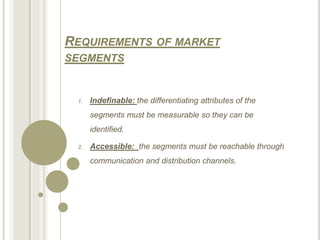
1. Indefinable: the differentiating attributes of the
segments must be measurable so they can be
identified.
2. Accessible: the segments must be reachable through
communication and distribution channels.
REQUIREMENTS OF MARKET
SEGMENTS
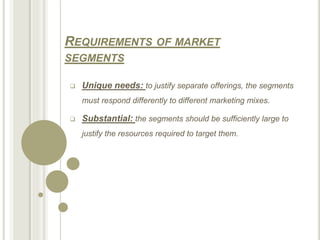
 Unique needs: to justify separate offerings, the segments
must respond differently to different marketing mixes.
 Substantial: the segments should be sufficiently large to
justify the resources required to target them.
REQUIREMENTS OF MARKET
SEGMENTS
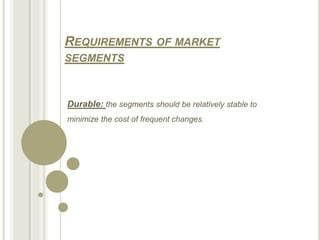
Durable: the segments should be relatively stable to
minimize the cost of frequent changes.
BASES FOR SEGMENTATION IN CONSUMER
MARKETS
 There are generally four segments
Geographic
Demographic
Psychographic
Behavioristic
GEOGRAPHIC
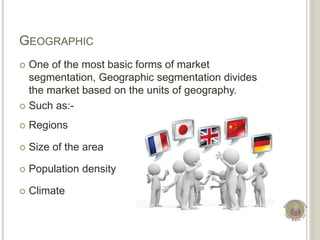
 One of the most basic forms of market
segmentation, Geographic segmentation divides
the market based on the units of geography.
 Such as:-
 Regions
 Size of the area
 Population density
 Climate
GEOGRAPHIC
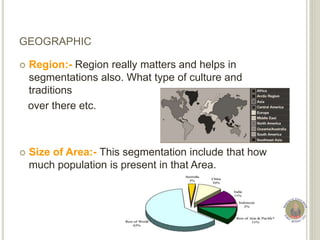
 Region:- Region really matters and helps in
segmentations also. What type of culture and
traditions
over there etc.
 Size of Area:- This segmentation include that how
much population is present in that Area.
GEOGRAPHIC
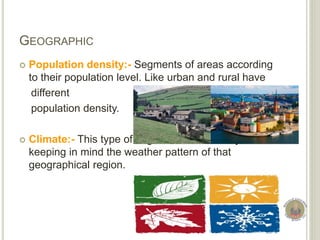
 Population density:- Segments of areas according
to their population level. Like urban and rural have
different
population density.
 Climate:- This type of segmentation done by
keeping in mind the weather pattern of that
geographical region.
DEMOGRAPHIC
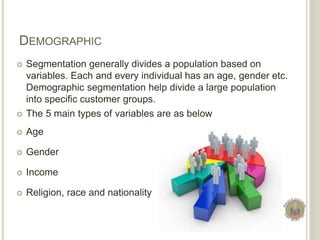
 Segmentation generally divides a population based on
variables. Each and every individual has an age, gender etc.
Demographic segmentation help divide a large population
into specific customer groups.
 The 5 main types of variables are as below
 Age
 Gender
 Income
 Religion, race and nationality
DEMOGRAPHIC
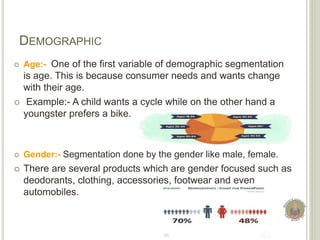
 Age:- One of the first variable of demographic segmentation
is age. This is because consumer needs and wants change
with their age.
 Example:- A child wants a cycle while on the other hand a
youngster prefers a bike.
 Gender:- Segmentation done by the gender like male, female.
 There are several products which are gender focused such as
deodorants, clothing, accessories, footwear and even
automobiles.
DEMOGRAPHIC
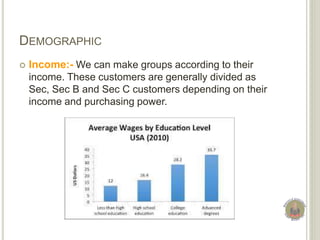
 Income:- We can make groups according to their
income. These customers are generally divided as
Sec, Sec B and Sec C customers depending on their
income and purchasing power.
DEMOGRAPHIC
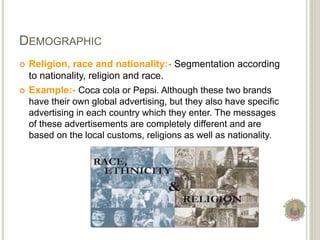
 Religion, race and nationality:- Segmentation according
to nationality, religion and race.
 Example:- Coca cola or Pepsi. Although these two brands
have their own global advertising, but they also have specific
advertising in each country which they enter. The messages
of these advertisements are completely different and are
based on the local customs, religions as well as nationality.
PSYCHOGRAPHIC
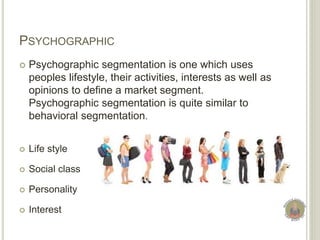
 Psychographic segmentation is one which uses
peoples lifestyle, their activities, interests as well as
opinions to define a market segment.
Psychographic segmentation is quite similar to
behavioral segmentation.
 Life style
 Social class
 Personality
 Interest
PSYCHOGRAPHIC
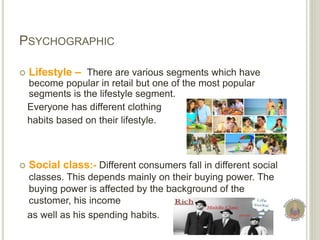
 Lifestyle – There are various segments which have
become popular in retail but one of the most popular
segments is the lifestyle segment.
Everyone has different clothing
habits based on their lifestyle.
 Social class:- Different consumers fall in different social
classes. This depends mainly on their buying power. The
buying power is affected by the background of the
customer, his income
as well as his spending habits.
PSYCHOGRAPHIC
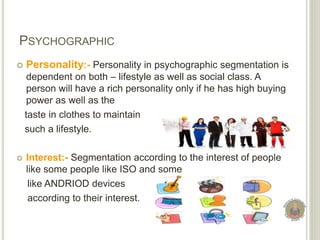
 Personality:- Personality in psychographic segmentation is
dependent on both – lifestyle as well as social class. A
person will have a rich personality only if he has high buying
power as well as the
taste in clothes to maintain
such a lifestyle.
 Interest:- Segmentation according to the interest of people
like some people like ISO and some
like ANDRIOD devices
according to their interest.
BEHAVIORISTIC
 Behavioral segmentation divides a population
based on their behavior, the way the population
respond to, use or know of a product. Consumer
decision making is affected by his behavior.
 Buying on occasions
 Benefits sought
 Loyalty
 Usage rate
BEHAVIORISTIC
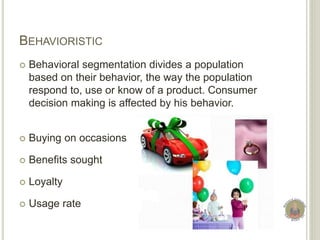
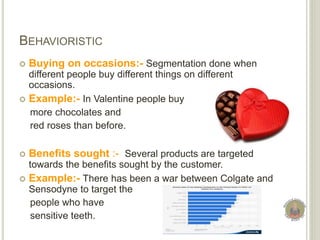
 Buying on occasions:- Segmentation done when
different people buy different things on different
occasions.
 Example:- In Valentine people buy
more chocolates and
red roses than before.
 Benefits sought :- Several products are targeted
towards the benefits sought by the customer.
 Example:- There has been a war between Colgate and
Sensodyne to target the
people who have
sensitive teeth.
BEHAVIORISTIC
 Loyalty:- There are two ways to grow a business. First is
to acquire new customers and second is to retain your
existing customers. The more loyal your customer is to you,
the more your customer base will increase.
 Example:- Mostly hotels, restaurants, workshops etc.
BEHAVIORISTIC
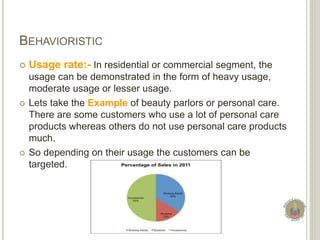
 Usage rate:- In residential or commercial segment, the
usage can be demonstrated in the form of heavy usage,
moderate usage or lesser usage.
 Lets take the Example of beauty parlors or personal care.
There are some customers who use a lot of personal care
products whereas others do not use personal care products
much.
 So depending on their usage the customers can be
targeted.
THE END
FOR YOUR
ATTENTION

Market segmentation

  • 2.
    MARKETING SEGMENTATION PRESENTED TO:-PORF. YOUSAF RAZA Presented BY:- MUSHABA ALAM (0038) USAMA AKHTAR (0032)
  • 3.
    OUT LINES  Marketsegmentations  Criteria  Advantages  Requirement of market segmentation  Bases of segmentation
  • 4.
    MARKET SEGMENTATION Market segmentationis the process of dividing a market into several relatively homogeneous groups. Both profit-seeking and not-for-profit organizations use segmentation to help them reach desirable target market.
  • 5.
    CRITERIA FOR MARKETSEGMENTATION Criterion A segment must be measureable group.  Data can be collected on the dollar amount and number of purchases by college students. A segment must be accessible for communication A growing number of seniors are going online, so they can be reached through internet channels. A segment must be large enough to offer profit potential .  In a small community, a store carrying only large-size shoes might not be profitable.
  • 7.
    REQUIREMENTS OF MARKET SEGMENTS 1.Indefinable: the differentiating attributes of the segments must be measurable so they can be identified. 2. Accessible: the segments must be reachable through communication and distribution channels.
  • 8.
    REQUIREMENTS OF MARKET SEGMENTS Unique needs: to justify separate offerings, the segments must respond differently to different marketing mixes.  Substantial: the segments should be sufficiently large to justify the resources required to target them.
  • 9.
    REQUIREMENTS OF MARKET SEGMENTS Durable:the segments should be relatively stable to minimize the cost of frequent changes.
  • 10.
    BASES FOR SEGMENTATIONIN CONSUMER MARKETS  There are generally four segments Geographic Demographic Psychographic Behavioristic
  • 11.
    GEOGRAPHIC  One ofthe most basic forms of market segmentation, Geographic segmentation divides the market based on the units of geography.  Such as:-  Regions  Size of the area  Population density  Climate
  • 12.
    GEOGRAPHIC  Region:- Regionreally matters and helps in segmentations also. What type of culture and traditions over there etc.  Size of Area:- This segmentation include that how much population is present in that Area.
  • 13.
    GEOGRAPHIC  Population density:-Segments of areas according to their population level. Like urban and rural have different population density.  Climate:- This type of segmentation done by keeping in mind the weather pattern of that geographical region.
  • 14.
    DEMOGRAPHIC  Segmentation generallydivides a population based on variables. Each and every individual has an age, gender etc. Demographic segmentation help divide a large population into specific customer groups.  The 5 main types of variables are as below  Age  Gender  Income  Religion, race and nationality
  • 15.
    DEMOGRAPHIC  Age:- Oneof the first variable of demographic segmentation is age. This is because consumer needs and wants change with their age.  Example:- A child wants a cycle while on the other hand a youngster prefers a bike.  Gender:- Segmentation done by the gender like male, female.  There are several products which are gender focused such as deodorants, clothing, accessories, footwear and even automobiles.
  • 16.
    DEMOGRAPHIC  Income:- Wecan make groups according to their income. These customers are generally divided as Sec, Sec B and Sec C customers depending on their income and purchasing power.
  • 17.
    DEMOGRAPHIC  Religion, raceand nationality:- Segmentation according to nationality, religion and race.  Example:- Coca cola or Pepsi. Although these two brands have their own global advertising, but they also have specific advertising in each country which they enter. The messages of these advertisements are completely different and are based on the local customs, religions as well as nationality.
  • 18.
    PSYCHOGRAPHIC  Psychographic segmentationis one which uses peoples lifestyle, their activities, interests as well as opinions to define a market segment. Psychographic segmentation is quite similar to behavioral segmentation.  Life style  Social class  Personality  Interest
  • 19.
    PSYCHOGRAPHIC  Lifestyle –There are various segments which have become popular in retail but one of the most popular segments is the lifestyle segment. Everyone has different clothing habits based on their lifestyle.  Social class:- Different consumers fall in different social classes. This depends mainly on their buying power. The buying power is affected by the background of the customer, his income as well as his spending habits.
  • 20.
    PSYCHOGRAPHIC  Personality:- Personalityin psychographic segmentation is dependent on both – lifestyle as well as social class. A person will have a rich personality only if he has high buying power as well as the taste in clothes to maintain such a lifestyle.  Interest:- Segmentation according to the interest of people like some people like ISO and some like ANDRIOD devices according to their interest.
  • 21.
    BEHAVIORISTIC  Behavioral segmentationdivides a population based on their behavior, the way the population respond to, use or know of a product. Consumer decision making is affected by his behavior.  Buying on occasions  Benefits sought  Loyalty  Usage rate
  • 22.
    BEHAVIORISTIC  Buying onoccasions:- Segmentation done when different people buy different things on different occasions.  Example:- In Valentine people buy more chocolates and red roses than before.  Benefits sought :- Several products are targeted towards the benefits sought by the customer.  Example:- There has been a war between Colgate and Sensodyne to target the people who have sensitive teeth.
  • 23.
    BEHAVIORISTIC  Loyalty:- Thereare two ways to grow a business. First is to acquire new customers and second is to retain your existing customers. The more loyal your customer is to you, the more your customer base will increase.  Example:- Mostly hotels, restaurants, workshops etc.
  • 24.
    BEHAVIORISTIC  Usage rate:-In residential or commercial segment, the usage can be demonstrated in the form of heavy usage, moderate usage or lesser usage.  Lets take the Example of beauty parlors or personal care. There are some customers who use a lot of personal care products whereas others do not use personal care products much.  So depending on their usage the customers can be targeted.
  • 25.