BUSINESS ENGLISH COURSE
UV DLGTE. ESL ACADEMY INC.
University of the Visayas
COURSE OVERVIEW
UV ESL Academy
UV ESL Business English Course is designed for people who need to communicate
effectively in English in their work. This course facilitates them to improve their
skills in business communication in the areas of listening, speaking, presenting,
reading, and writing which are vital in both informal and formal business
situations. The course is fitted to the students’ individual needs and enhance the
skills necessary for use in business contexts. While it increases the students’
knowledge of technical vocabulary, business terms and idioms, the course also
presents a wide range of business situations in the form of case studies, role plays
and discussions which familiarize students with issues they may encounter in
business organizations and provide them with the opportunity to develop effective
communication skills.
GOAL
UV ESL Academy
The goal of UV ESL Business English course is to give students the
business communication skills they need to meet the challenges in
their professional life and enhance their confidence in dealing with
foreign clients and colleagues in various business situations.
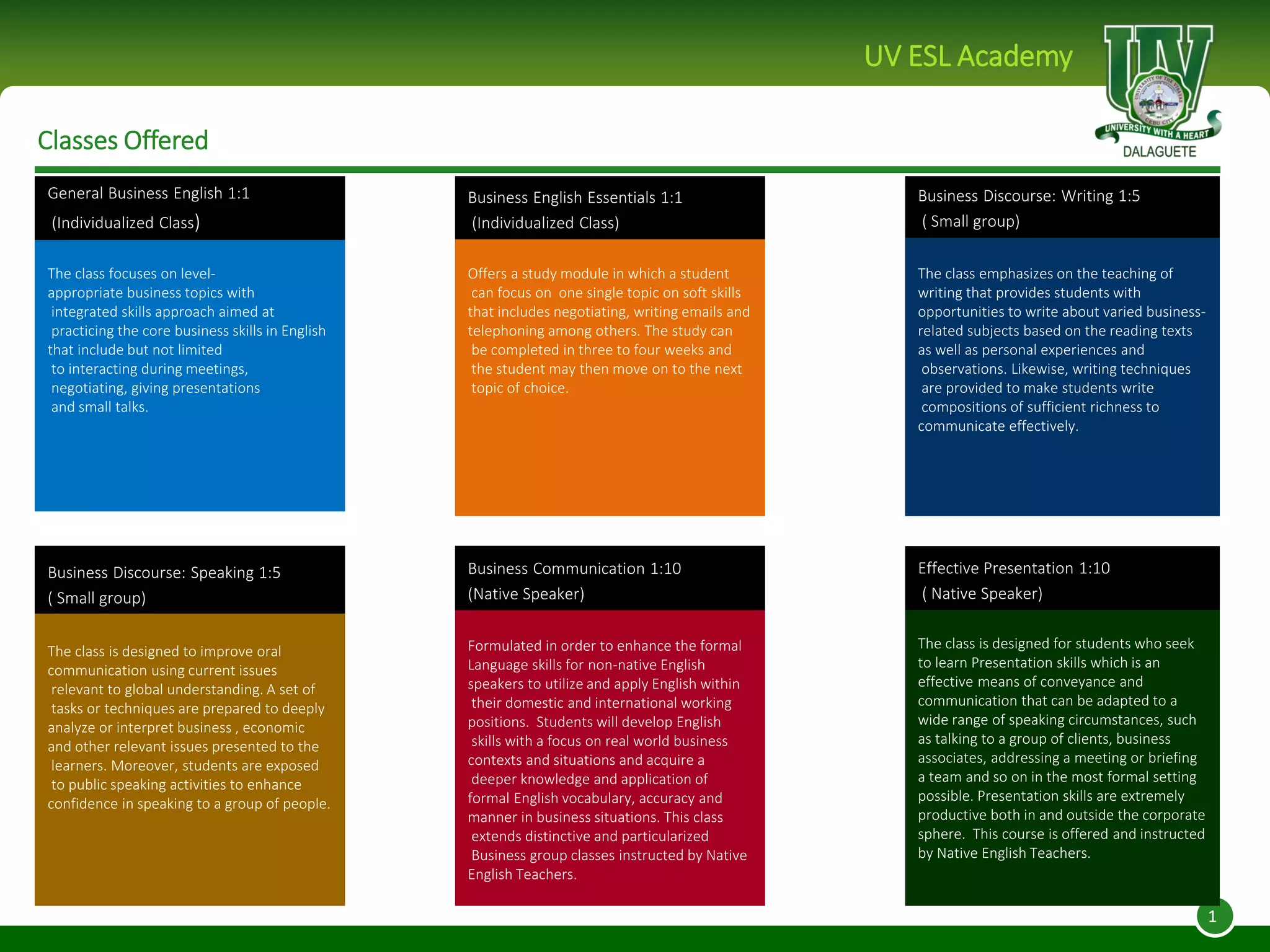
OBJECTIVES
UV ESL Academy
 Communicate more confidently in conducting business in
English
 Speak more accurately and fluently in discussing practical
business tasks
 Expand vocabulary and use complex grammar structures in
business contexts
 Participate in meetings more successfully
 Improve skills in negotiating agreements
 Deliver effective presentations
 Write e-mails, letters, and reports with appropriate register
 Understand business reports and correspondence
1
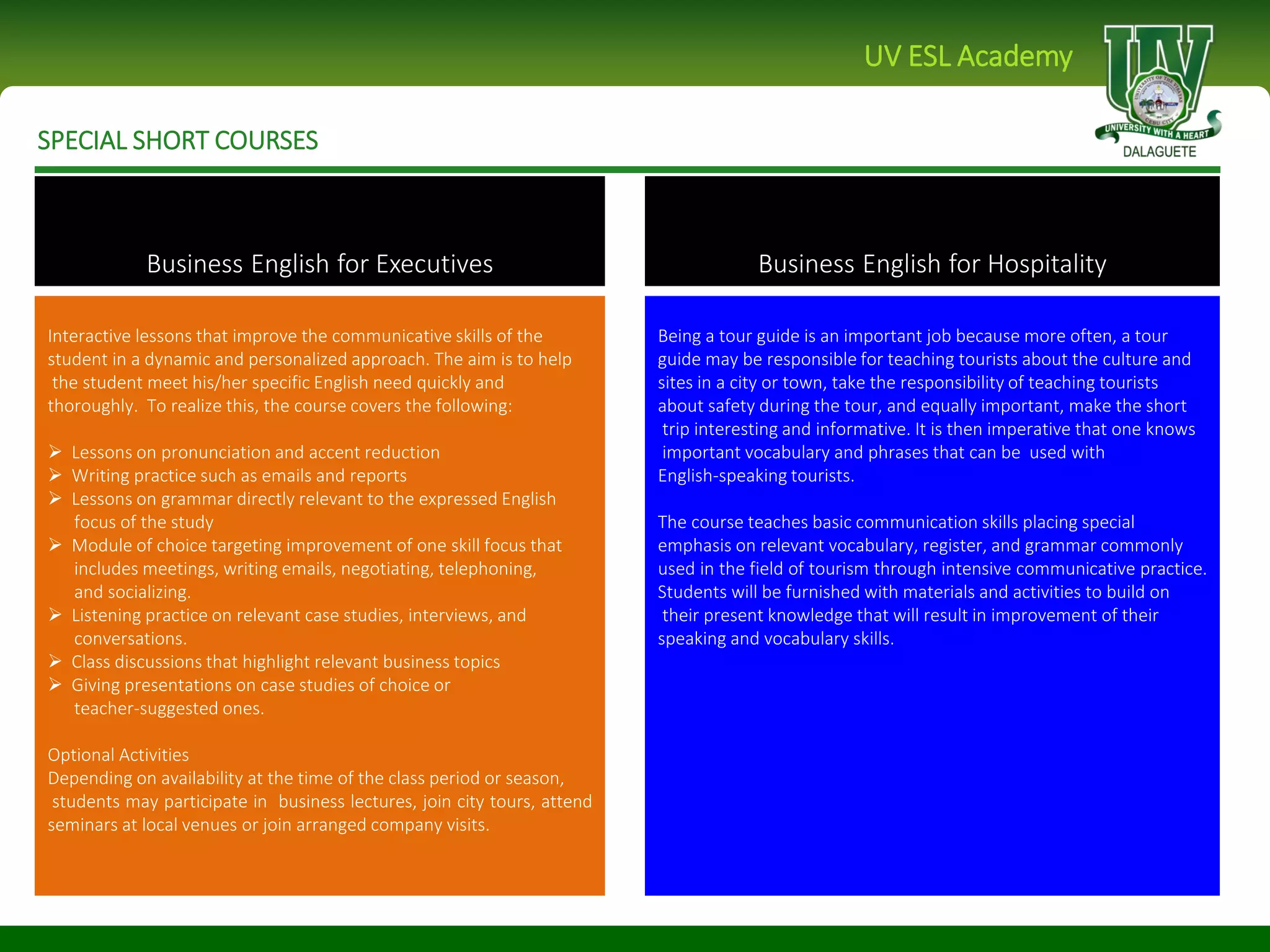
Classes Offered
UV ESL Academy
The class focuses on level-
appropriate business topics with
integrated skills approach aimed at
practicing the core business skills in English
that include but not limited
to interacting during meetings,
negotiating, giving presentations
and small talks.
General Business English 1:1
(Individualized Class)
Formulated in order to enhance the formal
Language skills for non-native English
speakers to utilize and apply English within
their domestic and international working
positions. Students will develop English
skills with a focus on real world business
contexts and situations and acquire a
deeper knowledge and application of
formal English vocabulary, accuracy and
manner in business situations. This class
extends distinctive and particularized
Business group classes instructed by Native
English Teachers.
The class is designed for students who seek
to learn Presentation skills which is an
effective means of conveyance and
communication that can be adapted to a
wide range of speaking circumstances, such
as talking to a group of clients, business
associates, addressing a meeting or briefing
a team and so on in the most formal setting
possible. Presentation skills are extremely
productive both in and outside the corporate
sphere. This course is offered and instructed
by Native English Teachers.
Offers a study module in which a student
can focus on one single topic on soft skills
that includes negotiating, writing emails and
telephoning among others. The study can
be completed in three to four weeks and
the student may then move on to the next
topic of choice.
The class emphasizes on the teaching of
writing that provides students with
opportunities to write about varied business-
related subjects based on the reading texts
as well as personal experiences and
observations. Likewise, writing techniques
are provided to make students write
compositions of sufficient richness to
communicate effectively.
Business Discourse: Speaking 1:5
( Small group)
Business Communication 1:10
(Native Speaker)
Effective Presentation 1:10
( Native Speaker)
Business English Essentials 1:1
(Individualized Class)
Business Discourse: Writing 1:5
( Small group)
The class is designed to improve oral
communication using current issues
relevant to global understanding. A set of
tasks or techniques are prepared to deeply
analyze or interpret business , economic
and other relevant issues presented to the
learners. Moreover, students are exposed
to public speaking activities to enhance
confidence in speaking to a group of people.
SPECIAL SHORT COURSES
UV ESL Academy
Interactive lessons that improve the communicative skills of the
student in a dynamic and personalized approach. The aim is to help
the student meet his/her specific English need quickly and
thoroughly. To realize this, the course covers the following:
 Lessons on pronunciation and accent reduction
 Writing practice such as emails and reports
 Lessons on grammar directly relevant to the expressed English
focus of the study
 Module of choice targeting improvement of one skill focus that
includes meetings, writing emails, negotiating, telephoning,
and socializing.
 Listening practice on relevant case studies, interviews, and
conversations.
 Class discussions that highlight relevant business topics
 Giving presentations on case studies of choice or
teacher-suggested ones.
Optional Activities
Depending on availability at the time of the class period or season,
students may participate in business lectures, join city tours, attend
seminars at local venues or join arranged company visits.
Being a tour guide is an important job because more often, a tour
guide may be responsible for teaching tourists about the culture and
sites in a city or town, take the responsibility of teaching tourists
about safety during the tour, and equally important, make the short
trip interesting and informative. It is then imperative that one knows
important vocabulary and phrases that can be used with
English-speaking tourists.
The course teaches basic communication skills placing special
emphasis on relevant vocabulary, register, and grammar commonly
used in the field of tourism through intensive communicative practice.
Students will be furnished with materials and activities to build on
their present knowledge that will result in improvement of their
speaking and vocabulary skills.
Business English for Executives Business English for Hospitality
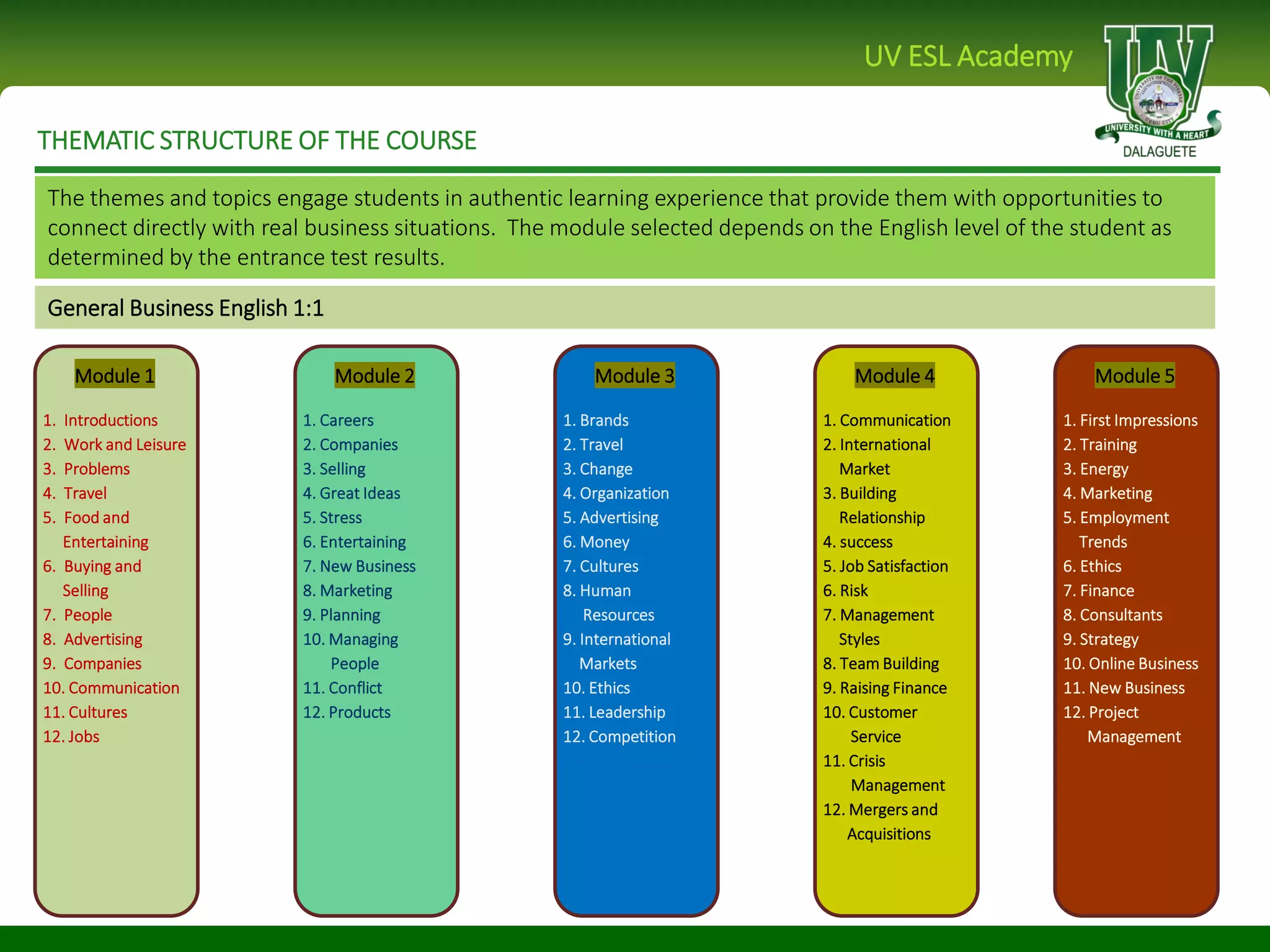
THEMATIC STRUCTURE OF THE COURSE
UV ESL Academy
The themes and topics engage students in authentic learning experience that provide them with opportunities to
connect directly with real business situations. The module selected depends on the English level of the student as
determined by the entrance test results.
General Business English 1:1
Module 1
1. Introductions
2. Work and Leisure
3. Problems
4. Travel
5. Food and
Entertaining
6. Buying and
Selling
7. People
8. Advertising
9. Companies
10. Communication
11. Cultures
12. Jobs
Module 2
1. Careers
2. Companies
3. Selling
4. Great Ideas
5. Stress
6. Entertaining
7. New Business
8. Marketing
9. Planning
10. Managing
People
11. Conflict
12. Products
Module 3
1. Brands
2. Travel
3. Change
4. Organization
5. Advertising
6. Money
7. Cultures
8. Human
Resources
9. International
Markets
10. Ethics
11. Leadership
12. Competition
Module 4
1. Communication
2. International
Market
3. Building
Relationship
4. success
5. Job Satisfaction
6. Risk
7. Management
Styles
8. Team Building
9. Raising Finance
10. Customer
Service
11. Crisis
Management
12. Mergers and
Acquisitions
Module 5
1. First Impressions
2. Training
3. Energy
4. Marketing
5. Employment
Trends
6. Ethics
7. Finance
8. Consultants
9. Strategy
10. Online Business
11. New Business
12. Project
Management
1
THEMATIC STRUCTURE OF THE COURSE
UV ESL Academy
Business English Essentials 1:1
Module 1
English for
Emails
1. An Introduction
to Emails
2. Formal and
Informal Emails
3. Enquiries
4. Requesting Action
5. Exchanging
Information
6. Making and
Confirming
Arrangements
Module 2
English for
Meetings
1. Arranging a
Meeting
2. Making
Introductions
3. Making a Point
4. Expressing
Opinion
5. Making a deal
6. Concluding a
Meeting
Module 3
English for
Telephoning
1. Telephoning Basics
2. Exchanging and
Checking
Information
3. Voicemail Greetings
4. Making and
Confirming
Appointments
5. Making and Dealing
with Complaints
6. Making and
Reacting to
Proposals
Module 4
English for
Negotiating
1. Preparation
2. Setting Objectives
3. The Meeting
4. Proposals
5. A New Offer
6. Dealing with deadlock
7. Agreement
Module 5
English for
Socializing
1. Making Contact
2. Welcoming Visitors
3. Getting Acquainted
4. Entertaining a Visitor
5. Eating Out
6. Networking at a
Trade Fair
Module 6
English for
Presentation
1. Let’s Get Started
Welcoming Audience
2. Today’s Topic is…
Body Language
3. My Next Slide
Shows…
Presentation Tools
4. As you can see from
this graph…
Typesof Visuals
5. To sum up…
Concluding a Presentation
6. ‘Any questions?’
Handling Q&A Session
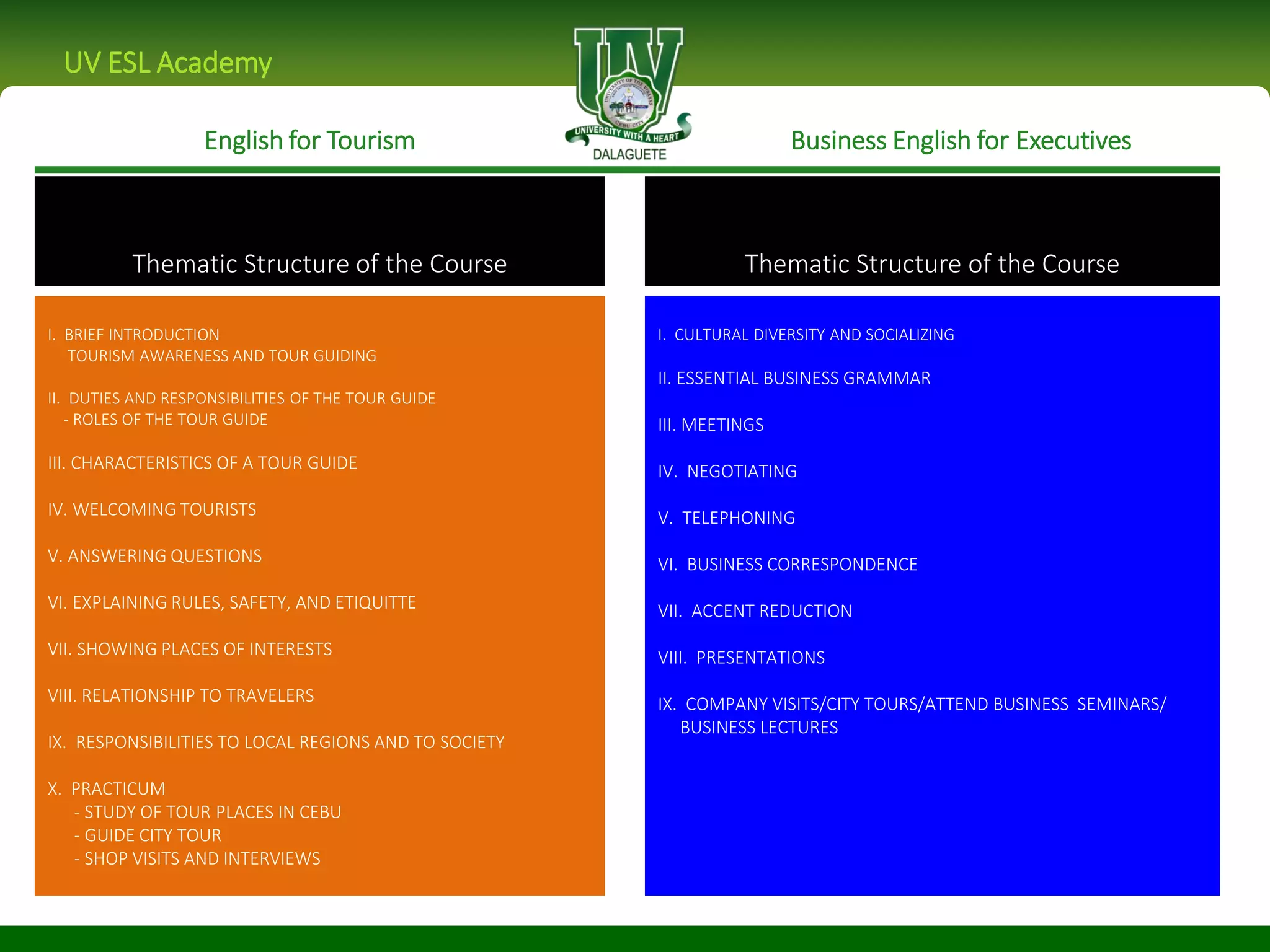
English for Tourism Business English for Executives
UV ESL Academy
I. BRIEF INTRODUCTION
TOURISM AWARENESS AND TOUR GUIDING
II. DUTIES AND RESPONSIBILITIES OF THE TOUR GUIDE
- ROLES OF THE TOUR GUIDE
III. CHARACTERISTICS OF A TOUR GUIDE
IV. WELCOMING TOURISTS
V. ANSWERING QUESTIONS
VI. EXPLAINING RULES, SAFETY, AND ETIQUITTE
VII. SHOWING PLACES OF INTERESTS
VIII. RELATIONSHIP TO TRAVELERS
IX. RESPONSIBILITIES TO LOCAL REGIONS AND TO SOCIETY
X. PRACTICUM
- STUDY OF TOUR PLACES IN CEBU
- GUIDE CITY TOUR
- SHOP VISITS AND INTERVIEWS
I. CULTURAL DIVERSITY AND SOCIALIZING
II. ESSENTIAL BUSINESS GRAMMAR
III. MEETINGS
IV. NEGOTIATING
V. TELEPHONING
VI. BUSINESS CORRESPONDENCE
VII. ACCENT REDUCTION
VIII. PRESENTATIONS
IX. COMPANY VISITS/CITY TOURS/ATTEND BUSINESS SEMINARS/
BUSINESS LECTURES
Thematic Structure of the Course Thematic Structure of the Course
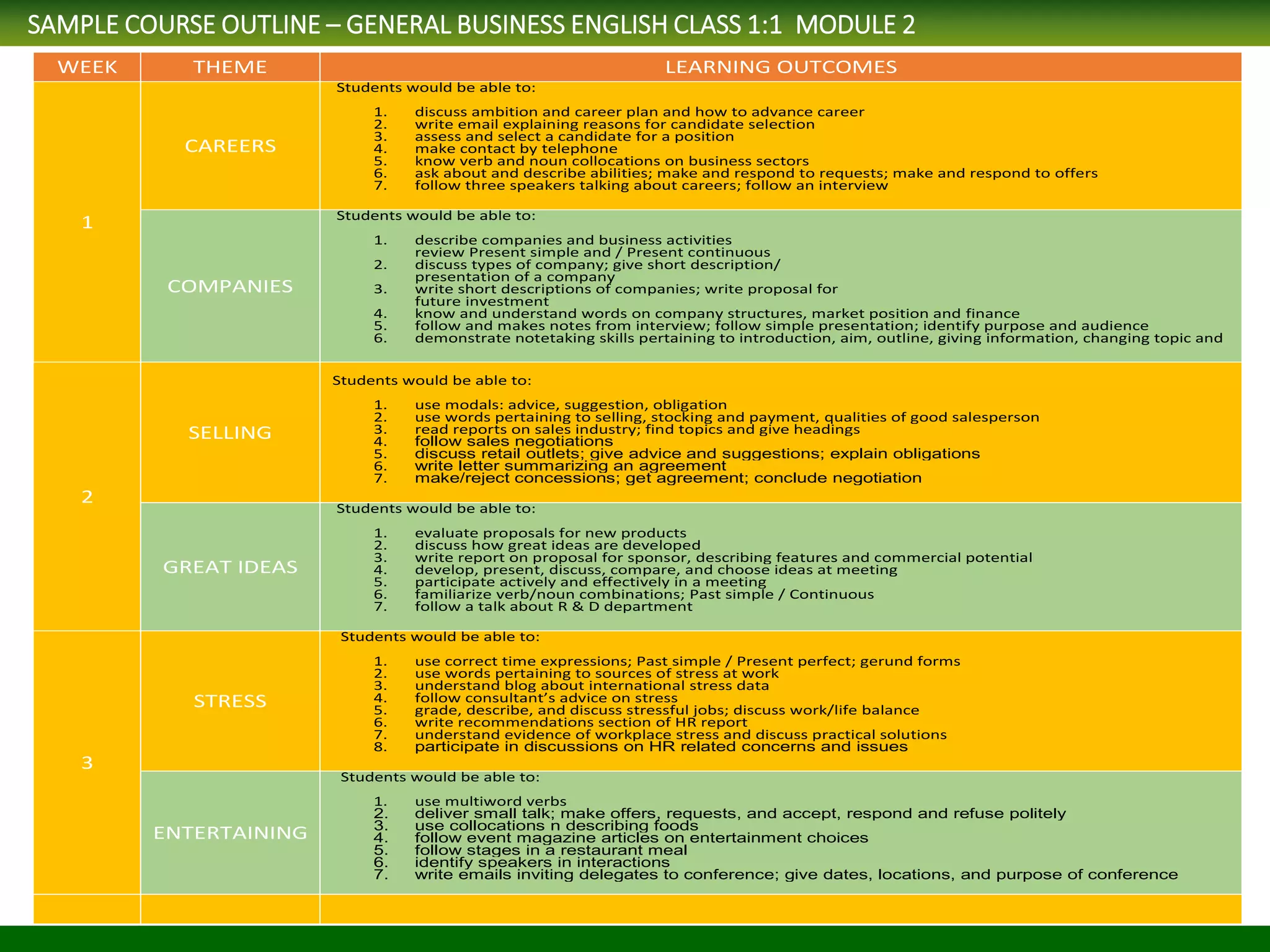
SAMPLE COURSE OUTLINE – GENERAL BUSINESS ENGLISH CLASS 1:1 MODULE 2
WEEK THEME LEARNING OUTCOMES
1
CAREERS
Students would be able to:
1. discuss ambition and career plan and how to advance career
2. write email explaining reasons for candidate selection
3. assess and select a candidate for a position
4. make contact by telephone
5. know verb and noun collocations on business sectors
6. ask about and describe abilities; make and respond to requests; make and respond to offers
7. follow three speakers talking about careers; follow an interview
COMPANIES
Students would be able to:
1. describe companies and business activities
review Present simple and / Present continuous
2. discuss types of company; give short description/
presentation of a company
3. write short descriptions of companies; write proposal for
future investment
4. know and understand words on company structures, market position and finance
5. follow and makes notes from interview; follow simple presentation; identify purpose and audience
6. demonstrate notetaking skills pertaining to introduction, aim, outline, giving information, changing topic and
2
SELLING
Students would be able to:
1. use modals: advice, suggestion, obligation
2. use words pertaining to selling, stocking and payment, qualities of good salesperson
3. read reports on sales industry; find topics and give headings
4. follow sales negotiations
5. discuss retail outlets; give advice and suggestions; explain obligations
6. write letter summarizing an agreement
7. make/reject concessions; get agreement; conclude negotiation
GREAT IDEAS
Students would be able to:
1. evaluate proposals for new products
2. discuss how great ideas are developed
3. write report on proposal for sponsor, describing features and commercial potential
4. develop, present, discuss, compare, and choose ideas at meeting
5. participate actively and effectively in a meeting
6. familiarize verb/noun combinations; Past simple / Continuous
7. follow a talk about R & D department
3
STRESS
Students would be able to:
1. use correct time expressions; Past simple / Present perfect; gerund forms
2. use words pertaining to sources of stress at work
3. understand blog about international stress data
4. follow consultant’s advice on stress
5. grade, describe, and discuss stressful jobs; discuss work/life balance
6. write recommendations section of HR report
7. understand evidence of workplace stress and discuss practical solutions
8. participate in discussions on HR related concerns and issues
ENTERTAINING
Students would be able to:
1. use multiword verbs
2. deliver small talk; make offers, requests, and accept, respond and refuse politely
3. use collocations n describing foods
4. follow event magazine articles on entertainment choices
5. follow stages in a restaurant meal
6. identify speakers in interactions
7. write emails inviting delegates to conference; give dates, locations, and purpose of conference
1
SAMPLE COURSE OUTLINE – GENERAL BUSINESS ENGLISH CLASS 1:1 MODULE 2
4
NEW
BUSINESS
Students would be able to:
1. use economic terms; identify time clauses and time linkers
2. compare and contrast Financial Time reports on new companies
3. follow interview with CEO of global money transfer company
4. understand economic data in reports, graphs, etc.
5. discuss requirements for a new business
6. discuss economic conditions
7. give an oral summary of an article
8. write economic profile of own country
9. write email suggesting a meeting for further discussion
MARKETING
Students would be able to:
1. use correct word order in Yes/No and WH questions
2. use collocations connected with marketing
3. extract data from a business article
4. follow and take notes from phone messages giving numbers and email addresses
5. make phone calls asking for and checking and finish the conversation politely
6. write report outlining marketing plans
7. exchange information by phone
5
PLANNING
Students would be able to:
1. talk about how to plan work and discuss benefits of business plans
2. extract important details from articles about planning
3. follow business meeting discussing relocation
4. write a letter introducing yourself and requesting an interview
5. use meeting skills such as interrupting, responding, and clarifying
6. use future forms
7. use verb/noun collocations related to planning
MANAGING
PEOPLE
Students would be able to:
1. use correct verbs + prepositions ; tense shift in reported speech
2. understand an article on management systems
3. follow an interview with managerial consultant
4. discuss and identify skills of a good manager
5. write report of recommendations calling for some changes
6. make notes from interview and write summary
7. apply personal skills in management
6
CONFLICT
Students would be able to:
1. use of conditionals in negotiating
2. use word formation from noun to adjective; prefixes
3. understand articles on managing conflict
4. follow interview about dispute resolution and salary negotiation
5. write a letter recommending or not recommending acceptance of bid, giving reasons
6. demonstrate skills in negotiating such as expressing a view, calming down, creating solutions,
closing a negotiation
PRODUCTS
Students would be able to:
1. Use passives in describing manufacture, sourcing, and use of products
2. Use adjectives to describe products and manufacturers; verb + causative
infinitive to describe lifecyle of product
3. Follow four speakers describing purchases and giving reasons
4. Follow and analyze a product presentation
5. Describe products purchased, give reasons for choice, give reasons for
selecting price range,
6. write a short report of one of the products considered
7. demonstrate skills in product presentation such as introduce, describe, state uses, list selling points, refer to
benefits, invite questions
SAMPLE CLASS SCHEDULE
Monday to Friday
7:40-8:30 8:35-9:25 9:35-10:25 10:30-11:20 11:30-12:20 1:20-2:10 2:20-3:10 3:15-4:05 4:15-5:05 5:10-6:00
Presentation
(BG)
Business
Discourse:
Speaking (SG)
General
Business English
1:1
General
Business English
1:1
Business
Discourse:
Writing (SG)
Business
Communication
(BG)
Business English
Essentials 1:1
Business English
Essentials 1:1
Optional Class Optional Class
Presentation
(BG)
Business
Discourse:
Speaking (SG)
General
Business English
1:1
General
Business English
1:1
Business
Discourse:
Writing (SG)
Business
Communication
(BG)
Business English
Essentials 1:1
Business English
Essentials 1:1
Optional Class Optional Class
Presentation
(BG)
Business
Discourse:
Speaking (SG)
General
Business English
1:1
General
Business English
1:1
Business
Discourse:
Writing (SG)
Business
Communication
(BG)
Business English
Essentials 1:1
Business English
Essentials 1:1
Optional Class Optional Class
Presentation
(BG)
Business
Discourse:
Speaking (SG)
General
Business English
1:1
General
Business English
1:1
Business
Discourse:
Writing (SG)
Business
Communication
(BG)
Business English
Essentials 1:1
Business English
Essentials 1:1
Optional Class Optional Class
Presentation
(BG) Business
Discourse:
Speaking (SG)
General
Business English
1:1
General
Business English
1:1
Business
Discourse:
Writing (SG)
Business
Communication
(BG)
Business English
Essentials 1:1
Business English
Essentials 1:1
Optional Class Optional Class
Presentation
(BG) Business
Discourse:
Speaking (SG)
General
Business English
1:1
General
Business English
1:1
Business
Discourse:
Writing (SG)
Business
Communication
(BG)
Business English
Essentials 1:1
Business English
Essentials 1:1
Optional Class Optional Class
SAMPLE CLASS SCHEDULE
UV ESL Academy
Class Size Combinations
1:1
General Business
English
1:1
General
Business English
1:1
Business English
Essentials
1:1
Business English
Essentials
1:5 (SG)
Business
Discourse:
Speaking
1:5 (SG)
Business
Discourse:
Writing
1:10 (BG)
Presentation
1:10 (BG)
Business
Communication
INSTRUCTIONAL METHODS
UV ESL Academy
Learning in Business English is maximized when students are engaged in a variety of methods. The recommended teaching methods
require that students discuss business-related issues, participate in role plays or business simulations, and involve themselves in case
studies. Furthermore, they are exposed but not limited to classroom activities such as essays and summaries writing, research writing,
debating, brainstorming, text reading and discussion, reports completion, direct instruction and lecture, audio-records listening, as well
as giving presentations.
ENGLISH LEVEL REQUIREMENT
Based on the TOEIC level achieved from the Entrance Test,
the modules have minimum level requirements so that
Intermediate Low is required in order to take
Module 2 for Business General Business English 1:1 bn
For Business English Essentials 1:1,
Novice Middle level is the minimum
level requirement for any of the
modules 1-6. Novice
Mid-High
Advanced
Low-High
Interme-
diate
High
Interme-
diate
MiddleInterme-
diate
Low
MODULE
1
MODULE
3
MODULE
2
MODULE
4
MODULE
5
Books and materials
Market Leader series for General Business English 1:1
Oxford English series for Business English |Essentials 1:1
Handouts, websites, supplementary books
Thank you!
UV DLGTE ESL ACADEMY
University of the Visayas

Khóa học tiếng Anh thương mại tại trường UV ESL

  • 1.
    BUSINESS ENGLISH COURSE UVDLGTE. ESL ACADEMY INC. University of the Visayas
  • 2.
    COURSE OVERVIEW UV ESLAcademy UV ESL Business English Course is designed for people who need to communicate effectively in English in their work. This course facilitates them to improve their skills in business communication in the areas of listening, speaking, presenting, reading, and writing which are vital in both informal and formal business situations. The course is fitted to the students’ individual needs and enhance the skills necessary for use in business contexts. While it increases the students’ knowledge of technical vocabulary, business terms and idioms, the course also presents a wide range of business situations in the form of case studies, role plays and discussions which familiarize students with issues they may encounter in business organizations and provide them with the opportunity to develop effective communication skills.
  • 3.
    GOAL UV ESL Academy Thegoal of UV ESL Business English course is to give students the business communication skills they need to meet the challenges in their professional life and enhance their confidence in dealing with foreign clients and colleagues in various business situations.
  • 4.
    OBJECTIVES UV ESL Academy Communicate more confidently in conducting business in English  Speak more accurately and fluently in discussing practical business tasks  Expand vocabulary and use complex grammar structures in business contexts  Participate in meetings more successfully  Improve skills in negotiating agreements  Deliver effective presentations  Write e-mails, letters, and reports with appropriate register  Understand business reports and correspondence
  • 5.
    1 Classes Offered UV ESLAcademy The class focuses on level- appropriate business topics with integrated skills approach aimed at practicing the core business skills in English that include but not limited to interacting during meetings, negotiating, giving presentations and small talks. General Business English 1:1 (Individualized Class) Formulated in order to enhance the formal Language skills for non-native English speakers to utilize and apply English within their domestic and international working positions. Students will develop English skills with a focus on real world business contexts and situations and acquire a deeper knowledge and application of formal English vocabulary, accuracy and manner in business situations. This class extends distinctive and particularized Business group classes instructed by Native English Teachers. The class is designed for students who seek to learn Presentation skills which is an effective means of conveyance and communication that can be adapted to a wide range of speaking circumstances, such as talking to a group of clients, business associates, addressing a meeting or briefing a team and so on in the most formal setting possible. Presentation skills are extremely productive both in and outside the corporate sphere. This course is offered and instructed by Native English Teachers. Offers a study module in which a student can focus on one single topic on soft skills that includes negotiating, writing emails and telephoning among others. The study can be completed in three to four weeks and the student may then move on to the next topic of choice. The class emphasizes on the teaching of writing that provides students with opportunities to write about varied business- related subjects based on the reading texts as well as personal experiences and observations. Likewise, writing techniques are provided to make students write compositions of sufficient richness to communicate effectively. Business Discourse: Speaking 1:5 ( Small group) Business Communication 1:10 (Native Speaker) Effective Presentation 1:10 ( Native Speaker) Business English Essentials 1:1 (Individualized Class) Business Discourse: Writing 1:5 ( Small group) The class is designed to improve oral communication using current issues relevant to global understanding. A set of tasks or techniques are prepared to deeply analyze or interpret business , economic and other relevant issues presented to the learners. Moreover, students are exposed to public speaking activities to enhance confidence in speaking to a group of people.
  • 6.
    SPECIAL SHORT COURSES UVESL Academy Interactive lessons that improve the communicative skills of the student in a dynamic and personalized approach. The aim is to help the student meet his/her specific English need quickly and thoroughly. To realize this, the course covers the following:  Lessons on pronunciation and accent reduction  Writing practice such as emails and reports  Lessons on grammar directly relevant to the expressed English focus of the study  Module of choice targeting improvement of one skill focus that includes meetings, writing emails, negotiating, telephoning, and socializing.  Listening practice on relevant case studies, interviews, and conversations.  Class discussions that highlight relevant business topics  Giving presentations on case studies of choice or teacher-suggested ones. Optional Activities Depending on availability at the time of the class period or season, students may participate in business lectures, join city tours, attend seminars at local venues or join arranged company visits. Being a tour guide is an important job because more often, a tour guide may be responsible for teaching tourists about the culture and sites in a city or town, take the responsibility of teaching tourists about safety during the tour, and equally important, make the short trip interesting and informative. It is then imperative that one knows important vocabulary and phrases that can be used with English-speaking tourists. The course teaches basic communication skills placing special emphasis on relevant vocabulary, register, and grammar commonly used in the field of tourism through intensive communicative practice. Students will be furnished with materials and activities to build on their present knowledge that will result in improvement of their speaking and vocabulary skills. Business English for Executives Business English for Hospitality
  • 7.
    THEMATIC STRUCTURE OFTHE COURSE UV ESL Academy The themes and topics engage students in authentic learning experience that provide them with opportunities to connect directly with real business situations. The module selected depends on the English level of the student as determined by the entrance test results. General Business English 1:1 Module 1 1. Introductions 2. Work and Leisure 3. Problems 4. Travel 5. Food and Entertaining 6. Buying and Selling 7. People 8. Advertising 9. Companies 10. Communication 11. Cultures 12. Jobs Module 2 1. Careers 2. Companies 3. Selling 4. Great Ideas 5. Stress 6. Entertaining 7. New Business 8. Marketing 9. Planning 10. Managing People 11. Conflict 12. Products Module 3 1. Brands 2. Travel 3. Change 4. Organization 5. Advertising 6. Money 7. Cultures 8. Human Resources 9. International Markets 10. Ethics 11. Leadership 12. Competition Module 4 1. Communication 2. International Market 3. Building Relationship 4. success 5. Job Satisfaction 6. Risk 7. Management Styles 8. Team Building 9. Raising Finance 10. Customer Service 11. Crisis Management 12. Mergers and Acquisitions Module 5 1. First Impressions 2. Training 3. Energy 4. Marketing 5. Employment Trends 6. Ethics 7. Finance 8. Consultants 9. Strategy 10. Online Business 11. New Business 12. Project Management
  • 8.
    1 THEMATIC STRUCTURE OFTHE COURSE UV ESL Academy Business English Essentials 1:1 Module 1 English for Emails 1. An Introduction to Emails 2. Formal and Informal Emails 3. Enquiries 4. Requesting Action 5. Exchanging Information 6. Making and Confirming Arrangements Module 2 English for Meetings 1. Arranging a Meeting 2. Making Introductions 3. Making a Point 4. Expressing Opinion 5. Making a deal 6. Concluding a Meeting Module 3 English for Telephoning 1. Telephoning Basics 2. Exchanging and Checking Information 3. Voicemail Greetings 4. Making and Confirming Appointments 5. Making and Dealing with Complaints 6. Making and Reacting to Proposals Module 4 English for Negotiating 1. Preparation 2. Setting Objectives 3. The Meeting 4. Proposals 5. A New Offer 6. Dealing with deadlock 7. Agreement Module 5 English for Socializing 1. Making Contact 2. Welcoming Visitors 3. Getting Acquainted 4. Entertaining a Visitor 5. Eating Out 6. Networking at a Trade Fair Module 6 English for Presentation 1. Let’s Get Started Welcoming Audience 2. Today’s Topic is… Body Language 3. My Next Slide Shows… Presentation Tools 4. As you can see from this graph… Typesof Visuals 5. To sum up… Concluding a Presentation 6. ‘Any questions?’ Handling Q&A Session
  • 9.
    English for TourismBusiness English for Executives UV ESL Academy I. BRIEF INTRODUCTION TOURISM AWARENESS AND TOUR GUIDING II. DUTIES AND RESPONSIBILITIES OF THE TOUR GUIDE - ROLES OF THE TOUR GUIDE III. CHARACTERISTICS OF A TOUR GUIDE IV. WELCOMING TOURISTS V. ANSWERING QUESTIONS VI. EXPLAINING RULES, SAFETY, AND ETIQUITTE VII. SHOWING PLACES OF INTERESTS VIII. RELATIONSHIP TO TRAVELERS IX. RESPONSIBILITIES TO LOCAL REGIONS AND TO SOCIETY X. PRACTICUM - STUDY OF TOUR PLACES IN CEBU - GUIDE CITY TOUR - SHOP VISITS AND INTERVIEWS I. CULTURAL DIVERSITY AND SOCIALIZING II. ESSENTIAL BUSINESS GRAMMAR III. MEETINGS IV. NEGOTIATING V. TELEPHONING VI. BUSINESS CORRESPONDENCE VII. ACCENT REDUCTION VIII. PRESENTATIONS IX. COMPANY VISITS/CITY TOURS/ATTEND BUSINESS SEMINARS/ BUSINESS LECTURES Thematic Structure of the Course Thematic Structure of the Course
  • 10.
    SAMPLE COURSE OUTLINE– GENERAL BUSINESS ENGLISH CLASS 1:1 MODULE 2 WEEK THEME LEARNING OUTCOMES 1 CAREERS Students would be able to: 1. discuss ambition and career plan and how to advance career 2. write email explaining reasons for candidate selection 3. assess and select a candidate for a position 4. make contact by telephone 5. know verb and noun collocations on business sectors 6. ask about and describe abilities; make and respond to requests; make and respond to offers 7. follow three speakers talking about careers; follow an interview COMPANIES Students would be able to: 1. describe companies and business activities review Present simple and / Present continuous 2. discuss types of company; give short description/ presentation of a company 3. write short descriptions of companies; write proposal for future investment 4. know and understand words on company structures, market position and finance 5. follow and makes notes from interview; follow simple presentation; identify purpose and audience 6. demonstrate notetaking skills pertaining to introduction, aim, outline, giving information, changing topic and 2 SELLING Students would be able to: 1. use modals: advice, suggestion, obligation 2. use words pertaining to selling, stocking and payment, qualities of good salesperson 3. read reports on sales industry; find topics and give headings 4. follow sales negotiations 5. discuss retail outlets; give advice and suggestions; explain obligations 6. write letter summarizing an agreement 7. make/reject concessions; get agreement; conclude negotiation GREAT IDEAS Students would be able to: 1. evaluate proposals for new products 2. discuss how great ideas are developed 3. write report on proposal for sponsor, describing features and commercial potential 4. develop, present, discuss, compare, and choose ideas at meeting 5. participate actively and effectively in a meeting 6. familiarize verb/noun combinations; Past simple / Continuous 7. follow a talk about R & D department 3 STRESS Students would be able to: 1. use correct time expressions; Past simple / Present perfect; gerund forms 2. use words pertaining to sources of stress at work 3. understand blog about international stress data 4. follow consultant’s advice on stress 5. grade, describe, and discuss stressful jobs; discuss work/life balance 6. write recommendations section of HR report 7. understand evidence of workplace stress and discuss practical solutions 8. participate in discussions on HR related concerns and issues ENTERTAINING Students would be able to: 1. use multiword verbs 2. deliver small talk; make offers, requests, and accept, respond and refuse politely 3. use collocations n describing foods 4. follow event magazine articles on entertainment choices 5. follow stages in a restaurant meal 6. identify speakers in interactions 7. write emails inviting delegates to conference; give dates, locations, and purpose of conference
  • 11.
    1 SAMPLE COURSE OUTLINE– GENERAL BUSINESS ENGLISH CLASS 1:1 MODULE 2 4 NEW BUSINESS Students would be able to: 1. use economic terms; identify time clauses and time linkers 2. compare and contrast Financial Time reports on new companies 3. follow interview with CEO of global money transfer company 4. understand economic data in reports, graphs, etc. 5. discuss requirements for a new business 6. discuss economic conditions 7. give an oral summary of an article 8. write economic profile of own country 9. write email suggesting a meeting for further discussion MARKETING Students would be able to: 1. use correct word order in Yes/No and WH questions 2. use collocations connected with marketing 3. extract data from a business article 4. follow and take notes from phone messages giving numbers and email addresses 5. make phone calls asking for and checking and finish the conversation politely 6. write report outlining marketing plans 7. exchange information by phone 5 PLANNING Students would be able to: 1. talk about how to plan work and discuss benefits of business plans 2. extract important details from articles about planning 3. follow business meeting discussing relocation 4. write a letter introducing yourself and requesting an interview 5. use meeting skills such as interrupting, responding, and clarifying 6. use future forms 7. use verb/noun collocations related to planning MANAGING PEOPLE Students would be able to: 1. use correct verbs + prepositions ; tense shift in reported speech 2. understand an article on management systems 3. follow an interview with managerial consultant 4. discuss and identify skills of a good manager 5. write report of recommendations calling for some changes 6. make notes from interview and write summary 7. apply personal skills in management 6 CONFLICT Students would be able to: 1. use of conditionals in negotiating 2. use word formation from noun to adjective; prefixes 3. understand articles on managing conflict 4. follow interview about dispute resolution and salary negotiation 5. write a letter recommending or not recommending acceptance of bid, giving reasons 6. demonstrate skills in negotiating such as expressing a view, calming down, creating solutions, closing a negotiation PRODUCTS Students would be able to: 1. Use passives in describing manufacture, sourcing, and use of products 2. Use adjectives to describe products and manufacturers; verb + causative infinitive to describe lifecyle of product 3. Follow four speakers describing purchases and giving reasons 4. Follow and analyze a product presentation 5. Describe products purchased, give reasons for choice, give reasons for selecting price range, 6. write a short report of one of the products considered 7. demonstrate skills in product presentation such as introduce, describe, state uses, list selling points, refer to benefits, invite questions
  • 12.
    SAMPLE CLASS SCHEDULE Mondayto Friday 7:40-8:30 8:35-9:25 9:35-10:25 10:30-11:20 11:30-12:20 1:20-2:10 2:20-3:10 3:15-4:05 4:15-5:05 5:10-6:00 Presentation (BG) Business Discourse: Speaking (SG) General Business English 1:1 General Business English 1:1 Business Discourse: Writing (SG) Business Communication (BG) Business English Essentials 1:1 Business English Essentials 1:1 Optional Class Optional Class Presentation (BG) Business Discourse: Speaking (SG) General Business English 1:1 General Business English 1:1 Business Discourse: Writing (SG) Business Communication (BG) Business English Essentials 1:1 Business English Essentials 1:1 Optional Class Optional Class Presentation (BG) Business Discourse: Speaking (SG) General Business English 1:1 General Business English 1:1 Business Discourse: Writing (SG) Business Communication (BG) Business English Essentials 1:1 Business English Essentials 1:1 Optional Class Optional Class Presentation (BG) Business Discourse: Speaking (SG) General Business English 1:1 General Business English 1:1 Business Discourse: Writing (SG) Business Communication (BG) Business English Essentials 1:1 Business English Essentials 1:1 Optional Class Optional Class Presentation (BG) Business Discourse: Speaking (SG) General Business English 1:1 General Business English 1:1 Business Discourse: Writing (SG) Business Communication (BG) Business English Essentials 1:1 Business English Essentials 1:1 Optional Class Optional Class Presentation (BG) Business Discourse: Speaking (SG) General Business English 1:1 General Business English 1:1 Business Discourse: Writing (SG) Business Communication (BG) Business English Essentials 1:1 Business English Essentials 1:1 Optional Class Optional Class
  • 13.
    SAMPLE CLASS SCHEDULE UVESL Academy Class Size Combinations 1:1 General Business English 1:1 General Business English 1:1 Business English Essentials 1:1 Business English Essentials 1:5 (SG) Business Discourse: Speaking 1:5 (SG) Business Discourse: Writing 1:10 (BG) Presentation 1:10 (BG) Business Communication
  • 14.
    INSTRUCTIONAL METHODS UV ESLAcademy Learning in Business English is maximized when students are engaged in a variety of methods. The recommended teaching methods require that students discuss business-related issues, participate in role plays or business simulations, and involve themselves in case studies. Furthermore, they are exposed but not limited to classroom activities such as essays and summaries writing, research writing, debating, brainstorming, text reading and discussion, reports completion, direct instruction and lecture, audio-records listening, as well as giving presentations. ENGLISH LEVEL REQUIREMENT Based on the TOEIC level achieved from the Entrance Test, the modules have minimum level requirements so that Intermediate Low is required in order to take Module 2 for Business General Business English 1:1 bn For Business English Essentials 1:1, Novice Middle level is the minimum level requirement for any of the modules 1-6. Novice Mid-High Advanced Low-High Interme- diate High Interme- diate MiddleInterme- diate Low MODULE 1 MODULE 3 MODULE 2 MODULE 4 MODULE 5 Books and materials Market Leader series for General Business English 1:1 Oxford English series for Business English |Essentials 1:1 Handouts, websites, supplementary books
  • 15.
    Thank you! UV DLGTEESL ACADEMY University of the Visayas