Marker-assisted Backcross
Breeding (MABC)
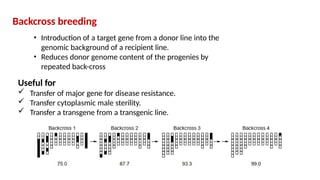
• Introduction of a target gene from a donor line into the
genomic background of a recipient line.
• Reduces donor genome content of the progenies by
repeated back-cross
Useful for
 Transfer of major gene for disease resistance.
 Transfer cytoplasmic male sterility.
 Transfer a transgene from a transgenic line.
Backcross breeding
Types of Backcrossing Breeding
Type 1: Stepwise backcrossing
Recurrent parent (RP1) is crossed with donor parent
(DP1) to produce the F1 hybrid and backcrossed up to
third backcross generation (BC3) to produce the
improved recurrent parent (IRP1). This improved
recurrent parent is then crossed with other donor
parent (DP2) to pyramid multiple genes.
 Precise gene tagging one gene at a time.
 Time consuming and less acceptable.
Type 2: Simultaneous backcrossing
Recurrent parent (RP1) is crossed with donor parents
(DP1, DP2, etc.) to get the F1 hybrids which are then
undercrossed to produce improved F1. F1 is then
backcrossed with the recurrent parent to get the
improved recurrent parent.
Types of Backcrossing Breeding
 Pyramiding is carried out in pedigree step.
 Pyramided gene(s) may be lost
when
multiple donor parents are involved.
Type 3: Stepwise and parallel backcrossing
Simultaneous crossing of recurrent parent (RP1) with
many donor parents and then backcrossing them up to
the BC3 generation. Backcross populations with the
individual gene are then inter-crossed with each other to
get the pyramided lines.
Types Backcrossing Breeding
 Less time consuming
and
acceptable.
 Fixation of genes is fully assured.
highly
Drawbacks of traditional Backcrossing Breeding
Requires bigger population for phenotypic selection
in each generation.
Recovery of recurrent genome is less efficient.
Often results in selection of undesirable genes
through negative selection and linkage drag.
Introgression of multiple genes and QTLs is highly difficult.
Self fertilization after
every backcrossing
increases the generation
time and requires a very
long time to retrieve the
recurrent parent
background.
Figure source: https://passel2.unl.edu/
Marker-assisted Backcrossing (MAB)
 Application of molecular markers in backcrossing process to avoid problems associated
with phenotypic selection of traits by selection of genes directly or indirectly.
 Make use of PCR based DNA tests for selection of traits containing individuals to be
used as parents in the next generation.
MAB depends on
• Types of molecular marker(s).
• Distance between closest marker and gene.
• Number of target genes.
• Size of the mapping population.
Traditional backcrossing -vs- Marker-assisted Backcrossing (MAB)
Traditional
backcrossing
Marker-assisted
backcrossing
Figure source: 1998 Elsevier Science Ltd.
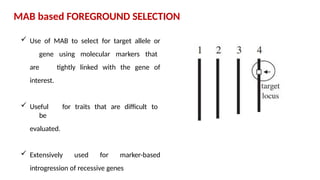
MAB based FOREGROUND SELECTION
 Use of MAB to select for target allele or
gene using molecular markers that
are tightly linked with the gene of
interest.
 Useful for traits that are difficult to
be
evaluated.
 Extensively used for marker-based
introgression of recessive genes
MAB based RECOMBINANT SELECTION
 Use of flaking markers to select for
recombinant locus in between.
 Significant decrease in linkage drag.
 Requires large population sizes. Distance
between flanking markers and target
locus should be significantly lower to
ensure recombinant selection.
MAB based BACKGROUND SELECTION
 Make use of unlinked marker to select
against the donor genome.
 Accelerates the recovery of recurrent
parent genome.
 Reduce the recovery time by avoiding the
requirement of 3 to 4
backcross generations.
Advantages of MAB
 MAB overcomes the expensive phenotypic screening.
 MAB can facilitate fixation of traits with low heritability or traits that are
affected by environment.
 MAB is useful for introgression of traits for resistance to diseases and
pests.
 MAB can facilitate the expression and heritability of recessive trait(s).
 MAB facilitate introgression of multiple gene into one genetic background
by way of gene pyramiding.

Marker assisted backcrossing.pdf 2.pptx

  • 1.
  • 2.
    • Introduction ofa target gene from a donor line into the genomic background of a recipient line. • Reduces donor genome content of the progenies by repeated back-cross Useful for  Transfer of major gene for disease resistance.  Transfer cytoplasmic male sterility.  Transfer a transgene from a transgenic line. Backcross breeding
  • 3.
    Types of BackcrossingBreeding Type 1: Stepwise backcrossing Recurrent parent (RP1) is crossed with donor parent (DP1) to produce the F1 hybrid and backcrossed up to third backcross generation (BC3) to produce the improved recurrent parent (IRP1). This improved recurrent parent is then crossed with other donor parent (DP2) to pyramid multiple genes.  Precise gene tagging one gene at a time.  Time consuming and less acceptable.
  • 4.
    Type 2: Simultaneousbackcrossing Recurrent parent (RP1) is crossed with donor parents (DP1, DP2, etc.) to get the F1 hybrids which are then undercrossed to produce improved F1. F1 is then backcrossed with the recurrent parent to get the improved recurrent parent. Types of Backcrossing Breeding  Pyramiding is carried out in pedigree step.  Pyramided gene(s) may be lost when multiple donor parents are involved.
  • 5.
    Type 3: Stepwiseand parallel backcrossing Simultaneous crossing of recurrent parent (RP1) with many donor parents and then backcrossing them up to the BC3 generation. Backcross populations with the individual gene are then inter-crossed with each other to get the pyramided lines. Types Backcrossing Breeding  Less time consuming and acceptable.  Fixation of genes is fully assured. highly
  • 6.
    Drawbacks of traditionalBackcrossing Breeding Requires bigger population for phenotypic selection in each generation. Recovery of recurrent genome is less efficient. Often results in selection of undesirable genes through negative selection and linkage drag. Introgression of multiple genes and QTLs is highly difficult.
  • 7.
    Self fertilization after everybackcrossing increases the generation time and requires a very long time to retrieve the recurrent parent background. Figure source: https://passel2.unl.edu/
  • 8.
    Marker-assisted Backcrossing (MAB) Application of molecular markers in backcrossing process to avoid problems associated with phenotypic selection of traits by selection of genes directly or indirectly.  Make use of PCR based DNA tests for selection of traits containing individuals to be used as parents in the next generation. MAB depends on • Types of molecular marker(s). • Distance between closest marker and gene. • Number of target genes. • Size of the mapping population.
  • 9.
    Traditional backcrossing -vs-Marker-assisted Backcrossing (MAB) Traditional backcrossing Marker-assisted backcrossing Figure source: 1998 Elsevier Science Ltd.
  • 10.
    MAB based FOREGROUNDSELECTION  Use of MAB to select for target allele or gene using molecular markers that are tightly linked with the gene of interest.  Useful for traits that are difficult to be evaluated.  Extensively used for marker-based introgression of recessive genes
  • 11.
    MAB based RECOMBINANTSELECTION  Use of flaking markers to select for recombinant locus in between.  Significant decrease in linkage drag.  Requires large population sizes. Distance between flanking markers and target locus should be significantly lower to ensure recombinant selection.
  • 12.
    MAB based BACKGROUNDSELECTION  Make use of unlinked marker to select against the donor genome.  Accelerates the recovery of recurrent parent genome.  Reduce the recovery time by avoiding the requirement of 3 to 4 backcross generations.
  • 13.
    Advantages of MAB MAB overcomes the expensive phenotypic screening.  MAB can facilitate fixation of traits with low heritability or traits that are affected by environment.  MAB is useful for introgression of traits for resistance to diseases and pests.  MAB can facilitate the expression and heritability of recessive trait(s).  MAB facilitate introgression of multiple gene into one genetic background by way of gene pyramiding.