10. Environmental microbiology
1
Learning objectives
At the end of this unit you must be able to
• To list microbes that are found in different waters
• To describe methods used in the determination of
bacteriological quality of water
• To describe steps in the purification of water
• To describe steps in sewage treatment
• To explain why water purification and sewage treatment is
necessary
• List the different groups of microbes found in the soil
• Discuss the role of microbes in the soil
• Describe/draw the carbon, nitrogen and sulfur cycles.
• Define mineralization and decomposition
• Distinguish between nitrogen fixation, nitrification,
denitrification and amonification 2
10.1.Microbial Diversity
• Microorganisms live in a wide variety of habitats because
of their metabolic diversity and their ability to use a
variety of carbon and energy sources and to grow under
different physical conditions.
• Microbes that live in extreme conditions of temperature,
acidity, alkalinity, or salinity are called extremophiles.
• Most are members of the Archaea.
• The enzymes (extremozymes) produced by extremophiles
can tolerate extremes of temperature, salinity, and pH that
would inactivate other enzymes.
3
10.2. Soil microbiology and
biogeochemical cycles
Soil microbes and their roles
• Soil microbiology studies about soil
microorganisms and their roles.
• Soil microorganisms include bacteria, fungi,
actinonmycetes, protozoa, algae and
cyanobacteria
4
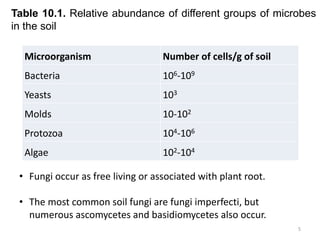
Microorganism Number of cells/g of soil
Bacteria 106-109
Yeasts 103
Molds 10-102
Protozoa 104-106
Algae 102-104
Table 10.1. Relative abundance of different groups of microbes
in the soil
• Fungi occur as free living or associated with plant root.
• The most common soil fungi are fungi imperfecti, but
numerous ascomycetes and basidiomycetes also occur.
5
• Microbes in the soil are important for
biodegradation and mineral cycling.
• Bacteria, fungi and actinomycetes are decomposers
and mineralizers in the biogeochemical cycles.
• They degrade important polymers such as cellulose
and lignin.
• Protozoa function as predators and they control
bacterial growth.
• The soil also contains pathogenic microorganisms.
6
• Essential elements such as carbon, nitrogen, sulfur,
phosphorus, oxygen, and iron are recharged through
biological, geologic, and chemical mechanisms called
biogeochemical cycles.
• All elements ultimately originate from a nonliving, long-term
reservoir in the atmosphere, the lithosphere, or the
hydrosphere.
• Elements such as C, N, S, P, etc., are recycled between the
abiotic environment and the biotic environment.
• Recycling maintains a necessary balance of nutrients in the
biosphere so that they do not build up or become unavailable.
Microbial biogeochemical cycling
7
Carbon cycle
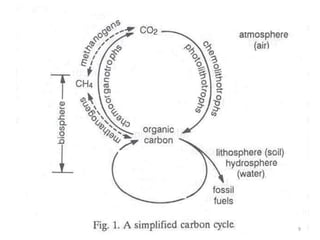
• Carbon is actively cycled between inorganic CO2
and the variety of organic compounds that
compose living organisms and their dead
organic matter.
• This cycle primarily involves the transfer of CO2
and organic carbon between the atmosphere,
and the hydrosphere and lithosphere (Figure 1).
8
9
• Chemolithotrophs and photolithotrophs are
responsible for primary production i.e. conversion of
CO2 to organic carbon.
• Once carbon is fixed (reduced) into organic
compounds it will be available for heterotrophs.
• Respiration and degradation of soil organic matter
brings CO2 back to the atmosphere.
• Soil microbes convert organic matter to various
nutrients. This is called mineralization.
• Microbes decompose complex organic substances
such as cellulose, hemicellulose and pectin into
simple sugars. 10
Nitrogen cycle
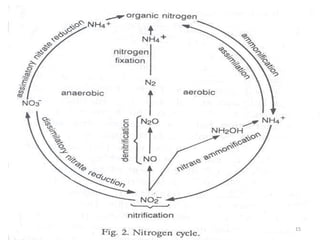
• Nitrogen cycling involves nitrogen fixation, ammonification,
nitrification and denitrification (Figure 2).
• Nitrogen cycling is largely dependent on microbes.
Nitrogen fixation
• Nitrogen fixation, the conversion of N2 to ammonia or organic
nitrogen, is restricted to prokaryotes only.
• Ammonia is assimilated into amino acids and subsequently
synthesized into proteins and nucleic acids.
• In soil, microbial fixation of N2 is carried out by free-living
bacteria (asymbiotic) and those in symbiotic association with
plants (symbiotic).
11
• In agricultural soils nitrogen fixation by Rhizobium and
Bradyrhizobium is most important, where these bacteria live
with legume crops only.
• In forests, other symbiotic N-fixing bacteria including
actinomycetes live in association with various trees
(nonleguminous plants).
• The Free-living N-fixing bacteria Azotobacter, Azomonas and
Derxia are common in temperate regions in neutral or alkaline
soils.
• In tropics, Beijerinkia, more acid tolerant, are prevalent in soil.
• In aquatic habitats, cyanobacteria, such as Nostoc and
Anabaena are important N-fixers.
12
Ammonification
• Many microbes (bacteria & fungi) as well as plants
and animals are able to convert organic nitrogen
compounds such as amino acids, urea, etc to
ammonia i.e. ammonification.
• Ammonia is then returned to the atmosphere or it is
converted to NH4
+ in moist soil and is used by
bacteria & plants for amino acid synthesis.
Nitrification
• In this process, ammonium ions are initially oxidized
to nitrite ions and subsequently to nitrate ions.
• The two steps are carried out by nitrifying bacteria,
which are aerobic.. 13
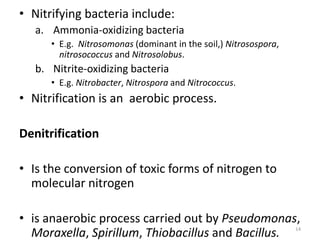
• Nitrifying bacteria include:
a. Ammonia-oxidizing bacteria
• E.g. Nitrosomonas (dominant in the soil,) Nitrosospora,
nitrosococcus and Nitrosolobus.
b. Nitrite-oxidizing bacteria
• E.g. Nitrobacter, Nitrospora and Nitrococcus.
• Nitrification is an aerobic process.
Denitrification
• Is the conversion of toxic forms of nitrogen to
molecular nitrogen
• is anaerobic process carried out by Pseudomonas,
Moraxella, Spirillum, Thiobacillus and Bacillus. 14
15
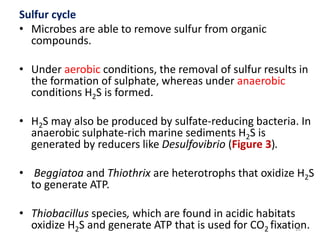
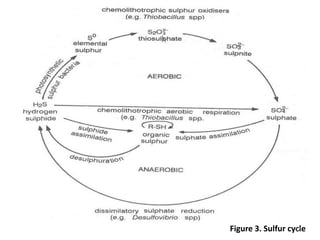
Sulfur cycle
• Microbes are able to remove sulfur from organic
compounds.
• Under aerobic conditions, the removal of sulfur results in
the formation of sulphate, whereas under anaerobic
conditions H2S is formed.
• H2S may also be produced by sulfate-reducing bacteria. In
anaerobic sulphate-rich marine sediments H2S is
generated by reducers like Desulfovibrio (Figure 3).
• Beggiatoa and Thiothrix are heterotrophs that oxidize H2S
to generate ATP.
• Thiobacillus species, which are found in acidic habitats
oxidize H2S and generate ATP that is used for CO2 fixation.
16
Figure 3. Sulfur cycle
17
10.3. Aquatic microbiology and sewage treatment
• Aquatic microbiology is the study of microorganisms and
their activities in natural waters, such as lakes, ponds,
streams, rivers, estuaries, and oceans.
Aquatic Microorganisms
• Large numbers of microorganisms in a body of water
generally indicate high nutrient levels in the water.
• Water contaminated by inflows from sewage systems or from
biodegradable industrial organic wastes is relatively high in
bacterial numbers.
• Ocean estuaries (fed by rivers) have higher nutrient levels and
therefore larger microbial populations than other shoreline
waters. 18
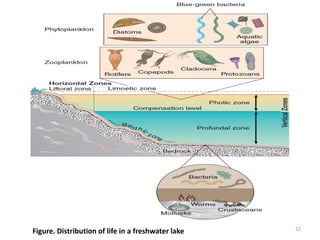
Freshwater Microbiota
• Microbial populations of freshwater bodies
tend to be affected mainly by the availability
of oxygen and light.
• Photosynthetic algae are the primary
producers of a lake that support a population
of bacteria, protozoa, fish, and other aquatic
life.
• They are located in the limnetic zone.
19
• Microorganisms growing on nutrients in stagnant water
quickly use up the dissolved oxygen in the water.
• In the oxygenless water, fish die, and anaerobic activity
produces odors.
• Wave action in shallow layers, or water movement in
rivers, tends to increase the amount of oxygen throughout
the water and aid in the growth of aerobic bacteria.
• Deeper waters of the profundal and benthic zones have
low oxygen concentrations and less light.
• Purple and green sulfur bacteria are found in the
profundal zone.
• These bacteria are anaerobic photosynthetic organisms
that metabolize H2S to sulfur. 20
• The sediment in the benthic zone includes
bacteria such as Desulfovibrio that use sulfate
(SO42-) as an electron acceptor and reduce it
to H2S.
• Methane-producing bacteria are also part of
these anaerobic benthic populations.
• In swamps, marshes, or bottom sediments,
they produce methane gas.
21
Figure. Distribution of life in a freshwater lake 22
Seawater Microbiota
• Photosynthetic cyanobacteria fill the upper 100 meters of
ocean.
• They fix carbon dioxide to form organic matter that is
eventually released as dissolved organic matter and is used by
the ocean’s heterotrophic bacteria.
• Photosynthetic bacteria form the basis of the oceanic food
chain.
• Phytoplankton are the primary producers of the open ocean.
• Cyanobacteria fixes nitrogen and helps replenish the nitrogen
that is lost as organisms sink to oceanic depths.
• Archaea predominate below 100 m.
• Seafloor sediments bacteria are mostly Archaea. 23
Microbial pollution of water and water borne diseases
• Water that moves below the ground’s surface undergoes a
filtering that removes most microorganisms.
• For this reason, water from springs and deep wells is
generally of good quality.
• The most dangerous form of water pollution occurs when
feces enter the water supply.
• The contaminants include coliform bacteria such as E.coli,
Salmonella, faecal streptococci, cholera bacteria,
protozoan cysts, enteric viruses, etc.
24
• Water can be a vehicle for the transfer of a wide
range microbial diseases, including typhoid fever,
cholera and bacterial dysentery.
• Viral diseases transmitted by water are virus A
hepatitis and polio.
• Protozoan diseases such as amoebiasis,
giardiasis, etc, are also transmitted through
water.
25
Water treatment
• Water may contain pathogenic microorganisms.
– Must be purified
Steps in water purification:
Sedimentation
• Removes bulky objects such as leaves, sand and gravel
particles. Microbes are also removed.
Filtration
• passing water through fine sand or coal; microorganisms
adsorb to sand particles
• removes the remaining microbes from the water.
Disinfection
– Chlorination: chlorine gas is added to the water. Chlorine reacts
with organic matter in the water.
– Ozonation
– UV- radiation 26
Sewage treatment
• Domestic water is called sewage.
• It includes housed hold water, toilet wastes,
industrial wastes, and rainwater.
• Since sewage contains biological and chemical
contaminants, it has to undergo treatments
which remove or reduce the contaminants.
• Steps in sewage treatment: primary,
secondary and tertiary treatments.
27
Primary sewage treatment
• It is the removal of solid matter (that collects at the
bottom) called sludges (by sedimentation).
• Sludge collects in sedimentation tanks
• It removes 25–35% of Biochemical oxygen demand
(BOD).
BOD
– the measure of the biodegradable organic matter in
water
– Determined by the amount of oxygen required by
bacteria to metabolize organic matter
28
• Secondary sewage treatment
– the biological (microbial) degradation of organic matter in
sewage aerobically and anaerobically
– Degradation by aerobic microbes is done in two ways:
• Activated sludge system
– Air passes through the effluent from primary
treatment
– Contains aerobic sewage-metabolizing microbes
– Removes 75–95% of BOD
• Trickling filters
– Sewage sprayed over rocks or plastic, forming biofilm
of aerobic microbes
– Removes 80–85% of BOD
29
• Degradation by anaerobic microbes occurs in
anaerobic sludge digesters.
– Sludge from primary treatment is placed in anaerobic sludge
digester and anaerobic bacteria degrade organic solids into
methane and carbon dioxide.
• Tertiary sewage treatment
– Removal of remaining BOD, nitrogen, and phosphorus
• N2 and NH3 evaporate and PO4 precipitated
– Physical and chemical treatment
• Filters of fine sands and activated charcoal remove small particulate
matter and dissolved chemicals.
• Chlorination
– Water is drinkable after treatment
30

10. Environmental microbiology (1).pdfbh

  • 1.
  • 2.
    Learning objectives At theend of this unit you must be able to • To list microbes that are found in different waters • To describe methods used in the determination of bacteriological quality of water • To describe steps in the purification of water • To describe steps in sewage treatment • To explain why water purification and sewage treatment is necessary • List the different groups of microbes found in the soil • Discuss the role of microbes in the soil • Describe/draw the carbon, nitrogen and sulfur cycles. • Define mineralization and decomposition • Distinguish between nitrogen fixation, nitrification, denitrification and amonification 2
  • 3.
    10.1.Microbial Diversity • Microorganismslive in a wide variety of habitats because of their metabolic diversity and their ability to use a variety of carbon and energy sources and to grow under different physical conditions. • Microbes that live in extreme conditions of temperature, acidity, alkalinity, or salinity are called extremophiles. • Most are members of the Archaea. • The enzymes (extremozymes) produced by extremophiles can tolerate extremes of temperature, salinity, and pH that would inactivate other enzymes. 3
  • 4.
    10.2. Soil microbiologyand biogeochemical cycles Soil microbes and their roles • Soil microbiology studies about soil microorganisms and their roles. • Soil microorganisms include bacteria, fungi, actinonmycetes, protozoa, algae and cyanobacteria 4
  • 5.
    Microorganism Number ofcells/g of soil Bacteria 106-109 Yeasts 103 Molds 10-102 Protozoa 104-106 Algae 102-104 Table 10.1. Relative abundance of different groups of microbes in the soil • Fungi occur as free living or associated with plant root. • The most common soil fungi are fungi imperfecti, but numerous ascomycetes and basidiomycetes also occur. 5
  • 6.
    • Microbes inthe soil are important for biodegradation and mineral cycling. • Bacteria, fungi and actinomycetes are decomposers and mineralizers in the biogeochemical cycles. • They degrade important polymers such as cellulose and lignin. • Protozoa function as predators and they control bacterial growth. • The soil also contains pathogenic microorganisms. 6
  • 7.
    • Essential elementssuch as carbon, nitrogen, sulfur, phosphorus, oxygen, and iron are recharged through biological, geologic, and chemical mechanisms called biogeochemical cycles. • All elements ultimately originate from a nonliving, long-term reservoir in the atmosphere, the lithosphere, or the hydrosphere. • Elements such as C, N, S, P, etc., are recycled between the abiotic environment and the biotic environment. • Recycling maintains a necessary balance of nutrients in the biosphere so that they do not build up or become unavailable. Microbial biogeochemical cycling 7
  • 8.
    Carbon cycle • Carbonis actively cycled between inorganic CO2 and the variety of organic compounds that compose living organisms and their dead organic matter. • This cycle primarily involves the transfer of CO2 and organic carbon between the atmosphere, and the hydrosphere and lithosphere (Figure 1). 8
  • 9.
  • 10.
    • Chemolithotrophs andphotolithotrophs are responsible for primary production i.e. conversion of CO2 to organic carbon. • Once carbon is fixed (reduced) into organic compounds it will be available for heterotrophs. • Respiration and degradation of soil organic matter brings CO2 back to the atmosphere. • Soil microbes convert organic matter to various nutrients. This is called mineralization. • Microbes decompose complex organic substances such as cellulose, hemicellulose and pectin into simple sugars. 10
  • 11.
    Nitrogen cycle • Nitrogencycling involves nitrogen fixation, ammonification, nitrification and denitrification (Figure 2). • Nitrogen cycling is largely dependent on microbes. Nitrogen fixation • Nitrogen fixation, the conversion of N2 to ammonia or organic nitrogen, is restricted to prokaryotes only. • Ammonia is assimilated into amino acids and subsequently synthesized into proteins and nucleic acids. • In soil, microbial fixation of N2 is carried out by free-living bacteria (asymbiotic) and those in symbiotic association with plants (symbiotic). 11
  • 12.
    • In agriculturalsoils nitrogen fixation by Rhizobium and Bradyrhizobium is most important, where these bacteria live with legume crops only. • In forests, other symbiotic N-fixing bacteria including actinomycetes live in association with various trees (nonleguminous plants). • The Free-living N-fixing bacteria Azotobacter, Azomonas and Derxia are common in temperate regions in neutral or alkaline soils. • In tropics, Beijerinkia, more acid tolerant, are prevalent in soil. • In aquatic habitats, cyanobacteria, such as Nostoc and Anabaena are important N-fixers. 12
  • 13.
    Ammonification • Many microbes(bacteria & fungi) as well as plants and animals are able to convert organic nitrogen compounds such as amino acids, urea, etc to ammonia i.e. ammonification. • Ammonia is then returned to the atmosphere or it is converted to NH4 + in moist soil and is used by bacteria & plants for amino acid synthesis. Nitrification • In this process, ammonium ions are initially oxidized to nitrite ions and subsequently to nitrate ions. • The two steps are carried out by nitrifying bacteria, which are aerobic.. 13
  • 14.
    • Nitrifying bacteriainclude: a. Ammonia-oxidizing bacteria • E.g. Nitrosomonas (dominant in the soil,) Nitrosospora, nitrosococcus and Nitrosolobus. b. Nitrite-oxidizing bacteria • E.g. Nitrobacter, Nitrospora and Nitrococcus. • Nitrification is an aerobic process. Denitrification • Is the conversion of toxic forms of nitrogen to molecular nitrogen • is anaerobic process carried out by Pseudomonas, Moraxella, Spirillum, Thiobacillus and Bacillus. 14
  • 15.
  • 16.
    Sulfur cycle • Microbesare able to remove sulfur from organic compounds. • Under aerobic conditions, the removal of sulfur results in the formation of sulphate, whereas under anaerobic conditions H2S is formed. • H2S may also be produced by sulfate-reducing bacteria. In anaerobic sulphate-rich marine sediments H2S is generated by reducers like Desulfovibrio (Figure 3). • Beggiatoa and Thiothrix are heterotrophs that oxidize H2S to generate ATP. • Thiobacillus species, which are found in acidic habitats oxidize H2S and generate ATP that is used for CO2 fixation. 16
  • 17.
  • 18.
    10.3. Aquatic microbiologyand sewage treatment • Aquatic microbiology is the study of microorganisms and their activities in natural waters, such as lakes, ponds, streams, rivers, estuaries, and oceans. Aquatic Microorganisms • Large numbers of microorganisms in a body of water generally indicate high nutrient levels in the water. • Water contaminated by inflows from sewage systems or from biodegradable industrial organic wastes is relatively high in bacterial numbers. • Ocean estuaries (fed by rivers) have higher nutrient levels and therefore larger microbial populations than other shoreline waters. 18
  • 19.
    Freshwater Microbiota • Microbialpopulations of freshwater bodies tend to be affected mainly by the availability of oxygen and light. • Photosynthetic algae are the primary producers of a lake that support a population of bacteria, protozoa, fish, and other aquatic life. • They are located in the limnetic zone. 19
  • 20.
    • Microorganisms growingon nutrients in stagnant water quickly use up the dissolved oxygen in the water. • In the oxygenless water, fish die, and anaerobic activity produces odors. • Wave action in shallow layers, or water movement in rivers, tends to increase the amount of oxygen throughout the water and aid in the growth of aerobic bacteria. • Deeper waters of the profundal and benthic zones have low oxygen concentrations and less light. • Purple and green sulfur bacteria are found in the profundal zone. • These bacteria are anaerobic photosynthetic organisms that metabolize H2S to sulfur. 20
  • 21.
    • The sedimentin the benthic zone includes bacteria such as Desulfovibrio that use sulfate (SO42-) as an electron acceptor and reduce it to H2S. • Methane-producing bacteria are also part of these anaerobic benthic populations. • In swamps, marshes, or bottom sediments, they produce methane gas. 21
  • 22.
    Figure. Distribution oflife in a freshwater lake 22
  • 23.
    Seawater Microbiota • Photosyntheticcyanobacteria fill the upper 100 meters of ocean. • They fix carbon dioxide to form organic matter that is eventually released as dissolved organic matter and is used by the ocean’s heterotrophic bacteria. • Photosynthetic bacteria form the basis of the oceanic food chain. • Phytoplankton are the primary producers of the open ocean. • Cyanobacteria fixes nitrogen and helps replenish the nitrogen that is lost as organisms sink to oceanic depths. • Archaea predominate below 100 m. • Seafloor sediments bacteria are mostly Archaea. 23
  • 24.
    Microbial pollution ofwater and water borne diseases • Water that moves below the ground’s surface undergoes a filtering that removes most microorganisms. • For this reason, water from springs and deep wells is generally of good quality. • The most dangerous form of water pollution occurs when feces enter the water supply. • The contaminants include coliform bacteria such as E.coli, Salmonella, faecal streptococci, cholera bacteria, protozoan cysts, enteric viruses, etc. 24
  • 25.
    • Water canbe a vehicle for the transfer of a wide range microbial diseases, including typhoid fever, cholera and bacterial dysentery. • Viral diseases transmitted by water are virus A hepatitis and polio. • Protozoan diseases such as amoebiasis, giardiasis, etc, are also transmitted through water. 25
  • 26.
    Water treatment • Watermay contain pathogenic microorganisms. – Must be purified Steps in water purification: Sedimentation • Removes bulky objects such as leaves, sand and gravel particles. Microbes are also removed. Filtration • passing water through fine sand or coal; microorganisms adsorb to sand particles • removes the remaining microbes from the water. Disinfection – Chlorination: chlorine gas is added to the water. Chlorine reacts with organic matter in the water. – Ozonation – UV- radiation 26
  • 27.
    Sewage treatment • Domesticwater is called sewage. • It includes housed hold water, toilet wastes, industrial wastes, and rainwater. • Since sewage contains biological and chemical contaminants, it has to undergo treatments which remove or reduce the contaminants. • Steps in sewage treatment: primary, secondary and tertiary treatments. 27
  • 28.
    Primary sewage treatment •It is the removal of solid matter (that collects at the bottom) called sludges (by sedimentation). • Sludge collects in sedimentation tanks • It removes 25–35% of Biochemical oxygen demand (BOD). BOD – the measure of the biodegradable organic matter in water – Determined by the amount of oxygen required by bacteria to metabolize organic matter 28
  • 29.
    • Secondary sewagetreatment – the biological (microbial) degradation of organic matter in sewage aerobically and anaerobically – Degradation by aerobic microbes is done in two ways: • Activated sludge system – Air passes through the effluent from primary treatment – Contains aerobic sewage-metabolizing microbes – Removes 75–95% of BOD • Trickling filters – Sewage sprayed over rocks or plastic, forming biofilm of aerobic microbes – Removes 80–85% of BOD 29
  • 30.
    • Degradation byanaerobic microbes occurs in anaerobic sludge digesters. – Sludge from primary treatment is placed in anaerobic sludge digester and anaerobic bacteria degrade organic solids into methane and carbon dioxide. • Tertiary sewage treatment – Removal of remaining BOD, nitrogen, and phosphorus • N2 and NH3 evaporate and PO4 precipitated – Physical and chemical treatment • Filters of fine sands and activated charcoal remove small particulate matter and dissolved chemicals. • Chlorination – Water is drinkable after treatment 30