Marin Horizon School
Rosetta Eun Ryong Lee
Seattle Girls’ School
I Learned Who I Was When…
Schools with Identity Development in Mind
Rosetta Eun Ryong Lee (http://tiny.cc/rosettalee)
About Seattle Girls’ School
Rosetta Eun Ryong Lee (http://tiny.cc/rosettalee)
Agenda
 Identity Development
 Exercise: Up-Downs
 Break
 Theory: Models of Identity Development,
Schools, and Social Interactions
 Exercise: Case Studies
Rosetta Eun Ryong Lee (http://tiny.cc/rosettalee)
 What is it?
 What are the
various dimensions
of identity?
 Why identity
development?
Identity Development
Rosetta Eun Ryong Lee (http://tiny.cc/rosettalee)
Dimensions of Identity and Culture
This model of identifiers and culture was created by Karen Bradberry and Johnnie Foreman for NAIS Summer Diversity Institute,
adapted from Loden and Rosener’s Workforce America! (1991) and from Diverse Teams at Work, Gardenswartz & Rowe (SHRM 2003).
Rosetta Eun Ryong Lee (http://tiny.cc/rosettalee)
National Coalition Building Institute, Seattle Chapter, “Building Bridges Workshop,” Adapted by Rosetta Eun Ryong Lee
• Stand proudly for your group
• Stand for as many groups
within one category
as applies to you
• If you are not standing,
cheer and applaud
the people who are
Exercise: Up-Downs
Rosetta Eun Ryong Lee (http://tiny.cc/rosettalee)
Debrief: Up-Downs
How did it feel to
stand and claim your
identities and
experiences? To be
applauded for them?
To applaud others for
their identities and
their experiences?
Rosetta Eun Ryong Lee (http://tiny.cc/rosettalee)
Break
Rosetta Eun Ryong Lee (http://tiny.cc/rosettalee)
 Innocence and Self Esteem
 Encounter and Self Doubt
 Assimilation to the Majority
 Immersion into Identity
 Emersion
 Integration
Identity Development:
Marginalized Identities
Rosetta Eun Ryong Lee (http://tiny.cc/rosettalee)
 Innocence and Self Esteem
 Encounter and Confusion
 Attempt to Reintegrate
 Re-Encounter and Guilt
 Acceptance and Action
 Immersion and Emersion
 Integration
Identity Development:
Privilged Identities
Rosetta Eun Ryong Lee (http://tiny.cc/rosettalee)
 Identity Frames
 Intractability
 Positive and Negative Encounters
 Identity Socialization
 Co-Authorship of Identity
Identity and Cultural Inclusion
Rosetta Eun Ryong Lee (http://tiny.cc/rosettalee)
 Parallel
 Regressive
 Crossed
 Progressive
 Symbiotic
R.T. Carter’s Model:
Racial Identity and
Social Interactions
Rosetta Eun Ryong Lee (http://tiny.cc/rosettalee)
Effect of Varying Identifications
Rosetta Eun Ryong Lee (http://tiny.cc/rosettalee)
Orientations Toward Ethnic Identity
Rosetta Eun Ryong Lee (http://tiny.cc/rosettalee)
Case Study:
Identity and Schools
Please read the assigned case
study, discuss what may be going
on, and how you might react as
individuals or as a school.
Rosetta Eun Ryong Lee (http://sites.google.com/site/sgsprofessionaloutreach/)
Break
Rosetta Eun Ryong Lee (http://tiny.cc/rosettalee)
Marin Horizon School
Rosetta Eun Ryong Lee
Seattle Girls’ School
Stretching the Inclusive Boundaries:
Cultural Competency Skills
Rosetta Eun Ryong Lee (http://tiny.cc/rosettalee)
Agenda
 Cultural Competency
 Communication Skills
 Focus on the Classroom
 Focus on the School Level
 Questions and Answers
Rosetta Eun Ryong Lee (http://tiny.cc/rosettalee)
Cultural Competency
Cultural competence is a set of
congruent behaviors, attitudes and
policies that come together in a
system, institution or individual and
enable that system, institution or
individual to work effectively in cross-
cultural situations.
Rosetta Eun Ryong Lee (http://tiny.cc/rosettalee)
Terry Cross
Cultural Competency: Key Elements
Value Orientation
Diversity as Value Added
Respect
Relationships
Equity
Thought Orientation
Knowledge
Awareness
Systems Thinking
Action Orientation
Consciousness Building
Capacity Building
Assessment
Adaptation
Rosetta Eun Ryong Lee (http://tiny.cc/rosettalee)
 What is it?
 How is it Different from Intercultural
Communication?
 CCC Theories
– Face-Negotiation Theory
– Conversational Constraints Theory
– Expectancy Violation Theory
– Anxiety/Uncertainty Management Theory
– Communication Accommodation Theory
Cross Cultural Communication
Rosetta Eun Ryong Lee (http://tiny.cc/rosettalee)
Individual - Collectivistic
Low Context - High Context
Task - Relationship
Low Uncertainty - High Uncertainty
Vertical - Horizontal
Dimensions of Variability
Rosetta Eun Ryong Lee (http://tiny.cc/rosettalee)
 Personality Orientation
 Individual Values
- Allocentric
- Idiocentric
 Self Construal
- Independent
- Interdependent
 Individual Socialization
 Cultural Norms and Rules
Factors that Influence
Rosetta Eun Ryong Lee (http://tiny.cc/rosettalee)
Discussion: My Style
In hearing about
communication
differences, what would
you describe as your
cultural communication
style? Have you noticed
stark differences
compared to others?
Rosetta Eun Ryong Lee (http://tiny.cc/rosettalee)
Cultural Values
Norms, and Rules
 Values
 Value Priorities
 Norms of Behavior
 Non-Verbal
Communication
Rosetta Eun Ryong Lee (http://tiny.cc/rosettalee)
CulturalValueDifferences
RELATIONAL
Individualism
self-reliance, independence
(selfish)
Collectivism
group interdependence
(mindless follower)
Informality
directness, give and take discussion
(rude and abrupt)
Formality
indirectness, protect "face"
(stiff and impersonal)
Competition
individual achievement
(egotistical, show-off)
Cooperation
group achievement
(avoiding doing work or taking responsibility)
AUTHORITY
Egalitarianism
fairness, belief in equal opportunity
(being picky, on a soapbox)
Hierarchy
privilege of status or rank
(power hungry or avoiding accountability)
TEMPORAL
Use of Time
"Time is money"
(doesn’t get the important things in life)
Passage of Time
"Time is for life"
(lazy and irresponsible)
Change/Future
Adaptability ensures survival
(muckraker, stirs up trouble)
Tradition/Past
Stability ensures survival
(old-school, afraid of change)
ACTIVITY
Action orientation
"Make things happen"
(rushes without thinking)
"Being" orientation
"Let things happen"
(indecisive and slow)
Practicality
Efficiency is always best
(impersonal and unscrupulous)
Idealism
Always maintain principles
(naïve and impractical)
Rosetta Eun Ryong Lee (http://tiny.cc/rosettalee)
Exercise: Non-Verbal Violations
1: Please pick a partner and stand.
2: You and your partner will receive
different instructions for nonverbal
behaviors. Do not share the
information.
3: Begin to converse about your interests
and hobbies.
4: INCREMENTALLY dramatize the
nonverbal behavior.
5: Make note of thoughts or feelings you
experience.
Rosetta Eun Ryong Lee (http://tiny.cc/rosettalee)
Non-Verbal Violations: Partner 1
You signal respect by standing
physically close to your partner. Stand
Approximately 6 inches away from
him/her. You enjoy asking a lot of
questions to signal conversational
excitement and involvement. You also
like to touch your partner's arm from
time-to-time to signal approval for a
good idea.
Rosetta Eun Ryong Lee (http://tiny.cc/rosettalee)
Non-Verbal Violations: Partner 2
You signal respect by standing at
least an arm's length away from your
partner. You constantly check your
watch or the clock for fear of running
out of time in the conversation. You
also like to make loud sounds (ahs,
oohs, uh-huhs, sighs, etc.) to signal
your approval and great contentment
of the conversation.
Rosetta Eun Ryong Lee (http://tiny.cc/rosettalee)
Debrief: Nonverbal Violations
Did the INTENT of your described
behaviors allow you to display
them more enthusiastically?
What was the IMPACT of the
behaviors of your partner?
Did knowing that “odd” behaviors
may be part of the exercise
help you accept your partner’s
behavior?
In working with people from
various communities, what do
you take away from this
exercise?
Rosetta Eun Ryong Lee (http://tiny.cc/rosettalee)
Break
Rosetta Eun Ryong Lee (http://tiny.cc/rosettalee)
Identifiers, Power,
and Communication
Internalized Oppression/Dominance
Stereotype Threat
Accumulated Impact/
Microaggressions
Code/Mode Switching
Fish Seeing the Water
“Normal” versus “Good”
“Intent” versus “Impact”
Rosetta Eun Ryong Lee (http://tiny.cc/rosettalee)
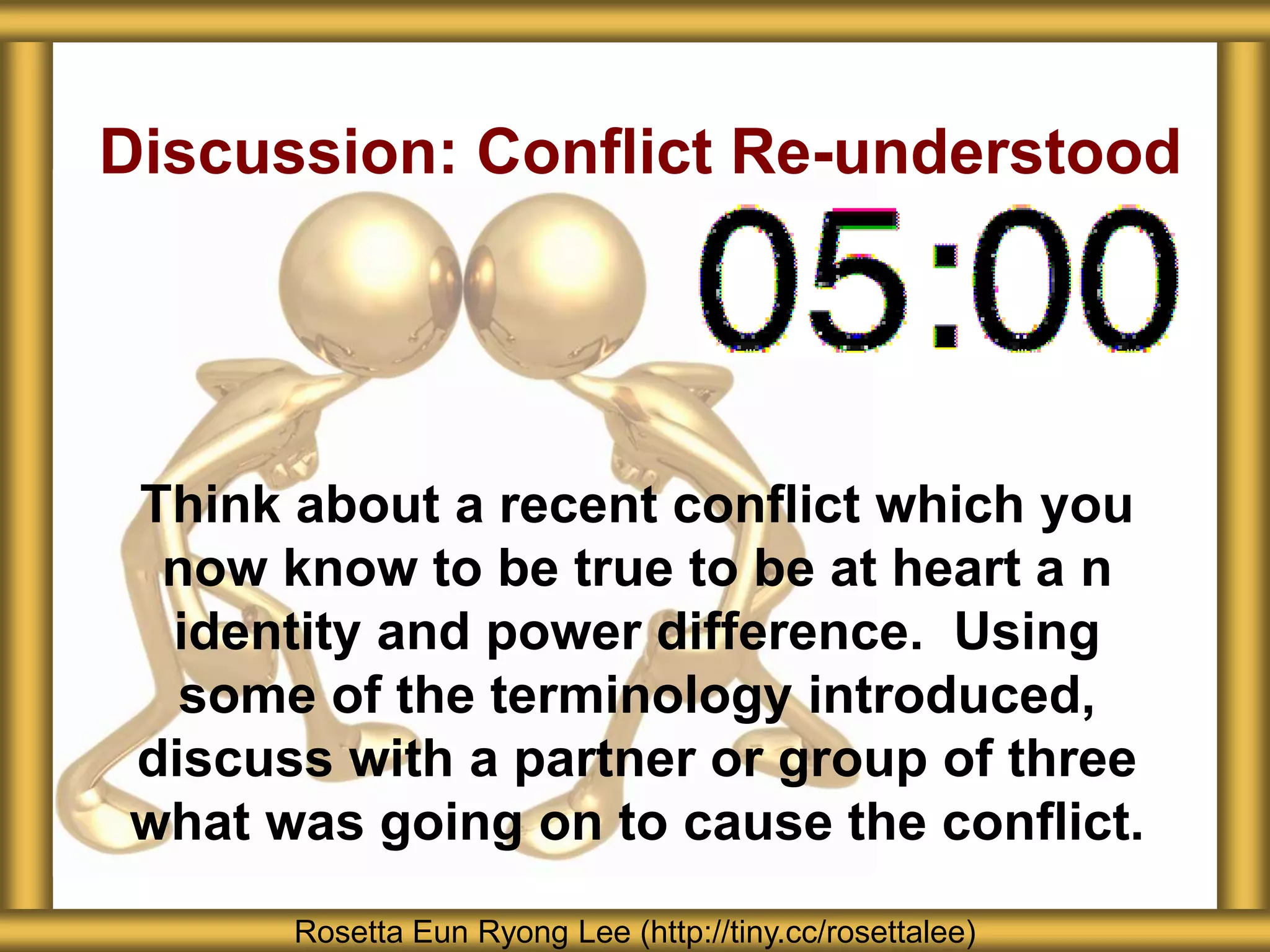
Discussion: Conflict Re-understood
Think about a recent conflict which you
now know to be true to be at heart a n
identity and power difference. Using
some of the terminology introduced,
discuss with a partner or group of three
what was going on to cause the conflict.
Rosetta Eun Ryong Lee (http://tiny.cc/rosettalee)
So What? Now What?
Rosetta Eun Ryong Lee (http://tiny.cc/rosettalee)
Examining the Self
 William Taylor’s Reflective Competence Model
Rosetta Eun Ryong Lee (http://tiny.cc/rosettalee)
1. What did you see/hear (raw data)?
2. What are your personal filters (cultural
values, norms, and identifiers)?
3. What was your interpretation of what you
saw/heard (inference)?
4. How did you feel as a result?
5. What do you want?
Checking Assumptions and
Interpretations: Steps to Analyze
Rosetta Eun Ryong Lee (http://tiny.cc/rosettalee)
1. How do you see materials
from this workshop applying
to your roles?
2. What questions do you still
have?
3. What are your personal action
steps?
Discussion:
How Will I Apply All This?
Rosetta Eun Ryong Lee (http://tiny.cc/rosettalee)
Break
Rosetta Eun Ryong Lee (http://tiny.cc/rosettalee)
Focus on the Classroom
Rosetta Eun Ryong Lee (http://sites.google.com/site/sgsprofessionaloutreach/)
- Increasing Trust
- Distinguishing
Behaviors
- Overcoming History
and Impact
Do You See Me?
Rosetta Eun Ryong Lee (http://sites.google.com/site/sgsprofessionaloutreach/)
- Representation on the
Walls
- Representation in the
Curriculum
- Interest in Personal
Story (Sharing of
Personal Story)
- Interactions In and Out
of the Classroom
- Demonstration of Care
Do You Hear Me?
Rosetta Eun Ryong Lee (http://sites.google.com/site/sgsprofessionaloutreach/)
- - Incorporation of Prior
Knowledge and Experience
- - Seeking and Responding
to Student Feedback
- - Student Choice in the
Curriculum
- - Empathy Reflex
- - Authoritative Discipline
Will You Treat Me Fairly?
- Clear and High
Expectations
- Equal Discipline and
Rewards
- Support in Struggle and
Push in Success
- Consistent and
Predictable Assessment
- Different Kinds of
Success
Rosetta Eun Ryong Lee (http://sites.google.com/site/sgsprofessionaloutreach/)
- Understanding of
Identity and Experience
- Interruption of Exclusive
or Oppressive Behavior
- Teaching and
Discussing Cultural and
Power Difference
- Encouragement of and
Practice with
Collaboration
Will You Protect Me?
Rosetta Eun Ryong Lee (http://tiny.cc/rosettalee)
Discussion
What are some ways we
practice inclusion in the
classroom and school
environment well? What
are some ways we can
do a better job?
Rosetta Eun Ryong Lee (http://tiny.cc/rosettalee)
You Win Some, You Lose Some
Rosetta Eun Ryong Lee (http://tiny.cc/rosettalee)
Focusing on the School
Rosetta Eun Ryong Lee (http://tiny.cc/rosettalee)
Developmental Stages From Exclusive to Inclusive
Rosetta Eun Ryong Lee (http://tiny.cc/rosettalee)
Cultural Proficiency Continuum
Rosetta Eun Ryong Lee (http://tiny.cc/rosettalee)
Cultural Proficiency Continuum
Rosetta Eun Ryong Lee (http://tiny.cc/rosettalee)
Organizational Development Model of Inclusion
Rosetta Eun Ryong Lee (http://tiny.cc/rosettalee)
Milton Bennett’s
Developmental Model of Intercultural Sensitivity
Rosetta Eun Ryong Lee (http://tiny.cc/rosettalee)
Hallmarks of Earlier Phases
 People feel pressure to fit in
 People fear speaking up
 “Who you know” is more important than “what
you know” (relationship-based culture)
 You only trust those closest to you (cliques)
 Denial of differences is considered a virtue (“we
don’t see differences here”)
 It’s hard for outsiders to learn the rules (sink or
swim to prove yourself)
Rosetta Eun Ryong Lee (http://tiny.cc/rosettalee)
Hallmarks of Later Phases
 People can bring their full selves to school
 The school encourages and welcomes people to
contribute different opinions and points of view
 There is a performance driven culture
 People form dynamic and diverse groups (trust)
 Differences are seen as additive and productive
 Success is explicitly defined, and the school
supports people in achieving it
 The school has an interactive culture
 People have the competencies to adapt to different
cultural contexts.
Rosetta Eun Ryong Lee (http://tiny.cc/rosettalee)
Schools Have ZPDs, Too!
Status Quo:
Reliance on what the
school does already
and naturally
Zone of Proximal
Development:
Mindful and strategic
change toward the
next stage of growth
Too Much, Too Fast:
Unrealistic demands
on the community
Rosetta Eun Ryong Lee (http://tiny.cc/rosettalee)
Identifying Growth Zones – The 5Ps
• Policy – Enumeration of the school’s diversity
commitment through mission, strategic plan,
handbooks, websites, etc.
• Programming – Diversity training and programming for
all constituencies (board, admin, faculty, staff,
students, families, etc.). Diversity and inclusivity
curriculum.
• Practice – Consistent and meaningful revisit of policy
and programs. Climate assessments, proactive
changes, and meaningful responses to incidents.
• People – Critical mass of people who are supportive
AND active on all levels.
• Pecuniary – Funding, people, and time allocated in the
strategic plan and daily life for supporting diversity
efforts.
Rosetta Eun Ryong Lee (http://tiny.cc/rosettalee)
Assess and Reassess
 Demographic Trends
– Entrance Numbers
– Attrition Numbers
– Disciplinary Cases
– Academic Cases
– Financial Aid Breakdowns
 Climate Surveys
 Exit Interviews
 Programmatic Surveys
 Pre-Post Assessments
 Every 1-2 Years
Rosetta Eun Ryong Lee (http://tiny.cc/rosettalee)
Stretching the Inclusive Boundaries
Rosetta Eun Ryong Lee (http://tiny.cc/rosettalee)
Presenter
Information
Rosetta Eun Ryong Lee
Outreach Specialist
Seattle Girls’ School
2706 S Jackson Street
Seattle WA 98144
(206) 805-6562
rlee@sgs-wa.org
http://tiny.cc/rosettalee
Rosetta Eun Ryong Lee (http://tiny.cc/rosettalee)
Identity Resources
• Carlos H. Arce, “A Reconsideration of Chicano Culture
and Identity”
• Atkinson, Morten, & Sue, “Racial/Cultural Identity
Development Model (R/CID)”
• Mindy Bingham and Sandy Stryker, “Socioemotional
Development for Girls”
• Vivienne Cass, “Homosexual identity formation: Testing
a theoretical model”
• William Cross, Shades of Black: Diversity in African
American Identity”
• Anthony D’Augelli, “ Identity development and sexual
orientation: Toward a model of lesbian, gay, and
bisexual development”
Rosetta Eun Ryong Lee (http://tiny.cc/rosettalee)
Identity Resources
• Erik Erikson, “Eight Stages of Man”
• J. E. Helms, Various Publications on Racial and Ethnic
Identity Development
• Jean Kim, “Processes of Asian American Identity
Development”
• James Maricia, “Four Ego and Identity Statuses”
• Suzanne Kobasa Ouellette, “The Three C’s of
Hardiness”
• Jean S. Phinney, “Ethnic Identity in Adolescents and
Adults: Review of the Research”
• Ponterotto & Pederso, Preventing Prejudice
• Maria P. P. Root, Various Works on Multiracial Identity
Rosetta Eun Ryong Lee (http://tiny.cc/rosettalee)
Identity Resources
• Patricia Romney, Karlene Ferron, and Jennifer Hill,
“Measuring the Success of Diversity Directors in
Independent Schools”
• Pedro Ruiz, “Latino/a Identity Development Model”
• Chalmer E. Thompson and Robert T. Carter, Racial
Identity Theory
• Alex Wilson, “How We Find Ourselves: Identity
Development and Two Spirit People”
• Christine J. Yeh, “The Collectivistic Nature of Identity
Development Among Asian-American College
Students”
Rosetta Eun Ryong Lee (http://tiny.cc/rosettalee)
Resources
 Joshua M. Aronson, Ph.D., “Improving Achievement &
Narrowing the Gap,” Learning and the Brain
Conference, Cambridge, MA, November 2003
 Allan G. Johnson, Privilege, Power, and Difference.
 Miss Representation, documentary film on media and
women
 United Nations Population Fund Statistics on Gender
Equality as of 2005
http://www.unfpa.org/swp/2005/presskit/factsheets/facts
_gender.htm
 Learning to be critically literate of mass media
http://www.medialit.org/
 Media Guide for Parents and Educators
http://www.commonsensemedia.org/
Rosetta Eun Ryong Lee (http://tiny.cc/rosettalee)
Gender Specific Resources
 Jennifer Bryan, various trainings and publications on gender
and sexuality diversity, From the Dress Up Corner to the
Senior Prom
 JoAnn Deak, Ph.D., Girls Will Be Girls: Raising Confident and
Courageous Daughters, How Girls Thrive
 Jackson Katz, Tough Guise, Wrestling with Manhood, The
Macho Paradox
 John Medina, Talaris Research Institute, various studies on
early gender differences in competition and play
 Mary Pipher, Ph.D., Reviving Ophelia: Saving the Selves of
Adolescent Girls
 Rachel Simmons, Odd Girl Out, Odd Girl Speaks Out, Curse
of the Good Girl
 Michael Thompson, Raising Cain, Speaking of Boys, It’s a
Boy!
Rosetta Eun Ryong Lee (http://tiny.cc/rosettalee)
Communication Resources
• “Stereotype Threat” by Joshua Aronson
• Brenda J. Allen, Difference Matters: Communicating
Social Identity
• William Gudykunst, Cross-Cultural and Intercultural
Comunication
• Milton Bennett, PhD, Intercultural Communication
Institute www.intercultural.org
• “Non-Verbal Communication Across Cultures” by Erica
Hagen, Intercultural Communication Resources
• Thiagi.com
• Thrive! Team Dynamics
• http://www.analytictech.com/mb021/action_science_
history.htm
Rosetta Eun Ryong Lee (http://tiny.cc/rosettalee)
Miscellaneous Resources
• Karen Bradberry and Johnnie Foreman, “Privilege and
Power,” Summer Diversity Institute, National Association
of Independent Schools, 2009
• Po Bronson and Ashley Merryman, Nurture Shock
• Kevin Jennings, GLSEN (Gay Lesbian and Straight Education
Network) www.glsen.org
• Allan G. Johnson, Privilege, Power, and Difference
• Johnnie McKinley, “Leveling the Playing Field and Raising
African American Students’ Achievement in Twenty-nine
Urban Classrooms,” New Horizons for Learning,
http://www.newhorizons.org/strategies/differentiated/
mckinley.htm
Michael J Nakkula and Eric Toshalis, Understanding Youth.
Rosetta Eun Ryong Lee (http://tiny.cc/rosettalee)
If We Have Extra Time…
(ha)
Rosetta Eun Ryong Lee (http://tiny.cc/rosettalee)
Developmentally Appropriate
Diversity Work
Rosetta Eun Ryong Lee (http://tiny.cc/rosettalee)
Younger Children
 Exposure Base
 Allowing Questions
 Gentle Guidance
 Modeling Comfort With Discussions
 Expanding Definition of What’s Possible
 Fairness, Kindness, and Rightness
Rosetta Eun Ryong Lee (http://tiny.cc/rosettalee)
Examples
 The Black Santa Story
 The Jackie Robinson Story
 What Makes a Family?
 Alternate Fairy Tales
 Dress-Up Corner
 Guest Speakers That Defy Stereotypes
Rosetta Eun Ryong Lee (http://tiny.cc/rosettalee)
Older Children
 Experiential And Discovery Base
 Facilitating Questions and Discussions
 Media Literacy
 Patterns and Systems
 Values and Actions
 Autonomy and Choice
 Justice and Activism
Rosetta Eun Ryong Lee (http://tiny.cc/rosettalee)
Examples
 Class Mottoes
 Products of Puberty
 Barbie Math
 Nacirema
 What’s So Funny?
 Video Documentary Project
 Pay It Forward
Rosetta Eun Ryong Lee (http://tiny.cc/rosettalee)
Integrated or Stand Alone?
Rosetta Eun Ryong Lee (http://tiny.cc/rosettalee)
Both-And: Examples
Stand-Alone Opportunities
– Class Norms and Rules
– Getting to Know You
– Class Dynamics
– Identity Development
Integrated Opportunities
– Literature
– History
– Math
– Science
– Art
– PE
– And More!
Rosetta Eun Ryong Lee (http://tiny.cc/rosettalee)
Parents: Partners or Foes?
Rosetta Eun Ryong Lee (http://tiny.cc/rosettalee)
What Parents Fear and
What We Can Do About It
 “I didn’t know about this stuff…”
 “I don’t have any language around this…”
 “I want to protect their innocence…”
 “Are you teaching my kids values?”
 Heads Up Communication
 Resources and Language
 Clear Reiteration of Mission and Values
 Research and Your Expertise
 Explicit Communication of Parents’ Roles
Rosetta Eun Ryong Lee (http://tiny.cc/rosettalee)

Marin Horizon School ID and CCC

  • 1.
    Marin Horizon School RosettaEun Ryong Lee Seattle Girls’ School I Learned Who I Was When… Schools with Identity Development in Mind Rosetta Eun Ryong Lee (http://tiny.cc/rosettalee)
  • 2.
    About Seattle Girls’School Rosetta Eun Ryong Lee (http://tiny.cc/rosettalee)
  • 3.
    Agenda  Identity Development Exercise: Up-Downs  Break  Theory: Models of Identity Development, Schools, and Social Interactions  Exercise: Case Studies Rosetta Eun Ryong Lee (http://tiny.cc/rosettalee)
  • 4.
     What isit?  What are the various dimensions of identity?  Why identity development? Identity Development Rosetta Eun Ryong Lee (http://tiny.cc/rosettalee)
  • 5.
    Dimensions of Identityand Culture This model of identifiers and culture was created by Karen Bradberry and Johnnie Foreman for NAIS Summer Diversity Institute, adapted from Loden and Rosener’s Workforce America! (1991) and from Diverse Teams at Work, Gardenswartz & Rowe (SHRM 2003). Rosetta Eun Ryong Lee (http://tiny.cc/rosettalee)
  • 6.
    National Coalition BuildingInstitute, Seattle Chapter, “Building Bridges Workshop,” Adapted by Rosetta Eun Ryong Lee • Stand proudly for your group • Stand for as many groups within one category as applies to you • If you are not standing, cheer and applaud the people who are Exercise: Up-Downs Rosetta Eun Ryong Lee (http://tiny.cc/rosettalee)
  • 7.
    Debrief: Up-Downs How didit feel to stand and claim your identities and experiences? To be applauded for them? To applaud others for their identities and their experiences? Rosetta Eun Ryong Lee (http://tiny.cc/rosettalee)
  • 8.
    Break Rosetta Eun RyongLee (http://tiny.cc/rosettalee)
  • 9.
     Innocence andSelf Esteem  Encounter and Self Doubt  Assimilation to the Majority  Immersion into Identity  Emersion  Integration Identity Development: Marginalized Identities Rosetta Eun Ryong Lee (http://tiny.cc/rosettalee)
  • 10.
     Innocence andSelf Esteem  Encounter and Confusion  Attempt to Reintegrate  Re-Encounter and Guilt  Acceptance and Action  Immersion and Emersion  Integration Identity Development: Privilged Identities Rosetta Eun Ryong Lee (http://tiny.cc/rosettalee)
  • 11.
     Identity Frames Intractability  Positive and Negative Encounters  Identity Socialization  Co-Authorship of Identity Identity and Cultural Inclusion Rosetta Eun Ryong Lee (http://tiny.cc/rosettalee)
  • 12.
     Parallel  Regressive Crossed  Progressive  Symbiotic R.T. Carter’s Model: Racial Identity and Social Interactions Rosetta Eun Ryong Lee (http://tiny.cc/rosettalee)
  • 13.
    Effect of VaryingIdentifications Rosetta Eun Ryong Lee (http://tiny.cc/rosettalee)
  • 14.
    Orientations Toward EthnicIdentity Rosetta Eun Ryong Lee (http://tiny.cc/rosettalee)
  • 15.
    Case Study: Identity andSchools Please read the assigned case study, discuss what may be going on, and how you might react as individuals or as a school. Rosetta Eun Ryong Lee (http://sites.google.com/site/sgsprofessionaloutreach/)
  • 16.
    Break Rosetta Eun RyongLee (http://tiny.cc/rosettalee)
  • 17.
    Marin Horizon School RosettaEun Ryong Lee Seattle Girls’ School Stretching the Inclusive Boundaries: Cultural Competency Skills Rosetta Eun Ryong Lee (http://tiny.cc/rosettalee)
  • 18.
    Agenda  Cultural Competency Communication Skills  Focus on the Classroom  Focus on the School Level  Questions and Answers Rosetta Eun Ryong Lee (http://tiny.cc/rosettalee)
  • 19.
    Cultural Competency Cultural competenceis a set of congruent behaviors, attitudes and policies that come together in a system, institution or individual and enable that system, institution or individual to work effectively in cross- cultural situations. Rosetta Eun Ryong Lee (http://tiny.cc/rosettalee) Terry Cross
  • 20.
    Cultural Competency: KeyElements Value Orientation Diversity as Value Added Respect Relationships Equity Thought Orientation Knowledge Awareness Systems Thinking Action Orientation Consciousness Building Capacity Building Assessment Adaptation Rosetta Eun Ryong Lee (http://tiny.cc/rosettalee)
  • 21.
     What isit?  How is it Different from Intercultural Communication?  CCC Theories – Face-Negotiation Theory – Conversational Constraints Theory – Expectancy Violation Theory – Anxiety/Uncertainty Management Theory – Communication Accommodation Theory Cross Cultural Communication Rosetta Eun Ryong Lee (http://tiny.cc/rosettalee)
  • 22.
    Individual - Collectivistic LowContext - High Context Task - Relationship Low Uncertainty - High Uncertainty Vertical - Horizontal Dimensions of Variability Rosetta Eun Ryong Lee (http://tiny.cc/rosettalee)
  • 23.
     Personality Orientation Individual Values - Allocentric - Idiocentric  Self Construal - Independent - Interdependent  Individual Socialization  Cultural Norms and Rules Factors that Influence Rosetta Eun Ryong Lee (http://tiny.cc/rosettalee)
  • 24.
    Discussion: My Style Inhearing about communication differences, what would you describe as your cultural communication style? Have you noticed stark differences compared to others? Rosetta Eun Ryong Lee (http://tiny.cc/rosettalee)
  • 25.
    Cultural Values Norms, andRules  Values  Value Priorities  Norms of Behavior  Non-Verbal Communication Rosetta Eun Ryong Lee (http://tiny.cc/rosettalee)
  • 26.
    CulturalValueDifferences RELATIONAL Individualism self-reliance, independence (selfish) Collectivism group interdependence (mindlessfollower) Informality directness, give and take discussion (rude and abrupt) Formality indirectness, protect "face" (stiff and impersonal) Competition individual achievement (egotistical, show-off) Cooperation group achievement (avoiding doing work or taking responsibility) AUTHORITY Egalitarianism fairness, belief in equal opportunity (being picky, on a soapbox) Hierarchy privilege of status or rank (power hungry or avoiding accountability) TEMPORAL Use of Time "Time is money" (doesn’t get the important things in life) Passage of Time "Time is for life" (lazy and irresponsible) Change/Future Adaptability ensures survival (muckraker, stirs up trouble) Tradition/Past Stability ensures survival (old-school, afraid of change) ACTIVITY Action orientation "Make things happen" (rushes without thinking) "Being" orientation "Let things happen" (indecisive and slow) Practicality Efficiency is always best (impersonal and unscrupulous) Idealism Always maintain principles (naïve and impractical) Rosetta Eun Ryong Lee (http://tiny.cc/rosettalee)
  • 27.
    Exercise: Non-Verbal Violations 1:Please pick a partner and stand. 2: You and your partner will receive different instructions for nonverbal behaviors. Do not share the information. 3: Begin to converse about your interests and hobbies. 4: INCREMENTALLY dramatize the nonverbal behavior. 5: Make note of thoughts or feelings you experience. Rosetta Eun Ryong Lee (http://tiny.cc/rosettalee)
  • 28.
    Non-Verbal Violations: Partner1 You signal respect by standing physically close to your partner. Stand Approximately 6 inches away from him/her. You enjoy asking a lot of questions to signal conversational excitement and involvement. You also like to touch your partner's arm from time-to-time to signal approval for a good idea. Rosetta Eun Ryong Lee (http://tiny.cc/rosettalee)
  • 29.
    Non-Verbal Violations: Partner2 You signal respect by standing at least an arm's length away from your partner. You constantly check your watch or the clock for fear of running out of time in the conversation. You also like to make loud sounds (ahs, oohs, uh-huhs, sighs, etc.) to signal your approval and great contentment of the conversation. Rosetta Eun Ryong Lee (http://tiny.cc/rosettalee)
  • 30.
    Debrief: Nonverbal Violations Didthe INTENT of your described behaviors allow you to display them more enthusiastically? What was the IMPACT of the behaviors of your partner? Did knowing that “odd” behaviors may be part of the exercise help you accept your partner’s behavior? In working with people from various communities, what do you take away from this exercise? Rosetta Eun Ryong Lee (http://tiny.cc/rosettalee)
  • 31.
    Break Rosetta Eun RyongLee (http://tiny.cc/rosettalee)
  • 32.
    Identifiers, Power, and Communication InternalizedOppression/Dominance Stereotype Threat Accumulated Impact/ Microaggressions Code/Mode Switching Fish Seeing the Water “Normal” versus “Good” “Intent” versus “Impact” Rosetta Eun Ryong Lee (http://tiny.cc/rosettalee)
  • 33.
    Discussion: Conflict Re-understood Thinkabout a recent conflict which you now know to be true to be at heart a n identity and power difference. Using some of the terminology introduced, discuss with a partner or group of three what was going on to cause the conflict. Rosetta Eun Ryong Lee (http://tiny.cc/rosettalee)
  • 34.
    So What? NowWhat? Rosetta Eun Ryong Lee (http://tiny.cc/rosettalee)
  • 35.
    Examining the Self William Taylor’s Reflective Competence Model Rosetta Eun Ryong Lee (http://tiny.cc/rosettalee)
  • 36.
    1. What didyou see/hear (raw data)? 2. What are your personal filters (cultural values, norms, and identifiers)? 3. What was your interpretation of what you saw/heard (inference)? 4. How did you feel as a result? 5. What do you want? Checking Assumptions and Interpretations: Steps to Analyze Rosetta Eun Ryong Lee (http://tiny.cc/rosettalee)
  • 37.
    1. How doyou see materials from this workshop applying to your roles? 2. What questions do you still have? 3. What are your personal action steps? Discussion: How Will I Apply All This? Rosetta Eun Ryong Lee (http://tiny.cc/rosettalee)
  • 38.
    Break Rosetta Eun RyongLee (http://tiny.cc/rosettalee)
  • 39.
    Focus on theClassroom Rosetta Eun Ryong Lee (http://sites.google.com/site/sgsprofessionaloutreach/) - Increasing Trust - Distinguishing Behaviors - Overcoming History and Impact
  • 40.
    Do You SeeMe? Rosetta Eun Ryong Lee (http://sites.google.com/site/sgsprofessionaloutreach/) - Representation on the Walls - Representation in the Curriculum - Interest in Personal Story (Sharing of Personal Story) - Interactions In and Out of the Classroom - Demonstration of Care
  • 41.
    Do You HearMe? Rosetta Eun Ryong Lee (http://sites.google.com/site/sgsprofessionaloutreach/) - - Incorporation of Prior Knowledge and Experience - - Seeking and Responding to Student Feedback - - Student Choice in the Curriculum - - Empathy Reflex - - Authoritative Discipline
  • 42.
    Will You TreatMe Fairly? - Clear and High Expectations - Equal Discipline and Rewards - Support in Struggle and Push in Success - Consistent and Predictable Assessment - Different Kinds of Success Rosetta Eun Ryong Lee (http://sites.google.com/site/sgsprofessionaloutreach/)
  • 43.
    - Understanding of Identityand Experience - Interruption of Exclusive or Oppressive Behavior - Teaching and Discussing Cultural and Power Difference - Encouragement of and Practice with Collaboration Will You Protect Me? Rosetta Eun Ryong Lee (http://tiny.cc/rosettalee)
  • 44.
    Discussion What are someways we practice inclusion in the classroom and school environment well? What are some ways we can do a better job? Rosetta Eun Ryong Lee (http://tiny.cc/rosettalee)
  • 45.
    You Win Some,You Lose Some Rosetta Eun Ryong Lee (http://tiny.cc/rosettalee)
  • 46.
    Focusing on theSchool Rosetta Eun Ryong Lee (http://tiny.cc/rosettalee)
  • 47.
    Developmental Stages FromExclusive to Inclusive Rosetta Eun Ryong Lee (http://tiny.cc/rosettalee)
  • 48.
    Cultural Proficiency Continuum RosettaEun Ryong Lee (http://tiny.cc/rosettalee)
  • 49.
    Cultural Proficiency Continuum RosettaEun Ryong Lee (http://tiny.cc/rosettalee)
  • 50.
    Organizational Development Modelof Inclusion Rosetta Eun Ryong Lee (http://tiny.cc/rosettalee)
  • 51.
    Milton Bennett’s Developmental Modelof Intercultural Sensitivity Rosetta Eun Ryong Lee (http://tiny.cc/rosettalee)
  • 52.
    Hallmarks of EarlierPhases  People feel pressure to fit in  People fear speaking up  “Who you know” is more important than “what you know” (relationship-based culture)  You only trust those closest to you (cliques)  Denial of differences is considered a virtue (“we don’t see differences here”)  It’s hard for outsiders to learn the rules (sink or swim to prove yourself) Rosetta Eun Ryong Lee (http://tiny.cc/rosettalee)
  • 53.
    Hallmarks of LaterPhases  People can bring their full selves to school  The school encourages and welcomes people to contribute different opinions and points of view  There is a performance driven culture  People form dynamic and diverse groups (trust)  Differences are seen as additive and productive  Success is explicitly defined, and the school supports people in achieving it  The school has an interactive culture  People have the competencies to adapt to different cultural contexts. Rosetta Eun Ryong Lee (http://tiny.cc/rosettalee)
  • 54.
    Schools Have ZPDs,Too! Status Quo: Reliance on what the school does already and naturally Zone of Proximal Development: Mindful and strategic change toward the next stage of growth Too Much, Too Fast: Unrealistic demands on the community Rosetta Eun Ryong Lee (http://tiny.cc/rosettalee)
  • 55.
    Identifying Growth Zones– The 5Ps • Policy – Enumeration of the school’s diversity commitment through mission, strategic plan, handbooks, websites, etc. • Programming – Diversity training and programming for all constituencies (board, admin, faculty, staff, students, families, etc.). Diversity and inclusivity curriculum. • Practice – Consistent and meaningful revisit of policy and programs. Climate assessments, proactive changes, and meaningful responses to incidents. • People – Critical mass of people who are supportive AND active on all levels. • Pecuniary – Funding, people, and time allocated in the strategic plan and daily life for supporting diversity efforts. Rosetta Eun Ryong Lee (http://tiny.cc/rosettalee)
  • 56.
    Assess and Reassess Demographic Trends – Entrance Numbers – Attrition Numbers – Disciplinary Cases – Academic Cases – Financial Aid Breakdowns  Climate Surveys  Exit Interviews  Programmatic Surveys  Pre-Post Assessments  Every 1-2 Years Rosetta Eun Ryong Lee (http://tiny.cc/rosettalee)
  • 57.
    Stretching the InclusiveBoundaries Rosetta Eun Ryong Lee (http://tiny.cc/rosettalee)
  • 58.
    Presenter Information Rosetta Eun RyongLee Outreach Specialist Seattle Girls’ School 2706 S Jackson Street Seattle WA 98144 (206) 805-6562 rlee@sgs-wa.org http://tiny.cc/rosettalee Rosetta Eun Ryong Lee (http://tiny.cc/rosettalee)
  • 59.
    Identity Resources • CarlosH. Arce, “A Reconsideration of Chicano Culture and Identity” • Atkinson, Morten, & Sue, “Racial/Cultural Identity Development Model (R/CID)” • Mindy Bingham and Sandy Stryker, “Socioemotional Development for Girls” • Vivienne Cass, “Homosexual identity formation: Testing a theoretical model” • William Cross, Shades of Black: Diversity in African American Identity” • Anthony D’Augelli, “ Identity development and sexual orientation: Toward a model of lesbian, gay, and bisexual development” Rosetta Eun Ryong Lee (http://tiny.cc/rosettalee)
  • 60.
    Identity Resources • ErikErikson, “Eight Stages of Man” • J. E. Helms, Various Publications on Racial and Ethnic Identity Development • Jean Kim, “Processes of Asian American Identity Development” • James Maricia, “Four Ego and Identity Statuses” • Suzanne Kobasa Ouellette, “The Three C’s of Hardiness” • Jean S. Phinney, “Ethnic Identity in Adolescents and Adults: Review of the Research” • Ponterotto & Pederso, Preventing Prejudice • Maria P. P. Root, Various Works on Multiracial Identity Rosetta Eun Ryong Lee (http://tiny.cc/rosettalee)
  • 61.
    Identity Resources • PatriciaRomney, Karlene Ferron, and Jennifer Hill, “Measuring the Success of Diversity Directors in Independent Schools” • Pedro Ruiz, “Latino/a Identity Development Model” • Chalmer E. Thompson and Robert T. Carter, Racial Identity Theory • Alex Wilson, “How We Find Ourselves: Identity Development and Two Spirit People” • Christine J. Yeh, “The Collectivistic Nature of Identity Development Among Asian-American College Students” Rosetta Eun Ryong Lee (http://tiny.cc/rosettalee)
  • 62.
    Resources  Joshua M.Aronson, Ph.D., “Improving Achievement & Narrowing the Gap,” Learning and the Brain Conference, Cambridge, MA, November 2003  Allan G. Johnson, Privilege, Power, and Difference.  Miss Representation, documentary film on media and women  United Nations Population Fund Statistics on Gender Equality as of 2005 http://www.unfpa.org/swp/2005/presskit/factsheets/facts _gender.htm  Learning to be critically literate of mass media http://www.medialit.org/  Media Guide for Parents and Educators http://www.commonsensemedia.org/ Rosetta Eun Ryong Lee (http://tiny.cc/rosettalee)
  • 63.
    Gender Specific Resources Jennifer Bryan, various trainings and publications on gender and sexuality diversity, From the Dress Up Corner to the Senior Prom  JoAnn Deak, Ph.D., Girls Will Be Girls: Raising Confident and Courageous Daughters, How Girls Thrive  Jackson Katz, Tough Guise, Wrestling with Manhood, The Macho Paradox  John Medina, Talaris Research Institute, various studies on early gender differences in competition and play  Mary Pipher, Ph.D., Reviving Ophelia: Saving the Selves of Adolescent Girls  Rachel Simmons, Odd Girl Out, Odd Girl Speaks Out, Curse of the Good Girl  Michael Thompson, Raising Cain, Speaking of Boys, It’s a Boy! Rosetta Eun Ryong Lee (http://tiny.cc/rosettalee)
  • 64.
    Communication Resources • “StereotypeThreat” by Joshua Aronson • Brenda J. Allen, Difference Matters: Communicating Social Identity • William Gudykunst, Cross-Cultural and Intercultural Comunication • Milton Bennett, PhD, Intercultural Communication Institute www.intercultural.org • “Non-Verbal Communication Across Cultures” by Erica Hagen, Intercultural Communication Resources • Thiagi.com • Thrive! Team Dynamics • http://www.analytictech.com/mb021/action_science_ history.htm Rosetta Eun Ryong Lee (http://tiny.cc/rosettalee)
  • 65.
    Miscellaneous Resources • KarenBradberry and Johnnie Foreman, “Privilege and Power,” Summer Diversity Institute, National Association of Independent Schools, 2009 • Po Bronson and Ashley Merryman, Nurture Shock • Kevin Jennings, GLSEN (Gay Lesbian and Straight Education Network) www.glsen.org • Allan G. Johnson, Privilege, Power, and Difference • Johnnie McKinley, “Leveling the Playing Field and Raising African American Students’ Achievement in Twenty-nine Urban Classrooms,” New Horizons for Learning, http://www.newhorizons.org/strategies/differentiated/ mckinley.htm Michael J Nakkula and Eric Toshalis, Understanding Youth. Rosetta Eun Ryong Lee (http://tiny.cc/rosettalee)
  • 66.
    If We HaveExtra Time… (ha) Rosetta Eun Ryong Lee (http://tiny.cc/rosettalee)
  • 67.
    Developmentally Appropriate Diversity Work RosettaEun Ryong Lee (http://tiny.cc/rosettalee)
  • 68.
    Younger Children  ExposureBase  Allowing Questions  Gentle Guidance  Modeling Comfort With Discussions  Expanding Definition of What’s Possible  Fairness, Kindness, and Rightness Rosetta Eun Ryong Lee (http://tiny.cc/rosettalee)
  • 69.
    Examples  The BlackSanta Story  The Jackie Robinson Story  What Makes a Family?  Alternate Fairy Tales  Dress-Up Corner  Guest Speakers That Defy Stereotypes Rosetta Eun Ryong Lee (http://tiny.cc/rosettalee)
  • 70.
    Older Children  ExperientialAnd Discovery Base  Facilitating Questions and Discussions  Media Literacy  Patterns and Systems  Values and Actions  Autonomy and Choice  Justice and Activism Rosetta Eun Ryong Lee (http://tiny.cc/rosettalee)
  • 71.
    Examples  Class Mottoes Products of Puberty  Barbie Math  Nacirema  What’s So Funny?  Video Documentary Project  Pay It Forward Rosetta Eun Ryong Lee (http://tiny.cc/rosettalee)
  • 72.
    Integrated or StandAlone? Rosetta Eun Ryong Lee (http://tiny.cc/rosettalee)
  • 73.
    Both-And: Examples Stand-Alone Opportunities –Class Norms and Rules – Getting to Know You – Class Dynamics – Identity Development Integrated Opportunities – Literature – History – Math – Science – Art – PE – And More! Rosetta Eun Ryong Lee (http://tiny.cc/rosettalee)
  • 74.
    Parents: Partners orFoes? Rosetta Eun Ryong Lee (http://tiny.cc/rosettalee)
  • 75.
    What Parents Fearand What We Can Do About It  “I didn’t know about this stuff…”  “I don’t have any language around this…”  “I want to protect their innocence…”  “Are you teaching my kids values?”  Heads Up Communication  Resources and Language  Clear Reiteration of Mission and Values  Research and Your Expertise  Explicit Communication of Parents’ Roles Rosetta Eun Ryong Lee (http://tiny.cc/rosettalee)