John Burroughs School
Rosetta Eun Ryong Lee
Seattle Girls’ School
Effective Communication:
Cross Cultural Communication, Microaggressions, and
Navigating Microaggressions
Rosetta Eun Ryong Lee (http://tiny.cc/rosettalee)
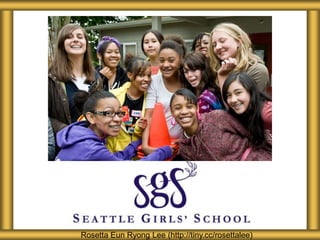
About Seattle Girls’ School
Rosetta Eun Ryong Lee (http://tiny.cc/rosettalee)
Agenda
 Cultural Competency
 Communication Across Culture
 Communication Across Power
 Microaggressions
 Navigating Microaggressions
Rosetta Eun Ryong Lee (http://tiny.cc/rosettalee)
Getting the Most Out of Today
Apply Growth Mindset
Ask Questions
Participate Fully
Use Technology to Help You Engage
Visit Website After
Rosetta Eun Ryong Lee (http://tiny.cc/rosettalee)
Safety versus Comfort
Safety: I feel that, in this space, I can ask questions without
fear of judgment. I can voice my perspective and know that
I will be validated for the fact that that is my truth. Others
may challenge my ideas, but that challenge is in the spirit of
greater shared understanding and growth.
Comfort: I feel that, in this space, my reality will be agreed
with, validated, and unchallenged. I don’t have to explain
myself to be understood, and I don’t have to justify my
perspective, as everyone shares it.
True dialogue happens in an environment where everyone is
safe but not always comfortable...
SO THAT THEY CAN LEARN AND GROW.
Rosetta Eun Ryong Lee (http://tiny.cc/rosettalee)
Safe Spaces 2.0 – Brave Spaces
 Controversy with Civility
 Own your own intent and impact
 Challenge by choice – with reflection
 Respect in all its multiplicity
 No personal attacks, but pointed
challenges are okay
 Be mindful of the true source of your
emotions
Rosetta Eun Ryong Lee (http://tiny.cc/rosettalee)
Culture [consists] primarily of the
symbolic, ideational, and intangible
aspects of human societies… It is the
values, symbols, interpretations, and
perspectives that distinguish one
people from another.
James A. Banks
What is Culture?
Rosetta Eun Ryong Lee (http://tiny.cc/rosettalee)
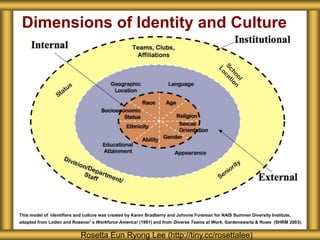
Dimensions of Identity and Culture
This model of identifiers and culture was created by Karen Bradberry and Johnnie Foreman for NAIS Summer Diversity Institute,
adapted from Loden and Rosener’s Workforce America! (1991) and from Diverse Teams at Work, Gardenswartz & Rowe (SHRM 2003).
Rosetta Eun Ryong Lee (http://tiny.cc/rosettalee)
Cultural Competency
Cultural competence is a set of
congruent behaviors, attitudes and
policies that come together in a
system, institution or individual and
enable that system, institution or
individual to work effectively in cross-
cultural situations.
Rosetta Eun Ryong Lee (http://tiny.cc/rosettalee)
Terry Cross
Rosetta Eun Ryong Lee (http://tiny.cc/rosettalee)
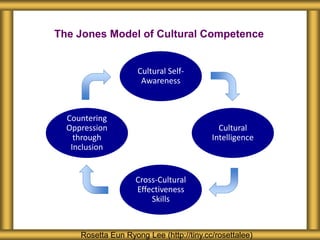
The Jones Model of Cultural Competence
Cultural Self-
Awareness
Cultural
Intelligence
Cross-Cultural
Effectiveness
Skills
Countering
Oppression
through
Inclusion
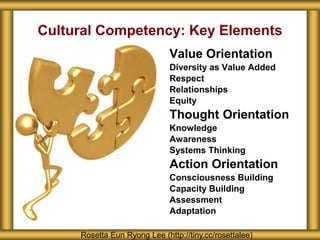
Cultural Competency: Key Elements
Value Orientation
Diversity as Value Added
Respect
Relationships
Equity
Thought Orientation
Knowledge
Awareness
Systems Thinking
Action Orientation
Consciousness Building
Capacity Building
Assessment
Adaptation
Rosetta Eun Ryong Lee (http://tiny.cc/rosettalee)
 What is it?
 How is it Different from Intercultural
Communication?
 CCC Theories
– Face-Negotiation Theory
– Conversational Constraints Theory
– Expectancy Violation Theory
– Anxiety/Uncertainty Management Theory
– Communication Accommodation Theory
Cross Cultural Communication
Rosetta Eun Ryong Lee (http://tiny.cc/rosettalee)
Individual - Collectivistic
Low Context - High Context
Task - Relationship
Low Uncertainty - High Uncertainty
Vertical - Horizontal
Dimensions of Variability
Rosetta Eun Ryong Lee (http://tiny.cc/rosettalee)
Discussion: My Style
In hearing about
communication
differences, what would
you describe as your
cultural communication
style? Have you noticed
stark differences
compared to others?
Rosetta Eun Ryong Lee (http://tiny.cc/rosettalee)
 Personality Orientation
 Individual Values
- Allocentric
- Idiocentric
 Self Construal
- Independent
- Interdependent
 Individual Socialization
 Cultural Norms and Rules
Factors that Influence
Rosetta Eun Ryong Lee (http://tiny.cc/rosettalee)
Cultural Values
Norms, and Rules
 Values
 Value Priorities
 Norms of Behavior
 Non-Verbal
Communication
Rosetta Eun Ryong Lee (http://tiny.cc/rosettalee)
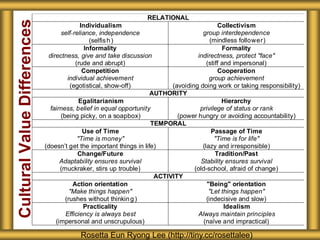
CulturalValueDifferences
RELATIONAL
Individualism
self-reliance, independence
(selfish)
Collectivism
group interdependence
(mindless follower)
Informality
directness, give and take discussion
(rude and abrupt)
Formality
indirectness, protect "face"
(stiff and impersonal)
Competition
individual achievement
(egotistical, show-off)
Cooperation
group achievement
(avoiding doing work or taking responsibility)
AUTHORITY
Egalitarianism
fairness, belief in equal opportunity
(being picky, on a soapbox)
Hierarchy
privilege of status or rank
(power hungry or avoiding accountability)
TEMPORAL
Use of Time
"Time is money"
(doesn’t get the important things in life)
Passage of Time
"Time is for life"
(lazy and irresponsible)
Change/Future
Adaptability ensures survival
(muckraker, stirs up trouble)
Tradition/Past
Stability ensures survival
(old-school, afraid of change)
ACTIVITY
Action orientation
"Make things happen"
(rushes without thinking)
"Being" orientation
"Let things happen"
(indecisive and slow)
Practicality
Efficiency is always best
(impersonal and unscrupulous)
Idealism
Always maintain principles
(naïve and impractical)
Rosetta Eun Ryong Lee (http://tiny.cc/rosettalee)
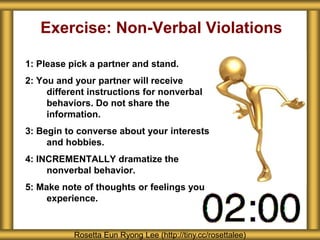
Exercise: Non-Verbal Violations
1: Please pick a partner and stand.
2: You and your partner will receive
different instructions for nonverbal
behaviors. Do not share the
information.
3: Begin to converse about your interests
and hobbies.
4: INCREMENTALLY dramatize the
nonverbal behavior.
5: Make note of thoughts or feelings you
experience.
Rosetta Eun Ryong Lee (http://tiny.cc/rosettalee)
Non-Verbal Violations: Partner 1
You signal respect by standing
physically close to your partner. Stand
Approximately 6 inches away from
your partner. You enjoy asking a lot
of questions to signal conversational
excitement and involvement. You also
like to touch your partner's arm from
time-to-time to signal approval for a
good idea.
Rosetta Eun Ryong Lee (http://tiny.cc/rosettalee)
Non-Verbal Violations: Partner 2
You signal respect by standing at
least an arm's length away from your
partner. You constantly check your
watch or the clock for fear of running
out of time in the conversation. You
also like to make loud sounds (ahs,
oohs, uh-huhs, sighs, etc.) to signal
your approval and great contentment
of the conversation.
Rosetta Eun Ryong Lee (http://tiny.cc/rosettalee)
Debrief: Nonverbal Violations
Did the INTENT of your described
behaviors allow you to display
them more enthusiastically?
What was the IMPACT of the
behaviors of your partner?
Did knowing that “odd” behaviors
may be part of the exercise
help you accept your partner’s
behavior?
In working with people from
various communities, what do
you take away from this
exercise?
Rosetta Eun Ryong Lee (http://tiny.cc/rosettalee)
Break
Rosetta Eun Ryong Lee (http://tiny.cc/rosettalee)
Identifiers, Power,
and Communication
Internalized Oppression/Dominance
Stereotype Threat
Accumulated Impact/
Microaggressions
Code/Mode Switching
Fish Seeing the Water
“Normal” versus “Good”
“Intent” versus “Impact”
Rosetta Eun Ryong Lee (http://tiny.cc/rosettalee)
Discussion: Conflict Re-understood
Think about a conflict or interaction which
you now know to be at heart an identity
and power difference. Using some of the
terminology introduced, discuss with a
partner or group of three what was going
on to cause the conflict.
Rosetta Eun Ryong Lee (http://tiny.cc/rosettalee)
So What? Now What?
Rosetta Eun Ryong Lee (http://tiny.cc/rosettalee)
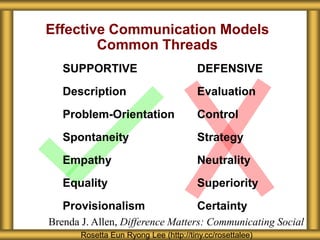
Effective Communication Models
Common Threads
Brenda J. Allen, Difference Matters: Communicating Social Ide
SUPPORTIVE DEFENSIVE
Description Evaluation
Problem-Orientation Control
Spontaneity Strategy
Empathy Neutrality
Equality Superiority
Provisionalism Certainty
Rosetta Eun Ryong Lee (http://tiny.cc/rosettalee)
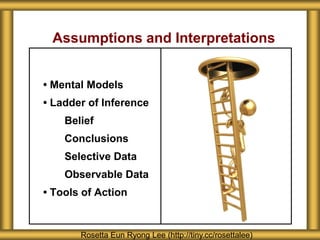
Assumptions and Interpretations
• Mental Models
• Ladder of Inference
Belief
Conclusions
Selective Data
Observable Data
• Tools of Action
Rosetta Eun Ryong Lee (http://tiny.cc/rosettalee)
1. What did you see/hear (raw data)?
2. What are your personal filters (cultural
values, norms, and identifiers)?
3. What was your interpretation of what you
saw/heard (inference)?
4. How did you feel as a result?
5. What do you want?
Checking Assumptions and
Interpretations: Steps to Analyze
Rosetta Eun Ryong Lee (http://tiny.cc/rosettalee)
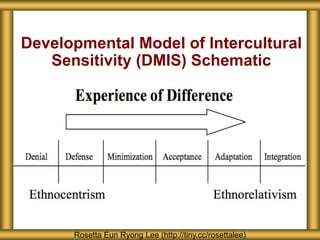
Developmental Model of Intercultural
Sensitivity (DMIS) Schematic
Rosetta Eun Ryong Lee (http://tiny.cc/rosettalee)
1. How do you see materials
from this morning applying
to your roles?
2. What questions do you still
have?
3. What are your personal action
steps?
Discussion:
How Will I Apply All This?
Rosetta Eun Ryong Lee (http://tiny.cc/rosettalee)
Lunch
until
1:15 pm
Rosetta Eun Ryong Lee (http://tiny.cc/rosettalee)
Process
Process
Check
Rosetta Eun Ryong Lee (http://tiny.cc/rosettalee)
 Microassaults
– Explicit
– Conscious and Deliberate
– Backstage Spaces
 Microinsults
– Hidden
– Often Unknown or Unintended
– Frontstage Spaces
 Microinvalidation
Zooming In: Microaggressions
Rosetta Eun Ryong Lee (http://tiny.cc/rosettalee)
 Alien in Own Land
 Ascription of Intelligence
 Colorblindness
 Criminality/Assumption of Criminal Status
 Denial of Individual Racism
 Myth of Meritocracy
 Pathologizing Cultural Values/Styles
 Second-Class Citizen
 Environmental
Microaggressions/Macroaggressions
Racial Microaggressions
Rosetta Eun Ryong Lee (http://tiny.cc/rosettalee)
Caucus Groups
 Think about your various identities, and which
ones hold much importance to you.
 Which one of your identities do you feel most
moved to advocate for and educate around?
 You will be answering the following prompts:
– What we never want people to say, think, or
do towards our group is…
– What we want you to know about our group
is…
Rosetta Eun Ryong Lee (http://tiny.cc/rosettalee)
National Coalition Building Institute, Seattle Chapter, “Building Bridges Workshop,” Adapted by Rosetta Eun Ryong Lee
Caucus Groups Formation
 Groups Identified
 Locations Assigned
 Caucus Groups
Meeting Time
 Caucus Group
Report Outs
Rosetta Eun Ryong Lee (http://tiny.cc/rosettalee)
To Keep in Mind:
 Write down all answers to prompts.
 Think about which items you’d like to
share with the larger group.
 Everyone in the group is invited to stand
together.
 Decide who will share items and how.
Rosetta Eun Ryong Lee (http://tiny.cc/rosettalee)
Caucus Groups/Locales:
 Working Moms (Patio)
 Bi/Multicultural (Colonnade)
 Female Teachers (Here)
 Infertility (Outside)
 Single Parent (Outside)
 Female Scientist/Mathematician (Fireplace)
 Older Professionals (Outside)
 Stay at Home Mom (Outside)
 Latino/a (Window by Senior Area)
 Seniors (Commons)
– What we never want people to say, think, or do
towards our group is…
– What we want you to know about our group is…
Rosetta Eun Ryong Lee (http://tiny.cc/rosettalee)
Caucus Group Report Outs
Rosetta Eun Ryong Lee (http://tiny.cc/rosettalee)
Debrief: Caucus Groups
1. What information was new,
informative, moving, etc. to
you?
2. How does this information
change what you will think or
do in the future?
3. What action can you take to
become a better advocate for
yourself?
4. What action can you take to
become a better ally for
others?
Rosetta Eun Ryong Lee (http://tiny.cc/rosettalee)
Break
Rosetta Eun Ryong Lee (http://tiny.cc/rosettalee)
Navigating Microaggressions
Rosetta Eun Ryong Lee (http://tiny.cc/rosettalee)
Please
Return by
2:40 pm
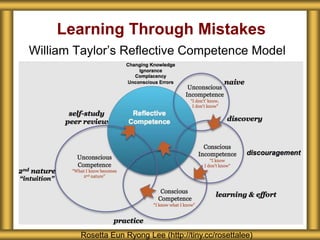
Learning Through Mistakes
William Taylor’s Reflective Competence Model
Rosetta Eun Ryong Lee (http://tiny.cc/rosettalee)
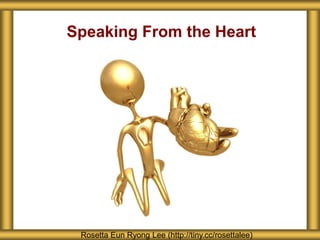
Speaking From the Heart
Rosetta Eun Ryong Lee (http://tiny.cc/rosettalee)
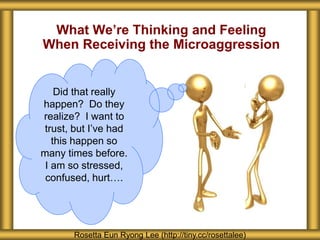
What We’re Thinking and Feeling
When Receiving the Microaggression
Rosetta Eun Ryong Lee (http://tiny.cc/rosettalee)
Did that really
happen? Do they
realize? I want to
trust, but I’ve had
this happen so
many times before.
I am so stressed,
confused, hurt….
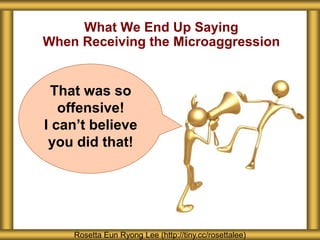
What We End Up Saying
When Receiving the Microaggression
Rosetta Eun Ryong Lee (http://tiny.cc/rosettalee)
That was so
offensive!
I can’t believe
you did that!
Be A DEAR….
Rosetta Eun Ryong Lee (http://tiny.cc/rosettalee)
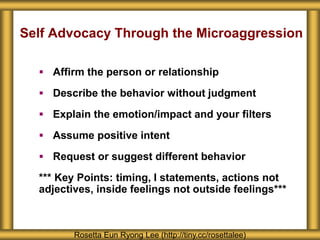
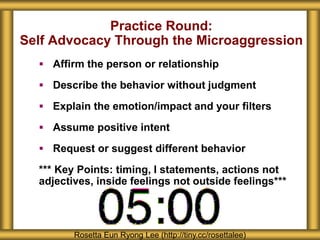
Self Advocacy Through the Microaggression
 Affirm the person or relationship
 Describe the behavior without judgment
 Explain the emotion/impact and your filters
 Assume positive intent
 Request or suggest different behavior
*** Key Points: timing, I statements, actions not
adjectives, inside feelings not outside feelings***
Rosetta Eun Ryong Lee (http://tiny.cc/rosettalee)
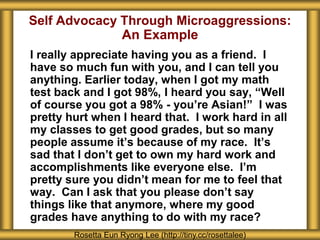
Self Advocacy Through Microaggressions:
An Example
I really appreciate having you as a friend. I
have so much fun with you, and I can tell you
anything. Earlier today, when I got my math
test back and I got 98%, I heard you say, “Well
of course you got a 98% - you’re Asian!” I was
pretty hurt when I heard that. I work hard in all
my classes to get good grades, but so many
people assume it’s because of my race. It’s
sad that I don’t get to own my hard work and
accomplishments like everyone else. I’m
pretty sure you didn’t mean for me to feel that
way. Can I ask that you please don’t say
things like that anymore, where my good
grades have anything to do with my race?
Rosetta Eun Ryong Lee (http://tiny.cc/rosettalee)
Practice Round:
Self Advocacy Through the Microaggression
 Affirm the person or relationship
 Describe the behavior without judgment
 Explain the emotion/impact and your filters
 Assume positive intent
 Request or suggest different behavior
*** Key Points: timing, I statements, actions not
adjectives, inside feelings not outside feelings***
Rosetta Eun Ryong Lee (http://tiny.cc/rosettalee)
Being A Witness
Rosetta Eun Ryong Lee (http://tiny.cc/rosettalee)
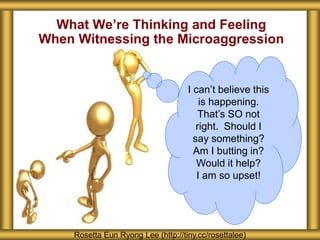
What We’re Thinking and Feeling
When Witnessing the Microaggression
Rosetta Eun Ryong Lee (http://tiny.cc/rosettalee)
I can’t believe this
is happening.
That’s SO not
right. Should I
say something?
Am I butting in?
Would it help?
I am so upset!
What We End Up Saying
When Witnessing the Microaggression
Rosetta Eun Ryong Lee (http://tiny.cc/rosettalee)
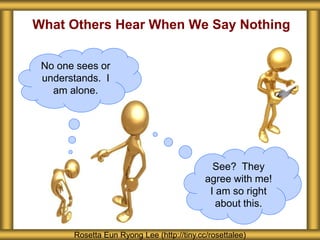
What Others Hear When We Say Nothing
Rosetta Eun Ryong Lee (http://tiny.cc/rosettalee)
See? They
agree with me!
I am so right
about this.
No one sees or
understands. I
am alone.
They were born
innocent…
Rosetta Eun Ryong Lee (http://tiny.cc/rosettalee)
NCBI Effective
Interventions Model
 Reduce Defensiveness
– Tone
– Body Language
– Respect
 Keep the Conversation Going
– Hear Them Out
– Ask Open-Ended Questions
– Set Aside Your Feeling for the Moment
– Dialogue
 Build the Relationship
 Stop the Behavior
 Win an Ally
Rosetta Eun Ryong Lee (http://tiny.cc/rosettalee)
Say Something to Somebody
 Now or Later (or Say It Now About a Later)
 Target, Agent, Fellow Bystanders, Authority Figures
“In the End, we will remember not the words of
our enemies, but the silence of our friends.”
Martin Luther King, Jr.
Rosetta Eun Ryong Lee (http://tiny.cc/rosettalee)
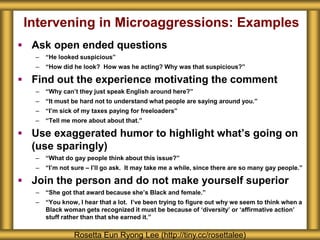
Intervening in Microaggressions: Examples
 Ask open ended questions
– “He looked suspicious”
– “How did he look? How was he acting? Why was that suspicious?”
 Find out the experience motivating the comment
– “Why can’t they just speak English around here?”
– “It must be hard not to understand what people are saying around you.”
– “I’m sick of my taxes paying for freeloaders”
– “Tell me more about about that.”
 Use exaggerated humor to highlight what’s going on
(use sparingly)
– “What do gay people think about this issue?”
– “I’m not sure – I’ll go ask. It may take me a while, since there are so many gay people.”
 Join the person and do not make yourself superior
– “She got that award because she’s Black and female.”
– “You know, I hear that a lot. I’ve been trying to figure out why we seem to think when a
Black woman gets recognized it must be because of ‘diversity’ or ‘affirmative action’
stuff rather than that she earned it.”
Rosetta Eun Ryong Lee (http://tiny.cc/rosettalee)
Practice Round:
Intervening in Microaggressions
 Ask open ended questions
 Find out the experience motivating the comment
 Use exaggerated humor to highlight what’s going
on (use sparingly)
 Join the person and do not make yourself superior
Rosetta Eun Ryong Lee (http://tiny.cc/rosettalee)
Listening to the Real Message
Rosetta Eun Ryong Lee (http://tiny.cc/rosettalee)
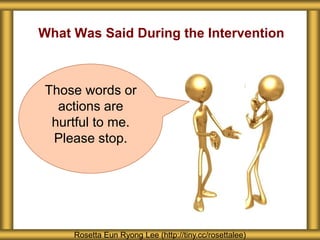
What Was Said During the Intervention
Rosetta Eun Ryong Lee (http://tiny.cc/rosettalee)
Those words or
actions are
hurtful to me.
Please stop.
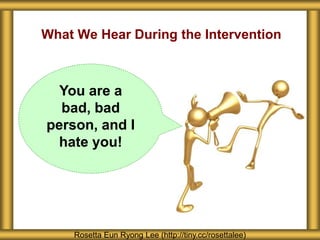
What We Hear During the Intervention
Rosetta Eun Ryong Lee (http://tiny.cc/rosettalee)
You are a
bad, bad
person, and I
hate you!
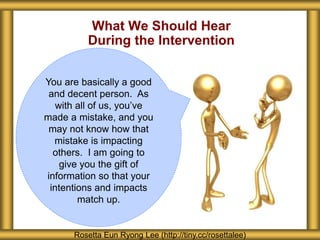
What We Should Hear
During the Intervention
Rosetta Eun Ryong Lee (http://tiny.cc/rosettalee)
You are basically a good
and decent person. As
with all of us, you’ve
made a mistake, and you
may not know how that
mistake is impacting
others. I am going to
give you the gift of
information so that your
intentions and impacts
match up.
It’s a gift…
Rosetta Eun Ryong Lee (http://tiny.cc/rosettalee)
When You’re Told About
the Microaggressive Impact You Created
 Listen with full attention
 Don’t try to defend or respond right away
– Take deep breaths
– Acknowledge your feelings
 Your mistakes don’t define you
– Be worthy of their trust and gift
 Prioritize the Impact over Intent
– Apologize for real
*** Moving through these moments with grace is
called shame resilience. It’s a vital skill***
Rosetta Eun Ryong Lee (http://tiny.cc/rosettalee)
When You’re Told About
the Microaggressive Impact You Created:
Examples
Rosetta Eun Ryong Lee (http://tiny.cc/rosettalee)
 “I really appreciate your telling me this.”
 “I’m so embarrassed that I did that.”
 “I’m so sorry my words and actions made you feel
that way. No matter what I intended, it hurt you.”
 “I’m pretty overwhelmed right now, and I don’t
want to respond in a way I’d regret. Do you think
you can help me come up with a better way to
handle that situation after I take a few minutes?”
 “I wanted to go back to a moment I don’t think I
handled very well… Can we talk?”
Discussion Round:
When You’re Told About
the Microaggressive Impact You Created
 Listen with full attention
 Don’t try to defend or respond right away
– Take deep breaths
– Acknowledge your feelings
 Your mistakes don’t define you
– Be worthy of their trust and gift
 Prioritize the Impact over Intent
– Apologize for real
Rosetta Eun Ryong Lee (http://tiny.cc/rosettalee)
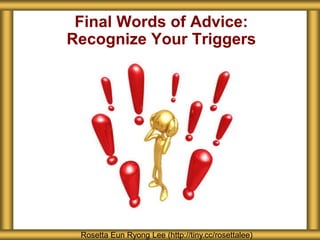
Final Words of Advice:
Recognize Your Triggers
Rosetta Eun Ryong Lee (http://tiny.cc/rosettalee)
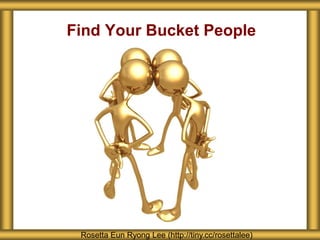
Find Your Bucket People
Rosetta Eun Ryong Lee (http://tiny.cc/rosettalee)
Practice Makes
Less Freeze-Ups
Rosetta Eun Ryong Lee (http://tiny.cc/rosettalee)
If You Messed Up and You Know It,
Don’t Wait for the Intervention –
Just Apologize
Rosetta Eun Ryong Lee (http://tiny.cc/rosettalee)
If You’re Really Sorry,
Work to Improve
Rosetta Eun Ryong Lee (http://tiny.cc/rosettalee)
Build Authentic Relationships
Rosetta Eun Ryong Lee (http://tiny.cc/rosettalee)
Inclusive Communities
Rosetta Eun Ryong Lee (http://tiny.cc/rosettalee)
Presenter Information
Rosetta Eun Ryong Lee
6th Faculty and
Professional Outreach
Seattle Girls’ School
2706 S Jackson Street
Seattle WA 98144
(206) 805-6562
rlee@seattlegirlsschool.org
http://tiny.cc/rosettalee
Rosetta Eun Ryong Lee (http://tiny.cc/rosettalee)
Communication Resources
• “Stereotype Threat” by Joshua Aronson
• Brenda J. Allen, Difference Matters: Communicating
Social Identity
• William Gudykunst, Cross-Cultural and Intercultural
Comunication
• Milton Bennett, PhD, Intercultural Communication
Institute www.intercultural.org
• “Non-Verbal Communication Across Cultures” by Erica
Hagen, Intercultural Communication Resources
• Thiagi.com
• Thrive! Team Dynamics
• http://www.analytictech.com/mb021/action_science_
history.htm
Rosetta Eun Ryong Lee (http://tiny.cc/rosettalee)
Courageous Conversation Resources
• Anti-Defamation League
• Brené Brown
• Cross Cultural Connections
(www.CulturesConnecting.com)
• National Coalition Building Institute
• The People’s Institute
• Stirfry Seminars
• Teaching Tolerance
• The Thiagi Group
Rosetta Eun Ryong Lee (http://tiny.cc/rosettalee)
Miscellaneous Resources
• Karen Bradberry and Johnnie Foreman, “Privilege and
Power,” Summer Diversity Institute, National Association
of Independent Schools, 2009
• Po Bronson and Ashley Merryman, Nurture Shock
• Kevin Jennings, GLSEN (Gay Lesbian and Straight Education
Network) www.glsen.org
• Allan G. Johnson, Privilege, Power, and Difference
• Johnnie McKinley, “Leveling the Playing Field and Raising
African American Students’ Achievement in Twenty-nine
Urban Classrooms,” New Horizons for Learning,
http://www.newhorizons.org/strategies/differentiated/
mckinley.htm
Michael J Nakkula and Eric Toshalis, Understanding Youth.
Rosetta Eun Ryong Lee (http://tiny.cc/rosettalee)

JBS In Service 2017 Day One

  • 1.
    John Burroughs School RosettaEun Ryong Lee Seattle Girls’ School Effective Communication: Cross Cultural Communication, Microaggressions, and Navigating Microaggressions Rosetta Eun Ryong Lee (http://tiny.cc/rosettalee)
  • 2.
    About Seattle Girls’School Rosetta Eun Ryong Lee (http://tiny.cc/rosettalee)
  • 3.
    Agenda  Cultural Competency Communication Across Culture  Communication Across Power  Microaggressions  Navigating Microaggressions Rosetta Eun Ryong Lee (http://tiny.cc/rosettalee)
  • 4.
    Getting the MostOut of Today Apply Growth Mindset Ask Questions Participate Fully Use Technology to Help You Engage Visit Website After Rosetta Eun Ryong Lee (http://tiny.cc/rosettalee)
  • 5.
    Safety versus Comfort Safety:I feel that, in this space, I can ask questions without fear of judgment. I can voice my perspective and know that I will be validated for the fact that that is my truth. Others may challenge my ideas, but that challenge is in the spirit of greater shared understanding and growth. Comfort: I feel that, in this space, my reality will be agreed with, validated, and unchallenged. I don’t have to explain myself to be understood, and I don’t have to justify my perspective, as everyone shares it. True dialogue happens in an environment where everyone is safe but not always comfortable... SO THAT THEY CAN LEARN AND GROW. Rosetta Eun Ryong Lee (http://tiny.cc/rosettalee)
  • 6.
    Safe Spaces 2.0– Brave Spaces  Controversy with Civility  Own your own intent and impact  Challenge by choice – with reflection  Respect in all its multiplicity  No personal attacks, but pointed challenges are okay  Be mindful of the true source of your emotions Rosetta Eun Ryong Lee (http://tiny.cc/rosettalee)
  • 7.
    Culture [consists] primarilyof the symbolic, ideational, and intangible aspects of human societies… It is the values, symbols, interpretations, and perspectives that distinguish one people from another. James A. Banks What is Culture? Rosetta Eun Ryong Lee (http://tiny.cc/rosettalee)
  • 8.
    Dimensions of Identityand Culture This model of identifiers and culture was created by Karen Bradberry and Johnnie Foreman for NAIS Summer Diversity Institute, adapted from Loden and Rosener’s Workforce America! (1991) and from Diverse Teams at Work, Gardenswartz & Rowe (SHRM 2003). Rosetta Eun Ryong Lee (http://tiny.cc/rosettalee)
  • 9.
    Cultural Competency Cultural competenceis a set of congruent behaviors, attitudes and policies that come together in a system, institution or individual and enable that system, institution or individual to work effectively in cross- cultural situations. Rosetta Eun Ryong Lee (http://tiny.cc/rosettalee) Terry Cross
  • 10.
    Rosetta Eun RyongLee (http://tiny.cc/rosettalee) The Jones Model of Cultural Competence Cultural Self- Awareness Cultural Intelligence Cross-Cultural Effectiveness Skills Countering Oppression through Inclusion
  • 11.
    Cultural Competency: KeyElements Value Orientation Diversity as Value Added Respect Relationships Equity Thought Orientation Knowledge Awareness Systems Thinking Action Orientation Consciousness Building Capacity Building Assessment Adaptation Rosetta Eun Ryong Lee (http://tiny.cc/rosettalee)
  • 12.
     What isit?  How is it Different from Intercultural Communication?  CCC Theories – Face-Negotiation Theory – Conversational Constraints Theory – Expectancy Violation Theory – Anxiety/Uncertainty Management Theory – Communication Accommodation Theory Cross Cultural Communication Rosetta Eun Ryong Lee (http://tiny.cc/rosettalee)
  • 13.
    Individual - Collectivistic LowContext - High Context Task - Relationship Low Uncertainty - High Uncertainty Vertical - Horizontal Dimensions of Variability Rosetta Eun Ryong Lee (http://tiny.cc/rosettalee)
  • 14.
    Discussion: My Style Inhearing about communication differences, what would you describe as your cultural communication style? Have you noticed stark differences compared to others? Rosetta Eun Ryong Lee (http://tiny.cc/rosettalee)
  • 15.
     Personality Orientation Individual Values - Allocentric - Idiocentric  Self Construal - Independent - Interdependent  Individual Socialization  Cultural Norms and Rules Factors that Influence Rosetta Eun Ryong Lee (http://tiny.cc/rosettalee)
  • 16.
    Cultural Values Norms, andRules  Values  Value Priorities  Norms of Behavior  Non-Verbal Communication Rosetta Eun Ryong Lee (http://tiny.cc/rosettalee)
  • 17.
    CulturalValueDifferences RELATIONAL Individualism self-reliance, independence (selfish) Collectivism group interdependence (mindlessfollower) Informality directness, give and take discussion (rude and abrupt) Formality indirectness, protect "face" (stiff and impersonal) Competition individual achievement (egotistical, show-off) Cooperation group achievement (avoiding doing work or taking responsibility) AUTHORITY Egalitarianism fairness, belief in equal opportunity (being picky, on a soapbox) Hierarchy privilege of status or rank (power hungry or avoiding accountability) TEMPORAL Use of Time "Time is money" (doesn’t get the important things in life) Passage of Time "Time is for life" (lazy and irresponsible) Change/Future Adaptability ensures survival (muckraker, stirs up trouble) Tradition/Past Stability ensures survival (old-school, afraid of change) ACTIVITY Action orientation "Make things happen" (rushes without thinking) "Being" orientation "Let things happen" (indecisive and slow) Practicality Efficiency is always best (impersonal and unscrupulous) Idealism Always maintain principles (naïve and impractical) Rosetta Eun Ryong Lee (http://tiny.cc/rosettalee)
  • 18.
    Exercise: Non-Verbal Violations 1:Please pick a partner and stand. 2: You and your partner will receive different instructions for nonverbal behaviors. Do not share the information. 3: Begin to converse about your interests and hobbies. 4: INCREMENTALLY dramatize the nonverbal behavior. 5: Make note of thoughts or feelings you experience. Rosetta Eun Ryong Lee (http://tiny.cc/rosettalee)
  • 19.
    Non-Verbal Violations: Partner1 You signal respect by standing physically close to your partner. Stand Approximately 6 inches away from your partner. You enjoy asking a lot of questions to signal conversational excitement and involvement. You also like to touch your partner's arm from time-to-time to signal approval for a good idea. Rosetta Eun Ryong Lee (http://tiny.cc/rosettalee)
  • 20.
    Non-Verbal Violations: Partner2 You signal respect by standing at least an arm's length away from your partner. You constantly check your watch or the clock for fear of running out of time in the conversation. You also like to make loud sounds (ahs, oohs, uh-huhs, sighs, etc.) to signal your approval and great contentment of the conversation. Rosetta Eun Ryong Lee (http://tiny.cc/rosettalee)
  • 21.
    Debrief: Nonverbal Violations Didthe INTENT of your described behaviors allow you to display them more enthusiastically? What was the IMPACT of the behaviors of your partner? Did knowing that “odd” behaviors may be part of the exercise help you accept your partner’s behavior? In working with people from various communities, what do you take away from this exercise? Rosetta Eun Ryong Lee (http://tiny.cc/rosettalee)
  • 22.
    Break Rosetta Eun RyongLee (http://tiny.cc/rosettalee)
  • 23.
    Identifiers, Power, and Communication InternalizedOppression/Dominance Stereotype Threat Accumulated Impact/ Microaggressions Code/Mode Switching Fish Seeing the Water “Normal” versus “Good” “Intent” versus “Impact” Rosetta Eun Ryong Lee (http://tiny.cc/rosettalee)
  • 24.
    Discussion: Conflict Re-understood Thinkabout a conflict or interaction which you now know to be at heart an identity and power difference. Using some of the terminology introduced, discuss with a partner or group of three what was going on to cause the conflict. Rosetta Eun Ryong Lee (http://tiny.cc/rosettalee)
  • 25.
    So What? NowWhat? Rosetta Eun Ryong Lee (http://tiny.cc/rosettalee)
  • 26.
    Effective Communication Models CommonThreads Brenda J. Allen, Difference Matters: Communicating Social Ide SUPPORTIVE DEFENSIVE Description Evaluation Problem-Orientation Control Spontaneity Strategy Empathy Neutrality Equality Superiority Provisionalism Certainty Rosetta Eun Ryong Lee (http://tiny.cc/rosettalee)
  • 27.
    Assumptions and Interpretations •Mental Models • Ladder of Inference Belief Conclusions Selective Data Observable Data • Tools of Action Rosetta Eun Ryong Lee (http://tiny.cc/rosettalee)
  • 28.
    1. What didyou see/hear (raw data)? 2. What are your personal filters (cultural values, norms, and identifiers)? 3. What was your interpretation of what you saw/heard (inference)? 4. How did you feel as a result? 5. What do you want? Checking Assumptions and Interpretations: Steps to Analyze Rosetta Eun Ryong Lee (http://tiny.cc/rosettalee)
  • 29.
    Developmental Model ofIntercultural Sensitivity (DMIS) Schematic Rosetta Eun Ryong Lee (http://tiny.cc/rosettalee)
  • 30.
    1. How doyou see materials from this morning applying to your roles? 2. What questions do you still have? 3. What are your personal action steps? Discussion: How Will I Apply All This? Rosetta Eun Ryong Lee (http://tiny.cc/rosettalee)
  • 31.
    Lunch until 1:15 pm Rosetta EunRyong Lee (http://tiny.cc/rosettalee)
  • 32.
    Process Process Check Rosetta Eun RyongLee (http://tiny.cc/rosettalee)
  • 33.
     Microassaults – Explicit –Conscious and Deliberate – Backstage Spaces  Microinsults – Hidden – Often Unknown or Unintended – Frontstage Spaces  Microinvalidation Zooming In: Microaggressions Rosetta Eun Ryong Lee (http://tiny.cc/rosettalee)
  • 34.
     Alien inOwn Land  Ascription of Intelligence  Colorblindness  Criminality/Assumption of Criminal Status  Denial of Individual Racism  Myth of Meritocracy  Pathologizing Cultural Values/Styles  Second-Class Citizen  Environmental Microaggressions/Macroaggressions Racial Microaggressions Rosetta Eun Ryong Lee (http://tiny.cc/rosettalee)
  • 35.
    Caucus Groups  Thinkabout your various identities, and which ones hold much importance to you.  Which one of your identities do you feel most moved to advocate for and educate around?  You will be answering the following prompts: – What we never want people to say, think, or do towards our group is… – What we want you to know about our group is… Rosetta Eun Ryong Lee (http://tiny.cc/rosettalee) National Coalition Building Institute, Seattle Chapter, “Building Bridges Workshop,” Adapted by Rosetta Eun Ryong Lee
  • 36.
    Caucus Groups Formation Groups Identified  Locations Assigned  Caucus Groups Meeting Time  Caucus Group Report Outs Rosetta Eun Ryong Lee (http://tiny.cc/rosettalee)
  • 37.
    To Keep inMind:  Write down all answers to prompts.  Think about which items you’d like to share with the larger group.  Everyone in the group is invited to stand together.  Decide who will share items and how. Rosetta Eun Ryong Lee (http://tiny.cc/rosettalee)
  • 38.
    Caucus Groups/Locales:  WorkingMoms (Patio)  Bi/Multicultural (Colonnade)  Female Teachers (Here)  Infertility (Outside)  Single Parent (Outside)  Female Scientist/Mathematician (Fireplace)  Older Professionals (Outside)  Stay at Home Mom (Outside)  Latino/a (Window by Senior Area)  Seniors (Commons) – What we never want people to say, think, or do towards our group is… – What we want you to know about our group is… Rosetta Eun Ryong Lee (http://tiny.cc/rosettalee)
  • 39.
    Caucus Group ReportOuts Rosetta Eun Ryong Lee (http://tiny.cc/rosettalee)
  • 40.
    Debrief: Caucus Groups 1.What information was new, informative, moving, etc. to you? 2. How does this information change what you will think or do in the future? 3. What action can you take to become a better advocate for yourself? 4. What action can you take to become a better ally for others? Rosetta Eun Ryong Lee (http://tiny.cc/rosettalee)
  • 41.
    Break Rosetta Eun RyongLee (http://tiny.cc/rosettalee)
  • 42.
    Navigating Microaggressions Rosetta EunRyong Lee (http://tiny.cc/rosettalee) Please Return by 2:40 pm
  • 43.
    Learning Through Mistakes WilliamTaylor’s Reflective Competence Model Rosetta Eun Ryong Lee (http://tiny.cc/rosettalee)
  • 44.
    Speaking From theHeart Rosetta Eun Ryong Lee (http://tiny.cc/rosettalee)
  • 45.
    What We’re Thinkingand Feeling When Receiving the Microaggression Rosetta Eun Ryong Lee (http://tiny.cc/rosettalee) Did that really happen? Do they realize? I want to trust, but I’ve had this happen so many times before. I am so stressed, confused, hurt….
  • 46.
    What We EndUp Saying When Receiving the Microaggression Rosetta Eun Ryong Lee (http://tiny.cc/rosettalee) That was so offensive! I can’t believe you did that!
  • 47.
    Be A DEAR…. RosettaEun Ryong Lee (http://tiny.cc/rosettalee)
  • 48.
    Self Advocacy Throughthe Microaggression  Affirm the person or relationship  Describe the behavior without judgment  Explain the emotion/impact and your filters  Assume positive intent  Request or suggest different behavior *** Key Points: timing, I statements, actions not adjectives, inside feelings not outside feelings*** Rosetta Eun Ryong Lee (http://tiny.cc/rosettalee)
  • 49.
    Self Advocacy ThroughMicroaggressions: An Example I really appreciate having you as a friend. I have so much fun with you, and I can tell you anything. Earlier today, when I got my math test back and I got 98%, I heard you say, “Well of course you got a 98% - you’re Asian!” I was pretty hurt when I heard that. I work hard in all my classes to get good grades, but so many people assume it’s because of my race. It’s sad that I don’t get to own my hard work and accomplishments like everyone else. I’m pretty sure you didn’t mean for me to feel that way. Can I ask that you please don’t say things like that anymore, where my good grades have anything to do with my race? Rosetta Eun Ryong Lee (http://tiny.cc/rosettalee)
  • 50.
    Practice Round: Self AdvocacyThrough the Microaggression  Affirm the person or relationship  Describe the behavior without judgment  Explain the emotion/impact and your filters  Assume positive intent  Request or suggest different behavior *** Key Points: timing, I statements, actions not adjectives, inside feelings not outside feelings*** Rosetta Eun Ryong Lee (http://tiny.cc/rosettalee)
  • 51.
    Being A Witness RosettaEun Ryong Lee (http://tiny.cc/rosettalee)
  • 52.
    What We’re Thinkingand Feeling When Witnessing the Microaggression Rosetta Eun Ryong Lee (http://tiny.cc/rosettalee) I can’t believe this is happening. That’s SO not right. Should I say something? Am I butting in? Would it help? I am so upset!
  • 53.
    What We EndUp Saying When Witnessing the Microaggression Rosetta Eun Ryong Lee (http://tiny.cc/rosettalee)
  • 54.
    What Others HearWhen We Say Nothing Rosetta Eun Ryong Lee (http://tiny.cc/rosettalee) See? They agree with me! I am so right about this. No one sees or understands. I am alone.
  • 55.
    They were born innocent… RosettaEun Ryong Lee (http://tiny.cc/rosettalee)
  • 56.
    NCBI Effective Interventions Model Reduce Defensiveness – Tone – Body Language – Respect  Keep the Conversation Going – Hear Them Out – Ask Open-Ended Questions – Set Aside Your Feeling for the Moment – Dialogue  Build the Relationship  Stop the Behavior  Win an Ally Rosetta Eun Ryong Lee (http://tiny.cc/rosettalee)
  • 57.
    Say Something toSomebody  Now or Later (or Say It Now About a Later)  Target, Agent, Fellow Bystanders, Authority Figures “In the End, we will remember not the words of our enemies, but the silence of our friends.” Martin Luther King, Jr. Rosetta Eun Ryong Lee (http://tiny.cc/rosettalee)
  • 58.
    Intervening in Microaggressions:Examples  Ask open ended questions – “He looked suspicious” – “How did he look? How was he acting? Why was that suspicious?”  Find out the experience motivating the comment – “Why can’t they just speak English around here?” – “It must be hard not to understand what people are saying around you.” – “I’m sick of my taxes paying for freeloaders” – “Tell me more about about that.”  Use exaggerated humor to highlight what’s going on (use sparingly) – “What do gay people think about this issue?” – “I’m not sure – I’ll go ask. It may take me a while, since there are so many gay people.”  Join the person and do not make yourself superior – “She got that award because she’s Black and female.” – “You know, I hear that a lot. I’ve been trying to figure out why we seem to think when a Black woman gets recognized it must be because of ‘diversity’ or ‘affirmative action’ stuff rather than that she earned it.” Rosetta Eun Ryong Lee (http://tiny.cc/rosettalee)
  • 59.
    Practice Round: Intervening inMicroaggressions  Ask open ended questions  Find out the experience motivating the comment  Use exaggerated humor to highlight what’s going on (use sparingly)  Join the person and do not make yourself superior Rosetta Eun Ryong Lee (http://tiny.cc/rosettalee)
  • 60.
    Listening to theReal Message Rosetta Eun Ryong Lee (http://tiny.cc/rosettalee)
  • 61.
    What Was SaidDuring the Intervention Rosetta Eun Ryong Lee (http://tiny.cc/rosettalee) Those words or actions are hurtful to me. Please stop.
  • 62.
    What We HearDuring the Intervention Rosetta Eun Ryong Lee (http://tiny.cc/rosettalee) You are a bad, bad person, and I hate you!
  • 63.
    What We ShouldHear During the Intervention Rosetta Eun Ryong Lee (http://tiny.cc/rosettalee) You are basically a good and decent person. As with all of us, you’ve made a mistake, and you may not know how that mistake is impacting others. I am going to give you the gift of information so that your intentions and impacts match up.
  • 64.
    It’s a gift… RosettaEun Ryong Lee (http://tiny.cc/rosettalee)
  • 65.
    When You’re ToldAbout the Microaggressive Impact You Created  Listen with full attention  Don’t try to defend or respond right away – Take deep breaths – Acknowledge your feelings  Your mistakes don’t define you – Be worthy of their trust and gift  Prioritize the Impact over Intent – Apologize for real *** Moving through these moments with grace is called shame resilience. It’s a vital skill*** Rosetta Eun Ryong Lee (http://tiny.cc/rosettalee)
  • 66.
    When You’re ToldAbout the Microaggressive Impact You Created: Examples Rosetta Eun Ryong Lee (http://tiny.cc/rosettalee)  “I really appreciate your telling me this.”  “I’m so embarrassed that I did that.”  “I’m so sorry my words and actions made you feel that way. No matter what I intended, it hurt you.”  “I’m pretty overwhelmed right now, and I don’t want to respond in a way I’d regret. Do you think you can help me come up with a better way to handle that situation after I take a few minutes?”  “I wanted to go back to a moment I don’t think I handled very well… Can we talk?”
  • 67.
    Discussion Round: When You’reTold About the Microaggressive Impact You Created  Listen with full attention  Don’t try to defend or respond right away – Take deep breaths – Acknowledge your feelings  Your mistakes don’t define you – Be worthy of their trust and gift  Prioritize the Impact over Intent – Apologize for real Rosetta Eun Ryong Lee (http://tiny.cc/rosettalee)
  • 68.
    Final Words ofAdvice: Recognize Your Triggers Rosetta Eun Ryong Lee (http://tiny.cc/rosettalee)
  • 69.
    Find Your BucketPeople Rosetta Eun Ryong Lee (http://tiny.cc/rosettalee)
  • 70.
    Practice Makes Less Freeze-Ups RosettaEun Ryong Lee (http://tiny.cc/rosettalee)
  • 71.
    If You MessedUp and You Know It, Don’t Wait for the Intervention – Just Apologize Rosetta Eun Ryong Lee (http://tiny.cc/rosettalee)
  • 72.
    If You’re ReallySorry, Work to Improve Rosetta Eun Ryong Lee (http://tiny.cc/rosettalee)
  • 73.
    Build Authentic Relationships RosettaEun Ryong Lee (http://tiny.cc/rosettalee)
  • 74.
    Inclusive Communities Rosetta EunRyong Lee (http://tiny.cc/rosettalee)
  • 75.
    Presenter Information Rosetta EunRyong Lee 6th Faculty and Professional Outreach Seattle Girls’ School 2706 S Jackson Street Seattle WA 98144 (206) 805-6562 rlee@seattlegirlsschool.org http://tiny.cc/rosettalee Rosetta Eun Ryong Lee (http://tiny.cc/rosettalee)
  • 76.
    Communication Resources • “StereotypeThreat” by Joshua Aronson • Brenda J. Allen, Difference Matters: Communicating Social Identity • William Gudykunst, Cross-Cultural and Intercultural Comunication • Milton Bennett, PhD, Intercultural Communication Institute www.intercultural.org • “Non-Verbal Communication Across Cultures” by Erica Hagen, Intercultural Communication Resources • Thiagi.com • Thrive! Team Dynamics • http://www.analytictech.com/mb021/action_science_ history.htm Rosetta Eun Ryong Lee (http://tiny.cc/rosettalee)
  • 77.
    Courageous Conversation Resources •Anti-Defamation League • Brené Brown • Cross Cultural Connections (www.CulturesConnecting.com) • National Coalition Building Institute • The People’s Institute • Stirfry Seminars • Teaching Tolerance • The Thiagi Group Rosetta Eun Ryong Lee (http://tiny.cc/rosettalee)
  • 78.
    Miscellaneous Resources • KarenBradberry and Johnnie Foreman, “Privilege and Power,” Summer Diversity Institute, National Association of Independent Schools, 2009 • Po Bronson and Ashley Merryman, Nurture Shock • Kevin Jennings, GLSEN (Gay Lesbian and Straight Education Network) www.glsen.org • Allan G. Johnson, Privilege, Power, and Difference • Johnnie McKinley, “Leveling the Playing Field and Raising African American Students’ Achievement in Twenty-nine Urban Classrooms,” New Horizons for Learning, http://www.newhorizons.org/strategies/differentiated/ mckinley.htm Michael J Nakkula and Eric Toshalis, Understanding Youth. Rosetta Eun Ryong Lee (http://tiny.cc/rosettalee)