9.1 Introduction.....................................................................................
9.2 Objectives .......................................................................................
9.3 Maria Montessori (1870–1952) ......................................................
9.3.1 Maria Montessori’s Method and Philosophy......................
9.3.2 Prepared Environment ........................................................
9.3.3 Freedom in Education.........................................................
9.3.4 Movement in Education......................................................
9.3.5 Sensory Education and Music.............................................
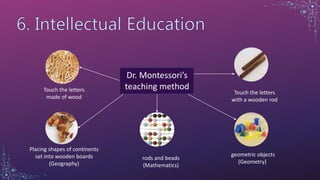
9.3.6 Intellectual Education .........................................................
9.4 Friedrich Froebel (1852–1982) the Birth of Kindergarten .............
9.4.1 Frobel’s Philosophy ............................................................
9.4.2 Frobel’s Concept and Aims of Education...........................
9.4.3 Frobel’s Kindergarten .........................................................
9.4.4 Methods of Teaching in the Kindergarten ..........................
9.4.5 Role of Teacher...................................................................
9.4.6 Inclusion of Nature Study in Curriculum............................
9.4.7 Contribution of Froebel to Educational Theory and Practice
9.5 Helen Parkhurst (1887–1973) Dolton Plan.....................................
9.5.1 Parkhurst’s Philosophy .......................................................
9.5.2 Parkhursts Dolton Plan .......................................................
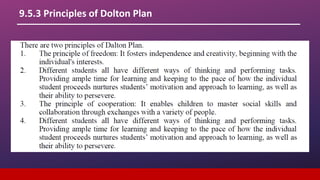
9.5.3 Principles of Dalton Plan ....................................................
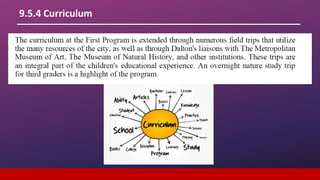
9.5.4 Curriculum..........................................................................
9.5.5 Homework...........................................................................
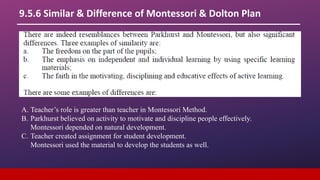
9.5.6 Similarities & Differences between Montessori & Dalton Plan
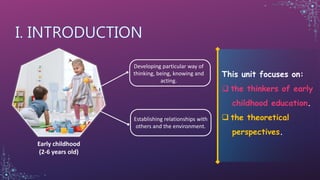
Early childhood
(2-6 years old)
Developing particular way of
thinking, being, knowing and
acting.
Establishing relationships with
others and the environment.
This unit focuses on:
 the thinkers of early
childhood education.
 the theoretical
perspectives.
After our presentation, you will be able to:
1) Understandthe Montessori systemof early childhood
education.
2) Recognize basic elements of Frobel system.
3) ExplainFriere’s Daltonplan.
4) And Evaluate the background and usefulnessof
critical thinking pedagogy.
Biography and facts
• Born: August 31, 1870, Chiaravalle, near Ancona, Italy.
• Died: May 6, 1952, Noordwijk aan Zee, Netherlands
• Family: middle-class with well-educated parents.
• Education: First Italian woman graduated in medicine from
the University of Rome in 1896.
• Work experiences:
1899 – 1901: a director of the State Orthophrenic School of
Rome
1896 – 1906: a chair in hygiene at a women’s college in Rome
1900 – 1907: a lecturer in pedagogy at the University of
Rome
1904 – 1908: a chair in anthropology, also studied philosophy,
psychology, and education
• Founder: The first "Casa Dei Bambini" or the "Children's
House“ ( a preschool for children) in 1907 and then
established over fifty countries.
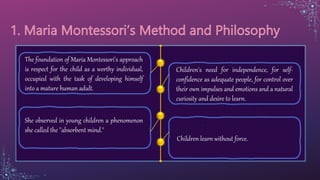
Children's need for independence, for self-
confidence as adequate people, for control over
their own impulses and emotions and a natural
curiosity and desire to learn.
The foundation of Maria Montessori's approach
is respect for the child as a worthy individual,
occupied with the task of developing himself
into a mature human adult.
She observed in young children a phenomenon
she called the "absorbent mind."
Children learn without force.
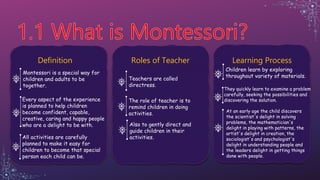
Definition
Montessori is a special way for
children and adults to be
together.
Every aspect of the experience
is planned to help children
become confident, capable,
creative, caring and happy people
who are a delight to be with.
Roles of Teacher
All activities are carefully
planned to make it easy for
children to become that special
person each child can be.
Teachers are called
directress.
The role of teacher is to
remind children in doing
activities.
Also to gently direct and
guide children in their
activities.
Children learn by exploring
throughout variety of materials.
Learning Process
They quickly learn to examine a problem
carefully, seeking the possibilities and
discovering the solution.
At an early age the child discovers
the scientist's delight in solving
problems, the mathematician's
delight in playing with patterns, the
artist's delight in creation, the
sociologist's and psychologist's
delight in understanding people and
the leaders delight in getting things
done with people.
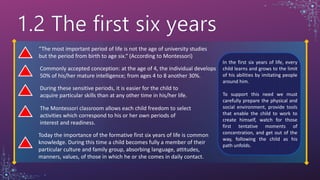
“The most important period of life is not the age of university studies
but the period from birth to age six.“ (According to Montessori)
Commonly accepted conception: at the age of 4, the individual develops
50% of his/her mature intelligence; from ages 4 to 8 another 30%.
During these sensitive periods, it is easier for the child to
acquire particular skills than at any other time in his/her life.
The Montessori classroom allows each child freedom to select
activities which correspond to his or her own periods of
interest and readiness.
Today the importance of the formative first six years of life is common
knowledge. During this time a child becomes fully a member of their
particular culture and family group, absorbing language, attitudes,
manners, values, of those in which he or she comes in daily contact.
In the first six years of life, every
child learns and grows to the limit
of his abilities by imitating people
around him.
To support this need we must
carefully prepare the physical and
social environment, provide tools
that enable the child to work to
create himself, watch for those
first tentative moments of
concentration, and get out of the
way, following the child as his
path unfolds.
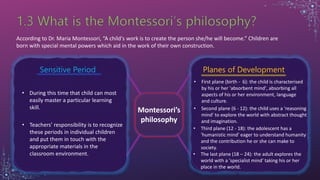
According to Dr. Maria Montessori, “A child's work is to create the person she/he will become.” Children are
born with special mental powers which aid in the work of their own construction.
Montessori’s
philosophy
Sensitive Period Planes of Development
• During this time that child can most
easily master a particular learning
skill.
• Teachers’ responsibility is to recognize
these periods in individual children
and put them in touch with the
appropriate materials in the
classroom environment.
• First plane (birth - 6): the child is characterised
by his or her 'absorbent mind', absorbing all
aspects of his or her environment, language
and culture.
• Second plane (6 - 12): the child uses a 'reasoning
mind' to explore the world with abstract thought
and imagination.
• Third plane (12 - 18): the adolescent has a
'humanistic mind' eager to understand humanity
and the contribution he or she can make to
society.
• The last plane (18 – 24): the adult explores the
world with a 'specialist mind' taking his or her
place in the world.
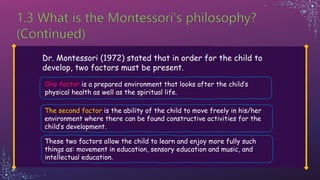
Dr. Montessori (1972) stated that in order for the child to
develop, two factors must be present.
One factor is a prepared environment that looks after the child’s
physical health as well as the spiritual life.
The second factor is the ability of the child to move freely in his/her
environment where there can be found constructive activities for the
child’s development.
These two factors allow the child to learn and enjoy more fully such
things as: movement in education, sensory education and music, and
intellectual education.
• Dr. Maria Montessori (1966) stated that “[a]n adult environment
is not a suitable environment for children” (p. 109).
• Montessori (1912) stated that in order for children to develop
properly, it is necessary to reduce all obstacles around them
to a minimum.
• This included creating the right environment for children indoors
and outdoors.
• For example, the office sized furniture pieces originally placed in
the schoolhouse were too big and too heavy for the little
children.
• Dr. Montessori designed and had manufactured little
furniture such as chairs, tables, washstands and cupboards
that preschool children could use easily.
For the outdoors Dr. Montessori designed
playgrounds and gardens with varieties of
trees and flowers, pathways for children to
take walks, small benches to sit on, and
objects such as hoops to play with.
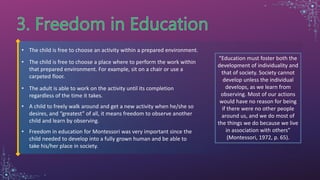
• The child is free to choose an activity within a prepared environment.
• The child is free to choose a place where to perform the work within
that prepared environment. For example, sit on a chair or use a
carpeted floor.
• The adult is able to work on the activity until its completion
regardless of the time it takes.
• A child to freely walk around and get a new activity when he/she so
desires, and “greatest” of all, it means freedom to observe another
child and learn by observing.
• Freedom in education for Montessori was very important since the
child needed to develop into a fully grown human and be able to
take his/her place in society.
“Education must foster both the
development of individuality and
that of society. Society cannot
develop unless the individual
develops, as we learn from
observing. Most of our actions
would have no reason for being
if there were no other people
around us, and we do most of
the things we do because we live
in association with others”
(Montessori, 1972, p. 65).
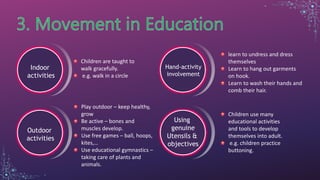
Indoor
activities
Children are taught to
walk gracefully.
e.g. walk in a circle
Outdoor
activities
Play outdoor – keep healthy,
grow
Be active – bones and
muscles develop.
Use free games – ball, hoops,
kites,…
Use educational gymnastics –
taking care of plants and
animals.
Hand-activity
involvement
learn to undress and dress
themselves
Learn to hang out garments
on hook.
Learn to wash their hands and
comb their hair.
Using
genuine
Utensils &
objectives
Children use many
educational activities
and tools to develop
themselves into adult.
e.g. children practice
buttoning.
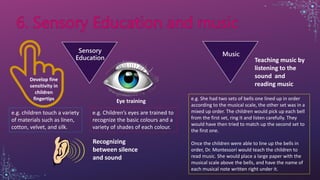
Sensory
Education
Music
Develop fine
sensitivity in
children
fingertips
e.g. children touch a variety
of materials such as linen,
cotton, velvet, and silk.
Eye training
e.g. Children’s eyes are trained to
recognize the basic colours and a
variety of shades of each colour.
Recognizing
between silence
and sound
Teaching music by
listening to the
sound and
reading music
e.g. She had two sets of bells one lined up in order
according to the musical scale, the other set was in a
mixed up order. The children would pick up each bell
from the first set, ring it and listen carefully. They
would have then tried to match up the second set to
the first one.
Once the children were able to line up the bells in
order, Dr. Montessori would teach the children to
read music. She would place a large paper with the
musical scale above the bells, and have the name of
each musical note written right under it.
Dr. Montessori’s
teaching method
Touch the letters
made of wood
Touch the letters
with a wooden rod
Placing shapes of continents
set into wooden boards
(Geography)
rods and beads
(Mathematics)
geometric objects
(Geometry)
4
Friedrich Frobel (1852-1982)
the Birth of Kindergarten
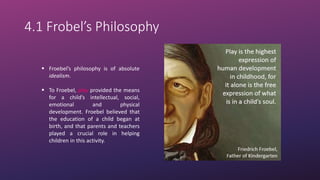
4.1 Frobel’s Philosophy
 Froebel’s philosophy is of absolute
idealism.
 To Froebel, play provided the means
for a child’s intellectual, social,
emotional and physical
development. Froebel believed that
the education of a child began at
birth, and that parents and teachers
played a crucial role in helping
children in this activity.
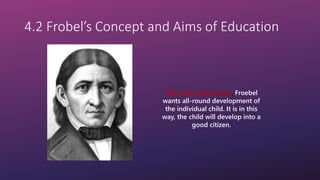
4.2 Frobel’s Concept and Aims of Education
The aims of education, Froebel
wants all-round development of
the individual child. It is in this
way, the child will develop into a
good citizen.
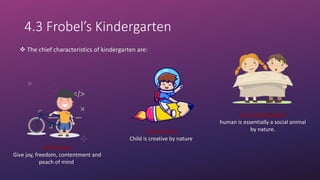
4.3 Frobel’s Kindergarten
Self Activity
Give joy, freedom, contentment and
peach of mind.
Creativeness
Child is creative by nature.
Social participation
human is essentially a social animal
by nature.
 The chief characteristics of kindergarten are:
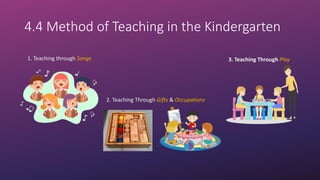
4.4 Method of Teaching in the Kindergarten
1. Teaching through Songs
2. Teaching Through Gifts & Occupations
3. Teaching Through Play
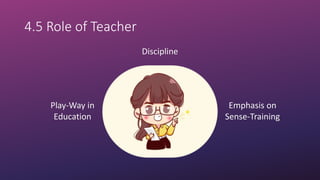
4.5 Role of Teacher
Discipline
Emphasis on
Sense-Training
Play-Way in
Education
4.6 Inclusion of Nature Study in Curriculum
Frobel’s main aim of including subject of nature in the
school curriculum was moral and religious uplift of the child, by
coming into contact with nature.
So, we can conclude by saying that Froebel’s Kindergarten
system aims at the complete development of the individual
child.
4.7 Contribution of Froebel to Educational
Theory and Practice
 Emphasis on Nursery Education
 Respect for the Child’s Individuality
 Self-Activity in Education
 Leaning Through Arts and Crafts
 Sociological Aspect of Education
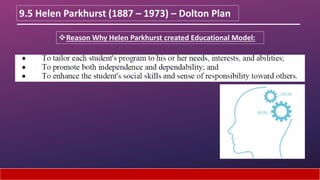
9.5 Helen Parkhurst (1887 – 1973) – Dolton Plan
Reason Why Helen Parkhurst created Educational Model:
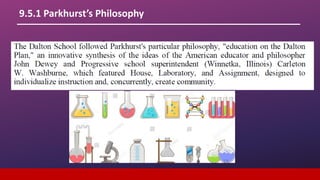
9.5.1 Parkhurst’s Philosophy
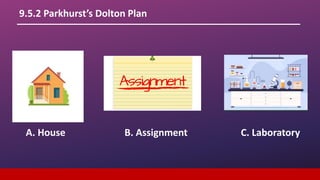
9.5.2 Parkhurst’s Dolton Plan
A. House B. Assignment C. Laboratory
9.5.3 Principles of Dolton Plan
9.5.4 Curriculum
9.5.5 Homework
9.5.6 Similar & Difference of Montessori & Dolton Plan
A. Teacher’s role is greater than teacher in Montessori Method.
B. Parkhurst believed on activity to motivate and discipline people effectively.
Montessori depended on natural development.
C. Teacher created assignment for student development.
Montessori used the material to develop the students as well.
Unit 9 Thinkers inEducation - B.pptx

Unit 9 Thinkers inEducation - B.pptx

  • 1.
    9.1 Introduction..................................................................................... 9.2 Objectives....................................................................................... 9.3 Maria Montessori (1870–1952) ...................................................... 9.3.1 Maria Montessori’s Method and Philosophy...................... 9.3.2 Prepared Environment ........................................................ 9.3.3 Freedom in Education......................................................... 9.3.4 Movement in Education...................................................... 9.3.5 Sensory Education and Music............................................. 9.3.6 Intellectual Education ......................................................... 9.4 Friedrich Froebel (1852–1982) the Birth of Kindergarten ............. 9.4.1 Frobel’s Philosophy ............................................................ 9.4.2 Frobel’s Concept and Aims of Education........................... 9.4.3 Frobel’s Kindergarten ......................................................... 9.4.4 Methods of Teaching in the Kindergarten .......................... 9.4.5 Role of Teacher................................................................... 9.4.6 Inclusion of Nature Study in Curriculum............................ 9.4.7 Contribution of Froebel to Educational Theory and Practice 9.5 Helen Parkhurst (1887–1973) Dolton Plan..................................... 9.5.1 Parkhurst’s Philosophy ....................................................... 9.5.2 Parkhursts Dolton Plan ....................................................... 9.5.3 Principles of Dalton Plan .................................................... 9.5.4 Curriculum.......................................................................... 9.5.5 Homework........................................................................... 9.5.6 Similarities & Differences between Montessori & Dalton Plan
  • 2.
    Early childhood (2-6 yearsold) Developing particular way of thinking, being, knowing and acting. Establishing relationships with others and the environment. This unit focuses on:  the thinkers of early childhood education.  the theoretical perspectives.
  • 3.
    After our presentation,you will be able to: 1) Understandthe Montessori systemof early childhood education. 2) Recognize basic elements of Frobel system. 3) ExplainFriere’s Daltonplan. 4) And Evaluate the background and usefulnessof critical thinking pedagogy.
  • 4.
    Biography and facts •Born: August 31, 1870, Chiaravalle, near Ancona, Italy. • Died: May 6, 1952, Noordwijk aan Zee, Netherlands • Family: middle-class with well-educated parents. • Education: First Italian woman graduated in medicine from the University of Rome in 1896. • Work experiences: 1899 – 1901: a director of the State Orthophrenic School of Rome 1896 – 1906: a chair in hygiene at a women’s college in Rome 1900 – 1907: a lecturer in pedagogy at the University of Rome 1904 – 1908: a chair in anthropology, also studied philosophy, psychology, and education • Founder: The first "Casa Dei Bambini" or the "Children's House“ ( a preschool for children) in 1907 and then established over fifty countries.
  • 5.
    Children's need forindependence, for self- confidence as adequate people, for control over their own impulses and emotions and a natural curiosity and desire to learn. The foundation of Maria Montessori's approach is respect for the child as a worthy individual, occupied with the task of developing himself into a mature human adult. She observed in young children a phenomenon she called the "absorbent mind." Children learn without force.
  • 6.
    Definition Montessori is aspecial way for children and adults to be together. Every aspect of the experience is planned to help children become confident, capable, creative, caring and happy people who are a delight to be with. Roles of Teacher All activities are carefully planned to make it easy for children to become that special person each child can be. Teachers are called directress. The role of teacher is to remind children in doing activities. Also to gently direct and guide children in their activities. Children learn by exploring throughout variety of materials. Learning Process They quickly learn to examine a problem carefully, seeking the possibilities and discovering the solution. At an early age the child discovers the scientist's delight in solving problems, the mathematician's delight in playing with patterns, the artist's delight in creation, the sociologist's and psychologist's delight in understanding people and the leaders delight in getting things done with people.
  • 7.
    “The most importantperiod of life is not the age of university studies but the period from birth to age six.“ (According to Montessori) Commonly accepted conception: at the age of 4, the individual develops 50% of his/her mature intelligence; from ages 4 to 8 another 30%. During these sensitive periods, it is easier for the child to acquire particular skills than at any other time in his/her life. The Montessori classroom allows each child freedom to select activities which correspond to his or her own periods of interest and readiness. Today the importance of the formative first six years of life is common knowledge. During this time a child becomes fully a member of their particular culture and family group, absorbing language, attitudes, manners, values, of those in which he or she comes in daily contact. In the first six years of life, every child learns and grows to the limit of his abilities by imitating people around him. To support this need we must carefully prepare the physical and social environment, provide tools that enable the child to work to create himself, watch for those first tentative moments of concentration, and get out of the way, following the child as his path unfolds.
  • 8.
    According to Dr.Maria Montessori, “A child's work is to create the person she/he will become.” Children are born with special mental powers which aid in the work of their own construction. Montessori’s philosophy Sensitive Period Planes of Development • During this time that child can most easily master a particular learning skill. • Teachers’ responsibility is to recognize these periods in individual children and put them in touch with the appropriate materials in the classroom environment. • First plane (birth - 6): the child is characterised by his or her 'absorbent mind', absorbing all aspects of his or her environment, language and culture. • Second plane (6 - 12): the child uses a 'reasoning mind' to explore the world with abstract thought and imagination. • Third plane (12 - 18): the adolescent has a 'humanistic mind' eager to understand humanity and the contribution he or she can make to society. • The last plane (18 – 24): the adult explores the world with a 'specialist mind' taking his or her place in the world.
  • 9.
    Dr. Montessori (1972)stated that in order for the child to develop, two factors must be present. One factor is a prepared environment that looks after the child’s physical health as well as the spiritual life. The second factor is the ability of the child to move freely in his/her environment where there can be found constructive activities for the child’s development. These two factors allow the child to learn and enjoy more fully such things as: movement in education, sensory education and music, and intellectual education.
  • 10.
    • Dr. MariaMontessori (1966) stated that “[a]n adult environment is not a suitable environment for children” (p. 109). • Montessori (1912) stated that in order for children to develop properly, it is necessary to reduce all obstacles around them to a minimum. • This included creating the right environment for children indoors and outdoors. • For example, the office sized furniture pieces originally placed in the schoolhouse were too big and too heavy for the little children. • Dr. Montessori designed and had manufactured little furniture such as chairs, tables, washstands and cupboards that preschool children could use easily. For the outdoors Dr. Montessori designed playgrounds and gardens with varieties of trees and flowers, pathways for children to take walks, small benches to sit on, and objects such as hoops to play with.
  • 11.
    • The childis free to choose an activity within a prepared environment. • The child is free to choose a place where to perform the work within that prepared environment. For example, sit on a chair or use a carpeted floor. • The adult is able to work on the activity until its completion regardless of the time it takes. • A child to freely walk around and get a new activity when he/she so desires, and “greatest” of all, it means freedom to observe another child and learn by observing. • Freedom in education for Montessori was very important since the child needed to develop into a fully grown human and be able to take his/her place in society. “Education must foster both the development of individuality and that of society. Society cannot develop unless the individual develops, as we learn from observing. Most of our actions would have no reason for being if there were no other people around us, and we do most of the things we do because we live in association with others” (Montessori, 1972, p. 65).
  • 12.
    Indoor activities Children are taughtto walk gracefully. e.g. walk in a circle Outdoor activities Play outdoor – keep healthy, grow Be active – bones and muscles develop. Use free games – ball, hoops, kites,… Use educational gymnastics – taking care of plants and animals. Hand-activity involvement learn to undress and dress themselves Learn to hang out garments on hook. Learn to wash their hands and comb their hair. Using genuine Utensils & objectives Children use many educational activities and tools to develop themselves into adult. e.g. children practice buttoning.
  • 13.
    Sensory Education Music Develop fine sensitivity in children fingertips e.g.children touch a variety of materials such as linen, cotton, velvet, and silk. Eye training e.g. Children’s eyes are trained to recognize the basic colours and a variety of shades of each colour. Recognizing between silence and sound Teaching music by listening to the sound and reading music e.g. She had two sets of bells one lined up in order according to the musical scale, the other set was in a mixed up order. The children would pick up each bell from the first set, ring it and listen carefully. They would have then tried to match up the second set to the first one. Once the children were able to line up the bells in order, Dr. Montessori would teach the children to read music. She would place a large paper with the musical scale above the bells, and have the name of each musical note written right under it.
  • 14.
    Dr. Montessori’s teaching method Touchthe letters made of wood Touch the letters with a wooden rod Placing shapes of continents set into wooden boards (Geography) rods and beads (Mathematics) geometric objects (Geometry)
  • 15.
  • 16.
    4.1 Frobel’s Philosophy Froebel’s philosophy is of absolute idealism.  To Froebel, play provided the means for a child’s intellectual, social, emotional and physical development. Froebel believed that the education of a child began at birth, and that parents and teachers played a crucial role in helping children in this activity.
  • 17.
    4.2 Frobel’s Conceptand Aims of Education The aims of education, Froebel wants all-round development of the individual child. It is in this way, the child will develop into a good citizen.
  • 18.
    4.3 Frobel’s Kindergarten SelfActivity Give joy, freedom, contentment and peach of mind. Creativeness Child is creative by nature. Social participation human is essentially a social animal by nature.  The chief characteristics of kindergarten are:
  • 19.
    4.4 Method ofTeaching in the Kindergarten 1. Teaching through Songs 2. Teaching Through Gifts & Occupations 3. Teaching Through Play
  • 20.
    4.5 Role ofTeacher Discipline Emphasis on Sense-Training Play-Way in Education
  • 21.
    4.6 Inclusion ofNature Study in Curriculum Frobel’s main aim of including subject of nature in the school curriculum was moral and religious uplift of the child, by coming into contact with nature. So, we can conclude by saying that Froebel’s Kindergarten system aims at the complete development of the individual child.
  • 22.
    4.7 Contribution ofFroebel to Educational Theory and Practice  Emphasis on Nursery Education  Respect for the Child’s Individuality  Self-Activity in Education  Leaning Through Arts and Crafts  Sociological Aspect of Education
  • 23.
    9.5 Helen Parkhurst(1887 – 1973) – Dolton Plan Reason Why Helen Parkhurst created Educational Model:
  • 24.
  • 25.
    9.5.2 Parkhurst’s DoltonPlan A. House B. Assignment C. Laboratory
  • 26.
  • 27.
  • 28.
  • 29.
    9.5.6 Similar &Difference of Montessori & Dolton Plan A. Teacher’s role is greater than teacher in Montessori Method. B. Parkhurst believed on activity to motivate and discipline people effectively. Montessori depended on natural development. C. Teacher created assignment for student development. Montessori used the material to develop the students as well.