Each
and
Every
Child
Each
and
Every
Child
An e-newsletter by the Iowa Department of Education
Leiah Craun was worried.
Her new third-grade student was
testing two years behind in math. It was
even worse in literacy: The child was
testing at preschool level.
“Honestly, this scared me,” Craun said.
“Here she was sitting in a third grade
classroom, and wasn’t completely
fluent in naming alphabet letters. I was
worried about the frustration she felt in
a classroom. I was worried if we could
catch up.
“I thought, ‘we have our work cut out for
us.”
It’s not like Craun scares easily. In the
last three years since her Marshalltown
school district introduced a
comprehensive intervention model,
this veteran special education teacher
only had one student who hasn’t
made at least a year-and-a-half worth
of progress. (“And we’re still trying to
figure out what’s going on with that
student,” Craun said.)
Equally scared were the student’s
parents, Sandy and Todd Dale.
“We knew that she struggled,” said
Sandy Dale, who herself is a special
education teacher at Marshalltown’s
high school. “In class, she knew she
had different spelling words. She knew
March 2016
Volume 6, Issue 3
Continued on next page
From good to great
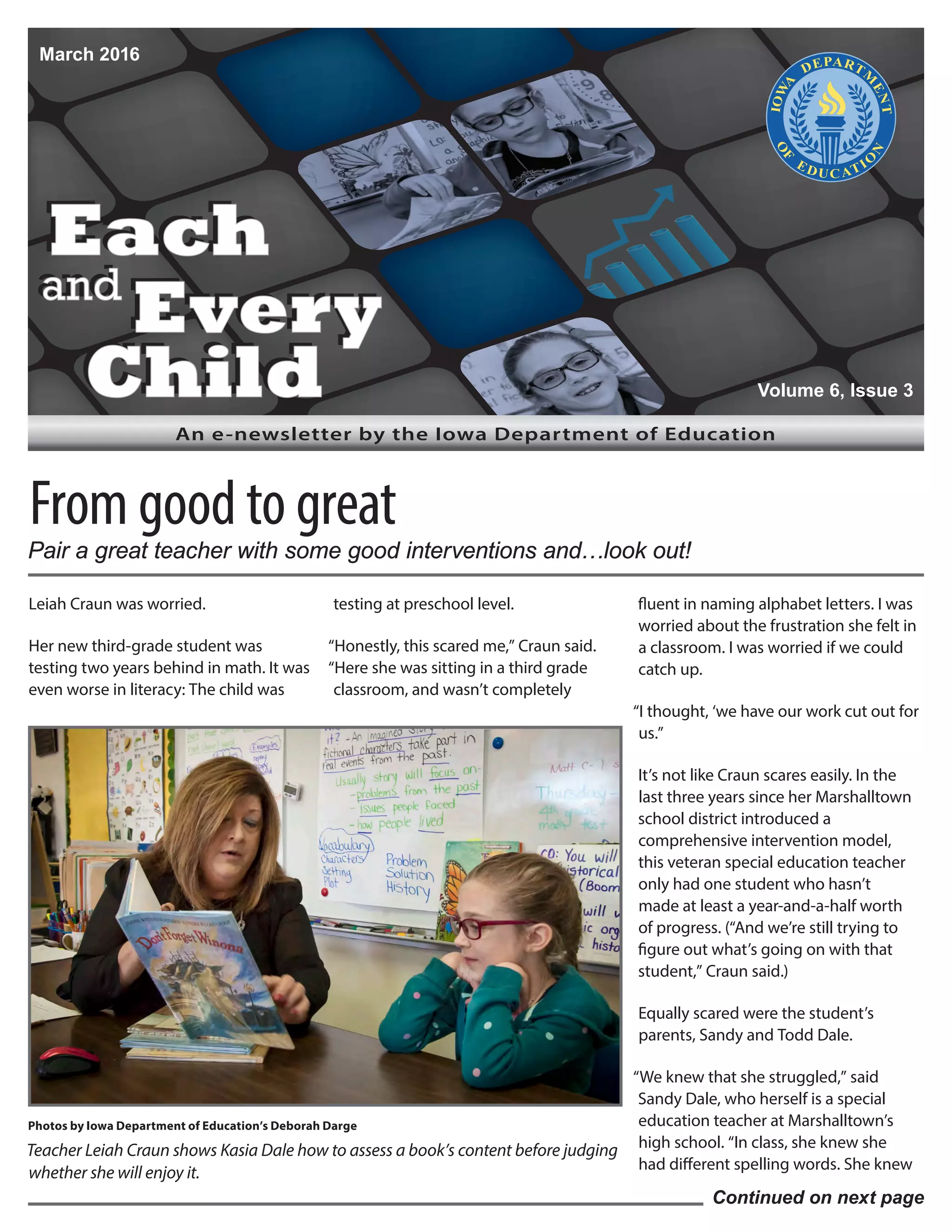
Teacher Leiah Craun shows Kasia Dale how to assess a book’s content before judging
whether she will enjoy it.
Photos by Iowa Department of Education’s Deborah Darge
Pair a great teacher with some good interventions and…look out!
that she wasn’t doing the same work
as everyone else. School wasn’t her
favorite place to be.”
The Dales had despaired since
kindergarten.
“We were uneasy with the advice we
were receiving from her teachers,”
Sandy Dale said. “Still, I don’t believe in
telling someone else how to do their
job. I am not an elementary teacher.”
But that was before their daughter,
Kasia, transferred into the Marshalltown
school district and, in particular,
Franklin Elementary. In one semester
– one – Craun had advanced Kasia
by an astonishing two years. And by
sometime next year, Craun expects
to exit Kasia from special education
altogether.
Don’t look for a silver bullet in the
Marshalltown district. Instead, educators
are receiving professional development
on four comprehensive literacy
interventions, developed by Linda Dorn
and Carla Soffos, said Penny Duer, the
district’s at-risk coordinator.
“The interventions each have their
own characteristics,” Duer said. “The
interventions are flexible and can be
mixed and matched to meet a variety of
student needs.”
Still, the interventions alone don’t
guarantee success.
“You can have the best programs in the
world,” Duer said. “But unless you have
a teacher who is responsive with kids
and implements the interventions with
fidelity, it’s not going to work. It never
really is the program – it’s always the
teacher. And that is Mrs. Craun.”
Craun’s usual unwavering confidence
in her ability to educate students
was seriously challenged when Duer
was training her in the interventions.
One key aspect of an intervention is
observing a student make mistakes as
a means of thoroughly diagnosing the
child’s problems.
“As special education teachers, we
have seen ourselves as rescuers,”
Craun said. “The temptation is to
dive in and help a student right
away. When I was being trained in
the new interventions, Penny was
observing me work with a student
who was reading. When she came to
a word she couldn’t figure out, I was
supposed to stay quiet. The student
started looking at me, pleading in
her eyes. I wanted to start asking
her questions to help her along. But
Penny could see what I was thinking
and said, ‘nope, don’t say anything.’ It
was very hard watching that student
struggle, but she finally figured it out.
It was that very day that I thought, ‘a-
ha! I get it.’
“It is such a shift. Now I want to see
the kids make mistakes and struggle,
because that’s when I get to my next
teaching point.”
Beyond the interventions, Craun says it’s
important that content used in pull out
parallels the work done in the general
Continued from the previous page
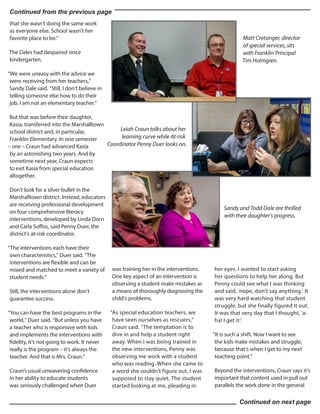
Matt Cretsinger, director
of special services, sits
with Franklin Principal
Tim Holmgren.
Continued on next page
Leiah Craun talks about her
learning curve while At-risk
Coordinator Penny Duer looks on.
Sandy and Todd Dale are thrilled
with their daughter’s progress.
Continued from the previous page
education classes.
“It is critical to align her work to what
is going on in gen. ed. to back it up,”
she said. “If it is something different,
that’s too much noise in her head.
I am aligning my work with the
classroom and the core standards.”
And, of course, there is engagement.
Craun has her students choose which
books they want to read – and in
which order – based on their own
interest.
As for the Dales, it’s an
understatement to say they
appreciate what Craun has done for
their daughter. And Sandy Dale says
Craun’s success has made her reflect
upon her own practices.
“I am a little envious,” she said. “I have
been thinking, ‘I am going to find out
the techniques and bring them to
the high schoolers.’ This has totally
transformed me.”
As for Kasia, she now loves school.
“I like school because it is fun,” she
said. “Because you can write and read.
It is fun to write stories.”
VOICE FROM THE FIELD
Maquoketa Educator
Jane Schmidt debuts her blog
Graphic designs by Iowa Department of Education’s Derek O’Riley
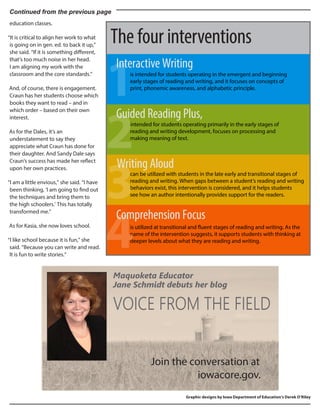
is intended for students operating in the emergent and beginning
early stages of reading and writing, and it focuses on concepts of
print, phonemic awareness, and alphabetic principle.
Interactive Writing
Guided Reading Plus,
intended for students operating primarily in the early stages of
reading and writing development, focuses on processing and
making meaning of text.
Writing Aloud
can be utilized with students in the late early and transitional stages of
reading and writing. When gaps between a student’s reading and writing
behaviors exist, this intervention is considered, and it helps students
see how an author intentionally provides support for the readers.
Comprehension Focus
is utilized at transitional and fluent stages of reading and writing. As the
name of the intervention suggests, it supports students with thinking at
deeper levels about what they are reading and writing.
1
2
3
4
The four interventions
Join the conversation at
iowacore.gov.

March2016EEC

  • 1.
    Each and Every Child Each and Every Child An e-newsletter bythe Iowa Department of Education Leiah Craun was worried. Her new third-grade student was testing two years behind in math. It was even worse in literacy: The child was testing at preschool level. “Honestly, this scared me,” Craun said. “Here she was sitting in a third grade classroom, and wasn’t completely fluent in naming alphabet letters. I was worried about the frustration she felt in a classroom. I was worried if we could catch up. “I thought, ‘we have our work cut out for us.” It’s not like Craun scares easily. In the last three years since her Marshalltown school district introduced a comprehensive intervention model, this veteran special education teacher only had one student who hasn’t made at least a year-and-a-half worth of progress. (“And we’re still trying to figure out what’s going on with that student,” Craun said.) Equally scared were the student’s parents, Sandy and Todd Dale. “We knew that she struggled,” said Sandy Dale, who herself is a special education teacher at Marshalltown’s high school. “In class, she knew she had different spelling words. She knew March 2016 Volume 6, Issue 3 Continued on next page From good to great Teacher Leiah Craun shows Kasia Dale how to assess a book’s content before judging whether she will enjoy it. Photos by Iowa Department of Education’s Deborah Darge Pair a great teacher with some good interventions and…look out!
  • 2.
    that she wasn’tdoing the same work as everyone else. School wasn’t her favorite place to be.” The Dales had despaired since kindergarten. “We were uneasy with the advice we were receiving from her teachers,” Sandy Dale said. “Still, I don’t believe in telling someone else how to do their job. I am not an elementary teacher.” But that was before their daughter, Kasia, transferred into the Marshalltown school district and, in particular, Franklin Elementary. In one semester – one – Craun had advanced Kasia by an astonishing two years. And by sometime next year, Craun expects to exit Kasia from special education altogether. Don’t look for a silver bullet in the Marshalltown district. Instead, educators are receiving professional development on four comprehensive literacy interventions, developed by Linda Dorn and Carla Soffos, said Penny Duer, the district’s at-risk coordinator. “The interventions each have their own characteristics,” Duer said. “The interventions are flexible and can be mixed and matched to meet a variety of student needs.” Still, the interventions alone don’t guarantee success. “You can have the best programs in the world,” Duer said. “But unless you have a teacher who is responsive with kids and implements the interventions with fidelity, it’s not going to work. It never really is the program – it’s always the teacher. And that is Mrs. Craun.” Craun’s usual unwavering confidence in her ability to educate students was seriously challenged when Duer was training her in the interventions. One key aspect of an intervention is observing a student make mistakes as a means of thoroughly diagnosing the child’s problems. “As special education teachers, we have seen ourselves as rescuers,” Craun said. “The temptation is to dive in and help a student right away. When I was being trained in the new interventions, Penny was observing me work with a student who was reading. When she came to a word she couldn’t figure out, I was supposed to stay quiet. The student started looking at me, pleading in her eyes. I wanted to start asking her questions to help her along. But Penny could see what I was thinking and said, ‘nope, don’t say anything.’ It was very hard watching that student struggle, but she finally figured it out. It was that very day that I thought, ‘a- ha! I get it.’ “It is such a shift. Now I want to see the kids make mistakes and struggle, because that’s when I get to my next teaching point.” Beyond the interventions, Craun says it’s important that content used in pull out parallels the work done in the general Continued from the previous page Matt Cretsinger, director of special services, sits with Franklin Principal Tim Holmgren. Continued on next page Leiah Craun talks about her learning curve while At-risk Coordinator Penny Duer looks on. Sandy and Todd Dale are thrilled with their daughter’s progress.
  • 3.
    Continued from theprevious page education classes. “It is critical to align her work to what is going on in gen. ed. to back it up,” she said. “If it is something different, that’s too much noise in her head. I am aligning my work with the classroom and the core standards.” And, of course, there is engagement. Craun has her students choose which books they want to read – and in which order – based on their own interest. As for the Dales, it’s an understatement to say they appreciate what Craun has done for their daughter. And Sandy Dale says Craun’s success has made her reflect upon her own practices. “I am a little envious,” she said. “I have been thinking, ‘I am going to find out the techniques and bring them to the high schoolers.’ This has totally transformed me.” As for Kasia, she now loves school. “I like school because it is fun,” she said. “Because you can write and read. It is fun to write stories.” VOICE FROM THE FIELD Maquoketa Educator Jane Schmidt debuts her blog Graphic designs by Iowa Department of Education’s Derek O’Riley is intended for students operating in the emergent and beginning early stages of reading and writing, and it focuses on concepts of print, phonemic awareness, and alphabetic principle. Interactive Writing Guided Reading Plus, intended for students operating primarily in the early stages of reading and writing development, focuses on processing and making meaning of text. Writing Aloud can be utilized with students in the late early and transitional stages of reading and writing. When gaps between a student’s reading and writing behaviors exist, this intervention is considered, and it helps students see how an author intentionally provides support for the readers. Comprehension Focus is utilized at transitional and fluent stages of reading and writing. As the name of the intervention suggests, it supports students with thinking at deeper levels about what they are reading and writing. 1 2 3 4 The four interventions Join the conversation at iowacore.gov.