JANUARY 2016
BGE/EI/UE/0216
Bord Gáis
Energy Index
Understanding energy
Bord Gáis Energy Index
January 2016
2
Bord Gáis Energy Index (Dec 31st 2009 = 100)
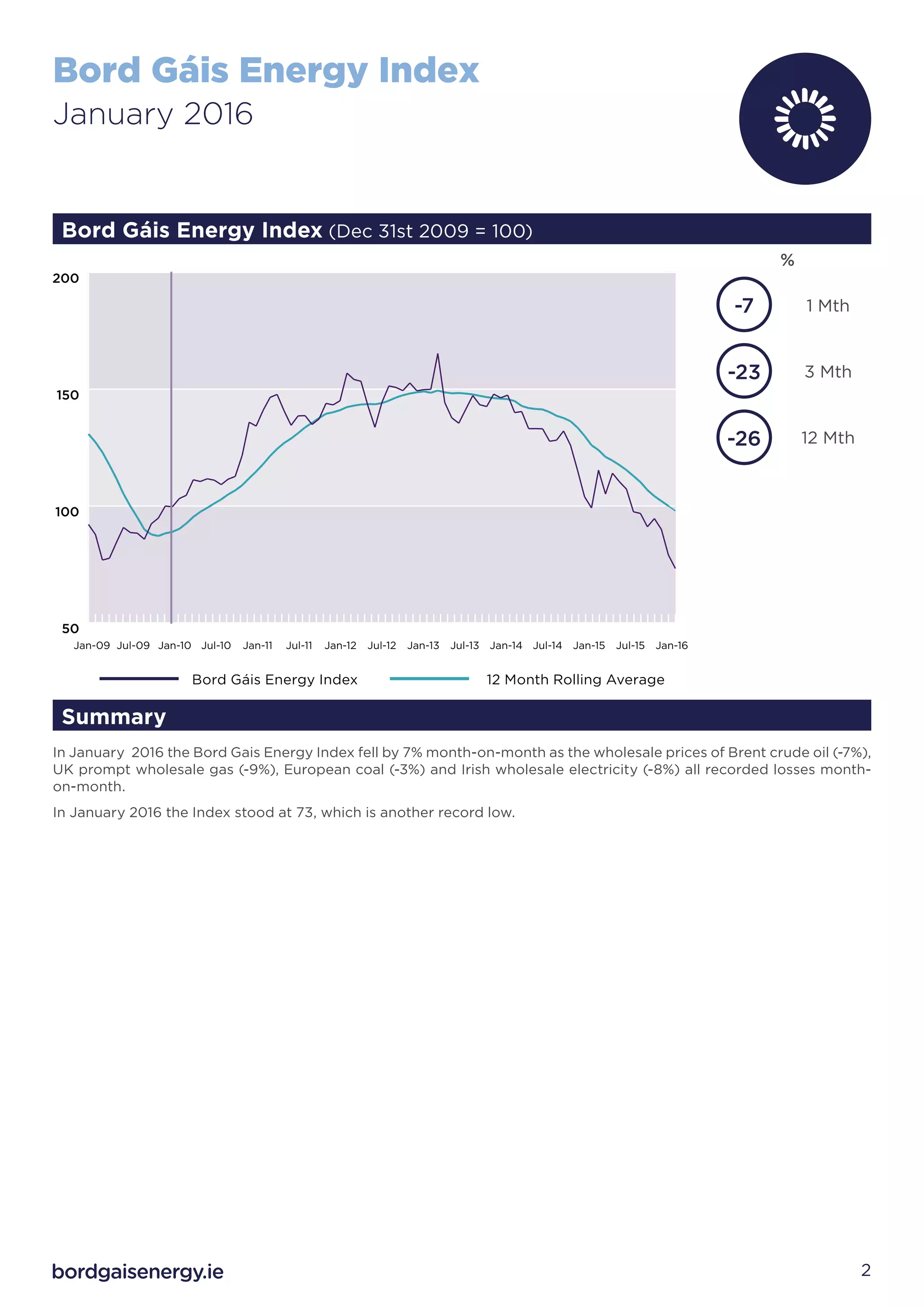
In January 2016 the Bord Gais Energy Index fell by 7% month-on-month as the wholesale prices of Brent crude oil (-7%),
UK prompt wholesale gas (-9%), European coal (-3%) and Irish wholesale electricity (-8%) all recorded losses month-
on-month.
In January 2016 the Index stood at 73, which is another record low.
Summary
Bord Gáis Energy Index 12 Month Rolling Average
50
100
150
200
Jan-16Jul-15Jan-15Jul-14Jan-14Jul-13Jan-13Jul-12Jan-12Jul-11Jan-11Jul-10Jan-10Jul-09Jan-09
%
1 Mth
3 Mth
12 Mth-26
-23
-7
Bord Gáis Energy Index
January 2016
3
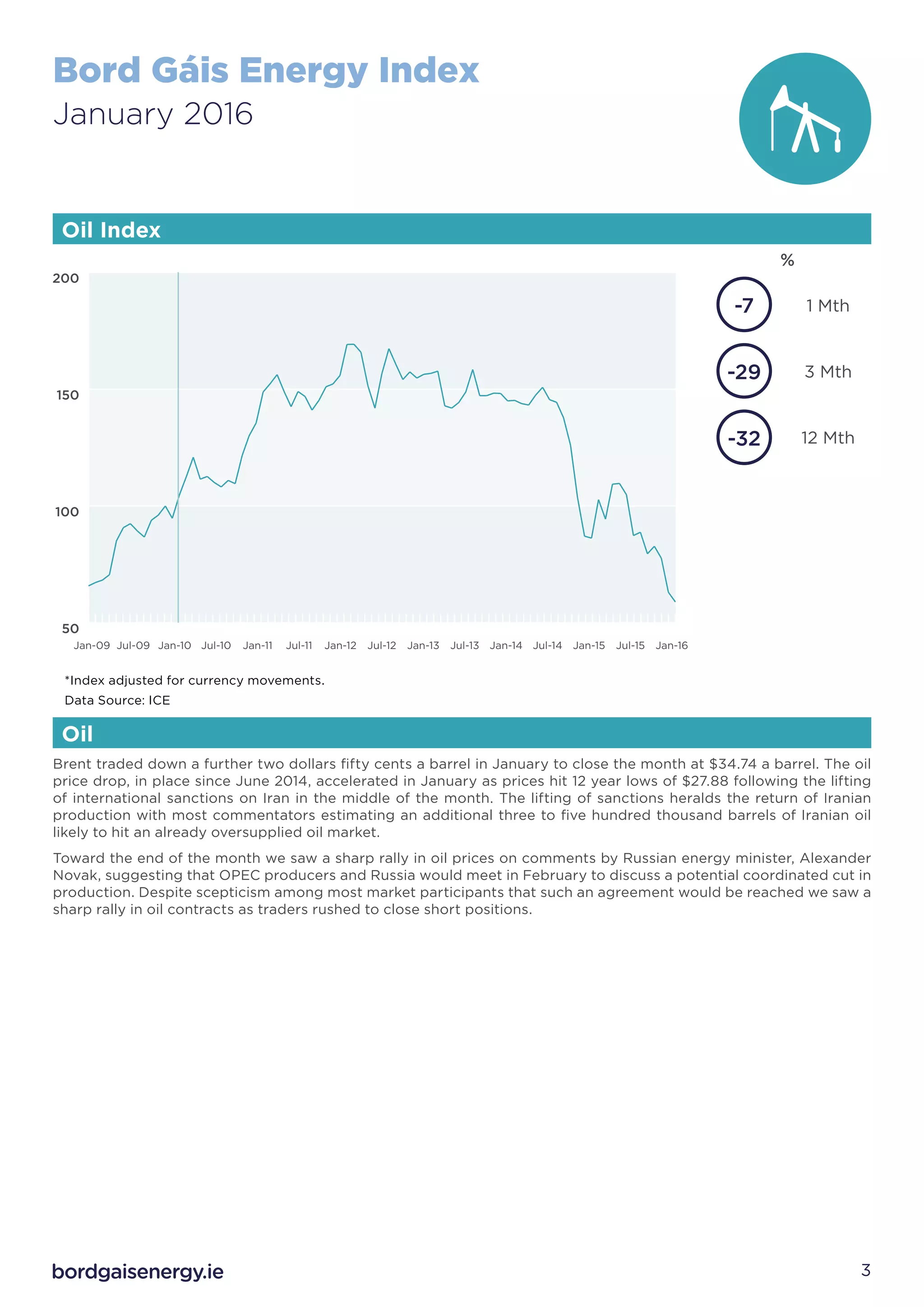
Brent traded down a further two dollars fifty cents a barrel in January to close the month at $34.74 a barrel. The oil
price drop, in place since June 2014, accelerated in January as prices hit 12 year lows of $27.88 following the lifting
of international sanctions on Iran in the middle of the month. The lifting of sanctions heralds the return of Iranian
production with most commentators estimating an additional three to five hundred thousand barrels of Iranian oil
likely to hit an already oversupplied oil market.
Toward the end of the month we saw a sharp rally in oil prices on comments by Russian energy minister, Alexander
Novak, suggesting that OPEC producers and Russia would meet in February to discuss a potential coordinated cut in
production. Despite scepticism among most market participants that such an agreement would be reached we saw a
sharp rally in oil contracts as traders rushed to close short positions.
*Index adjusted for currency movements.
Data Source: ICE
Oil Index
Oil
%
1 Mth
3 Mth
12 Mth-32
-29
-7
50
100
150
200
Jan-16Jul-15Jan-15Jul-14Jan-14Jul-13Jan-13Jul-12Jan-12Jul-11Jan-11Jul-10Jan-10Jul-09Jan-09
Bord Gáis Energy Index
January 2016
4
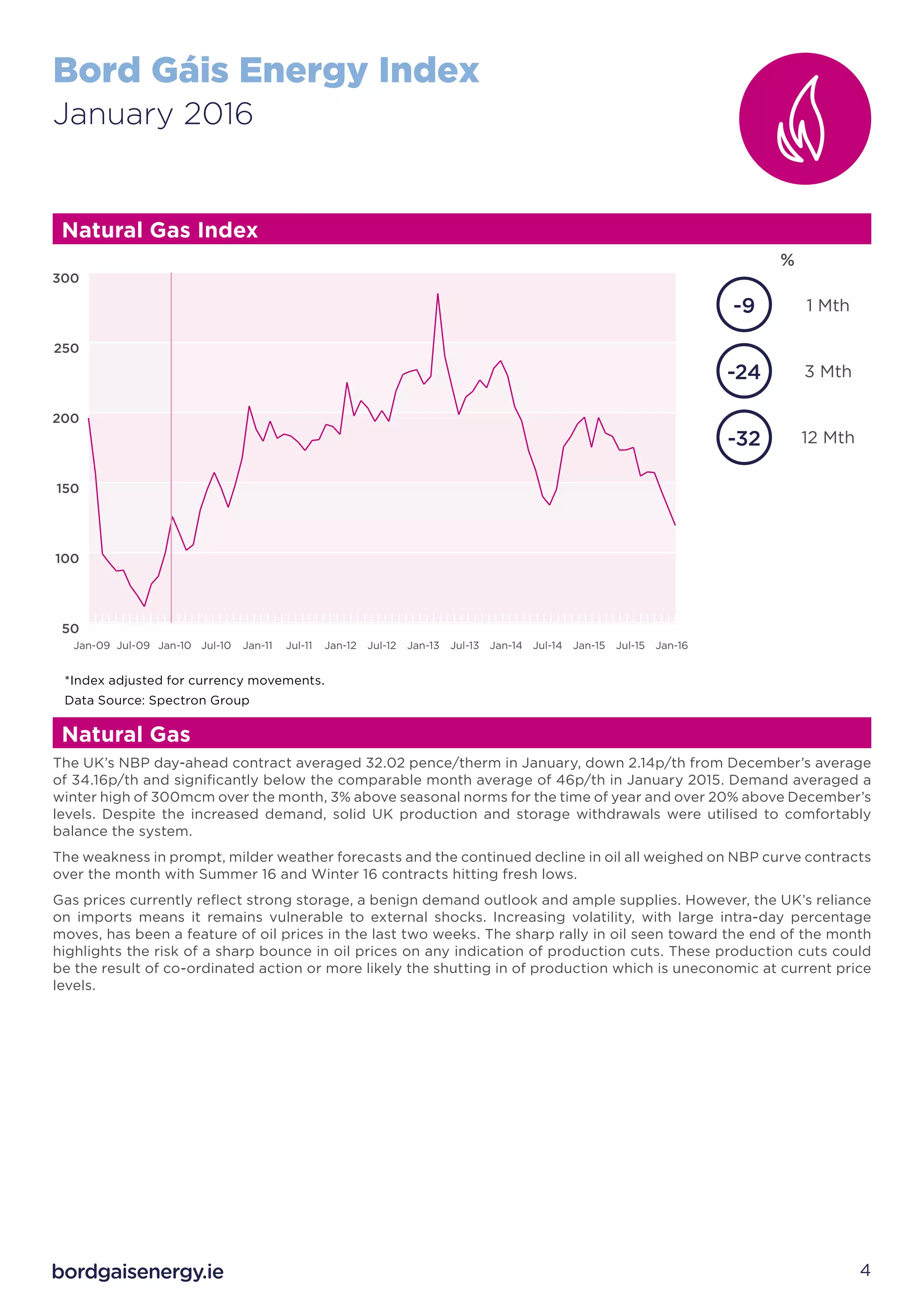
The UK’s NBP day-ahead contract averaged 32.02 pence/therm in January, down 2.14p/th from December’s average
of 34.16p/th and significantly below the comparable month average of 46p/th in January 2015. Demand averaged a
winter high of 300mcm over the month, 3% above seasonal norms for the time of year and over 20% above December’s
levels. Despite the increased demand, solid UK production and storage withdrawals were utilised to comfortably
balance the system.
The weakness in prompt, milder weather forecasts and the continued decline in oil all weighed on NBP curve contracts
over the month with Summer 16 and Winter 16 contracts hitting fresh lows.
Gas prices currently reflect strong storage, a benign demand outlook and ample supplies. However, the UK’s reliance
on imports means it remains vulnerable to external shocks. Increasing volatility, with large intra-day percentage
moves, has been a feature of oil prices in the last two weeks. The sharp rally in oil seen toward the end of the month
highlights the risk of a sharp bounce in oil prices on any indication of production cuts. These production cuts could
be the result of co-ordinated action or more likely the shutting in of production which is uneconomic at current price
levels.
Natural Gas
*Index adjusted for currency movements.
Data Source: Spectron Group
Natural Gas Index
1 Mth
3 Mth
12 Mth
%
-32
-24
-9
50
100
150
200
250
300
Jan-16Jul-15Jan-15Jul-14Jan-14Jul-13Jan-13Jul-12Jan-12Jul-11Jan-11Jul-10Jan-10Jul-09Jan-09
Bord Gáis Energy Index
January 2016
5
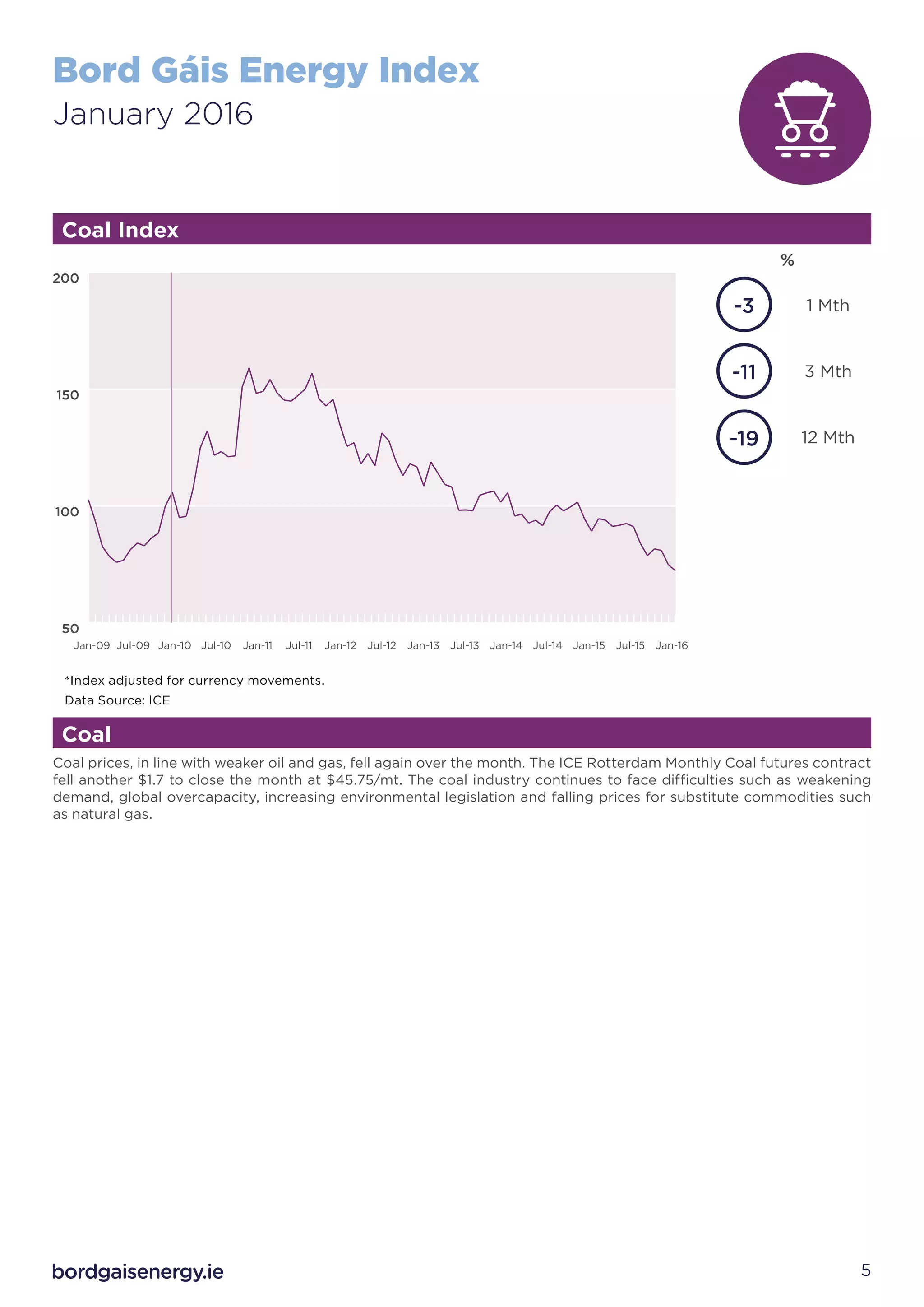
Coal prices, in line with weaker oil and gas, fell again over the month. The ICE Rotterdam Monthly Coal futures contract
fell another $1.7 to close the month at $45.75/mt. The coal industry continues to face difficulties such as weakening
demand, global overcapacity, increasing environmental legislation and falling prices for substitute commodities such
as natural gas.
50
100
150
200
Jan-16Jul-15Jan-15Jul-14Jan-14Jul-13Jan-13Jul-12Jan-12Jul-11Jan-11Jul-10Jan-10Jul-09Jan-09
Coal
*Index adjusted for currency movements.
Data Source: ICE
Coal Index
1 Mth
3 Mth
12 Mth
%
-19
-11
-3
Bord Gáis Energy Index
January 2016
6
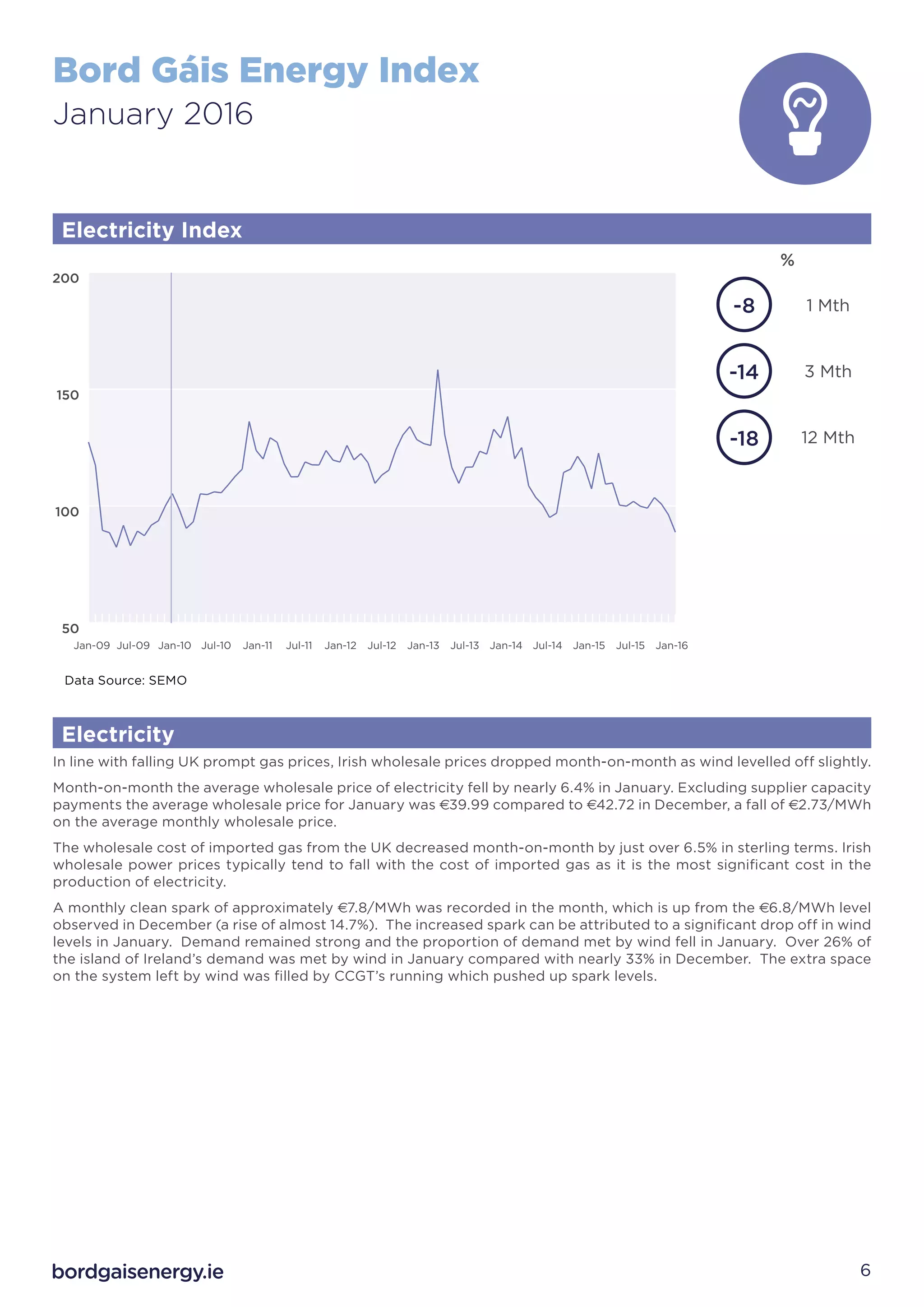
In line with falling UK prompt gas prices, Irish wholesale prices dropped month-on-month as wind levelled off slightly.
Month-on-month the average wholesale price of electricity fell by nearly 6.4% in January. Excluding supplier capacity
payments the average wholesale price for January was E39.99 compared to E42.72 in December, a fall of E2.73/MWh
on the average monthly wholesale price.
The wholesale cost of imported gas from the UK decreased month-on-month by just over 6.5% in sterling terms. Irish
wholesale power prices typically tend to fall with the cost of imported gas as it is the most significant cost in the
production of electricity.
A monthly clean spark of approximately E7.8/MWh was recorded in the month, which is up from the E6.8/MWh level
observed in December (a rise of almost 14.7%). The increased spark can be attributed to a significant drop off in wind
levels in January. Demand remained strong and the proportion of demand met by wind fell in January. Over 26% of
the island of Ireland’s demand was met by wind in January compared with nearly 33% in December. The extra space
on the system left by wind was filled by CCGT’s running which pushed up spark levels.
50
100
150
200
Jan-16Jul-15Jan-15Jul-14Jan-14Jul-13Jan-13Jul-12Jan-12Jul-11Jan-11Jul-10Jan-10Jul-09Jan-09
Electricity
Data Source: SEMO
Electricity Index
1 Mth
3 Mth
12 Mth
%
-18
-8
-14
Bord Gáis Energy Index
January 2016
7
1 Mth
3 Mth
12 Mth
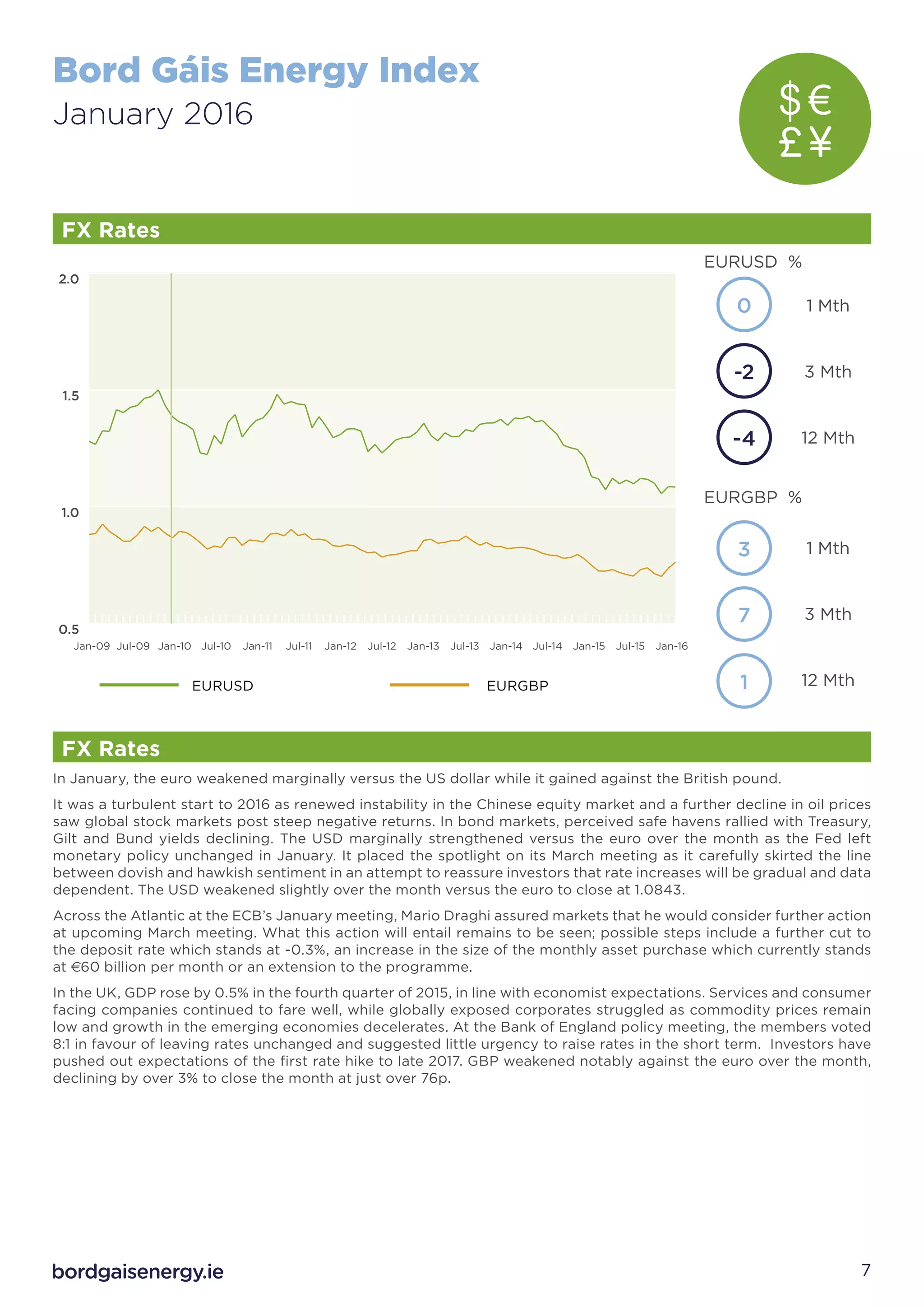
In January, the euro weakened marginally versus the US dollar while it gained against the British pound.
It was a turbulent start to 2016 as renewed instability in the Chinese equity market and a further decline in oil prices
saw global stock markets post steep negative returns. In bond markets, perceived safe havens rallied with Treasury,
Gilt and Bund yields declining. The USD marginally strengthened versus the euro over the month as the Fed left
monetary policy unchanged in January. It placed the spotlight on its March meeting as it carefully skirted the line
between dovish and hawkish sentiment in an attempt to reassure investors that rate increases will be gradual and data
dependent. The USD weakened slightly over the month versus the euro to close at 1.0843.
Across the Atlantic at the ECB’s January meeting, Mario Draghi assured markets that he would consider further action
at upcoming March meeting. What this action will entail remains to be seen; possible steps include a further cut to
the deposit rate which stands at -0.3%, an increase in the size of the monthly asset purchase which currently stands
at E60 billion per month or an extension to the programme.
In the UK, GDP rose by 0.5% in the fourth quarter of 2015, in line with economist expectations. Services and consumer
facing companies continued to fare well, while globally exposed corporates struggled as commodity prices remain
low and growth in the emerging economies decelerates. At the Bank of England policy meeting, the members voted
8:1 in favour of leaving rates unchanged and suggested little urgency to raise rates in the short term. Investors have
pushed out expectations of the first rate hike to late 2017. GBP weakened notably against the euro over the month,
declining by over 3% to close the month at just over 76p.
0.5
1.0
1.5
2.0
Jan-16Jul-15Jan-15Jul-14Jan-14Jul-13Jan-13Jul-12Jan-12Jul-11Jan-11Jul-10Jan-10Jul-09Jan-09
FX Rates
EURUSD %
EURGBP %
EURUSD EURGBP
FX Rates
1 Mth
3 Mth
12 Mth-4
3
7
0
-2
1
Bord Gáis Energy Index
January 2016
8
For more information please contact:
The contents of this report are provided solely as an information guide. The report is presented to you “as is” and may or may not be correct, current,
accurate or complete. While every effort is made in preparing material for publication no responsibility is accepted by or on behalf of Bord Gáis
Energy Limited, the SEMO, ICE Futures Europe, the Sustainable Energy Authority of Ireland or Spectron Group Limited (together, the “Parties”) for
any errors, omissions or misleading statements within this report. No representation or warranty, express or implied, is made or liability accepted by
any of the Parties or any of their respective directors, employees or agents in relation to the accuracy or completeness of the information contained
in this report. Each of the Parties and their respective directors, employees or agents does not and will not accept any liability in relation to the
information contained in this report. Bord Gáis Energy Limited reserves the right at any time to revise, amend, alter or delete the information provided
in this report.
Bord Gáis Energy	 Pressoffice@bge.ie
				 Claire Smith 087 027 9075 or Irene Gowing 087 2673964
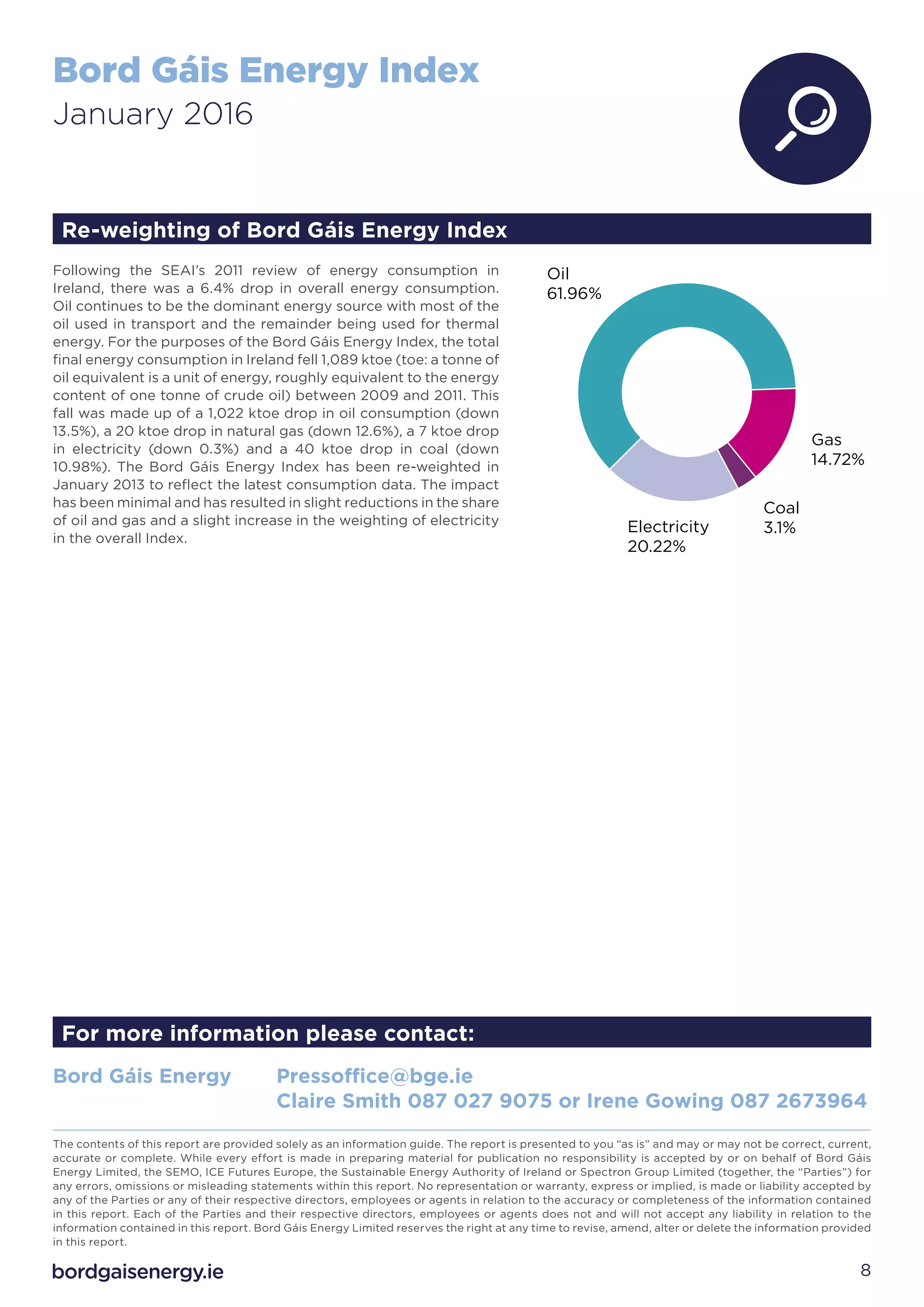
Following the SEAI’s 2011 review of energy consumption in
Ireland, there was a 6.4% drop in overall energy consumption.
Oil continues to be the dominant energy source with most of the
oil used in transport and the remainder being used for thermal
energy. For the purposes of the Bord Gáis Energy Index, the total
final energy consumption in Ireland fell 1,089 ktoe (toe: a tonne of
oil equivalent is a unit of energy, roughly equivalent to the energy
content of one tonne of crude oil) between 2009 and 2011. This
fall was made up of a 1,022 ktoe drop in oil consumption (down
13.5%), a 20 ktoe drop in natural gas (down 12.6%), a 7 ktoe drop
in electricity (down 0.3%) and a 40 ktoe drop in coal (down
10.98%). The Bord Gáis Energy Index has been re-weighted in
January 2013 to reflect the latest consumption data. The impact
has been minimal and has resulted in slight reductions in the share
of oil and gas and a slight increase in the weighting of electricity
in the overall Index.
Oil
61.96%
Gas
14.72%
Coal
3.1%Electricity
20.22%
Re-weighting of Bord Gáis Energy Index

Bord Gáis Energy Index January 2016

  • 1.
  • 2.
    Bord Gáis EnergyIndex January 2016 2 Bord Gáis Energy Index (Dec 31st 2009 = 100) In January 2016 the Bord Gais Energy Index fell by 7% month-on-month as the wholesale prices of Brent crude oil (-7%), UK prompt wholesale gas (-9%), European coal (-3%) and Irish wholesale electricity (-8%) all recorded losses month- on-month. In January 2016 the Index stood at 73, which is another record low. Summary Bord Gáis Energy Index 12 Month Rolling Average 50 100 150 200 Jan-16Jul-15Jan-15Jul-14Jan-14Jul-13Jan-13Jul-12Jan-12Jul-11Jan-11Jul-10Jan-10Jul-09Jan-09 % 1 Mth 3 Mth 12 Mth-26 -23 -7
  • 3.
    Bord Gáis EnergyIndex January 2016 3 Brent traded down a further two dollars fifty cents a barrel in January to close the month at $34.74 a barrel. The oil price drop, in place since June 2014, accelerated in January as prices hit 12 year lows of $27.88 following the lifting of international sanctions on Iran in the middle of the month. The lifting of sanctions heralds the return of Iranian production with most commentators estimating an additional three to five hundred thousand barrels of Iranian oil likely to hit an already oversupplied oil market. Toward the end of the month we saw a sharp rally in oil prices on comments by Russian energy minister, Alexander Novak, suggesting that OPEC producers and Russia would meet in February to discuss a potential coordinated cut in production. Despite scepticism among most market participants that such an agreement would be reached we saw a sharp rally in oil contracts as traders rushed to close short positions. *Index adjusted for currency movements. Data Source: ICE Oil Index Oil % 1 Mth 3 Mth 12 Mth-32 -29 -7 50 100 150 200 Jan-16Jul-15Jan-15Jul-14Jan-14Jul-13Jan-13Jul-12Jan-12Jul-11Jan-11Jul-10Jan-10Jul-09Jan-09
  • 4.
    Bord Gáis EnergyIndex January 2016 4 The UK’s NBP day-ahead contract averaged 32.02 pence/therm in January, down 2.14p/th from December’s average of 34.16p/th and significantly below the comparable month average of 46p/th in January 2015. Demand averaged a winter high of 300mcm over the month, 3% above seasonal norms for the time of year and over 20% above December’s levels. Despite the increased demand, solid UK production and storage withdrawals were utilised to comfortably balance the system. The weakness in prompt, milder weather forecasts and the continued decline in oil all weighed on NBP curve contracts over the month with Summer 16 and Winter 16 contracts hitting fresh lows. Gas prices currently reflect strong storage, a benign demand outlook and ample supplies. However, the UK’s reliance on imports means it remains vulnerable to external shocks. Increasing volatility, with large intra-day percentage moves, has been a feature of oil prices in the last two weeks. The sharp rally in oil seen toward the end of the month highlights the risk of a sharp bounce in oil prices on any indication of production cuts. These production cuts could be the result of co-ordinated action or more likely the shutting in of production which is uneconomic at current price levels. Natural Gas *Index adjusted for currency movements. Data Source: Spectron Group Natural Gas Index 1 Mth 3 Mth 12 Mth % -32 -24 -9 50 100 150 200 250 300 Jan-16Jul-15Jan-15Jul-14Jan-14Jul-13Jan-13Jul-12Jan-12Jul-11Jan-11Jul-10Jan-10Jul-09Jan-09
  • 5.
    Bord Gáis EnergyIndex January 2016 5 Coal prices, in line with weaker oil and gas, fell again over the month. The ICE Rotterdam Monthly Coal futures contract fell another $1.7 to close the month at $45.75/mt. The coal industry continues to face difficulties such as weakening demand, global overcapacity, increasing environmental legislation and falling prices for substitute commodities such as natural gas. 50 100 150 200 Jan-16Jul-15Jan-15Jul-14Jan-14Jul-13Jan-13Jul-12Jan-12Jul-11Jan-11Jul-10Jan-10Jul-09Jan-09 Coal *Index adjusted for currency movements. Data Source: ICE Coal Index 1 Mth 3 Mth 12 Mth % -19 -11 -3
  • 6.
    Bord Gáis EnergyIndex January 2016 6 In line with falling UK prompt gas prices, Irish wholesale prices dropped month-on-month as wind levelled off slightly. Month-on-month the average wholesale price of electricity fell by nearly 6.4% in January. Excluding supplier capacity payments the average wholesale price for January was E39.99 compared to E42.72 in December, a fall of E2.73/MWh on the average monthly wholesale price. The wholesale cost of imported gas from the UK decreased month-on-month by just over 6.5% in sterling terms. Irish wholesale power prices typically tend to fall with the cost of imported gas as it is the most significant cost in the production of electricity. A monthly clean spark of approximately E7.8/MWh was recorded in the month, which is up from the E6.8/MWh level observed in December (a rise of almost 14.7%). The increased spark can be attributed to a significant drop off in wind levels in January. Demand remained strong and the proportion of demand met by wind fell in January. Over 26% of the island of Ireland’s demand was met by wind in January compared with nearly 33% in December. The extra space on the system left by wind was filled by CCGT’s running which pushed up spark levels. 50 100 150 200 Jan-16Jul-15Jan-15Jul-14Jan-14Jul-13Jan-13Jul-12Jan-12Jul-11Jan-11Jul-10Jan-10Jul-09Jan-09 Electricity Data Source: SEMO Electricity Index 1 Mth 3 Mth 12 Mth % -18 -8 -14
  • 7.
    Bord Gáis EnergyIndex January 2016 7 1 Mth 3 Mth 12 Mth In January, the euro weakened marginally versus the US dollar while it gained against the British pound. It was a turbulent start to 2016 as renewed instability in the Chinese equity market and a further decline in oil prices saw global stock markets post steep negative returns. In bond markets, perceived safe havens rallied with Treasury, Gilt and Bund yields declining. The USD marginally strengthened versus the euro over the month as the Fed left monetary policy unchanged in January. It placed the spotlight on its March meeting as it carefully skirted the line between dovish and hawkish sentiment in an attempt to reassure investors that rate increases will be gradual and data dependent. The USD weakened slightly over the month versus the euro to close at 1.0843. Across the Atlantic at the ECB’s January meeting, Mario Draghi assured markets that he would consider further action at upcoming March meeting. What this action will entail remains to be seen; possible steps include a further cut to the deposit rate which stands at -0.3%, an increase in the size of the monthly asset purchase which currently stands at E60 billion per month or an extension to the programme. In the UK, GDP rose by 0.5% in the fourth quarter of 2015, in line with economist expectations. Services and consumer facing companies continued to fare well, while globally exposed corporates struggled as commodity prices remain low and growth in the emerging economies decelerates. At the Bank of England policy meeting, the members voted 8:1 in favour of leaving rates unchanged and suggested little urgency to raise rates in the short term. Investors have pushed out expectations of the first rate hike to late 2017. GBP weakened notably against the euro over the month, declining by over 3% to close the month at just over 76p. 0.5 1.0 1.5 2.0 Jan-16Jul-15Jan-15Jul-14Jan-14Jul-13Jan-13Jul-12Jan-12Jul-11Jan-11Jul-10Jan-10Jul-09Jan-09 FX Rates EURUSD % EURGBP % EURUSD EURGBP FX Rates 1 Mth 3 Mth 12 Mth-4 3 7 0 -2 1
  • 8.
    Bord Gáis EnergyIndex January 2016 8 For more information please contact: The contents of this report are provided solely as an information guide. The report is presented to you “as is” and may or may not be correct, current, accurate or complete. While every effort is made in preparing material for publication no responsibility is accepted by or on behalf of Bord Gáis Energy Limited, the SEMO, ICE Futures Europe, the Sustainable Energy Authority of Ireland or Spectron Group Limited (together, the “Parties”) for any errors, omissions or misleading statements within this report. No representation or warranty, express or implied, is made or liability accepted by any of the Parties or any of their respective directors, employees or agents in relation to the accuracy or completeness of the information contained in this report. Each of the Parties and their respective directors, employees or agents does not and will not accept any liability in relation to the information contained in this report. Bord Gáis Energy Limited reserves the right at any time to revise, amend, alter or delete the information provided in this report. Bord Gáis Energy Pressoffice@bge.ie Claire Smith 087 027 9075 or Irene Gowing 087 2673964 Following the SEAI’s 2011 review of energy consumption in Ireland, there was a 6.4% drop in overall energy consumption. Oil continues to be the dominant energy source with most of the oil used in transport and the remainder being used for thermal energy. For the purposes of the Bord Gáis Energy Index, the total final energy consumption in Ireland fell 1,089 ktoe (toe: a tonne of oil equivalent is a unit of energy, roughly equivalent to the energy content of one tonne of crude oil) between 2009 and 2011. This fall was made up of a 1,022 ktoe drop in oil consumption (down 13.5%), a 20 ktoe drop in natural gas (down 12.6%), a 7 ktoe drop in electricity (down 0.3%) and a 40 ktoe drop in coal (down 10.98%). The Bord Gáis Energy Index has been re-weighted in January 2013 to reflect the latest consumption data. The impact has been minimal and has resulted in slight reductions in the share of oil and gas and a slight increase in the weighting of electricity in the overall Index. Oil 61.96% Gas 14.72% Coal 3.1%Electricity 20.22% Re-weighting of Bord Gáis Energy Index