BRIEF RECAP ON LAST WEEK
What can you remember about Ernst Bloch’s work &
concepts?
Have you been able to establish any of your own
thoughts / ideas / connections to Bloch (Utopia)
MARCEL PROUST, WALTER BENJAMIN, &
GASTON BACHELARD:
LOST MEMORY / CREATIVE MEMORY
Craig Hammond
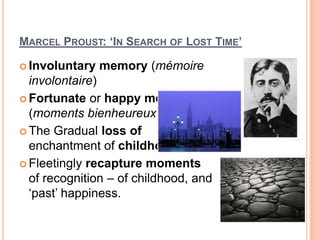
MARCEL PROUST: ‘IN SEARCH OF LOST TIME’
 Involuntary memory (mémoire
involontaire)
 Fortunate or happy moments
(moments bienheureux)
 The Gradual loss of
enchantment of childhood
 Fleetingly recapture moments
of recognition – of childhood, and
‘past’ happiness.
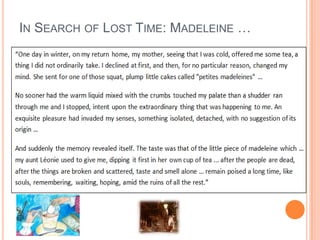
IN SEARCH OF LOST TIME: MADELEINE …
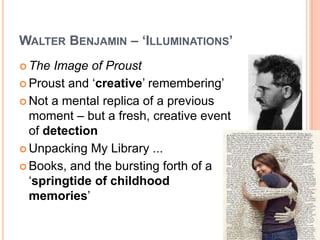
WALTER BENJAMIN – ‘ILLUMINATIONS’
 The Image of Proust
 Proust and ‘creative’ remembering’
 Not a mental replica of a previous
moment – but a fresh, creative event
of detection
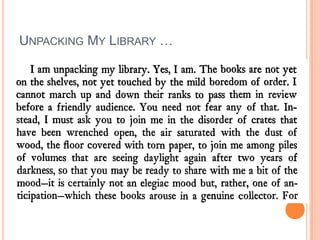
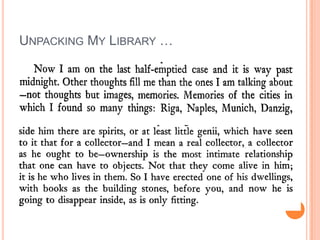
 Unpacking My Library ...
 Books, and the bursting forth of a
‘springtide of childhood
memories’
UNPACKING MY LIBRARY …
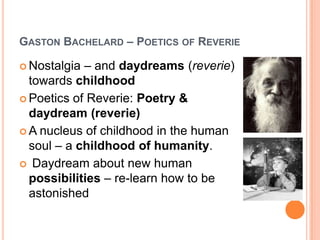
GASTON BACHELARD – POETICS OF REVERIE
 Nostalgia – and daydreams (reverie)
towards childhood
 Poetics of Reverie: Poetry &
daydream (reverie)
 A nucleus of childhood in the human
soul – a childhood of humanity.
 Daydream about new human
possibilities – re-learn how to be
astonished
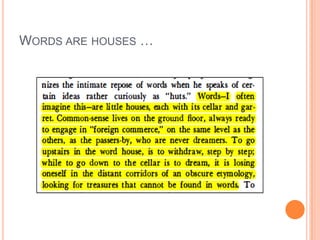
WORDS ARE HOUSES …
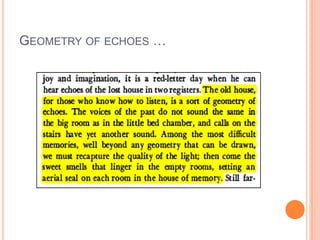
GEOMETRY OF ECHOES …
MINIATURE – INTERIORITY …
Initially, the remembrance of a trace of hope emerges as an „inner‟ self-
encounter, a moment of revelation, prompted by a personal connection.
This process is perhaps best illustrated by one of Bloch‟s personal
recollections, of a specific childhood encounter - in his book Traces, [in the
section „Red Window‟]:
Almost like legends were the clickers or marbles we played with; one likes to
have something colourful in ones hand. They were Arabian stones, ringed with
red or green, sometimes with stars, even with miniaturised lands; these we
carried in our pockets ... [they] were not marbles at all, but rather bringing
that distant land closer, all the more because it lay beneath. In the
apothecary‟s store lay a plate with some dried thing labelled “China Peel”; I
thought the chunk was a shard of the Chinese wall ... Eight years [old] and the
most remarkable thing was the sewing box in a shop window on the way to
school; it stood between skeins and mats, embroidered by feminine hands,
which could interest no one. But on the box was an illustration with many dots
or flecks of colour on the smooth paper, as though the paint had run. It
showed a hut and much snow ... in the windows of the hut burned a red light ...
at first I believed that it was a landscape on the moon, a great piece of China
peel, as it were; but I felt utter turmoil looking at it that I could hardly
express, and never forgot the red window (Traces: 43-44).
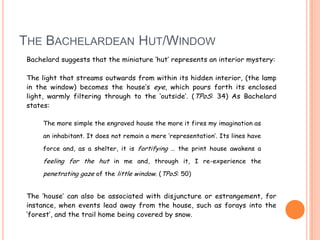
THE BACHELARDEAN HUT/WINDOW
Bachelard suggests that the miniature „hut‟ represents an interior mystery:
The light that streams outwards from within its hidden interior, (the lamp
in the window) becomes the house‟s eye, which pours forth its enclosed
light, warmly filtering through to the „outside‟. (TPoS: 34) As Bachelard
states:
The more simple the engraved house the more it fires my imagination as
an inhabitant. It does not remain a mere „representation‟. Its lines have
force and, as a shelter, it is fortifying … the print house awakens a
feeling for the hut in me and, through it, I re-experience the
penetrating gaze of the little window. (TPoS: 50)
The „house‟ can also be associated with disjuncture or estrangement, for
instance, when events lead away from the house, such as forays into the
„forest‟, and the trail home being covered by snow.
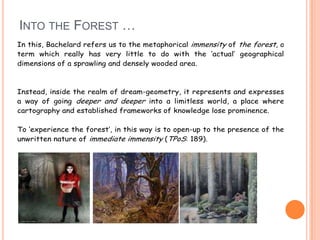
INTO THE FOREST …
In this, Bachelard refers us to the metaphorical immensity of the forest, a
term which really has very little to do with the „actual‟ geographical
dimensions of a sprawling and densely wooded area.
Instead, inside the realm of dream-geometry, it represents and expresses
a way of going deeper and deeper into a limitless world, a place where
cartography and established frameworks of knowledge lose prominence.
To „experience the forest‟, in this way is to open-up to the presence of the
unwritten nature of immediate immensity (TPoS: 189).
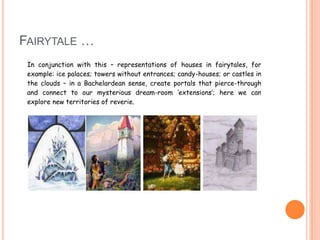
FAIRYTALE …
In conjunction with this – representations of houses in fairytales, for
example: ice palaces; towers without entrances; candy-houses; or castles in
the clouds – in a Bachelardean sense, create portals that pierce-through
and connect to our mysterious dream-room „extensions‟; here we can
explore new territories of reverie.
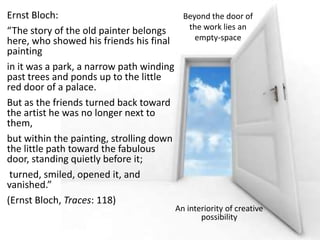
Beyond the door of
the work lies an
empty-space
Ernst Bloch:
“The story of the old painter belongs
here, who showed his friends his final
painting
in it was a park, a narrow path winding
past trees and ponds up to the little
red door of a palace.
But as the friends turned back toward
the artist he was no longer next to
them,
but within the painting, strolling down
the little path toward the fabulous
door, standing quietly before it;
turned, smiled, opened it, and
vanished.”
(Ernst Bloch, Traces: 118)
An interiority of creative
possibility
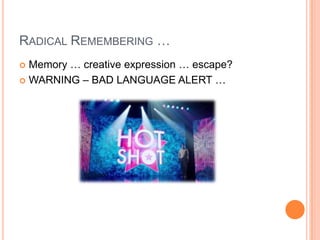
RADICAL REMEMBERING …
 Memory … creative expression … escape?
 WARNING – BAD LANGUAGE ALERT …
IN PREPARATION FOR NEXT WEEK
Consider the following – and start to make some
possible connections
BEGIN TO THINK ABOUT …
 Your own possible connections and interpretations
to:
 Bloch:
 Utopia
 Trace
 Memory
 Not-Yet (Future)
 Empty-Space
 Cultural Surplus (personal connections to a cultural
aretfact)
BEGIN TO THINK ABOUT …
 Your own possible connections and interpretations
to:
 Proust / Benjamin:
 Happy moments
 In search of lost time
 Smell
 Déjà vu
 Childhood wonder
 Creative memory
 Connections to books (or other personal collections)
BEGIN TO THINK ABOUT …
 Your own possible connections and interpretations
to:
 Bachelard:
 House
 Spaces
 Daydream (reverie)
 Creative daydreaming
 The eternal wonder of latent childhood

Marcel Proust, Walter Benjamin, Gaston Bachelard

  • 1.
    BRIEF RECAP ONLAST WEEK What can you remember about Ernst Bloch’s work & concepts? Have you been able to establish any of your own thoughts / ideas / connections to Bloch (Utopia)
  • 2.
    MARCEL PROUST, WALTERBENJAMIN, & GASTON BACHELARD: LOST MEMORY / CREATIVE MEMORY Craig Hammond
  • 3.
    MARCEL PROUST: ‘INSEARCH OF LOST TIME’  Involuntary memory (mémoire involontaire)  Fortunate or happy moments (moments bienheureux)  The Gradual loss of enchantment of childhood  Fleetingly recapture moments of recognition – of childhood, and ‘past’ happiness.
  • 4.
    IN SEARCH OFLOST TIME: MADELEINE …
  • 5.
    WALTER BENJAMIN –‘ILLUMINATIONS’  The Image of Proust  Proust and ‘creative’ remembering’  Not a mental replica of a previous moment – but a fresh, creative event of detection  Unpacking My Library ...  Books, and the bursting forth of a ‘springtide of childhood memories’
  • 6.
  • 7.
  • 8.
    GASTON BACHELARD –POETICS OF REVERIE  Nostalgia – and daydreams (reverie) towards childhood  Poetics of Reverie: Poetry & daydream (reverie)  A nucleus of childhood in the human soul – a childhood of humanity.  Daydream about new human possibilities – re-learn how to be astonished
  • 9.
  • 10.
  • 11.
    MINIATURE – INTERIORITY… Initially, the remembrance of a trace of hope emerges as an „inner‟ self- encounter, a moment of revelation, prompted by a personal connection. This process is perhaps best illustrated by one of Bloch‟s personal recollections, of a specific childhood encounter - in his book Traces, [in the section „Red Window‟]: Almost like legends were the clickers or marbles we played with; one likes to have something colourful in ones hand. They were Arabian stones, ringed with red or green, sometimes with stars, even with miniaturised lands; these we carried in our pockets ... [they] were not marbles at all, but rather bringing that distant land closer, all the more because it lay beneath. In the apothecary‟s store lay a plate with some dried thing labelled “China Peel”; I thought the chunk was a shard of the Chinese wall ... Eight years [old] and the most remarkable thing was the sewing box in a shop window on the way to school; it stood between skeins and mats, embroidered by feminine hands, which could interest no one. But on the box was an illustration with many dots or flecks of colour on the smooth paper, as though the paint had run. It showed a hut and much snow ... in the windows of the hut burned a red light ... at first I believed that it was a landscape on the moon, a great piece of China peel, as it were; but I felt utter turmoil looking at it that I could hardly express, and never forgot the red window (Traces: 43-44).
  • 12.
    THE BACHELARDEAN HUT/WINDOW Bachelardsuggests that the miniature „hut‟ represents an interior mystery: The light that streams outwards from within its hidden interior, (the lamp in the window) becomes the house‟s eye, which pours forth its enclosed light, warmly filtering through to the „outside‟. (TPoS: 34) As Bachelard states: The more simple the engraved house the more it fires my imagination as an inhabitant. It does not remain a mere „representation‟. Its lines have force and, as a shelter, it is fortifying … the print house awakens a feeling for the hut in me and, through it, I re-experience the penetrating gaze of the little window. (TPoS: 50) The „house‟ can also be associated with disjuncture or estrangement, for instance, when events lead away from the house, such as forays into the „forest‟, and the trail home being covered by snow.
  • 13.
    INTO THE FOREST… In this, Bachelard refers us to the metaphorical immensity of the forest, a term which really has very little to do with the „actual‟ geographical dimensions of a sprawling and densely wooded area. Instead, inside the realm of dream-geometry, it represents and expresses a way of going deeper and deeper into a limitless world, a place where cartography and established frameworks of knowledge lose prominence. To „experience the forest‟, in this way is to open-up to the presence of the unwritten nature of immediate immensity (TPoS: 189).
  • 14.
    FAIRYTALE … In conjunctionwith this – representations of houses in fairytales, for example: ice palaces; towers without entrances; candy-houses; or castles in the clouds – in a Bachelardean sense, create portals that pierce-through and connect to our mysterious dream-room „extensions‟; here we can explore new territories of reverie.
  • 15.
    Beyond the doorof the work lies an empty-space Ernst Bloch: “The story of the old painter belongs here, who showed his friends his final painting in it was a park, a narrow path winding past trees and ponds up to the little red door of a palace. But as the friends turned back toward the artist he was no longer next to them, but within the painting, strolling down the little path toward the fabulous door, standing quietly before it; turned, smiled, opened it, and vanished.” (Ernst Bloch, Traces: 118) An interiority of creative possibility
  • 16.
    RADICAL REMEMBERING … Memory … creative expression … escape?  WARNING – BAD LANGUAGE ALERT …
  • 17.
    IN PREPARATION FORNEXT WEEK Consider the following – and start to make some possible connections
  • 18.
    BEGIN TO THINKABOUT …  Your own possible connections and interpretations to:  Bloch:  Utopia  Trace  Memory  Not-Yet (Future)  Empty-Space  Cultural Surplus (personal connections to a cultural aretfact)
  • 19.
    BEGIN TO THINKABOUT …  Your own possible connections and interpretations to:  Proust / Benjamin:  Happy moments  In search of lost time  Smell  Déjà vu  Childhood wonder  Creative memory  Connections to books (or other personal collections)
  • 20.
    BEGIN TO THINKABOUT …  Your own possible connections and interpretations to:  Bachelard:  House  Spaces  Daydream (reverie)  Creative daydreaming  The eternal wonder of latent childhood