Health care
Working toward Affordability & Accessibility
The Problem
It is difficult to create change toward
affordability and accessibility in the U.S. health
care system because of its complexity.
Assumptions + Biases
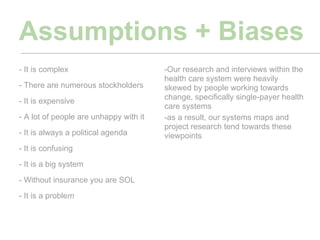
- It is complex                         -Our research and interviews within the
                                        health care system were heavily
- There are numerous stockholders       skewed by people working towards
- It is expensive                       change, specifically single-payer health
                                        care systems
- A lot of people are unhappy with it   -as a result, our systems maps and
                                        project research tend towards these
- It is always a political agenda       viewpoints
- It is confusing
- It is a big system
- Without insurance you are SOL
- It is a problem
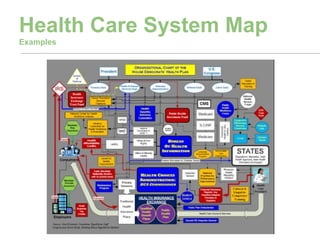
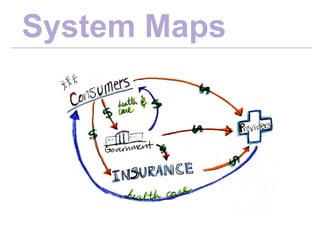
Health Care System Map
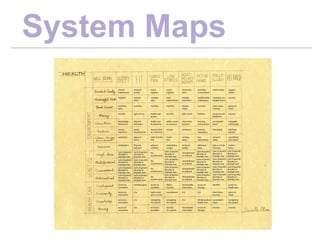
Examples
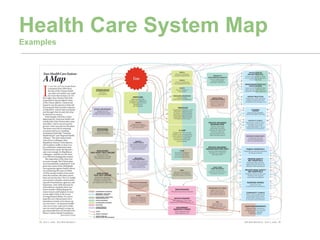
Health Care System Map
Examples
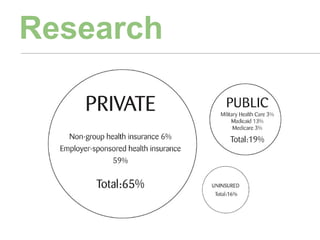
Research
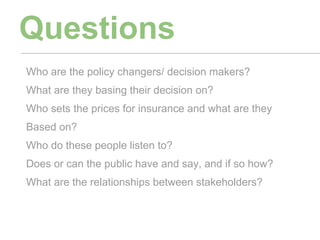
Questions
Who are the policy changers/ decision makers?
What are they basing their decision on?
Who sets the prices for insurance and what are they
Based on?
Who do these people listen to?
Does or can the public have and say, and if so how?
What are the relationships between stakeholders?
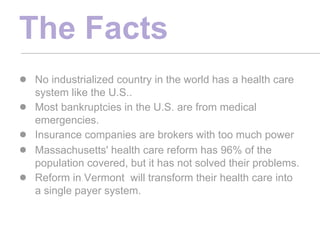
The Facts
● No industrialized country in the world has a health care
    system like the U.S..
●   Most bankruptcies in the U.S. are from medical
    emergencies.
●   Insurance companies are brokers with too much power
●   Massachusetts' health care reform has 96% of the
    population covered, but it has not solved their problems.
●   Reform in Vermont will transform their health care into
    a single payer system.
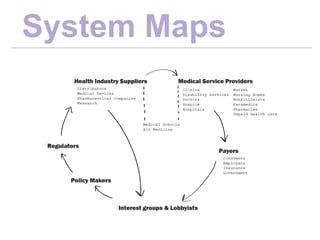
System Maps
System Maps
System Maps
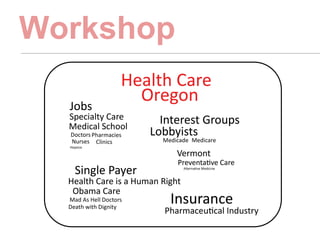
Workshop
PARTICIPANTS

Michael Hillis
Activist from Lights on Healthcare

Richard Bruno
Medical Student at OHSU and president of
Mad as Hell Doctors Student Chapter

Don Harker
Author, Birdwatcher, Epiphany Expert, and PNCA
Collaborative Design Supermentor
Workshop
Workshop
Workshop
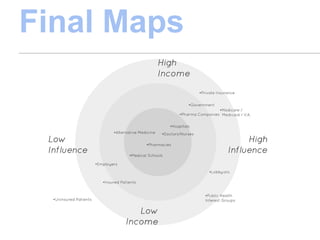
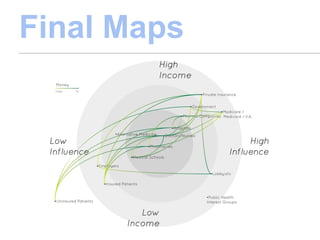
Final Maps
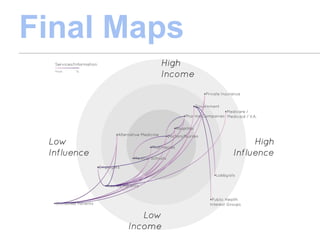
Final Maps
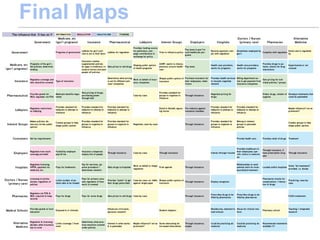
Final Maps
Final Maps
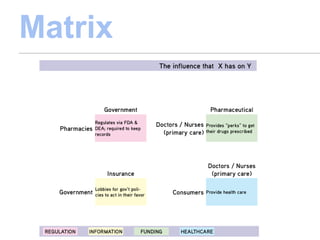
Matrix
Next steps
Further develop system maps for providers and policy
makers toward creating cohesion amongst progressives.

● Pharmacy-Insurance
● Doctors-Hospitals
 ●   Pharmaceuticals-Insurance
Next steps
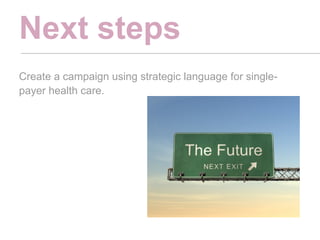
Create a campaign using strategic language for single-
payer health care.
Next steps

Mapping the Health Care System

  • 1.
    Health care Working towardAffordability & Accessibility
  • 2.
    The Problem It isdifficult to create change toward affordability and accessibility in the U.S. health care system because of its complexity.
  • 3.
    Assumptions + Biases -It is complex -Our research and interviews within the health care system were heavily - There are numerous stockholders skewed by people working towards - It is expensive change, specifically single-payer health care systems - A lot of people are unhappy with it -as a result, our systems maps and project research tend towards these - It is always a political agenda viewpoints - It is confusing - It is a big system - Without insurance you are SOL - It is a problem
  • 4.
    Health Care SystemMap Examples
  • 5.
    Health Care SystemMap Examples
  • 6.
  • 7.
    Questions Who are thepolicy changers/ decision makers? What are they basing their decision on? Who sets the prices for insurance and what are they Based on? Who do these people listen to? Does or can the public have and say, and if so how? What are the relationships between stakeholders?
  • 8.
    The Facts ● Noindustrialized country in the world has a health care system like the U.S.. ● Most bankruptcies in the U.S. are from medical emergencies. ● Insurance companies are brokers with too much power ● Massachusetts' health care reform has 96% of the population covered, but it has not solved their problems. ● Reform in Vermont will transform their health care into a single payer system.
  • 9.
  • 10.
  • 11.
  • 12.
    Workshop PARTICIPANTS Michael Hillis Activist fromLights on Healthcare Richard Bruno Medical Student at OHSU and president of Mad as Hell Doctors Student Chapter Don Harker Author, Birdwatcher, Epiphany Expert, and PNCA Collaborative Design Supermentor
  • 13.
  • 14.
  • 15.
  • 16.
  • 17.
  • 18.
  • 19.
  • 20.
  • 21.
    Next steps Further developsystem maps for providers and policy makers toward creating cohesion amongst progressives. ● Pharmacy-Insurance ● Doctors-Hospitals ● Pharmaceuticals-Insurance
  • 22.
    Next steps Create acampaign using strategic language for single- payer health care.
  • 23.