Mapping gold pathfinder metal ratios –
A methodological approach based on
compositional analysis of spatially
distributed multivariate data
Braga,L.P.1, Porto,C.1, Silva,F.2 and Borba,R.1
1Federal University of Rio de Janeiro
2Federal Rural University of Rio de Janeiro
Rio de Janeiro, RJ, Brazil
Geochemical exploration in deeply weathered
terrains is often hampered by a strong
modification of primary geochemical signals at
surface, making it difficult to locate potential
targets using geochemical results of soil samples.
This problem is particularly relevant in the
Amapari region, Amapá state, Brazil, where
10,235 soil samples were collected in an
extensive grid covering ~ 500 km2, whose
samples were analysed by ICP-MS after an
Aqua Regia digest producing results for 51
elements.
The methodology applied in this work is
directed at mapping potential targets for Au
mineralization using compositional kriging of
ratios of Au pathfinder metals
The samples were classified according to distinct
groups: training, composed of mineralized
samples over a known deposit area (B) and non-
mineralized samples from a background area (A);
validation, composed of another set of
mineralized samples over the same known deposit
area (B) and non-mineralized samples from the
same background area (A)
Training will be used to generate a model and
Validation to evaluate its performance with
samples not used in the modelling steps. The
criteria to validate the model uses the area
location (A or B) where the sample falls and its
metal content
B
A
From the 51 initial elements, (Au) was eliminated and
19 others as well as like B, Ba, Ca,Cd, Ce, Co, Mg, Mn,
Na, P, Re, Sb, Se, Sn, Sr, Ta, Te, Y, Zn based on
exploratory analysis. For example, Boron (B) has
almost every sample below detection limit (bdl).
Another example is phosphorus (P) which was
excluded for showing similar behaviour in both areas
A and B.
In addition to pure statistical reasons, geological analysis
was taken into account, eliminating five more metals –
(Be, Cs, K, Li and Rb) because they were associated to
granitoids and not to gold.
Drainage
Bif= bandded iron formation
Gn= gneiss
Gr= grantie
Grdt= granodiorite
-----
UM= ultramafic rocks
VNO= Vila Nova metavolcanic sequence
The Compositional Analysis approach was
adopted due to the nature of the data. Data was
treated with "compositions", an R-package for the
analysis of compositional and positive data using
different approaches, written by K. Gerald Van den
Boogart, Raimon Tolosana-Delgado and Matevz
Bren (version 1.40-1).
In the training phase of the model metals
associated with the Au mineralization were
identified using Compositional Principal
Components.
Based on these plots a Compositional
Discriminant Function was developed to
identify the origin of each sample (A or B) for
the selected metals. .
The second set, validation, is composed of
mineralized samples over the same known deposit
area (B) and non-mineralized samples from the
same background area (A). A satisfactory test with
the same discriminant function obtained from the
training sample was performed.
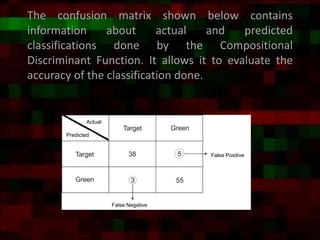
The confusion matrix shown below contains
information about actual and predicted
classifications done by the Compositional
Discriminant Function. It allows it to evaluate the
accuracy of the classification done.
Actual
Predicted
False Negative
False Positive
The third set to be tested (C), prospection, is
composed of samples from the rest of the area
covered by the grid but where Au mineralization has
not been recognized. However, the results were not
meaningful and another approach was assumed.
C
A compositional kriging interpolation was used to
build a map with the prospection samples where
only geochemical results were available. The first
step was to obtain models of Compositional Crossed
Variogram with the metals selected in the previous
phase. Below the adjusted model for the As-Hf-Tl
subcomposition.
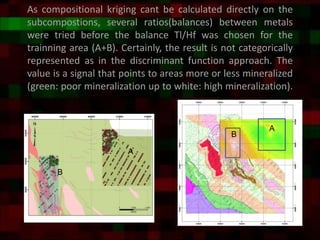
As compositional kriging cant be calculated directly on the
subcompostions, several ratios(balances) between metals
were tried before the balance Tl/Hf was chosen for the
trainning area (A+B). Certainly, the result is not categorically
represented as in the discriminant function approach. The
value is a signal that points to areas more or less mineralized
(green: poor mineralization up to white: high mineralization).
B
A
B
A
The adjusted variogram model (A+B) was then applied
to the kriging of the third sample (C). The balloons (left)
and the stars (right) point to effective minning activity.
This result is geologically and experimentally
coherent. First, the distributions of Hf and Tl in the
region show that area A has much more Hf than
area B and that Tl is present in area B but not in A.
This behaviour was observed after the present
balance kriging map was produced.
Second, a mining company has been working
in this area and is effectively mining gold in
the areas inside the signal map obtained from
the balance Tl/Hf.
Trainning A+B
Prospection C
(without A+B data)
Summing up
We propose a methodology for mapping gold
pathfinder metal ratios as a tool to reinforce
geochemical signals. The basic steps are:
1. Exploratory analysis of the data
2. Calculation of compositions
3. Principal Component Analysis
4. Selection of subcompositions
5. Modeling the logratio variogram(trainning)
6. Selection of Balances(trainning and validation)
7. Mapping the interpolation of composition
represented by a chosen balance(prospection)
References
Pawowlsky,-Glahn, V., Egozcue, J.J., Tolosana-
Delgado,R. (2015)Modelling and analysis of
compositional data: Wiley
Boogaart, K.G. Tolosana-Delgado, R. (2013) Analyzing
Compositional Data with R: Springer
Melo, L.V. de, Villas, R.N., Soares, J.S., Faraco, M.T.L.
(2003) Geological setting and mineralizing fluids of the
Amapari gold deposit, Amapá State, Brazil: BRGM-
France3.

Mapping gold pathfinders

  • 1.
    Mapping gold pathfindermetal ratios – A methodological approach based on compositional analysis of spatially distributed multivariate data Braga,L.P.1, Porto,C.1, Silva,F.2 and Borba,R.1 1Federal University of Rio de Janeiro 2Federal Rural University of Rio de Janeiro Rio de Janeiro, RJ, Brazil
  • 2.
    Geochemical exploration indeeply weathered terrains is often hampered by a strong modification of primary geochemical signals at surface, making it difficult to locate potential targets using geochemical results of soil samples.
  • 3.
    This problem isparticularly relevant in the Amapari region, Amapá state, Brazil, where 10,235 soil samples were collected in an extensive grid covering ~ 500 km2, whose samples were analysed by ICP-MS after an Aqua Regia digest producing results for 51 elements.
  • 6.
    The methodology appliedin this work is directed at mapping potential targets for Au mineralization using compositional kriging of ratios of Au pathfinder metals
  • 7.
    The samples wereclassified according to distinct groups: training, composed of mineralized samples over a known deposit area (B) and non- mineralized samples from a background area (A); validation, composed of another set of mineralized samples over the same known deposit area (B) and non-mineralized samples from the same background area (A)
  • 8.
    Training will beused to generate a model and Validation to evaluate its performance with samples not used in the modelling steps. The criteria to validate the model uses the area location (A or B) where the sample falls and its metal content
  • 9.
  • 10.
    From the 51initial elements, (Au) was eliminated and 19 others as well as like B, Ba, Ca,Cd, Ce, Co, Mg, Mn, Na, P, Re, Sb, Se, Sn, Sr, Ta, Te, Y, Zn based on exploratory analysis. For example, Boron (B) has almost every sample below detection limit (bdl). Another example is phosphorus (P) which was excluded for showing similar behaviour in both areas A and B.
  • 11.
    In addition topure statistical reasons, geological analysis was taken into account, eliminating five more metals – (Be, Cs, K, Li and Rb) because they were associated to granitoids and not to gold. Drainage Bif= bandded iron formation Gn= gneiss Gr= grantie Grdt= granodiorite ----- UM= ultramafic rocks VNO= Vila Nova metavolcanic sequence
  • 12.
    The Compositional Analysisapproach was adopted due to the nature of the data. Data was treated with "compositions", an R-package for the analysis of compositional and positive data using different approaches, written by K. Gerald Van den Boogart, Raimon Tolosana-Delgado and Matevz Bren (version 1.40-1).
  • 13.
    In the trainingphase of the model metals associated with the Au mineralization were identified using Compositional Principal Components.
  • 14.
    Based on theseplots a Compositional Discriminant Function was developed to identify the origin of each sample (A or B) for the selected metals. .
  • 15.
    The second set,validation, is composed of mineralized samples over the same known deposit area (B) and non-mineralized samples from the same background area (A). A satisfactory test with the same discriminant function obtained from the training sample was performed.
  • 16.
    The confusion matrixshown below contains information about actual and predicted classifications done by the Compositional Discriminant Function. It allows it to evaluate the accuracy of the classification done. Actual Predicted False Negative False Positive
  • 17.
    The third setto be tested (C), prospection, is composed of samples from the rest of the area covered by the grid but where Au mineralization has not been recognized. However, the results were not meaningful and another approach was assumed. C
  • 18.
    A compositional kriginginterpolation was used to build a map with the prospection samples where only geochemical results were available. The first step was to obtain models of Compositional Crossed Variogram with the metals selected in the previous phase. Below the adjusted model for the As-Hf-Tl subcomposition.
  • 19.
    As compositional krigingcant be calculated directly on the subcompostions, several ratios(balances) between metals were tried before the balance Tl/Hf was chosen for the trainning area (A+B). Certainly, the result is not categorically represented as in the discriminant function approach. The value is a signal that points to areas more or less mineralized (green: poor mineralization up to white: high mineralization). B A B A
  • 20.
    The adjusted variogrammodel (A+B) was then applied to the kriging of the third sample (C). The balloons (left) and the stars (right) point to effective minning activity.
  • 21.
    This result isgeologically and experimentally coherent. First, the distributions of Hf and Tl in the region show that area A has much more Hf than area B and that Tl is present in area B but not in A. This behaviour was observed after the present balance kriging map was produced.
  • 22.
    Second, a miningcompany has been working in this area and is effectively mining gold in the areas inside the signal map obtained from the balance Tl/Hf. Trainning A+B Prospection C (without A+B data)
  • 23.
    Summing up We proposea methodology for mapping gold pathfinder metal ratios as a tool to reinforce geochemical signals. The basic steps are: 1. Exploratory analysis of the data 2. Calculation of compositions 3. Principal Component Analysis 4. Selection of subcompositions 5. Modeling the logratio variogram(trainning) 6. Selection of Balances(trainning and validation) 7. Mapping the interpolation of composition represented by a chosen balance(prospection)
  • 24.
    References Pawowlsky,-Glahn, V., Egozcue,J.J., Tolosana- Delgado,R. (2015)Modelling and analysis of compositional data: Wiley Boogaart, K.G. Tolosana-Delgado, R. (2013) Analyzing Compositional Data with R: Springer Melo, L.V. de, Villas, R.N., Soares, J.S., Faraco, M.T.L. (2003) Geological setting and mineralizing fluids of the Amapari gold deposit, Amapá State, Brazil: BRGM- France3.