HEALTH 7
OBJECTIVES:
A. Identify the right food during adolescence;
B. Select the right food during adolescence;
C. Follow the nutritional guidelines for adolescence for healthy
eating.
PUBERTY or ADOLESCENCE
What do you call the process of
eating the right kind of food so you
can grow properly and be healthy?
N U T R I O
I
T N
A
A A A A
A
A
A
NUTRITION
Is the process of living being’s ability to eat food and use the
components of those foods to fuel growth and development.
(Google)
The process of eating the right kind of food so you can grow
properly and be healthy. (Merriam Dictionary)
FOOD
Any nutritious substances that people or animals eat or drink, or
plant absorb, in order to maintain life and growth.
TERMS
NUTRITION
NUTRIENTS
ADOLESCENT
GROWTH SPURT
CALORIES
NUTRIENTS - a substance that plant, animal and people need to
live and grow.
ADOLESCENT – a young person who is developing into an adult;
teenager
GROWTH SPURT – an occurrence of growing quickly and
suddenly in a short period of time.
KILOCALORIES or CALORIES – are units of heat that
measures the energy used by the body and the energy that foods
supply to the body.
ACTIVITY 1
GUESSING GAME!!!
Here’s how to play!
 Go to your assign group. Choose a member that will represent the group in
front.
The representative will bring a coin and bang it on the floor if he knows the
correct word. Then, the members at the back will make an animal sound 5
times.
 After mimicking an animal sound, the representative will guess the perfect
word that best describes the picture.
 The group that guesses the right answer will gain 5 points.
L E C H O N
_
_
_ _ _ _
C H O P S U
_ _ _ _ _
E Y
_ _ _
LETS PLAY!!!
C R
A H Y S
_
_ _ E
B O D R A T
_ _ _ _ _ _ _ _ _ _
_ _ _ _ T _
F R U I _ S
_ _ _ _ M C
V I T A _
I
_ N
_ _
_ _ _ _ R
_
F I B E
_ _ _ _ _ _
_
_ _ _
V E G E T L
B
A E S
_ _ _ _ _
F I B E R
_ _ _ _ M A
V I T A _
I
_ N
_ _
_ _ _ _ _
_ _ _ _ _ _ _
M I L K O
P R D U C T S
_ _ _ _ _
_ _
C A L C M
I U
_ _ _
_
M E T
A
_ _
_
I O
R N
_
_ _ _
_
P R T
O E N
I
_ _ _
Nutritional Needs of Adolescents
The growth spurt during adolescent creates
increased demand for energy and nutrients. As an
adolescent, your total nutrients needed are higher
at this stage than any other in your life. It only
shows that nutrition and physical growth are
essentially related; optimal nutrition is requisite for
achieving your growth potential.
Nutritional Needs of Adolescents
Due to rapid growth and development at this
stage, you have a greater need for certain
nutrients, such as calcium, iron, protein and energy
foods
FOOD
GUIDE
PYRAMID
FOR
13-19
AGE GROUP
FOOD GUIDE PYRAMID
 emphasized the importance of eating a balanced and
varied diet by depicting the 5 main food
groups:GRAINS, FRUITS, VEGETABLES MILK
PRODUCTS and other PROTEIN
It shows example of what to eat and the proportion
and recommended servings per day of each group.
It shows the combination of all our meals over days or
weeks.
GRAINS MILK FRUITS VEGETABLES MEAT
 6-11 servings
 13-14 (B - 50 kg)
423g/day
(G - 49 kg)
325 g/day
• Provides you
energy because it
contains
Carbohydrates
 3-4 servings
 B/G - 1OOO
ml/day
• It has Calcium
which builds
strong teeth
and bones
 2-4 servings
 B/G - 20-35
g/day
 It has Vitamin C
which heals
cuts and keeps
healthy skin
and Fiber
which prevent
constipation
 3-5 servings
 B/G - 2- 2 ½
cup/day
 Great source of
Fiber that helps
move waste
through the
digestive
system and
Vitamin A that
fight infections.
 2-3 servings
 13-14
 B - 71 g/day
 G - 68 g/day
 Source of Protein
which provides
Iron that helps in
building muscles.
GUIDELINES IN EATING HEALTHY FOOD
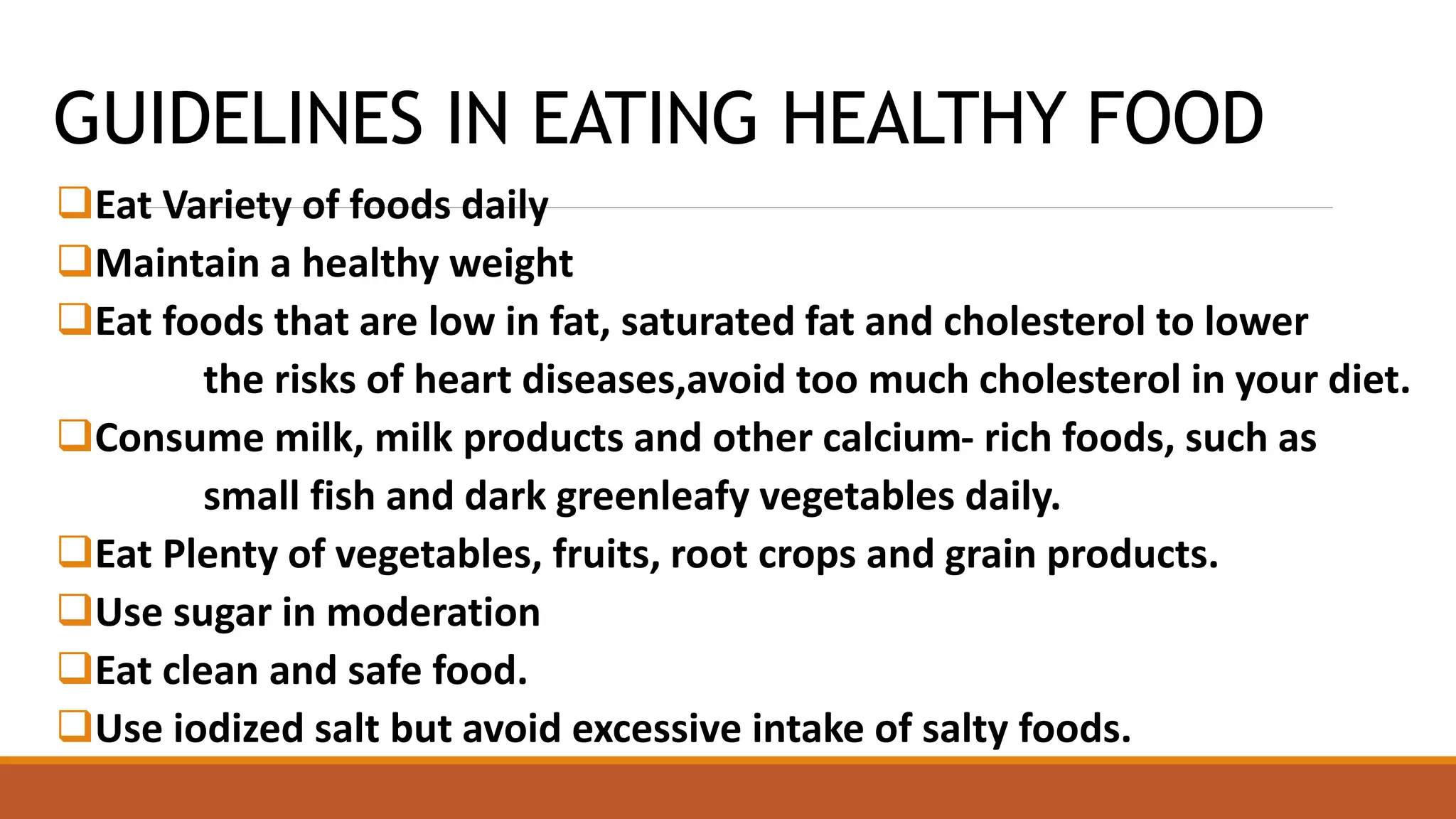
Eat Variety of foods daily
Maintain a healthy weight
Eat foods that are low in fat, saturated fat and cholesterol to lower
the risks of heart diseases,avoid too much cholesterol in your diet.
Consume milk, milk products and other calcium- rich foods, such as
small fish and dark greenleafy vegetables daily.
Eat Plenty of vegetables, fruits, root crops and grain products.
Use sugar in moderation
Eat clean and safe food.
Use iodized salt but avoid excessive intake of salty foods.
THANK YOU!!
 6-11 servings
 13-14 (B - 50 kg)
2,800 kcal.
(G - 49 kg)
2,250 kcal
• Gives you
energy
GRAINS
DAIRY PRODUCT
 3-4 servings
 B/G - 1OOO ml/day
• It has Calcium
which builds
strong teeth and
bones
MEAT
 2-3 servings
 13-14
 B - 71 g/day
 G - 68 g/day
 Source of Protein which
provides Iron that helps
in building muscles
VEGETABLES
 3-5 servings

 Great source of Fiber
that helps move waste
through the digestive
system and Vitamin A
that fight infections.
VEGETABLES
 2-4 servings
 B/G - 20-35 g/day
 It has Vitamin C which
heals cuts and keeps
healthy skin and Fiber
which prevent
constipation
CONVERSION
Calculating kcal in food from weight in grams and weight in grams to
kcal.
1 g protein = 4 kcal protein
1 g fat = 9 kcal fat
1 g carbohydrate = 1 kcal of carbohydrate
ANOREXIA NERVOSA
BULIMIA
BINGE EATING DISORDER
The Symptoms of Bulimia
In order for people to be diagnosed with bulimia, they must satisfy the following diagnostic criteria:
Display repetitive binge eating episodes, which can consist of:
◦ eating extremely large amounts of food in a specific time period (larger than most individuals would eat in a similar period of time and under the same circumstances) and/or
◦ feeling that they lack control over these eating episodes, such that they are unable to stop eating.
Engage in repetitive behaviors that are designed to compensate for potential weight gain as a result of their binging episodes, such as:
◦ self-induced vomiting
◦ abuse of laxatives
◦ use of other medications to purge
◦ excessive exercise
◦ fasting
Bingeing and compensatory behaviors occur at least on average of once a week for a total minimum period of three months
No diagnosis of anorexia
Self-worth or self-evaluation is based on weight or body size
Bulimia is differentiated from the other major eating disorders that occur in adolescence and adults by the above diagnostic criteria. For example, individuals diagnosed with anorexia may also
binge and purge; however, these individuals have a unhealthy amount of weight loss and a distorted self-image regarding their body size (people with anorexia nervosa can be painfully thin and
still see themselves as being too heavy), whereas an individual diagnosed with bulimia does not display the unhealthy weight loss and does not display the same distorted body image.

MAPEH 7 - NUTRITION.pptx

  • 1.
  • 2.
    OBJECTIVES: A. Identify theright food during adolescence; B. Select the right food during adolescence; C. Follow the nutritional guidelines for adolescence for healthy eating.
  • 3.
  • 5.
    What do youcall the process of eating the right kind of food so you can grow properly and be healthy?
  • 6.
    N U TR I O I T N A A A A A A A A
  • 7.
    NUTRITION Is the processof living being’s ability to eat food and use the components of those foods to fuel growth and development. (Google) The process of eating the right kind of food so you can grow properly and be healthy. (Merriam Dictionary) FOOD Any nutritious substances that people or animals eat or drink, or plant absorb, in order to maintain life and growth.
  • 8.
  • 9.
    NUTRIENTS - asubstance that plant, animal and people need to live and grow. ADOLESCENT – a young person who is developing into an adult; teenager GROWTH SPURT – an occurrence of growing quickly and suddenly in a short period of time. KILOCALORIES or CALORIES – are units of heat that measures the energy used by the body and the energy that foods supply to the body.
  • 10.
  • 11.
    Here’s how toplay!  Go to your assign group. Choose a member that will represent the group in front. The representative will bring a coin and bang it on the floor if he knows the correct word. Then, the members at the back will make an animal sound 5 times.  After mimicking an animal sound, the representative will guess the perfect word that best describes the picture.  The group that guesses the right answer will gain 5 points.
  • 12.
    L E CH O N _ _ _ _ _ _
  • 13.
    C H OP S U _ _ _ _ _ E Y _ _ _
  • 14.
  • 15.
    C R A HY S _ _ _ E B O D R A T _ _ _ _ _ _ _ _ _ _
  • 16.
    _ _ __ T _ F R U I _ S
  • 17.
    _ _ __ M C V I T A _ I _ N _ _
  • 18.
    _ _ __ R _ F I B E
  • 19.
    _ _ __ _ _ _ _ _ _ V E G E T L B A E S
  • 20.
    _ _ __ _ F I B E R
  • 21.
    _ _ __ M A V I T A _ I _ N _ _
  • 22.
    _ _ __ _ _ _ _ _ _ _ _ M I L K O P R D U C T S
  • 23.
    _ _ __ _ _ _ C A L C M I U
  • 24.
    _ _ _ _ ME T A
  • 25.
  • 26.
    _ _ _ _ PR T O E N I _ _ _
  • 27.
    Nutritional Needs ofAdolescents The growth spurt during adolescent creates increased demand for energy and nutrients. As an adolescent, your total nutrients needed are higher at this stage than any other in your life. It only shows that nutrition and physical growth are essentially related; optimal nutrition is requisite for achieving your growth potential.
  • 28.
    Nutritional Needs ofAdolescents Due to rapid growth and development at this stage, you have a greater need for certain nutrients, such as calcium, iron, protein and energy foods
  • 29.
  • 30.
    FOOD GUIDE PYRAMID emphasized the importance of eating a balanced and varied diet by depicting the 5 main food groups:GRAINS, FRUITS, VEGETABLES MILK PRODUCTS and other PROTEIN It shows example of what to eat and the proportion and recommended servings per day of each group. It shows the combination of all our meals over days or weeks.
  • 31.
    GRAINS MILK FRUITSVEGETABLES MEAT  6-11 servings  13-14 (B - 50 kg) 423g/day (G - 49 kg) 325 g/day • Provides you energy because it contains Carbohydrates  3-4 servings  B/G - 1OOO ml/day • It has Calcium which builds strong teeth and bones  2-4 servings  B/G - 20-35 g/day  It has Vitamin C which heals cuts and keeps healthy skin and Fiber which prevent constipation  3-5 servings  B/G - 2- 2 ½ cup/day  Great source of Fiber that helps move waste through the digestive system and Vitamin A that fight infections.  2-3 servings  13-14  B - 71 g/day  G - 68 g/day  Source of Protein which provides Iron that helps in building muscles.
  • 39.
    GUIDELINES IN EATINGHEALTHY FOOD Eat Variety of foods daily Maintain a healthy weight Eat foods that are low in fat, saturated fat and cholesterol to lower the risks of heart diseases,avoid too much cholesterol in your diet. Consume milk, milk products and other calcium- rich foods, such as small fish and dark greenleafy vegetables daily. Eat Plenty of vegetables, fruits, root crops and grain products. Use sugar in moderation Eat clean and safe food. Use iodized salt but avoid excessive intake of salty foods.
  • 40.
  • 44.
     6-11 servings 13-14 (B - 50 kg) 2,800 kcal. (G - 49 kg) 2,250 kcal • Gives you energy GRAINS
  • 45.
    DAIRY PRODUCT  3-4servings  B/G - 1OOO ml/day • It has Calcium which builds strong teeth and bones
  • 47.
    MEAT  2-3 servings 13-14  B - 71 g/day  G - 68 g/day  Source of Protein which provides Iron that helps in building muscles
  • 48.
    VEGETABLES  3-5 servings  Great source of Fiber that helps move waste through the digestive system and Vitamin A that fight infections.
  • 49.
    VEGETABLES  2-4 servings B/G - 20-35 g/day  It has Vitamin C which heals cuts and keeps healthy skin and Fiber which prevent constipation
  • 51.
    CONVERSION Calculating kcal infood from weight in grams and weight in grams to kcal. 1 g protein = 4 kcal protein 1 g fat = 9 kcal fat 1 g carbohydrate = 1 kcal of carbohydrate
  • 52.
  • 54.
  • 55.
  • 57.
    The Symptoms ofBulimia In order for people to be diagnosed with bulimia, they must satisfy the following diagnostic criteria: Display repetitive binge eating episodes, which can consist of: ◦ eating extremely large amounts of food in a specific time period (larger than most individuals would eat in a similar period of time and under the same circumstances) and/or ◦ feeling that they lack control over these eating episodes, such that they are unable to stop eating. Engage in repetitive behaviors that are designed to compensate for potential weight gain as a result of their binging episodes, such as: ◦ self-induced vomiting ◦ abuse of laxatives ◦ use of other medications to purge ◦ excessive exercise ◦ fasting Bingeing and compensatory behaviors occur at least on average of once a week for a total minimum period of three months No diagnosis of anorexia Self-worth or self-evaluation is based on weight or body size Bulimia is differentiated from the other major eating disorders that occur in adolescence and adults by the above diagnostic criteria. For example, individuals diagnosed with anorexia may also binge and purge; however, these individuals have a unhealthy amount of weight loss and a distorted self-image regarding their body size (people with anorexia nervosa can be painfully thin and still see themselves as being too heavy), whereas an individual diagnosed with bulimia does not display the unhealthy weight loss and does not display the same distorted body image.