HOUSE RULES:
• Raise your hand before speaking.
• Don’t disturb others.
• Listen carefully when someone is
speaking!
• Keep your cellphone inside your bag
• Respect everyone
• Do your best and have fun.
REVIEW
FACT
Opera is part of
Western Classical
Music form and
tradition.
BLUFF
Philippines do not
have an original
Philippine Opera.
BLUFF
The Phantom of the
Opera is an example
of Philippine Opera.
BLUFF
The Phantom of the
Opera is an example
of Philippine Opera.
FACT
La Loba Negra, Noli
Me Tangere and El
Filibusterismo are 3
iconic Philippine
Operas.

FACT
The Cultural Center of
the Philippines, paved
the way for Filipino
Opera’s to be staged at a
legitimate venue of
HISTORY OF
PHILIPPINE
OPERA
Analyze the historical
development and
significance of Opera in
the Philippines."
OPERA
Is a dramatic story told through
song.
it is considered as the most
complete art form, combining all
the elements of art; words,
music, drama and dance.
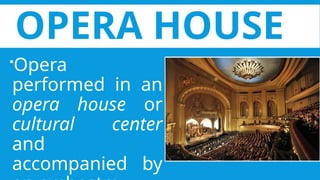
OPERA HOUSE
Opera
performed in an
opera house or
cultural center
and
accompanied by
HISTORY OF OPERA
It started in Italy more than
400 years ago at the end of
the 16th century and soon
spread throughout the rest
of Europe.
PHILIPPINE OPERA
It started during the middle
part of 19th century.
First introduced in the
Philippines in 1878 through
the Zarzuela.
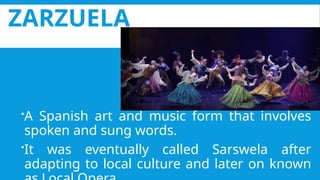
ZARZUELA
A Spanish art and music form that involves
spoken and sung words.
It was eventually called Sarswela after
adapting to local culture and later on known
DIFFERENT LOCAL
THEATERS IN THE
PHILIPPINES
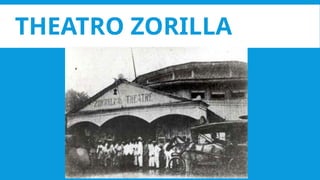
THEATRO ZORILLA
THEATRO ZORILLA
Also kown as “Dulaang Zorilla” sa
Maynila.
A prominent theatre in the Philippines.
The theatre where the First Filipino
Opera “Sandugong Panaginip” was
presented.
THEATRO ZORILLA
has a seating capacity of 900 people and
was officially opened on August 17, 1983
and served as the venue for Spanish-
language and Tagalog-language stage
performances.
-Maintained its activity until year 1970,
moment that closed its doors. At that time,
cinema had become the main occupation
MANILA GRAND OPERA
HOUSE
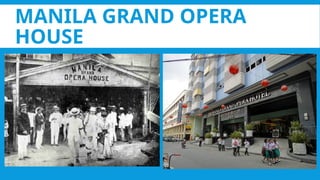
MANILA GRAND OPERA HOUSE
Initially designed for a
different kind of
entertainment; its actually
designed for a cycling event
and then was remodelled into
a theatre.
MANILA GRAND OPERA HOUSE
The country’s most popular theatre in
the 1900’s.
It gained the title “The theatre with a
History” and famously held the stage
for important political, historical and
cultural events in its glory days.
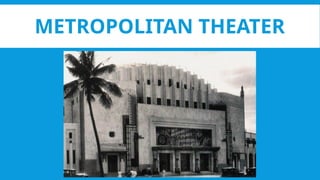
METROPOLITAN THEATER
has been sign of decay after it was closed in
1996.
it was one of Manila’s iconic landmarks during
the city’s years as the “PARIS of ASIA”
Filipino architect Juan Arellano, who was also
behind Manila’s Post Office Building and Jones
Bridge, designed the theatre.
it was a survivor of World War II
METROPOLITAN THEATER
It was the venue of the final showdown
between Sharon Cuneta’s Dorina Pineda
and Cherie Gil’s Lavina Arguelle’s in Bituing
Walang Ningning (1985)
Boy Abunda was once among the theater’s
staff,
It was considered as the Philippines first
THE NOTABLE
PEOPLE IN THE
DEVELOPMENT OF
PHILIPPINE
OPERA
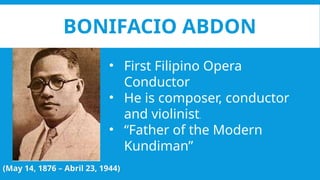
BONIFACIO ABDON
(May 14, 1876 – Abril 23, 1944)
• First Filipino Opera
Conductor
• He is composer, conductor
and violinist.
• “Father of the Modern
Kundiman”
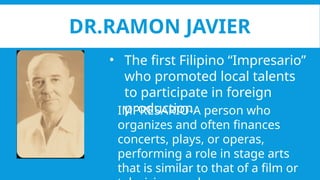
DR.RAMON JAVIER
• The first Filipino “Impresario”
who promoted local talents
to participate in foreign
production.
IMPRESARIO-A person who
organizes and often finances
concerts, plays, or operas,
performing a role in stage arts
that is similar to that of a film or
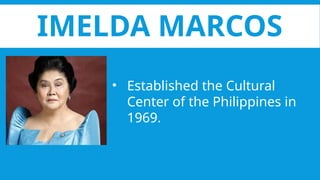
IMELDA MARCOS
• Established the Cultural
Center of the Philippines in
1969.
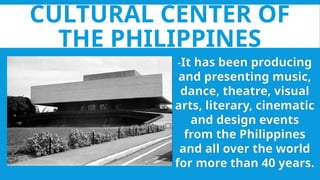
CULTURAL CENTER OF
THE PHILIPPINES
-It has been producing
and presenting music,
dance, theatre, visual
arts, literary, cinematic
and design events
from the Philippines
and all over the world
for more than 40 years.
ICONIC
PHILIPPINE
OPERAS
LA LOBA NEGRA
• Also known as “The Black Sheep-Wolf”
• A three-act Filipino Opera.
• Act I and Act II are based on history.
• Act III is based on a legend attributed to Fr.
Burgos, one of the three martyred priest.
• This music was composed by Francisco Feliciano
(National Artist) with libretto by Soprano Fides.
NOLI ME TANGERE; THE
OPERA
• Composed by National Artist Felipe de Leon,
with libretto by National Artist Guillermo
Tolentino.
• It was re-staged at CCP Main Theater from
September 18-20 1987 in connection with
the Music Theatre Foundation of the
Philippines.
• It had it’s US production premiere as Noli
EL FILIBUSTERISMO
• The three act opera El Filibusterismo
was composed by National Artist
Felipe de Leon in 1970/ with Libretto
in Filipino by Anthony Morli.
• Staged at the Cultural Center of the
Philippines.
“LEARNING MO, I-QUOTE
MO!”
Create your own short quotation
about the importance of Philippine
Opera in the Development of
Philippine Music and Art and role of
technology in ensuring that Operas
are still appreciated even at this time.
(5 minutes)
CRITERIA
Content 40%
Relevance 30%
Correct Grammar Usage 30%
TOTAL 100%
WHAT ARE THE DIFFERENT LOCAL
THEATERS IN THE PHILIPPINES?
Theatro Zorilla
Manila Grand Opera
House
Metropolitan Theater
WHO ARE THENOTABLE PEOPLE IN
THE DEVELOPMENT OF PHILIPPINE
OPERA?
Bonifacio Abdon, Dr.
Ramon Javier and Ms.
Imelda Marcos
WHAT IS THE IMPORTANCE OF
PHILIPPINE OPERA IN OUR LIFE IN
THE 21ST
CENTURY?
Original Filipino operas can
help the Filipino
understand and value our
culture by exposing [people
to] cultural heritages.
QUIZ
1-5. For 5 points. What is an Opera?
6. What is the first Filipino opera by Pedro Paterno in
1902 and was first presented in Zorilla Theatre?
7-8. Aside from Zorilla Theatre, provide two more local
theatres in the Philippines.
9. What do you think is the significance of Opera in the
Philippines?
10. What is the opera in the Philippines with only three
acts and its title is translated in English as “The Black
“TRUST YOUR
INSTINCTS!”
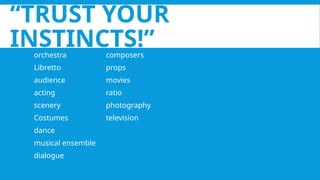
orchestra composers
Libretto props
audience movies
acting ratio
scenery photography
Costumes television
dance
musical ensemble
dialogue

MAPEH 10 (Fourth Quarter) OPERA .pptx

  • 2.
    HOUSE RULES: • Raiseyour hand before speaking. • Don’t disturb others. • Listen carefully when someone is speaking! • Keep your cellphone inside your bag • Respect everyone • Do your best and have fun.
  • 3.
  • 5.
    FACT Opera is partof Western Classical Music form and tradition.
  • 6.
    BLUFF Philippines do not havean original Philippine Opera.
  • 7.
    BLUFF The Phantom ofthe Opera is an example of Philippine Opera.
  • 8.
    BLUFF The Phantom ofthe Opera is an example of Philippine Opera.
  • 9.
    FACT La Loba Negra,Noli Me Tangere and El Filibusterismo are 3 iconic Philippine Operas.
  • 10.
    FACT The Cultural Centerof the Philippines, paved the way for Filipino Opera’s to be staged at a legitimate venue of
  • 11.
  • 12.
    Analyze the historical developmentand significance of Opera in the Philippines."
  • 13.
    OPERA Is a dramaticstory told through song. it is considered as the most complete art form, combining all the elements of art; words, music, drama and dance.
  • 14.
    OPERA HOUSE Opera performed inan opera house or cultural center and accompanied by
  • 15.
    HISTORY OF OPERA Itstarted in Italy more than 400 years ago at the end of the 16th century and soon spread throughout the rest of Europe.
  • 16.
    PHILIPPINE OPERA It startedduring the middle part of 19th century. First introduced in the Philippines in 1878 through the Zarzuela.
  • 17.
    ZARZUELA A Spanish artand music form that involves spoken and sung words. It was eventually called Sarswela after adapting to local culture and later on known

  • 18.
  • 19.
  • 20.
    THEATRO ZORILLA Also kownas “Dulaang Zorilla” sa Maynila. A prominent theatre in the Philippines. The theatre where the First Filipino Opera “Sandugong Panaginip” was presented.
  • 21.
    THEATRO ZORILLA has aseating capacity of 900 people and was officially opened on August 17, 1983 and served as the venue for Spanish- language and Tagalog-language stage performances. -Maintained its activity until year 1970, moment that closed its doors. At that time, cinema had become the main occupation
  • 22.
  • 23.
    MANILA GRAND OPERAHOUSE Initially designed for a different kind of entertainment; its actually designed for a cycling event and then was remodelled into a theatre.
  • 24.
    MANILA GRAND OPERAHOUSE The country’s most popular theatre in the 1900’s. It gained the title “The theatre with a History” and famously held the stage for important political, historical and cultural events in its glory days.
  • 25.
  • 26.
    METROPOLITAN THEATER has beensign of decay after it was closed in 1996. it was one of Manila’s iconic landmarks during the city’s years as the “PARIS of ASIA” Filipino architect Juan Arellano, who was also behind Manila’s Post Office Building and Jones Bridge, designed the theatre. it was a survivor of World War II
  • 27.
    METROPOLITAN THEATER It wasthe venue of the final showdown between Sharon Cuneta’s Dorina Pineda and Cherie Gil’s Lavina Arguelle’s in Bituing Walang Ningning (1985) Boy Abunda was once among the theater’s staff, It was considered as the Philippines first
  • 28.
    THE NOTABLE PEOPLE INTHE DEVELOPMENT OF PHILIPPINE OPERA
  • 29.
    BONIFACIO ABDON (May 14,1876 – Abril 23, 1944) • First Filipino Opera Conductor • He is composer, conductor and violinist. • “Father of the Modern Kundiman”
  • 30.
    DR.RAMON JAVIER • Thefirst Filipino “Impresario” who promoted local talents to participate in foreign production. IMPRESARIO-A person who organizes and often finances concerts, plays, or operas, performing a role in stage arts that is similar to that of a film or
  • 31.
    IMELDA MARCOS • Establishedthe Cultural Center of the Philippines in 1969.
  • 32.
    CULTURAL CENTER OF THEPHILIPPINES -It has been producing and presenting music, dance, theatre, visual arts, literary, cinematic and design events from the Philippines and all over the world for more than 40 years.
  • 33.
  • 34.
    LA LOBA NEGRA •Also known as “The Black Sheep-Wolf” • A three-act Filipino Opera. • Act I and Act II are based on history. • Act III is based on a legend attributed to Fr. Burgos, one of the three martyred priest. • This music was composed by Francisco Feliciano (National Artist) with libretto by Soprano Fides.
  • 36.
    NOLI ME TANGERE;THE OPERA • Composed by National Artist Felipe de Leon, with libretto by National Artist Guillermo Tolentino. • It was re-staged at CCP Main Theater from September 18-20 1987 in connection with the Music Theatre Foundation of the Philippines. • It had it’s US production premiere as Noli
  • 38.
    EL FILIBUSTERISMO • Thethree act opera El Filibusterismo was composed by National Artist Felipe de Leon in 1970/ with Libretto in Filipino by Anthony Morli. • Staged at the Cultural Center of the Philippines.
  • 40.
    “LEARNING MO, I-QUOTE MO!” Createyour own short quotation about the importance of Philippine Opera in the Development of Philippine Music and Art and role of technology in ensuring that Operas are still appreciated even at this time. (5 minutes)
  • 41.
    CRITERIA Content 40% Relevance 30% CorrectGrammar Usage 30% TOTAL 100%
  • 42.
    WHAT ARE THEDIFFERENT LOCAL THEATERS IN THE PHILIPPINES? Theatro Zorilla Manila Grand Opera House Metropolitan Theater
  • 43.
    WHO ARE THENOTABLEPEOPLE IN THE DEVELOPMENT OF PHILIPPINE OPERA? Bonifacio Abdon, Dr. Ramon Javier and Ms. Imelda Marcos
  • 44.
    WHAT IS THEIMPORTANCE OF PHILIPPINE OPERA IN OUR LIFE IN THE 21ST CENTURY? Original Filipino operas can help the Filipino understand and value our culture by exposing [people to] cultural heritages.
  • 45.
    QUIZ 1-5. For 5points. What is an Opera? 6. What is the first Filipino opera by Pedro Paterno in 1902 and was first presented in Zorilla Theatre? 7-8. Aside from Zorilla Theatre, provide two more local theatres in the Philippines. 9. What do you think is the significance of Opera in the Philippines? 10. What is the opera in the Philippines with only three acts and its title is translated in English as “The Black
  • 47.
    “TRUST YOUR INSTINCTS!” orchestra composers Librettoprops audience movies acting ratio scenery photography Costumes television dance musical ensemble dialogue

Editor's Notes

  • #34 The story of La Loba Negra took place in the 17th century, during the time of Spanish Rule in the Philippines. -The story thus focuses on the bitter reaction and planned revenge by his wife Doña Luisa (La Loba Negra) under the religious perpetrators.