Mehran University
Of Engineering And Technology, Jamshoro
Limits and fits:
Submitted To :
Sir Atif Qaim Khani
Presented By:
Habib Ur Rahman 20ME004
Mureed Hussain 20ME006
1
What is tolerance? It is the consequence of humanity.
We are all formed of frailty and error; let us pardon
reciprocally each other's folly that is the first law of
nature.
-VOLTAIRE
Table Of Contents
• Introduction
• Definition
• Types
• Importance
• Examples
• Applications
2
Introduction:
No two parts can be produced with identical measurements by any manufacturing process.
 In any production process, regardless of how well it is designed or how carefully it is
maintained, a certain amount of variation (natural) will always exist.
Variations arises from;
Improperly adjusted machines
Operator error
Tool wear
Defective raw materials etc. Such variations are referred as 'assignable causes' and can be
identified and controlled.
It is impossible to produce a part to an exact size or basic size, some variations, known as
tolerances, need to be allowed.
3
The permissible level of tolerance depends on the functional
requirements, which cannot be compromised. No
component can be manufactured precisely to a given
dimension; it can only be made to lie between two limits,
upper (maximum) and lower (minimum).
Designer has to suggest these tolerance limits to ensure
satisfactory operation.
The difference between the upper and lower limits is
termed permissive tolerance.
4
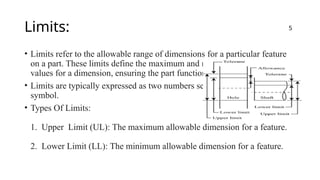
Limits:
• Limits refer to the allowable range of dimensions for a particular feature
on a part. These limits define the maximum and minimum acceptable
values for a dimension, ensuring the part functions as intended.
• Limits are typically expressed as two numbers separated by a tolerance
symbol.
• Types Of Limits:
1. Upper Limit (UL): The maximum allowable dimension for a feature.
2. Lower Limit (LL): The minimum allowable dimension for a feature.
5
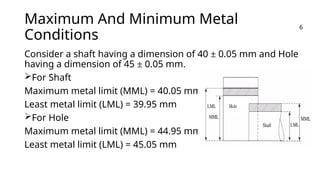
Maximum And Minimum Metal
Conditions
Consider a shaft having a dimension of 40 ± 0.05 mm and Hole
having a dimension of 45 ± 0.05 mm.
For Shaft
Maximum metal limit (MML) = 40.05 mm
Least metal limit (LML) = 39.95 mm
For Hole
Maximum metal limit (MML) = 44.95 mm
Least metal limit (LML) = 45.05 mm
6
Example:
Shaft has to be manufactured to a diameter of 40 ± 0.02 mm.
Solution
The shaft has a basic size of 40 mm.
It will be acceptable if its diameter lies between the limits of
sizes:
Upper limit of 40+0.02 = 40.02 mm
Lower limit of 40-0.02 = 39.98 mm.
Then, permissive tolerance is equal to 40.02 - 39.98 = 0.04
mm.
7
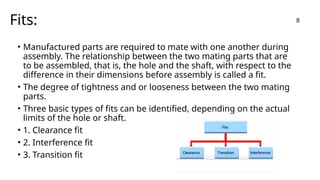
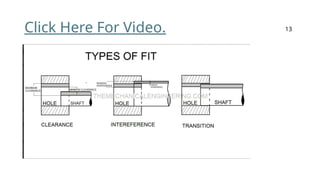
Fits:
• Manufactured parts are required to mate with one another during
assembly. The relationship between the two mating parts that are
to be assembled, that is, the hole and the shaft, with respect to the
difference in their dimensions before assembly is called a fit.
• The degree of tightness and or looseness between the two mating
parts.
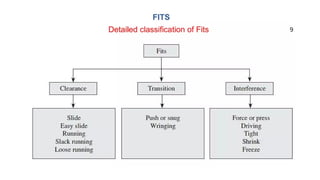
• Three basic types of fits can be identified, depending on the actual
limits of the hole or shaft.
• 1. Clearance fit
• 2. Interference fit
• 3. Transition fit
8
9
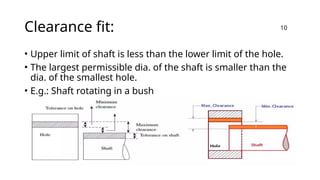
Clearance fit:
• Upper limit of shaft is less than the lower limit of the hole.
• The largest permissible dia. of the shaft is smaller than the
dia. of the smallest hole.
• E.g.: Shaft rotating in a bush
10
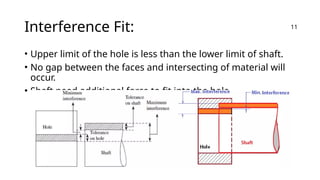
Interference Fit:
• Upper limit of the hole is less than the lower limit of shaft.
• No gap between the faces and intersecting of material will
occur.
• Shaft need additional force to fit into the hole.
11
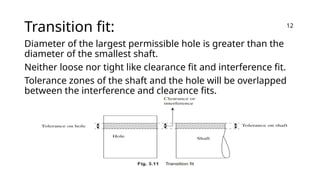
Transition fit:
Diameter of the largest permissible hole is greater than the
diameter of the smallest shaft.
Neither loose nor tight like clearance fit and interference fit.
Tolerance zones of the shaft and the hole will be overlapped
between the interference and clearance fits.
12
Click Here For Video. 13
References:
Chapter 3 Limits, Fits, and Tolerances
Book: Engineering Metrology And Measurements : N.V. Rag
havendra L. Krishnamurthy
https://themechanicalengineering.com/types-of-fit/
https://www.me.iitb.ac.in/~ramesh/courses/ME423/Limits_Fi
ts.pdf
14

Manufacturing Engineering Presentation.pptx

  • 1.
    Mehran University Of EngineeringAnd Technology, Jamshoro Limits and fits: Submitted To : Sir Atif Qaim Khani Presented By: Habib Ur Rahman 20ME004 Mureed Hussain 20ME006 1 What is tolerance? It is the consequence of humanity. We are all formed of frailty and error; let us pardon reciprocally each other's folly that is the first law of nature. -VOLTAIRE
  • 2.
    Table Of Contents •Introduction • Definition • Types • Importance • Examples • Applications 2
  • 3.
    Introduction: No two partscan be produced with identical measurements by any manufacturing process.  In any production process, regardless of how well it is designed or how carefully it is maintained, a certain amount of variation (natural) will always exist. Variations arises from; Improperly adjusted machines Operator error Tool wear Defective raw materials etc. Such variations are referred as 'assignable causes' and can be identified and controlled. It is impossible to produce a part to an exact size or basic size, some variations, known as tolerances, need to be allowed. 3
  • 4.
    The permissible levelof tolerance depends on the functional requirements, which cannot be compromised. No component can be manufactured precisely to a given dimension; it can only be made to lie between two limits, upper (maximum) and lower (minimum). Designer has to suggest these tolerance limits to ensure satisfactory operation. The difference between the upper and lower limits is termed permissive tolerance. 4
  • 5.
    Limits: • Limits referto the allowable range of dimensions for a particular feature on a part. These limits define the maximum and minimum acceptable values for a dimension, ensuring the part functions as intended. • Limits are typically expressed as two numbers separated by a tolerance symbol. • Types Of Limits: 1. Upper Limit (UL): The maximum allowable dimension for a feature. 2. Lower Limit (LL): The minimum allowable dimension for a feature. 5
  • 6.
    Maximum And MinimumMetal Conditions Consider a shaft having a dimension of 40 ± 0.05 mm and Hole having a dimension of 45 ± 0.05 mm. For Shaft Maximum metal limit (MML) = 40.05 mm Least metal limit (LML) = 39.95 mm For Hole Maximum metal limit (MML) = 44.95 mm Least metal limit (LML) = 45.05 mm 6
  • 7.
    Example: Shaft has tobe manufactured to a diameter of 40 ± 0.02 mm. Solution The shaft has a basic size of 40 mm. It will be acceptable if its diameter lies between the limits of sizes: Upper limit of 40+0.02 = 40.02 mm Lower limit of 40-0.02 = 39.98 mm. Then, permissive tolerance is equal to 40.02 - 39.98 = 0.04 mm. 7
  • 8.
    Fits: • Manufactured partsare required to mate with one another during assembly. The relationship between the two mating parts that are to be assembled, that is, the hole and the shaft, with respect to the difference in their dimensions before assembly is called a fit. • The degree of tightness and or looseness between the two mating parts. • Three basic types of fits can be identified, depending on the actual limits of the hole or shaft. • 1. Clearance fit • 2. Interference fit • 3. Transition fit 8
  • 9.
  • 10.
    Clearance fit: • Upperlimit of shaft is less than the lower limit of the hole. • The largest permissible dia. of the shaft is smaller than the dia. of the smallest hole. • E.g.: Shaft rotating in a bush 10
  • 11.
    Interference Fit: • Upperlimit of the hole is less than the lower limit of shaft. • No gap between the faces and intersecting of material will occur. • Shaft need additional force to fit into the hole. 11
  • 12.
    Transition fit: Diameter ofthe largest permissible hole is greater than the diameter of the smallest shaft. Neither loose nor tight like clearance fit and interference fit. Tolerance zones of the shaft and the hole will be overlapped between the interference and clearance fits. 12
  • 13.
    Click Here ForVideo. 13
  • 14.
    References: Chapter 3 Limits,Fits, and Tolerances Book: Engineering Metrology And Measurements : N.V. Rag havendra L. Krishnamurthy https://themechanicalengineering.com/types-of-fit/ https://www.me.iitb.ac.in/~ramesh/courses/ME423/Limits_Fi ts.pdf 14