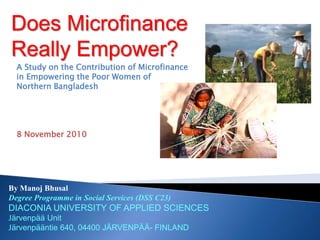
Does Microfinance
Really Empower?
By Manoj Bhusal
Degree Programme in Social Services (DSS C23)
DIACONIA UNIVERSITY OF APPLIED SCIENCES
Järvenpää Unit
Järvenpääntie 640, 04400 JÄRVENPÄÄ- FINLAND
A Study on the Contribution of Microfinance
in Empowering the Poor Women of
Northern Bangladesh
8 November 2010
 Microfinance covers a broader range of
financial services such as credits, savings,
insurance, housing loans.
 Microcredit refers specifically to loans and
the credit needs of clients (< $1,000)
 Entrepreneurial and life skills training, and
advice on topics such as health and
nutrition, sanitation, improving living
conditions, and the importance of
educating children.
 Today, microfinance has become a global
phenomenon
 Bangladesh: Birthplace of modern
Microfinance, Nobel Peace Prize 2006
 Service providers: NGOs, government-
banks, commercial banks and the
Grameen Bank.
 30 million (poor) people served by two
hundred thousand workers in more than
1000 MFIS
 Various models/schemes of microfinance
 10th biggest MFI in Bangladesh, since 1990
 Almost 0.5 million microfinance beneficiaries
 20,000 groups, (82% female,18% male)
 1600 employees for MF, in 11000 villages
 Loan Size(normal): Tk. 1,000-20,000
(€10- 200)
 (Micro-enterprise): upto Tk.3,00,000
(€3,000)
 Interest Rate: 12.5% ,9% for ultra poor
 No synchrony between MF and Non-MF programs
Source: Banglapedia, 2010; CIA Fact Book 2010
 People’s republic of Bangladesh, established in1971
 A parliamentary democracy of 162 million people
 Densely populated, 45% below poverty line
 GDP (per capita): $520 (157th)
 Life Expectancy: 60.25 years
 Literacy Rate: 47.9%, strikes, turmoil, floods
 Main Religions: Muslim 83%, Hindu 16%, other 1%
 Agrarian economy: garment, jute, but also remittance
 Hit hard by climatic fluctuations! Rising sea level
 100th out of 128 countries in the 2007 Gender Gap
Index (WEF)
 Labour force participation among women is 55%
whereas that of male is 88%
 Women earn less than half their male counterparts
 Women literacy rate 31%, only 4% women join
tertiary education.
 Paternal authority, polygamy still practiced
 To find out the contribution of microfinance schemes in social, political and
economic empowerment of the poor women in rural parts of northern
Bangladesh.
 To identify the patterns of gender roles in relation to changing economic
levels and the structure of power and control.
 To assess the effectiveness and outreach of NGOs and Microfinance
Institutions (MFIs) in addressing the needs of the poor and providing services
to them.
 To compare the degree of social participation and political awareness
between the beneficiaries and non-beneficiaries of microfinance schemes.
 To find out the local proxy indicators of empowerment in the rural parts of
Northern Bangladesh.
 To analyze the motivating factors for credit pursuit, the questions of credit
ownership and control, roles and approaches of different funding systems
and group as an empowering factor in relation to credit.
 Few studies done on socio-
political aspects, focus:
outreach and repayment rate!
 Studies and materials of MFIs
 Conducting large scale research is
expensive!
 Studies show mixed results
 No independent study was found from
the research area.
 Microfinance does have the potentiality to
significantly impact the lives of women by
empowering them but that ‘is not an automatic
consequence of women’s access to savings and
credit or group formation per se. In many cases
benefits may be marginal and women may even
be disempowered’ (Mayoux 2005, 2.)
 Benefits of microcredit ‘manifested in better
sanitary and health conditions and increased
empowerment of women’ (Alamgir 2006, 102-
106.)
 participation in microcredit program has no
effect on women's ‘say’ in all but one domain of
household decisions, i.e. decisions regarding
major household purchases.’ (Asim, 2008)
“For a person to be able to say or do something
differently involves some degree of choice. Having
more choice, compared to the past, implies
empowerment” (Davies 2000).
Perception of empowerment is highly contextual!
Five empowerment measurement case studies
conducted by the World Bank in Indonesia,
Nepal, Ethiopia, Honduras and Brazil was
studied to design an EMF.
Instead of complicated statistical analysis,
‘simple descriptive statistics and narrative
reporting’ is more appropriate for empowerment
measurement (Alsop, Bertelsen & Holland 2005)
 Variation between choices available as the crucial
determinant of empowerment!
 1. Whether an opportunity to make a choice exists (existence of
choice).
 2. Whether a person actually uses the opportunity to choose (use of
choice).
 3. Whether the choice resulted in the desired result (achievement of
choice).
 Social, Political and Economic aspects of empowerment
 Finding local proxy indicators of empowerment is important!
Micro (household), Meso (societal) and Macro (state).
1. Observation:
-A non-participant unstructured observation
(ethnographic field notes and video was used)
-11 Microfinance branch offices , 13 microfinance weekly group meetings,
and 7 community based organizations (The Federations) were observed.
- Observation was used for identifying the best possible sample.
2. Semi-structured focus group interviews:
- For comparative empowerment study
- Five long term and five short term beneficiaries selected from the same
locality.
- The sample represented the same locality, profession, age group, illiterate,
- The difference: No. of years of association with MFIs & loan amount
4. Family case studies: Information oriented sampling
2 ‘success’ and 2 ‘failure’ cases
 One of the
poorest
regions
 Prone to
flooding
 Women
literacy
30.9%
 Agrarian
 Economic Domain:
-Very little difference between the economic choices available to both types
of beneficiaries. (Credit is available for both with little outcomes, food
shortage, 3 LTBs were landless even after 20 years of MF use)
- Weak opportunity structure, not enough loan/educational opportunities
- LTBs were able to build some assets (cow, goats, chicken), but STBs used
the loan for consumption.
- LTBs qualify for bigger amount of loan, but still the results were not
encouraging
- LTBs made some contribution to the household economy seasonally, but
economic participation at market level was very weak.
 Social Domain
- Social/psychological domain of LTBs was better
(Comparatively confident, were federation members,believed MF
affiliation had somehow increased their worth in the family)
- However LTBs and STBs both faced domestic violence and were
not consulted while taking important family decisions
“We are women and they are men. It’s been always like that. They are
superior and have more power… My husband doesn’t beat me, but
doesn’t allow me to go outside either. I go to the field with him, we work
and come home together. I’m supposed to be either with him or at home,
that’s my routine.” - A long term beneficiary
“I think it’s quite normal to have some conflict in every family. Even rich
people fight. But our fight doesn’t last long. We are so poor that if we
don’t work together we won’t be able to eat in the evening and survive.
Poverty and disaster unite us faster.” – A short-term beneficiary
 Political domain
- LTBs were members of a local Federation and took some trainings
- Both cast votes, but didn’t select their ’right’ candidates
themselves
- No political affiliation
- don’t own any means of mass communication (such as
radio/phone etc)
- both value and participate weekly group meetings , STBs more
focus on credit and deposits than other discussions
- Think that ‘illiteracy’ has been the main obstacle toward progress
- landlessness and disaster: the roots of poverty!
What will empower women?
- Education
- Skill trainings
- Capital (property or enough loan)
- Awareness
- Special education for men
 Shahanaz, 35
- Grade 8 graduate
- MFB for 8 years
- From 1000Tk-20000Tk
- Has ’enough’ land (jute,
paddy,chilli)
- Has 4 cows, earns 500TK/days
- Has opened a bank account, made
savings for children’s education!
- Son, daughter both go to private
school
- Success: education, stable family
background, land,
supportive/educated husband
- Has higher risk bearing capacity
 Ruksana, 35
- Illetarate, has visual impairments
- Landless, rickshaw puller
husband, 3 daughters
- First loan 5000Tk, all chicken
died of bird flu
- 4 goats, 250 chicken, fish pond
Coping with recent ’fish robbery’!
- Earning goes to loan repayment,
but is determined for a better
future.
- Has enterpreunerial spirit, but risk
bearing capacity is very low.
-Even after several years of MFI affiliation, there has not been
significant increment to the choices they have and the level of
control and power they possess.
-LTBs exercised a slightly improved opportunity of social mobility
and an added value of self-worth, but failed to secure an
enhanced economic future and challenge the longstanding issues
of gender disparity and powerlessness.
- The link between microfinance and women’s empowerment is
not as strong as generally perceived.
-Empowerment is a complex phenomenon and requires many
components (education, family background, social structure, age,
ethnicity etc.)
 Microfinance was valued and taken as a pure and transparent
financial service by both STBs and LTBs, their longstanding
affiliation proves the same
 RDRS Microfinance reaches where others haven’t, provided loans
to ultra poor also
 MFIs replaced traditional oppressive money lending system and
have served people neglected by market oriented ‘formal’
financial institutions
 MFIs haven’t been able to fulfill the credit demand
 Impact differs: better off families get better results
 Consumption credit was valued by many
 Microfinance schemes were designed and marketed as products,
beneficiaries were not consulted in decision making or service
delivery
 A majority of beneficiaries didn’t have any plan,
motivation or idea to develop themselves as women
entrepreneurs.
 Microfinance in disaster affected areas seems to be
counterproductive, relief is needed not credit!
 Tendency to start and stay smaller is common. IGAs
are mostly traditional.
 Skill trainings and technical support were inadequate.
 Total dependency on microcredit seems to be less
productive.
 Irrespective of financial activities, existence of
microfinance groups was valued a lot.
 Credit was asked for one purpose and used for another, for instance, daughter’s
weeding. MFOs should be aware of credit use.
 There should be more cooperation between MFIs in the region to minimize
overlapping, information /experience sharing is needed
 Revision of weekly repayment system is needed.
 It is important to design and implement relatively long training and educational
programmes with specific objectives.
 Promotion of independent academic studies is needed instead of ‘rejoicing’ self-
reported success stories.
 Microfinance filed organizers (MOs) should receive more training.
 Failure of adult-classes? What about opting a different model?
 Work towards changing other structural issues such as land ownership, patriarchal
domination
 Minimalist microfinance is not a panacea! It’s just a financial service.
 Successful microfinance needs to be combined with education and skill
trainings, MFIs should get support for that.
 Focus should be on building capacity of the poor, not merely on raising
income of the poor. Each MFI needs a separate training unit.
 MFI beneficiaries are vulnerable to disaster, a Disaster Reserve Fund is
needed.
 More support for pro-poor research initiatives, e.g. rice research in northern
Bangladesh
 An alternative or complementary model of microfinance could be providing
subsidized credit and financial support to university graduates
 Sample population was rather narrow.
 Beneficiaries using micro-enterpreneurship
loan were not included.
 Interviewing the respondents was sometimes
challenging due to their husbands.
 3 months of field work, basic understanding
of Bengali, Familiar with the concept.
 Trust building was easy because of Nepali
background, didn’t have any expectations
and fear.
 Validity method: Data triangulation
 Research Ethics: Informed consent, voluntary
partcipation and confidentiality
 Got insights into the practicalities of
conducting a research work.
 Developed a better understanding of
qualitative research
 Skills such as listening skills, empathy, the
use of proper language, are important!
 Not only what they express, but also how
they express is important.
Research, my friend,
is not easy!!
...Thank You...

Does Microfinance Really Empower? A presentation by Manoj Bhusal

  • 1.
    Does Microfinance Really Empower? ByManoj Bhusal Degree Programme in Social Services (DSS C23) DIACONIA UNIVERSITY OF APPLIED SCIENCES Järvenpää Unit Järvenpääntie 640, 04400 JÄRVENPÄÄ- FINLAND A Study on the Contribution of Microfinance in Empowering the Poor Women of Northern Bangladesh 8 November 2010
  • 2.
     Microfinance coversa broader range of financial services such as credits, savings, insurance, housing loans.  Microcredit refers specifically to loans and the credit needs of clients (< $1,000)  Entrepreneurial and life skills training, and advice on topics such as health and nutrition, sanitation, improving living conditions, and the importance of educating children.  Today, microfinance has become a global phenomenon
  • 3.
     Bangladesh: Birthplaceof modern Microfinance, Nobel Peace Prize 2006  Service providers: NGOs, government- banks, commercial banks and the Grameen Bank.  30 million (poor) people served by two hundred thousand workers in more than 1000 MFIS  Various models/schemes of microfinance
  • 4.
     10th biggestMFI in Bangladesh, since 1990  Almost 0.5 million microfinance beneficiaries  20,000 groups, (82% female,18% male)  1600 employees for MF, in 11000 villages  Loan Size(normal): Tk. 1,000-20,000 (€10- 200)  (Micro-enterprise): upto Tk.3,00,000 (€3,000)  Interest Rate: 12.5% ,9% for ultra poor  No synchrony between MF and Non-MF programs
  • 5.
    Source: Banglapedia, 2010;CIA Fact Book 2010  People’s republic of Bangladesh, established in1971  A parliamentary democracy of 162 million people  Densely populated, 45% below poverty line  GDP (per capita): $520 (157th)  Life Expectancy: 60.25 years  Literacy Rate: 47.9%, strikes, turmoil, floods  Main Religions: Muslim 83%, Hindu 16%, other 1%  Agrarian economy: garment, jute, but also remittance  Hit hard by climatic fluctuations! Rising sea level
  • 6.
     100th outof 128 countries in the 2007 Gender Gap Index (WEF)  Labour force participation among women is 55% whereas that of male is 88%  Women earn less than half their male counterparts  Women literacy rate 31%, only 4% women join tertiary education.  Paternal authority, polygamy still practiced
  • 7.
     To findout the contribution of microfinance schemes in social, political and economic empowerment of the poor women in rural parts of northern Bangladesh.  To identify the patterns of gender roles in relation to changing economic levels and the structure of power and control.  To assess the effectiveness and outreach of NGOs and Microfinance Institutions (MFIs) in addressing the needs of the poor and providing services to them.  To compare the degree of social participation and political awareness between the beneficiaries and non-beneficiaries of microfinance schemes.  To find out the local proxy indicators of empowerment in the rural parts of Northern Bangladesh.  To analyze the motivating factors for credit pursuit, the questions of credit ownership and control, roles and approaches of different funding systems and group as an empowering factor in relation to credit.
  • 8.
     Few studiesdone on socio- political aspects, focus: outreach and repayment rate!  Studies and materials of MFIs  Conducting large scale research is expensive!  Studies show mixed results  No independent study was found from the research area.
  • 9.
     Microfinance doeshave the potentiality to significantly impact the lives of women by empowering them but that ‘is not an automatic consequence of women’s access to savings and credit or group formation per se. In many cases benefits may be marginal and women may even be disempowered’ (Mayoux 2005, 2.)  Benefits of microcredit ‘manifested in better sanitary and health conditions and increased empowerment of women’ (Alamgir 2006, 102- 106.)  participation in microcredit program has no effect on women's ‘say’ in all but one domain of household decisions, i.e. decisions regarding major household purchases.’ (Asim, 2008)
  • 10.
    “For a personto be able to say or do something differently involves some degree of choice. Having more choice, compared to the past, implies empowerment” (Davies 2000). Perception of empowerment is highly contextual! Five empowerment measurement case studies conducted by the World Bank in Indonesia, Nepal, Ethiopia, Honduras and Brazil was studied to design an EMF. Instead of complicated statistical analysis, ‘simple descriptive statistics and narrative reporting’ is more appropriate for empowerment measurement (Alsop, Bertelsen & Holland 2005)
  • 11.
     Variation betweenchoices available as the crucial determinant of empowerment!  1. Whether an opportunity to make a choice exists (existence of choice).  2. Whether a person actually uses the opportunity to choose (use of choice).  3. Whether the choice resulted in the desired result (achievement of choice).  Social, Political and Economic aspects of empowerment  Finding local proxy indicators of empowerment is important! Micro (household), Meso (societal) and Macro (state).
  • 12.
    1. Observation: -A non-participantunstructured observation (ethnographic field notes and video was used) -11 Microfinance branch offices , 13 microfinance weekly group meetings, and 7 community based organizations (The Federations) were observed. - Observation was used for identifying the best possible sample. 2. Semi-structured focus group interviews: - For comparative empowerment study - Five long term and five short term beneficiaries selected from the same locality. - The sample represented the same locality, profession, age group, illiterate, - The difference: No. of years of association with MFIs & loan amount 4. Family case studies: Information oriented sampling 2 ‘success’ and 2 ‘failure’ cases
  • 13.
     One ofthe poorest regions  Prone to flooding  Women literacy 30.9%  Agrarian
  • 14.
     Economic Domain: -Verylittle difference between the economic choices available to both types of beneficiaries. (Credit is available for both with little outcomes, food shortage, 3 LTBs were landless even after 20 years of MF use) - Weak opportunity structure, not enough loan/educational opportunities - LTBs were able to build some assets (cow, goats, chicken), but STBs used the loan for consumption. - LTBs qualify for bigger amount of loan, but still the results were not encouraging - LTBs made some contribution to the household economy seasonally, but economic participation at market level was very weak.
  • 15.
     Social Domain -Social/psychological domain of LTBs was better (Comparatively confident, were federation members,believed MF affiliation had somehow increased their worth in the family) - However LTBs and STBs both faced domestic violence and were not consulted while taking important family decisions “We are women and they are men. It’s been always like that. They are superior and have more power… My husband doesn’t beat me, but doesn’t allow me to go outside either. I go to the field with him, we work and come home together. I’m supposed to be either with him or at home, that’s my routine.” - A long term beneficiary “I think it’s quite normal to have some conflict in every family. Even rich people fight. But our fight doesn’t last long. We are so poor that if we don’t work together we won’t be able to eat in the evening and survive. Poverty and disaster unite us faster.” – A short-term beneficiary
  • 16.
     Political domain -LTBs were members of a local Federation and took some trainings - Both cast votes, but didn’t select their ’right’ candidates themselves - No political affiliation - don’t own any means of mass communication (such as radio/phone etc) - both value and participate weekly group meetings , STBs more focus on credit and deposits than other discussions - Think that ‘illiteracy’ has been the main obstacle toward progress - landlessness and disaster: the roots of poverty! What will empower women? - Education - Skill trainings - Capital (property or enough loan) - Awareness - Special education for men
  • 17.
     Shahanaz, 35 -Grade 8 graduate - MFB for 8 years - From 1000Tk-20000Tk - Has ’enough’ land (jute, paddy,chilli) - Has 4 cows, earns 500TK/days - Has opened a bank account, made savings for children’s education! - Son, daughter both go to private school - Success: education, stable family background, land, supportive/educated husband - Has higher risk bearing capacity  Ruksana, 35 - Illetarate, has visual impairments - Landless, rickshaw puller husband, 3 daughters - First loan 5000Tk, all chicken died of bird flu - 4 goats, 250 chicken, fish pond Coping with recent ’fish robbery’! - Earning goes to loan repayment, but is determined for a better future. - Has enterpreunerial spirit, but risk bearing capacity is very low.
  • 18.
    -Even after severalyears of MFI affiliation, there has not been significant increment to the choices they have and the level of control and power they possess. -LTBs exercised a slightly improved opportunity of social mobility and an added value of self-worth, but failed to secure an enhanced economic future and challenge the longstanding issues of gender disparity and powerlessness. - The link between microfinance and women’s empowerment is not as strong as generally perceived. -Empowerment is a complex phenomenon and requires many components (education, family background, social structure, age, ethnicity etc.)
  • 19.
     Microfinance wasvalued and taken as a pure and transparent financial service by both STBs and LTBs, their longstanding affiliation proves the same  RDRS Microfinance reaches where others haven’t, provided loans to ultra poor also  MFIs replaced traditional oppressive money lending system and have served people neglected by market oriented ‘formal’ financial institutions  MFIs haven’t been able to fulfill the credit demand  Impact differs: better off families get better results  Consumption credit was valued by many  Microfinance schemes were designed and marketed as products, beneficiaries were not consulted in decision making or service delivery
  • 20.
     A majorityof beneficiaries didn’t have any plan, motivation or idea to develop themselves as women entrepreneurs.  Microfinance in disaster affected areas seems to be counterproductive, relief is needed not credit!  Tendency to start and stay smaller is common. IGAs are mostly traditional.  Skill trainings and technical support were inadequate.  Total dependency on microcredit seems to be less productive.  Irrespective of financial activities, existence of microfinance groups was valued a lot.
  • 21.
     Credit wasasked for one purpose and used for another, for instance, daughter’s weeding. MFOs should be aware of credit use.  There should be more cooperation between MFIs in the region to minimize overlapping, information /experience sharing is needed  Revision of weekly repayment system is needed.  It is important to design and implement relatively long training and educational programmes with specific objectives.  Promotion of independent academic studies is needed instead of ‘rejoicing’ self- reported success stories.  Microfinance filed organizers (MOs) should receive more training.  Failure of adult-classes? What about opting a different model?  Work towards changing other structural issues such as land ownership, patriarchal domination
  • 22.
     Minimalist microfinanceis not a panacea! It’s just a financial service.  Successful microfinance needs to be combined with education and skill trainings, MFIs should get support for that.  Focus should be on building capacity of the poor, not merely on raising income of the poor. Each MFI needs a separate training unit.  MFI beneficiaries are vulnerable to disaster, a Disaster Reserve Fund is needed.  More support for pro-poor research initiatives, e.g. rice research in northern Bangladesh  An alternative or complementary model of microfinance could be providing subsidized credit and financial support to university graduates
  • 23.
     Sample populationwas rather narrow.  Beneficiaries using micro-enterpreneurship loan were not included.  Interviewing the respondents was sometimes challenging due to their husbands.
  • 24.
     3 monthsof field work, basic understanding of Bengali, Familiar with the concept.  Trust building was easy because of Nepali background, didn’t have any expectations and fear.  Validity method: Data triangulation  Research Ethics: Informed consent, voluntary partcipation and confidentiality
  • 25.
     Got insightsinto the practicalities of conducting a research work.  Developed a better understanding of qualitative research  Skills such as listening skills, empathy, the use of proper language, are important!  Not only what they express, but also how they express is important.
  • 26.
    Research, my friend, isnot easy!! ...Thank You...