Sexual assault is a crime.
It includes unwanted
touching, kissing,
grabbing and rape.
A victim is a person who
has been hurt by another
person.
Sexual abuse is not
about love. It’s about
violence.
In a healthy relationship,
you trust each other.
In a healthy relationship,
you like to spend time
together.
In a healthy relationship,
you respect each other.
In a healthy relationship,
you are both free to make
choices about your lives.
In a healthy relationship,
you consider the other
person’s feelings when
making decisions.
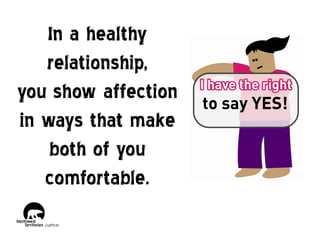
In a healthy
relationship,
you show affection
in ways that make
both of you
comfortable.
Dating violence is
threats
Dating violence is
physical abuse
Dating violence is
emotional abuse.
Dating violence is
sexual abuse.
Dating violence is
stalking.
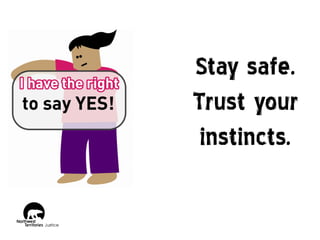
Stay safe.
Trust your
instincts.
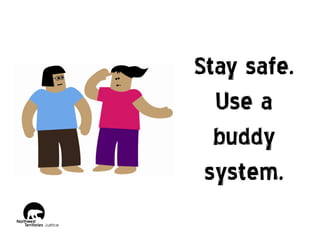
Stay safe.
Use a
buddy
system.
Stay safe. Keep your drink
with you at all times. If
you leave it unattended,
get a new one.
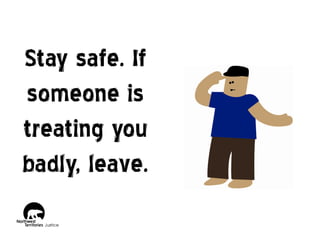
Stay safe. If
someone is
treating you
badly, leave.
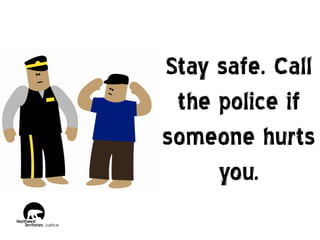
Stay safe. Call
the police if
someone hurts
you.
Whose fault is it when
someone is sexually
assaulted?
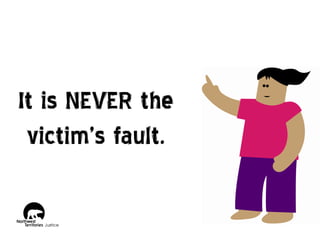
It is NEVER the
victim’s fault.
It is ALWAYS the
violent person’s fault.
Sexual assault is against
the law, even if:
you agreed to have sex
with the person in the past.
Sexual assault is against
the law, even if:
you love the person who
assaulted you.
Sexual assault is against the
law, even if:
you agreed to some sexual
acts, but not others.
Sexual assault is against the
law, even if:
the person who assaulted you
is your common-law or
married partner.
Sexual abuse is not the
victim’s fault. The abuser has
done something wrong and is
responsible for his actions.
Can I give consent if I’m
drunk or high?
No.
Can I give consent if I’m
threatened or bullied?
No.
Can I give consent if the
other person is an older
family member, like a relative
or part of my foster family?
No.
People under the age of
12 cannot consent to sex.
People who are 12 or 13
can only consent to sex
with a partner who is
less than 2 years older.
People who are 14 or 15
can only consent to sex
with a partner who is
less than 5 years older.
Many victims who are
assaulted are confused
about what to do.
You might love the person
who assaulted you.
You might not want the
person who assaulted
you to get into trouble.
It is normal to be
confused and not be
ready to talk about
sexual abuse right away.
After a sexual assault, it is
normal to feel embarrassed.
“I don’t want anyone to
know.”
After a sexual assault, it
is normal to feel angry.
“I just want to kill him.”
After a sexual assault, it is
normal to feel scared.
“I don’t want to be alone.”
After a sexual assault, it is
normal to feel shocked.
“I don’t feel anything.”
After a sexual assault, it is
normal to feel confused.
“I really like him.
How could he do this to me?”
After a sexual assault, it is
normal to feel guilty.
“I shouldn’t have been there.
This must be my fault.”
After a sexual assault, it is
normal to be in denial.
“It wasn’t that big of a deal.”
As time passes, your
feelings about the
assault may change.
Who can you talk to about
sexual assault?
Talk to someone you know
and trust.
There may be a lot of
reasons you don’t want
to tell. Whatever you
decide is your choice.
You are not alone. A lot
of other kids have been
abused.
When violent people are
not held responsible, they
keep hurting people.
What can you do if your
friend is being abused?
Listen to your friend.
Believe your friend.
What your friend has told you
is private. It is not for
everyone in your community
to know. Only people who can
help should know.
If someone is threatening
to hurt your friend, call
the RCMP.
If someone has forced himself
on you sexually in any way,
call the RCMP or social
services as soon as possible.
If someone has forced himself
on you sexually in any way,
do not take a bath or shower.
It will wash away evidence.
If someone has forced himself on
you sexually in any way,
do not throw away your clothes
or wash the sheets or anything
the RCMP might need for an
investigation.
If someone has forced
himself on you sexually
in any way,
find a friend to help you.
If someone has forced himself
on you sexually in any way,
go to the hospital or health
centre.
The RCMP will want to know:
Who assaulted you?
The RCMP will want to know:
What was said?
The RCMP will want to know:
Were you threatened?
The RCMP will want to know:
What happened?
What is evidence in a
sexual assault?
Blood stains, clothes,
sheets, marks on your
body, what people saw,
what people say.
Sometimes there is very little
evidence, or the evidence has
been lost, destroyed or
washed away.
Even if you think there is no
physical evidence, you can
still report the assault.
If there is not enough
evidence to go to court,
it does not mean that no
one believes you.
Your victim services
worker can help you for
as long as you need help.
If you are going to testify
in court, your victim
services worker can help
you to be less nervous.
There are things
that can help you
to testify.
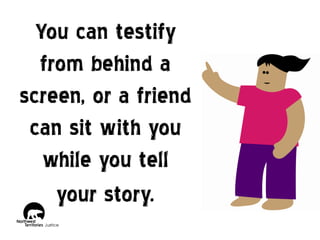
You can testify
from behind a
screen, or a friend
can sit with you
while you tell
your story.
Even if you don’t want to
report the assault, your
victim services worker
can still help you.
Sexual offences include
sexual assault:
any sexual contact with
another person without
that person’s consent.
Sexual offences include
sexual assault with a
weapon:
This is a serious offence.
Sexual offences include
aggravated sexual assault:
This means that the victim is
wounded or seriously hurt, or
her life is in danger.
Sexual offences include
incest:
Sexual intercourse with a
blood relative.
Sexual offences include
sexual interference:
touching the body of a person
under the age of 16, directly or
indirectly, for a sexual purpose.
Sexual offences include
indecent acts/exposing
genitals
Sexual offences include
invitation to sexual touching:
encouraging a child under 16 to
touch his/her own body or
someone else’s body for a
sexual purpose.
If I tell the police I was
raped, shouldn’t they
know what I am talking
about?
The police will know what you
mean. But they will ask you
questions. When you talk about
what happened, give as many
details as possible.
If I make out with my
partner, does that mean I
consented to sex?
No. Consenting to one
thing does not mean you
consent to everything.
You don’t have to do
anything you aren’t
comfortable doing.
If I was sexually
assaulted but wasn’t able
to fight back, does that
mean I consented?
No. Consent means you decide
freely what to do. If you had no
choice or were too afraid or felt
too threatened to fight back,
your consent was not freely
given.
If I was assaulted in
Edmonton, are the laws
the same?
Yes. The laws about sexual
assault are the same
everywhere in Canada.
What if someone tried to
sexually assault me and I
was able to get away?
You should still report it.
A person who tries to
assault you can be
charged with attempted
assault.
If I consented to sex
before, can I change my
mind?
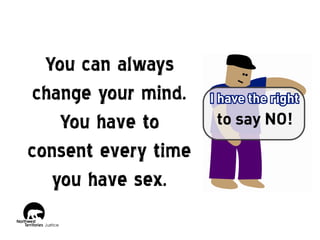
You can always
change your mind.
You have to
consent every time
you have sex.

Sexual assault is a crime pdf