managing your references
or
curating your resources?
Allan Parsons, October 2016
Enjoy your research!
three paradigms
conventional publishing – knowledge sharing – social engagement
search
store
analyse
write
edit
[publish]
locate
curate
create
disseminate
[share]
evaluate
collaborate
participate
[engage]
The time(s) at which, the degree to which and the ways in which
you allow in ‘the Other’
Institutional
Identity
Blogger
WordPress Academia.edu
Scoop It!
Google
Sites (Wiki)
Diigo ResearchGate
Mendeley LinkedIn
Twitter
Piirus
ORCiD
[Facebook?]
note on ‘curating’
selecting
collecting
caring
conserving
interpreting
displaying
contextualising
collating
evaluating
mattering
Machlup, F. (1982) Knowledge: its
creation, distribution, and economic
significance. Volume II: The Branches
of Learning. Princeton, NJ: Princeton
University Press.
Godin, B. (2008) The Knowledge economy: Fritz Machlup’s
construction of a synthetic concept. Quebec. Retrieved from
http://www.csiic.ca/PDF/Godin_37.pdf Accessed on 3
November 2012
philosophers
encyclopaedists
bibliographers
librarians
conceptual-topological
discursive-agonistic
bibliographic-intertextual
material-cultural
orders
iterative
reflexive
locating - curating
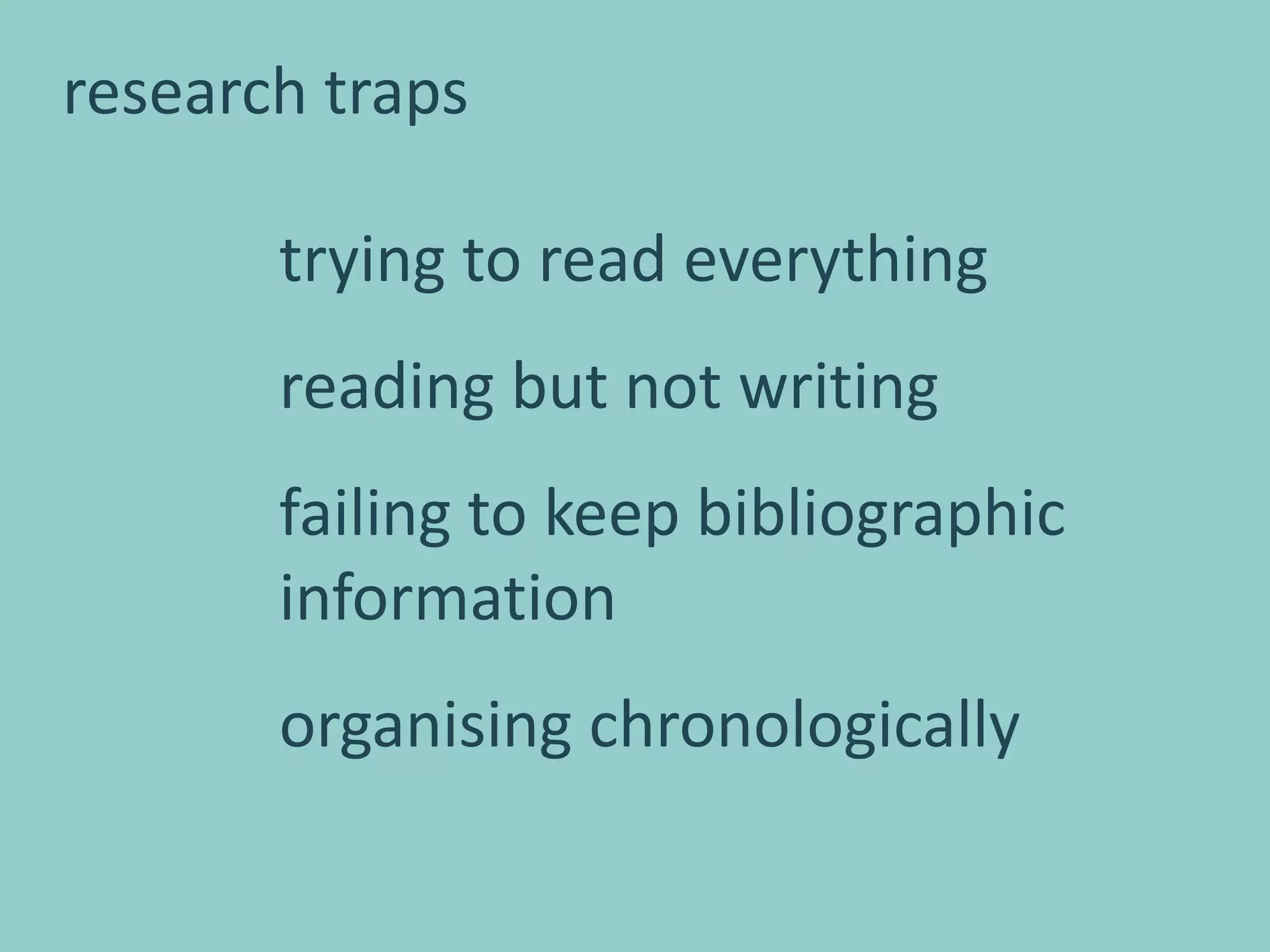
research traps
trying to read everything
reading but not writing
failing to keep bibliographic
information
organising chronologically
the resource field
[strategic literature search]
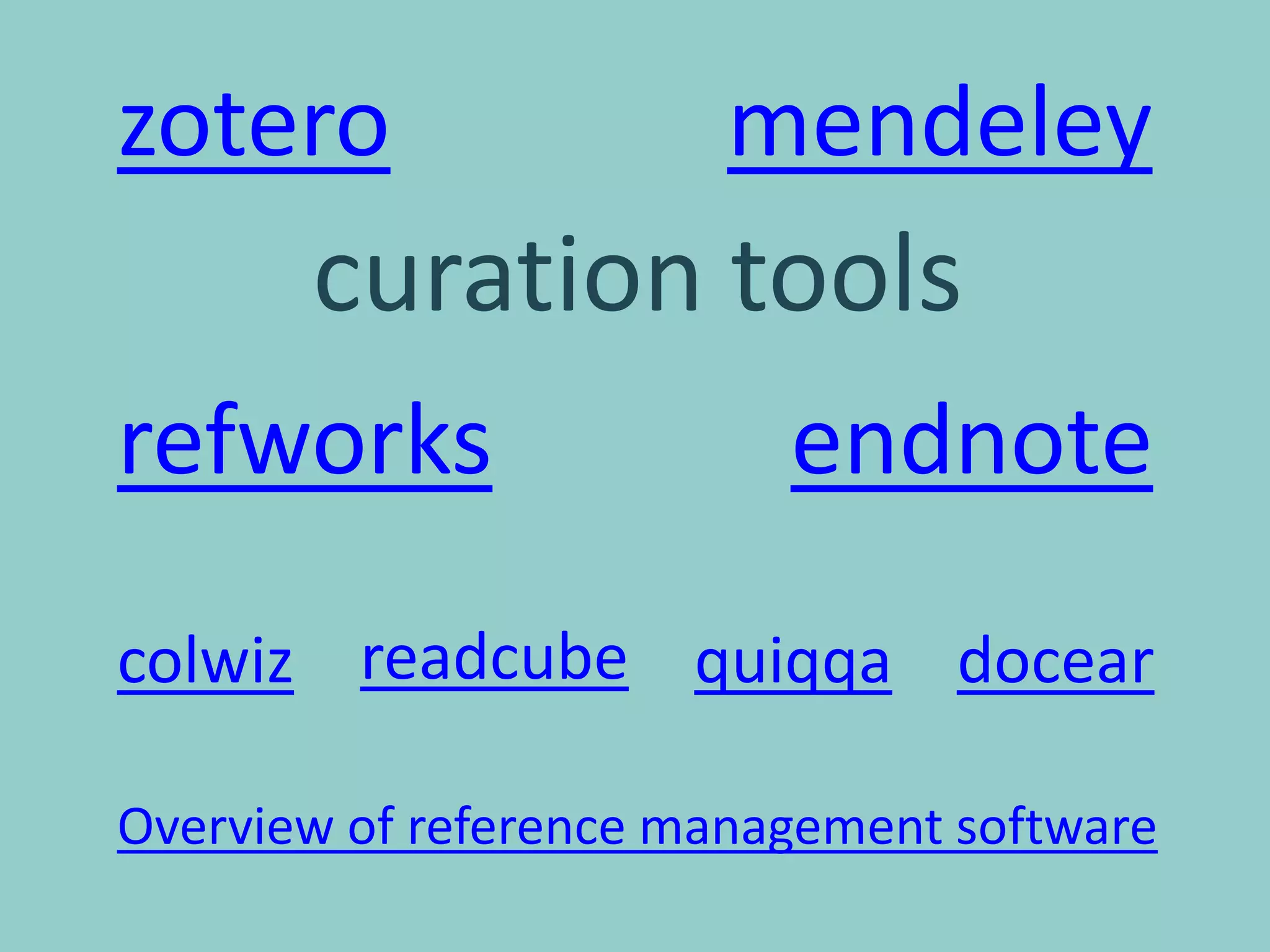
mendeleyzotero
endnoterefworks
colwiz readcube quiqqa
Overview of reference management software
curation tools
docear
Summary
Reference management tools can be
adapted as ‘curation’ tools:
• to avoid some of the traps inherent in
the research situation
• to facilitate the creation of the several
orders underlying the research and
writing process
• to initiate participation in wider
academic research communities
• to initiate participation in a wider world

Managing your references 2016

Editor's Notes

  • #6 It is a fashionable term; Everybody on the web from the mid 2000s onwards ‘curates resources’ or ‘curates content’ It is sometimes said that ‘content curation’ is the future of the internet, the future of journalism, the future of librarianship, and so one, any profession or technology which deals with content.
  • #7 Aside: In a discussion of "The Taxonomy of the Branches of Learning", Fritz Machlup (1982: 19) distinguishes among philosophers, encyclopaedists, bibliographers and librarians. Philosophers facilitate orderly thinking, systematic analysis of the universe. Their concern is to produce an overview of things, chiefly abstract, and an understanding of the inter-relationships among such things as exist.  The encyclopaedists present their work in a systematic but not alphabetic order. They are concerned with the orderly presentation of their material, in which they outline and organise the universe in a methodical way so that the reader might understand where all things should be placed, and where they should look for them in order to gain deeper insights. Bibliographers help readers and researchers become aware of all, or of the most important, publications in their specialist fields. Their listings secure the cumulative character of knowledge formation, promote the generation of new or amended knowledge, and prevent loss of knowledge previously created, duplication of research previously completed and repetition of error previously corrected. The crunch comes in Machlup's description of the librarian. For Machlup, librarians are concerned with the orderly listing of published titles in all fields of knowledge, orderly stacking of volumes, and orderly cataloguing, to help the users of books and journals find what they want to read or consult.]
  • #8 Aside: In a discussion of "The Taxonomy of the Branches of Learning", Fritz Machlup (1982: 19) distinguishes among philosophers, encyclopaedists, bibliographers and librarians. Philosophers facilitate orderly thinking, systematic analysis of the universe. Their concern is to produce an overview of things, chiefly abstract, and an understanding of the inter-relationships among such things as exist.  The encyclopaedists present their work in a systematic but not alphabetic order. They are concerned with the orderly presentation of their material, in which they outline and organise the universe in a methodical way so that the reader might understand where all things should be placed, and where they should look for them in order to gain deeper insights. Bibliographers help readers and researchers become aware of all, or of the most important, publications in their specialist fields. Their listings secure the cumulative character of knowledge formation, promote the generation of new or amended knowledge, and prevent loss of knowledge previously created, duplication of research previously completed and repetition of error previously corrected. The crunch comes in Machlup's description of the librarian. For Machlup, librarians are concerned with the orderly listing of published titles in all fields of knowledge, orderly stacking of volumes, and orderly cataloguing, to help the users of books and journals find what they want to read or consult.]
  • #9 Curating implies creating order along these four dimensions Metaphors for conceptual-topological order: tree of knowledge; circle of learning; book of nature; map of the sciences
  • #10 The relationship between searching for resources and curating resources is iterative (a repeated cycle) and reflexive (the next turn of the cycle depends on what has gone before; reflection on what has gone before alters what comes next)
  • #11 As identified in relation to an experimental molecular biology course Trying to read everything: relevance ; importance Reading but not writing: postponing the writing process Failing to keep bibliographic information: ‘managing your references’ Organising the review chronologically: conceptual/thematic/topological analysis The use of so-called curatorial tools, such as ‘reference management’ tools as a means of addressing these potential traps, e.g. RefWorks, EndNote and Mendeley (to put Zotero and the others to one side)