Managing your Mentoring Programs
Online: A view of the SBMS in
Melbourne, Australia
Presented by: Blake Escudier Ph.D
Entrepanalysis LLC
Mentoring Small Business

Management Functions

Pitfalls for Most Mentoring Programs
SBMS Online Management Success
Program Side Basics
Activities beyond working with a business owner!
•
•
•
•
•
•
•
•
•

Funding the Program
Managing Mentors
Communicating with Community
Managing Client In-take
Managing Mentor-Client Conflicts
Capturing & Maintaining Client Records
Reporting for Host Organization & Funding Sources
Reporting to Client
Maintain Office Operations (Office staff, Accounting, etc.)
Foundation for Small Business Mentoring
Small Business mentoring programs exist through
formal and informal mentoring relationships
developed through organizational assistance.
A fundamental goal for all organizations
managing mentoring programs is to provide a
system that best matches mentors with clients.

If clients are not able to self-assess, a best
practice process is needed to find the best
fitting Mentor
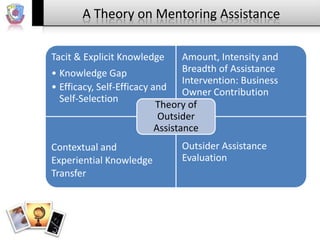
A Theory on Mentoring Assistance
Tacit & Explicit Knowledge

Amount, Intensity and
Breadth of Assistance
• Knowledge Gap
Intervention: Business
• Efficacy, Self-Efficacy and Owner Contribution
Self-Selection
Theory of
Outsider
Assistance
Contextual and
Experiential Knowledge
Transfer

Outsider Assistance
Evaluation
Common Program Pitfalls
1. Inadequate personnel and/or resources to run the
mentoring program.

2. Program manager has no commitment, passion, vision.
3. Mission and goals are not integrated into all parts of the
program.
4. Lack of partnering and/or networking within the
community.
5. Program staff has superficial contact with its mentors.
6. Nothing is special or unique about the program.
Pitfall: Inadequate personnel and/or resources to run
the mentoring program.
Best Practices:
Most pervasive problem as many programs are stretched to
the limit of their personnel. The staff is not stretched between
a number of duties.
SBMS Solution:
Most basic operational functions are managed online
through the SBMS website application allowing Management
and Staff more time for program growth functions.
Client Intake information
Client payments securely online
Client Evaluation for Selection of Mentor
How do you start?
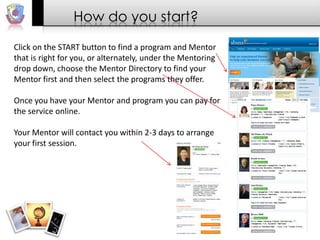
Click on the START button to find a program and Mentor
that is right for you, or alternately, under the Mentoring
drop down, choose the Mentor Directory to find your
Mentor first and then select the programs they offer.
Once you have your Mentor and program you can pay for
the service online.
Your Mentor will contact you within 2-3 days to arrange
your first session.
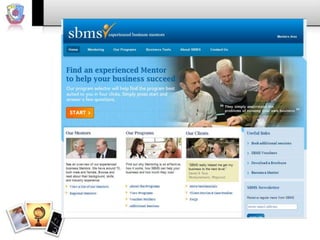
Website - www.sbms.org.au

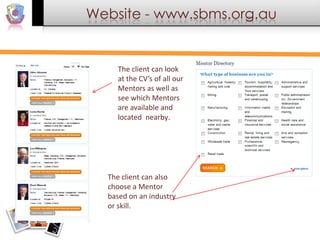
The client can look
at the CV’s of all our
Mentors as well as
see which Mentors
are available and
located nearby.

The client can also
choose a Mentor
based on an industry
or skill.
Pitfall: Program manager has no commitment,
passion, vision
Best Practice:
A. mentoring program is only as good as its leadership.

They should be prepared to tell people what mentoring is,
why it is so needed, and why their particular program is so
effective.
SBMS Solution:
SBMS is a not-for-profit association incorporated under the associations
Incorporations act 1981. Its affairs are managed by a Committee of
Management through the CEO. The association operates under the
requirements of the Act and its Constitution as approved by the
Department of Justice.
The Volunteer Mentors are the Membership and comprise the COM.
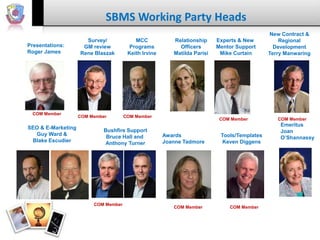
SBMS Working Party Heads
Presentations:
Roger James

COM Member

SEO & E-Marketing
Guy Ward &
Blake Escudier

Survey/
GM review
Rene Blaszak

COM Member

MCC
Programs
Keith Irvine

COM Member

Bushfire Support
Bruce Hall and
Anthony Turner

COM Member

Relationship
Officers
Matilda Parisi

Experts & New
Mentor Support
Mike Curtain

COM Member

Awards
Joanne Tadmore

COM Member

Tools/Templates
Keven Diggens

COM Member

New Contract &
Regional
Development
Terry Manwaring

COM Member

Emeritus
Joan
O’Shannassy
Pitfall: Mission and goals are not integrated into all parts
of the program
Best Practice:
.
Mission statements, goals and objectives are created – to be used
within the program and not forgotten.
Outcomes should go beyond the basic funder requirements allowing
use for future funding requests.

SBMS Solution: Keep it simple and focused!
SBMS Mission Statement:
To provide assistance for development, growth, increased
profitability and employment to the small business
community, by providing affordable and ongoing mentoring
What is the SBMS?
The Small Business Mentoring Service (SBMS) is an
Independent, Not for Profit organisation made up of
volunteers who are retired or semi-retired business people.

Working with small business owners to:
• Analyse the key business issues.
• Challenge preconceived ideas.
• Build an action plan.
• Help them to succeed.
Pitfall: Lack of partnering and/or networking within the
community.
Best Practice:
Developing partnership may promote programs, reduce
management work loads, and aid in recruiting mentors.
SBMS Solution:
The primary purpose and objective of SBMS is to help
new and existing small businesses throughout Victoria
through the delivery of mentoring programs. SBMS works in
close cooperation with the Department of Innovation
Industry and Regional Development (DIIRD) and Small
Business Victoria (SBV) to deliver high quality, low cost
services.
SBMS Client fees may be paid through partnerships
Pitfall: Program staff has superficial contact with its
mentors.
Best Practice:
Management of mentors should include consistent and
“hands on” involvement. Good Management / Mentor
relationships promote good Mentor / Client relationships.
SBMS Solution:
The membership has regular monthly meetings to
conduct organizational business and to provide direct
contact with the SBMS CEO, staff and partner programs.
The CEO personally interviews potential new Mentors for
membership and opens a direct connection with each
mentor.
Real People
Real Mentors
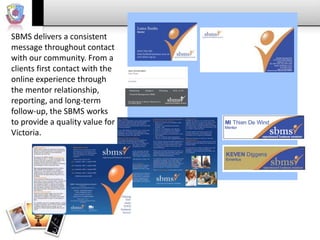
SBMS delivers a consistent
message throughout contact
with our community. From a
clients first contact with the
online experience through
the mentor relationship,
reporting, and long-term
follow-up, the SBMS works
to provide a quality value for
Victoria.
Pitfall: Nothing is special or unique about the program
Best Practice:
Programs need to constantly strive to move from the
ordinary to the extraordinary.
SBMS Solution: The Small Business Mentoring Service Inc. (SMBS) is
an independent not-for-profit organization supported by Small
Business Victoria a state government department. The SBMS has
operated for over 22 years and have assisted more than 20,000 small
businesses. (SBMS, 2010) The mentors at SBMS are all volunteers
and give their time for free. This enables the service to be very cost
effective. The mentors, who are members of the organization, are
selected for their experience, people skills and their passion for
helping businesses succeed.
SBMS an Online Mentoring Management Program = Best Practices

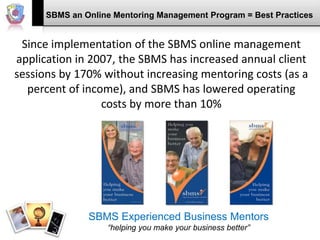
Since implementation of the SBMS online management
application in 2007, the SBMS has increased annual client
sessions by 170% without increasing mentoring costs (as a
percent of income), and SBMS has lowered operating
costs by more than 10%

SBMS Experienced Business Mentors
“helping you make your business better”

Managing your mentoring programs online

  • 1.
    Managing your MentoringPrograms Online: A view of the SBMS in Melbourne, Australia Presented by: Blake Escudier Ph.D Entrepanalysis LLC
  • 2.
    Mentoring Small Business ManagementFunctions Pitfalls for Most Mentoring Programs SBMS Online Management Success
  • 3.
    Program Side Basics Activitiesbeyond working with a business owner! • • • • • • • • • Funding the Program Managing Mentors Communicating with Community Managing Client In-take Managing Mentor-Client Conflicts Capturing & Maintaining Client Records Reporting for Host Organization & Funding Sources Reporting to Client Maintain Office Operations (Office staff, Accounting, etc.)
  • 4.
    Foundation for SmallBusiness Mentoring Small Business mentoring programs exist through formal and informal mentoring relationships developed through organizational assistance. A fundamental goal for all organizations managing mentoring programs is to provide a system that best matches mentors with clients. If clients are not able to self-assess, a best practice process is needed to find the best fitting Mentor
  • 5.
    A Theory onMentoring Assistance Tacit & Explicit Knowledge Amount, Intensity and Breadth of Assistance • Knowledge Gap Intervention: Business • Efficacy, Self-Efficacy and Owner Contribution Self-Selection Theory of Outsider Assistance Contextual and Experiential Knowledge Transfer Outsider Assistance Evaluation
  • 6.
    Common Program Pitfalls 1.Inadequate personnel and/or resources to run the mentoring program. 2. Program manager has no commitment, passion, vision. 3. Mission and goals are not integrated into all parts of the program. 4. Lack of partnering and/or networking within the community. 5. Program staff has superficial contact with its mentors. 6. Nothing is special or unique about the program.
  • 7.
    Pitfall: Inadequate personneland/or resources to run the mentoring program. Best Practices: Most pervasive problem as many programs are stretched to the limit of their personnel. The staff is not stretched between a number of duties. SBMS Solution: Most basic operational functions are managed online through the SBMS website application allowing Management and Staff more time for program growth functions. Client Intake information Client payments securely online Client Evaluation for Selection of Mentor
  • 9.
    How do youstart? Click on the START button to find a program and Mentor that is right for you, or alternately, under the Mentoring drop down, choose the Mentor Directory to find your Mentor first and then select the programs they offer. Once you have your Mentor and program you can pay for the service online. Your Mentor will contact you within 2-3 days to arrange your first session.
  • 10.
    Website - www.sbms.org.au Theclient can look at the CV’s of all our Mentors as well as see which Mentors are available and located nearby. The client can also choose a Mentor based on an industry or skill.
  • 11.
    Pitfall: Program managerhas no commitment, passion, vision Best Practice: A. mentoring program is only as good as its leadership. They should be prepared to tell people what mentoring is, why it is so needed, and why their particular program is so effective. SBMS Solution: SBMS is a not-for-profit association incorporated under the associations Incorporations act 1981. Its affairs are managed by a Committee of Management through the CEO. The association operates under the requirements of the Act and its Constitution as approved by the Department of Justice. The Volunteer Mentors are the Membership and comprise the COM.
  • 12.
    SBMS Working PartyHeads Presentations: Roger James COM Member SEO & E-Marketing Guy Ward & Blake Escudier Survey/ GM review Rene Blaszak COM Member MCC Programs Keith Irvine COM Member Bushfire Support Bruce Hall and Anthony Turner COM Member Relationship Officers Matilda Parisi Experts & New Mentor Support Mike Curtain COM Member Awards Joanne Tadmore COM Member Tools/Templates Keven Diggens COM Member New Contract & Regional Development Terry Manwaring COM Member Emeritus Joan O’Shannassy
  • 13.
    Pitfall: Mission andgoals are not integrated into all parts of the program Best Practice: . Mission statements, goals and objectives are created – to be used within the program and not forgotten. Outcomes should go beyond the basic funder requirements allowing use for future funding requests. SBMS Solution: Keep it simple and focused! SBMS Mission Statement: To provide assistance for development, growth, increased profitability and employment to the small business community, by providing affordable and ongoing mentoring
  • 14.
    What is theSBMS? The Small Business Mentoring Service (SBMS) is an Independent, Not for Profit organisation made up of volunteers who are retired or semi-retired business people. Working with small business owners to: • Analyse the key business issues. • Challenge preconceived ideas. • Build an action plan. • Help them to succeed.
  • 15.
    Pitfall: Lack ofpartnering and/or networking within the community. Best Practice: Developing partnership may promote programs, reduce management work loads, and aid in recruiting mentors. SBMS Solution: The primary purpose and objective of SBMS is to help new and existing small businesses throughout Victoria through the delivery of mentoring programs. SBMS works in close cooperation with the Department of Innovation Industry and Regional Development (DIIRD) and Small Business Victoria (SBV) to deliver high quality, low cost services.
  • 16.
    SBMS Client feesmay be paid through partnerships
  • 17.
    Pitfall: Program staffhas superficial contact with its mentors. Best Practice: Management of mentors should include consistent and “hands on” involvement. Good Management / Mentor relationships promote good Mentor / Client relationships. SBMS Solution: The membership has regular monthly meetings to conduct organizational business and to provide direct contact with the SBMS CEO, staff and partner programs. The CEO personally interviews potential new Mentors for membership and opens a direct connection with each mentor.
  • 18.
  • 19.
    SBMS delivers aconsistent message throughout contact with our community. From a clients first contact with the online experience through the mentor relationship, reporting, and long-term follow-up, the SBMS works to provide a quality value for Victoria.
  • 20.
    Pitfall: Nothing isspecial or unique about the program Best Practice: Programs need to constantly strive to move from the ordinary to the extraordinary. SBMS Solution: The Small Business Mentoring Service Inc. (SMBS) is an independent not-for-profit organization supported by Small Business Victoria a state government department. The SBMS has operated for over 22 years and have assisted more than 20,000 small businesses. (SBMS, 2010) The mentors at SBMS are all volunteers and give their time for free. This enables the service to be very cost effective. The mentors, who are members of the organization, are selected for their experience, people skills and their passion for helping businesses succeed.
  • 21.
    SBMS an OnlineMentoring Management Program = Best Practices Since implementation of the SBMS online management application in 2007, the SBMS has increased annual client sessions by 170% without increasing mentoring costs (as a percent of income), and SBMS has lowered operating costs by more than 10% SBMS Experienced Business Mentors “helping you make your business better”

Editor's Notes

  • #3 Take a look at the various functions of a mentoring program beyond the actual purpose of working with a business client.Use the 6 Pitfalls presented through a study by the EMT Associates and presented in a paper by Jerry Sherk – Best Practices in Mentoring (1999)
  • #4 The amount of work required for success is no different than other professional consulting firms with the exception that not-for-profits have two main publics to satisfy – the business owner as a client – and any funding sources as resource providers.
  • #5 Sherk, Jerry (1999) Best Practices for Mentoring. Retrieved September 29, 2010 from http://emt.org/userfiles/BestPractices.pdfThere are many so-called match-making programs online yet how many allow the prospective client to make specific choices? And if the client is unable to determine needs, the program requires committed resources for proper fitting of mentor to client!
  • #6 SBMS follows a theory of matching prospective clients to mentors through a theory on outsider assistance. This theory is hardwired into the online program to help clients choose the right program and mentor for their needs.
  • #7 Sherk, Jerry (1999) Best Practices for Mentoring. Retrieved September 29, 2010 from http://emt.org/userfiles/BestPractices.pdfWithin the EMT study on Mentoring programs, a common theme of problems kept surfacing so a follow-up study was conducted specifically to address mentoring program Pitfalls.The following slides will present the top 6 pitfalls, with the EMT provided Best Practices suggestion and the SBMS Solution.
  • #8 Only so much money – and personnel are usually overworked.Let Technology take over some of the work load.
  • #10 Once a Mentor is selected and payment is made (or voucher is entered), the program sends documentation to the selected Mentor who follows up directly with the client.
  • #11 The mentor selection process is enhanced by matching client entered information with mentor backgrounds. Mentors are displayed and the Client may choose one they believe initially fits their needs.
  • #12 The SBMS is the Mentors – and the mentors are the SBMS. All are volunteers who are interviewed prior to being invited to join the membership of the organization.
  • #14 Stagnant programs will potentially lose funding – the SBMS strives for continued growth. The organization is looking to grow beyond the present geographic State boundaries and expand services to other Australian States.
  • #16 No program can stand on its own without major fiscal resources – partnering within communities and regional areas helps a mentoring program grow and build brand value.
  • #17 The SBMS is working with local communities by taking up the slack due to failed business support activities, and regional areas without resources to develop a quality support program. Local community governments provide funding to the SBMS in the form of vouchers for clients rather than direct grants or donations. This “pay for demand” program has increased the SBMS brand awareness throughout Victoria.
  • #18 With more time available for program development, (Due to the online management application) the SBMS CEO has been able to focus on Mentor Development and provide more quality time with membership through monthly meetings and special events.
  • #21 Many programs say they support small business – but what do they actually do? No program is able to satisfy all needs – yet a sound program with consistency and leadership is able to excel within its mission, goals and objectives.
  • #22 These are facts – and in 2010 the SBMS The Trends: First year increase 24%, Second year 25%, Third year 60% Next year (2011) an additional 30% growth.In 2011, SBMS expects to provide mentoring services to more than 1500 clients, averaging 3.25 sessions per client.