Managing Disruptive Employee Behaviors


                Jamie Resker

                   May 9, 2012


A Service
   Of:                       Sponsored by:
INTEGRATED PLANNING
            Advising nonprofits in:        www.synthesispartnership.com
            • Strategy
            • Planning                                    (617) 969-1881
            • Organizational Development   info@synthesispartnership.com


A Service
   Of:                                            Sponsored by:
Affordable collaborative data
             management in the cloud.

A Service
   Of:                        Sponsored by:
Today’s Speaker


                                       Jamie Resker
                                  Founder and Practice Leader
                                 Employee Performance Solutions                           Hosting:
Assisting with chat questions:
April Hunt, Nonprofit Webinars                                    Sam Frank, Synthesis Partnership

A Service
   Of:                                                  Sponsored by:
Employee Performance Management:
  Managing Disruptive Behavior


                                    Facilitator:

                                   Jamie Resker


                                                   5
Learning Objectives

 When is behavior disruptive?

 When should we address it?
   What if it’s been going on for a long time?


 How to Craft Hearable Sayable Performance Message


                                                      6
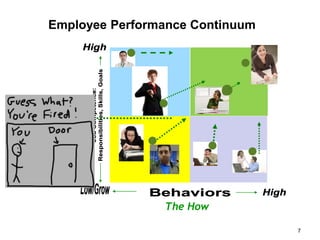
Employee Performance Continuum


The What


            Paul     Paul

           Tanya


                   The How

                                    7
                                7
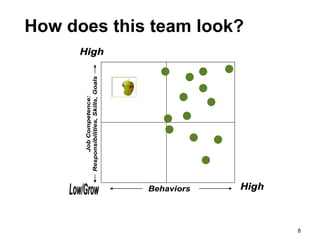
How does this team look?


            Sue


                  Paul


                           8   8
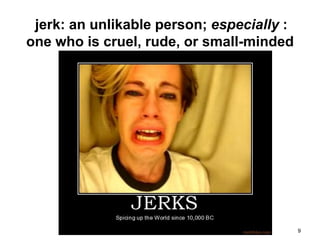
jerk: an unlikable person; especially :
one who is cruel, rude, or small-minded


                                           9
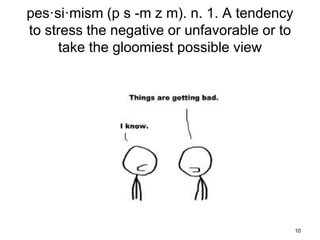
pes·si·mism (p s -m z m). n. 1. A tendency
to stress the negative or unfavorable or to
     take the gloomiest possible view


                                              10
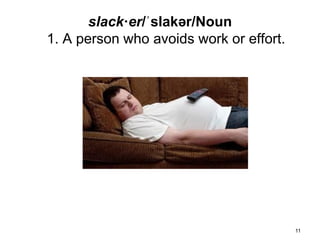
slack·er/ˈslakər/Noun
1. A person who avoids work or effort.


                                         11
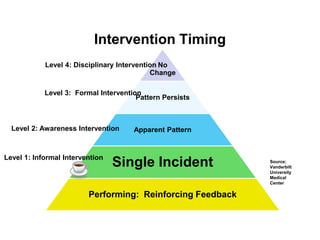
Intervention Timing
            Level 4: Disciplinary Intervention No
                                            Change

            Level 3: Formal Intervention
                                       Pattern Persists


  Level 2: Awareness Intervention     Apparent Pattern


Level 1: Informal Intervention
                                 Single Incident            Source:
                                                            Vanderbilt
                                                            University
                                                            Medical
                                                            Center

                         Performing: Reinforcing Feedback
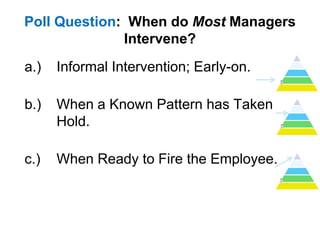
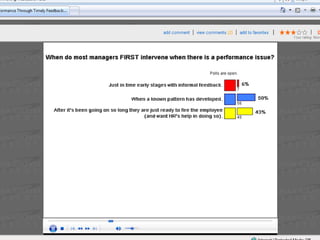
Poll Question: When do Most Managers
              Intervene?
a.)   Informal Intervention; Early-on.

b.)   When a Known Pattern has Taken
      Hold.

c.)   When Ready to Fire the Employee.
14
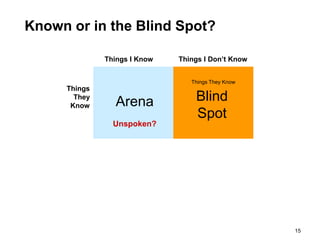
Known or in the Blind Spot?

              Things I Know   Things I Don’t Know


                                 Things They Know
     Things
       They
                 Arena            Blind
      Know
                                  Spot
                Unspoken?


                                                    15
Uncensored Perceptions

 Truth?
 Near Truth?
 Un-sayable (probably)
  - Examples


  -   What are some of your uncensored
      perceptions?


                                         16
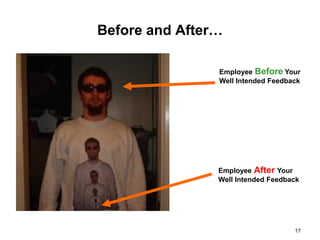
Before and After…

                Employee Before Your
                Well Intended Feedback


                Employee After Your
                Well Intended Feedback


                                    17
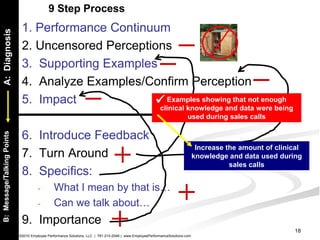
9 Step Process
                             1. Performance Continuum
 A: Diagnosis


                             2. Uncensored Perceptions
                             3. Supporting Examples
                             4. Analyze Examples/Confirm Perception
                             5. Impact              Examples showing that not enough                    clinical knowledge and data were being
                                                                                                                  used during sales calls

                             6. Introduce Feedback
B: Message/Talking Points


                                                                                                                               Increase the amount of clinical
                             7. Turn Around                                                                                   knowledge and data used during
                                                                                                                                         sales calls
                             8. Specifics:
                                      -        What I mean by that is…
                                      -        Can we talk about…
                             9. Importance
                                                                                                                                                           18
                            ©2010 Employee Performance Solutions, LLC | 781-210-2049 | www.EmployeePerformanceSolutions.com
22
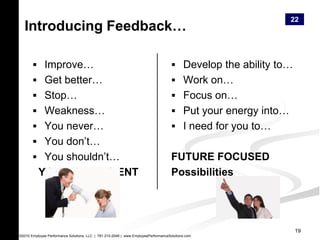
  Introducing Feedback…

        Improve…                                                                    Develop the ability to…
        Get better…                                                                 Work on…
        Stop…                                                                       Focus on…
        Weakness…                                                                   Put your energy into…
        You never…                                                                  I need for you to…
        You don’t…
        You shouldn’t…                                                             FUTURE FOCUSED
          YOU’RE DEFICIENT                                                          Possibilities


                                                                                                                19
©2010 Employee Performance Solutions, LLC | 781-210-2049 | www.EmployeePerformanceSolutions.com
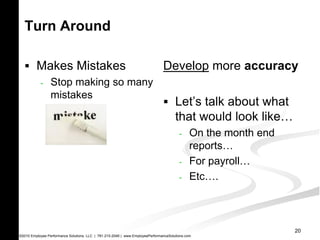
Turn Around

   Makes Mistakes        Develop more accuracy
    - Stop making so many
      mistakes
                           Let’s talk about what
                                                                                      that would look like…
                                                                                        -     On the month end
                                                                                              reports…
                                                                                        -     For payroll…
                                                                                        -     Etc….


                                                                                                                 20
©2010 Employee Performance Solutions, LLC | 781-210-2049 | www.EmployeePerformanceSolutions.com
Turn Around Examples

 Too conciliatory
   -   Defend your position and opinions.
 Makes rude comments about others
   -   When you have a thought about someone else that isn’t entirely
       positive I’d like you to hold your thoughts.
 Not resourceful; doesn’t dig to find answers
   -   Develop greater resourcefulness by digging to find answers.
 Condescending to those who are less experienced
   -   Use your experience and knowledge to helpfully and patiently
       mentor those with less experience or knowledge in x area.
 Doesn’t put in enough effort
   -   Develop a greater sense of urgency and attentiveness to your
       work.


                                                                      21
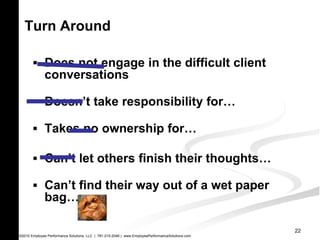
Turn Around

        Does not engage in the difficult client
              conversations

        Doesn’t take responsibility for…

        Takes no ownership for…

        Can’t let others finish their thoughts…

        Can’t find their way out of a wet paper
              bag…

                                                                                                  22
©2010 Employee Performance Solutions, LLC | 781-210-2049 | www.EmployeePerformanceSolutions.com
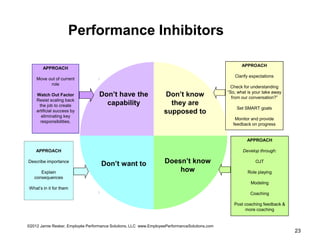
Performance Inhibitors

                                                                                                      APPROACH
       APPROACH
                                                                                                  Clarify expectations
    Move out of current
          role
                                                                                                Check for understanding
                                                                                               “So, what is your take away
    Watch Out Factor               Don’t have the                  Don’t know                    from our conversation?”
    Resist scaling back
      the job to create              capability                      they are
                                                                                                   Set SMART goals
    artificial success by                                          supposed to
       eliminating key
                                                                                                  Monitor and provide
       responsibilities.
                                                                                                 feedback on progress


                                                                                                        APPROACH

    APPROACH                                                                                          Develop through:

Describe importance
                                    Don’t want to                  Doesn’t know                              OJT

      Explain                                                          how                               Role playing
   consequences
                                                                                                          Modeling
What’s in it for them
                                                                                                          Coaching

                                                                                                  Post coaching feedback &
                                                                                                       more coaching


©2012 Jamie Resker, Employée Performance Solutions, LLC www.EmployeePerformanceSolutions.com
                                                                                                                             23
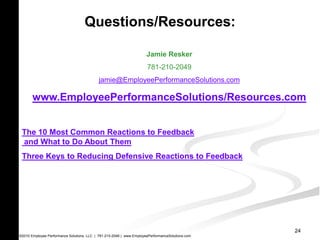
Questions/Resources:

                                                                      Jamie Resker
                                                                      781-210-2049
                                            jamie@EmployeePerformanceSolutions.com

       www.EmployeePerformanceSolutions/Resources.com


 The 10 Most Common Reactions to Feedback
 and What to Do About Them
 Three Keys to Reducing Defensive Reactions to Feedback


                                                                                                  24
©2010 Employee Performance Solutions, LLC | 781-210-2049 | www.EmployeePerformanceSolutions.com
Questions/Resources:

                                                                      Jamie Resker
                                                     Employee Performance Solutions
                                                                      781-210-2049
                                            jamie@EmployeePerformanceSolutions.com

       www.EmployeePerformanceSolutions/Resources.com


 The 10 Most Common Reactions to Feedback
 and What to Do About Them
 Three Keys to Reducing Defensive Reactions to Feedback


                                                                                                  25
©2010 Employee Performance Solutions, LLC | 781-210-2049 | www.EmployeePerformanceSolutions.com
Find listings for our current season
          of webinars and register at:

            NonprofitWebinars.com


A Service
   Of:                     Sponsored by:

Managing Disruptive Employee Behaviors

  • 1.
    Managing Disruptive EmployeeBehaviors Jamie Resker May 9, 2012 A Service Of: Sponsored by:
  • 2.
    INTEGRATED PLANNING Advising nonprofits in: www.synthesispartnership.com • Strategy • Planning (617) 969-1881 • Organizational Development info@synthesispartnership.com A Service Of: Sponsored by:
  • 3.
    Affordable collaborative data management in the cloud. A Service Of: Sponsored by:
  • 4.
    Today’s Speaker Jamie Resker Founder and Practice Leader Employee Performance Solutions Hosting: Assisting with chat questions: April Hunt, Nonprofit Webinars Sam Frank, Synthesis Partnership A Service Of: Sponsored by:
  • 5.
    Employee Performance Management: Managing Disruptive Behavior Facilitator: Jamie Resker 5
  • 6.
    Learning Objectives  Whenis behavior disruptive?  When should we address it?  What if it’s been going on for a long time?  How to Craft Hearable Sayable Performance Message 6
  • 7.
    Employee Performance Continuum TheWhat Paul Paul Tanya The How 7 7
  • 8.
    How does thisteam look? Sue Paul 8 8
  • 9.
    jerk: an unlikableperson; especially : one who is cruel, rude, or small-minded 9
  • 10.
    pes·si·mism (p s-m z m). n. 1. A tendency to stress the negative or unfavorable or to take the gloomiest possible view 10
  • 11.
    slack·er/ˈslakər/Noun 1. A personwho avoids work or effort. 11
  • 12.
    Intervention Timing Level 4: Disciplinary Intervention No Change Level 3: Formal Intervention Pattern Persists Level 2: Awareness Intervention Apparent Pattern Level 1: Informal Intervention Single Incident Source: Vanderbilt University Medical Center Performing: Reinforcing Feedback
  • 13.
    Poll Question: Whendo Most Managers Intervene? a.) Informal Intervention; Early-on. b.) When a Known Pattern has Taken Hold. c.) When Ready to Fire the Employee.
  • 14.
  • 15.
    Known or inthe Blind Spot? Things I Know Things I Don’t Know Things They Know Things They Arena Blind Know Spot Unspoken? 15
  • 16.
    Uncensored Perceptions  Truth? Near Truth?  Un-sayable (probably) - Examples - What are some of your uncensored perceptions? 16
  • 17.
    Before and After… Employee Before Your Well Intended Feedback Employee After Your Well Intended Feedback 17
  • 18.
    9 Step Process 1. Performance Continuum A: Diagnosis 2. Uncensored Perceptions 3. Supporting Examples 4. Analyze Examples/Confirm Perception 5. Impact  Examples showing that not enough clinical knowledge and data were being used during sales calls 6. Introduce Feedback B: Message/Talking Points Increase the amount of clinical 7. Turn Around knowledge and data used during sales calls 8. Specifics: - What I mean by that is… - Can we talk about… 9. Importance 18 ©2010 Employee Performance Solutions, LLC | 781-210-2049 | www.EmployeePerformanceSolutions.com
  • 19.
    22 IntroducingFeedback…  Improve…  Develop the ability to…  Get better…  Work on…  Stop…  Focus on…  Weakness…  Put your energy into…  You never…  I need for you to…  You don’t…  You shouldn’t… FUTURE FOCUSED YOU’RE DEFICIENT Possibilities 19 ©2010 Employee Performance Solutions, LLC | 781-210-2049 | www.EmployeePerformanceSolutions.com
  • 20.
    Turn Around  Makes Mistakes Develop more accuracy - Stop making so many mistakes  Let’s talk about what that would look like… - On the month end reports… - For payroll… - Etc…. 20 ©2010 Employee Performance Solutions, LLC | 781-210-2049 | www.EmployeePerformanceSolutions.com
  • 21.
    Turn Around Examples Too conciliatory - Defend your position and opinions.  Makes rude comments about others - When you have a thought about someone else that isn’t entirely positive I’d like you to hold your thoughts.  Not resourceful; doesn’t dig to find answers - Develop greater resourcefulness by digging to find answers.  Condescending to those who are less experienced - Use your experience and knowledge to helpfully and patiently mentor those with less experience or knowledge in x area.  Doesn’t put in enough effort - Develop a greater sense of urgency and attentiveness to your work. 21
  • 22.
    Turn Around  Does not engage in the difficult client conversations  Doesn’t take responsibility for…  Takes no ownership for…  Can’t let others finish their thoughts…  Can’t find their way out of a wet paper bag… 22 ©2010 Employee Performance Solutions, LLC | 781-210-2049 | www.EmployeePerformanceSolutions.com
  • 23.
    Performance Inhibitors APPROACH APPROACH Clarify expectations Move out of current role Check for understanding “So, what is your take away Watch Out Factor Don’t have the Don’t know from our conversation?” Resist scaling back the job to create capability they are Set SMART goals artificial success by supposed to eliminating key Monitor and provide responsibilities. feedback on progress APPROACH APPROACH Develop through: Describe importance Don’t want to Doesn’t know OJT Explain how Role playing consequences Modeling What’s in it for them Coaching Post coaching feedback & more coaching ©2012 Jamie Resker, Employée Performance Solutions, LLC www.EmployeePerformanceSolutions.com 23
  • 24.
    Questions/Resources: Jamie Resker 781-210-2049 jamie@EmployeePerformanceSolutions.com www.EmployeePerformanceSolutions/Resources.com The 10 Most Common Reactions to Feedback and What to Do About Them Three Keys to Reducing Defensive Reactions to Feedback 24 ©2010 Employee Performance Solutions, LLC | 781-210-2049 | www.EmployeePerformanceSolutions.com
  • 25.
    Questions/Resources: Jamie Resker Employee Performance Solutions 781-210-2049 jamie@EmployeePerformanceSolutions.com www.EmployeePerformanceSolutions/Resources.com The 10 Most Common Reactions to Feedback and What to Do About Them Three Keys to Reducing Defensive Reactions to Feedback 25 ©2010 Employee Performance Solutions, LLC | 781-210-2049 | www.EmployeePerformanceSolutions.com
  • 26.
    Find listings forour current season of webinars and register at: NonprofitWebinars.com A Service Of: Sponsored by: