Managerial Versus Entrepreneurial Decision
Making
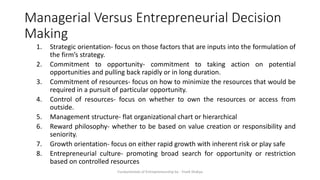
1. Strategic orientation- focus on those factors that are inputs into the formulation of
the firm’s strategy.
2. Commitment to opportunity- commitment to taking action on potential
opportunities and pulling back rapidly or in long duration.
3. Commitment of resources- focus on how to minimize the resources that would be
required in a pursuit of particular opportunity.
4. Control of resources- focus on whether to own the resources or access from
outside.
5. Management structure- flat organizational chart or hierarchical
6. Reward philosophy- whether to be based on value creation or responsibility and
seniority.
7. Growth orientation- focus on either rapid growth with inherent risk or play safe
8. Entrepreneurial culture- promoting broad search for opportunity or restriction
based on controlled resources
Fundamentals of Entrepreneurship by - Vivek Shakya
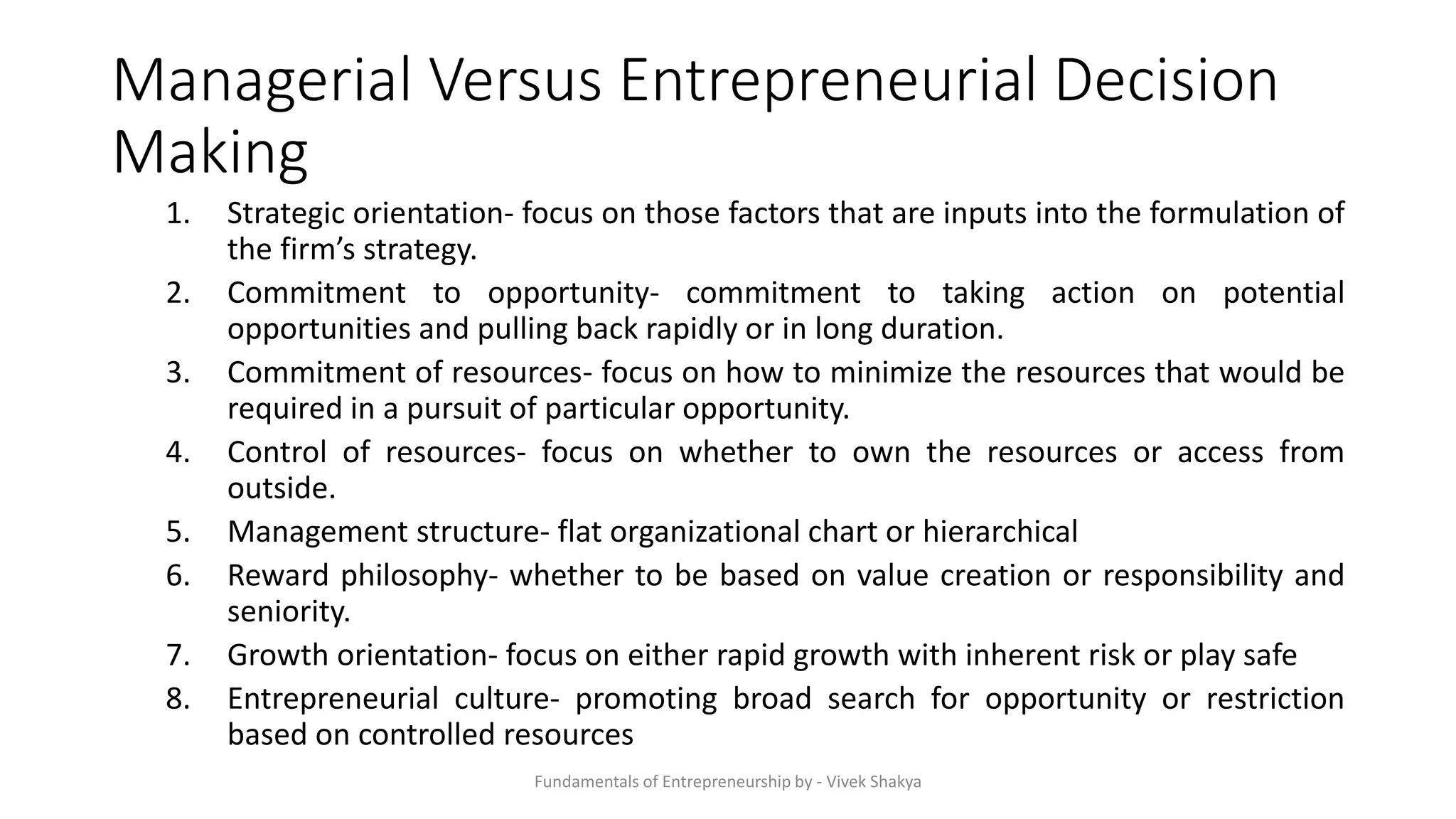
Distinguishing Entrepreneurially Managed
Firms From Traditionally Managed Firms
Fundamentals of Entrepreneurship by - Vivek Shakya
Reasons for Interest in Corporate
Entrepreneurship
Increasing interest in “doing your own thing” and doing it on one’s terms.
New search for meaning and impatience has caused more discontent in structured
organizations.
Fundamentals of Entrepreneurship by - Vivek Shakya
Reasons for Interest in Corporate
Entrepreneurship
• Inadequate Growth
• Failure Rate
• Major Barriers
• Inability to change
• Reliance on past
• Poor execution
• Accelerate growth
Fundamentals of Entrepreneurship by - Vivek Shakya
Establishing a culture of Corporate
Entrepreneurship
Corporate entrepreneurship is most strongly reflected in the following endeavors:
• New business venturing (corporate venturing) - The creation of a new business
within an existing organization.
• Innovativeness - Product and service innovation, with emphasis on development
and innovation in technology.
• Self-renewal - Transformation through renewal of the key ideas on which an
organization is built.
• Proactiveness - Includes initiative, risk taking, competitive aggressiveness, and
boldness.
Fundamentals of Entrepreneurship by - Vivek Shakya
Characteristics of an Entrepreneurial
Environment in an Organization
Fundamentals of Entrepreneurship by - Vivek Shakya
• New ideas encouraged
• Trial and error encouraged/ Failures are allowed
• No opportunity parameters
• Resources and available and accessible
• Multi-discipline teamwork approach
• Long time horizon
• Volunteer program
• Appropriate reward system
• Support of top management
Leadership Characteristics of a Corporate
Entrepreneur
Fundamentals of Entrepreneurship by - Vivek Shakya
• Understands the environment
• Is visionary and flexible
• Creates management options
• Encourages teamwork
• Encourages open discussion
• Builds a coalition of supporters
• Persists
• Understands the environment
• Is visionary and flexible
• Creates management options
• Encourages teamwork
• Encourages open discussion
• Builds a coalition of supporters
• Persistence

Managerial Versus Entrepreneurial Decision Making.pptx

  • 1.
    Managerial Versus EntrepreneurialDecision Making 1. Strategic orientation- focus on those factors that are inputs into the formulation of the firm’s strategy. 2. Commitment to opportunity- commitment to taking action on potential opportunities and pulling back rapidly or in long duration. 3. Commitment of resources- focus on how to minimize the resources that would be required in a pursuit of particular opportunity. 4. Control of resources- focus on whether to own the resources or access from outside. 5. Management structure- flat organizational chart or hierarchical 6. Reward philosophy- whether to be based on value creation or responsibility and seniority. 7. Growth orientation- focus on either rapid growth with inherent risk or play safe 8. Entrepreneurial culture- promoting broad search for opportunity or restriction based on controlled resources Fundamentals of Entrepreneurship by - Vivek Shakya
  • 2.
    Distinguishing Entrepreneurially Managed FirmsFrom Traditionally Managed Firms Fundamentals of Entrepreneurship by - Vivek Shakya
  • 3.
    Reasons for Interestin Corporate Entrepreneurship Increasing interest in “doing your own thing” and doing it on one’s terms. New search for meaning and impatience has caused more discontent in structured organizations. Fundamentals of Entrepreneurship by - Vivek Shakya
  • 4.
    Reasons for Interestin Corporate Entrepreneurship • Inadequate Growth • Failure Rate • Major Barriers • Inability to change • Reliance on past • Poor execution • Accelerate growth Fundamentals of Entrepreneurship by - Vivek Shakya
  • 5.
    Establishing a cultureof Corporate Entrepreneurship Corporate entrepreneurship is most strongly reflected in the following endeavors: • New business venturing (corporate venturing) - The creation of a new business within an existing organization. • Innovativeness - Product and service innovation, with emphasis on development and innovation in technology. • Self-renewal - Transformation through renewal of the key ideas on which an organization is built. • Proactiveness - Includes initiative, risk taking, competitive aggressiveness, and boldness. Fundamentals of Entrepreneurship by - Vivek Shakya
  • 6.
    Characteristics of anEntrepreneurial Environment in an Organization Fundamentals of Entrepreneurship by - Vivek Shakya • New ideas encouraged • Trial and error encouraged/ Failures are allowed • No opportunity parameters • Resources and available and accessible • Multi-discipline teamwork approach • Long time horizon • Volunteer program • Appropriate reward system • Support of top management
  • 7.
    Leadership Characteristics ofa Corporate Entrepreneur Fundamentals of Entrepreneurship by - Vivek Shakya • Understands the environment • Is visionary and flexible • Creates management options • Encourages teamwork • Encourages open discussion • Builds a coalition of supporters • Persists • Understands the environment • Is visionary and flexible • Creates management options • Encourages teamwork • Encourages open discussion • Builds a coalition of supporters • Persistence