Managerial Accounting
                                                   Ir. M. Geense
                                          (Delft University of Technology)


      Welcome

      Welcome to managerialaccounting.org. This website surveys the development of managerial accounting and
explains the most important managerial accounting terms and concepts.


      What is Managerial Accounting?

     Managerial accounting is concerned with providing information to managers- that is, to those who are inside an
organization and who direct and control its operations. Managerial accounting can be contrasted with financial
accounting, which is concerned with providing information to stockholders, creditors and others who are outside an
organization (Garrison and Noreen, 1999).

      Managerial accounting information include:

      M    Information on the costs of an organization’s products and services. For Example, managers can use product
costs to guide the setting of selling prices. In addition, these product costs are used for inventory valuation and
income determination (Horngren and Foster, pp. 2).
      i Budgets. A budget is a quantitave expression of a plan.
      i    Performance reports: These reports often consist of comparisons of budgets with actual results. The
deviations of actual results from budget are called variances (Horngren and Foster, pp. 3)
      d Other information which assist managers in their planning and control activities.
      Examples are information on revenues of an organization’s products and services, sales back logs, unit
quantities and demands on capacity resources (Kaplan and Atkinson, pp. 1).


      Managerial Accounting Practices

      Traditional managerial accounting systems are mainly designed to measure the efficiency of internal processes.
In the 1980’s, traditional managerial accounting practitioners were heavily critized on the grounds that their practices
had changed little over the preceding 60 years, despite radical changes in the business environment. For more
information on traditional managerial accounting practices see the Traditional Managerial Accounting page.

The last decades new managerial accounting practices such as activity-based-costing and the balanced scorecard were
developped:

       Unlike traditional managerial accounting, activity-based-costing deemphasizes direct labor or raw material as
cost drivers and concentrates instead on activities (e.g. the number of production runs per month) that drive costs.
Activity-based costing gives the management of an organization a clear picture of the cost drivers and the
opportunities to reduce costs (Kaplan and Norton, 2001, pp. 378). For more information on activity based costing, see
the Activity Based Costing page.

      Traditionally, management accountants’ principal performance report was variance analysis, which is a
systematic approach to the comparison of the actual and budgeted costs and revenues during a production period.
While some form of variance analysis is still used by most manufacturing firms, it nowadays tends to be used in
conjunction with other performance reports such as the balanced scorecard. A balanced scorecard is a set of financial
measures, operational measures on customer satisfaction, internal processes and the organization's innovation and
improvement activities (Kaplan and Norton, 1992). Kaplan and Norton also argue that the balanced scorecard can be
used as a strategic management system which identifies the value drivers of an organization's strategy and a
management system to align the organization to the strategy (Kaplan and Norton, 2001, pp. 378). For more
information on the balanced scorecard, see the Balanced Scorecard page.
Traditional Managerial Accounting
                                                    Ir. M. Geense
                                           (Delft University of Technology)


History of Accounting

        Information on commercial transactions has existed for as long as people have traded with one another.
Ancient civilizations engraved bookkeeping records on stone tablets. More than five hundred years ago, Luca Pacioli, a
mathematician monk, described the basics for a double-entry booking system. With this double-entry system traders
could determine the results of the transactions they made in the market and could also determine their assets and
debts.
During the industrial revolution a lot of production was transfered from individuals to large companies (texile mills,
steel factories, etc.). The whole production and selling of products consisted of several conversion processes which
were all performed in these large companies. Conversion processes that formerly were supplied at a price through
market exchanges became performed within one organization. A lot of internal transactions occurred as conversion
processes supplied their output to a next process within the organization instead of selling their output on the market.
Owners of these large companies devised systems to summarize the efficiency by which labor and material were
converted to finished products. These early managerial accounting systems produced efficiency measures such as cost
per hour or cost per pound produced per process and per worker. These measures were used to motivate and
evaluate the workers and their managers (Johnson and Kaplan, 1987, pp 6-12).


Early Cost Accounting Systems

        In order to calculate the costs of a product, the direct labor costs and direct material costs ('prime costs') of a
product were summarized. At the end of the nineteenth century companies also included indirect costs ("overhead")
when calculating the costs of a product. According to Church and Mann, most companies determined the indirect costs
of a product as a percentage of the direct labor costs (Solomons, 1952, pp 22-23). In 1910 Church wrote "it is a very
usual practice to average this large class of expense (red. indirect costs), and to express its incidence by a simple
percentage either upon wages or upon time. That this plan is entirely misleading there can be very little doubt,
because few of the expenses in the profit and loss accont have any relation either to each other or to wages or to
time. To rely upon an arbitrary established percentage .. is valueless and even dangerous" (Church, 1910 pp 79-81).
When determining the costs of a product, Church advocated dividing the factory into a series of 'production centers'
(e.g. a machine and a group of workers). In this production center method, the costs of each production center are
summarised. The hourly rate of each production center expresses the total costs of the production center per hour.
The costs of a production center is then loaded on to the work passing through it, at an hourly rate. (Solomons, 1952,
pp 25-27).


Early Budgetary Control Systems

        Budgeting as a tool to forecast expenses is an old practice. Joseph in Egypt made a budget of corn supplies
and planned Pharao's investment and consumption policy in the light of it. In Great Britain the practice of drawing up
a government budget each year is about 250 years old. In 1911 Bunnell described that each item of overheads was to
be budgeted and compared with the actual expenditure under each head as a way to control costs. This budget for
each item of overheads was a fixed budget, which was not adjusted for changes in the number of products produced.
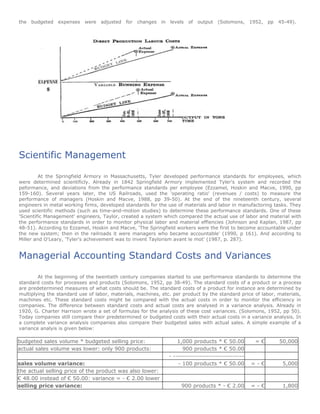
In 1903 Henry Hess described the basic idea of what we now call a flexible budget. Hess used a graphical method to
compare the budgeted expenditure and actual expenditure. For each main group of expenses (for instance direct
production labor costs) he plotted a straight line, representing the relationship between expenses and output. Thus
the   budgeted expenses    were   adjusted for changes in levels       of   output   (Solomons, 1952,   pp 45-49).


Scientific Management

         At the Springfield Armory in Massachusetts, Tyler developed performance standards for employees, which
were determined scientificly. Already in 1842 Springfield Armory implemented Tyler's system and recorded the
peformance, and deviations from the performance standards per employee (Ezzamel, Hoskin and Macve, 1990, pp
159-160). Several years later, the US Railroads, used the 'operating ratio' (revenues / costs) to measure the
performance of managers (Hoskin and Macve, 1988, pp 39-50). At the end of the nineteenth century, several
engineers in metal working firms, developed standards for the use of materials and labor in manufactoring tasks. They
used scientific methods (such as time-and-motion studies) to determine these performance standards. One of these
'Scientific Management' engineers, Taylor, created a system which compared the actual use of labor and material with
the performance standards in order to monitor physical labor and material effiencies (Johnson and Kaplan, 1987, pp
48-51). According to Ezzamel, Hoskin and Macve, 'The Springfield workers were the first to become accountable under
the new system; then in the railroads it were managers who became accountable' (1990, p 161). And according to
Miller and O'Leary, 'Tyler's achievement was to invent Taylorism avant le mot' (1987, p. 287).


Managerial Accounting Standard Costs and Variances

        At the beginning of the twentieth century companies started to use performance standards to determine the
standard costs for processes and products (Solomons, 1952, pp 38-49). The standard costs of a product or a process
are predetermined measures of what costs should be. The standard costs of a product for instance are determined by
multiplying the standard use of labor, materials, machines, etc. per product by the standard price of labor, materials,
machines etc. These standard costs might be compared with the actual costs in order to monitor the efficiency in
companies. The difference between standard costs and actual costs are analysed in a variance analysis. Already in
1920, G. Charter Harrison wrote a set of formulas for the analysis of these cost variances. (Solomons, 1952, pp 50).
Today companies still compare their predetermined or budgeted costs with their actual costs in a variance analysis. In
a complete variance analysis companies also compare their budgeted sales with actual sales. A simple example of a
variance analyis is given below:

budgeted sales volume * budgeted selling price:                    1,000 products * € 50.00        =€        50,000
actual sales volume was lower: only 900 products:                    900 products * € 50.00
                                                               - ------------------------------
sales volume variance:                                             - 100 products * € 50.00       =-€          5,000
the actual selling price of the product was also lower:
€ 48.00 instead of € 50.00: variance = - € 2.00 lower
selling price variance:                                             900 products * - € 2.00       =-€          1,800
the standard use of labor per product is 1.0 hour and
the standard price of labor is € 40.00
in this simple example no other costs are involved
the total standard costs allowed (flexible budget):           900 products * 1.0 * € 40.00        =-€         36,000
the actual use of labor per product was only 0.9 hour:        900 products * 0.9 * € 40.00
                                                               - ------------------------------
efficiency variance                                           900 products * 0.1 * € 40.00          =€          3,600
the actual price of labor however was higher:
€ 41.00 instead of € 40.00 = € 1.00 higher
labor price variance:                                         900 products * 0.9 * - € 1.00       =-€             810
                                                                                                      +     ----------
actual result:                                                                                         €        9.990


Return on Investment

        Around 1900, many mass producers, acquired there own distribution channels and own sources of raw
materials and other inputs. These firms performed several activities which were formerly performed by individual
companies. Manufacturing, purchasing, transportation and distribution became integrated in these multi-activity firms.
In these vertically integrated firms, many individual departments still relied on their own measures of efficiency. Most
of these efficiency measures however could not be related to overall company profit. In order to monitor the
contribution of each activity to overall profit they developped a new performance measure: return on investment. The
return on investment (income / invested capital) ratio helped top management to monitor the profitability of each
individual activity (Johnson and Kaplan, 1987, pp 61-93).


BIBLIOGRAPHY

- Church, A. H.,'Organisation by Production Factors', Engineering Magazine, April 1910.
- Ezzamel, M., K. Hoskin and R. Macve, 'Managing It All By Numbers: A Review of Johnson & Kaplan's 'Relevance
Lost', Accounting and Business Research, vol. 20, 1990, pp 153-166.
- Hoskin, K. W., and R. H. Macve, 'The Genesis of Accountability: The West Point Connections', Accounting,
Organizations and Society, 1988, pp 37-73.
- Johnson, H. T. and R. S. Kaplan, 'Relevance Lost: The Rise and Fall of Management Accounting', Harvard Business
School Press, 1987.
- Jorissen, A., 'Management accounting: een revolutie op de drempel van de 21ste eeuw?', Economisch en Sociaal
Tijdschrift, december 1993, pp 551-590
- Miller, P. and T. O'Leary, 'Accounting and the Construction of the Governable Person', Accounting, Organizations and
Society, 1987, pp 235-265.
- Solomons, D., 'Historical Development of Costing', Studies in Costing, Sweet & Maxwell, 1952, pp. 1-51.

Managerial accounting

  • 1.
    Managerial Accounting Ir. M. Geense (Delft University of Technology) Welcome Welcome to managerialaccounting.org. This website surveys the development of managerial accounting and explains the most important managerial accounting terms and concepts. What is Managerial Accounting? Managerial accounting is concerned with providing information to managers- that is, to those who are inside an organization and who direct and control its operations. Managerial accounting can be contrasted with financial accounting, which is concerned with providing information to stockholders, creditors and others who are outside an organization (Garrison and Noreen, 1999). Managerial accounting information include: M Information on the costs of an organization’s products and services. For Example, managers can use product costs to guide the setting of selling prices. In addition, these product costs are used for inventory valuation and income determination (Horngren and Foster, pp. 2). i Budgets. A budget is a quantitave expression of a plan. i Performance reports: These reports often consist of comparisons of budgets with actual results. The deviations of actual results from budget are called variances (Horngren and Foster, pp. 3) d Other information which assist managers in their planning and control activities. Examples are information on revenues of an organization’s products and services, sales back logs, unit quantities and demands on capacity resources (Kaplan and Atkinson, pp. 1). Managerial Accounting Practices Traditional managerial accounting systems are mainly designed to measure the efficiency of internal processes. In the 1980’s, traditional managerial accounting practitioners were heavily critized on the grounds that their practices had changed little over the preceding 60 years, despite radical changes in the business environment. For more information on traditional managerial accounting practices see the Traditional Managerial Accounting page. The last decades new managerial accounting practices such as activity-based-costing and the balanced scorecard were developped: Unlike traditional managerial accounting, activity-based-costing deemphasizes direct labor or raw material as cost drivers and concentrates instead on activities (e.g. the number of production runs per month) that drive costs. Activity-based costing gives the management of an organization a clear picture of the cost drivers and the opportunities to reduce costs (Kaplan and Norton, 2001, pp. 378). For more information on activity based costing, see the Activity Based Costing page. Traditionally, management accountants’ principal performance report was variance analysis, which is a systematic approach to the comparison of the actual and budgeted costs and revenues during a production period. While some form of variance analysis is still used by most manufacturing firms, it nowadays tends to be used in conjunction with other performance reports such as the balanced scorecard. A balanced scorecard is a set of financial measures, operational measures on customer satisfaction, internal processes and the organization's innovation and improvement activities (Kaplan and Norton, 1992). Kaplan and Norton also argue that the balanced scorecard can be used as a strategic management system which identifies the value drivers of an organization's strategy and a management system to align the organization to the strategy (Kaplan and Norton, 2001, pp. 378). For more information on the balanced scorecard, see the Balanced Scorecard page.
  • 2.
    Traditional Managerial Accounting Ir. M. Geense (Delft University of Technology) History of Accounting Information on commercial transactions has existed for as long as people have traded with one another. Ancient civilizations engraved bookkeeping records on stone tablets. More than five hundred years ago, Luca Pacioli, a mathematician monk, described the basics for a double-entry booking system. With this double-entry system traders could determine the results of the transactions they made in the market and could also determine their assets and debts. During the industrial revolution a lot of production was transfered from individuals to large companies (texile mills, steel factories, etc.). The whole production and selling of products consisted of several conversion processes which were all performed in these large companies. Conversion processes that formerly were supplied at a price through market exchanges became performed within one organization. A lot of internal transactions occurred as conversion processes supplied their output to a next process within the organization instead of selling their output on the market. Owners of these large companies devised systems to summarize the efficiency by which labor and material were converted to finished products. These early managerial accounting systems produced efficiency measures such as cost per hour or cost per pound produced per process and per worker. These measures were used to motivate and evaluate the workers and their managers (Johnson and Kaplan, 1987, pp 6-12). Early Cost Accounting Systems In order to calculate the costs of a product, the direct labor costs and direct material costs ('prime costs') of a product were summarized. At the end of the nineteenth century companies also included indirect costs ("overhead") when calculating the costs of a product. According to Church and Mann, most companies determined the indirect costs of a product as a percentage of the direct labor costs (Solomons, 1952, pp 22-23). In 1910 Church wrote "it is a very usual practice to average this large class of expense (red. indirect costs), and to express its incidence by a simple percentage either upon wages or upon time. That this plan is entirely misleading there can be very little doubt, because few of the expenses in the profit and loss accont have any relation either to each other or to wages or to time. To rely upon an arbitrary established percentage .. is valueless and even dangerous" (Church, 1910 pp 79-81). When determining the costs of a product, Church advocated dividing the factory into a series of 'production centers' (e.g. a machine and a group of workers). In this production center method, the costs of each production center are summarised. The hourly rate of each production center expresses the total costs of the production center per hour. The costs of a production center is then loaded on to the work passing through it, at an hourly rate. (Solomons, 1952, pp 25-27). Early Budgetary Control Systems Budgeting as a tool to forecast expenses is an old practice. Joseph in Egypt made a budget of corn supplies and planned Pharao's investment and consumption policy in the light of it. In Great Britain the practice of drawing up a government budget each year is about 250 years old. In 1911 Bunnell described that each item of overheads was to be budgeted and compared with the actual expenditure under each head as a way to control costs. This budget for each item of overheads was a fixed budget, which was not adjusted for changes in the number of products produced. In 1903 Henry Hess described the basic idea of what we now call a flexible budget. Hess used a graphical method to compare the budgeted expenditure and actual expenditure. For each main group of expenses (for instance direct production labor costs) he plotted a straight line, representing the relationship between expenses and output. Thus
  • 3.
    the budgeted expenses were adjusted for changes in levels of output (Solomons, 1952, pp 45-49). Scientific Management At the Springfield Armory in Massachusetts, Tyler developed performance standards for employees, which were determined scientificly. Already in 1842 Springfield Armory implemented Tyler's system and recorded the peformance, and deviations from the performance standards per employee (Ezzamel, Hoskin and Macve, 1990, pp 159-160). Several years later, the US Railroads, used the 'operating ratio' (revenues / costs) to measure the performance of managers (Hoskin and Macve, 1988, pp 39-50). At the end of the nineteenth century, several engineers in metal working firms, developed standards for the use of materials and labor in manufactoring tasks. They used scientific methods (such as time-and-motion studies) to determine these performance standards. One of these 'Scientific Management' engineers, Taylor, created a system which compared the actual use of labor and material with the performance standards in order to monitor physical labor and material effiencies (Johnson and Kaplan, 1987, pp 48-51). According to Ezzamel, Hoskin and Macve, 'The Springfield workers were the first to become accountable under the new system; then in the railroads it were managers who became accountable' (1990, p 161). And according to Miller and O'Leary, 'Tyler's achievement was to invent Taylorism avant le mot' (1987, p. 287). Managerial Accounting Standard Costs and Variances At the beginning of the twentieth century companies started to use performance standards to determine the standard costs for processes and products (Solomons, 1952, pp 38-49). The standard costs of a product or a process are predetermined measures of what costs should be. The standard costs of a product for instance are determined by multiplying the standard use of labor, materials, machines, etc. per product by the standard price of labor, materials, machines etc. These standard costs might be compared with the actual costs in order to monitor the efficiency in companies. The difference between standard costs and actual costs are analysed in a variance analysis. Already in 1920, G. Charter Harrison wrote a set of formulas for the analysis of these cost variances. (Solomons, 1952, pp 50). Today companies still compare their predetermined or budgeted costs with their actual costs in a variance analysis. In a complete variance analysis companies also compare their budgeted sales with actual sales. A simple example of a variance analyis is given below: budgeted sales volume * budgeted selling price: 1,000 products * € 50.00 =€ 50,000 actual sales volume was lower: only 900 products: 900 products * € 50.00 - ------------------------------ sales volume variance: - 100 products * € 50.00 =-€ 5,000 the actual selling price of the product was also lower: € 48.00 instead of € 50.00: variance = - € 2.00 lower selling price variance: 900 products * - € 2.00 =-€ 1,800
  • 4.
    the standard useof labor per product is 1.0 hour and the standard price of labor is € 40.00 in this simple example no other costs are involved the total standard costs allowed (flexible budget): 900 products * 1.0 * € 40.00 =-€ 36,000 the actual use of labor per product was only 0.9 hour: 900 products * 0.9 * € 40.00 - ------------------------------ efficiency variance 900 products * 0.1 * € 40.00 =€ 3,600 the actual price of labor however was higher: € 41.00 instead of € 40.00 = € 1.00 higher labor price variance: 900 products * 0.9 * - € 1.00 =-€ 810 + ---------- actual result: € 9.990 Return on Investment Around 1900, many mass producers, acquired there own distribution channels and own sources of raw materials and other inputs. These firms performed several activities which were formerly performed by individual companies. Manufacturing, purchasing, transportation and distribution became integrated in these multi-activity firms. In these vertically integrated firms, many individual departments still relied on their own measures of efficiency. Most of these efficiency measures however could not be related to overall company profit. In order to monitor the contribution of each activity to overall profit they developped a new performance measure: return on investment. The return on investment (income / invested capital) ratio helped top management to monitor the profitability of each individual activity (Johnson and Kaplan, 1987, pp 61-93). BIBLIOGRAPHY - Church, A. H.,'Organisation by Production Factors', Engineering Magazine, April 1910. - Ezzamel, M., K. Hoskin and R. Macve, 'Managing It All By Numbers: A Review of Johnson & Kaplan's 'Relevance Lost', Accounting and Business Research, vol. 20, 1990, pp 153-166. - Hoskin, K. W., and R. H. Macve, 'The Genesis of Accountability: The West Point Connections', Accounting, Organizations and Society, 1988, pp 37-73. - Johnson, H. T. and R. S. Kaplan, 'Relevance Lost: The Rise and Fall of Management Accounting', Harvard Business School Press, 1987. - Jorissen, A., 'Management accounting: een revolutie op de drempel van de 21ste eeuw?', Economisch en Sociaal Tijdschrift, december 1993, pp 551-590 - Miller, P. and T. O'Leary, 'Accounting and the Construction of the Governable Person', Accounting, Organizations and Society, 1987, pp 235-265. - Solomons, D., 'Historical Development of Costing', Studies in Costing, Sweet & Maxwell, 1952, pp. 1-51.