COMMUNICATING
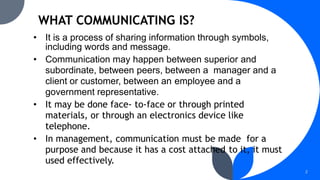
• It is a process of sharing information through symbols,
including words and message.
• Communication may happen between superior and
subordinate, between peers, between a manager and a
client or customer, between an employee and a
government representative.
• It may be done face- to-face or through printed
materials, or through an electronics device like
telephone.
• In management, communication must be made for a
purpose and because it has a cost attached to it, it must
used effectively.
2
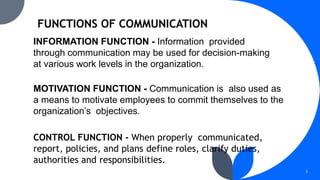
INFORMATION FUNCTION - Information provided
through communication may be used for decision-making
at various work levels in the organization.
MOTIVATION FUNCTION - Communication is also used as
a means to motivate employees to commit themselves to the
organization’s objectives.
CONTROL FUNCTION - When properly communicated,
report, policies, and plans define roles, clarify duties,
authorities and responsibilities.
3
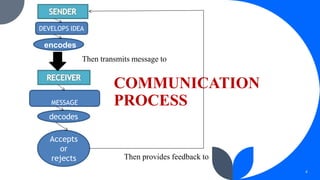
COMMUNICATION
PROCESS
4
DEVELOPS IDEA
encodes
MESSAGE
decodes
Accepts
or
rejects
Then transmits message to
Then provides feedback to
ENCODE- encode idea into word, illustration, figures, or
other symbols suitable for transmission. The method of
transmission should be determined in advance so that the
idea may be encoded to conform with the specific
requirements of the identified method.
5
TRANSMIT- After encoding, the message is now ready for
transmission through the use of an appropriate
communication channel. Among the various channels used
include the spoken word, body movements, the written
word, television, radio, an artist's paint, electronic mail,
etc.
6
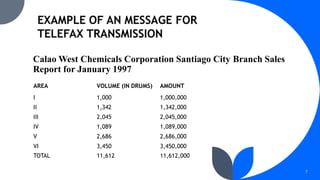
Calao West Chemicals Corporation Santiago City Branch Sales
Report for January 1997
7
AREA VOLUME (IN DRUMS) AMOUNT
I 1,000 1,000,000
II 1,342 1,342,000
III 2,045 2,045,000
IV 1,089 1,089,000
V 2,686 2,686,000
VI 3,450 3,450,000
TOTAL 11,612 11,612,000
RECEIVER- The next step is the communication process is
the actual receiving of the message by the intended
receiver. The requirement is for the receiver to be ready to
receive at the precise moment the message relayed by the
sender. The message may be initially received by a
machine or by a person.
8/27/2023 PRESENTATION TITLE 8
DECODE- The next step, decoding , means translating the
message from the sender into a form that will have meaning
to the recipient.
ACCEPT- The next step is for the receiver o accept or reject
the message. Sometimes, acceptance (rejection) is partial.
9
PRESENTATION TITLE 10
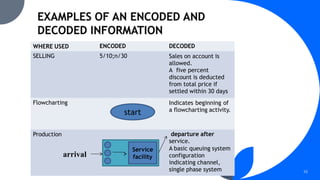
WHERE USED ENCODED DECODED
SELLING 5/10;n/30 Sales on account is
allowed.
A five percent
discount is deducted
from total price if
settled within 30 days
Flowcharting Indicates beginning of
a flowcharting activity.
Production departure after
service.
A basic queuing system
configuration
indicating channel,
single phase system
start
Service
facility
arrival
USE- The next step is for the receiver to use the information.
If the message provides information of importance to a
relevant activity, then the receiver could store it and retrieve
it when required.
8/27/2023 PRESENTATION TITLE 11
PROVIDE FEEDBACK- The last step in the communication
process is for the receiver to provide feedback to the sender.
Depending on the perception of the receiver, however, this
important step may not be made.
12
13
■ VERBAL
𝗈 Oral
𝗈 written
■ NONVERBAL
TWO MAJOR FORMS OF COMMUNICATION
8/27/2023 PRESENTATION TITLE 14
Verbal communications are those transmitted trough hearing or sight.
These modes of transmission into two classes: oral and written .
■ Oral communication- mostly involves hearing
the words of the sender, although sometimes,
opportunities are provided for seeing the
sender’s body movements.
■ Written communication- where the sender seeks
to communicate through the written word. It
may prepared as memo and sent to the receiver.
8/27/2023 PRESENTATION TITLE 15
Non verbal Communication is a means of
conveying message through body language, as
well as the use of time, space, touch, clothing,
appearance, and aesthetic elements.
8/27/2023 PRESENTATION TITLE 16
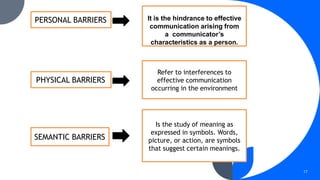
PERSONAL BARRIERS
PHYSICAL BARRIERS
SEMANTIC BARRIERS
17
PERSONAL BARRIERS
PHYSICAL BARRIERS
SEMANTIC BARRIERS
It is the hindrance to effective
communication arising from
a communicator’s
characteristics as a person.
Refer to interferences to
effective communication
occurring in the environment
Is the study of meaning as
expressed in symbols. Words,
picture, or action, are symbols
that suggest certain meanings.
8/27/2023 PRESENTATION TITLE 18
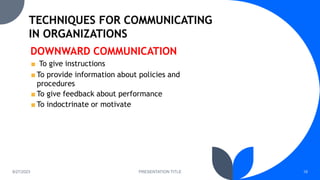
■ To give instructions
■ To provide information about policies and
procedures
■ To give feedback about performance
■ To indoctrinate or motivate
DOWNWARD COMMUNICATION
19
UPWARD COMMUNICATION-There is a need for management to
provide employees with all the necessary material and non
material support it can give. The requirement, however, is for
management to know the specific needs of the employees. This
is the primary reason for upward communication.
20
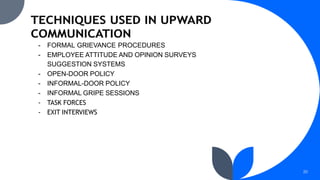
- FORMAL GRIEVANCE PROCEDURES
- EMPLOYEE ATTITUDE AND OPINION SURVEYS
SUGGESTION SYSTEMS
- OPEN-DOOR POLICY
- INFORMAL-DOOR POLICY
- INFORMAL GRIPE SESSIONS
- TASK FORCES
- EXIT INTERVIEWS
21
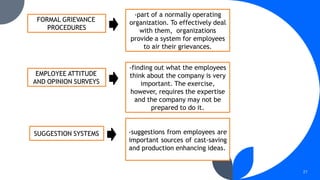
FORMAL GRIEVANCE
PROCEDURES
EMPLOYEE ATTITUDE
AND OPINION SURVEYS
SUGGESTION SYSTEMS -suggestions from employees are
important sources of cast-saving
and production enhancing ideas.
-finding out what the employees
think about the company is very
important. The exercise,
however, requires the expertise
and the company may not be
prepared to do it.
-part of a normally operating
organization. To effectively deal
with them, organizations
provide a system for employees
to air their grievances.
22
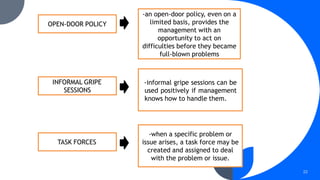
OPEN-DOOR POLICY
TASK FORCES
INFORMAL GRIPE
SESSIONS
-an open-door policy, even on a
limited basis, provides the
management with an
opportunity to act on
difficulties before they became
full-blown problems
-when a specific problem or
issue arises, a task force may be
created and assigned to deal
with the problem or issue.
-informal gripe sessions can be
used positively if management
knows how to handle them.
23
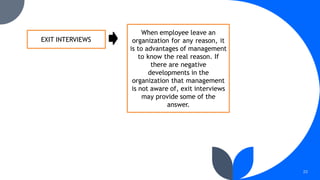
EXIT INTERVIEWS
When employee leave an
organization for any reason, it
is to advantages of management
to know the real reason. If
there are negative
developments in the
organization that management
is not aware of, exit interviews
may provide some of the
answer.
8/27/2023 PRESENTATION TITLE 24
HORIZONTAL COMMUNICATION- refers to
messages sent to individuals or groups from
another of the same organizational level or
position.
8/27/2023 PRESENTATION TITLE 25
• To coordinate activities between departments
• To persuade others at the same level of organization
• To pass on information about activities or feelings
8/27/2023 PRESENTATION TITLE 26
Memos
Meetings
Telephones
Picnics
Dinners
Social affairs
8/27/2023 PRESENTATION TITLE 27
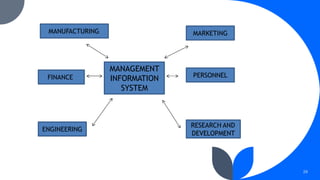
Management Information System (MIS is defined as
organized method of providing past. Present, future and
projected information on internal information's and
external intelligence for use in decision making.
28
• To provide a basis for analysis for early warnings signals that can
originate both externally and internally.
• To automate routine clerical operations like payroll and inventory
reports
• To assist managers in making routine decisions like scheduling orders,
assigning orders to machines, and reordering supplies
• To provide thee information necessary for management to make
strategic or non programmed decisions.
29
MANAGEMENT
INFORMATION
SYSTEM
MANUFACTURING
RESEARCH AND
DEVELOPMENT
PERSONNEL
MARKETING
ENGINEERING
FINANCE

MANAGEMENT.pptx

  • 1.
  • 2.
    • It isa process of sharing information through symbols, including words and message. • Communication may happen between superior and subordinate, between peers, between a manager and a client or customer, between an employee and a government representative. • It may be done face- to-face or through printed materials, or through an electronics device like telephone. • In management, communication must be made for a purpose and because it has a cost attached to it, it must used effectively. 2
  • 3.
    INFORMATION FUNCTION -Information provided through communication may be used for decision-making at various work levels in the organization. MOTIVATION FUNCTION - Communication is also used as a means to motivate employees to commit themselves to the organization’s objectives. CONTROL FUNCTION - When properly communicated, report, policies, and plans define roles, clarify duties, authorities and responsibilities. 3
  • 4.
  • 5.
    ENCODE- encode ideainto word, illustration, figures, or other symbols suitable for transmission. The method of transmission should be determined in advance so that the idea may be encoded to conform with the specific requirements of the identified method. 5
  • 6.
    TRANSMIT- After encoding,the message is now ready for transmission through the use of an appropriate communication channel. Among the various channels used include the spoken word, body movements, the written word, television, radio, an artist's paint, electronic mail, etc. 6
  • 7.
    Calao West ChemicalsCorporation Santiago City Branch Sales Report for January 1997 7 AREA VOLUME (IN DRUMS) AMOUNT I 1,000 1,000,000 II 1,342 1,342,000 III 2,045 2,045,000 IV 1,089 1,089,000 V 2,686 2,686,000 VI 3,450 3,450,000 TOTAL 11,612 11,612,000
  • 8.
    RECEIVER- The nextstep is the communication process is the actual receiving of the message by the intended receiver. The requirement is for the receiver to be ready to receive at the precise moment the message relayed by the sender. The message may be initially received by a machine or by a person. 8/27/2023 PRESENTATION TITLE 8
  • 9.
    DECODE- The nextstep, decoding , means translating the message from the sender into a form that will have meaning to the recipient. ACCEPT- The next step is for the receiver o accept or reject the message. Sometimes, acceptance (rejection) is partial. 9
  • 10.
    PRESENTATION TITLE 10 WHEREUSED ENCODED DECODED SELLING 5/10;n/30 Sales on account is allowed. A five percent discount is deducted from total price if settled within 30 days Flowcharting Indicates beginning of a flowcharting activity. Production departure after service. A basic queuing system configuration indicating channel, single phase system start Service facility arrival
  • 11.
    USE- The nextstep is for the receiver to use the information. If the message provides information of importance to a relevant activity, then the receiver could store it and retrieve it when required. 8/27/2023 PRESENTATION TITLE 11
  • 12.
    PROVIDE FEEDBACK- Thelast step in the communication process is for the receiver to provide feedback to the sender. Depending on the perception of the receiver, however, this important step may not be made. 12
  • 13.
    13 ■ VERBAL 𝗈 Oral 𝗈written ■ NONVERBAL TWO MAJOR FORMS OF COMMUNICATION
  • 14.
    8/27/2023 PRESENTATION TITLE14 Verbal communications are those transmitted trough hearing or sight. These modes of transmission into two classes: oral and written . ■ Oral communication- mostly involves hearing the words of the sender, although sometimes, opportunities are provided for seeing the sender’s body movements. ■ Written communication- where the sender seeks to communicate through the written word. It may prepared as memo and sent to the receiver.
  • 15.
    8/27/2023 PRESENTATION TITLE15 Non verbal Communication is a means of conveying message through body language, as well as the use of time, space, touch, clothing, appearance, and aesthetic elements.
  • 16.
    8/27/2023 PRESENTATION TITLE16 PERSONAL BARRIERS PHYSICAL BARRIERS SEMANTIC BARRIERS
  • 17.
    17 PERSONAL BARRIERS PHYSICAL BARRIERS SEMANTICBARRIERS It is the hindrance to effective communication arising from a communicator’s characteristics as a person. Refer to interferences to effective communication occurring in the environment Is the study of meaning as expressed in symbols. Words, picture, or action, are symbols that suggest certain meanings.
  • 18.
    8/27/2023 PRESENTATION TITLE18 ■ To give instructions ■ To provide information about policies and procedures ■ To give feedback about performance ■ To indoctrinate or motivate DOWNWARD COMMUNICATION
  • 19.
    19 UPWARD COMMUNICATION-There isa need for management to provide employees with all the necessary material and non material support it can give. The requirement, however, is for management to know the specific needs of the employees. This is the primary reason for upward communication.
  • 20.
    20 - FORMAL GRIEVANCEPROCEDURES - EMPLOYEE ATTITUDE AND OPINION SURVEYS SUGGESTION SYSTEMS - OPEN-DOOR POLICY - INFORMAL-DOOR POLICY - INFORMAL GRIPE SESSIONS - TASK FORCES - EXIT INTERVIEWS
  • 21.
    21 FORMAL GRIEVANCE PROCEDURES EMPLOYEE ATTITUDE ANDOPINION SURVEYS SUGGESTION SYSTEMS -suggestions from employees are important sources of cast-saving and production enhancing ideas. -finding out what the employees think about the company is very important. The exercise, however, requires the expertise and the company may not be prepared to do it. -part of a normally operating organization. To effectively deal with them, organizations provide a system for employees to air their grievances.
  • 22.
    22 OPEN-DOOR POLICY TASK FORCES INFORMALGRIPE SESSIONS -an open-door policy, even on a limited basis, provides the management with an opportunity to act on difficulties before they became full-blown problems -when a specific problem or issue arises, a task force may be created and assigned to deal with the problem or issue. -informal gripe sessions can be used positively if management knows how to handle them.
  • 23.
    23 EXIT INTERVIEWS When employeeleave an organization for any reason, it is to advantages of management to know the real reason. If there are negative developments in the organization that management is not aware of, exit interviews may provide some of the answer.
  • 24.
    8/27/2023 PRESENTATION TITLE24 HORIZONTAL COMMUNICATION- refers to messages sent to individuals or groups from another of the same organizational level or position.
  • 25.
    8/27/2023 PRESENTATION TITLE25 • To coordinate activities between departments • To persuade others at the same level of organization • To pass on information about activities or feelings
  • 26.
    8/27/2023 PRESENTATION TITLE26 Memos Meetings Telephones Picnics Dinners Social affairs
  • 27.
    8/27/2023 PRESENTATION TITLE27 Management Information System (MIS is defined as organized method of providing past. Present, future and projected information on internal information's and external intelligence for use in decision making.
  • 28.
    28 • To providea basis for analysis for early warnings signals that can originate both externally and internally. • To automate routine clerical operations like payroll and inventory reports • To assist managers in making routine decisions like scheduling orders, assigning orders to machines, and reordering supplies • To provide thee information necessary for management to make strategic or non programmed decisions.
  • 29.