AssignmentonManagementprocessandOrganizationBehaviour
1 | P a g e
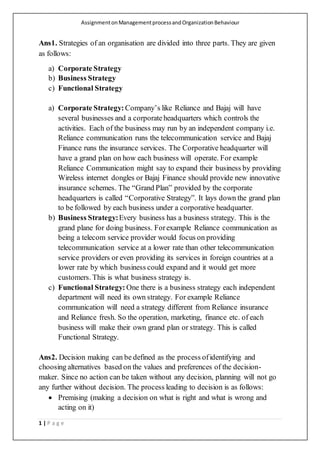
Ans1. Strategies of an organisation are divided into three parts. They are given
as follows:
a) Corporate Strategy
b) Business Strategy
c) Functional Strategy
a) Corporate Strategy: Company’s like Reliance and Bajaj will have
several businesses and a corporate headquarters which controls the
activities. Each of the business may run by an independent company i.e.
Reliance communication runs the telecommunication service and Bajaj
Finance runs the insurance services. The Corporative headquarter will
have a grand plan on how each business will operate. For example
Reliance Communication might say to expand their business by providing
Wireless internet dongles or Bajaj Finance should provide new innovative
insurance schemes. The “Grand Plan” provided by the corporate
headquarters is called “Corporative Strategy”. It lays down the grand plan
to be followed by each business under a corporative headquarter.
b) Business Strategy:Every business has a business strategy. This is the
grand plane for doing business. Forexample Reliance communication as
being a telecom service provider would focus on providing
telecommunication service at a lower rate than other telecommunication
service providers or even providing its services in foreign countries at a
lower rate by which business could expand and it would get more
customers. This is what business strategy is.
c) Functional Strategy: One there is a business strategy each independent
department will need its own strategy. For example Reliance
communication will need a strategy different from Reliance insurance
and Reliance fresh. So the operation, marketing, finance etc. of each
business will make their own grand plan or strategy. This is called
Functional Strategy.
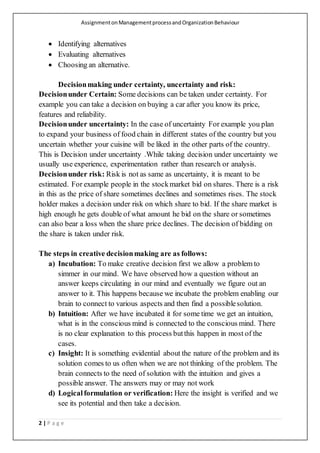
Ans2. Decision making can be defined as the process ofidentifying and
choosing alternatives based on the values and preferences of the decision-
maker. Since no action can be taken without any decision, planning will not go
any further without decision. The process leading to decision is as follows:
 Premising (making a decision on what is right and what is wrong and
acting on it)
AssignmentonManagementprocessandOrganizationBehaviour
2 | P a g e
 Identifying alternatives
 Evaluating alternatives
 Choosing an alternative.
Decisionmaking under certainty, uncertainty and risk:
Decisionunder Certain: Some decisions can be taken under certainty. For
example you can take a decision on buying a car after you know its price,
features and reliability.
Decisionunder uncertainty: In the case of uncertainty For example you plan
to expand your business of food chain in different states of the country but you
uncertain whether your cuisine will be liked in the other parts of the country.
This is Decision under uncertainty .While taking decision under uncertainty we
usually use experience, experimentation rather than research or analysis.
Decisionunder risk: Risk is not as same as uncertainty, it is meant to be
estimated. For example people in the stockmarket bid on shares. There is a risk
in this as the price of share sometimes declines and sometimes rises. The stock
holder makes a decision under risk on which share to bid. If the share market is
high enough he gets double of what amount he bid on the share or sometimes
can also bear a loss when the share price declines. The decision of bidding on
the share is taken under risk.
The steps in creative decisionmaking are as follows:
a) Incubation: To make creative decision first we allow a problem to
simmer in our mind. We have observed how a question without an
answer keeps circulating in our mind and eventually we figure out an
answer to it. This happens because we incubate the problem enabling our
brain to connect to various aspects and then find a possiblesolution.
b) Intuition: After we have incubated it for some time we get an intuition,
what is in the conscious mind is connected to the conscious mind. There
is no clear explanation to this process butthis happen in most of the
cases.
c) Insight: It is something evidential about the nature of the problem and its
solution comes to us often when we are not thinking of the problem. The
brain connects to the need of solution with the intuition and gives a
possible answer. The answers may or may not work
d) Logicalformulation or verification: Here the insight is verified and we
see its potential and then take a decision.
AssignmentonManagementprocessandOrganizationBehaviour
3 | P a g e
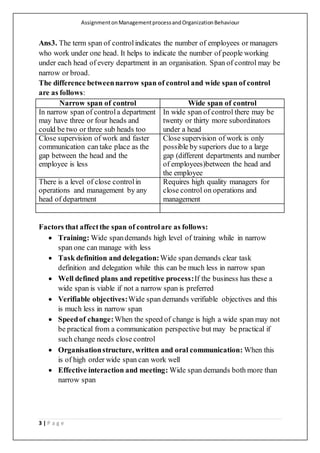
Ans3. The term span of controlindicates the number of employees or managers
who work under one head. It helps to indicate the number of people working
under each head of every department in an organisation. Span of control may be
narrow or broad.
The difference betweennarrow span of control and wide span of control
are as follows:
Narrow span of control Wide span of control
In narrow span of controla department
may have three or four heads and
could be two or three sub heads too
In wide span of control there may be
twenty or thirty more subordinators
under a head
Close supervision of work and faster
communication can take place as the
gap between the head and the
employee is less
Close supervision of work is only
possible by superiors due to a large
gap (different departments and number
of employees)between the head and
the employee
There is a level of close controlin
operations and management by any
head of department
Requires high quality managers for
close control on operations and
management
Factors that affectthe span of controlare as follows:
 Training: Wide spandemands high level of training while in narrow
span one can manage with less
 Task definition and delegation:Wide span demands clear task
definition and delegation while this can be much less in narrow span
 Well defined plans and repetitive process:If the business has these a
wide span is viable if not a narrow span is preferred
 Verifiable objectives:Wide span demands verifiable objectives and this
is much less in narrow span
 Speedof change:When the speed of change is high a wide span may not
be practical from a communication perspective but may be practical if
such change needs close control
 Organisationstructure, written and oral communication: When this
is of high order wide span can work well
 Effective interaction and meeting: Wide span demands both more than
narrow span
AssignmentonManagementprocessandOrganizationBehaviour
4 | P a g e
 Specialists:When there is a greater number of specialist’s at the upper
level a wide span is preferable. If the number of specialists is more at the
lower level then a narrow span can work better.
 Task simplicity: If the task is simple a wide span is viable.
 Competence ofmanagers:With highly competent managers a wide span
works well.
 Subordinate readiness:If the subordinators are mature and are willing
to assume responsibility a wide span works well.
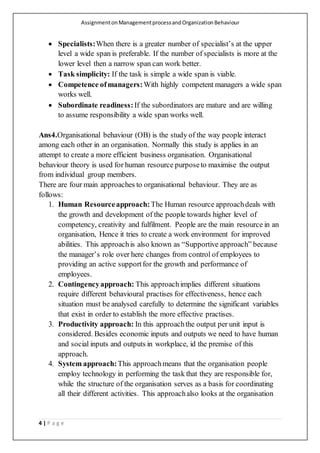
Ans4.Organisational behaviour (OB) is the study of the way people interact
among each other in an organisation. Normally this study is applies in an
attempt to create a more efficient business organisation. Organisational
behaviour theory is used for human resource purposeto maximise the output
from individual group members.
There are four main approaches to organisational behaviour. They are as
follows:
1. Human Resourceapproach:The Human resource approachdeals with
the growth and development of the people towards higher level of
competency, creativity and fulfilment. People are the main resource in an
organisation, Hence it tries to create a work environment for improved
abilities. This approachis also known as “Supportive approach” because
the manager’s role over here changes from control of employees to
providing an active supportfor the growth and performance of
employees.
2. Contingencyapproach: This approachimplies different situations
require different behavioural practises for effectiveness, hence each
situation must be analysed carefully to determine the significant variables
that exist in order to establish the more effective practises.
3. Productivity approach: In this approachthe output per unit input is
considered. Besides economic inputs and outputs we need to have human
and social inputs and outputs in workplace, id the premise of this
approach.
4. System approach:This approachmeans that the organisation people
employ technology in performing the task that they are responsible for,
while the structure of the organisation serves as a basis for coordinating
all their different activities. This approachalso looks at the organisation
AssignmentonManagementprocessandOrganizationBehaviour
5 | P a g e
and its broader environment i.e. social, economic, culture and politics
within which they operate.
Ans5. Perception is the process bywhich individuals organise and interpret
sensory impression in order to give meaning to the environment. It is the most
important factor of organisational behaviour. The importance of perception is as
follows:
 While creating vision for an organisation, our perception for the future
and the way things should be is a deciding factor.
 While making strategy out perception for opportunities and threats makes
us see the situation differently.
 Perception helps us to seek more information to make a more rational
decision.
 Perception effects planning because the goal/target set depends on our
perception of the world and the employees and their ability to achieve
them.
 The way we select staff is also based on perception and also the way we
treat, reward, promote them also depends on perception.
 The controls that we put in a place are based on perceptions of the
competence and sincerity of the employees.
The Factors affection perception is as follows:
a) Perceiverrelatedfactors:Peoples attitude, motives, interests,
experiences affect perception.
 Attitude and motives: Attitudes are evaluation statements
(wheatear spoke in words or otherwise) about objectives, people
and events. Motives are strong drives that we have for taking an
action.
 Interests: Interest is a natural inclination to talk, participate or
perform a task.
 Experiences: Experiences are something that one gains over a
period of time. It hard wires our brain. For e.g. An HR would hire a
new recruit only by knowing his/her previous experience in the
place that they worked before.
 Expectations: Expectation is anticipating with confidence of
fulfilment. It is a belief or feeling of something about to happen as
expected.
AssignmentonManagementprocessandOrganizationBehaviour
6 | P a g e
 Self-concept: Another factor that affects perception is self-
concept.anindividual with a positive self-concept tends to notice
positive attributes in another person.
 Moods:It is a prevailing psychological state that an individual
behaves in. Moods can have a strong influence on the way we
perceive someone.
 Cognitive structure: It is an individual pattern of thinking of an
individual. Some people tend to perceive physical traits suchas
height, weight, appearance etc. And some central traits such as
personality disposition.
b) Targetrelatedfactors:These are novelty, motion, sound, size,
background and proximity. We see them being used in business
especially advertisement’s.
c) Situation related factors:This factor affects perception depending on
the situation of the place, time and other factors of an activity. Time,
work setting, work tradition, nature of word and social setting are
important factors in a work situation that affects perception.
Ans6. Motivation is a process that boosts an individual’s intensity, direction and
persistence of effort toward attaining a goal. Motivation in an organisation can
be by the employer praising the employee for his good work or by giving the
employee promotion or by organising events to coolthe working environment
down a bit, etc.
The importance of motivation is as follows:
 Motivation helps to achieve personal goals
 Motivation gives job satisfaction
 Motivation helps in self-development of individuals
 An individual would always gain by working with a dynamic team
Maslow’s hierarchyof needs theory:
According to this theory, human beings have wants and desire which influence
their behaviour. Only dissatisfied needs can influence behaviour. The needs
follow an order of importance (called hierarchy) and when a lower need is
satisfied, he had a need to satisfy a higher level need. Maslow created the
following five hierarchies:
AssignmentonManagementprocessandOrganizationBehaviour
7 | P a g e
1. Physiological:This includes hunger, thirst, shelter, sex and other bodily
needs. So if the work place does not fulfil these an individual will not be
motivated.
2. Safety: Includes security and protection from physical and emotional
harm and therefore he looks for safer working place and does not want to
be threatened or abused in the workplace.
3. Social:Includes affection, belongingness, acceptance and friendship in
the work place and if he gets this he will be happier to work harder.
4. Esteem:Includes internal esteem factors such as self-respect, autonomy
and achievement and external esteem factors such as status, recognition
and attention. So when we set goals, supports him to achieve it and
rewards him for it, it fulfilled hid esteem needs and also other needs
because of the money he gets as a result which he can used to fulfil his
other needs such as buying a house(safety) giving a party (social)..etc.
5. Self-actualisation:The drive to become what one is capable of becoming
includes growth, achieving ones potential and self-fulfilment.

Management proccess and organisational behaviour assignment

  • 1.
    AssignmentonManagementprocessandOrganizationBehaviour 1 | Pa g e Ans1. Strategies of an organisation are divided into three parts. They are given as follows: a) Corporate Strategy b) Business Strategy c) Functional Strategy a) Corporate Strategy: Company’s like Reliance and Bajaj will have several businesses and a corporate headquarters which controls the activities. Each of the business may run by an independent company i.e. Reliance communication runs the telecommunication service and Bajaj Finance runs the insurance services. The Corporative headquarter will have a grand plan on how each business will operate. For example Reliance Communication might say to expand their business by providing Wireless internet dongles or Bajaj Finance should provide new innovative insurance schemes. The “Grand Plan” provided by the corporate headquarters is called “Corporative Strategy”. It lays down the grand plan to be followed by each business under a corporative headquarter. b) Business Strategy:Every business has a business strategy. This is the grand plane for doing business. Forexample Reliance communication as being a telecom service provider would focus on providing telecommunication service at a lower rate than other telecommunication service providers or even providing its services in foreign countries at a lower rate by which business could expand and it would get more customers. This is what business strategy is. c) Functional Strategy: One there is a business strategy each independent department will need its own strategy. For example Reliance communication will need a strategy different from Reliance insurance and Reliance fresh. So the operation, marketing, finance etc. of each business will make their own grand plan or strategy. This is called Functional Strategy. Ans2. Decision making can be defined as the process ofidentifying and choosing alternatives based on the values and preferences of the decision- maker. Since no action can be taken without any decision, planning will not go any further without decision. The process leading to decision is as follows:  Premising (making a decision on what is right and what is wrong and acting on it)
  • 2.
    AssignmentonManagementprocessandOrganizationBehaviour 2 | Pa g e  Identifying alternatives  Evaluating alternatives  Choosing an alternative. Decisionmaking under certainty, uncertainty and risk: Decisionunder Certain: Some decisions can be taken under certainty. For example you can take a decision on buying a car after you know its price, features and reliability. Decisionunder uncertainty: In the case of uncertainty For example you plan to expand your business of food chain in different states of the country but you uncertain whether your cuisine will be liked in the other parts of the country. This is Decision under uncertainty .While taking decision under uncertainty we usually use experience, experimentation rather than research or analysis. Decisionunder risk: Risk is not as same as uncertainty, it is meant to be estimated. For example people in the stockmarket bid on shares. There is a risk in this as the price of share sometimes declines and sometimes rises. The stock holder makes a decision under risk on which share to bid. If the share market is high enough he gets double of what amount he bid on the share or sometimes can also bear a loss when the share price declines. The decision of bidding on the share is taken under risk. The steps in creative decisionmaking are as follows: a) Incubation: To make creative decision first we allow a problem to simmer in our mind. We have observed how a question without an answer keeps circulating in our mind and eventually we figure out an answer to it. This happens because we incubate the problem enabling our brain to connect to various aspects and then find a possiblesolution. b) Intuition: After we have incubated it for some time we get an intuition, what is in the conscious mind is connected to the conscious mind. There is no clear explanation to this process butthis happen in most of the cases. c) Insight: It is something evidential about the nature of the problem and its solution comes to us often when we are not thinking of the problem. The brain connects to the need of solution with the intuition and gives a possible answer. The answers may or may not work d) Logicalformulation or verification: Here the insight is verified and we see its potential and then take a decision.
  • 3.
    AssignmentonManagementprocessandOrganizationBehaviour 3 | Pa g e Ans3. The term span of controlindicates the number of employees or managers who work under one head. It helps to indicate the number of people working under each head of every department in an organisation. Span of control may be narrow or broad. The difference betweennarrow span of control and wide span of control are as follows: Narrow span of control Wide span of control In narrow span of controla department may have three or four heads and could be two or three sub heads too In wide span of control there may be twenty or thirty more subordinators under a head Close supervision of work and faster communication can take place as the gap between the head and the employee is less Close supervision of work is only possible by superiors due to a large gap (different departments and number of employees)between the head and the employee There is a level of close controlin operations and management by any head of department Requires high quality managers for close control on operations and management Factors that affectthe span of controlare as follows:  Training: Wide spandemands high level of training while in narrow span one can manage with less  Task definition and delegation:Wide span demands clear task definition and delegation while this can be much less in narrow span  Well defined plans and repetitive process:If the business has these a wide span is viable if not a narrow span is preferred  Verifiable objectives:Wide span demands verifiable objectives and this is much less in narrow span  Speedof change:When the speed of change is high a wide span may not be practical from a communication perspective but may be practical if such change needs close control  Organisationstructure, written and oral communication: When this is of high order wide span can work well  Effective interaction and meeting: Wide span demands both more than narrow span
  • 4.
    AssignmentonManagementprocessandOrganizationBehaviour 4 | Pa g e  Specialists:When there is a greater number of specialist’s at the upper level a wide span is preferable. If the number of specialists is more at the lower level then a narrow span can work better.  Task simplicity: If the task is simple a wide span is viable.  Competence ofmanagers:With highly competent managers a wide span works well.  Subordinate readiness:If the subordinators are mature and are willing to assume responsibility a wide span works well. Ans4.Organisational behaviour (OB) is the study of the way people interact among each other in an organisation. Normally this study is applies in an attempt to create a more efficient business organisation. Organisational behaviour theory is used for human resource purposeto maximise the output from individual group members. There are four main approaches to organisational behaviour. They are as follows: 1. Human Resourceapproach:The Human resource approachdeals with the growth and development of the people towards higher level of competency, creativity and fulfilment. People are the main resource in an organisation, Hence it tries to create a work environment for improved abilities. This approachis also known as “Supportive approach” because the manager’s role over here changes from control of employees to providing an active supportfor the growth and performance of employees. 2. Contingencyapproach: This approachimplies different situations require different behavioural practises for effectiveness, hence each situation must be analysed carefully to determine the significant variables that exist in order to establish the more effective practises. 3. Productivity approach: In this approachthe output per unit input is considered. Besides economic inputs and outputs we need to have human and social inputs and outputs in workplace, id the premise of this approach. 4. System approach:This approachmeans that the organisation people employ technology in performing the task that they are responsible for, while the structure of the organisation serves as a basis for coordinating all their different activities. This approachalso looks at the organisation
  • 5.
    AssignmentonManagementprocessandOrganizationBehaviour 5 | Pa g e and its broader environment i.e. social, economic, culture and politics within which they operate. Ans5. Perception is the process bywhich individuals organise and interpret sensory impression in order to give meaning to the environment. It is the most important factor of organisational behaviour. The importance of perception is as follows:  While creating vision for an organisation, our perception for the future and the way things should be is a deciding factor.  While making strategy out perception for opportunities and threats makes us see the situation differently.  Perception helps us to seek more information to make a more rational decision.  Perception effects planning because the goal/target set depends on our perception of the world and the employees and their ability to achieve them.  The way we select staff is also based on perception and also the way we treat, reward, promote them also depends on perception.  The controls that we put in a place are based on perceptions of the competence and sincerity of the employees. The Factors affection perception is as follows: a) Perceiverrelatedfactors:Peoples attitude, motives, interests, experiences affect perception.  Attitude and motives: Attitudes are evaluation statements (wheatear spoke in words or otherwise) about objectives, people and events. Motives are strong drives that we have for taking an action.  Interests: Interest is a natural inclination to talk, participate or perform a task.  Experiences: Experiences are something that one gains over a period of time. It hard wires our brain. For e.g. An HR would hire a new recruit only by knowing his/her previous experience in the place that they worked before.  Expectations: Expectation is anticipating with confidence of fulfilment. It is a belief or feeling of something about to happen as expected.
  • 6.
    AssignmentonManagementprocessandOrganizationBehaviour 6 | Pa g e  Self-concept: Another factor that affects perception is self- concept.anindividual with a positive self-concept tends to notice positive attributes in another person.  Moods:It is a prevailing psychological state that an individual behaves in. Moods can have a strong influence on the way we perceive someone.  Cognitive structure: It is an individual pattern of thinking of an individual. Some people tend to perceive physical traits suchas height, weight, appearance etc. And some central traits such as personality disposition. b) Targetrelatedfactors:These are novelty, motion, sound, size, background and proximity. We see them being used in business especially advertisement’s. c) Situation related factors:This factor affects perception depending on the situation of the place, time and other factors of an activity. Time, work setting, work tradition, nature of word and social setting are important factors in a work situation that affects perception. Ans6. Motivation is a process that boosts an individual’s intensity, direction and persistence of effort toward attaining a goal. Motivation in an organisation can be by the employer praising the employee for his good work or by giving the employee promotion or by organising events to coolthe working environment down a bit, etc. The importance of motivation is as follows:  Motivation helps to achieve personal goals  Motivation gives job satisfaction  Motivation helps in self-development of individuals  An individual would always gain by working with a dynamic team Maslow’s hierarchyof needs theory: According to this theory, human beings have wants and desire which influence their behaviour. Only dissatisfied needs can influence behaviour. The needs follow an order of importance (called hierarchy) and when a lower need is satisfied, he had a need to satisfy a higher level need. Maslow created the following five hierarchies:
  • 7.
    AssignmentonManagementprocessandOrganizationBehaviour 7 | Pa g e 1. Physiological:This includes hunger, thirst, shelter, sex and other bodily needs. So if the work place does not fulfil these an individual will not be motivated. 2. Safety: Includes security and protection from physical and emotional harm and therefore he looks for safer working place and does not want to be threatened or abused in the workplace. 3. Social:Includes affection, belongingness, acceptance and friendship in the work place and if he gets this he will be happier to work harder. 4. Esteem:Includes internal esteem factors such as self-respect, autonomy and achievement and external esteem factors such as status, recognition and attention. So when we set goals, supports him to achieve it and rewards him for it, it fulfilled hid esteem needs and also other needs because of the money he gets as a result which he can used to fulfil his other needs such as buying a house(safety) giving a party (social)..etc. 5. Self-actualisation:The drive to become what one is capable of becoming includes growth, achieving ones potential and self-fulfilment.