Chapter 7 Legal Aspects of 
Business 
Chapter 7 
©2008 Thomson/South-Western 
1 Legal Aspects of Business
Lesson 7.1 Regulations 
Maintaining Competition 
Goals 
 Explain how federal laws help regulate 
monopolies. 
 Explain how federal laws help promote fair 
competition. 
Chapter 7 
2 Legal Aspects of Business
 Monopoly — exists when only one company 
provides a product or service without 
competition from other companies 
 Natural monopoly — usually involves 
providing public services, such as public 
utilities, which have a fairly stable demand 
and are costly to create 
Chapter 7 
Monopolies 
3 Legal Aspects of Business
Promoting Fair Competition 
Chapter 7 
 Sherman Act 
 Clayton Act 
 Robinson-Patman Act 
 Wheeler-Lea Act 
 Federal Trade Commission 
 Other federal agencies 
 Bankruptcy relief 
4 Legal Aspects of Business
Lesson 7.2 Regulations Protecting 
Business and the Public 
Goals 
 Explain how patent, copyright, and trademark 
protection benefits business. 
 Describe the ways in which government 
regulations protect consumers. 
 Describe three methods used by state and 
local governments to regulate business. 
Chapter 7 
5 Legal Aspects of Business
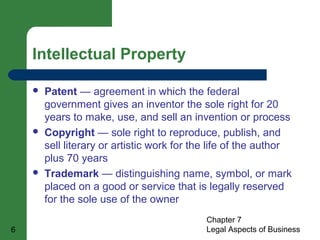
 Patent — agreement in which the federal 
government gives an inventor the sole right for 20 
years to make, use, and sell an invention or process 
 Copyright — sole right to reproduce, publish, and 
sell literary or artistic work for the life of the author 
plus 70 years 
 Trademark — distinguishing name, symbol, or mark 
placed on a good or service that is legally reserved 
for the sole use of the owner 
Chapter 7 
Intellectual Property 
6 Legal Aspects of Business
TRADEMARKS 
 Names 
 Symbols 
TRADEMARKS 
 Names 
 Symbols 
Chapter 7 
Intellectual Property 
PATENTS 
 Motors 
 Mousetraps 
 Games 
 Computers 
PATENTS 
 Motors 
 Mousetraps 
 Games 
 Computers 
COPYRIGHTS 
 Software 
 Novels 
 Histories 
 Poetry 
 Textbooks 
COPYRIGHTS 
 Software 
 Novels 
 Histories 
 Poetry 
 Textbooks 
7 Legal Aspects of Business
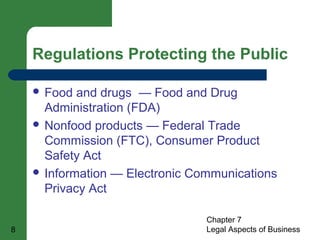
Regulations Protecting the Public 
 Food and drugs — Food and Drug 
Administration (FDA) 
 Nonfood products — Federal Trade 
Commission (FTC), Consumer Product 
Safety Act 
 Information — Electronic Communications 
Privacy Act 
Chapter 7 
8 Legal Aspects of Business
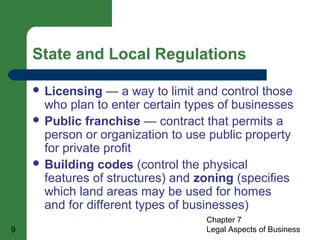
State and Local Regulations 
 Licensing — a way to limit and control those 
who plan to enter certain types of businesses 
 Public franchise — contract that permits a 
person or organization to use public property 
for private profit 
 Building codes (control the physical 
features of structures) and zoning (specifies 
which land areas may be used for homes 
and for different types of businesses) 
Chapter 7 
9 Legal Aspects of Business
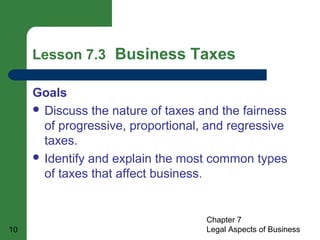
Lesson 7.3 Business Taxes 
Goals 
 Discuss the nature of taxes and the fairness 
of progressive, proportional, and regressive 
taxes. 
 Identify and explain the most common types 
of taxes that affect business. 
Chapter 7 
10 Legal Aspects of Business
 Proportional tax (also called flat tax) — tax 
whose rate remains the same regardless of 
the amount on which the tax is imposed 
 Progressive tax — tax based on ability to 
pay 
 Regressive tax — tax whose rate decreases 
as taxable amount increases 
Chapter 7 
Fairness of Taxation 
11 Legal Aspects of Business
 Income tax — tax on the profits of businesses and 
the earnings of individuals 
 Sales tax — tax levied on the retail price of goods 
and services at the time of sale 
– Excise tax — applied only to selected goods or services 
 Property tax — tax on material goods owned, such 
as real property tax (real estate) and personal 
property tax (movable possessions) 
Chapter 7 
Types of Taxes 
12 Legal Aspects of Business
Comparative Tax Rates 
Spain 
Fance 
Sweden 
Chapter 7 
60 
50 
40 
30 
20 
10 
0 
Japan 
UK 
U.S. 
Canada 
Greece 
Norway 
Germany 
Tax rate % 
13 Legal Aspects of Business

Management Chapter 7

  • 1.
    Chapter 7 LegalAspects of Business Chapter 7 ©2008 Thomson/South-Western 1 Legal Aspects of Business
  • 2.
    Lesson 7.1 Regulations Maintaining Competition Goals  Explain how federal laws help regulate monopolies.  Explain how federal laws help promote fair competition. Chapter 7 2 Legal Aspects of Business
  • 3.
     Monopoly —exists when only one company provides a product or service without competition from other companies  Natural monopoly — usually involves providing public services, such as public utilities, which have a fairly stable demand and are costly to create Chapter 7 Monopolies 3 Legal Aspects of Business
  • 4.
    Promoting Fair Competition Chapter 7  Sherman Act  Clayton Act  Robinson-Patman Act  Wheeler-Lea Act  Federal Trade Commission  Other federal agencies  Bankruptcy relief 4 Legal Aspects of Business
  • 5.
    Lesson 7.2 RegulationsProtecting Business and the Public Goals  Explain how patent, copyright, and trademark protection benefits business.  Describe the ways in which government regulations protect consumers.  Describe three methods used by state and local governments to regulate business. Chapter 7 5 Legal Aspects of Business
  • 6.
     Patent —agreement in which the federal government gives an inventor the sole right for 20 years to make, use, and sell an invention or process  Copyright — sole right to reproduce, publish, and sell literary or artistic work for the life of the author plus 70 years  Trademark — distinguishing name, symbol, or mark placed on a good or service that is legally reserved for the sole use of the owner Chapter 7 Intellectual Property 6 Legal Aspects of Business
  • 7.
    TRADEMARKS  Names  Symbols TRADEMARKS  Names  Symbols Chapter 7 Intellectual Property PATENTS  Motors  Mousetraps  Games  Computers PATENTS  Motors  Mousetraps  Games  Computers COPYRIGHTS  Software  Novels  Histories  Poetry  Textbooks COPYRIGHTS  Software  Novels  Histories  Poetry  Textbooks 7 Legal Aspects of Business
  • 8.
    Regulations Protecting thePublic  Food and drugs — Food and Drug Administration (FDA)  Nonfood products — Federal Trade Commission (FTC), Consumer Product Safety Act  Information — Electronic Communications Privacy Act Chapter 7 8 Legal Aspects of Business
  • 9.
    State and LocalRegulations  Licensing — a way to limit and control those who plan to enter certain types of businesses  Public franchise — contract that permits a person or organization to use public property for private profit  Building codes (control the physical features of structures) and zoning (specifies which land areas may be used for homes and for different types of businesses) Chapter 7 9 Legal Aspects of Business
  • 10.
    Lesson 7.3 BusinessTaxes Goals  Discuss the nature of taxes and the fairness of progressive, proportional, and regressive taxes.  Identify and explain the most common types of taxes that affect business. Chapter 7 10 Legal Aspects of Business
  • 11.
     Proportional tax(also called flat tax) — tax whose rate remains the same regardless of the amount on which the tax is imposed  Progressive tax — tax based on ability to pay  Regressive tax — tax whose rate decreases as taxable amount increases Chapter 7 Fairness of Taxation 11 Legal Aspects of Business
  • 12.
     Income tax— tax on the profits of businesses and the earnings of individuals  Sales tax — tax levied on the retail price of goods and services at the time of sale – Excise tax — applied only to selected goods or services  Property tax — tax on material goods owned, such as real property tax (real estate) and personal property tax (movable possessions) Chapter 7 Types of Taxes 12 Legal Aspects of Business
  • 13.
    Comparative Tax Rates Spain Fance Sweden Chapter 7 60 50 40 30 20 10 0 Japan UK U.S. Canada Greece Norway Germany Tax rate % 13 Legal Aspects of Business

Editor's Notes

  • #8 <number>