ASSIGNMENT 3 (CHAPTERS 8-9) QUESTIONS
Name:
MTMAIL Address:
Type accurate, detailed, and explanatory answers in the spaces
below. Email them in Word document to [email protected] (Do
not use D2L). Feel free to email me or call me at 615-292-3030
or 615-585-5353 (leave message if no answer; do not text) if
you have any questions.
Chapter 8 (Intellectual Property)
1. What are some aspects of branding that can be trademarked?
A trademark is a distinctive mark, motto, device, or implement
that a manufacturer stamps, prints, or otherwise affixes to the
goods it produces so that they can be identified on the market
and their origins made known.
2. What is trademark infringement?
When registering for a trademark with the U.S. Patent and
Trademark office, they give a notice on a nationwide basis that
the trademark belongs exclusively to the registrant. The
registrant then uses the trademark symbol on their mark to
indicate that it belongs to them. Whenever that trademark is
copied to a substantial degree, or used in its entirety by another,
whether intentionally or unintentionally, the trademark is
infringed. In other words, the trademark has been used without
authorization. The owner of the mark can take legal action
against the infringer by showing that the defendant’s use of the
mark created a likelihood of confusion about the origin of the
defendant’s goods or services.
3. Could a company likely obtain trademark protection for its
logo?
Companies such as Rolls Royce, McDonald’s, Starbucks, and
Apple, are all logos covered under the Federal Trademark
Dilution Act from unauthorized uses. These are known as
“distinctive” or “Famous” trademarks. Owners of these can
bring suits in federal court for dilution. A company can obtain
trademark protection by registering with the state or federal
government. This process may take six to thirty months, and
registration is postponed until the mark is actually used. During
the waiting period, any applicant can legally protect their
trademark against a third party who previously has never used
the mark nor filed an application for it.
4. Under what circumstances is trafficking in labels that bear
counterfeit trademarks a crime?
5. What is the result when Company A uses Company B’s
registered trademark without B’s consent?
6. What is a service mark?
A service mark is a trademark that is used to distinguish the
services (rather than the products) of one person or company
from those of another. For example, each airline has a specific
symbol associated with its name. Titles and character names
used in radio and TV are frequently used as service marks. The
registration symbol is R instead of T. Service marks can also be
slogans for companies. It can sometimes be difficult to
distinguish between service marks and trademarks. Mcdonald's
is a restaurant that offers products and services, so a big mac is
a trademarked product while providing the fast food is a service
mark.
7. What is a trade name?
A trade name indicates part or all of a business’s name, whether
the business is a sole proprietorship, a partnership, or
corporation. A trade name is directly related to a business and
its goodwill. A trade name may be protected as a trademark if
the trade name is also the name of the company’s trademarked
product. For example, the word Safeway, was sufficiently
fanciful to obtain protection as a trade name for grocery chain
because it is unusual or fancifully used. Therefore, this name is
protected.
8. Closing down the domain name of a website is effectively
used by U.S. officials when there is online sales of what kind of
goods?
9. What is a patent?
A patent is a grant or legal document from the government that
gives an inventor the exclusive right to make, use, or sell their
invention for a period of twenty years. Patents for designs are
given for a fourteen year period. Patents are an important
element in encouraging innovation. This grant gives the
inventor exclusive rights to their product or design in exchange
for a comprehensive disclosure of the invention. Whoever
invents or discovers new and useful process, machine,
manufacture, or composition of matter, or any new and useful
improvement, may obtain a patent and are subject to the
conditions and requirements of this title
10. What is a license?
A license is an agreement or contract permitting the use of a
trademark, copyright, patent, or trade secret for a certain
purpose. The party that owns the intellectual property rights and
issues the license is the licensor, and the party obtaining the
license is the license. A license only grants the rights expressly
described in the license agreement. When the license involves
internet uses, disputes frequently arise over licensing
agreements.
11. How long does A have to challenge B’s patent if A believes
B has infringed upon A’s previously acquired patent?
12. What is patent infringement?
Patent infringement is when a firm makes, uses, or sells
another’s patented design, product, or process without the
patent owner’s permission. Patent infringement may occur even
though the patent owner has not put the patented product into
commerce, or even though not all features or parts of a product
are copied.
13. Works that are copyrightable include what?
A copyright is an intangible property right granted by federal
statute to the author or originator of a literary or artistic
production of a specified type. A copyrightable is the particular
way in which an idea is expressed. When an idea and expression
are inseperable, the expression can not be copyrighted. Works
that are copyrightable include literary works, musical works,
dramatic works, pantomimes and choreographic works,
pictorial, graphic, and sculptural works, motion pictures and
other audiovisual works, and architectural works. Anything that
is not an original expression does not qualify for copyright
protection. Facts widely known to the public are not
copyrightable. Page numbers are not copyrightable because they
follow a sequence known to everyone. Mathematical
calculations are not copyrightable.
14. What must a work be to be protected under the Copyright
Act?
In order for a work to be protected under the Copyright Act, a
work must be “fixed in a durable medium” from which it can be
perceived, reproduced, or communicated. Protection of these
items are automatic, and registration is not required. These
works include books, records, films, menus, product packaging,
computer software, newspapers, musical works, ballets/other
forms of dance, cartoons, maps, sound recordings, motion
pictures, and many others. It must be an original expression or a
fact that is not widely known to the public to be protected.
15. What is copyright infringement?
Copyright infringement is when the form or expression of an
idea is copied. The reproduction does not have to be exactly the
same as the original, nor does it have to reproduce the original
in its entirety. If a substantial part of the original is reproduced,
the copyright has been infringed.
16. What does “fair use” mean as an exception to copyright
infringement?
The “fair use” doctrine is an exception to liability for copyright
infringement. In certain circumstances, a person or organization
can reproduce copyrighted material without paying royalties.
According to Section 107 of the Copyright Act, the fair use of
copyrighted work, including such use by reproduction in copies
or phonorecords for purposes such as criticism, comment, news
reporting, teaching, scholarship, or research, is not an
infringement of copyright. Because the guidelines for fair use is
very broad, the courts determine whether a particular use is fair
on a case-by-case basis.
17. What does the first sale doctrine enable a buyer of a newly
copyrighted book to do?
18. Does federal copyright protection extend to parts of an app
that can be read by computers?
19. Could A bring an action for copyright infringement against
its competitor, B, who copied parts of the software that can be
read by humans?
20. What is a theft of trade secrets?
A trade secret is information of commercial value, such as
customer lists, plans, and research development. A theft of trade
secrets is when confidential business data is stolen by industrial
espionage, such as by tapping into a competitor’s computer.
This is an actionable offense without any contractual violation.
The theft of trade secrets is a federal crime.
21. What kind of information may be protected as trade secrets?
(2)
Trade secrets protect the information of commercial value such
as customer lists, plans, and research development. They may
also protect pricing information, marketing methods, production
techniques, and generally anything that makes a company
individually unique. In other words, anything that would have
value to the company’s competitor would be protected as trade
secrets. Protection of trade secrets extends to both ideas and
their expression. Because of this, there is no registration or
filing requirements for trade secrets.
22. Is an app for an idea that businesses can use to track their
revenue, profit, and payroll protected by any federal law?
23. What is the significance of all signatories of the Berne
Convention as it relates to the publishing of a book written by a
French citizen first in France and then in the U.S.?
24. What is the essence of the TRIPS agreement regarding
infringement of intellectual property rights?
The TRIPS agreement, otherwise known as the Trade Related
Aspects of Intellectual Poverty Rights, is a party to various
international agreements relating to intellectual property rights.
For example, the Paris Convention of 1883, allows parties in
one country to file for patent and trademark protection in any of
the other member countries. The TRIPS agreement established
the standards for the international protection of intellectual
property rights, including patents, trademarks, and copyrights
for movies, computer programs, books, and music.
Chapter 9 (Internet Law, Social Media, and Privacy)
25. Would federal law preempt state law concerning anti spam?
The statute preempts state antispam laws except for those
provisions in state laws that prohibit false and deceptive e-
mailing practices. The act permits the sending of unsolicited
commercial email but prohibits certain types of spamming
activities. Prohibited activities include the use of a false return
address and the use of false, misleading, or deceptive
information when sending e-mail.
26. How many states currently prohibit or regulate spam?
Thirty-seven states have enacted laws that prohibit or regulate
the use of spam. Many state laws that regulate spam require the
senders of e-mail ads to instruct the recipients on how they can
“opt-out” of further e-mail ads from the same sources. In some
states, an unsolicited e-mail must include a toll-free phone
number or return e-mail address that the recipient can use to ask
the sender to stop forwarding those emails.
27. What is cybersquatting?
Cybersquatting is when a person registers on a domain name
that is the same as, or confusingly similar to, the trademark of
another and then offers to sell the domain name back to the
trademark owner. Apple Inc. has repeatedly sued cybersquatters
that registered domain names similar to the names of its
products, such as ipods.com.
28. Would it be illegal if A registered a domain name that is
confusingly similar to the trademark of B if A had bad faith
intent to profit from the mark by selling the name to B?
29. What is typosquatting?
30. What could a plaintiff recover if it proves the defendant is
profiting from a domain name that is confusingly similar to the
plaintiff’s trademark?
31. Be able to recognize an example of A diminishing the
quality of B’s domain name. Give an example of your own.
32. What is trademark dilution?
33. Is A’s downloading of music into her computer’s random
access memory (RAM) without authorization considered
copyright infringement?
34. Is the Digital Millennium Copyright Act violated if A
transfers pirated copies of movies of television programs to an
Internet site that permits users to view them without
downloading them?
35. What is a license?
36. Be able to recognize a fair use exception to the provisions
of the Digital Millennium Copyright Act.
37. Are making and selling devices and services for the
circumvention of encryption software a violation of the Digital
Millennium Copyright Act?
38. What is copyright infringement? (2)
39. What is peer-to-peer (P2P) networking?
40. What is a distributed network?
41. What is a business-extension exception under the Electronic
Communications Privacy Act?
42. What is cloud computing?
43. May an employer discipline and even fire an employee who
uses social media in a way that violates her employer’s stated
social media policies?
44. How could an employer violate the Stored Communications
Act with respect to its firing of employees who maintain a
password-protected social media page to vent about their work?
45. Under the Electronic Communications Privacy Act, is it
permissible for an employer to intercept employees’ business
communications on devices provided for employees’ use in the
ordinary course of its business?
46. What would cause an Internet Service Provider to have to
disclose the identity of those persons who make defamatory
statements online about a company’s products?
47. Can a company which markets its products online use
cookies to track individuals’ Web browsing activities?
48. Are the privacy rights of the users of companies’ Web sites
and apps for mobile devices frequently defined by the
companies that own the sites and the apps?
ACCT 6356.501 Tax Research – Fall 2022
Name __________________
RESEARCH ASSIGNMENT 3
Treasury (IRS) Regulations
( Please submit as a
Word document by email by
4:00 p.m. next Thursday, 9/15. )
This assignment is worth up to a maximum of five (5) points.
Your answer should be written
in your own words without any “cutting & pasting”
from the source doc-ument(s) you cite except that very brief
quotations are acceptable with proper attribution.
Points
will be deducted for, among other things, (i) spelling
and grammatical er-rors that Word highlighted but you failed to
correct and (ii) other egregious errors, including substantive
misstatements.
Any submissions received after 4:00 p.m. are worth a maximum
of three (3) points. Submissions not received by 7:00 p.m. will
not be scored (zero points).
Consult the Citation Style guide in the Syllabus. Be sure to
include your name on your work.
* * * *
Your client Ms. Executive was, until a few years ago, the CFO
of BigCo. She had worked her way up through the Controller’s
organization, then became Tax VP in 2009, then CFO in 2014.
Ms. Executive lost her role as BigCo’s CFO for the simple
reason that in 2019 BigCo was swallowed up in a merger (an
“A” reorganization) by BiggerCo. All of BigCo’s former assets
and operations now make up just another one of Bigger’s
several divisions.
Ms. Executive was fired the day after the merger closed –
Bigger had a CFO and didn’t need two.
But there was some happy news . . . because Ms.
Executive had been smart enough to negotiate for a generous
golden parachute provision in her CFO contract. The merger
pulled the ripcord on that parachute and she collected a pre-tax
lump-sum $4.4 million in September 2019. Can’t be sad about
that!
“Wow, close call!”, you had said to her at the time. “You
almost had to pay that nasty 20% excise tax!”
In 2021 Ms. Executive accepted a job in Hawaii and moved.
She’d said at that point that although she “love[d] you to death”
she felt the need for a local CPA. You agreed that that made
sense, and she found one…
* * *
Out of the blue today Ms. Executive called you and she’s
really angry. The IRS audited her 2019 return (the audit
handled by her new CPA) and no sooner was the IRS finished
than they handed Ms. Executive a tax deficiency notice saying
“$580,000 excise tax, please.”
“You told me that I wouldn’t have pay any excise tax! Now the
IRS says that I do owe it. Not happy with you!” (You can’t
blame her for being upset, you only wish that you’d been
involved in the audit...)
The IRS bases its position on Ms. Executive’s alleged
miscalculation of her base amount. You had told her that her
“base amount” was exactly $1.5 million. The IRS says it
actually was only $1,460,000, “so the government wins!” Here
are the relevant numbers, Ms. Executive’s salary (net of pre-tax
deductions) for the most recent five years before she was fired:
2014 : $1,400,000
2015 : $1,450,000
2016 : $1,500,000
2017 : $1,550,000
2018 : $1,600,000
But there’s an important footnote to those numbers: Because of
some disarray in BigCo’s Japanese subsidiary, Ms. Executive
had “volunteered” to transfer and to work out of the Tokyo
office (but still as a BigCo employee) in July 2015. She stayed
through 2016 and into 2017 before being called back to Dallas.
She claimed the § 911 exclusion in full for 2016 and partially
for 2015 and 2017.***
*** Let’s hypothetically say that the exclusion she qualified for
amounted to an aggregate total of
$200,000 for those three (two partial plus one whole)
calendar years together.
The IRS argues that since Ms. Executive didn’t pay FIT on the §
911 exclusion amount, it can’t be included in her base amount
calculation. So the government says that her base amount was
less than what you’d advised her it was, with the result that her
$4.4 million payout
was subject to excess tax.
* * *
You need to develop your response to your angry former client.
And then com-unicate it to her in writing.
8
image1.jpeg
1 | P a g e
Internal Revenue Service
Golden Parachute
Payments Guide
Audit Techniques Guide
Large Business and International
1/20/2017
2 | P a g e
Golden Parachute Payment - Audit Technique
Guide (ATG) (1-2017)
NOTE: This guide is current through the publication date.
Since changes may have oc-
curred after the publication date that would affect the accuracy
of this document, no guar-
antees are made concerning the technical accuracy after the
publication date.
The parachute examination can occur during the examination of
either the corporation's or
the individual's return. As the examination begins and
throughout its course, the following
items should be considered:
1. The Code requires that the excise tax payable under IRC §
4999 be administered as an
income tax. See IRC § 4999(c)(2). Accordingly, the three-year
statute of limitations of IRC §
6501 will apply because, in most cases, there has not been a
substantial understatement of
income.
2. The outcome of the parachute examination may affect the tax
return of a current or
former employee or independent contractor in another part of
the country so steps should
be taken to keep the statute open for the affected taxpayer.
3. Final regulations concerning golden parachute payments were
issued on August 4,
2003, and became effective for any payment contingent on a
change ownership or control
occurring on or after January 1, 2004.1
4. The Regulations § 1.280G-1 were issued in question and
answer format. Any refer-
ence to questions and answers (Q/A) in this ATG relate to the
final regulations. The key
code and regulations for Golden Parachutes are IRC § 280G;
IRC § 4999 and Treas. Reg.
§ 1.280G-1.
5. Potential Adjustments in a Golden Parachute Examina tion
• If a payment is determined to be an excess parachute payment,
the corporation
is not allowed a deduction for that payment under IRC § 280G
• An excise tax of 20% is imposed on the recipient of such a
payment under IRC §
4999
• The payor of the parachute payment must withhold the excise
tax if the payment
is wages. The payor of a parachute payment to an independent
contractor
would not have a withholding requirement.
1 For payments contingent on a change occurring prior to
January 1, 2004, taxpayers may rely on the 1989
proposed regulations, 2002 proposed regulations, or the final
regulations.
3 | P a g e
6. Golden Parachute Reporting Requirements
• Employees: Generally, wages plus golden parachute payments
are reported in box
1, and federal income taxes along with the excise tax are
reported in box 2 on Form
W-2. The employee must include the 20% excise tax, reported
in box 12 with a
code K on Form W-2, on the proper line of the other taxes
section on Form 1040.
• Non-Employees: Total golden parachute payments made to
non-employees are re-
ported on Form 1099-Misc in Box 7, Non-employee
compensation. Any excess par-
achute payment is reported in box 13, “Excess Golden Parachute
Payments”.
7. Section 162(m) provides that the $1 million limitation should
be reduced by any
amount of excess parachute payments. For example, if the chief
executive officer of a pub-
licly-held company received $2 million dollars from his
company in the year it was being
acquired, of which $200,000 was excess parachute payments
under IRC § 280G, the IRC
162(m) limitation for the CEO would be reduced to $800,000
($1,000,000 - $200,000).
However, this provision for reducing the $1 million limitation
for the excess parachute pay-
ment may not apply if the executive of the target is not
considered a covered employee dur-
ing the year of an acquisition since the target goes out of
existence and his pay is not re-
ported in the proxy statement.
Documents to review in a golden parachute examination:
Form 10-K is the annual report filed with the SEC and provides
a complete listing of sec-
tion 16(b) executives and directors, executive compensation,
and the security ownership of
certain beneficial owners and management (although each of the
foregoing may be de-
ferred to the definitive proxy statement or the definitive
information statement). Form 10-K
provides information for equity compensation plans using a
table format setting forth the (a)
number of securities to be issued (b) weighted-average exercise
price (c) additional shares
available for future grants. Any compensation plans adopted in
the applicable year without
stockholder approval are provided as an exhibit. Also, Form
10-K frequently references
additional compensation plans that were previously filed with
the SEC. These compensa-
tion plans frequently include stock options, restricted stock, and
other types of equity-based
compensation for executives. Form 10-K may discuss the
vesting provisions of such equi-
ty-based compensation especially in the event of a change in
control.
SEC filings can be downloaded from the SEC website.
DEF 14A, Proxy Statement Pursuant to Section 14A of the SEC,
better known as the
Definitive Proxy Statement, or the annual proxy statement, is
the easiest place to look up
information on executive compensation. This proxy statement
is sent to the shareholders
of record prior to the Annual Meeting and may contain
information about specific stock op-
tions and compensation plans for executives. It is more detailed
than Form 10-K and pro-
vides specific detail as to the number of options granted and the
total exercise price under
the various plans.
4 | P a g e
SEC filings can be downloaded from the SEC website.
Schedule 14A, Information Statement Pursuant to Section 14(a)
of the SEC and
Schedule 14C, Information Statement pursuant to Section 14(c)
of the SEC disclose
information regarding golden parachute payments in connection
with the solicitation for
shareholders’ approval as required by the Dodd-Frank Wall
Street Reform and Consumer
Protection Act. The provision requires a shareholder advisory
vote, commonly referred to
as “vote on golden parachute payments” for any new executive
compensation arrange-
ments in connection with a merger, acquisition, consolidation,
proposed sale, or disposition
of all or substantially all assets of a public company. The
company is required to disclose
all parachute payments that may be made if a change in control
occurs. A “Golden Para-
chute Compensation” table that shows quantitative information
about the components of
the parachute payments based the per share price is required.
Narrative descriptions for
the triggers, conditions for payment, how payments are made,
who makes payments, and
how long the payments are made are required in the table.
Additionally, any parachute
payments actually made upon a change in control must be
reported. Companies were re-
quired to comply with these golden parachute shareholder
advisory vote and disclosure re-
quirements on proxy statements and consent solicitations filed
seeking shareholder ap-
proval of a transaction after April 25, 2011. The rules of the
Dodd-Frank Act require the
disclosure of golden parachute payments in proxy statements
and informational statements
filed on Schedule 14A as well as Schedule 14C. SEC filings
can be downloaded from
the SEC website.
Forms S-4 and F-4, often referred to as the Registration
Statement under the Securi-
ties Act of 1933, are used to provide information to i nvestors
when registering securities.
They provide information related to mergers, acquisitions, or
when securities are ex-
changed between companies. Form F-4 is specifically used to
register securities offered by
foreign issuers.
SEC filings can be downloaded from the SEC website.
The Board of Directors and Compensation Committee Minutes:
Identify activities relat-
ing to shareholder approval of mergers, consolidations, or
liquidations of the corporation.
Also look for discussions of executive compensation due to
change in control. The minutes
may help identify change in control triggers and payments to be
made on a change in own-
ership or control.
Merger and Acquisition Agreements: These agreements may
contain important infor-
mation in determining if there was a change in control and may
contain information about
payments that may be made in connection with a change in
control. Not all mergers involve
a change in control so be alert to the type of merger in which
your taxpayer is involved.
The Employment Contracts, Employment Security Agreements
and Executive Bene-
fit Plans: The employment agreements and benefit plans may
contain additional infor-
5 | P a g e
mation about any payments that will be made on a change in
control and any change in
control triggers.
Deferred Compensation Arrangements: Review the deferred
compensation arrange-
ments for payments (including accelerated payments) and/or
change in control triggers.
Stock Option and Restricted Stock Plans: These plans may have
change in control trig-
gers and may contain additional information about payments
that will be made on a change
in control (including accelerated vesting or cash out of options).
Website: Review the parent company's website for information
on corporate acquisitions
and mergers.
Internet Research: Research internet sources for information on
the corporation for the
years under audit. Use search engines such as Google.com.
Tax Returns: Review the corporation's Form 1120 and Form
851, Affiliations Schedule, for
newly added or omitted subsidiary companies. Analyze
Schedule M- adjustments to de-
termine whether the corporation has reduced its compensation
deduction for excess para-
chute payments. This should appear as a deduction taken for
book purposes but not for tax
purposes.
Form W-2’s and Form 1099’s: If a change in ownership or
control has occurred, review
the appropriate executives’ Forms W-2 for large increases in
compensation from one year
to the next. This should be done for employees of both the
target company and the acquir-
ing company. Form 1099 may need to be examined for former
executives and/or inde-
pendent contractors.
Nine Steps to Perform in a Parachute Examination (refer to ex-
amination steps flow chart)
Step 1: Determine whether there has been a change in ownership
or control.
• A change in ownership or control occurs when one person or
more than one person
acting as a group acquires:
o 50% or more of the total fair market value or voting power of
the corporation,
(see Q/A-27) or
o Assets with a total gross fair market value equal to or greater
than 1/3rd of the
total gross fair market value of all of the assets of the
corporation in a 12-
month period. (See Q/A- 29, including the exceptions in Q/A-
29(b)).
• A presumed change in effective control occurs when:
6 | P a g e
o One person or more than one person acting as a group
acquires 20% or more
of the total voting power of the stock of the corporation in a 12-
month period,
or
o A majority of the board of directors is replaced during any 12-
month period by
directors who are not endorsed by a majority of the members of
the corpora-
tion’s board of directors. (See Q/A-28).
Step 2: Determine the "disqualified individuals"
• A "disqualified individual" is any individual (or any personal
service corporation or
similar entity) who is both an employee or an independent
contractor and a shareholder,
officer, or highly compensation individual.
• A shareholder. This is an individual who owns stock with a
fair market value that
exceeds 1% of the fair market value of all outstanding stock of
the corporation. (See Q/A-
17).
• An officer. Whether an individual is an officer is based on the
facts and
circumstances. (See Q/A-18).
• A highly compensated individual. This is someone whose
annual compensation is
above $120,000 for 2015, 2016 or 2017 (adjusted under IRC §
414(q)(1)(B)(i) and
indexed annually under IRS announcement published in the fall
for pension plan
limitations) and who is among a group consisting of the lesser
of the highest paid 1%
of the corporation or highest 250 employees of the corporation.
(See Q/A-19). A
search of irs.gov using the term “IRC § 414(q)(1)(B)
limitations” will locate the an-
nouncement.
Step 3: Determine each disqualified individual's "base amount"
and multiply it by 3
to establish the "safe harbor amount."
• In general, the base amount is the average annual
compensation that was includible
in gross income by the disqualified individual, for the
individual's most recent five
taxable years ending before a change of ownership or control.
• The "safe harbor amount" is the "base amount" times three. If
the present value
of all the potential parachute payments equals or exceeds this
amount, the
payments are parachute payments.
• Look closely at what is included in the base pay. A company
could have plans in
place that have more sensitive “change in control” triggers then
those by statute.
7 | P a g e
The company may treat these early payments as part of the base
pay. Check to see
if these payments might fall under the “closely associated”
standard in the regula-
tions. (See (Q/A-22(b)). Any payment pursuant to a contract
(or a portion of a pay-
ment pursuant to an amendment to a pre-existing contract)
entered into within one
year before a change of control is presumed to be contingent on
the change, unless
the taxpayer establishes the contrary by clear and convincing
evidence. (See IRC §
280G(b)(2)(C) and Q/A-25 and 26)).
Step 4: Determine what payments in the nature of compensation
were made to each
disqualified individual that were contingent on the change in
ownership or control.
• Only payments in the nature of compensation may be
parachute payments. (See
IRC § 280G(b)(2)(A)). In general, all payments are in the nature
of compensation if
they arise from an employment relationship or are associated
with the performance
of services. Wages, bonuses, severance pay, fringe benefits,
pension benefits,
transfer of property, the accelerated vesting or granti ng of stock
options, and other
deferred compensation are characterized as payments in the
nature of compensa-
tion. Elective or salary reduction contributions to a cafeteria
plan, cash or deferred
arrangement, or tax-sheltered annuity are also payments in the
nature of compensa-
tion. (See Q/A-11).
• Under IRC § 280G, a stock option is treated as property that is
transferred at the
time it becomes substantially vested. Thus, the vesting of an
option is treated as a
payment in the nature of compensation. (See Q/A-13(a)). For
information on the
valuation of stock options, see Rev. Proc. 2003-68, 2003-34
I.R.B. 398. If golden
parachute payments are treated as exempt, review the source of
the payments to
determine if the exemption requirements are met. Q/A-5 has a
list of exempt pay-
ments. If these exempt payments are from tax qualified plans
then these payments
are not subject to the golden parachute tax and do not count
toward the three-times-
base limit.
Step 5: Determine whether any of the payments that were
contingent on the change
of ownership or control due to acceleration can have the
contingent portion reduced
under Q/A-24.
• Generally, a payment is contingent unless it is substantially
certain, at the time of the
change, that it would have been made whether or not the change
of control oc-
curred. (See Q/A-22(a)). A payment is also treated as
contingent on a change if it is
contingent on an event that is closely related to a change (e.g.,
onset of a tender of-
fer or termination of employment), the change actually occurs,
and the event is ma-
terially related to the change. A material relationship is
presumed to exist if the
event occurs within one year before or after the change. (See
Q/A-22(b)).
• Whether or not the disqualified individual is terminated as a
result of the change in
ownership or control has no bearing on whether the payment is
contingent on the
8 | P a g e
change. A payment may be contingent on the change whether
the disqualified indi-
vidual continues employment or is either involuntarily or
voluntarily terminated.
• Generally, if a payment is contingent on a change in
ownership or control, the full
amount of the contingent payment is treated as contingent on
the change. However,
in certain circumstances only a portion of the payment is treated
as contingent (see
the next 2 bullets).
• If a payment is vested (without regard to the change) and the
change accelerates
the time at which the payment is made, Q/A-24(b) applies to
determine the portion of
the payment that is treated as contingent on the change.
• If a payment becomes vested as a result of the change
(assuming that absent the
change, the payment was contingent only on the continued
performance of services
for a specified time period and the payment is attributable, in
part, to services per-
formed before the date the payment vested), Q/A-24(c) applies
to determine the por-
tion of the payment that is treated as contingent on the change.
The payout of the
remaining salary due under an employment agreement is a
severance payment and
is not reduced under Q/A-24(c). Instead, the full amount of the
payment is treated
as contingent on the change. Also, if the payment would vest
due to an event other
than the performance of services (such as attainment of a
performance goal) and
the event does not occur prior to the change, neither Q/A-24(b)
or (c) applies to re-
duce the payment. Instead, the full amount of the payment is
treated as contingent
on the change.
Step 6: Reduce each parachute payment by whatever portion the
taxpayer establish-
es with "clear and convincing evidence" is reasonable
compensation for services to
be rendered on or after the change of ownership or control.
(See IRC
§280G(b)(4)(A)).
• This reduction generally applies when a disqualified
individual continues to render
services for the corporation after it has experienced a change in
control, but the
amounts paid for those services are contingent on the change.
• Refraining from the performance of services, such as in
compliance with a covenant
not to compete, may be considered reasonable compensation for
services to the ex-
tent it is demonstrated that the agreement substantially
constrains the individual’s
ability to perform services and there is a reasonable likelihood
that the agreement
will be enforced against the individual. (See Q/A-42(b)).
Step 7: Determine the present value of the contingent payment,
as reduced by Steps
5 and 6, to determine whether the aggregate present value of all
the payments equals
or exceeds the "safe harbor amount."
• At this point, the contingent payments are reduced by steps 5
and 6, and the result
is merely potential parachute payments. The next step is to
determine the present
9 | P a g e
value of all these potential parachute payments. If the aggregate
present value is
less than the “safe harbor amount,” they are not parachute
payments. If the aggre-
gate present value equals or exceeds the “safe harbor amount,”
they are parachute
payments.
• The present value of a payment is determined as of the date of
the change of own-
ership or control, or, if the payment is made prior to that date,
the date on which the
payment is made. (See Q/A-31). Present value is generally
determined by using a
discount rate equal to 120 percent of the Applicable Federal
Rate (AFR) determined
under IRC §1274(d) compounded semiannually. (See Q/A-32).
This AFR is pub-
lished in the Cumulative Bulletin and in the tax services.
Step 8: If the safe harbor amount of Step 7 is exceeded,
determine whether the tax-
payer has shown with clear and convincing evidence that a
portion of the payment is
reasonable compensation for services actually rendered before
the change in own-
ership or control.
• IRC § 280G(b)(4)(B) permits the taxpayer to replace the
allocable base amount with
an amount that represents whatever portion of a parachute
payment can be shown
with clear and convincing evidence is reasonable compensation
for services actually
rendered before the change of ownership or control. (See Q/A-
39 and 43)
Step 9: Calculate the “excess parachute payment” by subtracting
from each para-
chute payment the greater of the allocable base amount or the
reasonable compen-
sation of Step 8.
• Some companies will gross up payments to cover the excise
tax. This gross up
amount should also be treated as part of the golden parachute
payment.
• Whatever excess parachute payment is attributable to an
option is subject to income
tax in the year of exercise, excise tax in the year of vesting or
grant (if the grant is
the event that determines that the payment is contingent), and
the deduction is disal-
lowed when the option is exercised.
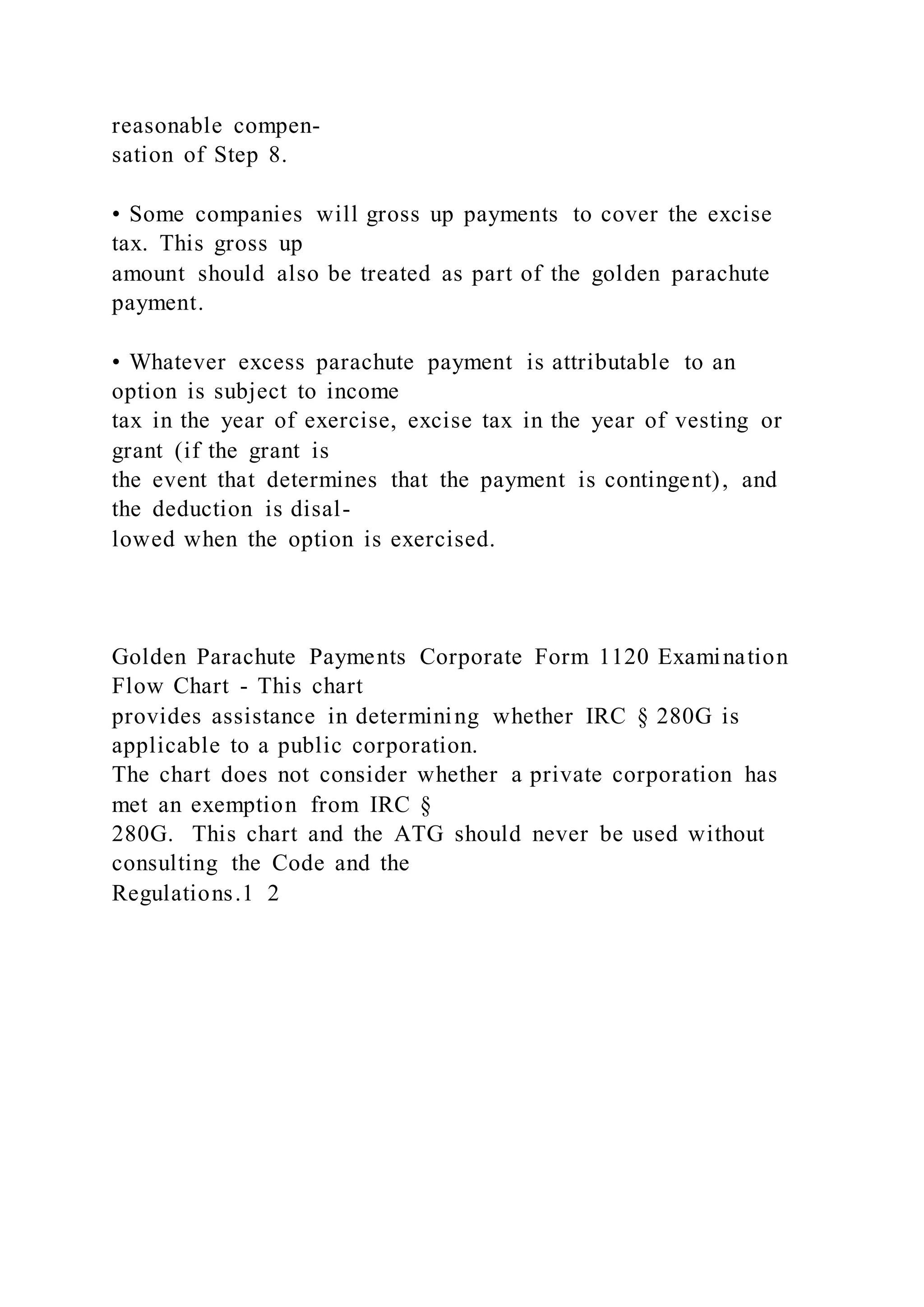
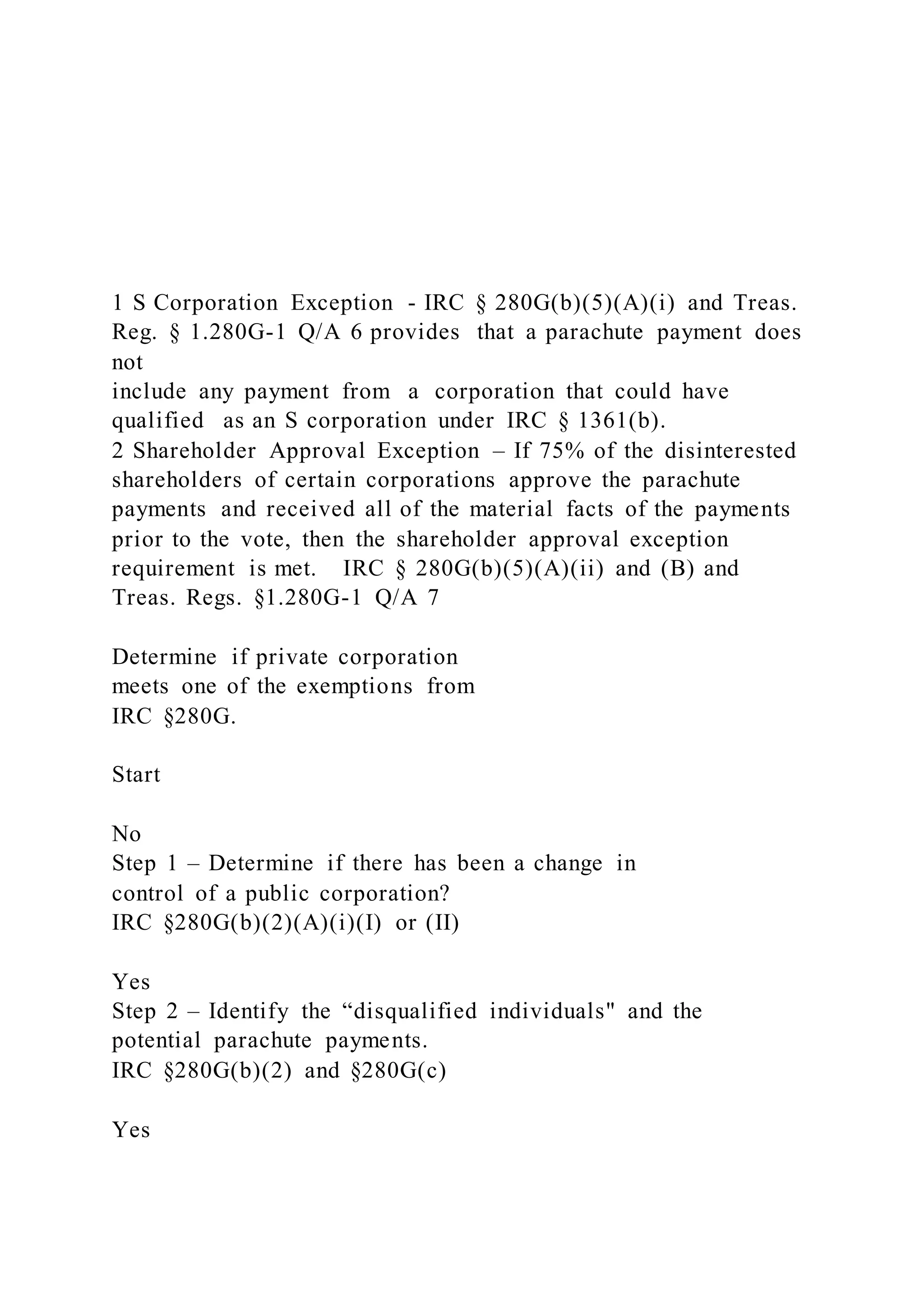
Golden Parachute Payments Corporate Form 1120 Examination
Flow Chart - This chart
provides assistance in determining whether IRC § 280G is
applicable to a public corporation.
The chart does not consider whether a private corporation has
met an exemption from IRC §
280G. This chart and the ATG should never be used without
consulting the Code and the
Regulations.1 2
1 S Corporation Exception - IRC § 280G(b)(5)(A)(i) and Treas.
Reg. § 1.280G-1 Q/A 6 provides that a parachute payment does
not
include any payment from a corporation that could have
qualified as an S corporation under IRC § 1361(b).
2 Shareholder Approval Exception – If 75% of the disinterested
shareholders of certain corporations approve the parachute
payments and received all of the material facts of the payments
prior to the vote, then the shareholder approval exception
requirement is met. IRC § 280G(b)(5)(A)(ii) and (B) and
Treas. Regs. §1.280G-1 Q/A 7
Determine if private corporation
meets one of the exemptions from
IRC §280G.
Start
No
Step 1 – Determine if there has been a change in
control of a public corporation?
IRC §280G(b)(2)(A)(i)(I) or (II)
Yes
Step 2 – Identify the “disqualified individuals" and the
potential parachute payments.
IRC §280G(b)(2) and §280G(c)
Yes
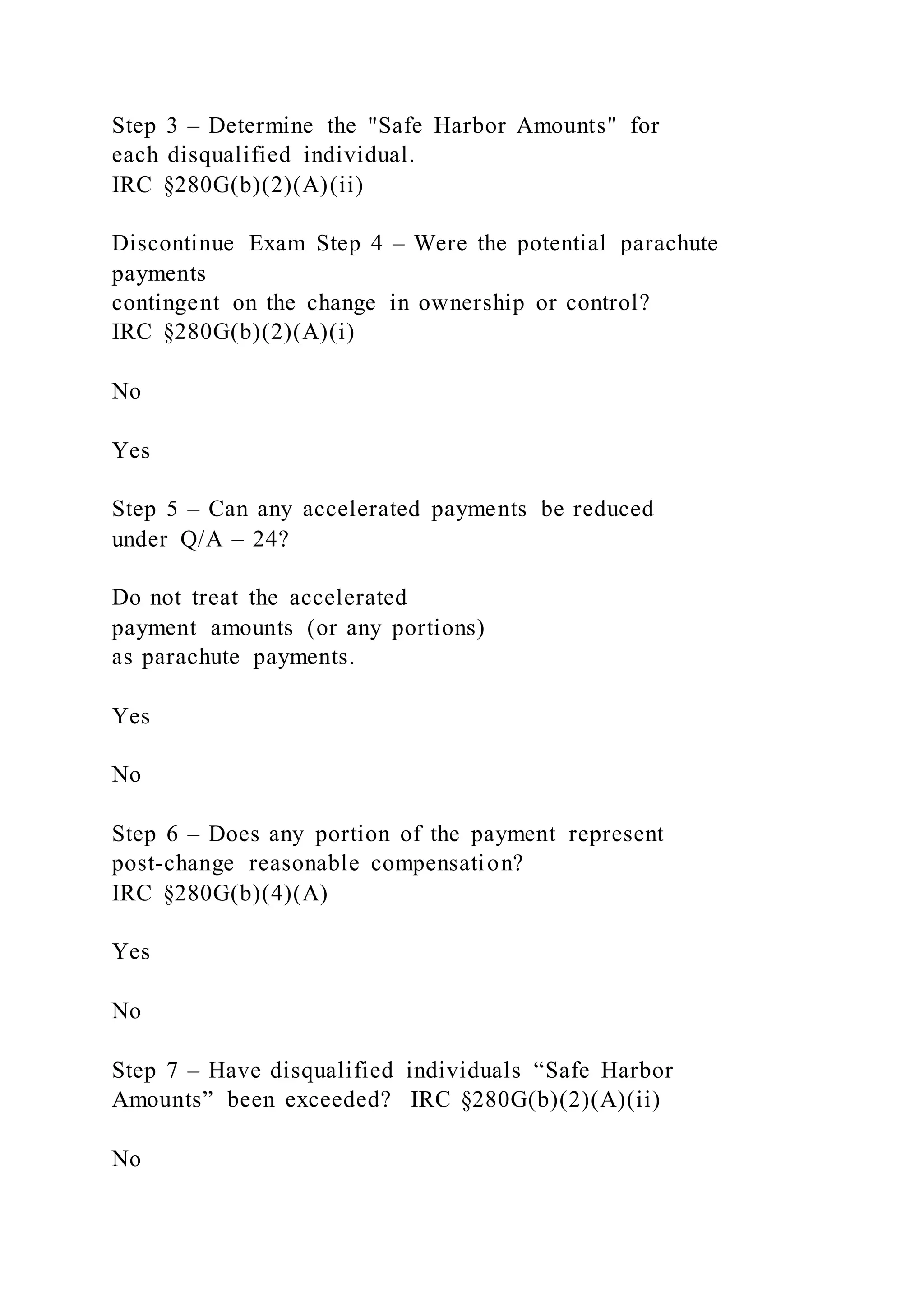
Step 3 – Determine the "Safe Harbor Amounts" for
each disqualified individual.
IRC §280G(b)(2)(A)(ii)
Discontinue Exam Step 4 – Were the potential parachute
payments
contingent on the change in ownership or control?
IRC §280G(b)(2)(A)(i)
No
Yes
Step 5 – Can any accelerated payments be reduced
under Q/A – 24?
Do not treat the accelerated
payment amounts (or any portions)
as parachute payments.
Yes
No
Step 6 – Does any portion of the payment represent
post-change reasonable compensation?
IRC §280G(b)(4)(A)
Yes
No
Step 7 – Have disqualified individuals “Safe Harbor
Amounts” been exceeded? IRC §280G(b)(2)(A)(ii)
No
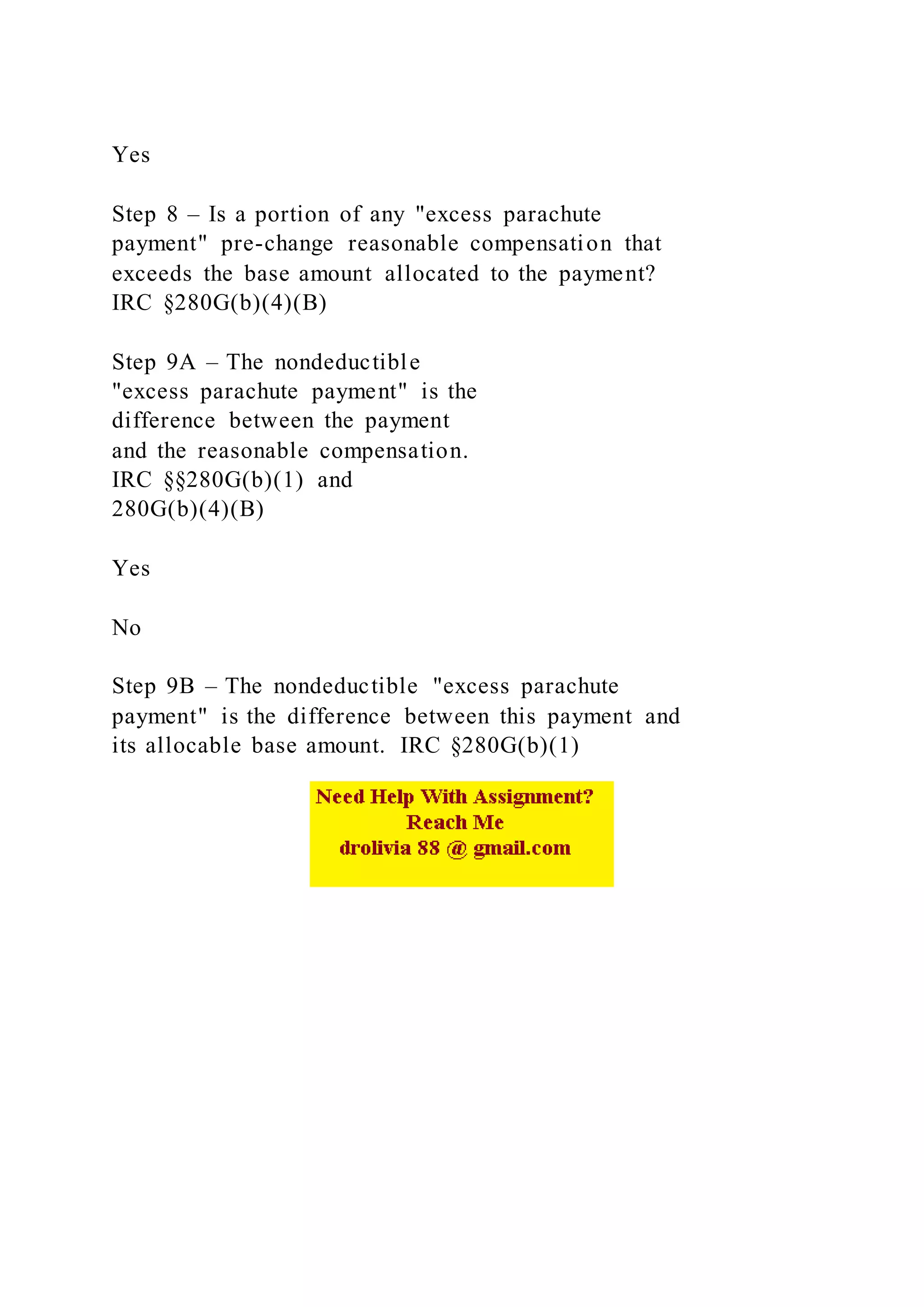
Yes
Step 8 – Is a portion of any "excess parachute
payment" pre-change reasonable compensation that
exceeds the base amount allocated to the payment?
IRC §280G(b)(4)(B)
Step 9A – The nondeductible
"excess parachute payment" is the
difference between the payment
and the reasonable compensation.
IRC §§280G(b)(1) and
280G(b)(4)(B)
Yes
No
Step 9B – The nondeductible "excess parachute
payment" is the difference between this payment and
its allocable base amount. IRC §280G(b)(1)

ASSIGNMENT 3 (CHAPTERS 8-9) QUESTIONS Name .docx

  • 1.
    ASSIGNMENT 3 (CHAPTERS8-9) QUESTIONS Name: MTMAIL Address: Type accurate, detailed, and explanatory answers in the spaces below. Email them in Word document to [email protected] (Do not use D2L). Feel free to email me or call me at 615-292-3030 or 615-585-5353 (leave message if no answer; do not text) if you have any questions. Chapter 8 (Intellectual Property) 1. What are some aspects of branding that can be trademarked? A trademark is a distinctive mark, motto, device, or implement that a manufacturer stamps, prints, or otherwise affixes to the goods it produces so that they can be identified on the market and their origins made known. 2. What is trademark infringement? When registering for a trademark with the U.S. Patent and Trademark office, they give a notice on a nationwide basis that the trademark belongs exclusively to the registrant. The registrant then uses the trademark symbol on their mark to indicate that it belongs to them. Whenever that trademark is copied to a substantial degree, or used in its entirety by another, whether intentionally or unintentionally, the trademark is infringed. In other words, the trademark has been used without authorization. The owner of the mark can take legal action against the infringer by showing that the defendant’s use of the mark created a likelihood of confusion about the origin of the
  • 2.
    defendant’s goods orservices. 3. Could a company likely obtain trademark protection for its logo? Companies such as Rolls Royce, McDonald’s, Starbucks, and Apple, are all logos covered under the Federal Trademark Dilution Act from unauthorized uses. These are known as “distinctive” or “Famous” trademarks. Owners of these can bring suits in federal court for dilution. A company can obtain trademark protection by registering with the state or federal government. This process may take six to thirty months, and registration is postponed until the mark is actually used. During the waiting period, any applicant can legally protect their trademark against a third party who previously has never used the mark nor filed an application for it. 4. Under what circumstances is trafficking in labels that bear counterfeit trademarks a crime? 5. What is the result when Company A uses Company B’s registered trademark without B’s consent?
  • 3.
    6. What isa service mark? A service mark is a trademark that is used to distinguish the services (rather than the products) of one person or company from those of another. For example, each airline has a specific symbol associated with its name. Titles and character names used in radio and TV are frequently used as service marks. The registration symbol is R instead of T. Service marks can also be slogans for companies. It can sometimes be difficult to distinguish between service marks and trademarks. Mcdonald's is a restaurant that offers products and services, so a big mac is a trademarked product while providing the fast food is a service mark. 7. What is a trade name? A trade name indicates part or all of a business’s name, whether the business is a sole proprietorship, a partnership, or corporation. A trade name is directly related to a business and its goodwill. A trade name may be protected as a trademark if the trade name is also the name of the company’s trademarked product. For example, the word Safeway, was sufficiently fanciful to obtain protection as a trade name for grocery chain because it is unusual or fancifully used. Therefore, this name is protected. 8. Closing down the domain name of a website is effectively used by U.S. officials when there is online sales of what kind of goods?
  • 4.
    9. What isa patent? A patent is a grant or legal document from the government that gives an inventor the exclusive right to make, use, or sell their invention for a period of twenty years. Patents for designs are given for a fourteen year period. Patents are an important element in encouraging innovation. This grant gives the inventor exclusive rights to their product or design in exchange for a comprehensive disclosure of the invention. Whoever invents or discovers new and useful process, machine, manufacture, or composition of matter, or any new and useful improvement, may obtain a patent and are subject to the conditions and requirements of this title 10. What is a license? A license is an agreement or contract permitting the use of a trademark, copyright, patent, or trade secret for a certain purpose. The party that owns the intellectual property rights and issues the license is the licensor, and the party obtaining the license is the license. A license only grants the rights expressly described in the license agreement. When the license involves internet uses, disputes frequently arise over licensing agreements. 11. How long does A have to challenge B’s patent if A believes B has infringed upon A’s previously acquired patent?
  • 5.
    12. What ispatent infringement? Patent infringement is when a firm makes, uses, or sells another’s patented design, product, or process without the patent owner’s permission. Patent infringement may occur even though the patent owner has not put the patented product into commerce, or even though not all features or parts of a product are copied. 13. Works that are copyrightable include what? A copyright is an intangible property right granted by federal statute to the author or originator of a literary or artistic production of a specified type. A copyrightable is the particular way in which an idea is expressed. When an idea and expression are inseperable, the expression can not be copyrighted. Works that are copyrightable include literary works, musical works, dramatic works, pantomimes and choreographic works, pictorial, graphic, and sculptural works, motion pictures and other audiovisual works, and architectural works. Anything that is not an original expression does not qualify for copyright protection. Facts widely known to the public are not copyrightable. Page numbers are not copyrightable because they follow a sequence known to everyone. Mathematical calculations are not copyrightable. 14. What must a work be to be protected under the Copyright Act? In order for a work to be protected under the Copyright Act, a work must be “fixed in a durable medium” from which it can be
  • 6.
    perceived, reproduced, orcommunicated. Protection of these items are automatic, and registration is not required. These works include books, records, films, menus, product packaging, computer software, newspapers, musical works, ballets/other forms of dance, cartoons, maps, sound recordings, motion pictures, and many others. It must be an original expression or a fact that is not widely known to the public to be protected. 15. What is copyright infringement? Copyright infringement is when the form or expression of an idea is copied. The reproduction does not have to be exactly the same as the original, nor does it have to reproduce the original in its entirety. If a substantial part of the original is reproduced, the copyright has been infringed. 16. What does “fair use” mean as an exception to copyright infringement? The “fair use” doctrine is an exception to liability for copyright infringement. In certain circumstances, a person or organization can reproduce copyrighted material without paying royalties. According to Section 107 of the Copyright Act, the fair use of copyrighted work, including such use by reproduction in copies or phonorecords for purposes such as criticism, comment, news reporting, teaching, scholarship, or research, is not an infringement of copyright. Because the guidelines for fair use is very broad, the courts determine whether a particular use is fair on a case-by-case basis.
  • 7.
    17. What doesthe first sale doctrine enable a buyer of a newly copyrighted book to do? 18. Does federal copyright protection extend to parts of an app that can be read by computers? 19. Could A bring an action for copyright infringement against its competitor, B, who copied parts of the software that can be read by humans? 20. What is a theft of trade secrets? A trade secret is information of commercial value, such as customer lists, plans, and research development. A theft of trade secrets is when confidential business data is stolen by industrial espionage, such as by tapping into a competitor’s computer. This is an actionable offense without any contractual violation. The theft of trade secrets is a federal crime. 21. What kind of information may be protected as trade secrets?
  • 8.
    (2) Trade secrets protectthe information of commercial value such as customer lists, plans, and research development. They may also protect pricing information, marketing methods, production techniques, and generally anything that makes a company individually unique. In other words, anything that would have value to the company’s competitor would be protected as trade secrets. Protection of trade secrets extends to both ideas and their expression. Because of this, there is no registration or filing requirements for trade secrets. 22. Is an app for an idea that businesses can use to track their revenue, profit, and payroll protected by any federal law? 23. What is the significance of all signatories of the Berne Convention as it relates to the publishing of a book written by a French citizen first in France and then in the U.S.? 24. What is the essence of the TRIPS agreement regarding infringement of intellectual property rights? The TRIPS agreement, otherwise known as the Trade Related Aspects of Intellectual Poverty Rights, is a party to various international agreements relating to intellectual property rights. For example, the Paris Convention of 1883, allows parties in one country to file for patent and trademark protection in any of
  • 9.
    the other membercountries. The TRIPS agreement established the standards for the international protection of intellectual property rights, including patents, trademarks, and copyrights for movies, computer programs, books, and music. Chapter 9 (Internet Law, Social Media, and Privacy) 25. Would federal law preempt state law concerning anti spam? The statute preempts state antispam laws except for those provisions in state laws that prohibit false and deceptive e- mailing practices. The act permits the sending of unsolicited commercial email but prohibits certain types of spamming activities. Prohibited activities include the use of a false return address and the use of false, misleading, or deceptive information when sending e-mail. 26. How many states currently prohibit or regulate spam? Thirty-seven states have enacted laws that prohibit or regulate the use of spam. Many state laws that regulate spam require the senders of e-mail ads to instruct the recipients on how they can “opt-out” of further e-mail ads from the same sources. In some states, an unsolicited e-mail must include a toll-free phone number or return e-mail address that the recipient can use to ask the sender to stop forwarding those emails.
  • 10.
    27. What iscybersquatting? Cybersquatting is when a person registers on a domain name that is the same as, or confusingly similar to, the trademark of another and then offers to sell the domain name back to the trademark owner. Apple Inc. has repeatedly sued cybersquatters that registered domain names similar to the names of its products, such as ipods.com. 28. Would it be illegal if A registered a domain name that is confusingly similar to the trademark of B if A had bad faith intent to profit from the mark by selling the name to B? 29. What is typosquatting? 30. What could a plaintiff recover if it proves the defendant is profiting from a domain name that is confusingly similar to the plaintiff’s trademark? 31. Be able to recognize an example of A diminishing the quality of B’s domain name. Give an example of your own.
  • 11.
    32. What istrademark dilution? 33. Is A’s downloading of music into her computer’s random access memory (RAM) without authorization considered copyright infringement? 34. Is the Digital Millennium Copyright Act violated if A transfers pirated copies of movies of television programs to an Internet site that permits users to view them without downloading them? 35. What is a license? 36. Be able to recognize a fair use exception to the provisions
  • 12.
    of the DigitalMillennium Copyright Act. 37. Are making and selling devices and services for the circumvention of encryption software a violation of the Digital Millennium Copyright Act? 38. What is copyright infringement? (2) 39. What is peer-to-peer (P2P) networking? 40. What is a distributed network? 41. What is a business-extension exception under the Electronic Communications Privacy Act?
  • 13.
    42. What iscloud computing? 43. May an employer discipline and even fire an employee who uses social media in a way that violates her employer’s stated social media policies? 44. How could an employer violate the Stored Communications Act with respect to its firing of employees who maintain a password-protected social media page to vent about their work? 45. Under the Electronic Communications Privacy Act, is it permissible for an employer to intercept employees’ business communications on devices provided for employees’ use in the ordinary course of its business?
  • 14.
    46. What wouldcause an Internet Service Provider to have to disclose the identity of those persons who make defamatory statements online about a company’s products? 47. Can a company which markets its products online use cookies to track individuals’ Web browsing activities? 48. Are the privacy rights of the users of companies’ Web sites and apps for mobile devices frequently defined by the companies that own the sites and the apps? ACCT 6356.501 Tax Research – Fall 2022 Name __________________ RESEARCH ASSIGNMENT 3 Treasury (IRS) Regulations ( Please submit as a Word document by email by
  • 15.
    4:00 p.m. nextThursday, 9/15. ) This assignment is worth up to a maximum of five (5) points. Your answer should be written in your own words without any “cutting & pasting” from the source doc-ument(s) you cite except that very brief quotations are acceptable with proper attribution. Points will be deducted for, among other things, (i) spelling and grammatical er-rors that Word highlighted but you failed to correct and (ii) other egregious errors, including substantive misstatements. Any submissions received after 4:00 p.m. are worth a maximum of three (3) points. Submissions not received by 7:00 p.m. will not be scored (zero points). Consult the Citation Style guide in the Syllabus. Be sure to include your name on your work. * * * * Your client Ms. Executive was, until a few years ago, the CFO of BigCo. She had worked her way up through the Controller’s organization, then became Tax VP in 2009, then CFO in 2014. Ms. Executive lost her role as BigCo’s CFO for the simple reason that in 2019 BigCo was swallowed up in a merger (an
  • 16.
    “A” reorganization) byBiggerCo. All of BigCo’s former assets and operations now make up just another one of Bigger’s several divisions. Ms. Executive was fired the day after the merger closed – Bigger had a CFO and didn’t need two. But there was some happy news . . . because Ms. Executive had been smart enough to negotiate for a generous golden parachute provision in her CFO contract. The merger pulled the ripcord on that parachute and she collected a pre-tax lump-sum $4.4 million in September 2019. Can’t be sad about that! “Wow, close call!”, you had said to her at the time. “You almost had to pay that nasty 20% excise tax!” In 2021 Ms. Executive accepted a job in Hawaii and moved. She’d said at that point that although she “love[d] you to death” she felt the need for a local CPA. You agreed that that made sense, and she found one… * * * Out of the blue today Ms. Executive called you and she’s really angry. The IRS audited her 2019 return (the audit handled by her new CPA) and no sooner was the IRS finished than they handed Ms. Executive a tax deficiency notice saying “$580,000 excise tax, please.” “You told me that I wouldn’t have pay any excise tax! Now the IRS says that I do owe it. Not happy with you!” (You can’t blame her for being upset, you only wish that you’d been
  • 17.
    involved in theaudit...) The IRS bases its position on Ms. Executive’s alleged miscalculation of her base amount. You had told her that her “base amount” was exactly $1.5 million. The IRS says it actually was only $1,460,000, “so the government wins!” Here are the relevant numbers, Ms. Executive’s salary (net of pre-tax deductions) for the most recent five years before she was fired: 2014 : $1,400,000 2015 : $1,450,000 2016 : $1,500,000 2017 : $1,550,000 2018 : $1,600,000 But there’s an important footnote to those numbers: Because of some disarray in BigCo’s Japanese subsidiary, Ms. Executive had “volunteered” to transfer and to work out of the Tokyo office (but still as a BigCo employee) in July 2015. She stayed through 2016 and into 2017 before being called back to Dallas. She claimed the § 911 exclusion in full for 2016 and partially for 2015 and 2017.*** *** Let’s hypothetically say that the exclusion she qualified for amounted to an aggregate total of $200,000 for those three (two partial plus one whole) calendar years together. The IRS argues that since Ms. Executive didn’t pay FIT on the § 911 exclusion amount, it can’t be included in her base amount calculation. So the government says that her base amount was less than what you’d advised her it was, with the result that her $4.4 million payout was subject to excess tax.
  • 18.
    * * * Youneed to develop your response to your angry former client. And then com-unicate it to her in writing. 8 image1.jpeg 1 | P a g e Internal Revenue Service Golden Parachute Payments Guide Audit Techniques Guide Large Business and International 1/20/2017 2 | P a g e Golden Parachute Payment - Audit Technique Guide (ATG) (1-2017) NOTE: This guide is current through the publication date. Since changes may have oc- curred after the publication date that would affect the accuracy of this document, no guar- antees are made concerning the technical accuracy after the
  • 19.
    publication date. The parachuteexamination can occur during the examination of either the corporation's or the individual's return. As the examination begins and throughout its course, the following items should be considered: 1. The Code requires that the excise tax payable under IRC § 4999 be administered as an income tax. See IRC § 4999(c)(2). Accordingly, the three-year statute of limitations of IRC § 6501 will apply because, in most cases, there has not been a substantial understatement of income. 2. The outcome of the parachute examination may affect the tax return of a current or former employee or independent contractor in another part of the country so steps should be taken to keep the statute open for the affected taxpayer. 3. Final regulations concerning golden parachute payments were issued on August 4, 2003, and became effective for any payment contingent on a change ownership or control occurring on or after January 1, 2004.1 4. The Regulations § 1.280G-1 were issued in question and answer format. Any refer- ence to questions and answers (Q/A) in this ATG relate to the final regulations. The key code and regulations for Golden Parachutes are IRC § 280G; IRC § 4999 and Treas. Reg. § 1.280G-1.
  • 20.
    5. Potential Adjustmentsin a Golden Parachute Examina tion • If a payment is determined to be an excess parachute payment, the corporation is not allowed a deduction for that payment under IRC § 280G • An excise tax of 20% is imposed on the recipient of such a payment under IRC § 4999 • The payor of the parachute payment must withhold the excise tax if the payment is wages. The payor of a parachute payment to an independent contractor would not have a withholding requirement. 1 For payments contingent on a change occurring prior to January 1, 2004, taxpayers may rely on the 1989 proposed regulations, 2002 proposed regulations, or the final regulations. 3 | P a g e 6. Golden Parachute Reporting Requirements • Employees: Generally, wages plus golden parachute payments are reported in box 1, and federal income taxes along with the excise tax are reported in box 2 on Form W-2. The employee must include the 20% excise tax, reported in box 12 with a code K on Form W-2, on the proper line of the other taxes section on Form 1040.
  • 21.
    • Non-Employees: Totalgolden parachute payments made to non-employees are re- ported on Form 1099-Misc in Box 7, Non-employee compensation. Any excess par- achute payment is reported in box 13, “Excess Golden Parachute Payments”. 7. Section 162(m) provides that the $1 million limitation should be reduced by any amount of excess parachute payments. For example, if the chief executive officer of a pub- licly-held company received $2 million dollars from his company in the year it was being acquired, of which $200,000 was excess parachute payments under IRC § 280G, the IRC 162(m) limitation for the CEO would be reduced to $800,000 ($1,000,000 - $200,000). However, this provision for reducing the $1 million limitation for the excess parachute pay- ment may not apply if the executive of the target is not considered a covered employee dur- ing the year of an acquisition since the target goes out of existence and his pay is not re- ported in the proxy statement. Documents to review in a golden parachute examination: Form 10-K is the annual report filed with the SEC and provides a complete listing of sec- tion 16(b) executives and directors, executive compensation, and the security ownership of certain beneficial owners and management (although each of the foregoing may be de- ferred to the definitive proxy statement or the definitive information statement). Form 10-K provides information for equity compensation plans using a table format setting forth the (a)
  • 22.
    number of securitiesto be issued (b) weighted-average exercise price (c) additional shares available for future grants. Any compensation plans adopted in the applicable year without stockholder approval are provided as an exhibit. Also, Form 10-K frequently references additional compensation plans that were previously filed with the SEC. These compensa- tion plans frequently include stock options, restricted stock, and other types of equity-based compensation for executives. Form 10-K may discuss the vesting provisions of such equi- ty-based compensation especially in the event of a change in control. SEC filings can be downloaded from the SEC website. DEF 14A, Proxy Statement Pursuant to Section 14A of the SEC, better known as the Definitive Proxy Statement, or the annual proxy statement, is the easiest place to look up information on executive compensation. This proxy statement is sent to the shareholders of record prior to the Annual Meeting and may contain information about specific stock op- tions and compensation plans for executives. It is more detailed than Form 10-K and pro- vides specific detail as to the number of options granted and the total exercise price under the various plans. 4 | P a g e SEC filings can be downloaded from the SEC website.
  • 23.
    Schedule 14A, InformationStatement Pursuant to Section 14(a) of the SEC and Schedule 14C, Information Statement pursuant to Section 14(c) of the SEC disclose information regarding golden parachute payments in connection with the solicitation for shareholders’ approval as required by the Dodd-Frank Wall Street Reform and Consumer Protection Act. The provision requires a shareholder advisory vote, commonly referred to as “vote on golden parachute payments” for any new executive compensation arrange- ments in connection with a merger, acquisition, consolidation, proposed sale, or disposition of all or substantially all assets of a public company. The company is required to disclose all parachute payments that may be made if a change in control occurs. A “Golden Para- chute Compensation” table that shows quantitative information about the components of the parachute payments based the per share price is required. Narrative descriptions for the triggers, conditions for payment, how payments are made, who makes payments, and how long the payments are made are required in the table. Additionally, any parachute payments actually made upon a change in control must be reported. Companies were re- quired to comply with these golden parachute shareholder advisory vote and disclosure re- quirements on proxy statements and consent solicitations filed seeking shareholder ap- proval of a transaction after April 25, 2011. The rules of the Dodd-Frank Act require the disclosure of golden parachute payments in proxy statements
  • 24.
    and informational statements filedon Schedule 14A as well as Schedule 14C. SEC filings can be downloaded from the SEC website. Forms S-4 and F-4, often referred to as the Registration Statement under the Securi- ties Act of 1933, are used to provide information to i nvestors when registering securities. They provide information related to mergers, acquisitions, or when securities are ex- changed between companies. Form F-4 is specifically used to register securities offered by foreign issuers. SEC filings can be downloaded from the SEC website. The Board of Directors and Compensation Committee Minutes: Identify activities relat- ing to shareholder approval of mergers, consolidations, or liquidations of the corporation. Also look for discussions of executive compensation due to change in control. The minutes may help identify change in control triggers and payments to be made on a change in own- ership or control. Merger and Acquisition Agreements: These agreements may contain important infor- mation in determining if there was a change in control and may contain information about payments that may be made in connection with a change in control. Not all mergers involve a change in control so be alert to the type of merger in which your taxpayer is involved.
  • 25.
    The Employment Contracts,Employment Security Agreements and Executive Bene- fit Plans: The employment agreements and benefit plans may contain additional infor- 5 | P a g e mation about any payments that will be made on a change in control and any change in control triggers. Deferred Compensation Arrangements: Review the deferred compensation arrange- ments for payments (including accelerated payments) and/or change in control triggers. Stock Option and Restricted Stock Plans: These plans may have change in control trig- gers and may contain additional information about payments that will be made on a change in control (including accelerated vesting or cash out of options). Website: Review the parent company's website for information on corporate acquisitions and mergers. Internet Research: Research internet sources for information on the corporation for the years under audit. Use search engines such as Google.com. Tax Returns: Review the corporation's Form 1120 and Form 851, Affiliations Schedule, for newly added or omitted subsidiary companies. Analyze Schedule M- adjustments to de-
  • 26.
    termine whether thecorporation has reduced its compensation deduction for excess para- chute payments. This should appear as a deduction taken for book purposes but not for tax purposes. Form W-2’s and Form 1099’s: If a change in ownership or control has occurred, review the appropriate executives’ Forms W-2 for large increases in compensation from one year to the next. This should be done for employees of both the target company and the acquir- ing company. Form 1099 may need to be examined for former executives and/or inde- pendent contractors. Nine Steps to Perform in a Parachute Examination (refer to ex- amination steps flow chart) Step 1: Determine whether there has been a change in ownership or control. • A change in ownership or control occurs when one person or more than one person acting as a group acquires: o 50% or more of the total fair market value or voting power of the corporation, (see Q/A-27) or o Assets with a total gross fair market value equal to or greater than 1/3rd of the total gross fair market value of all of the assets of the corporation in a 12- month period. (See Q/A- 29, including the exceptions in Q/A- 29(b)).
  • 27.
    • A presumedchange in effective control occurs when: 6 | P a g e o One person or more than one person acting as a group acquires 20% or more of the total voting power of the stock of the corporation in a 12- month period, or o A majority of the board of directors is replaced during any 12- month period by directors who are not endorsed by a majority of the members of the corpora- tion’s board of directors. (See Q/A-28). Step 2: Determine the "disqualified individuals" • A "disqualified individual" is any individual (or any personal service corporation or similar entity) who is both an employee or an independent contractor and a shareholder, officer, or highly compensation individual. • A shareholder. This is an individual who owns stock with a fair market value that exceeds 1% of the fair market value of all outstanding stock of the corporation. (See Q/A- 17). • An officer. Whether an individual is an officer is based on the
  • 28.
    facts and circumstances. (SeeQ/A-18). • A highly compensated individual. This is someone whose annual compensation is above $120,000 for 2015, 2016 or 2017 (adjusted under IRC § 414(q)(1)(B)(i) and indexed annually under IRS announcement published in the fall for pension plan limitations) and who is among a group consisting of the lesser of the highest paid 1% of the corporation or highest 250 employees of the corporation. (See Q/A-19). A search of irs.gov using the term “IRC § 414(q)(1)(B) limitations” will locate the an- nouncement. Step 3: Determine each disqualified individual's "base amount" and multiply it by 3 to establish the "safe harbor amount." • In general, the base amount is the average annual compensation that was includible in gross income by the disqualified individual, for the individual's most recent five taxable years ending before a change of ownership or control. • The "safe harbor amount" is the "base amount" times three. If the present value of all the potential parachute payments equals or exceeds this amount, the payments are parachute payments.
  • 29.
    • Look closelyat what is included in the base pay. A company could have plans in place that have more sensitive “change in control” triggers then those by statute. 7 | P a g e The company may treat these early payments as part of the base pay. Check to see if these payments might fall under the “closely associated” standard in the regula- tions. (See (Q/A-22(b)). Any payment pursuant to a contract (or a portion of a pay- ment pursuant to an amendment to a pre-existing contract) entered into within one year before a change of control is presumed to be contingent on the change, unless the taxpayer establishes the contrary by clear and convincing evidence. (See IRC § 280G(b)(2)(C) and Q/A-25 and 26)). Step 4: Determine what payments in the nature of compensation were made to each disqualified individual that were contingent on the change in ownership or control. • Only payments in the nature of compensation may be parachute payments. (See IRC § 280G(b)(2)(A)). In general, all payments are in the nature of compensation if they arise from an employment relationship or are associated with the performance of services. Wages, bonuses, severance pay, fringe benefits, pension benefits,
  • 30.
    transfer of property,the accelerated vesting or granti ng of stock options, and other deferred compensation are characterized as payments in the nature of compensa- tion. Elective or salary reduction contributions to a cafeteria plan, cash or deferred arrangement, or tax-sheltered annuity are also payments in the nature of compensa- tion. (See Q/A-11). • Under IRC § 280G, a stock option is treated as property that is transferred at the time it becomes substantially vested. Thus, the vesting of an option is treated as a payment in the nature of compensation. (See Q/A-13(a)). For information on the valuation of stock options, see Rev. Proc. 2003-68, 2003-34 I.R.B. 398. If golden parachute payments are treated as exempt, review the source of the payments to determine if the exemption requirements are met. Q/A-5 has a list of exempt pay- ments. If these exempt payments are from tax qualified plans then these payments are not subject to the golden parachute tax and do not count toward the three-times- base limit. Step 5: Determine whether any of the payments that were contingent on the change of ownership or control due to acceleration can have the contingent portion reduced under Q/A-24. • Generally, a payment is contingent unless it is substantially certain, at the time of the
  • 31.
    change, that itwould have been made whether or not the change of control oc- curred. (See Q/A-22(a)). A payment is also treated as contingent on a change if it is contingent on an event that is closely related to a change (e.g., onset of a tender of- fer or termination of employment), the change actually occurs, and the event is ma- terially related to the change. A material relationship is presumed to exist if the event occurs within one year before or after the change. (See Q/A-22(b)). • Whether or not the disqualified individual is terminated as a result of the change in ownership or control has no bearing on whether the payment is contingent on the 8 | P a g e change. A payment may be contingent on the change whether the disqualified indi- vidual continues employment or is either involuntarily or voluntarily terminated. • Generally, if a payment is contingent on a change in ownership or control, the full amount of the contingent payment is treated as contingent on the change. However, in certain circumstances only a portion of the payment is treated as contingent (see the next 2 bullets). • If a payment is vested (without regard to the change) and the
  • 32.
    change accelerates the timeat which the payment is made, Q/A-24(b) applies to determine the portion of the payment that is treated as contingent on the change. • If a payment becomes vested as a result of the change (assuming that absent the change, the payment was contingent only on the continued performance of services for a specified time period and the payment is attributable, in part, to services per- formed before the date the payment vested), Q/A-24(c) applies to determine the por- tion of the payment that is treated as contingent on the change. The payout of the remaining salary due under an employment agreement is a severance payment and is not reduced under Q/A-24(c). Instead, the full amount of the payment is treated as contingent on the change. Also, if the payment would vest due to an event other than the performance of services (such as attainment of a performance goal) and the event does not occur prior to the change, neither Q/A-24(b) or (c) applies to re- duce the payment. Instead, the full amount of the payment is treated as contingent on the change. Step 6: Reduce each parachute payment by whatever portion the taxpayer establish- es with "clear and convincing evidence" is reasonable compensation for services to be rendered on or after the change of ownership or control. (See IRC §280G(b)(4)(A)).
  • 33.
    • This reductiongenerally applies when a disqualified individual continues to render services for the corporation after it has experienced a change in control, but the amounts paid for those services are contingent on the change. • Refraining from the performance of services, such as in compliance with a covenant not to compete, may be considered reasonable compensation for services to the ex- tent it is demonstrated that the agreement substantially constrains the individual’s ability to perform services and there is a reasonable likelihood that the agreement will be enforced against the individual. (See Q/A-42(b)). Step 7: Determine the present value of the contingent payment, as reduced by Steps 5 and 6, to determine whether the aggregate present value of all the payments equals or exceeds the "safe harbor amount." • At this point, the contingent payments are reduced by steps 5 and 6, and the result is merely potential parachute payments. The next step is to determine the present 9 | P a g e value of all these potential parachute payments. If the aggregate present value is less than the “safe harbor amount,” they are not parachute payments. If the aggre-
  • 34.
    gate present valueequals or exceeds the “safe harbor amount,” they are parachute payments. • The present value of a payment is determined as of the date of the change of own- ership or control, or, if the payment is made prior to that date, the date on which the payment is made. (See Q/A-31). Present value is generally determined by using a discount rate equal to 120 percent of the Applicable Federal Rate (AFR) determined under IRC §1274(d) compounded semiannually. (See Q/A-32). This AFR is pub- lished in the Cumulative Bulletin and in the tax services. Step 8: If the safe harbor amount of Step 7 is exceeded, determine whether the tax- payer has shown with clear and convincing evidence that a portion of the payment is reasonable compensation for services actually rendered before the change in own- ership or control. • IRC § 280G(b)(4)(B) permits the taxpayer to replace the allocable base amount with an amount that represents whatever portion of a parachute payment can be shown with clear and convincing evidence is reasonable compensation for services actually rendered before the change of ownership or control. (See Q/A- 39 and 43) Step 9: Calculate the “excess parachute payment” by subtracting from each para- chute payment the greater of the allocable base amount or the
  • 35.
    reasonable compen- sation ofStep 8. • Some companies will gross up payments to cover the excise tax. This gross up amount should also be treated as part of the golden parachute payment. • Whatever excess parachute payment is attributable to an option is subject to income tax in the year of exercise, excise tax in the year of vesting or grant (if the grant is the event that determines that the payment is contingent), and the deduction is disal- lowed when the option is exercised. Golden Parachute Payments Corporate Form 1120 Examination Flow Chart - This chart provides assistance in determining whether IRC § 280G is applicable to a public corporation. The chart does not consider whether a private corporation has met an exemption from IRC § 280G. This chart and the ATG should never be used without consulting the Code and the Regulations.1 2
  • 36.
    1 S CorporationException - IRC § 280G(b)(5)(A)(i) and Treas. Reg. § 1.280G-1 Q/A 6 provides that a parachute payment does not include any payment from a corporation that could have qualified as an S corporation under IRC § 1361(b). 2 Shareholder Approval Exception – If 75% of the disinterested shareholders of certain corporations approve the parachute payments and received all of the material facts of the payments prior to the vote, then the shareholder approval exception requirement is met. IRC § 280G(b)(5)(A)(ii) and (B) and Treas. Regs. §1.280G-1 Q/A 7 Determine if private corporation meets one of the exemptions from IRC §280G. Start No Step 1 – Determine if there has been a change in control of a public corporation? IRC §280G(b)(2)(A)(i)(I) or (II) Yes Step 2 – Identify the “disqualified individuals" and the potential parachute payments. IRC §280G(b)(2) and §280G(c) Yes
  • 37.
    Step 3 –Determine the "Safe Harbor Amounts" for each disqualified individual. IRC §280G(b)(2)(A)(ii) Discontinue Exam Step 4 – Were the potential parachute payments contingent on the change in ownership or control? IRC §280G(b)(2)(A)(i) No Yes Step 5 – Can any accelerated payments be reduced under Q/A – 24? Do not treat the accelerated payment amounts (or any portions) as parachute payments. Yes No Step 6 – Does any portion of the payment represent post-change reasonable compensation? IRC §280G(b)(4)(A) Yes No Step 7 – Have disqualified individuals “Safe Harbor Amounts” been exceeded? IRC §280G(b)(2)(A)(ii) No
  • 38.
    Yes Step 8 –Is a portion of any "excess parachute payment" pre-change reasonable compensation that exceeds the base amount allocated to the payment? IRC §280G(b)(4)(B) Step 9A – The nondeductible "excess parachute payment" is the difference between the payment and the reasonable compensation. IRC §§280G(b)(1) and 280G(b)(4)(B) Yes No Step 9B – The nondeductible "excess parachute payment" is the difference between this payment and its allocable base amount. IRC §280G(b)(1)