BY- PREETI SAHAY & GOLDY SHARMA
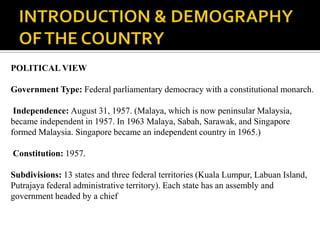
POLITICAL VIEW

Government Type: Federal parliamentary democracy with a constitutional monarch.

 Independence: August 31, 1957. (Malaya, which is now peninsular Malaysia,
became independent in 1957. In 1963 Malaya, Sabah, Sarawak, and Singapore
formed Malaysia. Singapore became an independent country in 1965.)

Constitution: 1957.

Subdivisions: 13 states and three federal territories (Kuala Lumpur, Labuan Island,
Putrajaya federal administrative territory). Each state has an assembly and
government headed by a chief
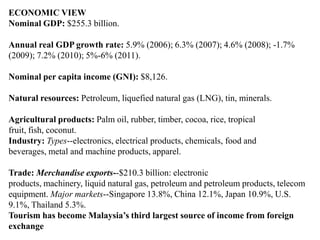
ECONOMIC VIEW
Nominal GDP: $255.3 billion.

Annual real GDP growth rate: 5.9% (2006); 6.3% (2007); 4.6% (2008); -1.7%
(2009); 7.2% (2010); 5%-6% (2011).

Nominal per capita income (GNI): $8,126.

Natural resources: Petroleum, liquefied natural gas (LNG), tin, minerals.

Agricultural products: Palm oil, rubber, timber, cocoa, rice, tropical
fruit, fish, coconut.
Industry: Types--electronics, electrical products, chemicals, food and
beverages, metal and machine products, apparel.

Trade: Merchandise exports--$210.3 billion: electronic
products, machinery, liquid natural gas, petroleum and petroleum products, telecom
equipment. Major markets--Singapore 13.8%, China 12.1%, Japan 10.9%, U.S.
9.1%, Thailand 5.3%.
Tourism has become Malaysia’s third largest source of income from foreign
exchange
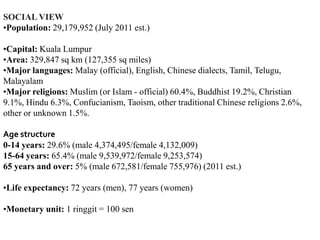
SOCIAL VIEW
•Population: 29,179,952 (July 2011 est.)

•Capital: Kuala Lumpur
•Area: 329,847 sq km (127,355 sq miles)
•Major languages: Malay (official), English, Chinese dialects, Tamil, Telugu,
Malayalam
•Major religions: Muslim (or Islam - official) 60.4%, Buddhist 19.2%, Christian
9.1%, Hindu 6.3%, Confucianism, Taoism, other traditional Chinese religions 2.6%,
other or unknown 1.5%.

Age structure
0-14 years: 29.6% (male 4,374,495/female 4,132,009)
15-64 years: 65.4% (male 9,539,972/female 9,253,574)
65 years and over: 5% (male 672,581/female 755,976) (2011 est.)

•Life expectancy: 72 years (men), 77 years (women)

•Monetary unit: 1 ringgit = 100 sen
Geography
Area: 329,847 sq. km. (127,315 sq. mi.);.
Terrain: Coastal plains and interior, jungle-covered mountains. The South China Sea
separates peninsular Malaysia from East Malaysia on Borneo.
Climate: Tropical.
 Development of Service sector: With the global economic change, the structure of
Malaysian economy has shifted from manufacturing to service sectors. Within the
period of 1990-2005 average annual growth rate of service sector was recorded at
10.0% compared to only 6.4% for manufacturing . In 2006 service sector has recorded
7.2% compared to 7.1% in manufacturing sector. This reflects a gradual shift in the
structure of the Malaysian economy from manufacturing to services.
The growth of metropolitan based economy: Cross-border movements of people
through international migration and tourism as well as a diffusion of information and
culture, the advancement of information technology particularly the internet, the flows
of cultural forms and symbols such as movies and consumerism and the rise of
international organizations including Trans National Corporations.

The level of overall household income, working environment, transport and
communication facilities, health, housing, family life and social participation, increased
significantly. On the other hand, the index for environmental conditions and public
service facilities worsened.
Urbanization : Rural areas in and around the Klang-Langat Valley has been
converted into new townships. Housing, industry and commerce became the
dominant land uses of the area. At the same time, population of the areas increased
drastically. This gave rise to many new urban centers in the region such Subang
Jaya, Ampang Jaya, Selayang, Cheras and Balakong. In fact, 9 out of 30 top cities
in Malaysia are located in the Klang-Langat Valley with a total population
exceeding 4.1 million.
Privatization : privatisation has also served to deepen integration of country into
the global production and financial systems by encouraging capital inflows and
bringing foreign ownership of state-owned enterprises.
The increased reliance on freely functioning markets and private incentive and
initiative are the core of neoliberal policies. Such policies have brought about
optimal resource use and increased productivity. Lower income taxes and flexible
labour markets encourage investment and economic growth while at the same time
eliminating unemployment.
THANK YOU

Malaysia ppt hr

  • 1.
    BY- PREETI SAHAY& GOLDY SHARMA
  • 2.
    POLITICAL VIEW Government Type:Federal parliamentary democracy with a constitutional monarch. Independence: August 31, 1957. (Malaya, which is now peninsular Malaysia, became independent in 1957. In 1963 Malaya, Sabah, Sarawak, and Singapore formed Malaysia. Singapore became an independent country in 1965.) Constitution: 1957. Subdivisions: 13 states and three federal territories (Kuala Lumpur, Labuan Island, Putrajaya federal administrative territory). Each state has an assembly and government headed by a chief
  • 3.
    ECONOMIC VIEW Nominal GDP:$255.3 billion. Annual real GDP growth rate: 5.9% (2006); 6.3% (2007); 4.6% (2008); -1.7% (2009); 7.2% (2010); 5%-6% (2011). Nominal per capita income (GNI): $8,126. Natural resources: Petroleum, liquefied natural gas (LNG), tin, minerals. Agricultural products: Palm oil, rubber, timber, cocoa, rice, tropical fruit, fish, coconut. Industry: Types--electronics, electrical products, chemicals, food and beverages, metal and machine products, apparel. Trade: Merchandise exports--$210.3 billion: electronic products, machinery, liquid natural gas, petroleum and petroleum products, telecom equipment. Major markets--Singapore 13.8%, China 12.1%, Japan 10.9%, U.S. 9.1%, Thailand 5.3%. Tourism has become Malaysia’s third largest source of income from foreign exchange
  • 4.
    SOCIAL VIEW •Population: 29,179,952(July 2011 est.) •Capital: Kuala Lumpur •Area: 329,847 sq km (127,355 sq miles) •Major languages: Malay (official), English, Chinese dialects, Tamil, Telugu, Malayalam •Major religions: Muslim (or Islam - official) 60.4%, Buddhist 19.2%, Christian 9.1%, Hindu 6.3%, Confucianism, Taoism, other traditional Chinese religions 2.6%, other or unknown 1.5%. Age structure 0-14 years: 29.6% (male 4,374,495/female 4,132,009) 15-64 years: 65.4% (male 9,539,972/female 9,253,574) 65 years and over: 5% (male 672,581/female 755,976) (2011 est.) •Life expectancy: 72 years (men), 77 years (women) •Monetary unit: 1 ringgit = 100 sen
  • 5.
    Geography Area: 329,847 sq.km. (127,315 sq. mi.);. Terrain: Coastal plains and interior, jungle-covered mountains. The South China Sea separates peninsular Malaysia from East Malaysia on Borneo. Climate: Tropical.
  • 6.
     Development ofService sector: With the global economic change, the structure of Malaysian economy has shifted from manufacturing to service sectors. Within the period of 1990-2005 average annual growth rate of service sector was recorded at 10.0% compared to only 6.4% for manufacturing . In 2006 service sector has recorded 7.2% compared to 7.1% in manufacturing sector. This reflects a gradual shift in the structure of the Malaysian economy from manufacturing to services. The growth of metropolitan based economy: Cross-border movements of people through international migration and tourism as well as a diffusion of information and culture, the advancement of information technology particularly the internet, the flows of cultural forms and symbols such as movies and consumerism and the rise of international organizations including Trans National Corporations. The level of overall household income, working environment, transport and communication facilities, health, housing, family life and social participation, increased significantly. On the other hand, the index for environmental conditions and public service facilities worsened.
  • 7.
    Urbanization : Ruralareas in and around the Klang-Langat Valley has been converted into new townships. Housing, industry and commerce became the dominant land uses of the area. At the same time, population of the areas increased drastically. This gave rise to many new urban centers in the region such Subang Jaya, Ampang Jaya, Selayang, Cheras and Balakong. In fact, 9 out of 30 top cities in Malaysia are located in the Klang-Langat Valley with a total population exceeding 4.1 million. Privatization : privatisation has also served to deepen integration of country into the global production and financial systems by encouraging capital inflows and bringing foreign ownership of state-owned enterprises. The increased reliance on freely functioning markets and private incentive and initiative are the core of neoliberal policies. Such policies have brought about optimal resource use and increased productivity. Lower income taxes and flexible labour markets encourage investment and economic growth while at the same time eliminating unemployment.
  • 8.