 Malaysia has progressed from an economy
dependent on agriculture and primary
commodities to a manufacturing-
based, export-driven economy. To move the
country forward, the Government has
crafted a framework comprising four pillars
to drive the change.
(Source: http://www.mida.com.my , 2012)
 The New Economic Model (NEM) to be
achieved through an Economic
Transformation Programme
(ETP) constitutes a key pillar which will
propel Malaysia to being an advanced nation
with inclusiveness and sustainability in line
with goals set forth in Vision 2020
1. Oil, Gas and Energy
2. Palm oil and Rubber
3. Business Services
4. Tourism
5. Financial Services
6. Education
7. Wholesale and Retail
8. Electrics and Electronic
9. Agriculture
10. Healthcare
11. Communication content and Infrastructure
12. Greater Klang Valley and Kuala Lumpur
 New Economic Model (NEM) was introduced
by Sixth’s Malaysian Prime Minister Dato’ Seri
Najib Tun Razak
 It was introduced on 30 March 2010
 Consist of 2 Part:
1st Part – start 30 March 2010
2nd part – announced after 10th Malaysia
Plan
 1st phase of NEM: Part 1 - Strategic Policy
Direction
 2nd phase of NEM: Concluding Part - Strategic
Policy Measures
(Source: : NEAC , Part 1 New Economic Model-
Strategic Policy Directions , 2010, page 15)
(Source: NEAC , Part 1 New Economic Model-
Strategic Policy Directions , 2010)
 Transform the Malaysian economy to become
one with high incomes and quality growth by
2020
 The goal of the NEM is for Malaysia to be a
developed and competitive economy
 People enjoy a high quality of life and a high
level of income resulting from growth that is
both inclusive and sustainable
 The Malaysian economy will be market
leader, well-governed, regionally
integrated, entrepreneurial and innovative
 Private sector – the main driver of economic
growth (innovation and creativity)
 Public sector – the public goods provider
(regulatory framework)
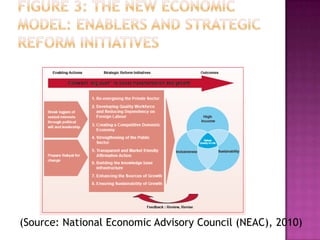
SRI 1: Re-energising the private sector to
drive growth
SRI 2: Developing a quality workforce and
reducing dependency on foreign labour
SRI 3: Creating a competitive domestic
economy
SRI 4: Strengthening the public sector
SRI 5: Transparent and market-friendly
affirmative action
SRI 6: Building the knowledge base and
infrastructure
SRI 7: Enhancing the sources of growth
SRI 8: Ensuring sustainability of growth
(Source: National Economic Advisory Council (NEAC), 2010)
 On 2010, Malaysia per capita income was
US$7000 approximately RM23,100- The target
is to doubled it in 10 years.
 The gap between rich and poor is widening-
64% between rich and middle income.
 Malaysia caught in the middle of income
trap- Middle income countries cannot
compete in all fields again all
corners(NEAC,2010)
(Source: National Economic Advisory Council (NEAC), 2010)
(Source: Nationmaster, UN, World Bank)

Malaysian new economic model

  • 2.
     Malaysia hasprogressed from an economy dependent on agriculture and primary commodities to a manufacturing- based, export-driven economy. To move the country forward, the Government has crafted a framework comprising four pillars to drive the change.
  • 3.
  • 4.
     The NewEconomic Model (NEM) to be achieved through an Economic Transformation Programme (ETP) constitutes a key pillar which will propel Malaysia to being an advanced nation with inclusiveness and sustainability in line with goals set forth in Vision 2020
  • 5.
    1. Oil, Gasand Energy 2. Palm oil and Rubber 3. Business Services 4. Tourism 5. Financial Services 6. Education 7. Wholesale and Retail 8. Electrics and Electronic 9. Agriculture 10. Healthcare 11. Communication content and Infrastructure 12. Greater Klang Valley and Kuala Lumpur
  • 6.
     New EconomicModel (NEM) was introduced by Sixth’s Malaysian Prime Minister Dato’ Seri Najib Tun Razak  It was introduced on 30 March 2010  Consist of 2 Part: 1st Part – start 30 March 2010 2nd part – announced after 10th Malaysia Plan
  • 7.
     1st phaseof NEM: Part 1 - Strategic Policy Direction  2nd phase of NEM: Concluding Part - Strategic Policy Measures
  • 8.
    (Source: : NEAC, Part 1 New Economic Model- Strategic Policy Directions , 2010, page 15)
  • 9.
    (Source: NEAC ,Part 1 New Economic Model- Strategic Policy Directions , 2010)
  • 10.
     Transform theMalaysian economy to become one with high incomes and quality growth by 2020  The goal of the NEM is for Malaysia to be a developed and competitive economy  People enjoy a high quality of life and a high level of income resulting from growth that is both inclusive and sustainable
  • 11.
     The Malaysianeconomy will be market leader, well-governed, regionally integrated, entrepreneurial and innovative  Private sector – the main driver of economic growth (innovation and creativity)  Public sector – the public goods provider (regulatory framework)
  • 12.
    SRI 1: Re-energisingthe private sector to drive growth SRI 2: Developing a quality workforce and reducing dependency on foreign labour SRI 3: Creating a competitive domestic economy SRI 4: Strengthening the public sector
  • 13.
    SRI 5: Transparentand market-friendly affirmative action SRI 6: Building the knowledge base and infrastructure SRI 7: Enhancing the sources of growth SRI 8: Ensuring sustainability of growth
  • 14.
    (Source: National EconomicAdvisory Council (NEAC), 2010)
  • 15.
     On 2010,Malaysia per capita income was US$7000 approximately RM23,100- The target is to doubled it in 10 years.  The gap between rich and poor is widening- 64% between rich and middle income.  Malaysia caught in the middle of income trap- Middle income countries cannot compete in all fields again all corners(NEAC,2010)
  • 16.
    (Source: National EconomicAdvisory Council (NEAC), 2010)
  • 17.