1
2
Table of Contents
What is the Right to Education
Covid- 19 and the Right to Education
Basic Education Reform in Africa and Beyond
Case Studies : India’s Right to Education (RTE)
Act 2009
Lessons from Kaduna State Government
Summary of Recommendations
Recommended Amendments to the UBE Act
(2004)
References
3
5
7
8
10
11
12
15
3
The right to education is a fundamental human right — recognised first in the Universal Declaration of Human
Rights (1948) and today in modern international human rights instruments such as the UN Convention on the
Rights of the Child (CRC), which was ratified by Nigeria in 1991.
Education is an enabler for sustainable development, meaning it makes it possible for individuals to access other
human rights. Education plays a key role in economic development, reducing poverty and child labour.
Girls’ education in particular promotes economic growth, improved public health, environmental sustainability and
reduced conflict.
The right to education is central to the 2030 Agenda for Sustainable Development adopted by the international
community. Sustainable Development Goal (SDG) 4 aims to guarantee “all girls and boys complete free, equitable
and quality primary and secondary education leading to relevant and effective learning outcomes” by 2030.
The African Union Agenda 2063 prioritizes the right to education, mandating African countries to expand universal
access to quality early childhood, primary and secondary education and expand and consolidate gender parity in
education.
Nigeria has pledged its commitment to global and regional development targets, including Agenda 2030 and
Agenda 2063, and has demonstrated ownership on the implementation process. The Federal Government has
mainstreamed global commitments into Nigeria’s national policy and budgetary frameworks and several states
have also domesticated the SDGs. The Economic Growth and Recovery Plan 2017–2020 and Universal Basic
Education (UBE) Act most closely align with global education indicators, with policy objectives ensuring access to
quality basic education for all and investing in girls’ education as a priority.
What is the Right to
Education?
3
4
This is, in part, due to the chronic underfunding of education, which has hindered the full implementation of these rights. According to
the Minister of Education, Malam Adamu Adamu, during a meeting with development partners in the education sector in December
2019, “persistent budget shortfalls affect schools and the desired education outcomes”.
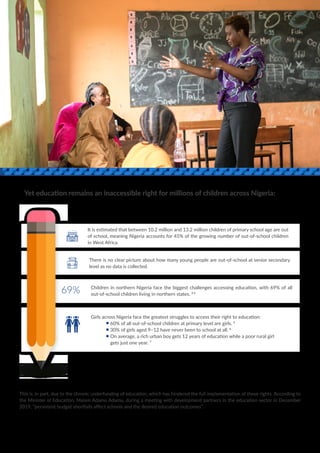
It is estimated that between 10.2 million and 13.2 million children of primary school age are out
of school, meaning Nigeria accounts for 45% of the growing number of out-of-school children
in West Africa.
There is no clear picture about how many young people are out-of-school at senior secondary
level as no data is collected.
Children in northern Nigeria face the biggest challenges accessing education, with 69% of all
out-of-school children living in northern states. 3 469%
Girls across Nigeria face the greatest struggles to access their right to education:
	 60% of all out-of-school children at primary level are girls. 5
	 30% of girls aged 9–12 have never been to school at all. 6
	 On average, a rich urban boy gets 12 years of education while a poor rural girl
	 gets just one year. 7
Yet education remains an inaccessible right for millions of children across Nigeria:
5
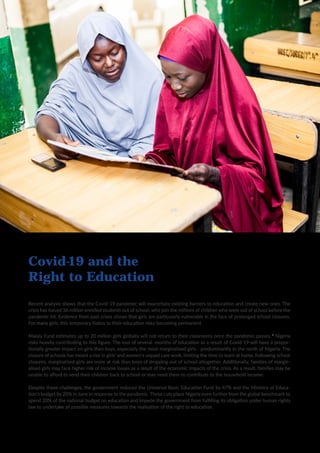
Recent analysis shows that the Covid-19 pandemic will exacerbate existing barriers to education and create new ones. The
crisis has forced 36 million enrolled students out of school, who join the millions of children who were out of school before the
pandemic hit. Evidence from past crises shows that girls are particularly vulnerable in the face of prolonged school closures.
For many girls, this temporary hiatus to their education risks becoming permanent.
Malala Fund estimates up to 20 million girls globally will not return to their classrooms once the pandemic passes. 8
Nigeria
risks heavily contributing to this figure. The loss of several months of education as a result of Covid-19 will have a propor-
tionally greater impact on girls than boys, especially the most marginalised girls - predominantly in the north of Nigeria. The
closure of schools has meant a rise in girls’ and women’s unpaid care work, limiting the time to learn at home. Following school
closures, marginalised girls are more at risk than boys of dropping out of school altogether. Additionally, families of margin-
alised girls may face higher risk of income losses as a result of the economic impacts of the crisis. As a result, families may be
unable to afford to send their children back to school or may need them to contribute to the household income.
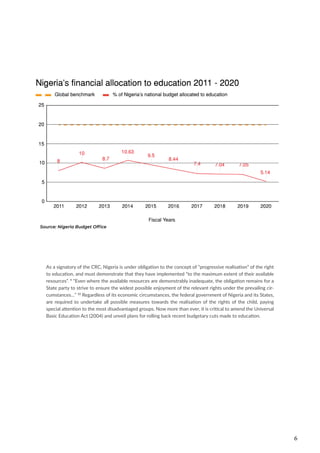
Despite these challenges, the government reduced the Universal Basic Education Fund by 47% and the Ministry of Educa-
tion’s budget by 20% in June in response to the pandemic. These cuts place Nigeria even further from the global benchmark to
spend 20% of the national budget on education and impede the government from fulfilling its obligation under human rights
law to undertake all possible measures towards the realisation of the right to education.
Covid-19 and the
Right to Education
6
Source: Nigeria Budget Office
As a signatory of the CRC, Nigeria is under obligation to the concept of “progressive realisation” of the right
to education, and must demonstrate that they have implemented “to the maximum extent of their available
resources”. 9
“Even where the available resources are demonstrably inadequate, the obligation remains for a
State party to strive to ensure the widest possible enjoyment of the relevant rights under the prevailing cir-
cumstances…” 10
Regardless of its economic circumstances, the federal government of Nigeria and its States,
are required to undertake all possible measures towards the realisation of the rights of the child, paying
special attention to the most disadvantaged groups. Now more than ever, it is critical to amend the Universal
Basic Education Act (2004) and unveil plans for rolling back recent budgetary cuts made to education.
7
2.1
Malawi
Education Act 2012
GNI/capita
(USD) 11
:
Education provision:
Level of devolution:
Commitment to equity:
$360
8 years - primary level free,
compulsory and available to
anyone under 18.
Community (via School Man-
agement Committees which are
‘representative of the commu-
nity’)
Provision is ‘for all people in Ma-
lawi; irrespective of race, ethnic-
ity, gender, religion, disability or
any other discriminatory charac-
teristics.’
$1,620
12 years - primary and second-
ary level free and compulsory.
State (via County Education
Board whose composition
observes the ‘principle of gender
equity’)
Provision ‘shall not discriminate
against any child seeking admis-
sion on any ground, including
ethnicity, gender, sex, religion,
race, colour or social origin, age,
disability, language or culture.”
$1,960
9 years - primary and junior
secondary level free and
compulsory.
Local Government (via Local
Government Education Au-
thority whose composition is
not determined by UBE Act)
Universal Basic Education’
means early childhood care
and education, the nine years
of formal schooling, adult liter-
acy and non-formal education,
skills acquisition programmes
and the education of special
groups• such as nomads and
migrants, girl-child and women,
almajiri, street children and dis-
abled groups.’
Kenya
Basic Education Act 2013
Nigeria
Universal Basic Education
Act 2004
Basic Education Reform in
Africa and Beyond
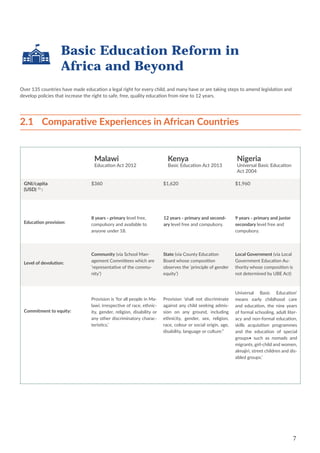
Over 135 countries have made education a legal right for every child, and many have or are taking steps to amend legislation and
develop policies that increase the right to safe, free, quality education from nine to 12 years.
Comparative Experiences in African Countries
8
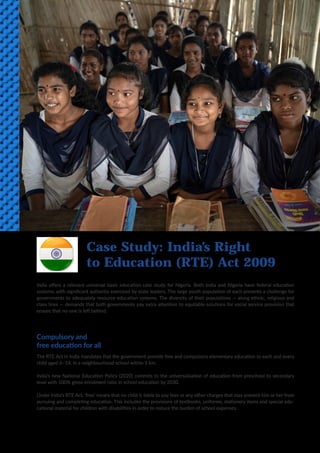
India offers a relevant universal basic education case study for Nigeria. Both India and Nigeria have federal education
systems, with significant authority exercised by state leaders. The large youth population of each presents a challenge for
governments to adequately resource education systems. The diversity of their populations — along ethnic, religious and
class lines — demands that both governments pay extra attention to equitable solutions for social service provision that
ensure that no-one is left behind.
Compulsory and
free education for all
The RTE Act in India mandates that the government provide free and compulsory elementary education to each and every
child aged 6–14, in a neighbourhood school within 1 km.
India’s new National Education Policy (2020) commits to the universalisation of education from preschool to secondary
level with 100% gross enrolment ratio in school education by 2030.
Under India’s RTE Act, ‘free’ means that no child is liable to pay fees or any other charges that may prevent him or her from
pursuing and completing education. This includes the provisions of textbooks, uniforms, stationery items and special edu-
cational material for children with disabilities in order to reduce the burden of school expenses.
Case Study: India’s Right
to Education (RTE) Act 2009
9
Monitoring compliance of
education norms and standards
All schools covered under the Act are required to establish a School Man-
agement Committee consisting of a head teacher, elected representatives of
the local authority, parents and community members. Committees must be
gender-balanced. The committees monitor the functioning of schools and
prepare school development plans.
Zero tolerance against
discrimination and harassment
The Act prohibits all kinds of discrimination based on gender, caste, class
and religion.
Financing
of education
To achieve universal free and compulsory education, the RTE Act delegates
specific duties to governments, local authorities and parents, and outlines
shared financial and administrative responsibilities between the central and
state governments.
Benchmarked norms and
standards to ensure quality education
The Act outlines minimum norms and standards to ensure safe and quali-
ty education, such as pupil–teacher ratios, classrooms, separate toilets for
girls and boys, drinking water facilities, number of school-working days
and working hours of teachers. It also mandates appointing appropriately
trained teachers with the requisite entry and academic qualifications.
The Act delegates an authority on curriculum development, ensuring cur-
ricula respond to the all-round social development of every child and that
learning methods are child-centred.
To improve performance, the Act introduced a Continuous Comprehen-
sive Evaluation system to ensure grade-appropriate learning outcomes in
schools and identify gaps in learning and development.
9
10
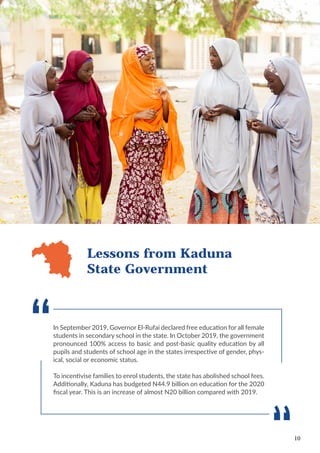
In September 2019, Governor El-Rufai declared free education for all female
students in secondary school in the state. In October 2019, the government
pronounced 100% access to basic and post-basic quality education by all
pupils and students of school age in the states irrespective of gender, phys-
ical, social or economic status.
To incentivise families to enrol students, the state has abolished school fees.
Additionally, Kaduna has budgeted N44.9 billion on education for the 2020
fiscal year. This is an increase of almost N20 billion compared with 2019.
Lessons from Kaduna
State Government
11
Summary of
Recommendations
	 Redefine basic education in line with international education commitments -
	 The government should amend the UBE Act to redefine ‘basic education’ to cover up to 12 years of education. This would 	
	 position Nigeria among other African countries like Kenya and Malawi that have taken steps to align their legislation to
	 commitments in SDGs Goal 4 and the African Union Agenda 2063.
	 Extend the mandate of the Universal Basic Education Commission -
	 The mandate of UBEC in overseeing and ensuring quality education should be extended to senior secondary education,
	 which is presently not covered under UBEC.
	 Increase budget allocations to education:
		Increase the Consolidated Revenue Fund to between 3-5% - The government should expand the proportion of the 	
		 Consolidated Revenue Fund (CRF) for education to ensure that the UBEC can take on the responsibility of senior 	
		 secondary level provision without diminishing quality and standards of primary and junior secondary levels.
		Rollback on cuts to UBE and MoE - The Federal and State governments should reinstate the initial education share 	
		 of the 2020 budgets as soon as possible and rollback the recent budget cuts, which saw 20% cut from the capital 	
		 allocations of the Federal Ministry of Education, a 47.2% reduction from the Universal Basic Education Funds and 	
		 other cuts to education at the state government level.
	 Adopt a progressive universalism approach that prioritises funding provision for marginalised groups, including girls who 	
	 fail to enter school, or who drop out before completing primary due to poverty, disability, and social disadvantage.
	 This should be supplemented by efforts to help girls overcome specific barriers to education that occur during adolescence, 	
	 through provision of targeted financial and in-kind support, helping such girls to access secondary education.
	 School Management Committees -
	 To achieve the objective of the Universal Basic Education programme, a community ownership approach should be outlined 	
	 in the Act to bring operation and activities of the schools under close supervision and scrutiny and foster trust for public 	
	 properties in the country.
12
Recommended Amendments
to the UBE Act (2004)
Amendment
Sections
2. Right of a child to com-
pulsory, free universal basic
education, etc.
Current Provisions
in the Act
Section 2 (1):
Every Government in
Nigeria shall provide free,
compulsory and univer-
sal basic education for
every child of primary and
junior secondary school
age.
Gaps in Current
Provisions
In line with global and regional
education commitments, the Act
should ensure that all children,
particularly those most vulner-
able and marginalised, have
access to 12 years of safe, free,
quality education.
Amendments and
New Provisions to
the Act
Suggested language:
“Every State Government in
Nigeria shall provide 1) com-
pulsory and universal basic
education for every child of
primary and junior secondary
school age and 2) free, safe
and quality education for all
children up to senior second-
ary school or its equivalent.”
4. Duty of a parent to ensure
the education of his child.
Section 4 (1): Every
parent shall ensure that
his child receives full time
education suitable for his
age, ability and aptitude
by regular attendance at
school.
Section 4 does not recognise the
roles and responsibilities of other
key stakeholders beside parents
in ensuring that all children re-
ceive full-time and suitable ed-
ucation. As such, the Act should
extend the responsibility to in-
clude the teachers, guardians
and government.
Suggested language:
Title of section: 4. “Duty of a
parent/guardian, teacher and
government to ensure the
education of each child”.
Section 4(1):
“Every parent, guardian, teach-
er and government shall en-
sure that his or her child/ward
receives-full time education
suitable for his or her age, abil-
ity and aptitude by regular
attendance at school.”
13
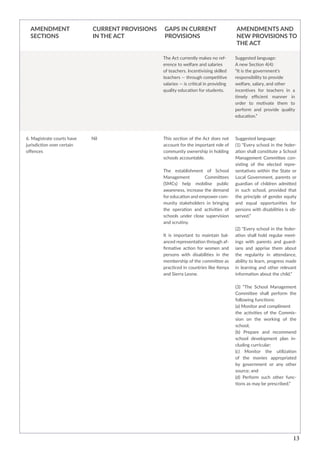
6. Magistrate courts have
jurisdiction over certain
offences
Nil This section of the Act does not
account for the important role of
community ownership in holding
schools accountable.
The establishment of School
Management Committees
(SMCs) help mobilise public
awareness, increase the demand
for education and empower com-
munity stakeholders in bringing
the operation and activities of
schools under close supervision
and scrutiny.
It is important to maintain bal-
anced representation through af-
firmative action for women and
persons with disabilities in the
membership of the committee as
practiced in countries like Kenya
and Sierra Leone.
Suggested language:
(1) “Every school in the feder-
ation shall constitute a School
Management Committee con-
sisting of the elected repre-
sentatives within the State or
Local Government, parents or
guardian of children admitted
in such school, provided that
the principle of gender equity
and equal opportunities for
persons with disabilities is ob-
served.”
(2) “Every school in the feder-
ation shall hold regular meet-
ings with parents and guard-
ians and apprise them about
the regularity in attendance,
ability to learn, progress made
in learning and other relevant
information about the child.”
(3) “The School Management
Committee shall perform the
following functions:
(a) Monitor and compliment
the activities of the Commis-
sion on the working of the
school;
(b) Prepare and recommend
school development plan in-
cluding curricular;
(c) Monitor the utilization
of the monies appropriated
by government or any other
source; and
(d) Perform such other func-
tions as may be prescribed.”
The Act currently makes no ref-
erence to welfare and salaries
of teachers. Incentivising skilled
teachers — through competitive
salaries — is critical in providing
quality education for students.
Suggested language:
A new Section 4(4):
“It is the government’s
responsibility to provide
welfare, salary, and other
incentives for teachers in a
timely efficient manner in
order to motivate them to
perform and provide quality
education.”
Amendment
Sections
Current Provisions
in the Act
Gaps in Current
Provisions
Amendments and
New Provisions to
the Act
14
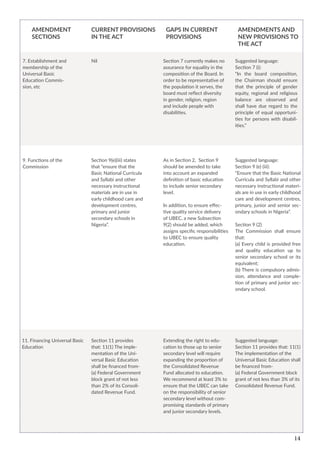
7. Establishment and
membership of the
Universal Basic
Education Commis-
sion, etc
Nil Section 7 currently makes no
assurance for equality in the
composition of the Board. In
order to be representative of
the population it serves, the
board must reflect diversity
in gender, religion, region
and include people with
disabilities.
Suggested language:
Section 7 (i):
“In the board composition,
the Chairman should ensure
that the principle of gender
equity, regional and religious
balance are observed and
shall have due regard to the
principle of equal opportuni-
ties for persons with disabil-
ities.”
9. Functions of the
Commission
11. Financing Universal Basic
Education
Section 11 provides
that: 11(1) The imple-
mentation of the Uni-
versal Basic Education
shall be financed from-
(a) Federal Government
block grant of not less
than 2% of its Consoli-
dated Revenue Fund.
Extending the right to edu-
cation to those up to senior
secondary level will require
expanding the proportion of
the Consolidated Revenue
Fund allocated to education.
We recommend at least 3% to
ensure that the UBEC can take
on the responsibility of senior
secondary level without com-
promising standards of primary
and junior secondary levels.
Suggested language:
Section 11 provides that: 11(1)
The implementation of the
Universal Basic Education shall
be financed from-
(a) Federal Government block
grant of not less than 3% of its
Consolidated Revenue Fund.
Section 9(e)(iii) states
that “ensure that the
Basic National Curricula
and Syllabi and other
necessary instructional
materials are in use in
early childhood care and
development centres,
primary and junior
secondary schools in
Nigeria”.
As in Section 2, Section 9
should be amended to take
into account an expanded
definition of basic education
to include senior secondary
level.
In addition, to ensure effec-
tive quality service delivery
of UBEC, a new Subsection
9(2) should be added, which
assigns specific responsibilities
to UBEC to ensure quality
education.
Suggested language:
Section 9 (e) (iii):
“Ensure that the Basic National
Curricula and Syllabi and other
necessary instructional materi-
als are in use in early childhood
care and development centres,
primary, junior and senior sec-
ondary schools in Nigeria”.
Section 9 (2)
The Commission shall ensure
that:
(a) Every child is provided free
and quality education up to
senior secondary school or its
equivalent;
(b) There is compulsory admis-
sion, attendance and comple-
tion of primary and junior sec-
ondary school.
Amendment
Sections
Current Provisions
in the Act
Gaps in Current
Provisions
Amendments and
New Provisions to
the Act
15
References
1
Universal Basic Education Commission (2018) 2018 Digest of Statistics for Public Basic Education Schools in Nigeria.
https://www.ubec.gov.ng/media/news/526415d9-ed64-46cd-a2b1-659a26d66507/
2
The Guardian Nigeria (2018) Article: Nigeria accounts for 45% of out of school children in West Africa, says UNICEF
https://guardian.ng/news/nigeria-accounts-for-45-out-of-school-children-in-west-africa-says-unicef/
3
States with the most out-of-school children are Benue, Jigawa, Kaduna, Kano, Katsina, Sokoto, Taraba, Yobe and Zamfara states in the North and Akwa Ibom, Ebonyi and
Oyo states in the South. Unicef (2018) Multiple Indicator Cluster Survey 2016-17: National Survey Finding Report.
https://www.unicef.org/nigeria/media/1406/file/Nigeria-MICS-2016-17.pdf.pdf
4
Premium Times (2019) Article: Eight million out-of-school children in 10 Nigerian states and Abuja – UNICEF.
https://www.premiumtimesng.com/news/headlines/335352-eight-million-out-of-school-children-in-10-nigerian-states-and-abuja-unicef.html
5
Ibid.
6
UNESCO-WIDE (2020) Indicator: Never been to school. Country: Nigeria. Year: 2013.
https://www.education-inequalities.org/countries/nigeria/indicators/edu0_prim#?dimension=all&group=all&age_group=|edu0_prim&year=|2013 [accessed 11 May 2020]
7
Gordon, R., Marston, L., Rose, P. and Zubairi, A. (2019) 12 Years of Quality Education for All Girls: A Commonwealth Perspective.
https://doi.org/10.5281/zenodo.2542579/
8
Malala Fund (2020) Girls’ education and COVID-19: What past shocks can teach us about mitigating the impact of pandemics.
https://downloads.ctfassets.net/0oan5gk9rgbh/6TMYLYAcUpjhQpXLDgmdIa/3e1c12d8d827985ef2b4e815a3a6da1f/COVID19_GirlsEducation_corrected_071420.pdf
9
UN Committee on the Rights of the Child (2003) General comment no. 5: General measures of implementation of the Convention on the Rights of the Child, paragraph 7.
https://www.refworld.org/docid/4538834f11.html [accessed 3 August 2020]
10
UN Committee on Economic, Social and Cultural Rights (1990) General Comment No. 3: The Nature of States Parties’ Obligations, paragraph 11.
https://www.refworld.org/docid/4538838e10.html [accessed 3 August 2020]
11
World Bank Data (2020) Indicator: GNI per capita, Atlas method (current US$). Country: Malawi, Kenya, Nigeria. Year: 2018.
https://data.worldbank.org/indicator/NY.GNP.PCAP.CD?locations=MW-KE-NG [accessed 11 May 2020]
16

MAKING THE UNIVERSAL BASIC ACT WORK FOR ALL CHILDREN IN NIGERIA

  • 1.
  • 2.
    2 Table of Contents Whatis the Right to Education Covid- 19 and the Right to Education Basic Education Reform in Africa and Beyond Case Studies : India’s Right to Education (RTE) Act 2009 Lessons from Kaduna State Government Summary of Recommendations Recommended Amendments to the UBE Act (2004) References 3 5 7 8 10 11 12 15
  • 3.
    3 The right toeducation is a fundamental human right — recognised first in the Universal Declaration of Human Rights (1948) and today in modern international human rights instruments such as the UN Convention on the Rights of the Child (CRC), which was ratified by Nigeria in 1991. Education is an enabler for sustainable development, meaning it makes it possible for individuals to access other human rights. Education plays a key role in economic development, reducing poverty and child labour. Girls’ education in particular promotes economic growth, improved public health, environmental sustainability and reduced conflict. The right to education is central to the 2030 Agenda for Sustainable Development adopted by the international community. Sustainable Development Goal (SDG) 4 aims to guarantee “all girls and boys complete free, equitable and quality primary and secondary education leading to relevant and effective learning outcomes” by 2030. The African Union Agenda 2063 prioritizes the right to education, mandating African countries to expand universal access to quality early childhood, primary and secondary education and expand and consolidate gender parity in education. Nigeria has pledged its commitment to global and regional development targets, including Agenda 2030 and Agenda 2063, and has demonstrated ownership on the implementation process. The Federal Government has mainstreamed global commitments into Nigeria’s national policy and budgetary frameworks and several states have also domesticated the SDGs. The Economic Growth and Recovery Plan 2017–2020 and Universal Basic Education (UBE) Act most closely align with global education indicators, with policy objectives ensuring access to quality basic education for all and investing in girls’ education as a priority. What is the Right to Education? 3
  • 4.
    4 This is, inpart, due to the chronic underfunding of education, which has hindered the full implementation of these rights. According to the Minister of Education, Malam Adamu Adamu, during a meeting with development partners in the education sector in December 2019, “persistent budget shortfalls affect schools and the desired education outcomes”. It is estimated that between 10.2 million and 13.2 million children of primary school age are out of school, meaning Nigeria accounts for 45% of the growing number of out-of-school children in West Africa. There is no clear picture about how many young people are out-of-school at senior secondary level as no data is collected. Children in northern Nigeria face the biggest challenges accessing education, with 69% of all out-of-school children living in northern states. 3 469% Girls across Nigeria face the greatest struggles to access their right to education: 60% of all out-of-school children at primary level are girls. 5 30% of girls aged 9–12 have never been to school at all. 6 On average, a rich urban boy gets 12 years of education while a poor rural girl gets just one year. 7 Yet education remains an inaccessible right for millions of children across Nigeria:
  • 5.
    5 Recent analysis showsthat the Covid-19 pandemic will exacerbate existing barriers to education and create new ones. The crisis has forced 36 million enrolled students out of school, who join the millions of children who were out of school before the pandemic hit. Evidence from past crises shows that girls are particularly vulnerable in the face of prolonged school closures. For many girls, this temporary hiatus to their education risks becoming permanent. Malala Fund estimates up to 20 million girls globally will not return to their classrooms once the pandemic passes. 8 Nigeria risks heavily contributing to this figure. The loss of several months of education as a result of Covid-19 will have a propor- tionally greater impact on girls than boys, especially the most marginalised girls - predominantly in the north of Nigeria. The closure of schools has meant a rise in girls’ and women’s unpaid care work, limiting the time to learn at home. Following school closures, marginalised girls are more at risk than boys of dropping out of school altogether. Additionally, families of margin- alised girls may face higher risk of income losses as a result of the economic impacts of the crisis. As a result, families may be unable to afford to send their children back to school or may need them to contribute to the household income. Despite these challenges, the government reduced the Universal Basic Education Fund by 47% and the Ministry of Educa- tion’s budget by 20% in June in response to the pandemic. These cuts place Nigeria even further from the global benchmark to spend 20% of the national budget on education and impede the government from fulfilling its obligation under human rights law to undertake all possible measures towards the realisation of the right to education. Covid-19 and the Right to Education
  • 6.
    6 Source: Nigeria BudgetOffice As a signatory of the CRC, Nigeria is under obligation to the concept of “progressive realisation” of the right to education, and must demonstrate that they have implemented “to the maximum extent of their available resources”. 9 “Even where the available resources are demonstrably inadequate, the obligation remains for a State party to strive to ensure the widest possible enjoyment of the relevant rights under the prevailing cir- cumstances…” 10 Regardless of its economic circumstances, the federal government of Nigeria and its States, are required to undertake all possible measures towards the realisation of the rights of the child, paying special attention to the most disadvantaged groups. Now more than ever, it is critical to amend the Universal Basic Education Act (2004) and unveil plans for rolling back recent budgetary cuts made to education.
  • 7.
    7 2.1 Malawi Education Act 2012 GNI/capita (USD)11 : Education provision: Level of devolution: Commitment to equity: $360 8 years - primary level free, compulsory and available to anyone under 18. Community (via School Man- agement Committees which are ‘representative of the commu- nity’) Provision is ‘for all people in Ma- lawi; irrespective of race, ethnic- ity, gender, religion, disability or any other discriminatory charac- teristics.’ $1,620 12 years - primary and second- ary level free and compulsory. State (via County Education Board whose composition observes the ‘principle of gender equity’) Provision ‘shall not discriminate against any child seeking admis- sion on any ground, including ethnicity, gender, sex, religion, race, colour or social origin, age, disability, language or culture.” $1,960 9 years - primary and junior secondary level free and compulsory. Local Government (via Local Government Education Au- thority whose composition is not determined by UBE Act) Universal Basic Education’ means early childhood care and education, the nine years of formal schooling, adult liter- acy and non-formal education, skills acquisition programmes and the education of special groups• such as nomads and migrants, girl-child and women, almajiri, street children and dis- abled groups.’ Kenya Basic Education Act 2013 Nigeria Universal Basic Education Act 2004 Basic Education Reform in Africa and Beyond Over 135 countries have made education a legal right for every child, and many have or are taking steps to amend legislation and develop policies that increase the right to safe, free, quality education from nine to 12 years. Comparative Experiences in African Countries
  • 8.
    8 India offers arelevant universal basic education case study for Nigeria. Both India and Nigeria have federal education systems, with significant authority exercised by state leaders. The large youth population of each presents a challenge for governments to adequately resource education systems. The diversity of their populations — along ethnic, religious and class lines — demands that both governments pay extra attention to equitable solutions for social service provision that ensure that no-one is left behind. Compulsory and free education for all The RTE Act in India mandates that the government provide free and compulsory elementary education to each and every child aged 6–14, in a neighbourhood school within 1 km. India’s new National Education Policy (2020) commits to the universalisation of education from preschool to secondary level with 100% gross enrolment ratio in school education by 2030. Under India’s RTE Act, ‘free’ means that no child is liable to pay fees or any other charges that may prevent him or her from pursuing and completing education. This includes the provisions of textbooks, uniforms, stationery items and special edu- cational material for children with disabilities in order to reduce the burden of school expenses. Case Study: India’s Right to Education (RTE) Act 2009
  • 9.
    9 Monitoring compliance of educationnorms and standards All schools covered under the Act are required to establish a School Man- agement Committee consisting of a head teacher, elected representatives of the local authority, parents and community members. Committees must be gender-balanced. The committees monitor the functioning of schools and prepare school development plans. Zero tolerance against discrimination and harassment The Act prohibits all kinds of discrimination based on gender, caste, class and religion. Financing of education To achieve universal free and compulsory education, the RTE Act delegates specific duties to governments, local authorities and parents, and outlines shared financial and administrative responsibilities between the central and state governments. Benchmarked norms and standards to ensure quality education The Act outlines minimum norms and standards to ensure safe and quali- ty education, such as pupil–teacher ratios, classrooms, separate toilets for girls and boys, drinking water facilities, number of school-working days and working hours of teachers. It also mandates appointing appropriately trained teachers with the requisite entry and academic qualifications. The Act delegates an authority on curriculum development, ensuring cur- ricula respond to the all-round social development of every child and that learning methods are child-centred. To improve performance, the Act introduced a Continuous Comprehen- sive Evaluation system to ensure grade-appropriate learning outcomes in schools and identify gaps in learning and development. 9
  • 10.
    10 In September 2019,Governor El-Rufai declared free education for all female students in secondary school in the state. In October 2019, the government pronounced 100% access to basic and post-basic quality education by all pupils and students of school age in the states irrespective of gender, phys- ical, social or economic status. To incentivise families to enrol students, the state has abolished school fees. Additionally, Kaduna has budgeted N44.9 billion on education for the 2020 fiscal year. This is an increase of almost N20 billion compared with 2019. Lessons from Kaduna State Government
  • 11.
    11 Summary of Recommendations Redefinebasic education in line with international education commitments - The government should amend the UBE Act to redefine ‘basic education’ to cover up to 12 years of education. This would position Nigeria among other African countries like Kenya and Malawi that have taken steps to align their legislation to commitments in SDGs Goal 4 and the African Union Agenda 2063. Extend the mandate of the Universal Basic Education Commission - The mandate of UBEC in overseeing and ensuring quality education should be extended to senior secondary education, which is presently not covered under UBEC. Increase budget allocations to education: Increase the Consolidated Revenue Fund to between 3-5% - The government should expand the proportion of the Consolidated Revenue Fund (CRF) for education to ensure that the UBEC can take on the responsibility of senior secondary level provision without diminishing quality and standards of primary and junior secondary levels. Rollback on cuts to UBE and MoE - The Federal and State governments should reinstate the initial education share of the 2020 budgets as soon as possible and rollback the recent budget cuts, which saw 20% cut from the capital allocations of the Federal Ministry of Education, a 47.2% reduction from the Universal Basic Education Funds and other cuts to education at the state government level. Adopt a progressive universalism approach that prioritises funding provision for marginalised groups, including girls who fail to enter school, or who drop out before completing primary due to poverty, disability, and social disadvantage. This should be supplemented by efforts to help girls overcome specific barriers to education that occur during adolescence, through provision of targeted financial and in-kind support, helping such girls to access secondary education. School Management Committees - To achieve the objective of the Universal Basic Education programme, a community ownership approach should be outlined in the Act to bring operation and activities of the schools under close supervision and scrutiny and foster trust for public properties in the country.
  • 12.
    12 Recommended Amendments to theUBE Act (2004) Amendment Sections 2. Right of a child to com- pulsory, free universal basic education, etc. Current Provisions in the Act Section 2 (1): Every Government in Nigeria shall provide free, compulsory and univer- sal basic education for every child of primary and junior secondary school age. Gaps in Current Provisions In line with global and regional education commitments, the Act should ensure that all children, particularly those most vulner- able and marginalised, have access to 12 years of safe, free, quality education. Amendments and New Provisions to the Act Suggested language: “Every State Government in Nigeria shall provide 1) com- pulsory and universal basic education for every child of primary and junior secondary school age and 2) free, safe and quality education for all children up to senior second- ary school or its equivalent.” 4. Duty of a parent to ensure the education of his child. Section 4 (1): Every parent shall ensure that his child receives full time education suitable for his age, ability and aptitude by regular attendance at school. Section 4 does not recognise the roles and responsibilities of other key stakeholders beside parents in ensuring that all children re- ceive full-time and suitable ed- ucation. As such, the Act should extend the responsibility to in- clude the teachers, guardians and government. Suggested language: Title of section: 4. “Duty of a parent/guardian, teacher and government to ensure the education of each child”. Section 4(1): “Every parent, guardian, teach- er and government shall en- sure that his or her child/ward receives-full time education suitable for his or her age, abil- ity and aptitude by regular attendance at school.”
  • 13.
    13 6. Magistrate courtshave jurisdiction over certain offences Nil This section of the Act does not account for the important role of community ownership in holding schools accountable. The establishment of School Management Committees (SMCs) help mobilise public awareness, increase the demand for education and empower com- munity stakeholders in bringing the operation and activities of schools under close supervision and scrutiny. It is important to maintain bal- anced representation through af- firmative action for women and persons with disabilities in the membership of the committee as practiced in countries like Kenya and Sierra Leone. Suggested language: (1) “Every school in the feder- ation shall constitute a School Management Committee con- sisting of the elected repre- sentatives within the State or Local Government, parents or guardian of children admitted in such school, provided that the principle of gender equity and equal opportunities for persons with disabilities is ob- served.” (2) “Every school in the feder- ation shall hold regular meet- ings with parents and guard- ians and apprise them about the regularity in attendance, ability to learn, progress made in learning and other relevant information about the child.” (3) “The School Management Committee shall perform the following functions: (a) Monitor and compliment the activities of the Commis- sion on the working of the school; (b) Prepare and recommend school development plan in- cluding curricular; (c) Monitor the utilization of the monies appropriated by government or any other source; and (d) Perform such other func- tions as may be prescribed.” The Act currently makes no ref- erence to welfare and salaries of teachers. Incentivising skilled teachers — through competitive salaries — is critical in providing quality education for students. Suggested language: A new Section 4(4): “It is the government’s responsibility to provide welfare, salary, and other incentives for teachers in a timely efficient manner in order to motivate them to perform and provide quality education.” Amendment Sections Current Provisions in the Act Gaps in Current Provisions Amendments and New Provisions to the Act
  • 14.
    14 7. Establishment and membershipof the Universal Basic Education Commis- sion, etc Nil Section 7 currently makes no assurance for equality in the composition of the Board. In order to be representative of the population it serves, the board must reflect diversity in gender, religion, region and include people with disabilities. Suggested language: Section 7 (i): “In the board composition, the Chairman should ensure that the principle of gender equity, regional and religious balance are observed and shall have due regard to the principle of equal opportuni- ties for persons with disabil- ities.” 9. Functions of the Commission 11. Financing Universal Basic Education Section 11 provides that: 11(1) The imple- mentation of the Uni- versal Basic Education shall be financed from- (a) Federal Government block grant of not less than 2% of its Consoli- dated Revenue Fund. Extending the right to edu- cation to those up to senior secondary level will require expanding the proportion of the Consolidated Revenue Fund allocated to education. We recommend at least 3% to ensure that the UBEC can take on the responsibility of senior secondary level without com- promising standards of primary and junior secondary levels. Suggested language: Section 11 provides that: 11(1) The implementation of the Universal Basic Education shall be financed from- (a) Federal Government block grant of not less than 3% of its Consolidated Revenue Fund. Section 9(e)(iii) states that “ensure that the Basic National Curricula and Syllabi and other necessary instructional materials are in use in early childhood care and development centres, primary and junior secondary schools in Nigeria”. As in Section 2, Section 9 should be amended to take into account an expanded definition of basic education to include senior secondary level. In addition, to ensure effec- tive quality service delivery of UBEC, a new Subsection 9(2) should be added, which assigns specific responsibilities to UBEC to ensure quality education. Suggested language: Section 9 (e) (iii): “Ensure that the Basic National Curricula and Syllabi and other necessary instructional materi- als are in use in early childhood care and development centres, primary, junior and senior sec- ondary schools in Nigeria”. Section 9 (2) The Commission shall ensure that: (a) Every child is provided free and quality education up to senior secondary school or its equivalent; (b) There is compulsory admis- sion, attendance and comple- tion of primary and junior sec- ondary school. Amendment Sections Current Provisions in the Act Gaps in Current Provisions Amendments and New Provisions to the Act
  • 15.
    15 References 1 Universal Basic EducationCommission (2018) 2018 Digest of Statistics for Public Basic Education Schools in Nigeria. https://www.ubec.gov.ng/media/news/526415d9-ed64-46cd-a2b1-659a26d66507/ 2 The Guardian Nigeria (2018) Article: Nigeria accounts for 45% of out of school children in West Africa, says UNICEF https://guardian.ng/news/nigeria-accounts-for-45-out-of-school-children-in-west-africa-says-unicef/ 3 States with the most out-of-school children are Benue, Jigawa, Kaduna, Kano, Katsina, Sokoto, Taraba, Yobe and Zamfara states in the North and Akwa Ibom, Ebonyi and Oyo states in the South. Unicef (2018) Multiple Indicator Cluster Survey 2016-17: National Survey Finding Report. https://www.unicef.org/nigeria/media/1406/file/Nigeria-MICS-2016-17.pdf.pdf 4 Premium Times (2019) Article: Eight million out-of-school children in 10 Nigerian states and Abuja – UNICEF. https://www.premiumtimesng.com/news/headlines/335352-eight-million-out-of-school-children-in-10-nigerian-states-and-abuja-unicef.html 5 Ibid. 6 UNESCO-WIDE (2020) Indicator: Never been to school. Country: Nigeria. Year: 2013. https://www.education-inequalities.org/countries/nigeria/indicators/edu0_prim#?dimension=all&group=all&age_group=|edu0_prim&year=|2013 [accessed 11 May 2020] 7 Gordon, R., Marston, L., Rose, P. and Zubairi, A. (2019) 12 Years of Quality Education for All Girls: A Commonwealth Perspective. https://doi.org/10.5281/zenodo.2542579/ 8 Malala Fund (2020) Girls’ education and COVID-19: What past shocks can teach us about mitigating the impact of pandemics. https://downloads.ctfassets.net/0oan5gk9rgbh/6TMYLYAcUpjhQpXLDgmdIa/3e1c12d8d827985ef2b4e815a3a6da1f/COVID19_GirlsEducation_corrected_071420.pdf 9 UN Committee on the Rights of the Child (2003) General comment no. 5: General measures of implementation of the Convention on the Rights of the Child, paragraph 7. https://www.refworld.org/docid/4538834f11.html [accessed 3 August 2020] 10 UN Committee on Economic, Social and Cultural Rights (1990) General Comment No. 3: The Nature of States Parties’ Obligations, paragraph 11. https://www.refworld.org/docid/4538838e10.html [accessed 3 August 2020] 11 World Bank Data (2020) Indicator: GNI per capita, Atlas method (current US$). Country: Malawi, Kenya, Nigeria. Year: 2018. https://data.worldbank.org/indicator/NY.GNP.PCAP.CD?locations=MW-KE-NG [accessed 11 May 2020]
  • 16.