ALERT Presentation: Making simulation
training stick with rapid cycle deliberate practice: Does interleaved
various scenarios versus single progressive scenario improve long
term retention of pediatric resuscitation skills?
Melissa Powell, RN, BSN, MHPE, CHSE
Johns Hopkins All Children’s Hospital
INSPIRE @ IMSH 2017 – Orlando, FL, USA
International Network for Simulation-based Pediatric Innovation, Research and Education
• Skills decay rapidly after training in as little as 3- 6 months. Recommended low dose high
frequency training, recognizing that bi-annual training is not enough for maintenance of
skills.
• We practice 1-2 times a year.
• “Rapid Cycle Deliberate Practice” (RCDP) is also Simulation Based Mastery Learning
(SBML) in that learners do not end the learning session until they have met the mastery
standard for resuscitation performance. Barsuk (2010) was able to get retention to one year
with SBML.
• Original research by Cepeda, Pashler, Vul, Wixted, & Rohrer in 2006 showed that
interleaving of skills practice increases learning and retention. This simulation research
proposes to study retention rates between 2 cohorts of nursing staff. One cohort will receive
a session using interleaving. Learners will rapidly change between various scenarios
receiving RCDP intra- coaching, stopping and restarting. The second cohort will receive
single progressive scenario simulations using RCDP intra- coaching, stopping and
restarting.
International Network for Simulation-based Pediatric Innovation, Research and Education
Background
• Population: Pediatric nurse teams from an academic
medical center. 2 separate cohorts.
• Intervention: RCDP with interleaving of different skills
and different scenarios
• Control/Comparison: RCDP with Progressive
single scenario
• Outcome(s): % of team participants retaining at 100%
of all 3 skill bundles for up to 12 monthsInternational Network for Simulation-based Pediatric Innovation, Research and Education
PICO / Research Question
• Longitudinal prospective cohort (team) study. Post-
test and retest study. Skills will be retested at 12
months and compared to post test results to test for
skill retention. Specific skill achievements for
performance assessment of nurses managing a
simulated cardiopulmonary arrest will be by
accurately and safely: (1) initiation of compressions
and ventilations within 1 minute of cardiopulmonary
arrest and (2) defibrillating within 2 min of recognition
of ventricular fibrillation on defibrillator monitor and
(3) administering a dose of epinephrine within 3
minutes of recognition of asystole on defibrillator
monitor.
International Network for Simulation-based Pediatric Innovation, Research and Education
Approach / Design
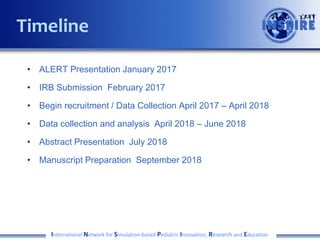
• ALERT Presentation January 2017
• IRB Submission February 2017
• Begin recruitment / Data Collection April 2017 – April 2018
• Data collection and analysis April 2018 – June 2018
• Abstract Presentation July 2018
• Manuscript Preparation September 2018
International Network for Simulation-based Pediatric Innovation, Research and Education
Timeline
1. I train 4-6 at a time – How do I
describe this type of study? Testing is of
team?
2. Some may participate in additional
mock codes – should they be excluded?
3. What are the issues?
International Network for Simulation-based Pediatric Innovation, Research and Education
3 questions to improve study
At INSPIRE @ IMSH 2017:
Receive targeted feedback
In 2 months: Submit for IRB approval.
International Network for Simulation-based Pediatric Innovation, Research and Education
Goals to accomplish
Melissa Powell
Johns Hopkins All Children’s Hospital
Mpowel41@jhmi.edu
931-993-6959
International Network for Simulation-based Pediatric Innovation, Research and Education
Contact Information

Making simulation training stick with rapid cycle deliberate practice

  • 1.
    ALERT Presentation: Makingsimulation training stick with rapid cycle deliberate practice: Does interleaved various scenarios versus single progressive scenario improve long term retention of pediatric resuscitation skills? Melissa Powell, RN, BSN, MHPE, CHSE Johns Hopkins All Children’s Hospital INSPIRE @ IMSH 2017 – Orlando, FL, USA International Network for Simulation-based Pediatric Innovation, Research and Education
  • 2.
    • Skills decayrapidly after training in as little as 3- 6 months. Recommended low dose high frequency training, recognizing that bi-annual training is not enough for maintenance of skills. • We practice 1-2 times a year. • “Rapid Cycle Deliberate Practice” (RCDP) is also Simulation Based Mastery Learning (SBML) in that learners do not end the learning session until they have met the mastery standard for resuscitation performance. Barsuk (2010) was able to get retention to one year with SBML. • Original research by Cepeda, Pashler, Vul, Wixted, & Rohrer in 2006 showed that interleaving of skills practice increases learning and retention. This simulation research proposes to study retention rates between 2 cohorts of nursing staff. One cohort will receive a session using interleaving. Learners will rapidly change between various scenarios receiving RCDP intra- coaching, stopping and restarting. The second cohort will receive single progressive scenario simulations using RCDP intra- coaching, stopping and restarting. International Network for Simulation-based Pediatric Innovation, Research and Education Background
  • 3.
    • Population: Pediatricnurse teams from an academic medical center. 2 separate cohorts. • Intervention: RCDP with interleaving of different skills and different scenarios • Control/Comparison: RCDP with Progressive single scenario • Outcome(s): % of team participants retaining at 100% of all 3 skill bundles for up to 12 monthsInternational Network for Simulation-based Pediatric Innovation, Research and Education PICO / Research Question
  • 4.
    • Longitudinal prospectivecohort (team) study. Post- test and retest study. Skills will be retested at 12 months and compared to post test results to test for skill retention. Specific skill achievements for performance assessment of nurses managing a simulated cardiopulmonary arrest will be by accurately and safely: (1) initiation of compressions and ventilations within 1 minute of cardiopulmonary arrest and (2) defibrillating within 2 min of recognition of ventricular fibrillation on defibrillator monitor and (3) administering a dose of epinephrine within 3 minutes of recognition of asystole on defibrillator monitor. International Network for Simulation-based Pediatric Innovation, Research and Education Approach / Design
  • 5.
    • ALERT PresentationJanuary 2017 • IRB Submission February 2017 • Begin recruitment / Data Collection April 2017 – April 2018 • Data collection and analysis April 2018 – June 2018 • Abstract Presentation July 2018 • Manuscript Preparation September 2018 International Network for Simulation-based Pediatric Innovation, Research and Education Timeline
  • 6.
    1. I train4-6 at a time – How do I describe this type of study? Testing is of team? 2. Some may participate in additional mock codes – should they be excluded? 3. What are the issues? International Network for Simulation-based Pediatric Innovation, Research and Education 3 questions to improve study
  • 7.
    At INSPIRE @IMSH 2017: Receive targeted feedback In 2 months: Submit for IRB approval. International Network for Simulation-based Pediatric Innovation, Research and Education Goals to accomplish
  • 8.
    Melissa Powell Johns HopkinsAll Children’s Hospital Mpowel41@jhmi.edu 931-993-6959 International Network for Simulation-based Pediatric Innovation, Research and Education Contact Information