ALERT Presentation: SecureTube Study in
Simulated Setting
Girish G. Deshpande, MD, FAAP
Professor of Clinical Pediatrics
Critical Care Medicine
Department of Pediatrics
University of Illinois College of Medicine=Peoria
INSPIRE @ IMSH 2017 – Orlando, FL, USA
International Network for Simulation-based Pediatric Innovation, Research and Education
• Unplanned extubations (UE) remains a common problem in ICU despite
several measures taken to decrease its rate.
• The traditional endotracheal tube (ET) design makes it vulnerable to UE,
due to constant linear outward pull through its attachment to the
ventilator tubings with only one place of securement at lips.
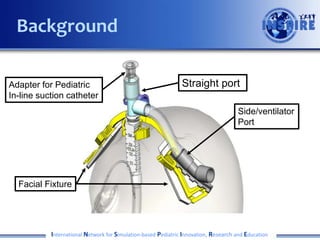
• The patented SecureTube (Figure) has two ports, the straight port and
the side (ventilator) port.
• The side port is secured to patient’s cheek; this may change the
direction of pull perpendicular to the long axis of ET tube.
• This change in design can alter the ability of the provider to perform
intubation using SecureTube. The perpendicular attachment of ventilator
port may change flow-dynamics of the tube.
• The objectives of this study were: to compare the flow characteristics
and intubation experience of SecureTube with traditional ET (with same
inner diameter) in simulated settings.
International Network for Simulation-based Pediatric Innovation, Research and Education
Background
International Network for Simulation-based Pediatric Innovation, Research and Education
Background
Side/ventilator
Port
Facial Fixture
Straight portAdapter for Pediatric
In-line suction catheter
• Population: MD/APN/PA, RN, RRT
• Intervention: Intubation assessment (MD/APN/PA) and Usability study
(NASA task load index) for RN/RRT Control/Comparison: Use of
traditional ET Tube (Mallinckrodt tube)
• Outcome(s): 1. Time to intubate, 2. Survey of ease of intubation (Likert
scale), 3. NASA task load index filled out by RN/RRT for securement
• Hypothesis: 1. SecureTube is not inferior to the traditional tube in ease of
its use by clinical practitioners. 2. SecureTube is not inferior to the
traditional tube in ease of ET tube management by the clinical
practitioners.
International Network for Simulation-based Pediatric Innovation, Research and Education
PICO / Research Question
• Study Design: Both groups watch a training video
demonstrating SecureTube functionality
– MD/APN/PA: intubate manikin using SecureTube and same size
traditional tube. Time to intubate is measured in min/sec. Providers fill
out a survey about ease of its use
– RN/RRT:
• secure the traditional tube to manikin using tape/facial fixtures and
affix SecureTube using its facial fixtures
• They adjust the depth of traditional tube and SecureTube up or
down
International Network for Simulation-based Pediatric Innovation, Research and Education
Approach / Design
• ALERT Presentation
• Grant Proposal (if applicable)
• IRB Submission
• Recruitment / Data Collection
• Data Analysis
• Abstract Presentation
• Manuscript Preparation
International Network for Simulation-based Pediatric Innovation, Research and Education
Timeline
Or flowcharts
1.
2.
3.
International Network for Simulation-based Pediatric Innovation, Research and Education
3 questions to improve study
At INSPIRE @ IMSH 2017:
 Brainstrom about additional research ideas
 Form a subgroup to investigate further
 Come up with survey questionnaire about SecureTube use
 In 2 months: Complete the study and submit
abstract/manuscript to Medical Devices journal
International Network for Simulation-based Pediatric Innovation, Research and Education
Goals to accomplish
Name: Girish G. Deshpande, MD
Institution: University of Illinois College of Medicine-
Peoria
E-mail: girish@uic.edu
Phone: 309-303-4007
Website / QR Code
International Network for Simulation-based Pediatric Innovation, Research and Education
Contact Information

Alert 2017 deshpande secure_tube study in simulated

  • 1.
    ALERT Presentation: SecureTubeStudy in Simulated Setting Girish G. Deshpande, MD, FAAP Professor of Clinical Pediatrics Critical Care Medicine Department of Pediatrics University of Illinois College of Medicine=Peoria INSPIRE @ IMSH 2017 – Orlando, FL, USA International Network for Simulation-based Pediatric Innovation, Research and Education
  • 2.
    • Unplanned extubations(UE) remains a common problem in ICU despite several measures taken to decrease its rate. • The traditional endotracheal tube (ET) design makes it vulnerable to UE, due to constant linear outward pull through its attachment to the ventilator tubings with only one place of securement at lips. • The patented SecureTube (Figure) has two ports, the straight port and the side (ventilator) port. • The side port is secured to patient’s cheek; this may change the direction of pull perpendicular to the long axis of ET tube. • This change in design can alter the ability of the provider to perform intubation using SecureTube. The perpendicular attachment of ventilator port may change flow-dynamics of the tube. • The objectives of this study were: to compare the flow characteristics and intubation experience of SecureTube with traditional ET (with same inner diameter) in simulated settings. International Network for Simulation-based Pediatric Innovation, Research and Education Background
  • 3.
    International Network forSimulation-based Pediatric Innovation, Research and Education Background Side/ventilator Port Facial Fixture Straight portAdapter for Pediatric In-line suction catheter
  • 4.
    • Population: MD/APN/PA,RN, RRT • Intervention: Intubation assessment (MD/APN/PA) and Usability study (NASA task load index) for RN/RRT Control/Comparison: Use of traditional ET Tube (Mallinckrodt tube) • Outcome(s): 1. Time to intubate, 2. Survey of ease of intubation (Likert scale), 3. NASA task load index filled out by RN/RRT for securement • Hypothesis: 1. SecureTube is not inferior to the traditional tube in ease of its use by clinical practitioners. 2. SecureTube is not inferior to the traditional tube in ease of ET tube management by the clinical practitioners. International Network for Simulation-based Pediatric Innovation, Research and Education PICO / Research Question
  • 5.
    • Study Design:Both groups watch a training video demonstrating SecureTube functionality – MD/APN/PA: intubate manikin using SecureTube and same size traditional tube. Time to intubate is measured in min/sec. Providers fill out a survey about ease of its use – RN/RRT: • secure the traditional tube to manikin using tape/facial fixtures and affix SecureTube using its facial fixtures • They adjust the depth of traditional tube and SecureTube up or down International Network for Simulation-based Pediatric Innovation, Research and Education Approach / Design
  • 6.
    • ALERT Presentation •Grant Proposal (if applicable) • IRB Submission • Recruitment / Data Collection • Data Analysis • Abstract Presentation • Manuscript Preparation International Network for Simulation-based Pediatric Innovation, Research and Education Timeline Or flowcharts
  • 7.
    1. 2. 3. International Network forSimulation-based Pediatric Innovation, Research and Education 3 questions to improve study
  • 8.
    At INSPIRE @IMSH 2017:  Brainstrom about additional research ideas  Form a subgroup to investigate further  Come up with survey questionnaire about SecureTube use  In 2 months: Complete the study and submit abstract/manuscript to Medical Devices journal International Network for Simulation-based Pediatric Innovation, Research and Education Goals to accomplish
  • 9.
    Name: Girish G.Deshpande, MD Institution: University of Illinois College of Medicine- Peoria E-mail: girish@uic.edu Phone: 309-303-4007 Website / QR Code International Network for Simulation-based Pediatric Innovation, Research and Education Contact Information