TTTTOOOOCCCCIIIICCCCOOOO 2222000000007777 CCCCoooonnnnffffeeeerrrreeeennnncccceeee 
TTTTOOOOCCCCIIIICCCCOOOO CCCCOOOONNNNFFFFEEEERRRREEEENNNNCCCCEEEE 2222000000007777 
MMMMMMMMaaaaaaaakkkkkkkkeeeeeeee ttttttttoooooooo AAAAAAAAvvvvvvvvaaaaaaaaiiiiiiiillllllllaaaaaaaabbbbbbbbiiiiiiiilllllllliiiiiiiittttttttyyyyyyyy aaaaaaaannnnnnnndddddddd BBBBBBBBeeeeeeeeyyyyyyyyoooooooonnnnnnnndddddddd 
Using market buffers and/or capacity buffers 
to enable both growth and stability. 
Presented By: Eli Schragenheim, The Goldratt Schools 
Date: November 5th, 2007 
1 © 2007 TOCICO. All rights reserved.
TTTTOOOOCCCCIIIICCCCOOOO 2222000000007777 CCCCoooonnnnffffeeeerrrreeeennnncccceeee 
DDDDDDDDeeeeeeeeffffffffiiiiiiiinnnnnnnniiiiiiiittttttttiiiiiiiioooooooonnnnnnnn 
• Make to Availability is a commitment to the 
market, or to specified clients, to maintain 
enough availability at a specific warehouse to 
be able to deliver immediately upon request at all 
times. 
• This definition is different from make-to-stock where 
no firm commitment is given. 
• A make-to-order environment that requires shorter 
delivery time than the production lead-time, calls for 
make-to-stock that is similar, but not the same, as 
make-to-availability. 
2 
© 2007 TOCICO. All rights reserved.
MMMMMMMMaaaaaaaakkkkkkkkeeeeeeee-ttttttttoooooooo-aaaaaaaavvvvvvvvaaaaaaaaiiiiiiiillllllllaaaaaaaabbbbbbbbiiiiiiiilllllllliiiiiiiittttttttyyyyyyyy vvvvvvvveeeeeeeerrrrrrrrssssssssuuuuuuuussssssss 
mmmmmmmmaaaaaaaakkkkkkkkeeeeeeee-ttttttttoooooooo-ssssssssttttttttoooooooocccccccckkkkkkkk 
TTTTOOOOCCCCIIIICCCCOOOO 2222000000007777 CCCCoooonnnnffffeeeerrrreeeennnncccceeee 
• Make-to-stock includes all cases where items are 
produced without a specific customer order. 
− Manufacturing companies that basically produce to 
order usually mix their production with make to stock. 
• A typical managerial question in such environments is: 
what is available to promise? 
− That question testifies to the current state of confusion. 
− A company claims it makes to order, but it produces, 
from time to time, also to stock, so it can sometimes 
deliver faster. 
− But, the company’s response time is not always fast, 
actually it is usually quite slow, so it cannot commit 
to fast delivery at all times. 
3 
© 2007 TOCICO. All rights reserved.
TTTTOOOOCCCCIIIICCCCOOOO 2222000000007777 CCCCoooonnnnffffeeeerrrreeeennnncccceeee 
MMMMMMMMaaaaaaaakkkkkkkkeeeeeeee-ttttttttoooooooo-aaaaaaaavvvvvvvvaaaaaaaaiiiiiiiillllllllaaaaaaaabbbbbbbbiiiiiiiilllllllliiiiiiiittttttttyyyyyyyy 
tttttttthhhhhhhheeeeeeee nnnnnnnneeeeeeeeeeeeeeeedddddddd aaaaaaaannnnnnnndddddddd tttttttthhhhhhhheeeeeeee ddddddddiiiiiiiiffffffffffffffffiiiiiiiiccccccccuuuuuuuullllllllttttttttyyyyyyyy 
• The point in offering a commitment for 
availability is to allow the potential client to 
rely on getting very fast response whenever 
needed! 
− It is applicable when the client is able to improve 
his business due to the availability provided. 
• Difficulty: How strong can our commitment 
be? 
− There is no way to provide true 100% availability. 
4 
© 2007 TOCICO. All rights reserved.
TTTTTTTThhhhhhhheeeeeeee ffffffffooooooooccccccccuuuuuuuussssssss ooooooooffffffff tttttttthhhhhhhhiiiiiiiissssssss pppppppprrrrrrrreeeeeeeesssssssseeeeeeeennnnnnnnttttttttaaaaaaaattttttttiiiiiiiioooooooonnnnnnnn 
TTTTOOOOCCCCIIIICCCCOOOO 2222000000007777 CCCCoooonnnnffffeeeerrrreeeennnncccceeee 
• Provide the operational issues related to make-to-availability 
(MTA). 
− Marketing and sales aspects are not included. 
• Also mentioning issues that in their way highlight 
the MTA aspects 
1. The concept of the market buffer. 
2. The use of capacity buffers as means to quickly 
expand the internal capacity whenever there is a 
need. 
3. When the market tolerance is larger than zero. 
5 
© 2007 TOCICO. All rights reserved.
TTTTOOOOCCCCIIIICCCCOOOO 2222000000007777 CCCCoooonnnnffffeeeerrrreeeennnncccceeee 
WWWWWWWWhhhhhhhhaaaaaaaatttttttt iiiiiiiissssssss uuuuuuuunnnnnnnniiiiiiiiqqqqqqqquuuuuuuueeeeeeee iiiiiiiinnnnnnnn MMMMMMMMTTTTTTTTAAAAAAAA 
• The real need of the market, for a certain quantity at 
a point in time, is not known at the planning stage. 
− An assumption: we have much better idea of the 
potential demand in the short term. 
− The most effective way to forecast the short-term 
demand is to assume it’d be similar to the present 
demand. 
− Thus, very fast reaction to the present demand is a 
key in MTA, on top of protecting the immediate sales 
by stock buffer. 
6 
© 2007 TOCICO. All rights reserved.
TTTTTTTThhhhhhhheeeeeeee tttttttthhhhhhhhrrrrrrrreeeeeeeeeeeeeeee cccccccciiiiiiiirrrrrrrrcccccccclllllllleeeeeeeessssssss ooooooooffffffff pppppppprrrrrrrrooooooootttttttteeeeeeeeccccccccttttttttiiiiiiiioooooooonnnnnnnn 
TTTTOOOOCCCCIIIICCCCOOOO 2222000000007777 CCCCoooonnnnffffeeeerrrreeeennnncccceeee 
1. First of all we protect the availability by holding 
enough stock, both at the warehouse and in 
production, to cover for maximum demand within 
the replenishment time. 
− And short replenishment time is an enabler to provide 
adequate protection at that level. 
2. Then, in the execution phase, we monitor the real 
priorities of the production orders as being 
expressed by the state of the stock buffer. 
3. And the replenishment time is protected by 
maintaining minimum protective/excess capacity. 
7 
© 2007 TOCICO. All rights reserved.
EEEEEEEEnnnnnnnnssssssssuuuuuuuurrrrrrrriiiiiiiinnnnnnnngggggggg tttttttthhhhhhhheeeeeeee aaaaaaaaddddddddeeeeeeeeqqqqqqqquuuuuuuuaaaaaaaatttttttteeeeeeee pppppppprrrrrrrrooooooootttttttteeeeeeeeccccccccttttttttiiiiiiiioooooooonnnnnnnn 
iiiiiiiissssssss rrrrrrrreeeeeeeeaaaaaaaallllllllllllllllyyyyyyyy oooooooonnnnnnnn 
TTTTOOOOCCCCIIIICCCCOOOO 2222000000007777 CCCCoooonnnnffffeeeerrrreeeennnncccceeee 
• Do we have the right stock buffers? 
− Dynamic Buffer Management (DBM) is an algorithm that 
signals when a change in the buffer is recommended. 
− This is based on the behavior of the stock buffers, not 
on re-calculating the maximum demand within rep. time. 
• Do the operators have an access to the single priority 
list and do they really follow the priorities? 
− Buffer Management provides the only priorities. Red 
orders should be expedited at all costs. 
• How do we ensure we have the capacity to maintain 
the fast replenishment time we need? 
8 
© 2007 TOCICO. All rights reserved.
TTTTTTTThhhhhhhheeeeeeee vvvvvvvvaaaaaaaagggggggguuuuuuuueeeeeeee nnnnnnnnaaaaaaaattttttttuuuuuuuurrrrrrrreeeeeeee ooooooooffffffff ccccccccaaaaaaaappppppppaaaaaaaacccccccciiiiiiiittttttttyyyyyyyy 
TTTTOOOOCCCCIIIICCCCOOOO 2222000000007777 CCCCoooonnnnffffeeeerrrreeeennnncccceeee 
• Critical realization: 
The response time to the market is heavily 
impacted by the amount of excess capacity of 
the weakest link. 
• In manufacturing, where the processing times are 
relatively short, and when all the flawed policies 
been chased out, the excess capacity of the CCR is 
the key factor of the average replenishment time. 
9 
© 2007 TOCICO. All rights reserved.
TTTTTTTThhhhhhhheeeeeeee vvvvvvvvaaaaaaaagggggggguuuuuuuueeeeeeee nnnnnnnnaaaaaaaattttttttuuuuuuuurrrrrrrreeeeeeee ooooooooffffffff ccccccccaaaaaaaappppppppaaaaaaaacccccccciiiiiiiittttttttyyyyyyyy 
TTTTOOOOCCCCIIIICCCCOOOO 2222000000007777 CCCCoooonnnnffffeeeerrrreeeennnncccceeee 
• However, the term “excess capacity” is not 
simple to express and measure. 
− If a resource is expected to process today 3-day 
load, does it mean the resource is a “bottleneck”? 
−What is the damage of one day of load being 
delayed by two days? 
− And if in three days from now, the resource would 
have nothing to do, would you still refer to it as a 
“bottleneck”? 
10 
© 2007 TOCICO. All rights reserved.
TTTTOOOOCCCCIIIICCCCOOOO 2222000000007777 CCCCoooonnnnffffeeeerrrreeeennnncccceeee 
MMMMMMMMeeeeeeeeaaaaaaaassssssssuuuuuuuurrrrrrrriiiiiiiinnnnnnnngggggggg tttttttthhhhhhhheeeeeeee llllllllooooooooaaaaaaaadddddddd vvvvvvvveeeeeeeerrrrrrrrssssssssuuuuuuuussssssss 
ccccccccaaaaaaaappppppppaaaaaaaacccccccciiiiiiiittttttttyyyyyyyy 
• Realization: in order to decide whether the load on 
a resource is “too high” we need to consider a 
horizon of time where we expect the resource to 
respond to a need. 
− We need to consider all the demand that is expected to 
be delivered within that horizon of time. 
− Then validate that the resource has enough capacity to 
handle it, including a certain extra for Murphy and going 
through the rest of the system. 
− This realization constitutes the definition of the planned 
11 
© 2007 TOCICO. All rights reserved. 
load:
PPPPPPPPllllllllaaaaaaaannnnnnnnnnnnnnnneeeeeeeedddddddd LLLLLLLLooooooooaaaaaaaadddddddd ffffffffoooooooorrrrrrrr MMMMMMMMaaaaaaaakkkkkkkkeeeeeeee-ttttttttoooooooo-AAAAAAAAvvvvvvvvaaaaaaaaiiiiiiiillllllllaaaaaaaabbbbbbbbiiiiiiiilllllllliiiiiiiittttttttyyyyyyyy 
TTTTOOOOCCCCIIIICCCCOOOO 2222000000007777 CCCCoooonnnnffffeeeerrrreeeennnncccceeee 
• Definition: The Planned Load is the accumulation of 
the load on the CCR of all the demand that have to 
be delivered within a certain horizon of time. 
• The concept of the planned load fits make-to-order very 
nicely. 
− It helps to smooth the load on the CCR and thus on the shop as 
12 
© 2007 TOCICO. All rights reserved. 
a whole. 
− It gives adequate idea whether the committed due-date is safe. 
• In MTA environment when a production order is initiated 
it has no firm due-date! 
− It’s relative priority would be determined by the sales in the near 
short term.
UUUUUUUUssssssssiiiiiiiinnnnnnnngggggggg tttttttthhhhhhhheeeeeeee PPPPPPPPllllllllaaaaaaaannnnnnnnnnnnnnnneeeeeeeedddddddd LLLLLLLLooooooooaaaaaaaadddddddd ttttttttoooooooo mmmmmmmmeeeeeeeeaaaaaaaassssssssuuuuuuuurrrrrrrreeeeeeee 
ccccccccaaaaaaaappppppppaaaaaaaacccccccciiiiiiiittttttttyyyyyyyy ffffffffoooooooorrrrrrrr MMMMMMMMaaaaaaaakkkkkkkkeeeeeeee-ttttttttoooooooo-AAAAAAAAvvvvvvvvaaaaaaaaiiiiiiiillllllllaaaaaaaabbbbbbbbiiiiiiiilllllllliiiiiiiittttttttyyyyyyyy 
TTTTOOOOCCCCIIIICCCCOOOO 2222000000007777 CCCCoooonnnnffffeeeerrrreeeennnncccceeee 
• How we translate the idea of the planned load to MTA, 
and get a good measure whether the available capacity 
is adequate? 
• When we maintain stock for MTA we should have an 
idea of the average replenishment time we try to 
maintain. 
• Let the average replenishment time be the horizon. 
• All the replenishment requirements be considered in 
the planned load for MTA. 
− This means not just the orders that have been released, 
but also those that their release was delayed because of 
too much load already in the shop. 
13 
© 2007 TOCICO. All rights reserved.
PPPPPPPPrrrrrrrreeeeeeeesssssssseeeeeeeerrrrrrrrvvvvvvvviiiiiiiinnnnnnnngggggggg tttttttthhhhhhhheeeeeeee eeeeeeeexxxxxxxxcccccccceeeeeeeessssssssssssssss ccccccccaaaaaaaappppppppaaaaaaaacccccccciiiiiiiittttttttyyyyyyyy 
TTTTOOOOCCCCIIIICCCCOOOO 2222000000007777 CCCCoooonnnnffffeeeerrrreeeennnncccceeee 
• The planned load for MTA should not be over 80% of 
the time horizon. 
− The horizon being equal to the average replenishment time. 
• The 80% line ensures that: 
− There is enough excess capacity to be able to expedite when 
14 
© 2007 TOCICO. All rights reserved. 
needed. 
− When the total demand grows the excess capacity gives 
management some time to react. 
− Either to restraint the sales or to increase capacity. 
• Warning: when demand is up then excess capacity 
goes down and the replenishment time goes up 
exponentially.
TTTTOOOOCCCCIIIICCCCOOOO 2222000000007777 CCCCoooonnnnffffeeeerrrreeeennnncccceeee 
AAAAAAAAnnnnnnnn eeeeeeeexxxxxxxxaaaaaaaammmmmmmmpppppppplllllllleeeeeeee 
• A producer of towels has an average replenishment time 
of 5 weeks to reach its plant warehouse. 
− The planned load to process all replenishments should not 
be more than 4 weeks. 
− It is possible to expedite a minimum batch in mere 4 days. 
− But, that is only in case of emergency. 
• What would happen if the total demand grow by 10%? 
− The planned load would fluctuate around 4.5 weeks. 
− The number of orders to be expedited would grow 
substantially. 
− Some buffers might be signaled for increase. This would 
add even more load on the system. 
− If we did not have substantially more excess capacity than 
10%, such a sudden increase could cause losing the 
availability and credibility. 
15 
© 2007 TOCICO. All rights reserved.
TTTTOOOOCCCCIIIICCCCOOOO 2222000000007777 CCCCoooonnnnffffeeeerrrreeeennnncccceeee 
WWWWWWWWhhhhhhhhaaaaaaaatttttttt ttttttttoooooooo ddddddddoooooooo wwwwwwwwiiiiiiiitttttttthhhhhhhh 2222222200000000%%%%%%%% eeeeeeeexxxxxxxxcccccccceeeeeeeessssssssssssssss 
ccccccccaaaaaaaappppppppaaaaaaaacccccccciiiiiiiittttttttyyyyyyyy???????? 
• One option is: let it be. 
− Let the CCR be actually idle for about 20% of the time when 
we review the long term. 
− Another option is letting the CCR “waste” this capacity by 
processing very small daily batches. 
• Another option: finding something the CCR can do with 
its spare capacity. 
− Necessary condition: Whatever the CCR would do in those 
20% of capacity has clearly less priority and will never 
cause a delay in production for the MTA market. 
− Thus, it cannot be a market for which we have any 
16 
© 2007 TOCICO. All rights reserved. 
commitment. 
− Naturally it won’t be a very lucrative market.
TTTTOOOOCCCCIIIICCCCOOOO 2222000000007777 CCCCoooonnnnffffeeeerrrreeeennnncccceeee 
TTTTTTTThhhhhhhheeeeeeee MMMMMMMMaaaaaaaarrrrrrrrkkkkkkkkeeeeeeeetttttttt BBBBBBBBuuuuuuuuffffffffffffffffeeeeeeeerrrrrrrr 
• Definition: Market Buffer is a well defined segment 
of the market where no commitment is made, but 
if the items are produced to stock it’d be possible 
to sell them for positive T. 
• The idea is to take advantage of the CCR limited 
capacity in such a way that would not harm the 
performance for the commitment market. 
• The Market Buffer is not really a buffer, it is a way to 
exploit the secondary constraint. 
− The main constraint is the lucrative market. 
− It uses the “excess-capacity-buffer”, the 20% of excess 
we must keep to keep the MTA intact, in a way that pays 
back the cost of the buffer. 
17 
© 2007 TOCICO. All rights reserved.
TTTTTTTThhhhhhhheeeeeeee cccccccchhhhhhhhaaaaaaaarrrrrrrraaaaaaaacccccccctttttttteeeeeeeerrrrrrrriiiiiiiissssssssttttttttiiiiiiiiccccccccssssssss ooooooooffffffff tttttttthhhhhhhheeeeeeee mmmmmmmmaaaaaaaarrrrrrrrkkkkkkkkeeeeeeeetttttttt 
bbbbbbbbuuuuuuuuffffffffffffffffeeeeeeeerrrrrrrr 
TTTTOOOOCCCCIIIICCCCOOOO 2222000000007777 CCCCoooonnnnffffeeeerrrreeeennnncccceeee 
• The market segment is for standard items that many 
suppliers offer. 
• In spite of the competition, either the market demand is 
very large, or the reputation of the company ensures 
that it would be sold for good enough price. 
• The items of the market buffer use the CCR time. 
• The maximum amount of items produced for the market 
buffer would not generate a new CCR. 
• The raw materials for the market buffer are routine and 
do not pose any additional problem. 
18 
© 2007 TOCICO. All rights reserved.
TTTTOOOOCCCCIIIICCCCOOOO 2222000000007777 CCCCoooonnnnffffeeeerrrreeeennnncccceeee 
OOOOOOOOppppppppeeeeeeeerrrrrrrraaaaaaaattttttttiiiiiiiioooooooonnnnnnnnaaaaaaaallllllll rrrrrrrraaaaaaaammmmmmmmiiiiiiiiffffffffiiiiiiiiccccccccaaaaaaaattttttttiiiiiiiioooooooonnnnnnnnssssssss 
• A clear set of rules have to be defined for 
production execution to determine when a 
production order for the market buffer be 
initiated. 
− Notifying Sales when such an order is released to 
19 
© 2007 TOCICO. All rights reserved. 
the floor. 
− Note, the decision to generate a market-buffer 
production order should lie with the execution. 
• Monitoring the total load, checking that it is still 
at or behind 80%, before orders for the market 
buffer are generated.
TTTTOOOOCCCCIIIICCCCOOOO 2222000000007777 CCCCoooonnnnffffeeeerrrreeeennnncccceeee 
CCCCCCCCaaaaaaaappppppppaaaaaaaacccccccciiiiiiiittttttttyyyyyyyy bbbbbbbbuuuuuuuuffffffffffffffffeeeeeeeerrrrrrrrssssssss 
• The term “capacity buffer” appears in several fields in 
TOC. The use here is different: 
• Definition: A capacity buffer is maintaining 
optional capacity, which is not part of the fixed 
costs and can be used whenever necessary, but 
costs extra truly-variable-costs per usage. 
− For instance, overtime and extra shifts. 
− Outsourcing. 
• The capacity buffer is a real buffer protecting the 
performance of the organization from occasional lack 
of capacity. 
20 
© 2007 TOCICO. All rights reserved.
TTTTTTTThhhhhhhheeeeeeee vvvvvvvvaaaaaaaalllllllluuuuuuuueeeeeeee ooooooooffffffff tttttttthhhhhhhheeeeeeee ccccccccaaaaaaaappppppppaaaaaaaacccccccciiiiiiiittttttttyyyyyyyy bbbbbbbbuuuuuuuuffffffffffffffffeeeeeeeerrrrrrrrssssssss 
TTTTOOOOCCCCIIIICCCCOOOO 2222000000007777 CCCCoooonnnnffffeeeerrrreeeennnncccceeee 
• The internal CCR can be safely used to 100%, as long 
as there is adequate amount of the capacity buffer 
left. 
− The real excess capacity is how much of the capacity 
buffer is not used. 
− Thus, when we recommend only 80% maximum 
utilization of the CCR – it includes the full capacity 
buffer. 
• Warning: Using the capacity buffer just for the CCR 
would elevate the CCR, and then the CCR might move 
to another resource. 
• Maintaining capacity buffers makes growth to be 
21 
© 2007 TOCICO. All rights reserved. 
smooth and stable.
TTTTOOOOCCCCIIIICCCCOOOO 2222000000007777 CCCCoooonnnnffffeeeerrrreeeennnncccceeee 
MMMMMMMMaaaaaaaannnnnnnnaaaaaaaaggggggggiiiiiiiinnnnnnnngggggggg tttttttthhhhhhhheeeeeeee bbbbbbbbuuuuuuuuffffffffffffffffeeeeeeeerrrrrrrrssssssss 
• The essence of buffer management is to fix the 
red-line – the point where there is a threat to the 
protected area. 
• The market buffer actually uses the excess-capacity 
capacity buffer. Thus, the red line is a minimum 
quantity of production for the market-buffer in a 
period. 
− Producing less than that quantity for the market buffer, 
signals too low excess capacity for the main market. 
22 
© 2007 TOCICO. All rights reserved.
A Content Buffer 
TTTTOOOOCCCCIIIICCCCOOOO 2222000000007777 CCCCoooonnnnffffeeeerrrreeeennnncccceeee 
TTTTTTTToooooooolllllllleeeeeeeerrrrrrrraaaaaaaannnnnnnncccccccceeeeeeee ttttttttiiiiiiiimmmmmmmmeeeeeeee >>>>>>>> 00000000 
• In cases of make-to-order where the required response 
time is shorter than the production lead-time, then: 
− It is possible to make-to-stock to cover for the time 
difference between production lead-time and the industry 
lead-time. 
− This is not truly MTA, because availability is neither 
maintained nor committed. 
− But, the stock is used to ensure fast enough delivery. 
• In such a case the protection on the delivery is made 
up of a combination of two buffers: 
− Time buffer: the tolerance time of the customer. 
− Stock, the amount of stock in the system (above the net on-hand 
23 
© 2007 TOCICO. All rights reserved. 
orders).
TTTTTTTThhhhhhhheeeeeeee OOOOOOOOppppppppeeeeeeeerrrrrrrraaaaaaaattttttttiiiiiiiioooooooonnnnnnnnaaaaaaaallllllll RRRRRRRRaaaaaaaammmmmmmmiiiiiiiiffffffffiiiiiiiiccccccccaaaaaaaattttttttiiiiiiiioooooooonnnnnnnnssssssss 
TTTTOOOOCCCCIIIICCCCOOOO 2222000000007777 CCCCoooonnnnffffeeeerrrreeeennnncccceeee 
• Any incoming order initiates a production order for the same 
quantity. 
• A target level of stock is maintained on top of the customer 
orders. 
• There should be enough finished goods stock, at any given 
time, for all orders to be shipped within 1/3 of the production 
lead-time. 
− If this is not the case, then the oldest order should be RED 
and expedited. 
− When the production lead time is 3 times longer than the 
customer lead time – move to full MTA. 
• The green situation means all open orders can be shipped 
from the finished goods stock. 
• According to the time spent in the red or green, rules to 
recommend changing the stock buffer can be developed. 
24 
© 2007 TOCICO. All rights reserved.
EEEEEEEElllllllliiiiiiii SSSSSSSScccccccchhhhhhhhrrrrrrrraaaaaaaaggggggggeeeeeeeennnnnnnnhhhhhhhheeeeeeeeiiiiiiiimmmmmmmm:::::::: IIIIIIII bbbbbbbbeeeeeeeelllllllliiiiiiiieeeeeeeevvvvvvvveeeeeeee 
TTTTOOOOCCCCIIIICCCCOOOO 2222000000007777 CCCCoooonnnnffffeeeerrrreeeennnncccceeee 
I believe TOC will eventually become the 
norm of how to manage. 
I believe we just scratched the surface of 
what could be developed by using the 
TOC concepts, guidelines and tools. 
I’’m personally interested to develop 
25 
© 2007 TOCICO. All rights reserved. 
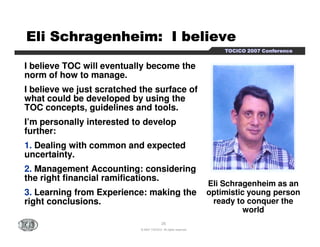
Eli Schragenheim as an 
optimistic young person 
ready to conquer the 
world 
further: 
1. Dealing with common and expected 
uncertainty. 
2. Management Accounting: considering 
the right financial ramifications. 
3. Learning from Experience: making the 
right conclusions.

Make to-availability and beyond

  • 1.
    TTTTOOOOCCCCIIIICCCCOOOO 2222000000007777 CCCCoooonnnnffffeeeerrrreeeennnncccceeee TTTTOOOOCCCCIIIICCCCOOOO CCCCOOOONNNNFFFFEEEERRRREEEENNNNCCCCEEEE 2222000000007777 MMMMMMMMaaaaaaaakkkkkkkkeeeeeeee ttttttttoooooooo AAAAAAAAvvvvvvvvaaaaaaaaiiiiiiiillllllllaaaaaaaabbbbbbbbiiiiiiiilllllllliiiiiiiittttttttyyyyyyyy aaaaaaaannnnnnnndddddddd BBBBBBBBeeeeeeeeyyyyyyyyoooooooonnnnnnnndddddddd Using market buffers and/or capacity buffers to enable both growth and stability. Presented By: Eli Schragenheim, The Goldratt Schools Date: November 5th, 2007 1 © 2007 TOCICO. All rights reserved.
  • 2.
    TTTTOOOOCCCCIIIICCCCOOOO 2222000000007777 CCCCoooonnnnffffeeeerrrreeeennnncccceeee DDDDDDDDeeeeeeeeffffffffiiiiiiiinnnnnnnniiiiiiiittttttttiiiiiiiioooooooonnnnnnnn • Make to Availability is a commitment to the market, or to specified clients, to maintain enough availability at a specific warehouse to be able to deliver immediately upon request at all times. • This definition is different from make-to-stock where no firm commitment is given. • A make-to-order environment that requires shorter delivery time than the production lead-time, calls for make-to-stock that is similar, but not the same, as make-to-availability. 2 © 2007 TOCICO. All rights reserved.
  • 3.
    MMMMMMMMaaaaaaaakkkkkkkkeeeeeeee-ttttttttoooooooo-aaaaaaaavvvvvvvvaaaaaaaaiiiiiiiillllllllaaaaaaaabbbbbbbbiiiiiiiilllllllliiiiiiiittttttttyyyyyyyy vvvvvvvveeeeeeeerrrrrrrrssssssssuuuuuuuussssssss mmmmmmmmaaaaaaaakkkkkkkkeeeeeeee-ttttttttoooooooo-ssssssssttttttttoooooooocccccccckkkkkkkk TTTTOOOOCCCCIIIICCCCOOOO 2222000000007777 CCCCoooonnnnffffeeeerrrreeeennnncccceeee • Make-to-stock includes all cases where items are produced without a specific customer order. − Manufacturing companies that basically produce to order usually mix their production with make to stock. • A typical managerial question in such environments is: what is available to promise? − That question testifies to the current state of confusion. − A company claims it makes to order, but it produces, from time to time, also to stock, so it can sometimes deliver faster. − But, the company’s response time is not always fast, actually it is usually quite slow, so it cannot commit to fast delivery at all times. 3 © 2007 TOCICO. All rights reserved.
  • 4.
    TTTTOOOOCCCCIIIICCCCOOOO 2222000000007777 CCCCoooonnnnffffeeeerrrreeeennnncccceeee MMMMMMMMaaaaaaaakkkkkkkkeeeeeeee-ttttttttoooooooo-aaaaaaaavvvvvvvvaaaaaaaaiiiiiiiillllllllaaaaaaaabbbbbbbbiiiiiiiilllllllliiiiiiiittttttttyyyyyyyy tttttttthhhhhhhheeeeeeee nnnnnnnneeeeeeeeeeeeeeeedddddddd aaaaaaaannnnnnnndddddddd tttttttthhhhhhhheeeeeeee ddddddddiiiiiiiiffffffffffffffffiiiiiiiiccccccccuuuuuuuullllllllttttttttyyyyyyyy • The point in offering a commitment for availability is to allow the potential client to rely on getting very fast response whenever needed! − It is applicable when the client is able to improve his business due to the availability provided. • Difficulty: How strong can our commitment be? − There is no way to provide true 100% availability. 4 © 2007 TOCICO. All rights reserved.
  • 5.
    TTTTTTTThhhhhhhheeeeeeee ffffffffooooooooccccccccuuuuuuuussssssss oooooooofffffffftttttttthhhhhhhhiiiiiiiissssssss pppppppprrrrrrrreeeeeeeesssssssseeeeeeeennnnnnnnttttttttaaaaaaaattttttttiiiiiiiioooooooonnnnnnnn TTTTOOOOCCCCIIIICCCCOOOO 2222000000007777 CCCCoooonnnnffffeeeerrrreeeennnncccceeee • Provide the operational issues related to make-to-availability (MTA). − Marketing and sales aspects are not included. • Also mentioning issues that in their way highlight the MTA aspects 1. The concept of the market buffer. 2. The use of capacity buffers as means to quickly expand the internal capacity whenever there is a need. 3. When the market tolerance is larger than zero. 5 © 2007 TOCICO. All rights reserved.
  • 6.
    TTTTOOOOCCCCIIIICCCCOOOO 2222000000007777 CCCCoooonnnnffffeeeerrrreeeennnncccceeee WWWWWWWWhhhhhhhhaaaaaaaatttttttt iiiiiiiissssssss uuuuuuuunnnnnnnniiiiiiiiqqqqqqqquuuuuuuueeeeeeee iiiiiiiinnnnnnnn MMMMMMMMTTTTTTTTAAAAAAAA • The real need of the market, for a certain quantity at a point in time, is not known at the planning stage. − An assumption: we have much better idea of the potential demand in the short term. − The most effective way to forecast the short-term demand is to assume it’d be similar to the present demand. − Thus, very fast reaction to the present demand is a key in MTA, on top of protecting the immediate sales by stock buffer. 6 © 2007 TOCICO. All rights reserved.
  • 7.
    TTTTTTTThhhhhhhheeeeeeee tttttttthhhhhhhhrrrrrrrreeeeeeeeeeeeeeee cccccccciiiiiiiirrrrrrrrcccccccclllllllleeeeeeeessssssssooooooooffffffff pppppppprrrrrrrrooooooootttttttteeeeeeeeccccccccttttttttiiiiiiiioooooooonnnnnnnn TTTTOOOOCCCCIIIICCCCOOOO 2222000000007777 CCCCoooonnnnffffeeeerrrreeeennnncccceeee 1. First of all we protect the availability by holding enough stock, both at the warehouse and in production, to cover for maximum demand within the replenishment time. − And short replenishment time is an enabler to provide adequate protection at that level. 2. Then, in the execution phase, we monitor the real priorities of the production orders as being expressed by the state of the stock buffer. 3. And the replenishment time is protected by maintaining minimum protective/excess capacity. 7 © 2007 TOCICO. All rights reserved.
  • 8.
    EEEEEEEEnnnnnnnnssssssssuuuuuuuurrrrrrrriiiiiiiinnnnnnnngggggggg tttttttthhhhhhhheeeeeeee aaaaaaaaddddddddeeeeeeeeqqqqqqqquuuuuuuuaaaaaaaatttttttteeeeeeeepppppppprrrrrrrrooooooootttttttteeeeeeeeccccccccttttttttiiiiiiiioooooooonnnnnnnn iiiiiiiissssssss rrrrrrrreeeeeeeeaaaaaaaallllllllllllllllyyyyyyyy oooooooonnnnnnnn TTTTOOOOCCCCIIIICCCCOOOO 2222000000007777 CCCCoooonnnnffffeeeerrrreeeennnncccceeee • Do we have the right stock buffers? − Dynamic Buffer Management (DBM) is an algorithm that signals when a change in the buffer is recommended. − This is based on the behavior of the stock buffers, not on re-calculating the maximum demand within rep. time. • Do the operators have an access to the single priority list and do they really follow the priorities? − Buffer Management provides the only priorities. Red orders should be expedited at all costs. • How do we ensure we have the capacity to maintain the fast replenishment time we need? 8 © 2007 TOCICO. All rights reserved.
  • 9.
    TTTTTTTThhhhhhhheeeeeeee vvvvvvvvaaaaaaaagggggggguuuuuuuueeeeeeee nnnnnnnnaaaaaaaattttttttuuuuuuuurrrrrrrreeeeeeeeooooooooffffffff ccccccccaaaaaaaappppppppaaaaaaaacccccccciiiiiiiittttttttyyyyyyyy TTTTOOOOCCCCIIIICCCCOOOO 2222000000007777 CCCCoooonnnnffffeeeerrrreeeennnncccceeee • Critical realization: The response time to the market is heavily impacted by the amount of excess capacity of the weakest link. • In manufacturing, where the processing times are relatively short, and when all the flawed policies been chased out, the excess capacity of the CCR is the key factor of the average replenishment time. 9 © 2007 TOCICO. All rights reserved.
  • 10.
    TTTTTTTThhhhhhhheeeeeeee vvvvvvvvaaaaaaaagggggggguuuuuuuueeeeeeee nnnnnnnnaaaaaaaattttttttuuuuuuuurrrrrrrreeeeeeeeooooooooffffffff ccccccccaaaaaaaappppppppaaaaaaaacccccccciiiiiiiittttttttyyyyyyyy TTTTOOOOCCCCIIIICCCCOOOO 2222000000007777 CCCCoooonnnnffffeeeerrrreeeennnncccceeee • However, the term “excess capacity” is not simple to express and measure. − If a resource is expected to process today 3-day load, does it mean the resource is a “bottleneck”? −What is the damage of one day of load being delayed by two days? − And if in three days from now, the resource would have nothing to do, would you still refer to it as a “bottleneck”? 10 © 2007 TOCICO. All rights reserved.
  • 11.
    TTTTOOOOCCCCIIIICCCCOOOO 2222000000007777 CCCCoooonnnnffffeeeerrrreeeennnncccceeee MMMMMMMMeeeeeeeeaaaaaaaassssssssuuuuuuuurrrrrrrriiiiiiiinnnnnnnngggggggg tttttttthhhhhhhheeeeeeee llllllllooooooooaaaaaaaadddddddd vvvvvvvveeeeeeeerrrrrrrrssssssssuuuuuuuussssssss ccccccccaaaaaaaappppppppaaaaaaaacccccccciiiiiiiittttttttyyyyyyyy • Realization: in order to decide whether the load on a resource is “too high” we need to consider a horizon of time where we expect the resource to respond to a need. − We need to consider all the demand that is expected to be delivered within that horizon of time. − Then validate that the resource has enough capacity to handle it, including a certain extra for Murphy and going through the rest of the system. − This realization constitutes the definition of the planned 11 © 2007 TOCICO. All rights reserved. load:
  • 12.
    PPPPPPPPllllllllaaaaaaaannnnnnnnnnnnnnnneeeeeeeedddddddd LLLLLLLLooooooooaaaaaaaadddddddd ffffffffoooooooorrrrrrrrMMMMMMMMaaaaaaaakkkkkkkkeeeeeeee-ttttttttoooooooo-AAAAAAAAvvvvvvvvaaaaaaaaiiiiiiiillllllllaaaaaaaabbbbbbbbiiiiiiiilllllllliiiiiiiittttttttyyyyyyyy TTTTOOOOCCCCIIIICCCCOOOO 2222000000007777 CCCCoooonnnnffffeeeerrrreeeennnncccceeee • Definition: The Planned Load is the accumulation of the load on the CCR of all the demand that have to be delivered within a certain horizon of time. • The concept of the planned load fits make-to-order very nicely. − It helps to smooth the load on the CCR and thus on the shop as 12 © 2007 TOCICO. All rights reserved. a whole. − It gives adequate idea whether the committed due-date is safe. • In MTA environment when a production order is initiated it has no firm due-date! − It’s relative priority would be determined by the sales in the near short term.
  • 13.
    UUUUUUUUssssssssiiiiiiiinnnnnnnngggggggg tttttttthhhhhhhheeeeeeee PPPPPPPPllllllllaaaaaaaannnnnnnnnnnnnnnneeeeeeeeddddddddLLLLLLLLooooooooaaaaaaaadddddddd ttttttttoooooooo mmmmmmmmeeeeeeeeaaaaaaaassssssssuuuuuuuurrrrrrrreeeeeeee ccccccccaaaaaaaappppppppaaaaaaaacccccccciiiiiiiittttttttyyyyyyyy ffffffffoooooooorrrrrrrr MMMMMMMMaaaaaaaakkkkkkkkeeeeeeee-ttttttttoooooooo-AAAAAAAAvvvvvvvvaaaaaaaaiiiiiiiillllllllaaaaaaaabbbbbbbbiiiiiiiilllllllliiiiiiiittttttttyyyyyyyy TTTTOOOOCCCCIIIICCCCOOOO 2222000000007777 CCCCoooonnnnffffeeeerrrreeeennnncccceeee • How we translate the idea of the planned load to MTA, and get a good measure whether the available capacity is adequate? • When we maintain stock for MTA we should have an idea of the average replenishment time we try to maintain. • Let the average replenishment time be the horizon. • All the replenishment requirements be considered in the planned load for MTA. − This means not just the orders that have been released, but also those that their release was delayed because of too much load already in the shop. 13 © 2007 TOCICO. All rights reserved.
  • 14.
    PPPPPPPPrrrrrrrreeeeeeeesssssssseeeeeeeerrrrrrrrvvvvvvvviiiiiiiinnnnnnnngggggggg tttttttthhhhhhhheeeeeeee eeeeeeeexxxxxxxxcccccccceeeeeeeessssssssssssssssccccccccaaaaaaaappppppppaaaaaaaacccccccciiiiiiiittttttttyyyyyyyy TTTTOOOOCCCCIIIICCCCOOOO 2222000000007777 CCCCoooonnnnffffeeeerrrreeeennnncccceeee • The planned load for MTA should not be over 80% of the time horizon. − The horizon being equal to the average replenishment time. • The 80% line ensures that: − There is enough excess capacity to be able to expedite when 14 © 2007 TOCICO. All rights reserved. needed. − When the total demand grows the excess capacity gives management some time to react. − Either to restraint the sales or to increase capacity. • Warning: when demand is up then excess capacity goes down and the replenishment time goes up exponentially.
  • 15.
    TTTTOOOOCCCCIIIICCCCOOOO 2222000000007777 CCCCoooonnnnffffeeeerrrreeeennnncccceeee AAAAAAAAnnnnnnnn eeeeeeeexxxxxxxxaaaaaaaammmmmmmmpppppppplllllllleeeeeeee • A producer of towels has an average replenishment time of 5 weeks to reach its plant warehouse. − The planned load to process all replenishments should not be more than 4 weeks. − It is possible to expedite a minimum batch in mere 4 days. − But, that is only in case of emergency. • What would happen if the total demand grow by 10%? − The planned load would fluctuate around 4.5 weeks. − The number of orders to be expedited would grow substantially. − Some buffers might be signaled for increase. This would add even more load on the system. − If we did not have substantially more excess capacity than 10%, such a sudden increase could cause losing the availability and credibility. 15 © 2007 TOCICO. All rights reserved.
  • 16.
    TTTTOOOOCCCCIIIICCCCOOOO 2222000000007777 CCCCoooonnnnffffeeeerrrreeeennnncccceeee WWWWWWWWhhhhhhhhaaaaaaaatttttttt ttttttttoooooooo ddddddddoooooooo wwwwwwwwiiiiiiiitttttttthhhhhhhh 2222222200000000%%%%%%%% eeeeeeeexxxxxxxxcccccccceeeeeeeessssssssssssssss ccccccccaaaaaaaappppppppaaaaaaaacccccccciiiiiiiittttttttyyyyyyyy???????? • One option is: let it be. − Let the CCR be actually idle for about 20% of the time when we review the long term. − Another option is letting the CCR “waste” this capacity by processing very small daily batches. • Another option: finding something the CCR can do with its spare capacity. − Necessary condition: Whatever the CCR would do in those 20% of capacity has clearly less priority and will never cause a delay in production for the MTA market. − Thus, it cannot be a market for which we have any 16 © 2007 TOCICO. All rights reserved. commitment. − Naturally it won’t be a very lucrative market.
  • 17.
    TTTTOOOOCCCCIIIICCCCOOOO 2222000000007777 CCCCoooonnnnffffeeeerrrreeeennnncccceeee TTTTTTTThhhhhhhheeeeeeee MMMMMMMMaaaaaaaarrrrrrrrkkkkkkkkeeeeeeeetttttttt BBBBBBBBuuuuuuuuffffffffffffffffeeeeeeeerrrrrrrr • Definition: Market Buffer is a well defined segment of the market where no commitment is made, but if the items are produced to stock it’d be possible to sell them for positive T. • The idea is to take advantage of the CCR limited capacity in such a way that would not harm the performance for the commitment market. • The Market Buffer is not really a buffer, it is a way to exploit the secondary constraint. − The main constraint is the lucrative market. − It uses the “excess-capacity-buffer”, the 20% of excess we must keep to keep the MTA intact, in a way that pays back the cost of the buffer. 17 © 2007 TOCICO. All rights reserved.
  • 18.
    TTTTTTTThhhhhhhheeeeeeee cccccccchhhhhhhhaaaaaaaarrrrrrrraaaaaaaacccccccctttttttteeeeeeeerrrrrrrriiiiiiiissssssssttttttttiiiiiiiiccccccccssssssss oooooooofffffffftttttttthhhhhhhheeeeeeee mmmmmmmmaaaaaaaarrrrrrrrkkkkkkkkeeeeeeeetttttttt bbbbbbbbuuuuuuuuffffffffffffffffeeeeeeeerrrrrrrr TTTTOOOOCCCCIIIICCCCOOOO 2222000000007777 CCCCoooonnnnffffeeeerrrreeeennnncccceeee • The market segment is for standard items that many suppliers offer. • In spite of the competition, either the market demand is very large, or the reputation of the company ensures that it would be sold for good enough price. • The items of the market buffer use the CCR time. • The maximum amount of items produced for the market buffer would not generate a new CCR. • The raw materials for the market buffer are routine and do not pose any additional problem. 18 © 2007 TOCICO. All rights reserved.
  • 19.
    TTTTOOOOCCCCIIIICCCCOOOO 2222000000007777 CCCCoooonnnnffffeeeerrrreeeennnncccceeee OOOOOOOOppppppppeeeeeeeerrrrrrrraaaaaaaattttttttiiiiiiiioooooooonnnnnnnnaaaaaaaallllllll rrrrrrrraaaaaaaammmmmmmmiiiiiiiiffffffffiiiiiiiiccccccccaaaaaaaattttttttiiiiiiiioooooooonnnnnnnnssssssss • A clear set of rules have to be defined for production execution to determine when a production order for the market buffer be initiated. − Notifying Sales when such an order is released to 19 © 2007 TOCICO. All rights reserved. the floor. − Note, the decision to generate a market-buffer production order should lie with the execution. • Monitoring the total load, checking that it is still at or behind 80%, before orders for the market buffer are generated.
  • 20.
    TTTTOOOOCCCCIIIICCCCOOOO 2222000000007777 CCCCoooonnnnffffeeeerrrreeeennnncccceeee CCCCCCCCaaaaaaaappppppppaaaaaaaacccccccciiiiiiiittttttttyyyyyyyy bbbbbbbbuuuuuuuuffffffffffffffffeeeeeeeerrrrrrrrssssssss • The term “capacity buffer” appears in several fields in TOC. The use here is different: • Definition: A capacity buffer is maintaining optional capacity, which is not part of the fixed costs and can be used whenever necessary, but costs extra truly-variable-costs per usage. − For instance, overtime and extra shifts. − Outsourcing. • The capacity buffer is a real buffer protecting the performance of the organization from occasional lack of capacity. 20 © 2007 TOCICO. All rights reserved.
  • 21.
    TTTTTTTThhhhhhhheeeeeeee vvvvvvvvaaaaaaaalllllllluuuuuuuueeeeeeee oooooooofffffffftttttttthhhhhhhheeeeeeee ccccccccaaaaaaaappppppppaaaaaaaacccccccciiiiiiiittttttttyyyyyyyy bbbbbbbbuuuuuuuuffffffffffffffffeeeeeeeerrrrrrrrssssssss TTTTOOOOCCCCIIIICCCCOOOO 2222000000007777 CCCCoooonnnnffffeeeerrrreeeennnncccceeee • The internal CCR can be safely used to 100%, as long as there is adequate amount of the capacity buffer left. − The real excess capacity is how much of the capacity buffer is not used. − Thus, when we recommend only 80% maximum utilization of the CCR – it includes the full capacity buffer. • Warning: Using the capacity buffer just for the CCR would elevate the CCR, and then the CCR might move to another resource. • Maintaining capacity buffers makes growth to be 21 © 2007 TOCICO. All rights reserved. smooth and stable.
  • 22.
    TTTTOOOOCCCCIIIICCCCOOOO 2222000000007777 CCCCoooonnnnffffeeeerrrreeeennnncccceeee MMMMMMMMaaaaaaaannnnnnnnaaaaaaaaggggggggiiiiiiiinnnnnnnngggggggg tttttttthhhhhhhheeeeeeee bbbbbbbbuuuuuuuuffffffffffffffffeeeeeeeerrrrrrrrssssssss • The essence of buffer management is to fix the red-line – the point where there is a threat to the protected area. • The market buffer actually uses the excess-capacity capacity buffer. Thus, the red line is a minimum quantity of production for the market-buffer in a period. − Producing less than that quantity for the market buffer, signals too low excess capacity for the main market. 22 © 2007 TOCICO. All rights reserved.
  • 23.
    A Content Buffer TTTTOOOOCCCCIIIICCCCOOOO 2222000000007777 CCCCoooonnnnffffeeeerrrreeeennnncccceeee TTTTTTTToooooooolllllllleeeeeeeerrrrrrrraaaaaaaannnnnnnncccccccceeeeeeee ttttttttiiiiiiiimmmmmmmmeeeeeeee >>>>>>>> 00000000 • In cases of make-to-order where the required response time is shorter than the production lead-time, then: − It is possible to make-to-stock to cover for the time difference between production lead-time and the industry lead-time. − This is not truly MTA, because availability is neither maintained nor committed. − But, the stock is used to ensure fast enough delivery. • In such a case the protection on the delivery is made up of a combination of two buffers: − Time buffer: the tolerance time of the customer. − Stock, the amount of stock in the system (above the net on-hand 23 © 2007 TOCICO. All rights reserved. orders).
  • 24.
    TTTTTTTThhhhhhhheeeeeeee OOOOOOOOppppppppeeeeeeeerrrrrrrraaaaaaaattttttttiiiiiiiioooooooonnnnnnnnaaaaaaaallllllll RRRRRRRRaaaaaaaammmmmmmmiiiiiiiiffffffffiiiiiiiiccccccccaaaaaaaattttttttiiiiiiiioooooooonnnnnnnnssssssss TTTTOOOOCCCCIIIICCCCOOOO 2222000000007777 CCCCoooonnnnffffeeeerrrreeeennnncccceeee • Any incoming order initiates a production order for the same quantity. • A target level of stock is maintained on top of the customer orders. • There should be enough finished goods stock, at any given time, for all orders to be shipped within 1/3 of the production lead-time. − If this is not the case, then the oldest order should be RED and expedited. − When the production lead time is 3 times longer than the customer lead time – move to full MTA. • The green situation means all open orders can be shipped from the finished goods stock. • According to the time spent in the red or green, rules to recommend changing the stock buffer can be developed. 24 © 2007 TOCICO. All rights reserved.
  • 25.
    EEEEEEEElllllllliiiiiiii SSSSSSSScccccccchhhhhhhhrrrrrrrraaaaaaaaggggggggeeeeeeeennnnnnnnhhhhhhhheeeeeeeeiiiiiiiimmmmmmmm:::::::: IIIIIIIIbbbbbbbbeeeeeeeelllllllliiiiiiiieeeeeeeevvvvvvvveeeeeeee TTTTOOOOCCCCIIIICCCCOOOO 2222000000007777 CCCCoooonnnnffffeeeerrrreeeennnncccceeee I believe TOC will eventually become the norm of how to manage. I believe we just scratched the surface of what could be developed by using the TOC concepts, guidelines and tools. I’’m personally interested to develop 25 © 2007 TOCICO. All rights reserved. Eli Schragenheim as an optimistic young person ready to conquer the world further: 1. Dealing with common and expected uncertainty. 2. Management Accounting: considering the right financial ramifications. 3. Learning from Experience: making the right conclusions.