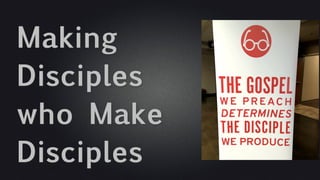
Making
Disciples
who Make
Disciples
Making
Disciples
who Make
Disciples
Most Christians have
never been
intentionally and
personally discipled!
“Discipling is a process that
takes place within accountable
relationships over a period of
time for the purpose of bringing
believers to spiritual maturity in
Christ.”
2. The Christian
Life: Casual versus
Disciplined
The Bible shows the
followers of Jesus living
disciplined lives.
However, only a small %
of believers are focussed
on intentional (deliberate
and determined) spiritual
growth.
Anyone who desires
to be good at
something disciplines
their life around it—
musicians, students,
sportsmen etc.
Anyone who desires
to be good at
something disciplines
their life around it—
musicians, students,
sportsmen etc.
1 Cor 9:24-27, NLT
Don’t you realize that in a race everyone runs,
but only one person gets the prize? So run to
win! 25 All athletes are disciplined in their
training. They do it to win a prize that will fade
away, but we do it for an eternal prize. 26 So I
run with purpose in every step. I am not just
shadowboxing. 27 I discipline my body like an
athlete, training it to do what it should.
Otherwise, I fear that after preaching to others
I myself might be disqualified.
Hebrews 5:12-14,
You have been believers so long now that you
ought to be teaching others. Instead, you need
someone to teach you again the basic things
about God’s word.[c] You are like babies who
need milk and cannot eat solid food. 13 For
someone who lives on milk is still an infant and
doesn’t know how to do what is right. 14 Solid
food is for those who are mature, who through
training have the skill to recognize the difference
between right and wrong
Dallas Willard,
“Grace is opposed
to earning, but not
to effort.”
A survey of Christians in the USA,
19% made daily reading of
Scripture a habit
33% studied the Bible in a small
group
25% were involved in reading or
discussing a Christian book
What of you, e.g.:
Relational engagement - are you
deliberately relating to other
believers?
Are you involved in a small
group?
Discipline involves intention and a
plan of action.
Do you have any specific,
measurable goals to grow
spiritually?
“...eight out of ten believers (USA)
found success in family, career
development and financial
achievement. This is hardly
distinguishable from the American
dream”
Greg Ogden
3. Discipleship:
Private versus
Holistic
In the Bible our
discipleship is seen
affecting every area
of life—faith is not a
personal, private
issue.
In the Kingdom
there is no area
of life that is not
meant to be
affected by it.
Parable of
Mustard Seed
We repented,
believed and
followed, we are in
a kingdom of light
not of darkness
(Mark 1:15-17,
Col 1:13).
The kingdom is where we belong
to: this applies to…
hearts, homes, workplaces;
attitudes thoughts and desires;
relationships and moral
decisions;
political convictions and social
awareness.
In every area we seek to
know and live the mind and
will of God.
I am a disciple of Jesus
masquerading (acting)
as a school-teacher /
plumber / taxi-driver
etc.
I am a disciple of Jesus
masquerading (acting)
as a school-teacher /
plumber / taxi-driver
etc.
My job might be to teach
children, but my call is
to follow Jesus in all I
do
People try to divide their life
into two parts: the secular and
the spiritual.
In the kingdom of light
everything in your life is
spiritual.
The social or secular world
produces different thoughts,
values and actions—for many
Christians it is a place where
faith is minimised.
Does your church call
you to account for
what you do in your
job as it is seen as
ministry to others?
Do I need support to
be effective for Jesus
in my job?
Are you expected
to make Christ-
focussed ethical
decisions?
Does your church
publicly affirm your
job as being part of
the call of God?
Are you expected
to make Christ-
focussed ethical
decisions?
Does your church
publicly affirm your
job as being part of
the call of God?
Does your church
care about how you
minister in your
daily work?
Does your church
care about how you
minister in your
daily work?
4. Church:
Conformed versus
Transformed
4. Church: The
same or Different?
Scripture shows
the church as a
counter-cultural
force.
John Stott
suggests that the
church is meant to
be a community of
“radical
nonconformity” or
a “contrast
society.”
John Stott
suggests that the
church is meant to
be a community of
“radical
nonconformity” or
a “contrast
society.”
John Stott
suggests that the
church is meant to
be a community of
“radical
nonconformity” or
a “contrast
society.”
1 Peter 2:11, all sorts of words
are translated to describe the
people of the kingdom:
temporary residents,
foreigners, aliens, exiles,
travellers.
The church, collectively, is
to present a lifestyle which
is a real, countercultural,
alternative to mainstream
society.
Matt 5:16,
16 In the same way, let your
light shine before others, so that
they may see your good works
and give glory to your Father
who is in heaven.
1 Peter 2:12,
12 Live such good lives among
the pagans that, though they
accuse you of doing wrong, they
may see your good deeds and
glorify God on the day he visits
us.
Do we think
differently on...
Divorce
Materialism
Sexual promiscuity
Sexual Identity
Racism
Abortion
Abuse within
marriage...
in the USA,
84% of adults think “the
highest goal in life is to enjoy
it as much as possible”
66% of Christians agreed!
And...
“the best way to find yourself
is to look within yourself”
91% adults, 76% of Christians.
For many Christians it is not
Jesus the way, but the way of
self.
The church is to be a
contrast standing on
kingdom values,
which are built on a
disciple-making
agenda of people
who are in covenant
relationship.
How do you assess the
lifestyle of believers in
your network of
relationships?
Will you be accountable
to a body of believers—
people who can
challenge you about
your commitments and
faithfulness?
5. Church:
Optional versus
Essential
Do you have a
choice?
The church, biblically speaking,
is the organism in which Christ
dwells.
Many see the church as an
optional institution, unnecessary
for discipleship.
The church is the
replacement for Jesus
Christ here on earth—the
incarnation of Jesus
continues within his people.
“The life of Jesus is still being
manifest among people, but
now no longer through an
individual physical body,
limited to one place on earth,
but through a complex,
corporate body called the
church.”
Paul’s favourite
image for the
church is the body
of Christ. This is
not an image, the
church is the body
of Christ.
The church is:
not optional…We cannot say
“Jesus yes, the church no!”
…central to God’s plan of
salvation
…God’s new community
God’s way of doing discipleship
David Platt quotes a preacher,
“Tonight, I want to call you to
put your faith in God.I am
urging you to begin a personal
relationship with Jesus. But let
me be clear. I’m not inviting
you to join the church. I’m
inviting you to come to Christ.”
Do you agree or disagree with
this statement:
You cannot become a
complete and mature person
unless you belong to a
community of faith that
influences you?
“Unless a commitment
to a church
community is similar
to the covenant of
marriage, how can
people be formed into
Christlike disciples?”
Greg Ogden
How do you
understand church
from God’s plan—is it
an option or central
to God’s view of
salvation?
6. Bible: Illiterate
versus Informed
John Wesley’s
followers were often
called, “the people of
the book”.
For many modern
believers their Bible
knowledge is very
poor.
The way God thinks and the way we
should live is revealed in the Bible.
2 Tim 3:15,
“15 You have been taught the holy
Scriptures from childhood, and they
have given you the wisdom to
receive the salvation that comes by
trusting in Christ Jesus.”
Scripture gives us answers to
life's most important worldview
questions:
How did the world come into
being?
Why are we here?
What went wrong?
How can it be made right?
Where is it all going?
Most believers say they love the
Bible, but they don’t read it!
In the USA,
14% of Christians read the
Bible each day
12% think they are highly
knowledgable about the Bible
43% of believers could name
the first 5 books of the Bible
40% thought JTB was one of
the disciples
25% recognised “the truth
shall set you free as being part
of the Bible
A	worldview	is	a	defined	
philosophy	[a	theory	or	attitude	
that	acts	as	a	guiding	principle	
for	behaviour]	about	life	that	
influences	and	directs	how	we	
live
Amos 8:11 NLT,
“The time is surely coming,” says
the Sovereign Lord,
“when I will send a famine on
the land— not a famine of bread
or water but of hearing the
words of the Lord.
7. Witness:
Inactive versus
Active
The Bible shows us that
all are to share the
story of their faith in
Christ with others.
We are all part of the
story that God is writing
- alone and together
our story forms part of
his bigger story.
Acts 1:8,
But you will receive
power when the Holy
Spirit comes upon you.
And you will be my
witnesses, telling people
about me everywhere—in
Jerusalem, throughout
Judea, in Samaria, and to
the ends of the earth.”
Acts 1:8,
But you will receive
power when the Holy
Spirit comes upon you.
And you will be my
witnesses, telling people
about me everywhere—in
Jerusalem, throughout
Judea, in Samaria, and to
the ends of the earth.”
Do you think it is
important to spend time
building relationships with
non-believers?
How often do you do this?
Worldwide we live in an age of
relativism—the belief that there
is no absolute truth.
Truth becomes what is true for
me, designer truth!
Nothing is right or
wrong; what is
important is what
works for us.
We often apply this
to religion too.
In such thinking believing in a
universal truth is considered
judgemental and intolerant!
Christians are called to swim
against the tide here—even if it
is hard.
If someone looks at your life
when thinking of becoming a
Christian, “Are they trading up
(improving) or trading down
(getting worse)?
What do I have to
offer? Is it life
giving, of vital
importance?
Do you want others
to have the same
relationship and
opportunity that you
have?
Do you experience
joy and love of Jesus
in such a way that
it’s attractive to
others
Are you ready and
willing to share the
good news of Jesus
with others?
Where are you?
Where are the
gaps in your life?
Where in these areas
do you see...
Yourself
Your church
Your Ministry
The Church in
general?
What work needs to be done to
close the discipleship gap?
Barna,
“Christianity would be incredibly
influential in our culture if Christians
consistently lived their faith. Most
non Christians don’t read the Bible,
so they judge Christianity by the
lives of the Christians they see.
Barna,
“Christianity would be incredibly
influential in our culture if Christians
consistently lived their faith. Most
non Christians don’t read the Bible,
so they judge Christianity by the
lives of the Christians they see.
The problem is that millions of
Christians don’t live like
Christians – and that’s partially
because they don’t know what
they believe and therefore
cannot apply appropriate
scriptural values to their lives.”

Make disciples who make disciples part2

  • 1.
  • 2.
  • 3.
    Most Christians have neverbeen intentionally and personally discipled!
  • 4.
    “Discipling is aprocess that takes place within accountable relationships over a period of time for the purpose of bringing believers to spiritual maturity in Christ.”
  • 5.
    2. The Christian Life:Casual versus Disciplined
  • 6.
    The Bible showsthe followers of Jesus living disciplined lives.
  • 7.
    However, only asmall % of believers are focussed on intentional (deliberate and determined) spiritual growth.
  • 8.
    Anyone who desires tobe good at something disciplines their life around it— musicians, students, sportsmen etc.
  • 9.
    Anyone who desires tobe good at something disciplines their life around it— musicians, students, sportsmen etc.
  • 10.
    1 Cor 9:24-27,NLT Don’t you realize that in a race everyone runs, but only one person gets the prize? So run to win! 25 All athletes are disciplined in their training. They do it to win a prize that will fade away, but we do it for an eternal prize. 26 So I run with purpose in every step. I am not just shadowboxing. 27 I discipline my body like an athlete, training it to do what it should. Otherwise, I fear that after preaching to others I myself might be disqualified.
  • 11.
    Hebrews 5:12-14, You havebeen believers so long now that you ought to be teaching others. Instead, you need someone to teach you again the basic things about God’s word.[c] You are like babies who need milk and cannot eat solid food. 13 For someone who lives on milk is still an infant and doesn’t know how to do what is right. 14 Solid food is for those who are mature, who through training have the skill to recognize the difference between right and wrong
  • 12.
    Dallas Willard, “Grace isopposed to earning, but not to effort.”
  • 13.
    A survey ofChristians in the USA, 19% made daily reading of Scripture a habit 33% studied the Bible in a small group 25% were involved in reading or discussing a Christian book
  • 14.
    What of you,e.g.: Relational engagement - are you deliberately relating to other believers? Are you involved in a small group? Discipline involves intention and a plan of action.
  • 15.
    Do you haveany specific, measurable goals to grow spiritually?
  • 16.
    “...eight out often believers (USA) found success in family, career development and financial achievement. This is hardly distinguishable from the American dream” Greg Ogden
  • 18.
  • 19.
    In the Bibleour discipleship is seen affecting every area of life—faith is not a personal, private issue.
  • 20.
    In the Kingdom thereis no area of life that is not meant to be affected by it. Parable of Mustard Seed
  • 21.
    We repented, believed and followed,we are in a kingdom of light not of darkness (Mark 1:15-17, Col 1:13).
  • 22.
    The kingdom iswhere we belong to: this applies to… hearts, homes, workplaces; attitudes thoughts and desires; relationships and moral decisions;
  • 24.
    political convictions andsocial awareness. In every area we seek to know and live the mind and will of God.
  • 25.
    I am adisciple of Jesus masquerading (acting) as a school-teacher / plumber / taxi-driver etc.
  • 26.
    I am adisciple of Jesus masquerading (acting) as a school-teacher / plumber / taxi-driver etc. My job might be to teach children, but my call is to follow Jesus in all I do
  • 27.
    People try todivide their life into two parts: the secular and the spiritual. In the kingdom of light everything in your life is spiritual.
  • 28.
    The social orsecular world produces different thoughts, values and actions—for many Christians it is a place where faith is minimised.
  • 31.
    Does your churchcall you to account for what you do in your job as it is seen as ministry to others? Do I need support to be effective for Jesus in my job?
  • 32.
    Are you expected tomake Christ- focussed ethical decisions? Does your church publicly affirm your job as being part of the call of God?
  • 33.
    Are you expected tomake Christ- focussed ethical decisions? Does your church publicly affirm your job as being part of the call of God? Does your church care about how you minister in your daily work?
  • 34.
    Does your church careabout how you minister in your daily work?
  • 35.
  • 36.
    4. Church: The sameor Different?
  • 37.
    Scripture shows the churchas a counter-cultural force.
  • 38.
    John Stott suggests thatthe church is meant to be a community of “radical nonconformity” or a “contrast society.”
  • 39.
    John Stott suggests thatthe church is meant to be a community of “radical nonconformity” or a “contrast society.”
  • 40.
    John Stott suggests thatthe church is meant to be a community of “radical nonconformity” or a “contrast society.”
  • 41.
    1 Peter 2:11,all sorts of words are translated to describe the people of the kingdom: temporary residents, foreigners, aliens, exiles, travellers.
  • 42.
    The church, collectively,is to present a lifestyle which is a real, countercultural, alternative to mainstream society.
  • 43.
    Matt 5:16, 16 Inthe same way, let your light shine before others, so that they may see your good works and give glory to your Father who is in heaven.
  • 44.
    1 Peter 2:12, 12Live such good lives among the pagans that, though they accuse you of doing wrong, they may see your good deeds and glorify God on the day he visits us.
  • 45.
    Do we think differentlyon... Divorce Materialism Sexual promiscuity Sexual Identity
  • 46.
  • 47.
    in the USA, 84%of adults think “the highest goal in life is to enjoy it as much as possible” 66% of Christians agreed! And...
  • 48.
    “the best wayto find yourself is to look within yourself” 91% adults, 76% of Christians. For many Christians it is not Jesus the way, but the way of self.
  • 49.
    The church isto be a contrast standing on kingdom values, which are built on a disciple-making agenda of people who are in covenant relationship.
  • 50.
    How do youassess the lifestyle of believers in your network of relationships?
  • 51.
    Will you beaccountable to a body of believers— people who can challenge you about your commitments and faithfulness?
  • 52.
  • 53.
    Do you havea choice?
  • 54.
    The church, biblicallyspeaking, is the organism in which Christ dwells. Many see the church as an optional institution, unnecessary for discipleship.
  • 55.
    The church isthe replacement for Jesus Christ here on earth—the incarnation of Jesus continues within his people.
  • 56.
    “The life ofJesus is still being manifest among people, but now no longer through an individual physical body, limited to one place on earth, but through a complex, corporate body called the church.”
  • 57.
    Paul’s favourite image forthe church is the body of Christ. This is not an image, the church is the body of Christ.
  • 59.
    The church is: notoptional…We cannot say “Jesus yes, the church no!” …central to God’s plan of salvation …God’s new community God’s way of doing discipleship
  • 60.
    David Platt quotesa preacher, “Tonight, I want to call you to put your faith in God.I am urging you to begin a personal relationship with Jesus. But let me be clear. I’m not inviting you to join the church. I’m inviting you to come to Christ.”
  • 61.
    Do you agreeor disagree with this statement: You cannot become a complete and mature person unless you belong to a community of faith that influences you?
  • 62.
    “Unless a commitment toa church community is similar to the covenant of marriage, how can people be formed into Christlike disciples?” Greg Ogden
  • 63.
    How do you understandchurch from God’s plan—is it an option or central to God’s view of salvation?
  • 66.
  • 67.
    John Wesley’s followers wereoften called, “the people of the book”. For many modern believers their Bible knowledge is very poor.
  • 68.
    The way Godthinks and the way we should live is revealed in the Bible. 2 Tim 3:15, “15 You have been taught the holy Scriptures from childhood, and they have given you the wisdom to receive the salvation that comes by trusting in Christ Jesus.”
  • 69.
    Scripture gives usanswers to life's most important worldview questions: How did the world come into being? Why are we here? What went wrong? How can it be made right? Where is it all going?
  • 70.
    Most believers saythey love the Bible, but they don’t read it! In the USA, 14% of Christians read the Bible each day 12% think they are highly knowledgable about the Bible
  • 71.
    43% of believerscould name the first 5 books of the Bible 40% thought JTB was one of the disciples 25% recognised “the truth shall set you free as being part of the Bible
  • 72.
  • 75.
    Amos 8:11 NLT, “Thetime is surely coming,” says the Sovereign Lord, “when I will send a famine on the land— not a famine of bread or water but of hearing the words of the Lord.
  • 78.
  • 79.
    The Bible showsus that all are to share the story of their faith in Christ with others. We are all part of the story that God is writing - alone and together our story forms part of his bigger story.
  • 80.
    Acts 1:8, But youwill receive power when the Holy Spirit comes upon you. And you will be my witnesses, telling people about me everywhere—in Jerusalem, throughout Judea, in Samaria, and to the ends of the earth.”
  • 81.
    Acts 1:8, But youwill receive power when the Holy Spirit comes upon you. And you will be my witnesses, telling people about me everywhere—in Jerusalem, throughout Judea, in Samaria, and to the ends of the earth.”
  • 82.
    Do you thinkit is important to spend time building relationships with non-believers? How often do you do this?
  • 85.
    Worldwide we livein an age of relativism—the belief that there is no absolute truth. Truth becomes what is true for me, designer truth!
  • 86.
    Nothing is rightor wrong; what is important is what works for us. We often apply this to religion too.
  • 88.
    In such thinkingbelieving in a universal truth is considered judgemental and intolerant! Christians are called to swim against the tide here—even if it is hard.
  • 89.
    If someone looksat your life when thinking of becoming a Christian, “Are they trading up (improving) or trading down (getting worse)?
  • 90.
    What do Ihave to offer? Is it life giving, of vital importance? Do you want others to have the same relationship and opportunity that you have?
  • 91.
    Do you experience joyand love of Jesus in such a way that it’s attractive to others Are you ready and willing to share the good news of Jesus with others?
  • 92.
    Where are you? Whereare the gaps in your life?
  • 93.
    Where in theseareas do you see... Yourself Your church Your Ministry The Church in general?
  • 94.
    What work needsto be done to close the discipleship gap?
  • 95.
    Barna, “Christianity would beincredibly influential in our culture if Christians consistently lived their faith. Most non Christians don’t read the Bible, so they judge Christianity by the lives of the Christians they see.
  • 96.
    Barna, “Christianity would beincredibly influential in our culture if Christians consistently lived their faith. Most non Christians don’t read the Bible, so they judge Christianity by the lives of the Christians they see. The problem is that millions of Christians don’t live like Christians – and that’s partially because they don’t know what they believe and therefore cannot apply appropriate scriptural values to their lives.”