z
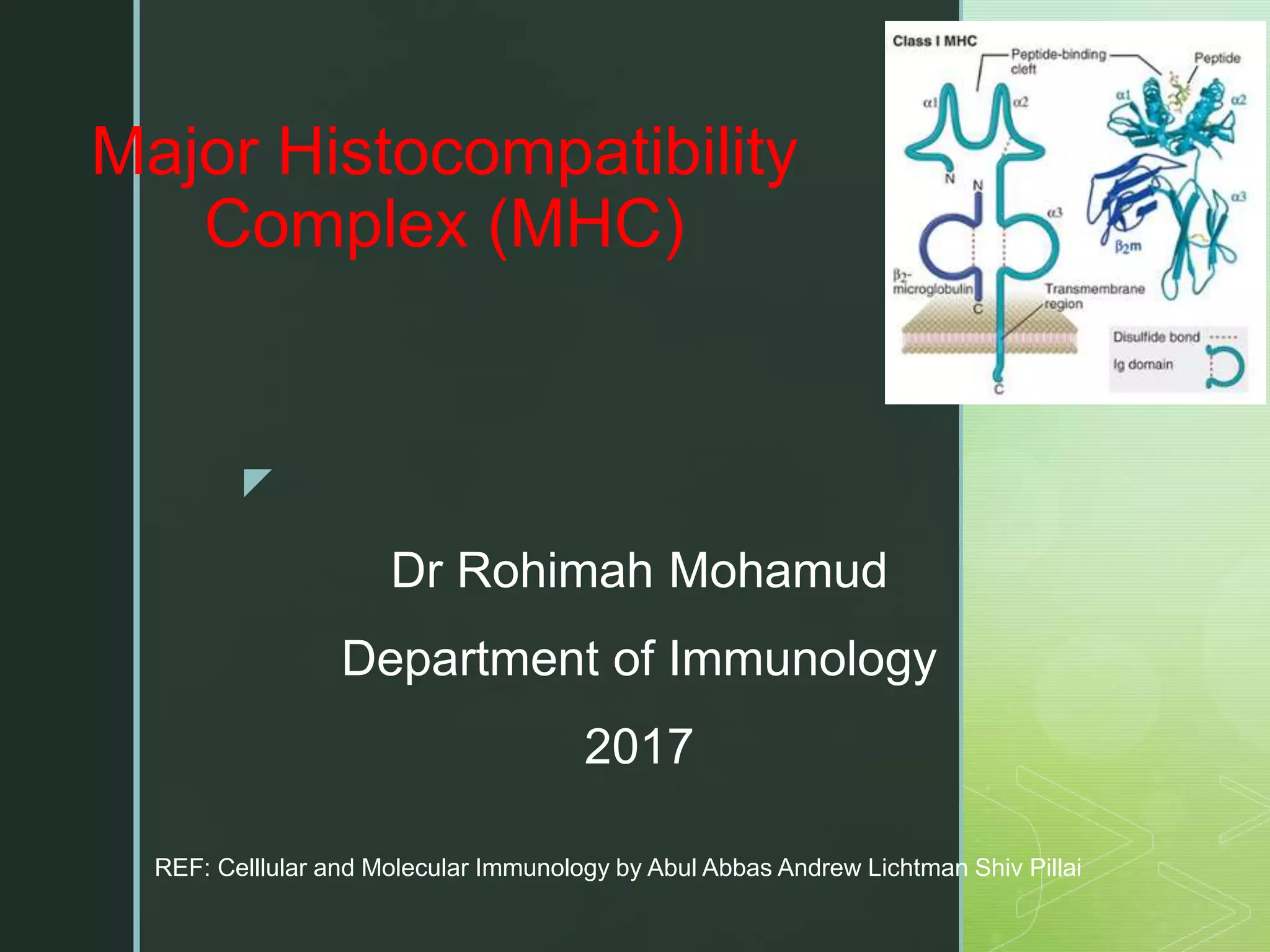
Major Histocompatibility
Complex (MHC)
Dr Rohimah Mohamud
Department of Immunology
2017
REF: Celllular and Molecular Immunology by Abul Abbas Andrew Lichtman Shiv Pillai
z
Lecture objectives: MHC structure
and functions
 discovery of MHC and different definition used in
HLA system
 genomic organization and structure of class I and
class II MHC molecules
 expression of MHC molecules
 role of MHC in immune responses
z
Discovery of the MHC: the mouse
MHC (H-2 complex)
 The MHC was discovered from studies of tissue
transplantation by George Snell and colleagues in 1940s
 They showed that a single genetic region is primarily
responsible for rapid rejection of tissue grafts - major
histocompatibility locus
 The particular locus linked to a gene on chromosome 17
encoding a blood group antigen called antigen II, and therefore
this region was named histocompatibility-2, or simply H-2.
 Initially, this locus was thought to contain a single gene that
controlled tissue compatibility.
 However, they found that occasional recombination events
occurred within the H-2 locus during interbreeding of different
strains, indicating that it contained several different but closely
linked genes
Page 117
z
MHC molecules?
 The genetic region that controlled graft rejection and contained several
linked genes
 Human form of MHC is called Human leukocyte antigens (HLA)
 A large genetic locus (on human chromosome 6 and mouse chromosome 17) that
includes the highly polymorphic genes encoding the peptide-binding molecules
recognized by T lymphocytes. The MHC locus also includes genes encoding
cytokines, molecules involved in antigen processing, and complement proteins.
z
Genomic organization of MHC
 Class I- encodes glycoproteins
expressed on the surface of nearly all
nucleated cell- the major function of the
class I gene is presentation of peptide
antigens to cytotoxic T cells (Cytotoxic
T Lymphocytes, CTL) = restricted to
CD8+ T cells
 Class II- encodes glycoproteins
expressed primarily on antigen-
presenting cells, eg: macrophages,
dendritic cells and B cells- present
processed peptides to T helper cells =
restricted to CD4+ T cells
 Class III- encodes various secreted
proteins that have immune function eg
C2,C4, Factor B, &TNF, and molecules
involved in inflammation.
Fig. 6.7, page 119
z
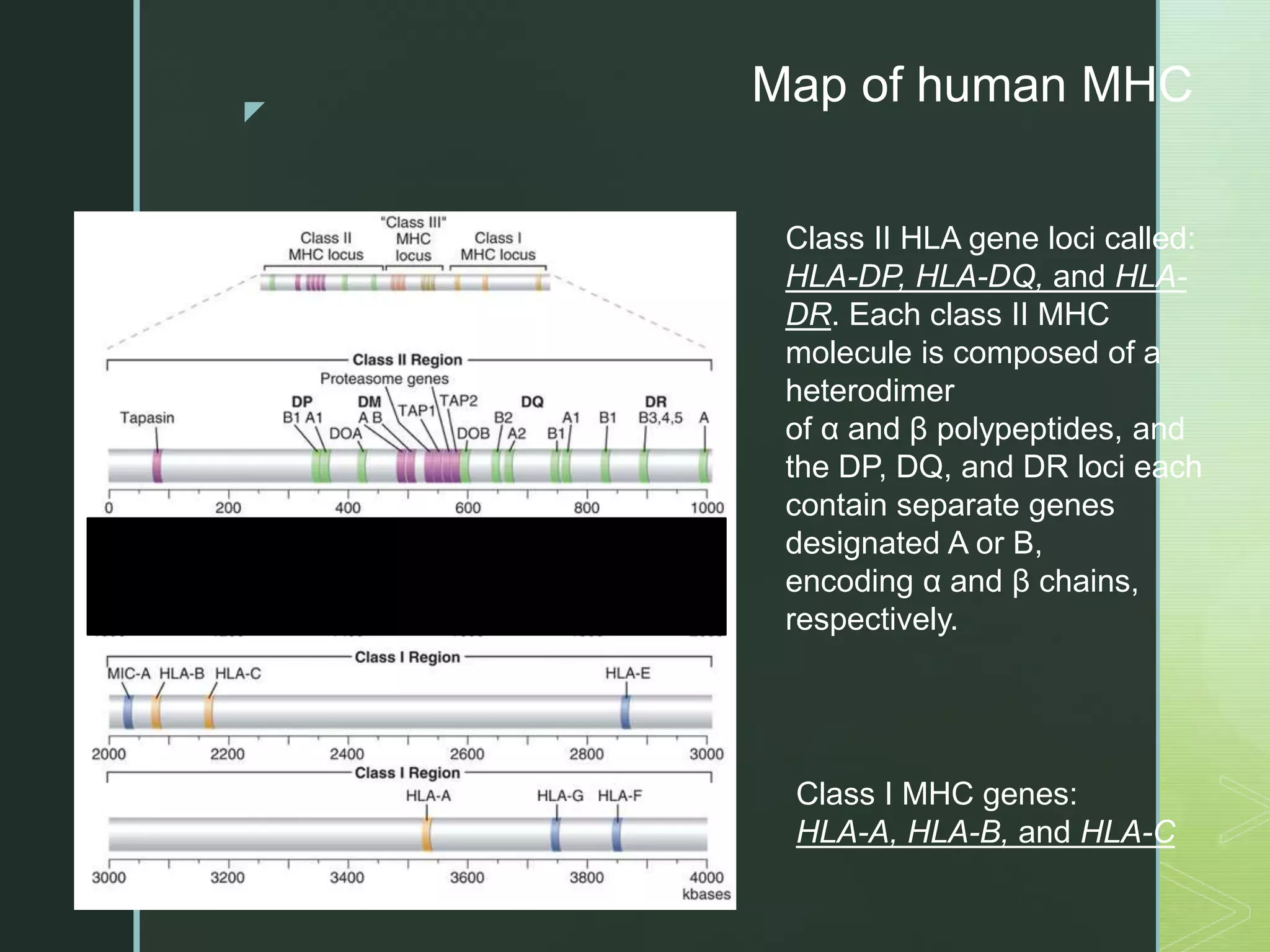
Map of human MHC
Class I MHC genes:
HLA-A, HLA-B, and HLA-C
Class II HLA gene loci called:
HLA-DP, HLA-DQ, and HLA-
DR. Each class II MHC
molecule is composed of a
heterodimer
of α and β polypeptides, and
the DP, DQ, and DR loci each
contain separate genes
designated A or B,
encoding α and β chains,
respectively.
z
General properties of MHC
molecules
• Each MHC molecule consists of an extracellular peptide-binding cleft, or groove, followed
by immunoglobulin (Ig)–like domains and transmembrane and cytoplasmic domains.
• The polymorphic amino acid residues of MHC molecules are located in and adjacent to
the peptide-binding cleft.
• The nonpolymorphic Ig-like domains of MHC molecules contain binding sites for the T cell
molecules CD4 and CD8.
Fig. 6.10, 6.12
page 124
z
Expression of MHC molecules
• Class I molecules are constitutively
expressed on virtually all nucleated cells,
whereas class II molecules are expressed
only on dendritic cells, B lymphocytes,
macrophages
• WHY? This pattern of MHC expression is
linked to the functions of class I–restricted
and class II–restricted T cells.
▫ The effector function of class I–restricted
CD8+ CTLs is to kill cells infected with
intracellular microbes, such as viruses, as well
as tumors that express tumor antigens.
▫ In contrast, class II–restricted CD4+ helper T
lymphocytes have a set of functions that require
recognizing antigen presented by a more limited
number of cell types
Fig. 1.2, page 3
z
Pathways of antigen processing
Fig. 6.14
z Pathways of antigen processing
Fig. 6.14
z
Functions of APC
Fig. 6.2
z
Lecture objectives: MHC structure
and functions
 discovery of MHC and different definition used in
HLA system
 genomic organization and structure of class I and
class II MHC molecules
 expression of MHC molecules
 role of MHC in immune responses
z
Thank you
rohimahm@usm.my
Ext: 6248

Major Histocompatibility Complex (MHC)

  • 1.
    z Major Histocompatibility Complex (MHC) DrRohimah Mohamud Department of Immunology 2017 REF: Celllular and Molecular Immunology by Abul Abbas Andrew Lichtman Shiv Pillai
  • 2.
    z Lecture objectives: MHCstructure and functions  discovery of MHC and different definition used in HLA system  genomic organization and structure of class I and class II MHC molecules  expression of MHC molecules  role of MHC in immune responses
  • 3.
    z Discovery of theMHC: the mouse MHC (H-2 complex)  The MHC was discovered from studies of tissue transplantation by George Snell and colleagues in 1940s  They showed that a single genetic region is primarily responsible for rapid rejection of tissue grafts - major histocompatibility locus  The particular locus linked to a gene on chromosome 17 encoding a blood group antigen called antigen II, and therefore this region was named histocompatibility-2, or simply H-2.  Initially, this locus was thought to contain a single gene that controlled tissue compatibility.  However, they found that occasional recombination events occurred within the H-2 locus during interbreeding of different strains, indicating that it contained several different but closely linked genes Page 117
  • 4.
    z MHC molecules?  Thegenetic region that controlled graft rejection and contained several linked genes  Human form of MHC is called Human leukocyte antigens (HLA)  A large genetic locus (on human chromosome 6 and mouse chromosome 17) that includes the highly polymorphic genes encoding the peptide-binding molecules recognized by T lymphocytes. The MHC locus also includes genes encoding cytokines, molecules involved in antigen processing, and complement proteins.
  • 5.
    z Genomic organization ofMHC  Class I- encodes glycoproteins expressed on the surface of nearly all nucleated cell- the major function of the class I gene is presentation of peptide antigens to cytotoxic T cells (Cytotoxic T Lymphocytes, CTL) = restricted to CD8+ T cells  Class II- encodes glycoproteins expressed primarily on antigen- presenting cells, eg: macrophages, dendritic cells and B cells- present processed peptides to T helper cells = restricted to CD4+ T cells  Class III- encodes various secreted proteins that have immune function eg C2,C4, Factor B, &TNF, and molecules involved in inflammation. Fig. 6.7, page 119
  • 6.
    z Map of humanMHC Class I MHC genes: HLA-A, HLA-B, and HLA-C Class II HLA gene loci called: HLA-DP, HLA-DQ, and HLA- DR. Each class II MHC molecule is composed of a heterodimer of α and β polypeptides, and the DP, DQ, and DR loci each contain separate genes designated A or B, encoding α and β chains, respectively.
  • 7.
    z General properties ofMHC molecules • Each MHC molecule consists of an extracellular peptide-binding cleft, or groove, followed by immunoglobulin (Ig)–like domains and transmembrane and cytoplasmic domains. • The polymorphic amino acid residues of MHC molecules are located in and adjacent to the peptide-binding cleft. • The nonpolymorphic Ig-like domains of MHC molecules contain binding sites for the T cell molecules CD4 and CD8. Fig. 6.10, 6.12 page 124
  • 8.
    z Expression of MHCmolecules • Class I molecules are constitutively expressed on virtually all nucleated cells, whereas class II molecules are expressed only on dendritic cells, B lymphocytes, macrophages • WHY? This pattern of MHC expression is linked to the functions of class I–restricted and class II–restricted T cells. ▫ The effector function of class I–restricted CD8+ CTLs is to kill cells infected with intracellular microbes, such as viruses, as well as tumors that express tumor antigens. ▫ In contrast, class II–restricted CD4+ helper T lymphocytes have a set of functions that require recognizing antigen presented by a more limited number of cell types Fig. 1.2, page 3
  • 9.
    z Pathways of antigenprocessing Fig. 6.14
  • 10.
    z Pathways ofantigen processing Fig. 6.14
  • 11.
  • 12.
    z Lecture objectives: MHCstructure and functions  discovery of MHC and different definition used in HLA system  genomic organization and structure of class I and class II MHC molecules  expression of MHC molecules  role of MHC in immune responses
  • 13.