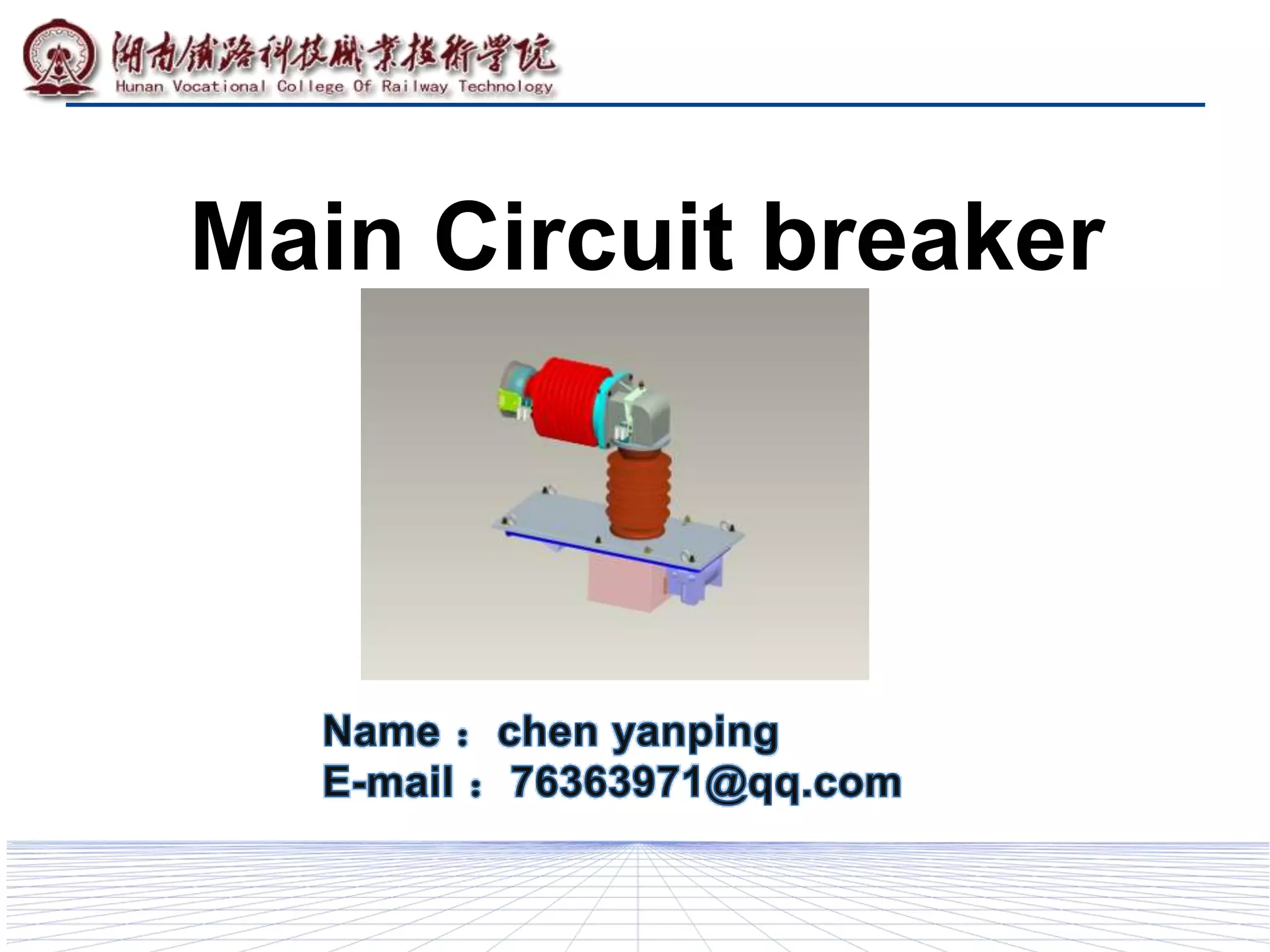
Main Circuit breaker
Content
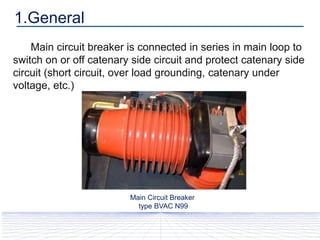
Main circuit breaker is connected in series in main loop to
switch on or off catenary side circuit and protect catenary side
circuit (short circuit, over load grounding, catenary under
voltage, etc.)
1.General
Main Circuit Breaker
type BVAC N99
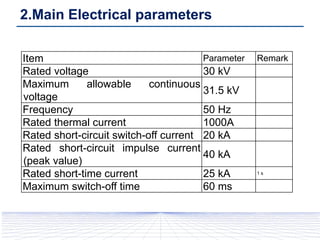
Item Parameter Remark
Rated voltage 30 kV
Maximum allowable continuous
voltage
31.5 kV
Frequency 50 Hz
Rated thermal current 1000A
Rated short-circuit switch-off current 20 kA
Rated short-circuit impulse current
(peak value)
40 kA
Rated short-time current 25 kA 1 s
Maximum switch-off time 60 ms
2.Main Electrical parameters
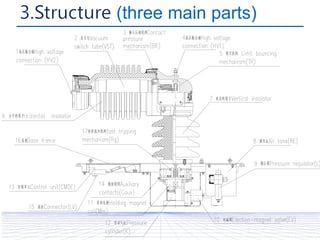
(three main parts)
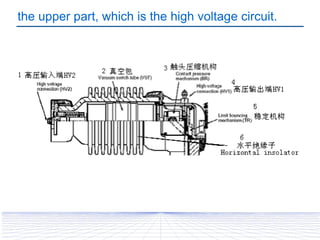
the upper part, which is the high voltage circuit.
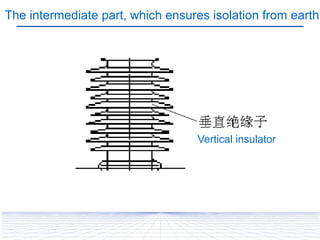
The intermediate part, which ensures isolation from earth.
Vertical insulator
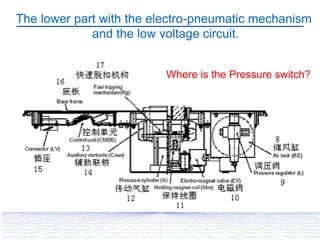
The lower part with the electro-pneumatic mechanism
and the low voltage circuit.
Where is the Pressure switch?
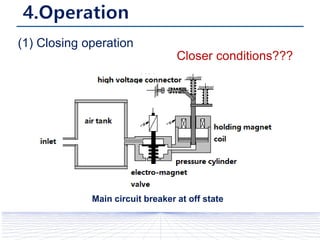
Main circuit breaker at off state
(1) Closing operation
Closer conditions???
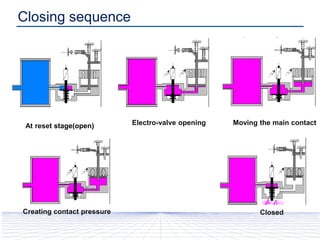
At reset stage(open) Electro-valve opening Moving the main contact
Creating contact pressure Closed
Closing sequence
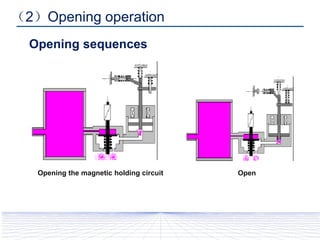
2.Opening operation, BVAC closed
Opening the magnetic holding circuit Open
(2)Opening operation
Opening sequences
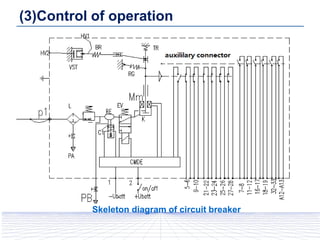
(3)Control of operation
Skeleton diagram of circuit breaker
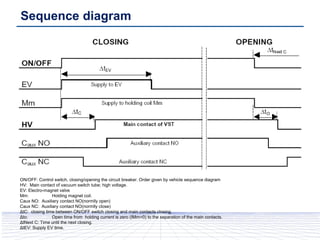
Sequence diagram
ON/OFF: Control switch, closing/opening the circuit breaker. Order given by vehicle sequence diagram
HV: Main contact of vacuum switch tube; high voltage.
EV: Electro-magnet valve
Mm: Holding magnet coil.
Caux NO: Auxiliary contact NO(normlly open)
Caux NC: Auxiliary contact NO(normlly close)
ΔtC: closing time between ON/OFF switch closing and main contacts closing.
Δto: Open time from holding current is zero (IMm=0) to the separation of the main contacts.
ΔtNext C: Time until the next closing.
ΔtEV: Supply EV time.
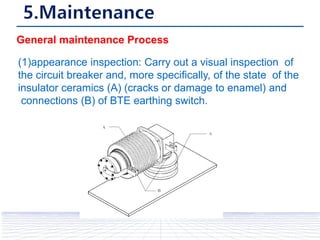
(1)appearance inspection: Carry out a visual inspection of
the circuit breaker and, more specifically, of the state of the
insulator ceramics (A) (cracks or damage to enamel) and
connections (B) of BTE earthing switch.
General maintenance Process
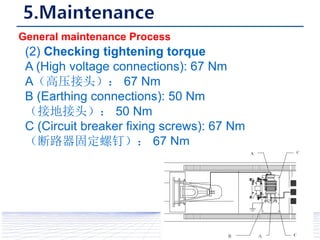
(2) Checking tightening torque
A (High voltage connections): 67 Nm
A(高压接头): 67 Nm
B (Earthing connections): 50 Nm
(接地接头): 50 Nm
C (Circuit breaker fixing screws): 67 Nm
(断路器固定螺钉): 67 Nm
General maintenance Process
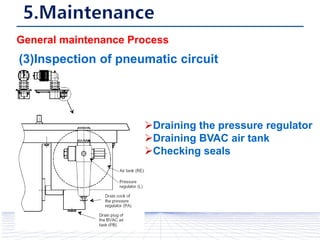
(3)Inspection of pneumatic circuit
Draining the pressure regulator
Draining BVAC air tank
Checking seals
General maintenance Process
Test requirements
(1)The minimum and maximum voltages shall relate to the
nominal voltage as follow:
Minimum voltage: 0.7Uctrl n
Maximum voltage: 1.25Uctrl n
(2)The permissible pressure varition in vehicle supply pipe
es from: 450kPa~1000kPa
(3)measure insulation resistance
(4)Switch-off time
The BVAC circuit breaker does not close.
The BVAC circuit breaker does not remain closed.
electrical part
mechanical part
pneumatic circuit
Page 19
Thank you!

Main circuit breaker.pptx

  • 1.
  • 2.
  • 3.
    Main circuit breakeris connected in series in main loop to switch on or off catenary side circuit and protect catenary side circuit (short circuit, over load grounding, catenary under voltage, etc.) 1.General Main Circuit Breaker type BVAC N99
  • 4.
    Item Parameter Remark Ratedvoltage 30 kV Maximum allowable continuous voltage 31.5 kV Frequency 50 Hz Rated thermal current 1000A Rated short-circuit switch-off current 20 kA Rated short-circuit impulse current (peak value) 40 kA Rated short-time current 25 kA 1 s Maximum switch-off time 60 ms 2.Main Electrical parameters
  • 5.
  • 6.
    the upper part,which is the high voltage circuit.
  • 7.
    The intermediate part,which ensures isolation from earth. Vertical insulator
  • 8.
    The lower partwith the electro-pneumatic mechanism and the low voltage circuit. Where is the Pressure switch?
  • 9.
    Main circuit breakerat off state (1) Closing operation Closer conditions???
  • 10.
    At reset stage(open)Electro-valve opening Moving the main contact Creating contact pressure Closed Closing sequence
  • 11.
    2.Opening operation, BVACclosed Opening the magnetic holding circuit Open (2)Opening operation Opening sequences
  • 12.
    (3)Control of operation Skeletondiagram of circuit breaker
  • 13.
    Sequence diagram ON/OFF: Controlswitch, closing/opening the circuit breaker. Order given by vehicle sequence diagram HV: Main contact of vacuum switch tube; high voltage. EV: Electro-magnet valve Mm: Holding magnet coil. Caux NO: Auxiliary contact NO(normlly open) Caux NC: Auxiliary contact NO(normlly close) ΔtC: closing time between ON/OFF switch closing and main contacts closing. Δto: Open time from holding current is zero (IMm=0) to the separation of the main contacts. ΔtNext C: Time until the next closing. ΔtEV: Supply EV time.
  • 14.
    (1)appearance inspection: Carryout a visual inspection of the circuit breaker and, more specifically, of the state of the insulator ceramics (A) (cracks or damage to enamel) and connections (B) of BTE earthing switch. General maintenance Process
  • 15.
    (2) Checking tighteningtorque A (High voltage connections): 67 Nm A(高压接头): 67 Nm B (Earthing connections): 50 Nm (接地接头): 50 Nm C (Circuit breaker fixing screws): 67 Nm (断路器固定螺钉): 67 Nm General maintenance Process
  • 16.
    (3)Inspection of pneumaticcircuit Draining the pressure regulator Draining BVAC air tank Checking seals General maintenance Process
  • 17.
    Test requirements (1)The minimumand maximum voltages shall relate to the nominal voltage as follow: Minimum voltage: 0.7Uctrl n Maximum voltage: 1.25Uctrl n (2)The permissible pressure varition in vehicle supply pipe es from: 450kPa~1000kPa (3)measure insulation resistance (4)Switch-off time
  • 18.
    The BVAC circuitbreaker does not close. The BVAC circuit breaker does not remain closed. electrical part mechanical part pneumatic circuit
  • 19.