Magento 2 benchmarks
Daniel Genis
A note about benchmarks (in general)
Not representative
Easy to make mistakes
Different methods
Different ways of measuring
Cold/Hot caches
Many subtle choices
Complexity
The benchmark test website
Sample data magento2
not many products
no plugins
about 3000 unique frontend URLs
Benchmarking frontend only
Zero cache invalidations
The benchmark tools
JMeter test plan, 20 threads doing:
Request a frontend page + all static content
upon completion wait 2 seconds
Request a different frontend page + static content
Each thread has a pre-generated list of urls
Each thread makes 50 requests per default
A warming run was done before actual benchmark
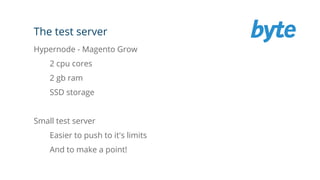
The test server
Hypernode - Magento Grow
2 cpu cores
2 gb ram
SSD storage
Small test server
Easier to push to it's limits
And to make a point!
Clean install - no redis, no varnish
20 threads 50 req / thread
With redis caching, no varnish
20 threads 50 req / thread
Redis caching 10 threads
10 threads 100 req / thread
With varnish caching
20 threads 50 req / thread
Statistical summary
clean install redis cache redis 10thr varnish cache
Average 412 ms 403 ms 278 ms 125 ms
Median 378 ms 372 ms 263 ms 116 ms
95th
percentile
727 ms 710 ms 423 ms 187 ms
Observations
Caching is easy to setup
Varnish cache in built
Redis cache in built
No plugins needed
These benchmarks were very bandwidth sensitive
Static content!
html: ~10kb
total incl static ~1mb
Observations
Varnish naturally is the fastest setup
Redis caching vs On disk caching (default)
frontend wise, no measurable improvement
local storage is cached in ram (hence no difference)
NFS ?
Scalability ?
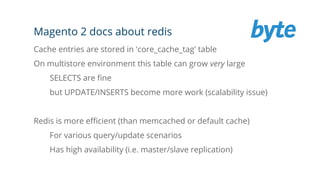
Magento 2 docs about redis
Cache entries are stored in 'core_cache_tag' table
On multistore environment this table can grow very large
SELECTS are fine
but UPDATE/INSERTS become more work (scalability issue)
Redis is more efficient (than memcached or default cache)
For various query/update scenarios
Has high availability (i.e. master/slave replication)
Bedankt!
Blijf op de hoogte van de laatste ontwikkelingen op
hosting-gebied. Volg ons op twitter: @Byte_NL

Magento 2 performance - a benchmark

  • 1.
  • 2.
    A note aboutbenchmarks (in general) Not representative Easy to make mistakes Different methods Different ways of measuring Cold/Hot caches Many subtle choices Complexity
  • 3.
    The benchmark testwebsite Sample data magento2 not many products no plugins about 3000 unique frontend URLs Benchmarking frontend only Zero cache invalidations
  • 4.
    The benchmark tools JMetertest plan, 20 threads doing: Request a frontend page + all static content upon completion wait 2 seconds Request a different frontend page + static content Each thread has a pre-generated list of urls Each thread makes 50 requests per default A warming run was done before actual benchmark
  • 5.
    The test server Hypernode- Magento Grow 2 cpu cores 2 gb ram SSD storage Small test server Easier to push to it's limits And to make a point!
  • 6.
    Clean install -no redis, no varnish 20 threads 50 req / thread
  • 7.
    With redis caching,no varnish 20 threads 50 req / thread
  • 8.
    Redis caching 10threads 10 threads 100 req / thread
  • 9.
    With varnish caching 20threads 50 req / thread
  • 10.
    Statistical summary clean installredis cache redis 10thr varnish cache Average 412 ms 403 ms 278 ms 125 ms Median 378 ms 372 ms 263 ms 116 ms 95th percentile 727 ms 710 ms 423 ms 187 ms
  • 11.
    Observations Caching is easyto setup Varnish cache in built Redis cache in built No plugins needed These benchmarks were very bandwidth sensitive Static content! html: ~10kb total incl static ~1mb
  • 12.
    Observations Varnish naturally isthe fastest setup Redis caching vs On disk caching (default) frontend wise, no measurable improvement local storage is cached in ram (hence no difference) NFS ? Scalability ?
  • 13.
    Magento 2 docsabout redis Cache entries are stored in 'core_cache_tag' table On multistore environment this table can grow very large SELECTS are fine but UPDATE/INSERTS become more work (scalability issue) Redis is more efficient (than memcached or default cache) For various query/update scenarios Has high availability (i.e. master/slave replication)
  • 14.
    Bedankt! Blijf op dehoogte van de laatste ontwikkelingen op hosting-gebied. Volg ons op twitter: @Byte_NL