Scaling when you are not Google
Abel Muiño
Abel Muino
‣ Lead Software Engineer
‣ Tweets as @amuino
‣ In another life, co-owned
1uptalent.com, played with
Docker and used AWS for
everything.
Disclaimer
‣ Cabify is 5 years old
‣ I joined Cabify about 1.5 years ago to work on product
‣ What you will hear today might be
‣ 70% folklore / 30% experience
‣ Only about production
‣ Not applicable to other areas (data analytics)
Cabify
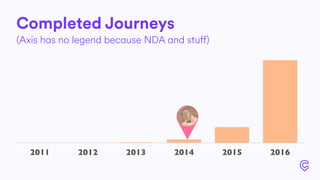
2011 2012 2013 2014 2015 2016
Completed Journeys
(Axis has no legend because NDA and stuff)
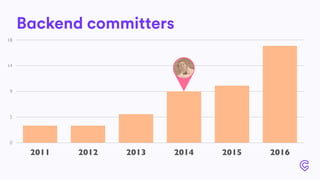
Backend committers
0
5
9
14
18
2011 2012 2013 2014 2015 2016
We are hiring!
(As if it wasn’t obvious from the charts)
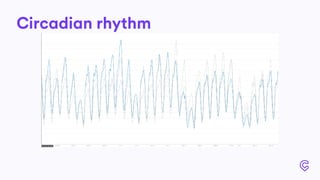
Circadian rhythm
Prelude
???? - 2014
Cabify foundations
‣ Mostly Ruby, some Go
‣ Running on VPS
‣ No sysadmins (devops?)
‣ CouchDB
‣ Redis
‣ Home-grown metrics &
monitoring (limited)
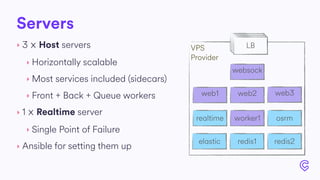
Servers
‣ 3 ⨉ Host servers
‣ Horizontally scalable
‣ Most services included (sidecars)
‣ Front + Back + Queue workers
‣ 1 ⨉ Realtime server
‣ Single Point of Failure
‣ Ansible for setting them up
VPS
Provider
LB
web1 web2 web3
worker1
LBLB
redis1 redis2elastic
realtime osrm
websock
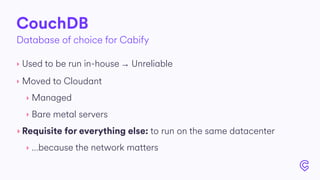
CouchDB
‣ Used to be run in-house → Unreliable
‣ Moved to Cloudant
‣ Managed
‣ Bare metal servers
‣ Requisite for everything else: to run on the same datacenter
‣ …because the network matters
Database of choice for Cabify
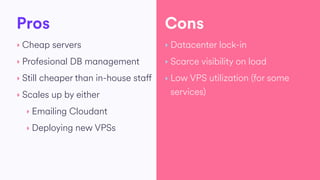
Pros
‣ Cheap servers
‣ Profesional DB management
‣ Still cheaper than in-house staff
‣ Scales up by either
‣ Emailing Cloudant
‣ Deploying new VPSs
‣ Datacenter lock-in
‣ Scarce visibility on load
‣ Low VPS utilization (for some
services)
Cons
Tl;dr: everything was fine
Until it wasn’t
2015 Road to bare metal
In 2014 we handled
7 times the load of 2013
Installed NewRelic
‣ Monitors our ruby stack
‣ Built custom adapters for API toolkit and CouchDB
‣ Golang not supported 😭
‣ Low hanging fruit for increasing performance
‣ Hint: Always contact a Sales Rep
‣ Bye bye home-grown monitoring! 👋
VPS provider
DDoSed
‣ Several times a week
‣ Cabify was unreachable
‣ VPSs where unreachable 

on the internal network
‣ Slow & bad support
‣ Reputation
‣ Solution: Level up!
Nobody ever got fired for choosing IBM
Moved to Bare Metal @ Softlayer
Same guys hosting our Cloudant cluster 👍
Mindset
Control the core, minimise work for everything else
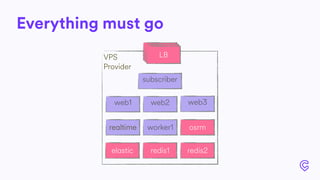
Everything must go
VPS
Provider
web1 web2 web3
worker1realtime
LBLBLB
redis1 redis2elastic
osrm
subscriber
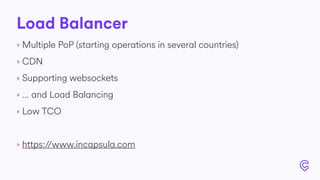
Load Balancer
‣ Multiple PoP (starting operations in several countries)
‣ CDN
‣ Supporting websockets
‣ … and Load Balancing
‣ Low TCO
‣ https://www.incapsula.com
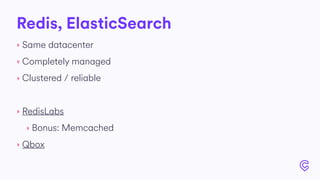
Redis, ElasticSearch
‣ Same datacenter
‣ Completely managed
‣ Clustered / reliable
‣ RedisLabs
‣ Bonus: Memcached
‣ Qbox
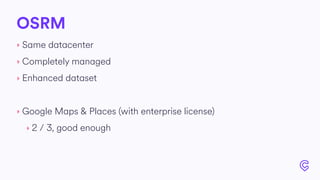
OSRM
‣ Same datacenter
‣ Completely managed
‣ Enhanced dataset
‣ Google Maps & Places (with enterprise license)
‣ 2 / 3, good enough
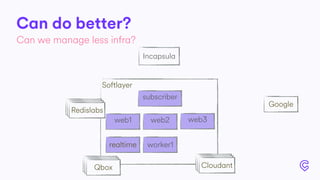
Can do better?
Can we manage less infra?
Softlayer
web1 web2 web3
worker1realtime
Google
subscriber
Incapsula
RedislabsRedislabsRedislabs
qboxqboxQbox
RedislabsRedislabsCloudant
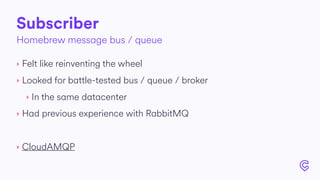
Subscriber
‣ Felt like reinventing the wheel
‣ Looked for battle-tested bus / queue / broker
‣ In the same datacenter
‣ Had previous experience with RabbitMQ
‣ CloudAMQP
Homebrew message bus / queue
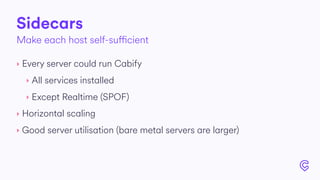
Sidecars
‣ Every server could run Cabify
‣ All services installed
‣ Except Realtime (SPOF)
‣ Horizontal scaling
‣ Good server utilisation (bare metal servers are larger)
Make each host self-sufficient
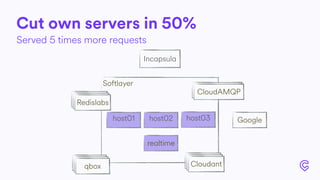
Cut own servers in 50%
Served 5 times more requests
Softlayer
host01 host02 host03
realtime
Google
Incapsula
RedislabsRedislabsRedislabs
qboxqboxqbox
RedislabsRedislabsCloudant
CloudAMQPCloudAMQP
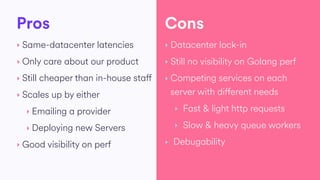
Pros
‣ Same-datacenter latencies
‣ Only care about our product
‣ Still cheaper than in-house staff
‣ Scales up by either
‣ Emailing a provider
‣ Deploying new Servers
‣ Good visibility on perf
‣ Datacenter lock-in
‣ Still no visibility on Golang perf
‣ Competing services on each
server with different needs
‣ Fast & light http requests
‣ Slow & heavy queue workers
‣ Debugability
Cons
Tl;dr: everything was fine
Until it wasn’t
2016, pushing to
the limit
In 2015 we handled
5 times the load of 2014
In 2016 we would invade LatAm
(new countries, cities, marketing…)
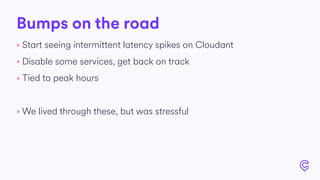
Bumps on the road
‣ Start seeing intermittent latency spikes on Cloudant
‣ Disable some services, get back on track
‣ Tied to peak hours
‣ We lived through these, but was stressful
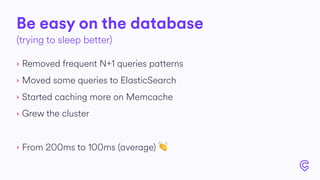
Be easy on the database
‣ Removed frequent N+1 queries patterns
‣ Moved some queries to ElasticSearch
‣ Started caching more on Memcache
‣ Grew the cluster
‣ From 200ms to 100ms (average) 👏
(trying to sleep better)
RabbitMQ can’t cope
‣ We saturated the cluster CPU with moderate load
‣ Tied to us using tag-based routing
‣ Messages were delivered much later than expected
‣ Made changes to use simpler routing
‣ Is there anything simpler than RabbitMQ for simple routing? 🤔
Interlude
DynDNS goes down, Cloudant uses them
We lose access to our databases cluster load balancer
Patched /etc/hosts with the actual ips in 30 minutes
The right tool for the job
‣ Clouchdb / Cloudant, not the best database for frequent updates
‣ Looking for alternatives to store fast-changing models
‣ RethinkDB
‣ Fast, easy to use, hosted options in same datacenter
‣ Streaming query updates
Expecting growth in line with previous years
Broke RethinkDB load balancer
Database stats were OK, but the LB couldn’t handle our rate
Slow support, no “enterprise” option
Decided to phase out RethinkDB
Wrote our first «database»
Simple in-memory store, backed by Couchdb
Update indexes on writes. All queries are indexed
Implemented in Golang, consumed from Ruby
Replaces RethinkDB, which replaced CouchDB
Cloudant latency spikes fixed!
Grow the cluster for the second time in the year
Load balancers hardware upgraded, problems gone
Also reduced the number of connections from ruby
Relax the Sidecars
‣ Load on background workers interfering with serving http
‣ Split the servers:
‣ Front (ruby/golang http interface)
‣ Workers (ruby job queues, ruby background)
Remove RabbitMQ
Replace with NSQ
Nice mix of sidecar and discovery
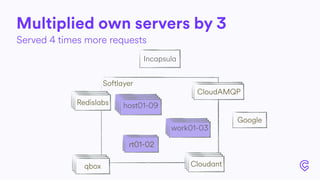
Softlayer
Multiplied own servers by 3
Served 4 times more requests
Google
Incapsula
RedislabsRedislabsRedislabs
qboxqboxqbox
RedislabsRedislabsCloudant
CloudAMQPCloudAMQP
host01-09host01-09host01-09host01-09
rt01-02rt01-02
work01-03work01-03work01-03
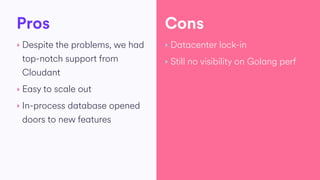
Pros
‣ Despite the problems, we had
top-notch support from
Cloudant
‣ Easy to scale out
‣ In-process database opened
doors to new features
‣ Datacenter lock-in
‣ Still no visibility on Golang perf
Cons
Cabify @ 2017
In 2016 we handled
4 times the load of 2015
Hired our first
full-time sysadmin!
Taking ownership
Improve our infra
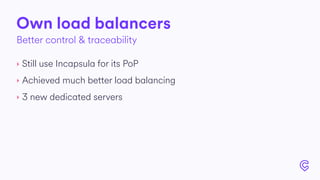
Own load balancers
‣ Still use Incapsula for its PoP
‣ Achieved much better load balancing
‣ 3 new dedicated servers
Better control & traceability
Plans for the future
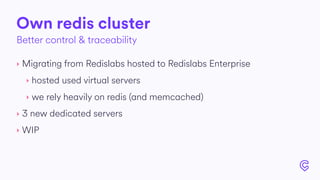
Own redis cluster
‣ Migrating from Redislabs hosted to Redislabs Enterprise
‣ hosted used virtual servers
‣ we rely heavily on redis (and memcached)
‣ 3 new dedicated servers
‣ WIP
Better control & traceability
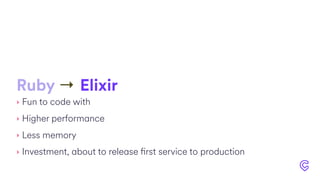
Ruby → Elixir
‣ Fun to code with
‣ Higher performance
‣ Less memory
‣ Investment, about to release first service to production
Extract from Product
Dedicated teams and resources for specific components
Make the core of Cabify leaner
Thanks!
And sorry for the 60 slides
Questions?
Abel Muiño
@amuino

Mad scalability: Scaling when you are not Google

  • 1.
    Scaling when youare not Google Abel Muiño
  • 2.
    Abel Muino ‣ LeadSoftware Engineer ‣ Tweets as @amuino ‣ In another life, co-owned 1uptalent.com, played with Docker and used AWS for everything.
  • 3.
    Disclaimer ‣ Cabify is5 years old ‣ I joined Cabify about 1.5 years ago to work on product ‣ What you will hear today might be ‣ 70% folklore / 30% experience ‣ Only about production ‣ Not applicable to other areas (data analytics)
  • 5.
  • 6.
    2011 2012 20132014 2015 2016 Completed Journeys (Axis has no legend because NDA and stuff)
  • 7.
  • 8.
    We are hiring! (Asif it wasn’t obvious from the charts)
  • 9.
  • 10.
  • 11.
    Cabify foundations ‣ MostlyRuby, some Go ‣ Running on VPS ‣ No sysadmins (devops?) ‣ CouchDB ‣ Redis ‣ Home-grown metrics & monitoring (limited)
  • 12.
    Servers ‣ 3 ⨉Host servers ‣ Horizontally scalable ‣ Most services included (sidecars) ‣ Front + Back + Queue workers ‣ 1 ⨉ Realtime server ‣ Single Point of Failure ‣ Ansible for setting them up VPS Provider LB web1 web2 web3 worker1 LBLB redis1 redis2elastic realtime osrm websock
  • 13.
    CouchDB ‣ Used tobe run in-house → Unreliable ‣ Moved to Cloudant ‣ Managed ‣ Bare metal servers ‣ Requisite for everything else: to run on the same datacenter ‣ …because the network matters Database of choice for Cabify
  • 14.
    Pros ‣ Cheap servers ‣Profesional DB management ‣ Still cheaper than in-house staff ‣ Scales up by either ‣ Emailing Cloudant ‣ Deploying new VPSs ‣ Datacenter lock-in ‣ Scarce visibility on load ‣ Low VPS utilization (for some services) Cons
  • 15.
    Tl;dr: everything wasfine Until it wasn’t
  • 16.
    2015 Road tobare metal
  • 17.
    In 2014 wehandled 7 times the load of 2013
  • 18.
    Installed NewRelic ‣ Monitorsour ruby stack ‣ Built custom adapters for API toolkit and CouchDB ‣ Golang not supported 😭 ‣ Low hanging fruit for increasing performance ‣ Hint: Always contact a Sales Rep ‣ Bye bye home-grown monitoring! 👋
  • 19.
    VPS provider DDoSed ‣ Severaltimes a week ‣ Cabify was unreachable ‣ VPSs where unreachable 
 on the internal network ‣ Slow & bad support ‣ Reputation ‣ Solution: Level up!
  • 20.
    Nobody ever gotfired for choosing IBM Moved to Bare Metal @ Softlayer Same guys hosting our Cloudant cluster 👍
  • 21.
    Mindset Control the core,minimise work for everything else
  • 22.
    Everything must go VPS Provider web1web2 web3 worker1realtime LBLBLB redis1 redis2elastic osrm subscriber
  • 23.
    Load Balancer ‣ MultiplePoP (starting operations in several countries) ‣ CDN ‣ Supporting websockets ‣ … and Load Balancing ‣ Low TCO ‣ https://www.incapsula.com
  • 24.
    Redis, ElasticSearch ‣ Samedatacenter ‣ Completely managed ‣ Clustered / reliable ‣ RedisLabs ‣ Bonus: Memcached ‣ Qbox
  • 25.
    OSRM ‣ Same datacenter ‣Completely managed ‣ Enhanced dataset ‣ Google Maps & Places (with enterprise license) ‣ 2 / 3, good enough
  • 26.
    Can do better? Canwe manage less infra? Softlayer web1 web2 web3 worker1realtime Google subscriber Incapsula RedislabsRedislabsRedislabs qboxqboxQbox RedislabsRedislabsCloudant
  • 27.
    Subscriber ‣ Felt likereinventing the wheel ‣ Looked for battle-tested bus / queue / broker ‣ In the same datacenter ‣ Had previous experience with RabbitMQ ‣ CloudAMQP Homebrew message bus / queue
  • 28.
    Sidecars ‣ Every servercould run Cabify ‣ All services installed ‣ Except Realtime (SPOF) ‣ Horizontal scaling ‣ Good server utilisation (bare metal servers are larger) Make each host self-sufficient
  • 29.
    Cut own serversin 50% Served 5 times more requests Softlayer host01 host02 host03 realtime Google Incapsula RedislabsRedislabsRedislabs qboxqboxqbox RedislabsRedislabsCloudant CloudAMQPCloudAMQP
  • 30.
    Pros ‣ Same-datacenter latencies ‣Only care about our product ‣ Still cheaper than in-house staff ‣ Scales up by either ‣ Emailing a provider ‣ Deploying new Servers ‣ Good visibility on perf ‣ Datacenter lock-in ‣ Still no visibility on Golang perf ‣ Competing services on each server with different needs ‣ Fast & light http requests ‣ Slow & heavy queue workers ‣ Debugability Cons
  • 31.
    Tl;dr: everything wasfine Until it wasn’t
  • 32.
  • 33.
    In 2015 wehandled 5 times the load of 2014
  • 34.
    In 2016 wewould invade LatAm (new countries, cities, marketing…)
  • 35.
    Bumps on theroad ‣ Start seeing intermittent latency spikes on Cloudant ‣ Disable some services, get back on track ‣ Tied to peak hours ‣ We lived through these, but was stressful
  • 36.
    Be easy onthe database ‣ Removed frequent N+1 queries patterns ‣ Moved some queries to ElasticSearch ‣ Started caching more on Memcache ‣ Grew the cluster ‣ From 200ms to 100ms (average) 👏 (trying to sleep better)
  • 37.
    RabbitMQ can’t cope ‣We saturated the cluster CPU with moderate load ‣ Tied to us using tag-based routing ‣ Messages were delivered much later than expected ‣ Made changes to use simpler routing ‣ Is there anything simpler than RabbitMQ for simple routing? 🤔
  • 38.
    Interlude DynDNS goes down,Cloudant uses them We lose access to our databases cluster load balancer Patched /etc/hosts with the actual ips in 30 minutes
  • 39.
    The right toolfor the job ‣ Clouchdb / Cloudant, not the best database for frequent updates ‣ Looking for alternatives to store fast-changing models ‣ RethinkDB ‣ Fast, easy to use, hosted options in same datacenter ‣ Streaming query updates Expecting growth in line with previous years
  • 40.
    Broke RethinkDB loadbalancer Database stats were OK, but the LB couldn’t handle our rate Slow support, no “enterprise” option Decided to phase out RethinkDB
  • 41.
    Wrote our first«database» Simple in-memory store, backed by Couchdb Update indexes on writes. All queries are indexed Implemented in Golang, consumed from Ruby Replaces RethinkDB, which replaced CouchDB
  • 42.
    Cloudant latency spikesfixed! Grow the cluster for the second time in the year Load balancers hardware upgraded, problems gone Also reduced the number of connections from ruby
  • 43.
    Relax the Sidecars ‣Load on background workers interfering with serving http ‣ Split the servers: ‣ Front (ruby/golang http interface) ‣ Workers (ruby job queues, ruby background)
  • 44.
    Remove RabbitMQ Replace withNSQ Nice mix of sidecar and discovery
  • 45.
    Softlayer Multiplied own serversby 3 Served 4 times more requests Google Incapsula RedislabsRedislabsRedislabs qboxqboxqbox RedislabsRedislabsCloudant CloudAMQPCloudAMQP host01-09host01-09host01-09host01-09 rt01-02rt01-02 work01-03work01-03work01-03
  • 46.
    Pros ‣ Despite theproblems, we had top-notch support from Cloudant ‣ Easy to scale out ‣ In-process database opened doors to new features ‣ Datacenter lock-in ‣ Still no visibility on Golang perf Cons
  • 47.
  • 48.
    In 2016 wehandled 4 times the load of 2015
  • 49.
  • 50.
  • 51.
    Own load balancers ‣Still use Incapsula for its PoP ‣ Achieved much better load balancing ‣ 3 new dedicated servers Better control & traceability
  • 52.
  • 53.
    Own redis cluster ‣Migrating from Redislabs hosted to Redislabs Enterprise ‣ hosted used virtual servers ‣ we rely heavily on redis (and memcached) ‣ 3 new dedicated servers ‣ WIP Better control & traceability
  • 54.
    Ruby → Elixir ‣Fun to code with ‣ Higher performance ‣ Less memory ‣ Investment, about to release first service to production
  • 55.
    Extract from Product Dedicatedteams and resources for specific components Make the core of Cabify leaner
  • 56.
    Thanks! And sorry forthe 60 slides
  • 57.
  • 58.