z
INTRODUCTION TO
Machsdine
Learning
Lectddure Slides for
z
CHAPTER 1:
Introduction
z
Why “Learn” ?
§ Machine learning is programming computers to
optimize a performance criterion using example
data or past experience.
§ There is no need to “learn” to calculate payroll
§ Learning is used when:
§ Human expertise does not exist (navigating on Mars),
§ Humans are unable to explain their expertise (speech
recognition)
§ Solution changes in time (routing on a computer
network)
§ Solution needs to be adapted to particular cases (user
biometrics)
Lecture
Notes
for
E
Alpaydın
2004
Introduction
to
Machine
Learning
©
The
MIT
Press
(V1.1)
3
z
What We Talk About When We Talk
About“Learning”
§ Learning general models from a data of particular
examples
§ Data is cheap and abundant (data warehouses,
data marts); knowledge is expensive and scarce.
§ Example in retail: Customer transactions to
consumer behavior:
People who bought “Da Vinci Code” also bought “The
Five People You Meet in Heaven” (www.amazon.com)
§ Build a model that is a good and useful
approximation to the data.
Lecture
Notes
for
E
Alpaydın
2004
Introduction
to
Machine
Learning
©
The
MIT
Press
(V1.1)
4
z
Data Mining
§ Retail: Market basket analysis, Customer
relationship management (CRM)
§ Finance: Credit scoring, fraud detection
§ Manufacturing: Optimization, troubleshooting
§ Medicine: Medical diagnosis
§ Telecommunications: Quality of service optimization
§ Bioinformatics: Motifs, alignment
§ Web mining: Search engines
§ ...
Lecture
Notes
for
E
Alpaydın
2004
Introduction
to
Machine
Learning
©
The
MIT
Press
(V1.1)
5
z
What is Machine Learning?
§ Optimize a performance criterion using example
data or past experience.
§ Role of Statistics: Inference from a sample
§ Role of Computer science: Efficient algorithms to
§ Solve the optimization problem
§ Representing and evaluating the
model for inference
Lecture
Notes
for
E
Alpaydın
2004
Introduction
to
Machine
Learning
©
The
MIT
Press
(V1.1)
6
z
Applications
§ Association
§ Supervised Learning
§ Classification
§ Regression
§ Unsupervised Learning
§ Reinforcement Learning
Lecture
Notes
for
E
Alpaydın
2004
Introduction
to
Machine
Learning
©
The
MIT
Press
(V1.1)
7
z
Learning Associations
§ Basket analysis:
P (Y | X ) probability that somebody who buys X
also buys Y where X and Y are products/services.
Example: P ( chips | beer ) = 0.7
Lecture
Notes
for
E
Alpaydın
2004
Introduction
to
Machine
Learning
©
The
MIT
Press
(V1.1)
8
z
Classification
Lecture
Notes
for
E
Alpaydın
2004
Introduction
to
Machine
Learning
©
The
MIT
Press
(V1.1)
9
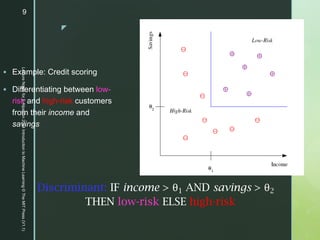
§ Example: Credit scoring
§ Differentiating between low-
risk and high-risk customers
from their income and
savings
Discriminant: IF income > θ1 AND savings > θ2
THEN low-risk ELSE high-risk
z
Classification: Applications
§ Aka Pattern recognition
§ Face recognition: Pose, lighting, occlusion (glasses,
beard), make-up, hair style
§ Character recognition: Different handwriting styles.
§ Speech recognition: Temporal dependency.
§ Use of a dictionary or the syntax of the language.
§ Sensor fusion: Combine multiple modalities; eg, visual
(lip image) and acoustic for speech
§ Medical diagnosis: From symptoms to illnesses
§ ...
Lecture
Notes
for
E
Alpaydın
2004
Introduction
to
Machine
Learning
©
The
MIT
Press
(V1.1)
10
z
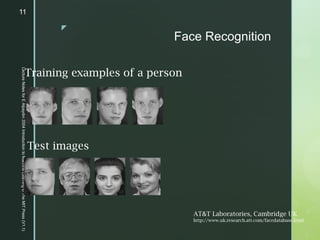
Face Recognition
Lecture
Notes
for
E
Alpaydın
2004
Introduction
to
Machine
Learning
©
The
MIT
Press
(V1.1)
11
Training examples of a person
Test images
AT&T Laboratories, Cambridge UK
http://www.uk.research.att.com/facedatabase.html
Regression
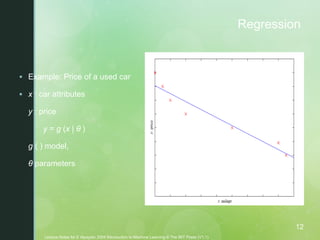
§ Example: Price of a used car
§ x : car attributes
y : price
y = g (x | θ )
g ( ) model,
θ parameters
Lecture Notes for E Alpaydın 2004 Introduction to Machine Learning © The MIT Press (V1.1)
12
y = wx+w0
z
Regression Applications
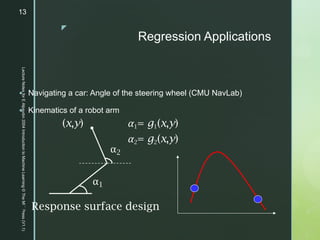
§ Navigating a car: Angle of the steering wheel (CMU NavLab)
§ Kinematics of a robot arm
Lecture
Notes
for
E
Alpaydın
2004
Introduction
to
Machine
Learning
©
The
MIT
Press
(V1.1)
13
α1= g1(x,y)
α2= g2(x,y)
α1
α2
(x,y)
n Response surface design
z Supervised Learning: Uses
§ Prediction of future cases: Use the rule to predict
the output for future inputs
§ Knowledge extraction: The rule is easy to
understand
§ Compression: The rule is simpler than the data it
explains
§ Outlier detection: Exceptions that are not covered
by the rule, e.g., fraud
Lecture
Notes
for
E
Alpaydın
2004
Introduction
to
Machine
Learning
©
The
MIT
Press
(V1.1)
14
z
Unsupervised Learning
§ Learning “what normally happens”
§ No output
§ Clustering: Grouping similar instances
§ Example applications
§ Customer segmentation in CRM
§ Image compression: Color
quantization
§ Bioinformatics: Learning motifs
Lecture
Notes
for
E
Alpaydın
2004
Introduction
to
Machine
Learning
©
The
MIT
Press
(V1.1)
15
z
Reinforcement Learning
§ Learning a policy: A sequence of outputs
§ No supervised output but delayed reward
§ Credit assignment problem
§ Game playing
§ Robot in a maze
§ Multiple agents, partial observability, ...
Lecture
Notes
for
E
Alpaydın
2004
Introduction
to
Machine
Learning
©
The
MIT
Press
(V1.1)
16
z
Resources: Datasets
§ UCI Repository:
http://www.ics.uci.edu/~mlearn/MLRepository.h
tml
§ UCI KDD Archive:
http://kdd.ics.uci.edu/summary.data.application
.html
§ Statlib: http://lib.stat.cmu.edu/
§ Delve: http://www.cs.utoronto.ca/~delve/
Lecture
Notes
for
E
Alpaydın
2004
Introduction
to
Machine
Learning
©
The
MIT
Press
(V1.1)
17
z
Resources: Journals
§ Journal of Machine Learning Research www.jmlr.org
§ Machine Learning
§ Neural Computation
§ Neural Networks
§ IEEE Transactions on Neural Networks
§ IEEE Transactions on Pattern Analysis and Machine
Intelligence
§ Annals of Statistics
§ Journal of the American Statistical Association
§ ...
Lecture
Notes
for
E
Alpaydın
2004
Introduction
to
Machine
Learning
©
The
MIT
Press
(V1.1)
18
z
Resources: Conferences
§ International Conference on Machine Learning (ICML)
§ ICML05: http://icml.ais.fraunhofer.de/
§ European Conference on Machine Learning (ECML)
§ ECML05: http://ecmlpkdd05.liacc.up.pt/
§ Neural Information Processing Systems (NIPS)
§ NIPS05: http://nips.cc/
§ Uncertainty in Artificial Intelligence (UAI)
§ UAI05: http://www.cs.toronto.edu/uai2005/
§ Computational Learning Theory (COLT)
§ COLT05: http://learningtheory.org/colt2005/
§ International Joint Conference on Artificial Intelligence (IJCAI)
§ IJCAI05: http://ijcai05.csd.abdn.ac.uk/
§ International Conference on Neural Networks (Europe)
§ ICANN05: http://www.ibspan.waw.pl/ICANN-2005/
§ ...
Lecture
Notes
for
E
Alpaydın
2004
Introduction
to
Machine
Learning
©
The
MIT
Press
(V1.1)
19

machinelearning_slide note this is repdf

  • 1.
  • 2.
  • 3.
    z Why “Learn” ? §Machine learning is programming computers to optimize a performance criterion using example data or past experience. § There is no need to “learn” to calculate payroll § Learning is used when: § Human expertise does not exist (navigating on Mars), § Humans are unable to explain their expertise (speech recognition) § Solution changes in time (routing on a computer network) § Solution needs to be adapted to particular cases (user biometrics) Lecture Notes for E Alpaydın 2004 Introduction to Machine Learning © The MIT Press (V1.1) 3
  • 4.
    z What We TalkAbout When We Talk About“Learning” § Learning general models from a data of particular examples § Data is cheap and abundant (data warehouses, data marts); knowledge is expensive and scarce. § Example in retail: Customer transactions to consumer behavior: People who bought “Da Vinci Code” also bought “The Five People You Meet in Heaven” (www.amazon.com) § Build a model that is a good and useful approximation to the data. Lecture Notes for E Alpaydın 2004 Introduction to Machine Learning © The MIT Press (V1.1) 4
  • 5.
    z Data Mining § Retail:Market basket analysis, Customer relationship management (CRM) § Finance: Credit scoring, fraud detection § Manufacturing: Optimization, troubleshooting § Medicine: Medical diagnosis § Telecommunications: Quality of service optimization § Bioinformatics: Motifs, alignment § Web mining: Search engines § ... Lecture Notes for E Alpaydın 2004 Introduction to Machine Learning © The MIT Press (V1.1) 5
  • 6.
    z What is MachineLearning? § Optimize a performance criterion using example data or past experience. § Role of Statistics: Inference from a sample § Role of Computer science: Efficient algorithms to § Solve the optimization problem § Representing and evaluating the model for inference Lecture Notes for E Alpaydın 2004 Introduction to Machine Learning © The MIT Press (V1.1) 6
  • 7.
    z Applications § Association § SupervisedLearning § Classification § Regression § Unsupervised Learning § Reinforcement Learning Lecture Notes for E Alpaydın 2004 Introduction to Machine Learning © The MIT Press (V1.1) 7
  • 8.
    z Learning Associations § Basketanalysis: P (Y | X ) probability that somebody who buys X also buys Y where X and Y are products/services. Example: P ( chips | beer ) = 0.7 Lecture Notes for E Alpaydın 2004 Introduction to Machine Learning © The MIT Press (V1.1) 8
  • 9.
    z Classification Lecture Notes for E Alpaydın 2004 Introduction to Machine Learning © The MIT Press (V1.1) 9 § Example: Creditscoring § Differentiating between low- risk and high-risk customers from their income and savings Discriminant: IF income > θ1 AND savings > θ2 THEN low-risk ELSE high-risk
  • 10.
    z Classification: Applications § AkaPattern recognition § Face recognition: Pose, lighting, occlusion (glasses, beard), make-up, hair style § Character recognition: Different handwriting styles. § Speech recognition: Temporal dependency. § Use of a dictionary or the syntax of the language. § Sensor fusion: Combine multiple modalities; eg, visual (lip image) and acoustic for speech § Medical diagnosis: From symptoms to illnesses § ... Lecture Notes for E Alpaydın 2004 Introduction to Machine Learning © The MIT Press (V1.1) 10
  • 11.
    z Face Recognition Lecture Notes for E Alpaydın 2004 Introduction to Machine Learning © The MIT Press (V1.1) 11 Training examplesof a person Test images AT&T Laboratories, Cambridge UK http://www.uk.research.att.com/facedatabase.html
  • 12.
    Regression § Example: Priceof a used car § x : car attributes y : price y = g (x | θ ) g ( ) model, θ parameters Lecture Notes for E Alpaydın 2004 Introduction to Machine Learning © The MIT Press (V1.1) 12 y = wx+w0
  • 13.
    z Regression Applications § Navigatinga car: Angle of the steering wheel (CMU NavLab) § Kinematics of a robot arm Lecture Notes for E Alpaydın 2004 Introduction to Machine Learning © The MIT Press (V1.1) 13 α1= g1(x,y) α2= g2(x,y) α1 α2 (x,y) n Response surface design
  • 14.
    z Supervised Learning:Uses § Prediction of future cases: Use the rule to predict the output for future inputs § Knowledge extraction: The rule is easy to understand § Compression: The rule is simpler than the data it explains § Outlier detection: Exceptions that are not covered by the rule, e.g., fraud Lecture Notes for E Alpaydın 2004 Introduction to Machine Learning © The MIT Press (V1.1) 14
  • 15.
    z Unsupervised Learning § Learning“what normally happens” § No output § Clustering: Grouping similar instances § Example applications § Customer segmentation in CRM § Image compression: Color quantization § Bioinformatics: Learning motifs Lecture Notes for E Alpaydın 2004 Introduction to Machine Learning © The MIT Press (V1.1) 15
  • 16.
    z Reinforcement Learning § Learninga policy: A sequence of outputs § No supervised output but delayed reward § Credit assignment problem § Game playing § Robot in a maze § Multiple agents, partial observability, ... Lecture Notes for E Alpaydın 2004 Introduction to Machine Learning © The MIT Press (V1.1) 16
  • 17.
    z Resources: Datasets § UCIRepository: http://www.ics.uci.edu/~mlearn/MLRepository.h tml § UCI KDD Archive: http://kdd.ics.uci.edu/summary.data.application .html § Statlib: http://lib.stat.cmu.edu/ § Delve: http://www.cs.utoronto.ca/~delve/ Lecture Notes for E Alpaydın 2004 Introduction to Machine Learning © The MIT Press (V1.1) 17
  • 18.
    z Resources: Journals § Journalof Machine Learning Research www.jmlr.org § Machine Learning § Neural Computation § Neural Networks § IEEE Transactions on Neural Networks § IEEE Transactions on Pattern Analysis and Machine Intelligence § Annals of Statistics § Journal of the American Statistical Association § ... Lecture Notes for E Alpaydın 2004 Introduction to Machine Learning © The MIT Press (V1.1) 18
  • 19.
    z Resources: Conferences § InternationalConference on Machine Learning (ICML) § ICML05: http://icml.ais.fraunhofer.de/ § European Conference on Machine Learning (ECML) § ECML05: http://ecmlpkdd05.liacc.up.pt/ § Neural Information Processing Systems (NIPS) § NIPS05: http://nips.cc/ § Uncertainty in Artificial Intelligence (UAI) § UAI05: http://www.cs.toronto.edu/uai2005/ § Computational Learning Theory (COLT) § COLT05: http://learningtheory.org/colt2005/ § International Joint Conference on Artificial Intelligence (IJCAI) § IJCAI05: http://ijcai05.csd.abdn.ac.uk/ § International Conference on Neural Networks (Europe) § ICANN05: http://www.ibspan.waw.pl/ICANN-2005/ § ... Lecture Notes for E Alpaydın 2004 Introduction to Machine Learning © The MIT Press (V1.1) 19