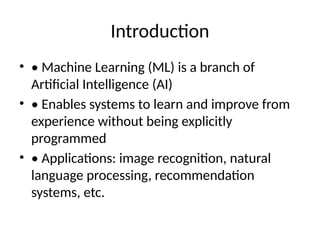
Introduction
• • MachineLearning (ML) is a branch of
Artificial Intelligence (AI)
• • Enables systems to learn and improve from
experience without being explicitly
programmed
• • Applications: image recognition, natural
language processing, recommendation
systems, etc.
3.
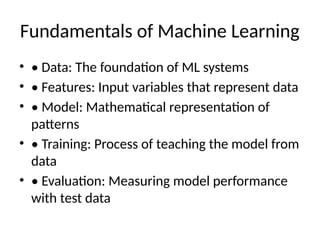
Fundamentals of MachineLearning
• • Data: The foundation of ML systems
• • Features: Input variables that represent data
• • Model: Mathematical representation of
patterns
• • Training: Process of teaching the model from
data
• • Evaluation: Measuring model performance
with test data
4.
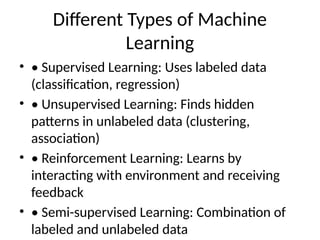
Different Types ofMachine
Learning
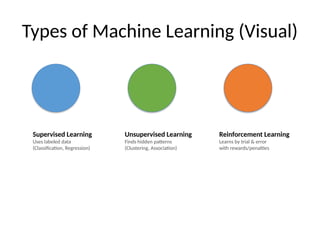
• • Supervised Learning: Uses labeled data
(classification, regression)
• • Unsupervised Learning: Finds hidden
patterns in unlabeled data (clustering,
association)
• • Reinforcement Learning: Learns by
interacting with environment and receiving
feedback
• • Semi-supervised Learning: Combination of
labeled and unlabeled data
5.
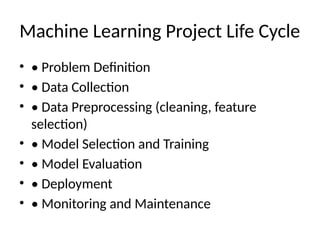
Machine Learning ProjectLife Cycle
• • Problem Definition
• • Data Collection
• • Data Preprocessing (cleaning, feature
selection)
• • Model Selection and Training
• • Model Evaluation
• • Deployment
• • Monitoring and Maintenance
6.
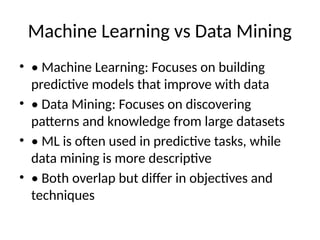
Machine Learning vsData Mining
• • Machine Learning: Focuses on building
predictive models that improve with data
• • Data Mining: Focuses on discovering
patterns and knowledge from large datasets
• • ML is often used in predictive tasks, while
data mining is more descriptive
• • Both overlap but differ in objectives and
techniques
7.
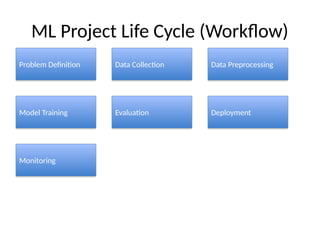
ML Project LifeCycle (Workflow)
Problem Definition Data Collection Data Preprocessing
Model Training Evaluation Deployment
Monitoring
8.
ML vs DataMining (Comparison)
Objective Approach Output
0
0.1
0.2
0.3
0.4
0.5
0.6
0.7
0.8
0.9
1
9.
Types of MachineLearning (Visual)
Supervised Learning
Uses labeled data
(Classification, Regression)
Unsupervised Learning
Finds hidden patterns
(Clustering, Association)
Reinforcement Learning
Learns by trial & error
with rewards/penalties
10.
Conclusion & KeyTakeaways
• • Machine Learning enables systems to learn
from data and improve over time
• • Fundamentals: data, features, models,
training, evaluation
• • Types: Supervised, Unsupervised,
Reinforcement (and semi-supervised)
• • Project life cycle: from problem definition to
deployment & monitoring
• • Difference from Data Mining: ML focuses on
prediction, DM on pattern discovery


![[Deck] What's New in Spark-Iceberg Integration via DSV2.pptx](https://cdn.slidesharecdn.com/ss_thumbnails/deckwhatsnewinspark-icebergintegrationviadsv2-260210005337-25955b12-thumbnail.jpg?width=640&height=640&fit=bounds)


