Image
Introduction to Machine Learning
Concepts, Methods, and Applications
Data Science Department
University of Advanced Technology
February 9, 2026
ML Team (University) Introduction to Machine Learning February 9, 2026 1 / 14
Image
Outline
1 Introduction to Machine Learning
2 Types of Machine Learning
3 Key Algorithms
4 ML Workflow
5 Applications
6 Challenges and Future
7 Conclusion
ML Team (University) Introduction to Machine Learning February 9, 2026 2 / 14
Image
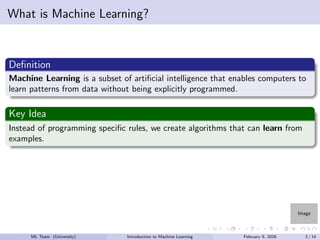
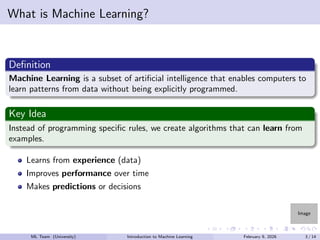
What is Machine Learning?
Definition
Machine Learning is a subset of artificial intelligence that enables computers to
learn patterns from data without being explicitly programmed.
Key Idea
Instead of programming specific rules, we create algorithms that can learn from
examples.
ML Team (University) Introduction to Machine Learning February 9, 2026 3 / 14
Image
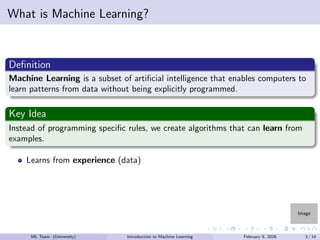
What is Machine Learning?
Definition
Machine Learning is a subset of artificial intelligence that enables computers to
learn patterns from data without being explicitly programmed.
Key Idea
Instead of programming specific rules, we create algorithms that can learn from
examples.
Learns from experience (data)
ML Team (University) Introduction to Machine Learning February 9, 2026 3 / 14
Image
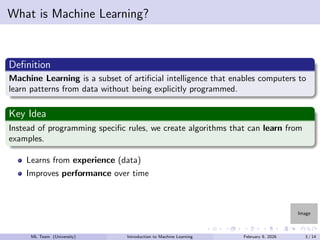
What is Machine Learning?
Definition
Machine Learning is a subset of artificial intelligence that enables computers to
learn patterns from data without being explicitly programmed.
Key Idea
Instead of programming specific rules, we create algorithms that can learn from
examples.
Learns from experience (data)
Improves performance over time
ML Team (University) Introduction to Machine Learning February 9, 2026 3 / 14
Image
What is Machine Learning?
Definition
Machine Learning is a subset of artificial intelligence that enables computers to
learn patterns from data without being explicitly programmed.
Key Idea
Instead of programming specific rules, we create algorithms that can learn from
examples.
Learns from experience (data)
Improves performance over time
Makes predictions or decisions
ML Team (University) Introduction to Machine Learning February 9, 2026 3 / 14
Image
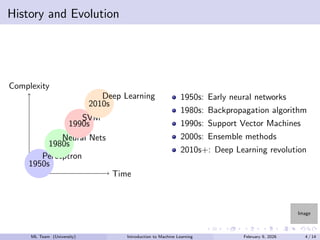
History and Evolution
Time
Complexity
1950s
Perceptron
1980s
Neural Nets
1990s
SVM
2010s
Deep Learning 1950s: Early neural networks
1980s: Backpropagation algorithm
1990s: Support Vector Machines
2000s: Ensemble methods
2010s+: Deep Learning revolution
ML Team (University) Introduction to Machine Learning February 9, 2026 4 / 14
Image
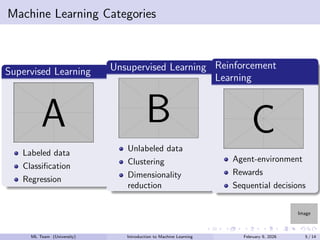
Machine Learning Categories
Supervised Learning
A
Labeled data
Classification
Regression
Unsupervised Learning
B
Unlabeled data
Clustering
Dimensionality
reduction
Reinforcement
Learning
C
Agent-environment
Rewards
Sequential decisions
ML Team (University) Introduction to Machine Learning February 9, 2026 5 / 14
Image
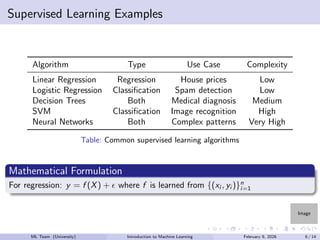
Supervised Learning Examples
Algorithm Type Use Case Complexity
Linear Regression Regression House prices Low
Logistic Regression Classification Spam detection Low
Decision Trees Both Medical diagnosis Medium
SVM Classification Image recognition High
Neural Networks Both Complex patterns Very High
Table: Common supervised learning algorithms
Mathematical Formulation
For regression: y = f (X) + ϵ where f is learned from {(xi , yi )}n
i=1
ML Team (University) Introduction to Machine Learning February 9, 2026 6 / 14
Image
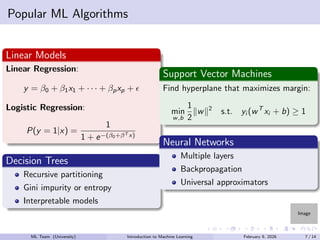
Popular ML Algorithms
Linear Models
Linear Regression:
y = β0 + β1x1 + · · · + βpxp + ϵ
Logistic Regression:
P(y = 1|x) =
1
1 + e−(β0+βT x)
Decision Trees
Recursive partitioning
Gini impurity or entropy
Interpretable models
Support Vector Machines
Find hyperplane that maximizes margin:
min
w,b
1
2
∥w∥2
s.t. yi (wT
xi + b) ≥ 1
Neural Networks
Multiple layers
Backpropagation
Universal approximators
ML Team (University) Introduction to Machine Learning February 9, 2026 7 / 14
Image
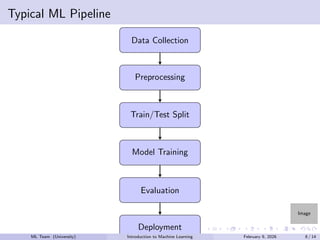
Typical ML Pipeline
Data Collection
Preprocessing
Train/Test Split
Model Training
Evaluation
Deployment
ML Team (University) Introduction to Machine Learning February 9, 2026 8 / 14
Image
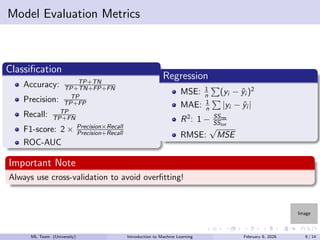
Model Evaluation Metrics
Classification
Accuracy: TP+TN
TP+TN+FP+FN
Precision: TP
TP+FP
Recall: TP
TP+FN
F1-score: 2 × Precision×Recall
Precision+Recall
ROC-AUC
Regression
MSE: 1
n
P
(yi − ŷi )2
MAE: 1
n
P
|yi − ŷi |
R2
: 1 − SSres
SStot
RMSE:
√
MSE
Important Note
Always use cross-validation to avoid overfitting!
ML Team (University) Introduction to Machine Learning February 9, 2026 9 / 14
Image
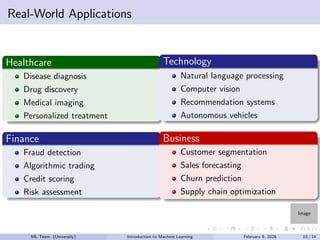
Real-World Applications
Healthcare
Disease diagnosis
Drug discovery
Medical imaging
Personalized treatment
Finance
Fraud detection
Algorithmic trading
Credit scoring
Risk assessment
Technology
Natural language processing
Computer vision
Recommendation systems
Autonomous vehicles
Business
Customer segmentation
Sales forecasting
Churn prediction
Supply chain optimization
ML Team (University) Introduction to Machine Learning February 9, 2026 10 / 14
Image
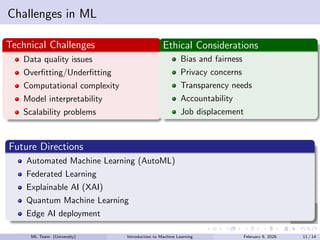
Challenges in ML
Technical Challenges
Data quality issues
Overfitting/Underfitting
Computational complexity
Model interpretability
Scalability problems
Ethical Considerations
Bias and fairness
Privacy concerns
Transparency needs
Accountability
Job displacement
Future Directions
Automated Machine Learning (AutoML)
Federated Learning
Explainable AI (XAI)
Quantum Machine Learning
Edge AI deployment
ML Team (University) Introduction to Machine Learning February 9, 2026 11 / 14
Image
Summary
Machine Learning enables computers to
learn from data
Image
Figure: ML Impact Growth
ML Team (University) Introduction to Machine Learning February 9, 2026 12 / 14
Image
Summary
Machine Learning enables computers to
learn from data
Three main types: Supervised,
Unsupervised, Reinforcement Image
Figure: ML Impact Growth
ML Team (University) Introduction to Machine Learning February 9, 2026 12 / 14
Image
Summary
Machine Learning enables computers to
learn from data
Three main types: Supervised,
Unsupervised, Reinforcement
Proper workflow is crucial for success
Image
Figure: ML Impact Growth
ML Team (University) Introduction to Machine Learning February 9, 2026 12 / 14
Image
Summary
Machine Learning enables computers to
learn from data
Three main types: Supervised,
Unsupervised, Reinforcement
Proper workflow is crucial for success
Numerous applications across industries
Image
Figure: ML Impact Growth
ML Team (University) Introduction to Machine Learning February 9, 2026 12 / 14
Image
Summary
Machine Learning enables computers to
learn from data
Three main types: Supervised,
Unsupervised, Reinforcement
Proper workflow is crucial for success
Numerous applications across industries
Important challenges need addressing
Image
Figure: ML Impact Growth
ML Team (University) Introduction to Machine Learning February 9, 2026 12 / 14
Image
Summary
Machine Learning enables computers to
learn from data
Three main types: Supervised,
Unsupervised, Reinforcement
Proper workflow is crucial for success
Numerous applications across industries
Important challenges need addressing
Rapidly evolving field with exciting future
Image
Figure: ML Impact Growth
ML Team (University) Introduction to Machine Learning February 9, 2026 12 / 14
Image
Thank You!
Questions?
Email: datascience@university.edu
Website: www.university.edu/ml
GitHub: github.com/ml-course
ML Team (University) Introduction to Machine Learning February 9, 2026 13 / 14
Image
References
Mitchell, T. M. (1997). Machine Learning. McGraw-Hill.
Goodfellow, I., Bengio, Y., & Courville, A. (2016). Deep Learning. MIT Press.
Hastie, T., Tibshirani, R., & Friedman, J. (2009). The Elements of Statistical
Learning. Springer.
Chollet, F. (2021). Deep Learning with Python. Manning Publications.
Further Reading
Coursera: Machine Learning by Andrew Ng
Kaggle: Competitions and datasets
ArXiv: Latest research papers
ML Team (University) Introduction to Machine Learning February 9, 2026 14 / 14
Introduction_to_Machine_Learning_Presentation.pdf

  • 1.
    Image Introduction to MachineLearning Concepts, Methods, and Applications Data Science Department University of Advanced Technology February 9, 2026 ML Team (University) Introduction to Machine Learning February 9, 2026 1 / 14
  • 2.
    Image Outline 1 Introduction toMachine Learning 2 Types of Machine Learning 3 Key Algorithms 4 ML Workflow 5 Applications 6 Challenges and Future 7 Conclusion ML Team (University) Introduction to Machine Learning February 9, 2026 2 / 14
  • 3.
    Image What is MachineLearning? Definition Machine Learning is a subset of artificial intelligence that enables computers to learn patterns from data without being explicitly programmed. Key Idea Instead of programming specific rules, we create algorithms that can learn from examples. ML Team (University) Introduction to Machine Learning February 9, 2026 3 / 14
  • 4.
    Image What is MachineLearning? Definition Machine Learning is a subset of artificial intelligence that enables computers to learn patterns from data without being explicitly programmed. Key Idea Instead of programming specific rules, we create algorithms that can learn from examples. Learns from experience (data) ML Team (University) Introduction to Machine Learning February 9, 2026 3 / 14
  • 5.
    Image What is MachineLearning? Definition Machine Learning is a subset of artificial intelligence that enables computers to learn patterns from data without being explicitly programmed. Key Idea Instead of programming specific rules, we create algorithms that can learn from examples. Learns from experience (data) Improves performance over time ML Team (University) Introduction to Machine Learning February 9, 2026 3 / 14
  • 6.
    Image What is MachineLearning? Definition Machine Learning is a subset of artificial intelligence that enables computers to learn patterns from data without being explicitly programmed. Key Idea Instead of programming specific rules, we create algorithms that can learn from examples. Learns from experience (data) Improves performance over time Makes predictions or decisions ML Team (University) Introduction to Machine Learning February 9, 2026 3 / 14
  • 7.
    Image History and Evolution Time Complexity 1950s Perceptron 1980s NeuralNets 1990s SVM 2010s Deep Learning 1950s: Early neural networks 1980s: Backpropagation algorithm 1990s: Support Vector Machines 2000s: Ensemble methods 2010s+: Deep Learning revolution ML Team (University) Introduction to Machine Learning February 9, 2026 4 / 14
  • 8.
    Image Machine Learning Categories SupervisedLearning A Labeled data Classification Regression Unsupervised Learning B Unlabeled data Clustering Dimensionality reduction Reinforcement Learning C Agent-environment Rewards Sequential decisions ML Team (University) Introduction to Machine Learning February 9, 2026 5 / 14
  • 9.
    Image Supervised Learning Examples AlgorithmType Use Case Complexity Linear Regression Regression House prices Low Logistic Regression Classification Spam detection Low Decision Trees Both Medical diagnosis Medium SVM Classification Image recognition High Neural Networks Both Complex patterns Very High Table: Common supervised learning algorithms Mathematical Formulation For regression: y = f (X) + ϵ where f is learned from {(xi , yi )}n i=1 ML Team (University) Introduction to Machine Learning February 9, 2026 6 / 14
  • 10.
    Image Popular ML Algorithms LinearModels Linear Regression: y = β0 + β1x1 + · · · + βpxp + ϵ Logistic Regression: P(y = 1|x) = 1 1 + e−(β0+βT x) Decision Trees Recursive partitioning Gini impurity or entropy Interpretable models Support Vector Machines Find hyperplane that maximizes margin: min w,b 1 2 ∥w∥2 s.t. yi (wT xi + b) ≥ 1 Neural Networks Multiple layers Backpropagation Universal approximators ML Team (University) Introduction to Machine Learning February 9, 2026 7 / 14
  • 11.
    Image Typical ML Pipeline DataCollection Preprocessing Train/Test Split Model Training Evaluation Deployment ML Team (University) Introduction to Machine Learning February 9, 2026 8 / 14
  • 12.
    Image Model Evaluation Metrics Classification Accuracy:TP+TN TP+TN+FP+FN Precision: TP TP+FP Recall: TP TP+FN F1-score: 2 × Precision×Recall Precision+Recall ROC-AUC Regression MSE: 1 n P (yi − ŷi )2 MAE: 1 n P |yi − ŷi | R2 : 1 − SSres SStot RMSE: √ MSE Important Note Always use cross-validation to avoid overfitting! ML Team (University) Introduction to Machine Learning February 9, 2026 9 / 14
  • 13.
    Image Real-World Applications Healthcare Disease diagnosis Drugdiscovery Medical imaging Personalized treatment Finance Fraud detection Algorithmic trading Credit scoring Risk assessment Technology Natural language processing Computer vision Recommendation systems Autonomous vehicles Business Customer segmentation Sales forecasting Churn prediction Supply chain optimization ML Team (University) Introduction to Machine Learning February 9, 2026 10 / 14
  • 14.
    Image Challenges in ML TechnicalChallenges Data quality issues Overfitting/Underfitting Computational complexity Model interpretability Scalability problems Ethical Considerations Bias and fairness Privacy concerns Transparency needs Accountability Job displacement Future Directions Automated Machine Learning (AutoML) Federated Learning Explainable AI (XAI) Quantum Machine Learning Edge AI deployment ML Team (University) Introduction to Machine Learning February 9, 2026 11 / 14
  • 15.
    Image Summary Machine Learning enablescomputers to learn from data Image Figure: ML Impact Growth ML Team (University) Introduction to Machine Learning February 9, 2026 12 / 14
  • 16.
    Image Summary Machine Learning enablescomputers to learn from data Three main types: Supervised, Unsupervised, Reinforcement Image Figure: ML Impact Growth ML Team (University) Introduction to Machine Learning February 9, 2026 12 / 14
  • 17.
    Image Summary Machine Learning enablescomputers to learn from data Three main types: Supervised, Unsupervised, Reinforcement Proper workflow is crucial for success Image Figure: ML Impact Growth ML Team (University) Introduction to Machine Learning February 9, 2026 12 / 14
  • 18.
    Image Summary Machine Learning enablescomputers to learn from data Three main types: Supervised, Unsupervised, Reinforcement Proper workflow is crucial for success Numerous applications across industries Image Figure: ML Impact Growth ML Team (University) Introduction to Machine Learning February 9, 2026 12 / 14
  • 19.
    Image Summary Machine Learning enablescomputers to learn from data Three main types: Supervised, Unsupervised, Reinforcement Proper workflow is crucial for success Numerous applications across industries Important challenges need addressing Image Figure: ML Impact Growth ML Team (University) Introduction to Machine Learning February 9, 2026 12 / 14
  • 20.
    Image Summary Machine Learning enablescomputers to learn from data Three main types: Supervised, Unsupervised, Reinforcement Proper workflow is crucial for success Numerous applications across industries Important challenges need addressing Rapidly evolving field with exciting future Image Figure: ML Impact Growth ML Team (University) Introduction to Machine Learning February 9, 2026 12 / 14
  • 21.
    Image Thank You! Questions? Email: datascience@university.edu Website:www.university.edu/ml GitHub: github.com/ml-course ML Team (University) Introduction to Machine Learning February 9, 2026 13 / 14
  • 22.
    Image References Mitchell, T. M.(1997). Machine Learning. McGraw-Hill. Goodfellow, I., Bengio, Y., & Courville, A. (2016). Deep Learning. MIT Press. Hastie, T., Tibshirani, R., & Friedman, J. (2009). The Elements of Statistical Learning. Springer. Chollet, F. (2021). Deep Learning with Python. Manning Publications. Further Reading Coursera: Machine Learning by Andrew Ng Kaggle: Competitions and datasets ArXiv: Latest research papers ML Team (University) Introduction to Machine Learning February 9, 2026 14 / 14