Bizmetric – MLOps Capability
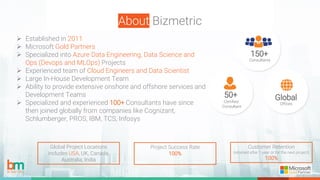
➢ Established in 2011
➢ Microsoft Gold Partners
➢ Specialized into Azure Data Engineering, Data Science and
Ops (Devops and MLOps) Projects
➢ Experienced team of Cloud Engineers and Data Scientist
➢ Large In-House Development Team
➢ Ability to provide extensive onshore and offshore services and
Development Teams
➢ Specialized and experienced 100+ Consultants have since
then joined globally from companies like Cognizant,
Schlumberger, PROS, IBM, TCS, Infosys
150+
Consultants
50+ Global
Offices
Certified
Consultant
About Bizmetric
Global Project Locations
includes USA, UK, Canada,
Australia, India
Project Success Rate
100%
Customer Retention
(retained after 1 year or for the next project)
100%
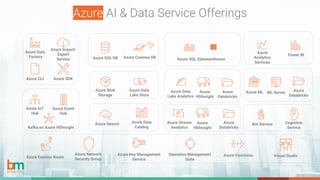
Azure AI & Data Service Offerings
Azure Data
Factory
Azure Import/
Export
Service
Azure CLI Azure SDK
Azure SQL DB Azure Cosmos DB
Azure Blob
Storage
Azure Data
Lake Store
Azure IoT
Hub
Azure Event
Hub
Kafka on Azure HDInsight
Azure Search Azure Data
Catalog
Azure SQL Datawarehouse
Azure Data
Lake Analytics
Azure
HDInsight
Azure
Databricks
Azure
HDInsight
Azure
Databricks
Azure Stream
Analytics
Azure
Analytics
Services
Power BI
Azure
Databricks
Azure ML ML Server
Bot Service Cognitive
Service
Azure Express Route
Azure Network
Security Group
Azure Key Management
Service
Operation Management
Suite
Visual Studio
Azure Functions
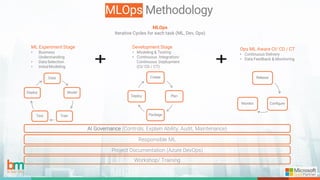
MLOps Methodology
MLOps
Iterative Cycles for each task (ML, Dev, Ops)
ML ExperimentStage
• Business
Understanding
• Data Selection
• InitialModeling
Development Stage
• Modeling & Testing
• Continuous Integration/
Continuous Deployment
(CI/ CD / CT)
Ops ML Aware CI/ CD / CT
• Continuous Delivery
• Data Feedback & Monitoring
Data
Model
Train
Test
Deploy
Create
Plan
Package
Deploy
Release
Configure
Monitor
AI Governance (Controls, Explain Ability, Audit, Maintenance)
Responsible ML
Project Documentation (Azure DevOps)
Workshop/ Training
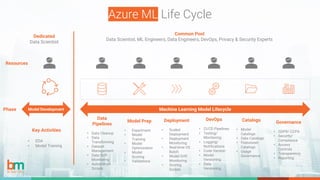
Azure ML Life Cycle
Dedicated
Data Scientist
Common Pool
Data Scientist, ML Engineers, Data Engineers, DevOps, Privacy & Security Experts
Resources
Phase Model Development Machine Learning Model Lifecycle
Data
Pipelines
• Data Cleanup
• Data
Transforming
• Dataset
Management
• Data Drift
Monitoring
• Automation
Scripts
Model Prep
• Experiment
• Model
Training
• Model
Optimization
• Model
Scoring
• Validations
Deployment
• Scaled
Deployment
• Deployment
Monitoring
• Real-time VS
Batch
• Model Drift
Monitoring
• Scoring
Scripts
DevOps
• CI/CD Pipelines
• Testing/
Monitoring
• Logging/
Notifications
• Code Version
• Model
Versioning
• Data
Versioning
Catalogs
• Model
Catalogs
• Data Catalogs
• Featureset
Catalogs
• Usage
Governance
Governance
• GDPR/ CCPA
• Security/
Compliance
• Access
Controls
• Transparency
• Reporting
Key Activities
• EDA
• Model Training
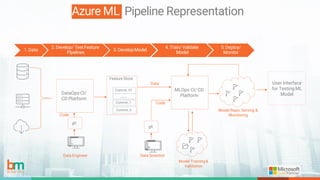
Azure ML Pipeline Representation
1.Data
2. Develop/ TestFeature
Pipelines
3. DevelopModel
4. Train/ Validate
Model
5.Deploy/
Monitor
DataOps CI/
CD Platform
Data Engineer
git
Code
Feature Store
Commit..97
……
Commit..1
Commit..0
MLOps CI/ CD
Platform
Data
git
Code
Data Scientist
Model Training &
Validation
Model Repo, Serving &
Monitoring
User Interface
for Testing ML
Model
Azure ML Architecture
Azure Pipeline
Azure Machine Learning
Data
Sanity
Test
Unit Test Create ML
Workspace
Create
ML
Compute
Publish
ML
Pipeline
One Time Run
Runs for New Code
Azure Pipeline
Azure DevOps Build Pipeline
Azure Machine Learning Azure Machine Learning
Package
model into
image
Model
Deploying
on ACI
Test Web
Service
Model
Deploying
on AKS
Test Web
Service
Azure DevOps Release Pipeline
G]
Staging QA Production
Manual
Release
Gate
AML Model
Management
Azure Kubernetes
Service
Azure Storage
Azure ML
Pipeline
Endpoint
Azure ML
Retraining Pipeline
Train
Model
Evaluate
Model
Register
Model
Azure Container Instances
Azure ML Compute
Publish ML
Pipeline
New Data Location
Model Artefact Trigger
Azure App Insights
Monitoring
Triggers: data-driven, Schedule Driven, Metrics-
driven
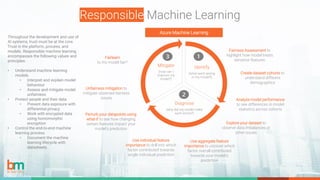
Responsible Machine Learning
Throughout the development and use of
AI systems, trust must be at the core.
Trust in the platform, process, and
models. Responsible machine learning
encompasses the following values and
principles:
• Understand machine learning
models
• Interpret and explain model
behaviour
• Assess and mitigate model
unfairness
• Protect people and their data
• Prevent data exposure with
differential privacy
• Work with encrypted data
using homomorphic
encryption
• Control the end-to-end machine
learning process
• Document the machine
learning lifecycle with
datasheets
Identify
(what went wrong
in my model?)
Diagnose
(why did my model make
such errors?)
Mitigate
(how can I
improve my
model?)
Fairness Assessment to
highlight how model treats
sensitive features
Create dataset cohorts to
understand different
demographics
Analyze model performance
to see differences in model
statistics across cohorts
Explore your dataset to
observe data imbalances or
other issues
Use aggregate feature
importance to uncover which
factor overall contributed
towards your model’s
prediction
Use individual feature
importance to drill into which
factor contributed towards
single individual prediction
Perturb your datapoints using
what-if to see how changing
certain features impact your
model’s prediction
Azure Machine Learning
Unfairness mitigation to
mitigate observed fairness
issues
Fairlearn
Is my model fair?
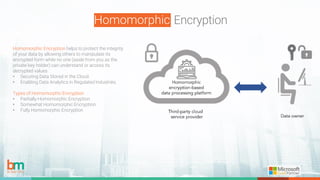
Homomorphic Encryption helps to protect the integrity
of your data by allowing others to manipulate its
encrypted form while no one (aside from you as the
private key holder) can understand or access its
decrypted values
• Securing Data Stored in the Cloud.
• Enabling Data Analytics in Regulated Industries.
Types of Homomorphic Encryption
• Partially Homomorphic Encryption
• Somewhat Homomorphic Encryption
• Fully Homomorphic Encryption
Homomorphic Encryption
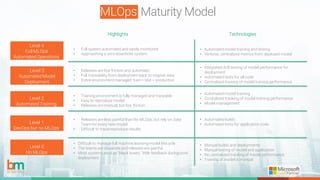
MLOps Maturity Model
Level 0
No MLOps
Level 1
DevOps but no MLOps
Level 2
Automated Training
Level 3
Automated Model
Deployment
Level 4
Full MLOps
Automated Operations
Highlights Technologies
• Full system automated and easily monitored
• Approaching a zero-downtime system
• Automated model training and testing
• Verbose, centralized metrics from deployed model
• Releases are low friction and automatic
• Full traceability from deployment back to original data
• Entire environment managed: train > test > production
• Integrated A/B testing of model performance for
deployment
• Automated tests for all code
• Centralized training of model training performance
• Training environment is fully managed and traceable
• Easy to reproduce model
• Releases are manual, but low friction
• Automated model training
• Centralized tracking of model training performance
• Model management
• Releases are less painful than No MLOps, but rely on Data
Team for every new model
• Difficult to trace/reproduce results
• Automated builds
• Automated tests for application code
• Difficult to manage full machine learning model lifecycle
• The teams are disparate and releases are painful
• Most systems exist as "black boxes," little feedback during/post
deployment
• Manual builds and deployments
• Manual testing of model and application
• No centralized tracking of model performance
• Training of model is manual
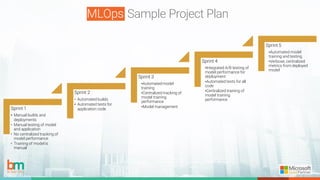
MLOps Sample Project Plan
Sprint 1
• Manual builds and
deployments
• Manual testing of model
and application
• No centralized tracking of
model performance
• Training of model is
manual
Sprint 2
• Automated builds
• Automated tests for
application code
Sprint 3
•Automatedmodel
training
•Centralized tracking of
model training
performance
•Model management
Sprint 4
•Integrated A/B testing of
model performance for
deployment
•Automated tests for all
code
•Centralized training of
model training
performance
Sprint 5
•Automated model
training and testing
•Verbose, centralized
metrics from deployed
model
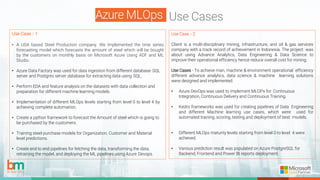
Azure MLOps Use Cases
Use Case :- 1
• A USA based Steel Production company. We Implemented the time series
forecasting model which forecasts the amount of steel which will be bought
by the customers on monthly basis on Microsoft Azure Using ADF and ML
Studio.
• Azure Data Factory was used for data ingestion from different database SQL
server and Postgres server database for extracting data using SQL.
• Perform EDA and feature analysis on the datasets with data collection and
preparation for different machine learning models.
• Implementation of different MLOps levels starting from level 0 to level 4 by
achieving complete automation.
• Create a python framework to forecast the Amount of steel which is going to
be purchased by the customers.
• Training steel-purchase models for Organization, Customer and Material
level predictions.
• Create end to end pipelines for fetching the data, transforming the data,
retraining the model, and deploying the ML pipelines using Azure Devops.
Use Case :- 2
Client is a multi-disciplinary mining, infrastructure, and oil & gas services
company with a track record of achievement in Indonesia. The project was
about using Advance Analytics, Data Engineering & Data Science to
improve their operational efficiency hence reduce overall cost for mining.
Use Cases - To achieve man, machine & environment operational efficiency
different advance analytics, data science & machine learning solutions
were designed and implemented.
• Azure DevOps was used to implement MLOPs for Continuous
Integration, Continuous Delivery and Continuous Training.
• Kedro frameworks was used for creating pipelines of Data Engineering
and different Machine learning use cases, which were used for
automated training, scoring, testing and deployment of best models.
• Different MLOps maturity levels starting from level 0 to level 4 were
achieved.
• Various prediction result was populated on Azure PostgreSQL for
Backend, Frontend and Power BI reports deployment.
ExxonMobil MLOps Case Study
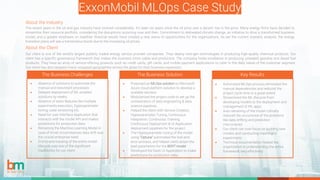
About the Client
Our client is one of the world's largest publicly traded energy service provider companies. They deploy next-gen technologies in producing high-quality chemical products. Our
client has a specific governance framework that makes the business more viable and productive. The company holds excellence in producing unleaded gasoline and diesel fuel
products. They have an array of service-offering products such as credit cards, gift cards, and mobile payment applications to cater to the daily needs of the customer segment.
Our client has also targeted many untapped geographies across the globe for their business expansion.
The Business Challenges The Business Solution Key Results
• Absence of solutions to automate the
manual and redundant processes
• Delayed deployment of ML-enabled
solutions by weeks
• Absence of extra features like multiple
experiments execution, hyperparameter
tuning, code versioning etc.
• Need for user Interface Application that
interacts with the model API and makes
predictions for production data
• Retraining the Machine Learning Model in
case of trivial circumstances data drift was
the crucial enterprise need
• End-to-end tracking of the entire model
lifecycle was one of the significant
roadblocks for our client
• Proposed an MLOps solution on Microsoft
Azure cloud platform solution to develop a
scalable solution
• Modularized the project code to set up the
orchestration of data engineering & data
science pipelines
• Helped the client with Service Creation,
Hyperparameter Tuning, Continuous
Integration, Continuous Training,
Continuous Deployment & UI Application
deployment pipelines for the project
• The Hyperparameter tuning of the model
using "Optuna" automated the trial-and-
error process, and helped client obtain the
best parameters for the BERT model
• Developed the Dash UI Application to make
predictions for production data
• Automated MLOps process eliminated the
manual dependencies and reduced the
project cycle time to a great extent
• Streamlined the ML lifecycle from
developing models to the deployment and
management of ML apps
• Auto retraining of the model critically
reduced the occurrence of the problems
like data drifting and prediction
inaccuracies
• Our client can now focus on building new
models and conducting meaningful
experiments
• Technical documentation helped the
organization in understanding the entire
framework very effectively
About the Industry
The recent years in the oil and gas industry have evolved considerably. It's been six years since the oil price saw a decent rise in the price. Many energy firms have decided to
streamline their resource portfolio, considering the disruptions occurring now and then. Commitment to delineated climate change, an initiative to drive a transformed business
model, and a greater emphasis on healthier financial results have created a new arena of opportunities for the organizations. As per the current scenario analysis, the energy
transition plans will see a tremendous boost due to the increasing oil prices.
Continuous Integration
Pipeline
∷ Code Quality & Unit Tests
∷ Data Engineering Pipeline
∷ Training code
∷ Evaluating code
∷ Registering code
∷ Score File
Azure Data Lake
Store (Hot)
Data
Tables
Azure Data Lake
Store (Archive)
Training
Compute
Create Docker Image
from Registered Model
(IMAGES)
Container Registry
(TEST) (DEPLOYMENTS)
Container Instance
(Rest API)
(PROD)
(DEPLOYMENTS)
Kubernetes Services
(Prod API)
AKS Deploy + Test
ACI Deploy + Test
(MODELS) ML
Model Registry
Experiment
Logs/Metrics
Track
Experiment
Run + Logs
Training
Data
Snapshot
(FUTURE)
Automated Retraining
“Trigger” Model Retraining
Data Drift/Prediction Drift
Commit
Azure ML SDK/CLI
Create Docker from
artifacts…
+ Registered Model
+ Score File
+ Conda File
Azure ML SDK/CLI
Deploy Docker Image ➜ ACI
Azure ML SDK/CLI
Deploy Docker Image ➜ AKS
Enable Azure ML model monitoring (SDK)
Repo Pipeline Pipeline Pipeline
Trigger / Manual Run
Raw Data
AZURE DEVOPS REPOS (source code) + PIPELINES (yml)
Model Monitor
Azure Storage
(RT Data History)
Usage Reports
App Insights
(RT Stats History)
Statistics Reports
AZURE ML SERVICE
Model
Iterate
(DEV) (DEPLOYMENTS)
Web App UI on ACI
Batch & User Input Testing
Branches
dev, qa & master
Accuracy & Loss
Azure Machine
Learning
Train Evaluate Register
Publish
Build Pipeline
∷ Create workspace
∷ Create compute resource
UI App on ACI
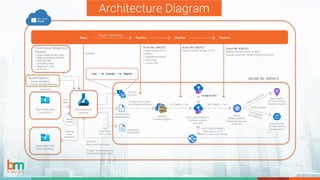
Architecture Diagram
Repo Pipeline Pipeline Pipeline
Trigger / Manual Run
Repo Pipeline Pipeline
Thank You
Q&A

Machine Learning Operations Cababilities

  • 1.
  • 2.
    ➢ Established in2011 ➢ Microsoft Gold Partners ➢ Specialized into Azure Data Engineering, Data Science and Ops (Devops and MLOps) Projects ➢ Experienced team of Cloud Engineers and Data Scientist ➢ Large In-House Development Team ➢ Ability to provide extensive onshore and offshore services and Development Teams ➢ Specialized and experienced 100+ Consultants have since then joined globally from companies like Cognizant, Schlumberger, PROS, IBM, TCS, Infosys 150+ Consultants 50+ Global Offices Certified Consultant About Bizmetric Global Project Locations includes USA, UK, Canada, Australia, India Project Success Rate 100% Customer Retention (retained after 1 year or for the next project) 100%
  • 3.
    Azure AI &Data Service Offerings Azure Data Factory Azure Import/ Export Service Azure CLI Azure SDK Azure SQL DB Azure Cosmos DB Azure Blob Storage Azure Data Lake Store Azure IoT Hub Azure Event Hub Kafka on Azure HDInsight Azure Search Azure Data Catalog Azure SQL Datawarehouse Azure Data Lake Analytics Azure HDInsight Azure Databricks Azure HDInsight Azure Databricks Azure Stream Analytics Azure Analytics Services Power BI Azure Databricks Azure ML ML Server Bot Service Cognitive Service Azure Express Route Azure Network Security Group Azure Key Management Service Operation Management Suite Visual Studio Azure Functions
  • 4.
    MLOps Methodology MLOps Iterative Cyclesfor each task (ML, Dev, Ops) ML ExperimentStage • Business Understanding • Data Selection • InitialModeling Development Stage • Modeling & Testing • Continuous Integration/ Continuous Deployment (CI/ CD / CT) Ops ML Aware CI/ CD / CT • Continuous Delivery • Data Feedback & Monitoring Data Model Train Test Deploy Create Plan Package Deploy Release Configure Monitor AI Governance (Controls, Explain Ability, Audit, Maintenance) Responsible ML Project Documentation (Azure DevOps) Workshop/ Training
  • 5.
    Azure ML LifeCycle Dedicated Data Scientist Common Pool Data Scientist, ML Engineers, Data Engineers, DevOps, Privacy & Security Experts Resources Phase Model Development Machine Learning Model Lifecycle Data Pipelines • Data Cleanup • Data Transforming • Dataset Management • Data Drift Monitoring • Automation Scripts Model Prep • Experiment • Model Training • Model Optimization • Model Scoring • Validations Deployment • Scaled Deployment • Deployment Monitoring • Real-time VS Batch • Model Drift Monitoring • Scoring Scripts DevOps • CI/CD Pipelines • Testing/ Monitoring • Logging/ Notifications • Code Version • Model Versioning • Data Versioning Catalogs • Model Catalogs • Data Catalogs • Featureset Catalogs • Usage Governance Governance • GDPR/ CCPA • Security/ Compliance • Access Controls • Transparency • Reporting Key Activities • EDA • Model Training
  • 6.
    Azure ML PipelineRepresentation 1.Data 2. Develop/ TestFeature Pipelines 3. DevelopModel 4. Train/ Validate Model 5.Deploy/ Monitor DataOps CI/ CD Platform Data Engineer git Code Feature Store Commit..97 …… Commit..1 Commit..0 MLOps CI/ CD Platform Data git Code Data Scientist Model Training & Validation Model Repo, Serving & Monitoring User Interface for Testing ML Model
  • 7.
    Azure ML Architecture AzurePipeline Azure Machine Learning Data Sanity Test Unit Test Create ML Workspace Create ML Compute Publish ML Pipeline One Time Run Runs for New Code Azure Pipeline Azure DevOps Build Pipeline Azure Machine Learning Azure Machine Learning Package model into image Model Deploying on ACI Test Web Service Model Deploying on AKS Test Web Service Azure DevOps Release Pipeline G] Staging QA Production Manual Release Gate AML Model Management Azure Kubernetes Service Azure Storage Azure ML Pipeline Endpoint Azure ML Retraining Pipeline Train Model Evaluate Model Register Model Azure Container Instances Azure ML Compute Publish ML Pipeline New Data Location Model Artefact Trigger Azure App Insights Monitoring Triggers: data-driven, Schedule Driven, Metrics- driven
  • 8.
    Responsible Machine Learning Throughoutthe development and use of AI systems, trust must be at the core. Trust in the platform, process, and models. Responsible machine learning encompasses the following values and principles: • Understand machine learning models • Interpret and explain model behaviour • Assess and mitigate model unfairness • Protect people and their data • Prevent data exposure with differential privacy • Work with encrypted data using homomorphic encryption • Control the end-to-end machine learning process • Document the machine learning lifecycle with datasheets Identify (what went wrong in my model?) Diagnose (why did my model make such errors?) Mitigate (how can I improve my model?) Fairness Assessment to highlight how model treats sensitive features Create dataset cohorts to understand different demographics Analyze model performance to see differences in model statistics across cohorts Explore your dataset to observe data imbalances or other issues Use aggregate feature importance to uncover which factor overall contributed towards your model’s prediction Use individual feature importance to drill into which factor contributed towards single individual prediction Perturb your datapoints using what-if to see how changing certain features impact your model’s prediction Azure Machine Learning Unfairness mitigation to mitigate observed fairness issues Fairlearn Is my model fair?
  • 9.
    Homomorphic Encryption helpsto protect the integrity of your data by allowing others to manipulate its encrypted form while no one (aside from you as the private key holder) can understand or access its decrypted values • Securing Data Stored in the Cloud. • Enabling Data Analytics in Regulated Industries. Types of Homomorphic Encryption • Partially Homomorphic Encryption • Somewhat Homomorphic Encryption • Fully Homomorphic Encryption Homomorphic Encryption
  • 10.
    MLOps Maturity Model Level0 No MLOps Level 1 DevOps but no MLOps Level 2 Automated Training Level 3 Automated Model Deployment Level 4 Full MLOps Automated Operations Highlights Technologies • Full system automated and easily monitored • Approaching a zero-downtime system • Automated model training and testing • Verbose, centralized metrics from deployed model • Releases are low friction and automatic • Full traceability from deployment back to original data • Entire environment managed: train > test > production • Integrated A/B testing of model performance for deployment • Automated tests for all code • Centralized training of model training performance • Training environment is fully managed and traceable • Easy to reproduce model • Releases are manual, but low friction • Automated model training • Centralized tracking of model training performance • Model management • Releases are less painful than No MLOps, but rely on Data Team for every new model • Difficult to trace/reproduce results • Automated builds • Automated tests for application code • Difficult to manage full machine learning model lifecycle • The teams are disparate and releases are painful • Most systems exist as "black boxes," little feedback during/post deployment • Manual builds and deployments • Manual testing of model and application • No centralized tracking of model performance • Training of model is manual
  • 11.
    MLOps Sample ProjectPlan Sprint 1 • Manual builds and deployments • Manual testing of model and application • No centralized tracking of model performance • Training of model is manual Sprint 2 • Automated builds • Automated tests for application code Sprint 3 •Automatedmodel training •Centralized tracking of model training performance •Model management Sprint 4 •Integrated A/B testing of model performance for deployment •Automated tests for all code •Centralized training of model training performance Sprint 5 •Automated model training and testing •Verbose, centralized metrics from deployed model
  • 12.
    Azure MLOps UseCases Use Case :- 1 • A USA based Steel Production company. We Implemented the time series forecasting model which forecasts the amount of steel which will be bought by the customers on monthly basis on Microsoft Azure Using ADF and ML Studio. • Azure Data Factory was used for data ingestion from different database SQL server and Postgres server database for extracting data using SQL. • Perform EDA and feature analysis on the datasets with data collection and preparation for different machine learning models. • Implementation of different MLOps levels starting from level 0 to level 4 by achieving complete automation. • Create a python framework to forecast the Amount of steel which is going to be purchased by the customers. • Training steel-purchase models for Organization, Customer and Material level predictions. • Create end to end pipelines for fetching the data, transforming the data, retraining the model, and deploying the ML pipelines using Azure Devops. Use Case :- 2 Client is a multi-disciplinary mining, infrastructure, and oil & gas services company with a track record of achievement in Indonesia. The project was about using Advance Analytics, Data Engineering & Data Science to improve their operational efficiency hence reduce overall cost for mining. Use Cases - To achieve man, machine & environment operational efficiency different advance analytics, data science & machine learning solutions were designed and implemented. • Azure DevOps was used to implement MLOPs for Continuous Integration, Continuous Delivery and Continuous Training. • Kedro frameworks was used for creating pipelines of Data Engineering and different Machine learning use cases, which were used for automated training, scoring, testing and deployment of best models. • Different MLOps maturity levels starting from level 0 to level 4 were achieved. • Various prediction result was populated on Azure PostgreSQL for Backend, Frontend and Power BI reports deployment.
  • 13.
    ExxonMobil MLOps CaseStudy About the Client Our client is one of the world's largest publicly traded energy service provider companies. They deploy next-gen technologies in producing high-quality chemical products. Our client has a specific governance framework that makes the business more viable and productive. The company holds excellence in producing unleaded gasoline and diesel fuel products. They have an array of service-offering products such as credit cards, gift cards, and mobile payment applications to cater to the daily needs of the customer segment. Our client has also targeted many untapped geographies across the globe for their business expansion. The Business Challenges The Business Solution Key Results • Absence of solutions to automate the manual and redundant processes • Delayed deployment of ML-enabled solutions by weeks • Absence of extra features like multiple experiments execution, hyperparameter tuning, code versioning etc. • Need for user Interface Application that interacts with the model API and makes predictions for production data • Retraining the Machine Learning Model in case of trivial circumstances data drift was the crucial enterprise need • End-to-end tracking of the entire model lifecycle was one of the significant roadblocks for our client • Proposed an MLOps solution on Microsoft Azure cloud platform solution to develop a scalable solution • Modularized the project code to set up the orchestration of data engineering & data science pipelines • Helped the client with Service Creation, Hyperparameter Tuning, Continuous Integration, Continuous Training, Continuous Deployment & UI Application deployment pipelines for the project • The Hyperparameter tuning of the model using "Optuna" automated the trial-and- error process, and helped client obtain the best parameters for the BERT model • Developed the Dash UI Application to make predictions for production data • Automated MLOps process eliminated the manual dependencies and reduced the project cycle time to a great extent • Streamlined the ML lifecycle from developing models to the deployment and management of ML apps • Auto retraining of the model critically reduced the occurrence of the problems like data drifting and prediction inaccuracies • Our client can now focus on building new models and conducting meaningful experiments • Technical documentation helped the organization in understanding the entire framework very effectively About the Industry The recent years in the oil and gas industry have evolved considerably. It's been six years since the oil price saw a decent rise in the price. Many energy firms have decided to streamline their resource portfolio, considering the disruptions occurring now and then. Commitment to delineated climate change, an initiative to drive a transformed business model, and a greater emphasis on healthier financial results have created a new arena of opportunities for the organizations. As per the current scenario analysis, the energy transition plans will see a tremendous boost due to the increasing oil prices.
  • 14.
    Continuous Integration Pipeline ∷ CodeQuality & Unit Tests ∷ Data Engineering Pipeline ∷ Training code ∷ Evaluating code ∷ Registering code ∷ Score File Azure Data Lake Store (Hot) Data Tables Azure Data Lake Store (Archive) Training Compute Create Docker Image from Registered Model (IMAGES) Container Registry (TEST) (DEPLOYMENTS) Container Instance (Rest API) (PROD) (DEPLOYMENTS) Kubernetes Services (Prod API) AKS Deploy + Test ACI Deploy + Test (MODELS) ML Model Registry Experiment Logs/Metrics Track Experiment Run + Logs Training Data Snapshot (FUTURE) Automated Retraining “Trigger” Model Retraining Data Drift/Prediction Drift Commit Azure ML SDK/CLI Create Docker from artifacts… + Registered Model + Score File + Conda File Azure ML SDK/CLI Deploy Docker Image ➜ ACI Azure ML SDK/CLI Deploy Docker Image ➜ AKS Enable Azure ML model monitoring (SDK) Repo Pipeline Pipeline Pipeline Trigger / Manual Run Raw Data AZURE DEVOPS REPOS (source code) + PIPELINES (yml) Model Monitor Azure Storage (RT Data History) Usage Reports App Insights (RT Stats History) Statistics Reports AZURE ML SERVICE Model Iterate (DEV) (DEPLOYMENTS) Web App UI on ACI Batch & User Input Testing Branches dev, qa & master Accuracy & Loss Azure Machine Learning Train Evaluate Register Publish Build Pipeline ∷ Create workspace ∷ Create compute resource UI App on ACI Architecture Diagram Repo Pipeline Pipeline Pipeline Trigger / Manual Run Repo Pipeline Pipeline
  • 15.