MACHINE LEARNING IN
BANKING
TIGRAN SUKIASYAN, PHD
DATA SCIENTIST AT AMERIABANK CJSC
VISITING LECTURER AT YEREVAN STATE UNIVERSITY - FACULTY OF MATHEMATICS AND
MECHANICS
URL: HTTP://WWW.LINKEDIN.COM/IN/TIGRAN -SUKIASYAN
Talk outline
◦ traditional credit risk modelling
◦ learning countrywide probability of credit defaults and financial stability
implications
◦ machine learning for time series forecasting
◦ text mining for central bank research
Christine Lagard’s speech
Central Banking and Fintech—A Brave New World?
“In 2040, the governor walking into the Bank will be of flesh and bones, and
behind the front door she will find people – at least a few,” Lagarde predicted.
https://www.imf.org/external/mmedia/view.aspx?vid=5595522478001
watch from 18:45 to 24:10.
HOW THE SYSTEM WORKS
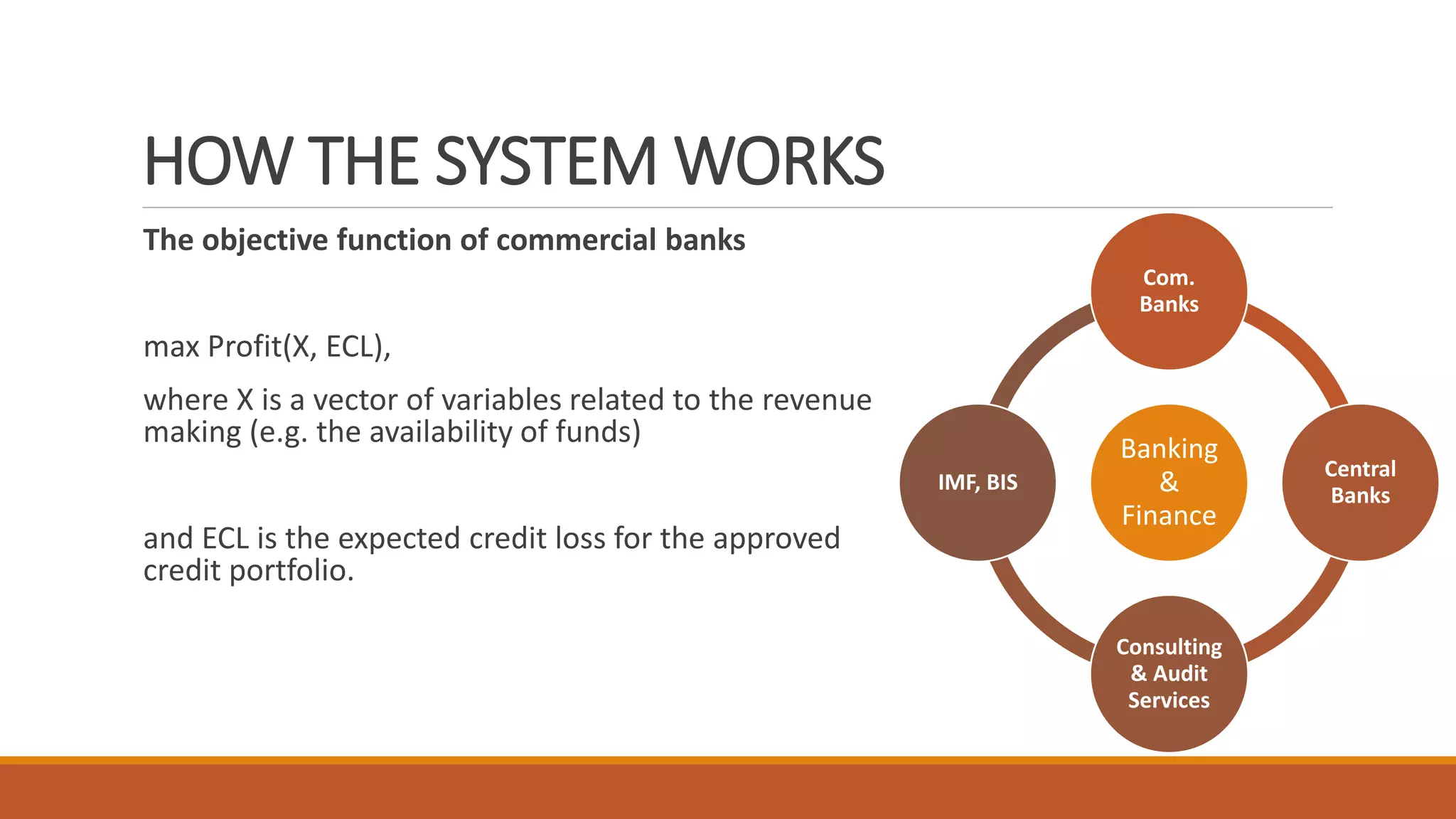
The objective function of commercial banks
max Profit(X, ECL),
where X is a vector of variables related to the revenue
making (e.g. the availability of funds)
and ECL is the expected credit loss for the approved
credit portfolio.
Banking
&
Finance
Com.
Banks
Central
Banks
Consulting
& Audit
Services
IMF, BIS
Traditional Credit Risk Modelling
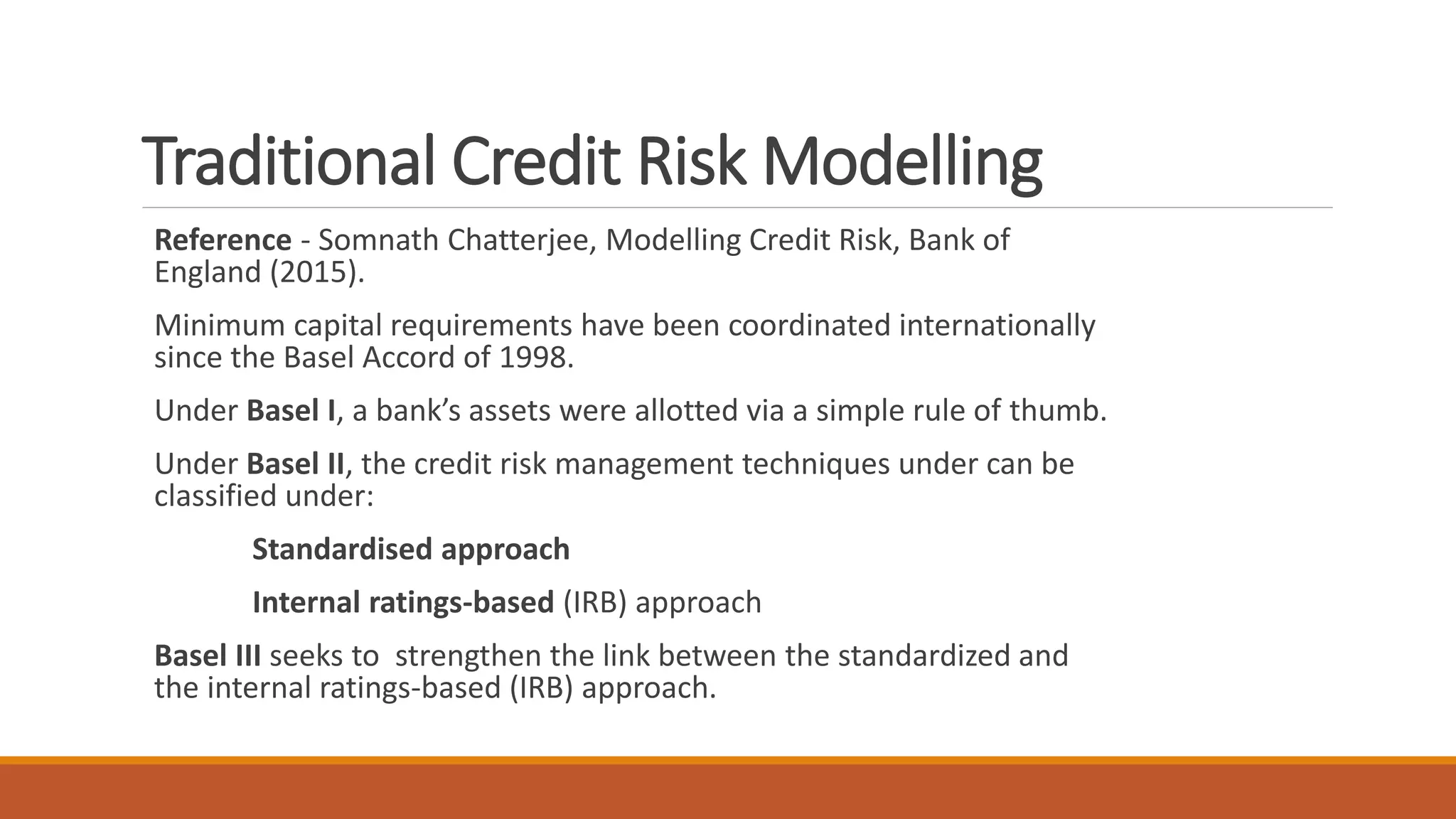
Reference - Somnath Chatterjee, Modelling Credit Risk, Bank of
England (2015).
Minimum capital requirements have been coordinated internationally
since the Basel Accord of 1998.
Under Basel I, a bank’s assets were allotted via a simple rule of thumb.
Under Basel II, the credit risk management techniques under can be
classified under:
Standardised approach
Internal ratings-based (IRB) approach
Basel III seeks to strengthen the link between the standardized and
the internal ratings-based (IRB) approach.
Traditional Credit Risk Modelling
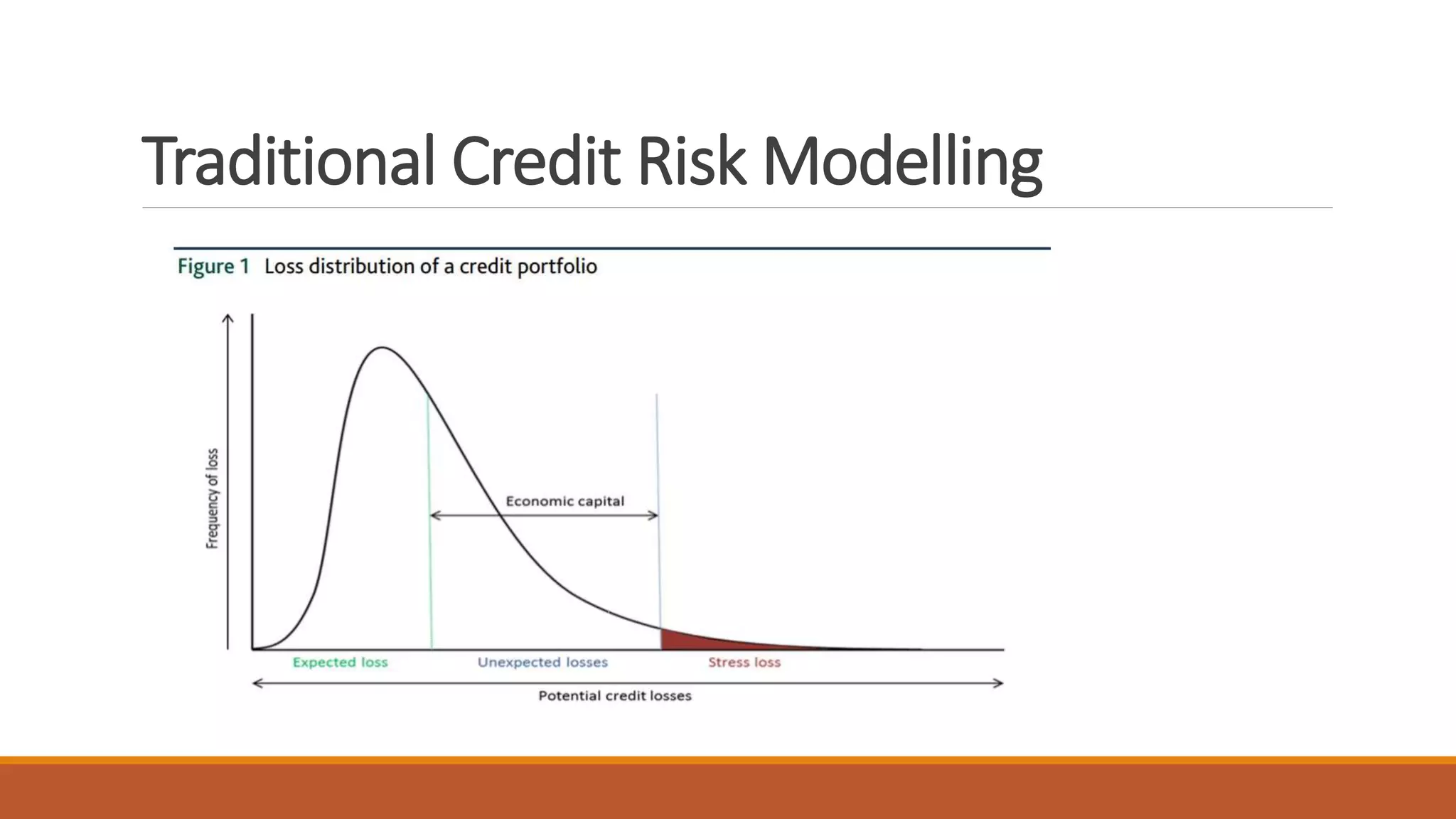
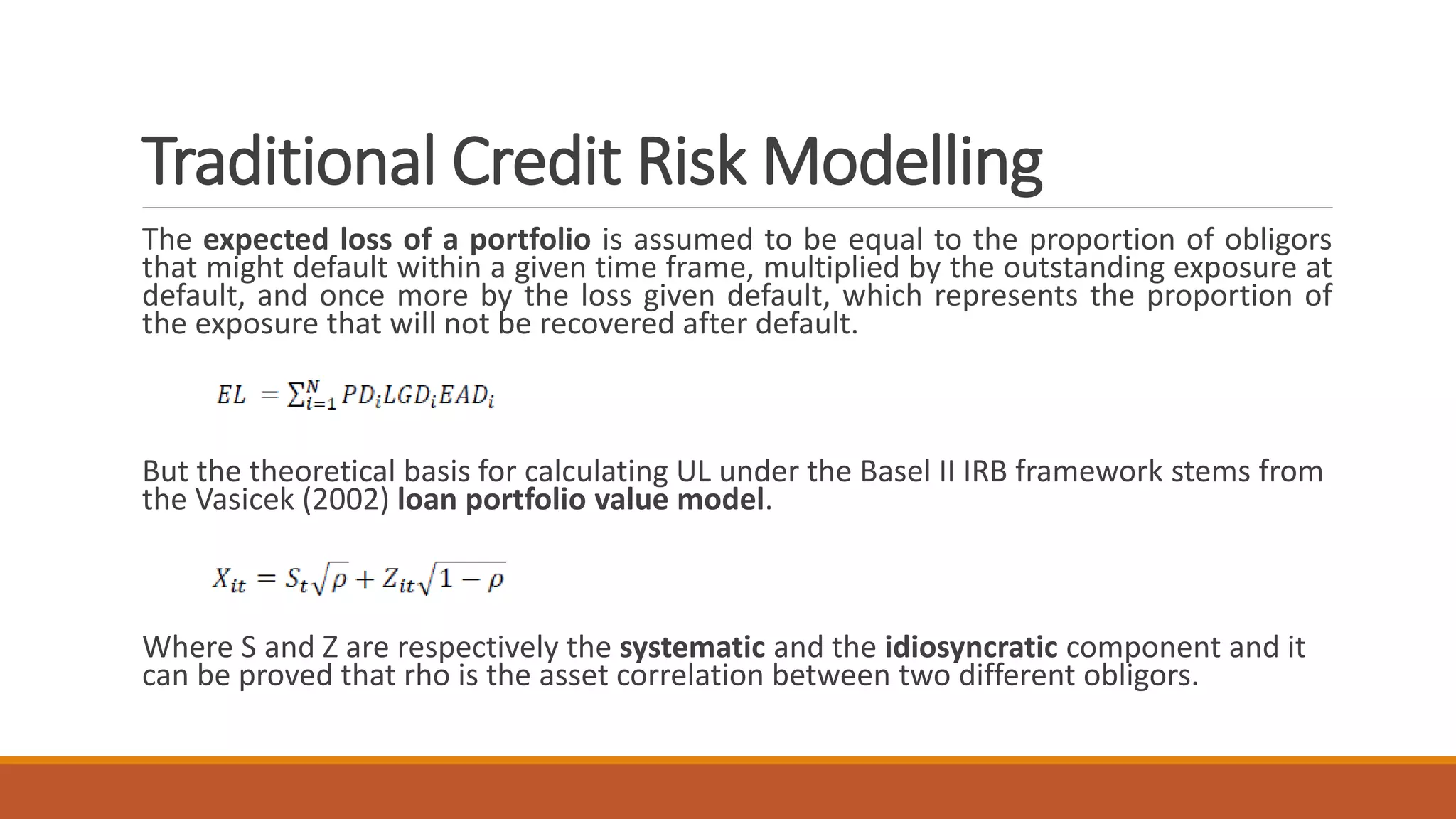
The expected loss of a portfolio is assumed to be equal to the proportion of obligors
that might default within a given time frame, multiplied by the outstanding exposure at
default, and once more by the loss given default, which represents the proportion of
the exposure that will not be recovered after default.
But the theoretical basis for calculating UL under the Basel II IRB framework stems from
the Vasicek (2002) loan portfolio value model.
Where S and Z are respectively the systematic and the idiosyncratic component and it
can be proved that rho is the asset correlation between two different obligors.
Traditional Credit Risk Modelling
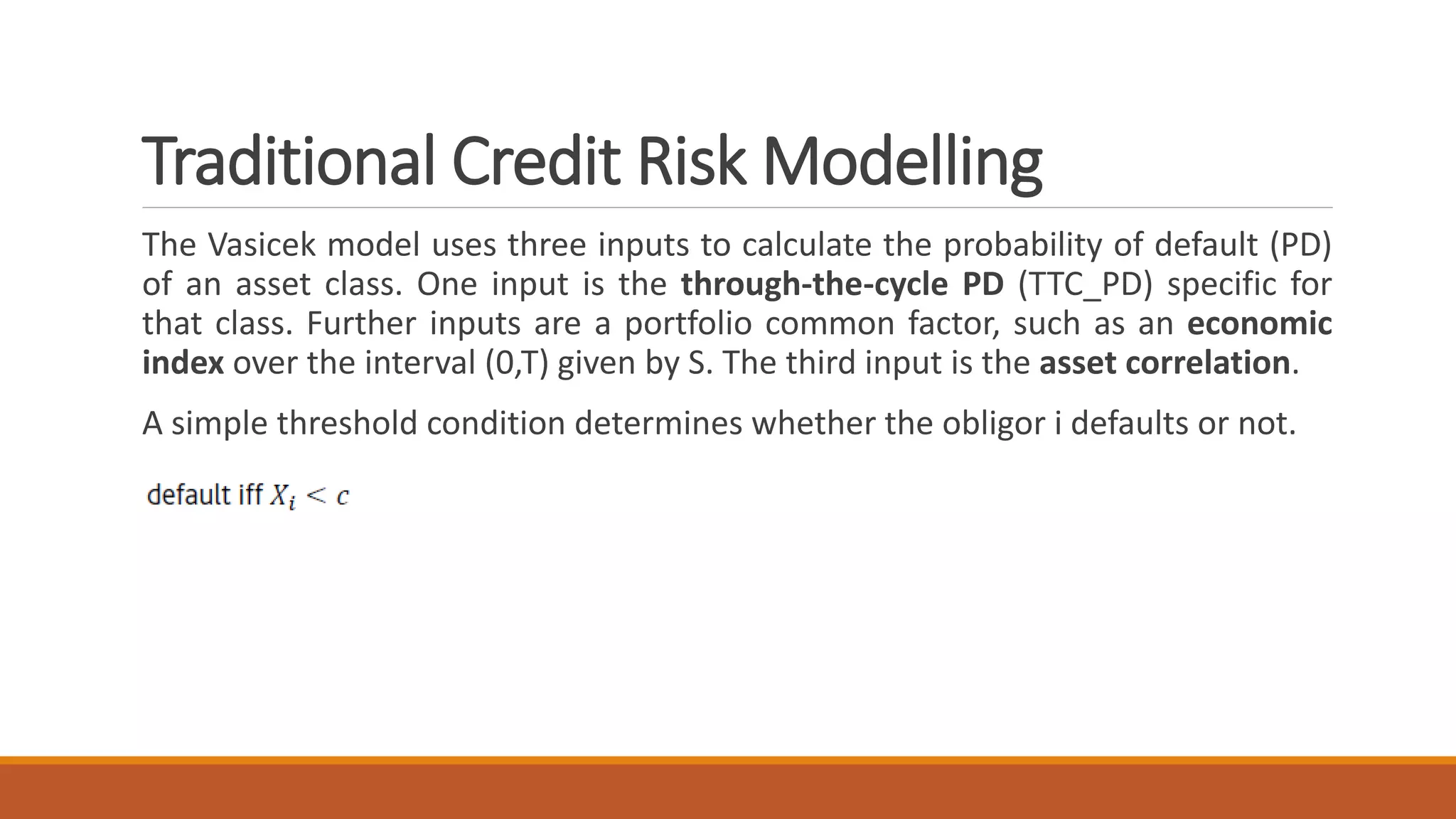
The Vasicek model uses three inputs to calculate the probability of default (PD)
of an asset class. One input is the through-the-cycle PD (TTC_PD) specific for
that class. Further inputs are a portfolio common factor, such as an economic
index over the interval (0,T) given by S. The third input is the asset correlation.
A simple threshold condition determines whether the obligor i defaults or not.
Internal Credit Rating System
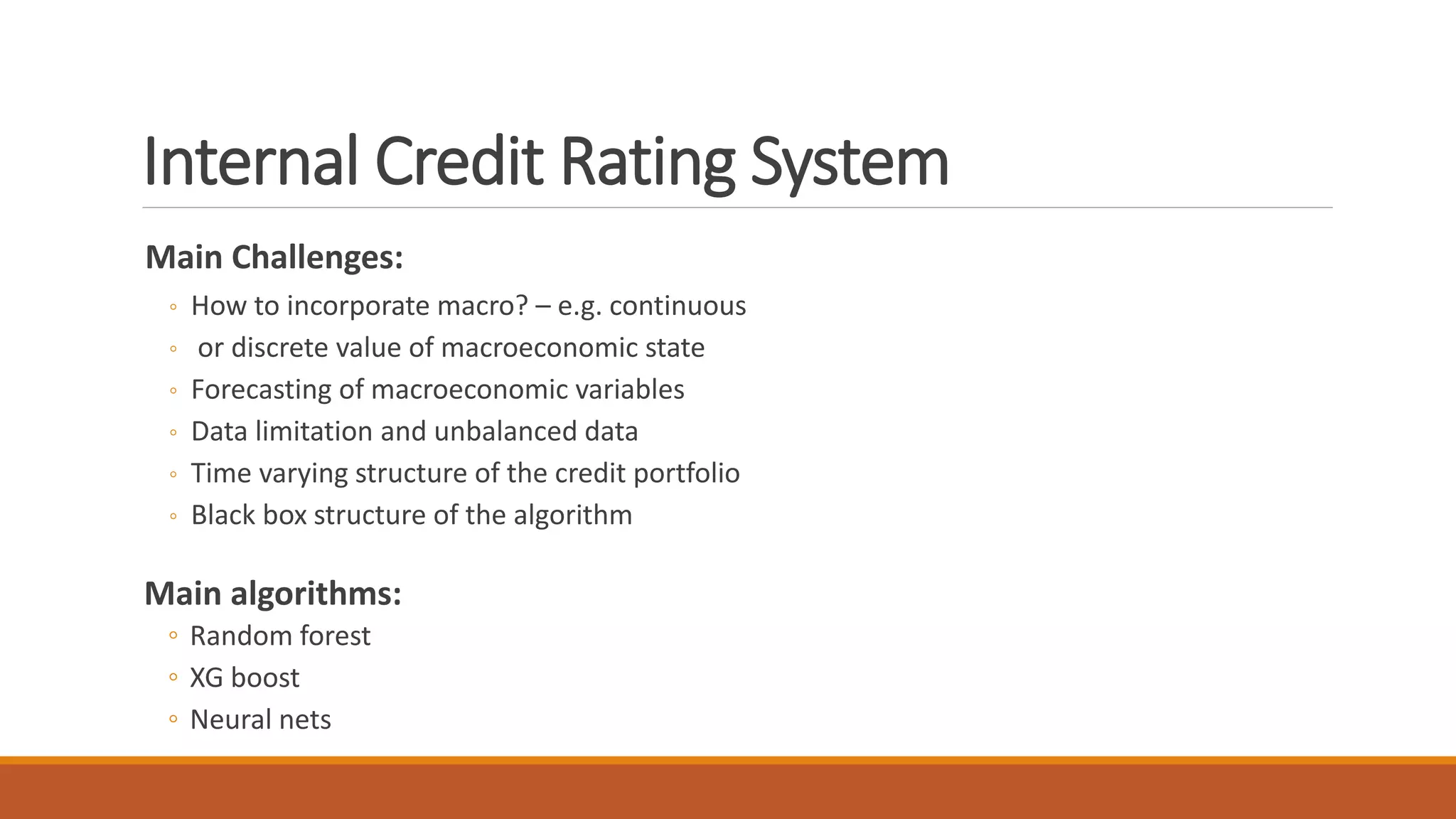
Examples of S&P and Moody’s.
Machine Learning Solution
Assumptions
◦ Probability of Credit Default - f(borrower specific variables, macroeconomic
variables, stochastic component).
◦ Main macro variables - gdp growth rate, inflation and monetary policy rate
changes.
◦ The patterns in the sample will persist.
Internal Credit Rating System
Main algorithms:
◦ Random forest
◦ XG boost
◦ Neural nets
Main Challenges:
◦ How to incorporate macro? – e.g. continuous
◦ or discrete value of macroeconomic state
◦ Forecasting of macroeconomic variables
◦ Data limitation and unbalanced data
◦ Time varying structure of the credit portfolio
◦ Black box structure of the algorithm
Internal Credit Rating System
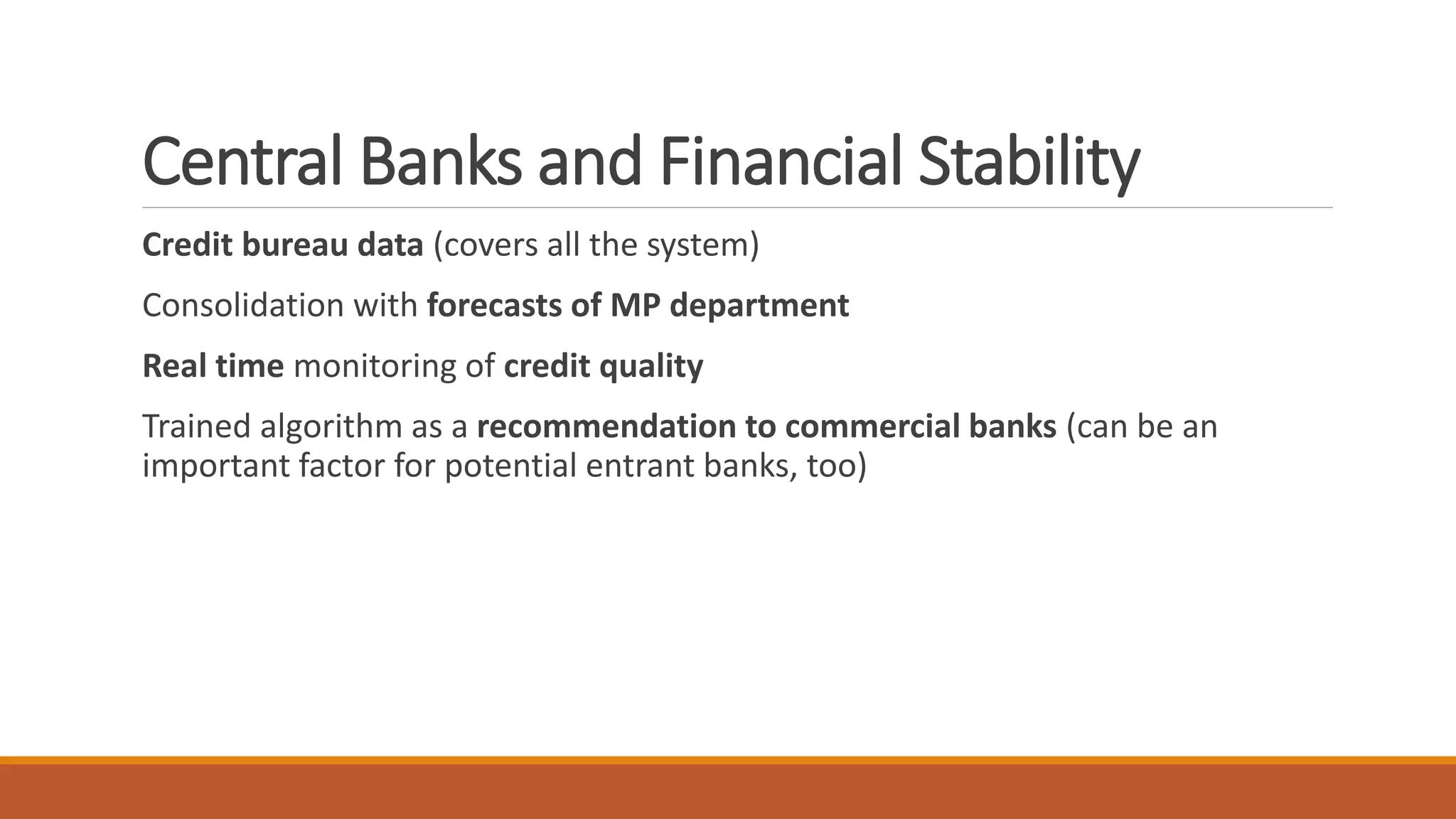
Central Banks and Financial Stability
Credit bureau data (covers all the system)
Consolidation with forecasts of MP department
Real time monitoring of credit quality
Trained algorithm as a recommendation to commercial banks (can be an
important factor for potential entrant banks, too)
ML for Time Series Forecasting
Reference - Forecasting Inflation in a Data-Rich Environment: The Benefits of
Machine Learning Methods.
https://www.norges-bank.no/contentassets/f2cc0752a45b4a5f8fe7eead30c0a49e/medeiros_slides.pdf
Monthly US inflation forecasting with
◦ large set of predictors (>500)
◦ new statistical (machine) learning (ML) methods
Forecasting horizons
◦ 1 to 12 months-ahead
ML for Time Series Forecasting
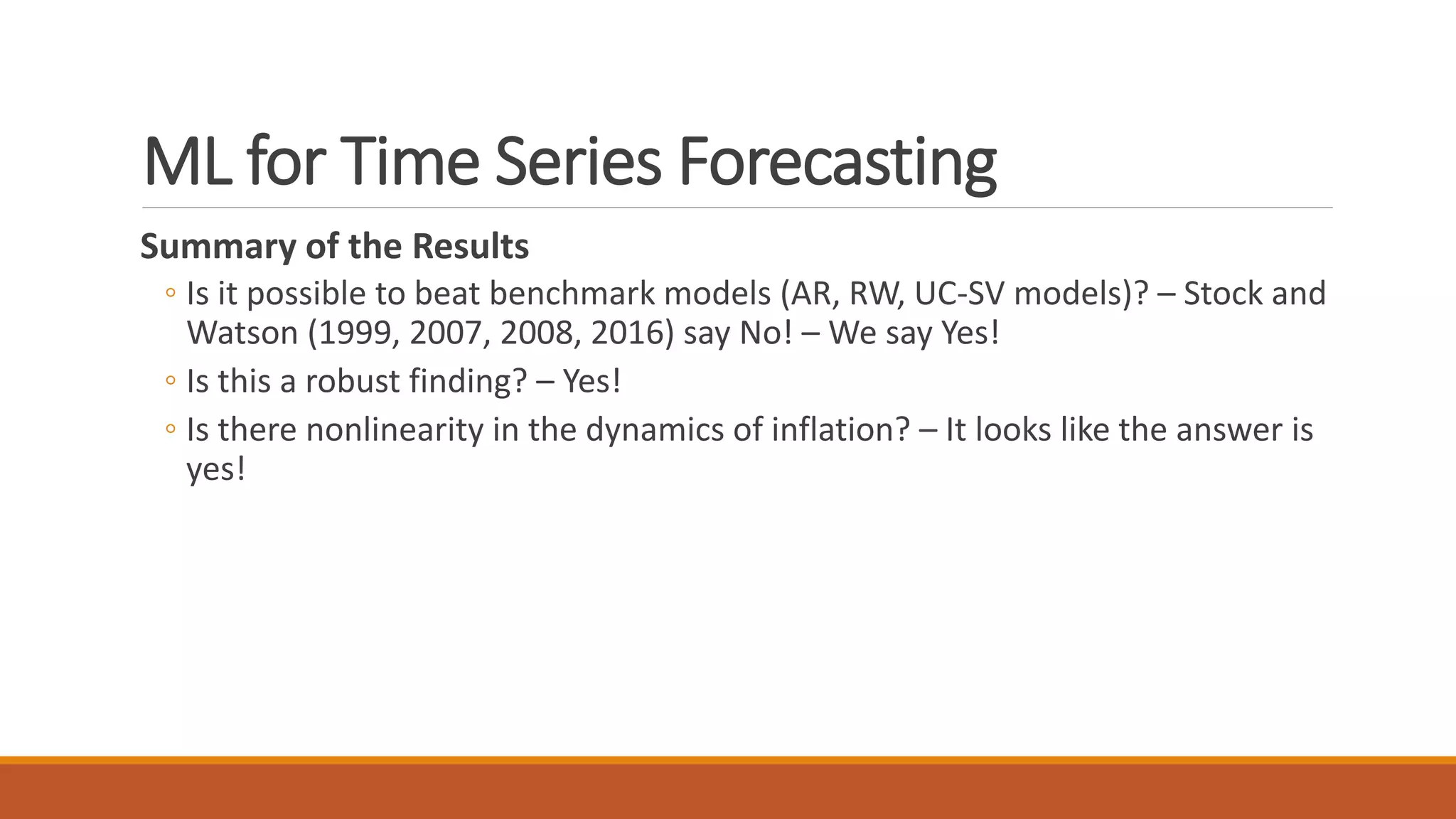
Summary of the Results
◦ Is it possible to beat benchmark models (AR, RW, UC-SV models)? – Stock and
Watson (1999, 2007, 2008, 2016) say No! – We say Yes!
◦ Is this a robust finding? – Yes!
◦ Is there nonlinearity in the dynamics of inflation? – It looks like the answer is
yes!
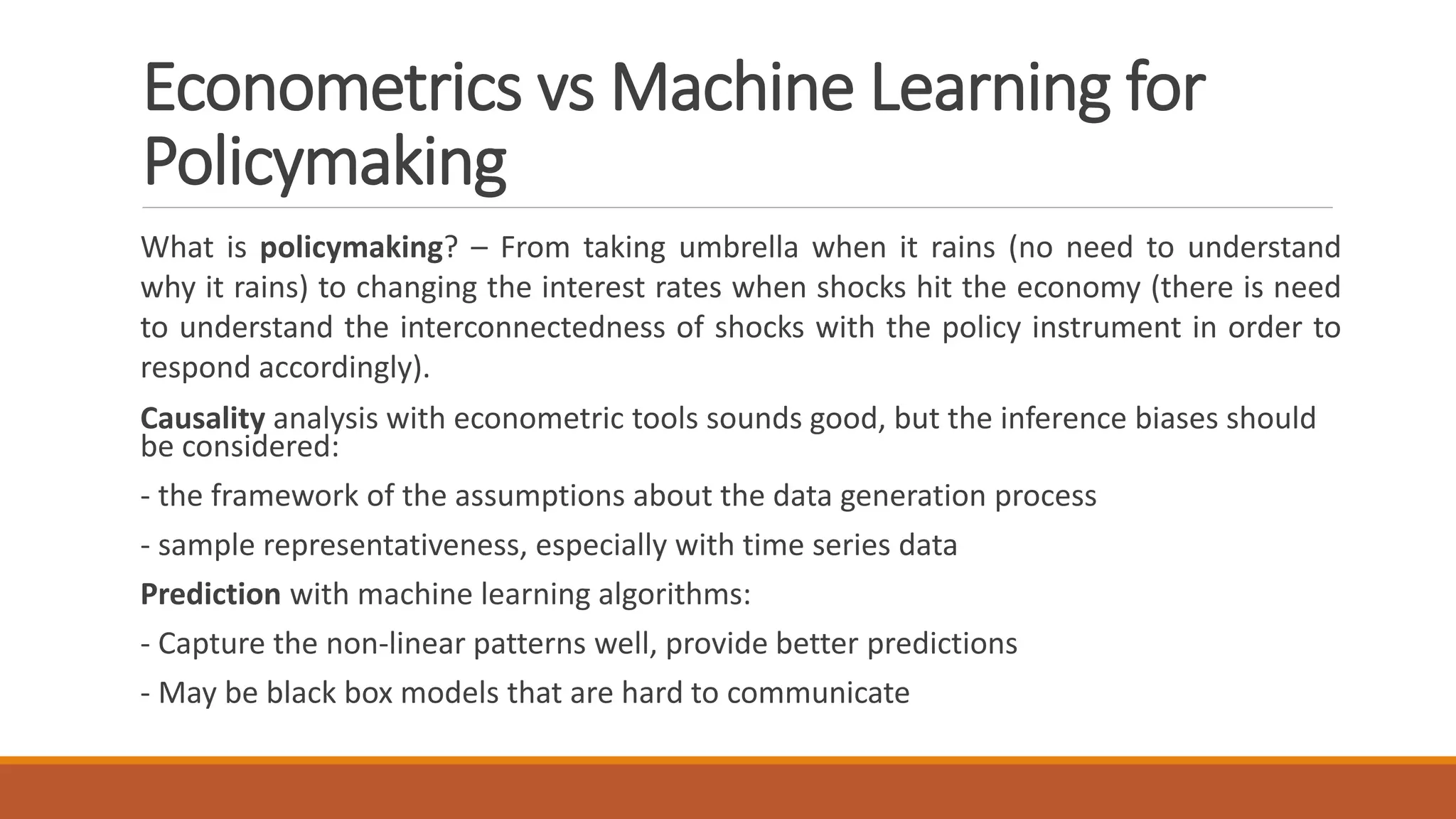
What is policymaking? – From taking umbrella when it rains (no need to understand
why it rains) to changing the interest rates when shocks hit the economy (there is need
to understand the interconnectedness of shocks with the policy instrument in order to
respond accordingly).
Causality analysis with econometric tools sounds good, but the inference biases should
be considered:
- the framework of the assumptions about the data generation process
- sample representativeness, especially with time series data
Prediction with machine learning algorithms:
- Capture the non-linear patterns well, provide better predictions
- May be black box models that are hard to communicate
Econometrics vs Machine Learning for
Policymaking
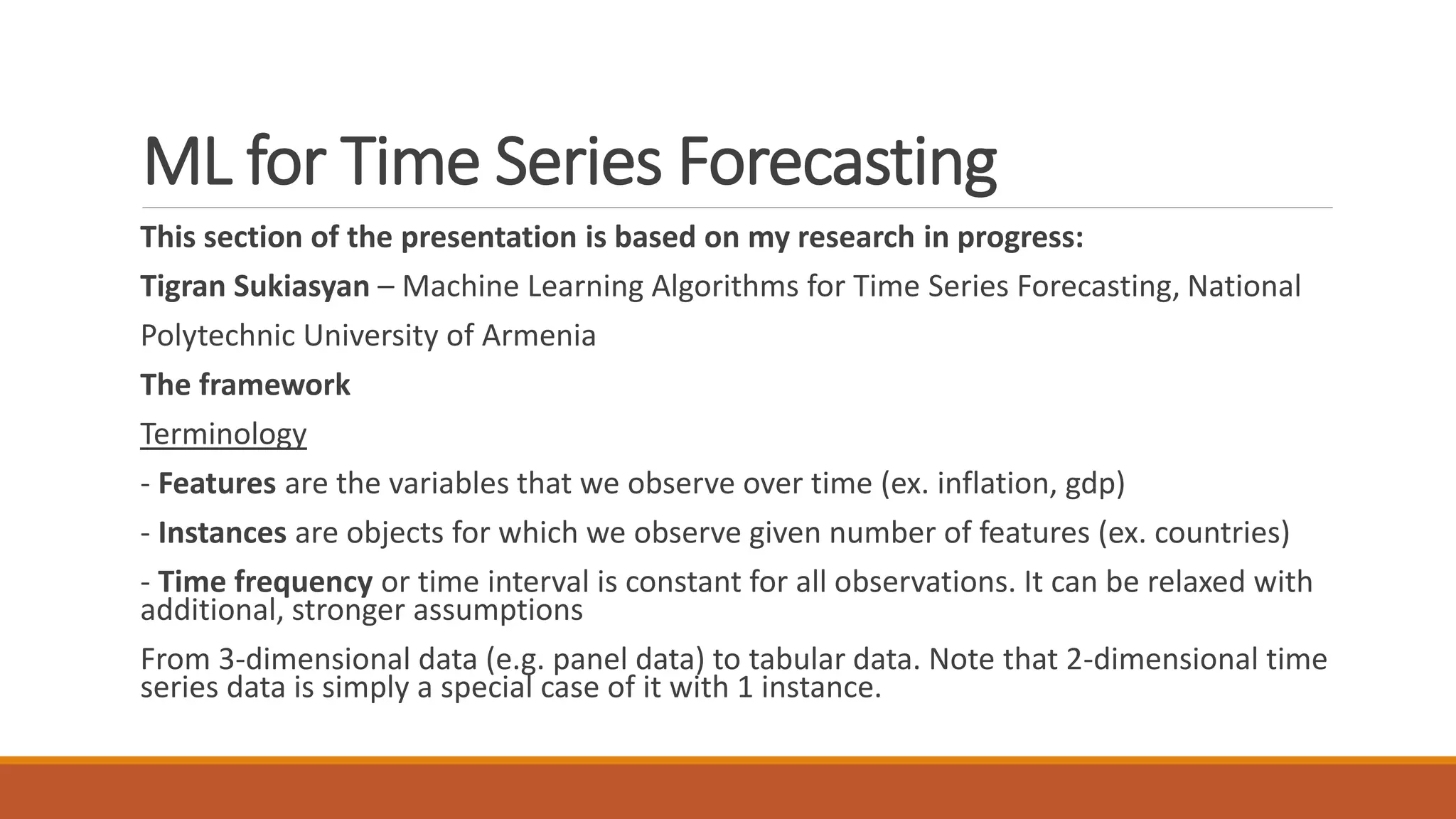
This section of the presentation is based on my research in progress:
Tigran Sukiasyan – Machine Learning Algorithms for Time Series Forecasting, National
Polytechnic University of Armenia
The framework
Terminology
- Features are the variables that we observe over time (ex. inflation, gdp)
- Instances are objects for which we observe given number of features (ex. countries)
- Time frequency or time interval is constant for all observations. It can be relaxed with
additional, stronger assumptions
From 3-dimensional data (e.g. panel data) to tabular data. Note that 2-dimensional time
series data is simply a special case of it with 1 instance.
ML for Time Series Forecasting
The framework uses the following assumption:
The instances behave in a similar fashion and they are just separated with each
other by the time dimension.
Ex. Country 1 may be in a state now, where Country 2 was 10 years ago and this
information from Country 2 can be used to make forecasts for Country 1.
The lags of the targets are the features.
Multiple target variables with multiple features can be used.
Within this framework the imbalanced panel data is not an issue.
ML for Time Series Forecasting
Dataset Date Feature 1
(m-i)-th
lag)
Feature 1
(m-th lag)
Feature 2
(n-j)-th lag)
Feature 2
(n-th lag)
Target
Instance 1 Period 1
Period 2
Period 3
Instance 2 Period 1
Period 2
Period 3
Instance 3 Period 1
Period 2
Period 3
ML ALGORITHM
HYPERPARAMETER
TUNING
INITIAL RESULTS FOR US INFLATION
Here are the semester ahead
forecasts of a machine
learning algorithm that uses
from 6th to 12th lags of the
inflation rate (blue line),
a benchmark model that uses
the simple average of the
same lags (dashed line),
and the actual inflation
(green line).
MSE_ML = 0.03
MSE_benchmark = 0.05
-0.4
-0.2
0
0.2
0.4
0.6
0.8
Jun2015
Jul2015
Aug2015
Sep2015
Oct2015
Nov2015
Dec2015
Jan2016
Feb2016
Mar2016
Apr2016
May2016
Jun2016
Jul2016
Aug2016
Sep2016
Oct2016
Nov2016
Dec2016
Jan2017
Feb2017
Mar2017
Apr2017
May2017
Jun2017
Jul2017
Aug2017
Sep2017
Oct2017
Nov2017
Dec2017
Jan2018
Feb2018
Mar2018
Apr2018
May2018
US MoM Inflation
Actual_inflation Benchmark_forecast ML_forecast
Future work:
◦ How to deal with seasonality?
◦ How to deal with non stationarity?
◦ How to choose the right lags?
◦ How to do cross validation?
◦ How to interpret the results (if possible)?
◦ Other?
Econometrics vs Machine Learning for
Policymaking
Reference – Text Mining For Central Banks,
David Bholat, Stephen Hansen, Pedro Santos
and Cheryl Schonhardt-Bailey.
McLaren and Shanbhogue (2011) offer a fine
example of what can be done. Using Google
data on search volumes, they find that such
data provides a timelier tracking of key
economic variables than do official statistics.
Google searches for Jobseeker’s Allowance
closely track official unemployment.
Text as data for CB research
One issue that interests central banks is measuring risk and uncertainty in the
economy and the financial system. A recent contribution in this direction is
research by Nyman et al. (2015).
They test their hypothesis by looking at three text data sources: the Bank’s daily
market commentary (2000-2010), broker research reports (2010-2013) and the
Reuters’ News Archive (1996-2014).
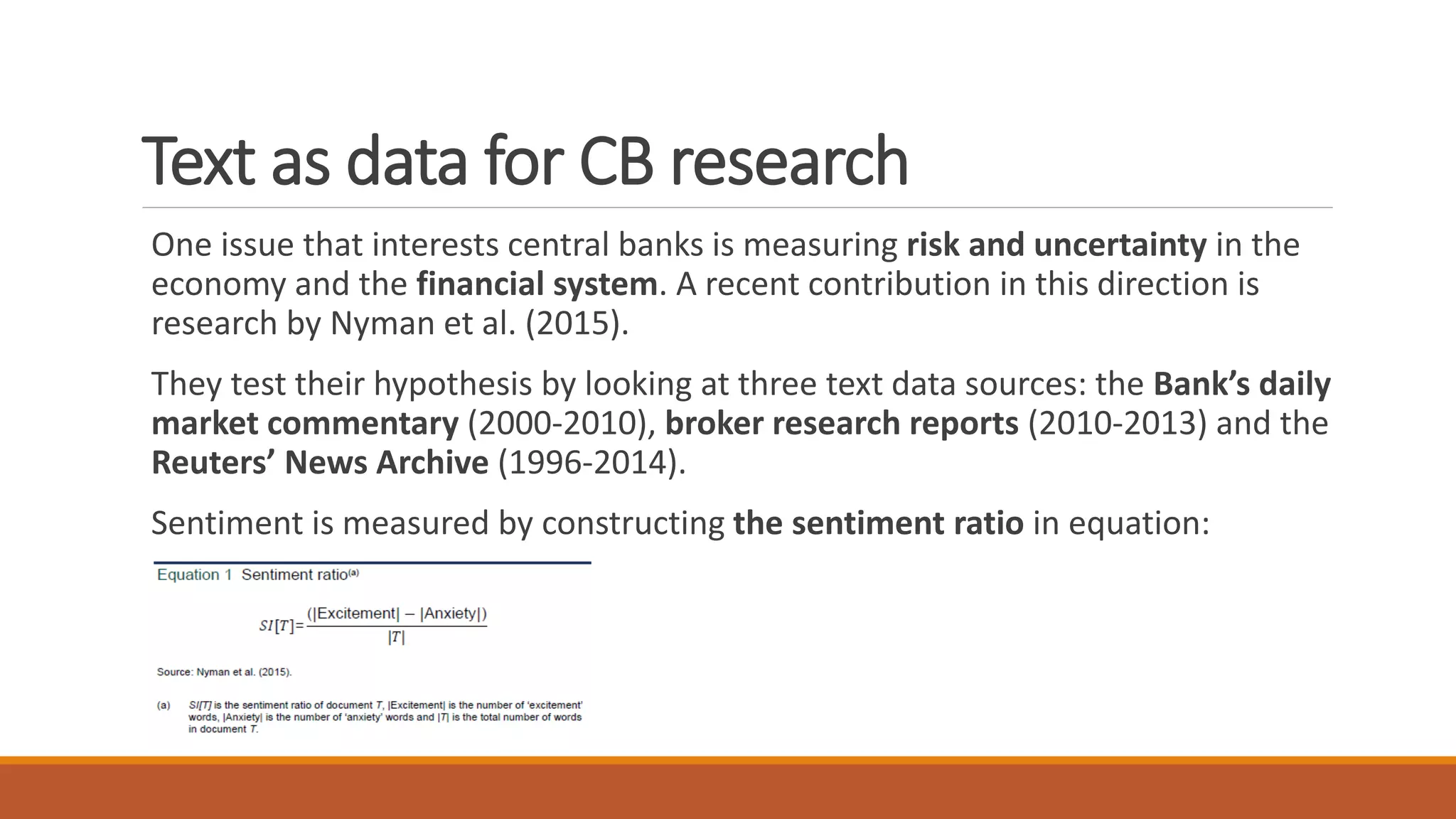
Sentiment is measured by constructing the sentiment ratio in equation:
Text as data for CB research
The sign of the ratio gives an indication of
market sentiment: bullish, if the ratio is
positive, or bearish, if the number is
negative.
In addition, they measure narrative
consensus. In particular, their approach is
to group articles into topic clusters. The
uncertainty in the distribution of topics
then acts as a proxy for uncertainty. In
other words, reduced entropy in the topic
distribution is used as an indicator of topic
concentration or consensus.
Thank You!

Machine Learning in Banking

  • 1.
    MACHINE LEARNING IN BANKING TIGRANSUKIASYAN, PHD DATA SCIENTIST AT AMERIABANK CJSC VISITING LECTURER AT YEREVAN STATE UNIVERSITY - FACULTY OF MATHEMATICS AND MECHANICS URL: HTTP://WWW.LINKEDIN.COM/IN/TIGRAN -SUKIASYAN
  • 2.
    Talk outline ◦ traditionalcredit risk modelling ◦ learning countrywide probability of credit defaults and financial stability implications ◦ machine learning for time series forecasting ◦ text mining for central bank research
  • 3.
    Christine Lagard’s speech CentralBanking and Fintech—A Brave New World? “In 2040, the governor walking into the Bank will be of flesh and bones, and behind the front door she will find people – at least a few,” Lagarde predicted. https://www.imf.org/external/mmedia/view.aspx?vid=5595522478001 watch from 18:45 to 24:10.
  • 4.
    HOW THE SYSTEMWORKS The objective function of commercial banks max Profit(X, ECL), where X is a vector of variables related to the revenue making (e.g. the availability of funds) and ECL is the expected credit loss for the approved credit portfolio. Banking & Finance Com. Banks Central Banks Consulting & Audit Services IMF, BIS
  • 5.
    Traditional Credit RiskModelling Reference - Somnath Chatterjee, Modelling Credit Risk, Bank of England (2015). Minimum capital requirements have been coordinated internationally since the Basel Accord of 1998. Under Basel I, a bank’s assets were allotted via a simple rule of thumb. Under Basel II, the credit risk management techniques under can be classified under: Standardised approach Internal ratings-based (IRB) approach Basel III seeks to strengthen the link between the standardized and the internal ratings-based (IRB) approach.
  • 6.
  • 7.
    Traditional Credit RiskModelling The expected loss of a portfolio is assumed to be equal to the proportion of obligors that might default within a given time frame, multiplied by the outstanding exposure at default, and once more by the loss given default, which represents the proportion of the exposure that will not be recovered after default. But the theoretical basis for calculating UL under the Basel II IRB framework stems from the Vasicek (2002) loan portfolio value model. Where S and Z are respectively the systematic and the idiosyncratic component and it can be proved that rho is the asset correlation between two different obligors.
  • 8.
    Traditional Credit RiskModelling The Vasicek model uses three inputs to calculate the probability of default (PD) of an asset class. One input is the through-the-cycle PD (TTC_PD) specific for that class. Further inputs are a portfolio common factor, such as an economic index over the interval (0,T) given by S. The third input is the asset correlation. A simple threshold condition determines whether the obligor i defaults or not.
  • 9.
    Internal Credit RatingSystem Examples of S&P and Moody’s. Machine Learning Solution Assumptions ◦ Probability of Credit Default - f(borrower specific variables, macroeconomic variables, stochastic component). ◦ Main macro variables - gdp growth rate, inflation and monetary policy rate changes. ◦ The patterns in the sample will persist.
  • 10.
    Internal Credit RatingSystem Main algorithms: ◦ Random forest ◦ XG boost ◦ Neural nets Main Challenges: ◦ How to incorporate macro? – e.g. continuous ◦ or discrete value of macroeconomic state ◦ Forecasting of macroeconomic variables ◦ Data limitation and unbalanced data ◦ Time varying structure of the credit portfolio ◦ Black box structure of the algorithm
  • 11.
  • 12.
    Central Banks andFinancial Stability Credit bureau data (covers all the system) Consolidation with forecasts of MP department Real time monitoring of credit quality Trained algorithm as a recommendation to commercial banks (can be an important factor for potential entrant banks, too)
  • 13.
    ML for TimeSeries Forecasting Reference - Forecasting Inflation in a Data-Rich Environment: The Benefits of Machine Learning Methods. https://www.norges-bank.no/contentassets/f2cc0752a45b4a5f8fe7eead30c0a49e/medeiros_slides.pdf Monthly US inflation forecasting with ◦ large set of predictors (>500) ◦ new statistical (machine) learning (ML) methods Forecasting horizons ◦ 1 to 12 months-ahead
  • 14.
    ML for TimeSeries Forecasting Summary of the Results ◦ Is it possible to beat benchmark models (AR, RW, UC-SV models)? – Stock and Watson (1999, 2007, 2008, 2016) say No! – We say Yes! ◦ Is this a robust finding? – Yes! ◦ Is there nonlinearity in the dynamics of inflation? – It looks like the answer is yes!
  • 15.
    What is policymaking?– From taking umbrella when it rains (no need to understand why it rains) to changing the interest rates when shocks hit the economy (there is need to understand the interconnectedness of shocks with the policy instrument in order to respond accordingly). Causality analysis with econometric tools sounds good, but the inference biases should be considered: - the framework of the assumptions about the data generation process - sample representativeness, especially with time series data Prediction with machine learning algorithms: - Capture the non-linear patterns well, provide better predictions - May be black box models that are hard to communicate Econometrics vs Machine Learning for Policymaking
  • 16.
    This section ofthe presentation is based on my research in progress: Tigran Sukiasyan – Machine Learning Algorithms for Time Series Forecasting, National Polytechnic University of Armenia The framework Terminology - Features are the variables that we observe over time (ex. inflation, gdp) - Instances are objects for which we observe given number of features (ex. countries) - Time frequency or time interval is constant for all observations. It can be relaxed with additional, stronger assumptions From 3-dimensional data (e.g. panel data) to tabular data. Note that 2-dimensional time series data is simply a special case of it with 1 instance. ML for Time Series Forecasting
  • 17.
    The framework usesthe following assumption: The instances behave in a similar fashion and they are just separated with each other by the time dimension. Ex. Country 1 may be in a state now, where Country 2 was 10 years ago and this information from Country 2 can be used to make forecasts for Country 1. The lags of the targets are the features. Multiple target variables with multiple features can be used. Within this framework the imbalanced panel data is not an issue. ML for Time Series Forecasting
  • 18.
    ML for TimeSeries Forecasting Dataset Date Feature 1 (m-i)-th lag) Feature 1 (m-th lag) Feature 2 (n-j)-th lag) Feature 2 (n-th lag) Target Instance 1 Period 1 Period 2 Period 3 Instance 2 Period 1 Period 2 Period 3 Instance 3 Period 1 Period 2 Period 3 ML ALGORITHM HYPERPARAMETER TUNING
  • 19.
    INITIAL RESULTS FORUS INFLATION Here are the semester ahead forecasts of a machine learning algorithm that uses from 6th to 12th lags of the inflation rate (blue line), a benchmark model that uses the simple average of the same lags (dashed line), and the actual inflation (green line). MSE_ML = 0.03 MSE_benchmark = 0.05 -0.4 -0.2 0 0.2 0.4 0.6 0.8 Jun2015 Jul2015 Aug2015 Sep2015 Oct2015 Nov2015 Dec2015 Jan2016 Feb2016 Mar2016 Apr2016 May2016 Jun2016 Jul2016 Aug2016 Sep2016 Oct2016 Nov2016 Dec2016 Jan2017 Feb2017 Mar2017 Apr2017 May2017 Jun2017 Jul2017 Aug2017 Sep2017 Oct2017 Nov2017 Dec2017 Jan2018 Feb2018 Mar2018 Apr2018 May2018 US MoM Inflation Actual_inflation Benchmark_forecast ML_forecast
  • 20.
    Future work: ◦ Howto deal with seasonality? ◦ How to deal with non stationarity? ◦ How to choose the right lags? ◦ How to do cross validation? ◦ How to interpret the results (if possible)? ◦ Other? Econometrics vs Machine Learning for Policymaking
  • 21.
    Reference – TextMining For Central Banks, David Bholat, Stephen Hansen, Pedro Santos and Cheryl Schonhardt-Bailey. McLaren and Shanbhogue (2011) offer a fine example of what can be done. Using Google data on search volumes, they find that such data provides a timelier tracking of key economic variables than do official statistics. Google searches for Jobseeker’s Allowance closely track official unemployment. Text as data for CB research
  • 22.
    Text as datafor CB research One issue that interests central banks is measuring risk and uncertainty in the economy and the financial system. A recent contribution in this direction is research by Nyman et al. (2015). They test their hypothesis by looking at three text data sources: the Bank’s daily market commentary (2000-2010), broker research reports (2010-2013) and the Reuters’ News Archive (1996-2014). Sentiment is measured by constructing the sentiment ratio in equation:
  • 23.
    Text as datafor CB research The sign of the ratio gives an indication of market sentiment: bullish, if the ratio is positive, or bearish, if the number is negative. In addition, they measure narrative consensus. In particular, their approach is to group articles into topic clusters. The uncertainty in the distribution of topics then acts as a proxy for uncertainty. In other words, reduced entropy in the topic distribution is used as an indicator of topic concentration or consensus.
  • 24.