MACHINE LEARNING
LEARN FROM
EXPERIENCE
TAKES
INSTRUCTIONS
LEARN FROM
DATA
THE IDEA OF MACHINE LEARNING
WHAT IS MACHINE LEARNING?
“Machine Learning is the field of study that gives computers the
ability to learn without explicitly programmed.”
MACHINE LEARNING
ALGORITHMS
RULE BASED
PROGRAMS
Traditional
Systems
Machine Learning
DATA PROGRAM
DATA
OUTPUTS
OUTPUTS
TRADITIONAL SYSTEMS VS MACHINE LEARNING
WHY MACHINE LEARNING IS A BUZZWORD THESE DAYS?
There has been explosion in amount of data created every second with the use of
internet.
2.7 Zettabytes of data exists on our digital universe.
149,513 emails are sent every minute
3.8 Million Google searches are made every minute
448,800 emails are constructed every minute.
500 hours of videos uploaded every hour on youtube.
APPLICATIONS OF MACHINE LEARNING
Virtual personal assistants. Recommendation engines
Self driving cars
Fraud detection
Stock movement prediction Virtual Reality and AR
Speech recognition Customer sentiment analysis
Health Care
TYPES OF MACHINE LEARNING
Training is done on
labelled data.
Output label is known to
us.
There are two types of
supervised learning
regression and
classification.
Training is done on
unlabelled data.
Infer patterns from data
without reference to
known labels.
E.g - Customer
segmentation.
It features an algorithm
that improves upon itself.
Learning is done based on
trial and error.
Favourable outputs are
encouraged and
unfavourable outputs are
discouraged.
SUPERVISED
LEARNING
REINFORCEMENT
LEARNING
UNSUPERVISED
LEARNING
CLASSIFICATION AND REGRESSION
EXPERIENCE SALARY
2 35,000
3 38,000
4 42,000
5 45,000
7 48,000
INDEPENDENT
VARIABLE
DEPENDENT
VARIABLE
CONTINUOUS DEPENDENT VARIABLE
REGRESSION PROBLEM
TRANSACTION
AMOUNT
CLASS
2,000 NO FRAUD
40,000 FRAUD
20,000 FRAUD
10,000 NO FRAUD
8,000 NO FRAUD
INDEPENDENT
VARIABLE(X)
DEPENDENT
VARIABLE(Y)
CATEGORICAL DEPENDENT VARIABLE
CLASSIFICATION PROBLEM
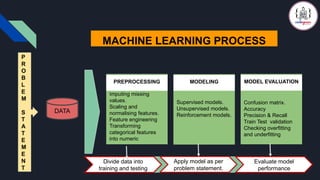
MACHINE LEARNING PROCESS
DATA
Imputing missing
values.
Scaling and
normalising features.
Feature engineering
Transforming
categorical features
into numeric
Supervised models.
Unsupervised models.
Reinforcement models.
Confusion matrix.
Accuracy
Precision & Recall
Train Test validation
Checking overfitting
and underfitting
PREPROCESSING MODELING MODEL EVALUATION
P
R
O
B
L
E
M
S
T
A
T
E
M
E
N
T
Divide data into
training and testing
Apply model as per
problem statement.
Evaluate model
performance
Feature scaling in machine learning is one of the most
critical steps during the pre-processing of data before
creating a machine learning model.
Scaling can make a difference between a weak
machine learning model and a better one.
The most common techniques of feature scaling are
Normalization and Standardization.

Feature
Scaling
Normalization is used when we want to bound our
values between two numbers, typically, between [0,1]
or [-1,1].
While Standardization transforms the data to have zero
mean and a variance of 1, they make our
data unitless.
Machine learning algorithm just sees number — if there
is a vast difference in the range say few ranging in
thousands and few ranging in the tens, and it makes
the underlying assumption that higher ranging numbers
have superiority of some sort.
So these more significant number starts playing a more
decisive role while training the model.
Suppose we have two features of weight and price, as
in the below table. The “Weight” cannot have a
meaningful comparison with the “Price.” So the
assumption algorithm makes that since “Weight” >
“Price,” thus “Weight,” is more important than “Price.”
So these more significant number starts playing a more
decisive role while training the model. Thus feature
scaling is needed to bring every feature in the same
footing without any upfront importance. Interestingly, if
we convert the weight to “Kg,” then “Price” becomes
dominant.
Another reason why feature scaling is applied is that
few algorithms like Neural network gradient
descent converge much faster with feature scaling
than without it
The Standard Scaler assumes data is normally
distributed within each feature and scales them such
that the distribution centered around 0, with a standard
deviation of 1.
Centering and scaling happen independently on each
feature by computing the relevant statistics on the
samples in the training set. If data is not normally
distributed, this is not the best Scaler to use.
Feature scaling is an essential step in Machine
Learning pre-processing. Deep learning requires
feature scaling for faster convergence, and thus it is
vital to decide which feature scaling to use.
Evaluation Metrics
1.Confusion Matrix
2.F1 Score
3.Gain and Lift Charts
4.Kolmogorov Smirnov Chart
5.AUC – ROC
6.Log Loss
7.Gini Coefficient
8.Concordant – Discordant Ratio
9.Root Mean Squared Error
10.Cross Validation (Not a metric though!)
A confusion matrix is an N X N matrix, where N is the number of
classes being predicted. For the problem in hand, we have N=2,
and hence we get a 2 X 2 matrix. Here are a few definitions, you
need to remember for a confusion matrix :
•Accuracy : the proportion of the total number of predictions that
were correct.
•Positive Predictive Value or Precision : the proportion of
positive cases that were correctly identified.
•Negative Predictive Value : the proportion of negative cases
that were correctly identified.
•Sensitivity or Recall : the proportion of actual positive cases
which are correctly identified.
•Specificity : the proportion of actual negative cases which are
correctly identified.
In some cases we will be having more features to
be considered. Then Confusion matrix will get N
number variables
TIME TO CODE AND GET HANDS
DIRTY WITH DATA!

Machine Learning basics and algorithm.pptx

  • 1.
  • 2.
  • 3.
    WHAT IS MACHINELEARNING? “Machine Learning is the field of study that gives computers the ability to learn without explicitly programmed.”
  • 4.
    MACHINE LEARNING ALGORITHMS RULE BASED PROGRAMS Traditional Systems MachineLearning DATA PROGRAM DATA OUTPUTS OUTPUTS TRADITIONAL SYSTEMS VS MACHINE LEARNING
  • 5.
    WHY MACHINE LEARNINGIS A BUZZWORD THESE DAYS? There has been explosion in amount of data created every second with the use of internet. 2.7 Zettabytes of data exists on our digital universe. 149,513 emails are sent every minute 3.8 Million Google searches are made every minute 448,800 emails are constructed every minute. 500 hours of videos uploaded every hour on youtube.
  • 6.
    APPLICATIONS OF MACHINELEARNING Virtual personal assistants. Recommendation engines Self driving cars Fraud detection Stock movement prediction Virtual Reality and AR Speech recognition Customer sentiment analysis Health Care
  • 7.
    TYPES OF MACHINELEARNING Training is done on labelled data. Output label is known to us. There are two types of supervised learning regression and classification. Training is done on unlabelled data. Infer patterns from data without reference to known labels. E.g - Customer segmentation. It features an algorithm that improves upon itself. Learning is done based on trial and error. Favourable outputs are encouraged and unfavourable outputs are discouraged. SUPERVISED LEARNING REINFORCEMENT LEARNING UNSUPERVISED LEARNING
  • 8.
    CLASSIFICATION AND REGRESSION EXPERIENCESALARY 2 35,000 3 38,000 4 42,000 5 45,000 7 48,000 INDEPENDENT VARIABLE DEPENDENT VARIABLE CONTINUOUS DEPENDENT VARIABLE REGRESSION PROBLEM TRANSACTION AMOUNT CLASS 2,000 NO FRAUD 40,000 FRAUD 20,000 FRAUD 10,000 NO FRAUD 8,000 NO FRAUD INDEPENDENT VARIABLE(X) DEPENDENT VARIABLE(Y) CATEGORICAL DEPENDENT VARIABLE CLASSIFICATION PROBLEM
  • 9.
    MACHINE LEARNING PROCESS DATA Imputingmissing values. Scaling and normalising features. Feature engineering Transforming categorical features into numeric Supervised models. Unsupervised models. Reinforcement models. Confusion matrix. Accuracy Precision & Recall Train Test validation Checking overfitting and underfitting PREPROCESSING MODELING MODEL EVALUATION P R O B L E M S T A T E M E N T Divide data into training and testing Apply model as per problem statement. Evaluate model performance
  • 10.
    Feature scaling inmachine learning is one of the most critical steps during the pre-processing of data before creating a machine learning model. Scaling can make a difference between a weak machine learning model and a better one. The most common techniques of feature scaling are Normalization and Standardization. Feature Scaling
  • 11.
    Normalization is usedwhen we want to bound our values between two numbers, typically, between [0,1] or [-1,1]. While Standardization transforms the data to have zero mean and a variance of 1, they make our data unitless.
  • 12.
    Machine learning algorithmjust sees number — if there is a vast difference in the range say few ranging in thousands and few ranging in the tens, and it makes the underlying assumption that higher ranging numbers have superiority of some sort. So these more significant number starts playing a more decisive role while training the model.
  • 13.
    Suppose we havetwo features of weight and price, as in the below table. The “Weight” cannot have a meaningful comparison with the “Price.” So the assumption algorithm makes that since “Weight” > “Price,” thus “Weight,” is more important than “Price.”
  • 14.
    So these moresignificant number starts playing a more decisive role while training the model. Thus feature scaling is needed to bring every feature in the same footing without any upfront importance. Interestingly, if we convert the weight to “Kg,” then “Price” becomes dominant. Another reason why feature scaling is applied is that few algorithms like Neural network gradient descent converge much faster with feature scaling than without it
  • 15.
    The Standard Scalerassumes data is normally distributed within each feature and scales them such that the distribution centered around 0, with a standard deviation of 1. Centering and scaling happen independently on each feature by computing the relevant statistics on the samples in the training set. If data is not normally distributed, this is not the best Scaler to use. Feature scaling is an essential step in Machine Learning pre-processing. Deep learning requires feature scaling for faster convergence, and thus it is vital to decide which feature scaling to use.
  • 16.
    Evaluation Metrics 1.Confusion Matrix 2.F1Score 3.Gain and Lift Charts 4.Kolmogorov Smirnov Chart 5.AUC – ROC 6.Log Loss 7.Gini Coefficient 8.Concordant – Discordant Ratio 9.Root Mean Squared Error 10.Cross Validation (Not a metric though!)
  • 17.
    A confusion matrixis an N X N matrix, where N is the number of classes being predicted. For the problem in hand, we have N=2, and hence we get a 2 X 2 matrix. Here are a few definitions, you need to remember for a confusion matrix : •Accuracy : the proportion of the total number of predictions that were correct. •Positive Predictive Value or Precision : the proportion of positive cases that were correctly identified. •Negative Predictive Value : the proportion of negative cases that were correctly identified. •Sensitivity or Recall : the proportion of actual positive cases which are correctly identified. •Specificity : the proportion of actual negative cases which are correctly identified.
  • 20.
    In some caseswe will be having more features to be considered. Then Confusion matrix will get N number variables
  • 21.
    TIME TO CODEAND GET HANDS DIRTY WITH DATA!