CONTENTS
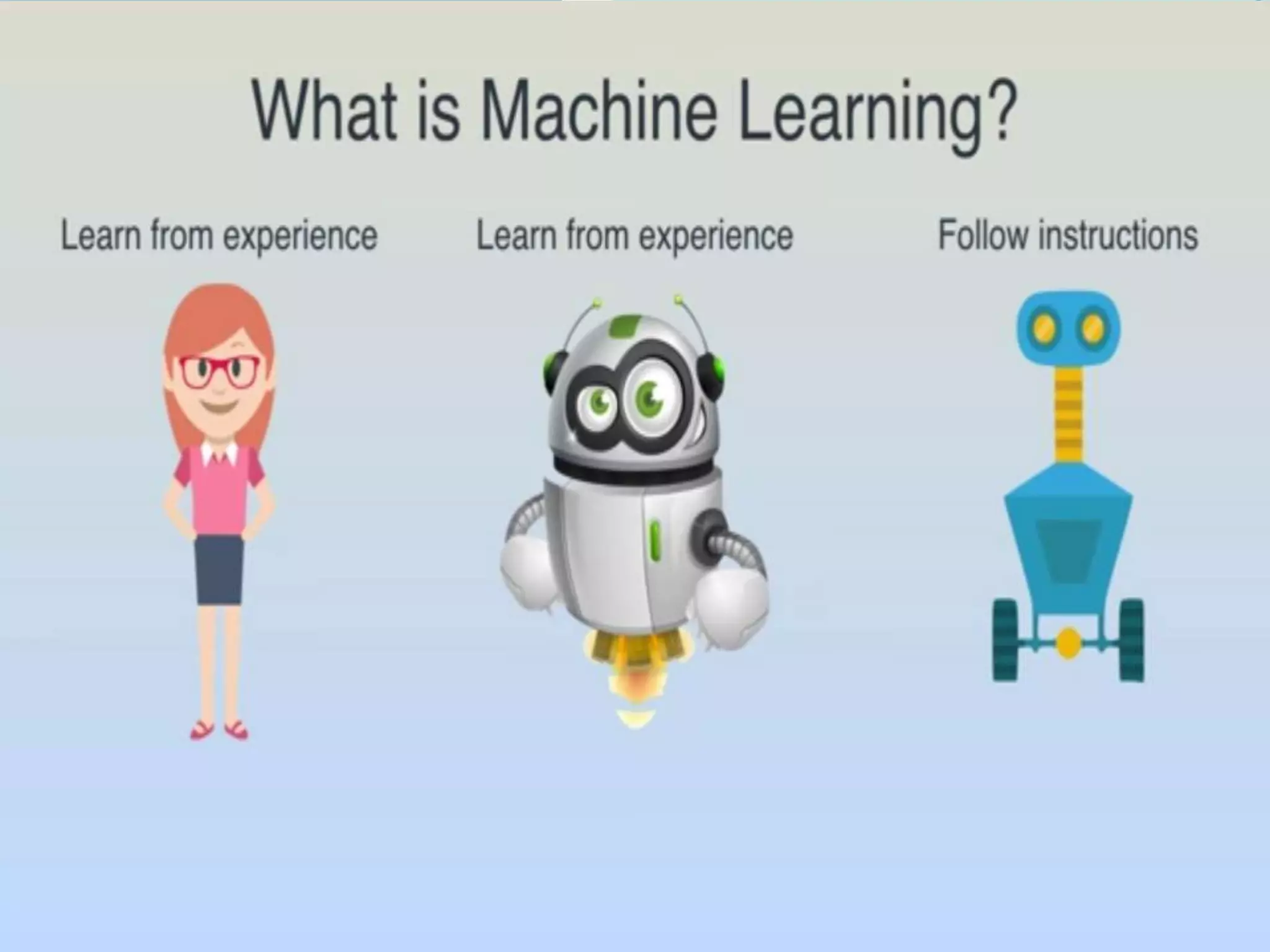
What is machine learning
Definition of ML
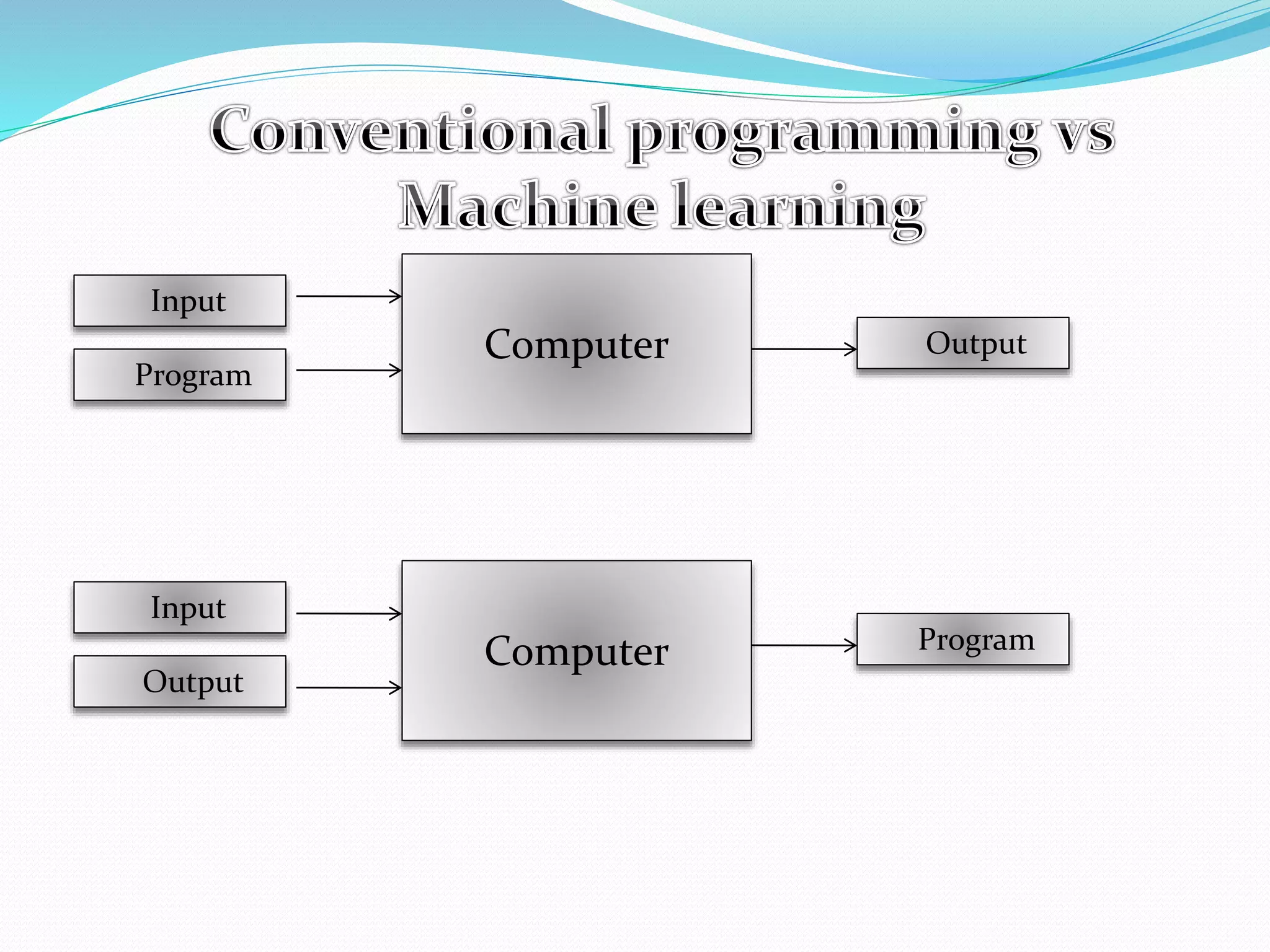
Conventional programming vs Machine
learning
Supervised Learning
Unsupervised Learning
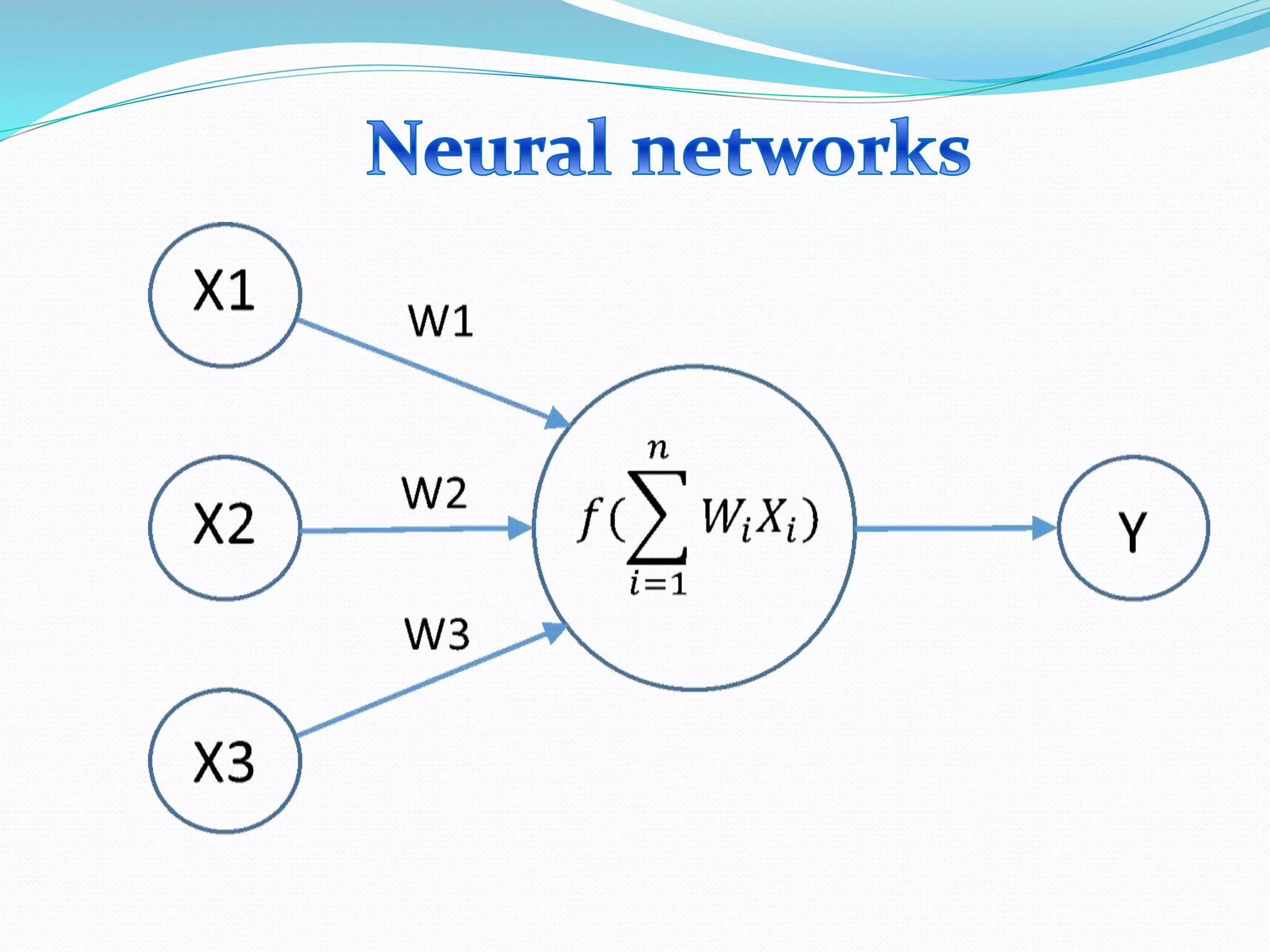
Neural Networks
Reinforcement Learning
Conclusion
References
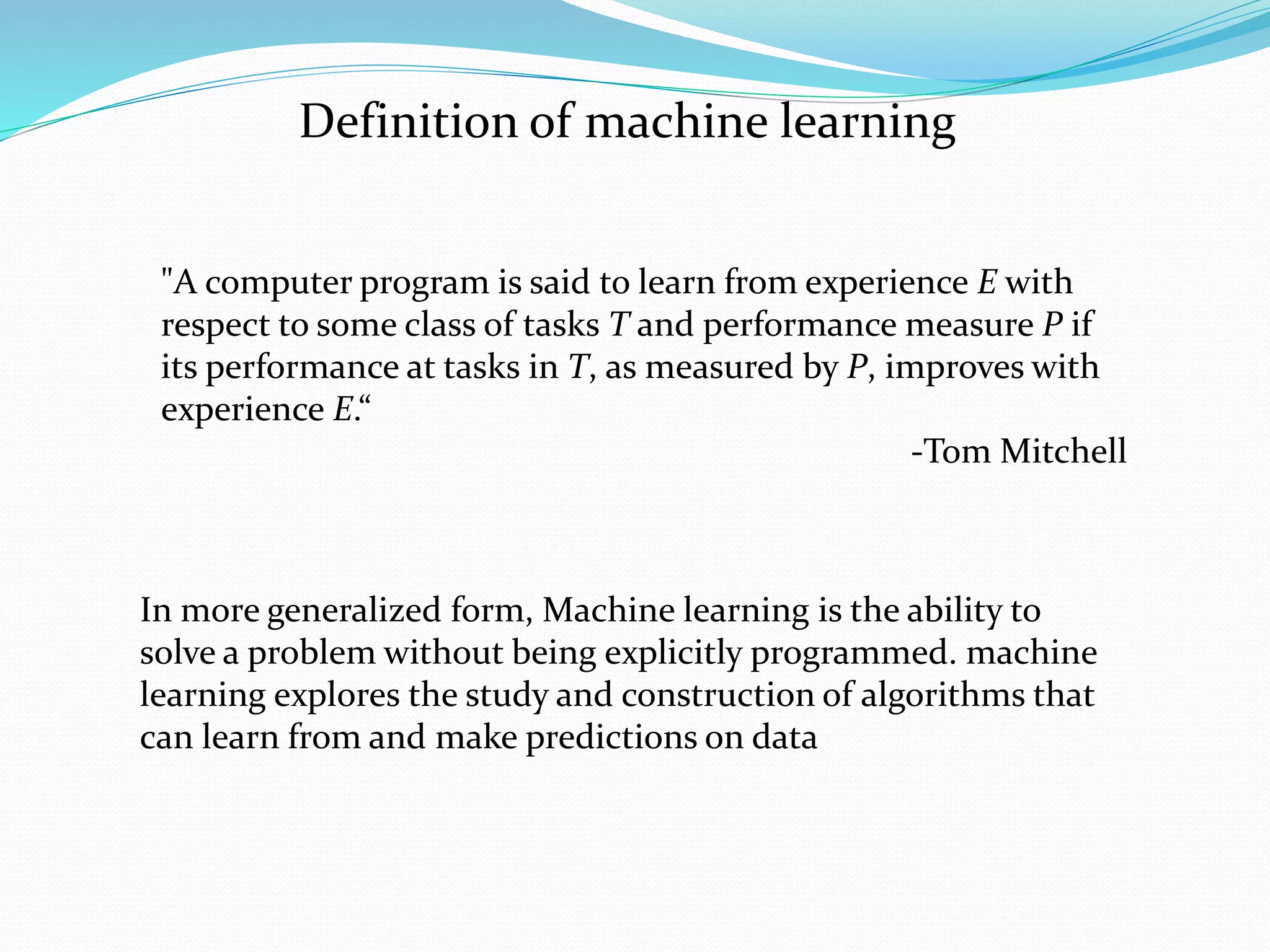
Definition of machine learning
"A computer program is said to learn from experience E with
respect to some class of tasks T and performance measure P if
its performance at tasks in T, as measured by P, improves with
experience E.“
-Tom Mitchell
In more generalized form, Machine learning is the ability to
solve a problem without being explicitly programmed. machine
learning explores the study and construction of algorithms that
can learn from and make predictions on data
Input
Program
Computer Output
Input
Output
Computer Program
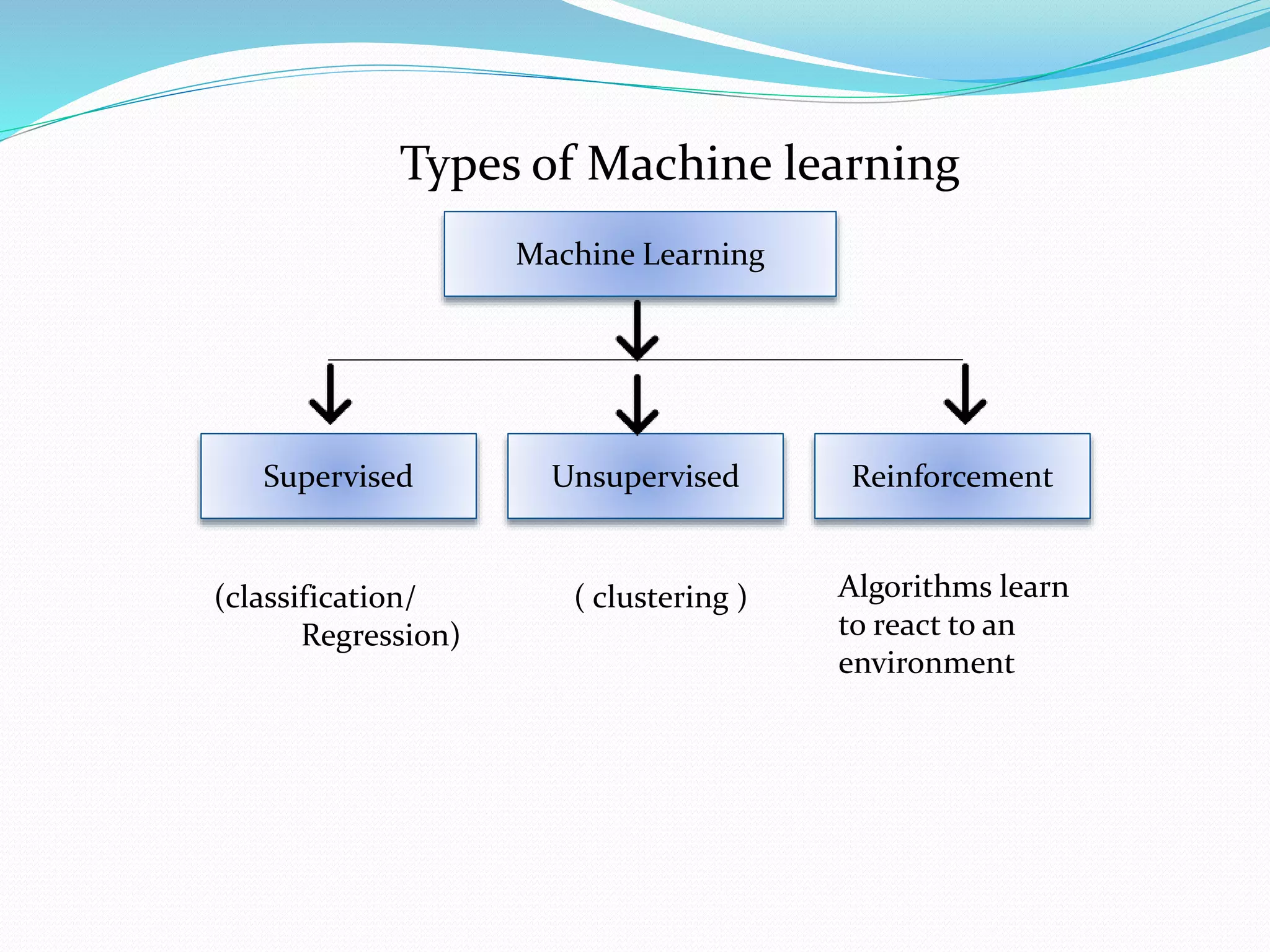
Types of Machine learning
Machine Learning
Supervised Unsupervised Reinforcement
(classification/
Regression)
( clustering ) Algorithms learn
to react to an
environment
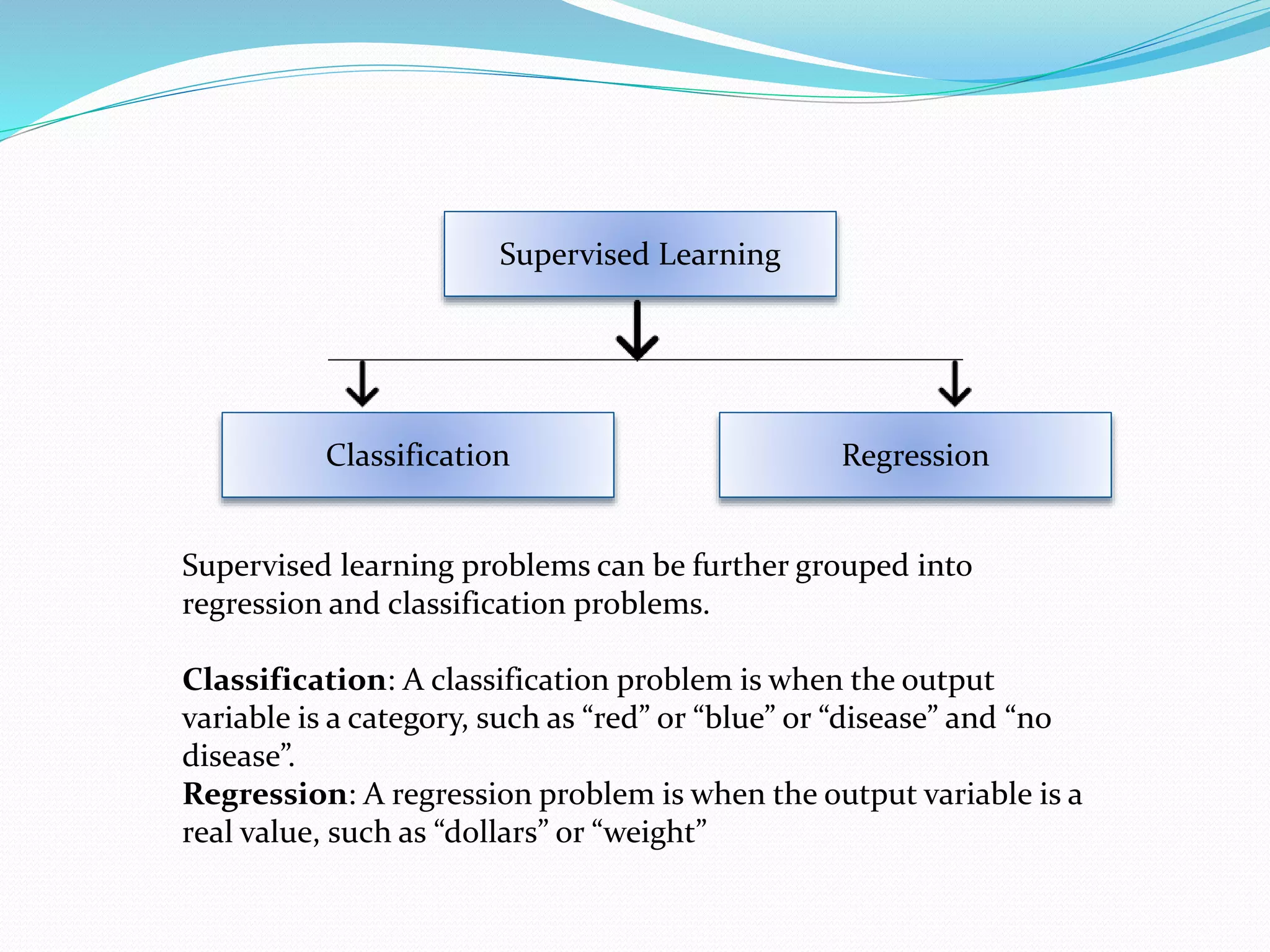
Supervised Learning
RegressionClassification
Supervised learning problems can be further grouped into
regression and classification problems.
Classification: A classification problem is when the output
variable is a category, such as “red” or “blue” or “disease” and “no
disease”.
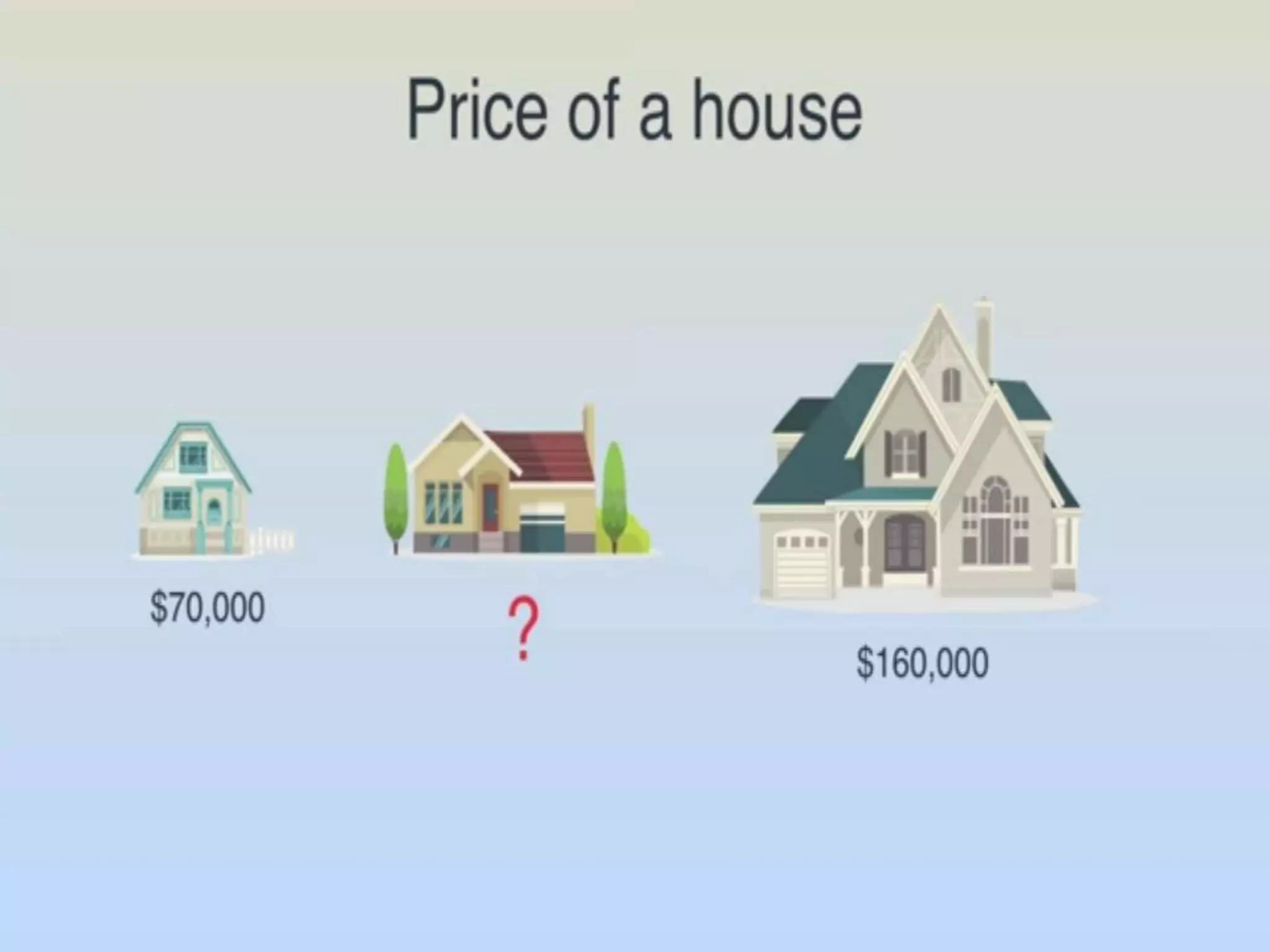
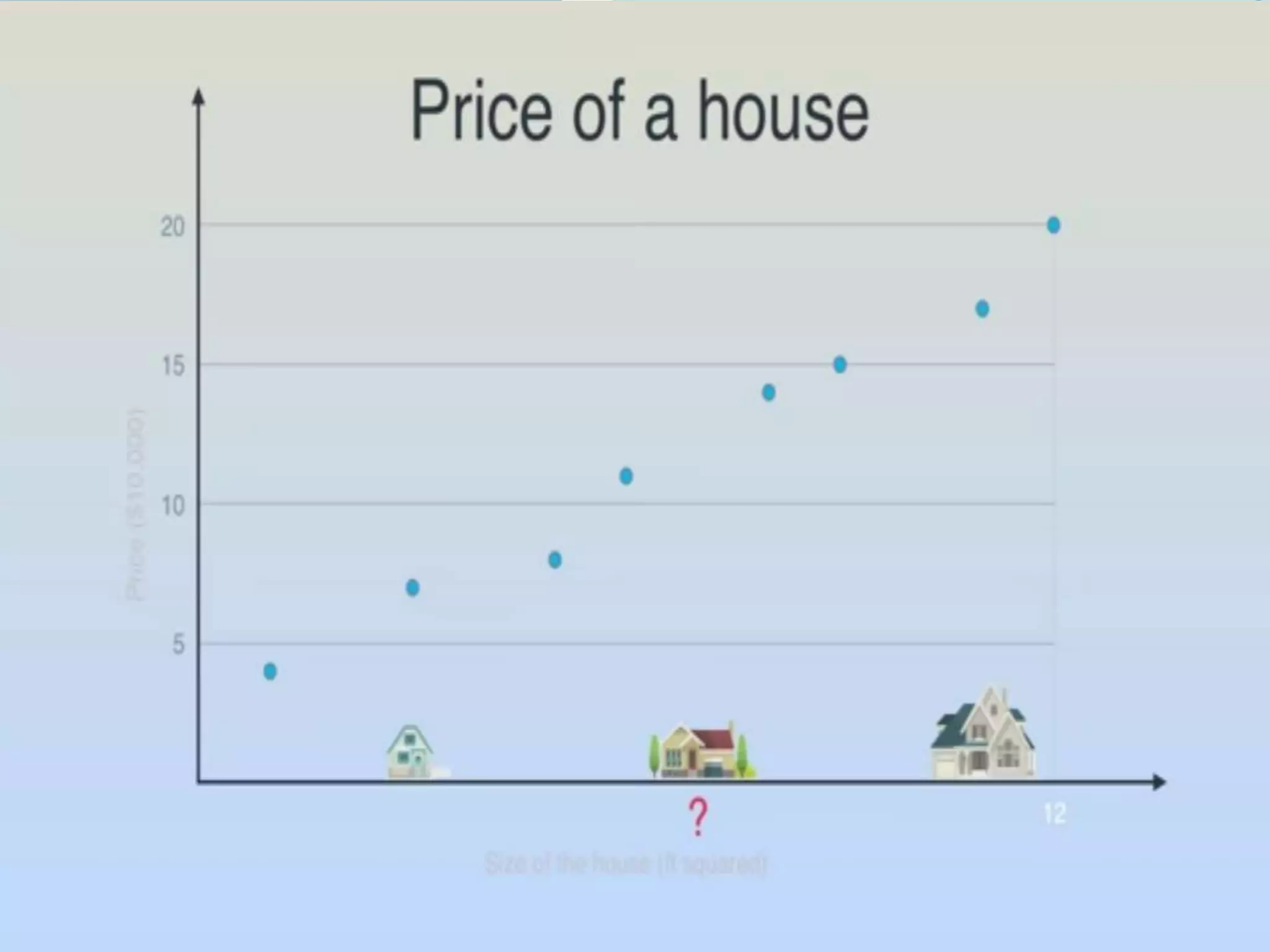
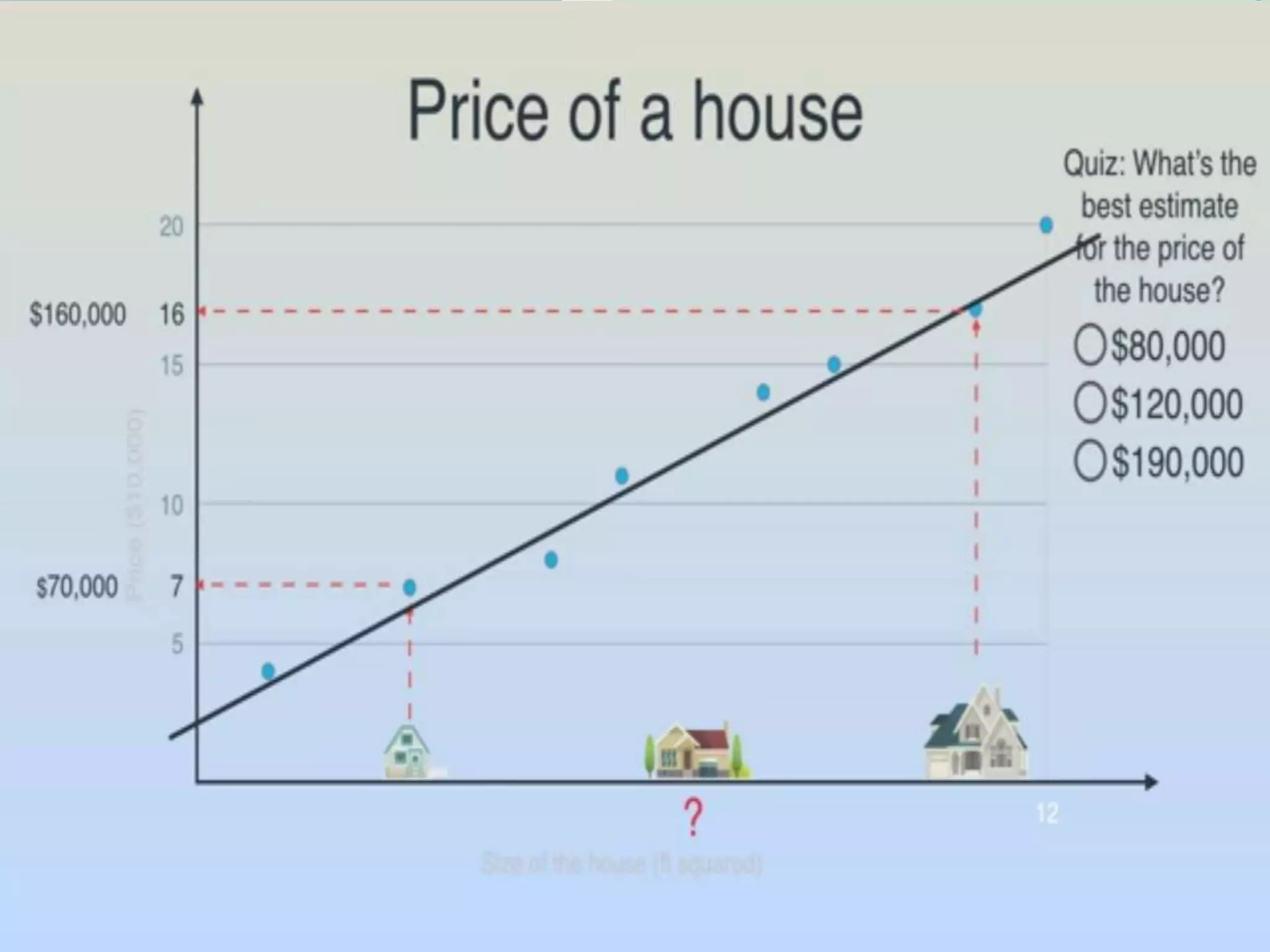
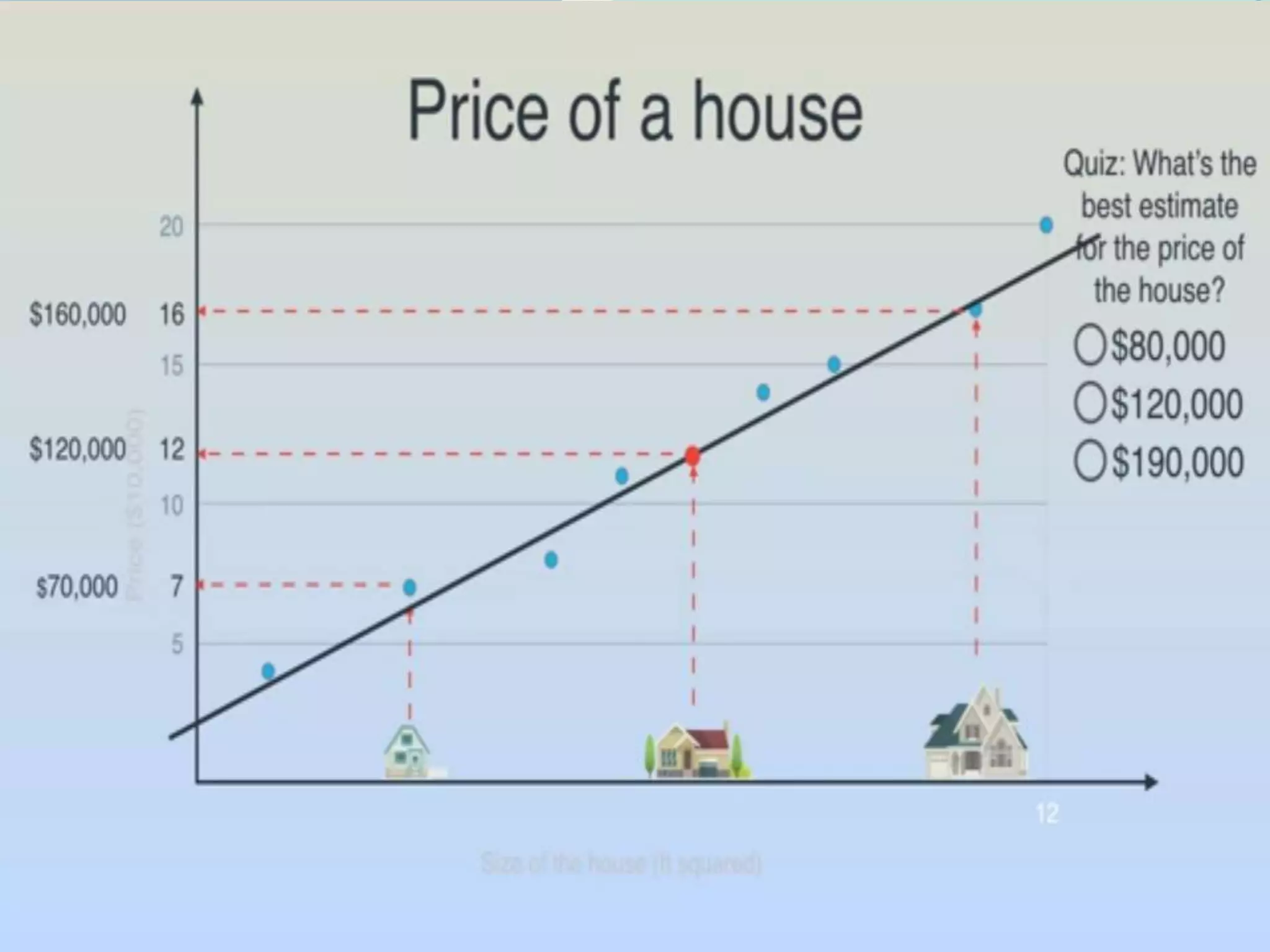
Regression: A regression problem is when the output variable is a
real value, such as “dollars” or “weight”
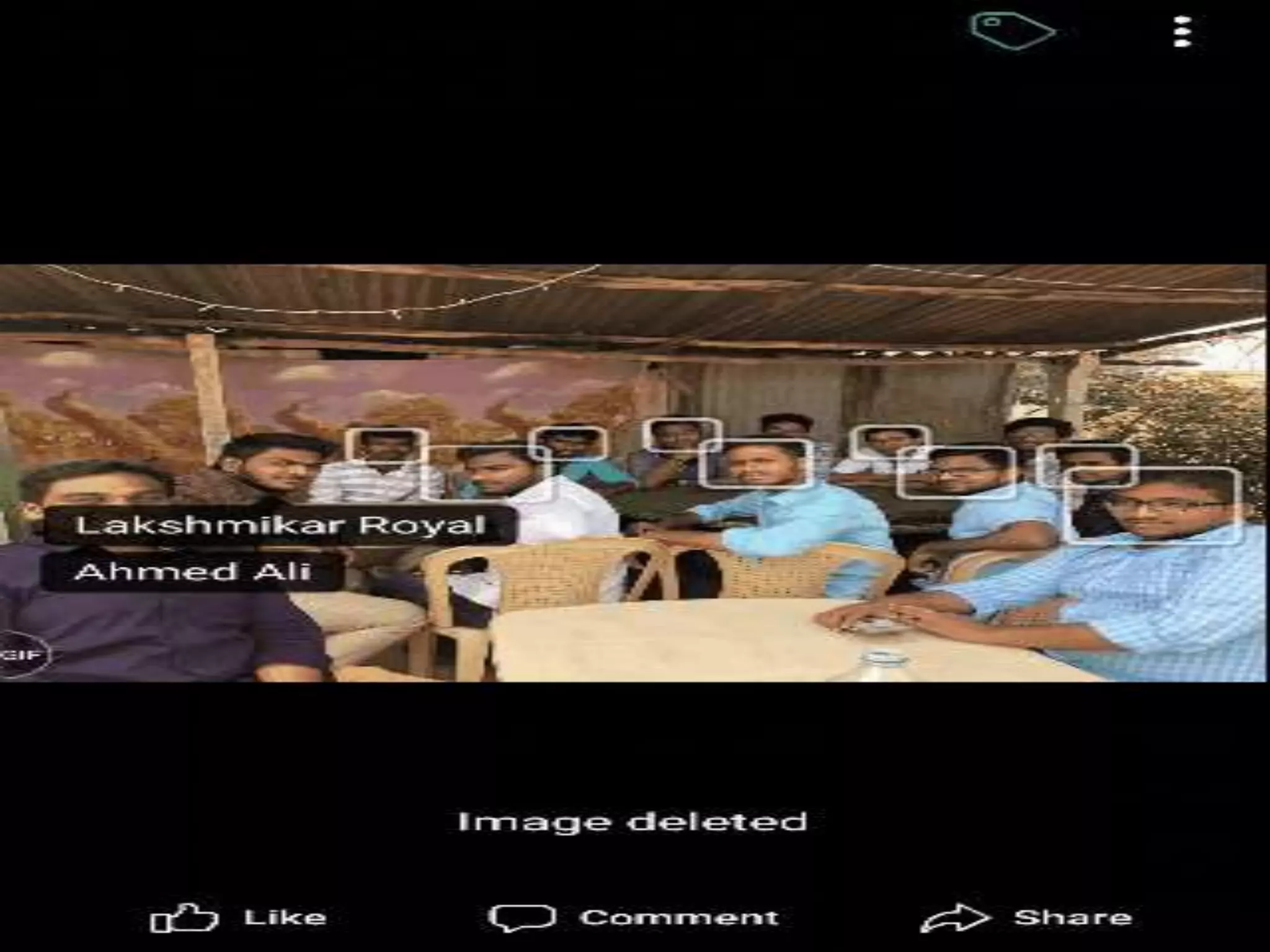
Have you noticed that Facebook has developed an uncanny ability to
recognize your friends in your photographs? In the old days, Facebook
used to make you to tag your friends in photos by clicking on them and
typing in their name. Now as soon as you upload a photo, Facebook tags
everyone for you like magic:
This technology is called face recognition. Face book's algorithms are
able to recognize your friends’ faces after they have been tagged only a
few times. It’s pretty amazing technology—Face book can recognize
faces with 98% accuracy which is pretty much as good as humans can do!
But face recognition is really a series of several related problems:
First, look at a picture and find all the faces in it
Second, focus on each face and be able to understand that even
if a face is turned in a weird direction or in bad lighting, it is still
the same person.
Third, be able to pick out unique features of the face that you
can use to tell it apart from other people— like how big the eyes
are, how long the face is, etc.
Finally, compare the unique features of that face to all the
people you already know to determine the person’s name.
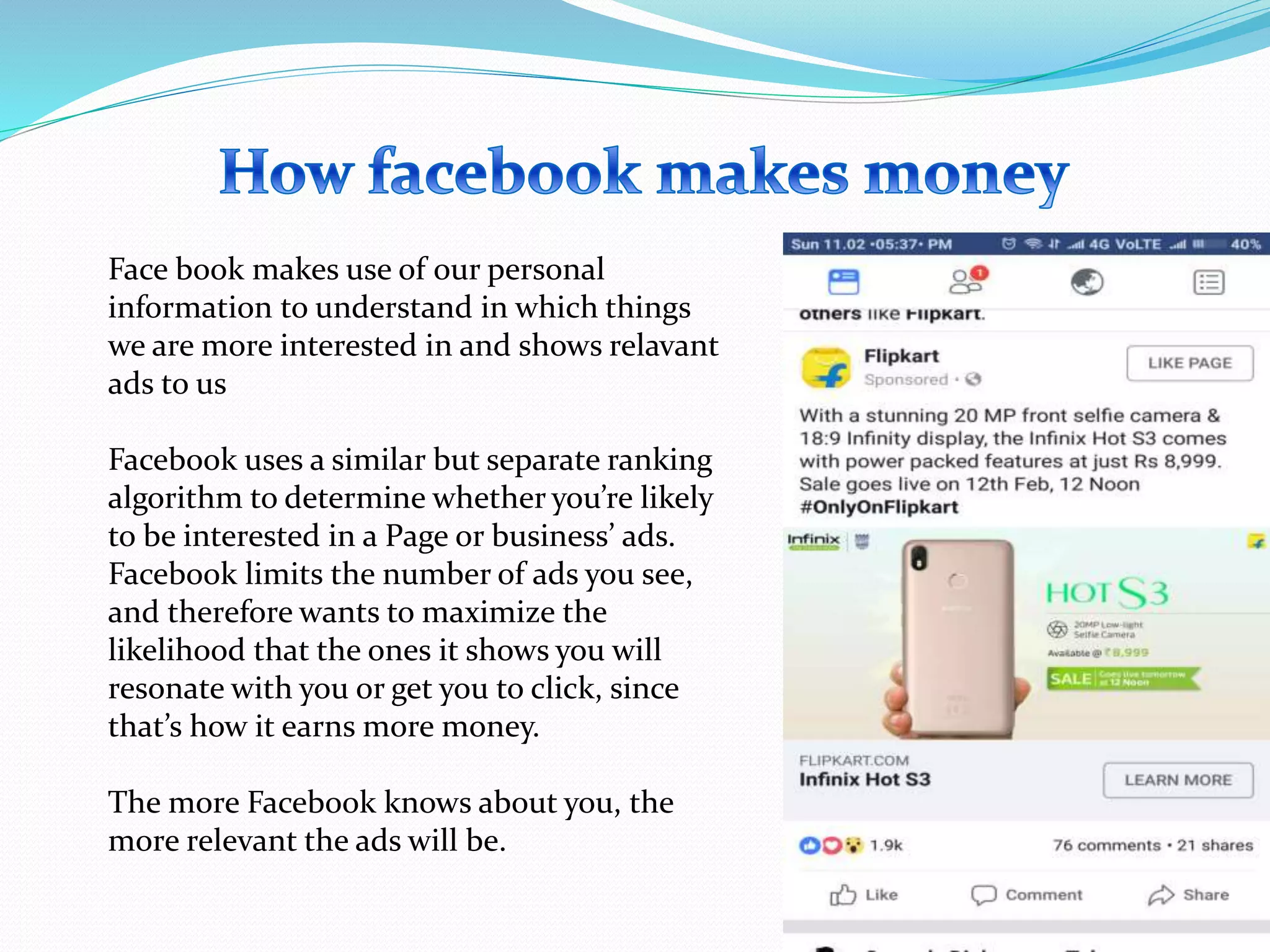
Face book makes use of our personal
information to understand in which things
we are more interested in and shows relavant
ads to us
Facebook uses a similar but separate ranking
algorithm to determine whether you’re likely
to be interested in a Page or business’ ads.
Facebook limits the number of ads you see,
and therefore wants to maximize the
likelihood that the ones it shows you will
resonate with you or get you to click, since
that’s how it earns more money.
The more Facebook knows about you, the
more relevant the ads will be.
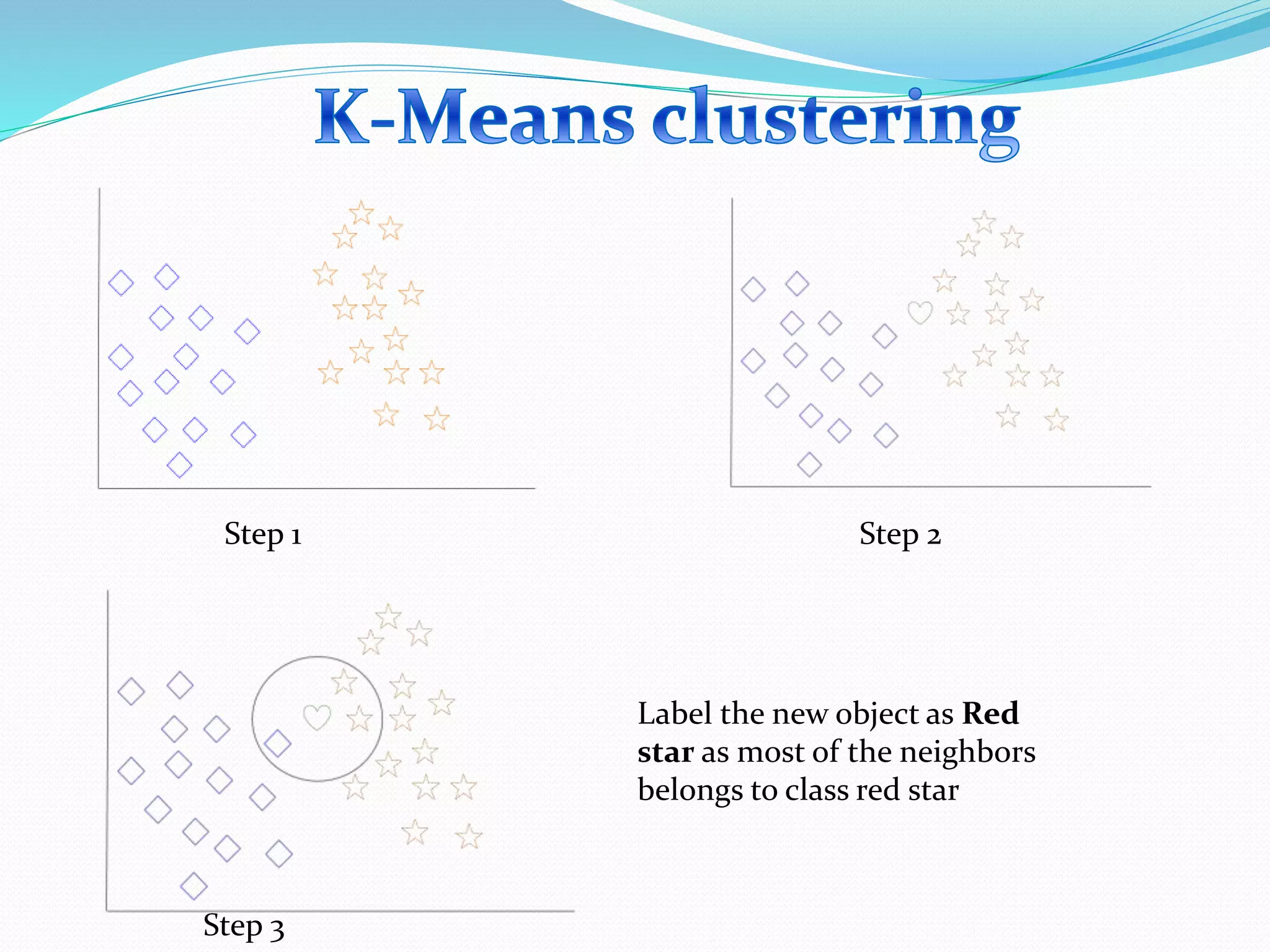
Step 1 Step 2
Step 3
Label the new object as Red
star as most of the neighbors
belongs to class red star
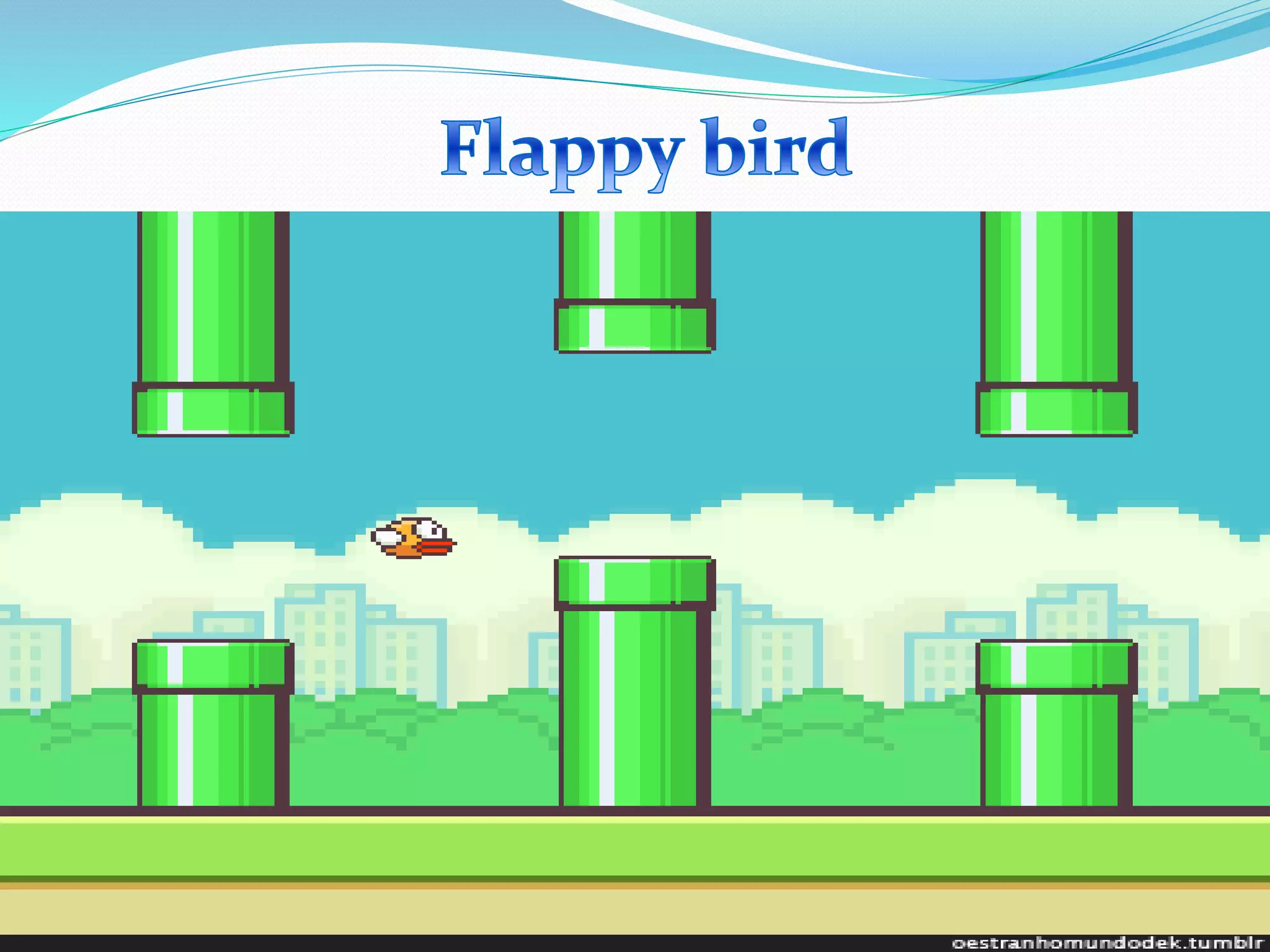
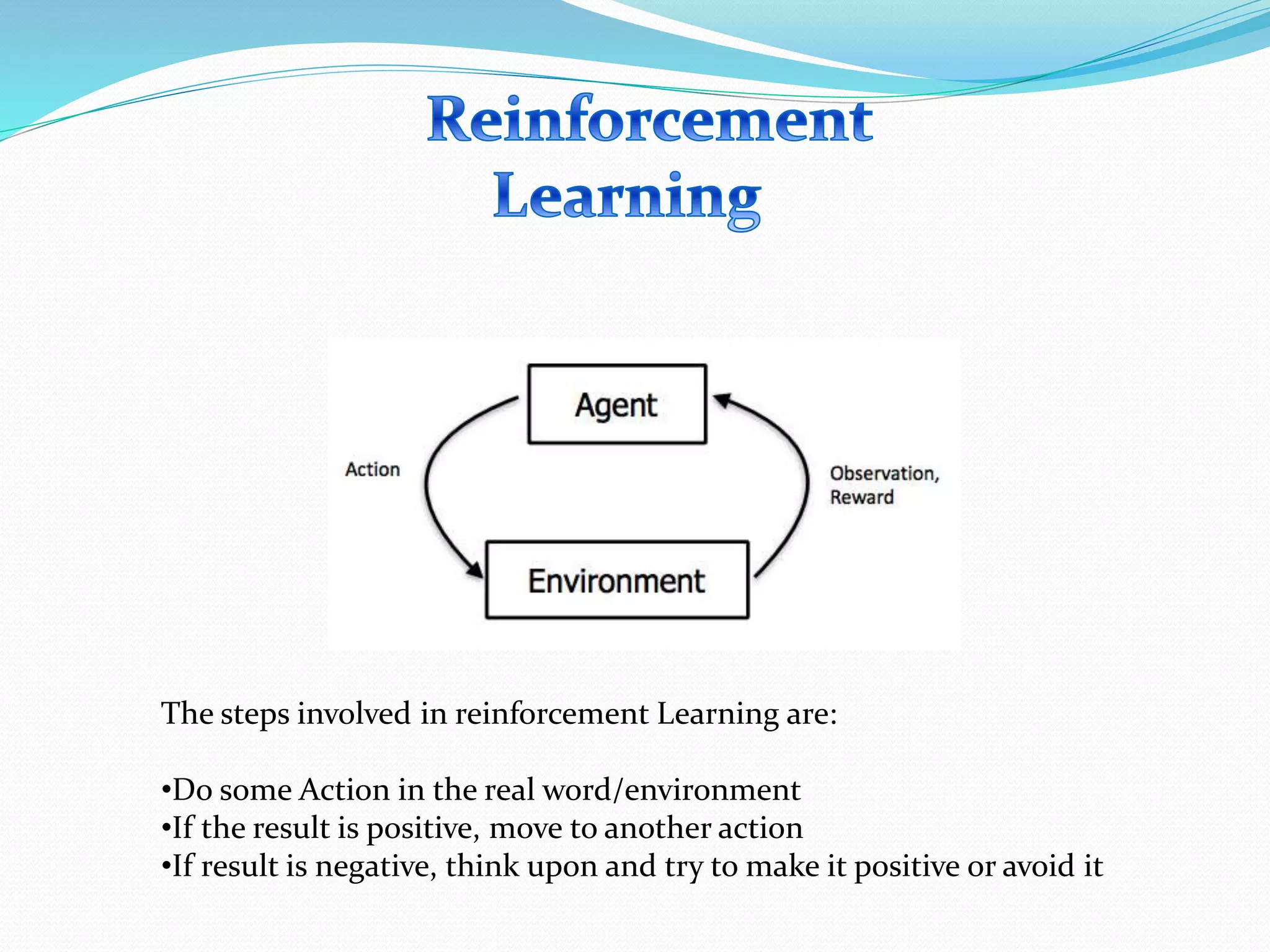
The steps involved in reinforcement Learning are:
•Do some Action in the real word/environment
•If the result is positive, move to another action
•If result is negative, think upon and try to make it positive or avoid it
Machine Learning is becoming an exciting
profession in computer science as well as in
Artificial Intelligence too. Because of IOT,
machines in this world are going to fill with
data. In such cases Machine Learning plays a
crucial role in analyzing data and finding
patterns in the data. Also Machine Learning is
used to give the AI Machines the ability to learn
from the experience.
1. Baldi, P. and Brunak, S. (2002). Bioinformatics: A Machine Learning
Approach. Cambridge, MA: MIT Press.
This book offers a good coverage of machine learning approaches - especially
neural networks and hidden Markov models in bioinformatics.
2. Baldi, P., Frasconi, P., Smyth, P. (2003). Modeling the Internet and the
Web - Probabilistic Methods and Algorithms. New York: Wiley.
A good introduction to machine learning approaches to text mining and
related applications on the web.
3. Bishop, C. M. Neural Networks for Pattern Recognition. New York: Oxford
University Press (1995).
This book offers a good coverage of neural networks
Chakrabarti, S. (2003). Mining the Web, Morgan Kaufmann.
4. Cohen, P.R. (1995) Empirical Methods in Artificial Intelligence.
Cambridge, MA: MIT Press. This is an excellent reference on experiment
design, and hypothesis testing, and related topics that are essential for
empirical machine learning research.
5. Cowell, R.G., Dawid, A.P., Lauritzen, S.L., and Spiegelhalter,D.J. (1999).
Graphical Models and Expert Systems.Berlin: Springer.
This is a very good introduction to probabilistic graphical models
Machine learning

Machine learning

  • 2.
    CONTENTS What is machinelearning Definition of ML Conventional programming vs Machine learning Supervised Learning Unsupervised Learning Neural Networks Reinforcement Learning Conclusion References
  • 4.
    Definition of machinelearning "A computer program is said to learn from experience E with respect to some class of tasks T and performance measure P if its performance at tasks in T, as measured by P, improves with experience E.“ -Tom Mitchell In more generalized form, Machine learning is the ability to solve a problem without being explicitly programmed. machine learning explores the study and construction of algorithms that can learn from and make predictions on data
  • 5.
  • 6.
    Types of Machinelearning Machine Learning Supervised Unsupervised Reinforcement (classification/ Regression) ( clustering ) Algorithms learn to react to an environment
  • 8.
    Supervised Learning RegressionClassification Supervised learningproblems can be further grouped into regression and classification problems. Classification: A classification problem is when the output variable is a category, such as “red” or “blue” or “disease” and “no disease”. Regression: A regression problem is when the output variable is a real value, such as “dollars” or “weight”
  • 10.
    Have you noticedthat Facebook has developed an uncanny ability to recognize your friends in your photographs? In the old days, Facebook used to make you to tag your friends in photos by clicking on them and typing in their name. Now as soon as you upload a photo, Facebook tags everyone for you like magic: This technology is called face recognition. Face book's algorithms are able to recognize your friends’ faces after they have been tagged only a few times. It’s pretty amazing technology—Face book can recognize faces with 98% accuracy which is pretty much as good as humans can do!
  • 12.
    But face recognitionis really a series of several related problems: First, look at a picture and find all the faces in it Second, focus on each face and be able to understand that even if a face is turned in a weird direction or in bad lighting, it is still the same person. Third, be able to pick out unique features of the face that you can use to tell it apart from other people— like how big the eyes are, how long the face is, etc. Finally, compare the unique features of that face to all the people you already know to determine the person’s name.
  • 19.
    Face book makesuse of our personal information to understand in which things we are more interested in and shows relavant ads to us Facebook uses a similar but separate ranking algorithm to determine whether you’re likely to be interested in a Page or business’ ads. Facebook limits the number of ads you see, and therefore wants to maximize the likelihood that the ones it shows you will resonate with you or get you to click, since that’s how it earns more money. The more Facebook knows about you, the more relevant the ads will be.
  • 20.
    Step 1 Step2 Step 3 Label the new object as Red star as most of the neighbors belongs to class red star
  • 27.
    The steps involvedin reinforcement Learning are: •Do some Action in the real word/environment •If the result is positive, move to another action •If result is negative, think upon and try to make it positive or avoid it
  • 29.
    Machine Learning isbecoming an exciting profession in computer science as well as in Artificial Intelligence too. Because of IOT, machines in this world are going to fill with data. In such cases Machine Learning plays a crucial role in analyzing data and finding patterns in the data. Also Machine Learning is used to give the AI Machines the ability to learn from the experience.
  • 30.
    1. Baldi, P.and Brunak, S. (2002). Bioinformatics: A Machine Learning Approach. Cambridge, MA: MIT Press. This book offers a good coverage of machine learning approaches - especially neural networks and hidden Markov models in bioinformatics. 2. Baldi, P., Frasconi, P., Smyth, P. (2003). Modeling the Internet and the Web - Probabilistic Methods and Algorithms. New York: Wiley. A good introduction to machine learning approaches to text mining and related applications on the web. 3. Bishop, C. M. Neural Networks for Pattern Recognition. New York: Oxford University Press (1995). This book offers a good coverage of neural networks Chakrabarti, S. (2003). Mining the Web, Morgan Kaufmann. 4. Cohen, P.R. (1995) Empirical Methods in Artificial Intelligence. Cambridge, MA: MIT Press. This is an excellent reference on experiment design, and hypothesis testing, and related topics that are essential for empirical machine learning research. 5. Cowell, R.G., Dawid, A.P., Lauritzen, S.L., and Spiegelhalter,D.J. (1999). Graphical Models and Expert Systems.Berlin: Springer. This is a very good introduction to probabilistic graphical models