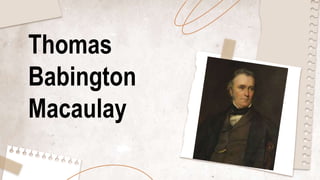
Thomas
Babington
Macaulay
Introduction
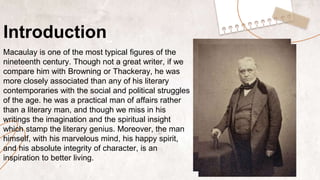
Macaulay is one of the most typical figures of the
nineteenth century. Though not a great writer, if we
compare him with Browning or Thackeray, he was
more closely associated than any of his literary
contemporaries with the social and political struggles
of the age. he was a practical man of affairs rather
than a literary man, and though we miss in his
writings the imagination and the spiritual insight
which stamp the literary genius. Moreover, the man
himself, with his marvelous mind, his happy spirit,
and his absolute integrity of character, is an
inspiration to better living.
Education:
Trinity College,
Cambridge
Subject of study:
England- History
of United Kingdom
Best known work:
History of England
Political party:
Whig
Literary Movement:
Victorian age
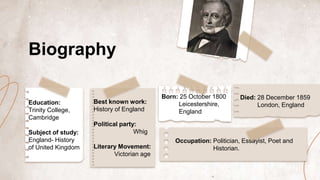
Born: 25 October 1800
Leicestershire,
England
Occupation: Politician, Essayist, Poet and
Historian.
Died: 28 December 1859
London, England
Biography
Life
The measure of a man’s real
character is what he would do if he
knew he would never be found out.
~ Thomas B.
Macaulay
3
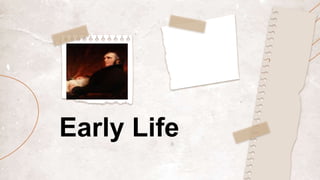
Early Life
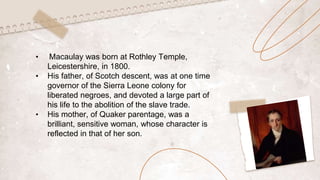
• Macaulay was born at Rothley Temple,
Leicestershire, in 1800.
• His father, of Scotch descent, was at one time
governor of the Sierra Leone colony for
liberated negroes, and devoted a large part of
his life to the abolition of the slave trade.
• His mother, of Quaker parentage, was a
brilliant, sensitive woman, whose character is
reflected in that of her son.
• At three years of age he began to read
eagerly.
• At five he "talked like a book".
• At ten he had written a compendium of
universal history, besides various hymns,
verse romances, arguments for Christianity,
and one ambitious epic poem.
● The habit of rapid reading, begun
in childhood, continued
throughout his life.
● His memory was phenomenal. He
could repeat long poems and
essays after a single reading.
His
Education
Half-knowledge is worse than
ignorance.
-Thomas Babington Macaulay
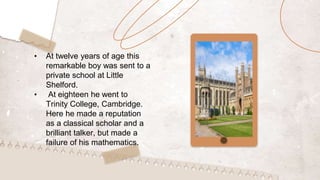
• At twelve years of age this
remarkable boy was sent to a
private school at Little
Shelford.
• At eighteen he went to
Trinity College, Cambridge.
Here he made a reputation
as a classical scholar and a
brilliant talker, but made a
failure of his mathematics.
• After his college course Macaulay studied law, was admitted
to the bar, devoted himself largely to politics, entered
Parliament in 1830, and almost immediately won a reputation
as the best debater and the most eloquent speaker, of the
Liberal or Whig party.
• Gladstone says of him: "Whenever he arose to speak it was a
summons like a trumpet call to fill the benches."
• In 1857 his great ability and services to his country were
recognized by his being raised to the peerage with the title
of Baron Macaulay of Rothley.
• Macaulay's literary work began in college with the
contribution of various ballads and essays to the
magazines.
1
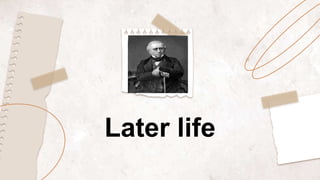
Later life
-His famous Essay on Milton appeared in the
Edinburgh Review in 1825.
-His Lays of Ancient Rome appeared in 1842, and in
the following year three volumes of his collected
Essays.
- In 1847 he lost his seat in Parliament, temporarily,
through his zealous efforts in behalf of religious
toleration; and the loss was most fortunate, since it
gave him opportunity to begin his History of England, a
monumental work which he had been planning for
many years.
• The first two volumes appeared in
1848, and their success can be
compared only to that of the most
popular novels.
• The third and fourth volumes of the
History (1855) were even more
successful, and Macaulay was hard at
work on the remaining volumes when
he died, quite suddenly, in 1859.
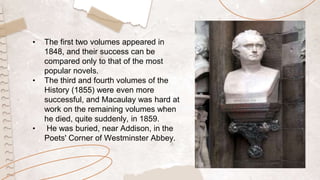
• He was buried, near Addison, in the
Poets' Corner of Westminster Abbey.
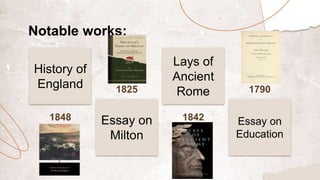
Essay on
Education
Essay on
Milton
Lays of
Ancient
Rome
History of
England
1848
1825
1842
1790
Notable works:
General characteristics
1 Macaulay's art is that of a
public speaker rather than that
of a literary man.
2 Macaulay's good spirits and
enthusiasm are contagious.
3. Macaulay has "the defect
of his qualities." He reads
and remembers so much
that he has no time to think
or to form settled opinions.
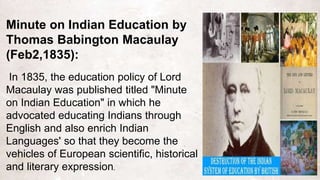
Minute on Indian Education by
Thomas Babington Macaulay
(Feb2,1835):
In 1835, the education policy of Lord
Macaulay was published titled "Minute
on Indian Education" in which he
advocated educating Indians through
English and also enrich Indian
Languages' so that they become the
vehicles of European scientific, historical
and literary expression.
On Indian education:
- After the passing of the Government of
India Act 1833, Macaulay was appointed
as the first Law Member of the Governor
General's Council.
- He went to India in 1834, serving on the Supreme Council of
India between 1834 and 1838. He was instrumental in creating
the foundations of bilingual colonial India, by convincing the
Governor-General to adopt English as the medium of instruction
in higher education from the sixth year of schooling onwards,
rather than Sanskrit or Persian then used in the institutions
supported by the East India Company.
Thank
you

Macaulay.pptx

  • 1.
  • 2.
    Introduction Macaulay is oneof the most typical figures of the nineteenth century. Though not a great writer, if we compare him with Browning or Thackeray, he was more closely associated than any of his literary contemporaries with the social and political struggles of the age. he was a practical man of affairs rather than a literary man, and though we miss in his writings the imagination and the spiritual insight which stamp the literary genius. Moreover, the man himself, with his marvelous mind, his happy spirit, and his absolute integrity of character, is an inspiration to better living.
  • 3.
    Education: Trinity College, Cambridge Subject ofstudy: England- History of United Kingdom Best known work: History of England Political party: Whig Literary Movement: Victorian age Born: 25 October 1800 Leicestershire, England Occupation: Politician, Essayist, Poet and Historian. Died: 28 December 1859 London, England Biography
  • 4.
    Life The measure ofa man’s real character is what he would do if he knew he would never be found out. ~ Thomas B. Macaulay
  • 5.
  • 6.
    • Macaulay wasborn at Rothley Temple, Leicestershire, in 1800. • His father, of Scotch descent, was at one time governor of the Sierra Leone colony for liberated negroes, and devoted a large part of his life to the abolition of the slave trade. • His mother, of Quaker parentage, was a brilliant, sensitive woman, whose character is reflected in that of her son.
  • 7.
    • At threeyears of age he began to read eagerly. • At five he "talked like a book". • At ten he had written a compendium of universal history, besides various hymns, verse romances, arguments for Christianity, and one ambitious epic poem.
  • 8.
    ● The habitof rapid reading, begun in childhood, continued throughout his life. ● His memory was phenomenal. He could repeat long poems and essays after a single reading.
  • 9.
    His Education Half-knowledge is worsethan ignorance. -Thomas Babington Macaulay
  • 10.
    • At twelveyears of age this remarkable boy was sent to a private school at Little Shelford. • At eighteen he went to Trinity College, Cambridge. Here he made a reputation as a classical scholar and a brilliant talker, but made a failure of his mathematics.
  • 11.
    • After hiscollege course Macaulay studied law, was admitted to the bar, devoted himself largely to politics, entered Parliament in 1830, and almost immediately won a reputation as the best debater and the most eloquent speaker, of the Liberal or Whig party. • Gladstone says of him: "Whenever he arose to speak it was a summons like a trumpet call to fill the benches."
  • 12.
    • In 1857his great ability and services to his country were recognized by his being raised to the peerage with the title of Baron Macaulay of Rothley. • Macaulay's literary work began in college with the contribution of various ballads and essays to the magazines.
  • 13.
  • 14.
    -His famous Essayon Milton appeared in the Edinburgh Review in 1825. -His Lays of Ancient Rome appeared in 1842, and in the following year three volumes of his collected Essays. - In 1847 he lost his seat in Parliament, temporarily, through his zealous efforts in behalf of religious toleration; and the loss was most fortunate, since it gave him opportunity to begin his History of England, a monumental work which he had been planning for many years.
  • 15.
    • The firsttwo volumes appeared in 1848, and their success can be compared only to that of the most popular novels. • The third and fourth volumes of the History (1855) were even more successful, and Macaulay was hard at work on the remaining volumes when he died, quite suddenly, in 1859. • He was buried, near Addison, in the Poets' Corner of Westminster Abbey.
  • 16.
    Essay on Education Essay on Milton Laysof Ancient Rome History of England 1848 1825 1842 1790 Notable works:
  • 17.
    General characteristics 1 Macaulay'sart is that of a public speaker rather than that of a literary man. 2 Macaulay's good spirits and enthusiasm are contagious. 3. Macaulay has "the defect of his qualities." He reads and remembers so much that he has no time to think or to form settled opinions.
  • 18.
    Minute on IndianEducation by Thomas Babington Macaulay (Feb2,1835): In 1835, the education policy of Lord Macaulay was published titled "Minute on Indian Education" in which he advocated educating Indians through English and also enrich Indian Languages' so that they become the vehicles of European scientific, historical and literary expression.
  • 19.
    On Indian education: -After the passing of the Government of India Act 1833, Macaulay was appointed as the first Law Member of the Governor General's Council. - He went to India in 1834, serving on the Supreme Council of India between 1834 and 1838. He was instrumental in creating the foundations of bilingual colonial India, by convincing the Governor-General to adopt English as the medium of instruction in higher education from the sixth year of schooling onwards, rather than Sanskrit or Persian then used in the institutions supported by the East India Company.
  • 20.